
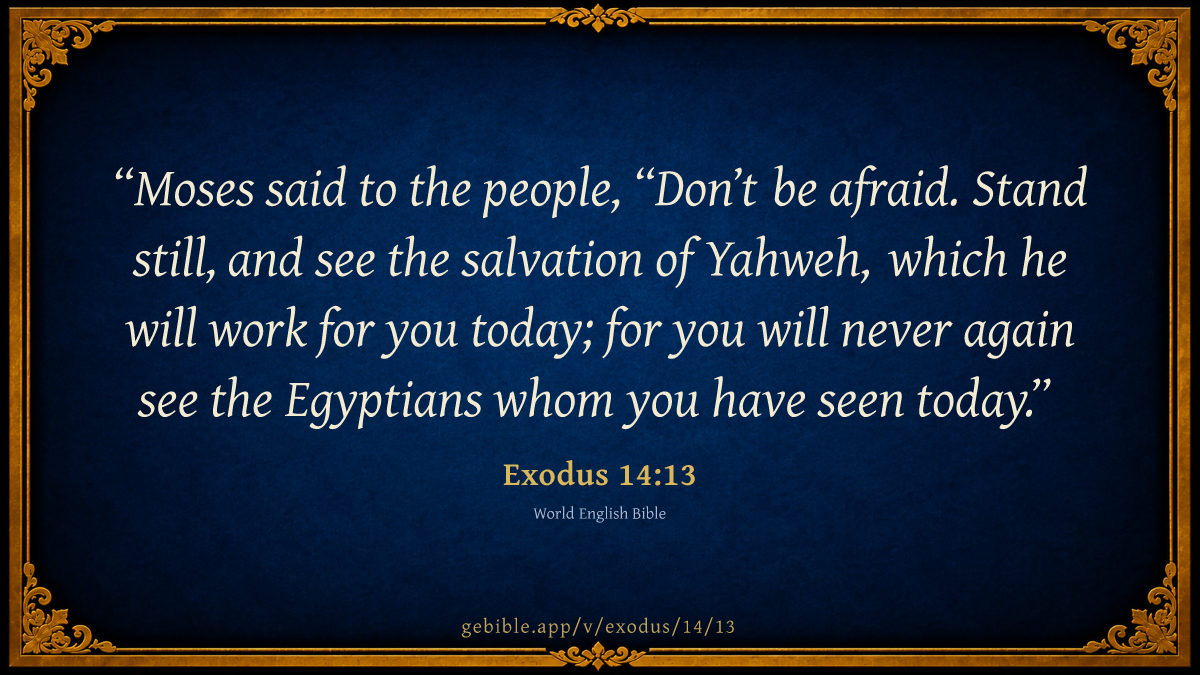
Moses said to the people, “Don’t be afraid. Stand still, and see the salvation of Yahweh, which he will work for you today; for you will never again see the Egyptians whom you have seen today.
Parallel Translations
-
Moses said to the people, “Don’t be afraid. Stand still, and see the salvation of Yahweh, which he will work for you today; for you will never again see the Egyptians whom you have seen today.
-
And Moses said unto the people, Fear ye not, stand still, and see the salvation of the LORD, which he will shew to you to day: for the Egyptians whom ye have seen to day, ye shall see them again no more for ever.
-
And Moses said unto the people: 'Fear ye not, stand still, and see the salvation of the LORD, which He will work for you to-day; for whereas ye have seen the Egyptians to-day, ye shall see them again no more for ever.
Cross-references (26)
Passages linked to Exodus 14:13 in the Treasury of Scripture Knowledge, ordered by reader-vote popularity; verse text shown in World English Bible.
- 2 Chronicles 20:17 You will not need to fight this battle. Set yourselves, stand still, and see the salvation of Yahweh with you, O Judah and Jerusalem. Don’t be afraid, nor be dismayed. Go out against them tomorrow, for Yahweh is with you.’ ”
- 2 Chronicles 20:15 and he said, “Listen, all Judah, and you inhabitants of Jerusalem, and you, king Jehoshaphat. Yahweh says to you, ‘Don’t be afraid, and don’t be dismayed because of this great multitude; for the battle is not yours, but God’s.
- Isaiah 41:10-14 Don’t you be afraid, for I am with you. Don’t be dismayed, for I am your God. I will strengthen you. Yes, I will help you. Yes, I will uphold you with the right hand of my righteousness. Behold, all those who are incensed against you will be disappointed and confounded. Those who strive with you will be like nothing, and shall perish. You will seek them, and won’t find them, even those who contend with you. Those who war against you will be as nothing, as a non-existent thing. For I, Yahweh your God, will hold your right hand, saying to you, ‘Don’t be afraid. I will help you.’ Don’t be afraid, you worm Jacob, and you men of Israel. I will help you,” says Yahweh. “Your Redeemer is the Holy One of Israel.
- Exodus 14:30 Thus Yahweh saved Israel that day out of the hand of the Egyptians; and Israel saw the Egyptians dead on the seashore.
- 2 Kings 6:16 He answered, “Don’t be afraid; for those who are with us are more than those who are with them.”
- Lamentations 3:26 It is good that a man should hope and quietly wait for the salvation of Yahweh.
- Isaiah 35:4 Tell those who have a fearful heart, “Be strong! Don’t be afraid! Behold, your God will come with vengeance, God’s retribution. He will come and save you.
- Psalms 27:1-2 Yahweh is my light and my salvation. Whom shall I fear? Yahweh is the strength of my life. Of whom shall I be afraid? When evildoers came at me to eat up my flesh, even my adversaries and my foes, they stumbled and fell.
- Hosea 13:4 “Yet I am Yahweh your God from the land of Egypt; and you shall acknowledge no god but me, and besides me there is no savior.
- Habakkuk 3:13 You went out for the salvation of your people, for the salvation of your anointed. You crushed the head of the land of wickedness. You stripped them head to foot.
- Numbers 14:9 Only don’t rebel against Yahweh, neither fear the people of the land; for they are bread for us. Their defense is removed from over them, and Yahweh is with us. Don’t fear them.”
- Deuteronomy 20:3 and shall tell them, “Hear, Israel, you draw near today to battle against your enemies. Don’t let your heart faint! Don’t be afraid, nor tremble, neither be scared of them;
- Isaiah 43:11 I myself am Yahweh. Besides me, there is no savior.
- Genesis 49:18 I have waited for your salvation, Yahweh.
- Genesis 15:1 After these things Yahweh’s word came to Abram in a vision, saying, “Don’t be afraid, Abram. I am your shield, your exceedingly great reward.”
- Nehemiah 9:9 “You saw the affliction of our fathers in Egypt, and heard their cry by the Red Sea,
- Psalms 3:8 Salvation belongs to Yahweh. May your blessing be on your people.
- Jeremiah 3:23 Truly help from the hills, the tumult on the mountains, is in vain. Truly the salvation of Israel is in Yahweh our God.
- Psalms 46:1-3 God is our refuge and strength, a very present help in trouble. Therefore we won’t be afraid, though the earth changes, though the mountains are shaken into the heart of the seas; though its waters roar and are troubled, though the mountains tremble with their swelling.
- Isaiah 26:3 You will keep whoever’s mind is steadfast in perfect peace, because he trusts in you.
- Matthew 28:5 The angel answered the women, “Don’t be afraid, for I know that you seek Jesus, who has been crucified.
- Exodus 15:1-27 Then Moses and the children of Israel sang this song to Yahweh, and said, “I will sing to Yahweh, for he has triumphed gloriously. He has thrown the horse and his rider into the sea. Yah is my strength and song. He has become my salvation. This is my God, and I will praise him; my father’s God, and I will exalt him. Yahweh is a man of war. Yahweh is his name. He has cast Pharaoh’s chariots and his army into the sea. His chosen captains are sunk in the Red Sea. The deeps cover them. They went down into the depths like a stone. Your right hand, Yahweh, is glorious in power. Your right hand, Yahweh, dashes the enemy in pieces. In the greatness of your excellency, you overthrow those who rise up against you. You send out your wrath. It consumes them as stubble. With the blast of your nostrils, the waters were piled up. The floods stood upright as a heap. The deeps were congealed in the heart of the sea. The enemy said, ‘I will pursue. I will overtake. I will divide the plunder. My desire will be satisfied on them. I will draw my sword. My hand will destroy them.’ You blew with your wind. The sea covered them. They sank like lead in the mighty waters. Who is like you, Yahweh, among the gods? Who is like you, glorious in holiness, fearful in praises, doing wonders? You stretched out your right hand. The earth swallowed them. “You, in your loving kindness, have led the people that you have redeemed. You have guided them in your strength to your holy habitation. The peoples have heard. They tremble. Pangs have taken hold of the inhabitants of Philistia. Then the chiefs of Edom were dismayed. Trembling takes hold of the mighty men of Moab. All the inhabitants of Canaan have melted away. Terror and dread falls on them. By the greatness of your arm they are as still as a stone, until your people pass over, Yahweh, until the people you have purchased pass over. You will bring them in, and plant them in the mountain of your inheritance, the place, Yahweh, which you have made for yourself to dwell in; the sanctuary, Lord, which your hands have established. Yahweh will reign forever and ever.” For the horses of Pharaoh went in with his chariots and with his horsemen into the sea, and Yahweh brought back the waters of the sea on them; but the children of Israel walked on dry land in the middle of the sea. Miriam the prophetess, the sister of Aaron, took a tambourine in her hand; and all the women went out after her with tambourines and with dances. Miriam answered them, “Sing to Yahweh, for he has triumphed gloriously. The horse and his rider he has thrown into the sea.” Moses led Israel onward from the Red Sea, and they went out into the wilderness of Shur; and they went three days in the wilderness, and found no water. When they came to Marah, they couldn’t drink from the waters of Marah, for they were bitter. Therefore its name was called Marah. The people murmured against Moses, saying, “What shall we drink?” Then he cried to Yahweh. Yahweh showed him a tree, and he threw it into the waters, and the waters were made sweet. There he made a statute and an ordinance for them, and there he tested them. He said, “If you will diligently listen to Yahweh your God’s voice, and will do that which is right in his eyes, and will pay attention to his commandments, and keep all his statutes, I will put none of the diseases on you, which I have put on the Egyptians; for I am Yahweh who heals you.” They came to Elim, where there were twelve springs of water, and seventy palm trees. They encamped there by the waters.
- 1 Chronicles 11:14 They stood in the middle of the plot, defended it, and killed the Philistines; and Yahweh saved them by a great victory.
- Isaiah 30:15 For thus said the Lord Yahweh, the Holy One of Israel, “You will be saved in returning and rest. Your strength will be in quietness and in confidence.” You refused,
- Hosea 13:9 You are destroyed, Israel, because you are against me, against your help.
- Habakkuk 3:8 Was Yahweh displeased with the rivers? Was your anger against the rivers, or your wrath against the sea, that you rode on your horses, on your chariots of salvation?
Cross-references from openbible.info (CC BY 4.0)
Explain this verse (17 sources)
Historical commentary, presented as a primary source — not an endorsement.
Private notes
Saved on this device only — never synced or sent anywhere.
Geneva Bible translators 1599 · Public Domain Or, deliverance.
Or, deliverance.
Geneva Bible (1599) marginal notes — public domain.
John Trapp 1656 · Public Domain Exo 14:13 And Moses said unto the people, Fear…
Exo 14:13 And Moses said unto the people, Fear ye not, stand still, and see the salvation of the LORD, which he will shew to you to day: for the Egyptians whom ye have seen to day, ye shall see them again no more for ever.
Ver. 13. Stand still, and see the salvation.] Thus God "heard their cry at the Red Sea," {Neh 9:9} though it were not the cry of faith, but of fright and perturbation. So he "heard the voice of the lad." {Gen 21:17}
John Trapp, A Commentary or Exposition upon All the Books of the Old and New Testament (1647–1656) — public domain. Text from a community e-Sword module.
Matthew Poole 1685 · Public Domain Stand still; Heb. make yourselves to stand; let not…
Stand still; Heb. make yourselves to stand; let not and your hearts fail and sink, or stagger through unbelief, but with quiet minds look up to God. It notes the frame of their minds, not the posture of their bodies. Whom ye have seen; or, as ye have seen them, to wit, alive and armed, ready to devour you; for otherwise they did see them dead, and disarmed, Exo 14:30.
Matthew Poole's English Annotations on the Holy Bible (1683–1685) — public domain. Text from a community e-Sword/MySword module.
John Gill 1763 · Public Domain And Moses said unto the people,.... Not in wrath…
And Moses said unto the people,.... Not in wrath and anger, but very coolly and sedately, agreeably to his character of the meekest man on earth; though what they had said to him was very insulting and provoking:
fear ye not; Pharaoh and his numerous host, do not be dismayed at them or possess yourselves with a dread of them, and of destruction by them:
Read full note →
stand still; do not stir from the place where you are, do not offer to run away, or to make your escape by flight (and which indeed seemed impossible), keep your place and station, and put yourselves in such a situation as to wait and observe the issue of things:
and see the salvation of the Lord which he will shew to you today; which is expressive of great faith in Moses in the midst of this extremity, who firmly believed that God would save them from this numerous and enraged army, and that very quickly, even that day; at least within twenty four hours, within the compass of a day; for it was the night following that salvation was wrought for them, and their eyes beheld it: and it may be called the salvation of the Lord, for it was his own hand that only effected it, the Israelites not contributing anything in the least unto it, and was typical of the great salvation which Christ with his own arm, and without the help of his people, has wrought out for them:
for the Egyptians whom ye have seen today, ye shall see them again no more for ever; that is, in such a posture or manner, no more armed, nor alive, and the objects of their fear and dread; for otherwise they did see them again, but then they were on the sea shore dead; for it should be rendered, not "whom", but "how", or "in what manner" (w).
(w) , Sept. "quemadmodum", Piscator; "quomod o", Noldius, p. 107. No. 544.
John Gill's Exposition of the Whole Bible (1746–1763) — public domain (CC PDM 1.0). Text via the HelloAO Bible API.
John Wesley 1765 · Public Domain Moses answered not these fools according to their folly:…
Moses answered not these fools according to their folly: Instead of chiding he comforts them, and with an admirable pretense of mind, not disheartened either by the threatenings of Egypt, or the tremblings of Israel, stills their murmuring, Fear ye not, It is our duty, when we cannot get out of our troubles, yet to get above our fears, so that they may only serve to quicken our prayers and endeavours, but may not prevail to silence our faith and hope. Stand still, and think not to save yourselves either by fighting or flying; wait God's orders, and observe them; Compose yourselves, by an entire confidence in God, into a peaceful prospect of the great salvation God is now about to work for you. Hold your peace, you need not so much as give a shout against the enemy: the work shall be done without any concurrence of yours. In times of great difficulty, it is our wisdom to keep our spirits calm, quiet, and sedate, for then we are in the best frame both to do our own work, and to consider the work of God.
John Wesley, Explanatory Notes Upon the Whole Bible (1754–1765) — public domain. Text via the GEBible commentary corpus.
Adam Clarke 1810 · Public Domain Verse 13. Moses said - Fear ye not] This…
Verse 13. Moses said - Fear ye not] This exhortation was not given to excite them to resist, for of that there was no hope; they were unarmed, they had no courage, and their minds were deplorably degraded.
Stand still] Ye shall not be even workers together with God; only be quiet, and do not render yourselves wretched by your fears and your confusion.
Read full note →
See the salvation of the Lord] Behold the deliverance which God will work, independently of all human help and means.
Ye shall see them again no more] Here was strong faith, but this was accompanied by the spirit of prophecy. God showed Moses what he would do, he believed, and therefore he spoke in the encouraging manner related above.
Adam Clarke's Commentary on the Bible (1810–1826) — public domain. Text from a community e-Sword/MySword module.
Joseph Benson 1811 · Public Domain Exo 14:13-14. Moses said, Fear ye not, stand still…
Exo 14:13-14. Moses said, Fear ye not, stand still — Hebrew, make yourselves to stand. Let not your hearts fail, or sink, or stagger, through unbelief: but with quiet minds look up to God. The Lord shall fight for you, and ye shall hold your peace — Ye shall contribute nothing to the victory, neither by your words nor by your deeds. A remarkable instance this of the composure of Moses’s mind, and the sedateness of his temper, and how well he deserved the character given him Num 12:3, of being one of the meekest of men. He did not answer these fools according to their folly: he does not chide, but comforts them; and with an admirable presence of mind, not in the least disconcerted or disheartened, either by the approach of Pharaoh, or the tremblings of Israel, he stills their murmurings, calmly exhorting them to take heart and trust in God. It is our duty when we cannot get out of our troubles, yet to get above our fears, so that they may only serve to quicken our prayers and endeavours, but may not prevail to silence our faith and hope.
Joseph Benson's Commentary on the Old and New Testaments (1811–1818) — public domain. Text from a community e-Sword module.
Albert Barnes 1834 · Public Domain For the Egyptians whom ... - The true sense…
For the Egyptians whom ... - The true sense is, ye shall never see the Egyptians in the same way, under the same circumstances.
Albert Barnes' Notes on the Bible (1834–1885) — public domain. Text from a community e-Sword/MySword module.
Haydock's Catholic Bible Commentary 1859 · Public Domain Ever. They saw their floating carcasses the following morning.…
Ever. They saw their floating carcasses the following morning. Hebrew, "you shall not see the Egyptians any more as you see them at present." They were not in the same condition.
George Leo Haydock (1774–1849), Haydock's Catholic Family Bible and Commentary, 1859 edition — public domain. Excludes Psalms (Douay-Rheims chapter numbering differs from Protestant) and Deuterocanonical books (Catholic canon only).
Robert Jamieson, A. R. Fausset & David Brown 1871 · Public Domain Moses said, . . . Fear ye not, stand…
Moses said, . . . Fear ye not, stand still, and see the salvation of the Lord--Never, perhaps, was the fortitude of a man so severely tried as that of the Hebrew leader in this crisis, exposed as he was to various and inevitable dangers, the most formidable of which was the vengeance of a seditious and desperate multitude; but his meek, unruffled, magnanimous composure presents one of the sublimest examples of moral courage to be found in history. And whence did his courage arise? He saw the miraculous cloud still accompanying them, and his confidence arose solely from the hope of a divine interposition, although, perhaps, he might have looked for the expected deliverance in every quarter, rather than in the direction of the sea.
Jamieson, Fausset & Brown — Commentary Critical and Explanatory on the Whole Bible (1871) — public domain (CC PDM 1.0). Text via the HelloAO Bible API.
Daniel D. Whedon 1874 · Public Domain 13. Stand still, and see the salvation of the…
13. Stand still, and see the salvation of the Lord — Moses rises to the height of the occasion; his faith is mighty, but he cannot see how salvation is to come.
Daniel D. Whedon (gen. ed.), Commentary on the Old and New Testaments (1874–1909) — public domain. Text from a community e-Sword module.
The Cambridge Bible for Schools and Colleges 1878 · Public Domain 13. stand still] rather, stand firm, without fleeing; cf.…
13. stand still] rather, stand firm, without fleeing; cf. Deu_7:24; Deu_11:25, 2Sa_21:5. Comp. the quotation in 2Ch_20:17 (EVV. set yourselves [not ‘stand still’]).
salvation] The Heb. word is used here in its original etym. sense—which, as Arabic shews, was properly breadth, spaciousness, freedom—of a material deliverance; so Exo 1Sa_14:45, Psa_3:2 (EVV. help), 8 (see RVm.), Psa_18:50, Psa_28:8, Job_30:15 (EVV. welfare), Isa_26:18, &c. Elsewhere in the prophets and Psalms the word often implies spiritual blessings as well. Cf. the writer’s Parallel Psalter, p. 455 f.
Read full note →
13b. The marg. gives the correct meaning.
The Cambridge Bible for Schools and Colleges (gen. ed. J. J. S. Perowne; Cambridge University Press, 1878–1918) — public domain. Text from a community e-Sword module.
Ellicott's Commentary for English Readers 1878 · Public Domain (13, 14) Fear ye not, stand still.—There are times…
(13, 14) Fear ye not, stand still.—There are times when all our strength must be “in quietness and confidence” (Isa_30:15). So long as we have means of resistance put in our power, with a reasonable prospect of success, it is our duty to use them—to exert ourselves to the uttermost, to make all possible efforts. God, for the most part, “helps those who help themselves.” But there are occasions when we can do nothing—when all must be left to Him. (Comp. 2Ch_20:17.) Under these circumstances, our duty and our true wisdom is to wait patiently, quietly, courageously. Moses, probably, did not yet know how God would effect Israel’s deliverance, but he was confident that, in one way or another, it would be effected.
The Egyptians whom ye have seen . . . —Heb., As ye have seen the Egyptians to-day, ye shall see them no more for ever: i.e., never again shall ye see them in the pride of power, haughty, menacing, terrible. When next you behold them they will be stiff and lifeless—pale corpses strewing the Red Sea shore (see Exo_14:30). The reference is to the present time only, not to the future relations of the two peoples.
A Bible Commentary for English Readers, edited by Charles John Ellicott (1878–1897) — public domain. Text from a community e-Sword module.
The Pulpit Commentary 1880 · Public Domain And Moses said fear ye not. Moses knew that…
And Moses said fear ye not. Moses knew that the pursuit of Israel by the host of the Egyptians was a part of the counsel of God, and was to tend in some way or other to the promotion of Gods honour and glory (ver. 4). He had sufficient faith to believe in a deliverance the nature of which it is not likely that he could anyway conjecture. Whether hail would fall from heaven and destroy them; (Jos_10:11) or the earth gape and swallow them up; (Num_16:32) or the angel of death smite them all in the night; (2Ki_19:35) or any other strange form of destruction come upon them, he did not know; but he concluded from what had been revealed to him, that God was about to vindicate his own honour without the aid of man. Hence his wordsStand still, and see the salvation of the Lord which assigned to the Israelites a mere passive attitude of expectation. For the Egyptians, etc. The order of the words in the original favours the marginal rendering, which is to be adopted with one slight change. TranslateFor, as ye have seen the Egyptians to-day, ye shall see them again no more for ever," i.e., ye shall see them no more alive, vigorous and menacing, but still and lifeless upon the Red Sea shore (ver. 30). There is no reference to any other Egyptians than those with Pharaoh in the camp, nor to any later relations between Egypt and the chosen people.
HOMILIES BY H.T. ROBJOHNSThe passage of the Red Sea.
Read full note →
Fear ye not, stand still (firm), and see the salvation of God". (Exo_14:13) Mark, by way of introduction, the critical character of this event, the greatest in Old Testament history. (For valuable suggestions on this point, see Stanley"s Sinai and Palestine," p. 33, and Ewald"s History of Israel," vol. 2. p. 70, Eng. ed. Ewald even is constrained to speak of this event, whose historical certainty is well established .") may solid foundations for sermonic treatment by describing first the scene, expounding the history, and then evolving the truths in the history.
I THE SCENE. In the Gospels, the spiritual significance is almost independent of topography. Only two or three scenes (e.g. , Jacobs well: the ridge whence Jesus saw from Olivet the city and wept over it), can be absolutely and certainly identified. But here sermon and story are inextricably blended with sea and shore. Note! twice change of direction:
(1) not by way of Philistia:
(2) not by caravan road, round by the mouth of the western arm of the Red Sea; but brought into a position of extreme danger, with the sea roaring between Israel and the freedom of the desert. The writer of this section of the commentary believes, that Israel encamped on what is now known as the plain of Suez, the sea reaching then much further north than now. (See maps and interesting article, Une Splendeur de la Foi," by L"Abb Moigno, in Les Mondes " for Aug. 28, 1879.) Any detailed map will show that there Israel would have the sea on the east, hills to north and south, an open valley to the west, along which the Egyptian forces would charge. Deepen the impression, that these two millions of people, some indeed armed, but not yet organised, with women, children, and the aged, were in a position utterly hopeless. It was a situation of despair but that which is impossible with man is possible with God.
II THE HISTORY. One of the objects should be to vivify and make very real to the hearers, the histories of the Old Testament, which sometimes seem so very far away from modern thought and life. With this intent, bring out clearly, by aid of exposition elsewhere, points like these: probably seven days elapsed between the Passover and the song on the eastern shore of the sea, occupied thus:
1. By Israel. On the 15th, to Succeth, fifteen miles; on the 16th, to Etham, fifteen miles; on the 17th, to the dangerous position by the sea; on the 18th, 19th, and 20th, encamped there, completing arrangements for the pilgrimage to Sinai and Palestine.
2. By Egypt. Every movement watched by the government; night of 15th, report from Succoth; of the 16th, from Etham; morning of the 17th, courier could carry in a few hours, over the thirty miles, intelligence that Israel had taken the wrong(?) road. Sudden determination of the king. Had three days to overtake. Called together six hundred picked chariots, other chariots, infantry, and led in person. On the afternoon of the 20th, the pickets of Israel saw far away the force coming over the sand ridges. Horror of the two millions. The splendid cities of tombs in Egypt rose to the memory. But here soon a sort of gigantic anticipation of Isandula. A cry against Moses, and unto Jehovah. The moral attitude of Moses mixed cheer for the people a fainting heart before God. His silent prayer. The upward glancing of an eye. " The word of assurance. Forward. " The movement of what must have been, in this instance, wall of cloud and fire, to give soft electric light to Israel and over the sea, to be darkness to Egypt, and to cover the greatest military movement in all history. The short time demanded perfect order. Then came the ploughshare of the east winch In the confusion and darkness, Egypt eagerly followed. The look out of the cloud, shot with thunderbolt a lock which meant ruin. Sea rolls back from the rear of Egypt. Chariot clashes against chariot. Wheels lost. On the night of the 14th Israel became a nation. On the morning of the 21st the nation was free.
III TRUTHS.
1. Neither first nor even second openings in life are always into the way God intends us to take. A common error to suppose that any opening is providential. " Not via Philistia: nor the caravan road to Sinai. God"s object to develop moral thoughtfulness, and the scrutiny of apparent leading. E.g. , Will this course imperil my principle, lead into temptation, and ruin my soul?
2. Seemingly hopeless entanglement may have great issues. Moral firmness developed: dependence upon God. Salvation complete, and anthem of victory.
3. The temper for crisis is that of calm confidence. No panic! Had there been panic, Israel had been food for Egyptian sabres! Stand firm!" (see Hebrews) Apply this to state of religion; things social, political, at home and abroad; to affairs personal. (See good sermon on this, by Professor Jowett, in Christian World Pulpit," March 26, 1879.)
4. Confidence should express itself in prayer. Note the difference: the cry of Israel, and the evidently silent appeal of Moses.
5. Action must follow prayer. Wherefore criest," etc., an intimation that prayer was already answered; and now Moses to the front, and every man to his post.
6. When God leads into danger, He will certainly see us safely through it. If wantonly and wilfully we go into danger, we may (through mercy) be delivered; if on Divine leading, we shall. E.g., going into some scene of vice, out of curiosity, or worse motive; on the other hand, at the request of a distant friend, to save a soul. Difference between presumption and courage.
7. Salvations of God are ever timely and complete.
8. After God"s great salvation comes, the dumbness of amazement, and after the dumbness, song. Jehovah shall fight for you, and ye shall be dumb. R. (Rev_15:2-4)
HOMILIES BY D. YOUNG
Vers. 13-31. God completes the deliverance of the Israelites from Pharaoh and removes their terror.
I NOTE THE WAY IN WHICH MOSES MEETS THE COMPLAINTS OF THE ISRAELITES. They had addressed to him sarcastic, flippant, and in every way unworthy speeches. They were not so filled with fear, not so occupied with the troubles of their own hearts, but that they could find a malignant delight in striving to make him ridiculous. This mingling of feelings on their part, fear mingled with hate, makes the single-heartedness of his reply all the more manifest and beautiful. The time is not one for him to stand on his own dignity, or bandy sharp language with mean men, even were his character such as to incline him that way. There is but a step from the sublime to the ridiculous; in one sense he makes that step, and by his noble, impressive exhortation, he at once sweeps the ridiculous out of the path of the sublime. The subject of the grave surely is never a seemly one for jesting; and the jesting was unseemliest of all at this present hour. One almost sees these little, pert jokers retreating into the background before the great believer. They would not trouble him again for a while. It was not Israel that had come out of Egypt seeking for graves, but Pharaoh and his host. These murmurers did indeed find graves in the wilderness by and by; but it was for a subsequent transgression. It is part of the peculiar pathos of human life that no one can tell where he must die and be buried. So much then with respect to the meek and comely attitude true attitude of a prophet of God which Moses here assumed. He rises clear above the little men of the crowd, for God has taken him out, in particular, with a high hand, and now what shall the matter of his answer be? He does not turn towards God doubtfully. (Contrast his conduct here with his conduct Exo_5:22-23) The peril is to the natural eye overwhelming, but it is not peril to him, for God has filled him with the spirit of faith. He himself, unfearing, can tell the people not to fear. He himself, calmly expectant that some great deliverance is on the way, can recommend, his face not belying his tongue, the same calm expectancy to the people. Let them stand still and wait, instead of rushing hither and thither, weakening themselves still more by their disorder. Moses, exactly comprehending that the position is one in which man can do nothing, and God must do everything, presses this view on his brethren. What is his personal dignity, his amour-propre, compared with the glorious view to be opened out to them? Here is a lesson then, when people speak to us out of little envies and personal grudges. Reply by directing them to great soul-filling truths. Lead, if you can, mean, grovelling souls to the mountain top. Give them the chance of seeing the wide inheritance of the saints; and if they cannot take it in, then the loss, and the responsibility of the loss, is theirs.
II NOTE THE INSTRUCTIONS WHICH GOD GIVES TO MOSES, vers. 15-18. These instructions, astounding as they must have seemed at the time, were, nevertheless, eminently practical. Those who bear the name of practical among men are those who keep well within what is reckoned possible by the ordinary judgment. Men of the Columbus type, such as great discoverers and great inventors, have to bear for long enough the name of being mere visionaries, day-dreamers, wasters of life. But Gods practicality is to set his servants at once to things reckoned impossible. His directions are very simple: Go forward. " He waits till the people are indeed shut up on every hand, and then he says, Go forward. " They were to continue in the same direction, and that led onward to the sea. This was the appointed path to the mountain where they were to serve God. Yes; and if the path had been through the rocky steeps which enclosed them, God could have dissolved those steeps away. Or if it had been through Pharaoh"s host, he could have smitten that host utterly, as he afterwards did Sennacherib"s. Notice that in this command there is another proving of faith. First, with regard to Moses. For it will be observed that there is nothing to show that Moses knew anything of what would happen in the Red Sea, until God now made it known. Probably during the whole course of the plagues, the precise nature of each plague was revealed to Moses only just as it was approaching. And so here, in this new imprisonment, he was quietly waiting for light to come from God, well knowing that sufficient would be done to deliver Israel that God had led his people into this entanglement, not without a perfectly definite purpose, and that the end of all would be the destruction of the Egyptians. But he knew not any more than the least child in Israel, until just beforehand, how all this was to be brought about. There was also a great proving of the faith of the people. God has a command for them, and it is one requiring great faith. Notice how appropriately it comes on, as the climax of past treatment. We have seen the Israelites sharing at first in the suffering of the Egyptian plagues. After a while, the district in which they reside is exempted from the plagues. Then when the first-born are smitten, the Israelites, by their obedience to Jehovah"s instructions, escape the blow. And now at last their escape is to be completed by again obeying Jehovah"s instructions, and equally in the obedience of a pure faith. But mark the most important advance and development of faith, which is here illustrated. Two quite different states of mind are brought out by slaying the passover lamb in faith, and by going towards and through the Red Sea in faith. To slay the passover lamb is to do a thing for which no reason is given but the command of God. But it is a thing which plainly can be done. It involves no peril; there is no appearance of impossibility about it; the only temptation is to think it useless, a superfluous reasonless form. On the other hand, it is perfectly plain that passage through the Red Sea will provide escape. The question is, can such a passage be gained, and therein the temptation lies In slaying the passover lamb, the Israelites had to humble their intellects before Divine wisdom; in advancing to the Red Sea, they had to show the utmost confidence in Divine power. We must steadily believe that all God commands is useful and necessary; we must also steadily believe that all which is fit for him to do, he most assuredly can do. It is a matter deserving consideration that Jehovah should have given such a command, seeing the state of unbelief and carnality in which the Israelites evidently were. They had not spoken like men ready for such an awful miracle. But we can see certain things which made obedience easier. For one thing, God had shut them up to it. If they had been taken down to the Red Sea, with no Pharaoh behind, with no enclosing mountains on either hand, they might have rebelled. But circumstances lent a strong compulsive aid. We know not what we can do, what triumphs of faith we can achieve till God shuts us up to them. Then there was something also in the sight of the rod. God commanded Moses to exhibit something which had already been associated with wonderful deeds. Thus we see God making plain to Israel the way out of their peril, and so far all is definite. But this being told, the definite immediately shades away into the indefinite. The indefinite mark, but not therefore the uncertain. All is manifest and straightforward with regard to the Israelites; they are to be safe. But what about Pharaoh and his army? We remember Peter"s question to Jesus concerning John. (Joh_21:21) Lord, what shall this man do?" So Moses might have questioned JehovahLord, what is to happen to Pharaoh?" Something on this matter Jehovah does say, just enough to preserve confidence, attention and expectation; but for the details Moses and Israel must wait a little longer. Meanwhile an inspiring hint is given of great judgment, great humiliation, and for Jehovah himself, great glory. Here the information stops; and here we again notice the eminent practicality of God"s instructions. For the day"s need and for our own need God gives us the amplest guidance; but what is to happen to our enemies, and exactly how they are to be removed he keeps within his own knowledge, as within his own power. The proper answer to all impious and curious pryings on our part is that which Jesus gave to PeterWhat is that to thee? follow thou me.
III NOTE THE CONSEQUENT DEALINGS OF JEHOVAH IN DELIVERING ISRAEL AND DESTROYING THE EGYPTIANS.
1. The altered position of the cloudy pillar. The angel of God removed and went behind. By the angel of God is possibly meant the pillar itself. Just as the burning bush is described as a messenger of God, (Exo_3:2) so here there seems an indicating of the cloudy pillar as another messenger. Just at this moment it was not wanted for purposes of guidance. Indeed it would not have proved sufficient for these purposes. Jehovah had found it needful himself to intervene and signify by unmistakable words, the way in which he would have the people go. The cloudy pillar was enough for guidance only as long as the Israelites were in open and ordinary paths. But where it could not be used for guidance, it could be used for defence. God"s messengers can easily change their use. The cloud, by changing its place, hindered Egypt, and thereby helped Israel. Nor did it help Israel in this way alone; the boon was a positive as much as a negative one. Surely this was a marvellous cloud, for it had in it darkness as well as light. Thus it served a double purpose. Hiding Israel from the Egyptian eyes, it proved the best of fortifications. But at the same time it shone upon the Israelites and gave them the benefits of day with the immunities of night. They could put everything in perfect order for the march, so as to take it the moment the way through the sea was ready. Imagine that miraculous light shining down on that miraculous path, even from end to end; just like a light shining down a street; and as it were pointing Israel onward, even though it stood behind them. Thus we are made to think of all the double aspect of the work of Jesus, how at the same time he confounds his enemies and guides and cheers his friends. Consider this especially in connection with his resurrection. On the one hand he abolished death; on the other he brought life and immortality to light.
1. The obedience of Moses and the Israelites to the Divine command. As we have noticed, all this had been well prepared for beforehand. Moses had been led up to it, and so had Israel; and therefore when the moment came, there was no hesitation. After what has been already said there is no need to dwell on this actual obedience. It is enough to note in passing, that God having duly arranged all conspiring causes, the effect followed as a matter of course. But now we come to the point of main interest in the closing section of this chapter, namely,
2. The conduct, treatment, and ultimate fate of the Egyptians. There is first, their infatuated advance. They go down in the path which Jehovah had made for Israel as if it was to remain a path for them. The Egyptians were too full of their purpose, too full of the spirit of vengeance and greed to notice their danger, even though it was a danger of the most obvious kind. They might have gone into certain positions where a miracle would have been required to put them in danger; but here the miracle is already wrought, and these enemies of Jehovah and Jehovah"s people advance, as if the piled-up waters were thus to remain, their shape settled for ages to come, just like the shape of the solid hills around. The only thing to explain their conduct is the momentum that had been produced in their own breasts. It was with them just as it is with the runner when he has gained a certain speed. Suppose in his headlong career he comes to a chasm, stop he cannot. Either he must clear the chasm or fall into it. The next point to be noticed is God"s treatment of them in their advance. The whole progress of affairs is exactly arranged so as to produce the deliverance of Israel and the destruction of Pharaoh. The very nearness of Pharaoh and his army to the Israelites, instead of proving ruin to them, only more effectually proves ruin to him. Some of the more timid among the Israelites might be tempted to say, Oh! that the waters would return, immediately the last Israelite is ashore; let the great barrier be set between us and Pharaoh as soon as possible. " But such a course would only have secured a present safety at the expense of a future one. Jehovah has a far better way of working than any which human panic can suggest. He lets the Egyptians go on until the whole army is in the midst of the sea, and then he who has truly proved himself a man of war opens the last decisive battle by making the chariots useless. Nay, not only were they useless; they seem to have become a hindrance and a terror. Jehovah neither hastens nor lingers; he smites at the right time, and therefore he smites effectually; and now we are called to listen to a resolution made too late. Let us flee from the face of Israel. " If only they had been wise in time, they would not have had to flee at all. What were they doing in the midst of the Red Sea? Nay more, what were they doing out of their own country? They had trifled and trifled with danger after danger, and now they had trifled beyond escape. It is no time to talk of flight when the door of the trap has fallen. The waters are on the point of returning; the ordinary course of nature is about to assert itself. Why should that course be interrupted one moment longer, simply to preserve a host of proud and dangerous men. The great lesson from Pharaoh"s fall is to be wise in time. Flee from the wrath to come there is a possibility of that; but when the wrath has come, who then shall flee? (Rev_6:16-17)
IV NOTE THE IMPRESSION SAID TO HAVE BEEN PRODUCED ON THE MINDS OF THE ISRAELITES. Ver. 31. More desirable words surely could not be spoken of any people than that they fear Jehovah and believe in him and his servants. The fear and the faith, however, must be of the right sort, arising out of a right state of the heart, and cleaving to God through all the vicissitudes of circumstance. Such unfortunately was not the fear and faith of these Israelites. We must have heart knowledge of Gods character, and come to understand how necessary it is to pass through a shaking of the things that can be shaken in order that the things which cannot be shaken may remain. Then we shall fear as we ought to fear, and believe as we ought to believe. Y.
The Pulpit Commentary (1880–1919), ed. H.D.M. Spence-Jones & Joseph S. Exell — public domain. Text from a community e-Sword module.
The Biblical Illustrator 1887 · Public Domain Fear ye not, stand still, and see the salvation…
Exo_14:13
Fear ye not, stand still, and see the salvation of the Lord.
Read full note →
The temper for the crises of life
I. The question was once asked by an eminent thinker, whether nations, like individuals, could go mad. There certainly have been movements, like the Reformation or the French Revolution, of which no one could foretell the existence or power. But such movements, like the cataclysms of geology, have been rare, and they seem likely to be rarer as the world goes on. Yet this is not the aspect of the world which our imagination presents to us. There are the two opposite poles of feeling, the one exaggerating, the other minimizing, actions and events; the one all enthusiasm and alarm, the other cynical and hopeless. The true temper in politics is the temper of confidence and hope. Stand still, and see the salvation of the Lord. Be patient, and instead of changing every day with the gusts of public opinion, observe how curiously, not without a Divine providence, many things work themselves out into results which we never foresaw.
II. A temper of confidence and repose is needed in matters of religion. The great changes in religious opinion during the last forty years have taken two directions--Rome and Germany. These changes are far from unimportant, but the temper of alarm and exaggeration is not the right way of dealing with them. Amid the charges of religious opinions and the theological discord which distracts the world, we may possess our souls in peace. If sometimes our ears are thrilled and our minds confused by the Babel of voices which dins around us, we may turn from without, and listen calmly to that voice which speaks to us from within, of love, and righteousness, and peace.
III. Let us apply the same principle to our own lives. We need to see ourselves as we truly are, in all our relations to God and to our fellow-men. We need to carry into the whole of life that presence of mind which is required of the warrior who in the hour of conflict is calm, and sees what he foresaw. (B. Jowett, M. A.)
A duty and a blessing
I. These words which to fleshly Israel must have seemed so strange, and which to weak faith echo so strangely still, contain two parts, a duty and a blessing. They were to stand still, and so should they see the salvation of God. And this condition of blessing runs continually through the whole history of the Jewish and Christian Church. When God has tried His chosen servants or His chosen people, the most frequent trial perhaps has been this, whether they would tarry the Lords leisure, be content to receive Gods gift in Gods way, hasten not, turn not to the right hand or the left, but stand still and see the salvation of God. By patient (the word implies suffering) waiting for God, an unresisting resistance unto blood, did the Church take root in the whole world.
II. It is for instruction only that we may ask why God should so have annexed the blessing of conquest to enduring suffering, and made patience mightier than what men call active virtues.
1. It may be that it has some mysterious connection with the sufferings of Christ. Vicarious suffering may be so far well-pleasing to God as having a communion with the sufferings of His beloved Son, and doubtless it may make those who are partakers of it more capable of the communication of the merits and influence of His passion.
2. Then, also, it may be needful, in the wisdom of God, for the perfecting of His saints. As all trial implies pain, so the trial of the most precious vessels, it may be, is to be accompanied by pains proportionate.
3. It is evident, that so Gods power and glory are most shown in averting suffering, or in crowning the enduring faith by His blessing.
4. Since mans self-will was the cause of his fall, God would thus teach him to renounce dependence upon himself, to quit his own wisdom and his own schemes, and do Gods will. (E. B. Pusey, D. D.)
Lessons
1. It concerns Gods instruments of salvation to reason quietly with a froward people who despise it.
2. God much contends by His ministers to remove the unbelieving fears of His people.
3. Stability in faith is Gods command to cure fears in unbelief.
4. Jehovahs salvation is worth the looking unto by His poor creatures in faith.
5. Present salvation God can and will give to His people to quiet them in believing.
6. Gods command for faith carries proportionable reason for it in all cases.
7. Causes of fear which hinder faith God removeth at His pleasure.
8. In Gods great redemption, typical and real, the Church is passive, not a word to it.
9. In such appearances of God it is but just with men to be silent from murmuring (Exo_14:14). (G. Hughes, B. D.)
Faith and fear
As man is capable of different forms of actions, so is he susceptible of various kinds of emotions. There are two kinds of emotions which govern mankind more than any others--faith and fear. These comprehend almost all the interests, and sway almost all the actions of life. They are often opposed to each other, and frequently fear conquers faith. Fear is a power governed more by sense than faith; it is more selfish and timid than it. Faith is a more spiritual and religious power than fear, and must conquer all fear and all opposing powers before men can be powerful and triumphant.
I. Let us observe, first, the triumph of fear or feeling over faith.
1. Faith is often opposed and conquered when immediate danger appears, and when it cannot point to immediate deliverance.
2. When the superficial inclination of man is opposed and self-denial demanded, faith often is vanquished, and feeling triumphs.
3. Faith is often conquered by sense or feeling when reason cannot comprehend and explain things in Gods dealings towards His creatures.
4. Feeling often overcomes faith when religion appears to militate against what men consider their present interest.
5. Feeling sometimes gets the advantage over faith on the ground of ease and indulgence.
6. Faith also is often conquered for want of free and open heart and mind to receive truth and conviction. Prejudice and narrowness of mind are deadly enemies to faith, as they are to the advancement of truth and right life everywhere.
7. I mention another ground on which faith is too often conquered by feeling--namely, because it looks to the future for its full reward. Feeling has no patience to wait; it must be satisfied with its objects now; whilst faith rises above the visible and the present to the unseen and the future.
II. We shall now notice the triumph of faith over sense and feeling. Though faith is above feeling, it is not necessarily opposed to it; it works through it, and makes it subordinate to its influence and end. The unity of the two is essential to make men strong and happy; when they are divided the happiness of men is marred, and their strength of heart and character is shorn.
1. When the mind is profoundly convinced of truth it conquers. In the degree the mind is capable of deep conviction, it is strong, and this also is one of the strongholds of faith. When the mind becomes thoroughly imbued with the importance and truth of anything, it possesses the first qualification of conquest over all opposition and difficulty; and never till then can great things be accomplished.
2. Another condition under which faith proves itself triumphant is a deep conviction of need. Conviction of need, either personally or relatively, is both the reason and power of any and every effort, and no great sacrifice and conquest will be accomplished without.
3. For the development and triumph of faith, it is requisite as a condition that the soul should be convinced of the failure and insufficiency of all sensuous and finite things to satisfy its requirements.
4. It is requisite that the moral perception and feeling of the soul should be opened and awakened to see and feel things as they are before faith can conquer. Though faith is a power of confidence in the dark, it is nevertheless a power that thrives in light, and demands all the evidence the case in hand permits.
5. Faith conquers whilst the soul lives in close union with God, and carries with it a consciousness of His presence; for conscious communion with God is the power as well as the life of the soul, and so long as this is enjoyed faith is triumphant.
III. We come now to the triumph of God over nature--See the salvation of the Lord, which He will show to you to-day. Such a salvation was not wrought in the ordinary course of nature. Apparently the forces and laws of nature were against the possibility of it; it was a Divine display of Divine triumph of God over nature.
1. The event is represented as authentic and real. It is not an allegory, or any ideal manifestation representing a potential possibility, or a thing to excite human fancy.
2. The event was a manifestation, and produced in subordination to the purpose of mercy.
3. The event was produced for a moral and religious end. God had repeatedly promised to deliver them, and the act was a fulfilment of an old and repeated engagement. The promise was made and performed on the ground of religion.
4. The event is in harmony with its conditions. The event is not professed to be the production of ordinary power, which would be inconsistent; for it is an extraordinary one, and there must be some equality between the power of production and the production itself. The event is professed to be an extraordinary manifestation of an infinite power; and unless this power itself is denied in the fact of its existence, it is hard to guess how the event can be considered impossible. The event is professed to have been produced for a wise and sufficient reason.
Lessons:
1. The dealings of God are suitable always to the occasion. He works in the right time and place, when and where the thing is needed.
2. It is possible to be in a condition which is beyond all human and natural deliverance.
3. God sometimes delays His deliverance to an extreme hour.
4. Where duty is clear, difficulties should not prevent an effort to perform it.
5. The difference between the real and the unreal is seen most clearly in extreme conditions.
6. There are things in life which we meet once, and we pass on and never meet again.
7. Genuine and deep-rooted faith shows its superiority in circumstances that baffle sensuous reasoning. (T. Hughes.)
Direction in dilemma
Our text exhibits the posture in which a man should be found while exercised with trial. Methinks, also, it shows the position in which a sinner should be found when he is under trouble on account of sin. We will employ it in both ways.
I. Take our text first as A picture of the believer when he is reduced to great straits. Then Gods command to him is, Stand still, and see the salvation of the Lord. In this brief sentence there are two things very conspicuous: first, what is to be done, Stand still; and secondly, what is to be seen, See the salvation of the Lord.
1. What is to be done? Faith hears the bidding of her faithful God, and is not willing to be shut up in the iron cage of despair; nay, she defies the old giant to put so much as a finger upon her. Lie down and die? that she never will while her God bids her stand. See the word stand. What does it mean? Keep the posture of an upright man, ready for action, expecting further orders, cheerfully and patiently awaiting the directing voice. But in what way are we to stand still? Surely it means, among other things, that we are to wait awhile. Time is precious, but there are occasions when the best use we can make of it is to let it run on. A man who would ride post.haste had better wait till he is perfectly mounted, or he may slip from the saddle. He who glorifies God by standing still is better employed than he who diligently serves his own self-will.
(1) Wait in prayer, however. Call upon God and spread the case before Him; tell Him your difficulty, and plead His promise of aid.
(2) Wait in faith, for unfaithful, untrusting waiting is but an insult to the Lord. Believe that if He shall keep you tarrying even till midnight, yet He will come at the right time; the vision shall come and shall not tarry.
(3) Wait in quiet patience, not murmuring because you are under the affliction, but blessing God for it.
2. But now, secondly, what is to be seen? You are to see the salvation of God. In your present temporal trials you are to see Gods power and love manifested. Now, I think I hear you say, Well, one thing I know, I cannot deliver myself out of the dilemma in which I am now placed. I had some dependence once upon my own judgment and upon my own ability, but that dependence is entirely gone. It is a good thing for you sometimes, Christian, to be wholly weaned from yourself. But you are saying, What shall I see? Well, I know not precisely what you shall see, except I am sure of this, you shall see the salvation of God, and in that salvation you shall see two or three things, just as the children of Israel saw them.
(1) You shall see, if needs be, all nature and all providence subservient to Gods love.
(2) You will see again, if you will but stand still and see it, that the Lord reigneth. You shall have such a picture of Jehovah sitting upon His throne, controlling and overruling all things, that you shall extol Him with your whole heart as your God and King for ever. You shall see most distinctly, if you will but wait and look for it, how He can make you a wonder.
(3) You shall be a wonder to yourself, and marvel how it is that God supports you. You shall be a wonder to your enemies. You shall do what they cannot do; you shall walk through the depths of the sea, which the Egyptians, assaying to do, were drowned.
(4) You shall see your enemies utterly destroyed, if you will but wait.
II. I intend to take the text in reference to the sinner brought into the sake condition in a moral sense.
1. Stand still in the renunciation of all thine own righteousness, and of all attempts to seek a righteousness by thine own doings.
2. But now the sinner says, Suppose, then, I give up all hope, and do no more by way of trusting to myself, what shall I see? Do remark that all the sinner can do, is to see the salvation. He is not to work it out, he is not to help it on, but he is to see it; yet, mark you, that sinner cannot even find out that salvation of itself, for if you notice, the next sentence to our text is, which He will show you to-day. God must show it to us, or else we cannot see it. I will tell thee of it.
(1) First, it was ordained of old, like the deliverance of the Red Sea. If Gods election comes to those who are without merit, without hope, without strength, here is hope for thee.
(2) In the next place, the salvation which God shows is one wrought by a mediator. (C. H. Spurgeon.)
Salvation of the Lord
John Lyons, a well-known citizen in Arizona, while at work in the shaft of his mine near Tres Alamos, had just put in a blast and lighted the fuse, when, on reaching the top of the shaft, he beheld four mounted Apaches rapidly approaching. Their horrible yells and hostile gestures revealed their murderous intent, and Mr. Lyons was for an instant paralyzed with terror. His first impulse was to hurl himself into the shaft and be blown to atoms by the explosion of the blast rather than perish miserably at the hands of the remorseless foe. Suddenly the blast at the bottom of the shaft exploded with terrific effect, throwing a shower of rock and debris high in the air, which was followed by a dense volume of smoke rolling up from the shaft. The Indians checked their horses, appalled by the unexpected and to them mysterious eruption, then, with a yell of terror, wheeled round and galloped off in the direction whence they came. But for the coincidence of the blast igniting at that particular moment, the man would, doubtless, have been tortured to death in the true Apache style. In the Christian life there come times when destruction seems inevitable, as it seemed to the miner, but those who trust in God experience deliverance as unexpected as his.
Fitness before action
The first thing this proud and sinful soul of mine needs is to be emptied of self and become like a little child. Action by and by. Work when you are ready and fit for work. March when you have been told where to go, and can see your way--not before. First of all, if we would do anything good or great we must get into a right attitude with God, from whom all goodness and greatness come. First of all get you to the Fountain Head, and see that the channels are open for real streams of light and life to flow down from the unseen and supernatural Heart into your own. Make sure that there is a God, and that He is your God; and that, being yours, His course is your course and His fight is your fight. It is not the atheist that is told to go forward; for his very going will be godless and he will blunder into Egypt again. The farther he goes the worse. It is not the pantheist that is bidden to go forward; for no fatherly hand will lead him but a blind force, the blind leading the blind. It is not the arrogant and unreligious moralist; for he will have to build his system out of the same materials that have failed him so often, or else trust the poor instinct which has already cast him helpless between the wilderness and the sea. When Christ and the apostles were asked, What shall I do to be a Christian? the answer was always in the same order--it was a pointing upward, first, not forward: Believe; lay hold on Heaven; take the hand of Christ; see that spiritual things are real; make your first act one of devotion; repent; be baptized; be confirmed; pray. Fill your mind and will with power from on high. (Bp. F. D. Huntington.)
The Christian must both stand still and go forward
Twice the Divine voice speaks. It says, first, Stand still. Stand still, O impatient, eager, unthinking, unbelieving men! Stand still, men of unregulated activity, of unconsecrated knowledge, of swift and sweeping passion, of intemperate desire! Stand still, reckless competitions, grasping enterprises, immoderate labours and furious amusements, of these hurrying days and heated nights! Stand still, boundless ambition, over-wrought and overconfident brain, from your wild chase for bubbles in the air! Stand still, selfish traffic, corrupted legislation, Mammon and Passion and Vanity Fair, an unprincipled press, a frivolous society, a worldly-minded and mercenary Church! Stand still and see the salvation of God! Stand still, O lustful appetite and unfeeling avarice and cruel pride and headstrong self-will in the unchildlike and unchristian heart! But go forward, men of duty, men of honour, men of faith, men of God! Speak to the children of the Christian Israel soberly; speak encouragingly to one another, you who have long borne a burden that presses hard and borne it for your covenants and your sanctuarys sake. The Lord shall fight for you. Go forward, mercy and charity, works of faith and love, missions, healings, sacrifices, praises, reconciliations--go forward, O kingdom, in every soul and every land till they all are the kingdom of our God! (Bp. F. D. Huntington.)
Sit still and trust
One day when Stonewall Jackson, with his sister-in-law, was crossing the boiling torrent, just below the American falls at Niagara, in a slight boat manned by two oarsmen, the current so swirled the boat that the lady became terrified, believing they were going to the bottom. Jackson seized her by the arms, and turned to one of the men and said, How often have you crossed here? I have been rowing people across, sir, for twelve years. Did you ever meet with an accident? Never, sir. Never were capsized? never lost a life? Nothing of the kind, sir! Then turning, in a somewhat peremptory tone, he said to the lady, You hear what the boatman says, and unless you think you can take the oars and row better than he does, sit still and trust him as I do.
Stand still
These words contain Gods command to the believer when he is reduced to great straits and brought into extraordinary difficulties. Stand still. Despair whispers, Lie down and die; give it all up. But God would have us put on a cheerful courage, and even in our worst times rejoice in His love and faithfulness. Cowardice says, Retreat, go back to the worldlings way of action; you cannot play the Christians part, it is too difficult. Relinquish your principles. But, however much Satan may urge this course upon you, you cannot follow it, if you are a child of God. The Divine fiat has bid thee go from strength to strength, and so thou shalt; and neither death nor hell shall turn thee from thy course. Precipitancy says, Do something; stir yourself--to stand still and wait is sheer idleness. We must be doing something at once. Presumption boasts, If the sea be before you, march into it and expect a miracle. But Faith listens neither to Presumption, nor to Despair, nor to Cowardice, nor to Precipitancy, but it hears God say, stand still, and immovable as a rock it stands. (C. H. Spurgeon.)
Ye shall see them again no more for ever.--
Social separations
Although the Israelites beheld the next morning the Egyptian host dead upon the beach, they saw them no more in their pomp and power, fierceness and anger; they saw them no more in this world for ever. Let us look at the fact in three aspects.
I. As affording a glimpse of the moral government of God. A signal interposition displaying justice towards the oppressor, and mercy towards the oppressed.
1. Moral government takes cognizance of mans conduct.
2. Moral government righteously visits mans conduct.
II. As illustrating separations that are going on between men every day.
1. Every day we see men that we shall see no more in this world for ever.
2. Every day we see men that we shall see no more in their present circumstances for ever.
3. Every day we see men that we shall see no more in their present character for ever.
III. As foreshadowing that final separation which must take place between the wicked and the righteous.
1. This takes place really at death. No more sensualists with their seductions, sceptics with their insinuations, devil with his temptations.
2. This takes place publicly in the day of judgment. (Homilist.)
Lessons
I. Then wicked men shall perish in the very hour of their splendour and pride. Ii. Then wicked men are often powerless to inflict the injury they desire upon the good. If we are injured by these enemies of the soul, it is because of our unbelief.
III. Then the wicked and the good will be eternally separated in the life to come. (J. S. Exell, M. A.)
Never again
I have seen one person at least, to-day, whom I have seen for the last time in this life. He may live many days or many years--I may live many days or many years; but in a crowded city like this it must needs be that there is one among that throng whom I have passed whom I never again will see. He stands, therefore, as a messenger direct from me to the judgment seat of God. Little did I think, when I spoke to him, with what a message I was freighting him l It is the last look that strikes, the last touch that tells, and if it was an unkind or a false word I then spoke, that unkind or false word has sunk like a die on the molten memory of him from whom I have just parted, as well as of myself. What testimony will he bear against me in the judgment of the future?
1. Perhaps it was one whom I was bound to love on whom my words fell. If it were, may God forgive me! for if they burned and seared that heart, far more deeply will they burn and sear mine, when I find that the ear that listened so eagerly for love, and shrank so agonizingly from unkindness, is now closed in death.
2. Perhaps it was one whom I was bound to protect, and whom with words of cunning I have overreached. If so, may God forgive me, for I have thus sent direct to His throne of justice this accusation against myself! Never again! And yet again when I go forth to-morrow there is at least one other whom I will meet whom I may meet never again! Guard my tongue and my heart, O God, that my account as to him may be just before Thee! (Episcopal Recorder.)
The resource of God against the enemies of the good
During the American Civil War an English ship was boarded by the crew of a confederate cruiser. They drew their swords. But the gallant English Captain Williams marched forward and said, Gentlemen, I am a simple sailor, but do not forget that behind this flag which I hold in my hand lies all the power of the army and navy of England. If you strike me you strike the might of England. So we may be simple men and women, but when we are engaged in the Lords work we do not stand alone. (G. Howard James.)
The Biblical Illustrator, edited by Joseph S. Exell (c. 1880s–1900s) — public domain. Text from a community e-Sword module.
unfoldingWord translationNotes 2017 · CC BY-SA 4.0 Moses said to the people
Moses said to the people
Moses responds to the Israelites' fears.
Read full note →
provide for you
The pronoun "you" refers to the Israelites. (See: Forms of You)
For you will never see again the Egyptians
Moses used a polite way of saying God was going to destroy the Egyptian army. AT: "For God will kill the Egyptians" (See: Euphemism)
translationWords
fear
unfoldingWord translationNotes — © Distant Shores Media and the Door43 World Missions Community, licensed CC BY-SA 4.0. Source: git.door43.org/Door43/en_tn.
Tyndale Open Study Notes 2022 · CC BY-SA 4.0 14:13-14 One person, at least, had learned the lesson…
14:13-14 One person, at least, had learned the lesson of the plagues and applied it to this crisis of faith. Moses did not know what God would do, but in one of the great statements of faith in the Bible, Moses declared his confidence in God. It was not the Lord who would fail, but the Egyptians.
Tyndale Open Study Notes — © Tyndale Open Resources, licensed CC BY-SA 4.0. Text via the HelloAO Bible API.