
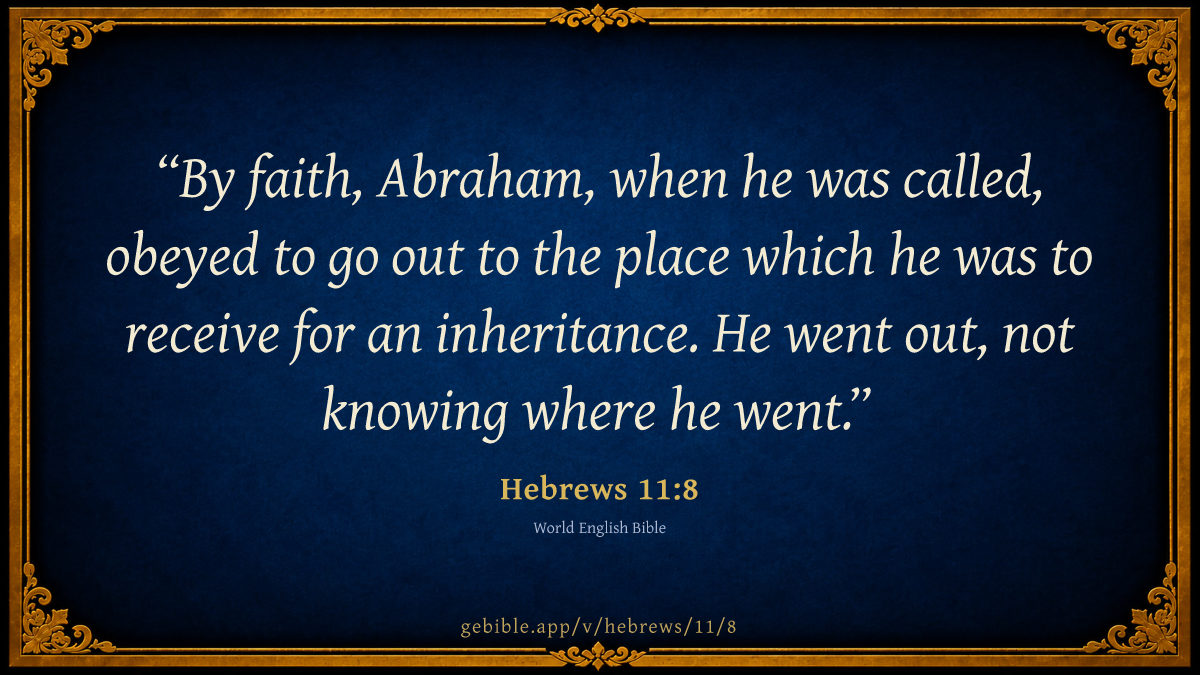
By faith, Abraham, when he was called, obeyed to go out to the place which he was to receive for an inheritance. He went out, not knowing where he went.
Parallel Translations
-
By faith, Abraham, when he was called, obeyed to go out to the place which he was to receive for an inheritance. He went out, not knowing where he went.
-
By fayth Abraham when he was called obeyed to goo out into a place which he shuld afterwarde receave to inheritaunce and he wet out not knowynge whether he shuld goo.
-
By faith Abraham, when he was called, obeyed God, to goe out into a place, which hee should afterward receiue for inheritance, and he went out, not knowing whither he went.
Examined in Scripture Analysis
Contradictions (1)
Questions where the Bible appears to say two different things, with the passages on each side set together.
Cross-references (28)
Passages linked to Hebrews 11:8 in the Treasury of Scripture Knowledge, ordered by reader-vote popularity; verse text shown in World English Bible.
- Genesis 12:1-4 Now Yahweh said to Abram, “Leave your country, and your relatives, and your father’s house, and go to the land that I will show you. I will make of you a great nation. I will bless you and make your name great. You will be a blessing. I will bless those who bless you, and I will curse him who treats you with contempt. All the families of the earth will be blessed through you.” So Abram went, as Yahweh had told him. Lot went with him. Abram was seventy-five years old when he departed from Haran.
- Acts 7:2-4 He said, “Brothers and fathers, listen. The God of glory appeared to our father Abraham when he was in Mesopotamia, before he lived in Haran, and said to him, ‘Get out of your land and away from your relatives, and come into a land which I will show you.’ Then he came out of the land of the Chaldaeans and lived in Haran. From there, when his father was dead, God moved him into this land, where you are now living.
- Genesis 15:7-8 He said to Abram, “I am Yahweh who brought you out of Ur of the Chaldees, to give you this land to inherit it.” He said, “Lord Yahweh, how will I know that I will inherit it?”
- Matthew 7:24-25 “Everyone therefore who hears these words of mine, and does them, I will liken him to a wise man, who built his house on a rock. The rain came down, the floods came, and the winds blew, and beat on that house; and it didn’t fall, for it was founded on the rock.
- Genesis 22:18 All the nations of the earth will be blessed by your offspring, because you have obeyed my voice.’ ”
- Genesis 12:7 Yahweh appeared to Abram and said, “I will give this land to your offspring.” He built an altar there to Yahweh, who had appeared to him.
- James 2:14-16 What good is it, my brothers, if a man says he has faith, but has no works? Can faith save him? And if a brother or sister is naked and in lack of daily food, and one of you tells them, “Go in peace. Be warmed and filled;” yet you didn’t give them the things the body needs, what good is it?
- Psalms 105:9-11 the covenant which he made with Abraham, his oath to Isaac, and confirmed it to Jacob for a statute; to Israel for an everlasting covenant, saying, “To you I will give the land of Canaan, the lot of your inheritance,”
- Isaiah 41:2 Who has raised up one from the east? Who called him to his foot in righteousness? He hands over nations to him and makes him rule over kings. He gives them like the dust to his sword, like the driven stubble to his bow.
- Romans 10:16 But they didn’t all listen to the glad news. For Isaiah says, “Lord, who has believed our report?”
- Hebrews 11:33 who through faith subdued kingdoms, worked out righteousness, obtained promises, stopped the mouths of lions,
- 1 Peter 4:17 For the time has come for judgment to begin with the household of God. If it begins first with us, what will happen to those who don’t obey the Good News of God?
- Genesis 13:15-17 for I will give all the land which you see to you and to your offspring forever. I will make your offspring as the dust of the earth, so that if a man can count the dust of the earth, then your offspring may also be counted. Arise, walk through the land in its length and in its width; for I will give it to you.”
- Genesis 15:5 Yahweh brought him outside, and said, “Look now toward the sky, and count the stars, if you are able to count them.” He said to Abram, “So your offspring will be.”
- Genesis 17:8 I will give to you, and to your offspring after you, the land where you are traveling, all the land of Canaan, for an everlasting possession. I will be their God.”
- Genesis 26:3 Live in this land, and I will be with you, and will bless you. For I will give to you, and to your offspring, all these lands, and I will establish the oath which I swore to Abraham your father.
- Deuteronomy 9:5 Not for your righteousness or for the uprightness of your heart do you go in to possess their land; but for the wickedness of these nations Yahweh your God does drive them out from before you, and that he may establish the word which Yahweh swore to your fathers, to Abraham, to Isaac, and to Jacob.
- Joshua 24:3 I took your father Abraham from beyond the River, and led him throughout all the land of Canaan, and multiplied his offspring, and gave him Isaac.
- Isaiah 51:2 Look to Abraham your father, and to Sarah who bore you; for when he was but one I called him, I blessed him, and made him many.
- Ezekiel 36:24 “ ‘ “For I will take you from among the nations and gather you out of all the countries, and will bring you into your own land.
- Romans 1:5 through whom we received grace and apostleship for obedience of faith among all the nations for his name’s sake;
- Romans 6:17 But thanks be to God, that, whereas you were bondservants of sin, you became obedient from the heart to that form of teaching to which you were delivered.
- 1 Peter 1:22 Seeing you have purified your souls in your obedience to the truth through the Spirit in sincere brotherly affection, love one another from the heart fervently,
- Genesis 11:31 Terah took Abram his son, Lot the son of Haran, his son’s son, and Sarai his daughter-in-law, his son Abram’s wife. They went from Ur of the Chaldees, to go into the land of Canaan. They came to Haran and lived there.
- 2 Corinthians 10:5 throwing down imaginations and every high thing that is exalted against the knowledge of God and bringing every thought into captivity to the obedience of Christ,
- Hebrews 5:9 Having been made perfect, he became to all of those who obey him the author of eternal salvation,
- 1 Peter 3:1 In the same way, wives, be in subjection to your own husbands; so that, even if any don’t obey the Word, they may be won by the behavior of their wives without a word,
- Nehemiah 9:7-8 You are Yahweh, the God who chose Abram, brought him out of Ur of the Chaldees, gave him the name of Abraham, found his heart faithful before you, and made a covenant with him to give the land of the Canaanite, the Hittite, the Amorite, the Perizzite, the Jebusite, and the Girgashite, to give it to his offspring, and have performed your words; for you are righteous.
Cross-references from openbible.info (CC BY 4.0)
Explain this verse (22 sources)
Historical commentary, presented as a primary source — not an endorsement.
Private notes
Saved on this device only — never synced or sent anywhere.
John Calvin 1540 · Public Domain 8. By faith Abraham, etc. He comes now to…
8. By faith Abraham, etc. He comes now to Abraham, who is the chief father of God’s church on earth, and in whose name the Jews gloried, as though by the distinction of being the holy race of Abraham alone, they were removed from the common order of men. But he now reminds them of what they ought to possess as the main thing, that they might be counted among his children. He therefore calls their attention to faith, for Abraham himself had no excellency which did not proceed from faith.
He first teaches us that faith was the cause why he immediately obeyed God when he was commanded to remove from his own country; and then that through the same faith it was that he went on without wavering, according to what he was called to do even to the end. By these two things, — his promptness in obeying, and his perseverance, was Abraham’s faith most clearly proved.
Read full note →
When he was called, etc. The old Latin translator and Erasmus apply this to his name, which is extremely tame and frigid. On the contrary, I refer it to the oracle by which he was called from his own country. He indeed did in this way undergo a voluntary exile, while yet he did nothing but by God’s command; and no doubt it is one of the chief things which belong to faith, not to move a step except God’s word shows us the way, and as a lantern gives us light, according to what David says. (Psalm 119:105.) Let us then learn that it is a thing to be observed through life, that we are to undertake nothing to which God does not call us.
To go out into a place, etc. To the command was added a promise, that God would give him a land for an inheritance. This promise he immediately embraced, and hastened as though he was sent to take possession of this land. It is a no ordinary trial of faith to give up what we have in hand, in order to seek what is afar off, and unknown to us. For when God commanded him to leave his own country, he did not point out the place where he intended him to live, but left him in suspense and perplexity of mind: “go”, he said, “into the place that I will show thee.” (Genesis 12:1.) Why did he defer to point out the place, except that his faith might be more and more exercised? Besides, the love of his native land might not only have retarded the alacrity of Abraham, but also held him so bound to it, so as not to quit his home. His faith then was not of an ordinary kind, which thus broke through all hindrances and carried him where the Lord called him to go.
John Calvin's Commentaries (1540-1563) — public domain. Text from the Calvin Translation Society English edition (1840s-50s) via the Christian Classics Ethereal Library (ccel.org). Calvin's coverage is partial (roughly two-thirds of the Bible); uncommented books and verses are honest gaps, never fabricated. The 19th-century editor's footnotes and remarks are omitted so the notes are faithfully Calvin's own voice.
Geneva Bible translators 1599 · Public Domain Abraham and Sarah.
Abraham and Sarah.
Geneva Bible (1599) marginal notes — public domain.
John Trapp 1656 · Public Domain 8 By faith Abraham, when he was called to…
8 By faith Abraham, when he was called to go out into a place which he should after receive for an inheritance, obeyed; and he went out, not knowing whither he went.
Ver. 8. When he was called] A man may follow God dryshod through the Red Sea. He is to be obeyed without sciscitation, with a blind obedience. Abraham winked, as it were, and put his hand into God’s to be led whithersoever he pleased. Magnus est animus, qui se Dee tradidit; pusillus et degener qui obluctatur. (Seneca.) That is a brave man indeed that can wholly resign himself up to God- Quo fata trahunt, retrahuntque, sequamur. (Virgil.)
John Trapp, A Commentary or Exposition upon All the Books of the Old and New Testament (1647–1656) — public domain. Text from a community e-Sword module.
Matthew Poole 1685 · Public Domain Here begin instances of this Divine faith after the…
Here begin instances of this Divine faith after the flood from Abraham to Moses’s time, Heb 11:8-22. The first is the father of believers, so entitled by God, eminent in the exercise of this grace, of whose ancestry, and their descent from him, these Hebrews did greatly glory. He had an express discovery of the will of God unto him, that he should leave the idolatrous place where he lived, Gen 11:31; 12:1-3; compare Jos 24:2; Act 7:2,3; and with his family should travel to a land which God would show him, and which he would give him as an inheritance for him and his, which was the land of Canaan, as described, Gen 13:14-17; 25:18,19,21. This command of God, strengthened by a promise, he obeyed, Gen 12:4; Act 7:4; through faith, really, freely, and fully resigning up himself and his to God’s disposal.
And he went out not knowing whither he went; he went forth with his father Terah from his country, kindred, and friends, in Ur of the Chaldees, to Charran, and there they dwelt till Terah died, Gen 11:31; Act 7:4. After which, he pursued God’s orders in his motion from place to place, though he knew neither the way, nor the place in which and whither he was to move, resting himself on God’s word and guidance, and relying wholly on his provision for him, and protection of him in all his ways.
Matthew Poole's English Annotations on the Holy Bible (1683–1685) — public domain. Text from a community e-Sword/MySword module.
William Burkitt 1703 · Public Domain The next illustrious instance of the efficacy of faith…
The next illustrious instance of the efficacy of faith we have here in the person of Abraham, who obeyed the call and command of God in leaving his own native country, to go he knew not whither, and to receive an inheritance he knew not when.
Where note, 1. The foundation of Abraham’s faith and obedience, and that was the call of God; he had an immediate command to go out of his own country into a certain place, with a promise to receive it for an inheritance: Get thee from thy country, relations, friends, and all outward enjoyments, is a command becoming the greatness of God to give; and self-denial in fact or resolution to comply with such a command from the great God, is the foundation of all sincere profession.
Read full note →
Note, 2. What was the principle of Abraham’s obedience in complying with this call of God, and that was his faith: By faith, Abraham, when he was called, obeyed. True faith, wherever it is, bringeth forth sincere obedience; these two can no more be separated then the light and the sun, than the fire and heat; obedience is the daughter of faith, and faith the parent and principle of obedience.
Note, 3. The difficulty, and therein the excellency, of his obedience; He obeyed, and went out, not knowing whither he went. If faith be once satisfied in the call and command of God, it will follow him when he cannot see a step of its way; over hills and mountains, through dales and vallies, fearing nothing. He that has God’s call, need not fear God’s conduct.
William Burkitt's Expository Notes on the New Testament (1700–1703) — public domain. Text from a community e-Sword module.
John Gill 1763 · Public Domain By faith he sojourned in the land of promise,....…
By faith he sojourned in the land of promise,.... The land of Canaan, so called, because it was promised to Abraham and his seed; and is typical of heaven, which is not by the works of the law, but by the free promise and grace of God: here Abraham sojourned for a while,
as in a strange country; which was not his native place, and not his own, but another's; see Act 7:5 and an idolatrous one; here he sojourned by faith, believing that as it was promised, it would be given to him, and his seed: so all God's people are sojourners in this world, strangers and pilgrims in it; this is not their dwelling place; they do not belong to it, but to another; their stay in it is but for a while; and, while they are in it, do not look upon themselves at home, but are looking out for another, and better country; they are unknown to the men of the world, and the men of the world are strangers to them; though they have a civil conversation with them, they separate from them, both as to profaneness and superstition, and live by faith, in the expectation of the heavenly country, as Abraham also did:
Read full note →
dwelling in tabernacles with Isaac and Jacob, the heirs with him of the same promise; the same promised land, the same promised blessings, and the same promised seed, the Messiah; see Gen 12:3 with these Abraham dwelt, for he lived until Isaac was seventy five years of age, and Jacob fifteen; he was an hundred years old when Isaac was born, Gen 21:5 and he lived one hundred and seventy five years, Gen 25:7 and Isaac was sixty years old when Jacob was born, Gen 25:26 and Abraham dwelt with them in tabernacles, or tents, which they pitched at pleasure, and moved from place to place. So true believers, as they are Abraham's seed, they are heirs with him, according to the promise; and are heirs together of the grace of life; and dwell in earthly tabernacles, in houses of clay, which are erected for a while, and then taken down.
John Gill's Exposition of the Whole Bible (1746–1763) — public domain (CC PDM 1.0). Text via the HelloAO Bible API.
John Wesley 1765 · Public Domain Gen. xii, 1-4
Gen. xii, 1-4
John Wesley, Explanatory Notes Upon the Whole Bible (1754–1765) — public domain. Text via the GEBible commentary corpus.
Adam Clarke 1810 · Public Domain Verse 8. Abraham, when he was called] See on…
Verse 8. Abraham, when he was called] See on Ge 12:1-4.
Not knowing whither he went.] Therefore his obedience was the fullest proof of his faith in God, and his faith was an implicit faith; he obeyed, and went out from his own country, having no prospect of any good or success but what his implicit faith led him to expect from God, as the rewarder of them that diligently seek him. In all the preceding cases, and in all that follow, the apostle keeps this maxim fully in view.
Adam Clarke's Commentary on the Bible (1810–1826) — public domain. Text from a community e-Sword/MySword module.
Joseph Benson 1811 · Public Domain Heb 11:8. By faith — In the divine promises;…
Heb 11:8. By faith — In the divine promises; Abraham when he was called — The call here intended is referred to Gen 12:1; to go out — From his father’s house and native land; into a place far distant, which God promised he should afterward receive for an inheritance — Without disputing or murmuring, obeyed; and — Relying on the power and veracity of God; went out, not knowing whither he went — Although he did not know the country to which he was going, nor whether it was a good or a bad land.
Joseph Benson's Commentary on the Old and New Testaments (1811–1818) — public domain. Text from a community e-Sword module.
Albert Barnes 1834 · Public Domain By faith Abraham - There is no difficulty in…
By faith Abraham - There is no difficulty in determining that Abraham was influenced by faith in God. The case is even stronger than that of Noah, for it is expressly declared, Gen 15:6, “And he believed in the Lord; and he counted it to him for righteousness.” Compare notes, Rom 4:1-5. In the illustrations of the power of faith in this chapter, the apostle appeals to two instances in which it was exhibited by Abraham, “the father of the faithful.” Each of these required confidence in God of extraordinary strength, and each of them demanded a special and honorable mention. The first was that when he left his own country to go to a distant land of strangers (Gen 15:8-10); the other when he showed his readiness to sacrifice his own son in obedience to the will of God, Heb 11:17-19.
When he was called - Gen 12:1, “Now the Lord had said unto Abraham, Get thee out of thy country, and from thy kindred, and from thy father’s house, unto a land that I will show thee.”
Read full note →
Into a place which he should after receive for an inheritance, obeyed - To Palestine, or the land of Canaan, though that was not indicated at the time.
And he went out, not knowing whither he went - Gen 12:4. Abraham at that time took with him Sarai, and Lot the son of his brother, and “the souls that they had gotten in Haran.” Terah, the father of Abraham, started on the journey with them, but died in Haran; Gen 11:31-32. The original call was made to Abraham, Gen 12:1; Act 7:2-3, but he appears to have induced his father and his nephew to accompany him. At this time he had no children Gen 11:30, though it seems probable that Lot had; Gen 12:5. Some, however, understand the expression in Gen 12:5, “and the souls they had gotten in Haran,” as referring to the servants or domestics that they had in various ways procured, and to the fact that Abraham and Lot gradually drew around them a train of dependents and followers who were disposed to unite with them, and accompany them wherever they went. The Chaldee Paraphrast; understands it of the proselytes which Abraham had made there - “All the souls which he had subdued unto the law.” When it is said that Abraham “went out, not knowing whither he went,” it must be understood as meaning that he was ignorant to what country he would in fact be led. If it be supposed that he had some general intimation of the nature of that country, arid of the direction in which it was situated, yet it must be remembered that the knowledge of geography was then exceedingly imperfect; that this was a distant country; that it lay beyond a pathless desert, and that probably no traveler had ever come from that land to apprize him what it was. All this serves to show what was the strength of the faith of Abraham.
Albert Barnes' Notes on the Bible (1834–1885) — public domain. Text from a community e-Sword/MySword module.
Haydock's Catholic Bible Commentary 1859 · Public Domain By faith he that is called Abraham, &c. He…
By faith he that is called Abraham, &c. He commends his faith, who believing God, left his own country, lived in Chanaan [Canaan] as in a strange country, waiting for the promise and for a city, whose builder and maker is God; i.e. for an habitation in the kingdom of heaven. (Witham)
George Leo Haydock (1774–1849), Haydock's Catholic Family Bible and Commentary, 1859 edition — public domain. Excludes Psalms (Douay-Rheims chapter numbering differs from Protestant) and Deuterocanonical books (Catholic canon only).
Lange's Commentary on the Holy Scriptures 1864 · Public Domain The example of Abraham and Sarah
II
The example of Abraham and Sarah
Read full note →
Heb_11:8-12
8By faith Abraham, when7 he was called to go out into a place which he should after [was destined to] receive for an inheritance, obeyed [hearkened, ὑπήκουσεν]; and he went out, not knowing whither he went [cometh]. 9By faith he sojourned in the [a]8 land of promise, as in a strange [alien, ὰλλοτρίαν] country, dwelling in tabernacles 10[tents] with Isaac and Jacob, the heirs with him of the same promise: For he looked for a [was looking for the] city which hath foundations, whose builder [architect, designer, τεχνίτης] and maker [framer, fabricator, δημιουργός] is God. 11Through faith also Sarah herself received strength to conceive seed, and was delivered of a child [om. was delivered, etc.] when she was past age [contrary to her time of life],9 because she judged him faithful who had promised. 12Therefore sprang there even of one, and him as good as dead [and that too, having become deadened], so many as the stars of the sky in multitude, and as the sand10 which is by the sea shore, [the] innumerable.
[Heb_11:8.—καλούμενος, being called, summoned; with Art. ὁ, as read by many, “he that is called Abraham;” but much less well.—ὑπήκουσεν ἐξελθεῖν, hearkened, or obeyed, to go out, i.e., so as to go out.—ἔμελλεν λαμβ., was about, was destined to receive; E. V., should after receive.—ποῦ ἔρχεται, where, he cometh, ποῦ, pregnant=whither (ποῖ), he is coming, and where he is going to remain.
Heb_11:9.—παρῷκησεν εἰς γῆν, sojourned, dwelt as a stranger (lit., dwelt along side of) in the land; εἰς, again pregnant, “went into the land in order to sojourn in it.” So Mat_2:23, κατώκησεν εἰς πόλιν, dwelt into, i.e., came into and dwelt in.—ὡς ἀλλοτρίαν, as alien, as belonging to others, though he had himself been promised the future possession of it.
Heb_11:10.—ἐξεδέχετο, he was awaiting, looking for, Imperf.—τὴν πόλιν, the city, not, a city. τεχνίτης, artisan, architect; δημιουργός, framer, builder, i.e., of the heavenly Jerusalem, Heb_12:22.
Heb_11:11.—εἰς καταβολὴν σπέρματος, for the depositing of seed (Alf.); for the founding of a seed, an offspring (Moll); Del., für befruchtenden Samen; Stier, einen Samen zu gründen; De Wette, zur Gründung des Geschlechts.—καὶ παρὰ καιρὸν ἡλικίας, even contrary to the period of her age or time of life (παρά, aside from, in inconsistency with).
Heb_11:12.—καὶ ταῦτα νενεκρωμένου, and that too having become dead.—καθώς, according as, equality of measure, not merely ὡς, as, of likeness.—ἡ ἀναρίθμητος, the=which is innumerable, agreeing with ἅμμος, not, as would seem in E. V., referring to the progeny.—K.].
EXEGETICAL AND CRITICAL
Heb_11:8. When he was called.—The lect. rec. without the article is preferable in respect to sense, since ὁ καλούμενος Ἀβραάμ can hardly mean Abraham who was called or summoned, namely, to come forth (Lün.); but, in accordance with usage, could mean only the so-called Abraham, or, he who was called Abraham. But a reference to the change of name would here have nor elevancy, since this change took place not until twenty-five years after Abram’s departure from Haran, the event which is here spoken of.
Heb_11:9. Sojourned—Παροικεῖν in the classics is used only of dwelling in the neighborhood, but in Hellenistic use, of sojourning as a foreigner; in connection with εἰς it includes also the idea of coming to sojourn.
Heb_11:10. The city that hath foundations.—This is not the earthly Jerusalem (Grot., etc.), but the heavenly (Gal_4:28), which (Heb_12:22) is called the city of the living God, and (Heb_13:14) the city that is to be, whose foundations also are mentioned (Rev_21:14). In so far as God projected the plan of this city, He is called its τεχνίτης, and as the one who executes this plan, its δημιουργός. This latter word elsewhere only at 2Ma_4:1. [It figures largely in the Gnostic vocabulary, but in a very different sense].
Heb_11:11. Also Sarah herself.—The emphatic καὶ αὐτή is referred by Chrys., Beng., etc., to the fact that Sarah was a mere woman; by Schlicht., Schultz, etc., to the fact that she was barren; but by the majority correctly to that of her having been at the outset unbelieving, Rom_4:19.
DOCTRINAL AND ETHICAL
1. Faith gives to obedience, which is its characteristic mark, also power; for it surrenders man entirely into the hands of God, while he sacrifices his individual will with his natural propensities and dearest inclinations, and merges his heart entirely in the pleasure and will of God. The Divine command determines his calling, and in the obedience of faith he goes willingly whither God calls him; in the confidence of faith he leaves it entirely to the Divine disposal to determine time, place, object, and limit of his sojourning and his wandering; and in the hope of faith he confidently waits in his pilgrimage for the final fulfilment of the Divine promise, and anticipates his entrance into the eternal mansions.
2. Faith renders us not merely strong in the conflict with the trials of our earthly pilgrimage, and not merely willing to surrender our temporal possessions for eternal good; it conquers also unbelief and doubt in the bosom of man, and qualifies him to be an instrument of God’s omnipotence and compassion, to which later generations are pointed for their edification and their admonition (Isa_51:1 ff.; Mal_2:15; Eze_33:24).
HOMILETICAL AND PRACTICAL
The pilgrimage of Abraham a figure of the character of our earthly life.—To the believer the word of God is sufficient: 1, as a command to set out; 2, as a directory of the way; 3, as nourishment on the journey.—The leadings of God are often dark, and it is not unfrequently difficult for men to follow them; but faith which clings to God’s word and faithfulness, receives light for the one, and power for the other.—Faith triumphs over outward affliction and over inward assaults.—It is not enough to have received a call from God: we must steadfastly abide in this clear to the end.—The first steps are frequently the hardest; but they are the decisive ones.—What we find in God repays abundantly what we sacrifice in our vocation.—As we have to give heed to the word of God, so we have to trust in the power of God.
Starke:—The believer follows, if God calls him from one place to another, although he sees no temporal advantage, Act_20:22-23.—Believers acknowledge that they are here strangers and pilgrims, and are seeking a genuine habitation.—The impotence of nature yields to the power of faith.—God fulfils abundantly His promises; blessed are all they who put their trust in Him!—Abundance of population is a Divine blessing, and produces no scarcity in the land; the fault of this lies in the sins of men (Lev_26:9; Lev_26:26).
Rieger:—The will of God is as an infinitely wide space which has indeed a narrow entrance; but whoever has once forced his way through the entrance, and has entirely offered up his will to God, he henceforth has abundant space in the will of God to move in accordance with His choice.—Waiting expresses exceedingly well the nature and power of faith. For in waiting, certainty of conviction springing from the promise, a loving longing and desire for the promised good, and patience in hope, flow together beautifully into one.—The word of promise is, to be sure, the only seed for faith; but to prepare the heart properly to preserve this seed often requires many other labors.
Heubner:—Faith produces perseverance under heavy trials.—Faith must, with the believer, decide in regard to the choice of his residence.—God gives to the dead new life.—God is the guardian of holy wedlock.
Footnotes:
[8]Heb_11:9.—The art. before γῆν is, according to Sin. A. D**. K. L. and many minusc., to be stricken out.
[9]Heb_11:11.—Ἔτεκεν of the Rec., after ἡλικίας, is, according to A. D*., 17, to be expunged. In Sin. it is from the hand of the corrector.
[10]Heb_11:12.—Instead of ὡσεὶ ἅμμος, we are to read after Sin. A. D. E. K. L., 23, 37, 46, 47, ὡς ἡ ἅμμος, and we retain the words ἠ παρὰ τὸ χεῖλος, which are wanting in D*. E.—Instead of ἐγεννήθησαν, write with A. E*. K., 109, 219*., ἐγενήθησαν.
Lange's Commentary on the Holy Scriptures (Critical, Doctrinal, and Homiletical), ed. John Peter Lange, English translation edited by Philip Schaff (1864–1880) — public domain. Text from a community e-Sword module.
Robert Jamieson, A. R. Fausset & David Brown 1871 · Public Domain From the antediluvian saints he passes to the patriarchs…
From the antediluvian saints he passes to the patriarchs of Israel, to whom "the promises" belonged.
called--by God (Gen 12:1). The oldest manuscripts and Vulgate read, "He that was called Abraham," his name being changed from Abram to Abraham, on the occasion of God's making with him and his seed a covenant sealed by circumcision, many years after his call out of Ur. "By faith, he who was (afterwards) called Abraham (father of nations, Gen 17:5, in order to become which was the design of God's bringing him out of Ur) obeyed (the command of God: to be understood in this reading), so as to go out," &c.
Read full note →
which he should after receive--He had not fully received even this promise when he went out, for it was not explicitly given him till he had reached Canaan (Gen 12:1, Gen 12:6-7). When the promise of the land was given him the Canaanite was still in the land, and himself a stranger; it is in the new heaven and new earth that he shall receive his personal inheritance promised him; so believers sojourn on earth as strangers, while the ungodly and Satan lord it over the earth; but at Christ's coming that same earth which was the scene of the believer's conflict shall be the inheritance of Christ and His saints.
Jamieson, Fausset & Brown — Commentary Critical and Explanatory on the Whole Bible (1871) — public domain (CC PDM 1.0). Text via the HelloAO Bible API.
Daniel D. Whedon 1874 · Public Domain 8. Example of Abraham. As the great typical example…
8. Example of Abraham. As the great typical example of faith, both with Jewish writers (note on Gal_3:6) and St. Paul, Abraham with Sarah fills a long paragraph, 8-20. And the similarity of the treatment here is good proof that Paul’s idea of faith is still the same, and this epistle by his hand.
Called—A well supported reading in the Greek would read Abraham the called. And that reading would mean, according to Delitzsch, Abraham the well known, or historically illustrious as the called—a very suitable and significant meaning. But Alford, in accordance with the old Greek commentators, interprets it the man who previously was called Abram, and was subsequently named Abraham. The reading, however, without the article, is, probably, the true one, and the reference is to “the call of Abraham.”
Read full note →
Go out into a place—Modern research suggests the probability that Abraham’s going out was part of a great western movement of the Asiatic peoples. But Abraham’s great peculiarity was, that he went under divine guidance, about to plant a special race in a special spot for a future divine history. By his faithfulness he became the founder of that race whose history stands alone in the history of the world.
Went out—As Noah launched forth upon the unknown waters, so Abraham started forth into unknown lands. So the man of faith looks onward and upward to an unknown but blessed home.
Daniel D. Whedon (gen. ed.), Commentary on the Old and New Testaments (1874–1909) — public domain. Text from a community e-Sword module.
The Cambridge Bible for Schools and Colleges 1878 · Public Domain 8. Abraham] As was natural, the faith of “the…
8. Abraham] As was natural, the faith of “the father of the faithful was one of the commonest topics of discussion in the Jewish Schools. Wordsworth (Eccles. Sonnets, xxvi.) speaks of
“Faith, which to the Patriarchs did dispense
Read full note →
Sure guidance ere a ceremonial fence
Was needful to men thirsting to transgress.”
when he was called] The Greek (if ὁ καλούμενος be the right reading) can only mean literally either “he who is called Abraham,” which would be somewhat meaningless; or “Abraham, who was called to go out.”
to go out] from Ur of the Chaldees (Act_7:4).
a place which he should after receive] Gen_12:7.
The Cambridge Bible for Schools and Colleges (gen. ed. J. J. S. Perowne; Cambridge University Press, 1878–1918) — public domain. Text from a community e-Sword module.
Ellicott's Commentary for English Readers 1878 · Public Domain (8) When he was called to go out.—Our older…
(8) When he was called to go out.—Our older versions are here better than the Authorised, bringing in the word “obeyed” after “called”—“obeyed to go out into,” &c.
Which he should after receive.—The English rendering may seem to imply that when “called” Abraham received the promise that the land to which he would be directed should in the future be his inheritance. It is not so (Act_7:5); for this promise is not found in Gen_12:1-3, but was bestowed when he had obeyed (Gen_12:7). The meaning here is, “unto a place which he was to receive.”
A Bible Commentary for English Readers, edited by Charles John Ellicott (1878–1897) — public domain. Text from a community e-Sword module.
The Pulpit Commentary 1880 · Public Domain By faith Abraham, when he was called to go…
By faith Abraham, when he was called to go out into a place which he should after receive for an inheritance, obeyed (literally, when called, obeyed to go out, etc.); and he went out, not knowing whither he went. The reference is to the first call of Abraham, (Gen_12:1) his obedience to which is the first instance of the faith which the whole life of the father of the faithful so eminently exemplifies. The fact of the place he was to go to being so far unrevealed (intimated only as "a land that I will show thee") enhances the faith displayed, He followed the Divine voice as it were blindly, not seeing whither it was leading him, knowing only that it was right to follow it. So to those who walk by faith now the future may be unknown or dim. Lead thou me on. ... I do not ask to see The distant scene; one step enough for me.
Vers. 8-19. Faith of the Hebrew Pilgrim Fathers.
Read full note →
What Anglo-Saxon could look without emotion on the granite boulder at New Plymouth corner-stone of a nation upon which the Pilgrim Fathers of New England stepped ashore from the Mayflower? And, in like manner, what Jew can think but with enthusiasm of those three glorious names Abraham, Isaac, and Jacob? The verses before us were well fitted to stir the hearts" blood of the Hebrews to whom this treatise was addressed. And they should stir ours too; for these patriarchs are the Pilgrim Fathers of all the men of faith. We shall consider the passage chiefly in connection with Abraham, the father of the faithful. In his spiritual life there were at least four great crises four occasions upon which his faith was severely tried, and came forth victorious. The apostle introduces his reference to each of these with the expression which is the refrain of the whole chapter By faith" (vers. 8, 9, 11, 17).
I ABRAHAM"S FAITH WAS SHOWN IN HIS EMIGRATION. (Ver. 8) It was a hard command which he received, to leave his native country, and to cast himself upon the bare promise of God for another home. He had to break the ties which bound him to the scenes of his youth. He was at first ignorant as to what country he was going. His long journey would expose him to hardships and dangers. Yet Abraham did not hesitate to obey. He gathered his flocks together, and set out with his household caravan. It was impossible that he could have comprehended the large plan of Providence, of which only one little corner was unfolded in his call; but the precept and the promise were sufficient to determine his action. So he put his hand trustfully into the great hand of God, and allowed him to guide his feet. Abraham"s emigration was the first link in the golden chain of the triumphs of his faith. It teaches us such lessons as these that personal religion
(1) takes its rise in God;
(2) is the fruit of a Divine revelation; and
(3) is the product of an earnest faith.
II ABRAHAM"S FAITH WAS SHOWN IN HIS LIFELONG PILGRIMAGE. (Vers. 9, 10, 13-16) When he arrived in Canaan, the patriarch found that he was not to receive immediate possession of the land. Indeed, while he lived, it remained stilt but the land of promise. " He dwelt in tents. He did not build any walled city. The only piece of ground which he ever acquired was a burying-place. But his view of the meaning of the covenant expanded with his spiritual experience. Abraham and Sarah, Isaac and Jacob, gradually learned that the promise of an inheritance in the literal Canaan was in their own case an illusion. Yet they did not conclude that it had been a delusion. They learned to understand the promises spiritually, and were persuaded that God would fulfill his word even to themselves, in a deeper way than at first they had dreamed. So they steadfastly maintained their faith; and, viewing Canaan as a type of heaven, "confessed that they were strangers and pilgrims on the earth." Abraham was content to feel always from home in this world. Although he became immensely wealthy, he continued spiritually a pilgrim. His maxim was not that of sense, "A bird in the hand is worth two in the bush; "rather, as a prince of the men of faith," he looked for the city which hath the foundations." The fatherland for which he longed was not the place of his birth, else he could easily have recrossed the Euphrates (ver. 15). "The heirs of the promise" sought their home in heaven. And so, "These all died in faith," is the epitaph common to all the monuments in PatriarchsCorner of the abbey church of the Old Testament. And because they so died, God condescended to take one of his great Bible-names from those Hebrew Pilgrim Fathers God of Abraham, Isaac, and Jacob.
III ABRAHAM"S FAITH WAS SHOWN DURING HIS PROTRACTED CHILDLESSNESS. (Vers. 11, 12) This severe trial Sarah shared with him. If the faith of Abraham forms, as it were, the magnificent frontispiece of the volume of Jewish history, Sarah"s faith occupies the positron of the vignette upon the title-page. (Isa_51:2) The time came when the birth of a child to them was, humanly speaking, doubly impossible; and yet God said that the covenant would not be fulfilled in the line of Ishmael. Had it not been for their faith, accordingly, Sarah"s son Isaac would never have been born; and the promise could not have been realized that Abraham should have a posterity both natural and spiritual numerous as the stars in the Eastern sky, or as the sand-grains upon the shore of ocean.
IV ABRAHAM"S FAITH WAS SHOWN IN THE SACRIFICE OF HIS SON. (Vers. 17-19) This extraordinary event was the final strain to which his faith was subjected. It was a dreadful ordeal, and one from which even most good men would have recoiled with horror. The patriarch was commanded to offer up the most precious of all sacrifices. He was to perform a deed abhorrent to the most sacred human affection. He was required to put to death the heir of the Divine promise, and thus appear to destroy the hopes which clustered round him. Yet by faith Abraham sustained this last and crowning trial. His submission was entire. His obedience was perfect. The apostle says definitely that he "offered up Isaac;" for the sacrifice was completely accomplished in the patriarch"s will before the angel stayed his hand. And what was the faith which comforted his heart and nerved his arm, at this unparalleled crisis of his spiritual life? Abraham accounted that "God is able to raise up, even from the dead." He was sure that Isaac would be restored to life again, rather than that the promise should fail. Isaac"s resurrection would not be a greater miracle than his birth had been. And, the apostle adds, the patriarch really did receive Isaac from the dead, figuratively speaking (ver. 19). An achievement so sublime evinced that complete self-consecration and submission to God"s will which belongs only to perfect faith, and thus certifies Abraham"s right to the lofty title of "father of the faithful.
APPLICATION.
1. Are we ready to obey any call of God, whether relating to our outer life or to our soul-life?
2. Do we feel ourselves to be strangers and pilgrims on the earth," or could we take an eternity of our present life, provided our material circumstances were comfortable?
3. Have we the faith which can laugh at impossibilities rather than disbelieve the Divine promise?
4. Have we unreservedly consecrated to God our soul, our life, our all? Happy is each heart that can "make melody to the Lord" in the words of the hymnThe God of Abraham praise, At whose supreme command From earth I rise, and seek the joys At his right hand. I all on earth forsake, Its wisdom, fame, and power; And him my only Portion make, My Shield and Tower. (Olivers.)
Vers. 8-10. The faith of Abraham.
"By faith Abraham, when he was called," etc. Abraham was a good and a great man. "He was called the friend of God." Even amongst the heroes of religious faith he is conspicuous as a believer in God. St. Paul speaks of him as "the father of all" the faithful. Let us consider the exhibition of his faith which our text presents. We discover it
I IN HIS OBEDIENCE TO THE DIVINE CALL. "By faith Abraham, when he was called to go out into a place which he should after receive for an inheritance, obeyed," etc. The summons here mentioned is recorded in Gen_12:1-5. This call was
(1) of Divine origination. It was not solicited from God by Abraham, but addressed by God to Abraham. The initiative was Divine, not human. Every summons to the true and good is from above. Every aspiration and effort after holiness and usefulness is the result of Divine influence. This call was
(2) a Divine communication. How it was addressed to Abraham, whether through his bodily senses or direct to his spiritual consciousness, we know not. But we know the fact that the summons came to him, and was felt by him to be a sacred and Divine command. A mysterious and mighty impulse came upon him, and he felt that it was from God. The call was to depart from his country and kindred to a land whither God would lead him. And it seems that either then or formerly he was called to a truer and higher life. Whether he was ever an idolater we cannot tell; but if such were the case, he was summoned from polytheism to monotheism. Most glorious and animating was the destiny which was set forth for him and his posterity. (Gen_12:2, Gen_12:3) But at present we have to do with his call to leave his home in Ur of the Chaldees, and to follow whithersoever the unseen hand might lead him. In his prompt and pious obedience to that call we have an impressive illustration of his faith.
1. He obeyed, notwithstanding the fact that his obedience involved considerable sacrifices. Unto a man like Abraham it could not have been a light thing to depart "from his country, and from his kindred, and from his father"s house." It must have been a trial to him to go forth from places which were hallowed by precious and sacred memories, to sever many close and tender social associations, and without any prospect of returning to these cherished friends and familiar scenes again. Yet he obeyed the heavenly call. His faith in God was mightier than his strongest human feelings.
2. He obeyed, notwithstanding his ignorance of his destination and of the way by which it was to be reached. Abraham must, we think, have had some idea as to the direction and destination of his journey. But he was called, not to any country which is named in the call, but "unto a land that I will show thee." "And he went out, not knowing whither he went." The distance he might have to travel, the difficulties and dangers he might have to encounter, the scene and circumstances in which his journey would end, he knew not. Yet he went out, obedient to the voice which faith alone could hear, and guided by the hand which faith alone could see. The Divine call is addressed at some time or other to every man. The summons from carnal existence to spiritual life, from selfish pursuits to generous sympathies and services, from the local and temporal to the universal and eternal, from sin to holiness, the call to God by Christ Jesus sounds at some time in the soul of every man. It is addressed by various voices and at different times; to some it comes again and again; and it is variously treated by those who hear it. Be it ours like Abraham to attentively hear, heartily believe, and promptly obey the heavenly mandate. If we have believing]y received the summons, let us not hesitate to go forward, though the way be unknown to us. Complying with the Divine command, the Divine conduct will never fail us.
II IN ITS CONTINUED EXERCISE, NOTWITHSTANDING THE LONG-DELAYED FULFILMENT OF THE PROMISE. "By faith he sojourned in the land of promise, as in a strange country," etc. When Abraham arrived in Canaan Jehovah appeared unto him, and promised to give that land to him and to his seed; (Gen_12:7 Gen_13:15, 17 15:18) yet he never possessed that land. Very forcibly is this fact stated by Stephen: "And he gave him none inheritance in it, no, not so much as to set his foot on: and he promised that he would give it to him for a possession, and to his seed after him, when as yet he had no child." Once in the life of Abraham the fact that he had no actual possession in that land was very forcibly and feelingly expressed. In his great and sacred sorrow by reason of the death of his beloved wife, he had to purchase a place in which to bury her mortal remains. "And Abraham stood up from before his dead, and spake unto the sons of Heth, saying, I am a stranger and a sojourner with you: give me a possession of a burying-place with you, that I may bury my dead out of my sight." And he paid four hundred shekels of silver for the field and the cave of Machpelah for a possession of a burying-place (Genesis 23). The points which we wish to bring out as taught in ver. 9 are these:
1. Though the land was promised to him, yet he never possessed it. "He sojourned in the land of promise, as in a strange country;" or, "as in a land not his own.
2. Though he dwelt in the land, it was as a stranger. He became a sojourner there, not a settler or a citizen. He had no home there. He did not attempt to build a fixed dwelling-place, but took up his abode in tents, which could easily and speedily be removed from place to place.
3. Yet he believed God lived by faith" in God and in his promise. Now, as Robertson says, "the surprising point is that Abraham, deceived, as you might almost say, did not complain of it as a deception; he was even grateful for the non-fulfillment of the promise; he does not even seem to have expected its fulfillment; he did not look for Canaan, but "for a city which had foundations;" his faith appears to have consisted in disbelieving the letter, almost as much as in believing the spirit of the promise." Abraham"s life in Canaan as exhibited in the ninth verse may be viewed
(1) as a picture of our life upon earth. There is no abiding-place for man in this world; and the Christian"s treasure is in heaven, not upon earth; his inheritance also is not here, but is "reserved in heaven for" him. This part of Abraham"s life may be viewed
(2) as a pattern for our life upon earth. We should emulate the spirit of the illustrious patriarch. "Seek the things that are above," etc. (Col_3:1, Col_3:2)
III IN THE SUBLIME HOPE WHICH IT INSPIRED. "For he looked for the city which hath the foundations, whose Builder and Maker is God." We must not attribute to Abraham views of the future state as full and clear as those which are unfolded in the New Testament. Yet it is evident that the writer of this Epistle intended to teach that he and the other patriarchs expected the fulfillment of the promise of Canaan in something higher than any earthly city. Abraham believed God"s promise; but by faith he looked for even more than its literal fulfillment. His faith hoped for and anticipated a more glorious inheritance than the earthly Canaan, and a fairer, firmer, and diviner city than was ever designed by human skill or constructed by human strength. He looked forward to:
1. A state of social blessedness. "He looked for the city." A city is suggestive of society. In Canaan Abraham was a sojourner amongst strangers; he anticipated being a citizen of the heavenly Jerusalem, and at home in congenial society. Heaven is a scene of the most delightful fellowships.
2. A state of permanent blessedness. "The city which hath the foundations." The inhabitants of the heavenly world are immortal; and their "inheritance is incorruptible, undefiled, and fadeth not away." The crowns which the faithful wear in that high realm are "crowns of glory that fade not away." Its holy enjoyments are everlasting.
3. A state of Divine blessedness. "Whose Builder," or Architect, and Maker is God." As an edifice illustrates the mind of the architect and the character of the builder; so in the new Jerusalem will be specially displayed the skill and the strength, the goodness and the glory, of the great God. "He hath prepared for" his people this city. Its securities and sanctities, its occupations and enjoyments, are all from him. "And he shall dwell with them, and they shall be his people, and God himself shall be with them, their God." This state Abraham was eagerly expecting. The sublime hope of it sustained him in his earthly sojourn. To us a fuller, clearer, brighter revelation of the future is given. If we have obeyed the Divine call and are following the Divine guidance, let us hold fast and cherish the inspiring hope of perfect holiness and perpetual blessedness, in "the city which hath the foundations, whose Builder and Maker is God. W.J.
The faith of Abraham going forth into the unknown. We have to notice what Abraham"s faith rested on.
I ON A DIVINE CALL. It was not an impulse of his own. Not in ambition, not in discontent, not in self-will, did he go forth. Nor was it a suggestion from some other human being. The voice came from above, speaking to what was inmost in him. Jehovah had chosen him for a purpose of his own, and therefore made the authority of the summons indisputably clear. It is the fact of this Divine call at the beginning which makes the observation of Abraham"s subsequent course so interesting. We desire to see what God will make out of a man to whom he gives a special summons. It is a great deal when any of us can be quite sure, amid the difficulties and perplexities of life, that we are where God has put us.
II ON A DIVINE PROMISE. The promises of God give a better resting-place for faith than any projects of our own. God had said definitely to Abraham that there was a land of inheritance for him. Abraham, so far from going out on the great journey of life with nothing better than a peradventure, really had the best of prospects. All he had to do was to show the obedience of faith. God always presents us with a hope when he calls us to a duty. He sets before us great ends corresponding to our nature and to his interest in us.
III ON DIVINE GUIDANCE. This was the element in the Divine call which would try Abraham most, that he knew not where he was going. This would expose him to the wonder and the ridicule of his neighbours. Human prudence seems such an excellent principle of action, seems to keep men out of so many troubles, seems to achieve such satisfactory results, that men can hardly think of a higher and a better one. But then human prudence has its value only in a certain path. We cannot begin by choosing our path according to God"s directions and then going on in it according to our own judgment. Everything must be begun, continued, and ended in God. Y.
The Pulpit Commentary (1880–1919), ed. H.D.M. Spence-Jones & Joseph S. Exell — public domain. Text from a community e-Sword module.
The Biblical Illustrator 1887 · Public Domain The faith of Abraham
Heb_11:8-10
Abraham
Read full note →
The faith of Abraham
I.
THE FAITH EXHIBITED BY ABRAHAM IN HIS OBEDIENCE TO THE DIVINE CALL. It was neither poverty, nor restless discontent with the monotony of daily toil, that sent him out of Ur of the Chaldees. Nor does Scripture drop any hint of persecution. The simple urgent reason was a Divine command, Get thee out, &c. Mighty consequences hung upon his obedience. It was the first link in a long chain of acts of faith by which the knowledge of the true God was to be preserved in the earth, and the redemption of mankind accomplished. The greatest and happiest consequences have flowed from single acts of righteousness and faith. Men simply did their present duty; they took counsel with none but their own conscience; one step before them on lifes path stood clearly revealed, and they ventured, notwithstanding all being dark beyond. By faith they acted thus, believing that if a man can only see his way a yard before him in the path of duty, he may step it as boldly as though the whole road were clear right up to the gate of heaven. When Wicliff, the pioneer of the English mind in that unknown land of promise which lay hid in the Bible, first led the way by translating it into his mother-tongue, he went forth in faith, not knowing whither. When John Hampden resisted the unrighteous impost of ship-money, he-committed himself in faith to a struggle the issue of which no sagacity could predict. Little did he think that he was making himself a name as chief among the founders of his countrys liberties; it was the duty of the hour, and that was enough for him. When the crew of the Mayflower left our shores to seek a home in the New World, they went out not knowing whither; in their grandest dreams they could never have imagined what a stronghold of civil and religious liberty would arise out of the foundation they were laying in obedience to conscience and by their faith in God.
II. ABRAHAMS SOJOURN IN CANAAN, AS IN A LAND NOT HIS OWN, THOUGH IT WAS THE LAND OF PROMISE. Similar trials of faith have fallen to the lot of other men who, obeying God and conscience, have gone out not knowing whither, Not always have they found the promised land. Many have died without witnessing the accomplishment of their hopes, sometimes without catching a glimpse of the splendid results to which their faith and courage ultimately led. Exemption from such trials must not be expected. Brave lives are sacrificed in the forefront of battle that the soldiers in the rear may pass on to victory; so in every battle of principle the faith and courage of many a good soldier appear to be spent without result. Without result indeed they would be, if the conflict ended with their lives and their example perished. But since, in every contest for truth and right, the victory has first to be won inwardly, in the hearts of many earnest men, before it can be made palpable to eye and ear, so those who help the spiritual preparation contribute as much to the victory as they who actually accomplish it. (E. W. Shalders, B. A.)
The obedience of faith:
Obedience--what a blessing it would be if we were all trained to it by the Holy Spirit! How fully should we be restored if we were perfect in it! Oh, for obedience! It has been supposed by many ill-instructed people that the doctrine of justification by faith is opposed to the teaching of good works, or obedience. There is no truth in the supposition. We preach the obedience of faith. Faith is the fountain, the foundation, and the fosterer of obedience. Obedience, such as God can accept, never cometh out of a heart which thinks God a liar, but is wrought in us by the Spirit of the Lord, through our believing in the truth and love and grace of our God in Christ Jesus. There is a free-grace road to obedience, and that is receiving by faith the Lord Jesus, who is the gift of God, and is made of God unto us sanctification. We accept the Lord Jesus by faith, and He Leaches us obedience, and creates it in us. The more of faith in Him you have, the more of obedience to Him will you manifest.
I. THE KIND OF FAITH WHICH PRODUCES OBEDIENCE.
1. It is, manifestly, faith in God as having the right to command our obedience. He has a greater claim upon our ardent service than He has upon the services of angels; for while they were created as we have been, yet they have never been redeemed by precious blood.
2. Next, we must have faith in the rightness of all that God says or does. We hear people talk about minor points, and so on; but we must not consider any word of our God as a minor thing if by that expression is implied that it is of small importance. We must accept every single word of precept or prohibition or instruction as being what it ought to be, and neither to be diminished nor increased. We should not reason about the command of God as though it might be set aside or amended. He bids: we obey.
3. Furthermore, we must have faith in the Lords call upon us to obey. We, who are His chosen, redeemed from among men, called out from the rest of mankind, ought to feel that if no other ears hear the Divine call, our ears must hear it; and if no other heart obeys, our soul rejoices to do so.
4. Obedience arises out of a faith which is to us the paramount principle of action. The kind of faith which produces obedience is lord of the understanding, a royal faith. The true believer believes in God beyond all his belief in anything else and everything else.
II. THE KIND OF OBEDIENCE WHICH FAITH PRODUCES.
1. Genuine faith in God creates a prompt obedience. By faith Abraham, when he was called, obeyed. There was an immediate response to the command. Delayed obedience is disobedience.
2. Next, obedience should be exact. Abraham, when he was called to go out … went out. That which the Lord commands we should do--just that, and not another thing of our own devising. Mind your jots and tittles with the Lords precepts. Attention to little things is a fine feature in obedience: it lies much more as to its essence in the little things than in the great ones.
3. And next, mark well that Abraham rendered practical obedience. The religion of mere brain and jaw does not amount to much. We want the religion of hands and feet. I remember a place in Yorkshire, years ago, where a good man said to me, We have a real good minister. I said, I am glad to hear it. Yes, he said; he is a fellow that preaches with his feet. Well, now, that is a capital thing if a preacher preaches with his feet by walking with God, and with his hands by working for God. He does well who glorifies God by where he goes and by what he does; he will excel fifty others who only preach religion with their tongues.
4. Next, faith produces a far-seeing obedience. Note this. Abraham, when he was called to go out into a place which he should after receive for an inheritance. How great a company would obey God if they were paid for it on the spot! Those who practise the obedience of faith look for the reward hereafter, and set the greatest store by it. To their faith alone the profit is exceeding great. To take up the cross will be to carry a burden, but it will also be to find rest.
5. Yet, remember that the obedience which comes of true faith is often bound to be altogether unreckoning and implicit; for it is written, He went out, not knowing whither he went. Even bad men will obey God when they think fit; but good men will obey when they know not what to think of it. It is not ours to judge the Lords command, but to follow it.
6. The obedience which faith produces must be continuous. Having commenced the separated life, Abraham continued to dwell in tents and sojourn in the land which was far from the place of his birth. His whole life may be thus summed up: By faith Abraham obeyed. He believed, and therefore walked before the Lord in a perfect way. Do not cultivate doubt, or you will soon cultivate disobedience. Set this up as your standard, and henceforth be this the epitome of your life--By faith he obeyed.
III. THE SORT OF LIFE WHICH WILL COME OF THIS FAITH AND OBEDIENCE.
1. It will be, in the first place, life without that great risk which else holds us in peril. A man runs a great risk when he steers himself. Rocks or no rocks, the peril lies in the helmsman. The believer is no longer the helmsman of his own vessel; he has taken a pilot on board. To believe in God, and to do His bidding, is a great escape from the hazards of personal weakness and folly. Providence is Gods business, obedience is ours. What harvest will come of our sowing we must leave with the Lord of the harvest; but we ourselves must look to the basket and the seed, and scatter our handfuls in the furrows without fail.
2. In the next place, we shall enjoy a life free from its heaviest cares. If we were in the midst of the wood, with Stanley, in the centre of Africa, our pressing care would be to find our way out; but when we have nothing to do but to obey, our road is mapped out for us. Jesus says, Follow Me; and this makes our way plain, and lifts from our shoulders a load of cares.
3. The way of obedience is a life of the highest honour. By faith we yield our intelligence to the highest intelligence: we are led, guided, directed; and we follow where our Lord has gone. Among His children, they are best who best know their Fathers mind, and yield to it the gladdest obedience. Should we have any other ambition, within the walls of our:Fathers house, than to be perfectly obedient children before Him and implicitly trustful towards Him?
4. But this is a kind of life which will bring communion with God. Obedient faith is the way to eternal life; nay, it is eternal life revealing itself.
5. The obedience of faith creates a form of life-which may be safely copied. As parents, we wish so to live that our children may copy us to their lasting profit. Children usually exaggerate their models; but there will be no fear of their going too far in faith or in obedience to the Lord.
6. Lastly, faith working obedience is a kind of life which needs great grace. Every careless professor will not live in this fashion. It will need watchfulness and prayer, and nearness to God, to maintain the faith which obeys in everything. He giveth more grace. The Lord will enable us to add to our faith all the virtues. (C. H. Spurgeon.)
Abraham forsaking the world
I. THE RESULT OF ABRAHAMS FAITH, which we are now called upon to consider. There are three distinct points before us:
1. The first part of what is mentioned as the work of Abrahams faith, showing the Christian what he should give up.
2. What he should bear.
3. What he should live for. What had Abraham to give up? Get thee out of thy country, and from thy kindred, and from thy fathers house. What a command! Consider what he had to forsake. And in the eyes of his family how absurd and fanciful must his scheme have been! But Abraham was supported by a certain hope. He looked for a city which hath foundations, whose builder and maker is God.
Thus, then
1. Abraham gave up the world and endured hardships.
2. Lived on the hope of a future blessing, which he did receive.
3. And all this he did by faith.
II. AND NOW LET US APPLY ABRAHAMS CASE AND CONDUCT TO OUR OWN. First, then, what is the world you have to give up? It is the world, the objects to which we are drawn, the objects around us, which draw forth our sinful inclinations, which we are now to consider.
1. It depends upon different dispositions what becomes our world. To one man nature is his world: he has a mind to enjoy extremely the beauties and the works of nature. The feelings produced by a rich sunset or a beautiful view are his very religion; he gazes at the beauty of a flower till he thinks he worships the God who made it; he forgets the Creator in the creature, and mistakes the one for the other. Poetry is his religion, or sentiment, or some such natural feeling. Now suppose such a man called by duty, i.e. by God, to live in a place where he is cut off from all such objects of admiration, to live quietly and without excitement amid what are to him the dull realities of life, obliged to give up all his taste and refinement, and put up with quiet, dull, sober, everyday work--at least what is so to him naturally; and suppose this man refuses to do it, or lingers in doing it: he thinks if he gives up nature and his admiration that all his religion will go too. All his religion depended on a place, and nature is that mans world. It is what Abrahams family and home were to him, and if he refuse to desert it at the call of duty, he is not living above the world.
2. Again: in another man applause and praise is his world; he lives for this, and has lived for it all his life; every act of his life is governed by what men think of it. Now suppose such a man withdrawn from the sphere in which he had been admired, courted and flattered; suppose him called by duty to work in a sphere where his brightest acts would be unknown, and there would be none to admire even his most creditable denials; and suppose he hesitated to do this--then that mans world would be human applause.
3. Or again; to some men mere worldly success is their world, what they call getting on in life; they live for this; their whole views of right and wrong are almost bounded by their chance of success in their profession, their trade, their farm, their place.
4. But to some, like Abraham himself, their family is their world. If your family interfere with any single duty to God, that family is your world.
5. To others--in the common use of the word--pleasure is their world; society, whose only object it; is to gratify the sense or entertain the imagination. Good-natured society; dissipated society; intellectual society; idle society, whose object it is to pass away the dull hours of life by the empty reading of novels, or by lounging in listless carelessness through the precious fleeting hours of time. Ambitious society, whose great object it is to surpass each other in display of wealth.
6. To some, activity is a kind of world.
7. To some a particular set of circumstances connected with religion is their world, a particular minister, whom they almost worship, particular religious friends, whose word, with them, would almost surmount the authority of Scripture. This, then, is what he must do and give up for Christs sake and the gospels. The believer must show forth his faith, like Abraham, by forsaking and coming out from the world.
III. AND UNDER THIS WHAT IS THE CHRISTIANS HOPE?
IV. BUT ALL THIS IS THE RESULT OF FAITH. By faith Abraham gave up the world and rested on future promises. And by faith you must give up the world and rest on future promises. For example
1. If your world is the admiration of nature, of trees and hills, and the objects of the earth around you; then, if called by duty to cease to spend days in contemplating these, to work in a line which to you is dull and uninteresting, faith helps you by opening your eyes to see a world where are objects like those you yield, which you shall enjoy freely hereafter; where are hills without their toil, suns without their burning, trees without their dying, flowers without their fading, nature unstained by sin, unvisited by death, in the very presence of death for ever.
2. If your world is the praise of man, you are called to give it up; faith offers you the praise of God instead, the approval of your Saviour.
3. If your world is success m your earthly calling, and you are called by conscience to resign hopes of high success here, faith points through the veil of humiliation to the everlasting hills, where you shall reign as kings and priests for ever.
4. If your world is your family, whose affections God calls you willingly and cheerfully to resign, faith points to a re-union in heaven.
5. If your world is society, with its vain, empty, delusive, dissipating pleasure, faith points you to a society whose whole object is God, whose whole religion is praise, and whose whole will is obedience; a society of angels and saints, gathered from the earliest ages, and purified by the influence of the Spirit.
6. If your world is activity, and passive suffering to the call of God, faith offers a field of active service before God for ever.
7. If your world is a particular sphere of religious circumstances, faith points you to God, and bids you trust in Him, not in man. (E. Monro.)
Self-renunciation at the call of God
I. It becomes the infinite greatness, and all-satisfactory goodness of God, at the very first revelation of Himself unto any of His creatures, TO REQUIRE OF THEM RENUNCIATION OF ALL OTHER THINGS, AND OF THEIR INTEREST IN THEM, IN COMPLIANCE WITH HIS COMMANDS.
II. THE POWER OF SOVEREIGN GRACE, IN CALLING MEN TO GOD, AND THE MIGHTY EFFICACY OF FAITH COMPLYING THEREWITH.
III. IT IS THE CALL OF GOD ALONE THAT MAKES A DISTINCTION AMONGST MANKIND, AS UNTO FAITH AND OBEDIENCE, WITH ALL THE EFFECTS OF THEM. Abraham thus believed and obeyed God, because he was called. And he was called, not because he was better, or wiser than others, but because it pleased God to call him and not others (1Co_1:26-31).
IV. THE CHURCH OF BELIEVERS CONSISTS OF THOSE THAT ARE CALLED OUT OF THE WORLD. The call of Abraham is a pattern of the call of the Church Psa_45:10; 2Co_6:17-18).
V. SELF-DENIAL IN FACT OR RESOLUTION, IS THE FOUNDATION OF ALL SINCERE PROFESSION. Abraham began his profession in the practice of this, and proceeded unto the height of it in the greatest instances imaginable. And the instruction that our Saviour gives herein (Mat_10:37-38; Mat_16:24-25), amounts but unto this--If you intend to have the faith of Abraham, with the fruits and blessings attending it, you must lay the foundation of it in the relinquishment of all things, if called thereunto, as he did.
VI. THERE IS NO RIGHT, TITLE, OR POSSESSION, THAT CAN PRESCRIBE AGAINST THE RIGHTEOUSNESS OF GOD; IN THE DISPOSAL OF ALL INHERITANCES HERE BELOW AT HIS PLEASURE.
VII. GODS GRANT OF THINGS UNTO ANY, IS THE BEST OF TITLES, AND MOST SURE AGAINST ALL PRETENCES OR IMPEACHMENTS (Jdg_11:24).
VIII. POSSESSION BELONGS UNTO AN INHERITANCE ENJOYED. This God gave unto Abraham in his posterity, with a mighty hand, and stretched out arm; and He divided it unto them by lot.
IX. AN INHERITANCE MAY BE GIVEN ONLY FOR A LIMITED SEASON. The title unto it may be continued unto a prefixed period. So was it with this inheritance; for although it is called an everlasting inheritance, yet it was so only on two accounts.
1. That it was typical of that heavenly inheritance which is eternal.
2. Because, as unto right and title, it was to be continued unto the end of that limited perpetuity which God granted unto the church-state in that land; that is, unto the coming of the promised Seed, in whom all nations should be blessed; which the call and faith of Abraham did principally regard.
X. THAT IT IS FAITH ALONE THAT GIVES THE SOUL SATISFACTION IN FUTURE REWARDS, IN THE MIDST OF PRESENT DIFFICULTIES AND DISTRESSES. So it did to Abraham, who, in the whole course of his pilgrimage, attained nothing of this promised inheritance.
XI. THE ASSURANCE GIVEN US BY DIVINE PROMISES IS SUFFICIENT TO ENCOURAGE US TO ADVANCE IN THE MOST DIFFICULT COURSE OF OBEDIENCE. (John Owen, D. D.)
I. THE HARD TASK TO WHICH ABRAHAM WAS CALLED.
Faith the power for severing old ties
1. It involved painful separation from the past.
2. It involved the risk of being misunderstood in the present.
3. It involved great uncertainty for the future.
II. THE SIMPLE FAITH BY WHICH THIS HARD TASK WAS FULFILLED.
1. This faith was based on a Divine call.
2. Sustained by abundant promises.
3. Expressed by absolute surrender.
III. THE WONDERFUL BLESSING TO WHICH THIS SIMPLE FAITH LED. What came of this act of obedience? All the blessedness the world has ever had. (C. New.)
Abrahams prompt obedience to the call of God
I. WHAT WAS ABRAHAMS SPECIAL EXPERIENCE WHICH LED TO HIS BECOMING SO REMARKABLE A SAINT?
1. He had a call.
2. He obeyed it.
3. He obeyed it because he believed God.
II. WHAT WAS THERE PECULIAR IN ABRAHAMS CONDUCT?
1. That he was willing to be separated from his kindred.
2. That he was ready for all the losses and risks that might be involved in obedience to the call of God.
3. That he waived the present for the future.
4. That he committed himself to God by faith.
5. What he did was done at once.
III. THE RESULT OF ABRAHAMS ACTION. Did it pay? That is the inquiry of most people, and within proper bounds it is not a wrong question. Our reply is, it did so gloriously. True, it brought him into a world of trouble, and no wonder: such a noble course as his was not likely to be an easy one. What grand life ever was easy? Who wants to be a child and do easy things? Yet we read in Abrahams life, after a whole host of troubles, And Abraham was old and well stricken in years, and the Lord had blessed Abraham in all things. That is a splendid conclusion--God had blessed Abraham in all things. Whatever happened, he had always been under the Divine smile, and all things had worked for his good. He was parted from his friends, but then he had the sweet society of his God, and was treated as the friend of the Most High, and allowed to intercede for others, and clothed with power on their behalf. What honour, also, the patriarch had among his contemporaries; he was a great man, and held in high esteem. How splendidly he bore himself; no king ever behaved more royally. His image passes across the page of history rather like that of a spirit from the supernal realms than that of a mere mad; he is so thorough, so childlike, and therefore so heroic. He lived in God, and on God, and with God. Such a sublime life recompensed a thousandfold all the sacrifice he was led to make. Was not his life a happy one? One might wisely say, Let my life be like that of Abraham. As to temporal things the Lord enriched him, and in spirituals he was richer still. He was wealthier in heart than in substance, though great even in that respect. This very day, through his matchless seed, to whom be glory for ever and ever, even Jesus Christ of the seed of Abraham, all tribes of men are blessed. His life was, both for time and for eternity, a great success; both for temporals and for spirituals the path of faith was the best that he could have followed. (C. H. Spurgeon.)
Adventuring for God:
We can hardly read those words without at once thinking how all this common life around us would be both simplified and made noble if men generally, in laying out their plans and carrying on their ordinary work, were moved and guided in the same Divine way!--i.e., if they inquired first, at every important decision, every new start and every new turn in the road, where their Lord called them to go; and then, leaving all other questions aside, were to go straight on, no matter what comfort, like the familiar country that the patriarch was leaving, they might be obliged to give up, and no matter how untried or bleak the regions before. I suppose one chief hindrance to its having this effect on most of us will be the difficulty of our realising that, with respect to each one of us, in our personal insignificance, God just as truly has a plan and a particular place, both of work and of communion, as He had for Abraham or Moses, for Enoch or Samuel, for St. John or St. Paul, for any hero or any saint. But He has. Ours may not be so high a place or so much honoured with usefulness as theirs. We have no concern with that; but the whole tenor of our Christian religion tells us our place is there; that when He created us God designed each one, in every station of society, of either sex, in all kinds of employment, for a particular service in His Church, in His family on earth, and in His heaven for ever. You may forfeit it by not believing in it, and by trying to live and die for yourself; God may hereafter fill up the vacancy and finish the full harmony of His heavenly multitude by the river of life without you. But in the millions of wayward lives entangled with each other He will never for one instant lose sight of the thread of yours. He formed you with a loving intention, and all His affection and mercy to the rest have not diminished a particle His affection and mercy for you. Next observe the large meaning of one small word--the word out. This faithful man was called to go out, and he went out. We are to draw from that a new inference, viz., that in his journeying one place did not look to him just like another, equally attractive and desirable. On the contrary, between the past and the future there was a contrast. What he must leave behind is familiar; what he must turn toward is strange. What he must leave behind is known, tried and safe and agreeable; what he must encounter is hazardous. Going out implies a giving up of something like a home, with the warm, bright, sheltering, endearing attributes always associated with that beloved name. Within are security and comfort; without are exposure, peril, sacrifice. Here, then, is a new rule for the Christian life. Where that life is regenerate, what a Christian life ought to be, fulfilling the gospel idea, it does not merely run on from one scene to another on the same level, nor does it consist in merely moving about through the routine of aa easy experience without progress, without trying new difficulties, gaining greater heights, or by fresh sacrifices coming into a closer and more spiritual sympathy with Christ. Every step needs faith in God, faith in the better country to come, faith in the end to be reached, or else he would look back and perhaps sink down in the road. Take in, then, with this another strong element in the doctrine of the text--the superiority, in this going forward of the disciple after his Lord, of faith over knowledge. We knew the low country we left by eyesight, by the senses, or the intellect; but what lay before was always unknown, invisible, a land of promise, only believed in. In all our approaches to God, in making up our minds to come out on Christs side in an open confession, in baptism in maturer years, in coming to be confirmed, in every victory over the evils of the world, we cannot depend merely on the understanding. He went out, not knowing whither he went. That was the crown and the glory of his obedience. He did know who tailed him, and in whom he believed, and that was enough. It might seem, at first sight, in reading this passage, as if the principal stress were laid on the obedience. And then some of you who are more advanced in the higher privileges of the gospel, and accustomed to> discriminate in spiritual matters, might say: No; obedience is a low and elementary stage; obedience is of the law; we are not under the law, but under grace; we are not Jews; Christ has come, and it is the faith and love which go out to Him for what He is in the beauty of His holiness, and what He has done for us in the atonement of the Cross, that constitute the special advantage of our position in the Christian Church. Nothing can be more true than this. The whole object of this chapter is to celebrate, not the bare keeping of commandments, but faith in the invisible, and the glory of acting freely with reference to the absolute God rather than present profits, or any outward reward. Hence it runs all through the passage that there are two kinds of obedience, not distinguished from each other by the outward appearance of the obedient action--for this may be precisely the same in the two cases--but by the motive which prompts the obedience, or the feeling that impels us to act as we do. Two different kinds of character are produced by these two sorts of obedience. One is the obedience of calculation; the other is the obedience of faith. (Bp. F. D. Huntington.)
Abrahams faith:
What did God mean to teach Abraham, by calling him out of his country, and telling him, I will make of thee a great nation? I think He meant to show him, for one thing, that that Babel plan of society was utterly absurd and accursed, certain to come to nought, and so to lead him on to hope for a city which had foundations, and to see that its builder and maker must be, not the selfishness or the ambition of men, but the will, and the wisdom, and providence of God. Let us see how God led Abraham on to understand this--to look for a city which had foundations; in short, to understand what a state and a nation means and ought to be. First, God taught him that he was not to cling, coward-like, to the place where he was born, but to go out boldly to colonise and subdue the earth, for the great God of heaven would protect and guide him. Again: God taught him what a nation was: I will make of thee a great nation. As much as to say, Never fancy, as those fools at Babel did, that a nation only means a great crowd of people--never fancy that men can make themselves into a nation just by feeding altogether, and breeding altogether, and fighting altogether, as the herds of wild cattle and sheep do, while there is no real union between them. For what brought those Bable men together? Just what keeps a herd of cattle together--selfishness and fear. Each man thought he would be safer forsooth in company. Each man thought that if he was in company he could use his neighbours wits as well as his own, and have the benefit of his neighbours strength as well as his own. And that is all true enough; but that does not make a nation. Selfishness can join nothing; it may join a set of men for a time, each for his own ends, just as a joint-stock company is made up; but it will soon split them up again. Each man, in a merely selfish community, will begin, after a time, to play on his own account, as well as work on his own account--to oppress and over-reach for his own ends, as well as to be honest and benevolent for his own ends, for he will find ill-doing far easier and more natural, in one senses and a plan that brings in quicker profits, than well-doing; and so this godless, loveless, every-man-for-himself nation, or sham nation, rather, this joint-stock company, in which fools expect that universal selfishness will do the work of universal benevolence, will quarrel and break up, crumble to dust again, as Babel did. But, says God to Abraham, I will make of thee a great nation. I make nations, and not they themselves. So it is: this is the lesson which God taught Abraham, the lesson which we English must learn nowadays over again, or smart for it bitterly--that God makes nations. The Psalms set forth the Son of God as the King of all nations. In Him all the nations of the earth are truly blessed. He the Saviour of a few individual souls only? God forbid! To Him all power is given in heaven and earth; by Him were all things created, whether in heaven or earth, visible and invisible, whether they be thrones or dominions, or principalities or powers; all national life, all forms of government, whether hero-despotisms, republics, or monarchies, aristocracies of birth, or of wealth, or of talent--all were created by Him, and for Him, and He is before all things, and by Him all things consist and hold together. Believe me, it takes long years, too, and much training from God and from Christ, the King of kings, to make a nation. Everything which is most precious great is also most slow in growing, and so is a nation. But again: God said to Abraham, when He had led him into this far country, Unto thy seed will I give this land. This was a great and a new lesson for Abraham, that the earth belonged to that same great invisible God who had promised to guide and protect him, and make him into a nation--that this same God gave the earth to whomsoever He would, and allotted to each people their proper portion of it. How this must have taught Abraham that the rights of property were sacred things--things appointed by God; that it was an awful and heinous sin to make wanton war on other people, to drive them out and take possession of their land; that it was not mere force or mere fancy which gave men a right to a country, but the providence of Almighty God! Now, Abraham needed this warning, for the men of Babel seem from the first to have gone on the plan of driving out and conquering the tribes around them. Now, in Gen_14:1-24. there is an account of Abrahams being called on to put in practice what he had learnt, and, by doing so, learning a fresh lesson. We read of four kings making war against five kings, against Chedorlaomer, king of Elam or Persia, who had been following the nays of Nimrod and the men of Babel, and conquering these foreign kings and making them serve him. We read of Chedorlaomer and four other kings coming down and wantonly destroying other countries, besides the five kings who had rebelled against them, and at last carrying off captive the people of Sodom and Gomorrah, and Lot, Abrahams nephew. We read then how Abraham armed his trained servants, both in his own house, three hundred and eighteen men, and pursued after these tyrants and plunderers, and with his small force completely overthrew that great army. Now, that was a sign and a lesson to Abraham, as much as to say, See the fruits of having the great God of heaven and earth for your protector and your guide; see the fruits of having men round you, not hirelings, keeping in your company just to see what they can get by it, but born in your own house, who love and trust you, whom you can love and trust; see how the favour of God, and reverence for those family ties and duties which He has appointed, make you and your little band of faithful men superior to those great mobs of selfish, godless, unjust robbers; see how hundreds of these slaves ran away before one man, who feels that he is a member of a family, and has a just cause for fighting, and that God and his brethren are with him. Now, as sure as God made Abraham a great nation, so if we English are a great nation, God has made us so; as sure as God gave Abraham the land of Canaan for his possession, so did He give us this land of England, when He brought our Saxon forefathers out of the wild barren north, and drove out before them nations greater and mightier than they, and gave them great and goodly cities which they builded not, and wells digged which they digged not, farms and gardens which they planted not, that we too might fear the Lord our God, and serve Him, and swear by His name; as sure as He commanded Abraham to respect the property of his neighbours, so has He commanded us; as sure as God taught Abraham that the nation which was to grow from him owed a duty to God, and could be only strong by faith in God, so it is with us: we English people owe a duty to God, and are to deal among ourselves, and with foreign countries, by faith in God, and in the fear of God, seeking first the kingdom of God and His righteousness, sure that then all other things--victory, health, commerce, art, and science--will be added to us. (C. Kingsley, M. A.)
The spiritual production and practical development of true religion
I. THE SPIRITUAL PRODUCTION OF TRUE RELIGION.
1. Divine sovereignty.
2. Special revelation.
3. Earnest faith.
II. THE PRACTICAL DEVELOPMENT OF REAL RELIGION.
1. Renunciation of old mode of life.
2. Adoption of new.
(1) Implicit trust in God.
(2) Conscious strangeness on earth.
(3) Glorious prospect. (Homilist.)
Faith making light of present privations
I. GODS PEOPLE ARE OFTEN CALLED TO STRANGE PRIVATIONS.
1. One hard feature of these privations was that they had come in the way of obedience to God.
2. Moreover, they seemed to involve unfulfilled promise on Gods part.
II. THESE PRIVATIONS ARE, HOWEVER, ACCOMPANIED WITH BRIGHT PROSPECTS.
1. The present and visible does not limit our history.
2. The future will be as good as even God can make it.
3. In that future the delayed promises will be fulfilled, and the fruit of present obedience and discipline enjoyed.
III. FAITH DWELLING ON THIS PROSPECT CAN ENDURE THE PRIVATIONS.
1. Assuring us of this future, faith gives songs in present trouble. With the joy of hope we can sing as we suffer.
2. Lifting us unto this future, faith dwarfs present need. The sufferings of the present time are not worthy, &c.
3. Showing us the possibilities of this future; faith endures present discipline. Discipline is to make the future greater. These light afflictions work for us a far more, &c. While we look, &c. Conclusion: Feed and exercise this faith that it may grow. By it often climb the mount and see the land that is very far off. (C. New.)
Abrahams faith and pilgrimage
I. THE OBJECT OF ABRAHAMS DESIRE: A city which hath foundations, whose Builder and Maker is God. This was the view under which the future state was presented to him; and it suggests
1. The immortality of its inhabitants. The city hath foundations, and shall evermore endure.
2. The changelessness of its enjoyments. This is also intimated by the term foundations. Its happiness is permanent.
3. The glory of the state. Whose Builder is God, that is, in a special sense. It displays, in a peculiar degree, His power, wisdom, and goodness.
4. Common participation. There is society. This multiplies happiness to angels and saints.
5. Perfect moral order. Whose Maker is God.
II. PRACTICAL SUGGESTIONS WHICH THIS SINGULAR, BUT INSTRUCTIVE, CONDUCT OF ABRAHAM SUGGESTS. He chose the pilgrims life, and dwelt in tents rather than inhabit a city on earth.
1. We are taught by this conduct of Abraham the true ground of the eminent piety of Gods ancient saints.
2. We are taught to regulate our choice in life by our superior regard to the interests of the soul.
3. We are taught a noble indifference to the accommodation of our pilgrimage.
4. We are taught to be willing to make sacrifices for the religious good of others. (R. Watson.)
Abrahams faith
I. Where faith enables men to live unto God, as unto their eternal concerns, IT WILL ENABLE THEM TO TRUST UNTO HIM IN ALL THE DIFFICULTIES, dangers, and hazards of this life. To pretend a trust in God as unto our souls and invisible things, and not resign our temporal concerns with patience and quietness unto His disposal, is a vain pretence.
II. If we design to have an interest in the blessing of Abraham, WE MUST WALK IN THE STEPS OF THE FAITH OF ABRAHAM. Firm affiance in the promises for grace, mercy, and eternal salvation, trust in His providence for preservation and protection in this world, with a cheerful resignation of all our temporal and eternal concerns unto His disposal, according to the tenor of the covenant, are required hereunto.
III. WHERE FAITH IS ONCE DULY FIXED ON THE PROMISES, IT WILL WAIT PATIENTLY UNDER TRIALS, AFFLICTIONS, AND TEMPTATIONS, FOR THEIR FULL ACCOMPLISHMENT; as did that of Abraham, which is here celebrated.
IV. FAITH DISCERNING ARIGHT THE GLORY OF SPIRITUAL PROMISES, WILL MAKE THE SOUL OF A BELIEVER CONTENTED AND WELL SATISFIED WITH THE SMALLEST PORTION OF EARTHLY ENJOYMENTS, &C. (John Owen, D. D.)
On travelling
There is a time when a man may leave his own country and travel into strange countries, yet great circumspection is to be had in it.
1. A man must be called to it: we must do nothing without a calling. Not as if every one should expect such a calling as Abraham had by Gods immediate voice. We have our callings, but mediate. If a man be employed in an ambassadage to a foreign prince, he hath a calling to leave his country for a time. If a man cannot live in his own country, and can more conveniently maintain himself and his charge in another, he may go to it, so as he make not shipwreck of religion. If a man abound in wealth, and be desirous of tongues, arts, and sciences in another country, he hath a calling to it.
2. We must take heed that our families in the mean season be not neglected. He that careth not for them of his house is worse than an infidel. A man under pretext of travelling may not run away from his wife and children.
3. We must have no sinister respect in it. We must not make travelling a cloak to cover theft, murder, adultery, and other gross and notorious vices. God can find us out in all places; for whither shall we fly from His presence?
4. We must not imagine our travelling to be meritorious, as pilgrimages were in former times.
5. Let us take heed in travelling that we travel not away faith and good conscience; wheresoever we become, let us keep ourselves undefiled of the superstitions and corruptions that be in other countries. Let us keep our religion safe and sound, that the least crack be not found in it. Travelling is a dangerous thing. Let us not take it on us unless we be some way or other called to it, as Abraham was. (W. Jones, D. D.)
The illusiveness of life
I. GODS PROMISES NEVER ARE FULFILLED IN THE SENSE IN WHICH THEY SEEM TO HIVE BEEN GIVEN. Life is a deception; its anticipations, which are Gods promises to the imagination, are never realised; they who know life best, and have trusted God most to fill it with blessings, are ever the first to say that life is a series of disappointments. And in the spirit of this text we have to say that it is a wise and merciful arrangement which ordains it thus. Abraham had a few feet of earth, obtained by purchase--beyond that nothing; he died a stranger and a pilgrim in the land. Isaac had a little. So small was Jacobs hold upon his country that the last years of his life were spent in Egypt, and he died a foreigner in a strange land. His descendants came into the land of Canaan, expecting to find it a land flowing with milk and honey; they found hard work to do--war and unrest, instead of rest and peace. During one brief period in the history of Israel the promise may seem to have been fulfilled. It was during the later years of David and the earlier years of Solomon; but we have the warrant of Scripture itself for affirming that even then the promise was not fulfilled. In the Book of Psalms David speaks of a hope of entering into a future rest. They who believe that the Jews will be restored to their native land, expect it on the express ground that Canaan has never been actually and permanently theirs. A certain tract of country--three hundred miles in length, by two hundred in breadth--must be given, or else they think the promise has been broken. To quote the expression of one of the most eloquent of their writers, If there be nothing yet future for Israel, then the magnificence of the promise has been lost in the poverty of its accomplishment. I do not quote this to prove the correctness of the interpretation of the prophecy, but as an acknowledgment which may be taken so far as a proof, that the promise made to Abraham has never been accomplished. And such is lifes disappointment. Its promise is, you shall have a Canaan; it turns out to be a baseless, airy dream--toil and warfare--nothing that we can call our own; not the land of rest, by any means. But we will examine this in particulars.
1. Our senses deceive us; we begin life with delusion. Our senses deceive us with respect to distance, shape, and colour. That which afar off seems oval turns out to be circular, modified by the perspective of distance; that which appears a speck, upon nearer approach becomes a vast body. All experience is a correction of lifes delusions--a modification, a reversal of the judgment of the senses: and all life is a lesson on the falsehood of appearances.
2. Our natural anticipations deceive us--I say natural in contradistinction to extravagant expectations. Every human life is a fresh one, bright with hopes that will never be realised. There may be differences of character in these hopes; finer spirits may look on life as the arena of successful deeds, the more selfish as a place of personal enjoyment. With man the turning-point of life may be a profession--with woman, marriage; the one gilding the future with the triumphs of intellect, the other with the dreams of affection; but in every case life is not what any of them expects, but something else. It would almost seem a satire on existence to compare the youth in the outset of his career, flushed and sanguine, with the aspect of the same being when it is nearly done--worn, sobered, covered with the dust of life, and confessing that its days have been few and evil. Where is the land flowing with milk and honey? With our affections it is still worse, because they promise more. Mans affections are but the tabernacles of Canaan--the tents of a night; not permanent habitations even for this life. Where are the charms of character, the perfection, and the purity, and the truthfulness, which seemed so resplendent in our friend? They were only the shape of our own conceptions--our creative shaping intellect projected its own fantasies on him: and hence we outgrow our early friendships; outgrow the intensity of all: we dwell in tents; we never find a home, even in the land of promise. Life is an unenjoyable Canaan, with nothing real or substantial in it.
3. Our expectations, resting on revelation, deceive us. The worlds history has turned round two points of hope; one, the first, the other, the second coming of the Messiah. The magnificent imagery of Hebrew prophecy had described the advent of the Conqueror; He came--a root out of a dry ground, with no form or comeliness; and when they saw Him there was no beauty in Him that they should desire Him. The victory, predicted in such glowing terms, turned out to be the victory of submission--the law of our humanity, which wins by gentleness and love. The promise in the letter was unfulfilled. For ages the worlds hope has been the Second Advent. The early Church expected it in their own day. We, which are alive, and remain until the coming of our Lord. The Saviour Himself had said, This generation shall not pass till all things be fulfilled. Yet the Son of Man has never come; or rather, He has been ever coming. Unnumbered times the judgment eagles have gathered together over corruption ripe for condemnation. Times innumerable the separation has been made between good and bad. The promise has not been fulfilled, or it has been fulfilled, but in either case anticipation has been foiled and disappointed. There are two ways of considering this aspect of life. One is the way of sentiment; the other is the way of faith. The sentimental way is trite enough. Saint, sage, sophist, moralist, and preacher, have repeated in every possible image, till there is nothing new to say, that life is a bubble, a dream, a delusion, a phantasm. The other is the way of faith: the ancient saints felt as keenly as any moralist could feel the brokenness of its promises; they confessed that they were strangers and pilgrims here; they said that they had here no continuing city; but they did not mournfully moralise on this; they said it cheerfully, and rejoiced that it was so. They felt that all was right; they knew that the promise itself had a deeper meaning; they looked undauntedly for a city which hath foundations.
II. THE MEANING OF THIS DELUSIVENESS.
1. It serves to allure us on. Could a man see his route before him--a fiat, straight road, unbroken by bush, or tree, or eminence, with the suns heat burning down upon it, stretched out in dreary monotony--he could scarcely find energy to begin his task; but the uncertainty of what may be seen beyond the next turn keeps expectation alive. The view that may be seen from yonder summit--the glimpse that may be caught, perhaps, as the road winds round yonder knoll--hopes like these, not far distant, beguile the traveller on from mile to mile, and from league to league. In fact, life is an education. The object for which you educate your son is to give him strength of purpose, self-command, discipline of mental energies; but you do not reveal to your son this aim of his education; you tell him of his place in his class, of the prizes at the end of the year, of the honours to be given at college. These are not the true incentives to knowledge; such incentives are not the highest--they are even mean, and partially injurious; yet these mean incentives stimulate and lead on, from day to day and from year to year, by a process the principle of which the boy himself is not aware of. So does God lead on, through lifes unsatisfying and false reward, ever educating: Canaan first; then the hope of a Redeemer; then the millennial glory.
2. This non-fulfilment of promise fulfils it in a deeper way. The account we have given already, were it to end there, would be insufficient to excuse the failure of lifes promise; by saying that it allures us would be really to charge God with deception. Now, life is not deception, but illusion. We distinguish between illusion and delusion. We may paint wood so as to be taken for stone, iron, or marble; this is delusion: but you may paint a picture, in which rocks, trees, and sky are never mistaken for what they seem, yet produce all the emotion which real rocks, trees, and sky would produce. This is illusion, and this is the painters art: never for one moment to deceive by attempted imitation, but to produce a mental state in which the feelings are suggested which the natural objects themselves would create. Let us take an instance drawn from life. To a child a rainbow is a real thing--substantial and palpable; its limb rests on the side of yonder hill; he believes that he can appropriate it to himself; and when, instead of gems and gold hid in its radiant bow, he finds nothing but damp mist--cold, dreary drops of disappointment--that disappointment tells that his belief has been delusion. To the educated man that bow is a blessed illusion, yet it never once deceives; he does not take it for what it is not, he does not expect to make it his own; he feels its beauty as much as the child could feel it, nay, infinitely more--more even from the fact that he knows that it will be transient; but besides and beyond this, to him it presents a deeper loveliness; he knows the laws of light, and the laws of the human soul which gave it being. He has linked it with the laws of the universe, and with the invisible mind of God; and it brings to him a thrill of awe, and the sense of a mysterious, nameless beauty, of which the child did not conceive. It is illusion still; but it has fulfilled the promise. In the realm of spirit, in the temple of the soul, it is the same. All is illusion; but we look for a city which hath foundations; and in this the promise is fulfilled. And such was Canaan to the Israelites. To some doubtless it was delusion. They expected to find their reward in a land of milk and honey. They were bitterly disappointed, and expressed their disappointment loudly enough in their murmurs against Moses, and their rebellion against his successors. But to others, as to Abraham, Canaan was the bright illusion which never deceived, but for ever shone before as the type of something more real. And even taking the promise literally, though they built in tents, and could not call a foot of land their own, was not its beauty theirs? Were not its trellised vines, and glorious pastures, and rich olive-fields, ministers to the enjoyment of those who had all in God, though its milk, and oil, and honey, could not be enjoyed with exclusiveness of appropriation? Yet over and above and beyond this, there was a more blessed fulfilment of the promise; there was a city which had foundations--built and made by God--toward which the anticipation of this Canaan was leading them. The kingdom of God was forming in their souls, for ever disappointing them by the unreal, and teaching them that what is spiritual and belongs to mind and character alone can be eternal. (F. W. Robertson, M. A.)
Mysteriousness of life
It is not unusual for captains to receive their commands from their country to set sail, especially in times of war and danger, knowing not their destination. They cannot open their commission, perhaps, until they have reached a solitary, silent part of the great ocean. And we sail under sealed orders; we all go out not knowing whither we go. (E. P. Hood.)
Reason may hinder faith
I suppose you will all say that if a man were able to go a journey of two or three hundred miles a-foot, he were a very good footman; yet if you will tie him to carry a child of four or five years old with him, you will say it would be a great luggage to him; and the man would say, Pray, let this child be left alone; for though he may run along in my hand half a mile, or go a mile with me, yet notwithstanding I must carry him the rest of the way; and when I come at any great water, or have to go over any hill, I must take him upon my back, and that will be a great burden to me. Thus it is between faith and reason. Reason at the best is but a child to faith. Faith can foot it over mountains and difficulties, and wade through afflictions, though they be very wide; but when reason comes to any affliction, to wade through that and to go over some great difficulties, then it cries out, and says, Oh Faith, good Faith, go back again; good Faith, go back again. No, says Faith, but I will take thee upon my back, Reason. And so Faith is fain to do, indeed, to take Reason upon its back. But oh, what a luggage is Reason to Faith! Faith never works better than when it works most alone. The mere rational considering of the means, and the deadness thereof, is a great and special enemy to the work of believing. (William Bridge.)
Faith stimulating endeavour
See the spider casting out her film to the gale; she feels persuaded that somewhere or other it will adhere and form the commencement of her web. She commits the slender filament to the breeze, believing that there is a place provided for it to fix itself. In this fashion should we believingly cast forth our endeavours in this life, confident that God will find a place for us. He who bids us pray and work will aid our efforts and guide us in His providence in a right way. Sit not still in despair, O son of toil, but again cast out the floating thread of hopeful endeavour, and the wind of love will bear it to its resting-place.
The tent life:
The tent life will always be the natural one for those who feel that their mother country is beyond the stars. We should be like the wandering Swiss, who hear in a strange land the rude old melody that used to echo among the Alpine pastures. The sweet sad tones kindle home sickness that will not let them rest: no matter where they are, or what they are doing, no matter what honour they have carved out for themselves with their swords, they throw off the livery of the alien king which they have worn, and turning their backs upon pomp and courts, seek the free air of the mountains, and find home better than a place by a foreign throne. (A. Maclaren, D. D.)
A city which hath foundations
The way to the city:
There are some men who are like the patriarch Abraham in this--they have no fixed dwelling-place in the earth. They go from one city to another at the different seasons of the year, arranging to come to each just at the season of its highest bloom. This is thought to be a pleasant, but it is a very poor way of spending life. Men who are always seeking pleasure are never happy. They soon wear all freshness out of their hearts. Better far be at the hardest work all the year round than be such a man. In the intervals of work, however, it is a good thing to see, as one can, the famous cities of the world. It is a relief to leave the well-known streets and the scenes of accustomed occupation for a time; and some expansion of the mind is attained amid the new and varied scenes which come into view. Now, suppose a man on pilgrimage going through a number of such cities, and coming at last of purpose to the best. May we not suppose such a man pausing and saying, Is this all? Have I seen the strongest that man can build, the fairest that he can paint? Is there no other city which I have not seen, no fairer lands than those which I have traversed? I have been refreshed, I am thankful; but alas for my immortality if this be all! Could you not suppose such a man, at such a time, rejoicing in the privilege of taking his place beside Abraham, and looking for a city which hath foundations?
I. THE CITY. How far we are to carry forward the ideas which we have about a city on earth, and fix them on that celestial place which God has prepared for the dwelling of His people through all eternity, it is difficult to say. It is with this as it is with the natural and spiritual body: there is a resemblance and yet a difference. To transfer our ideas just as they are, without purification or expansion, would be to vulgarise and degrade heaven. But to rise by their means to higher ideas like them, is just what the teaching of Scripture enables us to do. A city. Let us thank God for that word--or these: a country, a better country, that is, an heavenly. How do these familiar terms fill up for us the dim and vast obscure I They make a home for our wandering thoughts. They give an answer to our wondering inquiries.
1. This city is very ancient. Not the plan of it merely in Divine thought, nor parts of it merely in course of construction, but the whole city was built and finished, and Abraham journeyed to it through the quietness of the patriarchal days, just as a man now might journey to Paris or Rome.
2. This city is very strong and stable. It hath foundations. It is designedly put in contrast with those frail and movable structures in which Abraham dwelt during his pilgrimage. And what a contrast with the strongest cities and securest abodes of men! Nature and time wear down all mans works. As soon as a house is finished, it begins to vanish away. As soon as a tower is erected, it begins to decay. Man is still weaker than his house. His outward man is perishing far more rapidly than walls and towns, and rooms and pictures. It is to a being mortal in himself, and dwelling thus amid things, that this grand vision is revealed of a city which hath foundations, whose builder and maker is God.
3. This city is all built by God. He is Architect and Artificer. He designs and builds. How grand is this conception of heaven as the masterpiece of Divine skill! a meet dwellingplace for those who have been cleansed and perfected by the redemption that is in Christ Jesus.
II. THE WAY to the city. The way to the city is to look for it, to expect it. It is the way of faith. Without faith, showing itself by a life-long looking, we have no interest in the place. If we do not look, we reject the whole. This is the way in which heaven is lost to innumerable multitudes. The heart, the soul is in the look, and where a man looks his soul will go. A whole city for a look! Only it must be the look of the whole soul, continued through the whole life, until the city appears. There are those who would be willing enough to think themselves into a celestial city, to speculate concerning a future life, its probable scenes and characteristics, and then to have it as their fancy had feigned. That is not the way to the city. There are those who would be very willing to buy themselves into it. They would give a great many religious services, much money, and some suffering to get there. Neither is that the way to the city. It cannot be gotten for gold, neither shall silver be weighed for the price thereof. They cannot discern it by knowledge. They may measure and weigh the heavenly bodies with the lines and balances of their thought; they may analyse those beams of light which are shot down on us, and describe the chemistry of the stars; but after they have said all, and told all they know, there is still no sign of the city. They cannot win it by strength. Men do not ascend the snowy summits of the mountains, and then go up to a nobler world. Alas! they all go downwards--down, down to the grave. They cannot win it by merit. Do men so live in this world that they would be justified in saying, We do not need to look beyond this life. There must be another world prepared for us, and we can well afford to wait for the day of entrance? Benjamin Franklin said, As this world was all prepared for me before I came here, so the world to which I am going will be ready when I go there. But there is a fallacy in this reasoning; it is to place a man who has lived responsibly, who has, of his own will, chosen good or evil for threescore years, in the same category as an infant who has never lived at all. God has said that this is the way to the city, the way of the faith-look; and if we are to be wise, we must walk in this way, on and on, until the city comes in sight. This looking is the whole soul acting in faith, rising in desire, answering to the word and assurance of God in reference to the life to come. No test of a mans state could be deeper or truer than this, and therefore it is good and worthy Of God to make faith the condition of salvation, and to give a city of eternal glory for a life-long look. (A. Raleigh, D. D.)
The hope of Abraham:
It is an interesting fact, that though Abraham was selected by Providence to be the head of a great nation, and though he had in those days of his much cattle and a great company of dependents, yet he had no special or particular home in the land he traversed. His habitation was a tent, like that of the traveller of the desert; and this he pitched in the land of promise, as a pilgrim in a strange country. The reason given by the apostle for this conduct is expressed in the words, He looked for a city which hath foundations, whose Builder and Maker is God. Here we have the object of the patriarchs faith; and in considering it briefly, let us notice a few of its peculiar features, as well as the nature of his faith itself.
I. OBSERVE IT IS A CITY OF DIVINE ORIGIN.
1. Abraham may not have had any mysterious vision of this city as St. John had of the heavenly Jerusalem, described in the twenty-first chapter of the Book of Revelation. But it is possible that he might have thought of that which is distinguished by the peculiar advantages of a city; such as a central spot of splendour, of security, of unity, in which the tribes of earth could meet together in social harmony and friendship; and, lastly, as the seat of government. It is not impossible but what one of the most beautiful cities of the Canaanites might have suggested the idea to his mind. But be that as it may, he readily drew a distinction between an earthly and a heavenly city. The earthly he well knew would perish. But the heavenly city, having God for its Builder and Creator, its foundations and its glory would be eternal. Thus it would stem that Abraham had a belief in the souls immortality, by his having an expectation of permanent rest and happiness after death. Hence Christians of the present age are linked to Abraham through centuries long past by this simple faith and hope in the glorious future.
2. As the city is Divine in its origin, so we may rightly conclude that its inhabitants would correspond in character with its Supreme Founder. Abraham no doubt included this view of the city in his expectations. He must have well known that if the character of the heavenly citizens did not differ from that of the earthly ones, he could neither expect within its walls rest, nor security, nor permanency. Consequently, while expecting it he must have disciplined himself in all goodness, and in all obedience to the commands of God, as a qualification for entering it and for associating with its inhabitants.
II. THINK UPON THE FAITH OF ABRAHAM.
1. It induced a purpose worthy of a life like that of Abraham. This purpose was to realise the glory and greatness of the object which faith acknowledged. Can we imagine a purpose of life more inspiriting, more fraught with greatness, and more suited to give an elevation to thought and feeling? The purposes generally for which men live here, when properly considered, are beneath the capacity, the calling, and the destiny of man.
They are very limited as to their duration, and very uncertain as to their possession. But the purposes of a Christian life are eternal; and the very certainty of the promise on which they rest leaves no regret or disappointment in the hour of death. What brighter vision can pass before the spirit, when leaving its earthly tabernacle, than the home-city of the faithful, whose Maker and Builder is God?
2. The faith of Abraham, furthermore, induced his co-operation with the Divine purposes and power. No doubt many of his neigh-hours derided him for what they might have thought an act of folly; and it is more than probable that in travelling over wide and lonely deserts he felt the difficulty of his undertaking. But Abraham did not turn back, neither did his faith fairer, nor did the peril of the day or of the night change his purpose. Thus we are taught a lesson of co-operation, by giving a ready obedience to the Divine will in the use of means adapted to meet the ends of Christian faith and worship. We are called upon to come out from the world, from its spirit, and to separate ourselves from its hurtful maxims, and from its dangerous companionship.
3. The faith of Abraham was childlike and humble. A faith which led him in its moral influence to tread only in one path, and that path was Christ. It is not a broad way, giving a wide scope to earthly passions, and favouring the selfish ease which knows not the force of the struggle between the downward tendency of the flesh and the upward strivings of the renewed spirit, but it is a narrow way. Yet withal, though the way is in some places steep and rugged, it is safe, and its end is peace and rest for evermore. (W.
D. Heywood.)
The believers earnest desire for heaven
I. WHY HEAVEN IS LIKENED TO A CITY. The description implies
1. Safety. Its walls are too high to be sealed by the wily foe, too firmly built to be beaten down; its gates are too strong to be forced, and He who possesses the keys too wise not to discover a friend from a foe, under whatever disguise, when seeking admittance. He that laid the foundations of the holy city is Himself its Guardian.
2. Society. It is a delightful thing to think of meeting with our Christian friends who have long since gone to their rest, to see the prophets who foretold the day of Christ..
3. The permanence of its enjoyments. Heaven is a city that stands; the stream of time, the ocean of eternity, as it washes its base, shall in vain attempt to undermine it, for it has foundations that cannot be moved.
II. WHAT IS IMPLIED IN THE EXPRESSION THAT ABRAHAM LOOKED FOR THE CITY.
1. A belief in its existence.
2. A desire to have a place in it.
3. An actual preparation for it.
III. THE EFFECTS RESULTING FROM THE CONTEMPLATION OF THE HEAVENLY STATE.
1. It should moderate our attachment to worldly objects.
2. It should endue us with patience under all the afflictions and trials which it may be ours to suffer.
3. It should make us anxious to lead others to seek it. (James Clason.)
The heavenly city:
I. A CERTAIN EXPECTATION OF THE HEAVENLY REWARD, GROUNDED ON THE PROMISES AND COVENANT OF GOD, IS SUFFICIENT TO SUPPORT AND ENCOURAGE THE SOULS OF BELIEVERS UNDER ALL THEIR TRIALS IN THE WHOLE COURSE OF THEIR OBEDIENCE.
II. HEAVEN IS A SETTLED QUIET HABITATION. A suitable dwelling for them that have had a life of trouble in this world.
III. ALL STABILITY, ALL PERPETUITY IN EVERY STATE HERE AND HEREAFTER, ARISETH FROM THE PURPOSE OF GOD, AND IS RESOLVED THEREINTO.
IV. This is that which recommends to us the city of God, the heavenly state, THAT IT IS, AS THE WORK OF GOD ALONE, SO THE PRINCIPAL EFFECT OF HIS WISDOM AND POWER. (John Owen, D. D.)
The expected city
I. THE CITY IS DESCRIBED FROM THE STABILITY AND THE BUILDER THEREOF. A city is sometimes taken for a multitude and vicinity of buildings: sometimes it is taken for a political community; sometimes it is taken for the condition and estate of these societies. In this place the word city must be taken spiritually, for such a kind of habitation, society, and estate as is not found in this world.
1. It hath foundations; for nothing can be firm which is not firmly fixed upon an immovable ground. This cloth difference it from tabernacles and tents, and also from all other buildings, habitations, societies, states, kingdoms, and their prosperity; for they are obnoxious to change, decay, and ruin. Experience doth sufficiently prove this by the ruin of so many castles, palaces, cities, societies, states, and kingdoms, which have flourished in great splendour, power, and strength, yet now lie in the dust and do not appear. This city is no such thing; but the place of abode, the persons, and their felicity, endure for ever.
2. The Builder and Maker is God. All other cities, societies, and their condition is from men; but in this man hath no hand at all; for God made it according to the model contrived by Himself. These words are added to inform us
(1) That it was so far above the art and power of man, that only God could make it. He was not only the Principal, but the sole Efficient of it.
(2) That it was most excellent, and far above all other cities of the world for firmness, duration, beauty, and felicity; for the peace, pleasures, and felicity of it are full and everlasting.
II. ABRAHAMS EXPECTATION OF THIS CITY BY FAITH. This looking for, or expectation, includes many things; as
1. He had a title to it by virtue of Gods promise and his qualification; and this was not a mere title, but something more; for there was a time limited in the grant of the full enjoyment, and he had received the first fruits of glory.
2. He desired and lounged after the enjoyment of this city far more than for anything in this world.
3. These desires were very effectual and working upon his soul, and stirred him to seek this city, and constantly to use all means appointed by God for to attain it; and the whole course of his life was a continued approach towards this eternal rest and glorious estate.
4. The actual possession of this blessed estate was deferred; yet he with patience did wait for it, and made no doubt but to attain that which he so much desired. And here it is to be observed
(1) That no man can be a right sojourner on earth who doth not look for a city eternally stable in heaven; for that which most effectually draws the heart of man off from this world is the expectation of a far better estate in the world to come.
(2) That believers and expectants of heaven, who are candidates of eternity, are of a most noble and Divine spirit. Amongst men of this world, the ambitious, who aspire to crowns and kingdoms, and aim at perpetual fame by their heroic virtues and rare exploits, are judged persons of far greater gallantry than covetous muck-worms or brutish epicures; yet in their thoughts and highest designs they are very base in comparison of these pilgrims, in whose breast the sparks of heavenly fire do ever burn and move, and carry them upward, far above the world.
(3) That neither Abraham, nor any other, without faith could look for this glorious city; for by it they did not only understand how glorious it was, but also were verily persuaded of Gods promise and fidelity; and without this faith they could not possibly hope or look for it. And as by faith they did sojourn, so by the same faith they did look for this city. (G. Lawson.)
The hope of Abraham:
Abraham, the friend of God and the father of the faithful, was homeless man in a strange country, dwelling in tents like an Arab or a Tartar. This fact, though not inexplicable, is so far singular as to deserve our particular attention.
1. Why, then, was Abraham a wanderer, a homeless man, a sojourner in the land of promise? I remark that it was not on account of poverty. Abraham was rich, by inheritance, by acquisition--rich by the blessing of God on the increase of his possessions, and rich through the favour of the kings and chiefs whose friendship he enjoyed.
2. Was it, then, because he had no real estate, no landed property, to which he could lay claim and on which he might reside? The whole land of
Canaan was in one sense his own. It was his by express grant from Jehovah--made sure to him and to his heirs for ever.
3. We read that when Abraham first crossed the Jordan from the East, the Canaanite was in the land. The Hivite, the Hittite, the Jebusite, the Amorite, and other sons of Canaan, had possession of the country. And so thickly were they settled, in the central part at least, that there was not room for Abraham and Lot to live together. May it not be, therefore, that these actual possessors of the country would not suffer him to dwell among them? Had they known his pretensions, or, to speak more properly, his rights, they might have hated him and driven him away. But as he made no efforts to enforce those rights, and as he came among them from the East with flocks and herds, and as an independent chieftain, they received him with respect, and this respect increased. It was not, therefore, on account of any enmity between him and the Canaanites that, instead of founding a great city, he preferred to live a wandering life. There must be other reasons for his course.
4. It may be suggested that his perseverance in a wandering course shows him to have been a mere barbarian, one who was unable to appreciate the comforts of a settled life, or rather, who had never had experience of them. Thus we find that in Arabia there are tribes of Bedouins who regard their wandering life as the most honourable possible, and laugh to scorn those pleasures and advantages of civilised society about which they know nothing by experience. But let it be observed that these tribes inhabit the Arabian desert, where cultivation exists only in detached spots, and where the herdsman is obliged to change his pasture-ground and home continually. Abraham, on the other hand, was in a fertile, cultivated, thickly settled country full of proud cities, walled towns of inferior size, and villages innumerable. It was not because he knew no better that he obese to dwell in tents instead of houses, and to govern an encampment, not a city or a kingdom.
5. Was it, then, because he thought it wrong to lead a settled life in towns and cities, that he dwelt in tents? There is no trace of such a doctrine in the Word of God, and Abraham was too well grounded in the Divine will to hold it as a superstition. He was no ascetic.
6. To some the thought may here occur that we are searching for the explanation of a fact which needs none. Why should Abrahams wandering be considered stranger than the wandering of any other Eastern chief? And as those of the: highest rank lead such a life to this day, it need not be regarded as below the dignity even of the Father of the Faithful and the Friend of God. He came inter the country with his flocks and herds; and as the land was densely peopled, he was under the necessity of frequently changing his encampment and his pasture. This would be wholly satisfactory but for the apostles mention of the patriarchs unsettled life as a remarkable evidence of faith.
7. Having thus determined negatively that it was neither poverty nor want of title to the land, nor opposition on the part of the inhabitants, nor ignorance, nor mere ascetic self-denial, nor a regard to temporal convenience that induced him to reside in tents rather than in a palace and a city worthy of so great a prince, we are ready to receive the explanation of the text, which is this: he looked, or was looking, for a city. The sense is not that Abraham was wandering in search of a city upon earth, but that, he lived in quiet expectation of a city. If we hope for that we see not, then do we with patience wait for it. It was this patience of hope that rendered Abraham indifferent to the walled cities of the Canaanites around him whose antiquity was of ancient days, and whose defence was the munition of rocks. Nothing so effectually breeds indifference to present objects as the hope of better things to come. The traveller pressing homewards after a long absence can pass, with a contemptuous smile or absolute unconsciousness, those very objects which the homeless traveller dwells upon with rapture.
8. And what sort of s city did he look for, in contempt of those around him? How did the city of his expectations differ from the cities of the Canaanites and the Philistines, from old Damascus, and from Ur of the Chaldees? It had foundations. And had not they foundations? In one sense they had none. They were liable to change. In the same sense, Abrahams city, which he looked for, had foundations--has them now; for observe the present form of the expression. It was a city, therefore, not of this world; for in this world there are no foundations time-proof. And whence had the city of his hopes these firm foundations? From the Architect.
9. Whose Builder and Maker is God. God does not build like man. The foundations of His structures are laid deep in His decrees, and the cement has been growing hard from all eternity. His power over the materials He uses is not merely the disposing power of a builder, but the absolute power of a maker. What He builds He creates. The city of which He is the Maker and Builder is eternal; it has foundations which decay can never weaken, and which laugh at the violence of storm and earthquake. And who are its inhabitants? (Rev_21:24-26). And are none to be excluded? Ah, Rev_21:27). This is the grand distinction of the city for which Abraham looked. It is a city free from sin. In this it differs from all earthly cities, And why is it called a city? Because with a city we associate ideas of substantial strength, immense wealth, regular government, social intercourse, refinement of manners, and external splendour. But what are all these, in the cities of the earth, to the surpassing glories of that city for which Abraham looked, and where the saints shall be enthroned as kings and priests unto God?
10. Here, then, we begin to see a marked resemblance between his case and our own. However remote from our experience what has hitherto been said of his condition, at last we are alike, we are all sojourners and strangers upon earth, we seek the same city as the patriarch. However well we may be pleased with it, however fully satisfied with what it can afford, we know that our abode in it is only for a time; it is not the place of our rest. And of this we are receiving constant admonitions.
11. Now this feeling of uneasiness, this sense of homelessness, is, as you well know, incompatible with happiness. In order to be happy you must have a home, either present or in prospect. Have you such a home? Remember that earthly homes, in reference to eternity, are nothing worth. Look at the households breaking up around you, and say whether these can be your solace and your stay for ever. What will you do then? Will you waste yourselves in misanthropic discontent! No! do as Abraham did: look forward to the city which hath foundations, whose Builder and Maker is God. The more unsatisfactory you find this world, look the more eagerly and steadfastly on that which is to come.
12. But here let us guard against a fatal error--the error of imagining that mere expectation is alone required. Believe me, multitudes have looked for that city who have never reached it. There is but one path to it through the wilderness of life, and that path is a narrow one. It was by that path that the Father of the Faithful gained the object of his faith and hope. If you would gain it likewise, you must walk in the footsteps of the Friend of God. Do you ask what path he travelled? I reply, the:path of humble, childlike faith.
13. And now let me turn to you who have your faces turned to Zion, and are already looking for that city to which Abraham aspired, and where he reigns in glory. It is said that when the caravan of pilgrims to the sepulchre of Christ cross the mountains of Judaea, worn with hunger and fatigue, they are sometimes ready to relax their efforts, and despair of safe arrival. They may even repent of their own folly in attempting so adventurous a journey, and wish themselves in safety at their own distant firesides. But these thoughts all vanish when the summit is attained, and from the mountains brow they catch a glimpse of Olivet and Zion, and the forsaken city seated in her widows weeds upon her throne of hills. That sight reanimates their courage and renews their strength. With simultaneous energy they rise and hasten onward, and the roughness of the journey is forgotten in the presence of Jerusalem. Oh! we are also strangers and pilgrims, and our way through the world may be precipitous and rugged, and so long as we look only at the things around us, our hearts may well grow faint and our knees feeble. But amidst these discouragements, look upward to the heavenly hills, and, through the dust and smoke of this worlds troubles, keep the eternal city steadfastly in view. That sight will make your hearts beat with new vigour. It will nerve your arm for battle and your bosom for resistance. It will enable you to look down with contempt upon the pleasures and temptations of the world; it will preserve you from illusions, painful even to the Christian, and, ah! how often fatal to the unbeliever. (J. A. Alexander, D. D.)
The city Abraham looked for:
Here he had a tent, but there he looked for a city; τήν, for that city which alone deserves the name of a city. It excels all earthly cities. Aholiab and Bezaleel made the tabernacle, Hiram the temple; carpenters and masons set up these cities; but God Himself is the Maker and Builder of this city. These cities may be overthrown by waters; the sea may come in tumbling and sweep them away; these towns and cities may be consumed with fire, there be burnings almost every day; these may be sacked with the enemy, and made even with the ground, as Jerusalem and the temple are, which were the wonder of the world; we may be driven by famine and pestilence out of those towns and cities. Howsoever they stand awhile, and we in them; the time shall come when the earth, with all the goodly buildings that be on it, shall be burned with fire. Therefore let us use these cities as we used them not. Let our hearts and affections be in this city, whose Maker and Builder is God. We have not here an abiding city. London is no abiding city; York, Norwich, no town is an abiding town. Death will give us a remove out of all towns. But in this city we shall abide for ever, and reign with Christ for evermore; therefore let us all long for it. He cloth not say that he believed there was such a city; but he looked for it (Jdg_5:28). We look out of our windows on sights in the streets, gardens, orchards, etc., but not out of the windows of our hearts for this city. He that looks shortly for a new ,coat, will not be much in love with his old; for a fair house, will not care for a cottage. We look after our wool and cloth, houses, and lands, &c. Let us look daily for Christs coming; that will put us in possession of this city. (W. Jones, D. D.)
A hold upon eternity:
As in some sea-weed, far out in the depths of the ocean, the tiny frond that floats upon the billows goes down, and down, and down, by filaments that knit it to the basal rock; so the most insignificant act of our fleeting days has a hold upon eternity, and life in all its moments may be knit to the permanent. (A. Maclaren, D. D.)
The Biblical Illustrator, edited by Joseph S. Exell (c. 1880s–1900s) — public domain. Text from a community e-Sword module.
B. W. Johnson 1891 · Public Domain 8–12. By faith Abraham. See Gen. 11:31; 12:1–4. While…
8–12. By faith Abraham. See Gen. 11:31; 12:1–4. While in Ur of the Chaldees he was commanded to go where he should be led. In obedience to this call he obeyed through faith, a striking example of the action of faith.
B. W. Johnson's The People's New Testament with Notes (1889–1891) — public domain. Electronic text from the Christian Classics Ethereal Library (CCEL) ThML edition.
Paul E. Kretzmann 1924 · Public Domain The example of Abraham and Sarah:
The example of Abraham and Sarah:
v. 8. By faith Abraham, when he was called to go out into a place which he should after receive for an inheritance, obeyed; and he went out, not knowing whither he went.
Read full note →
v. 9. By faith he sojourned in the Land of Promise, as in a strange country, dwelling in tabernacles with Isaac and Jacob, the heirs with him of the same promise;
v. 10. for he looked for a city which hath foundations, whose builder and maker is God.
v. 11. Through faith also Sarah herself received strength to conceive seed, and was delivered of a child when she was past age, because she judged Him faithful who had promised.
v. 12. Therefore sprang there even of one, and him as good as dead, so many as the stars of the sky in multitude, and as the sand which is by the seashore innumerable.
Since he was the father of the Old Testament believers, the example of Abraham is treated at length, no fewer than five points in which his faith stood out prominently being given in this chapter: By faith Abraham, being called to go forth to a place which he was destined to receive as an inheritance, obeyed, and he went out, not knowing where he was going. Gen 12:1-4. When the Lord issued His special call to Abraham, the latter was living with his father Terah at Haran. The call of God influenced his heart and mind to such an extent that he was no longer identified in any manner with the idolatry practiced in his father’s house, and that his faith wrought in him a strong obedience to the call of the Lord. It may not have been an easy matter for Abraham, who at that time was already seventy-five years old and possessed great wealth, to leave the home of his father for an unknown country, where, moreover, idolatry was practiced just as badly as in Mesopotamia. But his faith in the promise of the Messiah gave him power to believe also the promise concerning the land of his inheritance on earth.
Abraham’s faith was put to a severe test at this time: By faith he sojourned in the Land of Promise as in a foreign country, living in tents, with Isaac and Jacob, the heirs with him of the same promise; for he was waiting for the city having foundations, whose architect and builder is God. All these facts are recorded in the Book of Genesis. Having come into the Land of Promise, the land of Canaan, Abraham, instead of being given the country for his possession as he might have expected from the words of the Lord, did not get so much as a foot of land to call his own, being even obliged, at the death of Sarah, to buy a place of burial for her from the children of Heth. He lived the life of a nomad, dwelling in tents, and moving from one place to another as occasion offered. This was the lot also of his son Isaac and of his grandson Jacob. They lived in the land which God had promised to them as their inheritance, and yet it was a strange land to them, a country in which they were merely suffered as sojourners. This surely was a strong test for the faith of the patriarchs. But Abraham was equal to the test. Although possessing not a foot of soil in Canaan for more than fifty years and then only a small cave with the adjoining land, he looked upon this country as his possession and would not permit Eliezer to suggest taking Isaac back to Mesopotamia. In this faith Abraham was sustained by his firm hope of the future glory, which he knew to be his by virtue of the Messiah’s merits. He might be obliged, as long as he lived here on earth, to live the life of a nomad, but this did not shake his firm hope of entering the heavenly Jerusalem, the city which was designed and built by God for those that love Him. That is the hope of the believers of all times; for they have here no continuing city, but they seek the one to come.
The faith of Abraham was shared also by his wife Sarah, though not in the same measure: By faith also Sarah received strength to conceive and was delivered of a son though past the usual age, since she counted Him faithful that had promised. Gen 18:12-15. When Abraham came to Canaan, Sarah was about sixty-five years old and had not only been barren, but was now past the age when she might expect to bear a child in agreement with the course of nature, Gen 18:11. For twenty-four years she waited for the promise of God to be fulfilled, and her faith was sometimes not equal to the strain, as when she gave Abraham her maid Hagar as a second wife, and when she laughed at the final definite announcement of the Lord, Gen 18:12-13. But the Lord’s gentle rebuke upon this last occasion seems to have had the beneficial effect of banishing all doubts from her heart, simply because she relied upon God’s promise. It was this faith, growing, as it did, out of the true faith in the promised Messiah, which was ever connected with God’s announcement to Abraham, that gave her strength to become a mother at the age of eighty-nine, against the course of nature.
The result of this unwavering reliance upon God’s word and promise was truly remarkable: Wherefore also there were begotten of one, and of one as good as dead, these (descendants) as the stars of the heaven for multitude, and as the sand which is by the seashore innumerable. In such a miraculous manner there was founded through Sarah, herself by nature doubly incapable for that purpose, a family. And another strange point is this, that Abraham at that time also was beyond the age when a man is ordinarily able to beget children; his generative power, according to the usual course of nature, had waned. Because God’s promise, however, was so certain, the result was that the descendants of Abraham, through Isaac, the children of Israel, finally were like the stars of the sky or the sand at the seashore for multitude. Gen 21:2; Gen 22:17; Gen 32:12. Thus was the faith of both Abraham and Sarah vindicated most wonderfully.
Paul E. Kretzmann, Popular Commentary of the Bible (1921–1924) — public domain. Text from a community e-Sword module.
unfoldingWord translationNotes 2017 · CC BY-SA 4.0 when he was called
when he was called
This can be stated in active form. AT: "when God called him" (See: Active or Passive)
Read full note →
went out to the place
"left his home to go to the place"
that he was to receive as an inheritance
The land that God promised to give Abraham's descendants is spoken of as if it were an inheritance that Abraham was to receive. AT: "that God would give him" (See: Metaphor)
He went out
"He left his home"
he lived in the land of promise as a foreigner
This can be reworded so that the abstract noun "promise" is expressed as the verb "promised." AT: "he lived as a foreigner in the land God had promised to him" (See: Abstract Nouns)
fellow heirs
"heirs together." This speaks about Abraham, Isaac, and Jacob as if they were heirs that would receive an inheritance from their father. (See: Metaphor)
the city with foundations
"the city that has foundations." Having foundations indicates that the city is permanent. AT: "the eternal city" (See: Metonymy)
whose architect and builder is God
"which is designed and built by God" or "which God would design and build"
architect
a person who designs buildings and cities
translationWords
faith
Abraham
call
obey
receive
inherit
know
life
promise
alien
tent
Isaac
Jacob
heir
found
unfoldingWord translationNotes — © Distant Shores Media and the Door43 World Missions Community, licensed CC BY-SA 4.0. Source: git.door43.org/Door43/en_tn.
Tyndale Open Study Notes 2022 · CC BY-SA 4.0 11:8 Abraham obeyed: See Gen 12:1-2. He, too, acted…
11:8 Abraham obeyed: See Gen 12:1-2. He, too, acted in the face of what he could not yet see, since he went without knowing where he was going.
Tyndale Open Study Notes — © Tyndale Open Resources, licensed CC BY-SA 4.0. Text via the HelloAO Bible API.