
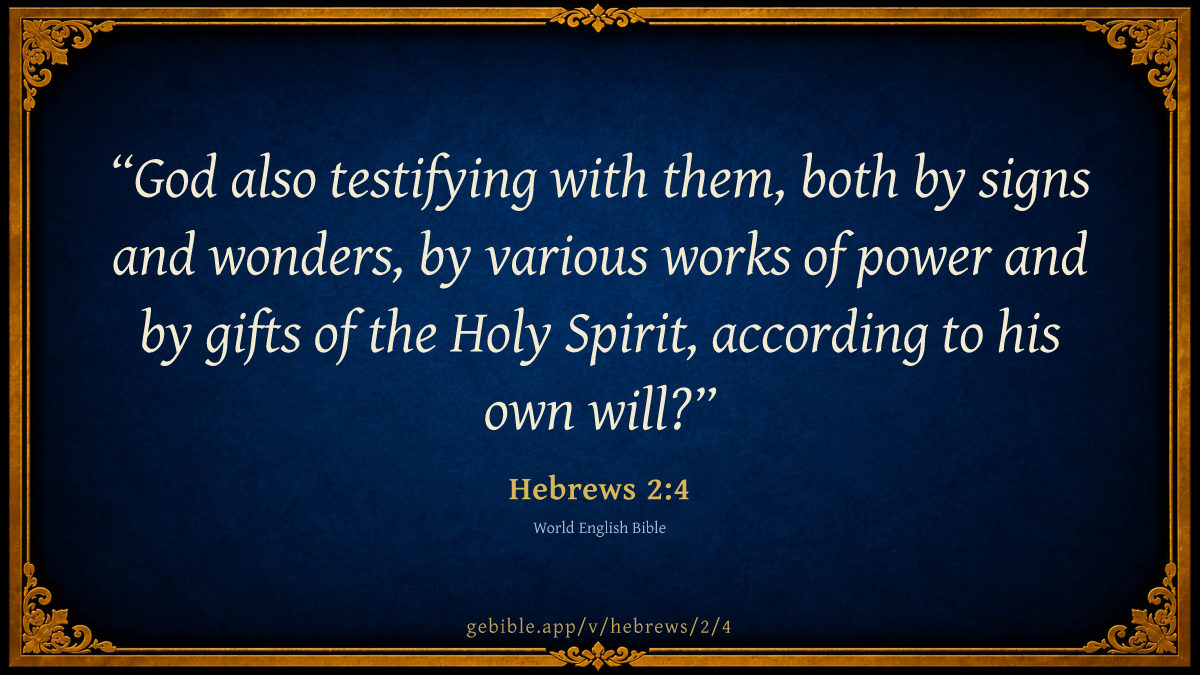
God also testifying with them, both by signs and wonders, by various works of power and by gifts of the Holy Spirit, according to his own will?
Parallel Translations
-
God also testifying with them, both by signs and wonders, by various works of power and by gifts of the Holy Spirit, according to his own will?
-
god bearynge witnes therto bothe with sygnes and wonders also and with divers miracles and gyftes of the holy gooste accordynge to his awne will.
-
God bearing witnes thereto, both with signes and wonders, and with diuers miracles, and gifts of the holy Ghost, according to his owne will?
Cross-references (14)
Passages linked to Hebrews 2:4 in the Treasury of Scripture Knowledge, ordered by reader-vote popularity; verse text shown in World English Bible.
- Acts 14:3 Therefore they stayed there a long time, speaking boldly in the Lord, who testified to the word of his grace, granting signs and wonders to be done by their hands.
- Mark 16:20 They went out, and preached everywhere, the Lord working with them, and confirming the word by the signs that followed. Amen.
- Ephesians 1:5 having predestined us for adoption as children through Jesus Christ to himself, according to the good pleasure of his desire,
- Romans 15:18-19 For I will not dare to speak of any things except those which Christ worked through me, for the obedience of the Gentiles, by word and deed, in the power of signs and wonders, in the power of God’s Spirit; so that from Jerusalem, and around as far as to Illyricum, I have fully preached the Good News of Christ;
- 1 Corinthians 12:4-11 Now there are various kinds of gifts, but the same Spirit. There are various kinds of service, and the same Lord. There are various kinds of workings, but the same God, who works all things in all. But to each one is given the manifestation of the Spirit for the profit of all. For to one is given through the Spirit the word of wisdom, and to another the word of knowledge, according to the same Spirit; to another faith, by the same Spirit; and to another gifts of healings, by the same Spirit; and to another workings of miracles; and to another prophecy; and to another discerning of spirits; to another different kinds of languages; and to another the interpretation of languages. But the one and the same Spirit produces all of these, distributing to each one separately as he desires.
- Ephesians 4:8-11 Therefore he says, “When he ascended on high, he led captivity captive, and gave gifts to people.” Now this, “He ascended”, what is it but that he also first descended into the lower parts of the earth? He who descended is the one who also ascended far above all the heavens, that he might fill all things. He gave some to be apostles; and some, prophets; and some, evangelists; and some, shepherds and teachers;
- Daniel 4:35 All the inhabitants of the earth are reputed as nothing; and he does according to his will in the army of heaven, and among the inhabitants of the earth; and no one can stop his hand, or ask him, “What are you doing?”
- John 4:48 Jesus therefore said to him, “Unless you see signs and wonders, you will in no way believe.”
- Acts 19:11-12 God worked special miracles by the hands of Paul, so that even handkerchiefs or aprons were carried away from his body to the sick, and the diseases departed from them, and the evil spirits went out.
- John 15:26 “When the Counselor has come, whom I will send to you from the Father, the Spirit of truth, who proceeds from the Father, he will testify about me.
- Acts 3:15-16 and killed the Prince of life, whom God raised from the dead, to which we are witnesses. By faith in his name, his name has made this man strong, whom you see and know. Yes, the faith which is through him has given him this perfect soundness in the presence of you all.
- Acts 2:32-33 This Jesus God raised up, to which we all are witnesses. Being therefore exalted by the right hand of God, and having received from the Father the promise of the Holy Spirit, he has poured out this, which you now see and hear.
- Ephesians 1:9 making known to us the mystery of his will, according to his good pleasure which he purposed in him
- Acts 4:10 may it be known to you all, and to all the people of Israel, that in the name of Jesus Christ of Nazareth, whom you crucified, whom God raised from the dead, this man stands here before you whole in him.
Cross-references from openbible.info (CC BY 4.0)
Explain this verse (18 sources)
Historical commentary, presented as a primary source — not an endorsement.
Private notes
Saved on this device only — never synced or sent anywhere.
John Calvin 1540 · Public Domain 4. God also bearing them witness, etc. In addition…
4. God also bearing them witness, etc. In addition to the fact, that the Apostles had what they preached from the Son of God, the Lord also proved his approbation of their preaching by miracles, as by a solemn subscription. Then they who do not reverently receive the Gospel recommended by such testimonies, disregard not only the word of God, but also his works.
He designates miracles, for the sake of amplifying their importance, by three names. They are called signs because they rouse men’s minds, that they may think of something higher that what appears; and wonders, because they present what is rare and unusual; and miracles, because the Lord shows in them a singular and an extraordinary evidence of his power.
Read full note →
As to the word, bearing witness, or attesting, it points out the right use of miracles, even that they serve to establish the Gospel. For almost all the miracles done in all ages were performed as we find for this end, that they might be the seals of Gods word. The more strange then is the superstition of the Papists, who employ their own fictitious miracles for the purpose of overthrowing the truth of God.
The conjunction συν, together with, has this meaning, that we are confirmed in the faith of the Gospel by the joint testimony of God and men; for God’s miracles were testimonies concurring with the voice of men.
He adds, by the gifts or distributions of the Holy Spirit, by which also the doctrine of the Gospel was adorned, of which they were the appendages. For why did God distribute the gifts of his Spirit, except in part that they might be helps in promulgating it, and in part that their might move through admiration the minds of men to obey it? Hence Paul says, that tongues were a sign to unbelievers. The words, according to his will, remind us, that the miracles mentioned could not be ascribed to any except to God alone, and that they were not wrought undesignedly, but, for the distinct purpose of sealing the truth of the Gospel.
John Calvin's Commentaries (1540-1563) — public domain. Text from the Calvin Translation Society English edition (1840s-50s) via the Christian Classics Ethereal Library (ccel.org). Calvin's coverage is partial (roughly two-thirds of the Bible); uncommented books and verses are honest gaps, never fabricated. The 19th-century editor's footnotes and remarks are omitted so the notes are faithfully Calvin's own voice.
Geneva Bible translators 1599 · Public Domain This is the true end of miracles. Now they…
This is the true end of miracles. Now they are called signs, because they appear one thing, and represent another: and they are called wonders, because they represent some strange and unaccustomed things and virtues, because they give us a glimpse of God’s mighty power.
Geneva Bible (1599) marginal notes — public domain.
John Trapp 1656 · Public Domain 4 God also bearing them witness, both with signs…
4 God also bearing them witness, both with signs and wonders, and with divers miracles, and gifts of the Holy Ghost, according to his own will?
Ver. 4. And with divers miracles] Whereby, as by the wings of the wind, the doctrine of the gospel was divulged at first. But he that now requireth a miracle, is himself a miracle. The establishing of the present reformation is and will be that miracle which we are in these times to look for. It is that which the former age had despaired of, the present admireth, and the future shall stand amazed at.
John Trapp, A Commentary or Exposition upon All the Books of the Old and New Testament (1647–1656) — public domain. Text from a community e-Sword module.
Matthew Poole 1685 · Public Domain God also bearing them witness: here is a further…
God also bearing them witness: here is a further aggravation of the neglect of the gospel of salvation, from God’s testifying to it by the works and gifts of his Holy Spirit: such sin grievously, and will receive a proportionable punishment; for God, the Father, Son, and Holy Spirit, cotestify with all those instruments confirming the gospel of salvation, with a testimony peculiarly fitted to it; yet in this joint witnessing God is the highest, and αυτος πιστος, only to be believed for himself.
Both with signs and wonders; by works above nature’s reach, signifying God’s being in and approving the gospel law, which they attend, Mar 16:17. More numerous and glorious were these than they which confirmed the law, Act 2:22,43; 4:30; such strange works as raised admiration in all that saw them, and are prodigious to those that hear of them, or read them, Rom 15:19.
Read full note →
And with divers miracles; miraculous works, such as are compassed only by a Divine, supernatural power; and variety of these, as healing all diseases, raising the dead, ejecting devils, Mar 16:17,18; works of as great mercy, as wisdom or power.
And gifts of the Holy Ghost, according to his own will; as gifts of tongues, prophecies, &c., Rom 12:6-8; compare 1Co 12:7-10; such as nature could not furnish any with, but the Redeemer did by his Spirit, commmunicating them to various persons of divers kinds and indifferent degrees. From, by, and for himself he giveth out these wonderful works; his will the only rule for time, persons, manner, and measure of their distribution, allotting all their portion, Rom 12:3; 1Co 7:17; 12:4,7,11,18; Eph 4:7.
Matthew Poole's English Annotations on the Holy Bible (1683–1685) — public domain. Text from a community e-Sword/MySword module.
William Burkitt 1703 · Public Domain Here we have a special reason assigned, why such…
Here we have a special reason assigned, why such as reject the gospel cannot escape divine wrath, because the gospel was first published and delivered by Jesus Christ; it was clearly, plainly, sweetly, and persuasively preached by himself first. The law was promulgated by angels, the gospel proclaimed by the Son of God, and afterwards by his apostles; and God confirmed their testimony by signs and wonders, by miraculous powers and gifts of the Holy Ghost: All which did signify God’s approbation of their doctrine, and gave the world a confirmation of the truth and excellency of it, and consequently gave credibility to it.
Here note, That as the law of Moses was confirmed by miracles, so was the gospel of Jesus also: nay, herein this was superior to that. Moses wrought signs and wonders, but the gifts of the Holy Ghost were peculiar to the times of the Messiah, and were the proper confirmation of the gospel dispensation.
Read full note →
Yet note farther, That though the apostles had a power to work miracles, yet it was according to God’s will, and not at their own pleasure; they could not work miracles when they pleased, not what they pleased: whence it was evident that not they, but God was the worker of them. And the more God’s over-ruling will was seen in the miracles then, the greater confirmation have we of the doctrine now: Which (gospel) was at first spoken by the Lord, and was confirmed unto us by divers miracles and gifts of the Holy Ghost.
William Burkitt's Expository Notes on the New Testament (1700–1703) — public domain. Text from a community e-Sword module.
John Gill 1763 · Public Domain For unto the angels,.... Though angels were concerned in…
For unto the angels,.... Though angels were concerned in the giving of the law, and were frequently employed under the former dispensation, in messages to men, and in making revelations of God's mind and will to them, yet to them
hath he not put in subjection the world to come, whereof we speak: by which is meant, not the future state of eternal glory and happiness in heaven, as opposed to this world, and the present state of things; though there may be much truth in this sense, as that the present world is in subjection to angels, and the world to come is not; the present world is much in subjection, though it is not put into subjection, to evil angels, who usurp a power over it, hence Satan is called the god and prince of this world; and it is in some sense in subjection to good angels, as they are used by God in the execution of his providential care and government, in influencing and assisting at the councils of princes, in inflicting God's judgments on kingdoms and nations, and in the special care of his own people: but the world to come, as opposed to this, is not at all subject to them; they are employed in carrying the souls of departed saints thither, and shall be with them there, and join with them in their service; but they will not be as kings, nor even as children, but as servants; much less is heaven at their dispose to give to whomsoever they please; it is only in this sense in subjection to Christ, the Prince of life, who has power to give eternal life to as many as the Father has given to him: but it is not of this world the apostle is speaking; he is speaking of something now, which bears this name, and in proof of it cites a passage out of Psa 8:1 where mention is made of sheep, and other things, which cannot refer to the world of glory: rather it designs the new heavens and new earth at the resurrection, and day of judgment, for these will not be put in subjection to angels; though of these the apostle is not speaking in the context: it seems therefore to intend the Gospel, and the Gospel dispensation and church state, in opposition to the Jewish state, and legal dispensation, which was called a world, and had in it a worldly sanctuary, and worldly ordinances, which is now at an end; and at the end of which Christ came, and then another world took place, here called "the world to come", as the times of the Messiah are frequently called by the Jews , "the world to come", the Gospel dispensation, the apostle was treating of in the preceding verses, in distinction from the law, the word spoken by angels; for the Gospel was not spoken by them, but by the Lord: the Gospel state is very properly the world to come, with respect to the Old Testament saints, who were looking for it, and in which old things are past away, and all things are become new; angels desire to look into the mysteries of it, and learn from the church the manifold wisdom of God; but not they, but men, are the dispensers of the doctrines of it; and Christ, he is the Head, King, Governor, and Father of this new world: so instead of "everlasting Father", the Septuagint render the clause , in Isa 9:6 "the Father of the age", or "world to come"; and hence mention is made in the Jewish writings of , "the world to come of the Messiah" (d).
Read full note →
(d) Targum in 1 Kings iv. 33.
John Gill's Exposition of the Whole Bible (1746–1763) — public domain (CC PDM 1.0). Text via the HelloAO Bible API.
John Wesley 1765 · Public Domain By signs and wonders - While he lived. And…
By signs and wonders - While he lived. And various miracles and distributions of the Holy Ghost - Miraculous gifts, distributed after his exaltation. According to his will - Not theirs who received them.
John Wesley, Explanatory Notes Upon the Whole Bible (1754–1765) — public domain. Text via the GEBible commentary corpus.
Adam Clarke 1810 · Public Domain Verse 4. God also bearing them witness] He did…
Verse 4. God also bearing them witness] He did not leave the confirmation of these great truths to the testimony of men; he bore his own testimony to them by signs, wonders, various miracles, and distributions of the Holy Ghost, Πνευματος 'Αγιου μερισμοις. And all these were proved to come from himself; for no man could do those miracles at his own pleasure, but the power to work them was given according to God's own will; or rather, God himself wrought them, in order to accredit the ministry of his servants.
For the meaning of signs, wonders, &c., See the note on "De 4:34".
Adam Clarke's Commentary on the Bible (1810–1826) — public domain. Text from a community e-Sword/MySword module.
Albert Barnes 1834 · Public Domain God also bearing them witness - By miracles. Giving…
God also bearing them witness - By miracles. Giving them the sanction of his authority, or showing that they were sent by him. No man can work a miracle by his own power. When the dead are raised, the deaf made to hear and the blind to see by a word, it is the power of God alone that does it. He thus becomes a “witness” to the divine appointment of him by whose instrumentality the miracle is performed; or furnishes an attestation that what he says is true; see notes on Act 14:3.
With signs and wonders. - These words are usually connected in the New Testament. The word rendered “signs” - σημεῖον sēmeion - means any miraculous event that is suited to show that what had been predicted by a prophet would certainly take place; see Mat 12:38; compare note on Isa 7:11. A “wonder” - τέρας teras - denotes a portent, or prodigy - something that is suited to excite wonder or amazement - and hence, a miracle. The words together refer to the various miracles which were performed by the Lord Jesus and his apostles, designed to confirm the truth of the Christian religion.
Read full note →
And with divers miracles. - Various miracles, such as healing the sick, raising the dead, etc. The miracles were not of one class merely, but were various, so that all pretence of deception should be taken away.
And gifts of the Holy Ghost. - Margin, “Distributions.” The various influences of the Holy Spirit enabling them to speak different languages, and to perform works beyond the power of man; see notes on 1Co 12:4-11.
According to his will - As he chose. He acted as a sovereign in this. He gave them where he pleased, and imparted them in such measure as he chose. The sense of this whole passage is, “The gospel has been promulgated to man in a solemn manner. It was first published by the Lord of glory himself. It was confirmed by the most impressive and solemn miracles. It is undoubtedly a revelation from heaven; was given in more solemn circumstances than the Law of Moses, and its threatenings are more to be dreaded than those of the Law. Beware, therefore, how you trifle with it, or disregard it. It cannot be neglected with safety; its neglect or rejection must be attended with condemnation.”
Albert Barnes' Notes on the Bible (1834–1885) — public domain. Text from a community e-Sword/MySword module.
Haydock's Catholic Bible Commentary 1859 · Public Domain The miraculous powers of the Almighty bestowed in the…
The miraculous powers of the Almighty bestowed in the early ages [centuries] of the Church, for the establishment and propagation of the faith, became afterwards less frequent, as there was less need of them; but they have ever been totally withdrawn, as some pretend, nor has there passed a single age from that of the apostles down to the present time, in which several most evident and stupendous miracles have not bee wrought in the Catholic Church.
George Leo Haydock (1774–1849), Haydock's Catholic Family Bible and Commentary, 1859 edition — public domain. Excludes Psalms (Douay-Rheims chapter numbering differs from Protestant) and Deuterocanonical books (Catholic canon only).
Robert Jamieson, A. R. Fausset & David Brown 1871 · Public Domain them--rather, "God also [as well as Christ, Heb 2:3]…
them--rather, "God also [as well as Christ, Heb 2:3] bearing witness to it," &c., joining in attestation of it."
signs and wonders--performed by Christ and His apostles. "Signs" and miracles, or other facts regarded as proofs of a divine mission; "wonders" are miracles viewed as prodigies, causing astonishment (Act 2:22, Act 2:33); "powers" are miracles viewed as evidences of superhuman power.
Read full note →
divers miracles--Greek, "varied (miraculous) powers" (Co2 12:12) granted to the apostles after the ascension.
gifts, &c.--Greek, "distributions." The gift of the Holy Spirit was given to Christ without measure (Joh 3:34), but to us it is distributed in various measures and operations (Rom 12:3, Rom 12:6, &c.; Co1 12:4-11).
according to his own will--God's free and sovereign will, assigning one gift of the Spirit to one, another to another (Act 5:32; Eph 1:5).
Jamieson, Fausset & Brown — Commentary Critical and Explanatory on the Whole Bible (1871) — public domain (CC PDM 1.0). Text via the HelloAO Bible API.
Daniel D. Whedon 1874 · Public Domain 4. Not angels, but Jesus, Lord of this dispensation,…
4. Not angels, but Jesus, Lord of this dispensation, Heb_2:5-8.
4. Bearing… witness—While the Lord was main speaker, God corroborated the divinity of his person and the truth of his announcements with signs and wonders. Signs implies their significance as proofs; wonders their startling supernaturalism; miracles their divine power, as dealings of omnipotence.
Read full note →
Gifts—Rather, distributions, distributive impartations.
Will—And according with his divine wisdom. The apostles could not work miracles at their own will.
Daniel D. Whedon (gen. ed.), Commentary on the Old and New Testaments (1874–1909) — public domain. Text from a community e-Sword module.
The Cambridge Bible for Schools and Colleges 1878 · Public Domain 4. God also bearing them witness] The original is…
4. God also bearing them witness] The original is stronger, “God bearing witness with them;” the supernatural witness coincided with the human.
both with signs and wonders, and with divers miracles] “Signs” to shew that there was a power behind their witness; “portents” to awaken the feeling of astonishment, and so arouse interest; and various “powers.” These are alluded to, or recorded, in Mar_16:20; Act_2:43; Act_19:11. St Paul himself appealed to his own “mighty signs and wonders” (Rom_15:18-19; 1Co_2:4).
Read full note →
and gifts of the Holy Ghost, according to his own will] The word “gifts” means rather “distributions” (Heb_4:12, “dividing”), and the words “according to His own will” apply only to this clause—the gifts which the Holy Spirit distributes as He wills (1Co_7:17; 1Co_12:11; Rom_12:3).
The Cambridge Bible for Schools and Colleges (gen. ed. J. J. S. Perowne; Cambridge University Press, 1878–1918) — public domain. Text from a community e-Sword module.
Ellicott's Commentary for English Readers 1878 · Public Domain (4) God also bearing them witness.—That is, bearing witness…
(4) God also bearing them witness.—That is, bearing witness with them to the truth they preached. Mar_16:20 is a striking parallel; see also Act_4:30. The divine attestation was given by miracles and by “gifts” (literally, distributions, as in the margin; see 1Co_12:11) “of the Holy Ghost.” We have here, as in Act_2:22 and 2Co_12:12 (see the Notes), the full threefold description of miracles, as “signs” and “wonders” and “powers”; as wonderful works that are wrought by divine power, and are thus signs of the divine presence and symbols of a corresponding spiritual work. The words here used are illustrated especially by 2Co_12:12, in its reference to miracles as attesting the apostolic preaching. But yet “greater works” (Joh_14:12) were wrought by the messengers of Christ, in that through them were bestowed the gifts of the Spirit. The last words, “according to His will,” bring us back to the first words of the section (Heb_1:1); as it is God who speaks to men in His Son, it is He who works with those who proclaim the word that they have heard, attesting their message by gifts according to His will.
A Bible Commentary for English Readers, edited by Charles John Ellicott (1878–1897) — public domain. Text from a community e-Sword module.
The Pulpit Commentary 1880 · Public Domain God also bearing them witness; rather, God attesting with…
God also bearing them witness; rather, God attesting with them. The word is sunepimarturountov , a double compound, meaning to attest jointly with others. The idea is that the hearers of "the Lord" testified, and God attested their testimony by the signs that accompanied their ministry. The passage is instructive as expressing the grounds of acceptance of the gospel. Its truth was already "confirmed" to believers by the testimony of unimpeachable witnesses to that which, so attested, carried with it its own evidence. But the signs attending the apostolic ministry were granted for further attestation. Thus "signs and wonders," the craving for which as a condition of belief was so condemned by our Lord, have their true evidential value assigned them. They did not furnish the original basis of belief, which rested on Christ himself, his Person. and his work, as unimpeachably attested. They came in only as suitable accompaniments of a Divine dispensation, and as additional confirmations. The apologists of the last generation were given to rest the evidence of Christianity too exclusively on miracles. The tendency of the present age is to dwell rather on its internal evidence, and, so far as it can be done, to explain away the miracles. They are not to be explained away, having been, as has been said, fitting accompaniments and confirmations of such a dispensation as the gospel was. But to us, as well as to those early believers, they are not the first or main ground of our belief. To us, as re them, Christ and his gospel, testified to as they are by" them that heard," are their own sufficient evidence. Indeed, the cogency of the "signs" in the way of evidence is less now than formerly, since they too have now passed into the category of things that rest on testimony. The evidential counterpart to them in our case is the continued attestation which God gives to the gospel in its living power on the souls of men, and its results in the world before our eyes. It is thus that our faith is strengthened in "the salvation at first spoken through the Lord, and confirmed to us by them that heard." Four expressions are used for the miraculous accompaniments of the first preaching of the gospel, denoting, apparently, not so much different classes of miracles, as different ways of regarding them. They were
(1) signs (shmeia), attesting the truth of what was preached;
Read full note →
(2) wonders (terata), something out of the common course of things, arresting attention;
(3) diverse powers (poikilai dunameiv), varying manifestations of a Divine power at work;
(4) distributions of the Holy Ghost (Pneumatov agiou merismoi), gifts of the Spirit to individual Christians apportioned variously the last expression having especial reference to the carismata of the apostolic Church, so often alluded to in St. Paul"s Epistles. The phrase, with that which follows, according to his own will, is peculiarly Pauline, and confirms the conclusion that the writer, though not necessarily St. Paul himself, was at any rate one of the circle influenced by his teaching.
The Pulpit Commentary (1880–1919), ed. H.D.M. Spence-Jones & Joseph S. Exell — public domain. Text from a community e-Sword module.
The Biblical Illustrator 1887 · Public Domain With signs and wonders, and with divers miracles
Heb_2:4
With signs and wonders, and with divers miracles
Read full note →
Signs, wonders, and miracles
1.
Signs, according to the notation of the word, imply such external visible things as signify and declare some memorable matter which otherwise could not be so well discerned, nor would be believed. We would see a sign from Thee say the Pharisees to Christ (Mat_12:38). And they desired Him that He would show them a sign (Mat_16:1). These two words, see, show, imply that a sign is of some external visible thing that may be showed and seen. And extraordinary it must be, because it useth to be for confirmation of s me secret and Divine matter. Thus the Pharisees would have a sign from heaven (Mat_16:1), which must needs be extraordinary. Thereupon signs and wonders arc oft joined together (Joh_4:48; Act_2:43; Act_4:30; Act_7:36).
2. The word translated wonder is used by all sorts of authors for some strange thing, that may seem to foretell some other thing to come. I will shew wonders in heaven, saith the Lord (Act_2:19). Those strange things which by the ministry of Moses were done in Egypt, in the Red Sea, and in the wilderness, are set out under this word wonders (Act_7:36). Our English doth fitly translate the Greek word wonders, by reason of the effect, they cause wonder; and by reason of the strangeness of them, they are wonderful (Mat_15:31; Mar_6:51; Act_3:10). Our English word miracle, according to the notation of the Latin word, whence it is taken, signifieth a matter of wonder.
3. The Greek word here translated miracles, properly signifieth powers. It is derived from a verb that signifieth to be able. This word in the singular number is put for a mans ability (Mat_25:15); for his strength 2Co_1:8); and also for strength in the sun (Rev_1:16); and in sin (1Co_15:56). It is also put for virtue in one Mar_5:30); and for the power or man (1Co_4:19); of a prophet (Luk_1:17); of the Spirit (Eph_3:16); of Christ 2Co_12:9); and of God (Mat_22:29). In the plural number it is put, for angels (Rom_8:38; 1Pe_3:22), which excel in strength(Psa_103:20). And for the firm and stable things in heaven (Mat_24:29); and for extraordinary works. Hereupon they are styled in our English, mighty deeds (2Co_12:12) mighty works (Mat_11:20-21; Mat_11:23); wonderful works (Mat_7:21); and frequently, as here in this text miracles (Act_2:22; Act_19:11; 1Co_12:10; 1Co_12:28-29). For miracles cannot be wrought but by an extraordinary power, even the power of God Himself. Fitly, therefore, is this word powers used to set out miracles, and fitly is it here, and in other places, translated miracles. (W. Gouge.)
Of the miracles wrought in confirmation of Christianity
Miracles are a Divine testimony given to a person or doctrine.
I. WHAT A MIRACLE IS. The shortest and plainest description I can give of it is this: that it is a supernatural effect, evident and wonderful to sense.
1. That it be a supernatural effect. By a supernatural effect I mean such an effect as either in itself or in its own nature, or in the manner and circumstances of it, exceeds any natural power that we know of to produce it.
2. There is another condition also required to a miracle, that it be an effect evident and wonderful to sense; for if we do not see it, it is to us as if it were not, and can be no testimony or proof of anything, because itself stands in need of another miracle to give testimony to it, and to prove that it was wrought; and neither in Scripture, nor profane authors, nor in common use of speech, is anything called a miracle, but what falls under the notice of our senses; a miracle being nothing else but a thing wonderful to sense; and the very end and design of it is to be a sensible proof and conviction to us of something which we do not see.
II. IN WHAT CIRCUMSTANCES, AND WITH WHAT CAUTIONS AND LIMITATIONS, MIRACLES GIVE TESTIMONY TO THE TRUTH AND DIVINITY OF ANY DOCTRINE.
1. The entire proof of the Christian doctrine or religion, consisting of many considerations, when taken together, make up a full demonstration of the truth of it, when perhaps no one of them, taken singly and by itself, is a convincing and undeniable proof.
2. But yet miracles are the principal external proof and confirmation of the divinity of a doctrine.
3. Especially if miracles have all the circumstances of advantage given to them which they are capable of; if they be many and great, public and unquestionable, and universal and of long continuance.
4. It cannot be denied, but that God doth sometimes permit miracles to be wrought for the countenancing of a false doctrine. So our Saviour tells us that the elect, that is, the true and sincere Christians, should not be deceived by the signs and wonders of the false Christs and false prophets. And therefore He was not afraid of having the credit of His doctrine weakened by foretelling that false prophets should work miracles; because He knew when the devil had done his utmost, the difference would be apparent enough between the confirmation which He had given to the Christian doctrine, and what the devil should be able to give to his instruments. As
(1) Either the doctrine would be absurd in itself, and such as no miracles can confirm. Or
(2) It would be contrary to that doctrine which had already bad a far greater and more Divine confirmation. Or
(3) The miracles which false prophets work are presently confuted, and upon the spot. Thus Moses confuted and conquered Pharaohs magicians, by working miracles which they could not work, which forced them to yield the cause, and acknowledge that it was the finger of God. And so likewise Simon Magus. Or else
(4) The miracles wrought, or pretended to be wrought, to confirm false doctrines, are such as do, some way or other, confute themselves; or if they be real, are sufficiently detected to be the pranks of the devil, and not the great and glorious works of God. Such were the miracles of the heathen deities, wrought so privately and obscurely, and confessedly mixed with so much of imposture, as to bring a just suspicion upon them that, when they were real, the devil was the author of them. And such were the miracles which are attributed to Mahomet.
1. What hath been said may satisfy us of the truth and divinity of the Christian doctrine, which had so eminent a testimony given t, it from heaven, and did at first so strangely prevail in the world, contrary to all human probability, not by might, nor by power, but by the Spirit of the Lord.
2. From hence we may judge how groundless the pretences are, which men nowadays make to inspiration and infallibility, because this is not to be proved and made out any other way but by miracles. For either we must believe every pretence of this kind; and then we are at the mercy of every crafty and confident man, to be led by him into what delusions he pleases; or we must only believe those who give Borne testimony of their inspiration; but the evidence of inspiration was always miracles.
3. You see what an immediate testimony from heaven God was pleased to give to the first preachers of the Christian doctrine, to qualify them with any probability of success, to contest with violent and almost invincible prejudices of men educated in a contrary religion, and which had the secular authority and laws on its side. For having this Divine seal given to their commission, they did as it were carry the letters-patents of heaven in their hands, and an authority paramount to that of human laws.
4. The consideration of what has been said, doth justly upbraid us, that our religion, which hath such evident marks of divinity upon it, and comes down to us confirmed by so many miracles, should yet have so little efficacy upon the lives of the greatest part of those who call themselves Christians.
Secondly, that God gave testimony to the apostles and first publishers of Christianity, in a very eminent manner.
1. At this time the Holy Ghost descended upon the apostles in miraculous powers and gifts; when this new law was to come forth out of Zion, and the Word of the Lord from Jerusalem. And among these gifts, the first we find mentioned was the gift of tongues, without which the gospel must of necessity have been very slowly propagated in the world.
2. The next miraculous gift I shall mention after the gift of tongues is the gift of prophecy, or foretelling things future, which was always looked upon as an evidence of inspiration.
3. The next gift is that of healing all manner of diseases.
4. The power of raising the dead, which hath always been esteemed one of the greatest and most unquestionable miracles of all other.
5. Another miraculous gift was that of discerning spirits, the principal use of which was to try and judge who were true prophets.
6. And, besides these which I have mentioned, there was likewise a power of inflicting corporal punishments and diseases upon scandalous and obstinate Christians, which in Scripture is called, a delivering men up to
Satan, for the destroying or tormenting of their bodies, that their souls might be saved at last. And of this kind were those diseases which befel the Christians for their disorderly and irregular carriage at the sacrament, of which the apostle speaks (1Co_11:30).
7. There was the power of casting out devils in the name of Christ, which was common to the meanest Christian, and continued in the Church a long time after most of the other gifts were ceased, as Tertullian, Minucius Felix, and Arnobius, do most expressly testify concerning their times.
III. THE REASON WHY THESE MIRACLES ARE NOW CEASED IN THE CHRISTIAN CHURCH, and have been for a long time, so that there have been no footsteps of this miraculous power for many ages.
I. THESE MIRACULOUS POWERS AND GIFTS HAVE CEASED IN THE CHURCH FOR SEVERAL AGES.
II. THERE IS NOT THE LIKE NECESSITY AND OCCASION FOR THEM THAT THERE WAS BEFORE. They were at first in a great degree necessary to introduce the gospel into the world, which was destitute of all other helps and advantages, to recommend it to the esteem and liking of mankind; to give credit to a new doctrine and religion, so contrary to the inveterate prejudices of men, bred up in another religion very different from this, and so opposite to the lusts and interests of men.
III. I come now TO ANSWER THAT OBJECTION from the innumerable miracles which have been, and still are pretended to be, wrought in the Church of Rome. And so indeed we find that, the Arians and other heretics in former times pretended to miracles, for the confirmation of their errors, a good while after miracles were generally ceased in the Christian Church, which shows that this is no new or strange thing.
1. The most learned and judicious writers of the Roman Church do acknowledge that there is no necessity of miracles, s now, and that Christianity is sufficiently established by the miracles which were wrought at first to give testimony to it; and therefore, not being necessary, without manifest evidence of fact, it, is not necessary to believe that they are continued.
2. The miracles pretended to by the Church of Rome are of very doubtful and suspected credit, even among the wisest persons of their own communion.
3. The miracles of the Church of Rome, supposing several of them to be true, have such marks and characters upon them, as render it very suspicious that they are not operations of God, or good spirits, but the working of Satan.
4. The miracles of the Church of Rome, taking them for true, are very impertinently and unseasonably wrought. When and where there is no need and occasion for them, they are very rife and frequent; but where there is greatest occasion for them and most reason to expect them, they are either not at all, or very rarely so much as pretended to.
5. Be from whom of all persons in that Church we might expect the most and greatest miracles, does not, so far as I can learn, pretend at all to that gift; I mean the head of their church, the Pope.
6. Most of the doctrines in difference between us and the Church of Rome, which they chiefly pretend to confirm by these miracles, are not capable of being confirmed by them. There are three sorts of doctrines, two of which are in their own nature incapable of being confirmed by a miracle, and a third upon supposition of its cent, artery to the Christian doctrine, which hath already had an unquestionable Divine confirmation.
(1) No doctrine which is contrary to sense, is capable of being confirmed by a miracle, as transubstantiation.
(2) No doctrine that does countenance or enjoin idolatry is capable of being confirmed by a miracle. This is evident from Deu_13:1-18.
(3) No doctrine contrary to any part of the Christian doctrine, which hath already received an unquestionable Divine confirmation, is capable of being confirmed by the miracles pretended to in the Church of Rome, if they were real.
7. The chief Prophecies of the New Testament, which are concerning false prophets, and concerning antichrist, have marked Him out by this character, that He should be a great worker of miracles and magnify Himself upon this pretence (Mat_24:24). (Archbp. Tillotson.)
Miracles not needed now
Now that the use of miracles is performed unto us and we do believe the gospel, in token that our faith is accepted of God, now He hath taken signs from us which served us before when we were unbelieving. And surely our faith is never so honourable, nor God so well pleased with us, as when we have said both to heaven and earth, we seek no signs from them: when the Word of God hath such a persuasion in our hearts, that we have now taken hold of all the good promises of God and said unto miracles, get you hence. The Jews seek a sign, saith St. Paul surely we that be Christians seek for none; when they were offered of God, He showed His compassion upon our infirmity; now He hath taken them away, He showed greater mercy that He accepteth our faith, and let us hearken to the Word of Christ; by it we shall live; if we believe it not, we would not believe all miracles in the world, no, though dead men should rise to preach unto us. For great miracles have been already done, not only by the apostles, but by Christ Himself, to confirm His word. If We believe not them it is too much childishness to think we would believe other. Signs were when doctrine was more obscure; now it is so clear the signs are gone. The Son of God once revenged the transgression of His law with the earth opening, with waters, with fire, with whirlwinds, that the people might fear. He doth not so now, because His threatenings have been heard of all flesh: Go ye cursed into eternal fire--a voice that pierceth between the marrow and the bones, with greater fear than the rage of earth or water. And Christ once showed loving signs to make His people put their trust in Him, but now He hath spoken in our hearts: Come ye blessed of My Father into everlasting life--a voice that goeth deeper into the soul and spirit than the hearing of all the miracles, by which Israel was led into the land of Canaan. And we shall do injury to our Saviour Christ if now we will ask that to these words He should add miracles, for if we bring faith to that which is spoken, it will fill our hearts with all fulness, and will sell the sight of all the miracles in the world to buy but one grain of a constant faith in Christ; wherein whosoever shall stumble, let him accuse himself if God give him over to his own blindness, that because he had no love to believe the truth, therefore he should be led with lies and deceivable things. (E. Deering, B. D.)
Gifts of the Holy Ghost
The gifts of the Holy Ghost
Gifts of the Holy Ghost were extraordinary qualities and powers given to such as heard the apostles doctrine and believed it; as power to heal, to speak in strange languages, to prophecy, to do miracles. They are said to be gifts and effects of the Holy Ghost, because they had them not by nature, or industry, or instruction by man, but from the power of God-Redeemer, and the Spirit of Christ. They are called in the original, distributions or divisions, because they were
1. Communicated to divers persons.
2. Were many of different kinds.
3. Were given in several degrees. They were distributed according to His own will.
(1) Freely.
(2) To whom He will.
(3) What gifts He will.
(4) In what measure He will. For there are diversities of gifts (1Co_12:4).
But all these worketh that one and the self-same Spirit, dividing to every man severally as He will (Heb_2:11). The effect of these miracles and gifts was the confirmation of the doctrine of the apostles, which they did confirm by word and deed. For
1. They did most certainly affirm and assert this doctrine, as baying heard it immediately of Christ, and as having received the immediate knowledge thereof from Him.
2. They did these signs, wonders, and mighty deeds, and upon the imposition of their hands, believers received the extraordinary gifts of the Holy Ghost, yet they neither did these miracles, nor gave these gifts by their own power or holiness. But the works were done, and the graces given by them as instruments, in the name of Christ as risen and glorified and from God. So that the power of God, the merit of Christ, their ministration, did all concur to the production of these glorious effects. God was the principal cause, therefore is it said, that by these God did bear them witness and attest their doctrine to he true, and from Him; so that this confirmation was a giving credibility to the doctrine of the gospel, so far as it was new,. and delivered the positive truths concerning Jesus of Nazareth, dying for our sins, rising again, sitting at the right hand of God, and the dependence of justification before the tribunal of God, and eternal glory upon faith in Him making intercession in heaven. For there was no need thus to cut, firm the ceremonials of Moses, and the covenant of God with
Israel before Mount Sinai to the Jew; for these things He made no doubt of, nor was this confirmation needful for to persuade the Gentile of the equity and justice of the morals of the Scripture, for the natural light of reason did approve them. These miracles and gifts were proofs very strong and powerful, for they were no juggling impostures or delusions, but real demonstrations of the Divine will, and clear to the senses. (G. Lawson.)
According to His own will
Of Gods will in ordering works and gifts
The forementioned diversity of miracles and distribution of gifts, were ordered and disposed according to the will of God. This act of distributing is attributed to God (1Co_7:17); to His Son (Eph_4:7); and to His Spirit (1Co_12:11). And for kind, number, and measure of gifts, all are ordered by the will of this one God according to His own will, not anothers; the Greek word intends as much. The will of God is that rule whereby all things are ordered that He Himself doth, and whereby all things ought to be ordered that creatures do. Hereupon Gods will is distinguished into His secret and revealed will (Deu_29:29). The secret will of God is called His counsel (Isa_46:10); the counsel of His will (Eph_1:11); His purpose (Rom_13:23): His pleasure (Isa_46:10); His good pleasure (Eph_1:9); the good pleasure of His will (Eph_1:5). The other is commonly called Gods Word, and that after the manner of men, because the ordinary means whereby men make known their minds is the word of their mouth, therefore the revelation of Gods will is called Gods Word, whether it be by an audible voice from God Himself (Mat_3:17), or by the ministry of angels (Heb_2:2), or by the ministry of men (Hos_1:2). This is also called the good and acceptable and perfect will of God (Rom_12:2). This revealed will of God is that which is principally intended in the second petition of the Lords prayer. Here Gods secret will is meant. This is that supreme and absolute will of God, by which all things are, and without which nothing can be (Psa_115:3; Eph_1:11; Rom_11:34). This is Gods only rule; He hath nothing else to regulate any purpose or act of His but His own will. As therefore He disposeth all things, so in special the gifts of the Holy Ghost according to His will. The grounds following do demonstrate the equity hereof.
1. God is the fountain whence all gifts flow (Jam_1:17). All are His; hereupon He thus presseth His right against such as were not contented with that portion which He gave them (Mat_20:15).
2. God is the most supreme Sovereign over all. He is the Lord and Master of all; He therefore hath power to order the places and duties and parts of all as He pleaseth, according to His own will (1Ch_28:4-5).
3. God is the wisest of all. He is wise in heart (Job_9:4); yea, mighty in wisdom (Job_36:5); His understanding is infinite (Psa_147:5); He is only wise (Rom_16:27). He therefore best knoweth what is fittest for every one, and He is fittest to order it according to His will.
4. Gods will is the rule of righteousness. Whatsoever is ordered thereby and agreeable thereto is righteous, and whatsoever cometh from it is altogether righteous. The Lord is righteous in all His ways, His ordering therefore of matters must needs be according to right and equity.
5. The Lord fitteth gifts and functions one to another. Such gifts as are needful for such a function and such a function as is fittest for such gifts Mat_25:15; Exo_31:2; Exo_31:8). This teacheth us every one to be content with our own measure which God hath proportioned to us, for we may be assured thereupon that it is the fittest and best Jot us. Hast thou a small measure? bear it patiently, that measure is fittest for thee. Hast thou a great measure? use it conscionably, that is fittest for thee. We are exhorted earnestly to covet the best gifts (1Co_12:31), and to seek to 1Co_14:12), and to grow up in all things (Eph_4:15). None of these, nor any such like exhortations are contrary to Christian contentedness.
For
1. Though a man covet a more excellent gift than God hath Ordained for him, yet when he seeth that God hath bestowed such and such a gift upon him less than his desire, he may quietly subject himself to Gods wise disposition and rest contented therewith. For the will of God being nosy made known unto him, he may persuade himself that the gift he hath is b,-st for him.
2. Seeking to excel is not ambitiously to strive for the highest places and greatest offices in the Church (as Diotrephes did, 3Jn_1:9), but every one to strive in his one place to do most god in Gods Church. This, therefore, is the full exhortation: Seek that you may excel to the edifying of the Church (1Co_14:12). So as this teacheth us how to make the bent use of the place wherein God hath set us, and of the parts which He hath given us.
3. A continual growth in grace is no more opposite to Christian contentedness than the growth of the little tinge, is to the place wherein it is set. Growth and contentedness may well stand together, yea, they always go together. Growth in grace received showeth our good liking thereof, and that we think it the fittest for us; and are thereupon stirred up to nourish and cherish it, to keep it from decay, and to increase it more and more. (W. Gouge.)
The Biblical Illustrator, edited by Joseph S. Exell (c. 1880s–1900s) — public domain. Text from a community e-Sword module.
B. W. Johnson 1891 · Public Domain 4. God bearing them witness. God bore witness to…
4. God bearing them witness. God bore witness to the truth of their words by the signs and wonders of Pentecost. He also bore witness afterwards by giving them miraculous powers, and by the extraordinary gifts of the Holy Spirit. Note that when he Law was given on Sinai God bore witness by signs and wonders. Also when the gospel, the message of Christ, was given on Mt. Zion God bore witness with signs and wonders.
B. W. Johnson's The People's New Testament with Notes (1889–1891) — public domain. Electronic text from the Christian Classics Ethereal Library (CCEL) ThML edition.
Tyndale Open Study Notes 2022 · CC BY-SA 4.0 2:4 God confirmed the message (literally God bore witness):…
2:4 God confirmed the message (literally God bore witness): God himself confirmed the validity of the message of Christ and his followers by giving signs and wonders and various miracles and gifts of the Holy Spirit (see Acts 2:22; Rom 15:19; 2 Cor 12:12).
Tyndale Open Study Notes — © Tyndale Open Resources, licensed CC BY-SA 4.0. Text via the HelloAO Bible API.