
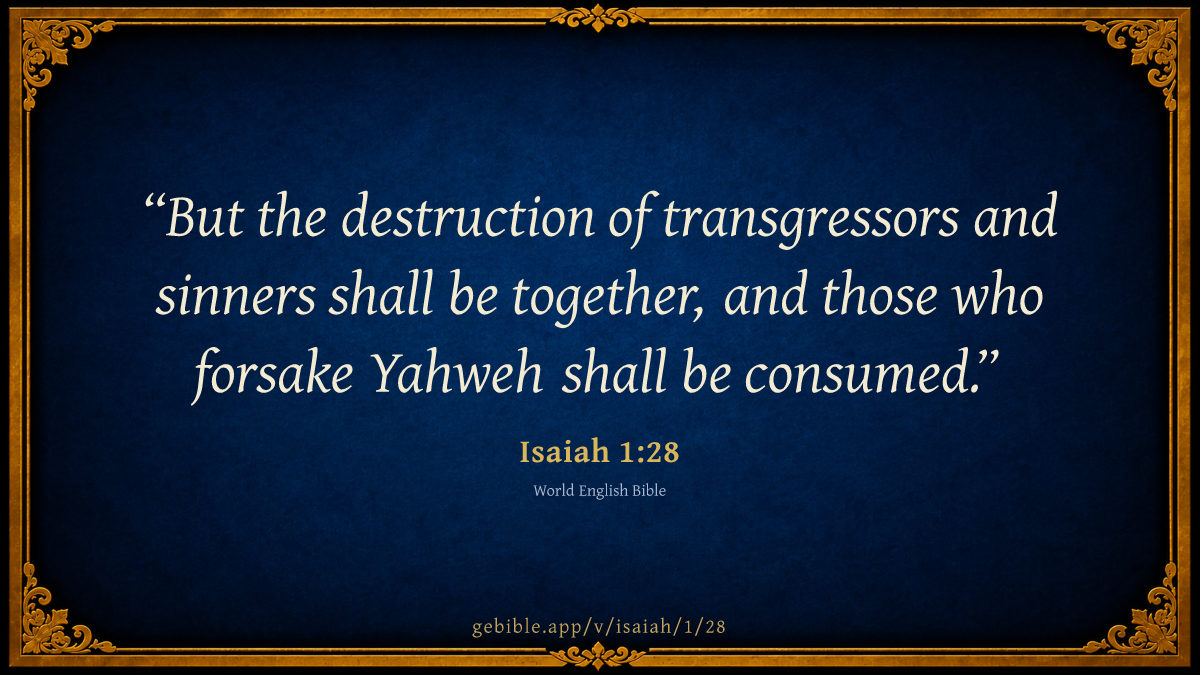
But the destruction of transgressors and sinners shall be together, and those who forsake Yahweh shall be consumed.
Parallel Translations
-
But the destruction of transgressors and sinners shall be together, and those who forsake Yahweh shall be consumed.
-
And the destruction of the transgressors and of the sinners shall be together, and they that forsake the LORD shall be consumed.
-
But the destruction of the transgressors and the sinners shall be together, and they that forsake the LORD shall be consumed.
Cross-references (23)
Passages linked to Isaiah 1:28 in the Treasury of Scripture Knowledge, ordered by reader-vote popularity; verse text shown in World English Bible.
- Psalms 1:6 For Yahweh knows the way of the righteous, but the way of the wicked shall perish.
- 2 Thessalonians 1:8-9 punishing those who don’t know God, and to those who don’t obey the Good News of our Lord Jesus, who will pay the penalty: eternal destruction from the face of the Lord and from the glory of his might,
- Job 31:3 Is it not calamity to the unrighteous, and disaster to the workers of iniquity?
- Isaiah 30:13 therefore this iniquity shall be to you like a breach ready to fall, swelling out in a high wall, whose breaking comes suddenly in an instant.
- Revelation 21:8 But for the cowardly, unbelieving, sinners, abominable, murderers, sexually immoral, sorcerers, idolaters, and all liars, their part is in the lake that burns with fire and sulfur, which is the second death.”
- 1 Samuel 12:25 But if you keep doing evil, you will be consumed, both you and your king.”
- 1 Kings 9:6-9 But if you turn away from following me, you or your children, and not keep my commandments and my statutes which I have set before you, but go and serve other gods, and worship them; then I will cut off Israel out of the land which I have given them; and I will cast this house, which I have made holy for my name, out of my sight; and Israel will be a proverb and a byword among all peoples. Though this house is so high, yet everyone who passes by it will be astonished and hiss; and they will say, ‘Why has Yahweh done this to this land, and to this house?’ and they will answer, ‘Because they abandoned Yahweh their God, who brought their fathers out of the land of Egypt, and embraced other gods, and worshiped them, and served them. Therefore Yahweh has brought all this evil on them.’ ”
- 1 Chronicles 28:9 You, Solomon my son, know the God of your father, and serve him with a perfect heart and with a willing mind; for Yahweh searches all hearts, and understands all the imaginations of the thoughts. If you seek him, he will be found by you; but if you forsake him, he will cast you off forever.
- Psalms 5:6 You will destroy those who speak lies. Yahweh abhors the bloodthirsty and deceitful man.
- Psalms 9:5 You have rebuked the nations. You have destroyed the wicked. You have blotted out their name forever and ever.
- Psalms 37:38 As for transgressors, they shall be destroyed together. The future of the wicked shall be cut off.
- Psalms 73:27 For, behold, those who are far from you shall perish. You have destroyed all those who are unfaithful to you.
- Psalms 92:9 For, behold, your enemies, Yahweh, for, behold, your enemies shall perish. All the evildoers will be scattered.
- Psalms 104:35 Let sinners be consumed out of the earth. Let the wicked be no more. Bless Yahweh, my soul. Praise Yah!
- Psalms 125:5 But as for those who turn away to their crooked ways, Yahweh will lead them away with the workers of iniquity. Peace be on Israel.
- Proverbs 29:1 He who is often rebuked and stiffens his neck will be destroyed suddenly, with no remedy.
- Isaiah 50:11 Behold, all you who kindle a fire, who adorn yourselves with torches around yourselves, walk in the flame of your fire, and among the torches that you have kindled. You will have this from my hand: you will lie down in sorrow.
- Isaiah 65:11 “But you who forsake Yahweh, who forget my holy mountain, who prepare a table for Fortune, and who fill up mixed wine to Destiny;
- Isaiah 66:24 “They will go out, and look at the dead bodies of the men who have transgressed against me; for their worm will not die, nor will their fire be quenched, and they will be loathsome to all mankind.”
- Zephaniah 1:4-6 I will stretch out my hand against Judah, and against all the inhabitants of Jerusalem. I will cut off the remnant of Baal from this place: the name of the idolatrous and pagan priests, those who worship the army of the sky on the housetops, those who worship and swear by Yahweh and also swear by Malcam, those who have turned back from following Yahweh, and those who haven’t sought Yahweh nor inquired after him.
- Luke 12:45-46 But if that servant says in his heart, ‘My lord delays his coming,’ and begins to beat the menservants and the maidservants, and to eat and drink, and to be drunken, then the lord of that servant will come in a day when he isn’t expecting him, and in an hour that he doesn’t know, and will cut him in two, and place his portion with the unfaithful.
- 1 Thessalonians 5:3 For when they are saying, “Peace and safety,” then sudden destruction will come on them, like birth pains on a pregnant woman. Then they will in no way escape.
- 2 Peter 3:7 But the heavens that exist now and the earth, by the same word have been stored up for fire, being reserved against the day of judgment and destruction of ungodly men.
Cross-references from openbible.info (CC BY 4.0)
Explain this verse (12 sources)
Historical commentary, presented as a primary source — not an endorsement.
Private notes
Saved on this device only — never synced or sent anywhere.
Geneva Bible translators 1599 · Public Domain The wicked shall not be partakers of God’s promise,…
The wicked shall not be partakers of God’s promise, Ps. 92:9.
Geneva Bible (1599) marginal notes — public domain.
John Trapp 1656 · Public Domain Isa 1:28 And the destruction of the transgressors and…
Isa 1:28 And the destruction of the transgressors and of the sinners [shall be] together, and they that forsake the LORD shall be consumed.
Ver. 28. And the destruction.] Heb., The shivering or shattering. Tremellius rendereth it, the fragments or scraps - sc., of the dross above mentioned; these shall be broken and burnt together.
Read full note →
Shall be together.] As well the sinners in Zion, or hypocrites, as the transgressors or notorious offenders, shall be destroyed without distinction. Such as "turn aside unto their crooked ways" - stealing their passage to hell, as it were - the Lord shall "lead them forth with the workers of iniquity," with openly profane persons. {Psa 125:5} The angels also shall bundle them up together to be burnt. {Mat 13:30}
John Trapp, A Commentary or Exposition upon All the Books of the Old and New Testament (1647–1656) — public domain. Text from a community e-Sword module.
Matthew Poole 1685 · Public Domain And; or rather, but, as that particle is oft…
And; or rather, but, as that particle is oft used; for here is a manifest opposition.
The destruction of the transgressors and of the sinners shall be together; though I will deliver my people from the Babylonish captivity, yet those of them who shall still go on in their wickedness shall not have the benefit of that mercy, but are reserved for a more dreadful and total destruction.
Matthew Poole's English Annotations on the Holy Bible (1683–1685) — public domain. Text from a community e-Sword/MySword module.
John Gill 1763 · Public Domain And the destruction of the transgressors and of the…
And the destruction of the transgressors and of the sinners shall be together,.... Of the beast and false prophet, of the followers of antichrist, the man of sin, who are transgressors of the law of God, and sinners against the Lord; the destruction of these, or the breaking of them into shivers, as the word (o) signifies, see Rev 2:27 will be at the time of Zion's redemption, and make a part of it; and it shall be all at once and together; these sinners will be all together consumed out of the earth, and these wicked antichristian ones will be no more in it, Psa 104:35.
and they that forsake the Lord; his word, his worship and ordinances; as the Papists have manifestly done, by setting up their own unwritten traditions against the word of God, by adulterating his ordinances, and introducing new ones, and by worshipping images of gold, silver, brass, and wood;
Read full note →
wherefore they shall be consumed; with the breath of Christ's mouth, and with the brightness of his coming, Th2 2:8.
(o) "contritio sive confractio", Syr.
John Gill's Exposition of the Whole Bible (1746–1763) — public domain (CC PDM 1.0). Text via the HelloAO Bible API.
Albert Barnes 1834 · Public Domain And the destruction - Hebrew שׁבר sheber - the…
And the destruction - Hebrew שׁבר sheber - the breaking, or crushing, that is, the punishment which was about to come upon them; compare Lam 2:11; Lam 3:47; Pro 16:18.
Of the transgressors - “Revolters,” or those that rebel against God.
Read full note →
And of the sinners - Of all the sinners in the nation, of all kinds and degrees.
Together - At the same time with the redemption of Zion.
Shall be consumed - יכלוּ yı̂kelû, from כלה kâlâh, to be completed, or finished; to be consumed, wasted away; to vanish, or disappear. It denotes complete and entire extinction; or the completing of anything. It is applied to a cloud of smoke, that entirely dissolves and disappears:
As the cloud is consumed and vanisheth away:
So he that goeth down to the grave shall come up no more,
Job 7:9.
But the wicked shall perish,
And the enemies of the Lord shall be as the fat of lambs;
They shall consume,
Into smoke shall they cosume away.
Psa 37:20.
It is applied to time, as vanishing and disappearing Job 7:6; and to the destruction or perishing of men; Jer 16:4; Eze 5:13. The idea is that of complete and entire consumption and destruction, so that none shall be left. Applied to future punishment, it means that the destruction of sinners shall be total and complete. There shall be no sinner who shall not be destroyed; and there shall be none destroyed whose destruction shall not be entire and total. The expression here refers to the heavy calamities which were about to come upon the guilty nation, but it is as descriptive of the future punishment that shall come upon the wicked.
Albert Barnes' Notes on the Bible (1834–1885) — public domain. Text from a community e-Sword/MySword module.
Robert Jamieson, A. R. Fausset & David Brown 1871 · Public Domain destruction--literally, "breaking into shivers" (Rev 2:27). The prophets hasten…
destruction--literally, "breaking into shivers" (Rev 2:27). The prophets hasten forward to the final extinction of the ungodly (Psa 37:20; Rev 19:20; Rev 20:15); of which antecedent judgments are types.
Jamieson, Fausset & Brown — Commentary Critical and Explanatory on the Whole Bible (1871) — public domain (CC PDM 1.0). Text via the HelloAO Bible API.
Daniel D. Whedon 1874 · Public Domain 28. Destruction… transgressors — Literally, there shall be a…
28. Destruction… transgressors — Literally, there shall be a breaking, or entire crushing out, of apostates, revolters, deserters from Jehovah.
They that forsake — An equivalent expression to apostates; they shall come to an end, be destroyed totally. The characters in the first of the chapter are here referred to. See Psa_37:20; Psa_37:38.
Daniel D. Whedon (gen. ed.), Commentary on the Old and New Testaments (1874–1909) — public domain. Text from a community e-Sword module.
The Cambridge Bible for Schools and Colleges 1878 · Public Domain 28. And the destruction … together] Better as an…
28. And the destruction … together] Better as an exclamation: But destruction of rebels and sinners together! Rebels, sinners, forsakers of Jehovah, as in Isa_1:2-4.
The Cambridge Bible for Schools and Colleges (gen. ed. J. J. S. Perowne; Cambridge University Press, 1878–1918) — public domain. Text from a community e-Sword module.
Ellicott's Commentary for English Readers 1878 · Public Domain (28) Of the transgressors and of the sinners.—The first…
(28) Of the transgressors and of the sinners.—The first of the two words presents evil in its aspect of apostasy, the second in that of the open sin which may accompany the apostasy or exist without it.
A Bible Commentary for English Readers, edited by Charles John Ellicott (1878–1897) — public domain. Text from a community e-Sword module.
The Pulpit Commentary 1880 · Public Domain Transgressors... sinners... they that forsake the Lord (comp. vers.…
Transgressors... sinners... they that forsake the Lord (comp. vers. 2 and 4). These are scarcely distinct classes rather different names for the ungodly. All of them, by whatever name they were called, would perish "together."
The Pulpit Commentary (1880–1919), ed. H.D.M. Spence-Jones & Joseph S. Exell — public domain. Text from a community e-Sword module.
The Biblical Illustrator 1887 · Public Domain They that forsake the Lord shall be consumed
Isa_1:28
They that forsake the Lord shall be consumed
Read full note →
Forsaking the Lord
I.
THE GUILT OF FORSAKING THE SERVICE OF THE LORD.
1. Man is bound by the law of his nature to obey that Almighty Being by whom he was made an intelligent and immortal creature.
2. Many in forsaking the Lord violate their own express and solemn engagements. (Heb_10:29.)
II. THE FOLLY OF FORSAKING THE SERVICE OF THE LORD. If we do so we shall--
1. Incur the reproaches of our own mind.
2. Forfeit the esteem and confidence of all good men.
3. Forfeit the favour and incur the wrath of God. And for what are all those tremendous sacrifices made? For the pleasures of sin, which are but for a season!
III. THE DANGER OF FORSAKING THE SERVICE OF THE LORD. Shall be consumed. The threatened doom is--
1. Awful.
2. Certain. (J. H. Hobart, D. D.)
The Biblical Illustrator, edited by Joseph S. Exell (c. 1880s–1900s) — public domain. Text from a community e-Sword module.
The Preacher's Complete Homiletical Commentary 1892 · Public Domain Isa_1:28-31. They that forsake the Lord shall be consumed.…
THE DOOM OF THE APOSTATES
Isa_1:28-31. They that forsake the Lord shall be consumed. For they [472] shall be ashamed of the oaks which ye [475] have denied, and ye shall be confounded for the gardens that ye have chosen. For ye shall be as an oak whose leaf fadeth, and as a garden that hath no water. And the strong shall be as tow, and the maker of it as a spark, and they shall both burn together, and none shall quench them.
Read full note →
[472] In Isa_1:29 is an instance of what seemed to Lowth’s classical taste a corrupt reading—“They shall be ashamed of the oaks which ye have desired.” But this variation of the persons of the verb is not unusual in Hebrew, and certainly no corruption. Indeed, if we look at Psalms 91, which is very artistically constructed, we shall see reason to think that what jars so harshly on a classically trained ear was a beauty to the Hebrew poets.—Strachey.
[475] “Which ye have desired.” He was speaking of “the sinners,” he suddenly turns round to the men of his own generation, and says, “You are the men who are thus storing up shame and confusion.”—Kay.
In modern days, when men “forsake the Lord,” they become simply irreligious—practical atheists; but in ancient times such men became idolaters, they became worshippers of idols set up under the “oaks” planted on the hilltops, or in gardens [478] It is almost impossible for us to understand the fascination of idol-worship, but it was very powerful, and the idols were made objects of passionate trust. They were regarded as the strength of those who served them. Trusting in their protection their votaries went forth confidently to battle. Defeat did not dispel this delusion; it was interpreted to mean merely that the god of the victors was mightier than the god of the vanquished. To men glorying in their false deities, and confiding in their protection, the prophet predicts utter destruction. You shall be consumed, he says; the day is at hand when ye shall be caused to blush for your gods; you yourselves shall be withered oaks, and gardens without water; yea, your idols, and ye who have made them, for they are but things, the work of your hands, shall be burned together in unquenchable fire [481] The theme of these verses is therefore the doom of the apostates, and of the objects of their trust.
[478] In the judgments and the restoration which the prophet foretells, he declares that the people shall learn the worthlessness of the idols which they have been worshipping under the oak-trees, and in the sacred groves and gardens. The worship of the high places was partly a local worship of Jehovah, which only became irregular and blameable in later times; but there was also a widespread worship of Baal, Astarte, and Moloch, the old gods of the Canaanites and other nations, in sacred groves and gardens, as well as on the hill-tops—a worship of impersonated and deified sensuality and cruelty—which sometimes even established itself within the precincts of the temple itself, and was still more readily blended with, or substituted for, the worship of Jehovah in the high places. And this idolatrous worship was going on in Judæa during the reigns of Uzziah and Jotham, at the same time with the temple services, as appears from 2Ki_15:3-4, compared with 2Ch_27:2. In the day of judgment and restoration, says the prophet, these men who have been flourishing in their sin like their oaks, and living in pleasures like those of their well-watered gardens, shall find that the idols to which these oaks and gardens are dedicated have no power to save them from a destruction which shall make them “as an oak whose leaf fadeth, and as a garden that hath no water,” images which will be the more forcible if we remember that in a southern climate trees fade rather from excessive heat than from seasonable cold, and a garden without water is a mere desert of sand. Then shall the strong, the mighty, and the unjust ruler become tow, and his idols, the work of his hands, a spark; they shall both burn together, and no man shall quench them.—Strachey.
[481] The interpretation of Isa_1:31 on which the above outline is based is that of Calvin and the earlier Protestant commentators. That which in modern days has been almost universally adopted, is given in the preceding extract from Strachey, and the homiletic use to which it may be put is indicated in the next outline: “The tow and the spark.” We are persuaded, however, that the earlier interpretation is that which is most in harmony with the scope of the whole passage. All the ancient versions treat הָסו as an abstract, meaning strength, and Dr. Alexander admits that “this agrees well with its form, resembling that of an infinitive or verbal noun.” Latterly it has become the fashion to translate it “strong man,” but the harmony of the whole passage is best maintained by rendering it “their strength,” that is, that which the idolaters have regarded as their “strength,” the deity in whose protection they have trusted.
I. Idolatry is still the sin of our race. It is not confined to “heathen” lands. There is need in this land for a proclamation of the first commandment. For what is idolatry in its essence? It is loving and trusting some being or thing more than God. Every man’s God is what he lives for. Hence the declaration that “covetousness is idolatry; it is one form of the widespread sin.
II. The confidence of men in their idols is still limitless and exultant. Every idolater is persuaded that that which he lives for is worth living for; this is the conviction of the miser, the ambitious man, &c.
III. The time is at hand when the falsity of this confidence shall be exposed. There are coming upon those who cherish it calamities amid which they will seek in vain for comfort from their “idols.” How often this is verified in daily life! In the withered, desolate condition of those who have forsaken the Lord how awfully is their folly demonstrated!
IV. Yea, there is a day appointing in which all idolaters and their idols shall be consumed together. In the day of judgment the worshippers of Dagon, of Astarte, of Baal, and of Brahm will not be the only persons on whom utter destruction shall come: those who have made gold their confidence, &c., shall be burned up, together with their “gods.” The objects of their trust shall be as powerless as is “tow” to resist flame, and they themselves shall be but as “sparks,” swept away by the blast of the Divine indignation.
Application.—
1. The day of judgment is a great reality; it is no mere dream of theologians, it is A TREMENDOUS FACT with which we shall soon be brought face to face.
2. This fact should govern us in selecting the object of our supreme love and trust.
3. It should prevent us from envying those who have forsaken the Lord, because of the temporary prosperity in which they are rejoicing [484]
4. It should make us earnest in our endeavours to reclaim them from their apostasy while the day of Divine long-suffering and mercy still continues.
[484] O sirs! do wicked men purchase their present pleasures at so dear a rate as eternal torments, and do we envy their enjoyment of them so short a time? Would any envy a man going to execution because he saw him in a prison nobly feasted, and nobly attended, and bravely courted? or because he saw him go up the ladder with a gold chain about his neck, and a scarlet gown upon his back? or because he saw him walk to execution through pleasant fields or delightsome gardens? or because there went before him drums beating, colours flying, and trumpets sounding? &c. Surely no! Oh, no more should we envy the grandeur of the men of the world, for every step they take is but a step to an eternal execution.—Brooks, 1628–1680.
What reason have we to envy the wicked in their riches and prosperity? If a man be standing firmly on a river’s bank, and sees another gliding gaily but inevitably down to a tremendous precipice below, shall he be envious of the pleasant sail that intervenes before the dread catastrophe? Shall he stand and envy him, and wish to exchange places with him? Oh no, but let him rather cry aloud, and warn him of his danger. Let him hasten to the rescue; throw out his arms with right good-will, and if it may be, save a soul from death.—Nason.
The Preacher's Complete Homiletical Commentary (gen. ed. Joseph S. Exell; Funk & Wagnalls, c. 1892) — public domain (pre-1929). A full-Bible homiletical/sermon-outline anthology covering 65 of 66 books (2 John is absent from the source module). Text from a community e-Sword module.