
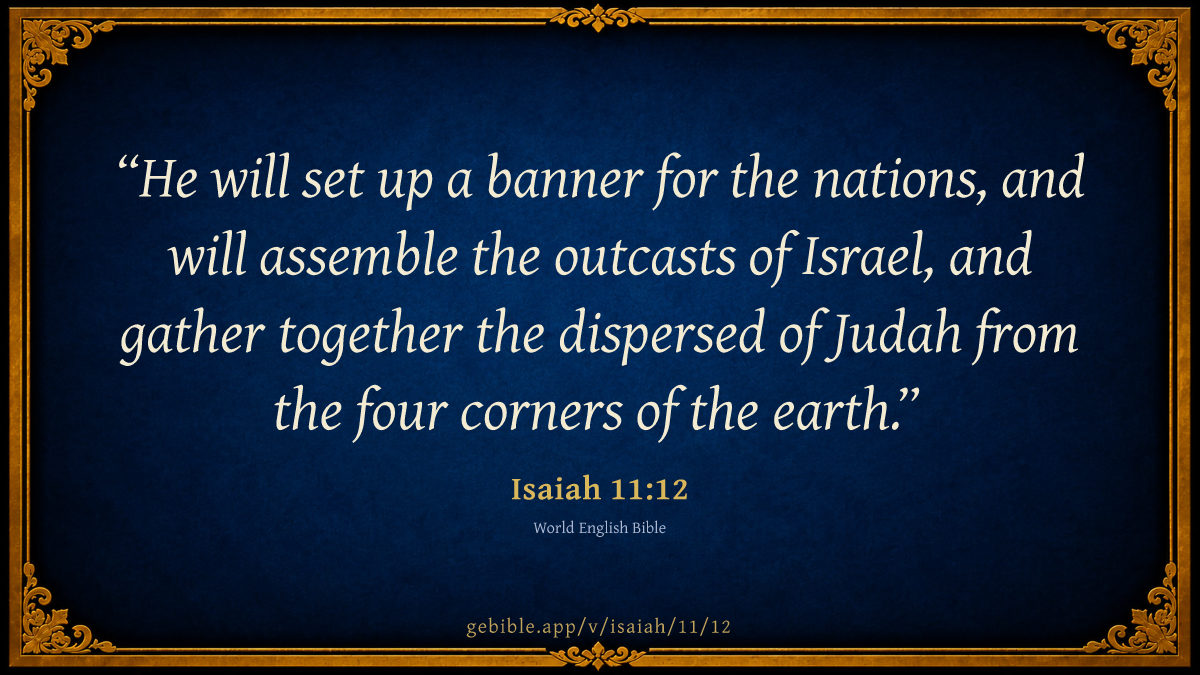
He will set up a banner for the nations, and will assemble the outcasts of Israel, and gather together the dispersed of Judah from the four corners of the earth.
Parallel Translations
-
He will set up a banner for the nations, and will assemble the outcasts of Israel, and gather together the dispersed of Judah from the four corners of the earth.
-
And he shall set up an ensign for the nations, and shall assemble the outcasts of Israel, and gather together the dispersed of Judah from the four corners of the earth.
-
And He will set up an ensign for the nations, and will assemble the dispersed of Israel, and gather together the scattered of Judah from the four corners of the earth.
Examined in Scripture Analysis
Science (1)
Historical claims about the natural world, weighed against the scientific record.
Cross-references (16)
Passages linked to Isaiah 11:12 in the Treasury of Scripture Knowledge, ordered by reader-vote popularity; verse text shown in World English Bible.
- Isaiah 43:6 I will tell the north, ‘Give them up!’ and tell the south, ‘Don’t hold them back! Bring my sons from far away, and my daughters from the ends of the earth—
- Isaiah 56:8 The Lord Yahweh, who gathers the outcasts of Israel, says, “I will yet gather others to him, in addition to his own who are gathered.”
- Psalms 147:2 Yahweh builds up Jerusalem. He gathers together the outcasts of Israel.
- Zephaniah 3:10 From beyond the rivers of Cush, my worshipers, even the daughter of my dispersed people, will bring my offering.
- Isaiah 11:10 It will happen in that day that the nations will seek the root of Jesse, who stands as a banner of the peoples; and his resting place will be glorious.
- Zechariah 10:6 “I will strengthen the house of Judah, and I will save the house of Joseph, and I will bring them back; for I have mercy on them; and they will be as though I had not cast them off: for I am Yahweh their God, and I will hear them.
- Psalms 68:22 The Lord said, “I will bring you again from Bashan, I will bring you again from the depths of the sea,
- Isaiah 27:13 It will happen in that day that a great trumpet will be blown; and those who were ready to perish in the land of Assyria, and those who were outcasts in the land of Egypt, shall come; and they will worship Yahweh in the holy mountain at Jerusalem.
- Isaiah 49:11-12 I will make all my mountains a road, and my highways shall be exalted. Behold, these shall come from afar, and behold, these from the north and from the west; and these from the land of Sinim.”
- Deuteronomy 32:26 I said that I would scatter them afar. I would make their memory to cease from among men;
- Isaiah 18:3 All you inhabitants of the world, and you dwellers on the earth, when a banner is lifted up on the mountains, look! When the trumpet is blown, listen!
- Isaiah 59:19 So they will fear Yahweh’s name from the west, and his glory from the rising of the sun; for he will come as a rushing stream, which Yahweh’s breath drives.
- Isaiah 62:10 Go through, go through the gates! Prepare the way of the people! Build up, build up the highway! Gather out the stones! Lift up a banner for the peoples.
- John 7:35 The Jews therefore said among themselves, “Where will this man go that we won’t find him? Will he go to the Dispersion among the Greeks, and teach the Greeks?
- James 1:1 James, a servant of God and of the Lord Jesus Christ, to the twelve tribes which are in the Dispersion: Greetings.
- Revelation 5:9 They sang a new song, saying, “You are worthy to take the book and to open its seals: for you were killed, and bought us for God with your blood out of every tribe, language, people, and nation,
Cross-references from openbible.info (CC BY 4.0)
Explain this verse (11 sources)
Historical commentary, presented as a primary source — not an endorsement.
Private notes
Saved on this device only — never synced or sent anywhere.
John Trapp 1656 · Public Domain Isa 11:12 And he shall set up an ensign…
Isa 11:12 And he shall set up an ensign for the nations, and shall assemble the outcasts of Israel, and gather together the dispersed of Judah from the four corners of the earth.
Ver. 12. And he shall set up an ensign.] {a} See on Isa 11:10.
Read full note →
The dispersed of Judah.] {b} See Joh 7:35 Jas 1:1. The word dispersed in the Hebrew is feminine, to show that no sort or sex shall be excluded. {Col 3:11}
{a} Elevatio signi est praedicatio crucifixi. - Oecolamp.
{b} Dispersas oves Iudae. - Piscat.
John Trapp, A Commentary or Exposition upon All the Books of the Old and New Testament (1647–1656) — public domain. Text from a community e-Sword module.
Matthew Poole 1685 · Public Domain For the nations; all nations, Jews and Gentiles, who…
For the nations; all nations, Jews and Gentiles, who shall then embrace the true faith and the Messiah, as was said, Isa 11:10.
The outcasts; that were driven and banished out of their own land into foreign parts, as the word implies.
Read full note →
Of Israel; strictly so called, or of the ten tribes, as is manifest, both from their opposition to Judah in this verse, and from the mention of Ephraim in the next verse.
Matthew Poole's English Annotations on the Holy Bible (1683–1685) — public domain. Text from a community e-Sword/MySword module.
John Gill 1763 · Public Domain And he shall set up an ensign for the…
And he shall set up an ensign for the nations,.... For the gathering of them, for the calling of the Gentiles, that is, the Lord would do it; he who before is said to set his hand a second time to recover his people, whether among Jews or Gentiles; this he has done in the ministration of the Gospel, in which Christ is lifted up and held forth as the only Saviour of lost sinners, the sole author and glorious Captain of salvation, for them to flee to, and lay hold on; and this he still does, and will continue to do, until all his people are gathered in from the several parts of the world:
and shall assemble the outcasts of Israel; so those of his people among the ten tribes, that were scattered about in various countries, when the Gospel was preached throughout the world by the apostles, were called by it, and gathered into Gospel churches among the Gentiles, of whom the first churches of Christ consisted; and so it will be in the latter day, when all Israel shall be saved:
Read full note →
and gather together the dispersed of Judah; the Jews, scattered about like lost sheep, among each of the nations of the world; some of which were looked up, and found out, and brought into the sheepfold, in the first times of Christianity; and others will be in the latter day:
even from the four corners of the earth: which shows that this cannot intend the return of the Jews from the Babylonish captivity, which was only from one corner of the earth; The Targum is,
"from the four winds of the earth;''
a phrase the same with that in Rev 7:1.
John Gill's Exposition of the Whole Bible (1746–1763) — public domain (CC PDM 1.0). Text via the HelloAO Bible API.
John Wesley 1765 · Public Domain Nations - All nations, Jews and Gentiles. Out-casts -…
Nations - All nations, Jews and Gentiles. Out-casts - That were driven out of their own land, into foreign parts. Israel - Of the ten tribes.
John Wesley, Explanatory Notes Upon the Whole Bible (1754–1765) — public domain. Text via the GEBible commentary corpus.
Albert Barnes 1834 · Public Domain And he shall set up an ensign - See…
And he shall set up an ensign - See Isa 11:10. The Messiah shall stand in view of the nations, as a standard is erected by a military leader. An ensign or standard was usually lifted up on the mountains or on some elevated place (compare Isa 18:3); and the meaning here is, that the Messiah would be the conspicuous object around which the nations would rally.
And shall assemble - This word, אסף 'âsaph, properly means, to gather, collect, to assemble together, as fruits are collected for preservation Exo 23:10; to collect a people together Num 21:16; to gather or collect gold; 2Ki 22:4. It may also mean to gather or collect anything for destruction Jer 8:13; and hence, to take out of the way, to kill, destroy; 1Sa 15:6. Here, it is evidently synonymous with the word ‘recover’ in Isa 11:11. It cannot be proved that it means that God will “literally” re-assemble all the scattered Jews, for the “collecting them,” or regathering them to himself “as his people,” though they may be still scattered among the nations, is all that the words necessarily imply. Thus when the word is used, as it is repeatedly, to denote the death of the patriarchs, where it is said they were ‘gathered to their fathers,’ it does not mean that they were buried in the same grave, or the same vicinity, but that they were united to them in death; they partook of the same lot; they all alike went down to the dead; Gen 25:8; Gen 35:29; Gen 49:29; Num 20:24; Deu 32:50.
Read full note →
The outcasts of Israel - The name ‘Israel,’ applied at first to all the descendants of Jacob, came at length to denote the ‘kingdom of Israel,’ or of the ‘ten tribes,’ or of ‘Ephraim,’ as the tribes which revolted under Jeroboam were called. In this sense it is used in the Scriptures after the time of Jeroboam, and thus it acquired a technical signification, distinguishing it from Judah.
The dispersed of Judah - ‘Judah,’ also, though often used in a general sense to denote the Jews as such, without reference to the distinction in tribes, is also used technically to denote the kingdom of Judah, as distinguished from the kingdom of Israel. The tribe of Judah was much larger than Benjamin, and the name of the latter was lost in the former. A considerable part of the ten tribes returned again to their own land, with those of the tribes of Judah and Benjamin; a portion remained still in the countries of the East, and were intermingled with the other Jews who remained there. All distinctions of the tribes were gradually abolished, and there is no reason to think that the ‘ten tribes,’ here referred to by the name ‘Israel,’ have now anywhere a distinct and separate existence; see this point fully proved in a review of Dr. Grant’s work on ‘” The Nestorians, or, the Lost Ten tribes,”’ in the “Bib. Rep.” for October 1841, and January 1842, by Prof. Robinson. The literal meaning here then would be, that he would gather the remains of those scattered people, whether pertaining to ‘Israel’ or ‘Judah,’ from the regions where they were dispersed.
It does not necessarily mean that they would be regathered in their distinctive capacity as ‘Israel’ and ‘Judah,’ or that the distinction would be still preserved, but that the people of God would be gathered together, and that all sources of alienation and discord would cease. The meaning, probably, is, that under the Messiah all the remains of that scattered people, in all parts of the earth, whether originally pertaining to ‘Israel’ or ‘Judah,’ should be collected into one spiritual kingdom, constituting one happy and harmonious people. To the fulfillment of this, it is not necessary to be supposed that they would be literally gathered into one place, or that they would be restored to their own land, or that they would be preserved as a distinct and separate community. The leading idea is, that the Messiah would set up a glorious kingdom in which all causes of alienation and discord would cease.
From the four corners of the earth - Chaldee, ‘From the four winds of the earth.’ The Septuagint renders it, ‘From the four wings (πτερύγων pterugōn) of the earth.’ It means, that they should be collected to God from each of the four parts of the earth - the east, the west, the north, and the south. The Hebrew word rendered here ‘corners,’ means properly “wings.” It is applied, however, to the corner, or border of a thing, as a skirt, or mantle 1Sa 24:5, 1Sa 24:11; Deu 23:1; and hence, to the boundaries, or corners of the earth, because the earth seems to have been represented as a quadrangular plain; Eze 7:2.
Albert Barnes' Notes on the Bible (1834–1885) — public domain. Text from a community e-Sword/MySword module.
Robert Jamieson, A. R. Fausset & David Brown 1871 · Public Domain In the first restoration Judah alone was restored, with…
In the first restoration Judah alone was restored, with perhaps some few of Israel (the ten tribes): in the future restoration both are expressly specified (Eze 37:16-19; Jer 3:18). To Israel are ascribed the "outcasts" (masculine); to Judah the "dispersed" (feminine), as the former have been longer and more utterly castaways (though not finally) than the latter (Joh 7:52). The masculine and feminine conjoined express the universality of the restoration.
from the four corners of the earth--Hebrew, "wings of the earth."
Jamieson, Fausset & Brown — Commentary Critical and Explanatory on the Whole Bible (1871) — public domain (CC PDM 1.0). Text via the HelloAO Bible API.
The Cambridge Bible for Schools and Colleges 1878 · Public Domain 12. The meaning of the “signal” here is explained…
12. The meaning of the “signal” here is explained by ch. Isa_49:22; it is a signal to the nations to release or even to bring back the exiles.
the dispersed of Judah] The participle in Hebr. is fem. This may be “a short way of expressing that both sexes will be included” (Cheyne). Giesebrecht, however, explains it by the favourite emblem (with later writers) of a scattered flock (Eze_34:4 ff.; Zep_3:19).
Read full note →
the four corners (lit. “edges,” Deu_22:12) of the earth] The expression occurs only in Eze_7:2 (of the land); Job_37:3; Job_38:13 (cf. Isa_24:16).
The Cambridge Bible for Schools and Colleges (gen. ed. J. J. S. Perowne; Cambridge University Press, 1878–1918) — public domain. Text from a community e-Sword module.
Ellicott's Commentary for English Readers 1878 · Public Domain (12) And he shall set up an ensign .…
(12) And he shall set up an ensign . . .—The thought of Isa_11:10 re-appears. The “signal” is, as before, “the root of Jesse,” and the exiles gather round it. In the Hebrew the “outcasts” are men, and the “dispersed” are women, the prophet thus implying that in the case of both Israel and Judah both sexes should alike be sharers in the blessings of restoration.
A Bible Commentary for English Readers, edited by Charles John Ellicott (1878–1897) — public domain. Text from a community e-Sword module.
The Pulpit Commentary 1880 · Public Domain He shall set up an ensign for the nations…
He shall set up an ensign for the nations (comp. ver. 10). Christ is the Ensign. God sets it up to draw the nations to his standard. The outcasts of Israel... the dispersed of Judah. "Outcasts" is masculine, "the dispersed" feminine. The meaning is, "He shall gather together the outcasts and dispersed of both Israel and Judah, both male and female."
The Pulpit Commentary (1880–1919), ed. H.D.M. Spence-Jones & Joseph S. Exell — public domain. Text from a community e-Sword module.
The Expositor's Bible 1887 · Public Domain
CHAPTER VI
GOD: A SACRAMENT
Read full note →
Isa_40:12-16
SUCH are the Four Voices which herald the day of Israels redemption. They are scarcely silent, before the Sun Himself uprises, and horizon after horizon of His empire is displayed to the eyes of His starved and waiting people. From the prologue of the prophecy, in Isa_40:1-11, we advance to the presentation, in Isa_40:12-31 and Isaiah 41, of its primary and governing truth-the sovereignty and omnipotence of God, the God of Israel.
We may well call this truth the sun of the new day which Israel is about to enter. For as it is the sun which makes the day, and not the day which reveals the sun; so it is God, supreme and almighty, who interprets, predicts, and controls His peoples history, and not their history, which, in its gradual evolution, is to make Gods sovereignty and omnipotence manifest to their experience. Let us clearly understand this. The prophecy, which we are about to follow, is an argument not so much from history to God as from God to history. Israel already have their God; and it is because He is what He is, and what they ought to know Him to be, that they are bidden believe that their future shall take a certain course. The prophet begins with God, and everything follows from God. All that in these chapters lends light or force, all that interprets the history of today and fills tomorrow with hope, fact, and promise alike, the captivity of Israel, the appearance of Cyrus, the fall of Babylon, Israels redemption, the extension of their mission to the ends of the earth, the conversion of the Gentiles, the equipment, discipline, and triumph of the Servant Himself, -we may even say the expanded geography of our prophet, the countries which for the first time emerge from the distant west within the vision of a Hebrew seer, -all are due to that primary truth about God with which we are now presented. It is Gods sovereignty which brings such far-off things into the interest of Israel; it is Gods omnipotence which renders such impossible things practicable. And as with the subjects, so with the style of the following chapters. The prophets style is throughout the effect of his perfect and brilliant monotheism. It is the thought of God which everywhere kindles his imagination. His most splendid passages are those, in which he soars to some lofty vision of the Divine glory in creation or history; while his frequent sarcasm and ridicule owe their effectiveness to the sudden scorn with which, from such a view, scattering epigrams the while, he sweeps down upon the heathens poor images, or Israels grudging thoughts of his God. The breadth and the force of his imagination, the sweep of his rhetoric, the intensity of his scorn, may all be traced to his sense of Gods sovereignty, and are the signs to us of how absolutely he was possessed by this as his main and governing truth.
This, then, being the sun of Israels coming day, we may call what we find Isa_40:12-31 and Isaiah 41 the sunrise-the full revelation and uprising on oursight of this original gospel of the prophet. It is addressed to two classes of men; in Isa_11:12-31 to Israel, but in chapter 41 (for the greater part, at least) to the Gentiles. In dealing with these two classes the prophet makes a great difference. To Israel he presents their God, as it were, in sacrament; but to the Gentiles he urges Gods claims in challenge and argument. It is to the past that he summons Israel, and to what they ought to know already about their God; it is to the future, to history yet unmade, that he proposes to the Gentiles they should together appeal, in order to see whether his God or their gods are the true Deity. In this chapter we shall deal with the first of these-God in sacrament.
The fact is familiar to all, that the Old Testament nowhere feels the necessity of proving the existence of God. That would have been a proof unintelligible to those to whom its prophets addressed themselves. In the time when the Old Testament came to him, man as little doubted the existence of God as he doubted his own life. But as life sometimes burned low, needing replenishment, so faith would grow despondent and morbid, needing to be led away from objects which only starved it, or produced, as idolatry did, the veriest delirium of a religion. A man had to get his faith lifted from the thoughts of his own mind and the works of his own hand, to be borne upon and nourished by the works of God, -to kindle with the sunrise, to broaden out by the sight of the firmament, to deepen as he faced the spaces of night, -and win calmness and strength to think life into order as he looked forth upon the marshalled hosts of heaven, having all the time no doubt that the God who created and guided these was his God. Therefore, when psalmist or prophet calls Israel to lift their eyes to the hills, or to behold how the heavens declare the glory of God, or to listen to that unbroken tradition, which day passes to day and night to night, of the knowledge of the Creator, it is not proofs to doubting minds which he offers: it is spiritual nourishment to hungry souls. These are not arguments - they are sacraments. When we Christians go to the Lords Supper, we go not to have the Lord proved to us, but to feed upon a life and a love of whose existence we are past all doubt. Our sacrament fills all the mouths by which needy faith is fed-such as outward sight, and imagination, and memory, and wonder, and love. Now very much what the Lords Supper is to us for fellowship with God and feeding upon Him, that were the glory of the heavens, and the everlasting hills, and the depth of the sea, and the vision of the stars to the Hebrews. They were the sacraments of God. By them faith was fed, and the spirit of man entered into the enjoyment of God, whose existence indeed he had never doubted, but whom he had lost, forgotten, or misunderstood.
Now it is as such a minister of sacrament to Gods starved and disheartened people that our prophet appears in Isa_40:12-31.
There were three elements in Israels starvation. Firstly, for nearly fifty years they had been deprived of the accustomed ordinances of religion. Temple and altar had perished; the common praise and the national religious fellowship were impossible; the traditional symbols of the faith lay far out of sight; there was at best only a precarious ministry of the Word. But, in the second place, this famine of the Word and of Sacraments was aggravated by the fact that history had gone against the people. To the baser minds among them, always ready to grant their allegiance to success, this could only mean that the gods of the heathen had triumphed over Jehovah. It is little wonder that such experience, assisted by the presentation, at every turn in their ways, of idols and a splendid idol-worship, the fashion and delight of the populations through whom they were mixed, should have tempted many Jews to feed their starved hearts at the shrines of their conquerors gods. But the result could only be the further atrophy of their religious nature. It has been held as a reason for the worship of idols that they excite the affection and imagination of the worshipper. They do no such thing: they starve and they stunt these. The image reacts upon the imagination, infects it with its own narrowness and poverty, till mans noblest creative faculty becomes the slave of its own poor toy. But, thirdly, if the loftier spirits in Israel refused to believe that Jehovah, exalted in righteousness, could be less than the brutal deities whom Babylon vaunted over Him, they were flung back upon the sorrowful conviction that their God had cast them off; that He had retreated from the patronage of so unworthy a people into the veiled depths of His own nature. Then upon that heaven, from which no answer came to those who were once its favourites, they cast we can scarcely tell what reflection of their own weary and spiritless estate. As, standing over a city by night, you will see the majestic darkness above stained and distorted into shapes of pain or wrath by the upcast of the citys broken, murky lights, so many of the nobler exiles saw upon the blank, unanswering heaven a horrible mirage of their own trouble and fear. Their weariness said, He is weary; the ruin of their national life reflected itself as the frustration of His purposes; their accusing conscience saw the darkness of His counsel relieved only by streaks of wrath.
But none of these tendencies in Israel went so far as to deny that there was a God, or even to doubt His existence. This, as we have said, was nowhere yet the temptation of mankind. When the Jew lapsed from that true faith, which we have seen his nation carry into exile, he fell into one of the two tempers just described-devotion to false gods in the shape of idols, or despondency consequent upon false notions of the true God. It is against these tempers, one after another, that Isa_40:12-31 is directed. And so we understand why, though the prophet is here declaring the basis and spring of all his subsequent prophecy, he does not adopt the method of abstract argument. He is not treating with men who have had no true knowledge of God in the past, or whose intellect questions Gods reality. He is treating with men who have a national heritage of truth about God, but they have forgotten it; who have hearts full of religious affection, but it has been betrayed; who have a devout imagination, but it has been starved; who have hopes, but they are faint unto death. He will recall to them their heritage, rally their shrinking convictions by the courage of his own faith, feed their hunger after righteousness by a new hope set to noble music, and display to the imagination that has been stunted by so long looking upon the face of idols the wide horizons of Divine glory in earth and heaven.
His style corresponds to his purpose. He does not syllogise; he exhorts, recalls, and convicts by assertion. The passage is a series of questions, rallies, and promises. "Have ye not known? have ye not heard?" is his chief note. Instead of arranging facts in history or nature as in themselves a proof for God, he mentions them only by way of provoking inward recollections. His sharp questions are as hooks to draw from his hearers hearts their timid and starved convictions, that he may nourish these upon the sacramental glories of nature and of history.
Such a purpose and style trust little to method, and it would be useless to search for any strict division of strophes in the passage. The following, however, is a manifest division of subject, according to the two tempers to which the prophet had to appeal. Isa_40:12-25, and perhaps Isa_40:26, are addressed to the idolatrous Jews. But in Isa_40:26 there is a transition to the despair of the nobler hearts in Israel, who, though they continued to believe in the One True God, imagined that He had abandoned them; and to such Isa_40:27-31 are undoubtedly addressed. The different treatment accorded to the two classes is striking. The former of these the prophet does not call by any title of the people of God; with the latter he pleads by a dear double name that he may win them through every recollection of their gracious past, Jacob and Israel (Isa_40:27). Challenge and sarcasm are his style with the idolaters, his language clashing out in bursts too loud and rapid sometimes for the grammar, as in Isa_40:24; but with the despondent his way is gentle persuasiveness, with music that swells and brightens steadily, passing without a break from the minor key of pleading to the major of glorious promise.
1. AGAINST THE IDOLATERS. A couple of sarcastic sentences upon idols and their manufacture (Isa_40:19-20) stand between two majestic declarations of Gods glory in nature and in history (Isa_40:12-17 and Isa_40:21-24). It is an appeal from the worshippers images to their imagination. "Who hath measured in his hollow hand the waters, and heaven ruled off with a span? Or caught in a tierce the dust of the earth, and weighed in scales mountains, and hills in a balance? Who hath directed the spirit of Jehovah, and as man of His counsel hath helped Him to know? With whom took He counsel, that such a one informed Him and taught Him in the orthodox path, and taught Him knowledge and helped Him to know the way of intelligence?" The term translated "orthodox path" is literally "path of ordinance or judgment, the regular path," and is doubtless to be taken along with its parallel, "way of intelligence," as a conventional phrase of education, which the prophet employed to make his sarcasm the stronger. "Lo nations! as a drop from a bucket, and like dust in a balance, are they reckoned. Lo the Isles! as a trifle He lifteth. And Lebanon is by no means enough for burning, nor its brute-life enough for an offering. All the nations are as nothing before Him, as spent and as waste are they reckoned for Him."
When he has thus soared enough, as on an archangels wings, he swoops with one rapid question down from the height of his imagination upon the images.
"To whom then will ye liken God, and what likeness will ye range by Him?"
"The image! A smith cast it, and a smelter plates it with gold, and smelts silver chains. He that is straitened for an offering-he chooseth a tree that does not rot, seeks to him a cunning carver to set up an image that will not totter."
The image shrivels up in face of that imagination; the idol is abolished by laughter. There is here, and for almost the first time in history, the same intellectual intolerance of images, the same burning sense of the unreasonableness of their worship, which has marked all monotheists, and turned even the meekest of their kind into fierce scorners and satirists-Elijah, Mohammed, Luther, and Knox. We hear this laughter from them all. Sometimes it may sound truculent or even brutal, but let us remember what is behind it. When we hear it condemned-as, in the interests of art and imagination, its puritan outbursts have often been condemned-as a barbarian incapacity to sympathise with the aesthetic instincts of man, or to appreciate the influence of a beautiful and elevating cult, we can reply that it was the imagination itself which often inspired both the laughter at, and the breaking of, images, and that, because the iconoclast had a loftier vision of God than the image-maker, he has, on the whole, more really furthered the progress of art than the artist whose works he has destroyed. It is certain, for instance, that no one would exchange the beauties of the prophecy now before us, with its sublime imaginations of God, for all the beauty of all the idols of Babylonia which it consigned to destruction. And we dare to say the same of two other epochs, when the uncompromising zeal of monotheists crushed to the dust the fruits of centuries of Christian art. The Koran is not often appealed to as a model of poetry, but it contains passages whose imagination of God, broad as the horizon of the desert of its birth, and swift and clear as the desert dawn, may be regarded as infinitely more than compensation-from a purely artistic point of view - for the countless works of Christian ritual and imagery which it inspired the rude cavalry of the desert to trample beneath the hoofs of their horses. And again, if we are to blame the reformers of Western Christendom for the cruelty with which they lifted their hammers against the carved work of the sanctuary, do not let us forget how much of the spirit of the best modem art is to be traced to their more spiritual and lofty conceptions of God. No one will question how much Miltons imagination owed to his Protestantism, or how much Carlyles dramatic genius was the result of his Puritan faith. But it is to the spirit of the Reformation, as it liberated the worshippers soul from bondage to artificial and ecclesiastical symbols of the Deity, that we may also ascribe a large part of the force of that movement towards Nature add the imagination of God in His creation which inspired, for example, Wordsworths poetry, and those visual sacraments of rainbow, storm, and dawn to which Browning so often lifts our souls from their dissatisfaction with ritual or with argument.
From his sarcasm on the idols our prophet returns to his task of drawing forth Israels memory and imagination. "Have ye not known? Have ye not heard? Hath it not been told you from the beginning? Have ye not understood from the foundations of the earth? He that is enthroned above the circle of the earth, and its dwellers are before Him as grasshoppers; who stretcheth as a fine veil the heavens, and spreadeth them like a dwelling tent" (that is, as easily as if they were not even a pavilion or marquee, but only a humble dwelling tent). "He who bringeth great men to nothing, the judges of the earth He maketh as waste. Yea, they were not planted; yea, they were not sown; yea, their root had not struck in the earth, but (immediately) He blew upon them and they withered, and a whirlwind like stubble carried them away. To whom, then, will ye liken Me, that I may match with him? saith the Holy One." But this time it is not necessary to suggest the idols; they were dissolved by that previous burst of laughter. Therefore, the prophet turns to the other class in Israel with whom he has to deal.
2. TO THE DESPAIRERS OF THE LORD. From history we pass back to nature in Isa_40:26, which forms a transition, the language growing steadier from the impetuosity of the address to the idolaters to the serene music of the second part. Enough rebuke has the prophet made. As he now lifts his peoples vision to the stars, it is not to shame their idols, but to feed their hearts. "Lift up on high your eyes and see! Who hath created these? Who leads forth by number their host, and all of them calleth by name, by abundance of might, for He is powerful in strength, not one is amissing." Under such a night, that veils the confusion of earth only to bring forth all the majesty and order of heaven, we feel a moments pause. Then as the expanding eyes of the exiles gaze upon the infinite power above, the prophet goes on. "Why then sayest thou, O Jacob, and speakest, O Israel? Hidden is my way from Jehovah, and from my God my right hath passed."
Why does the prophet point his people to the stars? Because he is among Israel on that vast Babylonian plain, from whose crowded and confused populations, struggling upon one monotonous level, there is no escape for the heart but to the stars. Think of that plain when Nebuchadrezzar was its tyrant; of the countless families of men torn from their far homes and crushed through one another upon its surface; of the ancient liberties that were trampled in that servitude, of the languages that were stifled in that Babel, of the many patriotisms set to sigh themselves out into the tyrants mud and mortar! Ah heaven! was there a God in thee, that one man could thus crush nations in his vat, as men crushed shell-fish in those days, to dye his imperial purple? Was there any Providence above, that he could tear peoples from the lands and seas, where their various gifts and offices for humanity had been developed, and press them to his selfish and monotonous servitude? In that medley of nations, all upon one level of captivity, Israel was just as lost as the most insignificant tribe; her history severed, her worship impossible, her very language threatened with decay. No wonder, that from the stifling crowd and desperate flatness of it all she cried, "Hidden is my way from Jehovah, and from my God my right hath passed."
But from the flatness and the crowd the stars are visible; and it was upon the stars that the prophet bade his people feed their hearts. There were order and unfailing guidance; "for the greatness of His might not one is missing." And He is your God. Just as visible as those countless stars are, one by one, in the dark heavens, to your eyes looking up, so your lives and fortunes are to His eyes looking down on this Babel of peoples. "He gathereth the outcasts of Israel. He telleth the number of the stars." {Psalms 147} And so the prophet goes on earnestly to plead: "Hast thou not known? Hast thou not heard? that an everlasting God is Jehovah. Creator of the ends of the earth. He fainteth not, neither is weary. There is no searching of His understanding. Giver to the weary of strength! And upon him that is of no might, he lavisheth power. Even youths may faint and be weary, and young men utterly fall; but they who hope in Jehovah shall renew strength, put forth pinions like eagles, run and not weary, walk and not faint." Listen, ears, not for the sake of yourselves only, though the music is incomparably sweet! Listen for the sake of the starved hearts below, to whom you carry the sacraments of hope, whom you lift to feed upon the clear symbols of Gods omnipotence and unfailing grace.
This chapter began with the assurance to the heart of Israel of their Gods will to redeem and restore them. It closes with bidding the people take hope in God. Let us again emphasise-for we cannot do so too often, if we are to keep ourselves from certain errors of today on the subject of Revelation-the nature of this prophecy. It is not a reading-off of history; it is a call from God. No deed has yet been done pointing towards the certainty of Israels redemption; it is not from facts writ large on the life of their day, that the prophet bids the captives read their Divine discharge.
That discharge he brings from God; he bids them find the promise and the warrant of it in their Gods character, in their own convictions of what that character is. In order to revive those convictions, he does, it is true, appeal to certain facts, but these facts are not the facts of contemporary history which might reveal to any clear eye, that the current and the drift of politics was setting towards the redemption of Israel. They are facts of nature and facts of general providence, which, as we have said, like sacraments evidence Gods power to the pious heart, feed it with the assurance of His grace, and bid it hope in His word, though history should seem to be working quite the other way.
This instance of the method of revelation does not justify two opinions, which prevail at the present day regarding prophecy. In the first place, it proves to us that those are wrong who, too much infected by the modern temper to judge accurately writers so unsophisticated, describe prophecy as if it were merely a philosophy of history, by which the prophets deduced from their observation of the course of events their idea of God and their forecast of His purposes. The prophets had indeed to do with history; they argued from it, and they appealed to it. The history that was past was full of Gods condescension to men, and shone like Natures self with sacramental signs of His power and will: the history that was future was to be His supreme tribunal, and to afford the vindication of the word they claimed to have brought from Him. But still all this-their trust in history and their use of it-was something secondary in the prophetic method. With them God Himself was first; they came forth from His presence, as they describe it, with the knowledge of His will gained through the communion of their spirits with His Spirit. If they then appealed to past history, it was to illustrate their message; or to future, it was for vindication of this. But God Himself was the source and Author of it; and therefore, before they had facts beneath their eyes to corroborate their promises, they appealed to the people, like our prophet in chapter 40, to "wait on Jehovah." The day might not yet have dawned so as to let them read the signs of the times. But in the darkness they "hoped in Jehovah," and borrowed for their starved hearts from the stars above, or other sacrament, some assurance of His unfailing power.
Jehovah, then, was the source of the prophets word: His character was its pledge. The prophets were not mere readers from history, but speakers from God.
But the testimony of our chapter to all this enables us also to arrest an opinion about Revelation which has too hurriedly run off with some Christians, and to qualify it. In the inevitable recoil from the scholastic view of revelation as wholly a series of laws and dogmas and predictions, a number of writers on the subject have of late defined Revelation as a chain of historical acts, through which God uttered His character and will to men. According to this view, Revelation is God manifesting Himself in history, and the Bible is the record of this historical process. Now, while it is true that the Bible is, to a large extent, the annals and interpretation of the great and small events of a nations history-of its separation from the rest of mankind, its miraculous deliverances, its growth, its defeats and humiliations, its reforms and its institutions; in all of which God manifested His character and will-yet the Bible also records a revelation which preceded these historical deeds; a revelation the theatre of which was not the national experience, but the consciousness of the individual; which was recognised and welcomed by choice souls in the secret of their own spiritual life, before it was realised and observed in outward fact; which was uttered by the prophets voice and accepted by the peoples trust in the dark and the stillness, before the day of the Lord had dawned or there was light to see His purposes at work. In a word, Gods revelation to men was very often made clear in their subjective consciousness, before it became manifest in the history about them.
And, for ourselves, let us remember that to this day true religion is as independent of facts as it was with the prophet. True religion is a conviction of the character of God, and a resting upon that alone for salvation. We need nothing more to begin with; and everything else, in our experience and fortune, helps us only in so far as it makes that primary conviction more clear and certain. Darkness may be over us, and we lonely and starved beneath it. We may be destitute of experience to support our faith; we may be able to discover nothing in life about us making in the direction of our hopes. Still, "let us wait on the Lord." It is by bare trust in Him that we "renew our strength, put forth wings like eagles, run and not weary, walk and not faint."
Put forth wings-run-walk! Is the order correct? Hope swerves from the edge of so descending a promise, which seems only to repeat the falling course of nature-that droop, we all know, from short ambitions, through temporary impulsiveness to the old commonplace and routine. Soaring, running, walking-and is not the next stage, a cynic might ask, standing still?
On the contrary, it is a natural and a true climax, rising from the easier to the more difficult, from the ideal to the real, from dream to duty, from what can only be the rare occasions of life to what must be lifes usual and abiding experience. History followed this course. Did the prophet, as he promised, think of what should really prove to be the fortune of his people during the next few years?-the great flight of hope, on which we see them rising in their psalms of redemption as on the wings of an eagle; the zeal and liberality of preparation for departure from Babylon; the first rush at the Return; and then the long tramp, day after day, with the slow caravan at the pace of its most heavily-laden beasts of burden, when "they shall walk and not faint" should indeed seem to them the sweetest part of their Gods promise.
Or was it the far longer perspective of Israels history that bade the prophet follow this descending scale? The spirit of prophecy was with himself to soar higher than ever before, reaching by truly eagle-flight to a vision of the immediate consummation of Israels glory: the Isles waiting for Jehovah, the Holy City radiant in His rising, and open with all her gates to the thronging nations; the true religion flashing from Zion across the world, and the wealth of the world pouring back upon Zion. And some have wondered, and some scoff, that after this vision there should follow centuries of imperceptible progress-five-and-a-half centuries of preparation for the coming of the Promised Servant; and then-Israel, indeed gone forth over the world, but only in small groups, living upon the grudged and fitful tolerance of the great centres of Gentile civilisation. The prophet surely anticipates all this, when he places the walking after the soaring and the running. When he says at last, and most impressively, of his peoples fortunes, that they "shall walk and not faint," he has perhaps just those long centuries in view, when, instead of a nation of enthusiasts taking humanity by storm, we see small bands of pioneers pushing their way from city to city by the slow methods of ancient travel, -Damascus, Antioch, Tarsus, Iconium, Ephesus, Thessalonica, Athens, Corinth and Rome, -everywhere that Paul and the missionaries of the Cross found a pulpit and a congregation ready for the Gospel; toiling from day to day at their own trades, serving the alien for wages, here and there founding a synagogue, now and then completing a version of their Scriptures, often times achieving martyrdom, but ever living a pure and a testifying life in face of the heathen, with the passion of these prophecies at their hearts. It was certainly for such centuries and such men that the word was written, "they shall walk and not faint." This persistence under persecution, this monotonous drilling of themselves in school and synagogue, this slow progress without prize or praise along the common highways of the world and by the worlds ordinary means of livelihood, was a greater proof of indomitableness than even the rapture which filled their hearts on the golden eve of the return, under the full diapason of prophecy.
And so must it ever be. First the ideal, and then the rush at it with passionate eyes, and then the daily trudge onward, when its splendour has faded from the view, but is all the more closely wrapped round the heart. For glorious as it is to rise to some great consummation on wings of dream and song, glorious as it is, also, to bend that impetus a little lower and take some practical crisis of life by storm, an even greater proof of our religion and of the help our God can give us is the lifelong tramp of earths common surface, without fresh wings of dream, or the excitement of rivalry, or the attraction of reward, but with the head cool, and the face forward, and every footfall upon firm ground. Let hope rejoice in a promise, which does not go off into the air, but leaves us upon solid earth; and let us hold to a religion which, while it exults in being the secret of enthusiasm and the inspiration of heroism, is daring and Divine enough to find its climax in the commonplace.
William Robertson Nicoll, ed., The Expositor's Bible (London: Hodder & Stoughton, 1887–1910) — public domain. 65 of 66 books (1 Corinthians is not separately keyed, as that volume carries no machine-parseable verse references); section-level commentary keyed to the opening verse. Introductory and overview sections not keyed to a specific passage are excluded.
unfoldingWord translationNotes 2017 · CC BY-SA 4.0 He will set up a banner for the nations
He will set up a banner for the nations
Possible meanings are 1) "The Lord will set up the king as a banner for the nations" or 2) "The king will set up a banner for the nations" (See: Metaphor)
Read full note →
a banner for the nations
"a flag for the nations to see" or "a flag to call the nations to himself"
the dispersed of Judah
"the people of Judah who had been scattered around the world"
from the four corners of the earth
The earth is pictured as if it has four corners, and those corners are its most distant places. This refers to everywhere on earth where those people might be. AT: "from even the most distant places of the earth" or "from all over the earth" (See: Synecdoche)
He will turn aside the envy of Ephraim
Ephraim here refers to the descendants of the northern kingdom of Israel. The noun "envy" can be expressed as an adjective. AT: "He will stop the people of Ephraim from being envious" (See: Abstract Nouns)
Judah will no longer be hostile to Ephraim
Judah here refers to the descendants of the southern kingdom. This phrase can be stated in active form. AT: "he will stop the people of Judah from being hostile" or "he will stop the people of Judah from hating" (See: Active or Passive)
translationWords
nation
Israel
Judah
envy
Ephraim
cut off
unfoldingWord translationNotes — © Distant Shores Media and the Door43 World Missions Community, licensed CC BY-SA 4.0. Source: git.door43.org/Door43/en_tn.