
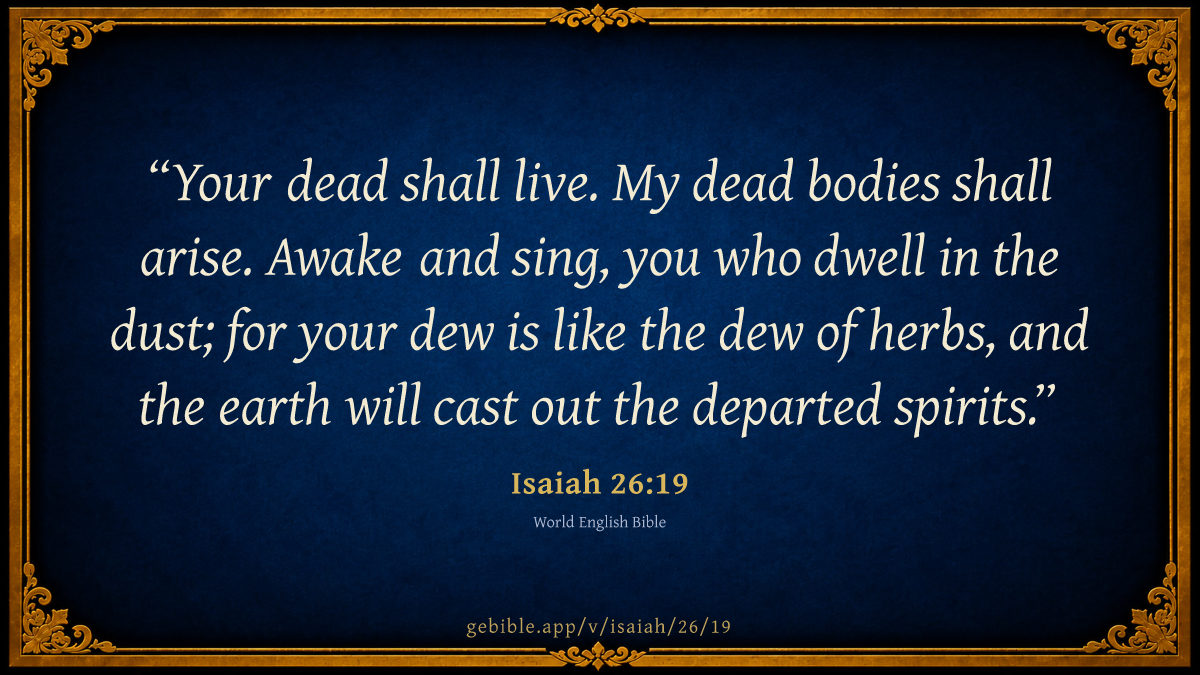
Your dead shall live. My dead bodies shall arise. Awake and sing, you who dwell in the dust; for your dew is like the dew of herbs, and the earth will cast out the departed spirits.
Parallel Translations
-
Your dead shall live. My dead bodies shall arise. Awake and sing, you who dwell in the dust; for your dew is like the dew of herbs, and the earth will cast out the departed spirits.
-
Thy dead men shall live, together with my dead body shall they arise. Awake and sing, ye that dwell in dust: for thy dew is as the dew of herbs, and the earth shall cast out the dead.
-
Thy dead shall live, my dead bodies shall arise — awake and sing, ye that dwell in the dust — for Thy dew is as the dew of light, and the earth shall bring to life the shades.
Examined in Scripture Analysis
Contradictions (1)
Questions where the Bible appears to say two different things, with the passages on each side set together.
Cross-references (29)
Passages linked to Isaiah 26:19 in the Treasury of Scripture Knowledge, ordered by reader-vote popularity; verse text shown in World English Bible.
- Daniel 12:2 Many of those who sleep in the dust of the earth will awake, some to everlasting life, and some to shame and everlasting contempt.
- Ezekiel 37:1-14 Yahweh’s hand was on me, and he brought me out in Yahweh’s Spirit, and set me down in the middle of the valley; and it was full of bones. He caused me to pass by them all around: and behold, there were very many in the open valley; and behold, they were very dry. He said to me, “Son of man, can these bones live?” I answered, “Lord Yahweh, you know.” Again he said to me, “Prophesy over these bones, and tell them, ‘You dry bones, hear Yahweh’s word. The Lord Yahweh says to these bones: “Behold, I will cause breath to enter into you, and you will live. I will lay sinews on you, and will bring up flesh on you, and cover you with skin, and put breath in you, and you will live. Then you will know that I am Yahweh.” ’ ” So I prophesied as I was commanded. As I prophesied, there was a noise, and behold, there was an earthquake. Then the bones came together, bone to its bone. I saw, and, behold, there were sinews on them, and flesh came up, and skin covered them above; but there was no breath in them. Then he said to me, “Prophesy to the wind, prophesy, son of man, and tell the wind, ‘The Lord Yahweh says: “Come from the four winds, breath, and breathe on these slain, that they may live.” ’ ” So I prophesied as he commanded me, and the breath came into them, and they lived, and stood up on their feet, an exceedingly great army. Then he said to me, “Son of man, these bones are the whole house of Israel. Behold, they say, ‘Our bones are dried up, and our hope is lost. We are completely cut off.’ Therefore prophesy, and tell them, ‘The Lord Yahweh says: “Behold, I will open your graves, and cause you to come up out of your graves, my people; and I will bring you into the land of Israel. You will know that I am Yahweh, when I have opened your graves, and caused you to come up out of your graves, my people. I will put my Spirit in you, and you will live. Then I will place you in your own land; and you will know that I, Yahweh, have spoken it and performed it,” says Yahweh.’ ”
- Matthew 27:52 The tombs were opened, and many bodies of the saints who had fallen asleep were raised;
- Ephesians 5:14 Therefore he says, “Awake, you who sleep, and arise from the dead, and Christ will shine on you.”
- Hosea 13:14 I will ransom them from the power of Sheol. I will redeem them from death! Death, where are your plagues? Sheol, where is your destruction? “Compassion will be hidden from my eyes.
- Psalms 71:20 You, who have shown us many and bitter troubles, you will let me live. You will bring us up again from the depths of the earth.
- Revelation 20:12-13 I saw the dead, the great and the small, standing before the throne, and they opened books. Another book was opened, which is the book of life. The dead were judged out of the things which were written in the books, according to their works. The sea gave up the dead who were in it. Death and Hades gave up the dead who were in them. They were judged, each one according to his works.
- Hosea 6:2 After two days he will revive us. On the third day he will raise us up, and we will live before him.
- Isaiah 25:8 He has swallowed up death forever! The Lord Yahweh will wipe away tears from off all faces. He will take the reproach of his people away from off all the earth, for Yahweh has spoken it.
- 1 Thessalonians 4:14-15 For if we believe that Jesus died and rose again, even so God will bring with him those who have fallen asleep in Jesus. For this we tell you by the word of the Lord, that we who are alive, who are left until the coming of the Lord, will in no way precede those who have fallen asleep.
- John 5:28-29 Don’t marvel at this, for the hour comes in which all who are in the tombs will hear his voice, and will come out; those who have done good, to the resurrection of life; and those who have done evil, to the resurrection of judgment.
- Philippians 3:21 who will change the body of our humiliation to be conformed to the body of his glory, according to the working by which he is able even to subject all things to himself.
- John 11:25-26 Jesus said to her, “I am the resurrection and the life. He who believes in me will still live, even if he dies. Whoever lives and believes in me will never die. Do you believe this?”
- Isaiah 60:1-2 “Arise, shine; for your light has come, and Yahweh’s glory has risen on you. For, behold, darkness will cover the earth, and thick darkness the peoples; but Yahweh will arise on you, and his glory shall be seen on you.
- 1 Corinthians 15:22-23 For as in Adam all die, so also in Christ all will be made alive. But each in his own order: Christ the first fruits, then those who are Christ’s, at his coming.
- Revelation 20:5-6 The rest of the dead didn’t live until the thousand years were finished. This is the first resurrection. Blessed and holy is he who has part in the first resurrection. Over these, the second death has no power, but they will be priests of God and of Christ, and will reign with him one thousand years.
- Zechariah 8:12 “For the seed of peace and the vine will yield its fruit, and the ground will give its increase, and the heavens will give their dew; and I will cause the remnant of this people to inherit all these things.
- 1 Corinthians 15:20 But now Christ has been raised from the dead. He became the first fruits of those who are asleep.
- Hosea 14:5 I will be like the dew to Israel. He will blossom like the lily, and send down his roots like Lebanon.
- Revelation 11:8-11 Their dead bodies will be in the street of the great city, which spiritually is called Sodom and Egypt, where also their Lord was crucified. From among the peoples, tribes, languages, and nations, people will look at their dead bodies for three and a half days, and will not allow their dead bodies to be laid in a tomb. Those who dwell on the earth rejoice over them, and they will be glad. They will give gifts to one another, because these two prophets tormented those who dwell on the earth. After the three and a half days, the breath of life from God entered into them, and they stood on their feet. Great fear fell on those who saw them.
- Deuteronomy 33:28 Israel dwells in safety, the fountain of Jacob alone, In a land of grain and new wine. Yes, his heavens drop down dew.
- Psalms 22:15 My strength is dried up like a potsherd. My tongue sticks to the roof of my mouth. You have brought me into the dust of death.
- Isaiah 52:1-2 Awake, awake! Put on your strength, Zion. Put on your beautiful garments, Jerusalem, the holy city: for from now on the uncircumcised and the unclean will no more come into you. Shake yourself from the dust! Arise, sit up, Jerusalem! Release yourself from the bonds of your neck, captive daughter of Zion!
- Philippians 3:10 that I may know him, and the power of his resurrection, and the fellowship of his sufferings, becoming conformed to his death,
- Deuteronomy 33:13 About Joseph he said, “His land is blessed by Yahweh, for the precious things of the heavens, for the dew, for the deep that couches beneath,
- Isaiah 51:17 Awake, awake! Stand up, Jerusalem, you who have drunk from Yahweh’s hand the cup of his wrath. You have drunken the bowl of the cup of staggering, and drained it.
- Acts 24:15 having hope toward God, which these also themselves look for, that there will be a resurrection of the dead, both of the just and unjust.
- Deuteronomy 32:2 My doctrine will drop as the rain. My speech will condense as the dew, as the misty rain on the tender grass, as the showers on the herb.
- Matthew 27:58 This man went to Pilate, and asked for Jesus’ body. Then Pilate commanded the body to be given up.
Cross-references from openbible.info (CC BY 4.0)
Explain this verse (19 sources)
Historical commentary, presented as a primary source — not an endorsement.
Private notes
Saved on this device only — never synced or sent anywhere.
Geneva Bible translators 1599 · Public Domain He comforteth the faithful in their afflictions, showing them…
He comforteth the faithful in their afflictions, showing them that even in death they shall have life: and that they should most certainly rise to glory, the contrary should come to the wicked, as verse 14.
As herbs dead in winter flourisheth again by the rain in the springtime: so they that lie in the dust, shall rise up to joy, when they feel the dew of God’s grace.
Geneva Bible (1599) marginal notes — public domain.
John Trapp 1656 · Public Domain Isa 26:19 Thy dead [men] shall live, [together with]…
Isa 26:19 Thy dead [men] shall live, [together with] my dead body shall they arise. Awake and sing, ye that dwell in dust: for thy dew [is as] the dew of herbs, and the earth shall cast out the dead.
Ver. 19. Thy dead men shall rise.] So shall not thine enemies. {Isa 26:14} This may seem to be Christ’s gracious answer to his poor desponding people; and it is, say some, argumentum a beata resurrectione sumptum, an argument taken from the happy resurrection of the righteous; the wicked also shall be raised at the last day, but not by the like means, nor for the like blessed purpose. {Dan 12:2} Some read the words thus: "Thy dead, my dead body shall live"; for the faithful, say they, are Christ’s body; {Eph 4:12} and therefore, to shew this, "my dead body" is here added by apposition, to show how the faithful, being dead and buried, are to be accounted of, even Christ’s dead body, &c., and shall be raised at the last day by virtue of that mystical ration which still they hold with Christ. Hence they are said to "sleep in Jesus," to be "dead in Christ," who shall "change our vile body, that it may be fashioned like unto his glorious body, according to the working whereby he is able even to subdue all things unto himself." {Php 3:21} The Hebrews call a dead corpse Nephesh, i.e., a soul, {Num 5:2; Num 9:10; Num 19:11 Hag 2:14} to note that it shall live again, and that the soul shall return to it. At this day also they call the churchyard Bethcaiim, the "house of the living"; and as they return from the burial place, every one plucks off grass from off the ground twice or thrice, and casts it over his head, saying, florebunt de civitate tanquam faenum terrae, &c. {Psa 92:12-13} so to set forth their hopes of a resurrection, {a} Neither need it seem "incredible" with any "that God should raise the dead" {Act 26:8} considering what followeth: (1.) "Together with my dead body shall they arise," i.e., with Christ’s body raised as the "first fruits of them that sleep." {1Co 15:20} One of the Rabbis readeth it, As my dead body, they shall arise. (2.) The force of Christ’s all-powerful voice, saying, "Awake and sing ye that dwell in dust": arise and come away, lift up your heads, for your redemption is at hand. The resurrection is in the Syriac called the "consolation." {Joh 11:24} (3.) "Thy dew is as the dew of herbs, and the earth shall cast out the dead," i.e., Qua facilitate herbulas reficit Deus, eadem mortuos animare potest. God can as easily raise the dead as refresh the herbs of the earth with a reviving dew, when they were even scorched to death with the heat of the sun. See we not a yearly resurrection of grass, grain, flowers, fruits, every spring tide. And surely if nature can produce out of a small seed a great tree, or a butterfly out of a worm, or the beautiful feathered peacock out of a misshapen egg, cannot the Almighty raise our bodies out of dust, who first out of dust made them? Or can the condition of any people or person be so desperate that he is not able to help them out. The assurance of God’s power, which shall show itself in the raising of the dead, is a most excellent argument to confirm us in the certainty of God’s promises, seem they never so incredible to flesh and blood. Atque haec de Cantico.
Read full note →
{a} Leo Modena, Hist. of Rites of the Jews, p. 238.
John Trapp, A Commentary or Exposition upon All the Books of the Old and New Testament (1647–1656) — public domain. Text from a community e-Sword module.
Matthew Poole 1685 · Public Domain Thy dead men shall live. The prophet here turneth…
Thy dead men shall live. The prophet here turneth his speech to God’s people, and gives them a cordial to support them in their deep distress, expressed in the foregoing verse. Thy dead men are not like those Isa 26:14, for they shall not live, as I there said; but thine shall live. You shall certainly be delivered from all your fears and dangers. Nothing is more frequent, both in Scripture and other authors, than for great calamities to be compared to death, and deliverance from them to life, and reviving, and resurrection; and particularly the captivity of the Jews in Babylon, and their deliverance out of it, is largely expressed by this very similitude, Eze 37:11, &c.
Together with my dead body; as I myself, who am one of your number, and of these dead men, shall live again. You shall be delivered together with me. Which he might add, to meet with an objection; for they might think that God would take some special care of this holy prophet, and would preserve him when they should he destroyed. No, saith he, as I am at present like a dead carcass no less than you, so you shall be restored to life no less than I. If the supplement of our translation seems to be too literal, it may be rendered to the same purpose, as my body, the particle as being oft understood, as I have divers times observed: As my dead body shall rise, so shall theirs also; we are equally dead, and shall equally live again.
Read full note →
Shall they arise unto life, as appears from the former clause.
Awake out of your sleep, even the sleep of death, as it is called, Psa 13:3; death being oft compared to a sleep, as Joh 11:11; Act 7:60, and restoration to life unto awaking, as 2Ki 4:31.
Ye that dwell in the dust; you that are dead and buried in the dust, as the dead are said to deep in the dust, Dan 12:2.
Thy dew; the favour and blessing of God upon thee, which is oft compared to the dew, as Hos 14:5; Mic 5:7. The pronoun thy is here taken not efficiently, but objectively, as thy curse, Gen 27:13, is the curse coming upon thee.
Is as the dew of herbs, which gently refresheth and reviveth them, and maketh them to grow and flourish.
The earth shall cast out the dead, as an abortive birth is cast out of the womb, to which the grave is compared. Job 1:21. But because the verb here used doth not signify to cast out, but to cast down, which seems not proper here, these words may be, and are, both by ancient and later interpreters, rendered otherwise, and thou wilt cast down the land of the giants, or of the violent ones, of the proud and potent tyrants of the world. For the word here rendered dead is elsewhere rendered giants, as 2Sa 21:16,18. See also Job 26:5; Pro 9:18; 21:16. But then the words seem to be better rendered, and thou wilt cast the giants down to the ground: either,
1. Thou, O God, who is oft understood in such cases; or rather,
2. Thou, O my people, to whom he speaks in the foregoing clauses of the verse, thy dead body, and thy dew and here continueth his speech, thou wilt or shalt cast, &c., thou shalt subdue even the most giant-like and mighty enemies; which though it be properly God’s work, the church is oft said to do, because she by her prayers engageth God to do it. And so as the former clauses of the verse speak of the deliverance and prosperity of God’s church and people, so this clause speaks of the destruction of their enemies, which usually accompanieth it.
Matthew Poole's English Annotations on the Holy Bible (1683–1685) — public domain. Text from a community e-Sword/MySword module.
John Gill 1763 · Public Domain Thy dead men shall live,.... These are the words…
Thy dead men shall live,.... These are the words of Christ to his church and people, promising great and good things to them after their troubles are over, thereby comforting them under all their trials and disappointments; as that such things should come to pass, which would be as life from the dead; as the conversion of the Jews, and of great numbers of the Gentiles, dead in trespasses and sins; and a great reviving of the interest of religion, and of professors of it, grown cold, and dead, and lifeless; and a living again of the witnesses, which had been slain. And, moreover, this may refer to the first resurrection, upon the second coming of Christ, when the church's dead, and Christ's dead, the dead in him, will live again, and rise first, and come forth to the resurrection of life, and live and reign with Christ a thousand years:
together with my dead body shall they arise; or, "arise my dead body"; the church, the mystical body of Christ, and every member of it, though they have been dead, shall arise, everyone of them, and make up that body, which is the fulness of him that filleth all in all, and that by virtue of their union to him: there was a pledge and presage of this, when Christ rose from the dead, upon which the graves were opened, and many of the saints arose, Mat 27:51 see Hos 6:2, or, "as my dead body shall they arise" (g); so Kimchi and Ben Melech; as sure as Christ's dead body was raised, so sure shall everyone of his people be raised; Christ's resurrection is the pledge and earnest of theirs; because he lives, they shall live also; he is the first fruits of them that slept: or as in like manner he was raised, so shall they; as he was raised incorruptible, powerful, spiritual, and glorious, and in the same body, so shall they; their vile bodies shall be fashioned like unto his glorious body. This is one of the places in Scripture from whence the Jews (h) prove the resurrection of the dead; and which they apply to the times of the Messiah, and to the resurrection in his days.
Read full note →
Awake and sing, ye that dwell in the dust; this is a periphrasis of the dead, of such as are brought to the dust of death, and sleep there; as death is expressed by sleeping, so the resurrection by awaking out of sleep; which will be brought about by the voice of Christ, which will be so loud and powerful, that the dead will hear it, and come out of their graves; and then will they "sing", and have reason for it, since they will awake in the likeness of Christ, and bear the image of him the heavenly One:
for thy dew is as the dew of herbs; the power of Christ will have as great effect upon, and as easily raise the dead, as the dew has upon the herbs, to refresh, raise, and revive them; so that their "bones", as the prophet says, "shall flourish like an herb", Isa 66:14,
and the earth shall cast out the dead; deliver up the dead that are in it, at the all powerful voice of Christ; see Rev 20:13. The Targum is,
"but the wicked to whom thou hast given power, and they have transgressed thy word, thou wilt deliver into hell;''
see Rev 20:14.
(g) "quemadmodum corpus meum resurget", Vatablus. (h) T. Bab. Sanhedrin, fol. 90. 2, & Cetubot, fol. 111. 1. Midrash Kohelet, fol. 62. 3. Targum in loc. Elias Levita in his Tishbi, p. 109. says the word is never used in Scripture but of the carcass of a beast or fowl that is dead; and never of a man that is dead, but of him that dies not a natural death, excepting this place, which speaks of the resurrection of the dead; and, adds he,
"I greatly wonder at it, how he (the prophet) should call the bodies of the pure righteous ones a carcass; no doubt there is a reason for it, known to the wise men and cabalists, which I am ignorant of.''
But the words are spoken of one who did not die a natural, but a violent death, even the Messiah Jesus; and so just according to the Rabbin's own observation.
John Gill's Exposition of the Whole Bible (1746–1763) — public domain (CC PDM 1.0). Text via the HelloAO Bible API.
John Wesley 1765 · Public Domain Thy - The prophet here turns his speech to…
Thy - The prophet here turns his speech to God's people, and gives them a cordial in their distress. Thy dead men are not like those, ver. 14, for they shall not live; but thine shall live. You shall be delivered from all your fears and dangers. My dead body - As I myself, who am one of these dead men, shall live again; you shall be delivered together with me. Awake - Out of your sleep, even the sleep of death, you that are dead and buried in the dust. Thy dew - The favour and blessing of God upon thee. The dew - Which makes them grow and flourish.
John Wesley, Explanatory Notes Upon the Whole Bible (1754–1765) — public domain. Text via the GEBible commentary corpus.
Adam Clarke 1810 · Public Domain Verse 19. My dead body - "My deceased"] All…
Verse 19. My dead body - "My deceased"] All the ancient Versions render it in the plural; they read נבלותי niblothai, my dead bodies. The Syriac and Chaldee read נבלותיהם niblotheyhem, their dead bodies. No MS. yet found confirms this reading.
The dew of herbs - "The dew of the dawn"] Lucis, according to the Vulgate; so also the Syriac and Chaldee.
Read full note →
The deliverance of the people of God from a state of the lowest depression is explained by images plainly taken from the resurrection of the dead. In the same manner the Prophet Ezekiel represents the restoration of the Jewish nation from a state of utter dissolution by the restoring of the dry bones to life, exhibited to him in a vision, Eze 37:1-14, which is directly thus applied and explained, Eze 37:11-13. And this deliverance is expressed with a manifest opposition to what is here said above, Isa 26:14, of the great lords and tyrants, under whom they had groaned: -
"They are dead, they shall not live;
They are deceased tyrants, they shall not rise:"
that they should be destroyed utterly, and should never be restored to their former power and glory. It appears from hence, that the doctrine of the resurrection of the dead was at that time a popular and common doctrine; for an image which is assumed in order to express or represent any thing in the way of allegory or metaphor, whether poetical or prophetical, must be an image commonly known and understood; otherwise it will not answer the purpose for which it is assumed. - L.
Kimchi refers these words to the days of the Messiah, and says, "Then many of the saints shall rise from the dead." And quotes Da 12:2. Do not these words speak of the resurrection of our blessed Lord; and of that resurrection of the bodies of men, which shall be the consequence of his body being raised from the dead?
Thy dead men shall live, - with my dead body shall they arise.] This seems very express.
Adam Clarke's Commentary on the Bible (1810–1826) — public domain. Text from a community e-Sword/MySword module.
Joseph Benson 1811 · Public Domain Isa 26:19. Thy dead men shall live — The…
Isa 26:19. Thy dead men shall live — The prophet here, speaking in the name of God, turns his speech to God’s church, and gives her a cordial to support her in that deep distress which he had foretold she should suffer, and which is described in the preceding verse. Thy dead men are not like those mentioned Isa 26:14, for they shall not live, as was there said, but thine shall live. You shall certainly be delivered from all your fears and dangers. For here, as Bishop Lowth observes, “The deliverance of the people of God, from a state of the lowest depression, is explained by images taken from the resurrection of the dead.” And nothing is more frequent, both in Scripture and other authors, than for great calamities to be compared to death, and deliverance from them to reviving, a resurrection, and life; and particularly the captivity of the Jews in Babylon, and their deliverance out of it, is largely expressed by this very similitude, Eze 37:11, &c. “It appears from hence,” says Bishop Lowth, “that the doctrine of the resurrection was at that time a popular and common doctrine; for an image which is assumed, in order to express or represent any thing in the way of allegory, or metaphor, whether poetical or prophetical, must be an image commonly known and understood, otherwise it will not answer the purpose for which it is assumed.” Together with my dead body shall they arise — It is to be observed here, that the words, together with, are supplied by our translation, there being nothing for them in the Hebrew. “All the ancient versions,” says Bishop Lowth, “render the word in the plural; they read נבלותי, my dead bodies.” The Vulgate has it, Interfecti mei resurgent, My slain men shall rise. The Syriac and Chaldaic read, their dead bodies; and the LXX. εγερθησονται οι εν τοις μνημειοις, those that are in their graves shall be raised. It seems this clause is added merely as an amplification or repetition of the former, being entirely equivalent therewith, and expressing only that the Jewish Church, with which the prophet connects himself, as being a member of it, should be delivered out of captivity in Babylon, but not that he himself should either personally suffer in that captivity, or have a part in that deliverance. Thus, in a similar way, (1Th 4:15; 1Th 4:17,) the apostle connects himself with those that should be found alive at Christ’s second coming, we who are alive, &c., certainly not intending to signify that he personally should be alive at that time. Awake, &c. — Out of your sleep, even the sleep of death, ye that dwell in the dust — You that are dead and buried in the earth. For thy dew — The favour and blessing of God upon thee; is as the dew of herbs — Which refreshes and revives them, and makes them grow and flourish. And the earth shall cast out the dead — As an abortive birth is cast out of the womb, to which the grave is compared, Job 1:21. But, as the verb תפיל, here used, does not properly signify to cast out, but to cast down, or cause to fall, these words are by many, both ancient and later interpreters, rendered otherwise, namely, thou wilt cast down, or she, that is, the church, shall cast down the land of the giants, or violent ones. Thus the Vulgate: Thou shalt draw into ruin the land of the giants; and the LXX., η δε γη των ασεβων πεσειται, the land of the ungodly shall fall, or be brought down. The sense is, the church shall prevail against all oppressors, and shall cast them down: when brought low she shall rise, but her enemies shall not.
Joseph Benson's Commentary on the Old and New Testaments (1811–1818) — public domain. Text from a community e-Sword module.
Albert Barnes 1834 · Public Domain Thy dead men shall live - Very various interpretations…
Thy dead men shall live - Very various interpretations have been given of this verse, which may be seen at length by comparing Vitringa, Rosenmuller, Gesenius, and Poole’s Synopsis. In Isa 26:14, the chorus is represented as saying of the dead men and tyrants of Babylon that had oppressed the captive Jews, that they should not rise, and should no more oppress the people of God. In contradistinction from this fate of their enemies, the choir is here introduced as addressing Yahweh (compare Isa 26:16), and saying ‘thy dead shall live;’ that is, thy people shall live again shall be restored to to vigor, and strength, and enjoyment. They had been dead; that is, civilly dead in Babylon; they were cut off from their privileges, torn away from their homes, made captives in a foreign land. Their king had been dethroned; their temple demolished; their princes, priests, and people made captive; their name blotted from the list of nations; and to all intents and purposes, as a people, they were deceased. This figure is one that is common, by which the loss of privileges and enjoyments, and especially of civil rights, is represented as death. So we speak now of a man’s being dead in law; dead to his country; spiritually dead; dead in sins. I do not understand this, therefore, as referring primarily to the doctrine of the resurrection of the dead; but to the captives in Babylon, who were civilly dead, and cut off by their oppressors from their rights and enjoyments as a nation.
Shall live - Shall be restored to their country. and be reinstated in all their rights and immunities as a people among the nations of the earth. This restoration shall be as striking as would be the resurrection of the dead front their graves. Though, therefore, this does not refer primarily to the resurrection of the dead, yet the illustration is drawn from that doctrine, and implies that that doctrine was one with which they were familiar. An image which is employed for the sake of illustration must be one that is familiar to the mind, and the reference here to this doctrine is a demonstration that the doctrine of the resurrection was well known.
Read full note →
Together with my dead body shall they arise - The words ‘together with’ are not in the original. The words rendered ‘my dead body’ (נבלתי nebēlâthiy) literally means, ‘my dead body,’ and may be applied to a man, or to a beast Lev 5:2; Lev 7:24. It is also applied to the dead in general; to the deceased; to carcasses, or dead bodies (see Lev 11:11; Psa 79:2; Jer 7:33; Jer 9:22; Jer 16:18; Jer 26:23; Jer 34:20). It may, therefore, be rendered, ‘My deceased, my dead;’ and will thus be parallel with the phrase ‘thy dead men,’ and is used with reference to the same species of resurrection. It is not the language of the prophet Isaiah, as if he referred to his own body when it should be dead, but it is the language of the choir that sings and speaks in the name of the Jewish people. “That people” is thus introduced as saying “my” dead, that is, “our” dead, shall rise. Not only in the address to Yahweh is this sentiment uttered when it is said ‘thy dead shall rise,’ but when the attention is turned to themselves as a people, they say ‘our dead shall rise;’ those that pertain to our nation shall rise from the dust, and be restored to their own privileges and land.
Awake and sing - In view of the cheering and consolatory fact just stated that the dead shall rise, the chorus calls on the people to awake and rejoice. This is an address made directly to the dejected and oppressed people, as if the choir were with them.
Ye that dwell in dust - To sit in dust, or to dwell in the dust, is emblematic of a state of dejection, want, oppression, or poverty Psa 44:25; Psa 119:25; Isa 25:12; Isa 26:5; Isa 47:1. Here it is supposed to be addressed to the captives in Babylon, as oppressed, enslaved, dejected. The “language” is derived from the doctrine of the resurrection of the body, and proves that that doctrine was understood and believed; the sense is, that those wire were thus dejected and humbled should be restored to their former elevated privileges.
For thy dew - This is evidently an address to Yahweh. “His” dew is that which he sends down from heaven, and which is under his direction and control. Dew is the emblem of that which refreshes and vivifies. In countries where it rains but seldom, as it does in the East, the copious dews at night supply in some sense the want of rain. “Thence dew” is used in Scripture as an emblem of the graces and influences of the Spirit of God by which his people are cheered and comforted, as the parched earth and the withered herbs are refreshed by the copious dews at night. Thus in Hos 14:5 :
I will be as the dew unto Israel;
He shall grow as the lily,
And cast forth his roots as Lebanon.
The prophet here speaks of the captivity in Babylon. Their state is represented as a state of death - illustrated by the parched earth, and the decayed and withered herbs. But his grace and favor would visit them, and they would be revived.
As the dew of herbs - As the dew that falls on herbs. This phrase has, however, been rendered very variously. The Vulgate renders it, ‘Thy dew is as the dew of light.’ The Septuagint: ‘Thy dew shall be healing (ἴαμα iama) unto them.’ The Chaldee, ‘Thy dew shall be the dew of light.’ But the most correct and consistent translation is undoubtedly that which renders the word אורת 'ôroth, herbs or vegetables (compare 2Ki 9:19).
And the earth shall cast out the dead - This is language which is derived from the doctrine of the resurrection of the body; and shows also that that doctrine was understood by the Hebrews in the time of Isaiah. The sense is, that as the earth shall cast forth its dead in the resurrection, so the people of God in Babylon should be restored to life, and to their former privileges in their own land.
Albert Barnes' Notes on the Bible (1834–1885) — public domain. Text from a community e-Sword/MySword module.
Haydock's Catholic Bible Commentary 1859 · Public Domain Dead: a civil death, shall regain their liberty; and…
Dead: a civil death, shall regain their liberty; and those who have left this world in a state of virtue, shall be happy. --- Ruin. Cyrus liberated the Jews, having conquered Babylon.
George Leo Haydock (1774–1849), Haydock's Catholic Family Bible and Commentary, 1859 edition — public domain. Excludes Psalms (Douay-Rheims chapter numbering differs from Protestant) and Deuterocanonical books (Catholic canon only).
Robert Jamieson, A. R. Fausset & David Brown 1871 · Public Domain In antithesis to Isa 26:14, "They (Israel's foes) shall…
In antithesis to Isa 26:14, "They (Israel's foes) shall not live"; "Thy (Jehovah's) dead men (the Jews) shall live," that is, primarily, be restored, spiritually (Isa 54:1-3), civilly and nationally (Isa 26:15); whereas Thy foes shall not; ultimately, and in the fullest scope of the prophecy, restored to life literally (Eze 37:1-14; Dan 12:2).
together with my dead body--rather, "my dead body," or "bodies" (the Jewish nation personified, which had been spiritually and civilly dead; or the nation, as a parent, speaking of the bodies of her children individually, see on Isa 26:9, "I," "My"): Jehovah's "dead" and "my dead" are one and the same [HORSLEY]. However, as Jesus is the antitype to Israel (Mat 2:15), English Version gives a true sense, and one ultimately contemplated in the prophecy: Christ's dead body being raised again is the source of Jehovah's people (all, and especially believers, the spiritual Israelites) also being raised (Co1 15:20-22).
Read full note →
Awake-- (Eph 5:14), spiritually.
in dust--prostate and dead, spiritually and nationally; also literally (Isa 25:12; Isa 47:1).
dew--which falls copiously in the East and supplies somewhat the lack of rain (Hos 14:5).
cast out . . . dead--that is, shall bring them forth to life again.
Jamieson, Fausset & Brown — Commentary Critical and Explanatory on the Whole Bible (1871) — public domain (CC PDM 1.0). Text via the HelloAO Bible API.
Daniel D. Whedon 1874 · Public Domain 19. But in strong contrast with the preceding despair,…
19. But in strong contrast with the preceding despair, the cheering word comes.
Thy dead men shall live — Civilly, nationally, dead in Babylon, is the primary meaning. The tone changes from sorrow over the long national subjection to exultant joy in view of a speedy return to a higher national and spiritual life in Zion.
Read full note →
My dead body — The Lord is speaking. “Subjected Zion being ‘my dead body,’” that is, being the dead of Zion, shall arise, shall have a spiritual as well as a civil resurrection. Alexander thinks this phrase to be unauthorized.
For thy dew… herbs — The Lord’s “dew,” such as he sends upon herbs to refresh and make them thrive. “Dew” is ever the emblem in Scripture of a divine quickening — an animating figure — as in the East, where rain falls seldom, copious dews largely supply the deficiency. See Hos_14:5.
Earth shall cast out the dead — “Cast out,” a rendering of שׂפיל, (taphil,) is a strong way of saying, “The earth shall precipitate, as by a convulsive act; that is, bring to the surface the dead;” a meaning which the verb necessarily bears here, as most expositors, even the rationalistic, agree. Such language could scarcely be used, except in view of the doctrine of the resurrection, not unfamiliar at this time. The language is clearly figurative, and borrowed from this doctrine. It is applied here to the Church, as good as dead in Babylon, but soon to have resurrection life in Zion. Figures are formed, not from things unknown, but from things or ideas before conceived of and familiar. Because Moses said little of a future life, and urged motives to obedience upon the Israelites from sanctions drawn from this side of eternity, is certainly no proof that he knew nothing of the doctrine of a future life. He dealt with people whose obedience to the law should rest first upon the essential righteousness of the law itself, and upon the reality of a holy, all-powerful Sovereign immediately ruling them. In like manner other doctrines — the resurrection of the dead especially — were held from direct statement and revelation till it should be practically seasonable for such statements and revelation to be made. In favoured minds — in minds inspired and commissioned to teach the world, as were Moses, Isaiah, and the like — no doubt doctrines latest needed in the world’s history lay at least in a dim premonitory outline in connexion with the whole scheme of redemption; and this outline came out in marked clearness as fast as the world’s mind should comprehend and need it. Numerous are the hints in the Old Testament that Abraham, Jacob, Moses, Job, David, Isaiah, and other prophets, knew of future life with its rewards and punishments, and of the resurrection of the dead, long before Persian Zoroastrianism had existence, from which rationalists allege the resurrective idea originated. The air of familiarity with this idea in our prophet’s easy allusion to it in the expression and figures here in question, leaves, so far forth, little opportunity for cavil.
Daniel D. Whedon (gen. ed.), Commentary on the Old and New Testaments (1874–1909) — public domain. Text from a community e-Sword module.
The Cambridge Bible for Schools and Colleges 1878 · Public Domain 19. The answer to these utterances of disappointed hopes…
19. The answer to these utterances of disappointed hopes is the promise of the Resurrection. The speaker throughout is the community, and the words are addressed to God, with the exception of an apostrophe to the buried Israelites in the middle of the verse. There is indeed no decisive argument against the view of those who think that the first half of the verse expresses the longing of the nation for the restoration of its dead (“May thy dead live, &c.”), and the second the triumphant assurance of the prophet that the prayer shall be fulfilled. But it is more probable that the language throughout is that of confident belief and hope.
Thy dead … arise] Render with R.V., Thy dead shall live, my dead bodies (collect. in Hebr.) shall arise. The dead saints are at once Jehovah’s dead and Israel’s.
Read full note →
for thy dew is as the dew of herds] Better, for a dew of lights is thy dew (O Jehovah). Comp. Jas_1:17. The word means “herbs” in 2Ki_4:39, but the idea is too prosaic for this passage. It is a heavenly, supernatural, dew that is meant; as soon as this falls on the dead they awake to life. Duhm refers to a Talmudic representation of a dew kept in the seventh heaven which is to descend on the bones of the dead and quicken them into life. “Light” and “life” are frequently and naturally associated: Psa_36:9; Psa_56:13; Job_3:20; Job_33:30; Joh_1:4.
the earth shall cast out the dead] Render: the earth (or the land) shall bring forth shades (Isa_26:14). The verb is lit. “cause to fall,” but obviously in the sense explained under Isa_26:18.
The doctrine of the resurrection here presented is reached through the conviction, gradually produced by the long process of revelation, that the final redemption of Israel could not be accomplished within the limits of nature. It became clear that the hopes and aspirations engendered by the Spirit in believing minds pointed forward to the great miracle here described, and thus the belief in the resurrection was firmly bound up with the indestructible hopes of the future of Israel (cf. Rom_11:15). The idea is exhibited in a form which is immature in the light of New Testament teaching, but it practically represents the highest development of Old Testament revelation on this subject. The only passage which is slightly in advance of this is Dan_12:2, and even there a universal resurrection is not taught. Here the hope is restricted to Israelites (see Isa_26:14) and no doubt to those Israelites who had departed this life in the faith and fear of God. On the other hand, the teaching of this verse is quite different from such passages as Hos_6:2; Eze_37:1-14. There rising from the dead is but a figurative clothing of the idea of national regeneration, whereas there can be no doubt that here a literal resurrection of individuals is foretold.
The Cambridge Bible for Schools and Colleges (gen. ed. J. J. S. Perowne; Cambridge University Press, 1878–1918) — public domain. Text from a community e-Sword module.
Ellicott's Commentary for English Readers 1878 · Public Domain (19) Thy dead men shall live.—Better, Thy dead shall…
(19) Thy dead men shall live.—Better, Thy dead shall live; my corpses shall rise. The words, though they imply a belief more or less distinct in a resurrection, are primarily like the vision of dry bones in Eze_37:1-14, and like St. Paul’s “life from the dead” in Rom_11:15 (comp. also Hos_6:2), used of national and spiritual resurrection.
For thy dew is as the dew of herbs.—The rendering is a tenable one, and expresses the thought that as the dew that falls upon the parched and withered plant quickens it to a fresh life, so should the dew of Jehovah’s grace (comp. 2Sa_23:4) revive the dying energies of His people. Most interpreters, however, render the words the dew of lights (plural expressing completeness), the dew which is born of the womb of the morning (Psa_110:3). This, coming as it does from the “Father of Lights” (so the LXX., “The dew that is from Thee shall be healing for them”), shall have power to make the earth cast forth even the shadowy forms of the dead. The verb for “cast forth” is another form of that used in Isa_26:18 of childbirth, and is, in this interpretation, used in the same sense.
A Bible Commentary for English Readers, edited by Charles John Ellicott (1878–1897) — public domain. Text from a community e-Sword module.
The Pulpit Commentary 1880 · Public Domain Vers. 19-21. THE PROPHET"S COMMENT ON THE SONG OF…
Vers. 19-21. THE PROPHET"S COMMENT ON THE SONG OF THE JUST. Having concluded his song of the just" in a minor key with a confession of human weakness, the prophet proceeds to cheer and encourage his disciples by a clear and positive declaration of the doctrine of the resurrection: "Thy dead, O Israel, shall live." He then adds a recommendation for the present a recommendation to privacy and retirement, until the judgments of God which he has predicted (Isa 24) are shown forth upon the earth.
Thy dead men shall live. A universal resurrection of" some to everlasting life, and some to shame and everlasting contempt", (Dan_12:2) is not yet announced; but only a resurrection of the just, perhaps only of the just Israelites. The object is encouragement, especially encouragement of those whom the prophet directly addresses the religious Israelites of his own day. It is enough for them at the present time to know that, whether the day of the Lord comes in their time or no, when it comes, they will have a part in it. The assurance is given, and is made doubly sure by repetition. The prophet does not say, Together with my dead body they will arise; for there is nothing in the Hebrew corresponding to "together," and the ellipse of ira, with," though suggested by Kimchi, is impossible; nor is it likely that he intends to speak of his own dead body at all. He may, perhaps, call the past generations of just Israelites "my dead," i.e. the dead with whom he is in sympathy; or the supposed personal suffix may be merely paragogic, as Rosenm argues. In any case the two clauses must be regarded as identical in meaning an instance of "synonymous parallelism.... Thy dead men shall live; my dead shall arise." Awake and sing; rather, awake and shout for joy. (comp. Psa_35:27 Psa_67:4, etc.) Ye that dwell in dust. (comp. Dan_12:2, "Many that sleep in the dust of the earth shall awake Thy dew is as the dew of herbs; i.e. refreshing, vivifying, potent to make even dead bones live. "Thy dew" may be said with reference to Jehovah, for changes in the person addressed are frequent in Isaiah; or with reference to the people of Israel, meaning, "the dew which Jehovah will shed on thee," i.e. on thy dead.
Read full note →
The doctrine of the resurrections.
The belief in a future life and a future judgment was held by the Assyrians and Babylonians from a time anterior to the departure of Abraham from Ur of the Chaldees. A very elaborate doctrine of a resurrection was also held by the Egyptians from an extremely remote antiquity. The Jews, on the other hand, do not appear to have had definite notions on the subject until the period of the Captivity. It is, perhaps, possible to account for the indistinct and undeveloped state of the doctrine among the early Israelites by the effect upon them of their Babylonian and Egyptian experiences.
I THE BABYLONIAN VIEW, with which they came into contact in Ur of the Chaldees, was the following. A life beyond the grave was expected; but the duration of this life was quite uncertain. Merodach, a sun-god, was the Dayannisi, or "judge of men," and by his favor the souls of the just were received into a heavenly abode, where they enjoyed life and happiness ("Religions of the Ancient World," p. 63). The wicked descended at death into an infernal region, where there was no enjoyment, and (apparently) suffered different degrees of punishment according to their deserts. Fire was, perhaps, an agent in their suffering.
II THE EGYPTIAN VIEW was far more complete and elaborate. The Egyptians held that the soul was quite distinct from the body, and that, immediately after death, it descended into the lower world (Amenti), and was conducted to the "hall of truth," where it was judged in the presence of Osiris and of his forty-two assessors, the "lords of truth" and judges of the dead. Anubis, the son of Osiris, who was called the director of the weight," brought forth a pair of scales, and, after placing in one scale a figure or emblem of truth, set in the other a vase containing the good deeds of the deceased, Thoth standing by the while, with a tablet in his hand, whereon to record the result. If the good deeds were sufficient, if they weighed down the scale wherein they were placed, then the happy soul was permitted to enter "the boat of the sun," and was conducted by good spirits to the Elysian fields (Aahlu), to the "pools of peace," and the dwelling-places of the blest. If, on the contrary, the good deeds were insufficient, if the scale remained suspended in the air, then the unhappy soul was sentenced, according to the degree of its ill deserts, to go through a round of transmigrations in the bodies of animals more or less unclean; the number, nature, and duration of the transmigrations depending on the degree of the deceased"s demerits, and the consequent length and severity of the punishment which he deserved or the purification which he needed. Ultimately, if after many trials sufficient purity was not attained, the wicked soul, which had proved itself incurable, underwent a final sentence at the hands of Osiris, supreme judge of the dead, and, being condemned to complete and absolute annihilation, was destroyed upon the steps of heaven by Shu, the "lord of light." The good soul, having been first freed from its infirmities by passing through the basin of purgatorial fire guarded by the four ape-faced genii, was made a companion of Osiris for a period of three thousand years, after which it returned from Amenti, re-entered its former body, rose from the dead, and lived once more a human life upon the earth. This process was gone through again and again, until a certain mystic cycle of years became complete, when, to crown all, the good and blessed attained the final joy of union with God, being absorbed into the Divine essence from which they had once emanated, and so attaining the full perfection and true end of their existence. With this elevating belief were mixed up a number of strange, superstitions, not very easily reconcilable with the main creed, yet occupying an important place in the thoughts of the people. The soul, notwithstanding its transmigrations and presence in Amenti and Aahlu, was never at any time wholly separated from its body, but still inhabited the tomb, partook of the offerings left for it, and even had meetings and held converse with the souls belonging to other neighboring bodies. It could at all times read the passages from the "ritual of the dead" painted on its sarcophagus, or its mummy-bandages, or the inner walls of its tomb, and could thus refresh its memory if at any time in its long journeyings through the lower world it failed to recollect at the right moment the proper invocation or prayer under circumstances of danger.
III THE HEBREW VIEW. Coming from Babylonia into Egypt, with probably only some vague notions of an after-life, in which the inequalities of this life should be remedied and justice meted out to all, the Hebrews were brought into contact with the complicated and elaborate creed of Egypt upon the subject a creed which filled the thoughts of the Egyptians, and dominated their whole life, entering into all their relations, political, social, and domestic. This creed was mixed up with all the intricacies of the Egyptian polytheism, involved acceptance of the Osirid myth, acknowledgment of half a hundred deities, and adoption, if it were accepted, of numerous superstitious practices. Whatever may have been the case with individuals, (Jos_24:14 Eze_20:6-9) the Hebrews, as a nation, rejected the Egyptian creed, viewed it as corrupting and debasing, and put it aside en bloc, without troubling themselves to sift the wheat from the chaff, the grains of gold from the mud and sand in which they were embedded. The rejection of the imaginative theosophy of Egypt produced a reaction in the Hebrew mind towards the material and the mundane. They seem to have left Egypt with less definite views on the subject of a future life than those which their ancestors had had in Babylonia. And in his revelations from Sinai it did not please God to enlighten them. Light was vouchsafed them gradually through the psalmists and prophets by the present statement of Isaiah, by Ezekiel"s vision el the dry bones (Eze_37:1-10) and the teaching which followed it (vers. 11-14), by Daniel"s prophecy (Dan_12:2) already referred to, and otherwise, until, in the time of the Maccabees, their faith in the resurrection was as strong, and almost as full and definite, as that of Christians. (see RAPC 2Ma 7:9, 14, 23, 29, 36 12:43, 44)
Ver. 19 (with ver. 14). Contrasted issues.
Taking ver. 19 as it surely should be taken, in connection and in contrast with ver. 14, and understanding the primary reference of both of them to he to the hopes of the Hebrew nation at the time of the prophecy, we have our attention called to
I THE ISSUE OF UPRIGHTEOUSNESS DEATH.
1. It tends to fatal ruin. The tyrants of Babylon, being overthrown, should rise up no more, should never regain their position, were as dead men whose day was hopelessly and irretrievably gone. All unrighteousness tends to the same issue; it leads down to loss, to overthrow, to shame, to a depth of ruin from which there is no recovery. At length the guilty man (party, nation) is down so low that those who look on say, "He (it) is dead; he shall rise no more.
2. It travels fast to the grave. Guilty violence (Psa_55:23 Psa_140:11) and shameful vice (Pro_2:18 Pro_9:18) make a quick passage to the tomb.
3. It sinks into permanent oblivion. God makes "their memory to perish". (Psa_34:16 Pro_10:7 Ecc_8:10) No man cares to remember those whose lives have been disgraced by sin; their names lie unmentioned, and their memory fades from view till it is lost in the thickening shadows of time.
4. It goes down to the death which is eternal. "The wages of sin is death.
II THE ISSUE OF RIGHTEOUSNESS REVIVAL. "Thy dead men shall live." God"s people who have fallen till they have seemed to be wholly lost shall be recovered and shall reappear. Righteousness is immortal; it cannot be buried and forgotten and lost.
1. It commonly ends in restoration to power and position. Joseph is cast into prison, but he comes out to be the first minister in Egypt. David is driven into the caves, but he comes forth to sit down upon the throne. The persecuted people of God, whether in Babylon, in the Vaudois valleys, in Holland, in the Highlands of Scotland, in the woods and rocks of Madagascar, come forth when the "red, right hand" of cruelty is stricken down, and appear as those that have risen from the tomb.
2. It secures an earthly immortality that of a lasting recollection: "The righteous shall be had in everlasting remembrance": (Psa_112:6 Pro_10:7) that, also, of abiding influence; for the effect of their holy lives and true, faithful words shall go down to distant generations.
3. It issues in eternal blessedness. The righteous shall go into "life eternal. C.
The Pulpit Commentary (1880–1919), ed. H.D.M. Spence-Jones & Joseph S. Exell — public domain. Text from a community e-Sword module.
The Biblical Illustrator 1887 · Public Domain Thy dead men shall live
Isa_26:19
Thy dead men shall live
Read full note →
The Jewish hope of resurrection
Granted the pardon, the justice, the temple, and the God which the returning exiles now enjoyed, the possession of these only makes more painful the shortness of life itself.
This life is too shallow and too frail a vessel to hold, peace and righteousness and worship and the love of God. St. Paul has said, If in this life only we have hope in Christ, we are of all men most miserable. What avails it to have been pardoned, to have regained the Holy Land and the face of God, if the dear dead are left behind in graves of exile, and all the living must soon pass into that captivity (Hezekiahs expression for death, Isa_38:12) from which there is no return? It must have been thoughtslike these which led to the expression of one of the most abrupt and powerful of the few hopes of the resurrection which the Old Testament contains. This hope, which lightens Isa_25:7-8, bursts through again--without logical connection with the context--in verses 14-19 of chap.
26. (Prof. G. A. Smith, D. D.)
The resurrection of the life to come
I. THE RESURRECTION OF THE BODIES OF BELIEVERS. Thy dead men shall live, etc.
II. THE EFFICIENT CAUSE OF THE RESURRECTION. Thy dew is as the dew of herbs, and the earth shall cast out the dead. In Eastern countries the dew is extremely heavy and almost entirely supplies the place of rain. It is frequently referred to in Scripture (Psa_133:3; Hos_14:5). The dew means the influence of the Holy Spirit, which is the great efficient cause of the raising of the bodies of believers; not the primary cause--that is the atonement made by our Lord Jesus. But the text adds, The earth shall cast out the dead. The word cast out means to travail. The earth shall put forth them that are now buried. The whole creation groaneth and travaileth in pain together; but when the Spirit shall come forth with His mighty influence, the earth shall be no longer able to retain its dead.
III. THE JOY OF THIS RESURRECTION. Without doubt the joy of departed saints is exceeding great; but the joy will be so much greater at the resurrection that the Church may with propriety sing in concert, Awake and sing, ye that dwell in the dust. They will then see the full glory of Christ established; they will see sin and Satan in chains; they will see hell subdued, death quite swallowed up. (R. W. Sibthorp.)
The dust of death
If one has seen a place of graves in the East, he will appreciate the elements of this figure, which takes dust for death and dew for life. With our damp graveyards mould has become the traditional trappings of death; but where under the hot Eastern sun things do not rot into lower forms of life, but crumble into sapless powder, that will not keep a worm in life, dust is the natural symbol of death. When they die, men go not to feed fat the mould, but down into the dust; and there the foot of the living falls silent, and his voice is choked, and the light is thickened and in retreat, as if it were creeping away to die. The only creatures the visitor starts are timid, unclean bats, that flutter and whisper about him like the ghosts of the dead. There are no flowers in an Eastern cemetery; and the withered branches and other ornaments are thickly powdered with the same dust that chokes and silences and darkens all. Hence the Semitic conception of the underworld was dominated by dust. It was not water nor fire nor frost nor altogether darkness which made the infernal prison horrible, but that upon its floors and rafters, hewn from the roots and ribs of the primeval mountains, dust lay deep and choking. Amid all the horrors he imagined for the dead, Dante did not include one more awful than the horror of dust. (Prof. G. A. Smith, D. D.)
Dew for dust
For dust there is dew, and even to graveyards the morning comes that brings dew and light together. As, when the dawn comes, the drooping flowers of yesterday are seen erect and lustrous with the dew, every spike a crown of glory, so also shall be the resurrection of the dead. (Prof. G. A. Smith, D. D.)
Awake and sing, ye that dwell in dust
The Divine call to moral grovellers
This call may he addressed--
I. To the SENSUALIST. All his thoughts and activities are directed to the pampering of his animal appetites and the gratification of his animal lusts. To such the word may be fairly addressed, Arise from the dust. Why live in mud, when you ought and might live in heavenly places?
II. To the WORLDLING.
By a worldling, I mean a man who gives his heart and energies and time to the accumulation of wealth; a man who had no idea of worth but money; no idea of dignity apart from material parade and possessions; a man whose inspiration in everything is love of gold. Such a man is literally in the dust. He is a grub. Now, to such a man the call come with power: Arise from the dust; break away from that wretched materialism that imprisons thy spirit. A mans life consisteth not in the abundance of the things of this world. CONCLUSION. All unregenerate men are in the dust. He that is born of the flesh, is flesh--is flesh in experience, in character, known by his compeers only by fleshly or material characteristics. He that is born of the Spirit, is spirit--the spirit has been liberated from the bondage of the flesh, called up to his true regal position, and is known hence on, not by material features, but by high mental and moral characteristics. (Homilist.)
Souls sleeping in the dust
There are two senses in which men may be considered dead while yet living inhabitants of the earth.
(1) They may be civilly dead: utterly deprived of all political rights and privileges. To this the prophet refers undoubtedly. Ezekiel in a vision saw them as a valley of dry bones. Here is a call for the restoration. Thy dead men shall live--live politically, restored to their own country, reinstated in all their rights, placed again amongst the nations of the earth.
(2) Another sense in which men may be considered dead whilst living inhabitants of the earth is spiritually; Observe then--
I. THE SPIRITUAL CONDITION of unregenerated men. They dwell in the dust.
1. Scientific materialists are in the dust. All their attention is taken up with material substances, combinations, forces, operations, laws. They have no world outside beyond the tangible and the visible.
2. Mercenary worldlings are in the dust.
3. Voluptuous sensualists are in the dust.
4. Ceremonial religionists are in the dust.
II. THE URGENT CALL MADE on unregenerate men. Awake and sing, ye that dwell in dust. But why awake?
1. Because the sleep is injurious. Physical sleep is refreshing, but spiritual sleep is pernicious; it enervates the powers; it is a disease that wastes and destroys.
2. Because the sleep is sinful. It is a sin against our constitution, against the ordination of Heaven, against the well being of the universe.
3. Because it is perilous. In their dreams they feel that they are increasing in goods and have need of nothing, whereas they are poor and wretched, blind and naked. (Homilist.)
Dwelling in the dust
I. AN INVOCATION OR ADDRESS. Ye that dwell in dust. To whom is this designation applicable, and to whom does it in point of fact apply?
1. All men, without exception, may be described as dwelling in dust. They live in houses of clay; their foundation is in the dust; they are crushed before the moth. They are made of the earth, earthy.
2. This address is still more descriptive of mankind, as it refers to their sin and guilt in the sight of God. They are sunk in the depths of abject servitude.
3. But it is not to sinners in their natural state that the words of our text are addressed. God directs them to His chosen people, and says even unto them, Ye that dwell in dust. Nor is the expression inappropriate. For humble and lowly is the spiritual estate even of the believer. His home is in Heaven, his treasure is there, his heart is there, his Redeemer is there; and though he wishes to be in thought and feeling continually there, the opposing influences of sin, Satan, the world, and the flesh, retard his efforts, and cloud the sunshine of his joys with ever-recurring darkness. Is it not strange that an heir of immortality, a participant in Christs everlasting redemption, a member of the Saviours ever-living body, a being who is destined for eternal glory should drink the cup of humiliation and suffering in the dust? There is another sense in which Gods people may be described by this epithet. They dwell in dust, inasmuch as their life in this world is a life of affliction.
4. But, lastly, the address contained in our text refers literally to those who dwell in the dust--who reside in the cold and cheerless tomb.
II. A SUMMONS OR COMMAND. Awake and ring. The passage is not addressed to all who dwell in dust, as the context clearly shows, but only to those who are Gods chosen and willing people. There is a night of death that has no morning, but it is yet future, distant, and unseen. All who are in their graves shall hear the voice of the Son of Man, and shall come forth, they that have done evil as well as they that have done good. But it is only to the righteous that the voice of Omnipotence shall say, Awake and sing! Brightly and beautifully on them will dawn the resurrection morning.
III. THE REASON WHY GOD COMMANDS THEM THAT DWELL IN DUST TO AWAKE AND SING. It is because their dew is as the dew of herbs. Dew in countries such as Judea, where rain seldom falls, is the grand agent that fertilises, fructifies, and waters the earth. They that dwell in dust have their dew. Their dew is the beneficent law of Heaven, which seals them up in the grave, until such time as the fructifying influence of the Spirit shall quicken them into a resurrection life.
IV. THE RESULT OF THE COMMAND, Awake and sing. The earth shall cast out the dead. The subject presents to us--
1. A ground of comfort amidst all the distresses of life.
2. A most powerful motive to holiness and duty. (A. Nisbet.)
Thy dew is as the dew of herbs
Resurrection preservation
I. AGAINST DECOMPOSITION. One of the great difficulties connected with the resurrection is the fact that the bodies of the dead decompose, and that oftentimes some of their parts go to make up the growth of plants and animals. But is not this difficulty removed by the law of the text; the law that governs the reproduction of plants, and which is so forcibly presented by the apostle in his argument to the Corinthians for the resurrection of the dead?
II. AGAINST DEPORTATION. Other dangers threaten the bodies of the dead. Being on the surface of the earth and mingled with its particles, they must necessarily be moved about. The winds may waft them to other regions; birds or animals or men may carry them abroad; the rivers may float them in their rapid currents; the ocean may heave them on its mighty billows. How then shall they be preserved? God has purposely made many of the seeds so that they are wafted on the winds, not that they may be destroyed, but may be brought into better positions for their preservation and subsequent prosperity. And shall we disbelieve the fact that the great God who performs these wonders in the ordinary operations of nature, is able and willing so to control winds, and birds, and beasts, and living men, and flowing rivers, and heaving oceans, as to preserve and carry to safer or better places the germs of those bodies which He has taught us shall rise at the resurrection of the last day?
III. AGAINST INTERMINGLING OR LOSS OF IDENTITY. Take the many hundreds of plants that exist about us--there are computed to be more than 80,000 kinds on the globe--with their millions of seeds. The God of nature never mixes them up. Whatever may be true about the amalgamation of growing plants, when their seeds or germs are perfected it is impossible so to mix them as to confound them. And think you that the God who works such wonders of infallible certainty in the identification of the untold millions of these varieties of plant seeds, every year and through so many centuries, however they may be mixed up, cannot or will not, even when He has promised it, preserve the identity of each different human body, so that it shall be enstamped with all the characteristics of its own individuality, though it be mingled with so many other human bodies through so many centuries?
IV. AGAINST DESTRUCTION BY EXTERNAL FORCES. The seeds of many species resist the destructive power, not only of cold but of great heat, and of drought and moisture, in a wonderful manner, not only through the lapse of one season, but of centuries. And as God does thus preserve these inferior and feebler creations of His, amid such great and long continued action of the elements of destruction, will He not much rather preserve against all accidents and all assaults of the forces of destruction, those nobler creations of His for whose use and control the inferior things of earth were made and preserved?
V. AGAINST THE GNAWING TOOTH OF TIME. So far as the law of life has been developed, it is evident that mere lapse of time has no effect to destroy life, so long as circumstances are favourable to its continuation. Some Celtic tombs were discovered not very long since in France, which had been filled nearly two thousand years ago. Under the Lead of each corpse was found a tile, and under each tile a circular hole covered with cement, and containing a few seeds. These seeds were planted, they soon vegetated; and the heliotrope, the trefoil, and the cornflower were seen rising to life again, and expanding their flowers in the light of spring with admirable display, after their seeds had slept two thousand years beneath the pillows of the dead in the dust of the tomb. Can we believe less of the power and willingness of God, with reference to the preservation through the onstretching centuries, of the bodies of men whom He made in His own image, and whom He rescued from destruction by the death of His well-beloved Son, who is risen from the dead, and become the first fruits of them that slept?
VI. AGAINST PREMATURE DEVELOPMENT. But, says a persistent objector, if all these things are true, why do we not have some evidence of it; why do we not find such occasionally appearing in the body? We know that there are plants in tropical countries called air plants, which grow from the sustenance they receive out of the atmosphere. One species of these--the live-forever plant,--grows in the temperate zone; and some of us may remember seeing these plants suspended from the beams of houses and flourishing there. Suppose a man who had never seen an oak grow, but who was told that an acorn contained the germ of an oak, should fasten that acorn by the side of his air plants to a beam of his house, or fasten ten, or twenty, or a hundred acorns there; and then, when he saw his air plants growing, and his acorns remaining dry and unsprouted, should declare to you that there was no such fact as that oaks would grow from acorns, or that, anyhow, those acorns would never produce oaks; what would be your reply? You would say to him, There is a law of germination and growth belonging to those acorns; and whenever you bring them into the position where that law is met, they will grow. We are ignorant equally of the facts in what the identity or germ of a human dead body consists, and what conditions are necessary to bring it into active resurrection life; these are the affairs of the Author of existence. But we do know, that whatever it is that constitutes the identity of the dead bodys existence, cannot and will not develop itself in a resurrection life power, until the great Keeper of man brings it into a position and condition where the laws of its development are fulfilled. (N. D. Williamson.)
The Biblical Illustrator, edited by Joseph S. Exell (c. 1880s–1900s) — public domain. Text from a community e-Sword module.
The Preacher's Complete Homiletical Commentary 1892 · Public Domain Isa_26:19. Thy dead men shall live.
NATIONAL REVIVAL
Isa_26:19. Thy dead men shall live.
Read full note →
I. This is the language of exultation. [1081] In this part of the chapter the tone changes from sorrow, failure, and abortion to life, prosperity, and joy. “Thy dead, O Zion, shall live again.” Thy people have been virtually, civilly, nationally dead, but they shall have a resurrection. Because these dead are God’s people, their resurrection from national death is certain. Then, thrilled with confidence in this truth, the prophet gives utterance to the voice of God within him, “Awake and sing, ye that lie buried in dust, awake; come forth from your (figurative) graves, and break out in song as ye come up to the light of day!”
[1081] This passage proves beyond a question that the idea of a resurrection from the dead was familiar to the prophet and to his first readers, for whose immediate use he wrote. Sensible writers never borrow figures from things unknown, but always from things better known than the facts they would illustrate. As no writer could draw a figure from what was unknown to himself, so, if he sought to teach, he would not draw one from what was unknown to his readers. As Isaiah could not talk about a resurrection if he had never known the idea and the words to express it, so he would not expect to be understood unless his readers were also familiar with it.—Cowles.
II. This expression involves a contrast. The resurrection of national life of God’s people stands in contrast with the denial of resurrection to the wicked rulers of Babylon (Isa_26:14). That Chaldean nation went down to its political grave with no hope, no possibility of being raised to national life again. On the contrary, God’s people, from being in a state of national death in Babylon, were eventually called into national life.
III. This declaration suggests a truth which nations ought to learn. No nation that seeks God and His righteousness can be permanently kept down. “Righteousness exalteth a nation;” exalteth it from depression into power. It may be brought low, but if the elements of rectitude lie within it, if public justice be a part of its political creed, and respect for the rights of others its unvarying practice, then, though apparently buried in the grave of defeat and degradation, its resurrection shall come. God rules not only amid the armies of heaven, but amongst the inhabitants of the earth, and to every nation maintaining justice, mercy, and truth, though brought ever so low, the voice of history proclaims, “Thy dead men shall live!” The bodies of English martyrs in the Tudor period perished. Under the Stuart dynasty the bones of those English patriots who defied “crowned and mitred tyranny” were dug up and dishonoured. That part of them corruptible and worthless died, but the better part of them has experienced a resurrection. Their principles live to-day. “Thy dead men shall live.”—Henry Cowles, D.D.
The Preacher's Complete Homiletical Commentary (gen. ed. Joseph S. Exell; Funk & Wagnalls, c. 1892) — public domain (pre-1929). A full-Bible homiletical/sermon-outline anthology covering 65 of 66 books (2 John is absent from the source module). Text from a community e-Sword module.
C. I. Scofield 1917 · Public Domain thy dead men
thy dead men
Eliminate the supplied words, men, and, together with. "Body" is in the plural, "bodies." Isa 26:19-21 with Isaiah 27, constitute Jehovah’s answer to the plaint of Israel, Isa 26:11-18. Isa 28:19 should read: "Thy dead shall live: my dead bodies shall rise" (i.e. the dead bodies of Jehovah’s people). The restoration and re-establishment of Israel as a nation is also spoken of as a resurrection Eze 37:1-11 and many hold that no more than this is meant in Isa 26:19. But since the first resurrection is unto participation in the kingdom Rev 20:4-6 it seems the better view that both meanings are here.
The Scofield Reference Bible (1917 edition), notes by C. I. Scofield — public domain. Text from a community e-Sword module.
unfoldingWord translationNotes 2017 · CC BY-SA 4.0 Your dead will live
Your dead will live
This can be reworded so that the nominal adjective "dead" is expressed as the verb "have died." AT: "Your people who have died will live again" (See: Nominal Adjectives)
Read full note →
Your dead
Possible meanings are 1) "Your" refers to Yahweh or 2) "Your" refers to the people of Israel. If you choose option two you could translate it as "Our dead."
Awake
This speaks of dead people coming back to life as if they were waking up from sleep. (See: Metaphor)
you who live in the dust
This is a polite way of referring to those who have died. AT: "those who are dead and buried" (See: Euphemism)
for your dew is the dew of light
Yahweh acting kindly towards his people and bringing them back to life is spoken of as if it were the dew that causes the plants to live. (See: Metaphor)
for your dew
Possible meanings are 1) "your" refers to Yahweh and this is the dew that Yahweh gives or 2) "your" refers to the people of Israel and this is the dew they receive from Yahweh.
dew of light
Possible meanings are 1) "light" refers to Yahweh's power to make dead people alive again. AT: "dew from Yahweh" or 2) "light" refers to the morning time when dew is on the plants. AT: "dew in the morning"
the earth will bring forth its dead
"the earth will give birth to those who died." Yahweh causing dead people to come back to life is spoken of as if the earth would give birth to those who have died. AT: "and Yahweh will cause those who have died to rise from the earth" (See: Metaphor)
translationWords
die
life
joy
unfoldingWord translationNotes — © Distant Shores Media and the Door43 World Missions Community, licensed CC BY-SA 4.0. Source: git.door43.org/Door43/en_tn.
Tyndale Open Study Notes 2022 · CC BY-SA 4.0 26:19 those who die . . . will live:…
26:19 those who die . . . will live: There is hope for the remnant. Some hold the minimal interpretation that this means the people would be restored to the land after the Exile (see Ezek 37:11-12) or that the Lord would preserve Jerusalem (see Isa 29:4, 6-8). More likely it refers to the resurrection of the body from the grave (see 25:7-8). The Old Testament has little to say about the resurrection, but this text anticipates fuller development in the New Testament (see 1 Cor 15:12-58).
Tyndale Open Study Notes — © Tyndale Open Resources, licensed CC BY-SA 4.0. Text via the HelloAO Bible API.