
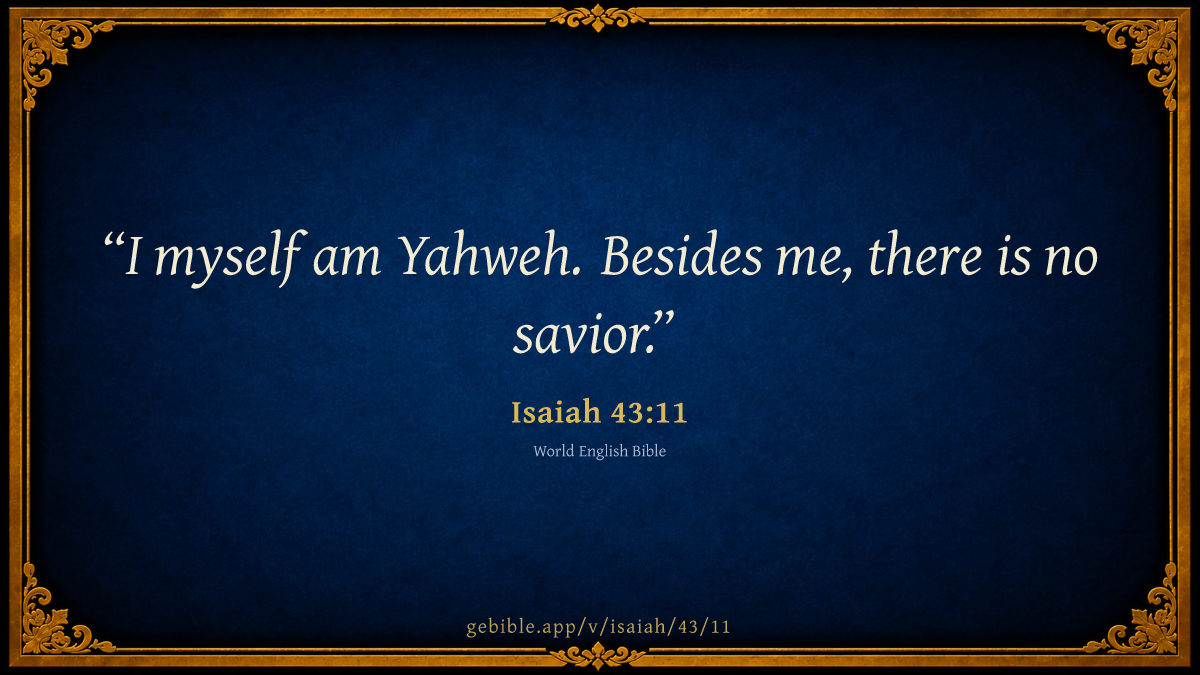
I myself am Yahweh. Besides me, there is no savior.
Parallel Translations
-
I myself am Yahweh. Besides me, there is no savior.
-
I, even I, am the LORD; and beside me there is no saviour.
-
I, even I, am the LORD; and beside Me there is no saviour.
Cross-references (22)
Passages linked to Isaiah 43:11 in the Treasury of Scripture Knowledge, ordered by reader-vote popularity; verse text shown in World English Bible.
- Hosea 13:4 “Yet I am Yahweh your God from the land of Egypt; and you shall acknowledge no god but me, and besides me there is no savior.
- Isaiah 44:6 This is what Yahweh, the King of Israel, and his Redeemer, Yahweh of Armies, says: “I am the first, and I am the last; and besides me there is no God.
- Isaiah 43:3 For I am Yahweh your God, the Holy One of Israel, your Savior. I have given Egypt as your ransom, Ethiopia and Seba in your place.
- Isaiah 45:21-22 Declare and present it. Yes, let them take counsel together. Who has shown this from ancient time? Who has declared it of old? Haven’t I, Yahweh? There is no other God besides me, a just God and a Savior. There is no one besides me. “Look to me, and be saved, all the ends of the earth; for I am God, and there is no other.
- Acts 4:12 There is salvation in no one else, for there is no other name under heaven that is given among men, by which we must be saved!”
- Revelation 7:10-12 They cried with a loud voice, saying, “Salvation be to our God, who sits on the throne, and to the Lamb!” All the angels were standing around the throne, the elders, and the four living creatures; and they fell on their faces before his throne, and worshiped God, saying, “Amen! Blessing, glory, wisdom, thanksgiving, honor, power, and might, be to our God forever and ever! Amen.”
- Isaiah 12:2 Behold, God is my salvation. I will trust, and will not be afraid; for Yah, Yahweh, is my strength and song; and he has become my salvation.”
- Deuteronomy 6:4 Hear, Israel: Yahweh is our God. Yahweh is one.
- Isaiah 44:8 Don’t fear, neither be afraid. Haven’t I declared it to you long ago, and shown it? You are my witnesses. Is there a God besides me? Indeed, there is not. I don’t know any other Rock.”
- Jude 1:25 to God our Savior, who alone is wise, be glory and majesty, dominion and power, both now and forever. Amen.
- Hosea 1:7 But I will have mercy on the house of Judah, and will save them by Yahweh their God, and will not save them by bow, sword, battle, horses, or horsemen.”
- Luke 1:47 My spirit has rejoiced in God my Savior,
- Luke 2:11 For there is born to you today, in David’s city, a Savior, who is Christ the Lord.
- Titus 3:4-6 But when the kindness of God our Savior and his love toward mankind appeared, not by works of righteousness which we did ourselves, but according to his mercy, he saved us through the washing of regeneration and renewing by the Holy Spirit, whom he poured out on us richly, through Jesus Christ our Savior;
- 1 John 5:20-21 We know that the Son of God has come, and has given us an understanding, that we know him who is true, and we are in him who is true, in his Son Jesus Christ. This is the true God and eternal life. Little children, keep yourselves from idols.
- Revelation 1:17-18 When I saw him, I fell at his feet like a dead man. He laid his right hand on me, saying, “Don’t be afraid. I am the first and the last, and the Living one. I was dead, and behold, I am alive forever and ever. Amen. I have the keys of Death and of Hades.
- Titus 2:10 not stealing, but showing all good fidelity, that they may adorn the doctrine of God, our Savior, in all things.
- Titus 2:13 looking for the blessed hope and appearing of the glory of our great God and Savior, Jesus Christ,
- 2 Peter 3:18 But grow in the grace and knowledge of our Lord and Savior Jesus Christ. To him be the glory both now and forever. Amen.
- 1 John 4:14 We have seen and testify that the Father has sent the Son as the Savior of the world.
- Revelation 1:11 saying, “What you see, write in a book and send to the seven assemblies: to Ephesus, Smyrna, Pergamum, Thyatira, Sardis, Philadelphia, and to Laodicea.”
- John 10:28-30 I give eternal life to them. They will never perish, and no one will snatch them out of my hand. My Father who has given them to me is greater than all. No one is able to snatch them out of my Father’s hand. I and the Father are one.”
Cross-references from openbible.info (CC BY 4.0)
Explain this verse (11 sources)
Historical commentary, presented as a primary source — not an endorsement.
Private notes
Saved on this device only — never synced or sent anywhere.
John Trapp 1656 · Public Domain Isa 43:11 I, [even] I, [am] the LORD; and…
Isa 43:11 I, [even] I, [am] the LORD; and beside me [there is] no saviour.
Ver. 11. I, even I, am the Lord.] This redoubled I is emphatic and exclusive.
Read full note →
And beside me there is no Saviour.] They are gross idolaters, therefore, that set up for saviours the saints departed.
John Trapp, A Commentary or Exposition upon All the Books of the Old and New Testament (1647–1656) — public domain. Text from a community e-Sword module.
Matthew Poole 1685 · Public Domain That can and doth save his worshippers: whereby he…
That can and doth save his worshippers: whereby he implies that the false gods were not only weak, and unable to save their people, but also were the destroyers of their people, as being the great cause of their ruin.
Matthew Poole's English Annotations on the Holy Bible (1683–1685) — public domain. Text from a community e-Sword/MySword module.
John Gill 1763 · Public Domain I have declared, and I have saved, and I…
I have declared, and I have saved, and I have showed,.... The Targum is,
"I have showed to Abraham your father what should come to pass; I redeemed you out of Egypt, as I swore to him between the pieces; and I caused you to hear the doctrine of the law at Sinai.''
Read full note →
But the sense is, that God had declared by his prophets, long before the Messiah came, that he would send him; that he should come and save his people by his obedience, sufferings, and death; accordingly he was come, and was the author of salvation; the Lord had wrought out salvation by him, as he had declared he would; and this he had shown, published, and made known by the everlasting Gospel, preached among all nations:
when there was no strange god among you; that assisted in this salvation; the arm of Christ alone wrought it out: or, "and this is not strange among you" (i); this work of salvation wrought out is not strange among you; it is well known unto you, being published in the Gospel.
(i) "et non est in vobis alienum vel peregrinum", Musculus.
John Gill's Exposition of the Whole Bible (1746–1763) — public domain (CC PDM 1.0). Text via the HelloAO Bible API.
Joseph Benson 1811 · Public Domain Isa 43:11-13. Besides me there is no saviour —…
Isa 43:11-13. Besides me there is no saviour — None that can and does save his worshippers: wherein is implied, that the false gods were not only weak and unable to save those that trusted in them, but also were their destroyers, as being the great cause of their ruin. I have declared, and have saved — I first foretold your deliverance, and then effected it. And l have showed, when there was no strange god, &c. — Rather, I made it known; nor was it any strange god. So Bishop Lowth. This divine prescience and predicting of future events is thus repeatedly insisted upon, because it is the principal argument used here, and in chap. 41., to determine this controversy between Jehovah and idols. Yea, before the day was — Before all time: or, which is the same, from all eternity. I am he — I am God, and have proved myself to be so. None can deliver out of my hands — None of those that are called gods can save them whom I will destroy. Therefore they are impotent, and consequently no gods. I will work, and who shall let it? — Nor can they hinder me in any other work which I resolve to do.
Joseph Benson's Commentary on the Old and New Testaments (1811–1818) — public domain. Text from a community e-Sword module.
Albert Barnes 1834 · Public Domain I, even I, am the Lord - The repetition…
I, even I, am the Lord - The repetition of the pronoun ‘I’ makes it emphatic. The design is, to affirm that there was no other being to whom the name ‘Yahweh’ pertained. There was no other one who had the attributes which the name involved; there was, therefore, no other God. On the meanins of the word Yahweh, see the note at Isa 1:2.
And beside me there is no Saviour - There is no one who can deliver from oppression, and captivity, and exile, such as the Jews suffered in Babylon; there is no one but he who can save from sin, and from hell. All salvation, therefore, must come from God; and if we obtain deliverance from temporal ills, or from eternal death, we must seek it from him.
Albert Barnes' Notes on the Bible (1834–1885) — public domain. Text from a community e-Sword/MySword module.
Robert Jamieson, A. R. Fausset & David Brown 1871 · Public Domain saviour--temporally, from Babylon: eternally, from sin and hell (Hos…
Lord--Jehovah.
saviour--temporally, from Babylon: eternally, from sin and hell (Hos 13:4; Act 4:12). The same titles as are applied to God are applied to Jesus.
Jamieson, Fausset & Brown — Commentary Critical and Explanatory on the Whole Bible (1871) — public domain (CC PDM 1.0). Text via the HelloAO Bible API.
Daniel D. Whedon 1874 · Public Domain 11-13. The foregoing series of thoughts are here recapitulated…
11-13. The foregoing series of thoughts are here recapitulated with important additions and inferences.
I am the Lord — Exodus vi: “I am that I am,” with, of course, no beginning, no ending. Before him was no god; of course no god will be after him, and no Saviour or deliverer beside him. The Jehovah-name ceases in the Old Testament, and the name of Jesus takes its place in the New Testament. To the ancients Jehovah was the ineffable, the unused name; Adonai, (Lord,) through sheer reverence, taking its place in pronunciation. Both the Septuagint and the Greek Testament render the name κυριος, (Lord,) which is equivalent to Jehovah, and in the New Testament refers for its meaning to the phrase, “The Lord Jesus Christ.” The Jews are witnesses that he is Jehovah, and that besides him there is no all-knowing and all-powerful One, and no Saviour.
Daniel D. Whedon (gen. ed.), Commentary on the Old and New Testaments (1874–1909) — public domain. Text from a community e-Sword module.
The Cambridge Bible for Schools and Colleges 1878 · Public Domain 11. I, even I, am the Lord] I, I…
11. I, even I, am the Lord] I, I am Jehovah; see on ch. Isa_42:8. there is no saviour] see on Isa_43:3.
The Cambridge Bible for Schools and Colleges (gen. ed. J. J. S. Perowne; Cambridge University Press, 1878–1918) — public domain. Text from a community e-Sword module.
The Pulpit Commentary 1880 · Public Domain Beside me there is no saviour. None but God…
Beside me there is no saviour. None but God can save men. Man cannot make atonement for his fellows; "for it cost more to redeem their souls, so that he must let that alone for ever". (Psa_49:8, Prayer-book Version) The human "saviours" whom God raises up to deliver his people out of the hand of their enemies, (Jud_1:3:9 2Ki_13:5 Neh_9:27, etc.) are "saviours" in quite a secondary and inferior sense.
The Pulpit Commentary (1880–1919), ed. H.D.M. Spence-Jones & Joseph S. Exell — public domain. Text from a community e-Sword module.
The Biblical Illustrator 1887 · Public Domain I, even I, am the Lord
Isa_43:11
I, even I, am the Lord
Read full note →
Royal proclamation
I.
THE OBJECT OF OUR WORSHIP. The heavenly majesty asserted by Himself. I am the Lord. A self-existent Being, contrasted with idols--dwelling in His own eternity, independent, everlastingly immutable, the eternal Jehovah. Mark how this glorious self-existent Being is subject to none, exists in Himself, the source of all being, and subject to no other beings. Shall we, for a moment, trifle in the presence of such a being? If I look a little further at this glorious self-existing Being, as revealed in His Word, I find Him manifesting Himself as sanctity itself inherent. Therefore, again and again, He says to Israel of old, I will be sanctified before all people; and again, Sanctify the Lord God in your hearts. Moreover, this glorious self-existent Being, this source of all being, and subject to none either in heaven or in earth, has made Himself known in the attribute of holiness by solemn oath. I have sworn by My holiness that I will not lie unto David. Moreover, if we pause to think of His glorious attributes, all of them are expressly supernatural, transcendently glorious, and Divine. Advance a step farther, to notice the veneration and adoration to be given to this glorious Being in His Trinity of Persons. The glorious self-existent Being is sovereign over all worlds.
II. THE EXCLUSIVE CLAIM TO THE PREROGATIVE OF BEING A SAVIOUR. Besides Me there is no Saviour. Some men make a Saviour of their priest. Some of their alms and their doings. Some will make a part Saviour of Christ, and a part saviour of their own doings and repentings and believings, and they lose both, and must be despised as neutralists. But Beside Me, the Eternal God the Lord, there is no Saviour It was the Fathers purpose of love that ordained salvation. Then, Christ, as a Saviour, received salvation to centre entirely in Himself. This salvation is by the Holy Ghost. Mark the unity of all the Divine Persons in this salvation, which is exclusive. There is no other Saviour, consequently no salvation but in our covenant God. (J. Irons.)
The Biblical Illustrator, edited by Joseph S. Exell (c. 1880s–1900s) — public domain. Text from a community e-Sword module.
The Preacher's Complete Homiletical Commentary 1892 · Public Domain (Missionary Sermon.)
ONE LORD AND SAVIOUR
(Missionary Sermon.)
Read full note →
Isa_43:11. I, even I, am the Lord; and beside Me there is no Saviour.
I. This is a declaration that is now needless in many parts of the world. All the civilised nations are convinced that, if there is a God at all, there is only one God. What an intellectual advance! In Isaiah’s time, the monotheists were in a miserable minority. All the great nations had their god or gods. The depressed condition of the worshippers of JEHOVAH seemed to most people a sufficient proof that He was only a god, and a god inferior to others. Sennacherib’s estimate of Him (2Ch_32:10-15, “How much less!”) seemed to have been ultimately justified. The men for whom this prophecy was intended knew that He had not delivered Jerusalem from the power of the worshippers of the Assyrian gods, who ascribed their victories to those gods. Hence it was necessary for them to protest against the belief that JEHOVAH was at the most only a god; to proclaim Him as the only living and true God (Isa_43:12). This proclamation was not made in vain. Belief in Him as the only God and Saviour has been spreading ever since. Cured during their exile of their passion for idolatry, the Jews have ever since been His faithful and successful witnesses. The testimony first of those Jews to whom God had revealed Himself in Christ, and then of their converts, consigned to oblivion the gods of Greece and Rome, and has rendered idolatry impossible among the leading races of mankind. What a glorious intellectual advance! And what inestimable moral advances have been its results!
II. But it is a declaration that is still needful in many parts of the world. The world is not merely the particular portion of it in which we dwell. We are apt to think so. But we should look beyond the circle in which we are living. When we do so, what do we see? Idolaters—millions of them. Polytheists still outnumber Monotheists. To this fact we must not be indifferent. For us, it is a call to duty. Knowing God, we must make Him known. It is for this purpose that He has mercifully revealed Himself to us (Isa_43:10-12). Shall we be silent concerning Him? Zeal for His glory forbids it. Compassion for our fellow-men forbids it. No greater benefit could we confer upon them. If we have no zeal for His glory, no compassion for our fellow-men, how dare we call ourselves God’s people? how can we hope to dwell with Him in blessedness for ever when this short life is over?
Mission work is our duty. It would be our duty, if it were as hopeless an enterprise as was Isaiah’s in his own day (Isa_6:9-10). But faithful witness-bearing for God has been in this century prolific of glorious results. Results of mission work in the South Seas, Madagascar, &c. So it will be. The task has the allurement of certain success. Let us address ourselves to it vigorously and with glad heart.
III. It is a declaration which we may make with even more confidence than did our fathers. The unity of God is being more and more clearly revealed to us. Science is the friend of religion. By it how wonderfully has our conception of the vastness of the universe been enlarged! How completely we have been convinced that it is in a universe we find ourselves, in an immense empire over which one Power rules. Marvellously varied are its provinces, but in each and all the same laws are in operation. Behind all these laws there is one Will (H. E. I. 2222, 3174). Nothing can oppose or evade it with success. The attempt is madness, and ends always in misery. Throughout all the revelations of science, God speaks to us precisely as He does in this chapter: “I, even I, am the Lord, … and there is none that can deliver out of my hand: I will work, and who will turn it back?”
Being so much more fully instructed than our fathers were, we should also be more clearly, confidently, and fervently witnesses for God.
IV. It is a declaration which we should not only make to others, but should lay to heart ourselves. Wonderful and glorious is the revelation given us in our text.
1. On one side, it is an awful revelation. It is an assertion of absolute authority, under which we must live and act: “I am the LORD!” Science bears especially this testimony, that we are in an empire where law is universally and indiscriminately administered (H. E. I. 3171). In God’s kingdom there is no border-land, such as the strip that divided England and Scotland before the days of the Stuarts, where men may do very much as they please, without fear of government penalties; no realm of lawlessness such as the Highlands of Scotland were in the days of the Stuarts. God’s authority is maintained everywhere; there is not one physical law of His which can be violated or disregarded without mischief. The testimony of Science and of Scripture is one and the same: Sin and suffering are inseparably united. This is as true in the moral and spiritual realm as in the physical; one Lord rules over all! (Num_33:23; Pro_10:29; Pro_11:21; Rom_2:6-9; H. E. I. 3188, 4603–4610.)
To this revelation of God let us give heed. Let it govern our conduct. So will temptation be stripped of all its allurements and seductions (H. E. I. 4673–4676, 4754–4757). So we shall travel life’s journey safely.
2. To this revelation there is another side which is indeed a Gospel. Were there no other voice than that of Science to address us, we should shudder as we listened; we are surrounded by so many possibilities of transgression, we are so prone to fall into them, and their results are so disastrous! Conscience would then be only an alarming force; it would haunt us with its testimony that we have already sinned against the Ruler who administers justice so inflexibly, and punishes transgression so relentlessly. But Scripture had another word to add; it reveals Him to us as the SAVIOUR: “I, even I, am the LORD; and beside me there is no Saviour!”
1. He is a Saviour. By His very nature. “God is love”—practical love. He cannot behold His children in need, and sit idle; cannot listen unmoved to their cries for help (Exo_3:7-8; H. E. I. 2303). In every time of trouble let us remember this, and be comforted and strengthened.
2. There is no other Saviour. Experience had been teaching this lesson to the captives in Babylon. When the power of Assyria and Babylon had begun to loom up before them and their fathers, and threatened to enslave and destroy them in their fear and unbelief, they had sought help from human powers, but had sought it worse than in vain (Isa_30:1-5, &c.)
Is not this a lesson we need to learn! In the time of temporal trouble or of spiritual conflict, how apt we are to look elsewhere than to God! But we look in vain. In neither kind of necessity can we do anything for ourselves (Joh_15:5; H. E. I. 2358). Nor can our friends help, further than God pleases (Psa_146:3-4). Nor even in sacred things, apart from God, is there help for us (H. E. I. 3438–3442). In every time of need, let us trust in God only (Psa_62:5; H. E. I. 172–176.)
3. We need no other Saviour, for He is an all-sufficient Saviour. This was the lesson the poor captives in Babylon needed. Not easy for them to learn it. Their case appeared hopeless. Think how the power of Babylon must have seemed to them (they were far weaker in comparison with it than is Poland now in comparison with Russia); how impossible that they should ever be set free from it! What they needed to be taught was, that in comparison with God, Babylon was nothing, and less than nothing; that when JEHOVAH was pleased to set them free nothing could withstand Him (Isa_43:5-6; Isa_43:13-17). How completely and gloriously these promises were fulfilled, we know.
We also need to learn this lesson. Sometimes our distress is so great, that we are ready to believe that there can be no deliverance from it. But this despair and distrust in God is foolishness (Jer_32:17). The wiles of the devil are so subtle, his assaults so overwhelming, that we are disposed to cease from the conflict as a hopeless one. But again our fear is foolishness (2Co_12:9; Eph_6:10; Rom_8:37; H. E. I. 3363–2376.)
In God our Saviour let us rejoice with great joy, and let us hasten to make Him known to our fellow-men, whose needs are as great, whose conflicts are as severe, and whose perils are as terrible as our own.
The Preacher's Complete Homiletical Commentary (gen. ed. Joseph S. Exell; Funk & Wagnalls, c. 1892) — public domain (pre-1929). A full-Bible homiletical/sermon-outline anthology covering 65 of 66 books (2 John is absent from the source module). Text from a community e-Sword module.