
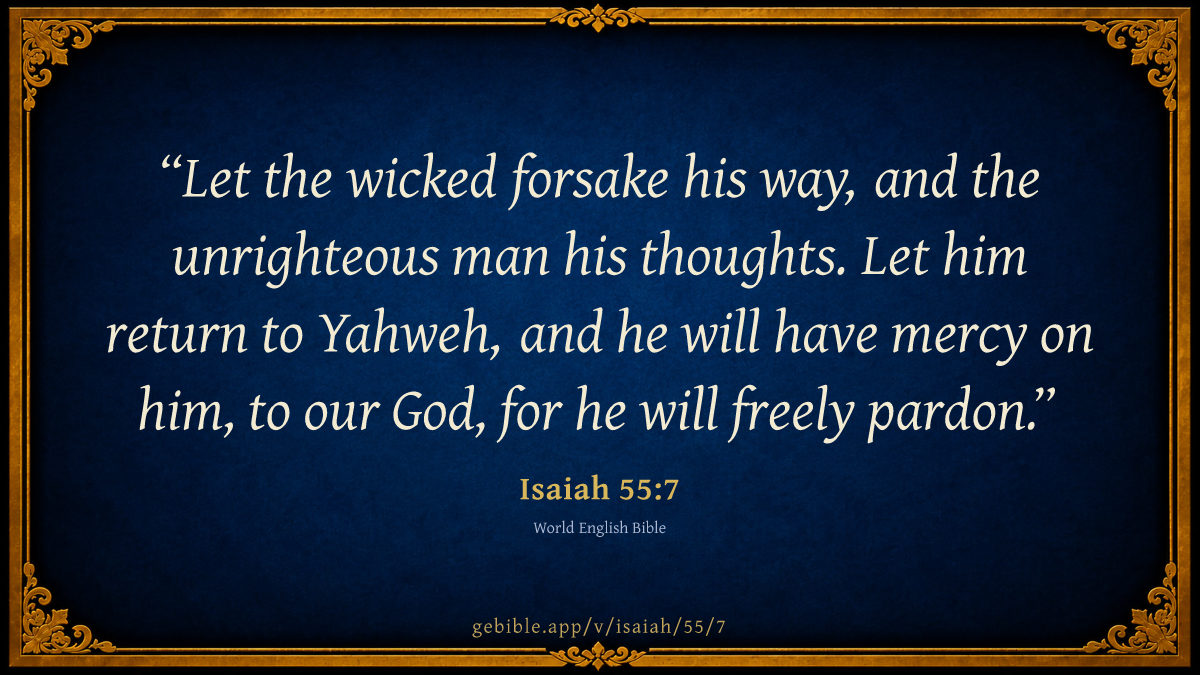
Let the wicked forsake his way, and the unrighteous man his thoughts. Let him return to Yahweh, and he will have mercy on him, to our God, for he will freely pardon.
Parallel Translations
-
Let the wicked forsake his way, and the unrighteous man his thoughts. Let him return to Yahweh, and he will have mercy on him, to our God, for he will freely pardon.
-
Let the wicked forsake his way, and the unrighteous man his thoughts: and let him return unto the LORD, and he will have mercy upon him; and to our God, for he will abundantly pardon.
-
Let the wicked forsake his way, and the man of iniquity his thoughts; and let him return unto the LORD, and He will have compassion upon him, and to our God, for He will abundantly pardon.
Cross-references (45)
Passages linked to Isaiah 55:7 in the Treasury of Scripture Knowledge, ordered by reader-vote popularity; verse text shown in World English Bible.
- Proverbs 28:13 He who conceals his sins doesn’t prosper, but whoever confesses and renounces them finds mercy.
- James 4:8-10 Draw near to God, and he will draw near to you. Cleanse your hands, you sinners. Purify your hearts, you double-minded. Lament, mourn, and weep. Let your laughter be turned to mourning, and your joy to gloom. Humble yourselves in the sight of the Lord, and he will exalt you.
- Ezekiel 18:21-23 “But if the wicked turns from all his sins that he has committed, and keeps all my statutes, and does that which is lawful and right, he shall surely live. He shall not die. None of his transgressions that he has committed will be remembered against him. In his righteousness that he has done, he shall live. Have I any pleasure in the death of the wicked?” says the Lord Yahweh; “and not rather that he should return from his way, and live?
- Isaiah 44:22 I have blotted out, as a thick cloud, your transgressions, and, as a cloud, your sins. Return to me, for I have redeemed you.
- Luke 15:10 Even so, I tell you, there is joy in the presence of the angels of God over one sinner repenting.”
- Jonah 3:10 God saw their works, that they turned from their evil way. God relented of the disaster which he said he would do to them, and he didn’t do it.
- Isaiah 43:25 I, even I, am he who blots out your transgressions for my own sake; and I will not remember your sins.
- Ezekiel 33:14-16 Again, when I say to the wicked, “You will surely die;” if he turns from his sin, and does that which is lawful and right; if the wicked restore the pledge, give again that which he had taken by robbery, walk in the statutes of life, committing no iniquity; he will surely live. He will not die. None of his sins that he has committed will be remembered against him. He has done that which is lawful and right. He will surely live.
- 1 Timothy 1:15-16 The saying is faithful and worthy of all acceptance, that Christ Jesus came into the world to save sinners, of whom I am chief. However, for this cause I obtained mercy, that in me first, Jesus Christ might display all his patience for an example of those who were going to believe in him for eternal life.
- 2 Chronicles 7:14 if my people, who are called by my name, will humble themselves, pray, seek my face, and turn from their wicked ways; then I will hear from heaven, will forgive their sin, and will heal their land.
- Ezekiel 18:27-32 Again, when the wicked man turns away from his wickedness that he has committed, and does that which is lawful and right, he will save his soul alive. Because he considers, and turns away from all his transgressions that he has committed, he shall surely live. He shall not die. Yet the house of Israel says, ‘The way of the Lord is not fair.’ House of Israel, aren’t my ways fair? Aren’t your ways unfair? “Therefore I will judge you, house of Israel, everyone according to his ways,” says the Lord Yahweh. “Return, and turn yourselves from all your transgressions; so iniquity will not be your ruin. Cast away from you all your transgressions, in which you have transgressed; and make yourself a new heart and a new spirit: for why will you die, house of Israel? For I have no pleasure in the death of him who dies,” says the Lord Yahweh. “Therefore turn yourselves, and live!
- Acts 3:19 “Repent therefore, and turn again, that your sins may be blotted out, so that there may come times of refreshing from the presence of the Lord,
- Jeremiah 4:14 Jerusalem, wash your heart from wickedness, that you may be saved. How long will your evil thoughts lodge within you?
- Ezekiel 33:11 Tell them, ‘ “As I live,” says the Lord Yahweh, “I have no pleasure in the death of the wicked; but that the wicked turn from his way and live. Turn, turn from your evil ways! For why will you die, house of Israel?” ’
- Matthew 9:13 But you go and learn what this means: ‘I desire mercy, and not sacrifice,’ for I came not to call the righteous, but sinners to repentance.”
- Psalms 66:18 If I cherished sin in my heart, the Lord wouldn’t have listened.
- 1 Corinthians 6:9-11 Or don’t you know that the unrighteous will not inherit God’s Kingdom? Don’t be deceived. Neither the sexually immoral, nor idolaters, nor adulterers, nor male prostitutes, nor homosexuals, nor thieves, nor covetous, nor drunkards, nor slanderers, nor extortionists, will inherit God’s Kingdom. Some of you were such, but you were washed. But you were sanctified. But you were justified in the name of the Lord Jesus, and in the Spirit of our God.
- Jeremiah 3:12-13 Go, and proclaim these words toward the north, and say, ‘Return, you backsliding Israel,’ says Yahweh; ‘I will not look in anger on you; for I am merciful,’ says Yahweh. ‘I will not keep anger forever. Only acknowledge your iniquity, that you have transgressed against Yahweh your God, and have scattered your ways to the strangers under every green tree, and you have not obeyed my voice,’ says Yahweh.”
- Ezekiel 3:18-19 When I tell the wicked, ‘You will surely die;’ and you give him no warning, nor speak to warn the wicked from his wicked way, to save his life; that wicked man will die in his iniquity; but I will require his blood at your hand. Yet if you warn the wicked, and he doesn’t turn from his wickedness, nor from his wicked way, he will die in his iniquity; but you have delivered your soul.”
- Isaiah 1:16-18 Wash yourselves. Make yourself clean. Put away the evil of your doings from before my eyes. Cease to do evil. Learn to do well. Seek justice. Relieve the oppressed. Defend the fatherless. Plead for the widow.” “Come now, and let’s reason together,” says Yahweh: “Though your sins are as scarlet, they shall be as white as snow. Though they are red like crimson, they shall be as wool.
- Acts 8:21-22 You have neither part nor lot in this matter, for your heart isn’t right before God. Repent therefore of this, your wickedness, and ask God if perhaps the thought of your heart may be forgiven you.
- Matthew 23:25-26 “Woe to you, scribes and Pharisees, hypocrites! For you clean the outside of the cup and of the platter, but within they are full of extortion and unrighteousness. You blind Pharisee, first clean the inside of the cup and of the platter, that its outside may become clean also.
- Acts 26:20 but declared first to them of Damascus, at Jerusalem, and throughout all the country of Judea, and also to the Gentiles, that they should repent and turn to God, doing works worthy of repentance.
- Ephesians 1:6-8 to the praise of the glory of his grace, by which he freely gave us favor in the Beloved, in whom we have our redemption through his blood, the forgiveness of our trespasses, according to the riches of his grace, which he made to abound toward us in all wisdom and prudence,
- Isaiah 40:2 “Speak comfortably to Jerusalem; and call out to her that her warfare is accomplished, that her iniquity is pardoned, that she has received of Yahweh’s hand double for all her sins.”
- Luke 11:39-40 The Lord said to him, “Now you Pharisees cleanse the outside of the cup and of the platter, but your inward part is full of extortion and wickedness. You foolish ones, didn’t he who made the outside make the inside also?
- Isaiah 54:10 For the mountains may depart, and the hills be removed; but my loving kindness will not depart from you, and my covenant of peace will not be removed,” says Yahweh who has mercy on you.
- Jeremiah 8:4-6 “Moreover you shall tell them, ‘Yahweh says: “ ‘Do men fall, and not rise up again? Does one turn away, and not return? Why then have the people of Jerusalem fallen back by a perpetual backsliding? They cling to deceit. They refuse to return. I listened and heard, but they didn’t say what is right. No one repents of his wickedness, saying, “What have I done?” Everyone turns to his course, as a horse that rushes headlong in the battle.
- Hosea 14:1-2 Israel, return to Yahweh your God; for you have fallen because of your sin. Take words with you, and return to Yahweh. Tell him, “Forgive all our sins, and accept that which is good: so we offer our lips like bulls.
- Mark 7:23 All these evil things come from within, and defile the man.”
- Luke 7:47 Therefore I tell you, her sins, which are many, are forgiven, for she loved much. But one to whom little is forgiven, loves little.”
- Luke 15:24 for this, my son, was dead, and is alive again. He was lost, and is found.’ Then they began to celebrate.
- Numbers 14:18-19 ‘Yahweh is slow to anger, and abundant in loving kindness, forgiving iniquity and disobedience; and he will by no means clear the guilty, visiting the iniquity of the fathers on the children, on the third and on the fourth generation.’ Please pardon the iniquity of this people according to the greatness of your loving kindness, and just as you have forgiven this people, from Egypt even until now.”
- Exodus 34:6-7 Yahweh passed by before him, and proclaimed, “Yahweh! Yahweh, a merciful and gracious God, slow to anger, and abundant in loving kindness and truth, keeping loving kindness for thousands, forgiving iniquity and disobedience and sin; and who will by no means clear the guilty, visiting the iniquity of the fathers on the children, and on the children’s children, on the third and on the fourth generation.”
- Psalms 51:1 Have mercy on me, God, according to your loving kindness. According to the multitude of your tender mercies, blot out my transgressions.
- Psalms 130:7 Israel, hope in Yahweh, for there is loving kindness with Yahweh. Abundant redemption is with him.
- Mark 7:21 For from within, out of the hearts of men, proceed evil thoughts, adulteries, sexual sins, murders, thefts,
- Genesis 6:5 Yahweh saw that the wickedness of man was great in the earth, and that every imagination of the thoughts of man’s heart was continually only evil.
- Isaiah 32:7 The ways of the scoundrel are evil. He devises wicked plans to destroy the humble with lying words, even when the needy speaks right.
- Matthew 15:18-19 But the things which proceed out of the mouth come out of the heart, and they defile the man. For out of the heart come evil thoughts, murders, adulteries, sexual sins, thefts, false testimony, and blasphemies.
- Romans 5:16-21 The gift is not as through one who sinned; for the judgment came by one to condemnation, but the free gift came of many trespasses to justification. For if by the trespass of the one, death reigned through the one; so much more will those who receive the abundance of grace and of the gift of righteousness reign in life through the one, Jesus Christ. So then as through one trespass, all men were condemned; even so through one act of righteousness, all men were justified to life. For as through the one man’s disobedience many were made sinners, even so through the obedience of the one, many will be made righteous. The law came in that the trespass might abound; but where sin abounded, grace abounded more exceedingly; that as sin reigned in death, even so grace might reign through righteousness to eternal life through Jesus Christ our Lord.
- James 1:15 Then the lust, when it has conceived, bears sin. The sin, when it is full grown, produces death.
- Isaiah 59:7 Their feet run to evil, and they hurry to shed innocent blood. Their thoughts are thoughts of iniquity. Desolation and destruction are in their paths.
- Jeremiah 3:3 Therefore the showers have been withheld and there has been no latter rain; yet you have had a prostitute’s forehead and you refused to be ashamed.
- Zechariah 8:17 and let none of you devise evil in your hearts against his neighbor, and love no false oath: for all these are things that I hate,” says Yahweh.
Cross-references from openbible.info (CC BY 4.0)
Explain this verse (13 sources)
Historical commentary, presented as a primary source — not an endorsement.
Private notes
Saved on this device only — never synced or sent anywhere.
Geneva Bible translators 1599 · Public Domain Hereby he showeth that repentance must be joined with…
Hereby he showeth that repentance must be joined with faith, and how we cannot call upon God aright, except the fruits of our faith appear.
Geneva Bible (1599) marginal notes — public domain.
John Trapp 1656 · Public Domain Isa 55:7 Let the wicked forsake his way, and…
Isa 55:7 Let the wicked forsake his way, and the unrighteous man his thoughts: and let him return unto the LORD, and he will have mercy upon him; and to our God, for he will abundantly pardon.
Ver. 7. Let the wicked forsake his way.] Or else never think of finding favour with God, or of calling upon him to any purpose. The leper’s lips should be covered according to the law: a good motion from an ill mouth will never take with God.
Read full note →
“ Pura Deus mens est, pura vult mente vocari:
Et puras iussit pondus habere preces. ”
And the unrighteous man his thoughts.] See Jas 4:8. {See Trapp on "Jas 4:8"} A Pilate may wash his hands, a Pharisee cleanse the outside of the platter. Castae manus sunt, sed mens habet piacula, said a heathen, who saw by the light of nature that clean hands and foul hearts did not suit well.
And let him return unto the Lord.] {See Trapp on "Zec 1:2"} {See Trapp on "Joe 2:12"} {See Trapp on "Joe 2:13"}
For he will abundantly pardon.] He will multiply to pardon: as we multiply sins, he will multiply pardons. God in Christ mollis est el misericors, not an "austere man," implacable, inexorable, but multis ad ignoscendum, as the Vulgate here rendereth it; and Fulgentius {a} thus descanteth upon it, In hoc multo nihil deest, in quo est omnipotens misericordia et omnipotentia miserecors, &c. In this much nothing is wanting - how can there? say - since there is in it omnipotent mercy and merciful omnipotence. A pardon, of course, he giveth us for involuntary and unavoidable infirmities; this we have included in that general pardon which we have upon our general repentance. And for other sins - be they blasphemies {Mat 12:13} - God hath all plasters and pardons at hand, and ready made and sealed, for else we might die in our sins while the pardon is in providing. He hath also hanged out his tables, as I may say, in the holy Scriptures, showing what great sinners he hath pardoned, as Adam, that arch-rebel, Manasseh, who was all manner of naughts, David, Peter, Paul, Magdalene, &c. The Lord Hungerford of Hatesby was beheaded in Henry VIII’s time. The Lord Thomas Cromwell, a better man, but executed together with him, cheered him up and bade him be of good comfort; For, said he, if you repent, and be heartily sorry for that you have done, there is for you also mercy with the Lord, who, for Christ’s sake, will forgive you; therefore be not dismayed. {b} God seemeth to say to sinners, as once the French King Francis I did to one that begged pardon for some ill words spoken against his majesty, Do thou learn to speak little, so to sin no more, and I will not fail to pardon much; I can remit whatsoever you can commit, never doubt it.
{a} Epist. 7, Ad Venant.
{b} Acts and Mon., 109.
John Trapp, A Commentary or Exposition upon All the Books of the Old and New Testament (1647–1656) — public domain. Text from a community e-Sword module.
Matthew Poole 1685 · Public Domain Let the wicked man, any wicked man, either Jew…
Let the wicked man, any wicked man, either Jew or Gentile, forsake his way; his evil or wicked way, as is evident from the foregoing word, and as it is more fully expressed, Jer 18:11; 25:5; which is called his way, because it is natural, and customary, and dear to him, and in opposition to God’s good way; his sinful course or manner of life. Let him cease to do evil, as it is Isa 1:16. This he adds, to intimate that men’s seeking and calling upon God will do them no good without reformation of their lives.
His thoughts; the sinful devices and purposes of his mind. Thus he strikes at the root of sinful actions, and showeth that the heart must be purged and changed as well as the outward actions.
Read full note →
Let him return unto the lord; as he hath departed from God by sin, let him turn to him by sincere repentance, and the practice of all God’s precepts; whereby he intimates that a mere abstinence from wicked courses is not sufficient, without the exercise of the contrary graces; that we must not only cease to do evil, but also learn to do well, as it is prescribed, Isa 1:16,17.
To our God; to the God of Israel, who is and hath showed himself to be a most merciful and gracious God.
For he will abundantly pardon: he useth so many words and arguments to encourage them to repentance, because the persons here invited were guilty of idolatry, apostacy, and many other gross wickednesses; which he knew, when they came to themselves, and to a serious sense of their sins, and of the just and holy nature and law of God, would be an insupportable burden to their awakened consciences, and make them very prone to conclude that God either could not or would not pardon such horrid delinquencies, and therefore would rather drive them from God, than draw them to him.
Matthew Poole's English Annotations on the Holy Bible (1683–1685) — public domain. Text from a community e-Sword/MySword module.
John Gill 1763 · Public Domain Let the wicked forsake his way,.... His evil way,…
Let the wicked forsake his way,.... His evil way, as the Targum paraphrases it, his wicked course of life; and which is his own way, of his own choosing, and in which he delights, and a very dangerous one it is; and yet he is bent upon it, and nothing can turn him from it but efficacious grace; nor will he ever forsake it till he sees the evil, danger, and loathsomeness of it; and when he does forsake it, it is so as not to make sin the course of his life, though he does not and cannot live without sin. The word for "wicked" signifies restless, troublesome, and ungodly, and is expressive of the pollution and guilt of sin all are under. Some are notoriously wicked, and all men are wicked in the account of God, though they may think otherwise themselves; and they become so their own apprehensions, when they are thoroughly awakened and convinced of sin, and of the evil of their ways, and are enabled to forsake them: though this may also be understood of "his own way" of saving himself, which is by works of righteousness he has done, in opposition to God's way of saving men by Jesus Christ; which way of his own must be relinquished, and Christ alone must be applied unto, and laid hold on, for salvation:
and the unrighteous man his thoughts: not his natural thoughts, but his sinful ones, his wrong thoughts of religion, righteousness, and salvation; particularly his thoughts of being justified by his own righteousness; which thoughts are to be forsaken, as being contrary to God's way of justifying sinners; and as all men are unrighteous, are destitute of righteousness, and full of unrighteousness, so is the self-righteous person; and he must be divested of all thoughts of his own righteousness, and acknowledge himself an unrighteous man, ere he receives mercy, forgiveness, righteousness and salvation, at the hands of the Lord:
Read full note →
and let him return unto the Lord; from whom he has departed, against whom he has sinned, and who only can save him; and this he does when he comes and acknowledges his sin before the Lord, implores his grace and mercy, and attends his word and worship; all which is the fruit and effect of powerful and efficacious grace, in turning and drawing. The Targum is,
"and let him turn to the worship of the Lord:''
and he will have mercy upon him; which shows that the returning of the sinner to God is not meritorious, it is mercy still to receive him; and which is here mentioned as the motive to return; there is an abundance of it with the Lord, and he has resolved and promised to show it, and he takes delight in it, and many are the instances of it:
and to our God, for he will abundantly pardon; God is to be applied unto, not as an absolute God, or out of Christ; but as our God in Christ, in whom he has proclaimed his name, a God gracious and merciful, and so he does abundantly pardon. The promise of pardon is absolute and unconditional, and is here observed as the motive to forsake sin, and not that as the condition of pardon; the design is to comfort those that are distressed with sin; God does and will pardon, and none but he can, and he has declared that he will; forgiveness is with him, and it is published in the Gospel, and there have been many instances of it.
The Lord does abundantly pardon, or "multiply to pardon" (m); he pardons all sorts of sinners, and all sorts of sins; original sin, actual sins and transgressions; all backslidings and revoltings; all but the sin against the Holy Ghost.
(m) "multiplicabit ad parcendum vel ut parcat", Pagninus, Montanus, Vatablus; "multiplicabit condonare", Cocceius; "multus erit ut proritietur": Munster.
John Gill's Exposition of the Whole Bible (1746–1763) — public domain (CC PDM 1.0). Text via the HelloAO Bible API.
John Wesley 1765 · Public Domain Return - By sincere repentance, and faith.
Return - By sincere repentance, and faith.
John Wesley, Explanatory Notes Upon the Whole Bible (1754–1765) — public domain. Text via the GEBible commentary corpus.
Albert Barnes 1834 · Public Domain Let the wicked ... - In this verse we…
Let the wicked ... - In this verse we are told what is necessary in order to seek God and to return to him, and the encouragement which we have to do it. The first step is for the sinner to forsake his way. He must come to a solemn pause, and resolve to abandon all his transgressions. His evil course; his vices; his corrupt practices; and his dissipated companions, must be forsaken.
And the unrighteous man - Margin, “Man of iniquity.” This is a literal translation. The address is made to all people, for all are such.
Read full note →
His thoughts - The Hebrew word denotes all that is the object of thought; and the idea is, that the man must abandon his plans and purposes of life. The thoughts, in the sight of a holy God, are not less important than the external deportment; and no man can obtain his favor who is not ready to abandon his erroneous opinions, his pride and vanity, his plans of evil, and his purposes of life that are opposed to God.
And let him return unto the Lord - Man, in the Scriptures, is everywhere described as having wandered away from the true God. Religion consists in returning to him for pardon, for consolation, for protection, for support. The true penitent is desirous of returning to him, as the prodigal son returned to his father’s house; the man who loves sin chooses to remain at a distance from God.
And to our God - The God of his people; the God of the speaker here. It is the language of those who have found mercy. The idea is, that he who has bestowed mercy on us, will be ready to bestow it on others. ‘We have returned to God. We have had experience of his compassion, and we have such a conviction of his overflowing mercy, that we can assure all others that if they will return to our God, he will abundantly pardon them.’ The doctrine is, that they who have found favor have a deep conviction of the abounding compassion of God, and such a sense of the fullness of his mercy, that they are disposed to offer the assurance to all others, that they may also obtain full forgiveness. Compare Rev 22:17 - ‘And let him that heareth say, Come.’
For he will abundantly pardon - Margin, as Hebrew, ‘Multiply to pardon.’ He abounds in forgiveness. This is the conviction of those who are pardoned; this is the promise of inestimable worth which is made to all who are willing to return to God. On the ground of this promise all may come to him, and none who come shall be sent empty away.
Albert Barnes' Notes on the Bible (1834–1885) — public domain. Text from a community e-Sword/MySword module.
Haydock's Catholic Bible Commentary 1859 · Public Domain Way. This is a necessary preliminary to God’s service.…
Way. This is a necessary preliminary to God’s service. (Worthington)
George Leo Haydock (1774–1849), Haydock's Catholic Family Bible and Commentary, 1859 edition — public domain. Excludes Psalms (Douay-Rheims chapter numbering differs from Protestant) and Deuterocanonical books (Catholic canon only).
Robert Jamieson, A. R. Fausset & David Brown 1871 · Public Domain unrighteous--Hebrew, "man of iniquity"; true of all men. The…
unrighteous--Hebrew, "man of iniquity"; true of all men. The "wicked" sins more openly in "his way"; the "unrighteous" refers to the more subtle workings of sin in the "thoughts." All are guilty in the latter respect, thought many fancy themselves safe, because not openly "wicked in ways" (Psa 94:11). The parallelism is that of gradation. The progress of the penitent is to be from negative reformation, "forsaking his way," and a farther step, "his thoughts," to positive repentance, "returning to the Lord" (the only true repentance, Zac 12:10), and making God his God, along with the other children of God (the crowning point; appropriation of God to ourselves: "to our God"). "Return" implies that man originally walked with God, but has apostatized. Isaiah saith, "our God," the God of the believing Israelites; those themselves redeemed desire others to come to their God (Psa 34:8; Rev 22:17).
abundantly pardon--Literally, "multiply to pardon," still more than "have mercy"; God's graciousness is felt more and more the longer one knows Him (Psa 130:7).
Jamieson, Fausset & Brown — Commentary Critical and Explanatory on the Whole Bible (1871) — public domain (CC PDM 1.0). Text via the HelloAO Bible API.
The Cambridge Bible for Schools and Colleges 1878 · Public Domain 7. the unrighteous man] lit., “the man of evil”…
7. the unrighteous man] lit., “the man of evil” or falsehood.
The Cambridge Bible for Schools and Colleges (gen. ed. J. J. S. Perowne; Cambridge University Press, 1878–1918) — public domain. Text from a community e-Sword module.
The Pulpit Commentary 1880 · Public Domain Let the wicked forsake his way; i.e. his mode…
Let the wicked forsake his way; i.e. his mode of life. A general promise of forgiveness of sin upon repentance and amendment of life was first given to Israel through Solomon. (2Ch_7:14) The doctrine is largely preached by the prophets; but is nowhere more distinctly and emphatically laid down than in this place. God"s will is to "multiply pardon," if man will only turn to him.
Distance return welcome.
Read full note →
Few more gracious words than these can be found in Scripture: they are of those which the world would not willingly let die; whole libraries could be better spared from human literature than this single verse. We may express the thoughts it offers to us by four simple propositions.
I SIN MEANS SEPARATION the separation of the soul from its Creator. The distance we can calculate in miles or in degrees is nothing to that which divides one spirit from another; it is nothing to that which separates the erring, guilty soul of man from the Holy Spirit of the living God. We may be in the same room with another of our race or even of our family, and yet feel further apart than if many leagues of ocean came between us. We are always near to him who is everywhere, and yet our ingratitude, our unworthiness, our guilt, may compel us to feel terribly far off from him.
II REPENTANCE MEANS RETURN the abandonment by the sinful soul of its evil way, and its return to the righteous God whom it has forsaken. It signifies much more than a change of creed and of profession; or than a passing emotion of sorrow, however violent the feeling may be; or than an alteration in outward habit. It signifies:
1. The aversion of the heart from the thought and love of evil. "Let the unrighteous man forsake his evil thoughts.
2. The consequent change of the habit of life. "Let the wicked forsake his way.
3. The return of the soul to God. The man who has neglected, forsaken, disregarded, and disobeyed God, coming back in penitent thought and with the language of confession on his lips to the Father from whom he has wandered.
III THE WAY BACK IS OPEN. Can the sinner be forgiven? Is the way clear? Are there not insuperable obstacles in the way grievous transgressions of Law, accumulated guilt, darkening and deepening iniquity? How can all this be removed from the path of reconciliation? The answer is m the gospel statement: "Through this Man is preached unto you the forgiveness of sins." "He is the Propitiation for... the sins of the whole world.
IV THE WELCOME HOME IS SURE. There is an assurance, here as elsewhere, which is "doubly sure." The mercy of God is not only enough for our necessities, it is far more than enough. It is not only a lake, it is a deep and wide sea; it is not merely a hill, it is an overtowering mountain; there are not only riches, there are exceeding riches, unsearchable riches of grace; on the repentant and believing sinner God will not only have mercy, he will abundantly pardon him; the returning prodigal will not merely be taken in when he arrives; the Father will run to meet him. and lavish upon him all possible proofs of his parental love. C.
Man"s preparations for receiving God"s pardon.
Two things have to be clearly recognized, and harmoniously set together.
1. God"s pardon and favour are absolutely free and priceless; they are sovereign gifts, based on no condition, won by no payment, responsive to no merit in us. He saves us purely for his "own Name"s sake.
2. And yet there are conditions which those who receive the grace are reasonably required to be in, if they are to be recipients, and make right use of the grace received. These conditions are absolutely necessary, and yet there are in no sense at all any merit, or price, on which the grace is obtained. The harmonizing of the two things is not difficult. When we bestow a gift we look for a proper recipiency in those who receive. It would be to waste our gifts to bestow them where there was no preparedness to use them rightly. In this verse the preparation takes a threefold form.
I THERE MUST BE THE PUTTING AWAY OF ALL WRONGDOING. It would be insult for a child to ask pardon of a father while he kept on doing the disobedient thing that grieved his father. Sincerity of desire for pardon is shown in separating ourselves from the sin. Sense of the evil of the act is indicated in resolutely putting it away. This is the first thing God looks for in all who seek him. Kept sin, always and everywhere, keeps off the "grace.
II THERE MUST BE A CLEANSING OF THOUGHT AND HEART. The love of sinning must go, and the act of sinning must cease. In the view of God, sin is not merely some positive act done. The Heart-searcher knows that the act was but the expression of evil thought, biassed will, selfish purpose. And so a man is not ready for forgiveness until his thought is changed, and exactly that changed thought is what we put into the word "repentance." Reformation of life and repentance of heart must go together to make the proper recipient attitude.
III THERE MUST BE A POSITIVE TURNING TOWARDS GOD. The difference between evangelical repentance and worldly remorse is that repentance draws us toward God in hope, and remorse drives us from God in despair. It is distinctly expected that man will make positive efforts; and therefore we find the plea, "Come, and let us return unto the Lord." Bishop Wordsworth says, "In proclaiming God"s loving promises, and the free offers of Divine grace, the prophet does not forget man"s duties both in will and work." H. Ward Beecher gives the following illustration: "Every day, from my window, I see the gulls making circuits and beating against the north wind. Now they mount high above the masts of the vessels in the stream, and then suddenly drop to the water"s edge, seeking to find some eddy unobstructed by the steady-blowing blast; till at length, abandoning their efforts, they turn and fly with the wind; and then how like a gleam of light do their white wings flash down the bay, faster than the eye can follow! So, when we cease to resist God"s influences, and, turning towards him, our thought and feelings are upborne by the breath of the Spirit, how do they make such swift heavenward flight as no words can overtake!" When these three preparations indicate to God a readiness to receive his grace, then will that grace overflow, and he will "abundantly pardon. R.T.
The Pulpit Commentary (1880–1919), ed. H.D.M. Spence-Jones & Joseph S. Exell — public domain. Text from a community e-Sword module.
The Biblical Illustrator 1887 · Public Domain Let the wicked forsake his way
Isa_55:7-9
Let the wicked forsake his way
Read full note →
The way of return to God and its encouragements
1.
Here there are apparently two things expressed--a negative and a positive, two lines of conduct expressed--a forsaking one way of living and the adoption of another, but in reality the two things are but one. They are two in thought and expression, but only one in conduct. The forsaking the wicked way and the wicked thought is no other than the returning with all our heart to God. You cannot separate them. If I were to say to a man going out to his days work. Now, do not go to the public-house this evening when you have done work, but return straight home to your wife and children, you will see that the two pieces of advice resolve themselves into one, and he would have only to go straight home from work to fulfil both duties. And so we can forsake no evil way or evil thought but by beginning to walk in the right way and cherishing the right thought.
2. There are two methods of forsaking evil ways and evil thoughts. The one by means of self-denial and self-repression when a mans conscience arrests him and sternly forbids him to continue any longer in his evil way of life, and he makes a strong resolve that he will root out the passion or the habit that has hitherto mastered him. Then a tremendous struggle begins between the spirit and the flesh, and by the force of sheer will he holds down the rebellious appetite. The sense of duty gives him strength for a time, but, alas I the tension of the will is too strained to last, and a rebound comes, and he says, I cannot maintain the strife any longer. I must yield. The other method begins at a different point. Instead of fighting the evil in pitched battles, he seeks to conquer by diverting the mind into a different channel of activity, and awakening within himself a different order of sentiments and affections.
3. You observe that the wicked is not only to forsake his way, but his thoughts also, so that the regeneration is to extend not only to the outward ways, but to the very inward thoughts of the mind, indicating how thorough and universal the change is to be. Now consider how firmly established men are in evil ways and evil thoughts, and how they delight in them, and how completely they are surrendered to their power. They do not want to change, and they do not believe they are capable of it. They say human nature is human nature, and that it is Utopian to expect men to give up ways of living common to all the world and to all the ages; and so they go on beating the everlasting round of human ways and human sin, till at length life becomes weary, and they die, and go we know not where. But there are some who are seized at intervals with better thoughts and nobler desires, who see before them a good in life after which they make Convulsive snatches.
4. I want to point out to any who are lamenting their failures, who have tried to conquer themselves, but have sunk back defeated, what is the Divine method as pointed out in the Bible--both in the Old and in the New Testament. It is what I have called the positive method--not the direct, but the indirect and successful. Here it is called, Seeking the Lord while He may be found, calling upon. Him while He is near, and a returning unto the Lord. Christ calls it a coming unto Him in our weariness, believing on Him so as to come into everlasting life. It is faith, the surrender of ourselves to Him, to His goodness, to His love, to His Spirit, and example, and will. (C. Short, M. A.)
The wicked, whose name, in the Hebrew language, is derived from a word that signifies to be unquiet. This designation will agree with the turbulent dispositions for which people of this character are often remarkable. Unquiet is their name, and unquietness is with them. They cannot cease from sin, which renders them unstable and fluctuating, and ofttimes uneasy to themselves and troublesome to society. In contempt of God and His authority, they are restless and assiduous in the practice of iniquity. (R. Macculloch.)
Conversion
I. THE CONVERSION OF A SINNER is expressed in three degrees.
1. In the forsaking of wicked ways.
2. In the forsaking of evil thoughts.
3. In returning again to the Lord.
II. THE CONDITION WHEREIN HE STANDS WHO HATH DONE ALL THIS is no state of merit, but of mercy; no, not so much as a little merit, but even abundant mercy. (J. Mode.)
An offer of mercy
I. THE COUNSEL: which is to amendment of life.
1. The act of aversion.
(1) For his,, course.. Let the wicked forsake his way.
(2) As it reaches to a mans mind. The unrighteous man his thoughts. The law of God does reach to our thoughts for ordering and regulating them. The thoughts of men are the proper issue and emanation of their souls, and so for that reason more especially to be rectified in them. The thoughts are such as whereto the Gospel and ministry of the Word does especially extend itself (Heb_4:12; 2Co_10:5). God Himself is a searcher and trier of the thoughts and inward man.
2. The act of conversion. Let him return unto the Lord. This is the nature of true repentance--it is a turning from sin to God.
II. THE PROMISE or argument to enforce this counsel and invitation. That is taken from Gods readiness to the forgiveness of sin upon that condition. (T. Horton, D. D.)
Unrighteous thoughts
These evil thoughts which are to be forsaken may be ranked into three sorts.
1. As to matter of opinion. Take a man in his natural condition, and he has many strange conceits in his head, whilst he so remains (Rom_1:21).
(1) The thoughts of sin--when a man is converted he forsakes these. In his natural condition, he many times makes nothing of sin. Fools make a mock of sin.
(2) So, also, his thoughts of grace, and godliness and godly men.
(3) So again, for his thoughts of God Himself, he must forsake these and think otherwise of Him.
2. As to matter of contemplation, he must forsake his thoughts here also. Take a carnal man, and where are all his thoughts? What is that which his mind does most run on? Why, upon the world, and the things of the world.
3. As to matter of contrivance and design. Wicked men, as they are full of vain meditations, so they are commonly full of sinful devices. And they are still laying a train for future wickedness in themselves--making provisions for the flesh to fulfil the lusts thereof. (T. Horton, D. D.)
Divine counsels to the wicked
I. THE COUNSELLOR. The Father of the wicked is here speaking to the wicked. He who speaks knows every wicked man. He who speaks hates evil. He who speaks hath power to destroy the wicked in hell. He desireth not the death of one transgressor, but rather that he should turn unto Him and live. It is the redeeming God who is here addressing the wicked man.
II. HIS COUNSEL. Let the wicked forsake, etc. We have ways in common; but we have ways that are individual and peculiar to ourselves. Every man has his way of thinking, and reasoning, and imagining, and feeling, and willing, and acting. Now, the wicked setteth himself in a way that is not good, and God says, Get out of it, forsake it. This advice is based upon the following facts. The way of the wicked and the thoughts of the unrighteous are absolutely wrong. They are injurious--injurious to the wicked man himself, Further, repentance now is possible; for the Son of the Father now speaking to the wicked man, is exalted to give repentance and remission of sins. Further, God Himself seeks it. This advice requires--
1. Self-inspection. It asks the wicked man to look at his way. It says to him, Look back--it has been a rough way, sometimes covered, it is true, with bright green grass, and with soft enticing moss; but the flints have come through it all, and have made the feet often bleed: so that if the wicked man will look back, he will find blood-marks on his way, an evidence that the way of transgressors is hard. The wicked man is not only to look at his way, but the unrighteous man at his thoughts. He is to consider his purposes.
2. The admission of truth as to the character of the way, and as to the nature of the thoughts. It is quite possible that a wicked man looking back, and seeing his path to be hard, will try to forget it. God says, admit the truth.
3. The resistance of an inclination to go on.
4. Submission to the conviction that the way is evil, and the abandonment of every unrighteous purpose, with actual departure from the path of open and actual transgression. It is just possible that in the midst of a multitude of transgressions, there is one master sin; and that master sin, it may be, the key-stone of all your transgressions. Take that away, and your habits of sinning are broken up. This advice requires appeal to God for mercy, and for help and reconciliation.
III. THE COUNSELLED. If you take a Concordance and look through it at the word wicked, I think you will be astonished to find how often the winked are recognized in Holy Scripture, and men often talk about the wicked. But God and men do not always mean the same thing. Men unduly limit the application of this word. They call the immoral wicked, and only the immoral. Now hear what the Lord says in describing a wicked man. God is not in all his thoughts; so that he is a wicked man who does not recognize God in Gods own world.
IV. THE PROMISE OR ASSURANCE BY WHICH THIS ADVICE IS SANCTIONED AND SUSTAINED. It is like the promise made to faith; you must believe in order to realize the promise. It is like the promise made to repentance: you must repent in order to realize the promise. The promise is conditional; and yet, mark, it is sure. The promise is made, further, to characters. There is, therefore, an indefiniteness about it which may well encourage you. It is not necessary I should go into your wickedness, or that I should at all define or describe your thoughts. (S. Martin.)
The need and nature of conversion
This is not a merely legal demand; it is a Gospel demand, found in the centre of a Gospel chapter in the writings of the most evangelical of all the prophets.
I. THE NECESSITY OF CONVERSION. Right about face! is the marching order for every sinner.
1. This will be at once evident when I ask, How would it be consistent with the holiness of God for Him to put aside our past sin, and then to allow us to go on sinning as we did before?
2. Neither is there a single case in fact, nor one emblem in parable, that would lead any man to hope that he could keep his sins, and yet be saved.
3. Besides, our common-sense tells us that it would be highly dangerous to society if men were to be pardoned, and yet were not to be renewed in character and lira.
4. Moreover, it would be a serious injury to the man himself, I have come to the conclusion that the very worst form of character is produced in the man who, for some reason or other, thinks himself to be a favourite of Heaven, and yet continues to indulge in sin.
II. THE NATURE OF THIS CONVERSION. How is it described here?
1. It deals with the life. Let the wicked forsake his way. It is his way that he is to forsake; that is his natural way, the way in which he says he was brought up, the way that his natural affections, and propensities, and passions lead him. He must forsake this way, even though it is the way in which he has walked these thirty, forty, fifty, sixty, seventy, or even eighty years; he will have to get out of this way, however much he may delight in it. I will tell you what I will do, says one; I will still keep to my old way, but I will not travel quite so rapidly in it. I will not live such a fast life as I have done. I tell thee that thou must forsake that old way, of thine altogether if thou wouldst be saved. That is pretty strong language, says some one. Do you think so? I shall have to use still stronger expressions presently, for the next point concerning the nature of this repentance is that--
2. It deals with the mans thoughts. In thought, is often the very essence of sin. A deed might in itself be colourless; but the motive for doing it--the thought at the back of it--puts the venom, and virus, and guilt into the deed. As that is the case, what sort of thoughts must the unrighteous man give up? He must give up a great many fine opinions of which he is very proud; his opinion about God, for instance. To the ungodly man it is often quite a treat to sit down, and think of what he calls the jolly days of his youth, when he sowed his wild oats. We must also forsake our thoughts in the sense of turning from all purposes of evil. That, indeed, is the main meaning of the Hebrew word used here: Let the unrighteous man forsake his purposes. You say that you will do this or that, without any thought of whether God would have it so or not. Possibly it is your purpose, as you express it, to have your fling. You have come up from the country, young man, you are pleased that you have got away from your mothers apron strings, and now you are going to have your own way. Forsake all such thoughts, I implore you.
3. The text further says, and let him return unto the Lord,- so that this conversion deals with the sinner in his relation to God. He who would find mercy must return to God to obtain it.
(1) You must begin to think about God.
(2) Then you must yield to Him, give up your will to His will; and, doing that, you must pray to Him, cry to Him for mercy; and then you must trust Him. Especially, you must accept His way of salvation by faith in Jesus Christ.
III. THE GOSPEL OF THIS CONVERSION. Possibly somebody says, You have been preaching to us the law, sir. No, I have not. The law says nothing about repentance. The law curses you from the very first moment when you have broken it. That gracious message, Repent ye therefore, and be converted, that your sins may be blotted out, is not the utterance of law, but of the Gospel.
1. The Gospel of it lies in the fact that God has promised that He will abundantly pardon those who turn from their evil ways.
2. Not only does God bid men turn to Him, but He enables them to turn to Him; so the Gospel of this passage is, that God the Holy Ghost is freely given to sinners to turn them, first in their hearts, and then in their lives.
3. Jesus Christ Himself came into the world on purpose that this Divine Spirit might be given in connection with the exercise, by men, of faith in Him.
4. God gave His Son, Jesus Christ, to offer a full and complete atonement for sin. (C. H. Spurgeon.)
From desert to garden
This verse leaves nothing unsaid that needs to be said to the inquiring soul. In simple and orderly declaration, it lays before us the whole fact of human responsibility and Divine promise concerning mans salvation. We shall best understand our text by seeing its relation to the context. This chapter is a perfect prophetic message in itself. Intimately related to that which has preceded it, vitally connected with that which is to follow, it may yet be taken as one direct utterance of the prophet of God to people living under certain conditions of life. The chapter presents a remarkable and-striking contrast. The conditions described in the first part are utterly different from those described in the last. The figures made use of are different. Mark the condition of life to which the prophet was addressing himself. Every one that thirsteth, he that hath no money, ye spend money for that which is not bread, your labour for that which satisfieth not, a people who are thirsty, and hungry, and hard-working, and never satisfied. Towards the close of the chapter, different conditions are described:--Ye shall go out with joy, and be led forth with peace (verses 12, 13). You see the contrast. In the one case you have the desert, in the other the garden; in the one, hot, restless, dissatisfied life; in the other, joy, peace, singing. In each the language is figurative, but figurative of a very positive condition of life. But how can I get from the desert into the garden? Half-way through this chapter, by a coincidence of arrangement, in the central verse, is the gateway through which a man may leave the desert and get into the garden. Let the wicked forsake his way, etc. In this verse I have the perfect laying out of the plan of salvation. In an analysis of the verse I discover the philosophy of salvation, and in the structure of the verse I find the simple programme of salvation. There are two parts to this verse.
I. SOMETHING FOR MAN TO DO. Here are three things the prophet declares to be necessary. They are not three, but one; each merges into the other, and it is only as the final one is obeyed that the former ones are obeyed; and yet let us take them in their sequence.
1. Let the wicked forsake his way.
2. The unrighteous man his thoughts.
3. Let him return unto the Lord. As a matter of fact, the prophet here is beginning in the outer reaches of life, passing to the inner circle, until he comes to the central fact of mans nature. We will begin in this outer court.
The Hebrew word translated way at this point means a beaten track, the way along which a man habitually walks; and it is used figuratively in Hebrew writings of the general set and direction of a mans life, and the prophet says that the first thing a man has to do if he is to come back into the garden is to leave his way, the outward set, and direction of his life. Then he comes to another word, Let the unrighteous man forsake his thoughts, and the Hebrew word here means literally a web, figuratively a plan, a conception, an ideal. So that the prophet now has come to something deeper than the outward set of a mans life. He is to give that up by giving up his inward conception of life. And how is a man to give up his outward way and the inward conception, and why is a man to give up his outward way, and his inward conception? He is to give it up by returning, to the Lord, and he is to give it up because it is not the Lords way and the Lords thought. Notice what immediately follows this seventh verse. In the Authorized Version, at verse 8, there is a paragraph mark that we need to dispense with. The paragraph mark is put in to indicate the fact that the prophet there begins a new subject. As a matter of fact, he does nothing of the sort; he goes right on with the same subject. Here we are touching the fundamental question of sin. When the prophet calls a man to forsake his way, it is not that he asks him to give up drinking, or thieving, or lying, or impurity. All we like sheep have gone astray; we have turned, every one to his own way. That is the essence of sin. The essential trouble is not that a man drinks, or swears; it is that he has elected to go his own way, instead of Gods way. The underlying root sin of humanity is rebellion against the government of God. That sin may manifest itself in vulgar forms, against which we sign pledges; or it may manifest itself in the cultured and refined paganism that attempts to live without prayer and without worship. I will tell you, in the name of God, what is the trouble in your life! It is godless, that is the trouble. I will tell you why you are in the desert. You have turned your back upon God. I will tell you why you are never satisfied with water or bread. It is because you have left the place of intimate and first-hand relationship to God. Do you want to get from the desert, back to God? Forsake your way; take His. Give up your thought; take His. But, says some man in his pride, why should I give up my way, and take Gods way? And why should I give up my thought, and take Gods thought? Go right on, and see what the prophet says (verse 8). Gods thought for you is the thought of Heaven. Yours is the thought of earth. God thinks infinitely more of you than you think of yourself. Yours is a degraded estimate of your own life. Will you say, Yes, that true, I will return to the Lord.
Then I know immediately your face is set toward Gods high conception, toward Gods great highway, the next consciousness will be that of your sin, the wasted years will come sweeping back upon you like an avalanche. If, indeed, thou art at this wicket gate, and thy face is set back toward, God then hear the evangel, He will have mercy. He will abundantly pardon.
II. SOMETHING THAT GOD WILL DO. You are to do what He tells you, and He will do what He promises. You arc to obey; that is repentance. You are to trust Him; that is faith. That is the whole programme of salvation. (G. C. Morgan, D. D.)
The way to pardon
I. A VIVID PORTRAIT.
1. It introduces the man of evil deeds.
2. We have likewise the portrait of the man of unholy purposes. What a mirror the text holds up to society!
II. AN EARLIEST EXHORTATION.
1. Let the wicked forsake, etc. The sinner is required to forsake, to abandon his sin.
2. Let him return unto the Lord. The sinner lives abnormally, unnaturally. He is a prodigal away from home, a wandering sheep beyond the protection of the fold, a lost piece of silver. Hence religion is a return to God, to first relations, to natural courses of behaviour. Sinners are like wandering stars escaped from their orbit. Conversion restores them to their proper place in the onward sweep of the Divine purpose. The text is a disclosure of the nature of true repentance and of saving faith.
III. AN EXCEEDING GREAT AND PRECIOUS PROMISE.
1. And He will have mercy upon him. Mercy is Gods wealth. Rich in mercy.
2. Abundantly pardon. What music is in these words! (Homiletic Review.)
Repentance
In the exhortation to repentance in Isa_55:7, both sides of the μετάνοια find expression--the forsaking of sinful selfishness, and return to the God of salvation. (F. Delitzsch, D. D.)
Repentance
I. THE OBLIGATIONS TO AN EARLY REPENTANCE.
II. THE TRUE NATURE OF REPENTANCE. (J. Taylor, LL. D.)
The surrender of the thoughts
Another thing we have to give up, and which is harder, I think, than giving up the will and the way, is our thoughts. Most men have their thoughts about the way in which they are to be saved. Because God does not con vert them in the way they have planned, or think He should, they think they cannot be saved. Man thinks he can repent when he is sick and about to die. He thinks that is better than repenting in early life; and some go further and say, I think a man can repeat after death; I think there will be another chance if he misses his chance in this life. And another class says, I think we are all going to be saved; the pure with the impure are all going to be swept into the Kingdom of God. That is mans thought; but that is not Gods thought. Man thinks he can be saved by works. Gods thoughts are altogether different. It is to him that worketh not, but believeth. After a man is born into the Kingdom of God, he ought to show his faith by works; but we do not work for salvation. Others think that you must be saved by ordinances. Ordinances are all right in their place; but when you come to put ordinances in the place of salvation, that is a great mistake. Some people say, I should like very much to get rid of my sins, and if I could get rid of them I would come to Christ. Here a great many fall into a pit. If we could get rid of our sins, we should not want a Saviour. It is because we cannot get rid of our sins that we need to come to Christ. (D. L. Moody.)
The moral disparity between mans thoughts and ways, and Gods thoughts and ways, an argument for a moral change on mans part
I. GOD HAS ENDOWED MAN WITH CAPACITIES TO ACT IN SOME MEASURE LIKE HIMSELF, INASMUCH AS BOTH HAVE THEIR THOUGHTS AND WAYS.
1. God has His thoughts--thoughts about Himself--the universe; about all actualities and possibilities. Some of His thoughts have been embodied and their forms destroyed, centuries ago Some are now embodied in creation, In historical events, in redemption, etc. Some are yet to be embodied in new universes, etc. And some will never take form. There is an infinite ocean of thought in the Divine mind that has never yet taken form, and never will.
2. God has His ways. He has settled methods of action. He has a method of creating, governing, destroying, and saving. Hence science and art, which imply settled methods.
3. Man has his thoughts. He is full of thought, of some sort or other; he thinks by a necessity of his nature; his power to think is the glory of his nature.
4. Man too has his ways. He has his methods of doing things.
II. BETWEEN THE THOUGHTS AND WAYS OF WICKED AND UNRIGHTEOUS MEN AND THOSE OF GOD THERE IS AN IMMENSE MORAL DISPARITY. My thoughts are not your thoughts, etc. We say moral disparity, for natural disparity must exist by an eternal necessity. We may mention two points of moral difference. One in relation to being in general, and the other in relation to enemies.
1. As to the former, Gods thoughts and ways are concerned for the general happiness, those of wicked men for personal ends.
2. As to the latter, Gods thoughts are concerned for the pardon of the offender, those of the wicked for punishment.
(1) God graciously offers pardon to the offender. Do the wicked do so?
(2) God graciously offers pardon to offenders much beneath Him. Do the wicked do so?
(3) God graciously offers pardon to offenders who have repeatedly rejected His overtures. Do the wicked do so?
(4) God graciously offers pardon through a wonderful sacrifice--His Son. Would the wicked do so?
III. THE MORAL DISPARITY BETWEEN THE THOUGHTS AND WAYS OF WICKED MEN AND THOSE OF GOD RENDERS A CHANGE ON THE PART OF THE FORMER URGENTLY NECESSARY. Let the wicked, etc. Why? Because
My thoughts, etc. Two thoughts are implied here, and will show the strength of this reason.
1. A moral disparity of thought and way between the creature and the Creator is eternally incompatible with the creatures well-being. Gods thoughts and ways are the resistless forces of the universe. He who thinks and acts contrary battles against every wind and wave of being and the mighty Spirit in all. He must be crushed.
2. The removal of this disparity will never take place by any change on Gods part. The words imply this, and it is a great truth. God cannot change, and there is no need for Him to change. Here, then, is the argument; if a moral disparity exists, and if the removal is essential to our well-being, and if God cannot change, let the wicked, etc.
IV. THIS GREAT CHANGE ON THE PART OF THE WICKED IS ENCOURAGED BY THE ASSURANCE THAT GOD WILL MERCIFULLY DEAL WITH HIM ON HIS RETURN. He will have mercy on him; He will abundantly pardon. (Homilist.)
Gods ways and mans ways
I. WHY, IN SO FAR AS GODS NATURE DIFFERS FROM MANS, HE MAY BE SUPPOSED LESS LIKELY TO FORGIVE.
1. God knows us more thoroughly than any human being; He knows the worst of us, and He knows the great hidden element of character which is only occasionally betrayed.
2. Ha knows the motives, and knows that there are bad motives even for good actions.
3. He judges our sins by an infinitely higher standard than mans.
II. WHY GOD IS, JUST BECAUSE OF THAT DIFFERENCE, INFINITELY MORE LIKELY TO FORGIVE.
1. Among men the best and purest are not the severest censors and judges, for human goodness is the more merciful in proportion as it approaches nearer to perfection.
2. In God there is no fictional irascibility or resentment. Christs life on earth was the story of a long, silent, immovable patience, of absolute lifelong superiority to personal feeling.
3. Although to justice or righteousness it is some satisfaction that a bad man should be miserable, yet it is another nobler and sweeter satisfaction that he should become a good man. (J. Caird, D. D.)
Pardon for the penitent
We find in the text,--
I. AN EXHORTATION TO REPENTANCE. Here, in few words, we are given plainly to understand in what genuine repentance consists.
II. THE PROMISE OF PARDON ANNEXED TO THE EXHORTATION. If the wicked will forsake his way, and the unrighteous man his thoughts, and return unto the Lord, He will have mercy upon him, and will abundantly pardon him. Repentance is here enjoined as a prerequisite to pardon. And do not other passages of Scripture speak the same language? We must not, however suppose that there, is anything meritorious, in our repentance. It possesses no virtue or efficacy to expiate our guilt. It Is our bounden duty, but it makes no compensation for past failures; no atonement for past transgressions. It is itself the gift of God, who has exalted His beloved Son to be a Prince and a Saviour, in order to bestow it on the rebellious. It can therefore deserve nothing. Nevertheless, it is to the penitent alone that God extends His pardoning mercy. Why? It would be enough to answer, that such is the good pleasure of His will; but we can also add, that the penitent alone is qualified to receive and appreciate the blessing. But it may be asked, How can God be favour-able to the sinner? For an answer we must turn to the Gospel of His grace, which alone informs us how He can be a just God and yet a Saviour.
III. AN ENCOURAGEMENT TO LAY HOLD OF THE PROMISE. What answer do you make?
1. Some one, perhaps, in the brokenness of his heart may reply, Yes, I must believe that God is indeed merciful and gracious. I perceive also that He can, in the Son of His love, be a just God and a Saviour. But, alas! my sins have been so numerous that, though He may forgive others, I cannot persuade myself He will extend pardon to me. But what saith God? My thoughts are not your thoughts. As the heavens are higher than the earth, so are My thoughts higher than your thoughts.
2. But, says another, my sins have been not only numerous, but highly aggravated. If you had sinned so often and so heinously against your fellow-creatures, you might well despair of forgiveness. It is too much, alas I our way to retaliate evil for evil. But your ways are not My ways, etc.
3. I seem to hear a third in anguish of spirit exclaiming, I am one of those awful characters known in Scripture by the name of backsliders. The words here translated abundantly pardon, are rendered on the margin multiply to pardon. The Lord will pardon, not once only, but again, and again, and again. Conclusion: It is painful to think that any one should be so wicked, and so lost to every grateful feeling, as to pervert such a subject. Yet it is a fact that many are guilty of so doing. There are two characters especially who come under this charge. One of them is the hardened and impenitent transgressor, who takes encouragement to proceed in his sinful career from the consideration that God is merciful, and will not fail to pardon him at the last.
2. The other is the antinomian professor of religion, who professes to know God, but in works denies Him, and endeavours to lull conscience to rest by extolling His sovereign and superabounding grace. The grace of God was never meant to embolden us in a course of transgression; nor does it ever produce this effect on those who know it in truth. (D. Rees.)
Refuge in Gods mercy
There is a story of a man who dreams he is out in an open field in a fierce, driving storm. He is wildly seeking a refuge. He sees one gate over which Holiness is written. There seems to be shelter inside, and he knocks. The door in opened by one in white garments, but none, save the holy, can be admitted; and he is not holy. So he hurries on to seek shelter elsewhere. He sees another and tries that, but Truth is inscribed above it, and he is not fit to enter, He hastens on to a third, which is the palace of Justice; but armed sentinels keep the door, and only the righteous can be received. At last, when he is almost in despair, he sees a light shining some distance away and hastens toward it. The door stands wide open, and beautiful angels meet him with welcomes of joy. It is the house of Mercy, and he is taken in and finds refuge from the storm and is hospitably entertained. None of us can ever find a refuge at any door, save at the door of Mercy. But here the vilest sinner can find eternal shelter; and not mere cold shelter only, for Gods mercy is tender. (J. R. Miller, D. D.)
He will abundantly pardon
Pardoning mercy abundant
I. THE ABUNDANCE OF GODS PARDONING MERCY IS EVINCED BY THE REMOVAL OF THE OBSTACLES TO ITS EXERCISE. It was not by annihilating--by scattering our iniquities in the regions of oblivion with no evidenceof the Divine abhorrence--that the way is open for their remission But God laid upon His Son the iniquities of us all.
II. THE ABUNDANCE OF GODS PARDONING MERCY MAY BE ARGUED FROM HIS BENEVOLENCE. The goodness of God--i.e. His whole character--is intent on the promotion of the greatest good. When this end demands the punishment of sin, this goodness dictates it, and in this consists what we call justice. When this end is the pardon of the sinner, the same goodness dictates it, and in this consists mercy.
III. THE ABUNDANCE OF GODS PARDONING MERCY MAY BE EVINCED FROM THE RICHES OF HIS FORBEARANCE AND LONGSUFFERING. Consider--
1. The objects of the Divine forbearance; a world, our whole species in rebellion.
2. Its design; their repentance and salvation with eternal glory.
3. Its circumstances; how easy for Omnipotence to break the thread that holds us over the pit, and yet He spares us--He spares sinners, while He regards them with all the abhorrence that is due to sin--He spares them, while He can glorify Himself in their instant and eternal destruction--He spares them, when in the midst of great and repeated provocations, when, from the very patience of God, they derive only hardihood in rebellion--He spares them that He may use every possible means for their conversion and salvation. He comes to them in His Word and in His providence; by the chastisements and the bounties of His hand; by every moments preservation; in the counsels and prayers and example of the pious; in visible displays of His eternal power and Godhead; by the heralds of the Cross, who warn them night and day with tears; in the opened gates of heaven, and the uncovered mouth of the pit; in full displays of the beauty and glory and sufficiency of an incarnate Saviour. Why these efforts to bring to repentance, if He has no mercy for the penitent? (N. W. Taylor, D. D.)
Abundant pardon
The certainty of their finding pardon was the tempting bait with which this ancient fisher of souls endeavoured to catch men.
I. GOD DOES ABUNDANTLY PARDON. We will turn that truth over and over, and see it in many lights.
1. The pardon of God may well be abundant, for it wells up from an infinite fountain; mercy, which endureth for ever.
2. The objects to which this pardon has been extended are abundant too. Well is it said, He will abundantly pardon, for God has already pardoned sinners more numerous than can be estimated by human arithmetic.
3. His pardon is abundant when we consider the abundance of the sins which the love of God blots out.
(1) Sins of thought--rebellious thoughts, proud thoughts, blasphemous thoughts, atheistical thoughts, covetous thoughts, lustful thoughts, impatient thoughts, cruel thoughts, false thoughts, thoughts of ill memory, and dreams of an unholy future; what swarms are there l Moreover, the omission of thoughts which should have been, such as thoughts of repentance, gratitude, reverence, faith, and the like, these are equally numerous: with the double list my roll is written within and without with a hideous catalogue. As the gnats which swarm the air at eventide, so numerous are the transgressions of the mind.
(2) Sins of word. What words have vexed the pure and holy ear of God! Words against Himself, against His Son, against His law and Gospel, against our neighbour, against everything that is good and true! Words proud and hectoring, words defiant and obstinate, words untruthful, words lascivious, words of vanity, and words of wilful unbelief.
(3) Sins of deed, which in very truth are but the fruits which grow out of sins of thought.
(4) Perhaps the sins we do not know are more numerous than the sins we are conscious of. Conscience may not be properly enlightened, and hence many a thing may not seem to be sinful which really is so; but Gods clear eye perceiveth everything that is obnoxious to His holy law. Innumerable sins are forgiven by one word from the lips of Divine love.
4. We can see the truth of this in the abundant sin of those sins which are pardoned. Did you ever find a spiders nest just when the young spiders have all come to life, it is a city of spiders; now, such is any one sin, it is a colony of iniquities, a living mass of offence. In addition to there being many sins in one sin, I want you to remember how much virus of sin we sometimes manage to stow await in a sin. A man has done wrong and smarted for it, yet he does the very same thing again wilfully, against his own conscience and against the warning he has received. A man will sometimes acknowledge what a fool he has been, and yet play the fool again. Some men sin for no motive whatever--for mere wantonness of sin.
5. The Lord abundantly pardons, when we consider the abundant means of pardon which he has been ever pleased to provide for sinners.
6. The abundant ease of the terms of pardon. Let the wicked forsake, etc., that is all! No man can expect to be forgiven if he goes on with his sin.
7. The abundance of this pardon may be seen in the fulness of it.
8. He doth abundantly pardon, because of the abundant blessings which attend that pardon.
II. THE INFERENCES WHICH FLOW OUT OF ABUNDANT PARDON.
1. There is no room for anybody to despair.
2. There is a loud call to every one who has not repented to do so; for who would be so base as to offend so good, so kind a Lord?
3. If there is anybody in this house the text especially calls, it is the biggest sinner here; because there cannot be abundant pardon where there is not abundant sin.
4. For such a forgiving God we ought in return to have great love. (C. H.Spurgeon.)
Mohammedism or Christi-unity
I have heard men say, often, Why is it Jesus Christ has so few disciples? The Gospel has been preached for 1,800 years, and yet Mohammed has more disciples than Jesus Christ. The question is very easily answered. A man can be a follower of Mohammed, and not give up his sin. He may be a follower of Confucius without giving up his sin; and the reason Jesus Christ has so few disciples is that men are not willing to part with their sin. If men could only get into the Kingdom of God without giving up anything, they would push into it by the thousand. (D. L. Moody.)
Free pardon
When I was preaching in Yorkshire at some mission services, a collier came to me at the close of one of the services, and said to me, I would like to be a Christian, but I cannot receive what you have said to-night. I said, My brother, why not? He said, I would give anything to believe that God would forgive my sin; but I cannot believe He will just forgive it if I turn to Him. It is too cheap. I looked at him, and I said, My dear friend, have you been to work to-day? Yes. Where have you been working? He looked at me slightly astonished, and said, I was down in the pit, as usual. How did you get home? Oh, I walked home along the road. But how did you get out of the pit? The way I always do. I got into the cage, and I was pulled up to the top. How much did you pay to come out of the pit? He looked at me astonished, and said, Pay? Of course, I dont pay anything. I said to him, Were you not afraid to trust yourself in that cage? Was it not too cheap? Oh, no, he said. It was cheap for me, but it cost the company a lot of money to sink that shaft. And without another word the truth of that admission broke upon him, the fountains of the great deep were broken up, and he saw if he could have salvation without money and without price, it had cost the Infinite God a great price to sink that shaft and rescue lost men. (G. Campbell Morgan, D. D.)
The Biblical Illustrator, edited by Joseph S. Exell (c. 1880s–1900s) — public domain. Text from a community e-Sword module.
The Preacher's Complete Homiletical Commentary 1892 · Public Domain Isa_55:7. Let the wicked forsake his way, &c.
MAN’S ABILITY TO TURN TO GOD AND BELIEVE THE GOSPEL
Isa_55:7. Let the wicked forsake his way, &c.
Read full note →
God has done and is doing, in the work of Christ and in the work of the Holy Spirit, all that is needful for the salvation of every child of Adam, and having done this He now commands all men everywhere to repent and believe the Gospel. That man is able to turn to God and believe the Gospel is evident from the following considerations:—
I. The distinction between the work of God and the work of man in conversion. A clear distinction between them is manifest from what God is said to do, and what man is required to do. God says that He will teach man in the way he should go; man’s work is to learn of God, &c In short, God’s work is to enlighten, to renew, to beget, to change the heart, to turn man to Himself; man’s work is to hear, to repent, to believe, to turn to God. Hence it is that conversion is ascribed sometimes to God, and sometimes to man; sometimes to the Word, and sometimes to the sinner himself. And all this accords with the nature of the case. [1692]
[1692] Suppose a traveller is on a wrong road, and another calls him to turn, and he believes and obeys the call. What then? The other turned him, his word turned him, and he turned himself. There is no contradiction here. So in conversion. God calls all men to turn from their wicked ways; one hears and obeys the call. What then? God turned him, His word turned him, and he turned himself. Suppose the traveller refused to hear and believe the call, he would not have turned. So, in like manner, if the sinner refuse to hear and obey the call of God, he is not converted; God does not turn him, because he would not turn. In what sense the work of the fall was Satan’s, the work of conversion is God’s; in what sense the work of the fall was our first parents’, the work of conversion is man’s.—Johnston.
II. Conversion to God is a duty required of man. Conversion is a command binding upon all men. God commands all men to turn to Himself. Is not man bound to obey the moment God calls? Every moment he refuses, he is adding to his rebellion and guilt. But if man cannot turn to God, he cannot obey the call, nor is he bound to obey; and consequently, he is not guilty of disobedience should he not turn. It is impossible to prove man’s guilt in not being converted, and deny his ability to turn to God. Nothing could be more striking and remarkable than the words of Eze_18:30-32; Eze_33:11. See also Act_3:19, “Repent and be converted, that your sins may be blotted out;” or more properly, “Change your mind and turn, that your sins may be blotted out.” To change the mind is the same as to make a new heart and a new spirit. And surely man can change his mind when God shows him something capable of working a change. Man can change his mind regarding anything he learns from man; and surely he can change his mind regarding what he learns from God. The words, “be converted” in this verse, ought to be simply “turn.”
III. God never requires impossibilities. He requires and commands man to turn to Him, but if man cannot do so, then He requires an impossibility, a thing which God cannot do. God requires man to love Him with all his heart, and soul, and mind, and his neighbour as himself; but He requires no man to love Him more than with all his might; that is, more than he is able: nor his neighbour more than Himself. [1695]
[1695] We refer to this both as an apt illustration, and because some entertain the most extraordinary notion that this is an instance of God’s requiring of man an impossibility. Such a notion is a positive slight against the character of God. We are told that man is fallen and depraved; true, but still God does not require man to love Him beyond the strength which He has given him. The word is “with all thy might,” not beyond thy might. There can be only two cases in which man cannot turn to God and believe in Jesus. The one is the case of those who have not the truth—the means by which God turns man to Himself. The other is the case of those who have not faculties of mind capable of understanding and receiving the truth.
The former are destitute of objective ability; the latter of subjective ability, without both of which it is impossible to believe in Jesus. Any man who comes under one or other of these cases will never be punished for unbelief. This is plainly taught by our Lord, in Joh_9:41; Joh_15:22-24. All those, therefore, who have the truth, the gospel, and the faculty—mind, are able to turn to God and believe in Jesus. God commands them to do so, and He will not command what is not duty; and that cannot be duty to a man which the man is not able to do. It is not a blind man’s duty to see; nor a deaf man’s to hear; no more is it the duty of man to believe if he cannot believe. Our Saviour frequently alludes to this very thought, when He so often says, “He who hath ears to hear, let him hear.” And mark how He remonstrates with His disciples (Mar_8:18).—Johnston.
IV. Conversion requires resolute determination. If a man is not determined, he will never turn to God. Nothing is more necessary to conversion than earnestness and resolution; and perhaps nothing is a greater hindrance than want of decision. Many allow the religion of Jesus to be a good thing, and absolutely necessary to salvation, yet for want of manfully making up their minds, they live and die unconverted. Nothing could more clearly show man’s activity in his own conversion, and his ability to turn to God. The necessity of resolution is clearly seen from the following Scriptures: Lam_3:40-41; Hos_5:4; these verses show what man wants in order to his conversion. Let him only search and try his ways, &c. But no, he does not like this. Here is the reason why he does not turn. It is not because he is not able. Our Saviour shows the necessity of resolution, when He says, “Strive,” &c. Mark the difference between seeking and striving; agonize, as the Greek has it. Now if man has nothing to do in his own conversion, if he is unable to turn to God, if he is as passive as a stone, such an exhortation has no meaning; the half of the Bible becomes meaningless. [1698]
[1698] The prodigal son affords a pleasing illustration of resolution, and of man’s ability to turn to God. The rich young man is an affecting illustration of the fatal consequences of wanting resolution. He came to our Lord, asking what he must do to inherit eternal life; yet when he found that he must sell all which he had and follow Jesus, he was not ready to make such a sacrifice. The truth is, his mind was not made up to have eternal life at all costs; and, for want of this resolution, he lost all. What a fatal choice! Will you make the same, or resolve, come what will, to have eternal life?—Johnston.
V. Unconverted Gospel hearers are those and those only who refuse to turn to God at His call. This refusal is the only reason why every Gospel hearer is not a Christian, &c. Men harden their hearts lest they should turn, and God should save them. [1701]
[1701] This is evident from our Lord’s quotation from Isaiah, in Mat_13:15. Paul also quotes the same words as being the reason why the Jews at Rome believed not his preaching (Act_28:17). Those who hear the Word and are not converted, are those only who put it away from them, judging themselves unworthy of everlasting life, as Paul told the Jews at Antioch (Act_13:46). Those who hearths Word, and turn to God, are those and those only who take it to themselves, and are bent upon everlasting life at all hazards. The manner in which some account for the difference between gospel hearers, ascribing it to election and the sovereign withholding or bestowing of a special influence, arises from mistaken views of Scripture statements, and is utterly subversive of the responsibility of man. We believe that upon no other view of the case than that which we have stated can the calls and invitations of the Gospel, and the promises and threatenings attached to them, have any meaning or consistency. Mark the words of the glorious invitation in Isa_55:1-7. In the same manner we might examine all the calls, promises, and threatenings of the gospel; all teaching the same thing—man’s duty, ability, and consequent responsibility. What is the difference between him who believeth, and him who believeth not (Joh_3:18; Joh_3:36)? But if the sinner is not able to believe, these promises and threatenings have no consistency. But no, the sinner who believes not is righteously condemned, because he is able to believe, but stubbornly refuses to obey God.—Johnston.
Conclusion.—What is your state? Have you believed on the Lord Jesus? Have you forsaken your evil ways and thoughts and turned to God? If so, happy are you; your sins are all forgiven; eternal life is yours. But if not, except you repent, &c., there is nothing for you but everlasting woe. Let me ask you: why have you not believed? Do you think you are unable? How strange that you should be able to believe man, and not be able to believe God! &c. “Awake, thou that sleepest,” &c.—F. Johnston: The Work of God and Man in Conversion, pp. 110–124.
The Preacher's Complete Homiletical Commentary (gen. ed. Joseph S. Exell; Funk & Wagnalls, c. 1892) — public domain (pre-1929). A full-Bible homiletical/sermon-outline anthology covering 65 of 66 books (2 John is absent from the source module). Text from a community e-Sword module.
Tyndale Open Study Notes 2022 · CC BY-SA 4.0 55:7 Let the wicked change . . . turn…
55:7 Let the wicked change . . . turn to the Lord: True conversion demands a change of how we live in favor of God’s requirements (see 1:16-17; 30:15; 59:20). • have mercy on them: God’s compassion reaches out to the needy and finds them where they are. • he will forgive generously: Forgiveness of sin is foundational to the good news of redemption (see Eph 1:7; Col 1:14; see also Pss 32:1; 86:5; 99:8; 103:2-5).
Tyndale Open Study Notes — © Tyndale Open Resources, licensed CC BY-SA 4.0. Text via the HelloAO Bible API.