
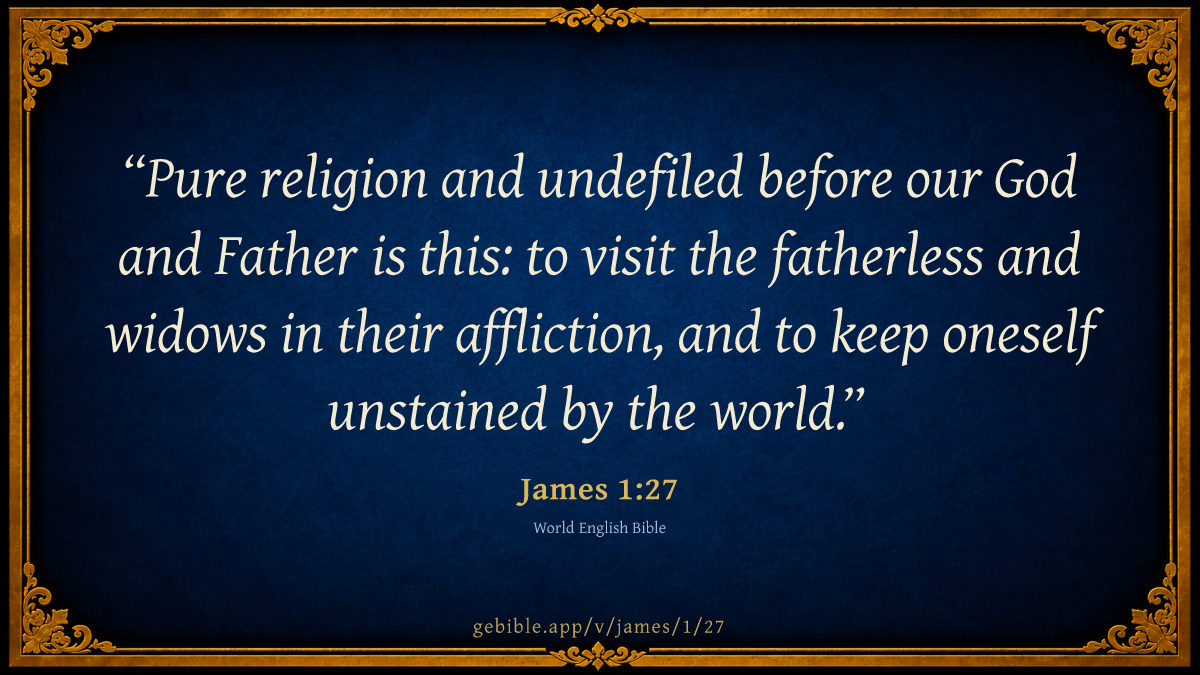
Pure religion and undefiled before our God and Father is this: to visit the fatherless and widows in their affliction, and to keep oneself unstained by the world.
Parallel Translations
-
Pure religion and undefiled before our God and Father is this: to visit the fatherless and widows in their affliction, and to keep oneself unstained by the world.
-
Pure devocion and vndefiled before God the father is this: to vysit the frendlesse and widdowes in their adversite and to kepe him silfe vnspotted of the worlde.
-
Pure religion and vndefiled before God, euen the Father, is this, to visite the fatherlesse, and widdowes in their aduersitie, and to keepe himselfe vnspotted of the world.
Cross-references (25)
Passages linked to James 1:27 in the Treasury of Scripture Knowledge, ordered by reader-vote popularity; verse text shown in World English Bible.
- Isaiah 1:16-17 Wash yourselves. Make yourself clean. Put away the evil of your doings from before my eyes. Cease to do evil. Learn to do well. Seek justice. Relieve the oppressed. Defend the fatherless. Plead for the widow.”
- 1 John 3:17-19 But whoever has the world’s goods and sees his brother in need, then closes his heart of compassion against him, how does God’s love remain in him? My little children, let’s not love in word only, or with the tongue only, but in deed and truth. And by this we know that we are of the truth, and persuade our hearts before him,
- Galatians 6:9-10 Let’s not be weary in doing good, for we will reap in due season, if we don’t give up. So then, as we have opportunity, let’s do what is good toward all men, and especially toward those who are of the household of the faith.
- Romans 12:2 Don’t be conformed to this world, but be transformed by the renewing of your mind, so that you may prove what is the good, well-pleasing, and perfect will of God.
- Matthew 25:34-46 Then the King will tell those on his right hand, ‘Come, blessed of my Father, inherit the Kingdom prepared for you from the foundation of the world; for I was hungry, and you gave me food to eat. I was thirsty, and you gave me drink. I was a stranger, and you took me in. I was naked, and you clothed me. I was sick, and you visited me. I was in prison, and you came to me.’ “Then the righteous will answer him, saying, ‘Lord, when did we see you hungry, and feed you; or thirsty, and give you a drink? When did we see you as a stranger, and take you in; or naked, and clothe you? When did we see you sick, or in prison, and come to you?’ “The King will answer them, ‘Most certainly I tell you, because you did it to one of the least of these my brothers, you did it to me.’ Then he will say also to those on the left hand, ‘Depart from me, you cursed, into the eternal fire which is prepared for the devil and his angels; for I was hungry, and you didn’t give me food to eat; I was thirsty, and you gave me no drink; I was a stranger, and you didn’t take me in; naked, and you didn’t clothe me; sick, and in prison, and you didn’t visit me.’ “Then they will also answer, saying, ‘Lord, when did we see you hungry, or thirsty, or a stranger, or naked, or sick, or in prison, and didn’t help you?’ “Then he will answer them, saying, ‘Most certainly I tell you, because you didn’t do it to one of the least of these, you didn’t do it to me.’ These will go away into eternal punishment, but the righteous into eternal life.”
- Isaiah 58:6-7 “Isn’t this the fast that I have chosen: to release the bonds of wickedness, to undo the straps of the yoke, to let the oppressed go free, and that you break every yoke? Isn’t it to distribute your bread to the hungry, and that you bring the poor who are cast out to your house? When you see the naked, that you cover him; and that you not hide yourself from your own flesh?
- 1 John 2:15-17 Don’t love the world or the things that are in the world. If anyone loves the world, the Father’s love isn’t in him. For all that is in the world, the lust of the flesh, the lust of the eyes, and the pride of life, isn’t the Father’s, but is the world’s. The world is passing away with its lusts, but he who does God’s will remains forever.
- Job 31:15-20 Didn’t he who made me in the womb make him? Didn’t one fashion us in the womb? “If I have withheld the poor from their desire, or have caused the eyes of the widow to fail, or have eaten my morsel alone, and the fatherless has not eaten of it (no, from my youth he grew up with me as with a father, I have guided her from my mother’s womb); if I have seen any perish for want of clothing, or that the needy had no covering; if his heart hasn’t blessed me, if he hasn’t been warmed with my sheep’s fleece;
- 1 Timothy 5:4 But if any widow has children or grandchildren, let them learn first to show piety toward their own family and to repay their parents, for this is acceptable in the sight of God.
- Job 29:12-13 Because I delivered the poor who cried, and the fatherless also, who had no one to help him, the blessing of him who was ready to perish came on me, and I caused the widow’s heart to sing for joy.
- Psalms 68:5 A father of the fatherless, and a defender of the widows, is God in his holy habitation.
- Colossians 3:1-3 If then you were raised together with Christ, seek the things that are above, where Christ is, seated on the right hand of God. Set your mind on the things that are above, not on the things that are on the earth. For you died, and your life is hidden with Christ in God.
- Psalms 119:1 Blessed are those whose ways are blameless, who walk according to Yahweh’s law.
- James 4:4 You adulterers and adulteresses, don’t you know that friendship with the world is hostility toward God? Whoever therefore wants to be a friend of the world makes himself an enemy of God.
- Luke 1:6 They were both righteous before God, walking blamelessly in all the commandments and ordinances of the Lord.
- Isaiah 1:23 Your princes are rebellious and companions of thieves. Everyone loves bribes and follows after rewards. They don’t defend the fatherless, neither does the cause of the widow come to them.
- James 3:17 But the wisdom that is from above is first pure, then peaceful, gentle, reasonable, full of mercy and good fruits, without partiality, and without hypocrisy.
- Matthew 5:8 Blessed are the pure in heart, for they shall see God.
- 1 Timothy 1:5 but the goal of this command is love, out of a pure heart and a good conscience and sincere faith,
- 1 John 5:4-5 For whatever is born of God overcomes the world. This is the victory that has overcome the world: your faith. Who is he who overcomes the world, but he who believes that Jesus is the Son of God?
- 1 John 5:18 We know that whoever is born of God doesn’t sin, but he who was born of God keeps himself, and the evil one doesn’t touch him.
- John 17:14-15 I have given them your word. The world hated them, because they are not of the world, even as I am not of the world. I pray not that you would take them from the world, but that you would keep them from the evil one.
- Galatians 1:4 who gave himself for our sins, that he might deliver us out of this present evil age, according to the will of our God and Father—
- Galatians 6:14 But far be it from me to boast, except in the cross of our Lord Jesus Christ, through which the world has been crucified to me, and I to the world.
- Galatians 5:6 For in Christ Jesus neither circumcision amounts to anything, nor uncircumcision, but faith working through love.
Cross-references from openbible.info (CC BY 4.0)
Explain this verse (19 sources)
Historical commentary, presented as a primary source — not an endorsement.
Private notes
Saved on this device only — never synced or sent anywhere.
John Calvin 1540 · Public Domain 27 Pure religion. As he passes by those things…
27 Pure religion. As he passes by those things which are of the greatest moment in religion, he does not define generally what religion is, but reminds us that religion without the things he mentions is nothing; as when one given to wine and gluttony boasts that he is temperate, and another should object, and say that the temperate man is he who does not indulge in excess as to wine or eating; his object is not to express the whole of what temperance is, but to refer only to one thing, suitable to the subject in hand. For they are in vain religious of whom he speaks, as they are for the most part trifling pretenders.
James then teaches us that religion is not to be estimated by the pomp of ceremonies; but that there are important duties to which the servants of God ought to attend.
Read full note →
To visit in necessity is to extend a helping hand to alleviate such as are in distress. And as there are many others whom the Lord bids us to succor, in mentioning widows and orphans, he states a part for the whole. There is then no doubt but that under one particular thing he recommends to us every act of love, as though he had said, “Let him who would be deemed religious, prove himself to be such by self denial and by mercy and benevolence towards his neighbors.”
And he says, before God, to intimate that it appears in deed otherwise to men, who are led astray by external masks, but that we ought to seek what pleases him. By God and Father, we are to understand God who is a father.
John Calvin's Commentaries (1540-1563) — public domain. Text from the Calvin Translation Society English edition (1840s-50s) via the Christian Classics Ethereal Library (ccel.org). Calvin's coverage is partial (roughly two-thirds of the Bible); uncommented books and verses are honest gaps, never fabricated. The 19th-century editor's footnotes and remarks are omitted so the notes are faithfully Calvin's own voice.
Geneva Bible translators 1599 · Public Domain The fourth: the true service of God standeth in…
The fourth: the true service of God standeth in charity toward our neighbors (especially such as need others’ help, as the fatherless and widows), and purity of life.
To have a care of them, and to help them as much as we can.
Geneva Bible (1599) marginal notes — public domain.
John Trapp 1656 · Public Domain 27 Pure religion and undefiled before God and the…
27 Pure religion and undefiled before God and the Father is this, To visit the fatherless and widows in their affliction, and to keep himself unspotted from the world.
Ver. 27. And widows] A vine whose root is uncovered thrives not; a widow whose covering of eyes is taken away, joys not.
John Trapp, A Commentary or Exposition upon All the Books of the Old and New Testament (1647–1656) — public domain. Text from a community e-Sword module.
Matthew Poole 1685 · Public Domain Pure religion; true, sincere, genuine, Mat 5:8; Joh 15:3.
Pure religion; true, sincere, genuine, Mat 5:8; Joh 15:3.
And undefiled; this seems to reflect upon the hypocritical Jews, whose religion consisted so much in external observances, and keeping themselves from ceremonial defilements, when yet they were sullied with so many moral ones, Jam 1:14; Mat 23:23; Joh 18:28; devoured widows’ houses. They thought their religion pure and undefiled; the apostle shows here which is really so before God; in the sight of God, and according to his judgment.
Read full note →
God and the Father; i.e. God who is the Father, and being only explicative, as Eph 1:3; 5:20; yet this title may be given here to God with respect to what follows, and to show that such acts of charity are acceptable to him that is called the the Judge of widows, and the Father of the fatherless, Psa 68:5.
To visit; this includes all other acts of charity to them, comforting, counselling, relieving them, &c.
The fatherless and widows; he doth not exclude others from being the objects of our charity and compassion, but instanceth in fatherless and widows, as being usually most miserable, because destitute of those relations which might be most helpful to them; and possibly in those times persecution might increase the number of widows and orphans.
In their affliction; when they had most need; lest any should think it sufficient to visit them that were rich, or in a prosperous condition.
And to keep himself unspotted from the world; untainted by the evil example of men in the world, and free from the lusts of the world, moral pollutions. The apostle doth not here define religion but only instanceth in these two things, good works and holiness of conversation, as testimonies and arguments of the truth of it.
Matthew Poole's English Annotations on the Holy Bible (1683–1685) — public domain. Text from a community e-Sword/MySword module.
William Burkitt 1703 · Public Domain Observe here, 1. That the apostle doth not set…
Observe here, 1. That the apostle doth not set down the whole of religion, but an eminent part and instance of it only: pure religion is this, that is, this is the practice of religion, without which all religion is vain; this is an eminent fruit, which springs from the root of pure religion; if pure religon live in the heart, the fruits of pious charity will appear in the life.
Observe, 2. The acts of charity, when they flow from a religious principle, do commence acts of worship; to visit the widow and fatherless, considered in itself, may be only an act of indifferency and civil courtesy; but when it is performed as an act of duty, in obedience to the command of God, or as an act of mercy and pity, for the supply of their wants by our purse, or for the comforting of their hearts by our counsel; being thus done out of conscience, it is as acceptable to God as an act of worship, to visit the fatherless and widows in their affliction.
Read full note →
Observe, 3. How the apostle joins charity and purity together; a pretense to the one without the other discovers the insincerity of both; the relieving of the afflicted, and a life unspotted, must go together, or God accept of neither: Pure religion is this, to visit the widow, and keep himself unspotted from the world; that is, from the defilement and pollutions of the world by the lusts thereof; plainly intimating,
1. That the world is a filthy place, a dirty defiling thing. What company almost can you come into, generally speaking, that is not sooty and leprous? How hard is it to converse with them, and not be polluted and infected by them? Even as hard as it is to touch pitch, and not be defiled.
2. That it is our duty, and ought to be our daily endeavour, to keep ourselves as unstained by, and unspotted from the world as we can: and that we may escape the pollutions which are in the world through lust, let us be instant in prayer, diligent in our watch, that if we cannot make the world better, that shall never make us worse.
3. That we should more and more grow weary of the world, and long for heaven, where there is nothing that defileth, where we shall have pure hearts, pure company, every thing agreeable, and this not for a few years, but for everlasting ages. Lord! when shall we ascend on high to live with thee in purity?
William Burkitt's Expository Notes on the New Testament (1700–1703) — public domain. Text from a community e-Sword module.
John Gill 1763 · Public Domain Pure religion and undefiled,.... That which is sincere and…
Pure religion and undefiled,.... That which is sincere and genuine, and free from adulteration and hypocrisy:
before God and the Father; or in the sight of God the Father of Christ, and all his people; that which is approved of by him, who is the searcher of hearts, and the trier of the reins of men, "is this": not that the apostle is giving a full definition of true religion; only he mentions some of the effects of it, by which it is known, and without which it cannot be true and genuine; and they are these:
Read full note →
to visit the fatherless and widows in their affliction; and not only to see them, and speak a word of comfort to them, but to communicate to them, and supply their wants, as they may require, and according to the ability God has given: where there is true religion in the heart, there is love to God; and where there is love to God, there is love to the saints; and this will show itself to them, in times of affliction and distress; and where this is wanting, religion itself is not pure and undefiled:
and to keep himself unspotted from the world: from the men of the world, who defile by their evil communications; and "from the vices of the world", as the Arabic version renders it, which are of a defiling nature; and, where religion is in its power and purity, and the Gospel of the grace of God comes with efficacy, it teaches to separate from the rest of the world, and to deny ungodliness and worldly lusts, and to live soberly, righteously, and godly.
Next: James Chapter 2
John Gill's Exposition of the Whole Bible (1746–1763) — public domain (CC PDM 1.0). Text via the HelloAO Bible API.
John Wesley 1765 · Public Domain The only true religion in the sight of God,…
The only true religion in the sight of God, is this, to visit - With counsel, comfort, and relief. The fatherless and widows - Those who need it most. In their affliction - In their most helpless and hopeless state. And to keep himself unspotted from the world - From the maxims, tempers, and customs of it. But this cannot be done, till we have given our hearts to God, and love our neighbour as ourselves.
John Wesley, Explanatory Notes Upon the Whole Bible (1754–1765) — public domain. Text via the GEBible commentary corpus.
Adam Clarke 1810 · Public Domain Verse 27. Pure religion, and undefiled] Having seen something…
Verse 27. Pure religion, and undefiled] Having seen something of the etymology of the word θρησκεια, which we translate religion, it will be well to consider the etymology of the word religion itself.
In the 28th chapter of the 4th book of his Divine Instructions, LACTANTIUS, who flourished about A. D. 300, treats of hope, true religion, and superstition; of the two latter he gives Cicero's definition from his book De Natura Deorum, lib. ii. c. 28, which with his own definition will lead us to a correct view, not only of the etymology, but of the thing itself.
Read full note →
"Superstition," according to that philosopher, "had its name from the custom of those who offered daily prayers and sacrifices, that their children might SURVIVE THEM; ut sui sibi liberi superstites essent. Hence they were called superstitiosi, superstitious. On the other hand, religion, religio, had its name from those who, not satisfied with what was commonly spoken concerning the nature and worship of the gods, searched into the whole matter, and perused the writings of past times; hence they were called religiosi, from re, again, and lego, I read."
This definition Lactantius ridicules, and shows that religion has its name from re, intensive, and ligo, I bind, because of that bond of piety by which it binds us to God, and this he shows was the notion conceived of it by Lucretius, who laboured to dissolve this bond, and make men atheists.
Primum quod magnis doceo de rebus, et ARCTIS
RELIGIONUM animos NODIS EXSOLVERE pergo.
For first I teach great things in lofty strains,
And loose men from religion's grievous chains.
Lucret., lib. i., ver. 930, 931
As to superstition, he says it derived its name from those who paid religious veneration to the memory of the dead, (qui superstitem memoriam defunctorem colunt,) or from those who, surviving their parents, worshipped their images at home, as household gods; aut qui, parentibus suis superstites, colebant imagines eorum domi, tanquam deos penates. Superstition, according to others, refers to novel rites and ceremonies in religion, or to the worship of new gods. But by religion are meant the ancient forms of worship belonging to those gods, which had long been received. Hence that saying of Virgil: -
Vana superstitio veterumque ignara deorum.
"Vain superstition not knowing the ancient gods."
Here Lactantius observes, that as the ancient gods were consecrated precisely in the same way with these new ones, that therefore it was nothing but superstition from the beginning. Hence he asserts, the superstitious are those who worship many and false gods, and the Christians alone are religious, who worship and supplicate the one true God only. St. James' definition rather refers to the effects of pure religion than to its nature. The life of God in the soul of man, producing love to God and man, will show itself in the acts which St. James mentions here. It is pure in the principle, for it is Divine truth and Divine love. It is undefiled in all its operations: it can produce nothing unholy, because it ever acts in the sight of God; and it can produce no ungentle word nor unkind act, because it comes from the Father.
The words καθαρα και αμιαντος, pure and undefiled, are supposed to have reference to a diamond or precious stone, whose perfection consists in its being free from flaws; not cloudy, but of a pure water. True religion is the ornament of the soul, and its effects, the ornament of the life.
To visit the fatherless and widows in their affliction] Works of charity and mercy are the proper fruits of religion; and none are more especially the objects of charity and mercy than the orphans and widows. False religion may perform acts of mercy and charity; but its motives not being pure, and its principle being defiled, the flesh, self, and hypocrisy, spot the man, and spot his acts. True religion does not merely give something for the relief of the distressed, but it visits them, it takes the oversight of them, it takes them under its care; so επισκεπτεσθαι means. It goes to their houses, and speaks to their hearts; it relieves their wants, sympathizes with them in their distresses, instructs them in Divine things and recommends them to God. And all this it does for the Lord's sake. This is the religion of Christ. The religion that does not prove itself by works of charity and mercy is not of God. Reader, what religion hast thou? Has thine ever led thee to cellars, garrets, cottages, and houses, to find out the distressed? Hast thou ever fed, clothed, and visited a destitute representative of Christ?
The subject in Jas 1:11 suggests several reflections on the mutability of human affairs, and the end of all things.
1. Nature herself is subject to mutability, though by her secret and inscrutable exertions she effects her renovation from her decay, and thus change is prevented from terminating in destruction. Yet nature herself is tending, by continual mutations, to a final destruction; or rather to a fixed state, when time, the place and sphere of mutability, shall be absorbed in eternity. Time and nature are coeval; they began and must terminate together. All changes are efforts to arrive at destruction or renovation; and destruction must be the term or bound of all created things, had not the Creator purposed that his works should endure for ever. According to his promise, we look for a new heaven and a new earth; a fixed, permanent, and endless state of things; an everlasting sabbath to all the works of God.
I shall confirm these observations with the last verses of that incomparable poem, the Faery Queene, of our much neglected but unrivalled poet, Edmund Spenser: -
"When I bethink me on that speech whylear,
Of mutability, and well it weigh;
Me seems, that though she all unworthy were
Of the heaven's rule; yet very sooth to say,
In all things else she bears the greatest sway;
Which makes me loath this state of life so tickle,
And love of things so vain to cast away;
Whose flow'ring pride, so fading and so fickle,
Short Time shall soon cut down with his consuming sickle.
Then gin I think on that which Nature sayd,
Of that same time when no more change shall be,
But stedfast rest of all things, firmly stayd
Upon the pillours of eternity,
That is contrayr to mutability:
For all that moveth, doth in change delight:
But thenceforth all shall rest eternally
With him that is the God of Sabaoth hight:
O that great Sabaoth God, grant me that Sabaoth's sight!"
When this is to be the glorious issue, who can regret the speedy lapse of time? Mutability shall end in permanent perfection, when time, the destroyer of all things, shall be absorbed in eternity. And what has a righteous man to fear from that "wreck of matter and that crush of worlds," which to him shall usher in the glories of an eternal day? A moralist has said, "Though heaven shall vanish like a vapour, and this firm globe of earth shall crumble into dust, the righteous man shall stand unmoved amidst the shocked depredations of a crushed world; for he who hath appointed the heavens and the earth to fail, hath said unto the virtuous soul, Fear not! for thou shalt neither perish nor be wretched."
Dr. Young has written most nervously, in the spirit of the highest order of poetry, and with the knowledge and feeling of a sound divine, on this subject, in his Night Thoughts. Night vi. in fine.
Of man immortal hear the lofty style: -
"If so decreed, th' Almighty will be done.
Let earth dissolve, yon ponderous orbs descend
And grind us into dust: the soul is safe;
The man emerges; mounts above the wreck,
As towering flame from nature's funeral pyre;
O'er desolation, as a gainer, smiles;
His charter, his inviolable rights,
Well pleased to learn from thunder's impotence,
Death's pointless darts, and hell's defeated storms."
After him, and borrowing his imagery and ideas, another of our poets, in canticis sacris facile princeps, has expounded and improved the whole in the following hymn on the Judgment.
"Stand the Omnipotent decree,
Jehovah's will be done!
Nature's end we wait to see,
And hear her final groan.
Let this earth dissolve, and blend
In death the wicked and the just;
Let those ponderous orbs descend
And grind us into dust.
Rests secure the righteous man;
At his Redeemer's beck,
Sure to emerge, and rise again,
And mount above the wreck.
Lo! the heavenly spirit towers
Like flames o'er nature's funeral pyre;
Triumphs in immortal powers,
And claps her wings of fire.
Nothing hath the just to lose
By worlds on worlds destroy'd;
Far beneath his feet he views,
With smiles, the flaming void;
Sees the universe renew'd;
The grand millennial reign begun;
Shouts with all the sons of God
Around th' eternal throne." WESLEY
One word more, and I shall trouble my reader no farther on a subject on which I could wear out my pen and drain the last drop of my ink. The learned reader will join in the wish.
"Talia saecla suis dixerunt, currite, fusis
Concordes stabili fatorum numine Parcae.
Aggredere O magnos (aderit jam tempus!) honores,
Cara Deum soboles, magnum Jovis incrementum.
Aspice convexo nutantem pondere mundum,
Terrasque, tractusque maris, coelumque profundum:
Aspice, venturo laetentur ut omnia saeclo.
O mihi tam longae maneat pars ultima vitae,
Spiritus, et quantum sat erit tua dicere facta!"
VIRG. Eclog. iv.
There has never been a translation of this, worthy of the poet; and to such a piece I cannot persuade myself to append the hobbling verses of Mr. Dryden.
2. Taken in every point of view, Jas 1:17 is one of the most curious and singular in the New Testament. It has been well observed, that the first words make a regular Greek hexameter verse, supposed to be quoted from some Greek poet not now extant; and the last clause of the verse, with a very little change, makes another hexameter: -
Πασα δοσις αγαθη, και παν δωρημα τελειον,
Εστ' απο των φωτων Πατρος καταβαινον ανωθεν.
"Every goodly gift, and every perfect donation,
Is from the Father of lights, and from above it descendeth."
The first line, which is incontestably a perfect hexameter, may have been designed by St. James, or in the course of composition may have originated from accident, a thing which often occurs to all good writers; but the sentiment itself is immediately from heaven. I know not that we can be justified by sound criticism in making any particular distinction between δοσις and δωρημα· our translators have used the same word in rendering both. They are often synonymous; but sometimes we may observe a shade of difference, δοσις signifying a gift of any kind, here probably meaning earthly blessings of all sorts, δωρημα signifying a free gift-one that comes without constraint, from the mere benevolence of the giver; and here it may signify all spiritual and eternal blessings. Now all these come from above; God is as much the AUTHOR of our earthly good, as he is of our eternal salvation. Earthly blessings are simply good; but they are imperfect, they perish in the using. The blessings of grace and glory are supreme goods, they are permanent and perfect; and to the gift that includes these the term τελειον, perfect, is here properly added by St. James. There is a sentiment very similar to this in the ninth Olympic Ode of Pindar, l. 41: -
- - Αγαθοι δε
Και σοφοι κατα Δαιμον' ανδρες.
Man, boast of naught: whate'er thou hast is given;
Wisdom and virtue are the gifts of Heaven.
But how tame is even Pindar's verse when compared with the energy of James!
3. In the latter part of the verse, παρ ᾡ ουκ ενι παραλλαγη, η τροπης αποσκιασμα, which we translate, with whom is no variableness, neither shadow of turning, there is an allusion to some of the most abstruse principles in astronomy. This is not accidental, for every word in the whole verse is astronomical. In his Πατηρ των φωτων, Father of lights, there is the most evident allusion to the SUN, who is the father, author, or source of all the lights or luminaries proper to our system. It is not only his light which we enjoy by day, but it is his light also which is reflected to us, from the moon's surface, by night. And it is demonstrable that all the planets - Mercury, Venus, the Earth, the Moon, Mars, Ceres, Pallas, Juno, Vesta, Jupiter, Saturn, Saturn's Rings, and Herschel, or the Georgium Sidus, with the four satellites of Jupiter, the seven satellites of Saturn, and the six satellites of the Georgium Sidus, thirty-one bodies in all, besides the comets, all derive their light from the sun, being perfectly opaque or dark in themselves; the sun being the only luminous body in our system; all the rest being illumined by him.
The word παραλλαγη, which we translate variableness, from παραλλαττω, to change alternately, to pass from one change to another, evidently refers to parallax in astronomy. To give a proper idea of what astronomers mean by this term, it must be premised that all the diurnal motions of the heavenly bodies from east to west are only apparent, being occasioned by the rotation of the earth upon its axis in an opposite direction in about twenty-four hours. These diurnal motions are therefore performed uniformly round the axis or polar diameter of the earth, and not round the place of the spectator, who is upon the earth's surface. Hence every one who observes the apparent motion of the heavens from this surface will find that this motion is not even, equal arches being described in unequal times; for if a globular body, such as the earth, describe equally the circumference of a circle by its rotatory motion, it is evident the equality of this motion can be seen in no other points than those in the axis of the circle, and therefore any object viewed from the centre of the earth will appear in a different place from what it does when observed from the surface. This difference of place of the same object, seen at the same time from the earth's centre and surface, is called its parallax.
As I shall make some farther use of this point, in order to make it plain to those who are not much acquainted with the subject, to which I am satisfied St. James alludes, I shall introduce the following diagram: Let the circle OKNS. in the annexed figure, represent the earth, E its center, O the place of an observer on its surface, whose visible or sensible horizon is OH, and the line EST, parallel to OH, the rational, true, or mathematical horizon. Let ZDFT be considered a portion of a great circle in the heavens, and A the place of an object in the visible horizon. Join EA by a line produced to C: then C is the true place of the object, and H is its apparent place; and the angle CAH is its parallax; and, because the object is in the horizon, it is called its horizontal parallax. As OAE, the angle which the earth's radius or semidiameter subtends to the object, is necessarily equal to its opposite angle CAH, hence the horizontal parallax of an object is defined to be the angle which the earth's semidiameter subtends at that object.
The whole effect of parallax is in a vertical direction; for the parallactic angle is in the plane passing through the observer and the earth's center, which plane is necessarily perpendicular to the horizon, the earth being considered as a sphere. The more elevated an object is above the horizon, the less the parallax, the distance from the earth's center continuing the same. To make this sufficiently clear, let B represent an object at any given altitude above the visible horizon OAH; then the angle DBF, formed by the straight lines OB and EB produced to F and D, will be the parallax of the object at the given altitude, and is less than the parallax of the same object when in the visible horizon OAH, for the angle DBF is less than the angle CAH. Hence the horizontal parallax is the greatest of all diurnal parallaxes; and when the object is in the zenith, it has no parallax, the visual ray passing perpendicularly from the object through the observer to the earth's center, as in the line Zoe.
The quantity of the horizontal parallax of any object is in proportion to its distance from the place of observation, being greater or less as the object is nearer to or farther removed from the spectator. In illustration of this point, let I be the place of an object in the sensible horizon; then will LIH be its horizontal parallax, which is a smaller angle than CAH, the horizontal parallax of the nearer object A.
The horizontal parallax being given, the distance of the object from the earth's center, EA or EI, may be readily found in semidiameters of the earth by the resolution of the right-angled triangle OEA, in which we have given the angle OAE, the horizontal parallax, the side OE, the semidiameter of the earth, considered as unity, and the right angle AOE, to find the side EA, the distance of the object from the earth's center. The proportion to be used in this case is: The sine of the horizontal parallax is to unity, the semidiameter of the earth, as radius, i.e. the right angle AOE, the sine of ninety degrees being the radius of a circle, is to the side EA. This proportion is very compendiously wrought by logarithms as follows: Subtract the logarithmic sine of the horizontal parallax from 10, the radius, and the remainder will be the logarithm of the answer.
Example. When the moon's horizontal parallax is a degree, what is her distance from the earth's center in semidiameters of the earth?
From the radius 10.0000000 Subtract the sine of 1 degree 8.2418553 Remainder the logarithm of 57.2987 1.7581447
Which is the distance of the moon in semidiameters of the earth, when her horizontal parallax amounts to a degree. If 57.2987 be multiplied by 3977, the English miles contained in the earth's semidiameter, the product, 227876.9, will be the moon's distance from the earth's center in English miles.
The sun's horizontal parallax is about eight seconds and three-fifths, as is evident from the phenomena attending the transits of Venus, of 1761 and 1769, as observed in different parts of the world: a method of obtaining the solar parallax abundantly less liable to be materially affected by error of observation than that of Hipparchus, who lived between the 154th and 163d Olympiad, from lunar eclipses; or than that of Aristarchus the Samian, from the moon's dichotomy; or even than that of modern astronomers from the parallax of Mars when in opposition, and, at the same time, in or near his perihelion. The sun's horizontal parallax being scarcely the four hundred and eighteenth part of that of the moon given in the preceding example, if 227876.9, the distance of the moon as found above, be multiplied by 418.6, (for the horizontal parallax decreases nearly in proportion as the distance increases), the product will be the distance of the sun from the earth's center, which will be found to be upwards of ninety-five millions of English miles.
When we know the horizontal parallax of any object, its magnitude is easily determined. The apparent diameter of the sun, for example, at his mean distance from the earth, is somewhat more than thirty-two minutes of a degree, which is at least a hundred and eleven times greater than the double of the sun's horizontal parallax, or the apparent diameter of the earth as seen from the sun; therefore, the real solar diameter must be at least a hundred and eleven times greater than that of the earth; i.e. upwards of 880,000 English miles. And as spherical bodies are to each other as the cubes of their diameters, if 111 be cubed, we shall find that the magnitude of the sun is more than thirteen hundred thousand times greater than that of the earth.
The whole effect of parallax being in a vertical circle, and the circles of the sphere not being in this direction, the parallax of a star will evidently change its true place with respect to these different circles; whence there are five kinds of diurnal parallaxes, viz. the parallax of longitude, parallax of latitude, parallax of ascension or descension, parallax: of declination, and parallax of altitude, the last of which has been already largely explained; and the meaning of the first four, simply, is the difference between the true and visible longitude, latitude, right ascension, and declination of an object. Besides these, there is another kind of parallax, called by modern astronomers the parallax of the earth's Annual Orbit, by which is meant the difference between the places of a planet as seen from the sun and the earth at the same time, the former being its true or heliocentric place, and the latter its apparent or geocentric place. The ancient astronomers gave the term parallax only to the diurnal apparent inequalities of motion in the moon and planets; Ptolemy, who lived in the second century, calling prosaphaeresis orbis what is now named the parallax of the great or annual orbit. This parallax is more considerable than the diurnal parallax, as the earth's annual orbit is more considerable than the earth's semidiameter. This parallax, when greatest, amounts in Mars, the nearest superior planet, to upwards of forty-seven degrees; in Jupiter to near twelve degrees; in Saturn to more than six degrees, etc. In the region of the nearest fixed stars, i.e. those new ones of 1572 and 1604, double the radius of the earth's orbit does not subtend an angle of a single minute of a degree; whence it is evident the nearest fixed stars are at least hundreds of times more distant from us than the Georgium Sidus is, whose greatest annual parallax amounts to upwards of three degrees. The annual parallaxes of the fixed stars are, in general, too minute to be measured; hence their distances from the earth must be inconceivably great.
Any farther description of parallax would be useless in reference to the subject to be illustrated.
The words τροπης αποσκιασμα, shadow of turning, either refer to the darkness in which the earth is involved in consequence of its turning round its axis once in every twenty-four hours, by means of which one hemisphere, or half of its surface, is involved in darkness, being hidden from the sun by the opposite hemisphere; or to the different portions of the earth which come gradually into the solar light by its revolution round its orbit, which, in consequence of the pole of the earth being inclined nearly twenty-three degrees and a half to the plane of its orbit, and keeping its parallelism through every part of its revolution, causes all the vicissitudes of season, with all the increasing and decreasing proportions of light and darkness, and of cold and heat.
Every person who understands the images will see with what propriety St. James has introduced them; and through this his great object is at once discernible. It is evident from this chapter that there were persons, among those to whom he wrote, that held very erroneous opinions concerning the Divine nature; viz. that God tempted or influenced men to sin, and, consequently, that he was the author of all the evil that is in the world; and that he withholds his light and influence when necessary to convey truth and to correct vice. To destroy this error he shows that though the sun, for its splendor, genial heat, and general utility to the globe and its inhabitants, may be a fit emblem of God, yet in several respects the metaphor is very imperfect; for the sun himself is liable to repeated obscurations; and although, as to his mass, he is the focus of the system, giving light and heat to all, yet he is not everywhere present, and both his light and heat may be intercepted by a great variety of opposing bodies, and other causes. St. James refers particularly to the Divine ubiquity or omnipresence. Wherever his light and energy are, there is he himself; neither his word nor his Spirit gives false or inconsistent views of his nature and gracious purposes. He has no parallax, because he is equally present everywhere, and intimately near to all his creatures; He is never seen where he is not, or not seen where he is. He is the God and Father of all; who is Above all, and Through all, and In all; "in the wide waste, as in the city full;" nor can any thing be hidden from his light and heat. There can be no opposing bodies to prevent him from sending forth his light and truth, because he is everywhere essentially present. He suffers no eclipses; he changes not in his nature; he varies not in his designs; he is ever a full, free, and eternal fountain of mercy, goodness, truth, and good will, to all his intelligent offspring. Hallelujah, the Lord God Omnipotent reigneth! Amen.
In concluding these observations, I think it necessary to refer to Mr. Wakefield's translation of this text, and his vindication of that translation: Every good gift, and every perfect kindness, cometh down from above, from the Father of lights, with whom is no parallax, nor tropical shadow. "Some have affected," says he, "to ridicule my translation of this verse, if it be obscure, the author must answer for that, and not the translator. Why should we impoverish the sacred writers, by robbing them of the learning and science they display? Why should we conceal in them what we should ostentatiously point out in profane authors? And if any of these wise, learned, and judicious critics think they understand the phrase shadow of turning, I wish they would condescend to explain it." Yes, if such a sentiment were found in Aratus, or in any other ancient astronomical writer, whole pages of commentary would be written on it, and the subtle doctrine of the parallactic angle proved to be well known in itself, and its use in determining the distances and magnitudes of the heavenly bodies, to the ancients some hundreds of years before the Christian era.
The sentiment is as elegant as it is just, and forcibly points out the unchangeableness and beneficence of God. He is the Sun, not of a system, but of all worlds; the great Fountain and Dispenser of light and heat, of power and life, of order, harmony, and perfection. In him all live and move, and from him they have their being. There are no spots on his disk; all is unclouded splendor. Can he who dwells in this unsufferable and unapproachable light, in his own eternal self-sufficiency, concern himself with the affairs of mortals? Yes, for we are his offspring; and it is one part of his perfection to delight in the welfare of his intelligent creatures. He is loving to every man: he hates nothing that he has made; and his praise endureth for ever!
Adam Clarke's Commentary on the Bible (1810–1826) — public domain. Text from a community e-Sword/MySword module.
Albert Barnes 1834 · Public Domain Pure religion - On the word here rendered “religion”…
Pure religion - On the word here rendered “religion” (θρησκεία thrēskeia), see the notes at Col 2:18. It is used here evidently in the sense of piety, or as we commonly employ the word religion. The object of the apostle is to describe what enters essentially into religion; what it will do when it is properly and fairly developed. The phrase “pure religion” means that which is genuine and sincere, or which is free from any improper mixture.
And undefiled before God and the Father - That which God sees to be pure and undefiled. Rosenmuller supposes that there is a metaphor here taken from pearls or gems, which should be pure, or without stain.
Read full note →
Is this - That is, this enters into it; or this is religion such as God approves. The apostle does not say that this is the whole of religion, or that there is nothing else essential to it; but his general design clearly is, to show that religion will lead to a holy life, and he mentions this as a specimen, or an instance of what it will lead us to do. The things which he specifies here are in fact two:
(1)That pure religion will lead to a life of practical benevolence; and,
(2)That it will keep us unspotted from the world. If these things are found, they show that there is true piety. If they are not, there is none.
To visit the fatherless and widows in their affliction - To go to see, to look after, to be ready to aid them. This is an instance or specimen of what true religion will do, showing that it will lead to a life of practical benevolence. It may be remarked in respect to this:
(1)That this has always been regarded as an essential thing in true religion; because
(a) it is thus an imitation of God, who is “a father of the fatherless, and a judge of the widows in his holy habitation,” Psa 68:5; and who has always revealed himself as their friend, Deu 10:18; Deu 14:29; Psa 10:14; Psa 82:3; Isa 1:17; Jer 7:7; Jer 49:11; Hos 14:3.
(b) Religion is represented as leading its friends to do this, or this is required everywhere of those who claim to be religious, Isa 1:17; Deu 24:17; Deu 14:29; Exo 22:22; Job 29:11-13.
(2)Where this disposition to be the real friend of the widow and the orphan exists, there will also exist other corresponding things which go to make up the religious character. This will not stand alone. It will show what the heart is, and prove that it will ever be ready to do good. If a man, from proper motives, is the real friend of the widow and the fatherless, he will be the friend of every good word and work, and we may rely on him in any and every way in doing good.
And to keep himself unspotted from the world - Compare the Rom 12:2 note; Jam 4:4 note; 1Jo 2:15-17 note. That is, religion will keep us from the maxims, vices, and corruptions which prevail in the world, and make us holy. These two things may, in fact, be said to constitute religion. If a man is truly benevolent, he bears the image of that God who is the fountain of benevolence; if he is pure and uncontaminated in his walk and deportment, he also resembles his Maker, for he is holy. If he has not these things, he cannot have any well-founded evidence that he is a Christian; for it is always the nature and tendency of religion to produce these things. It is, therefore, an easy matter for a man to determine whether he has any religion; and equally easy to see that religion is eminently desirable. Who can doubt that that is good which leads to compassion for the poor and the helpless, and which makes the heart and the life pure?
Albert Barnes' Notes on the Bible (1834–1885) — public domain. Text from a community e-Sword/MySword module.
Haydock's Catholic Bible Commentary 1859 · Public Domain Religion pure and unspotted, &c. St. James may use…
Religion pure and unspotted, &c. St. James may use the word pure, as a proper admonition to the Jews, who were generally mostly solicitous to avoid legal uncleanness, such as were incurred by eating meats forbidden in their law as unclean, by touching a dead body, &c. He therefore tells them that the Christian religion is known by acts of charity, by visiting and assisting widows, the fatherless, and such as are under afflictions, and in general by keeping our consciences interiorly clean, unspotted, and undefiled from this world, from the corrupt maxims and sinful practices so common in this wicked world. (Witham)
George Leo Haydock (1774–1849), Haydock's Catholic Family Bible and Commentary, 1859 edition — public domain. Excludes Psalms (Douay-Rheims chapter numbering differs from Protestant) and Deuterocanonical books (Catholic canon only).
Robert Jamieson, A. R. Fausset & David Brown 1871 · Public Domain Pure . . . and undefiled--"Pure" is that love…
Pure . . . and undefiled--"Pure" is that love which has in it no foreign admixture, as self-deceit and hypocrisy. "Undefiled" is the means of its being "pure" [TITTMANN]. "Pure" expresses the positive, "undefiled" the negative side of religious service; just as visiting the fatherless and widow is the active, keeping himself unspotted from the world, the passive side of religious duty. This is the nobler shape that our religious exercises take, instead of the ceremonial offices of the law.
before God and the Father--literally, "before Him who is (our) God and Father." God is so called to imply that if we would be like our Father, it is not by fasting, &c., for He does none of these things, but in being "merciful as our Father is merciful" [CHRYSOSTOM].
Read full note →
visit--in sympathy and kind offices to alleviate their distresses.
the fatherless--whose "Father" is God (Psa 68:5); peculiarly helpless.
and--not in the Greek; so close is the connection between active works of mercy to others, and the maintenance of personal unworldliness of spirit, word, and deed; no copula therefore is needed. Religion in its rise interests us about ourselves in its progress, about our fellow creatures: in its highest stage, about the honor of God.
keep himself--with jealous watchfulness, at the same time praying and depending on God as alone able to keep us (Joh 17:15; Jde 1:24).
Next: James Chapter 2
Jamieson, Fausset & Brown — Commentary Critical and Explanatory on the Whole Bible (1871) — public domain (CC PDM 1.0). Text via the HelloAO Bible API.
Daniel D. Whedon 1874 · Public Domain 27. Pure religion—A worshipfulness pure from these synagogue blemishes.…
27. Pure religion—A worshipfulness pure from these synagogue blemishes. In order to set the quarrelsome ritualism in its true light James contrasts with it a service of the most practical nature. It is a pure worshipfulness, not that quarrels, but that pours forth deeds of beneficence.
Before—As viewed by.
Read full note →
God and the Father—More correctly, our God and Father. Pure service, as our God and Father judges, is this, etc.
Unspotted from the world—The Christian is like a man walking through freshly painted objects, liable, without the greatest care, to being spotted. On every side are examples of vice and temptations to compliance which demand all his care, aided by grace from above, to make his words and his works consistent with a pure profession. Our apostle does not limit all pure religion to benevolence towards orphans and widows; he only contrasts that with the religion of captious talk. But, taking in this closing clause, all religion is comprehended.
Daniel D. Whedon (gen. ed.), Commentary on the Old and New Testaments (1874–1909) — public domain. Text from a community e-Sword module.
The Cambridge Bible for Schools and Colleges 1878 · Public Domain 27. Pure religion] The word still presents the outward…
27. Pure religion] The word still presents the outward aspect of the devout life. Better perhaps, pure worship.
undefiled] The term seems chosen with special reference to the Pharisee’s scrupulous care to avoid anything that caused ceremonial defilement. Comp. Joh_18:28, “lest they should be defiled,” where the word is that commonly used in the LXX. for polluted, or being “unclean,” as in Lev_5:3; Lev_11:23. St James reproduces the teaching of our Lord, that the real defilement comes from within, not from without, that true purity is found in “giving alms of such things as we have” (Mar_7:20-23, Luk_11:40).
Read full note →
before God and the Father] The last word seems chosen with a special reference to the duty that follows. We worship the Father when we are like Him in our care for the orphans (Psa_68:5).
To visit] The Greek word implies somewhat more than that which we commonly attach to the English; “to care for,” “look after,” as in “God hath visited his people” (Luk_7:16).
the fatherless and widows] These were the natural and therefore proverbial types of extremest affliction. Comp. Job_29:12-13; Sir_35:14. We find from Act_6:1, that they occupied a prominent place in what we may venture to call the “Charity Organisation” of the Church of Jerusalem. Comp. also Act_9:39; 1Ti_5:3-10.
and to keep himself unspotted from the world] The adjective is chosen with special reference to the “undefiled.” The “world” is used as including all the circumstances that tempt to sin, especially perhaps, the mass of unrenewed humanity out of which Christians are called, but into which they are in danger of sinking back. The real defilement to be guarded against was to be found in spiritual contact with that “world,” and not, as the Pharisee thought, in touching cup or garment that was ceremonially unclean. Comp. chap. Jas_4:4. In this fullest sense of the word, God alone can thus keep a man unspotted, but it is characteristic of St James to lay stress on the co-operation of man’s will, even, we may add, as St Paul does in “keep thyself pure” (1Ti_5:22). The teaching of St James finds a striking parallel in that of Philo, who speaks of those who practise “a ritual religion” (using the same word as St James) “instead of holiness” (Philo, p. 173). Comp. also Coleridge, Aids to Reflection, Aph. xxiii. “The outward service (θρησκεία) of ancient religion, the rites, ceremonies, and ceremonial vestments of the old law, had morality for their substance. They were the letter of which morality was the spirit; the enigma of which morality was the meaning. But morality itself is the service and ceremonial (cultus exterior, θρησκεία) of the Christian religion.”
The Cambridge Bible for Schools and Colleges (gen. ed. J. J. S. Perowne; Cambridge University Press, 1878–1918) — public domain. Text from a community e-Sword module.
Ellicott's Commentary for English Readers 1878 · Public Domain (27) Pure religion . . .—It will be observed…
(27) Pure religion . . .—It will be observed that by religion here is meant religious service. No one word can express this obvious interpretation of the original, taken as it must be in completion of the verse before; and certainly “religion” in its ordinary sense will not convey the right idea. Real worship, we may say, pure and undefiled, beheld and acknowledged as such in the presence of God, even the Father—mark the tender pathos of His divine relationship—is this:
To visit the fatherless (or, orphans) and widows in their affliction, and to keep himself unspotted from the world.—Here is the double proof of the perfect life of holiness, the savour whereof is as perpetual incense before the throne of God. And the help afforded to the helpless, put thus in the first place of the two requirements, will often bring about the second—namely, that spotless condition of unworldliness which marks, and will ever mark, the true servant of the Lord Jesus Christ. Deeds of benevolence may be and are often done by those who are not His; but all who truly belong to Him must live a life which praises Him continually in good works; not, it is hardly needful to say, as a cause—but rather the natural and inevitable result of love for Him, warming the heart within.
Read full note →
Scrupulous indeed were the “religious” contemporaries of James; they would not enter where the image of Divus Cæsar had its votive flame, while they were ceremonially clean for the keeping of their passover—“they went not into the judgment hall lest they should be defiled” (Joh_18:28). But He whom there they cruelly sought to slay had told them before, though in vain, “that which cometh out of the man, that defileth the man” (Mar_7:20), and “nothing from without can defile him” (Jas_1:15). What an eternal caution may be learned here against cold reliance upon ritual! What an instance, ever, under all varieties and forms, to be applied to themselves by the erring; persecuting, and deceitful sons of men! while, on the other hand, from these words of the wise Apostle we may be sure what is truest, nay, the only true service, acceptable and accepted, of the Most High—“To visit the fatherless and the widow,” beholding in them a new image of Christ, the Man of Sorrows, is to show pity verily to Him; and at the last such “pure religion” will receive His own approval. “Inasmuch as ye have done it unto one of the least of these, my brethren, ye have done it unto me” (Mat_25:40). Blessed be the ears attuned to catch the golden cadence, for it rings in angel voices round the soothers of the sick and sorrow-laden even now!
A Bible Commentary for English Readers, edited by Charles John Ellicott (1878–1897) — public domain. Text from a community e-Sword module.
The Pulpit Commentary 1880 · Public Domain God and the Father; rather, our God and Father.…
God and the Father; rather, our God and Father. The article (tw) binds together Qew and Patri, so that they should not be separated, as in the A.V To visit the fatherless and to keep himself unspotted. Observe that our duty towards our fellow-men is placed first; then that towards ourselves. jEpiskeptesqai is the regular word for visiting the sick; cf. Ecc 7:35, "Be not slow to visit the sick (mhtespqai ajrjrJwston)." The fatherless and widows (ojrfanouv kairav). These stand here (as so often in the Old Testament) as types of persons in distress; the "personae miserabiles" of the Canon Law. (see Deu_10:18; Psa_68:5 Psa_82:3; Isa_1:17; and cf. Ecc_4:10) "Be as a father unto the fatherless, and instead of a husband unto their mother; so shalt thou be as the son of the Most High, and he shall love thee more than thy mother doth." To keep himself unspotted. Man"s duty towards himself. (For aspilon, cf. (1Pe_1:19; 2Pe_3:14) From the world. This clause may be connected either with threin or with aspilon, as in the phrase, kaqarov ajpo in Act_20:26.
The Pulpit Commentary (1880–1919), ed. H.D.M. Spence-Jones & Joseph S. Exell — public domain. Text from a community e-Sword module.
The Biblical Illustrator 1887 · Public Domain Pure religion and undefiled before God
Jam_1:27
Pure religion and undefiled before God
Read full note →
The true ideal of religion
In our day, perhaps more than at any previous time, attempts have been made to define religion, to give us some description of what religion is, of what is that mysterious element that mingles so largely with, and colours so largely, human life.
Religion, says one, is the sense of the infinite overshadowing and influencing life. Religion, says another, is the determination of human life by the feeling of a bond uniting the human spirit to the mysterious spirit, whose domination over the world and himself he recognises, and to which he likes to feel himself united. Religion, says another, is the feeling of man, together with the activities, customs, and institutions springing out of that feeling concerning the relation in which he supposes himself to stand to the universe. These are some definitions of religion, culled almost at random, from modern speculative literature; and when we come from the sphere of philosophy to that of theology, and still more to that of Churchism, the definitions become almost countless. Religion in some quarters is retirement from the world to a monastery or a nunnery, and a monk or a nun is called by the distinctive name religious. The more ritual sects or Churches have called it religion, to observe devoutly and strictly certain prescribed rights and forms; and mere doctrinal sects have made religion consist in modes of belief, in holding certain opinions, in interpreting difficult passages of Scripture in a certain way. Now it is with something like a feeling of relief that one turns from all the carefully put together and logically constructed, and wonderfully polished definitions philosophical, ecclesiastical, and theological, to one like that in the text. It tells us that religion in its essence is twofold--it is charity and it is purity. On the one hand it is mercifulness, kindness, generosity in our dealings with others, as exemplified in the case of the widow and the afflicted; and on the other hand, as regards ourselves, it is purity of life in all its aspects. What has been called a white soul--a life without a stain, a life on which no shadow of dishonour rests, a life which, though led in the world, and perhaps in the busiest scenes of the world, is unspotted by the meanness and falsity and impurity found in the world. That, according to the text, is pure religion and undefiled. Now, when we take that as a definition of what religion is, and when we hold it up before us, and look steadily at it, how do we feel regarding it?
1. Well, first, does not there come to us a sense of its supreme beauty? It is told of one of the best men of our time--a man who specially exemplified the ideal of the text on both its sideshow, travelling with a party up the Nile, his character produced a profound impression on the Arab attendants, and when one said of him to the Sheik or leader of the party that in his own country he was regarded somewhat as a heretic, his reply was, He may be called what you like, he may not be a good Christian; I know not; but this I know, he is a good man. Such was the impression a character like this produced upon a Mahomedan of the desert, and such is the impression of beauty and reverence which a religious life of the kind indicated in the text is calculated to produce in time upon any mind in which a trace of goodness still lingers.
2. And close upon this thought of the beauty of religion there comes to one, in looking at the text, another and a second thought--namely, the permanence and durability of religion. We cannot conceive of a time, except, perhaps, in the final break up of society, when goodness shall not be esteemed as the highest form of human life, when charity and stainlessnes of character shall not be reverenced as the noblest expression which life can take, and the highest level to which human perfection can rise. Men may fall away from that ideal, they may run amuck in selfishness and sensuality, but they will never cease in their hearts to reverence it, and after their madness is past to come back to it again.
3. Take a third thought that the text suggests. If this be religion, how very wrong we all are in the standard and criterion we often apply in our judgment of others. We laugh when we read of the child asking her parent whether such a person is an irreligious man, a bad man, because he does not hide his face in his hat at the beginning of divine service. But are we much better ourselves? Is not our test often equally false, if not equally silly? We ask whether a man can be religious who does not hold this belief, who does not belong to this or that church? I believe it is far better not to judge our neighbours in this matter at all, for we will likely be wrong; but if we are impelled to form an opinion, let us take the measuring standard of the text and apply it. There is religion. How do they stand in this matter? I fear if you were to go through our professed religious people with a measuring rod of this kind, many of them would fall very far short, and many of them would be out of the reckoning altogether. If any of you are to judge of a fruit-tree growing in your garden, what method will you take to do so? Will you bore holes into it, and see whether the sap is running, and whether the inner bark is green, or will you uncover the roots and see whether they have a firm hold, and whether they are rightly spread where the moisture lies; or will you take note of the fruit that it produces in autumn? The last way is the better way, whatever may be said in favour of the former methods; but that is not the way most men take in pronouncing an opinion as to whether a man is religious or not, and there are very few who do not think themselves perfectly qualified to sit in judgment.
4. Once more, does not the text give us an idea of a comprehensive, widespread Catholic Church? It was said of a distinguished ecclesiastic--the remembrance of whom still lingers in the hearts of those who knew him, like a strain of sweet music--it was said of him that he was a clergyman of the Church of England and an honorary member of all other Churches. The words were uttered in contempt, and were thought by some to be a piece of irony, and of refined and scornful wit; but, to my mind, no higher tribute could be paid, for they tell how he based his idea of religion, essentially not upon dogma or rite, but upon goodness, and drew to all in whom goodness could be found as spirits, kindred with himself. I do not know myself anything that brings one more truly to the gospel than this definition of religion. Take the first half of it--charity, or, as it is put here in a strong form, visiting the fatherless and widows in their affection. Can such a life as that be carried out--except in a very spasmodic way--without a strong internal spiritual impulse, like that which comes from Christ. It is hard to raise charity from men who do not feel such an impulse. You might as well raise water from a pump without a valve. You work the piston of persuasion and push the water up, but there is no valve, and it straightway flows down again. I do not think anything can produce a life dedicated to humanity, but a self-dedication to that Christ who identified Himself with it, the strong impulse that comes from personal self-consecration to Him who bore our sins and carried our sorrows. Or take the other half of this text--Keeping ones self unspotted from the world. How hard it is for any one to do that. How hopeless the work seems to any one who tries steadily to do that. To conquer old habits, and to put down passions by philosophy, is like trying to put out a fire with a scanty supply of water or a small hose. I believe if we would walk in white, we must find our hidden life in Christ, through whom we can find a sense of forgiveness for the past, and strength for the time to come. Now, I may speak to some one here who has drifted, or who thinks he has drifted, away from Christianity. I hold up to him this idea of religion, pure and undefiled. Unless he has fallen away from goodness, as well as from Christ, he must acknowledge its perfection and its beauty. (J. C. Lees, D. D.)
Pure and undefiled religion
I. The virtue of BENEVOLENCE is here described by one of its most interesting and incumbent exercises. There is no description of persons who have a stronger claim on the tender compassions of our nature than those here specified--the widow and the orphan. It is deserving of special remark how frequently and how strongly God represents them as engaging His sympathies--how explicit and peremptory His charges are in their behalf, and how full of pointed force and heavy severity His denunciations against their oppressors (Psa_68:5; Deu_10:18; Pro_23:10-11; Exo_22:22-24). If we fancy ourselves, or any dear to us, placed by Divine providence in the conditions referred to, we are powerfully sensible how much we should value the soothing sympathy and the kind attentions of friends and fellow Christians, and how deeply we should be wounded were these to be withheld. The more strongly we are sensible of this, the more imperative does the obligation that rests upon us become in behalf of those whom the Lord has afflicted. That He afflicted them is no reason why we should. Instead of its being a time when we are to keep aloof, and to affliction to the afflicted, it is a time when we are to hear the voice of Him whose very nature is love, enjoining by His providence and by His word the exercise of sympathy and kindness. The terms of the text suggest the lesson that our benevolence must not be mere emotion--no, nor mere words, or mere regrets, and sighs, and tears. Benevolence must be evinced by beneficence. Well-wishing must manifest its sincerity by well-doing. It is not in word only, but in deed. It visits the fatherless and widows in their affliction. I need not say that to visit is to visit for the purpose of consolation and relief. It is quite obvious that under the term visiting there ought to be included all that we have it in our power to do for them: all for which visiting is of any real service. And surely there is no visitation of the fatherless and the widow more truly benevolent than that of which the object is to impart to them the consolations, the joys, the hopes of the very religion itself, by whose principles we are ourselves actuated in paying the visits.
II. The second part of practical religion, pure and undefiled, contained in the text, is to keep himself unspotted from the world. To this we give the general designation of SELF-GOVERNMENT. The style in which it is expressed is quite peculiar to the Scriptures. In this sacred book God and the world are invariably set in opposition to each other; as masters of opposite characters and opposite requirements, whose services can never be reconciled. The expression may be interpreted as including the whole of Christian purity of character. God is holy. All the precepts of God are holy; and all His truths, containing the manifestations of Himself and the motives to this purity, are holy. Purity is the first and most essential attribute of whatever comes from Him who is Light, and in whom there is no darkness at all. But the world--the fallen, apostate, alien world--is in its maxims, and principles, and ways, opposed to the purity of God. It is polluting; it is infectious. It is hard to keep white robes clean in passing through the midst of all that is defiling. It is hard to shun contagion amidst crowds infected with the plague. Such, however, in a moral and spiritual sense, must be the Christians daily and hourly endeavour. With such circumspection, jealous and incessant, is he called to walk. He must have no fellowship with the unfruitful works of darkness. He must cleanse himself from all filthiness of the flesh and spirit, perfecting holiness in the fear of God. He must, in every department of his walk and conversation, seek to make it to all apparent that, although in the world, he is not of the world.
III. Let me now guard against prevailing and injurious MISCONCEPTIONS by one or two general observations.
1. Let not the two parts of pure and undefiled religion be separated. They too often are. There are men many a time to be found who are very humane, but who are by no means patterns of personal purity or separation from the world. They found their confidence before God on their charity as the means of pacifying His anger and conciliating His good-will, and rendering Him, if not blind altogether to their vices and their self-indulgent worldliness, at least very indulgent to them, and very gentle in His verdict against them. Men of humanity, without religion, may, no doubt, do good by the direct influence of their liberality on the temporal comfort and wellbeing of others. But they contribute as directly to an opposite result, in regard to interests of a higher order--the spiritual and eternal interests of men. And what is the body to the soul?--what is time to eternity?--what is the chaff to the wheat? saith the Lord. And even where there is not open licentiousness, where there is only a mind that seeks its happiness in the world, the character is, in one view, the more dangerous from there being the less in it that does violence to the moral principles, whilst yet there is in all so lamentable a deficiency, the destitution of the hallowing and consecrating influence of piety. The mind is almost unconsciously deceived into the impression that religion is not essential to a good character. Everything appears to go on so amiably and usefully, and, on the whole, well and happily, without it. Oh that I could impress you all, deeply, permanently, influentially, with the conviction of the radical defectiveness of all principles that do not begin with God.
2. That neither the benevolence nor the purity enjoined by the text should be separated from those Christian principles of faith by which they are produced and maintained. Scriptural faith is faith that produces practice; scriptural practice is practice that springs from faith. It is with the extreme that talks of faith, to the overlooking of practice, that James has here to do. This is clear from verses 21-26, It will not do to divorce morality from religion. The principles of religion are the only principles of true morality. They form, indeed, themselves the first and highest branch of morals; the obligation that arises from our relation to God Himself being, in the strictest sense and strongest degree, of a moral character. And as all Bible morality is founded in religion, let it not be forgotten that the Bible is a revelation of God to sinners; and that the religion of a sinner must necessarily regard God as so revealed. And this is the same thing with saying that the religion of a sinner must begin with the humble acceptance of mercy, as it is made known and offered by the gospel. (R. Wardlaw, D. D.)
Benevolence and self-government enforced
The Christian religion is eminently good-will towards men; for, like its Divine Author, it breathes a spirit of universal benevolence. The benefits which it proclaims are for the whole human race--benefits which respect as well the present as the future world. We are not to understand the apostle as proposing morality to us in the abstract, but as enforcing upon our attention the necessity of personal purity and practical piety, from the acknowledged principles of our profession. Consequently it will not be either improper or unprofitable to offer in the first instance--
I. Some observations connected with THE MOTIVES AND OBLIGATIONS OF CHRISTIAN DUTY, with especial reference to the two comprehensive duties of benevolence and self-government, described in the text. God is love tits tender mercies are over all His works. Whether we trace the character of the high and lofty One in the works of nature or in the dispensation of grace, the same benevolent trait of the Deity everywhere meets our view. What return shall we make unto the Lord for all His benefits? To present themselves a living sacrifice, holy, acceptable unto God, they acknowledge to be a reasonable service. Hence their most earnest desires are that they may be holy, even as God is holy; that they may be preserved blameless and harmless, the sons of God without rebuke, in the midst of a perverse and crooked generation. And hope supports them in their conflict with every enemy of their peace, and, in faith of the promises, they anticipate the glory that shall be revealed. But, besides motives of personal holiness, there are others also which influence our conduct as respects the world at large. Thus, both individually and collectively, the benign power of the gospel is exerted. The Christian reasons, If God so loved us, we ought also to love one another. This life we know is only a preparation for a better, and accordingly as we shall have performed our parts well or ill here to our brethren that are in the world, so will our reward be hereafter. Thus we see that our own best, our immortal interests, are inseparably connected with those duties of sympathy and charity which we owe to our less fortunate brethren. Not, indeed, that our benevolent actions, or works of any other description, possess any innate value to recommend us to the favour of God, much less to merit a reward from Him: yet a reward of grace shall be given to them who, actuated by the principles of their Divine Master, have in their generation, after His example, gone about doing good. The foregoing remarks naturally lead to a further consideration, viz., that of--
II. PRACTICE THE TEST OF RELIGIOUS PRINCIPLE. Motives of duty implies duties to be performed. It sufficiently appears that the whole of Christian duty is not comprised in a system of opinions, nor in the mere observance of external ceremonies. Our Saviour hath Himself laid down a distinguishing mark, equally applicable to both true and false disciples Mat_7:20-21). Now, one essential requisite of pure and undefiled religion the text informs us is--
1. To visit the fatherless and widows in their affliction. A mind truly touched with heavenly influence will lead us to view with eyes of pity and compassion all the sons and daughters of affliction, to enter into their sorrows, and to pour into their wounds the balm of consolation. And sure I am that the humblest Christian will rejoice to have it in his power to contribute to the alleviation of the common misery.
2. To keep himself unspotted from the world. My brethren, the whole world lieth in wickedness. The carnal mind is enmity against God; it is not subject to the law of God, neither indeed can be (Rom_8:7); The imagination of mans heart is evil from his youth (Gen_8:21); That which is born of the flesh is flesh (Joh_3:6). Now examine yourselves by the test here proposed. Inquire what are your real characters in the sight of the holy, heart-searching God. Does your sympathy for the distressed spring only from natural feeling? or are you also actuated by Christian principles and motives in visiting the fatherless and widows in their affliction? (T. Sharpies, B. A.)
Benevolence and purity essential to true religion
I. It is here asserted that religion, in order to be pleasing and acceptable unto God, must exhibit itself in acts of SYMPATHISING KINDNESS AND COMPASSION towards those who are placed in circumstances of helplessness, difficulty, and distress. As all these manifestations of benevolence could not be enumerated, they are represented by the apostle under one prominent form--that of visiting the fatherless and widows in their affliction, thus presenting a case of affliction, and an occasion for kindness, from which no age of the world and no condition of society can be altogether exempt. He knew that other losses might be more easily compensated; that other sorrows might with less difficulty be soothed; that other bereavements would leave less of helplessness and loneliness behind them. He knew that the loss of property might be repaired by liberality, industry, and perseverance; that the loss of health was not invariably without its remedy; but that the loss of the fatherless and the widow would necessarily leave a vacuum which nothing could adequately supply. It is to the alleviation of this peculiar form of affliction, therefore/that the energies and the sympathies of the pure and undefiled religion of Him who cherished every form of social and domestic tenderness, who made little children the objects of His most gracious regard, and manifested towards His mother a most filial and watchful attention, are to be specially directed. In this amiable feature of its character, indeed, Christianity stands honourably distinguished from all the other forms and theories of religion which have ever prevailed in the world. It is the pure and undefiled, the compassionate and godlike religion of Jesus Christ alone, which has taught men their duty in this respect, as well as supplied them with adequate motives to the practice of it. It is this alone which has taught its professors to regard the whole human species, amidst all the diversity of its ranks, and pursuits, and conditions, as one great family. It has thus unsealed the great fountains of human sympathy and tenderness, which had hitherto been in a great degree locked up in the unconscious ignorance of our obligations, or concealed beneath the frost of selfishness.
II. But, in connection with the exercise of sympathetic kindness and practical benevolence, the apostle subjoins another essential constituent of pure and undefiled religion--that it maintains A CHARACTER UNSTAINED BY THOSE VARIOUS FORMS OF MORAL AND SPIRITUAL POLLUTION, with which the atmosphere of the present world is so deeply impregnated. Christian charity must not be less pure than generous; though she is in the world, she must not be of the world; though she blesses the earth with her presence, her origin is from heaven, and she must never forget the high and holy motives by which she is to be actuated. Like the sunbeam, she must illumine the darkest recesses of ignorance and vice without being contaminated by the contact; she must warm the desolate abodes of poverty without kindling into pride and self-righteousness; she must dispense her blessings with an open hand, and yet ascribe all the glory to that Father of lights, from whom cometh down every good and perfect gift; she must be willing, as occasion requires and her strength allows, to mingle in scenes from which the eye of taste and the sensibilities of worldly refinement, which have net been trained in the discipline of Christian humility and self-denial, would recoil; and yet she must be as the wings of a dove, which are covered with silver, and her feathers with yellow gold. But this exemption from the predominent sway and the polluting influence of the world, as contradistinguished from true and scriptural piety, is not only necessary as the concomitant of pure religion in general, but it is also indispensable to the due exercise of the duty previously inculcated. The spirit of Christian benevolence and the spirit of the world are diametrically opposed to each other. Where every effort of labour and science and art is directed with such intense energy to the main end of multiplying and accumulating wealth, it requires a more than ordinary measure of watchfulness and prayer--of the generous, and effusive, and constraining influence of the love of Christ shed abroad in the heart, to keep it untainted by the contracting and indurating spirit of covetousness and grasping selfishness. Whatever has a tendency to concentrate the thoughts and feelings upon self, and to make the enjoyment of personal gratification the great business of life, must inevitably impede the free and spontaneous development of that great and diffusive principle of Christian love. Amidst the various trials and sufferings which are more or less inseparable from the present state of existence, she unfolds to their view a world where sin and sorrow are unknown; a world whose atmosphere is health, whose resources are exhaustless, whose pleasures are untainted, and whose honours are unfading; a world in which there are neither fatherless nor widows, because all earthly unions and relations have been lost and absorbed in the delightful fellowship of one great family, of which God Himself is the Father, Jesus Christ the Elder Brother, and the eternal Spirit the all-pervading bond of holy and affectionate communion. (J. Davies, B.D.)
The evidence of true religion
The name of religion has perhaps been as much misapplied as the thing itself has been neglected. Creeds and systems of doctrine, outward observances and forms of service, conventionalisms in the use of meats and drinks, apparel, and modes of speech, have all among different parties been dignified by the name of religion. The primary cause of the mistake is to be found in the sensuous tendencies of the sinful heart; but a secondary cause, worthy of attention, consists in not keeping distinctly in view the character and gracious relations of that glorious Being with whom religion is immediately concerned. The religion described in the text is, as it were, a continuous spiritual worship, presented, in the harmonious working of renewed emotions and their consequent actions, to our God and Father in Christ.
I. THE FIRST OUTWARD MARK OF RELIGION MENTIONED BY THE APOSTLE IS BENEFICENCE. We use this word to denote the sincere and active exercise of love toward our fellow men. The connection of such love with those emotions towards God in which religion more immediately consists is best expounded in 1Jn_4:16; 1Jn_4:20. But such beneficence admits of degrees, from the easy donation of sixpence out of the accumulations of prosperous trade up to the willingly laying down our lives for the brethren. It may be doubted, therefore, what kind and what particular motive even of beneficence is enough to satisfy the question before us. To anticipate this difficulty, the apostle lays hold of one of its most real and impressive practical displays. To visit, says he, the fatherless and the widow in their affliction.
1. Religious beneficence addresses itself to the most necessitous objects. While impure beneficence, adulterated with an admixture of selfish policy, prefers a case of smaller to one of greater affliction, that which is sound at the core, and really springs from the presence of Divine love, contemplates affliction as such, and is impelled by the greatest force of desire to that wherein it finds the extremest need. Claims arising from duty to God may sometimes modify this feeling, but regard to worldly interest or convenience, never.
2. Religious beneficence especially singles out those objects which the worldly mind is disposed to despise. A poor widow is not unfrequintly like a queen dowager forsaken by the sycophant courtiers that formerly sunned themselves in the beams of her glory. The names of charity schools and charity children have passed into terms of reproach. Among all the evidences of human degeneracy this is perhaps the most widespread and manifest, that power is adored and goodness is despised. There is, therefore, a striking singularity in the conduct of the man who seeks out the fatherless and widows in their affliction. Our natural impression at once is that a Divine flame of love has been kindled in his heart, and that he is made a partaker of the nature of Him who, in the immensity of His glorious winks, has distinguished Himself by the unveiling of His goodness and the hiding of His power.
3. Religious beneficence expresses itself in personal effort and sacrifice. It is only an easy kind of beneficence when the rich give of their abundance to the relief of the poor, or where the eloquent on stated public occasions before listening thousands raise their voices on behalf of the fatherless. A feeble pulsation of love is all that is required for such benefactions. A better proof of its power is to be found in personal effort and sacrifice, or in the doing of that which is felt to be irksome in itself. Howard, descending into the depths of dungeons, placing himself in contact with the abandoned and the outcast, breathing the tainted air, of which he at length died, was an illustrious living embodiment of what the apostle has in view.
Those who in such loving sympathies are seen bending over the beds of sickness and cheering with their presence the home of sorrow and want are truly ministering angels, and present the nearest approach to that Divine love which, as a pure and glorious atmosphere, invests the regions of the heavenly paradise.
II. THE SECOND GREAT SIGN OF TRUE RELIGION MENTIONED BY THE APOSTLE IS PERSONAL PURITY OR HOLINESS, EXPRESSED IN THE WORDS, TO KEEP HIMSELF UNSPOTTED FROM THE WORLD. This may be regarded as the natural outworking of love to God, just as beneficence is more directly that of love to mankind. If ye love Me, says the Saviour, keep My commandments. Whoso, says John, keepeth His word, in him verily is the love of God perfected. On the one side is God, the sovereign Creator and Ruler of all things, holy in all His works and righteous in all His ways, most justly demanding the worship and service of men formed originally in His own image and sustained continually by His bounteous care. On the other side is the rebellious human race, sunk in sin, estranged from its Creator, conspiring with Satan, its actual god, against His law and government, and forming in its godless spirit, its selfish maxims, and its bondage to flesh and sense, the world, which bids Him defiance. To be kept, therefore, from the world, and not to be of the world, are expressions which denote an entire renunciation of all that belongs to its spirit and its relation to God--purity, that is, from its sins. The term unspotted seems to imply a notion of the word as something not only evil in itself, but also as being apt to contaminate those who are merely passing through it. As if the society of ungodly men were like a murky, polluting atmosphere, such as often envelopes our great cities, from which small particles of defilement are continually falling in silence on the objects below, and insensibly changing the brightest colours into those most nearly allied to blackness. Obviously in such circumstances the greatest care is necessary in order to keep ones self unspotted, not only by using means of protection, but also by observing regular seasons of cleansing. The world most fully presents this danger to the followers of Christ. The spirit which breathes in their necessary intercourse with society, the occasional excitement of sinful feelings by the provocations to which they are subject, the impressions continually made on their senses, and the secularising tendency even of their own lawful business, all conspire to damp the ardour of their spiritual life and to tarnish the lustre of their graces. Few Christians are absolutely without spots. But to be able in any fair measure, by the blessing of God or the use of means, to keep ones self unspotted from the contaminations of our age, is identical with a consistent and blameless Christian life. (J. M. Charlton, M. A.)
Pure religion
At first sight this text looks had. It seems subversive of all our theologics, and ethics also. The fact is, this text of ours is in no respect the simple formula of definition it looks like. It has a profound start, and takes a prodigious reach.
I. Pure religion and undefiled. Stop, now, just there. The first proposition found in the verses is this: THERE CAN BE ONLY ONE TRUE PERSONAL RELIGION FOR THE HUMAN SOUL.
1. Some argue for a mere intellectual scheme of belief. They would rest everything upon a certain fixed group of articles of faith and practice. The Christian religion has a creed of doctrines, and has a code of morals; but it is a life.
2. Some persistently press a mere poetic scheme of humane sympathy. It begins with a sigh, Oh, I wish I could be good! It continues with a song, Nearer, my God, to Thee! But it feels no sense of sin, and confesses none; so it generally rejects need of an atonement.
3. Some would urge upon us a mere routine scheme of ritual. This is little more than sentiment become artistic, devotion transmuted into devoteeism.
4. Some seek to present us with an ascetic scheme of moral observance. Of course, at its highest development, this ends in the cell of a hermit, and the white veil of a nun. But as we meet it in ordinary life, it goes not much farther than an iron rule of obedience to precept, and a strict treasuring of tradition.
5. Some insist on a scheme of mere philanthropy and benevolence. If such people knew there was a verse like ours in the Bible, they would flaunt it as the very motto on their banner--till they learned what it meant.
II. How is a man to choose? Who shall decide when all differ so? Pure religion, and undefiled before God and the Father, is this. The next proposition may be stated thus: THE STANDARD OF REFERENCE, UP TO WHICH ALL RELIGION MUST BE BROUGHT, IS DIVINE.
1. It will not do to settle it by the opinion of others.
2. Nor will it do that ones religion be settled by himself. Any one can easily make a foolish mistake, just by thinking more highly of himself than he ought to think, and so be lost.
3. All this matter must be, and certainly will be, settled by Gods opinion, and none other whatsoever.
III. We are ready to read on now somewhat further in the text. Pure religion, and undefiled before God and the Father, is this: To visit the fatherless and widows in their affliction. That is enough, and the new thought runs thus: THE TEST OF ALL TRUE PERSONAL RELIGION MAY BE FOUND IN CARE FOR THE WEAK AND LONELY.
1. The subjects of Christian charity mentioned here are typal as well as specific. Out of all classes of feeble people, the unprotected, and the helpless, God has chosen for our notice widows and orphans. The most trying condition in this world is brought to mind. A lonely mother, with fatherless children, is not only a living appeal for assistance and succour, but a thorough and exhaustive type, by which to teach the lesson that a true mans piety must be tested by the care he accepts for others.
2. But when is this duty binding? That brings out the occasion. The text says, In their affliction, that is, in the time of it and in the place of it. Our help must be given when our help is needed. Consider times of narrowness, of panic, of business depression, as offering special occasion.
3. The method of bestowing help is all found in one word of the text, visit. That cannot mean mere contribution of money; it means personal contact with those we hope to benefit. The one grand obstacle to all proper endeavour is found at the present day in the actual withdrawal of living heart from living heart in mutual acquaintance and interest.
4. But how far in such matters is one expected really to go? That inquiry is answered in our text also; the measure of obligation is quite clear. The significant lesson is taught us that religion is to be tested by feeling for the fatherless, and the feeling is to be measured by the fatherhood of God!
IV. Only on one condition can this ever be done; this is found in the final clause of the text. PERSONAL, RELIGION DEMANDS THE ENTIRE SURRENDER AND SEPARATION OF THE SOUL TO CHRIST. Unspotted from the world. Oh, how much that means! No self; no waiting for applause; no expectation of return; all this is of the world, worldly, and the true religion will have none of it. Of course, then, we all see this entire verse is addressed to Christians. Only thus can it be counted a definition. The text says that religion, pure and undefiled, is for a converted man; for an unconverted man it says nothing. Humanitarianism has nothing it does not borrow from religion. Success in all its enterprises would be secured better the moment the soul of the worker puts on Christ as a penitent believer. And he who puts on Christ, puts on also the burden of Christ. (C. S.Robinson, D. D.)
The true tests of faith
It is a paradox, and yet it is perfectly true, that man is not justified by works, and yet that man is not justified without works.
I. BETWEEN OBEDIENCE AND FAITH THERE SUBSISTS AN INSEPARABLE CONNECTION,
II. OBEDIENCE IS THE REQUISITE EVIDENCE OF FAITH. It is the one evidence. And, moreover, this is the evidence by which the world will judge. We sometimes hear the ungodly babbling they know not what about Christian doctrine, and affirming that there is so much obscure, and so much mysterious, that they cannot separate that which is practical and intelligible. But we very seldom indeed find that they bring any accusation at all against a benevolent, painstaking, self-denying, active life. (S. Robins, M. A.)
The wisdom of religion
I. TRUE RELIGION IS THE DIVINE SPRING OF PURE THOUGHT AND ACTION. As a watch is moved by its spring, so our actions are moved by the force of our inward belief. It is, therefore, of the highest importance to have true and inspiring faith, like that of a minister of the seventeenth century, when he said that the first act of religion is to know what is true of God, the second act is to express it in our lives.
II. TRUE RELIGION IS AN INWARD FORCE OR YEARNING FOR PERSONAL PURITY. It is the birth and existence of a cleansing spirit within us.
III. TRUE RELIGION IS THE FLOWING OF GODS LOVE THROUGH US TO ALL MEN WITH WHOM WE HAVE TO DO. (W. Birch.)
Pure and undefiled religion
I. TO VISIT THE FATHERLESS AND WIDOWS, THAT IS, TO BE PLENTEOUS IN GOOD WORKS; THESE ARE THE VERY BEGINNINGS AND NURSERY OF THE LOVE OF GOD.
1. There is no surer and readier step to the love of God, whom we have not seen, than by the love of our brethren, whom we see (1Jn_4:20).
2. As compassion to our brethren is a fair preparation to purity of life, so doth purity of conversation commend our liberality, and make it to be had in remembrance in the sight of the Lord. It may be bread, it is not an alms, that is brought by the hand of an oppressor or a Pharisee.
3. Therefore, in the next place, as they bear this fair correspondence, and mutually uphold each other, so we must not think it possible to separate them. Both are required at our hands; and if God hath joined them both together, let no man take upon him to divorce or put them asunder.
II. For, in the next place, THESE TWO THUS LINKED AND UNITED TOGETHER WILL KEEP RELIGION PURE AND UNDEFILED; which are as the colours and beauty of it, the beauty of holiness, which hath its colour and grace from whence it hath its being and strength, and, if it be true, will shine in the perfection of beauty. Religion, if it be true, and not a name only, is as a virgin pure and undefiled, and maketh us so, and espouseth us to Christ. So is true religion, simple and solid, full of itself, having no heterogeneous matter, but ever the same, and about the same. There is nothing in our love which soureth our justice, nothing in our justice to kill our compassion, nothing in our liberality to defile our chastity, nothing in our fear to beat down our confidence, nothing in our zeal to consume our charity. A true religious man is always himself. And as religion is pure, without mixture, so it is undefiled, and cannot subsist with pollution and profaneness. Now are our Olympics, now is the great trial to be made before God and the Father. And our religion consisteth in this, to fight it out legally (2Ti_2:5); a condition they were bound to who were admitted to those games and exercises.
III. And now I have showed you the picture of religion in little, represented it to you in these two, doing of good, and abstaining from evil; filling the hungry with good things, and purging and emptying ourselves of all uncleanness. You have seen its beauty in its graceful and glorious colours of purity and undefiledness; a picture to be hung up in the Church, nay, before God Himself. And THUS IT APPEARETH BEFORE GOD AND THE FATHER, AND HATH ITS RATIFICATION FROM HIM. Application:
1. This may serve, first, to make us in love with this religion, because it hath such a Founder as God the Father, who is wisdom itself, and can neither be deceived, nor deceive us.
2. Again, if St. James be canonical and authentic, if this be true religion, then it will make up an answer sufficient to stop the mouth of those of the Romish party who are very busy to demand at our hands a catalogue of fundamentals, and where our Church was before the days of Reformation. Do the ask what truths are fundamental? Faith supposed, as it is here, they are--charity to ourselves and others. To know this, is to know all we need to know. For is it not sufficient to know that which is sufficient to make us happy? But if nothing will satisfy them but a catalogue of particulars, they have Moses and the prophets (Luk_16:29); they have the apostles; and if they find their fundamentals not there, in vain shall they seek for them at our hands.
3. To conclude then. Men and brethren, are these things so? Is this only true religion--to do good, and to abstain from evil? If this should take place amongst the sons of men, we should have more religion and less noise. Could this religion, could the gospel of Christ prevail; could we deny ourselves and take up the cross, and keep ourselves unspotted from the world, there would be then no wars, nor rumours of wars. Let us not deceive ourselves. It is the neglect and want of this that hath been the main cause of all the hot contentions which have been, and aa yet are, in the Church of Christ; I mean, amongst those who call one another Christians; whose mark and badge it is to love one another. (A. Farindon, B. D.)
True religion
1. It is the glory of religion when it is pure. The true Christian religion is called a holy faith (Jud_1:20). No faith goeth so high for rewards, nor is so holy for precepts. Well, then, an impure life will not suit with a holy faith. Precious liquor must be kept in a clean vessel, and the mystery of the faith held in a pure conscience (1Ti_3:9). We never suit with our religion more than when the way is undefiled and the heart pure Psa_119:1; Mat_5:9).
2. That a pure religion should be kept undefiled. A holy life and a bounteous heart are ornaments to the gospel. Religion is not adorned with ceremonies, but purity and charity.
3. A great fruit and token of piety is provision for the afflicted. In Matthew
25. you see acts of charity fill up the bill. Works of mercy do well becomethem that do expect or have received mercy from God.
4. Charity singleth out the objects that are most miserable. That is true bounty when we give to those that are not able to make requital (Luk_14:12-14).
5. This charity to the poor must be performed as worship, out of respect to God. The apostle saith to visit the fatherless is worship. A Christian hath a holy art of turning duties of the second table into duties of the first; and in respect to man, they worship God. To do good, and to communicate, forget not; for with such sacrifice God is well pleased (Heb_13:16). Well, then, alms should be sacrifice; not a sin-offering, but a thank-offering to God.
6. True religion and profession is rather for Gods eye than mans. It aimeth at the approbation of God, not ostentation before men (Psa_18:23).
7. We serve God most comfortably when we consider Him as a Father in Christ. We are not servants, but have received the adoption of sons. Get an interest in God, that His work may be sweet to you.
8. The relieving of the afflicted and the unspotted life must go together.
9. The world is a dirty, defiling thing. A man can hardly walk here but he shall defile his garments.
(1) The very things of the world leave a taint upon our spirits. By worldly objects we soon grow worldly. It is hard to touch pitch and not to be defiled.
(2) The lusts of the world, they stain the glory and deface the excellency of your natures (2Pe_1:4). (Your affections were made for higher purposes than to be melted out in lusts.) The men of the world are sooty, dirty creatures. We cannot converse with them but they leave their filthiness upon us. (T. Manton.)
Why men should minister to the necessity of their brethren
1. In His law and gospel the Lord requireth this duty of love and service to be done, to whom seeing we are infinitely indebted, we herein must be obedient.
2. The remembrance of our frailty, fickleness of our worldly condition, must move to charity; for such as are rich to-day may be poor to-morrow.
3. That we are members each of each other, and all members of one body; might it not move us to mutual succour?
4. If we require example, God is rich in mercy and in all goodness; He giveth abundantly to all men, and reproacheth none.
5. If we look for a president, our Saviour Christ is our Pattern, who laid down His life for us, that we should lay down our lives (much more our goods) for the brethren.
6. If reward may allure us, we have not only therefore promise of increase and multiplying our store here, as we see was performed to the widow of Sarepta, but also of eternal blessing.
7. If punishment may terrify us, then let us recount that as God promiseth exceeding great reward, both temporal and eternal, to the merciful, so He threateneth grievous punishment, both in this life and in the life to come, to the merciless, which thing should move us.
8. If we consider that by the apostle is set down as a property and effect of true religion, without which our religion is but counterfeiting, our holiness but halting, our devotion but dissimulation before God, thereby shall we be stirred up to this duty.
9. Finally, we shall be better moved hereunto, if we shall consider that we are only stewards of these goods, and that they are committed to us upon trust. (R. Turnbull.)
The ritual of the gospel
The reference is to the externals of religious worship, the cultus exterior, the ceremonial, the ritual of worship. St. James throws into contrast the old law with its gorgeous and imposing exhibitions, with the humble simplicity of the gospel, and the self-denying duties it enjoins. If religion needs a ritual, an outside by which its highest and holiest service may be made manifest, let all that is external be evidenced in the visiting of orphans and widows in the hour of their woe and want, and in a holy separation from the defilements of a wicked world. (F. T.Bassett, M. A.)
To visit the fatherless and widows.
Visiting the fatherless and widows
I. WHAT IS MEANT BY VISITING THE FATHERLESS AND WIDOWS IN THEIR AFFLICTION.
1. The objects of our charity; the fatherless and widows in their affliction; in any want or distress wherein they need and are capable of our assistance.
2. The charitable act we are to exercise towards them who are in want or distress.
II. THIS IS A NECESSARY AND PRINCIPAL PART, AND A SIGNAL TESTIMONY, OF TRUE RELIGION. Mercy and charity are those duties which the gospel, the rule of our religion, doth in a most earnest and especial manner require and press the performance of (1Ti_1:5 : 1Co_13:13; 1Pe_4:8; Heb_13:16; Luk_3:8; Mat_5:7; Jam_2:13; 1Ti_6:17-19). Other exercises of religion can be of no value in the sight of God, where this duty of charity is neglected. What an affront must it be to God to pretend to join in prayers to Him for those who are in trouble, need, sickness, or any other adversity, if He hath put it in our own power to relieve them, and we will not! What mockery is it to come and sit before God as His people, and to hear His word, if covetousness hath so possessed our hearts that we have no regard to the most plain and express commands of it! The vanity and inefficacy of all such religious exercises, without charity, is most frequently asserted in Holy Scripture (Isa_1:11-12; Isa_1:17-18; Isa_58:6-7; Isa_58:9). The great ends of religion, the glory of God, the good of His people here, and the disposing us for heaven hereafter, are most highly promoted by charity, and therefore it must be a principal part of it.
III. IT IS A SINGULAR TESTIMONY OF TRUE RELIGION, AND WHAT IT OBLIGETH ALL SORTS OF MEN TO; TO TAKE PARTICULAR CARE OF THE FATHERLESS CHILDREN AND WIDOWS OF GODS MINISTERS IN THEIR AFFLICTION, AND TO HAVE A MORE SPECIAL REGARD TO THEM IN THE EXERCISE OF THEIR CHARITY. (L. Butler, D. D.)
Work for orphans
Dr. Guthrie whispered to me, as the children left the class, Do you see that golden-haired boy with full face and laughing eyes?
Let me tell you his story; and as we descended he continued, You see, he said, that splendid boy had followed his mother to the grave; and being friendless and shelterless, he returned when night fell and stretched himself on the grave, contented if he might but die. Next morning he was found half frozen to death. His little hands were frozen as cold as those of his dead mother or the earth on which he lay. If you had only seen him! Yes, it is a noble work which God has given us to do. (Robert Koenig.)
The Egyptian emblem of charity
A boy, naked, his heart in his hand, giving honey to a bee that has lost its wings. How beautiful and how suggestive! (A. T. Pierson, D. D.)
A scholar and a sick woman
A gentleman, near London, went to visit a woman who was sick. As he was going into room, he saw a little girl kneeling by the side of the poor womans bed. The little girl rose from her knees as soon as she saw the gentleman, and went out of the room. Who is that child? the gentleman asked. Oh, sir! said the sick woman, that is a little angel, who often comes to read her Bible to me, to my great comfort; and she has just now given me sixpence. The gentleman was so pleased with the little girls conduct, theft he wished to know how she had learned to love the Word of God and to be so kind to poor people. Finding that she was one of the scholars of a neighbouring Sunday school, he went to the school, and asked for the child. She felt rather afraid when she was called to the gentleman; but he was very kind to her, and asked her if she was the little girl that had been to read the Bible to the sick woman. She said she was. The gentleman said, My dear, what made you think of doing so? She answered, Because, sir, I find it is said in the Bible, that pure religion and undefiled before God and the Father is this--to visit the fatherless and the widows in their affliction. Well, said he, and did you give her any money? Yes, sir. And where did you get it? Sir, it was given me as a reward. (K. Arvine.)
Traces of Jewish habits of thought
In these large and noble words we find some traces of Jewish training and habits of thought. For when we read Pure and undefiled ritualism is to visit orphans and widows in their affliction, we instantly recognise a Jewish tone of thought and speech. Among the Jews, as among most Oriental races of the ancient world, widows and orphans were of all classes the most liable to plunder and oppression. Their inheritance was often filched from them under forms of law, now that they bad no strong arm to protect them, by an unjust judge whom they were unable to bribe, or even forcibly wrested from them by some rapacious kinsman or neighbour. Hence it was that the prophets constituted themselves the champions of the defenceless orphan and widow, denounced the curse of Heaven on all who wronged them, and even, by a bold figure of speech, declared God Himself to be the Husband of the widow and the Father of the fatherless. St. James, therefore, simply carries on the Hebrew tradition when he bids us, as part of the service, or worship, we owe to God, visit orphans and widows in their affliction. (Almoni Peloni.)
Visiting
The very word visit has a Hebrew twang in it. For, to the Jew, this word meant more than to us. God visited His people when He redeemed them from bondage, or gave them abundance for want, joy for mourning. God visited Job when he cleansed him from his leprosy and gave him twice as much as he had before. And, in like manner, we visit orphans and widows, in St. James sense of the word, not when we call upon them, or say a few kind words to them, which cost us nothing, but when we defend them from insult or wrong, when we effectively minister to their wants or comfort them in their sorrow. (Almoni Peloni.)
God-like to live for others
Just as the rosebud which refuses to unfold its petals, rots at the heart and dies, while the bud which bursts into blossom and scatters fragrance all around is healthy, and beautiful, and strong; so the man who lives to himself, dies while he lives; but the man who, forgetful of self, lives for the good and happiness of others, finds in his very unselfishness, health, and peace, and joy. In the great world around us, the sparrow gives nothing to God, yet day by day God cares for the sparrow. The worm and the insect give nothing back to God, yet God never forgets them. What is the lesson? Surely it is this, viz., that it is Godlike to work for anothers good, never looking for or expecting anything in return. (A. C. Price, B. A.)
The blessedness of charity
A story is told, in the Annals of the Round Table, of a knight who set out to find the Holy Grail Forth from the castle gate rode the knight, filled with his lofty purpose, having no eyes or ears for the common things about him, and giving no heed to the grey-bearded beggar that lay asking alms. Forth he went, and began to do many wonderful works. His sword wrought prodigies of valour, in gloomy woods by robbers strongholds, in wild mountains where the dragons lay. But he never saw the holy vision, the reward of Gods true knight. Then, spirit-broken, he gave up the quest as hopeless, and rode wearily homeward. He came with head hung down and eyes that looked upon the ground. Not for me, not for me, he muttered, is the holy vision. Then he caught sight of the beggar that lay yet at his gates, Ah, now thou shalt be helped, old man, cried the knight, for I must content myself with such small acts of pity. He sprang from his horse, and laid aside spear and crested shield, and bent over the beggar tending his wounds. He bade the servants bring him bread and wine, and himself saw all his wants supplied. And lo! as he turned, there floated the wondrous vision--he saw the Holy Grail! The truest and best service we can render is that which lies before us, in our way and next to hand. (M. G. Pearse.)
Christianity beneficent
Once, referring to the fact that orphanages are never maintained by infidels, Mr. Spurgeon used the felicitous expression, The God that answereth by orphanages, let Him be God. (H. P. Hughes, M. A.)
Philanthropy and piety
John Howard, when he grew sad about his piety, put on his hat and went out among the poor. He came back a gainer.
Active charity a part of pure religion
I. The apostles words prove, first, THAT SOMETHING MIGHT APPEAR TO BE, OR BE HELD TO BE, PURE AND UNDEFILED RELIGION, WHICH IS NOT SATISFACTORY BEFORE GOD.
1. They prove, for instance, that a scriptural and orthodox creed is not in itself sufficient.
2. Neither, it here appears, is an inactive, contemplative religion such as God approves.
II. IT SEEMED NEEDFUL THUS BRIEFLY TO HINT AT ERRORS IN THIS MATTER, FOR THE PURPOSE OF SHOWING, MORE PLAINLY WHAT IS TRUE AND UNDEFILED RELIGION.
1. It is, first, as we are here told, to visit the fatherless and widows in their affliction, One half of the world, as has sometimes been, said, knows not how the other half lives. This will not be the case where there is pure and undefiled religion. There will be then a principle which will lead the one half to inquire into the condition of the other. And truly, there is much need.
2. When St. James mentions the widows and the fatherless, he means, of course, the destitute and afflicted of every class. He specifies these only as most especially deserving our compassion.
3. Observe, brethren, to visit. The original word is more comprehensive than any one word of ours can fully render. It is to look round for and to inspect their circumstances: to see the assistance which they need, even as God Himself did when He visited and redeemed His people, baying seen and pitied their condition.
III. I come now to THE OTHER CHARACTERISTIC OF PURE AND UNDEFILED RELIGION--to keep himself unspotted from the world.
1. In regard to worldly business, I need not say that a man does not keep himself unspotted from the world by withdrawing from it. The cases must be few where this could be needful. Religion consists in using the world, as not abusing it.
2. The pleasures and amusements of the world are still more injurious than the business of the world, to pure and undefiled religion. Many of them, either considered in themselves, or viewed in their consequences and effects, are opposed to it altogether. They involve a waste of that time and that money which ought to be employed in the service of God and the welfare of mankind.
3. He is in danger, thirdly, from its sentiments as well as from its pleasures. Because the world, avowedly, does not take its sentiments from the Bible; but sets up its own authority, enacts its own rules, and issues its own decisions. At the same time, it must not be conceived that a man acts religiously, or thinks scripturally, merely because he opposes general opinion. The only proper course is, to be independent of general opinion; to choose a course according to our special case and circumstances, which we believe that God will approve, and which we r,-solve to follow, whether approved of men or no; whether with the world, or against the world. (Bp. Sumner.)
Unspotted from the world
Unspotted from the world
Men and women grow older in this world of ours, and as the years advance they change. Of all the changes that they undergo those of their moral natures are the most painful to watch. The boy changes into the man, and there is something lost which never seems to come back again. It is like the first glow of the morning that passes away--like the bloom on the blossom that never is restored. Your grown-up boy is wise in bad things which he used to know nothing about. His life no longer sounds with a perfectly clear ring, or shines with a perfectly white lustre. He is no longer unspotted. And then when a grown man sees and knows all this either in himself or in another, he is sure also that the change has come somehow from this boy having grown up to manhood in the midst of his fellow-men. Home, school, business, society, politics, human life in general in all its various activities--out of this have come the evil forces that have changed and soiled this life. We all think of ourselves, and in our kinder moments think of our brethren, as victims. We have not cast away the jewel, but we have fallen among thieves, and it has been taken from us. We have not merely been spotted, but spotted by the world. There is something very sublime, I think, in the Bible conception of the World which we are always meeting. The Bible touches us because it seems to know all about this world--this total of created things, this cosmos, this aggregate of disorder with purposes of order manifest all through it, this sea of tempest with its tides of law, this mixture of insignificant trifles with the most appalling solemnities, this storehouse of life and activity and influence which we are crowding on and crowded by every day, out of which come the shaping forces of our life, which we call the world. The Bible knows all about it, and so we listen when the Bible speaks. Here, then, we have one fact. Our own experience discovers it. The Bible steps in and describes it. Lives spotted by the world. The stained lives. Where is the man or woman who does not know what it means? There is the most outward sort of stain--the stain upon the reputation. It is what men see as they pass us, and know us by it for one who has struggled and been worsted. Then there are the stains upon our conduct, the impure and untrue acts which cross and cloud the fair surface of all our best activity. And then, far worst of all, there is the stain upon the heart, of which nobody but the man himself knows anything, but which to him gives all their unhappiness to the other stains, the debased motives, the low desires, the wicked passions of the inner life. These are the stains which we accumulate. They burn to our eyes even if no neighbour sees them. They burn in the still air of the Sabbath even if we do not see them in the week. You would not think for the world that your children should grow up to the same stains that have fastened upon you. You dream for them of a life unspotted from the world, and the very anxiety of that dream proves how you know that your own life is spotted and stained. And that dream for the children is almost hopeless. At any rate the danger is that you will give it up by and by, and get to expecting and excusing the stains that will come upon them as they grow older. The worst thing about all this staining power of the world is the way in which we come to think of it as inevitable. We practically believe that no man can keep himself unspotted. He must accumulate his stains. It is not true. Men do go through political life as pure and poor as any most tired mechanic lives and works at his bench. And there are merchants who do carry, through all the temptations of business life, the same high standards--hands just as clean, and hearts just as tender, as they have when they pray to God or teach their little children. And social life is lighted up with the lustre of the white, unstained robes of many a pure man or woman who walks through its very midst. But the spots fall so thick that it is easy for men to say, No one can go there and escape them. It is hopeless to try to keep yourself unspotted from the world; and then (for that comes instantly), We are not to blame for the worlds spots upon us. I said this was the worst, but there is one worse thing still. When a man comes not merely to tolerate, but to boast of the stains that the world has flung upon him; when he wears his spots as if they were jewels; when he flaunts his unscrupulousness, and his cynicism and his disbelief and his hard-heartedness in your face as the signs and badges of his superiority; when to be innocent and unsuspicious and sensitive seems to be ridiculous and weak; when it is reputable to show that we are men of the world by exhibiting the stains that the world has left upon our reputation, our conduct, and our heart, then we understand how flagrant is the danger; then we see how hard it must be to keep ourselves unspotted from the world. And now, in view of all this, we come to our religion. See how intolerant religion is. She starts with what men have declared to be impossible. She refuses to bring down her standards. She insists that men must come up to her. No man is thoroughly religious, she declares, unless he does this, which it seems so hard to do, unless he goes through this world untainted, as the sunbeam goes through the mist. There is something sublime in this unsparingness. It almost proves that our religion is Divine, when it undertakes for man so Divine a, task. It could not sustain itself in its great claim to be from God unless it took this high and godlike ground, that whoever named the name of Christ must depart from all iniquity. Our religion is not true unless it have this power in it. We must bring our faith to this test. Unless our Christianity does this for us, it is not the true religion that St. James talked of, and that the Lord Jesus came to reveal and to bestow. Let us be sure of this. We go for our assurance to the first assertion of the real character of Christianity in the life of Jesus. The very principle of the Incarnation, that without which it loses all its value, surely is this, that Christ was Himself the first Christian; that in Him was first displayed the power of that grace by which all who believed in Him were afterwards to be helped and saved. And so the life of Jesus was lived in the closest contact with His fellow-men. He was always seeing the kingdoms of the world, and all the glory of them, so realising the highest temptations to which our nature is open; always feeling an hungered, so entering into the lowest enticements that tell upon our human flesh. Tilling ourselves with this idea, then, that the spotlessness of the Saviours life is the pattern of the spotless life to which we must aspire--if we begin to study it, I think the first thing that strikes us about it is its positiveness. There are two ways of defending a castle; one by shutting yourself up in it, and guarding every loophole; the other by making it an open centre of operations from which all the surrounding country may be subdued. Is not the last the truest safety? Jesus was never guarding Himself, but always invading the lives of others with His holiness. His life was like an open stream that keeps the sea from flowing up into it by the eager force with which it flows down into the sea. He was so anxious that the world should be saved that therein was His salvation from the world. He laboured so to make the world pure that He never even had to try to be pure Himself. And so we see, by contrast, how many of our attempts at purity fail by their negativeness. A man knows that drink is ruining him, soul and body, and he makes up his mind that he will not drink again. How soon the empty hour grows wearisome. I do think that we break almost all our resolutions not to do wrong, while we keep a large proportion of our resolutions that we will do what is right. Habit, which is the power by which evil rules us, is only strong in a vacant life. And even if we could resist the evil by merely holding out against it, still should we not be like castles protecting themselves, but conquering and enriching no country around their walls? All merely negative purity has something of the taint of the impurity that it resists. The effort not to be frivolous is frivolous itself. The effort not to be selfish is very apt to be only another form of selfishness. So we are sure at once, and we learn it certainly from Christ, that the true spotlessness from the world must come, not negatively, by the garments being drawn back from every worldly contact, but positively by the garments being so essentially, Divinely pure that they fling pollution off, as sunshine, hurrying on its mission to the world, flings back the darkness that tries to stop its way. And what then? Is any such purity as Christs, so positive, so strong, possible for us? As I said, if our religion cannot help us to it, then our religion fails of its task. Now let me try to show you what the faith of Christ can do for us, if we will let it, to make us so strong that the contaminations of the world cannot affect us. I am sure that there are some of us who have come here, conscious of stains and wounds from the hard conflicts of the week, who do indeed desire to know how they can be stronger and purer.
1. In the first place, Christianity is a religion of the supernatural, and, to any one who is thoroughly in its power, it must bring the presence of a live supernaturalism, and make that the atmosphere of his life. What the poor creature needs who is standing right in the midst of the worlds defilements, catching them on every side, is it not just this: the clear, sure certainty of another world, of a spiritual world with spiritual purity for its law? It is very much as if you went out of the pure, sweet, sensitive home-life in which you have been bred, into the lowest, filthiest pollution of the city. Suppose you had to live there a week, a month. What would keep you pure from its defilement? Would it not be the constant sense, the ever-present vision, of that higher realm of life that you had come from, making your present home seem dreadful to you? Would not the very knowledge that such a higher realm of life existed be your strength and protection? Nay, to alter the illustration a little, would not your presence, if you were really radiant with the purity of the better life you came from, exalt and help some poor creature there with the knowledge of the existence and the possibility of better things? And that is just the power of the Incarnation. It opened the spiritual, the supernatural, the eternal. It was as if the clouds were broken above this human valley that we live in, and men saw the Alps above them, and took courage.
2. But this is not enough. No mere sense of the supernatural ever saved a soul. Christ must come nearer to the soul than this before it can really by Him escape the corruption that is in the world. Then there comes in all the personal relation between the soul and its Saviour. Now we must mount to think what was the purpose of the Incarnation. We must get sight of that Divine pity which saw us in our sins and came to rescue us. We must understand how clear-sighted the Creator is to see and feel the need of every one among His creatures. We must grasp the bewildering thought of a personal love for our single souls. And then all must be emphasised and condensed into the worlds tragedy. We must see the Jesus of the Cross on the Cross. And what then? Do you not see? Full of profoundest gratitude the soul looks round to see what it can give to the Saviour in token of its feeling of His love. And it can find nothing. It has nothing to give. And hopeless of finding anything, it simply gives itself. It is its own no longer. It is given away to Christ. It lives His life and not its own. Can you imagine that becoming real to a man and not changing his relation to the temptations that beset him? He feels now with Christs feeling, and corruption drops away from him as it drops away from Christ. Shame, love, hope, every good passion wakes in the soul. It walks unharmed, because it walks in this new sense of consecration.
3. When I ask somewhat more minutely into the method which Christ uses to keep His servants free from the worlds corruption, I seem to come to something like this, which seems, like so much besides in the gospel, at first surprising, and then sublimely natural and reasonable, that it is by a Christlike dedication to the world that Christ really saves us from the world. Do you see what I mean? You go to your Lord, and say, O Lord, this world is tempting me, and I fear its stains. How shall I escape it? Shall I run away from it? And the answer comes as unmistakable as if a voice spoke out of the opened sky, No; go up close to this world, and help it; feel for its wickedness; pity it; sacrifice yourself or it; so shall you be safest from its infection; so shall you be surest not to sacrifice yourself to it. They say the doctors and the nurses are least likely to catch the epidemic. If you have a friend who is dishonest or impure, the surest way to save yourself from him is to try to save him. More pure and more secure in purity than the Pharisee, man or woman, who draws back the spotless skirts from the reach of the poor fallen creature who clutches at them, is the pitying man or woman who in the nearest brotherhood or sisterhood goes close to the wretched sinner and takes him by the baud to lift him. I am not surprised to hear that the man who despises the sinner and gets as far away from him as possible has become, after all, the sharer of his sin. I am surprised if the tender sympathiser who goes to the poor slave of sin, and says, My brother, my heart bleeds for you; let me help you--I am surprised if he is not armed by his pity against the contagion of the sin he tries to help, and if he does not save both his brother and himself together. (Bp. Phillips Brooks.)
Unspotted from the world
The figure is doubtless derived from the Jewish law; the touch of the ceremonially defiled, of a grave, a carcase, a bone, or an unclean animal, imparted pollution to a man, and he had to submit to a cleansing process before he could join in the temple services or associate with his brethren. The world is graphically pictured as a graveyard, leper-house, a den of unclean beasts, through which the believer must pick his way so carefully and circumspectly that he may escape contact with the all-surrounding corruptions, and come forth with his purity unsullied and unstained. (F. T. Bassett, M. A.)
Unstained purity seen best in heaven
The bloom of the hawthorn looks like snow in Richmond Park, but nearer London, or by the roadsides, its virgin whiteness is sadly stained. Contact with the world has just such an effect upon our piety: we must away to the far-off Paradise to see holiness in its unsullied purity, and we must be much alone with God, if we would maintain a gracious life below. (C. H. Spurgeon.)
Charity pure
When Charity walks into the lowest places of want, we see the beautiful purity of her garments most distinctly.
Charity and unworldliness
Such a rule as this demands a nobler spirit than that of the world, which is apt to sympathise with wealth rather than with poverty, with strength rather than with weakness, with success rather than with failure. And hence, by a simple logical advance, St. James, after bidding us visit orphans and widows, bids us keep ourselves unspotted from the world. (Almoni Peloni.)
The Biblical Illustrator, edited by Joseph S. Exell (c. 1880s–1900s) — public domain. Text from a community e-Sword module.
B. W. Johnson 1891 · Public Domain 27. Pure religion and undefiled. Combining pure hearts and…
27. Pure religion and undefiled. Combining pure hearts and pure outward lives. This genuine religion has two elements: (1) Kind and loving deeds, exemplified especially in helping the helpless, such as widows and orphans, and (2) living pure, unsullied lives, unstained by the sins prevalent in this sinful world.
B. W. Johnson's The People's New Testament with Notes (1889–1891) — public domain. Electronic text from the Christian Classics Ethereal Library (CCEL) ThML edition.
Alexander MacLaren 1905 · Public Domain
James
PURE WORSHIP
Read full note →
Jas 1:27.
THIS is a text which is more often quoted and used than understood. The word ‘religion’ has somewhat shifted its meaning from that which it bore at the time of our translation. We understand by it one of two things. For instance, when we speak of the Mohammedan or the Brahminical religion we mean the body of beliefs, principles, and ceremonies which go to make up an objective whole. When we speak of an individual’s religion we generally mean, not that which he grasps, but the act, on his part, of grasping the consciousness of dependence, the attitude of reverence and aspiration and love and its consequences within. But when our translation was made the word meant rather worship than religion, or, to use an expression which has been recently naturalised among us, it meant the ‘cult’ of a God, and that mainly, though not exclusively, by ceremonials, or by oral and verbal praise and petition. Now, it is obvious that that is the meaning of the expression in my text, because otherwise you would have a patently absurd saying. If James meant by ‘religion’ here what we now mean by it, to say that benevolence and personal purity are religion would be just equivalent to and as absurd as saying that a mother’s love is washing and feeding her child, or that anger is a flushed face and a loud voice. The feeling is one thing, the expression of it is another. The feeling is religion, the expression of it is worship. And so if you take the true meaning, not only of the original Greek, but also of the word ‘religion’ at the beginning of the seventeenth century, then you will understand the passage a little better than some of the people that are so often quoting it do.
For the writer is not talking about religion, but about its expression, ‘worship.’ And he says that ‘ true worship, pure and undefiled... is to visit the widows and the fatherless in their affliction, and to keep oneself unspotted from the world.’ He has been, in the previous verses, striking at various forms of self-deception, such as that a man should conceive himself to be all right, because he listens to the law, and then goes away and forgets it, or that a man should think himself a real worshipper, while he does not bridle his tongue, and then he states the general principle of my text - worship has for its selectest manifestation and form these two things, beneficence and purity. Now I would deal with these words and seek to point out first -
I. The noble ideal of life that is set before us here.
You observe that there are two great departments into which all the forms of individual duty are, as it were, swept. To put these into plain words, the one is beneficence, as the sum and substance of all our duties to our fellows, and the other is keeping ourselves pure, as the sum and substance of all our duties to ourselves. Now I would notice, for it strikes me as being remarkable, that duties to other people are put first, and duties to ourselves second. I do not know that there is any question of practical morality more difficult for us to settle, with full satisfaction to ourselves, than the relative proportion, in our lives, of care for ourselves, for our own culture, for our own rectification, for our Own growth in grace and righteousness, and our obligations to our fellows. It is very hard for us to note how much we ought to give to the definite purpose of trying to make ourselves better, and how much we ought to give to the other purpose of forgetting ourselves, and seeking for the good of other people. But James, although he does not enter into the difficulties which clog the solution of that question for us individually, does seem to think that the first thing to be looked after is other people, and that in looking after such other people we shall be most efficiently keeping ourselves unspotted from the world. And it is so, for if we get around us, as it were, an atmosphere of sympathy, of unselfish regard, of unwearied effort for the benefit of other people, it is like the thin film or air that may surround some object, and prevent the fire from reaching it for a moment or two. We shall find that by no means the least powerful detergent to purge from us the spots of the world is an honest and thorough-going flinging of ourselves into the necessities and the sorrows of other people.
But I should like to put in a caution here. I believe that there are a great many good folk in this generation who have their hands so full of Christian work that they have no time at all for the development of their own Christian character in any other way, and that they lack an intelligent grasp of the principles of the gospel, and many things that would make their work upon other people a hundred times better, just because they are so busy helping other folk that they have no time at all to look after themselves. And so the Church as a whole to-day has, as I believe, not too much beneficent and religious machinery, for there never can be too much of that - but too much relatively to the strength of the Church to drive it.
Your engine is too big for your boiler, and to this busy generation, in which ‘Christian worker’ has all but blotted out the conception of ‘Christian thinker’ and ‘Christian scholar,’ I believe that it needs to be preached, not so much ‘Look after other people’ as ‘Do not forget yourself.’ ‘Take heed to thyself, and to thy teaching,’ was good counsel for Paul’s young representative, and it is good counsel for us all. ‘What God hath joined together, let no man put asunder.’ ‘Visit the widows and the fatherless in their affliction,’ by all means; and ‘Keep yourselves unspotted from the world.’
I suppose that it is scarcely necessary to remark that James does not mean visiting the widows and fatherless to be taken as a complete statement of our duties to others. He Singles out that one form which sympathy and hopefulness will take, as a typical example of the whole class of actions in which love will express itself. Nor need I do more than say in passing that ‘visiting’ means more than calling on - namely, looking after and caring for. The sum of all Christian duties to others, then, is gathered up in hopeful and sympathetic love, and in regard to ourselves James sums them up in what looks, after all, rather an incomplete ideal: ‘Keep yourselves unspotted from the world.’ He does not say with any falsely ascetic twist, ‘Keep yourselves out of the world.’ No! He says, ‘Fling yourselves into it, and when you are in the thickest of the muddy ways, see that no spots and splashes of filth come on your white garments.’ That implies that it is very likely, unless we take very rigid care, that contact with the external world, and with the aggregate of Godless men which makes the world, in the New Testament sense of the phrase, will infect Christian men and women with evil, even when they are going on with their works of beneficence. And I suppose we all know that that is true.
But here you get a very negative view of the sum of Christian duty, Some people preach ‘culture’ James says, ‘Try to keep yourselves clean.’ He realises that there is something more to be done by each of us with ourselves than to develop or draw out and increase that which is in us, that there needs to be another process, and that is to get rid of a great deal that is within us. We must cease to be much of what we are before we can be that which we may be and ought to be. Slay self first that you may live. Cultivate? Yes! and crucify as well.
Nor does James think any the less nobly of the resulting self, because he says that you will form the noblest character mainly by the way of negation. I know, of course, that that is only one-sided; but do we not all know that by reason of the abounding evil around us, and the proclivities more or less dormant, but existing, to much of that evil, which are in our own hearts, we do need that the law of our life should very largely be east in the form ‘Do not.’ Any man who has honestly set himself to the task of moulding his life into the likeness which God would approve, must know that to walk through the wards of an hospital and catch no infection, to stand in a dung-heap and bring away no stench nor foulness clinging to the robes, is as easy as it is to plunge into the world and catch no contagion and no pollution there.
And yet, says James, you have to do that. He sum, up Christian duty in this negative form, that is remarkable, and he flings the whole weight and burden of it on the man himself, that is more remarkable still. And yet we have only to read the rest of the chapter to see that he is not forgetting that there must be a Divine Keeper to keep the keepers, and that we shall never keep ourselves ‘unspotted’ unless we trust to Him who has said ‘I will keep thy feet from falling.’ So we need not wonder at the emphasis that is placed on the human side of the energy that is to be put forth in order to mould men into this character. But I desire to say here what I think some tendencies of good people’s opinions in this day do especially need: that we do not get cleansed, hallowed, sanctified, by faith only, but that the office of faith is to bring into our possession the power which will sanctify us if we use our own efforts. ‘Having therefore these premises, dearly beloved, let us cleanse ourselves from all filthiness of flesh and spirit,’ and not trust to faith alone to make us pure.
II. We have here, secondly, the true and pure worship in such a life.
I need not repeat what I have already said at the beginning of these remarks as to the true bearing of the principle laid down here. Only let me remind you that the writer is not flouting, or putting away out of court, other forms of action which are more frequently called worship. True religion, which expresses itself, according to James, most nobly in the worship of life, must express itself by all the other means which men have for expressing their inmost selves, by the worship of words, by symbolical deed, by a ceremonial as well as by the visiting of the widows and the fatherless, and the keeping oneself unspotted from the world. But what is insisted upon here is that of these two ways - both of them equally natural and equally indispensable, if there be any religion to express - in some aspects the higher and the nobler is the dumb worship of a pure and beneficent life. Now, of course, we are accustomed as Nonconformists to think that texts of this sort hit the adherents of a more elaborate, sensuous, and ceremonial form of worship than finds favour in our eyes, very hard, and sometimes to forget that they hit us quite as hard. There may be quite as real ritualists amongst Nonconformists as there are amongst Anglicans or Roman Catholics - I was going to say amongst Quakers - as amongst the adherents of any form of Christian worship. For it is not the elaboration of the form, but it is the existence of it, that tempts men to trust too much to it. And the baldest - to use a modern term of opprobrium - Nonconformist worship may be just as productive of immoral reliance upon it, on the part of those who adhere to it, as the most elaborate and sensuous ceremonial that fills a cathedral with clouds of incense, and calls upon men to worship simply by looking on at a priest performing his miracle. Dear brethren, you and I need the warning as much as anybody ever did. There are people, I have no doubt, who leave their religion in their pews, and lock it up there in the box along with their hymn books, and whose notion of religion is very little more than coming to a so-called ‘place of worship’ and offering up verbal prayers. There creep in insincerity, unreality, unconscious hypocrisy; there creeps in mechanical, perfunctory utterance of the words of praise, or listening to the voice of the preacher. How many of you think about the hymns you sing, and make them the expression of your own feelings? How many of you fancy that you have spent the Sunday rightly when you go to church and listen more or less attentively to what your minister may have to say to you, and then go out and live a life in flat contradiction to the prayers, and the hymns, and the readings, and the preachings in which you have nominally taken part? Oh, Brethren! let us get into reality, and learn more and more than ever we have done that worship does not mean the external act, but the bowing of the spirit before God, and that amidst the many temptations to insincerity, unreality, and dead, fossil formalism, which adhere to all forms of oral and ceremonial worship, there is as much need to-day as ever there was that we should listen to him who says, ‘What hath thy God required of thee but to do justly, to love mercy, and to walk humbly with thy God?’ ‘Lord! Lord! have we not prophesied in Thy name?’ ‘Depart from Me; I never knew you.’
III. And now let me say one last word as to the only possible foundation for such a life.
It is worship, it is the expression of religion, and only when it is the expression of religion will you find beneficence and purity in their highest and noblest forms. There are people that say, ‘I do not understand the Psalms; they are far too rapturous and emotional for me. I do not care about Paul and his metaphysical theology. I cannot make much of John and his mysticism. Give me James. That is plain common-sense; that is good practical morality. No clouds of darkness, no fine-spun theories.’ Yes, and James has for his fundamental principle that if you want morality you must begin with religion. He believes that visiting the widows and the fatherless in affliction, and keeping oneself unspotted from the world, or, in other words, the highest form of morality, is the body, of which religion is the soul.
I am not going to enter upon that thorny question of the possibility of having an independent theory of ethics without religion, but my point is this - theory or no theory, where will you get the practical power that will work the theory and bring it out of the region of theory into the region of daily life and fact? I know it is extremely narrow, extremely old-fashioned, extremely illiberal, and I believe it is profoundly true. Begin with Jesus Christ and the wish to please Him, and there is the root out of which all these self-regarding and other’s regarding graces and beauties will most surely come. I have no doubt that you can make your model of a life without Christianity, though I fancy that a great deal of the model comes from the Christianity. But after you have got it, then one comes and says, ‘Well! it is all very pretty - a beautiful model; do you think it will work?’ If you want it to work, obtain the fire of the Holy Spirit to get up the steam and then it will work. You must begin with religion if you are to have a vigorous moral life, and your work in the world must be worship if it is to rise to the height of these two great forms of beautiful and noble life, the regard for others and the effort at purity for yourselves.
Do not run away with the perversion of this text which says, ‘I do not frequent churches and chapels; that is not worship. The diffused worship of my life is what God wants.’ Yes, that is what God wants. And you will be most likely to render the diffused worship of a life if you have reservoirs in the life - like Sundays, like hours of private devotion and prayer - from which will flow - and without which I doubt there will not deeply and perennially flow the broad streams of devotion all through your days. ‘Work is worship’ is a monastic motto that is very frequently quoted nowadays. Well, ‘it depends; as they say. Work is worship if there is a reference to God in it, It is not worship unless there is. Brethren, begin where the New Testament begins, with faith in Jesus Christ, and you will end with a worship which harmonises the service of the lip and the service of the life. And if you do not begin so, you may flout the prayers of the Church, and look upon our gatherings together as of very little value, but I doubt extremely whether you will ever have in your life the all-present reference to God which will make common deeds worship, and I doubt whether you will ever succeed either in beneficence to others, or in keeping yourselves unspotted from the world.
Alexander MacLaren, Expositions of Holy Scripture (1904–1910) — public domain. Text from a community e-Sword module.
C. I. Scofield 1917 · Public Domain "kosmos" = world-system. Jas 4:4; Joh 7:7 (See Scofield…
world
"kosmos" = world-system. Jas 4:4; Joh 7:7 (See Scofield "Rev 13:8")
The Scofield Reference Bible (1917 edition), notes by C. I. Scofield — public domain. Text from a community e-Sword module.