
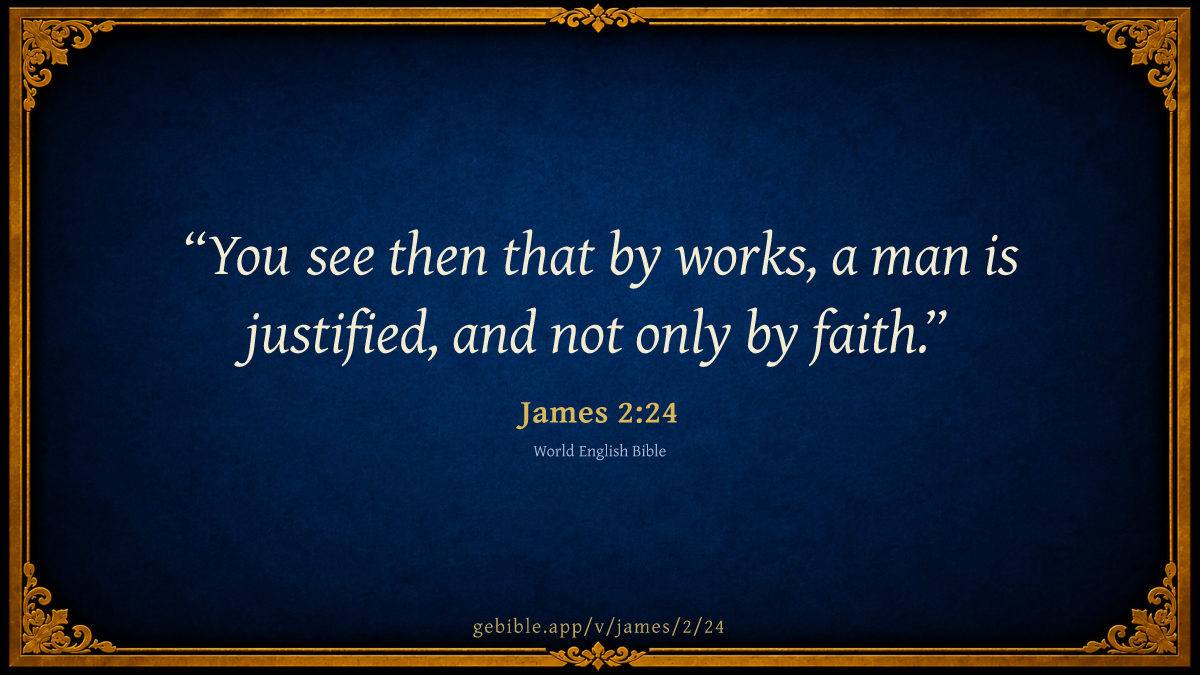
You see then that by works, a man is justified, and not only by faith.
Parallel Translations
-
You see then that by works, a man is justified, and not only by faith.
-
Ye se then how that of dedes a man is iustified and not of fayth only.
-
Ye see then howe that of workes a man is iustified, and not of faith onely.
Examined in Scripture Analysis
Contradictions (1)
Questions where the Bible appears to say two different things, with the passages on each side set together.
Cross-references (2)
Passages linked to James 2:24 in the Treasury of Scripture Knowledge, ordered by reader-vote popularity; verse text shown in World English Bible.
- James 2:15-18 And if a brother or sister is naked and in lack of daily food, and one of you tells them, “Go in peace. Be warmed and filled;” yet you didn’t give them the things the body needs, what good is it? Even so faith, if it has no works, is dead in itself. Yes, a man will say, “You have faith, and I have works.” Show me your faith without works, and I will show you my faith by my works.
- James 2:21-22 Wasn’t Abraham our father justified by works, in that he offered up Isaac his son on the altar? You see that faith worked with his works, and by works faith was perfected.
Cross-references from openbible.info (CC BY 4.0)
Explain this verse (13 sources)
Historical commentary, presented as a primary source — not an endorsement.
Private notes
Saved on this device only — never synced or sent anywhere.
Geneva Bible translators 1599 · Public Domain The conclusion: he is only justified that hath that…
The conclusion: he is only justified that hath that faith which hath works following it.
Is proved to be just.
Read full note →
Of that dead and fruitless faith which you boast of.
Geneva Bible (1599) marginal notes — public domain.
John Trapp 1656 · Public Domain 24 Ye see then how that by works a…
24 Ye see then how that by works a man is justified, and not by faith only.
Ver. 24. By works a man is justified] Declaratively, as by faith apprehensively, by God effectively.
John Trapp, A Commentary or Exposition upon All the Books of the Old and New Testament (1647–1656) — public domain. Text from a community e-Sword module.
Matthew Poole 1685 · Public Domain Ye see then; an inference either from the instance…
Ye see then; an inference either from the instance of Abraham, or from the whole preceding discourse.
How that by works; works of new obedience.
Read full note →
A man is justified; declared to be righteous, or approved as such, and acquitted from the guilt of hypocrisy.
And not by faith only; not by a mere profession of faith, or a bare assent to the truth, without the fruit of good works.
Question. How doth this general conclusion follow from the particular case of Abraham?
Answer. Abraham’s faith and justification, both before God and the world, are set forth as the exempars of ours, to which the faith and justification of all believers, both Jews and Gentiles, is to be conformed, Rom 4:11,12,23,24.
Question. Doth not James here contradict Paul’s doctrine in the matter of justification, Rom 4:1-25?
Answer. The contradiction is but seeming, not real, as will appear, if four things be considered:
1. The occasion of these apostles’ writing, and their scope in it. Having to do with different sorts of persons, they had likewise different designs. As Christ speaks one way when he dealt with proud Pharisees, whom he would humble; another way, when with humble hearers, whom he would encourage. and Paul carried it one way when among weak brethren, in condescension to whose infirmities he circumcised Timothy, Act 16:2,3; and another, when he was among false brethren, and men of contention, who opposed Christian liberty, seeking to bring believers into bondage, and then would not suffer Titus to be circumcised, Gal 2:3-5. So in the present affair. Paul’s business lay with false apostles and Judaizing Christians, such as did, in the matter of justification, either substitute a self-righteousness instead of God’s grace, or set it up in conjunction with it; and therefore his scope is (especially in his Epistles to the Romans and Galatians) to show the true cause and manner of justification, and vindicate the freeness of grace in it, by the exclusion of man’s works, of what kind soever; to which purpose he propounds the examples of Abraham and David, in their justification, Rom 4:1-25. Whereas James having to do with carnal professors, and such as abused the doctrine of grace to encourage themselves in sin, and thought it sufficient that they had faith, (such as it was), though they did not live like believers, resting in an empty profession, with the neglect of holiness; his design plainly is, to show the effects and fruits of justification, viz. holiness and good works; thereby to check the vanity and folly of them who did thus divorce faith from a holy life, (which God hath joined to it), and fancied themselves safe in the profession of the one, without any respect to, or care of, the other, as appears in this chapter, Jam 2:14,17,26. And because they might bear themselves high in this false confidence by the example of Abraham, their father according to the flesh, and whom Paul had set forth, Rom 4:1-25, as justified by faith, without the concurrence of works to his justification; James makes use of the same example of Abraham, as one eminent for holiness as well as faith, and who made his faith famous by the highest act of obedience that ever a saint did, to show, that faith and holiness ought not to be separated; Abraham’s faith being so highly commended, especially as productive of it. To the same purpose he makes use of the instance of Rahab, who, though a young saint, and newly come to the knowledge of God, yet showed the truth of her faith by so considerable an exercise of her love and mercy to God’s people, as her receiving the spies in peace was. This therefore helps not a little to reconcile the difference between these two apostles. Paul deals with those that magnified works too much, as if they were justified by them, and slighted faith and grace; and therefore, though he frequently shows the usefulness of faith and good works unto salvation, and presseth men every where to the practice of them, yet he proves that they have no interest in the justification of a sinner before God’s tribunal, which he asserts to be wholly and solely of grace, and by faith. But James, in dealing with loose Christians, who magnified faith, and slighted good works, not only as having no influence on justification, but as not necessary at all to salvation; he takes upon him to maintain good works, not as necessary to justification, but as the effects, signs, and evidences of it, and such as without which their faith was vain, and themselves in an unjustified state.
2. Paul and James take faith in different senses: Paul speaks of a true, lively faith, which purifies the heart, and worketh by love, Gal 5:6. Whereas James speaks of a profession, or presumption of faith, barren, and destitute of good fruits, such a faith as is dead, Jam 2:17, such as the devils may have, Jam 2:19, which is but historical, and consists only in a belief of God’s being, not a consent to his offer, or relying on his promises. What contradiction then is there here between these two apostles, if Paul assert justification to be by faith, viz. a lively, working faith; and James deny it to be by faith, viz. an idle, inactive, barren faith, and which hath only the name, but not the nature of that grace, and is rather the image of faith than faith itself?
3. But because James not only denies justification to the faith he speaks of, but ascribes it to works in this verse; therefore it is to be considered, that justification is taken one way by him, and another by Paul. Paul takes it for the absolution and acceptation of a sinner at God’s bar, by the imputation of Christ’s righteousness, which is the primary and proper notion of justification. But James takes it for the manifestation and declaration of that justification; and the word is taken in the like sense in other scriptures: Luk 7:29, the people justified God, i.e. owned and declared his righteousness by confession of their sins, and submission to John’s baptism; and Luk 7:35, Wisdom is justified, i.e. declared to be just and right. Rom 3:4, justified in thy sayings, i.e. acknowledged and declared to be true in thy word. And what is Christ’s being justified in the Spirit, 1Ti 3:16, but his being declared to be the Son of God? Rom 1:4. And that James takes justification in this sense, appears:
(1.) By the history of Abraham here mentioned: he was (as hath been said) justified by faith long before his offering up his son, Gen 15:1-21, but here is said to be justified, i.e. declared and proved to be so, by this testimony which he gave to the truth of his faith, and consequently to his justification by it; and the Lord therefore tells him, Gen 22:12, Now I know that thou fearest God, & c.; q.d. By this obedience thou hast abundantly showed the sincerity of thy graces.
(2.) Because if James doth not here speak of Abraham’s being justified declaratively, how can it be true which he speaks, Jam 2:23, that the Scripture was fulfilled (in his sacrificing his son) which saith, He believed God, and it was imputed unto him for righteousness? For if James intends justification in the proper sense, how was Abraham’s being justified by works a fulfilling of the Scripture, which asserts him to be justified by faith? Here therefore again there is no contradiction between these apostles. For it is true, that Abraham was justified, i.e. accepted of God, and absolved from guilt, by faith only; and it is as true, that he was justified, i.e. manifested and declared to be a believer, and a justified person, by his works.
4. Lastly, we may distinguish of the person that is said to be justified; either he is a sinner, in the state of nature; or a believer, in a state of grace; whence ariseth the two-fold justification here mentioned. The justification of a sinner, in the remission of his sins through the imputation of Christ’s righteousness, and acquitting him from the condemnation of the law, is the justification properly so called, and which Paul speaks so much of; and this is by faith only. The justification of a believer, is his absolution from condemnation by the gospel, and the charge of infidelity, or hypocrisy, and is no other than that declarative justification James speaks of, or an asserting and clearing up the truth and reality of the former justification, which is done by good works, as the signs and fruits of the faith, by which that former is obtained: and this is but improperly called justification. The former is an absolution from the general charge of sin, this from the special charge of hypocrisy, or infidelity. A sinner’s great fear (when first awakened to a sense of his sin and misery) is of a holy law, and a righteous Judge ready to condemn him for the violation of that law; and so his first business is to look to Christ by faith for righteousness, and remission of sin. But when he is justified by that righteousness, men may charge him with hypocrisy or unbelief, and so may the devil and conscience too, when faith is weak, or a temptation strong; and therefore his next work is to clear himself of this imputation, and to evidence the truth and reality of his faith and justification in God’s sight, which must be done by producing his obedience and good works, as the indications of his faith; and hereby he proves that he hath indeed closed with the promise of the gospel, and so is clear of the charge of not believing it, which was false; as well as (by consequence) is justified from the charge of sin against the law, which was true. To conclude, therefore, here is no opposition between Paul and James. Paul speaks of Abraham’s being justified as a sinner, and properly, and so by faith only; James speaks of his being justified as a believer, improperly, and so by works; by which not his person was justified, but rather his faith declared to be justifying: nor he constituted righteous, but approved as righteous. In a word, what God hath joined must not be divided, and what he hath divided must not be joined. He hath separated faith and works in the business of justification, and therefore we must not join them in it, as Paul disputes; and he hath joined them in the lives of justified persons, and there we must not separate them, as James teaches. Paul assures us they have not a co-efficiency in justification itself; and James assures us they may, and ought to have, a co-existence in them that are justified. If the reader desire further satisfaction yet, let him consult Turretine de Concordia Pauli et Jacobi, where he may find much more to the same purpose as hath been here said.
Matthew Poole's English Annotations on the Holy Bible (1683–1685) — public domain. Text from a community e-Sword/MySword module.
John Gill 1763 · Public Domain Ye see then how that by works a man…
Ye see then how that by works a man is justified,.... Not as causes procuring his justification, but as effects declaring it; for the best works are imperfect, and cannot be a righteousness justifying in the sight of God, and are unprofitable in this respect; for when they are performed in the best manner, they are no other than what it is a man's duty to perform, and therefore cannot justify from sin he has committed: and besides, justification in this sense would frustrate the grace of God, make void the death of Christ, and encourage boasting in men. Good works do not go before justification as causes or conditions, but follow it as fruits and effects:
and not by faith only: or as without works, or a mere historical faith, which being without works is dead, of which the apostle is speaking; and therefore can bear no testimony to a man's justification; hence it appears, that the Apostle James does not contradict the Apostle Paul in Rom 3:28 since they speak not of the same sort of faith; the one speaks of a mere profession of faith, a dead and lifeless one; the other of a true faith, which has Christ, and his righteousness, for its object, and works by love, and produces peace, joy, and comfort in the soul. Moreover, the Apostle Paul speaks of justification before God; and James speaks of it as it is known by its fruits unto men; the one speaks of a justification of their persons, in the sight of God; the other of the justification and approbation of their cause, their conduct, and their faith before men, and the vindication of them from all charges and calumnies of hypocrisy, and the like; the one speaks of good works as causes, which he denies to have any place as such in justification; and the other speaks of them as effects flowing from faith, and showing the truth of it, and so of justification by it; the one had to do with legalists and self-justiciaries, who sought righteousness not by faith, but by the works of the law, whom he opposed; and the other had to do with libertines, who cried up faith and knowledge, but had no regard to a religious life and conversation; and these things considered will tend to reconcile the two apostles about this business, but as effects declaring it; for the best works are imperfect, and cannot be a righteousness justifying in the sight of God, and are unprofitable in this respect; for when they are performed in the best manner, they are no other than what it is a man's duty to perform, and therefore cannot justify from sin he has committed: and besides, justification in this sense would frustrate the grace of God, make void the death of Christ, and encourage boasting in men. Good works do not go before justification as causes or conditions, but follow it as fruits and effects:
Read full note →
and not by faith only: or as without works, or a mere historical faith, which being without works is dead, of which the apostle is speaking; and therefore can bear no testimony to a man's justification; hence it appears, that the Apostle James does not contradict the Apostle Paul in Rom 3:28 since they speak not of the same sort of faith; the one speaks of a mere profession of faith, a dead and lifeless one; the other of a true faith, which has Christ, and his righteousness, for its object, and works by love, and produces peace, joy, and comfort in the soul. Moreover, the Apostle Paul speaks of justification before God; and James speaks of it as it is known by its fruits unto men; the one speaks of a justification of their persons, in the sight of God; the other of the justification and approbation of their cause, their conduct, and their faith before men, and the vindication of them from all charges and calumnies of hypocrisy, and the like; the one speaks of good works as causes, which he denies to have any place as such in justification; and the other speaks of them as effects flowing from faith, and showing the truth of it, and so of justification by it; the one had to do with legalists and self-justiciaries, who sought righteousness not by faith, but by the works of the law, whom he opposed; and the other had to do with libertines, who cried up faith and knowledge, but had no regard to a religious life and conversation; and these things considered will tend to reconcile the two apostles about this business.
John Gill's Exposition of the Whole Bible (1746–1763) — public domain (CC PDM 1.0). Text via the HelloAO Bible API.
John Wesley 1765 · Public Domain Ye see then that a man is justified by…
Ye see then that a man is justified by works, and not by faith only - St. Paul, on the other hand, declares, "A man is justified by faith," and not by works, Rom. iii, 28. And yet there is no contradiction between the apostles: because,
1. They do not speak of the same faith: St. Paul speaking of living faith; St. James here, of dead faith.
Read full note →
2. They do not speak of the same works: St. Paul speaking of works antecedent to faith; St. James, of works subsequent to it.
John Wesley, Explanatory Notes Upon the Whole Bible (1754–1765) — public domain. Text via the GEBible commentary corpus.
Adam Clarke 1810 · Public Domain Verse 24. Ye see then how] It is evident…
Verse 24. Ye see then how] It is evident from this example that Abraham's faith was not merely believing that there is a God; but a principle that led him to credit God's promises relative to the future Redeemer, and to implore God's mercy: this he received, and was justified by faith. His faith now began to work by love, and therefore he was found ever obedient to the will of his Maker. He brought forth the fruits of righteousness; and his works justified-proved the genuineness of his faith; and he continued to enjoy the Divine approbation, which he could not have done had he not been thus obedient; for the Spirit of God would have been grieved, and his principle of faith would have perished. Obedience to God is essentially requisite to maintain faith. Faith lives, under God, by works; and works have their being and excellence from faith. Neither can subsist without the other, and this is the point which St. James labours to prove, in order to convince the Antinomians of his time that their faith was a delusion, and that the hopes built on it must needs perish.
Adam Clarke's Commentary on the Bible (1810–1826) — public domain. Text from a community e-Sword/MySword module.
Albert Barnes 1834 · Public Domain Ye see then - From the course of reasoning…
Ye see then - From the course of reasoning pursued, and the example referred to.
How that by works a man is justified, and not by faith only - Not by a cold, abstract, inoperative faith. It must be by a faith that shall produce good works, and whose existence will be shown to men by good works. As justification takes place in the sight of God, it is by faith, for he sees that the faith is genuine, and that it will produce good works if the individual who exercises faith shall live; and he justifies men in view of that faith, and of no other. If he sees that the faith is merely speculative; that it is cold and dead, and would not produce good works, the man is not justified in his sight. As a matter of fact, therefore, it is only the faith that produces good works that justifies; and good works, therefore, as the proper expression of the nature of faith, foreseen by God as the certain result of faith, and actually performed as seen by men, are necessary in order to justification. In other words, no man will be justified who has not a faith which will produce good works, and which is of an operative and practical character. The ground of justification in the case is faith, and that only; the evidence of it, the carrying it out, the proof of the existence of the faith, is good works; and thus men are justified and saved not by mere abstract and cold faith, but by a faith necessarily connected with good works, and where good works perform an important part. James, therefore, does not contradict Paul, but he contradicts a false explanation of Paul’s doctrine. He does not deny that a man is justified in the sight of God by faith, for the very passage which he quotes shows that he believes that; but he does deny that a man is justified by a faith which would not produce good works, and which is not expressed by good works; and thus he maintains, as Paul always did, that nothing else than a holy life can show that a man is a true Christian, and is accepted of God.
Albert Barnes' Notes on the Bible (1834–1885) — public domain. Text from a community e-Sword/MySword module.
Robert Jamieson, A. R. Fausset & David Brown 1871 · Public Domain justified and, not by faith only--that is, by "faith…
justified and, not by faith only--that is, by "faith without (separated from: severed from) works," its proper fruits (see on Jam 2:20). Faith to justify must, from the first, include obedience in germ (to be developed subsequently), though the former alone is the ground of justification. The scion must be grafted on the stock that it may live; it must bring forth fruit to prove that it does live.
Jamieson, Fausset & Brown — Commentary Critical and Explanatory on the Whole Bible (1871) — public domain (CC PDM 1.0). Text via the HelloAO Bible API.
Daniel D. Whedon 1874 · Public Domain 24. By works… justified—Not that by merit-work (except so…
24. By works… justified—Not that by merit-work (except so far as faith itself is a work, note, Rom_3:27) a man is first brought into justification. But he is justified by work as an external completion of his faith.
Not by faith only—For if the faith be alone, and without the working element of faith, namely, the hearty will for work, it is mere speculative faith, as above said, and so dead and unjustifying.
Daniel D. Whedon (gen. ed.), Commentary on the Old and New Testaments (1874–1909) — public domain. Text from a community e-Sword module.
The Cambridge Bible for Schools and Colleges 1878 · Public Domain 24. Ye see then] The better MSS. omit the…
24. Ye see then] The better MSS. omit the then. The Greek verb may be indicative, imperative, or interrogative. The English Version is probably right in giving the preference to the first.
not by faith only] There is, it is obvious, a verbal contradiction between this and St Paul’s statement in Rom_3:28, but it is verbal only. St James does not exclude faith from the work of justifying, i. e. winning Good’s acquittal and acceptance, but only a faith which stands “by itself,” “alone,” and therefore “dead,” and assumes that “works” have their beginning in the faith which they ripen and complete. St Paul throughout assumes that faith will work by love and be productive in good acts, while the works which he excludes from the office of justifying are “works of the law,” i.e. works which, whether ceremonial or moral, are done as by a constrained obedience to an external commandment, through fear of punishment, or hope of reward, and are not the spontaneous outcome of love and therefore of faith. It will be felt that St James presents the more practical, St Paul the deeper and more mystical aspect of the Truth, and this is in itself a confirmation of the view maintained throughout these notes, that the latter was the later of the two, and therefore that so far as one corrects or completes the popular version of the teaching of the other, it was to St Paul and not to St James that that task was assigned.
The Cambridge Bible for Schools and Colleges (gen. ed. J. J. S. Perowne; Cambridge University Press, 1878–1918) — public domain. Text from a community e-Sword module.
Ellicott's Commentary for English Readers 1878 · Public Domain (24) Ye see then how that by works .…
(24) Ye see then how that by works . . .—Observe that St. James says a man is not justified “by faith only,” putting the adverb in the last and most emphatic position. He never denies Justification by Faith; but that fancied one of idle, speculative, theoretic faith, with no corresponding acts of love.
A Bible Commentary for English Readers, edited by Charles John Ellicott (1878–1897) — public domain. Text from a community e-Sword module.
B. W. Johnson 1891 · Public Domain 24. Ye see then, etc. The case of Abraham…
24. Ye see then, etc. The case of Abraham proves that the justifying faith is a working faith.
B. W. Johnson's The People's New Testament with Notes (1889–1891) — public domain. Electronic text from the Christian Classics Ethereal Library (CCEL) ThML edition.
Tyndale Open Study Notes 2022 · CC BY-SA 4.0 2:24 not by faith alone: That is, not like…
2:24 not by faith alone: That is, not like the demons who merely believe something is true (2:19), but by a belief that results in generous deeds like those of God himself (1:17). Though some have thought that this teaching contradicts what Paul taught, it does not. Paul does not speak against good deeds themselves, but about trying to receive forgiveness of sins through good deeds (Rom 3:28; Gal 2:16). Just as Paul understands that love and generosity necessarily issue from a true faith (Gal 5:6), so also James knows that good deeds can result only from authentic faith that results in a commitment to God (Jas 2:18, 26).
Tyndale Open Study Notes — © Tyndale Open Resources, licensed CC BY-SA 4.0. Text via the HelloAO Bible API.