
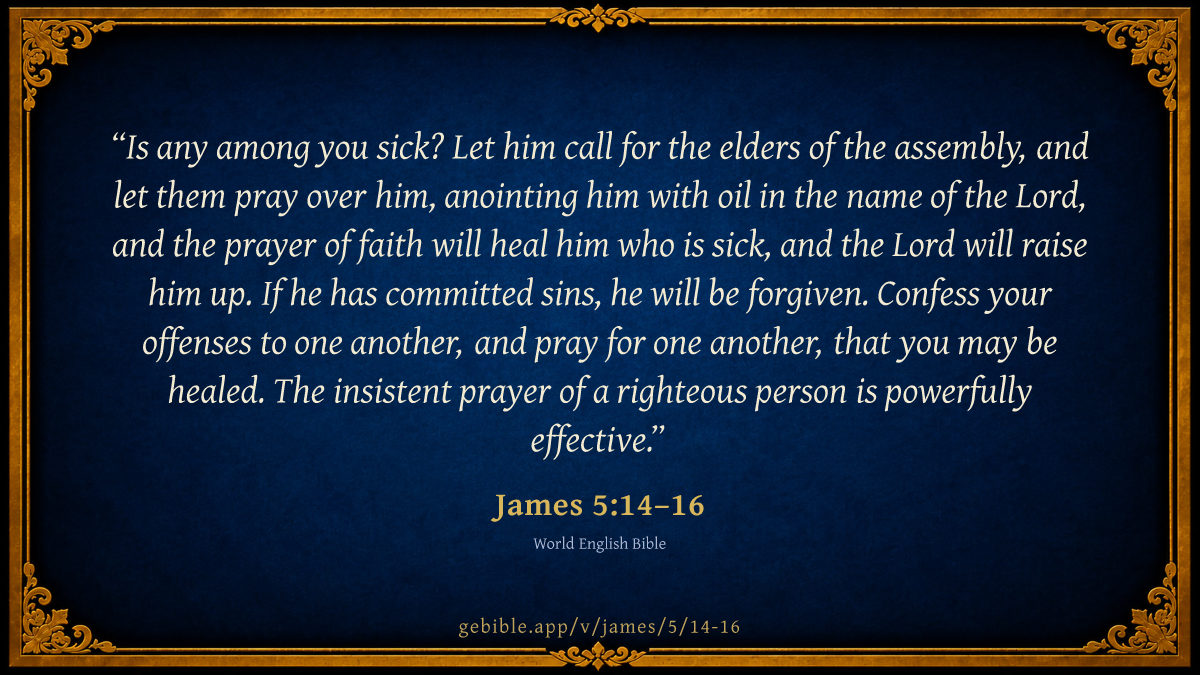
Is any among you sick? Let him call for the elders of the assembly, and let them pray over him, anointing him with oil in the name of the Lord, and the prayer of faith will heal him who is sick, and the Lord will raise him up. If he has committed sins, he will be forgiven. Confess your offenses to one another, and pray for one another, that you may be healed. The insistent prayer of a righteous person is powerfully effective.
Show the surrounding paragraph
James 5:14-16 sits inside this longer paragraph.
Is any among you suffering? Let him pray. Is any cheerful? Let him sing praises. Is any among you sick? Let him call for the elders of the assembly, and let them pray over him, anointing him with oil in the name of the Lord, and the prayer of faith will heal him who is sick, and the Lord will raise him up. If he has committed sins, he will be forgiven. Confess your offenses to one another, and pray for one another, that you may be healed. The insistent prayer of a righteous person is powerfully effective. Elijah was a man with a nature like ours, and he prayed earnestly that it might not rain, and it didn’t rain on the earth for three years and six months. He prayed again, and the sky gave rain, and the earth produced its fruit.
Parallel Translations
-
Is any among you sick? Let him call for the elders of the assembly, and let them pray over him, anointing him with oil in the name of the Lord,
and the prayer of faith will heal him who is sick, and the Lord will raise him up. If he has committed sins, he will be forgiven.
Confess your offenses to one another, and pray for one another, that you may be healed. The insistent prayer of a righteous person is powerfully effective.
-
Yf eny be defeated amonge you let him call for the elders of the congregacion and let the praye over him and anoynte him with oyle in the name of the lorde:
and the prayer of fayth shall save the sicke and the lorde shall rayse him vp: and yf he have committed synnes they shalbe forgeuen him.
knowledge youre fautes one to another: and praye one for another that ye maye be healed. The prayer of a ryghteous man avayleth moche yf it be fervet.
Show all 3 translations
-
Is any sicke among you? Let him call for the Elders of the Church, and let them pray for him, and anoynt him with oyle in the Name of the Lord.
And the prayer of faith shall saue the sicke, and the Lord shall raise him vp: and if he haue committed sinnes, they shalbe forgiuen him.
Acknowledge your faultes one to another, and pray one for another, that ye may be healed: for the prayer of a righteous man auaileth much, if it be feruent.
Examined in Scripture Analysis
Science (1)
Historical claims about the natural world, weighed against the scientific record.
Contradictions (1)
Questions where the Bible appears to say two different things, with the passages on each side set together.
Cross-references (87)
- Jeremiah 29:12-13 (v16) You shall call on me, and you shall go and pray to me, and I will listen to you. You shall seek me, and find me, when you search for me…
- Proverbs 15:29 (v16) Yahweh is far from the wicked, but he hears the prayer of the righteous.
- Matthew 21:22 (v16) All things, whatever you ask in prayer, believing, you will receive.”
- Psalms 34:15 (v16) Yahweh’s eyes are toward the righteous. His ears listen to their cry.
- John 9:31 (v16) We know that God doesn’t listen to sinners, but if anyone is a worshiper of God, and does his will, he listens to him.
Show all 87 cross-references
- Jeremiah 33:3 (v16) ‘Call to me, and I will answer you, and will show you great and difficult things, which you don’t know.’
- Psalms 145:18-19 (v16) Yahweh is near to all those who call on him, to all who call on him in truth. He will fulfill the desire of those who fear him. He also…
- 1 Peter 2:24 (v16) He himself bore our sins in his body on the tree, that we, having died to sins, might live to righteousness. You were healed by his wounds.
- Matthew 7:7-11 (v16) “Ask, and it will be given you. Seek, and you will find. Knock, and it will be opened for you. For everyone who asks receives. He who seeks…
- 1 John 3:22 (v16) so whatever we ask, we receive from him, because we keep his commandments and do the things that are pleasing in his sight.
- Daniel 9:20-22 (v16) While I was speaking, and praying, and confessing my sin and the sin of my people Israel, and presenting my supplication before Yahweh my…
- Proverbs 15:8 (v16) The sacrifice made by the wicked is an abomination to Yahweh, but the prayer of the upright is his delight.
- Acts 19:18 (v16) Many also of those who had believed came, confessing, and declaring their deeds.
- Luke 11:11-13 (v16) “Which of you fathers, if your son asks for bread, will give him a stone? Or if he asks for a fish, he won’t give him a snake instead of a…
- Psalms 10:17-18 (v16) Yahweh, you have heard the desire of the humble. You will prepare their heart. You will cause your ear to hear, to judge the fatherless and…
- 1 John 5:14-16 (v15) This is the boldness which we have toward him, that if we ask anything according to his will, he listens to us. And if we know that he…
- 1 Thessalonians 5:17 (v16) Pray without ceasing.
- James 5:13 (v15) Is any among you suffering? Let him pray. Is any cheerful? Let him sing praises.
- Genesis 20:17 (v16) Abraham prayed to God. God healed Abimelech, and his wife, and his female servants, and they bore children.
- Job 42:8 (v16) Now therefore, take to yourselves seven bulls and seven rams, and go to my servant Job, and offer up for yourselves a burnt offering; and…
- Proverbs 28:9 (v16) He who turns away his ear from hearing the law, even his prayer is an abomination.
- 2 Chronicles 30:20 (v16) Yahweh listened to Hezekiah, and healed the people.
- James 5:16 (v15) Confess your offenses to one another, and pray for one another, that you may be healed. The insistent prayer of a righteous person is…
- Numbers 11:2 (v16) The people cried to Moses; and Moses prayed to Yahweh, and the fire abated.
- Matthew 3:6 (v16) They were baptized by him in the Jordan, confessing their sins.
- Genesis 18:23-32 (v16) Abraham came near, and said, “Will you consume the righteous with the wicked? What if there are fifty righteous within the city? Will you…
- Hebrews 12:13 (v16) and make straight paths for your feet, so what is lame may not be dislocated, but rather be healed.
- 2 Kings 20:2-5 (v16) Then he turned his face to the wall, and prayed to Yahweh, saying, “Remember now, Yahweh, I beg you, how I have walked before you in truth…
- 1 Thessalonians 5:25 (v16) Brothers, pray for us.
- Matthew 21:21-22 (v15) Jesus answered them, “Most certainly I tell you, if you have faith, and don’t doubt, you will not only do what was done to the fig tree,…
- 2 Kings 4:33-35 (v16) He went in therefore, and shut the door on them both, and prayed to Yahweh. He went up, and lay on the child, and put his mouth on his…
- Luke 18:1-8 (v16) He also spoke a parable to them that they must always pray, and not give up, saying, “There was a judge in a certain city who didn’t fear…
- Acts 12:5-11 (v16) Peter therefore was kept in the prison, but constant prayer was made by the assembly to God for him. The same night when Herod was about to…
- Romans 3:10 (v16) As it is written, “There is no one righteous; no, not one.
- James 1:6 (v15) But let him ask in faith, without any doubting, for he who doubts is like a wave of the sea, driven by the wind and tossed.
- Exodus 9:28-29 (v16) Pray to Yahweh; for there has been enough of mighty thunderings and hail. I will let you go, and you shall stay no longer.” Moses said to…
- Matthew 17:20 (v15) He said to them, “Because of your unbelief. For most certainly I tell you, if you have faith as a grain of mustard seed, you will tell this…
- Acts 10:38 (v16) even Jesus of Nazareth, how God anointed him with the Holy Spirit and with power, who went about doing good and healing all who were…
- Hebrews 11:7 (v16) By faith, Noah, being warned about things not yet seen, moved with godly fear, prepared a ship for the saving of his house, through which…
- Genesis 20:7 (v16) Now therefore, restore the man’s wife. For he is a prophet, and he will pray for you, and you will live. If you don’t restore her, know for…
- 1 Kings 13:6 (v16) The king answered the man of God, “Now intercede for the favor of Yahweh your God, and pray for me, that my hand may be restored me again.”…
- 2 Chronicles 14:11-12 (v16) Asa cried to Yahweh his God, and said, “Yahweh, there is no one besides you to help, between the mighty and him who has no strength. Help…
- Mark 6:13 (v14) They cast out many demons, and anointed many with oil who were sick, and healed them.
- Acts 4:24-31 (v16) When they heard it, they lifted up their voice to God with one accord, and said, “O Lord, you are God, who made the heaven, the earth, the…
- Romans 5:19 (v16) For as through the one man’s disobedience many were made sinners, even so through the obedience of the one, many will be made righteous.
- Hebrews 11:4 (v16) By faith, Abel offered to God a more excellent sacrifice than Cain, through which he had testimony given to him that he was righteous, God…
- Hebrews 13:18 (v16) Pray for us, for we are persuaded that we have a good conscience, desiring to live honorably in all things.
- Genesis 32:28 (v16) He said, “Your name will no longer be called Jacob, but Israel; for you have fought with God and with men, and have prevailed.”
- Exodus 32:10-14 (v16) Now therefore leave me alone, that my wrath may burn hot against them, and that I may consume them; and I will make of you a great nation.”…
- Numbers 14:13-20 (v16) Moses said to Yahweh, “Then the Egyptians will hear it; for you brought up this people in your might from among them. They will tell it to…
- Numbers 21:7-9 (v16) The people came to Moses, and said, “We have sinned, because we have spoken against Yahweh and against you. Pray to Yahweh, that he take…
- Joshua 10:12 (v16) Then Joshua spoke to Yahweh in the day when Yahweh delivered up the Amorites before the children of Israel. He said in the sight of Israel,…
- 1 Kings 17:18-24 (v16) She said to Elijah, “What have I to do with you, you man of God? You have come to me to bring my sin to memory, and to kill my son!” He…
- 2 Kings 19:15-20 (v16) Hezekiah prayed before Yahweh, and said, “Yahweh, the God of Israel, who are enthroned above the cherubim, you are the God, even you alone,…
- Jeremiah 15:1 (v16) Then Yahweh said to me, “Though Moses and Samuel stood before me, yet my mind would not turn toward this people. Cast them out of my sight,…
- Daniel 2:18-23 (v16) that they would desire mercies of the God of heaven concerning this secret; that Daniel and his companions would not perish with the rest…
- Matthew 18:15-17 (v16) “If your brother sins against you, go, show him his fault between you and him alone. If he listens to you, you have gained back your…
- Luke 7:3-4 (v16) When he heard about Jesus, he sent to him elders of the Jews, asking him to come and save his servant. When they came to Jesus, they begged…
- Genesis 19:29 (v16) When God destroyed the cities of the plain, God remembered Abraham, and sent Lot out of the middle of the overthrow, when he overthrew the…
- Exodus 9:33 (v16) Moses went out of the city from Pharaoh, and spread out his hands to Yahweh; and the thunders and hail ceased, and the rain was not poured…
- Exodus 17:11 (v16) When Moses held up his hand, Israel prevailed. When he let down his hand, Amalek prevailed.
- Deuteronomy 9:18-20 (v16) I fell down before Yahweh, as at the first, forty days and forty nights. I neither ate bread nor drank water, because of all your sin which…
- 2 Chronicles 32:20-22 (v16) Hezekiah the king and Isaiah the prophet the son of Amoz, prayed because of this, and cried to heaven. Yahweh sent an angel, who cut off…
- Mark 2:5-11 (v15) Jesus, seeing their faith, said to the paralytic, “Son, your sins are forgiven you.” But there were some of the scribes sitting there, and…
- 1 Thessalonians 5:23 (v16) May the God of peace himself sanctify you completely. May your whole spirit, soul, and body be preserved blameless at the coming of our…
- 1 Samuel 12:18 (v16) So Samuel called to Yahweh; and Yahweh sent thunder and rain that day. Then all the people greatly feared Yahweh and Samuel.
- Hosea 12:3-4 (v16) In the womb he took his brother by the heel; and in his manhood he contended with God. Indeed, he struggled with the angel, and prevailed;…
- Genesis 41:9-10 (v16) Then the chief cup bearer spoke to Pharaoh, saying, “I remember my faults today. Pharaoh was angry with his servants, and put me in custody…
- 2 Samuel 19:19 (v16) He said to the king, “Don’t let my lord impute iniquity to me, or remember that which your servant did perversely the day that my lord the…
- Colossians 1:9 (v16) For this cause, we also, since the day we heard this, don’t cease praying and making requests for you, that you may be filled with the…
- Luke 9:6 (v16) They departed and went throughout the villages, preaching the Good News and healing everywhere.
- Mark 16:17-18 (v15) These signs will accompany those who believe: in my name they will cast out demons; they will speak with new languages; they will take up…
- Isaiah 33:24 (v15) The inhabitant won’t say, “I am sick.” The people who dwell therein will be forgiven their iniquity.
- Acts 28:8 (v14) The father of Publius lay sick of fever and dysentery. Paul entered in to him, prayed, and laying his hands on him, healed him.
- Mark 11:22-24 (v15) Jesus answered them, “Have faith in God. For most certainly I tell you, whoever may tell this mountain, ‘Be taken up and cast into the…
- John 5:14 (v15) Afterward Jesus found him in the temple, and said to him, “Behold, you are made well. Sin no more, so that nothing worse happens to you.”
- Mark 16:18 (v14) they will take up serpents; and if they drink any deadly thing, it will in no way hurt them; they will lay hands on the sick, and they will…
- 1 Corinthians 11:30-32 (v15) For this cause many among you are weak and sickly, and not a few sleep. For if we discerned ourselves, we wouldn’t be judged. But when we…
- Matthew 9:2-6 (v15) Behold, they brought to him a man who was paralyzed, lying on a bed. Jesus, seeing their faith, said to the paralytic, “Son, cheer up! Your…
- 1 Corinthians 12:28-30 (v15) God has set some in the assembly: first apostles, second prophets, third teachers, then miracle workers, then gifts of healings, helps,…
- 2 Kings 4:33 (v14) He went in therefore, and shut the door on them both, and prayed to Yahweh.
- 2 Kings 5:11 (v14) But Naaman was angry, and went away, and said, “Behold, I thought, ‘He will surely come out to me, and stand, and call on the name of…
- Acts 9:40 (v14) Peter sent them all out, and knelt down and prayed. Turning to the body, he said, “Tabitha, get up!” She opened her eyes, and when she saw…
- Acts 14:23 (v14) When they had appointed elders for them in every assembly, and had prayed with fasting, they commended them to the Lord, on whom they had…
- Acts 15:4 (v14) When they had come to Jerusalem, they were received by the assembly and the apostles and the elders, and they reported everything that God…
- Titus 1:5 (v14) I left you in Crete for this reason, that you would set in order the things that were lacking and appoint elders in every city, as I…
- 1 Kings 17:21 (v14) He stretched himself on the child three times, and cried to Yahweh, and said, “Yahweh my God, please let this child’s soul come into him…
Cross-references from openbible.info (CC BY 4.0)
Explain this passage (25 sources)
Historical commentary, presented as a primary source — not an endorsement.
Private notes
Saved on this device only — never synced or sent anywhere.
John Calvin 1540 · Public Domain On vv14–16 14 Is any sick among you. As the gift…
14 Is any sick among you. As the gift of healing as yet continued, he directs the sick to have recourse to that remedy. It is, indeed, certain that they were not all healed; but the Lord granted this favor as often and as far as he knew it would be expedient; nor is it probable that the oil was indiscriminately applied, but only when there was some hope of restoration. For, together with the power there was given also discretion to the ministers, lest they should by abuse profane the symbol. The design of James was no other than to commend the grace of God which the faithful might then enjoy, lest the benefit of it should be lost through contempt or neglect.
For this purpose he ordered the presbyters to be sent for, but the use of the anointing must have been confined to the power of the Holy Spirit.
Read full note →
The Papists boast mightily of this passage, when they seek to pass off their extreme unction. But how different their corruption is from the ancient ordinance mentioned by James I will not at present undertake to shew. Let readers learn this from my Institutes. I will only say this, that this passage is wickedly and ignorantly perverted; when extreme unction is established by it, and is called a sacrament, to be perpetually observed in the Church. I indeed allow that it was used as a sacrament by the disciples of Christ, (for I cannot agree with those who think that it was medicine;) but as the reality of this sign continued only for a time in the Church, the symbol also must have been only for a time. And it is quite evident, that nothing is more absurd than to call that a sacrament which is void and does not really present to us that which it signifies. That the gift of healing was temporary, all are constrained to allow, and events clearly prove: then the sign of it ought not to be deemed perpetual. It hence follows, that they who at this day set anointing among the sacraments, are not the true followers, but the apes of the Apostles, except they restore the effect produced by it, which God has taken away from the world for more than fourteen hundred years. So we have no dispute, whether anointing was once a sacrament; but whether it has been given to be so perpetually. This latter we deny, because it is evident that the thing signified has long ago ceased.
The presbyters, or elders, of the church. I include here generally all those who presided over the Church; for pastors were not alone called presbyters or elders, but also those who were chosen from the people to be as it were censors to protect discipline. For every Church had, as it were, its own senate, chosen from men of weight and of proved integrity. But as it was customary to choose especially those who were endued with gifts more than ordinary, he ordered them to send for the elders, as being those in whom the power and grace of the Holy Spirit more particularly appeared.
Let them pray over him. This custom of praying over one was intended to shew, that they stood as it were before God; for when we come as it were to the very scene itself, we utter prayers with more feeling; and not only Elisha and Paul, but Christ himself, roused the ardor of prayer and commended the grace of God by thus praying over persons. (2 Kings 4:32; Acts 20:10; John 11:41.)
John Calvin's Commentaries (1540-1563) — public domain. Text from the Calvin Translation Society English edition (1840s-50s) via the Christian Classics Ethereal Library (ccel.org). Calvin's coverage is partial (roughly two-thirds of the Bible); uncommented books and verses are honest gaps, never fabricated. The 19th-century editor's footnotes and remarks are omitted so the notes are faithfully Calvin's own voice.
Geneva Bible translators 1599 · Public Domain On vv14–16 He showeth peculiarly, to what physicians especially we must…
He showeth peculiarly, to what physicians especially we must go, when we are diseased, to wit, to the prayers of the Elders, which then also could cure the body, (for so much as the gift of healing was then in force) and take away the chiefest cause of sickness and diseases, by obtaining for the sick through their prayers and exhortations, remission of sins.
This was a sign of the gift of healing: and now seeing we have the gift no more, the sign is no longer necessary.
Read full note →
By calling on the Name of the Lord.
Geneva Bible (1599) marginal notes — public domain.
John Trapp 1656 · Public Domain On vv14–16 14 Is any sick among you? let him call…
14 Is any sick among you? let him call for the elders of the church; and let them pray over him, anointing him with oil in the name of the Lord:
Ver. 14. Is any man sick?] "Behold, he whom thou lovest is sick," said Martha to our Saviour, Joh 11:3. Si amatur, quomodo infirmatur, saith Augustine. If Christ’s friend, how comes he to be sick? Well enough; it is no new thing for Christ’s best beloved to be much afflicted.
Read full note →
Let him send for the elders] This help God hath provided for such as are by sickness disabled to pray for themselves. Sick Abimelech was sent to Abraham (a prophet) for prayers.
Anointing him with oil] As an extraordinary sign of an extraordinary cure. From mistake of this text, the Church instead of pastors had ointers and painters in times of Popery, who did not only ungere, to annoint, but emungere, to wipe, anneal {inflame} men, but beguile them of their monies, and of their souls. Neither want there at this day, that hold this anointing the sick as a standing ordinance for Church members among us; and they tell of strange cures too effected thereby. I hope they aim better than Ptiugius and Sidonius, authors of that wicked piece called the Interim, did; for they defended the Popish chrism and extreme unction, ut ipsi discederent unctiores (as one saith), that they might get fat bishoprics thereby. The Popish ointment differeth much from St James’s oil, used as an outward symbol and sign till miracles ceased. See Mar 16:17; Act 3:16. Proculus, a Christian, healed Severus the emperor on this wise, as Tertullian testifieth. (Advers. Scapulam.)
John Trapp, A Commentary or Exposition upon All the Books of the Old and New Testament (1647–1656) — public domain. Text from a community e-Sword module.
Matthew Poole 1685 · Public Domain On vv14–16 Is any sick? Or infirm, though not desperately and…
Is any sick? Or infirm, though not desperately and incurably.
Let him call for the elders; especially teaching elders, they being usually best furnished with gifts who labour in the word and doctrine, 1Ti 5:17. It is in the plural number, either by an enallage for the singular; q.d. Let him send for some or other of the elders; or, because there were in those times usually several elders (an ecclesiastical senate) in each church.
Read full note →
And let them pray over him; as it were setting him before God, and presenting him to him, which might be a means to stir up the greater affection and warmth in prayer; see 1Ki 17:21; 2Ki 4:33,34; Joh 11:41; Act 20:10; 9:40; or laying on their hands, as Act 28:8, which yet seems to be for the same end.
Anointing him with oil; an outward rite used in those times, in miraculous healing sick persons, which might then be kept up, while the gift whereof it was the symbol continued; but the gift ceasing, it is vainly used. These cures were sometimes wrought only with a word, Act 9:34; 14:10; 16:18; sometimes by taking by the hand, or embracing, Act 3:7; 20:10; sometimes by laying on of hands, Mar 16:18; Act 9:17; sometimes by anointing with oil, Mar 6:13; and so this is not an institution of a sacrament, but a command, that those elders that had the gift of healing, (as many in those days had), being called by the sick to come to them, should (the Spirit of the Lord so directing them) exercise that gift, as well as pray over them.
In the name of the Lord; either, calling upon the Lord, and so joining prayer with their anointing; or, in the name, is by the authority of the Lord, from whom they had received that gift.
Matthew Poole's English Annotations on the Holy Bible (1683–1685) — public domain. Text from a community e-Sword/MySword module.
William Burkitt 1703 · Public Domain On vv14–16 Some observe, 1. That St. James doth not say,…
Some observe, 1. That St. James doth not say, "Is any man sick? let him pray;" but let him send for others to pray with him, and for him: plainly supposing, that the sick man is very unfit to pray himself, or to pray for himself; in other afflictions let him pray, but in sickness let others pray for him, he having enough to do to grapple with his grief, and to conflict with his affliction: a diseased body unfits the mind for holy duties.
Yet observe, 2. It is one thing to want a heart in sickness to pray for ourselves, and another thing to want ability to pray for ourselves. Many desire the prayers of others in sickness, who wanted hearts to pray for themselves in health. This is a sad symptom that the soul is as sick, yea, more dangerously sick than the body. Add to this, that the prayers of others are very rarely beneficial to us, unless we pray, or have a desire to pray, for ourselves.
Read full note →
Observe, 3. The sick man’s duty, not only to desire prayer, but to send to the elders of the church to pray for him, and with him.
Quest. But if the sick neglect to send, may the minister neglect to go, if he knows of the sickness?
Ans. Doubtless we ought to go, if we know of it, whether they send or not, for they want our prayers and help most when they desire it least; and by refusing to go, we may lose the last, and perhaps the best opportunity of doing good unto them. If our people, through stupidity and insensibleness, omit their duty in sending for us, God forbid, that either through pride or sluggishness, we should neglect our duty in going to them; too, too often we never hear our people are sick, till the bell tells us they are dead: if therefore by any means we gain the knowlege of their condition, let us apply ourselves with all our might to their condition, lest God be more angry with us for not going to them, than with them for not sending to us, imitating our Lord, who was found of them that sought him not.
Some make this anointing with oil to be a medicinal practice among the Jews, and that they administered it physically: but why then must the elders administer it? The physician might have done it as well as they. True, but the elders are sent for, that they, applying this corporeal remedy, might join with it spiritual physic of prayer, good admonition and comfort. As if a sick person should send for the minister at his taking of physic, that he might then pray with him, counsel and comfort him. Others make this anointing with oil a religious act. Christ empowered his apostles to work miracles, and, amongst others, they had the gift of healing the sick, whom they anointed in the name of the Lord, or by the authority of the Lord; but the gospel being sufficiently confirmed, this gift of healing is ceased, and therewith the rite of anointing; therefore the church of Rome keep up an idle ceremony in anointing the sick, unless they had a miraculous power to heal the sick: to keep up the rite, unless they could produce the effect; to pretend to the anointing, without the power of healing, is a mere piece of pageantry; besides, they anoint those that are given over for dead, and the apostle’s anointing for the benefit of the living, as appears by the following verse.
William Burkitt's Expository Notes on the New Testament (1700–1703) — public domain. Text from a community e-Sword module.
John Gill 1763 · Public Domain On vv14–16 Is any sick among you?.... Which is often the…
Is any sick among you?.... Which is often the case; the bodies of the saints, as well as others, are liable to a variety of diseases; they are sick, and sometimes nigh unto death, as Epaphroditus was: and then,
let him call for the elders of the church; in allusion to the elders of the congregation of Israel, Lev 4:15. By these may be meant, either the elder members of the church, men of gravity and soundness in the faith, persons of long standing and experience; who have the gift and grace of prayer, and are not only capable of performing that duty, but of giving a word of counsel and advice to the sick. It was a kind of proverbial saying of Aristophanes the grammarian;
Read full note →
"the works of young men, the counsels of middle aged persons, and , "the prayers of ancient men" (z):''
or rather officers of churches are meant, particularly pastors, who are so called in Scripture; these should be sent for in times of sickness, as well as physicians; and rather than they, since their prayers may be the means of healing both soul and body: so in former times, the prophets of God were sent to in times of sickness, for advice and assistance. It is a saying of R. Phinehas ben Chama (a) that
"whoever has a sick person in his house, let him go to a wise man, and he will seek mercy for him.''
And it follows here,
and let them pray over him; or for him, for the recovery of his health:
anointing him with oil, in the name of the Lord; which some think was only done in a common medicinal way, oil being used much in the eastern countries for most disorders; and so these elders used ordinary medicine, as well as prayer: or rather this refers to an extraordinary gift, which some elders had of healing diseases, as sometimes by touching, and by laying on of hands, or by expressing some words, and so by anointing with oil; see Mar 6:13 which extraordinary gifts being now ceased, the rite or ceremony of anointing with oil ceases in course: however, this passage gives no countenance to the extreme unction of the Papists; that of theirs being attended with many customs and ceremonies, which are not here made mention of; that being used, as is pretended, for the healing of the souls of men, whereas this was used for corporeal healing; that is only performed when life is despaired of, and persons are just going out of the world; whereas this was made use of to restore men to health, and that they might continue longer in it, as follows.
(z) Apud Harpocratian. Lex. p. 125. (a) T. Bab. Bava Bathra, fol. 116. 1.
John Gill's Exposition of the Whole Bible (1746–1763) — public domain (CC PDM 1.0). Text via the HelloAO Bible API.
John Wesley 1765 · Public Domain On vv14–16 Having anointed him with oil - This single conspicuous…
Having anointed him with oil - This single conspicuous gift, which Christ committed to his apostles, Mark vi, 13, remained in the church long after the other miraculous gifts were withdrawn. Indeed, it seems to have been designed to remain always; and St. James directs the elders, who were the most, if not the only, gifted men, to administer at. This was the whole process of physic in the Christian church, till it was lost through unbelief. That novel invention among the Romanists, extreme unction, practiced not for cure, but where life is despaired of, bears no manner of resemblance to this.
John Wesley, Explanatory Notes Upon the Whole Bible (1754–1765) — public domain. Text via the GEBible commentary corpus.
Adam Clarke 1810 · Public Domain On vv14–16 Verse 14. Is any sick among you? let him…
Verse 14. Is any sick among you? let him call for the elders] This was also a Jewish maxim. Rabbi Simeon, in Sepher Hachaiyim, said: "What should a man do who goes to visit the sick? Ans. He who studies to restore the health of the body, should first lay the foundation in the health of the soul. The wise men have said, No healing is equal to that which comes from the word of God and prayer. Rabbi Phineas, the son of Chamma, hath said, 'When sickness or disease enters into a man's family, let him apply to a wise man, who will implore mercy in his behalf.'" See Schoettgen.
St. James very properly sends all such to the elders of the Church, who had power with God through the great Mediator, that they might pray for them.
Read full note →
Anointing him with oil] That St. James neither means any kind of incantation, any kind of miracle, or such extreme unction as the Romish Church prescribes, will be sufficiently evident from these considerations:
1. Be was a holy man, and could prescribe nothing but what was holy.
2. If a miracle was intended, it could have been as well wrought without the oil, as with it.
3. It is not intimated that even this unction is to save the sick man, but the prayer of faith, Jas 5:15.
4. What is here recommended was to be done as a natural means of restoring health, which, while they used prayer and supplication to God, they were not to neglect.
5. Oil in Judea was celebrated for its sanative qualities; so that they scarcely ever took a journey without carrying oil with them, (see in the case of the Samaritan,) with which they anointed their bodies, healed their wounds, bruises, c.
6. Oil was and in frequently used in the east as a means of cure in very dangerous diseases and in Egypt it is often used in the cure of the plague. Even in Europe it has been tried with great success in the cure of dropsy. And pure olive oil is excellent for recent wounds and bruises; and I have seen it tried in this way with the best effects.
7. But that it was the custom of the Jews to apply it as a means of healing, and that St. James refers to this custom, is not only evident from the case of the wounded man ministered to by the good Samaritan, Lu 10:34, but from the practice of the Jewish rabbins. In Midrash Koheleth, fol. 73, 1, it is said: "Chanina, son of the brother of the Rabbi Joshua, went to visit his uncle at Capernaum; he was taken ill; and Rabbi Joshua went to him and anointed him with oil, and he was restored." They had, therefore, recourse to this as a natural remedy; and we find that the disciples used it also in this way to heal the sick, not exerting the miraculous power but in cases where natural means were ineffectual. And they cast out many devils, and anointed with oil many that were sick, and healed them; Mr 6:13. On this latter place I have supposed that it might have been done symbolically, in order to prepare the way for a miraculous cure: this is the opinion of many commentators; but I am led, on more mature consideration, to doubt its propriety, yet dare not decide. In short, anointing the sick with oil, in order to their recovery, was a constant practice among the Jews. See Lightfoot and Wetstein on Mr 6:13. And here I am satisfied that it has no other meaning than as a natural means of restoring health; and that St. James desires them to use natural means while looking to God for an especial blessing. And no wise man would direct otherwise.
8. That the anointing recommended here by St. James cannot be such as the Romish Church prescribes, and it is on this passage principally that they found their sacrament of extreme unction, is evident from these considerations:
1. St. James orders the sick person to be anointed in reference to his cure; but they anoint the sick in the agonies of death, when there is no prospect of his recovery; and never administer that sacrament, as it is called, while there is any hope of life.
2. St James orders this anointing for the cure of the body, but they apply it for the cure of the soul; in reference to which use of it St. James gives no directions: and what is said of the forgiveness of sins, in Jas 5:15, is rather to be referred to faith and prayer, which are often the means of restoring lost health, and preventing premature death, when natural means, the most skillfully used, have been useless.
3. The anointing with oil, if ever used as a means or symbol in working miraculous cures, was only applied in some cases, perhaps very few, if any; but the Romish Church uses it in every case; and makes it necessary to the salvation of every departing soul. Therefore, St. James' unction, and the extreme unction of the Romish Church, are essentially different. See below.
Adam Clarke's Commentary on the Bible (1810–1826) — public domain. Text from a community e-Sword/MySword module.
Joseph Benson 1811 · Public Domain On vv14, 16 Jas 5:14-15. Is any sick? let him call for…
Jas 5:14-15. Is any sick? let him call for the elders of the church — Those ministers of Christ whose office it is to oversee and feed the flock; and let them pray over him — For his recovery, persuaded that what two or three of the Lord’s true disciples shall agree to ask, it shall be done for them; anointing him with oil — “This single conspicuous gift, (healing the sick by anointing them with oil,) which Christ committed to his apostles, (Mar 6:13,) remained in the church long after the other miraculous gifts were withdrawn. Indeed it seems to have been designed to remain always, and St. James directs the elders, who were the most, if not the only gifted men, to administer it. This was the whole process of physic in the Christian Church till it was lost through unbelief. That novel invention among the Romans, extreme unction, practised not for cure, but where life is despaired of, bears no manner of resemblance to this.” See Bengelius and Wesley. And the prayer offered in faith shall save, or heal, the sick, and the Lord shall raise him up — From his sickness; and if he have committed sins — That is, any special sins, for which this sickness has been laid upon him; they shall be forgiven him — Upon his repentance the punishment shall be taken off.
Joseph Benson's Commentary on the Old and New Testaments (1811–1818) — public domain. Text from a community e-Sword module.
Albert Barnes 1834 · Public Domain On vv14–16 Is any sick among you? - In the previous…
Is any sick among you? - In the previous verse the reference was to affliction in general, and the duty there urged was one that was applicable to all forms of trial. The subject of sickness, however, is so important, since it so often occurs, that a specific direction was desirable. That direction is to call in the aid of others to lead our thoughts, and to aid us in our devotions, because one who is sick is less able to direct his own reflections and to pray for himself than he is in other form of trial. Nothing is said here respecting the degree of sickness, whether it is that which would be fatal if these means were used or not; but the direction pertains to any kind of illness.
Let him call for the elders of the church - Greek “presbyters.” See the notes at Act 15:2; Act 11:30. It cannot be supposed that this refers to the apostles, for it could not be that they would be always accessible; besides, instructions like this were designed to have a permanent character, and to be applicable to the church at all times and in all places. The reference, therefore, is doubtless to the ordinary religious teachers of the congregation; the officers of the church intrusted with its spiritual interests. The spirit of the command would embrace those who are pastors, and any others to whom the spiritual interests of the congregation are confided - ruling elders, deacons, etc. If the allusion is to the ordinary officers of the church, it is evident that the cure to be hoped for Jam 5:15 was not miraculous, but was that to be expected in the use of appropriate means accompanied by prayer.
Read full note →
It may be added, as worthy of note, that the apostle says they should “call” for the elders of the church; that is, they should send for them. They should not wait for them to hear of their sickness, as they might happen to, but they should cause them to be informed of it, and give them an opportunity of visiting them and praying with them. Nothing is more common than for persons - even members of the church - to be sick a long time, and to presume that their pastor must know all about it; and then they wonder that he does not come to see them, and think hard of him because he does not. A pastor cannot be supposed to know everything; nor can it be presumed that he knows when persons are sick, any more than he can know anything else, unless he is apprized of it; and many hard thoughts, and many suspicions of neglect would be avoided, if, when persons are sick, they would in some way inform their pastor of it. It should always be presumed of a minister of the gospel that he is ready to visit the sick. But how can he go unless he is in some way apprized of the illness of those who need his counsel and his prayers? The sick send for their family physician; why should they presume that their pastor will know of their illness any more than that their physician will?
And let them pray over him - With him, and for him. A man who is sick is often little capable of praying himself; and it is a privilege to have some one to lead his thoughts in devotion. Besides, the prayer of a good man may be of avail in restoring him to health, Jam 5:15. Prayer is always one important means of obtaining the divine favor, and there is no place where it is more appropriate than by the bed-side of sickness. That relief from pain may be granted; that the mind may be calm and submissive; that the medicines employed may be blessed to a restoration to health; that past sins may be forgiven; that he who is sick may be sanctified by his trials; that he may be restored to health, or prepared for his “last change” - all these are subjects of prayer which we feel to be appropriate in such a case, and every sick man should avail himself of the aid of those who “have an interest at the throne of grace,” that they may be obtained.
Anointing him with oil - Oil, or unguents of various kinds, were much used among the ancients, both in health and in sickness. The oil which was commonly employed was olive oil. See the Isa 1:6 note; Luk 10:34 note. The custom of anointing the sick with oil still prevails in the East, for it is believed to have medicinal or healing properties. Niebuhr (Beschrieb. von Arabien, s. 131) says, “The southern Arabians believe that to anoint with oil strengthens the body, and secures it against the oppressive heat of the sun, as they go nearly naked. They believe that the oil closes the pores of the skin, and thus prevents the effect of the excessive heat by which the body is so much weakened; perhaps also they regard it as contributing to beauty, by giving the skin a glossy appearance. I myself frequently have observed that the sailors in the ships from Dsjidda and Loheia, as well as the common Arabs in Tehama, anointed their bodies with oil, in order to guard themselves against the heat. The Jews in Mocha assured Mr. Forskal, that the Mohammedans as well as the Jews, in Sana, when they were sick, were accustomed to anoint the body with oil.” Rosenmuller, Morgenland, in loc.
In the name of the Lord - By the authority or direction of the Lord; or as an act in accordance with his will, and that will meet with his approbation. When we do anything that tends to promote virtue, to alleviate misery, to instruct ignorance, to save life, or to prepare others for heaven, it is right to feel that we are doing it in the name of the Lord Compare, for such uses of the phrase “in the name of the Lord,” and “in my name,” Mat 10:22; Mat 18:5, Mat 18:20; Mat 19:29; Mat 24:9; Mar 9:41; Mar 13:13; Luk 21:12, Luk 21:17; Rev 2:3; Col 3:17. There is no reason to think that the phrase is used here to denote any peculiar religious rite or “sacrament.” It was to be done in the name of the Lord, as any other good deed is.
Albert Barnes' Notes on the Bible (1834–1885) — public domain. Text from a community e-Sword/MySword module.
Haydock's Catholic Bible Commentary 1859 · Public Domain On vv14, 16 Is any man sick among you? [3] or in…
Is any man sick among you? [3] or in danger of death by sickness, let him call, or bring in the priests of the Church, &c. The apostle here enjoins the constant use of the sacrament, called extreme unction, or the last anointing with oil, instituted, (as were all the sacraments of the Church) by our Saviour Christ, and which is here fully and clearly delivered in plain words, expressing, 1. the persons to whom this sacrament is to be administered; 2. the minister; 3. the form; 4. the matter; 5. the effects. As to the first, is any man sick among you? This sacrament then is to be given to every believing Christian, who is in danger of death by sickness. 2. Bring in the priests, one or more, they are the ministers of this sacrament. The Protestant translation has the elders; yet in their book of common prayer, he who is called in to assist and pray with the sick, is called either the minister, the curate, or the priest, never the elder. Dr. Wells has not changed the word elders in his translation; but in his paraphrase he expounds it of those ministers of the church who are above deacons. 3. And let t hem pray over him. Besides other prayers, the form of this sacrament is by way of prayer, let the Lord forgive thee, &c. 4. Anointing him with oil. The oil with which he is anointed by the priest, is the outward visible sign, and the matter of this sacrament, as water is the matter of baptism. 5. And the prayer of faith shall save the sick man, &c. All the sacraments of the new law have their virtue from the merits of our Saviour, Christ, and therefore must be ministered and received with faith in our Redeemer. (Witham) --- Is any man sick? &c. The Greek expression in this place is equivalent to, "Is any one dangerously ill amongst you?" Greek: Asthenei tis en umin. The primary intention of this sacrament of extreme unction, is to confer a special grace upon the dying Christian, to strengthen him in his last and dreadful conflict, when the prince of darkness will exert his utmost to ruin his poor soul. But besides this, it was also intended to free man from venial sin, and likewise from mortal, if guilty of any, provided he were contrite and not able to have recourse to the sacrament of penance. But the sacrament of penance being the only regular means of obtaining pardon for mortal sin committed after baptism, a person must first have recourse to this sacrament, if he be able, as necessary preparation for the sacrament of extreme unction. Other effects of this sacrament are, that it lessens the temporal punishment due to sin, and restores health to the worthy receiver, if it be expedient for the good of his soul. (St. Augustine, serm. 215. C. Theol. Petav. Habert. Bailly, &c. de Extrem. Unct.) --- How great then is the folly of such persons as are afraid to receive this sacrament, imagining it to be the irrevocable sentence of impending dissolution? whereas one of the very effects of this sacrament is to restore health, if it be expedient for the soul; and who would wish for health upon any other conditions? (Haydock) --- The anathemas pronounced by the council of Trent against those who deny the existence of this sacrament, are sufficient to establish the belief of it in the minds of Catholics. See session 14. canon 1. 2. and 3. of the council of Trent. It may be proper, however, to observe, in confirmation of our belief of this sacrament, that whenever the ancient Fathers have had occasion to speak of extreme unction, they have always attributed to it all the qualities of a sacrament, as St. John Chrysostom who proves from this text of St. James the power which the priest has to forgive sins; (lib. 3. de Sacerdotio.; St. Augustine, ser. 215) not to mention Origen, who wrote at the beginning of the third century, (hom. ii. in Levit.) enumerating the different ways by which sins are forgiven in the new law, says, "That they are remitted when the priest anoint the sick with oil, as is mentioned in St. James." When Decentius, bishop of Eugenium in Italy, in 416, wrote to Innocent I. upon this sacrament, he makes no question whether it was a sacrament, but only consults him concerning the manner of administering; whether a bishop could give it, or whether priests were the only administerers of this sacrament, as St. James says, "Let them call in the priests of the Church;" and whether it could be given to penitents before they had been reconciled by absolution. To the former question, the pope replied there could be no doubt, as St. James could never mean that bishops were excluded as being higher than priests; but that the word presbyter was then used indiscriminately for both bishops and priests. (Haydock) --- As to the next question, whether penitents could receive this sacrament before absolution, he answered in the negative. "For," says he, "can it be thought that this one sacrament can be given to those who are declared unworthy of receiving the rest?" (Innocent I. in epist. ad Decent. chap. viii.; Habert. de Extre. Unct. --- If it be objected that mention is not more frequently made of this sacrament in the writings of the ancients, we will answer with Bellarmine, that many of the mysteries were kept secret, to preserve them from the ridicule of the infidels. That in the times of persecution it was more difficult to administer this sacrament and less necessary, as the greatest part of Christians died not by sickness but by martyrdom. (Theo. Petav. de Extre. Unc.) --- Ven. Bede in Luke ix. speaketh thus: "It is clear that this custom was delivered to the holy Church by the apostles themselves, that the sick should be anointed with oil consecrated by the bishop’s blessing." --- Let him bring in, &c. See here a plain warrant of Scripture for the sacrament of extreme unction, that any controversy against its institution would be against the express words of the sacred text in the plainest terms. (Challoner) --- And the Lord, by virtue of this sacrament, or if you will, sacramental prayer, shall raise him up, shall give him spiritual strength and vigour to resist the temptations which at that hour are most dangerous. He shall also raise him up, by restoring him his corporal health, when God sees it more expedient for the sick man. --- And if he be in sins, they shall be forgiven him, not merely by prayer, but by this sacrament. (Witham)
===============================
Read full note →
[BIBLIOGRAPHY]
Infirmatur, Greek: asthenei tis; infirmum, Greek: kamnonta, laborantem; alleviabit, Greek: egerei, suscitabit.
George Leo Haydock (1774–1849), Haydock's Catholic Family Bible and Commentary, 1859 edition — public domain. Excludes Psalms (Douay-Rheims chapter numbering differs from Protestant) and Deuterocanonical books (Catholic canon only).
Robert Jamieson, A. R. Fausset & David Brown 1871 · Public Domain On vv14–16 let him call for the elders--not some one of…
let him call for the elders--not some one of the elders, as Roman Catholics interpret it, to justify their usage in extreme unction. The prayers of the elders over the sick would be much the same as though the whole Church which they represent should pray [BENGEL].
anointing him with oil--The usage which Christ committed to His apostles was afterwards continued with laying on of hands, as a token of the highest faculty of medicine in the Church, just as we find in Co1 6:2 the Church's highest judicial function. Now that the miraculous gift of healing has been withdrawn for the most part, to use the sign where the reality is wanting would be unmeaning superstition. Compare other apostolic usages now discontinued rightly, Co1 11:4-15; Co1 16:20. "Let them use oil who can by their prayers obtain recovery for the sick: let those who cannot do this, abstain from using the empty sign" [WHITAKER]. Romish extreme unction is administered to those whose life is despaired of, to heal the soul, whereas James' unction was to heal the body. CARDINAL CAJETAN [Commentary] admits that James cannot refer to extreme unction. Oil in the East, and especially among the Jews (see the Talmud, Jerusalem and Babylon), was much used as a curative agent. It was also a sign of the divine grace. Hence it was an appropriate sign in performing miraculous cures.
Read full note →
in the name of the Lord--by whom alone the miracle was performed: men were but the instruments.
Jamieson, Fausset & Brown — Commentary Critical and Explanatory on the Whole Bible (1871) — public domain (CC PDM 1.0). Text via the HelloAO Bible API.
Daniel D. Whedon 1874 · Public Domain On vv14–16 14. Sick—And even for bodily illness apostolic Christianity had…
14. Sick—And even for bodily illness apostolic Christianity had its divine resource.
The elders of the church—From this it is to be inferred that organized Churches, with definite authoritative elders, existed in the time of this epistle. We find in Acts (Act_21:18) that our St. James had a body of attendant elders over whom he appears to be president.
Read full note →
The church—The body of the people, whose place of worship is called a synagogue in Jas_2:2, as see note.
Let them pray—As men whose office and power are to pray.
Anointing him with oil—Wordsworth remarks that there is no indication in primitive history that oil was used sacramentally. It was used medically, as a means of restoration, with prayer for the due effect.
Wordsworth notes that the gift of healing remained some time in the Christian Church; for which he quotes the authority of Irenaeus, Tertullian, Eusebius, and others; that the Greek Church still retains the custom here prescribed for the purpose of a gracious restoration to health; whereas the Roman Church retains the ritual of oil, but not for the purpose of recovery, having perverted it to an “extreme unction,” or rite for the salvation of those beyond recovery. But the English Church, in the time of reform under Edward VI., after due consideration, disused the anointing with oil, lest it should seem to claim the gift of healing as now existing in the Church. The English Church thereby disclaimed any miraculous power over disease.
Daniel D. Whedon (gen. ed.), Commentary on the Old and New Testaments (1874–1909) — public domain. Text from a community e-Sword module.
The Cambridge Bible for Schools and Colleges 1878 · Public Domain On vv14–16 14. Is any sick among you? let him call…
14. Is any sick among you? let him call for the elders of the church] The rule is full of meaning. (1) As regards the functions of the Elders of the Church. Over and above special gifts of prophecy or teaching, they were to visit the sick, not merely for spiritual comfort and counsel, but as possessing “gifts of healing” (1Co_12:9). (2) The use of the term “Elders” exactly agrees with the account of the Jewish Church in Act_11:30; Act_15:6; Act_21:18. In the Gentile Churches the Greek title of Bishop (Episcopos = overseer) came into use as a synonym for “Elder” (Act_20:28; Php_1:1; 1Ti_3:1; Tit_1:5; Tit_1:7), but within the limits of the New Testament the Church of Jerusalem has only “Apostles and Elders.” It may fairly be inferred from the position which he occupies in Acts 15 that St James himself was reckoned as belonging to the first of the two classes. St Paul’s way of mentioning him naturally, though not necessarily, implies the same fact (Gal_1:19).
anointing him with oil in the name of the Lord] The context shews that this was done as a means of healing. It had been the practice of the Twelve during part, at least, of our Lord’s ministry (Mar_6:13). The Parable of the good Samaritan gives one example of the medical use of oil (Luk_10:34), another is found in Isa_1:6. Friction with olive oil was prescribed by Celsus for fever. Herod the Great used oil-baths (Joseph. Ant. xvii. 6. § 5). The principle implied in the use of oil instead of the direct exercise of supernatural gifts without any medium at all, was probably, in part, analogous to our Lord’s employment of like media in the case of the blind and deaf (Mar_7:33; Mar_8:23; Joh_9:6). It served as a help to the faith of the person healed; perhaps also, in the case of the Apostles, to that of the healer. The position of the disciples was not that of men trusting in charms or spells and boasting of their powers, but rather that of those who used simple natural means of healing in dependence on God’s blessing. A sanction was implicitly given to the use of all outward means as not inconsistent with faith in the power of prayer, to the prayer of faith as not excluding the use of any natural means. “The Lord” in whose Name this was to be done is here, without doubt, definitely the Lord Jesus. Comp. Mat_18:5; Mar_9:39; Luk_9:49; Act_3:16; Act_4:10; Act_4:18; Act_4:30. The subsequent history of the practice is not without interest. It does not seem to have been ever entirely dropped either in the West or East. In the latter, though miraculous gifts of healing no longer accompanied it, it was, and still is, employed ostensibly as a means of healing, and the term “extreme unction” has been carefully rejected. Stress is laid on the words of St James as pointing to the collective action of the elders, not to that of a single elder, and the legitimate number ranges from three as a minimum to seven. It is evident that here the idea of united prayer working with natural means has, in theory at least, survived. In the West, on the other hand, a new theory grew up with the growth of Scholasticism. If bodily healing no longer followed, it was because the anointing had become the sign and sacrament of a spiritual healing, and the special grace which it conveyed was thought of as being specifically different from that which came through other channels, adapted to the needs of the soul in its last struggles. So the term “Extreme Unction” came into use in the twelfth century, and the Council of Trent (Catech. vi. 2. 9) limited its use to those who were manifestly drawing near unto death, and gave it the title of “sacramentum exeuntium.” In the First Prayer Book of Edward vi. the rite was retained, partly, it would seem, by way of compromise (“if the sick person desire to be anointed”), partly, as the language of the prayer that was to accompany the act seems to indicate (“our heavenly Father vouchsafe for His great mercy (if it be His blessed will) to restore to thee thy bodily health”), with a faint hope of reviving the original idea. In the Prayer Book of 1552, the “unction” disappeared, and has never since been revived.
The Cambridge Bible for Schools and Colleges (gen. ed. J. J. S. Perowne; Cambridge University Press, 1878–1918) — public domain. Text from a community e-Sword module.
Ellicott's Commentary for English Readers 1878 · Public Domain On vv14, 16 (14) The elders of the church—i.e., literally, the presbyters.…
(14) The elders of the church—i.e., literally, the presbyters. The identity of “bishop” (episcopus) and “presbyter” in the language of the apostolic age seems conclusive. Such is the opinion of Lightfoot (Epistle to the Philippians, 93-97; see also his Dissertation on the Christian Ministry, ibid., 180-267), and few may hope to gainsay it. In fact, the organisation of the early Church was much more elastic than theologians always suppose; and names and terms were applied less rigidly than the schoolmen of the Middle Ages have so stoutly declared. But, on the other hand, no man who has read the Patres Apostolici can deny the reality of Church government as enforced by them, nor base on their authority any defence of Congregationalism or the rule of a mere presbytery. The theory of development must be maintained, though not on the lines of Dr. Newman.
(14, 15) Anointing him with oil.—Or, unction. The use of some precious and mysterious ointment, on solemn occasions, obtained in most of the ancient nations, specially the Eastern. The Jews themselves were by no means originators of the habit, although they carried it to its highest ceremonial and significance. Apart, too, from the regular performances of the rite, as upon the accession of a king, or the consecration of a high priest, it often occurred in private cases, and some striking instances are recorded in the Gospels:—the spikenard, costly and fragrant (Luk_7:36-50), wherewith the Saviour’s feet were anointed by “a woman which was a sinner;” and that, again, which Mary, of her grateful love, poured upon Him six days before His death (Joh_12:3-9). These were not unusual acts, but chiefly worthy of note because of the persons concerned. It was not remarkable for women to make such offerings to a famous rabbi, but that our Lord should be so treated, carried a deeper meaning. Nor, again, was it a new ordinance with which the Apostles were first commissioned, in pursuance whereof they “anointed with oil many that were sick, and healed them” (Mar_6:13). “Here,” observes Bishop Harold Browne, “unction was evidently an outward sign, similar to that used by our Saviour, when He made clay, and put it to the blind man’s eyes. It was connected with the miraculous power of healing.” This connection only, this use of a known form with a diviner import, was the cause of astonishment; and clearly it was to such a practice, with simply its common intention, that St. James refers. Nor can we refrain from saying, however undesirous of controversy, that all which unction now implies to the Romanist is quite opposed to whatever force and value are given it in Holy Writ. There unction is enjoined “with the special object of recovery;” its purport was a present bodily one, and in no way applicable to the future of the soul. “The prayer of faith shall save the sick”—i.e., shall heal him: the faithful prayer shall be that which God will answer, and so “raise up” the sufferer. But, it is urged, the next clause has a different force: “If he have committed sins, they shall be forgiven him.” Such is only apparent in our own version, and not in the original. The grammatical sense infers that the sick man is abiding under the consequence of some committed sin, which is “presumed to have been the working cause of his present sickness.” So Alford, and Bede similarly: “Many by reason of sins done in the soul are compassed by weakness: nay, even death of the body.” And the former theologian again: “Among all the daring perversions of Scripture, by which the Church of Rome has defended her superstitions, there is none more patent than that of the present passage. Not without reason has the Council of Trent defended its misinterpretation with anathema; for indeed it needed that, and every other recommendation, to support it, and give it any kind of acceptance. The Apostle is treating of a matter totally distinct from the occasion and the object of extreme unction. He is enforcing the efficacy of the prayer of faith in afflictions (Jas_5:13). Of such efficacy he adduces one special instance. In sickness let the sick man inform the elders of the church. Let them, representing the congregation of the faithful, pray over the sick man, accompanying that prayer with the symbolic and sacramental act of anointing with oil in the name of our Lord. Then the prayer of faith shall save (heal) the sick man, and the Lord shall bring him up out of his sickness; and even if it were occasioned by some sin, that sin shall be forgiven him. Such is the simple and undeniable sense of the Apostle, arguing for the efficacy of prayer; and such the perversion of that sense by the Church of Rome.” Not that we should think this and other like cases are wholly intentional twistings of God’s word. The Latin Bible is in many places a faulty—though not deliberately unfaithful—rendering of the Hebrew and Greek; and half our differences with Rome arise from such misinterpretations. Allowing the beginning of mischief to have been oftentimes a wrong translation, religious opinions engendered from it, we can understand, would be hardly cast aside, more especially when advantageous to their possessors. Little by little the change of doctrine drew on, and most probably thus:—The aim of the apostolic anointing was bodily recovery, and (again we quote Bishop Browne) “this exactly corresponds with the miraculous cures of early ages; . . . so long as such . . . powers remained in the Church, it was reasonable that anointing of the sick should be retained.” But these powers ceased, in the wisdom of God, after awhile; not so, however, the ceremony to which men’s minds in distress had been accustomed. It was retained in affection when its true force had departed. But since no outward result remained visible, fervent and mystical teachers could not well avoid searching for the invisible; and thus the area of operations was removed from the flesh to the spirit. The words of Holy Scripture would, with a little straining, bear such a colourable translation: and so was laid the foundation of that belief now current in a great part of Christendom. The Greek Church still practices unction, but rather in memory of a venerated custom, wherein God’s mercy was aforetime present; the Latin, unfortunately, is bound by its Council of Trent (Sessio xiv.) to believe “extreme unction to be a sacrament, instituted by Christ, conferring good, remitting sins, and comforting the infirm.” Its authorised manual of devotion—The Crown of Jesus (p. 710)—says, “Our Lord and Saviour Jesus Christ, in His tender solicitude for those whom He has redeemed by His precious blood, has been pleased to institute another sacrament, to help us at that most important hour on which eternity depends—the hour of death. This sacrament is called Extreme Unction, or the last anointing.” And further explains, “The priest, in administering this sacrament, anoints the five principal senses of the body—the eyes, the ears, the nostrils, the lips, the hands and the feet—because these have been employed during life in offending God. At each anointing he pronounces these words: ‘May the Lord by this holy anointing, and by His own most tender mercy, pardon thee whatever sin thou hast committed, by thy sight, hearing,’ &c. . . .” Notwithstanding this lamentable departure from right exegesis, some divines think it wise and well to reflect how far with profit the ancient ceremony could be revived; while others would rather let it slumber with the past. “When miraculous powers ceased, it was reasonable that the unction should cease also.” Still more reasonable is it that even the form or memorial, however touching and beautiful, should be abandoned, rather than we should seem by it to be at one with the changed—alas! the false—teaching of that Church of man’s tradition, Rome.
A Bible Commentary for English Readers, edited by Charles John Ellicott (1878–1897) — public domain. Text from a community e-Sword module.
The Pulpit Commentary 1880 · Public Domain On vv14, 16 Vers. 14, 15. Directions in ease of sickness. Let…
Vers. 14, 15. Directions in ease of sickness. Let him call for the elders of the Church. Of the original creation of the presbyterate no account is given, but elders appear as already existing in Judaea in Act_11:30; and from Act_14:23 we find that St. Paul and St. Barnabas "appointed elders in every Church" which they had founded on their first missionary journey. Nothing, therefore, can be concluded with regard to the date of the Epistle from this notice of elders. The elders were to be summoned for a twofold purpose:
(1) that they might pray over the sick person (on the accusative ejp aujton, see Winer, p. 508); and
Read full note →
(2) that they might anoint him with oil in the Name of the Lord,
The result anticipated is also twofold:
(1) the prayer of faith shall save the sick" ("save," swzein, here as in other passages, e.g. ; (Mat_9:21, Mat_9:22, etc., refers to bodily healing) and
(2) "if he have committed sins, it shall be forgiven him." (From the manner in which this last clause is introduced, it may fairly be inferred that the sins in question are presumed to have had some connection with the sickness, and to have been its cause. Vulgate, Et si in peccatis sit dimittentur cf.) Anointing him with oil in the Name of the Lord. By the omission of the last words, tou Kuriou, B has the striking reading, "anointing him with oil in THE NAME" (compare the use of to onoma absolutely in. (Act_5:41 3Jn_1:7) A similar use is also found in the Epistles of Ignatius. The Vatican Manuscript, however, appears to stand quite alone in this reading here. If the words, tou Kuriou, be admitted, they must be taken as referring to the Lord Jesus (contrast ver. 10, ejn tw ojnomati Kuriou). So also in ver. 15 the Lord (oJ Kuriov) who shall raise him up is clearly the Lord Jesus. Had God the Father been alluded to we should probably have had the anarthrous Kuriov after the manner of the LXX. (see note on Jam_4:10) Unction is mentioned in connection with the sick also in Mar_6:13. The apostles "anointed with oil many that were sick, and healed them;" and compare the parable of the good Samaritan, (Luk_10:34) pouring in wine and oil." Josephus mentions that among the remedies employed in the ease of Herod, he was put into a sort of oil bath.... The medicinal use of oil is also mentioned in the Mishna, which thus exhibits the Jewish practice of that day" ("Dictionary of the Bible," vol. it. p. 595; see Mishna, "Shabbath," 13:4; and compare Lightfoot, "Horae Hebraicae," vol. it. p. 415). According to Tertullian, the Christian Proculus, surnamed Torpacion, the steward of Euhodus," cured with oil Severus, the father of Antonino (i.e. Caracalla), who in gratitude kept him in his palace till the day of his death." Tertullian, "Ad Scapulam," c. 4. (see Oehler"s notes on the passage). But in the case before us if, as in these other instances, the oil was used as an actual remedy,
(1) why was it to be administered by the elders? and
(2) why is the healing immediately afterwards attributed to "the prayer of faith"? These questions would seem to suggest that oil was enjoined by St. James rather as an outward symbol than as an actual remedy. A further question remains to which a few lines must be devoted. Is the apostle prescribing a rite for all times? On the one hand, we are told that the use of oil was connected with the miraculous powers of healing, and therefore ceased "when those powers ceased" (cf. Bishop Browne on the Articles, p. 589). On the other hand, the passage is appealed to as warranting the Roman Catholic sacrament of extreme unction. With regard to the practice of the early Church, there is a constant stream of testimony to the use of oil for purposes of healing; e.g. the case in Tertullian already quoted, and many others in the fourth and fifth centuries (see "Dictionary of Christian Antiquities," pp. 1455, 2004, 2053). But
(1) as originally practiced it was administered by laymen and even by women.
(2) After the blessing of the oil was restricted to bishops it was still regarded as immaterial by whom the unction was performed. So Psalm-Innocent, "Ep. ad Decent.," "Being made by the bishop, it is lawful not for priests only, but for all Christians, to use it in anointing in their own need or in that of their friends.
(3) Not till the middle of the ninth century do we meet with any express injunction to the priest to perform the unction himself.
(4) "The restraint of the unction to the priest had momentous consequences. The original intention of it in relation to healing of the body was practically forgotten, and the rite came to be regarded as part of a Christian"s immediate preparation for death. Hence in the twelfth century it acquired the name of "the last unction," unctio extrema (Peter Lombard, " Sent.," 4:23), i.e. as the Catechism of Trent asserts ("De Extr. Unct.," 3), the last of those which a man received from the Church. In the thirteenth it was placed by the schoolmen among the seven rites to which they limited the application of the term sacrament" ("Dictionary of Christian Antiquities," p. 2004). In the sixteenth century it was definitely laid down at the Council of Trent,
(1) that it is a sacrament instituted by our Lord;
(2) that by it grace is conferred, sin remitted, and the sick comforted, "sometimes also" the recovery of health is obtained;
(3) that it should be given to those in danger of death, but if they recover they may receive it again (Session 14. c. 9.). Further, the Catechism of the Council condemns as a grievous error the practice of waiting to anoint the sick "until all hope of recovery being now lost, life begins to ebb, and the sick person to sink into lifeless insensibility." In spite of this, however, the common practice in the Roman Catholic Church at the present day appears to be to administer the rite only to persons in extremis. Turning now to the Eastern Church, we notice that a rite of unction has been continued there up till the present time. The service, which is a somewhat lengthy one, may be seen in Daniel"s "Codex Liturgicus," bk. 4. c.v.; and cf. Neale"s "Holy Eastern Church," Introd., vol. it. p. 1035, where it is noted that it differs from the Western use in three points:
(1) the oil is not previously consecrated by the bishop, but at the time by seven priests;
(2) the unction is not conferred only in extremis, but in slighter illness, and if possible in the church;
(3) it is not usually considered valid unless at least three priests are present to officiate. It has been thought well to give this slight historical sketch, as affording the best answer to the claims of Romanists by showing how they have gradually departed from the primitive custom and changed the character of the rite. But the sketch will also have shown that it is scarcely accurate to imply that unction ceased when the miraculous powers ceased. At the Reformation, when the English Church wisely rejected the mediaeval service for extreme unction, she yet retained in the first English Prayer-book a simple form of unction, to be used "if the sick person desire it," consisting of
(1) anointing, "upon the forehead or breast only," with the sign of the cross; and
(2) prayer for the inward anointing of the soul with the Holy Ghost, and for restoration of bodily health and strength. Thus the service was entirely primitive in character, and it is hard to see what valid objection could be raised to it. It was, however, omitted from the second English Prayer-book of 1552, and has never been restored. The justification, I suppose, of this disuse of unction must be sought in the entire absence of evidence that the primitive Church understood the passage before us as instituting a religious rite to be permanently continued. All the earliest notices of unction refer simply to its use for healing purposes.
Vers. 14-18.
The power and value of intercessory prayer
I THE POWER AND VALUE OF INTERCESSORY PRAYER, enforced by the instance of the effect of Elijah"s prayers the petitions of a man who was of like passions with us, and therefore one from whose ease it is fair to argue to our own. Intercessory prayer may be viewed as a privilege and work in which all can have their share. While Joshua is down in the valley fighting with Amalek, Moses in the mount must lift up holy hands to God in prayer; and when Moses lifted up his hands, Joshua and Israel prevailed. So with the Church"s warfare against her spiritual foes. Those who shall intercede and cry unto God day and night are needed equally with those who will bear the burden and heat of the day in the forefront of the battle. "They also serve who only stand and wait.
II THE NEED OF CONFESSION AND ACKNOWLEDGMENT OF SIN. This most necessary part of repentance is taught throughout the Bible. It is seen under the Law in the ordinances of the day of atonement, (Lev_16:21) and in the directions with regard to the sin offering (Lev_5:1-5; cf. Num_5:6, Num_5:7) It is found in the ministry of the Baptist (Mat_3:6; Mar_1:5) and continued under the Christian dispensation. (Act_19:18) How much of modern repentance is shallow and superficial, because men shrink from this! They excuse their sins, and content themselves with the general acknowledgment that they are sinners, instead of acknowledging the particular sins of which they are guilty, even to God in secret. In cases, too, where the fault has been against man, these confessions (sometimes the only reparation left) should be made to him who has been wronged; and in various sins we may say that "it is good to open the soul"s grief to a wise and kind friend. The act humbles, it tests the penitence; a fairer judgment than one"s own is gained, with the help of advice and prayers. If the need be felt great, or the soul"s questions be hard, the burdened one will naturally go to some discreet and learned minister of God"s Word," as the Prayer-book directs him (see the first exhortation in the Communion Service).
III ELIJAH A MAN OF LUKE PASSIONS WITH US; and yet he was one of the greatest saints under the old covenant, and honored in an especial way by exemption from the common lot of mortals, being taken up to heaven in a chariot of fire. Hence in our own case, too, holiness, even saintliness, is by God"s grace attainable (cf. Goulburn"s "Pursuit of Holiness" c. 1.).
The Pulpit Commentary (1880–1919), ed. H.D.M. Spence-Jones & Joseph S. Exell — public domain. Text from a community e-Sword module.
The Biblical Illustrator 1887 · Public Domain On vv14, 16 Is any sick among you?
Jam_5:14-15
Is any sick among you?
Read full note →
let him call for the elders
The elders of the Church, the anointing Of the sick, and extreme unction
I. The first thing to be noted in connection with this sending for the elders of the congregation by the sick man is, that in this Epistle, which is one of the very earliest among the Christian writings which have come down to us, we already find a DISTINCTION MADE BETWEEN CLERGY AND LAITY. St. James assumes as a matter of course, that every congregation has elders, that is a constituted ecclesiastical government. What the precise functions of the clergy were is not told us with much detail or precision; but it is quite clear that whatever the functions were they were spiritual rather than secular, and were duties which a select minority had to exercise in reference to the rest; they were not such as any one might exercise towards any one. In the present ease the sick person is not to send for any members of the congregation, but for certain who hold a definite, and apparently an official position. If any Christians could discharge the function in question, St. James would not have given the sick person the trouble of summoning the elders rather than those people who chanced to be near at hand. And it is quite clear that not all Christians are over all other Christians in the Lord; that not all are to rule, and all to obey and submit; therefore not all have the same authority to admonish others, or to watch in behalf of their souls, as they that shall give account. The reason why the elders are to be summoned is stated in different ways by different writers, but with a large amount of substantial agreement. As being those in whom the power and grace of the Holy Spirit more particularly appeared, says Calvin. Because when they pray it is not much less than if the whole Church prayed, says Bengel. St. James, says Neander, regards the presbyters in the light of organs of the Church, acting in its name; and, As the presbyters acted in the name of the whole Church, and each one as a member of the body felt that he needed its sympathy and intercession, and might count upon it; individuals should therefore, in cases of sickness, send for the presbyters of the Church. These were to offer prayer on their behalf. The intercession which St. James recommends, says Stier, is intercession for the sick on the part of the representatives of the Church,… not merely the intercession of friends or brethren as such, but in the name of the whole community, one of whose members is suffering.
II. The second point of interest is THE ANOINTING OF THE SICK PERSON BY THE ELDERS. What purpose was the oil intended to serve? Was it purely symbolical? and if so, of what? Was it merely for the refreshment of the sick person, giving relief to parched skin and stiffened limbs? Was it medicinal, with a view to a permanent cure by natural means? Was it the channel or instrument of a supernatural cure? Was it an aid to the sick persons faith? One or both of the last two suggestions may be accepted as the most probable solution. And the reason why oil was selected as a channel of Divine power and an aid to faith was, that it was believed to have healing properties. It is easier to believe when visible means are used than when nothing is visible, and it is still easier to believe when the visible means appear to be likely to contribute to the desired effect. Christ twice used spittle in curing blindness, probably because spittle was believed to be beneficial to the eyesight. And that oil was supposed to be efficacious as medicine is plain from numerous passages both in and outside of Holy Scripture (Isa_1:6; Luk_10:34). A mixture of oil and wine was used for the malady which attacked the army of AElius Gallus, and was applied both externally and internally. His physicians caused Herod the Great to be bathed in a vessel full of oil when he was supposed to be at deaths door. Celsus recommends rubbing with oil in the case of fevers and some other ailments. But it is obvious that St. James does not recommend the oil merely as medicine, for he does not say that the oil shall cure the sick person, nor yet that the oil with prayer shall do so; but that the prayer of faith shall save him that is sick, without mentioning the oil at all. On the other hand, he says that the anointing is to be done by the elders in the name of the Lord. If the anointing were merely medicinal, it might have been performed by any one, without waiting for the elders. And it can hardly be supposed that oil was believed to be a remedy for all diseases. On the other hand, it seems to be too much to say that the anointing had nothing to do with bodily healing at all, and was simply a means of grace for the sick. Thus Dollinger says, This is no gift of healing, for that was not confined to the presbyters; and for that Christ prescribed not unction, but laying on of hands. Had he meant that, St. James would have bidden or advised the sick to send for one who possessed this gift, whether presbyter or layman … What was to be conveyed by this medium was, therefore, only sometimes recovery or relief, always consolation, revival of confidence and forgiveness of sins, on condition, of course, of faith and repentance. But although the gift of healing was not confined to the elders, yet in certain cases they may have exercised it; and although Christ prescribed the laying on of hands (Mar_16:18), yet the apostles sometimes healed by anointing with oil (Mar_6:13). And that shall save him that is sick, means shall cure him, is clear both from the context, and also from the use of the same word elsewhere (Mt Mar_5:23; Joh_11:12). And the Lord shall raise him up makes this interpretation still more certain. The same expression is used of Simons wifes mother (Mar_1:31). That St. James makes the promise of recovery without any restriction may at first sight appear to be surprising; but in this he is only following the example of our Lord, who makes similar promises, and leaves it to the thought and experience of Christians to find out the limitations to them. St. James is only applying to a particular case what Christ promised in general terms (Mar_11:24; Mat_17:20; Joh_14:14; Joh_16:23). The words in My Name point to the limitation; they do not, of course, refer to the use of the formula through Jesus Christ our Lord, but to the exercise of the spirit of Christ: Not My will, but Thine be done. The union of our will with the will of God is the very first condition of successful prayer. The apostles themselves had no indiscriminate power of healing (Php_2:27; 2Ti_4:20; 2Co_12:7-9). How, then, can we suppose that St. James credited the elders of every congregation with an unrestricted power of healing? He leaves it to the common sense and Christian submission of his readers to understand that the elders have no power to cancel the sentence of death pronounced on the whole human race. To pray that any one should be exempt from this sentence would be not faith, but presumption. Of the employment of the rite here prescribed by St. James we have very little evidence in the early ages of the Church. Tertullian mentions a cure by anointing, but it is not quite a case in point. The Emperor Septimius Severus believed that he had been cured from an illness through oil administered by a Christian named Proculus Torpacion, steward of Evodias, and in gratitude for it he maintained him in the palace for the rest of his life. Origen quotes the passage from St. James, and seems to understand the sickness to be that of sin. He interpolates thus: Let him call for the elders of the Church, and let them lay their hands on him, anointing him with oil, &c. This perhaps tells us how the rite was administered in Alexandria in his time; or it may mean that Origen understood the pray over him of St. James to signify imposition of hands. With him, then, the forgiveness of sins is the healing. A century and a half later Chrysostom takes a further step, and employs the passage to show that priests have the power of absolution. For not only at the time when they regenerate us, but afterwards also, they have authority to forgive sins. And then he quotes Jam_5:14-15. It is evident that this is quite alien to the passage. The sickness and the sins are plainly distinguished by St. James, and nothing is said about absolution by the elders, who pray for his recovery, and (no doubt) for his forgiveness. When we reach the sixth century the evidence for the custom of anointing the sick with holy oil becomes abundant. At first any one with a reputation for sanctity might bless the oil--not only laymen, but women. But in the West the rule gradually spread from Rome that the sacred oil for the sick must be made by the bishop. In the East this has never been observed. Theodore of Tarsus, Archbishop of Canterbury, says that according to the Greeks it is lawful for presbyters to make the chrism for the sick. And this rule continues to this day. One priest suffices; but it is desirable to get seven, if possible. But the chief step in the development is taken when not only the blessing of the oil, but the administering of it to the Kick, is reserved to the clergy. In Bedes time this restriction was not yet made, as is clear from his comments on the passage, although even then it was customary for priests to administer the unction. But by the tenth century this restriction had probably become general. It became connected with the communion of the sick, which of course required a priest, and then with the Viaticum, or communion of the dying; but even then the unction seems to have preceded the last communion. The name Extreme Unction (unctio extrema)
, as a technical ecclesiastical term, is not older than the twelfth century. Other terms are Last Oil (ultimum oleum)
and Sacrament of the Departing (sacramentum exeuntium)
. But when we have reached these phrases we are very far indeed from the ordinance prescribed by St. James, and from that which was practised by the apostles. And if he have committed sins, it shall be forgiven him. We ought perhaps rather to translate, Even if he have committed sinsit shall be forgiven him. The meaning would seem to be, even if his sickness has been produced by his sins, his sin shall be forgiven, and his sickness cured. It is possible, but unnatural, to join the first clause of this sentence with the preceding one: the Lord shall raise him up, even if he have committed sins. In that case It shall be forgiven him forms a very awkward independent sentence, without conjunction. The ordinary arrangement of the clauses is much better: even if the malady is the effect of the mans own wrong-doing, the prayer offered by faith--his faith, and that of the elders--shall still prevail. (A. Plummer, D. D.)
The sick sending for the elders of the Church
1. From the supposition, Is any among you sick? The note is obvious. Christs worshippers are not exempted from sickness, no more than any other affliction. Those that are dear to God have their share of miseries. Austin asketh, If he were beloved, how came he to be sick? In the outward accidents of life God would make no difference.
2. From that let him call for the elders. Note that the chief care of a sick man should be for his soul. Physicians are to be called in their place, but not first, not chiefly. Sickness is Gods messenger to call us to meet with God.
3. From that let him call. The elders must be sent for. A man that hath continued in opposition is loath to submit at the last hour and to call the elders to his spiritual assistance. Aquinas saith that this last office must not be performed but to those that require it. Possidonius, in the life of Austin, saith that Austin was wont of his own accord to visit the poor, the fatherless, and the widow, but the sick never till he was called. It is indeed suitable to true religion to visit the fatherless, (Jam_1:27); but thesick must call for the elders.
4. From that the elders. For our comfort in sickness it is good to call in the help of the guides and officers of the Church. They, excelling in gifts, are best able to instruct and pray. They can with authority, and in a way of office, comfort and instruct; the prayers of prophets have a special efficacy.
5. Again from that the elders. Visiting of the sick should be performed with the joint care of Church officers; it is a weighty work, and needeth many shoulders; the diversity of gifts for prayer and discourse seemeth to call for it; it is the last office we can perform to those of whom the Lord hath made us overseers.
6. From that let them pray. One necessary work in visiting is commending sick persons to God, and this prayer must be made by them, or over them, that their sight may the more work upon us, and our prayers may work upon them.
7. From that and anoint him with oil. From this clause observe the condescension of God. The first preachers of the gospel of Christ had power to do miracles: the doctrine itself, being so rational and satisfactory, deserved belief; but God would give a visible confirmation, the better to encourage our faith.
8. From that anoint with oil in order to cure, note that the miracles done in Christs name were wrought by power, but ended in mercy. In the very confirmation of the gospel God would show the benefit of it.
9. From that in the name of the Lord. All the miracles that were wrought were to be wrought in Christs name. The apostles and primitive Christians, though they had such an excellent trust, did not abuse it to serve their own name and interests, but Christs; teaching us that we should exercise all our gifts and abilities by Christs power to Christs glory Psa_51:16). (T. Manton.)
Let them pray over him
Praying for the sick
When we remember what prayer is, we cannot possibly deny its prevailing power.
I. WE SHOULD ALWAYS BE HUMBLE IN OUR PRAYERS. The Times, in mentioning petitions which had been presented to the House of Lords, remarked of one, that it was rejected on the ground of an omission--after all, but a simple one--the word humble was left out. Doubtless, many a petition is rejected by a higher tribunal for lack of humility in the hearts of those who presented it. Of all trees, says Owen Feltham, I observe God hath chosen the vine, a low plant that creeps upon the helpful wall; of all beasts, the soft and patient lamb; of all fowls, the mild and guileless dove. When God appeared to Moses, it was not in the lofty cedar, nor the sturdy oak, but in a bush, a slender, lowly shrub: as if He would, by these elections, check the conceited arrogance of man.
II. IMPORTUNATE EARNESTNESS is another characteristic of successful prayer. A clergyman who had been preaching to the young, closed with an appeal to parents, in these words: About two-and-twenty years ago, a small circle had gathered around the couch of an apparently dying infant; the man of God, who led their devotions, seemed to forget the sickness of the child in his prayer for his future usefulness. He prayed for the child, who had been consecrated to God at his birth, as a man, and a minister of the Word. The parents laid hold of the horns , f the altar, and prayed with him. The child recovered, grew toward manhood, and ran far in the ways of folly and sin. One after another of that little circle were called sway; but two, and one of them the mother, lived to hear him proclaim the everlasting gospel. It is no fiction, added the minister; that child, that prodigal youth, that preacher, is he who now addresses you!
III. The prayers of the Church, when making special supplications for the sick, ALWAYS LEAVE IT TO THE WISDOM OF OUR HEAVENLY FATHER TO DETERMINE WHETHER RESTORATION TO HEALTH OR PREPARATION FOR A PEACEFUL DEATH SHALL BE BEST, and we beseech Him to grant the petition accordingly. Nothing could be more proper than this spirit of childlike submission. A father, once praying by the sick-bed of an only son, gave utterance to the rebellious petition, Let him become what he will; so he may live, I shall be satisfied. Years and years passed by; the child had been spared, grew up to manhood, passed through a course of crime too awful to be dwelt upon, and was tried, and condemned to die. As he went forth from the prison to the gallows, he said to his old, heartbroken father, with a careless air, Will you see me to the tree? What a lesson to those who, while beseeching the Lord for the removal of some bitter cup, have not learned to add in the Saviours submissive words, Nevertheless, not as I will, but as Thou wilt! (J. N. Norton, D. D.)
Prayer extending life
More than half a century since, Rev. T. Charles, of Bala, was evidently near death, when a prayermeeting of his friends was held, in which earnest prayer was offered by an aged Christian for his recovery; especially asking that fifteen years might be added to the useful life of his servant. The prayer was exactly answered. Mr. Charles filled up the fifteen added years in great usefulness and in full expectation of release at its end. On his last visit to some friends, he said that he could not expect to see them again, as he was now in the last year of his life. Strange as it may seem, his death occurred just at the termination of the fifteen years. (New Cyclopedia of Illustrations.)
Prayer saving the sick
There are cases on record in medical history, in which the perfect peace of a soul entirely prepared for either alternative has actually arrested the march of disease, and made the patient literally out of weakness strong. There are eases on record in which it has been said by the physician to the sufferer, desirous to depart and to be with Christ: Sir, in this state of joyous anticipation you cannot die. There are oases on record in which, according to promise, the prayer of faith has saved the sick; no other force even suggested as adequate to account for the victory of life over death, when physicians had withdrawn themselves from further effort, and could but watch inactive beside the bed of suffering. (C. J.Vaughan, D. D.)
Prayer for the sick
When one of his relatives was recovering from a dangerous illness, Bengel said: I did not regard outward appearances, unfavourable as they were. I prayed, and hoped for a favourable answer and it has been given. I said nothing about it to any one at the time, but it came to me as a positive assurance that God will hear prayer. (Bengels Life.)
Anointing him with oil
Anointing the sick
I. EXAMINE THE PASSAGE. Epistle of James. The first epistle written. Point, the activity of faith. It must do something. Such active faith covers the whole life. This passage is found among practical directions. Affliction. Merry. Sick. Every natural and simple explanation has been given to this difficult and misused passage. Anointing the body with oil was the sign of health. Those who were sick might not be anointed; nor those passing through a time of mourning. The ancient customs in relation to anointing may be illustrated by our customs in relation to shaving the beard. The sick man will neither trouble himself, nor be troubled, about shaving; but as soon as he begins to recover he will return to his cleanly habits. So the ancients would neglect daily anointing while under sickness, and their return to their old ways was the sign of recovering. When, therefore, James enjoins the elders to anoint the sick man after prayer for his restoration, he really says, Pray for him in perfect faith, and show that you have such strong faith by acting towards him as if he were restored to health again. The elders were to help him rise, wash, and anoint.
II. THINGS REQUIRING SPECIAL NOTICE. Age of miracles was not then passed.
1. The unconditional character of the promise. Not really without conditions. See the demand for faith, and for acts expressing faith. Rules should be stated without their exceptions. But all rules have such. Compare our Lords strong sentences about prayer.
2. The meaning of the anointing with oil. After the prayer. Idea.
(1) Symbolical of medicinal healing. Oil was a curative agent.
(2) Sacramental; a help toward realising the action of Divine grace.
Sight may be a help to the apprehension of spiritual things. Compare our Lords touching those whom He healed: or making clay to put on the eyes of the man whose sight He restored. This the true sacramental idea.
3. The sense in which forgiveness is blended with recovery.
(1) Sin regarded as scandal to the Church. Penitent, if sent for elders.
(2) Sin as before God. With this the man himself must deal. All recovery is sign of Divine forgiveness. Go and sin no more.
III. REMOVING THE LOCAL AND TEMPORARY, WHAT MAY WE LEARN FROM THE PASSAGE FOR OUR TIMES?
1. The duty of showing sympathy with the sick. Example of Christ. Consider sickness from the Christian point of view. Issue of sin. Divine chastisement. Corrective discipline.
2. The duty of using means for the recovery of sick. Oil a curative agent in those days. So the elders were to use means. Anointing means rubbing the body, or the affected parts. Symbol of all healing agents. Show how science now takes the place of miracle.
3. The importance of recognising the power of the prayer of faith. This was needed for miracle: much more is it needed for science. What, then, is our duty? To the sick belonging to our Church. Note that the duty rests on the sick to send for the elders, and on the elders to go when sent for. To the sick in general. Provision made for their relief. Support during sickness required. Prayer-power--faith-power--still more needed, if the spiritual ends, for which all sickness is sent, are to be reached. (The Weekly Pulpit.)
The Biblical Illustrator, edited by Joseph S. Exell (c. 1880s–1900s) — public domain. Text from a community e-Sword module.
The Expositor's Bible 1887 · Public Domain On vv14, 16 Chapter 27
Chapter 27
THE ELDERS OF THE CHURCH-THE ANOINTING OF THE SICK AND EXTREME UNCTION.
Read full note →
Jam_5:14-15
Two subjects stand out prominently in this interesting passage-the elders of the Church, and the anointing of the sick. The connection of the passage with what immediately precedes is close and obvious. After charging his readers in general terms to resort to prayer when they are in trouble, St. James takes a particular and very common instance of trouble, viz., bodily sickness, and gives more detailed directions as to the way in which the man in trouble is to make use of the relief and remedy of prayer. He is not to be content with giving expression to his need in private prayer to God; he is to "call for the elders of the Church."
1. The first thing to be noted in connection with this sending for the elders of the congregation by the sick man is, that in this Epistle, which is one of the very earliest among the Christian writings which have come down to us, we already find a distinction made between clergy and laity. This distinction runs through the whole of the New Testament. We find it in the earliest writing of all, the First Epistle to the Thessalonians, in which the Christians of Thessalonica are exhorted "to know them that labor among you, and are over you in the Lord, and admonish you; and to esteem them exceeding highly in love for their works sake". {1Th_5:12-13} And here St. James assumes as a matter of course, that every congregation has elders, that is a constituted ecclesiastical government. Compare with these the precept in the Epistle to the Hebrews, "Obey them that have the rule over you, and submit to them: for they watch in behalf of your souls, as they that shall give account"; {Heb_13:17} and the frequent directions in the Pastoral Epistles. {1Ti_3:1-13; 1Ti_4:6; 1Ti_4:13-14; 1Ti_5:17; 1Ti_5:19; 1Ti_5:22; Tit_1:5-9; Tit_2:15; 2Ti_1:6; 2Ti_1:14; 2Ti_2:2; 2Ti_4:5} What the precise functions of the clergy were is not told us with much detail or precision; but it is quite clear, from the passage before us, and those which have been quoted above, that whatever the functions were, they were spiritual rather than secular, and were duties which a select minority had to exercise in reference to the rest; they were not such as any one might exercise towards any one. In the present case the sick person is not to send for any members of the congregation, but for certain who hold a definite, and apparently an official position. If any Christians could discharge the function in question, St. James would not have given the sick person the trouble of summoning the elders rather than those people who chanced to be near at hand. And it is quite clear that not all Christians are over all other Christians in the Lord; that not all are to rule, and all to obey and submit; therefore not all have the same authority to "admonish" others, or to "watch in behalf of their souls, as they that shall give account."
The reason why the elders are to be summoned is stated in different ways by different writers, but with a large amount of substantial agreement. "As being those in whom the power and grace of the Holy Spirit more particularly appeared," says Calvin. "Because when they pray it is not much less than if the whole Church prayed," says Bengel. St. James, says Neander, "regards the presbyters in the light of organs of the Church, acting in its name"; and, "As the presbyters acted in the name of the whole Church, and each one as a member of the body felt that he needed its sympathy and intercession, and might count upon it; individuals should therefore, in cases of sickness, send for the presbyters of the Church. These were to offer prayer on their behalf." The intercession which St. James recommends, says Stier, is "intercession for the sick on the part of the representatives of the Church, not merely the intercession of friends or brethren as such, but in the name of the whole community, one of whose members is suffering." It is altogether beside the mark to suggest that the elders were summoned as people of the greatest experience, who perhaps also were specially skilled in medicine. Of that there is not only no hint, but the context excludes the idea. If that were in the writers mind, why does be not say at once, "Let him call for the physicians"? If the healing art is to be thought of at all in connection with the passage, the case is one in which medicine has already done all that it can, or in which it can do nothing at all. St. James would doubtless approve the advice given by the son of Sirach: "My son, in thy sickness be not negligent; but pray unto the Lord, and He will make thee whole" (Ecclus. 38:9). This exactly agrees with the precept, "Is any among you suffering? let him pray." "Then give place to the physician, for the Lord hath created him: let him not go from thee, for thou hast need of him. There is a time when in their hands there is good success" (12, 13). To this there is no equivalent in St. James; but he says nothing that is inconsistent with it. Then, after the physician has done his part, and perhaps in vain, would come the summoning of the elders to offer prayer. But it is simpler to suppose that the physicians part is left out of the account altogether.
2. The second point of interest is the anointing of the sick person by the elders. That what is said here affords no Scriptural authority for the Roman rite of Extreme Unction, is one of the commonplaces of criticism. One single fact is quite conclusive. The object of the unction prescribed by St. James is the recovery of the sick person; whereas Extreme Unction, as its name implies, is never administered until the sick persons recovery is considered to be almost or quite hopeless, and death imminent; the possibility of bodily healing is not entirely excluded, but it is not the main purpose of the rite. The only other passage in the New Testament in which the unction of the sick is mentioned is equally at variance with the Roman rite. We are told by St. Mark that the Twelve, when sent out by Christ two and two, "anointed with oil many that were silk, and healed them." {Mar_6:13} Here also recovery, and not preparation for death, was the purpose of the anointing, which the Apostles seem to have practiced on their own responsibility, for it is not mentioned in the charge which Christ gave them when He sent them out (Mar_6:7-11).
But there is this amount of connection between these two passages of Scripture and the Roman sacrament of Extreme Unction, viz., that the latter grew out of ecclesiastical practices which were based upon these passages. As in not a few other instances, development has brought about a state of things which is inconsistent with the original starting-point., But in order to understand the development we must understand the starting-point, and that requires us to find an answer to the question, What purpose was the oil intended to serve? Was it purely symbolical? and if so, of what? Was it merely for the refreshment of the sick person, giving relief to parched skin and stiffened limbs? Was it medicinal, with a view to a permanent cure by natural means? Was it the channel or instrument of a supernatural cure? Was it an aid to the sick persons faith? One or both of the last two suggestions may be accepted as the most probable solution. And the reason why oil was selected as a channel of Divine power and an aid to faith was, that it was believed to have healing properties. It is easier to believe when visible means are used than when nothing is visible, and it is still easier to believe when the visible means appear to be likely to contribute to the desired effect. Christ twice used spittle in curing blindness, probably because spittle was believed to be beneficial to the eyesight. And that oil was supposed to be efficacious as medicine is plain from numerous passages both in and outside of Holy Scripture. "From the sole of the foot even unto the head there is no soundness in it; but wounds, and bruises, and festering sores: they have not been closed, nor bound up, neither mollified with oil". {Isa_1:6} The Good Samaritan poured wine and oil into the wounds of the man who fell among robbers. {Luk_10:34} A mixture of oil and wine was used for the malady which attacked the army of Aelius Gallus, and was applied both externally and internally (Dion Cass., LIII 29; Strabo, XVI 9. 780). His physicians caused Herod the Great to be bathed in a vessel full of oil when he was supposed to be at deaths door (Josephus, "Ant.," XVII 6. 5). Celsus recommends rubbing with oil in the case of fevers and some other ailments ("De Med.," II 14, 17; III 6, 9, 19, 22; IV 2). But it is obvious that St. James does not recommend the oil merely as medicine, for he does not say that the oil shall cure the sick person, nor yet that the oil with prayer shall do so; but that "the prayer of faith shall save him that is sick," without mentioning the oil at all. On the other hand, he says that the anointing is to be done by the elders "in the name of the Lord." If the anointing were merely medicinal, it might have been performed by any one, without waiting for the elders. And it can hardly be supposed that oil was believed to be a remedy for all diseases.
On the other hand, it seems to be too much to say that the anointing had nothing to do with bodily healing at all, and was simply a means of grace for the sick. Thus Dollinger says, "This is no gift of healing, for that was not confined to the presbyters; and for that Christ prescribed not unction, but laying on of hands. Had he meant that, St. James would have bidden or advised the sick to send for one who possessed this gift, whether presbyter or layman"…
"What was to be conveyed by this medium was, therefore, only sometimes recovery or relief, always consolation, revival of confidence and forgiveness of sins, on condition, of course, of faith and repentance" ("First Age of the Church," p. 235, Oxenhams translation, 2d ed.: Allen, 1867).
But although the gift of healing was not confined to the elders, yet in certain eases they may have exercised it; and although Christ prescribed the laying on of hands, {Mar_16:18} yet the Apostles sometimes healed by anointing with oil. {Mar_6:13} And that "shall save him that is sick" (σωσει τομνοντα) means "shall cure him," is clear from the context, and also from the use of the same word elsewhere. "Daughter, be of good cheer; thy faith hath saved thee," to the woman with the issue of blood. {Mat_9:22} Jairus prays, "Come and lay Thy hands on her, that she may be saved". {Mar_5:23} The disciples say of Lazarus, "Lord, if he is fallen asleep, he will be saved". {Joh_11:12} And "the Lord shall raise him up" makes this interpretation still more certain. The same expression is used of Simons wifes mother. {Mar_1:31} "The Lord" is Christ, not the Father, both here and "in the Name of the Lord." Thus St. Peter says to Aeneas, "Jesus Christ healeth thee." {Act_9:34. Comp. Act_3:6; Act_3:16; Act_5:10}
That St. James makes the promise of recovery without any restriction may at first sight appear to be surprising; but in this he is only following the example of our Lord, who makes similar promises, and leaves it to the thought and experience of Christians to find out the limitations to them. St. James is only applying to a particular case what Christ promised in general terms. "All things, whatsoever ye pray and ask for, believe that ye have received them, and ye shall have them." {Mar_11:24. Comp. Mat_17:20} "If ye shall ask [Me] anything in My Name, I will do." {Joh_14:14} "If ye shall ask anything of the Father, He will give it you in My Name". {Joh_16:23} The words "in My Name" point to the limitation; they do not, of course, refer to the use of the formula "through Jesus Christ our Lord," but to the exercise of the spirit of Christ: "Not My will, but Thine be done." The union of our will with the will of God is the very first condition of successful prayer. The Apostles themselves had no indiscriminate power of healing. St. Paul did not heal Epaphroditus, much as he yearned for his recovery. {Php_2:27} He left Trophimus at Miletus sick. {2Ti_4:20} He did not cure his own thorn in the 2Co_12:7-9. How, then, can we suppose that St. James credited the elders of every congregation with an unrestricted power of healing? He leaves it to the common sense and Christian submission of his readers to understand that the elders have no power to cancel the sentence of death pronounced on the whole human race. To pray that any one should be exempt from this sentence would be not faith, but presumption.
Of the employment of the rite here prescribed by St. James we have very little evidence in the early ages of the Church. Tertullian mentions a cure by anointing, but it is not quite a case in point. The Emperor Septimius Severus believed that he had been cured from an illness through oil administered by a Christian named Proculus Torpacion, steward of Evodias, and in gratitude for it he maintained him in the palace for the rest of his life ("Ad. Scap.," 4.). Origen, in the second Homily on Leviticus (4), quotes the passage from St. James, and seems to understand the sickness to be that of sin. He interpolates thus: "Let him call for the elders of the Church, and let them lay their hands on him, anointing him with oil," etc. This perhaps tells us how the rite was administered in Alexandria in his time; or it may mean that Origen understood the "pray over him" επ αυτον of St. James to signify imposition of hands. With him, then, the forgiveness of sins is the healing. A century and a half later Chrysostom takes a further step, and employs the passage to show that priests have the power of absolution. "For not only at the time when they regenerate us, but afterwards also, they have authority to forgive sins." And then he Jam_5:14-15 ("De Sacerd.," III 6). It is evident that this is quite alien to the passage. The sickness and the sins are plainly distinguished by St. James, and nothing is said about absolution by the elders, who pray for his recovery, and (no doubt) for his forgiveness.
When we reach the sixth century the evidence for the custom of anointing the sick with holy oil becomes abundant. At first any one with a reputation for sanctity might bless the oil-not only laymen, but women. But in the West the rule gradually spread from Rome that the sacred oil for the sick must be "made" by the bishop. In the East this has never been observed. Theodore of Tarsus, Archbishop of Canterbury, says that according to the Greeks it is lawful for presbyters to make the chrism for the sick. And this rule continues to this day. One priest suffices; but it is desirable to get seven, if possible.
But the chief step in the development is taken when not only the blessing of the oil, but the administering of it to the sick, is reserved to the clergy. In Bedes time this restriction was not yet made, as is clear from his comments on the passage, although even then it was customary for priests to administer the unction. But by the tenth century this restriction had probably become general. It became connected with the communion of the sick, which of course required a priest, and then with the Viaticum, or communion of the dying; but even then the unction seems to have preceded the last communion. The name "Extreme Unction" (unctio extrema), as a technical ecclesiastical term, is not older than the twelfth century. Other terms are "Last Oil" (ultimum oleum) and "Sacrament of the Departing" (sacramentum exeuntium). But when we have reached these phrases we are very far indeed from the ordinance prescribed by St. James, and from that which was practiced by the Apostles. Jeremy Taylor, in the dedication of the "Holy Dying," says fairly enough, "The fathers of the Council of Trent first disputed, and after their manner at last agreed, that Extreme Unction was instituted by Christ; but afterwards being admonished by one of their theologues that the Apostles ministered unction to infirm people before they were priests, for fear that it should be thought that this unction might be administered by him that was no priest, they blotted out the word instituted, and put in its stead insinuated this sacrament, and that it was published by St. James. So it is in their doctrine; and yet in their anathematisms they curse all them that shall deny it to have been instituted by Christ. I shall lay no prejudice against it, but add this only, that there being but two places of Scripture pretended for this ceremony, some chief men of their own side have proclaimed these two invalid as to the institution of it"; and he mentions in particular Suarez and Cajetan. But he states more than he can know when he declares of Extreme Unction that "since it is used when the man is above half dead, when he can exercise no act of understanding, it must needs be nothing." Those who receive the rite are not always unconscious; and is it certain that an unconscious person "can exercise no act of the understanding," or that prayer for one who can exercise no act of the understanding "must needs be nothing"? With similar want of caution Stier speaks of the superstition which sends for the minister to pray over the sick, when these have scarce any consciousness left. Whether or no Extreme Unction is an edifying ceremony is a question worthy of argument, and nothing is here urged on either side; but we are going beyond our knowledge if we assert that it can have no effect on the dying man; and we are unduly limiting the power of prayer if we affirm that to pray for one who has lost consciousness is a useless superstition. All that is contended for here is that the Roman rite is something very different from that which is ordered by St. James.
"And if he have committed sins, it shall be forgiven him." We ought perhaps rather to translate, "Even if he have committed sins, it shall be forgiven him." (The Greek is not και εαν or εα, but καν for which) {Joh_8:14; Joh_10:38; Joh_11:25} the meaning would seem to be, "even if his sickness has been produced by his sins, his sin shall be forgiven, and his sickness cured." It is possible, but unnatural, to join the first clause of this sentence with the preceding one: "the Lord shall raise him up, even if he have committed sins." In that case "It shall be forgiven him" forms a very awkward independent sentence, without conjunction. The ordinary arrangement of the clauses is much better: even if the malady is the effect of the mans own wrong-doing, the prayer offered by faith-his faith, and that of the elders-shall still prevail. St. Paul tells the Corinthians that their misconduct respecting the Lords Supper had caused much sickness among them, and not a few deaths; {1Co_11:30} and such direct punishments of sin were not confined to the Corinthian Church nor to the Apostolic age. They still occur in abundance, and those who experience them have the assurance of Scripture that if they repent and pray in faith their sins will certainly be forgiven, and their punishment possibly removed.
William Robertson Nicoll, ed., The Expositor's Bible (London: Hodder & Stoughton, 1887–1910) — public domain. 65 of 66 books (1 Corinthians is not separately keyed, as that volume carries no machine-parseable verse references); section-level commentary keyed to the opening verse. Introductory and overview sections not keyed to a specific passage are excluded.
B. W. Johnson 1891 · Public Domain On vv14–16 14–16. Is any sick among you. In the early…
14–16. Is any sick among you. In the early church, when miraculous gifts were imparted by the laying on of apostolic hands “as a sign to unbelievers,” one of these was the gift of healing. In most early churches founded by the apostles some one of the elders would have this gift. There is no more reason for the descent of this gift to our times than of any other miraculous power. This passage, then, describes what was peculiar to the early church. The sick were anointed by the elders with oil, a symbol of the Spirit, which effected the healing, hands were laid, and prayer offered. See Mark 6:13; also Isaiah 1:6, and Luke 10:34.
B. W. Johnson's The People's New Testament with Notes (1889–1891) — public domain. Electronic text from the Christian Classics Ethereal Library (CCEL) ThML edition.
The Preacher's Complete Homiletical Commentary 1892 · Public Domain On v14 Jas_5:14. Call for.—Summon to him. Elders.—Officers usual in synagogues,…
CRITICAL AND EXEGETICAL NOTES
Jas_5:14. Call for.—Summon to him. Elders.—Officers usual in synagogues, and probably also found in the Jewish Christian congregations. Not priests, or even ministers. Anointing him with oil.—Clearly not as a religious ceremony, but as an agency for the recovery of health. It is also suggested that the use of oil in the toilet was a recognised sign of recovery to health. Compare our Lord’s saying to the maiden Arise! as if she was actually restored to life and health.
Read full note →
Jas_5:15. Prayer of faith.—The only kind of prayer that ever is acceptable to God: chap. Jas_1:6. The prayer that is answered in the restoration of a sick member in no way differs from the prayers for ordinary blessings. Christian prayer is “the prayer of faith.” Sins.—Here specially thought of as the immediate cause of his sickness. The sin of a Christian man, which has brought on him a penalty of suffering. Not all his sins, or the sins of any sick man. The reference of the text is strictly limited.
Jas_5:16. Faults.—Referring to the immediate case of which St. James is treating. The occasions of sickness are often faults rather than wilful sins; the word used would be better rendered, “transgressions.” One to another.—On the assumption that “all ye are brethren,” pledged to mutual helpfulness. By mutual confidence in one another we learn how, appropriately, to pray for each other. Availeth much.—As the term “effectual fervent” is given in the participle ἐνεργουμένη (working), it is suggested to render, “A righteous man’s supplication is of great weight in its working.”
MAIN HOMILETICS OF THE PARAGRAPH.—Jas_5:14-16
Christian Treatment of the Sick.—The subject treated in this passage is made difficult by our ignorance of the customs of society, and especially of religious society, in the time of St. James. Our customs so materially differ from those with which he was familiar. It is also made difficult by the development of two doctrines in the Christian Church, both of which—though they stand in marked contrast—are made to rest upon, and draw their support from, this passage: the “extreme unction” of Catholics, and the “faith-healing” of sentimental Protestants.
I. Examine what the passage does really say.—One ever-recurring point of St. James’s teaching is, that faith is an active thing. It cannot rest. It must do something. The activity of faith covers the whole life, and concerns itself with every place and relation. This passage is found among practical directions for the guidance of Christian faith in its activity. What should be done by, and for, the afflicted, the merry, the sick? Observe that, just as the afflicted man, and the happy man, are expected to act for themselves, so the sick man is expected to act for himself. “Let him call for the elders of the Church.” This is important, because it indicates that the man had gained the spiritual blessing intended to be wrought by his sickness, and was in a fit state of mind to receive a gracious healing, as an act of Divine favour. Compare the expression, “perceiving that he had faith to be healed.” The elders were not preachers, not missionaries, not apostles, not priests. They are represented by the elders of the Jewish synagogues, and are to be regarded simply as agents of the Christian Church; they are the Christian Church acting; and have neither power nor authority save as standing for the Church. It should be carefully observed that the sick man was not to call for some one of the elders, but for the elders as a body. If there were three, then all three; if ten, then all ten. These men were to pray over him, when they had anointed him with oil. That is, they were to pray with such a faith that he would be restored, as could show itself in dealing with him as if he actually were already restored. From what is known of anointing customs in daily life, one thing comes out quite clearly. Every one, when in health, used oil more or less in the daily toilet. But oil was never used when a person was laid aside in sickness. His return to the use of oil was a sign of his return to health. A very natural and simple explanation of this difficult and much misused passage can therefore be given. Anointing the body with oil was the sign of health. Those who were sick might not be anointed; nor those passing through a time of mourning. The ancient customs in relation to anointing may be illustrated by our customs in relation to shaving the beard. The sick man will neither trouble himself, nor be troubled, about shaving; but as soon as he begins to recover he will return to his old and cleanly habits. So the ancients would neglect daily anointing during sickness, and their return to their old ways was a sure sign that they were recovering. When St. James therefore gives these directions for the elders, what he really means may be put in this way—“By a sign which will show the sick brother your faith help his faith. Pray for him in such perfect faith that you can even anticipate the healing, and act toward him as if he were already restored.” The elders were to help the sick man to rise, wash, and anoint, and act just as if he were in health again.
II. What things in the passage require special consideration?—The age of miracles had not then passed, if it ever has passed.
1. Note the unconditional character of the promise, “Shall save him that is sick.” It is not really without conditions. See the demand for faith, and for certain defined acts expressing faith, and proving the obedience of faith. Rules should be stated without their exceptions; but all rules have such. Compare our Lord’s strong sentences about prayer.
2. Consider the meaning of the anointing with oil. Whether before or after prayer, the anointing is to be understood as a strictly simultaneous act. Two ideas have been suggested:
(1) The anointing may have been a medicinal healing. Oil was regarded as a curative agent.
(2) The anointing may have been sacramental—a help towards realising the action of Divine grace. Sight and feeling may be helps toward the apprehension of spiritual things. Compare our Lord’s touching those whom He healed, or making clay to put on the eyes of the man whose sight He restored.
3. Observe the sense in which forgiveness is blended with recovery. St. James does not assume that every case of sickness is a case of sin. But he says, if you do meet with a case in which the sickness connects with personal sin, in that case the faith which heals the body brings also forgiveness of the sin.
(1) Sin regarded as scandal to the Church. In such a case the man must be penitent, or he would not send for the elders of the Church.
(2) Sin as before God. Always conceived as the source of human disease. Compare our Lord saying to the woman, “Go, and sin no more.”
III. Removing the local and temporary, what may we learn from the passage for our own times?—
1. The duty of showing sympathy with the sick. Example of Christ. Consider sickness from the Christian point of view. Issue of self-will resisting the Divine order. Divine chastisement. Corrective discipline.
2. The duty of using means for the recovery of the sick. Oil was curative agency. The elders were to use means. Anointing here means rubbing the body, not pouring it on the head as a symbol of dedication—rubbing the affected parts, as for rheumatism. Symbol of all healing agents. Show how science now takes the place of miracle.
3. The importance of recognising the power of the “prayer of faith.” This was needed for miracle. How much more is it needed for science! Prayer-power, faith-power, are especially needed if the spiritual ends, for which all sickness—certainly all Christian sickness—is sent, are to be reached.
SUGGESTIVE NOTES AND SERMON SKETCHES
Jas_5:14. Signs of Healing.—Here unction was evidently an outward sign, similar to that used by our Saviour, when He made clay, and put it to the blind man’s eyes. It was connected with the miraculous power of healing. The sign by which a healing work is indicated is not the healing, or even a necessary part of the healing. Our Lord could have completed the recovery of the sight without any putting clay on the eyes, and could have healed the leper without any touch. The signs were precisely intended either to impress the person healed, and direct his close attention to his Healer, or else to arouse the interest of bystanders, and compel them to think of the power and claims of Him who could thus heal. If the distinction between the sign and the healing is fully recognised, and the sign is regarded as an addition to the healing for the sake of securing its proper moral influence, the anointing with oil in the name of the Lord can be very simply explained. It was a ceremony, not a healing agency, and in no way essential to the cure. It may be freely admitted that oil is sometimes used in the East—and, for that matter, in the West too—as a medical agent. But it is not sufficiently recognised that the act St. James enjoins is not a rubbing over of the body, or even of affected parts of the body, but the symbolical act of anointing, with which the Jews were familiar. It is most simple to understand St. James as requiring the pouring of oil on the man’s head, as a symbolic act, a sign of the Divine grace unto healing which would come down upon the sick man. Such a symbolic act would have a direct influence on those who prayed for the healing, fixing their thoughts on the power and grace of God whose ministry of healing they sought; and having an equally direct influence on the sufferer; making him look with believing expectancy for the recovering grace which the anointing oil symbolised. In this way the sign of healing, accompanying the prayer for healing, was a direct help to the nourishment of that faith on which the coming of the healing grace must ever depend.
Jas_5:16. The Healthy Confessional.—“Confess therefore your sins one to another.” It appears to be assumed by St. James, that sicknesses and diseases are often the natural and direct consequences, not only of sin, but of the actual sin of the person who suffers. And he seems to admit that this may even be true of members of the Church. By omissions, negligences, imprudences, and even self-indulgence and wilfulness, those within the Church may bring sickness and suffering upon themselves. There is then assumed a moral condition of sickness, as well as a physical. And the spirit of brotherly love in the Church secures as sincere—and a more anxious—interest in the state of the brother’s soul as in the state of his body. What the Church could do for the body has been dealt with. No inquiries were necessary, and no confessions were required, for the condition of the patient was evident enough. But what the Church could do for the man’s soul-condition was not manifest, for it must depend on what the condition of the man’s soul was, and that could only be found out by inquiry. The man must confess to his brethren if he would have their help towards the restoration of inward health. We cannot pray for one another’s spiritual conditions unless we know what those conditions are, and we can only know any man as he is pleased to reveal himself to us. This is what St. James means by “confessing our sins one to another.” By no scheming can confessing to one another be made to mean confessing to an official who has authority to absolve from the sin, or to remit the penalty. The brethren can neither heal the body nor the soul, but they can use the power of believing prayer about both the body and the soul. They can see with their eyes what to pray for on behalf of the body; but they can only know what to pray for on behalf of the soul, when the man himself tells them his trouble, his sin, or his need. Confessions that simply throw us on the sympathy and helpful love of our brethren and sisters in Christ Jesus are, in every way, healthy confessions.
The Preacher's Complete Homiletical Commentary (gen. ed. Joseph S. Exell; Funk & Wagnalls, c. 1892) — public domain (pre-1929). A full-Bible homiletical/sermon-outline anthology covering 65 of 66 books (2 John is absent from the source module). Text from a community e-Sword module.
William B. Godbey 1900 · Public Domain On v16 16. “The inwrought prayer of a righteous man availeth…
ARGUMENT 16
PREVAILING PRAYER
Read full note →
16. “The inwrought prayer of a righteous man availeth much.” The Greek for inwrought is energeumenee. It means the prayer wrought in the heart by the Holy Ghost. It is from ergon, work, and en, in. When the Holy Ghost works a prayer in your heart He is sure to answer it. This wonderful truth is corroborated by the case of Elijah, when he prayed three years in the cave by the Brook Cherith I visited this cave in 1895. I do not wonder that they did not find him, as it is profound and dark, while the craggy mountains jut over from either side. It is now occupied by a nice, strong superstructure, inhabited by Greek monks.
17. “Elijah prayed with prayer”(not “earnestly,” as your English reads). “With prayer,” as the Greek has it, is very significant. It means that Elijah prayed with the prayer which God gave him. That is the reason why he could lock the heavens three years and six months and withhold the rains. If God were to give you the prayer you could do the same, because God always answers the prayers which He gives. Learn the secret of prevailing prayer. Get in touch with the Almighty so He will give you your prayers, then He is sure to answer them. It makes no difference how low down your son or husband has sunk in sin, if you get in touch with God, so He will give you your petitions. You have but to take hold of Him in prayer and He will raise them up. “Elijah was a man of like suffering,” i.e., he suffered hunger, thirst and pain as we do. “Passion” is the wrong word, as Elijah was surely saved from all carnal passions, as we ought to be.
William B. Godbey, Commentary on the New Testament (1896–1900) — public domain. Text from a community e-Sword module.
C. I. Scofield 1917 · Public Domain On v16 faults Sin. (See Scofield "Rom 3:23").
faults Sin. (See Scofield "Rom 3:23").
righteous (See Scofield "Rom 10:10").
The Scofield Reference Bible (1917 edition), notes by C. I. Scofield — public domain. Text from a community e-Sword module.
Paul E. Kretzmann 1924 · Public Domain On v16 Admonition to forgiveness and loving intercession:
Admonition to forgiveness and loving intercession:
v. 16. Confess your faults one to another, and pray one for another that ye may be healed. The effectual, fervent prayer of a righteous man availeth much.
Read full note →
v. 17. Elias was a man subject to like passions as we are, and he prayed earnestly that it might not rain; and it rained not on the earth by the space of three years and six months.
v. 18. And he prayed again, and the heaven gave rain, and the earth brought forth her fruit.
v. 19. Brethren, if any one of you do err from the truth and one convert him,
v. 20. let him know that he which converteth the sinner from the error of his way shall save a soul from death, and shall hide a multitude of sins.
The forgiveness of sins mentioned at the close of the last paragraph now causes the apostle to add a general admonition: Confess, then, your sins toward one another, and pray for one another that you may be healed. There is not a word here concerning the exclusive right of elders or priests to forgive sins, the statement, on the contrary, being very general. All Christians, in their daily intercourse with one another, have abundant occasion to practice the love which is here spoken of. If anyone has harmed his brother by word or deed, he should frankly seek the forgiveness of the person wronged. At the same time intercessory prayer is urged; for the efficacy of such prayer, especially in cases of spiritual need, is so strongly established in Scriptures that its neglect is a matter of deep regret at the present time.
This point is emphasized with great force by the writer: A great power has the prayer of a righteous man in its efficacy: Elijah was a man of like passions with us, and he prayed a prayer that it should not rain, and it did not rain on the earth three years and six months; and he prayed again, and the heaven yielded rain, and the earth blossomed forth (and produced) her fruit. The apostle urges the believers to-be more instant in prayer, first, by a general statement of fact. If the prayer of the righteous is made with full trust in its efficacy, and therefore brought to the Throne of Grace with all energy, then it has a power beyond the experience of the average Christian in our days. This the apostle proceeds to show from the example of Elijah. Although this prophet of the Lord was a man with the same mental make-up, with the same inclinations and passions which we find in ourselves, yet his first prayer closed the heavens for a total of three years and six months, 1Ki 17:1; Luk 4:25, while his subsequent prayer opened the heavens that had been closed for so long a time, causing a great rain to come down, 1Ki 18:42, and restoring the soil to such a condition that it could bring forth plants to blossom and to yield fruit. Only few men have learned this lesson of the need and the power of earnest prayer, among them Martin Luther; but the example is still there and urges emulation.
In concluding, the apostle speaks of a special deed of kindness which should be practiced by all Christians, and with far greater liberality than is done at the present time: My brethren, if any one among you should err from the truth, and one should convert him, let him know that he who converts a sinner from the error of his way will save his soul from death, and will cover a multitude of sins. It will happen, time and again, and in spite of all vigilance, that some brother or sister will stray from the accepted truth, from the Word of Salvation. The world is full of temptations, and our own nature is only too weak in resisting evil. If this is the case, however, and one of the other brethren or sisters undertakes to bring back the erring one to the right path, then the thought should encourage such a one during the entire transaction that his action will, by the grace of God, result in saving a soul from death, from spiritual and eternal death. In that event, also, all the sins that were committed by the erring brother will be covered over and forgotten for the sake of the salvation of Christ which was won for just such sinners. Surely this consideration should make all Christians willing not only to exert the utmost vigilance over their own conduct, but to watch also with the brother and sister that may be inclined to stumble and fall. Above all, such charity and patience should rule in the Christian congregation as has its example in the love of the Savior.
Summary
The apostle addresses various admonitions to his readers in view of the nearness of Judgment Day, warning the rich to have the proper regard for the rights of their employees, urging all to show patient endurance in afflictions, distinguishing between the improper and the proper use of God’s name, and admonishing all Christians to practice forgiveness and loving intercession.
Paul E. Kretzmann, Popular Commentary of the Bible (1921–1924) — public domain. Text from a community e-Sword module.
unfoldingWord translationNotes 2017 · CC BY-SA 4.0 On v16 General Information:
General Information:
As these were Jewish believers, James reminds them to pray by recalling one of the prophets of old and that prophet's practical prayers.
Read full note →
So confess your sins
Admit to other believers things you did wrong so that you can be forgiven.
to one another
"to each other"
so that you may be healed
This can be stated in active form. AT: "so that God may heal you" (See: Active or Passive)
The prayer of a righteous person is very strong in its working
Prayer is presented as if it were an object that was strong or powerful. AT: "When the person who obeys God prays, God will do great things" (See: Metaphor)
prayed earnestly
"prayed eagerly" or "prayed passionately"
three ... six
"3 ... 6" (See: Numbers)
The heavens gave rain
"The heavens" probably refers to the sky, which is presented as the source of the rain. AT: "Rain fell from the sky"
the earth produced its fruit
Here the earth is presented as the source of the crops.
fruit
Here "fruit" stands for all the crops of the farmers. (See: Metonymy)
translationWords
confess
sin
pray
cure
righteous
Elijah
heaven
fruit
unfoldingWord translationNotes — © Distant Shores Media and the Door43 World Missions Community, licensed CC BY-SA 4.0. Source: git.door43.org/Door43/en_tn.
Tyndale Open Study Notes 2022 · CC BY-SA 4.0 On vv14–15 5:14 The elders of the church were responsible for…
5:14 The elders of the church were responsible for the well-being of a local assembly of Christians. Elders were selected because of their relative age and their qualifications as Christian leaders (Acts 14:23; 20:17, 28; 1 Pet 5:1-4; cp. 1 Tim 3:1-7; Titus 1:5-9). • At this early stage in the development of the church (AD 40s; see James Book Introduction, “Date and Location of Writing”), the word church is apparently a non-technical term meaning “congregation, assembly” (cp. Matt 18:17). • The act of anointing . . . with oil symbolizes divine blessing and healing (Isa 1:6; Matt 6:17; Mark 6:13; Luke 10:34).
Tyndale Open Study Notes — © Tyndale Open Resources, licensed CC BY-SA 4.0. Text via the HelloAO Bible API.