
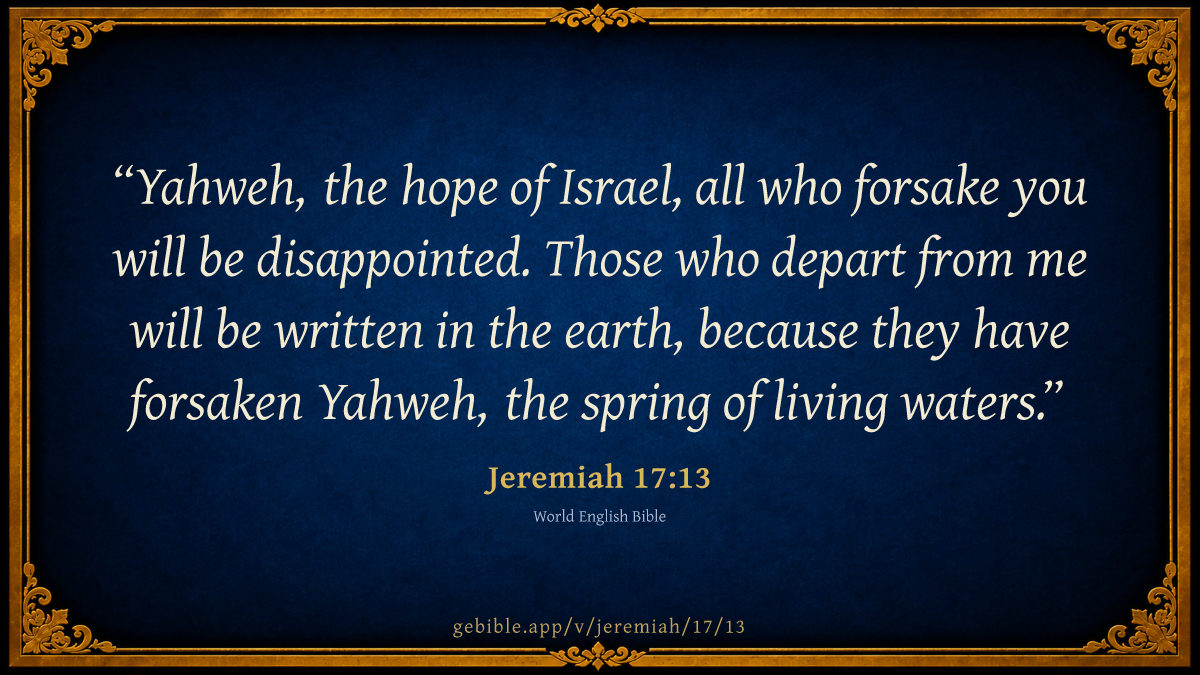
Yahweh, the hope of Israel, all who forsake you will be disappointed. Those who depart from me will be written in the earth, because they have forsaken Yahweh, the spring of living waters.
Parallel Translations
-
Yahweh, the hope of Israel, all who forsake you will be disappointed. Those who depart from me will be written in the earth, because they have forsaken Yahweh, the spring of living waters.
-
O LORD, the hope of Israel, all that forsake thee shall be ashamed, and they that depart from me shall be written in the earth, because they have forsaken the LORD, the fountain of living waters.
-
Thou hope of Israel, the LORD! All that forsake Thee shall be ashamed; they that depart from Thee shall be written in the earth, because they have forsaken the LORD, the fountain of living waters.
Cross-references (32)
Passages linked to Jeremiah 17:13 in the Treasury of Scripture Knowledge, ordered by reader-vote popularity; verse text shown in World English Bible.
- Revelation 7:17 for the Lamb who is in the middle of the throne shepherds them and leads them to springs of life-giving waters. And God will wipe away every tear from their eyes.”
- John 4:14 but whoever drinks of the water that I will give him will never thirst again; but the water that I will give him will become in him a well of water springing up to eternal life.”
- John 7:37-38 Now on the last and greatest day of the feast, Jesus stood and cried out, “If anyone is thirsty, let him come to me and drink! He who believes in me, as the Scripture has said, from within him will flow rivers of living water.”
- John 4:10 Jesus answered her, “If you knew the gift of God, and who it is who says to you, ‘Give me a drink,’ you would have asked him, and he would have given you living water.”
- Revelation 22:1 He showed me a river of water of life, clear as crystal, proceeding out of the throne of God and of the Lamb,
- Psalms 36:8-9 They shall be abundantly satisfied with the abundance of your house. You will make them drink of the river of your pleasures. For with you is the spring of life. In your light we will see light.
- Revelation 21:6 He said to me, “I have become the Alpha and the Omega, the Beginning and the End. I will give freely to him who is thirsty from the spring of the water of life.
- John 8:6-8 They said this testing him, that they might have something to accuse him of. But Jesus stooped down and wrote on the ground with his finger. But when they continued asking him, he looked up and said to them, “He who is without sin among you, let him throw the first stone at her.” Again he stooped down and wrote on the ground with his finger.
- Isaiah 1:28 But the destruction of transgressors and sinners shall be together, and those who forsake Yahweh shall be consumed.
- Luke 10:20 Nevertheless, don’t rejoice in this, that the spirits are subject to you, but rejoice that your names are written in heaven.”
- Revelation 20:15 If anyone was not found written in the book of life, he was cast into the lake of fire.
- Jeremiah 14:8 You hope of Israel, its Savior in the time of trouble, why should you be as a foreigner in the land, and as a wayfaring man who turns aside to stay for a night?
- Isaiah 66:5 Hear Yahweh’s word, you who tremble at his word: “Your brothers who hate you, who cast you out for my name’s sake, have said, ‘Let Yahweh be glorified, that we may see your joy;’ but it is those who shall be disappointed.
- Psalms 73:27 For, behold, those who are far from you shall perish. You have destroyed all those who are unfaithful to you.
- Jeremiah 2:13 “For my people have committed two evils: they have forsaken me, the spring of living waters, and cut out cisterns for themselves: broken cisterns that can’t hold water.
- Isaiah 65:11-14 “But you who forsake Yahweh, who forget my holy mountain, who prepare a table for Fortune, and who fill up mixed wine to Destiny; I will destine you to the sword, and you will all bow down to the slaughter; because when I called, you didn’t answer. When I spoke, you didn’t listen; but you did that which was evil in my eyes, and chose that in which I didn’t delight.” Therefore the Lord Yahweh says, “Behold, my servants will eat, but you will be hungry; behold, my servants will drink, but you will be thirsty. Behold, my servants will rejoice, but you will be disappointed; Behold, my servants will sing for joy of heart, but you will cry for sorrow of heart, and will wail for anguish of spirit.
- Jeremiah 2:17 “Haven’t you brought this on yourself, in that you have forsaken Yahweh your God, when he led you by the way?
- Jeremiah 2:26-27 As the thief is ashamed when he is found, so the house of Israel is ashamed: they, their kings, their princes, their priests, and their prophets, who tell wood, ‘You are my father,’ and a stone, ‘You have given birth to me,’ for they have turned their back to me, and not their face; but in the time of their trouble they will say, ‘Arise, and save us!’
- Joel 3:16 Yahweh will roar from Zion, and thunder from Jerusalem; and the heavens and the earth will shake; but Yahweh will be a refuge to his people, and a stronghold to the children of Israel.
- Psalms 97:7 Let all them be shamed who serve engraved images, who boast in their idols. Worship him, all you gods!
- Proverbs 10:7 The memory of the righteous is blessed, but the name of the wicked will rot.
- Isaiah 45:16-17 They will be disappointed, yes, confounded, all of them. Those who are makers of idols will go into confusion together. Israel will be saved by Yahweh with an everlasting salvation. You will not be disappointed nor confounded to ages everlasting.
- Jeremiah 17:5 Yahweh says: “Cursed is the man who trusts in man, relies on strength of flesh, and whose heart departs from Yahweh.
- Psalms 22:4 Our fathers trusted in you. They trusted, and you delivered them.
- Proverbs 14:14 The unfaithful will be repaid for his own ways; likewise a good man will be rewarded for his ways.
- Jeremiah 17:17 Don’t be a terror to me. You are my refuge in the day of evil.
- Ezekiel 16:63 that you may remember, and be confounded, and never open your mouth any more, because of your shame, when I have forgiven you all that you have done,” says the Lord Yahweh.’ ”
- Ezekiel 36:32 I don’t do this for your sake,” says the Lord Yahweh. “Let it be known to you: be ashamed and confounded for your ways, house of Israel.”
- Daniel 12:2 Many of those who sleep in the dust of the earth will awake, some to everlasting life, and some to shame and everlasting contempt.
- Acts 28:20 For this cause therefore I asked to see you and to speak with you. For because of the hope of Israel I am bound with this chain.”
- 1 Timothy 1:1 Paul, an apostle of Jesus Christ according to the commandment of God our Savior and the Lord Jesus Christ our hope;
- Revelation 22:17 The Spirit and the bride say, “Come!” He who hears, let him say, “Come!” He who is thirsty, let him come. He who desires, let him take the water of life freely.
Cross-references from openbible.info (CC BY 4.0)
Explain this verse (15 sources)
Historical commentary, presented as a primary source — not an endorsement.
Private notes
Saved on this device only — never synced or sent anywhere.
John Calvin 1540 · Public Domain It appears more clear from this verse why the…
It appears more clear from this verse why the Prophet had commended before the excellency of his own nation, even that by the comparison their impiety might appear less excusable; for the more bountiful God had dealt with them, the more atrocious was their sin of ingratitude. As then the Jews had been raised high, so that their elevation appeared eminent through the whole world, the more detestable became their contumacy against God, and also their ingratitude in rejecting and despising a favor so remarkable, when they forsook him and followed idols, vain hopes, and their own false counsels. It is the same as though the Prophet had said, — “What does it avail you, that God dwells among you, and that the Temple is as it were his earthly habitation, where he converses familiarly with you? what benefit is this to you? for no one accepts of this favor; nay, we wilfully, and as it were designedly cast away from us this kindness which is freely offered to us.”
We hence see that all this ought to be read together, — that the throne of God was in Judea, but that the people in the meantime malignantly and wickedly rejected the favor offered them.
Read full note →
But the Prophet turns to God, that he might rouse the Jews, for such was their perverseness that he in vain taught them. And he says, Jehovah, the expectation of Israel! whosoever forsake thee shall be made ashamed; as though he had said, — “The ungodly multitude which accepts not the dignity by which our race excels all other nations, receives no benefit. God indeed dwells in the midst of us, but hardly one in a hundred cleaves to him; nay, almost all treacherously forsake him; but notwithstanding all their glory, they shall be made ashamed who thus reject the kindness of God.” The Prophet, in short, reminds the Jews how vainly and presumptuously they gloried, because God had adopted their race; for a reciprocity was required, so that they were to respond to God and receive his benefits. But when they perversely his favor, what could have remained for them?
Hence he says, Ashamed shall all they be made who forsake thee. By the word forsake, he intimates that the Jews had been favored by God; for this could not have been said in the same sense, and in an equal degree of the heafilens, as the heathens had never been gathered by God into one body; but the Jews alone had enjoyed this favor. When therefore he had manifested himself to them, and testified that he would be their Father, he was forsaken by them. This defection, of which the Jews alone were guilty, is noticed, because God had sought them for himself; he had also come to them, and made with them a covenant. As then they were thus brought nigh to God, this defection was the more execrable. This is what the Prophet means.
He now adds, And they who depart shall be written in the earth. Literally it is, “Who depart from me;” but the י, iod, at the end, as many think, is a servile letter. And some think that the word is a verb, and that the י, iod, at the beginning denotes the future tense, and they regard the י, iod, at the end to be for ו, vau, יסודו isuru, “Who depart.” Others suppose it to be a noun, and read יסורי isuri, for וסורים vasurim As to the meaning, it is evident that the Prophet designed here to shake off from the Jews the vain glory with which they were inflated, when they boasted that they were the people of God, the holy race of Abraham, the royal priesthood; all these things he ridicules as vain, as though he had said, — “Away with all these boastings, which are all false; ye are apostates, therefore your name shall be written in the earth.” No doubt, the earth here is set in opposition to heaven; and Scripture sometimes says, that the name of the wicked shall be a reproach on earth. But as they often acquire a celebrated and honorable name on earth, the Prophet makes a concession and says, “Be it so; let the world regard you as the holy race of Abraham, the blessed seed and the chosen people; let, in short, every one of you claim for himself whatever he pleases, but your name shall be on earth, and shall be blotted out from heaven; there will be no inheritance above for you, no portion in the kingdom of God.” He in short intimates, that the Jews would have no place before God and his angels, for they were unworthy that God shouhi regard them as his children, since they had wickedly denied him. He then grants them a name on earth; but it is the, same as though he had said, that they wickedly lied in boasting that they were a chosen people, since they themselves, as far as they could, obliterated the election of God.
He afterwards adds, Because they have forsaken Jehovah, the fountain of living waters. The Prophet confirms what he had said, lest the Jews should think that they were too severely rebuked, when he said that their name was blotted out from heaven: Ye have forsaken, he says, the fountain of living waters. “What does this mean? God (according to what is said in Jeremiah 2) manifested himself to you; is there not in him a full and sufficient happiness for you? What more can be sought for by a mortal man than to enjoy his God, in whom there is the fullness of all blessings? God has offered himself to you, and his bounty has ever been extended to you, as though he were a fountain from which you might draw enough to satisfy you; but ye have forsaken this fountain. You must therefore perish through thirst, and justly so, for your ingratitude has been so great as to despise these remarkable and invaluable favors of God.” It now follows —
John Calvin's Commentaries (1540-1563) — public domain. Text from the Calvin Translation Society English edition (1840s-50s) via the Christian Classics Ethereal Library (ccel.org). Calvin's coverage is partial (roughly two-thirds of the Bible); uncommented books and verses are honest gaps, never fabricated. The 19th-century editor's footnotes and remarks are omitted so the notes are faithfully Calvin's own voice.
Geneva Bible translators 1599 · Public Domain Their names shall not be registered in the book…
Their names shall not be registered in the book of life.
Geneva Bible (1599) marginal notes — public domain.
John Trapp 1656 · Public Domain Jer 17:13 O LORD, the hope of Israel, all…
Jer 17:13 O LORD, the hope of Israel, all that forsake thee shall be ashamed, [and] they that depart from me shall be written in the earth, because they have forsaken the LORD, the fountain of living waters.
Ver. 13. Shall be written in the earth,] i.e., Aeterna motre damnabuntur; they shall be hurled into hell, as not having their names written in heaven, {Luk 10:20} where all that are "written among the living in Jerusalem" {Isa 4:3} are enrolled. {Heb 12:23} Non pro gloriosis sed pro probrosis habiti. See Psa 17:14. Prudentius rightly saith, that their names that are written in red letters of blood in the Church’s calendar, are written in golden letters in Christ’s register in the book of life; as on the contrary, these idolaters, whose sin was with an iron pen engraven on the tables of their hearts, {as Jer 17:1} are justly "written in the earth" - i.e., cast to hell.
John Trapp, A Commentary or Exposition upon All the Books of the Old and New Testament (1647–1656) — public domain. Text from a community e-Sword module.
Matthew Poole 1685 · Public Domain The hope of Israel; that is, he in whom…
The hope of Israel; that is, he in whom alone the true Israel of God can hope.
All they that forsake thee shall be ashamed; those who forsake thy law, and that rule thou hast given them whereby to direct their conversations, first or last will be ashamed of such their disobedience.
Read full note →
And they that depart from me shall be written in the earth; and those that depart from what I have, as thy prophet, revealed to them as thy will, shall have no portion beyond the earth which they seem so fond of; or their names and memories shall vanish, and perish, and be presently extinct, like words written in dust.
Because they have forsaken the Lord, the fountain of living waters; because they have forsaken thee, who art the alone certain relief and comfort of any people, the fountain and original of all that good they can hope for.
Matthew Poole's English Annotations on the Holy Bible (1683–1685) — public domain. Text from a community e-Sword/MySword module.
John Gill 1763 · Public Domain O Lord, the Hope of Israel,.... Of all true…
O Lord, the Hope of Israel,.... Of all true Israelites; such as are regenerate persons, and true believers in him; Christ is the author and giver of that hope that is in them; the door of it unto them; the object on which it is exercised; the ground and foundation of it, or what gives encouragement to it; and the person they are hoping for; Old Testament saints hoped, waited for, and expected his first coming; and New Testament saints are hoping for his second coming, and to be for ever with him (w):
all that forsake thee shall be ashamed; who forsake him as the Hope of Israel, and place their hope elsewhere; in the creature, in themselves, in their riches, in their righteousness, and profession of religion; such shall be ashamed of their vain hope; whereas a true hope, a hope upon the right object, on Christ the Hope of Israel, makes not ashamed; nor shall the man that has it be ashamed of that. The Targum paraphrases it,
Read full note →
"all who forsake thy worship shall be ashamed;''
for they forsake their own mercies, who forsake the house and ordinances of God, and the assembling of themselves together:
and they that depart from me; the prophet; refusing to hear the word of the Lord by him, which was all one as departing from the Lord. Some render it, "from thee", as the Vulgate Latin and Arabic versions; and so the Targum,
"and the ungodly that transgress thy word;''
whose heart departed from the Lord, as in
Jer 17:1 notwithstanding their show of devotion and religion. Some render the words, "that are chastised by me"; but repent not, and are not reformed thereby; reading not as the Masorites direct, and we, and many others, follow; but according to the letters, and retaining them, (x):
shall be written in the earth; have a name among earthly and carnal men, and be called so, being sensual and carnal, and minding nothing but earth and earthly things; and shall not be written among the living in Jerusalem, or have a name and a place among spiritual men: or they shall be of a short continuance; their memory shall rot; their names be put out for ever; and their memorial perish with them; for things written in the dust do not continue, but are presently destroyed by a puff of wind, or by the treading of the foot upon them; or they shall die, and return to the earth, and be laid in the grave, as Jarchi and Kimchi interpret it; or shall perish eternally, die the second death, being not written in the Lamb's book of life. The Targum is,
"into hell shall they fall.''
The phrase is opposed to a being written, or having names written in heaven, Luk 10:20; which is the same as to be written in the book of life, or to be ordained unto eternal life, Phi 4:3; and what is the case of such who are not written in heaven, but in earth, may be seen in Rev 20:15;
because they have forsaken the Lord, the fountain of living waters; See Gill on Jer 2:13.
(w) the word here used, sometimes signifies a confluence or collection of waters, as in Gen 1:10 and elsewhere, a place to bathe in; hence Fortunatus Scacchus, in Sacror. Eleaochr. Myrothec. l. 1. c. 23. col. 159. renders it here, "the bath of Israel", the Lord, the Lord Jesus Christ, whose blood is a fountain opened, in which sinners wash, and are cleansed from their sins, Zech. xiii. 1. and this agrees with the latter part of the verse, where the Lord is called "the fountain of living water"; so De Dieu, on ch. xiv. 8, observes, the word is so used in Exod. vii. 21. and so R. Akiba interprets the words, saying,
"what is "the meaning of it is that which cleanses the unclean; even so God cleanses Israel;''
and it is, adds De Dieu, as if you were to call God the pool of Israel, or a confluence of waters where Israel may be washed from his filth. (x) "Castigati a me", Schmidt; so Stockius, p. 455, 725, Junius & Tremellius follow the same reading, only they render the words, not so properly, "castigationes meae".
John Gill's Exposition of the Whole Bible (1746–1763) — public domain (CC PDM 1.0). Text via the HelloAO Bible API.
John Wesley 1765 · Public Domain Depart - From what I have revealed to them…
Depart - From what I have revealed to them as thy will, shall have no portion beyond the earth.
John Wesley, Explanatory Notes Upon the Whole Bible (1754–1765) — public domain. Text via the GEBible commentary corpus.
Adam Clarke 1810 · Public Domain Verse 13. Written in the earth] They shall never…
Verse 13. Written in the earth] They shall never come to true honour. Their names shall be written in the dust; and the first wind that blows over it shall mar every letter, and render it illegible.
Adam Clarke's Commentary on the Bible (1810–1826) — public domain. Text from a community e-Sword/MySword module.
Joseph Benson 1811 · Public Domain Jer 17:13. O Lord, the hope of Israel —…
Jer 17:13. O Lord, the hope of Israel — That is, He in whom alone thy true Israel can hope; all they that forsake thee shall be ashamed — Those who forsake thy law and that rule which thou hast given them, whereby to direct their conversation, will sooner or later be ashamed of such their disobedience. Or, as Lowth paraphrases the words, “Thou hast given many gracious promises to thy people, to encourage them to trust in thee; and they that forsake their interest in thy goodness will find all other expectations fail and disappoint them;” and they that depart from me — From my love and service, says God, and their reliance upon me, shall be written in the earth — Shall have no portion beyond the earth, on which they set their affections. Or, their names and memories shall be soon extinct; like words written in the dust: they shall not be registered among my people, nor shall their names be recorded in the book of life. The expression seems to allude to registers kept of the members of cities or corporations, the privileges of which none can pretend to but they who have their names entered in such registers; because they have forsaken the Lord, the fountain of living waters — The only certain relief and comfort of any people, the fountain and origin of all the good they can hope for. See note on Jer 2:13.
Joseph Benson's Commentary on the Old and New Testaments (1811–1818) — public domain. Text from a community e-Sword module.
Haydock's Catholic Bible Commentary 1859 · Public Domain Earth, where alone their portion shall be, (Apocalypse iii.…
Earth, where alone their portion shall be, (Apocalypse iii. 5,) or they shall be forgotten. It is a proverbial expression, like that of Catullus: Dixit: sed mulier cupido quod dixit amanti
In vento et rapida scribere oportet aqua.
Read full note →
--- Living, which never fail, unlike those of the wicked, chap. ii. 13.
George Leo Haydock (1774–1849), Haydock's Catholic Family Bible and Commentary, 1859 edition — public domain. Excludes Psalms (Douay-Rheims chapter numbering differs from Protestant) and Deuterocanonical books (Catholic canon only).
Robert Jamieson, A. R. Fausset & David Brown 1871 · Public Domain me--"Jehovah." Though "Thee" precedes. This sudden transition is usual…
me--"Jehovah." Though "Thee" precedes. This sudden transition is usual in the prophetic style, owing to the prophet's continual realization of Jehovah's presence.
all that forsake thee-- (Psa 73:27; Isa 1:28).
Read full note →
written in the earth--in the dust, that is, shall be consigned to oblivion. So Jesus' significant writing "on the ground (probably the accusers' names)" (Joh 8:6). Names written in the dust are obliterated by a very slight wind. Their hopes and celebrity are wholly in the earth, not in the heavenly book of life (Rev 13:8; Rev 20:12, Rev 20:15). The Jews, though boasting that they were the people of God, had no portion in heaven, no status before God and His angels. Contrast "written in heaven," that is, in the muster-roll of its blessed citizens (Luk 10:20). Also, contrast "written in a book," and "in the rock for ever" (Job 19:23-24).
living waters-- (Jer 2:13).
Jamieson, Fausset & Brown — Commentary Critical and Explanatory on the Whole Bible (1871) — public domain (CC PDM 1.0). Text via the HelloAO Bible API.
Daniel D. Whedon 1874 · Public Domain 13. Written in the earth — Where they shall…
13. Written in the earth — Where they shall soon disappear. In Exo_32:32, it is implied that the friends of God have their names written in his book, and in Dan_12:1, this is called the “book of life.” “Written in the earth” stands in contrast with this book of God’s remembrance.
That depart from me — One of many instances in which the prophet seems to identify himself with Jehovah, so that to leave one would be to leave the other.
Daniel D. Whedon (gen. ed.), Commentary on the Old and New Testaments (1874–1909) — public domain. Text from a community e-Sword module.
The Cambridge Bible for Schools and Colleges 1878 · Public Domain 13. shall be written in the earth] Their names…
13. shall be written in the earth] Their names shall be blotted out, unlike those engraved in some enduring material. Ewald restores the parallelism with “shall be ashamed” of the previous clause by an emendation which gives “they that depart from thee in the land shall be put to confusion.” Gi., amending differently, “shall be cut off from the earth.” Cp. Psa_34:16.
the fountain] See on ch. Jer_2:13.
The Cambridge Bible for Schools and Colleges (gen. ed. J. J. S. Perowne; Cambridge University Press, 1878–1918) — public domain. Text from a community e-Sword module.
Ellicott's Commentary for English Readers 1878 · Public Domain (13) They that depart from me.—The rapid change of…
(13) They that depart from me.—The rapid change of person from second to first and first to third is eminently Hebrew.
Written in the earth.—In implied contrast with the name graven on the rock for ever (Job_19:24) are those written on the dust or sand. The Eastern habit of writing on the ground (of which Joh_8:6 supplies one memorable instance, and which was the common practice in Jewish schools) gave a vividness to the similitude which we have almost lost. For “the fountain of living waters,” compare Note on Jer_2:13.
A Bible Commentary for English Readers, edited by Charles John Ellicott (1878–1897) — public domain. Text from a community e-Sword module.
The Pulpit Commentary 1880 · Public Domain They that depart from me. The abrupt change of…
They that depart from me. The abrupt change of person is extremely harsh; the Vulgate, followed by Ewald and Olshausen, supposes that a final caph has dropped out, rendering, "they that depart from thee." Shall be written in the earth; a contrast to that which is recorded for all time "with a pen of iron" (ver. 1). The fountain, etc.; a favorite phrase of our prophet. (see Jer_2:13)
"Written in the earth.
Read full note →
I As INDICATION OF WHY MEN DEPART FROM GOD. "Those who depart from Jehovah," says the prophet, "shall be written in the earth" Therefore we conclude that their aim is to be written in some more durable and trustworthy substance. When they are spoken of as departing from God, the description is one accommodated to our thoughts rather than exactly correspondent with reality. The connection has been real so far as mere opportunity and privilege were concerned, but nominal also, because the opportunity and privilege were never seized. God has drawn near to the man; the man has not been inclined to draw near to God. It has seemed to him that in drawing near there would be such a subordination of self as would amount to self-effacement. The lusts of the natural man are everywhere checked and contradicted by the commandments of God. Hence man strives to get away from God and into such relations with his fellow-men as will, he thinks, cause his name to be counted for more. It may be that it is self-glory he is seeking for; to have his name deeply graven on the world"s memorial tablets as one who has achieved much and stood out like a Hercules from the common crowd. It may be that he hopes for great power; to have his name written on the hearts of thousands whose interests will be bound up with his so that they cannot succeed if he fails. It is very gratifying to the pride of man to feel that others cannot do without him.
II THE SURE RESULT OF DEPARTURE FROM GOD. Men go away from God expecting to have their names written in the marble, and a very short experience shows that they are written, as it were, on the most shifty of all materials. From a certain point of view, nothing seems more irregular than the preservation of what was written in ancient ages. Deep letters on hard stones are long faded away, whale characters written on parchment or even paper survive to this day, and are now watched with an attention which bids fair to preserve them for many a year to come. But every one can see that what is written in the earth must, in the very nature of things, be quickly obliterated. Such writing may be the amusement of a child; it could never be the serious occupation of a man. And yet it is just by this figure that the folly of apostates from God is set forth. They write their names on a spot exposed to the trampling crowd of their fellow-men; and in their own selfishness they forget of how little account they are to others as selfish as themselves. And yet, in spite of such a warning to those who depart from God, they go on complaining because men forget them. It is just the way in which they must expect to be treated. It is the way of the world. After all, we are but weak creatures, with very limited powers, and we may well be excused if we cannot keep constantly in our minds those who have some claim on our sympathy and help. It is no fault of earth that it is earth instead of adamant. The fault lies with those who allow their names to be written there instead of in the enduring place which God has provided for them.
III THE EQUALLY SURE RESULT FROM CLEAVING TO GOD. Though not stated in so many words, it is cheeringly implied that those cleaving to God have their names written whence they can never be erased. For their names are indeed written, as it were, on the heart of God himself. He cannot either forget or forsake them. They are ever remembered in the wisdom of his thoughts and the resistless movements of his ways. The Best thing that can happen to us in purely human relations is to be written in the hearts of those who love us; when they remember us, not because it is their interest to do so, but out of an unselfish fullness of desire for our welfare and happiness. But how much Better is it to Be thus remembered by God, seeing that with him there abides a love inexpressibly deeper than any human affection, and, along with this love, a wisdom and power with which even the highest human wisdom and power are not for a moment to Be mentioned! Y.
The Pulpit Commentary (1880–1919), ed. H.D.M. Spence-Jones & Joseph S. Exell — public domain. Text from a community e-Sword module.
Alexander MacLaren 1905 · Public Domain Jer 17:13. - Luk 10:20.
Jeremiah
TWO LISTS OF NAMES
Read full note →
Jer 17:13. - Luk 10:20.
A name written on earth implies that the bearer of the name belongs to earth, and it also secondarily suggests that the inscription lasts but for a little while. Contrariwise, a name written in heaven implies that its bearer belongs to heaven, and that the inscription will abide.
We find running throughout Scripture the metaphor of books in which men’s names are written. Moses thought of a book which God has written, and in which his name was enrolled. A psalmist speaks of the ‘book of the living,’ and Isaiah of those who are ‘written among the living in Jerusalem.’ Ezekiel threatens the prophets who speak lies in Jehovah’s name that they ‘shall not be written in the writing of the house of Israel.’ The Apocalypse has many references to the book which is designated as ‘the Lamb’s book of life,’ and which is opened at the final judgment along with the books in which each man’s life-history is written, and only ‘they who are written in the Lamb’s book of life’ enter into the city that comes down out of heaven.
I. The principle on which the two lists are made up.
It is commonly supposed that the idea of unconditional predestination is implied in the writing of the names in the book of life. There is nothing in the figure itself to lead to that, and the text from Jeremiah suggests, on the contrary, that the voluntary attitude of men to God determines their being or not being inscribed in the book of heaven, since it is ‘they who depart from God’ whose ‘names are written on earth.’
Then, since in the New Testament the book of life is called ‘the Lamb’s,’ we are led to think of Christ as writing in it, and hence of our faith in Him as being the condition of enrolling our names.
II. The significance of the lists.
They are lists of the living and of the dead.
True life is in fellowship with God. The other is the register of the burials in a graveyard.
They are lists of the citizens of two cities.
The idea is that the one class have relations and affinities with the celestial, are ‘fellow-citizens with the saints,’ and have heaven as their metropolis, their mother city. Therefore they are but as aliens here, and should not wish to be naturalised. The other class are citizens of the earthly, belonging to the present, with all their thoughts and desires bounded by this visible diurnal sphere.
They are lists of those who shall be forgotten, and their works annihilated, and of those who shall be remembered and their work crowned.
The names written on earth are swiftly obliterated, like a child’s scrawl on the sand which is washed away by the next tide, or covered up by the next storm that blows about the sand-hills. What a contrast is that of the names written on the heavens, high up above all earthly mutations!
In one sense oblivion soon seizes on us all. In another none of us is ever forgotten by God, but good and bad alike live in His thought. Still this idea of a special remembrance has place, as suggesting that, however unnoticed or forgotten on earth, God’s children live in the true ‘Golden Book.’ Their names are in the book of life. ‘Of so much fame, in heaven expect the meed.’ Ay, and as, too, suggesting how brief after all is the honour that comes from men.
Also, there will be annihilation or perpetuation of their life’s work. Nothing lasts but the will of God. Men who live godless lives are engaged in true Sisyphean labour. They are running counter to the whole stream of things, and what can be left at the end but frustrated endeavours covered with a gloomy pall?
Is your life to be wasted?
They are lists of those who are accepted in judgment, and of those who are not.
Rev 20:12, Rev 20:15; Rev 21:27.
The books of men’s lives are to be opened, and also the book of life. What is written in the former can only bring condemnation. If our names are written in the latter, then He will ‘confess our names before His Father and the holy angels.’ And He will joyfully inscribe them there if we say to Him, like the man in Pilgrim’s Progress, ‘Set down my name.’ He will write them not only there, but on the palms of His hands and the tablets of His heart.
Alexander MacLaren, Expositions of Holy Scripture (1904–1910) — public domain. Text from a community e-Sword module.