
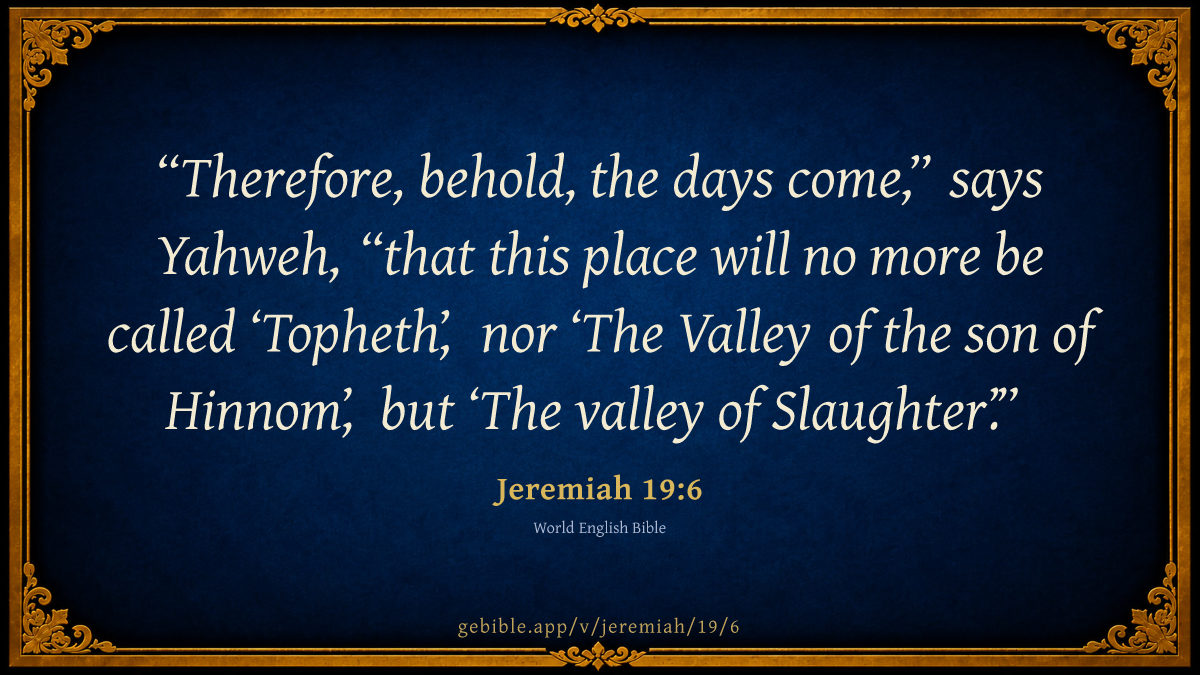
Therefore, behold, the days come,” says Yahweh, “that this place will no more be called ‘Topheth’, nor ‘The Valley of the son of Hinnom’, but ‘The valley of Slaughter’.
Parallel Translations
-
Therefore, behold, the days come,” says Yahweh, “that this place will no more be called ‘Topheth’, nor ‘The Valley of the son of Hinnom’, but ‘The valley of Slaughter’.
-
Therefore, behold, the days come, saith the LORD, that this place shall no more be called Tophet, nor The valley of the son of Hinnom, but The valley of slaughter.
-
Therefore, behold, the days come, saith the LORD, that this place shall no more be called Topheth, nor The valley of the son of Hinnom, but The valley of slaughter;
Cross-references (5)
Passages linked to Jeremiah 19:6 in the Treasury of Scripture Knowledge, ordered by reader-vote popularity; verse text shown in World English Bible.
- Joshua 15:8 The border went up by the valley of the son of Hinnom to the side of the Jebusite (also called Jerusalem) southward; and the border went up to the top of the mountain that lies before the valley of Hinnom westward, which is at the farthest part of the valley of Rephaim northward.
- Isaiah 30:33 For his burning place has long been ready. Yes, for the king it is prepared. He has made its pyre deep and large with fire and much wood. Yahweh’s breath, like a stream of sulfur, kindles it.
- Jeremiah 19:2 and go out to the valley of the son of Hinnom, which is by the entry of the gate Harsith, and proclaim there the words that I will tell you.
- Jeremiah 7:32-33 Therefore behold, the days come”, says Yahweh, “that it will no more be called ‘Topheth’ or ‘The valley of the son of Hinnom’, but ‘The valley of Slaughter’; for they will bury in Topheth until there is no place to bury. The dead bodies of this people will be food for the birds of the sky, and for the animals of the earth. No one will frighten them away.
- Jeremiah 19:11 and shall tell them, ‘Yahweh of Armies says: “Even so I will break this people and this city, as one breaks a potter’s vessel, that can’t be made whole again. They will bury in Topheth, until there is no place to bury.
Cross-references from openbible.info (CC BY 4.0)
Explain this verse (12 sources)
Historical commentary, presented as a primary source — not an endorsement.
Private notes
Saved on this device only — never synced or sent anywhere.
John Calvin 1540 · Public Domain We saw in the last Lecture that the Prophet…
We saw in the last Lecture that the Prophet was sent by God’s bidding to the house of the potter, that he might there take an earthen bottle, carry it to Topher, and there explain the judgment of God, which was nigh at hand on account of his worship being violated. And he shewed why the Jews deserved reproof, even because they made incense to Baal, built groves and high places for themselves, and committed their sons and daughters to the fire: they were not only profane towards God, but also cruel towards innocent souls. Now, lest they pretended an excuse, he also added, that such a thing never came to God’s mind; and this is worthy of notice, because God by this one expression fulminates against all those inventions with which men delight themselves. As then there is no command, it follows that whatever is thus attempted is frivolous and useless.
He now denounces punishment, The days are coming, or shall come, in which this place shall no more be called Tophet, nor The valley of the son of Hinnom, but The valley of slaughter. This seemed incredible to the Jews; for they had chosen that place for themselves to perform their superstitions: they thought therefore that a great part of their safety depended on their false worship.
Read full note →
As to the word Tophet, some think that it is to be taken simply for hell, or for eternal death; but this cannot by any means be admitted. More probable is their opinion who derive it from תף, teph, which means a drum; for they think that they did beat drums when infants were killed, that their cries might not be heard. But as this is only a conjecture, I know not whether another reason may be given. Some derive the word from יפה iphe, which signifies to be decorous or beautiful; and this etymology has something apparently in its favor. And perhaps it ought to be so taken in Job 17:6, where the holy man complains that he was become a proverb, and that he had been תפת Tophet, in the presence of all. There are indeed some who explain the word there as signifying something monstrous, and thus take it in a bad sense. But it seems rather to have been put in contrast with the former clause, — he had been a pleasant spectacle, but he was now become detestable. But they who take the word there as meaning hell, do so entirely without any reason, for that Job perished, seeing and knowing his perdition, as they say, is a forced view. I doubt not then but that he said, that he had been תפת Tophet; that is, an object of joy and of praise, but that he was then a sad and mournful spectacle. And it is certain that his name, תפת, Tophet, was given to the valley of Hinnom, because of the hilarity and joy which thence arose to the people; for they thought that God was propitious to them, when they so sedulously offered there their sacrifices, and yet they provoked his wrath. Then Tophet is to be taken in a good sense, when we regard the origin of the word. It is indeed true that in Isaiah 30:33, Tophet is to be taken for Gehenna; but it may be that the prophets had now begun so to execrate the place as to call hell indiscriminately Gehennon and Tophet; for the word Gehenna, as we have stated elsewhere, had its origin from the same place; it is indeed corrupted, but its origin is not doubtful. Now, the reason why the prophets and other faithful men called the place hell, was plainly this, — because the devil reigned in that place, when God’s worship became vitiated, and the whole of true religion was subverted; and especially, because superstition became so deeply fixed in the hearts of the people, that it could not be rooted up except by an extraordinary force and power.
However this may have been, we may conclude from this passage, as well as from other passages, that this name was given on account of the joy experienced there, even because they thought themselves altogether happy, as God was pacified towards them. But what does Jeremiah say? This place shall be no more called Tophet, nor The valley of the son of Hinnom, but The valley of slaughter. This seemed, as I have said, incredible to the Jews. But it however behoved the Prophet boldly to declare what was to be. It afterwards follows, —
John Calvin's Commentaries (1540-1563) — public domain. Text from the Calvin Translation Society English edition (1840s-50s) via the Christian Classics Ethereal Library (ccel.org). Calvin's coverage is partial (roughly two-thirds of the Bible); uncommented books and verses are honest gaps, never fabricated. The 19th-century editor's footnotes and remarks are omitted so the notes are faithfully Calvin's own voice.
Geneva Bible translators 1599 · Public Domain Read Jer. 7:31 and 2 Kings 23:10; Isa. 30:33.
Read Jer. 7:31 and 2 Kings 23:10; Isa. 30:33.
Geneva Bible (1599) marginal notes — public domain.
John Trapp 1656 · Public Domain Jer 19:6 Therefore, behold, the days come, saith the…
Jer 19:6 Therefore, behold, the days come, saith the LORD, that this place shall no more be called Tophet, nor The valley of the son of Hinnom, but The valley of slaughter.
Ver. 6. This place shall no more.] See Jer 7:32. Things are repeated, that they may be the better observed.
John Trapp, A Commentary or Exposition upon All the Books of the Old and New Testament (1647–1656) — public domain. Text from a community e-Sword module.
Matthew Poole 1685 · Public Domain For this God, by his prophet, threateneth that this…
For this God, by his prophet, threateneth that this place, anciently, in Joshua’s time, called
The valley of the son of Hinnom, and more lately Tophet, from the noise of drums and tabrets there, whilst children were burning, should have a new name, and be called
Read full note →
The valley of slaughter, from the multitude of dead bodies which upon the taking of the city should be slain and thrown into this valley. It was expounded Jer 7:32,33, For they shall bury in Tophet till there be no place; and the carcasses of this people shall be meat for the fowls of the heavens, and for the beasts of the earth, and none shall fray them away.
Matthew Poole's English Annotations on the Holy Bible (1683–1685) — public domain. Text from a community e-Sword/MySword module.
John Gill 1763 · Public Domain Therefore, behold, the days come, saith the Lord,.... Or,…
Therefore, behold, the days come, saith the Lord,.... Or, "are coming" (o); a little while and it will come to pass, what follows; to which a "behold" is prefixed, as calling for attention and admiration, as well as to assure of the certain performance of it:
that this place shall no more be called Tophet: as it had been, from the beating of drums in it, that the cries and shrieks of infants burnt in the fire might not be heard by their parents:
Read full note →
nor the valley of the son of Hinnom; which was its name in the times of Joshua, and long before it was called Tophet; but now it should have neither names:
but the valley of slaughter; or, "of the slain", as the Targum; from the multitude of those that should be killed here, at the siege and taking of Jerusalem; or that should be brought hither to be buried; see Jer 19:11 and See Gill on Jer 7:32.
(o) "dies (sunt) venientes", Montanus, Schmidt.
John Gill's Exposition of the Whole Bible (1746–1763) — public domain (CC PDM 1.0). Text via the HelloAO Bible API.
Joseph Benson 1811 · Public Domain Jer 19:6-9. Therefore, behold, the days come — And…
Jer 19:6-9. Therefore, behold, the days come — And are at no great distance; that this place shall no more be called Tophet, &c. — In Joshua’s time it was called The valley of the son of Hinnom; in after ages, it had the name of Tophet, from the noise of drums and tabrets sounding there while children were burning. Here it is foretold that it should have a new name and be called, The valley of Slaughter. See note on Jer 7:32-33. I will make void the counsel, &c., in this place — They shed innocent blood in this place, and in this place God would discomfit them, and cause their blood to be shed by the hands of the Chaldeans. And I will cause them to eat the flesh of their sons and daughters — A terrible judgment threatened by Moses, Deu 28:53; and actually fulfilled in the siege of Jerusalem. See Lam 4:10.
Joseph Benson's Commentary on the Old and New Testaments (1811–1818) — public domain. Text from a community e-Sword module.
Haydock's Catholic Bible Commentary 1859 · Public Domain Valley. Septuagint, "burial-place of slaughter," ver. 2. Here the…
Valley. Septuagint, "burial-place of slaughter," ver. 2. Here the Chaldeans slew many.
George Leo Haydock (1774–1849), Haydock's Catholic Family Bible and Commentary, 1859 edition — public domain. Excludes Psalms (Douay-Rheims chapter numbering differs from Protestant) and Deuterocanonical books (Catholic canon only).
Robert Jamieson, A. R. Fausset & David Brown 1871 · Public Domain no more . . . Tophet--from Hebrew, toph, "drum";…
no more . . . Tophet--from Hebrew, toph, "drum"; for in sacrificing children to Molech drums were beaten to drown their cries. Thus the name indicated the joy of the people at the fancied propitiation of the god by this sacrifice; in antithesis to its joyless name subsequently.
valley of slaughter--It should be the scene of slaughter, no longer of children, but of men; not of "innocents" (Jer 19:4), but of those who richly deserved their fate. The city could not be assailed without first occupying the valley of Hinnom, in which was the only fountain: hence arose the violent battle there.
Jamieson, Fausset & Brown — Commentary Critical and Explanatory on the Whole Bible (1871) — public domain (CC PDM 1.0). Text via the HelloAO Bible API.
Ellicott's Commentary for English Readers 1878 · Public Domain (6) Tophet.—See Notes on Jer_7:31-32.
(6) Tophet.—See Notes on Jer_7:31-32.
A Bible Commentary for English Readers, edited by Charles John Ellicott (1878–1897) — public domain. Text from a community e-Sword module.
The Pulpit Commentary 1880 · Public Domain (Comp. Jer_7:32) Tophet; rather, the Tophet. (see on Jer_7:31)
(Comp. Jer_7:32) Tophet; rather, the Tophet. (see on Jer_7:31)
The Pulpit Commentary (1880–1919), ed. H.D.M. Spence-Jones & Joseph S. Exell — public domain. Text from a community e-Sword module.
unfoldingWord translationNotes 2017 · CC BY-SA 4.0 "look" or "listen" or "pay attention to what I…
see
"look" or "listen" or "pay attention to what I am about to tell you"
Read full note →
this is Yahweh's declaration
Yahweh speaks of himself by name to express the certainty of what he is declaring. See how you translated this in Jeremiah 1:8. AT: "this is what Yahweh has declared" or "this is what I, Yahweh, have declared" (See: First, Second, or Third Person)
this place will no longer be called
This can be stated in active form. AT: "people will no longer call this place" (See: Active or Passive)
Topheth ... the Valley of Ben Hinnom ... the Valley of Slaughter
See how you translated the names of these places in Jeremiah 7:31.
I will make them to fall by the sword before their enemies
The idiom "to fall by the sword" means to die in battle. This can be stated in active form. AT: "I will enable their enemies to kill them with swords" (See: Idiom and Active or Passive)
I will make them
The word "them" refers to the people of Judah and Jerusalem.
by the hand of the ones seeking their lives
The verb may be supplied from the previous phrase. The idiom "fall ... by the hand of" means to be killed by someone, with the word "hand" representing the whole person. AT: "I will enable those who want to kill them to kill them" (See: Ellipsis and Synecdoche and Idiom)
the object of hissing
The word "hissing" refers to a sound that shows strong disapproval and can be translated with a verbal phrase. AT: "an object at which people hiss" (See: Abstract Nouns)
I will make them eat
"I will make the people who live in Jerusalem eat"
in the siege
"because of the siege"
and in the anguish brought on them by their enemies and the ones seeking their lives
This can be stated in active form. AT: "because their enemies and those who are seeking their lives have brought anguish upon them" (See: Active or Passive)
translationWords
declare
slaughter
sword
adversary
hand
life
heaven
beast
earth
ruin
plague
flesh
consume
neighbor
siege
anguish
unfoldingWord translationNotes — © Distant Shores Media and the Door43 World Missions Community, licensed CC BY-SA 4.0. Source: git.door43.org/Door43/en_tn.
Tyndale Open Study Notes 2022 · CC BY-SA 4.0 19:6 Valley of Slaughter: Cp. 7:32.
19:6 Valley of Slaughter: Cp. 7:32.
Tyndale Open Study Notes — © Tyndale Open Resources, licensed CC BY-SA 4.0. Text via the HelloAO Bible API.