
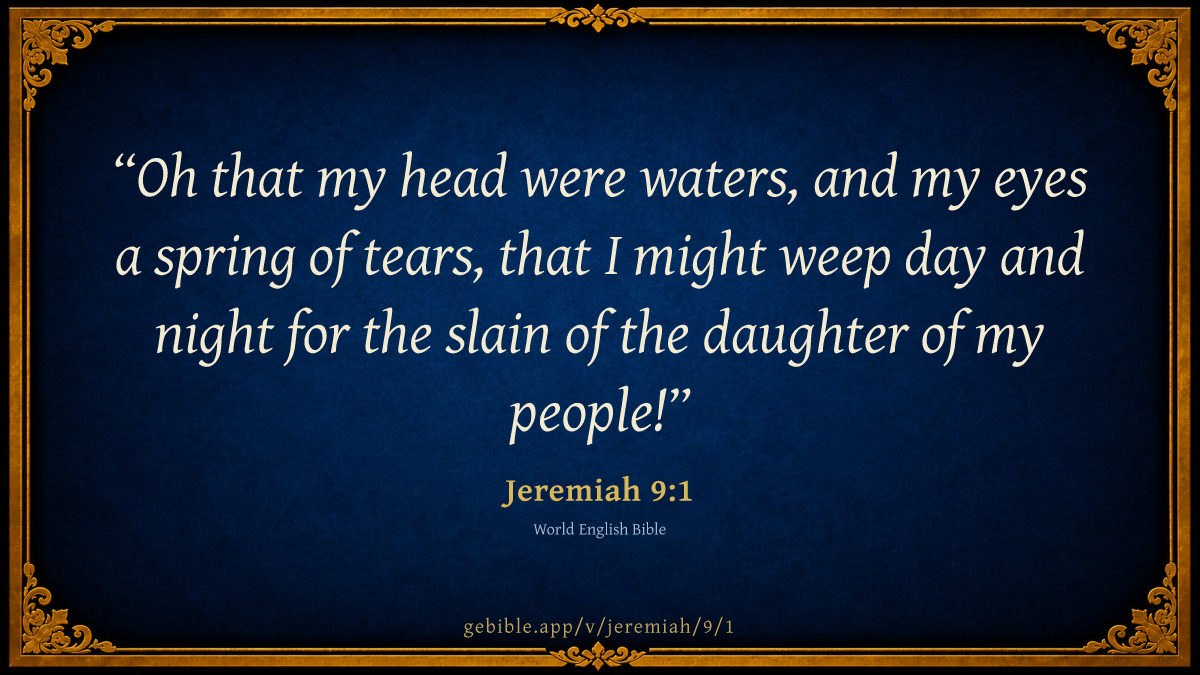
Oh that my head were waters, and my eyes a spring of tears, that I might weep day and night for the slain of the daughter of my people!
Parallel Translations
-
Oh that my head were waters, and my eyes a spring of tears, that I might weep day and night for the slain of the daughter of my people!
-
Oh that my head were waters, and mine eyes a fountain of tears, that I might weep day and night for the slain of the daughter of my people!
-
(8-23) Oh that my head were waters, and mine eyes a fountain of tears, that I might weep day and night for the slain of the daughter of my people!
Cross-references (13)
Passages linked to Jeremiah 9:1 in the Treasury of Scripture Knowledge, ordered by reader-vote popularity; verse text shown in World English Bible.
- Isaiah 22:4 Therefore I said, “Look away from me. I will weep bitterly. Don’t labor to comfort me for the destruction of the daughter of my people.
- Jeremiah 13:17 But if you will not hear it, my soul will weep in secret for your pride. My eye will weep bitterly, and run down with tears, because Yahweh’s flock has been taken captive.
- Jeremiah 8:21-22 For the hurt of the daughter of my people, I am hurt. I mourn. Dismay has taken hold of me. Is there no balm in Gilead? Is there no physician there? Why then isn’t the health of the daughter of my people recovered?
- Lamentations 2:11 My eyes fail with tears. My heart is troubled. My liver is poured on the earth, because of the destruction of the daughter of my people, because the young children and the infants swoon in the streets of the city.
- Jeremiah 6:26 Daughter of my people, clothe yourself with sackcloth, and wallow in ashes! Mourn, as for an only son, most bitter lamentation, for the destroyer will suddenly come on us.
- Psalms 42:3 My tears have been my food day and night, while they continually ask me, “Where is your God?”
- Psalms 119:136 Streams of tears run down my eyes, because they don’t observe your law.
- Isaiah 16:9 Therefore I will weep with the weeping of Jazer for the vine of Sibmah. I will water you with my tears, Heshbon, and Elealeh: for on your summer fruits and on your harvest the battle shout has fallen.
- Jeremiah 14:17 “You shall say this word to them: “ ‘Let my eyes run down with tears night and day, and let them not cease; for the virgin daughter of my people is broken with a great breach, with a very grievous wound.
- Lamentations 2:18-19 Their heart cried to the Lord. O wall of the daughter of Zion, let tears run down like a river day and night. Give yourself no relief. Don’t let the your eyes rest. Arise, cry out in the night, at the beginning of the watches! Pour out your heart like water before the face of the Lord. Lift up your hands toward him for the life of your young children, who faint for hunger at the head of every street.
- Lamentations 3:48-49 My eye runs down with streams of water, for the destruction of the daughter of my people. My eye pours down and doesn’t cease, without any intermission,
- Ezekiel 21:6-7 “Therefore sigh, you son of man. You shall sigh before their eyes with a broken heart and with bitterness. It shall be, when they ask you, ‘Why do you sigh?’ that you shall say, ‘Because of the news, for it comes! Every heart will melt, all hands will be feeble, every spirit will faint, and all knees will be weak as water. Behold, it comes, and it shall be done, says the Lord Yahweh.’ ”
- Jeremiah 4:19 My anguish, my anguish! I am pained at my very heart! My heart trembles within me. I can’t hold my peace, because you have heard, O my soul, the sound of the trumpet, the alarm of war.
Cross-references from openbible.info (CC BY 4.0)
Explain this verse (23 sources)
Historical commentary, presented as a primary source — not an endorsement.
Private notes
Saved on this device only — never synced or sent anywhere.
John Calvin 1540 · Public Domain He follows the same subject. During times of tranquillity,…
He follows the same subject. During times of tranquillity, when nothing but joyful voices were heard among the Jews, he bewails, as one in the greatest grief, the miseries of the people; and being not satisfied with this, he says, Who will set, or make, my head waters, and my eye a fountain of tears? He intimates by these words, that the ruin would be so dreadful that it could not be bewailed by a moderate or usual lamentation, inasmuch as God’s vengeance would exceed common bounds, and fill men with more dread than other calamities.
The meaning is, that the destruction of the people would be so monstrous that it could not be sufficiently bewailed. It hence appears how hardened the Jews had become; for doubtless the Prophet had no delight in such comparisons, as though he wished rhetorically to embellish his discourse; but as he saw that their hearts were inflexible, and that a common way of speaking would be despised, or would have no weight and authority, he was constrained to use such similitudes. And at this day, there is no less insensibility in those who despise God; for however Prophets may thunder, while God spares and indulges them, they promise to themselves perpetual quietness. Hence it is, that they ridicule and insult both God and his servants, as though they were too harshly treated. As then, the same impiety prevails now in the world as formerly, we may hence learn what vehemence they ought to use whom God calls to the same office of teaching. Plain teaching, then, will ever be deemed frigid in the world, except it, be accompanied with sharp goads, such as we find employed here by the Prophet He adds —
John Calvin's Commentaries (1540-1563) — public domain. Text from the Calvin Translation Society English edition (1840s-50s) via the Christian Classics Ethereal Library (ccel.org). Calvin's coverage is partial (roughly two-thirds of the Bible); uncommented books and verses are honest gaps, never fabricated. The 19th-century editor's footnotes and remarks are omitted so the notes are faithfully Calvin's own voice.
Geneva Bible translators 1599 · Public Domain The Prophet showeth the great compassion that he had…
The Prophet showeth the great compassion that he had toward this people, seeing that he could never sufficiently lament the destruction that he saw to hang over them, which is a special note to discern the true pastors from the hirelings, read Jer. 4:19.
Geneva Bible (1599) marginal notes — public domain.
John Trapp 1656 · Public Domain Jer 9:1 Oh that my head were waters, and…
Jer 9:1 Oh that my head were waters, and mine eyes a fountain of tears, that I might weep day and night for the slain of the daughter of my people!
Ver. 1. Oh that mine head were waters.] Mira sermonis transfiguratione utitur propheta, A wonderful wish of this weeping prophet, and to be taken up by God’s faithful ministers, considering the woeful condition of their perishing people, posting to perdition. Pia est illa tristitia, et si dici potest, beata miseria, Appease this sadness and if able to be said, bless this woe, saith Augustine; {a} this is a sweet sorrow, a blessed misery. Such waters will be turned into wine, at the wedding day of the Lamb; for which purpose also they are kept safe in God’s bottle. {Psa 56:8}
Read full note →
And mine eyes a fountain of tears.] That there might be a perennity of them. The same word in Hebrew signifieth both an eye and a fountain; both because the eye is of a watery constitution, and for that our eye should trickle down and not cease for our own and other men’s sins and miseries. {Lam 3:49} Athanasius by his tears, as by the bleeding of a chaste vine, is said to have cured the leprosy of that tainted age. {b}
{a} Epist. 545.
{b} Proborum virorum lachrymae sunt peccatorum diluvium, et mundi piamentum - Nazianzen, Orat. 3.
John Trapp, A Commentary or Exposition upon All the Books of the Old and New Testament (1647–1656) — public domain. Text from a community e-Sword module.
Matthew Poole 1685 · Public Domain Oh that my head were waters! Heb. Who will…
Oh that my head were waters! Heb. Who will give, &c.? by way of inquiry, because the Hebrews do want the imperative mood. The prophet in this chapter principally bewailing his poor countrymen’s calamity, whom Its therefore calls
the daughter of his people, he expresseth the greatness and excess of his sorrows, by wishing that his brains were as it were dissolved into water, (for the word is singular,) as if he wished it were all one water, signifying plenty, and that his eyes might distil tears like a fountain; the same word in the Hebrew for eye signifies a fountain; noting the continuance of it, as not to be drawn dry, expressed by day and night, apprehending it a misery so great, as never sufficiently to be bewailed. See Luk 19:41.
Read full note →
The slain; or that are to be slain, viz. by the Babylonians; a prophetical style; as sure to be slain as if they were slain already.
Matthew Poole's English Annotations on the Holy Bible (1683–1685) — public domain. Text from a community e-Sword/MySword module.
Matthew Henry 1710 · Public Domain The prophet, being commissioned both to foretel the destruction…
The prophet, being commissioned both to foretel the destruction coming upon Judah and Jerusalem and to point out the sin for which that destruction was brought upon them, here, as elsewhere, speaks of both very feelingly: what he said of both came from the heart, and therefore one would have thought it would reach to the heart.
I. He abandons himself to sorrow in consideration of the calamitous condition of his people, which he sadly laments, a one that preferred Jerusalem before his chief joy and her grievances before his chief sorrows.
Read full note →
1. He laments the slaughter of the persons, the blood shed and the lives lost (Jer 9:1): "O that my head were waters, quite melted and dissolved with grief, that so my eyes might be fountains of tears, weeping abundantly, continually, and without intermission, still sending forth fresh floods of tears as there still occur fresh occasions for them!" The same word in Hebrew signifies both the eye and a fountain, as if in this land of sorrows our eyes were designed rather for weeping than seeing. Jeremiah wept much, and yet wished he could weep more, that he might affect a stupid people and rouse them to a due sense of the hand of God gone out against them. Note, It becomes us, while we are here in this vale of tears, to conform to the temper of the climate and to sow in tears. Blessed are those that mourn, for they shall be comforted hereafter; but let them expect that while they are here the clouds will still return after the rain. While we find our hearts such fountains of sin, it is fit that our eyes should be fountains of tears. But Jeremiah's grief here is upon the public account: he would weep day and night, not so much for the death of his own near relations, but for the slain of the daughter of his people, the multitudes of his countrymen that fell by the sword of war. Note, When we hear of the numbers of the slain in great battles and sieges we ought to be much affected with the intelligence, and not to make a light matter of it; yea, though they be not of the daughter of our people, for, whatever people they are of, they are of the same human nature with us, and there are so many precious lives lost, as dear to them as ours to us, and so many precious souls gone into eternity.
2. He laments the desolations of the country. This he brings in (v. 10), for impassioned mourners are not often very methodical in their discourses: "Not only for the towns and cities, but for the mountains, will I take up a weeping and wailing" (not barren mountains, but the fruitful hills with which Judea abounded), and for the habitations of the wilderness, or rather the pastures of the plain, that used to be clothed with flocks or covered over with corn, and a goodly sight it was; but now they are burnt up by the Chaldean army (which, according to the custom of war, destroyed to the custom of war, destroyed the forage and carried off all the cattle), so that no one dares to pass through them, for fear of meeting with some parties of the enemy, no one cares to pass through them, every thing looks so melancholy and frightful, no one has any business to pass through them, for they hear not the voice of the cattle there as usual, the bleating of the sheep and the lowing of the oxen, that grateful music to the owners; nay, both the fowl of the heavens and the beasts have fled. either frightened away by the rude noises and terrible fires which the enemies make, or forced away because there is no subsistence for them. Note, God has many ways of turning a fruitful land into barrenness for the wickedness of those that dwell therein; and the havoc war makes in a country cannot but be for a lamentation to all tender spirits, for it is a tragedy which destroys the stage it is acted on.
II. He abandons himself to solitude, in consideration of the scandalous character and conduct of his people. Though he dwells in Judah where God is known, in Salem where his tabernacle is, yet he is ready to cry out, Woe is me that I sojourn in Mesech! Psa 120:5. While all his neighbours are fleeing to the defenced cities, and Jerusalem especially, in dread of the enemies' rage (Jer 4:5, Jer 4:6) he is contriving to retire into some desert, in detestation of his people's sin (Jer 9:2): "O that I had in the wilderness a lodging-place of wayfaring men, such a lonely cottage to dwell in as they have in the deserts of Arabia, which are uninhabited, for travellers to repose themselves in, that I might leave my people and go from them!" Not only because of the ill usage they gave him (he would rather venture himself among the wild beasts of the desert than among such treacherous barbarous people), but principally because his righteous soul was vexed from day to day, as Lot's was in Sodom, with the wickedness of their conversation, Pe2 2:7, Pe2 2:8. This does not imply any intention or resolution that he had thus to retire. God had cut him out work among them, which he must not quit for his own ease. We must not go out of the world, bad as it is, before our time. If he could not reform them, he could bear a testimony against them; if he could not do good to many, yet he might to some. but it intimates the temptation he was in to leave them, involves a threatening that they should be deprived of his ministry, and especially expresses the holy indignation he had against their abominable wickedness, which continued notwithstanding all the pains he had taken with them to reclaim them. It made him even weary of his life to see them dishonouring God as they did and destroying themselves. Time was when the place which God had chosen to put his name there was the desire and delight of good men. David, in a wilderness, longed to be again in the courts of God's house; but now Jeremiah, in the courts of God's house (for there he was when he said this), wishes himself in a wilderness. Those have made themselves very miserable that have made God's people and ministers weary of them and willing to get from them. Now, to justify his willingness to leave them, he shows,
1. What he himself had observed among them.
(1.) He would not think of leaving them because they were poor and in distress, but because they were wicked. [1.] They were filthy: They are all adulterers, that is, the generality of them are, Jer 5:8. They all either practised this sin or connived at those that did. Lewdness and uncleanness constituted that crying sin of Sodom at which righteous Lot was vexed in soul, and it is a sin that renders men loathsome in the eyes of God and all good men; it makes men an abomination. [2.] They were false. This is the sin that is most enlarged upon here. Those that had been unfaithful to their God were so to one another, and it was a part of their punishment as well as their sin, for even those that love to cheat, yet hate to be cheated. First, Go into their solemn meetings for the exercises of religion, for the administration of justice, or for commerce - to church, to court, or to the exchange - and they are an assembly of treacherous men; they are so by consent, they strengthen one another's hands in doing any thing that is perfidious. There they will cheat deliberately and industriously, with design, with a malicious design, for (Jer 9:3) they bend their tongues, like their bow, for lies, with a great deal of craft; their tongues are fitted for lying, as a bow that is bent is for shooting, and are as constantly used for that purpose. Their tongue turns as naturally to a lie as the bow to the strong. But they are not valiant for the truth upon the earth. Their tongues are like a bow strung, with which they might do good service if they would use the art and resolution which they are so much masters of in the cause of truth; but they will not do so. They appear not in defence of the truths of God, which were delivered to them by the prophets; but even those that could not deny them to be truths were content to see them run down. In the administration of justice they have not courage to stand by an honest cause that has truth on its side, if greatness and power be on the other side. Those that will be faithful to the truth must be valiant for it, and not be daunted by the opposition given to it, nor fear the face of man. They are not valiant for the truth in the land, the land which has truth for the glory of it. Truth has fallen in the land, and they dare not lend a hand to help it up, Isa 59:14, Isa 59:15. We must answer, another day, not only for our enmity in opposing truth, but for our cowardice in defending it. Secondly, Go into their families, and you will find they will cheat their own brethren (every brother will utterly supplant); they will trip up one another's heels if they can, for they lie at the catch to seek all advantages against those they hope to make a hand of. Jacob had his name from supplanting; it is the word here used; they followed him in his name, but not in his true character, without guile. So very false are they that you cannot trust in a brother, but must stand as much upon your guard as if you were dealing with a stranger, with a Canaanite that has balances of deceit in his hand. Things have come to an ill pass indeed when a man cannot put confidence in his own brother. Thirdly, Go into company and observe both their commerce and their conversation, and you will find there is nothing of sincerity or common honesty among them. Nec hospes ab hospite tutus - The host and the guest are in danger from each other. The best advice a wise man can give you is to take heed every one of his neighbour, nay, of his friend (so some read it), of him whom he has befriended and who pretends friendship to him. No man thinks himself bound to be either grateful or sincere. Take them in their conversation and every neighbour will walk with slander; they care not what ill they say one of another, though ever so false; that way that the slander goes they will go; they will walk with it. They will walk about from house to house too, carrying slanders along with them, all the ill-natured stories they can pick up or invent to make mischief. Take them in their trading and bargaining, and they will deceive every one his neighbour, will say any thing, though they know it to be false, for their own advantage. Nay, they will lie for lying sake, to keep their tongues in use to it, for they will not speak the truth, but will tell a deliberate lie and laugh at it when they have done.
(2.) That which aggravates the sin on this false and lying generation is, [1.] That they are ingenious to sin: They have taught their tongue to speak lies, implying that through the reluctances of natural conscience they found it difficult to bring themselves to it. Their tongue would have spoken truth, but they taught it to speak lies, and by degrees have made themselves masters of the art of lying, and have got such a habit of it that use has made it a second nature to them. They learnt it when they were young (for the wicked are estranged from the womb, speaking lies, Psa 58:3), and now they have grown dexterous at it. [2.] That they are industrious to sin: They weary themselves to commit iniquity; they put a force upon their consciences to bring themselves to it; they tire out their convictions by offering them continual violence, and they take a great deal of pains, till they have even spent themselves in bringing about their malicious designs. They are wearied with their sinful pursuits and yet not weary of them. The service of sin is a perfect drudgery; men run themselves out of breath in it, and put themselves to a great deal of toil to damn their own souls. [3.] That they grow worse and worse (Jer 9:3): They proceed from evil to evil, from one sin to another, from one degree of sin to another. They began with less sins. Nemo repente fit turpissimus - No one reaches the height of vice at once. They began with equivocating and bantering, but at last came to downright lying. And they are now proceeding to greater sins yet, for they know not me, saith the Lord; and where men have no knowledge of God, or no consideration of what they have known of him, what good can be expected from them? Men's ignorance of God is the cause of all their ill conduct one towards another.
2. The prophet shows what God had informed him of their wickedness, and what he had determined against them.
(1.) God had marked their sin. He could tell the prophet (and he speaks of it with compassion) what sort of people they were that he had to deal with. I know thy works, and where thou dwellest, Rev 2:13. So here (Jer 9:6): "Thy habitation is in the midst of deceit, all about thee are addicted to it; therefore stand upon thy guard." If all men are liars, it concerns us to beware of men,. and to be wise as serpents. They are deceitful men; therefore there is little hope of thy doing any good among them; for, make things ever so plain, they have some trick or other wherewith to shuffle off their convictions. This charge is enlarged upon, Jer 9:8. Their tongue was a bow bent (Jer 9:3), plotting and preparing mischief; here it is an arrow shot out, putting in execution what they had projected. It is as a slaying arrow (so some readings of the original have it); their tongue has been to many an instrument of death. They speak peaceably to their neighbours, against whom they are at the same time lying in wait; as Joab kissed Abner when he was about to kill him, and Cain, that he might not be suspected of any ill design, talked with his brother, freely and familiarly. Note, Fair words, when they are not attended with good intentions, are despicable, but, when they are intended as a cloak and cover for wicked intentions they are abominable. While they did all this injury to one another they put a great contempt upon God: "Not only they know not me, but (Jer 9:6) through deceit, through the delusions of the false prophets, they refuse to know me; they are so cheated into a good opinion of their own ways, the ways of their own heart, that they desire not the knowledge of my ways." Or, "They are so wedded to this sinful course which they are in, and so bewitched with that, and its gains, that they will by no means admit the knowledge of God, because that would be a check upon them in their sins." This is the ruin of sinners: they might be taught the good knowledge of the Lord and they will not learn it; and where no knowledge of God is, what good can be expected? Hos 4:1.
(2.) He had marked them for ruin, Jer 9:7, Jer 9:9, Jer 9:11. Those that will not know God as their lawgiver shall be made to know him as their judge. God determines here to bring his judgments upon them, for the refining of some and the ruining of the rest. [1.] Some shall be refined (Jer 9:7): "Because they are thus corrupt, behold I will melt them and try them, will bring them into trouble and see what that will do towards bringing them to repentance, whether the furnace of affliction will purify them from their dross, and whether, when they are melted, they will be new-cast in a better mould." He will make trial of less afflictions before he brings upon them utter destruction; for he desires not the death of sinners. They shall not be rejected as reprobate silver till the founder has melted in vain, Jer 6:29, Jer 6:30. For how shall I do for the daughter of my people? He speaks as one consulting with himself what to do with them that might be for the best, and as one that could not find in his heart to cast them off and give them up to ruin till he had first tried all means likely to bring them to repentance. Or, "How else shall I do for them? They have grown so very corrupt that there is no other way with them but to put them into the furnace; what other course can I take with them? Isa 5:4, Isa 5:5. It is the daughter of my people, and I must do something to vindicate my own honour, which will be reflected upon if I connive at their wickedness. I must do something to reduce and reform them." A parent corrects his own children because they are his own. Note, When God afflicts his people, it is with a gracious design to mollify and reform them; it is but when need is and when he knows it is the best method he can use. [2.] The rest shall be ruined (Jer 9:9): Shall I not visit for these things? Fraud and falsehood are sins which God hates and which he will reckon for. "Shall not my soul be avenged on such a nation as this, that is so universally corrupt, and, by its impudence in sin, even dares and defies divine vengeance? The sentence is passed, the decree has gone forth (Jer 9:11): I will make Jerusalem heaps of rubbish, and lay it in such ruins that it shall be fit for nothing but to be a den of dragons; and the cities of Judah shall be a desolation." God makes them so, for he gives the enemy warrant and power to do it: but why is the holy city made a heap? The answer is ready, Because it has become an unholy one?
Matthew Henry's Commentary on the Whole Bible (1708–1710) — public domain (CC PDM 1.0). Text via the HelloAO Bible API.
John Gill 1763 · Public Domain Oh that my head were waters, and mine eyes…
Oh that my head were waters, and mine eyes a fountain of tears,.... Or, "who will give to my head water, and to mine eyes a fountain of tears?" as the Septuagint, Vulgate Latin, and Arabic versions. The prophet wishes that his head was turned and dissolved into water, and that tears might flow from his eyes as water issues out from a fountain; and he suggests, that could this be, it would not be sufficient to deplore the miserable estate of his people, and to express the inward grief and sorrow of his mind on account of it.
That I might weep day and night for the slain of the daughter of my people; the design of all this is to set forth the greatness and horribleness of the destruction, signifying that words were wanting to express it, and tears to lament it; and to awaken the attention of the people to it, who were quite hardened, insensible, and stupid. The Jewish writers close the eighth chapter with this verse, and begin the ninth with the following.
John Gill's Exposition of the Whole Bible (1746–1763) — public domain (CC PDM 1.0). Text via the HelloAO Bible API.
John Wesley 1765 · Public Domain The prophet's lamentation continues over their adultery, deceit, idolatry,…
The prophet's lamentation continues over their adultery, deceit, idolatry, which God would certainly punish, and they should be laid waste, when they should sufficiently lament, ver. 1-22. No trust in ourselves, but in God, who will punish all nations, ver. 23- 26.
John Wesley, Explanatory Notes Upon the Whole Bible (1754–1765) — public domain. Text via the GEBible commentary corpus.
Adam Clarke 1810 · Public Domain The prophet bitterly laments the terrible judgments about to…
CHAPTER IX
The prophet bitterly laments the terrible judgments about to be
Read full note →
inflicted upon his countrymen, and points out some of the evils
which have provoked the Divine Majesty, 1-9.
Judea shall be utterly desolated, and the inhabitants
transplanted into heathen countries, 10-17.
In allusion to an ancient custom, a band of mourning women is
called to lament over the ruins of Jerusalem, 17, 18;
and even the funeral dirge is given in terms full of beauty,
elegance, and pathos, 19-22.
God is the fountain of all good; man, merely an instrument by
which a portion of this good is distributed in the earth;
therefore none should glory in his wisdom, might, or riches,
23, 24.
The judgments of God shall fall, not upon the land of Judea
only, but also upon many heathen nations, 25, 26.
NOTES ON CHAP. IX
Verse 1. O that my head were waters] מי יתן ראשי מים mi yitten roshi mayim, "who will give to my head waters?" My mourning for the sins and desolations of my people has already exhausted the source of tears: I wish to have a fountain opened there, that I may weep day and night for the slain of my people. This has been the sorrowful language of many a pastor who has preached long to a hardened, rebellious people, to little or no effect. This verse belongs to the preceding chapter.
Adam Clarke's Commentary on the Bible (1810–1826) — public domain. Text from a community e-Sword/MySword module.
Joseph Benson 1811 · Public Domain Jer 9:1. O that my head, &c. — The…
Jer 9:1. O that my head, &c. — The prophet sympathizes with the calamities of his people, as before, Jer 1:19; Jer 8:21; and thereby excites them to a sense of their own misfortunes, that they might humble themselves under the mighty hand of God. The passage is a fine instance of the pathetic, wherein Jeremiah so much excels. That I might weep day and night for the slain, &c. — For the multitudes of his countrymen that he foresaw would fall by the sword of the Babylonians. When we hear of great numbers slain in battles and sieges, we ought not to make a light matter of it, but to be much affected with it; yea, though they be not of the daughter of our people — For of whatever people they are, they are of the same human nature with us; and there are so many precious lives lost, as dear to them as ours to us, and so many precious souls gone into eternity.
Joseph Benson's Commentary on the Old and New Testaments (1811–1818) — public domain. Text from a community e-Sword module.
Albert Barnes 1834 · Public Domain This verse is joined in the Hebrew to the…
This verse is joined in the Hebrew to the preceding chapter. But any break at all here interrupts the meaning.
A fountain - Rather, “a reservoir,” in which tears had been stored up, so that the prophet might weep abundantly.
Albert Barnes' Notes on the Bible (1834–1885) — public domain. Text from a community e-Sword/MySword module.
Haydock's Catholic Bible Commentary 1859 · Public Domain To. Hebrew is more expressive. (Calmet) --- "Who will…
To. Hebrew is more expressive. (Calmet) --- "Who will give my head waters, (Haydock) or change it into water, and my eyes into a fountain." (Calmet) --- Protestants, "Oh that my head were waters." (Haydock) --- The miseries of my people are so great, (Calmet) a few tears would not suffice to bewail them. (Worthington)
George Leo Haydock (1774–1849), Haydock's Catholic Family Bible and Commentary, 1859 edition — public domain. Excludes Psalms (Douay-Rheims chapter numbering differs from Protestant) and Deuterocanonical books (Catholic canon only).
Lange's Commentary on the Holy Scriptures 1864 · Public Domain 1. Description of the prevailing deceit
III. THIRD CHARGE: THE GENERAL ENTIRE ABSENCE OF TRUTH AND FAITH
Jer_9:1-21
Read full note →
1. Description of the prevailing deceit
Jer_9:1-8
1 O that I had1 in the desert a travellers’ lodge,
That I might leave my people and go from them:
For they are all adulterers, a gang of knaves,
2 And bend2 their tongue as their bow of deceit;
And not by truth do they prevail in the land,
But proceed from wickedness to wickedness:
But Me they knew not, saith Jehovah.
3 Guard ye every one against his neighbor,
And trust no brother;
For every brother practices deceit,
And every neighbor slanders.
4 One overreaches3 another, and truth they speak not;
They taught their tongues to speak lies,
And weary themselves to commit iniquity.4
5 Thy habitation is in the midst of deceit;5
And through deceit they refuse to know Me, saith Jehovah.
6 Therefore thus saith Jehovah Zebaoth:
Behold, I melt them and try them;
For how should I act in view of the daughter of my people?
7 A deadly arrow6 is their tongue, they speak deceit;
With the mouth they speak7 to their neighbor peaceably,
But in the heart8 they lay snares.
8 Should I not visit them for such things? saith Jehovah.
Or should not my soul avenge itself on a people like this?
EXEGETICAL AND CRITICAL
As the main thought of the preceding chapter was contained in Jer_9:4-9 so the main thought of the present is found in Jer_9:1-8. The rest is added as a sequel. As in Jeremiah 8. the stiff-necked impenitence of Israel is censured, so here (as the third charge) their falseness in every relation. The two following strophes (Jer_9:9-15 and Jer_9:16-21) relate to the punishment threatened by God. In Jer_9:1-8 the prophet portrays the want of fidelity and trust, the falseness, malicious desire to defame, which was prevalent among his contemporaries (Jer_9:1-5) and which would compel the Lord to subject them to the punishment of a severe melting and refining process. (Jer_9:6-8).
Jer_9:1. O that I had in the desert … a gang of knaves. On travellers’ lodge comp. Jer_14:8. Living with his godless countrymen is so intolerable to the prophet that he would prefer the scanty protection of a tent erected in the desert to his present residence. [Henderson supposes the discomfort of a caravanserai to be alluded to.—S. R. A.]—Adulterers. The violation of conjugal fidelity or of the fidelity due to a neighbor by the invasion of his conjugal rights was censured by the prophet in the second discourse, in the passage where he reproaches the Israelites with their violations of faith, Jer_5:7-8.—בֹּגֵד, he who acts secretly (Vide, Fuerst) who deals in falsehood, deceit and treachery in general. This reproach also is found in Jer_9:11.
Jer_9:2. And bend their tongue … saith Jehovah. The imperfect with Vau consecutive here designates not a single act, but oft recurring acts, from which this course is to be understood as habitual; this case is therefore to be numbered among those in which the imperfect with Vau consec. is used to designate a permanent quality. Comp. Naegelsb. Gr., § 88, 9.—According to the Masoretes we must read: they caused their tongue to tread the bow of deceit. In this way the tongue would not be compared to a bow, (which might appear unsuitable to the Masoretes), but to an archer, and the bow would then be a purely ideal conception, a figure for the means and instrument of the intellectual activity connected with the tongue. But this would be a very artificial mode of expression. Since the tongue is elsewhere compared with a sword, (Psa_57:4; Psa_64:3) and an arrow (infra Jer_9:7) it may also be compared with a bow and in Psa_64:3 this is the fundamental conception.—bow is used as a simile in apposition with tongue. Comp. Psa_22:13; Psa_11:1. Naegelsb. Gr., § 72, 4.—Deceit may according to the sense be referred either to bend or bow, but on account of its position it is better to refer it to the latter. On the construction comp. Naegelsb. Gr., § 63, 4, g.—And not by truth. The prophet has especially the rulers in view. Comp. Psa_12:4, לֶאֱמוּנָה different from Jer_5:3; לְ here indicates the norm as in לַמִּצְעָר ,לַמִּשְׁפָטVid. Naegelsb. Gr., § 112, 5, b.—On wickedness to wickedness. Comp. Jer_25:32.
Jer_9:3. Guard ye … slanders. Comp. Mic_7:5-6.—On every brother, etc. Comp. Naegelsb. Gr., § 82, 1.—עקב יעקב. Since this verb in Kal occurs besides only in Gen_27:36 and Hos_12:4, both times of Jacob (it is found in Piel in Job_37:4) it is certainly probable that the prophet, speaking here of the deceit practised by one brother towards another, had this early instance in view (Gen_25:29 sqq.; Gen_27:35).—רכיל יהלך go about for tale-bearing. Vide supra6:28.
Jer_9:4. One overreaches another … to commit iniquity.—They taught. Comp. Jer_2:33. The Niphal of לאה signifies elsewhere “to be weary, disgusted with a thing” (Jer_6:11; Jer_15:6; Jer_20:9). This meaning does not suit here. The connection requires the meaning to weary one’s self. Comp. Gen_19:11; Isa_16:12.
Jer_9:5. Thy habitation … saith Jehovah. The verse has this object, to describe the relation of the deceitful race to the prophet and to Jehovah. They surround the prophet so that he dwells as the only honest man among deceivers (comp. Psalms 120); from the Lord however they turn away, the lying spirit rules them in such wise (comp. Gen_27:35; Gen_34:13) that they know nothing of God and desire not to know Him. (Comp. Jer_5:3).
Jer_9:6. Therefore … daughter of my people. A corruption so deeply rooted and so widely extended can be removed only by a process of entire melting, which will certainly be grievous but will also refine. Comp. Jer_6:27, etc.—אֵיךְ has by no means always a negative sense, (as for example Gen_44:34, quomodo ascenderem?i.e., non ascendam) but as often a decidedly positive meaning, Jer_9:18, 2Sa_1:25; 2Sa_1:27; how do ye advise me? 1Ki_12:6. So the Lord here asks, how He should act, if not as already indicated? He would say, there is nothing else remaining but to do this.—After מפּני to supply רַָעת, with reference to Jer_4:4; Jer_7:12, appears to me unnecessary, for מפני is used in a causative sense even immediately before names of persons. Comp. Jer_4:26; Jer_23:9. In both these passages it is also evinced by an explanatory addition that it is to be taken in a causative sense.
Jer_9:7-8. A deadly arrow … on a people like this. It might appear strange that the prophet, after he had properly concluded with Jer_9:6, should repeat the main point of the charge. But he evidently intended to conclude with the words repeated from Jer_5:9; Jer_5:29, in order to indicate by this conclusion that he had the section of his former discourse, so closely related to this, (Jeremiah 5) in view. The words of the eighth verse could not however follow immediately on Jer_9:6. The words them for such things would thus obtain a false reference. The prophet was therefore compelled again to mention the sins of the people.
2. FIRST PUNISHMENT: DESOLATION OF THE LAND AND DISPERSION OF THE PEOPLE
Jer_9:9-15
9 On the mountains let me raise a weeping and wailing,
And on the pastures of the desert a lamentation,
For they are desolated, without a man to pass through them;
And hear no longer the lowing of the cattle.
From the fowl of the heavens to the beast they are fled—gone!
10 And I will make Jerusalem a heap of stones,
The dwelling of jackals;
And the cities of Judah I will make desolate
Without an inhabitant,
11 Who is the man who is wise and understands this?
And who is he to whom the mouth of Jehovah has spoken,
That he may declare such things?
Why was the land destroyed
And laid waste as a desert without a man to pass through it?
12 And Jehovah said:
Because they have forsaken My law which I set before them,
And have not heard My voice, nor walked according to it;
13 But walked after the perversity of their heart,
And after the Baalim which their fathers have taught them;
14 Therefore thus saith Jehovah Zebaoth, God of Israel:
Behold! I give to them, this nation,
Wormwood to eat and poison water to drink.
15 And I scatter them among nations
Whom neither they nor their fathers have known;
And send after them the sword till I extirpate them.
EXEGETICAL AND CRITICAL
The preceding strophe contained the main thought of the chapter; description of the want of truth and faith among the people. As already remarked, to this are attached two additional strophes, which are occupied with the judgment provoked by that moral corruption. The connection of this strophe with the preceding is effected by Jer_9:6; Jer_9:8, declaring how the Lord would try and purify the people and avenge Himself upon them. Verses 9 and 10 describe accordingly the desolation of the land ordained as a punishment; Jer_9:11-13 again set forth the main causes of the moral corruption (Jer_9:12 negatively, Jer_9:13 positively); Jer_9:14-15 show us the fate of the inhabitants driven from the lands, and serve therefore to supplement the figure contained in verses 9 and 10.
Jer_9:9-10. On the mountains … make desolate without an inhabitant.עַל may grammatically and according to the connection designate both the place and the object. Comp. in the latter reference Jer_9:17; Eze_26:17; Amo_5:1. Yet it would be flat and prosaic to restrict עַל to the object. The poetic liveliness of the style requires us to refer it to the place (comp. Jer_3:21) and the object at the same time.—נצתו properly they are burnt, singed, and then generally desolated. Comp. Jer_9:11 and the remark on Jer_2:15. Compare besides Jer_46:19; 2Ki_22:13; 2Ki_22:17; Neh_1:3; Neh_2:17.—Without a man, etc. Comp. Jer_9:11, Zep_3:6; Eze_33:28.—fled, etc. Comp. Jer_4:25; Jer_1:3.—And I will make, etc. Sudden change of subject. Jehovah Himself announces that not only the country but the cities, Jerusalem before all, shall be desolated.—heap of stones. Comp. Jer_51:37.—תַּנִּים (comp. Jer_10:22; Jer_49:33; Isa_34:13; Isa_35:7; Isa_43:20) and אִיִּיִם (Isa_13:22) both mean jackals. Comp. Ges. Thes.S. 39, 1457, 1511.—Make desolate. Comp. Jer_2:15; Jer_4:17; Jer_33:10; Jer_46:19; Jer_51:29, etc.
Jer_9:11-13. Who is the man … have taught them. These three verses present the motive of the prospective desolation. It might be supposed that after what was said in Jer_9:1-8 this question would be superfluous. But we must not lose sight of the tableauesque character of Jeremiah’s style. Thus this strophe, besides the new elements contained in Jer_9:9-10; Jer_9:14-15, presents also the old elements in a modified form. The real root of this moral corruption is here indicated, viz., that Israel had turned from the Lord and to idols—Who is he, etc. These words remind us of Hos_14:9. It is only the wise man who knows, only he to whom the Lord has spoken, who tells the truth. The prophet presupposes that the correct knowledge of the true cause of the destruction (Jer_9:9) is not such an easy matter. The unspiritual sense seeks the cause everywhere but where it is really to be found. To it external accidental circumstances are at fault. To seek the reason in themselves, in the perversity of their own hearts, does not occur to the foolish Israelites. Hence it is that not Israel but the Lord answers in Jer_9:12. Among Israel there was none so wise as to know the reason. The Lord is obliged to declare it.—This and the suffix, in such things point, back to Jer_9:8-9;—to whom expresses in the form of a direct question in what relation that which was previously said is to be understood. It is knowledge of the reason, namely, which is treated of.—נִצְתָה points back to נִצְתוּ, Jer_9:9, and is to be taken in the same sense.—Allusions to passages in Deuteronomy are here frequent. Comp. Deu_4:8; Deu_11:32; Deu_28:15; Jer_26:4; Jer_44:10.—According to it refers back to my law. In Jer_9:12 the negative reason for the judgment coming upon the land is stated; in Jer_9:13 the positive.—Walked. Comp. Jer_3:17; Jer_7:24; Deu_29:18.—Baalim. Comp. Jer_2:8; Jer_2:23; Deu_4:3.—On taught comp. Jer_12:16; Deu_11:19.
Jer_9:14-15. Therefore thus saith Jehovah … extirpate them.—With therefore the prophet proceeds to the statement of the consequences, naming first the consequences which the sins mentioned in Jer_9:12-13 will bring upon the men, and afterwards those mentioned Jer_9:9-10, on the land.—לַעַנָה and ראֹשׁ occur together in Deu_29:17; Amo_6:12; Lam_3:19. Wormwood was considered poisonous by the ancients, but in the biblical use it is its bitterness which is prominent. Comp. Amo_5:7; Pro_5:4; Lam_3:15.—On poison-water, comp. Jer_8:14. Our words are repeated, Jer_23:15.—To them, this nation The anticipation of a noun by a pronoun is frequent in Jer_27:8; Jer_31:2; Jer_41:2-3; Jer_43:11; Jer_48:44; Jer_51:56. Comp. Ewald, § 309, c., Naegelsb. Gr., § 77, 2.—neither they nor their fathers. etc. Comp. Deu_28:36; Deu_28:64; Lev_26:33; Jer_16:13; Jer_17:4. That till I extirpate them is not to be understood absolutely, is seen from passages like Jer_4:27; Jer_5:10; Jer_5:18 coll. Lev_26:44.
Footnotes:
[1]Jer_9:1.—מי־יתנני. Comp. Psa_55:7, and Naegelsb. Gr., § 78.
[2]Jer_9:2.—The Masoretes punctuate וַיִדֶרְכוּ (the form like וַיַּרְבְּקוּ Sam. Jer_14:22; Jer_31:2; תַּהְכְּרוּ Job_19:3) probably because they regarded the Hiphil as causative. But for various reasons (Vid. Exeg. and Crit.) it is better with Hitzig, Graf and Meier to suppose that the reading, which corresponds to the consonants, וַיִּדְרְכוּ is the original and correct.
[3]Jer_9:4.—יְהָתֵלוּ Comp. תְּהָתֵלּוּ Job_13:9, and יְהָתֵּל 1Ki_18:27. The forms may be Piel from התל or Hiphil from תָּלַל. Comp. Olsh. § 257. Ewald, § 127, d.
[4]Jer_9:4.—הַֽעֲוֵה (Jer_3:21) Inf. constr., as הֱיֵה Eze_21:15, חַכֵּי Hos_6:9.—Comp. Ewald, § 238, c; Olshausen, § 191, b.
[5]Jer_9:5.—Graf has rightly declared against the alteration of the text, while Ewald, appealing to the LXX., proposesנִלְאוּ שִׁב תֹּךְ בְּתוֹךְ מִרְמָה בְּמִרְמָה. The infinitive שֶׁבֶת is frequently used with suffixes; Psa_27:4; Psa_139:2; 1Ki_8:30; Rth_2:7, etc.
[6]Jer_9:7.—Instead of the Chethibh שׁוֹחֻט jugulans, throttling, killing, the Keri would read שָׁחוּת which elsewhere occurs only with זָהָב (1Ki_10:16-17; 2Ch_9:15) and seems to denote gold beaten thin. Although from this the meaning “pointed” may be derived, which is also expressed by the Syriac and Chaldee, yet it is better to adhere to the reading of the text and to translate, a deadly murderous arrow.
[7]Jer_9:7.—דבר. The change of number is analogous to the frequently occurring change or person. Comp. Gram. § 101, Anm.
[8]Jer_9:8.—ארבו. The suffix is most naturally referred to the subject like that of בְּקִרבּוֹ Jer_9:8. Vide Jer_5:9; Jer_5:29.
3. SECOND PUNISHMENT: DEATH SNATCHES AWAY AN INNUMERABLE SACRIFICE
Jer_9:16-21
16 Thus saith Jehovah Zebaoth: Consider ye,
And call for mourning women,9 that they may come,10
And send for the skilful ones, that they appear;
17 And hasten, and raise a wailing11 over us,
That our eyes may run12 with tears,
And our eyelids overflow with water.
18 For—loud wailing is heard from Zion:
“How are we spoiled! We are greatly confounded;
For we have forsaken the land,
For they have thrown down our dwellings”
19 Hear then, ye women, the word of Jehovah,
And let your ear receive the word of his mouth,
And teach your daughters13 a song of lamentation,
And [teach ye] one another a dirge!
20 For death cometh in through our windows,
It enters into our palaces,
To exterminate the child from the street,
The youths from the free places.
21 [Speak: Thus saith Jehovah:]
And the carceases of men fall like dung14 on the field,
And like sheaves behind the reaper
When there is none to gather them.
EXEGETICAL AND CRITICAL
In connection with the close of the preceding strophe, the prophet sets forth another element of the punishment, viz., the fruitful harvest, which the sword would yield. He does this by even now calling for the mourning-women to lament over the future destruction of Zion and the dispersion of the people (Jer_9:16-18): but not content with this, he also calls upon all other women, as by divine command, to instruct their daughters and one another in the art of wailing, for death will summon his victims in masses.
Jer_9:16-17. Consider ye … overflow with water.—Consider is emphatic (comp. Jer_2:10; Jer_23:20; Jer_30:24) for what is required is something unusual. Usually mourning-women are called to weep over those who are already dead, and therefore others than those who call them. Here they are to raise their wailing over those very persons who call them, and over their future destruction.—Skilful. Since wailing does not require wisdom in the higher sense, and as the expression “wise women” is not proved to be a technical term for mourning-women (as sage femme for midwife), the word must denote only those who are skilful, experienced, in general, comp. Jer_10:9, and “skilful of lamentation,” Amo_5:16. [Comp. also Mat_9:23, and Thomson, The Land and the Book, I., p. 146.—S. R. A.]
Jer_9:18-19. For loud wailing … a dirge. The prophet feigns a kind of vision: the Israelites perceive, not with their bodily but spiritual ear, a loud wailing. This is future, and it is they who wail. The subject of lamentation is: we are destroyed (Jer_4:13), put to shame (Jer_51:51), have been obliged to forsake the land, because the enemy has thrown down our dwellings. So I render, with Raschi, Rosenmuller, Graf and others, since שָׁלַךָ is not merely to throw away, but also to throw to the ground (Job_18:17; Eze_19:12), and of the throwing down of a dwelling is expressly used in Dan_8:11.—Hear them. The second כִּי introduces a second reason for the wailing commanded in Jer_9:18. Jer_9:18 speaks only of destruction and exile in general. But dirges presuppose particular cases of death. Therefore in Jer_9:19-20 it is added, that the destruction and deportation will result in the death of many. This is introduced in this way: the mourning-women in the divine commission are further commanded to instruct not only their daughters, but also the other women in the art of wailing, for on account of the unusual number of deaths, a much larger number of mourners than usual will be required. The wailing of Jer_9:17 is not to be raised, therefore, because the women received the command contained in Jer_9:19, but because they received this command for the reason given in Jer_9:20-21.
Jer_9:20-21. For death cometh in … when there is none to gather them. Death will not, as an enemy lurking without, attack those only who venture out to him, but will assault the people, penetrating into all their houses to fetch his sacrifices. The figure is like that in Joe_2:9.—From the street. While death strangles the children and youths in the houses, he has at the same time taken them from the street and the places.—The words speak, thus saith Jehovah, are very disturbing. They interrupt the close connection, which according to the sense and the construction there is between and the carcases, etc., and Jer_9:20; they are wanting in the LXX., and the whole manner of expression is foreign to Jeremiah. For the imperative דָּבֵּר does not occur once in Jeremiah, either in the addresses of God to the prophet or elsewhere, and Jeremiah never says כּה נְאֻס־י׳. He also never places נאס־י׳ before, but always after the beginning, like the Latin inquam, or at the close of the address.—And the carcases, etc. These words we read in 2Ki_9:37 of the corpse of Jezebel. Comp. Psa_83:11; Jer_8:2; Jer_16:4; Jer_25:33.—The stricken will lie like sheaves behind the reaper, but there is to be this difference, that while the sheaves are collected and taken home, the dead bodies will lie in the field unregarded. Compare the figure of the sheaves, Mic_4:12.
Footnotes:
[9]Jer_9:16.—מְקּוֹנְנוֹת here only. Comp. besides Eze_32:16, and Winer, R. W. B., art. Leichen.
[10]Jer_9:16.—תְבוֹאֶינָה, Psa_45:17; 1Sa_10:7 (Chethibh)—תָּבֹואנָה is the more frequent form, comp. ex. gr., Gen_30:38; 1Ki_3:16; Isa_48:3.
[11]Jer_9:17.—וְתִשֶּׂנָה (the same form in Rth_1:14; Zec_5:9) for תִּשֶּׂאנָה (Rth_1:9) for which also תִּשִּׂאינָה (Eze_23:49). Comp. Olsh., § 239; Gesen., § 74; Anm. 4.
[12]Jer_9:17.—וְתֵרַדְנָה designates the intended effect. Comp. Naegelsb. Gr., § 89, 3, b. 2.—On the accusative construction. Comp. Jer_14:17; Lam_3:48; Joel 4:18; N. Gr., § 69:2 a.
[13]Jer_9:19.—On the suffix in אָזְנְכֶם and בְּנוֹתֵיכֶם, comp. Naegelsb. Gr., § 60:5. [Green, Gr., § 220:1 b.]
[14]Jer_9:21.—דֹּמֶן occurs only in the passages, Psa_83:11; Jer_8:2; Jer_16:4; Jer_25:33, and in figurative language.
DOCTRINAL AND ETHICAL
1. On Jer_9:1. O that I had in the desert, etc. “So it sounds here and there when the servant of the Lord comes from confession, from church, from the sick, from pastoral visitation, on the great fast-day, on the third festival-day, on almost every Sunday afternoon. A beautiful character of a witness when he needs nothing but a little spot in the desert, no improvement, no great management, when it is not necessary to say, ‘Alas, my heart is whelmed with grief! and whence Song of Solomon 1 obtain relief?’ When no one sits by him who presses upon him. The desert was to retain Jeremiah in connection with his people. He wished there to weep for them.” Zinzendorf.
2. On Jer_9:2. “They proceed from one wickedness to another—punished with the sins, which are suspended over them … a poor sold people who know not how to raise their ransom-money. We must tell them, and tell them again, whence it is to be fetched.” Zinzendorf.
3. On Jer_9:3. “Guard ye every one against his friend, and trust not even his brother. This is the Hobbesii jus naturæ.” Zinzendorf. “Hoc loco utendum est in tempore persecutionis et angustiæ, quando aut rara, aut nulla fides est; quando nee fratri, nec proximo credendum est, et inimici hominis domestici ejus, quando juxta evangelium tradet pater filium et filius patrem, et dividentur duo in tres et tres in duo (Mat_10:34 sqq.)” Jerome.
4. On Jer_9:4. “Laborant homines loqui mendacium, nam veritatem tota facilitate loquerentur. Ille enim laborat, qui fingit quod dixit. Nam qui verum vult dicere non laborat. Ipsa veritas sine labore loquitur. Ipsum mendacium hominum est labor labiorum ipsorum (Psa_7:14),” Augustin., Enarr. in Psalms 139. [Henry:—“They are wearied with their sinful pursuits, but not weary of them. The service of sin is a perfect drudgery; men run themselves out of breath in it; and put themselves to a great deal of toil to damn their own souls.”—S. R. A.]
5. On Jer_9:11. “We are not to search with culpable curiosity into the causes of divine judgment which God has hidden from us. But if God Himself discovers them to us, we should ponder them well and apply them as best we may (Jer_6:17-18).” Starke.
6. On Jer_9:11. It is always an important part of true wisdom to recognize the object of the divine chastisement. At Jericho (Joshua 7.) it was made known by an extraordinary revelation that the ban of sacrilege was resting upon Israel, and the lot further brought to light the author of the crime. But this mode of revelation is not the usual one. When punishment is the direct and immediate consequence of sin, ex. gr., when sickness follows on dissipation, and poverty on laziness and negligence, then every one who wishes, may easily see, whither the chastisement tends. But often the connection between sin and punishment is more remote and secret, although it is never an artificial and arbitrary, but always an organic and necessary one. Then is the time, in all humility and honesty to examine one’s self in order to learn “why the land is laid waste.”
HOMILETICAL AND PRACTICAL
1. On Jer_9:1-6. This text might serve as a foundation in cases where a preacher has occasion to speak to his congregation on separation from the world, etc. He might especially draw from it arguments in favor of such separation. Comp. Rev_2:2, οὐ δύνῃ βαστάσαι κακούς.—As a counterpoise might be applied, Heb_12:3; 2Ti_2:24.—A servant of the Lord is to be ἀνεξίκακος and ἀλεξίκακος.
2. On Jer_9:3. On the various stages in the condition of security. 1. Of evil rising into Acts 2 Of rising from one sin to another. Brandt: Altes und Neues in extemporirb. Entwürfen, Nürnberg, 1829, 1, 2.
3. On Jer_9:7-9. The double object of the divine judgments. 1. Restoration of the right (Jer_9:9). 2. Improvement of men (Jer_9:7, to melt and try).
4. On Jer_9:12-16. On the connection of temporal evil with our sins. Such a connection (1) undoubtedly exists, and should be (2) recognized and (3) announced by us (that is, not passed over in silence, but openly expresssed).
5. On Jer_9:20-21 (to be used in times when death snatches many away). Death as a destroying angel: 1. Who sends him: 2. Wherefore he is sent: 3. How we may protect ourselves against him.
IV. CONCLUSION: (Jer_9:22-25; Jer_10:17-25.)
1. The only means of escape, and the reason why it is not used
Jer_9:22-25
22 Thus saith Jehovah:
Let not the wise man glory in his wisdom,
Nor let the strong man glory in his strength,
Nor let the rich man glory in his riches.
23 But let him that glorieth glory15 in this,
To be wise16 and to know me—
That I am Jehovah—who exercise mercy,
Judgment and righteousness on the earth;
For in these do I delight, saith Jehovah.
24 Behold! the days are coming, saith Jehovah,
That I will punish every circumcision in foreskin:17
25 Egypt and Judah and Edom, and the children of Ammon and Moab,
And all with shorn hair [-corners] who dwell in the desert;
For all the people are uncircumcised,
The whole house of Israel is uncircumcised at heart.
EXEGETICAL AND CRITICAL
The prophet introduces the concluding part of his discourse with a general moral reflection, the object of which is to present the only means of escape from such fearfully threatening dangers, viz., a living and truly productive knowledge of the Lord (Jer_9:22-23). Unfortunately the prophet is at the close of the strophe (Jer_9:24-25) compelled to acknowledge the mournful fact that such a true knowledge of God by the people Israel was not to be expected, since they were a people of uncircumcised heart, and were therefore, notwithstanding their bodily circumcision, essentially like the uncircumcised heathen nations. From this it is evident that the passage (Jer_9:22-25) can be dispensed with neither from the inner connection nor the connection with the preceding context, and we should not therefore be justified in regarding it (with Graf) as a later addition.
Jer_9:22-23. Let not the wise man … delight. As the things in which they are not to glory, wisdom, strength (power), riches, are certainly mentioned, because they appear above all to the natural man as the most desirable, comp. 1Ki_1:13, where in substance these three ideas are placed in juxtaposition, with 2Ch_9:22; Job_12:13. But at the same time the prophet has doubtless in view actual circumstances and declarations previously made by him. The inclination of his hearers presumptuously to boast of external carnal advantages was censured by him in the seventh chapter (comp. Jer_9:4; Jer_9:8; Jer_9:10; Jer_9:14; Jer_9:24; Jer_9:26); that the Jews gloried in their wisdom is expressly stated in Jer_8:8-9. The mention of strength seems to point back to Jer_9:2, and riches remind us of Jer_5:26-28. The wisdom in which they are not to glory is not that which is called “better than strength” in Ecc_9:16, and which is essentially identical with that recommended in Jer_9:23, but it is worldly wisdom, which though it boast of enjoying divine direction, in truth rejects the word of God, and is therefore put to shame (Jer_8:8-9,) against which also a warning is given in Pro_3:5, in the words, “Trust in Jehovah with all thine heart, but on thine own understanding rely thou not.”—Strength is both physical strength (Psa_147:10, Job_39:19) and power (2Ki_10:34; 2Ki_20:20.)—Every man must have something in which to glory, i.e., which he esteems as his highest blessing and honor (without self-esteem) comp. Isa_51:16; 1Co_1:31; 2Co_10:17.—Me must depend on knows alone, or also on to be wise (understand) (Psa_64:10; Psa_106:7.) 1 prefer the latter. Wise then does not, as Graf assumes, contradict the beginning of Jer_9:22, but only opposes the true to the false wisdom. For in these, etc., is not the fundamental statement, but the explanation of the general אֹתִי. Comp. Naegelsb. Gr § 109, 1 a.—God is to be known as the eternally existent, therefore the only true God, who exercises mercy, judgment and righteousness on the earth. There is an antithesis here to strength, etc., Jer_9:22 (Jer_9:2; Jer_5:26 sqq.) But he who has learned to know the Lord as such, acts accordingly. Mercy is not in opposition to justice and righteousness as sometimes in Christian usage, but mercy is the root of righteousness, i.e., the disposition which does not with brute force trample upon the poor and weak, but with kindness and love secures to them their rights, and thus blessing and salvation. Comp. rems. on Jer_7:5-6. Psa_145:17.
Jer_9:24-25. Behold! the days are coming … uncircumcised at heart. All here primarily depends on the explanation of the expression מוּל בְּעָרְלָה= circumcision in foreskin. The explanations all circumcised on the foreskin (LXX. and Vulg.) and all the circumcised, together with those who have the foreskin (Tremell., Pisc., Rosenm.) neither suit the connection, nor can they be justified grammatically. The explanation of Hitzig, Graf, [Henderson, Noyes, Blayney,] according to which circumcised in foreskin is equivalent to uncircumcised (Hitzig compares “a knife without a handle and to which the blade is wanting”) imputes nonsense to the prophet. Grammatically the words can mean only: to circumcise in foreskin, i.e., circumcision, which is yet connected only with the foreskin, therefore no true circumcision. In favor of this explanation Isaiah 1. That the prophet mentions Judah among these nations. If it cannot be denied of this nation, that its circumcision was connected with the foreskin, the same must apply, though in a different sense, to the others. 2. If the prophet wished to mention only absolutely uncircumcised nations, why has he mentioned particularly these? He might then have omitted Judah, and mentioned all others in preference to these. The selection is evidently intentional. All these nations are either notoriously or—on account of their affinity of race with Israel—at least probably circumcised. The former was the case with the Egyptians (Herod. II. 36, 104). If circumcision was practiced only among the higher castes of the Egyptians (Winer, R. W. B. Art. “Beschneidung”) this would be another reason for the prophet to reckon the nation generally among the “circumcised in foreskin.” The קְצוּצִי פֵאָה were undoubtedly circumcised. For it is evident from Jer_25:23; Jer_49:28; Jer_49:32, that by this phrase Arabian tribes, especially the Kedarenes, are understood, of which Herodotus (III. 8) reports that they περιτρόκαλα κείρονται, περιξυροῦντες τούς κροτάφους which was forbidden to the Jews (Lev_19:27; Lev_21:5). The Kedarenes, however, were descended from Ishmael (Gen_25:13; comp. Herzog, R-Enc. 1, S. 463) who was circumcised by Abraham (Gen_17:23) and among whose descendants the practice of this rite is continued even to this day, not by order of Mohammed (the Koran nowhere enjoins circumcision, comp. Michaelis, Mos. Recht. § 184) but as an ancient sacred custom. If now it cannot also be proved of the Edomites, Ammonites and Moabites (Gen_19:37-38) that they had circumcision (John Hyrcanus gave the Edomites the alternative either of abandoning their country or accepting circumcision, and they chose the latter. Joseph. Antiqu. XIII. 9, 1) yet Jeremiah must have reckoned them among the circumcised. Whether he erred in this or not is another question. There is of course the possibility that the usage may have prevailed at his time among them also and afterwards declined, as even among the Israelites this law was by no means always punctually followed (Jos_5:2, sqq. Comp. Herzog. R-Enc. II. S. 108).—In short the juxtaposition of Judah and two other undoubtedly circumcised nations with three whose circumcision on account of their origin is possible and indeed highly probable, but not proved, shows that according to the intention of the prophet the expression (מול כערלה) is to be taken in the sense, which as we have shown above, is alone grammatically admissible.—With this also accords the causal sentence “for all the nations,” etc. It is entirely unnecessary to regard the article as a retrospective pronoun = all these nations. The prophet really wishes to say that all the nations of the heathens are uncircumcised, from which however it follows that those previously mentioned are so. If these are uncircumcised in spite of a circumcision, which from the standpoint of the theocracy must appear an unjustifiable imitation of the sacred sign of the covenant, and the whole house of Israel, including Judah, is uncircumcised at heart, it is explained why the Lord named Judah’s and the other nations’ circumcision—in foreskin. From this it further results that an improvement of Judah in the sense of Jer_9:23 is not to be expected, whence finally it follows that Judah is exposed to the judgment of the Lord as well as those other nations.
Footnotes:
[15]Jer_9:23.—הַמִּתְהַלֵּל. Comp. Naegelsb. Gr.. § 101, 2 c.
[16]Jer_9:23.—הַשְׂכֵל. The preposition is omitted, as frequently: Isa_48:16; Isa_28:6; Isa_41:7. Comp. N. Gr., § 72, 2; 112,8.
[17]Jer_9:24.—[A. V.: The circumcised with the uncircumcised.]
DOCTRINAL AND ETHICAL
1. On Jer_9:22-23. “Paul says, He that glorieth, let him glory in the Lord (2Co_10:17), and Jesus, This is life eternal that they might know Thee that Thou art the only true God and Jesus Christ, whom Thou hast sent (Joh_17:3). This is to glory, as though one should say, God be praised, I am right well and sound. To be sound in the faith is to have the knowledge of Jesus Christ, to maintain it, to grow in it. This is to prosper. To be silent concerning grace from humility is an affectation. To make a great noise of good works as our own, is ridiculous. For grace produces them, the power of God dwelling in us. We do nothing and should do nothing if it were left to us; but the work of God in us, that we believe, is not to be passed over in silence, moroseness, and ingratitude. What a noise do the humble saints in the Revelation make of their grace, freedom, priesthood, royal dignity, victory, redemption (chap. 4, 5, 7, 12, 14, 15, 17, 19). There is also nothing any longer secret when we bear His name on our forehead. O that the whole earth were full of our glorying in the Lord! ‘O that we were able, our songs so high to raise, That all the country round, might echo with His praise.’ The world and false theology recommend in this respect a certain silence, which shows that they do not know which is their proper sphere. And against them it is best to contend realiter by manifestation of the Spirit and of power. Let your light so shine before men that they may glorify the Father in heaven (Mat_5:16).” Zinzendorf.
2. On Jer_9:23. “Qui fideliter et obedienter vivit, non de ipsa obedientia tamquam de suo non accepto bono extollatur, sed qui gloriatur, in Domine glorietur. In ullo enim gloriandum, quando nostrum nihil sit.” Augustin: De bono Persever. Cap. xiv:7. Comp. Hilarius, Enarr in Psa_52:8.
3. On Jer_9:23. “Qui gloriatur, in Domine glorietur. Hoc est Christum pascere, hoc est Christo pascere, in Christo pascere, præter Christum sibi non pascere.” Augustin: De Pastoribus. Cap. Jer_13:9.
4. On Jer_9:23. “Videte quomodo nobis abstulit gloriam, ut daret gloriam; abstulit nostrum ut daret suam; abstulit inanem, ut daret plenam; abstulit nutantem, ut daret solidam.” Anselm. Comment. in 1Co_1:31.
5. On Jer_9:24-25. “Like brothers, like caps. If the circumcised and uncircumcised are alike good and pious, they will not unfairly be punished in like manner.” Cramer.
6. On Jer_9:24-25. “A clear testimony that the holy sacraments procure nothing per opus operatum, for the work’s sake. For the Jews were indeed circumcised in the flesh, but this was to be a sign to them of righteousness, that they should be spiritually circumcised in faith and good works. But since such spiritual circumcision did not follow, and they remained uncircumcised at heart, the other fleshly circumcision helped them not, but redounded instead to their sin.” Cramer.
HOMILETICAL AND PRACTICAL
1. On Jer_9:22-23. (Luther, Jer_9:23-24). The Christian’s highest and true glory. It consists in 1. Believing in the Lord; 2. Living in the Lord; 3. Working for the Lord; 4. Suffering for the Lord’s sake. (Florey: Trost Und Mahnung an Graben, I. Bändchen, S. 151).
2. On Jer_9:22-23. The true knowledge of God 1. Its nature (not dead science, but living experience); 2. its fruit, a. the highest blessing (mercy, justice and righteousness in Jesus Christ); b. the highest honor (he who has it will not be put to shame as he who glories in the flesh).
3. On Jer_9:22. [Eng. Vers. Jer_9:23. Bp. Bull:—Examples of the folly of glorying (or trusting) in wisdom, might or riches:—Solomon, Samson and Ahab.—S. R. A].
4. On Jer_9:23. [Eng. Vers. Jer_9:24. Abp. Tillotson:—1. The wisest and surest reasonings in religion are grounded on the unquestionable perfections of the divine nature (ex. gr. belief in Divine Providence and veracity). 2. The nature of God is the true idea and pattern of perfection and happiness.—S. R. A.].
5. On Jer_9:23. “The Christian’s self-glorying. 1. Evil self-glorying keep far from thee; 2. If thou wilt glory, glorify thyself in the Lord.” Gezetz. u. Zeugniss. 1860, Jan.
6. On Jer_9:25-26. Circumcision as a figure of the relation of man to God. 1. The three stages of circumcision, uncircumcised, outwardly circumcised, truly circumcised, correspond to the three stages of being without God, serving God outwardly, serving God in spirit and in truth. 2. As external circumcision without that of the heart is equivalent to uncircumcision, so the outward service of God without the inward is equivalent to no service at all.
Lange's Commentary on the Holy Scriptures (Critical, Doctrinal, and Homiletical), ed. John Peter Lange, English translation edited by Philip Schaff (1864–1880) — public domain. Text from a community e-Sword module.
Daniel D. Whedon 1874 · Public Domain PREVAILING DECEIT AND WICKEDNESS, Jer_9:1-8.
PREVAILING DECEIT AND WICKEDNESS, Jer_9:1-8.
1. Mine eyes a fountain of tears — This verse should go with the preceding chapter, as indeed it does in the Hebrew. We see in its pathetic words, as in a mirror, the heart of him who has been denominated, and not unaptly, the Weeping Prophet. Comp. Lam_2:11; Lam_3:48.
Daniel D. Whedon (gen. ed.), Commentary on the Old and New Testaments (1874–1909) — public domain. Text from a community e-Sword module.
The Cambridge Bible for Schools and Colleges 1878 · Public Domain Jer_9:1. Cp. Jer_13:16 f. This is the climax of…
Jer_9:1. Cp. Jer_13:16 f. This is the climax of the prophet’s lamentation, and so to be disconnected from the section that follows.
Ch. Jer_9:2-26. Judah’s corruption described. Her consequent sufferings. The recognition of Jehovah alone secures the weal of any nation
Read full note →
The section may be subdivided as follows.
(i) Jer_9:2-9. The prophet yearns for any retreat, even of the most dreary type, if it will deliver him from the sights he must behold in the city, viz., mutual distrust, treachery, and falsehood, which vitiate even the closest kinship, and lead to rejection of Jehovah, who must punish all this wickedness. (ii) Jer_9:10-16. Disaster is set forth in detail. The land is laid waste. All vegetation and animate life have vanished. Jerusalem itself shall be sacked. Can the wise interpret this? It is because of idolatrous excesses. (iii) Jer_9:17-22. The professional mourning women are bidden to come, and words are given them in which to bewail the fallen nation. Death steals in like a thief. No place is exempt; while the young are cut off in the open. (iv) Jer_9:23-26 are foreign to the context. See notes.
The Cambridge Bible for Schools and Colleges (gen. ed. J. J. S. Perowne; Cambridge University Press, 1878–1918) — public domain. Text from a community e-Sword module.
Ellicott's Commentary for English Readers 1878 · Public Domain (1) Oh, that my head were waters . .…
IX.
(1) Oh, that my head were waters . . .!—Literally, Who will give my head waters . . .? The form of a question was, in Hebrew idiom as in Latin, the natural utterance of desire. In the Hebrew text this verse comes as the last in Jeremiah 8. It is, of course, very closely connected with what precedes; but, on the other hand, it is even more closely connected with what follows. Strictly speaking, there ought to be no break at all, and the discourse should flow on continuously.
Read full note →
A fountain.—Here, as in Jer_2:13; Jer_17:13, and elsewhere, the Hebrew word makor is a tank or réservoir rather than a spring.
A Bible Commentary for English Readers, edited by Charles John Ellicott (1878–1897) — public domain. Text from a community e-Sword module.
The Pulpit Commentary 1880 · Public Domain The Hebrew more correctly attaches this verse to Jer…
The Hebrew more correctly attaches this verse to Jer 8. Oh that my head were waters, etc.! A quaint conceit, it may be said. But "if we have been going on pace for pace with the passion before, this sudden conversion of a strong-felt metaphor into something to be actually realized in nature, is strictly and strikingly natural." So Bishop Dearie, quoting, by way of illustration, Shakespeare"s "Richard II," "meditating on his own utter annihilation as to royalty:" Oh that I were a mockery king of snow, To melt before the sun of Bolingbroke!
The tone of complaint continues in the following verse, though the subject is different.
Read full note →
Ver. 1. Grief for others.
I THE RIGHT SPIRIT IN WHICH TO REGARD THE MISERIES OF OTHER MEN IS ONE OF GRIEF. A less worthy spirit is too common.
1. Self-congratulation. The evil condition of others is simply used as a dark background on which to throw out in relief our own superiority.
2. Indifference the spirit of Cain, which cries, "Am I my brother"s keeper?
3. Vindictiveness. Jeremiah denounced the sins of Israel, and threatened punishment. Yet he regarded these sins with no Pharisaical sternness, and he could not contemplate the punishment of them with indignant satisfaction. Even if men are deserving punishment, that punishment is still pitiable. Sin inclines a good man to sorrow as much as to anger.
II GRIEF FOR THE MISERIES OF OTHERS WILL BE INDUCED BY A TRUE APPRECIATION OF THOSE MISERIES IN A SPIRIT OF SYMPATHY.
1. A spirit of sympathy. Jeremiah felt the distresses of his nation as private sorrows. He was a true patriot. We must feel one with men before we can rightly regard their troubles.
2. A true appreciation of the miseries of men. Sympathy implies knowledge. We do not feel aright because we do not take the trouble to inquire into the condition of others. Much apparent hardheartedness arises simply from ignorance but culpable ignorance. True sympathy will feel distress for the real evil of others, not only for their transient moods. It may need to weep over those who foolishly rejoice, and rejoice for those who weep wholesome tears of penitence.
III GRIEF FOR THE MISERIES OF OTHERS MAY BE OUR BEST MEANS FOR HELPING THEM. Barren pity is a mockery when active aid is called for.
1. But genuine sympathy is the strongest motive to help.
2. We can intercede in prayer most effectually when we make the sorrows of others our own. Christ"s sorrow for men was an important element in his intercession.
3. Sorrow for others may move them to view their condition in a true light. Tears may avail where warnings are lost. We have no greater motive to repentance than can be furnished by a right feeling of what Christ has suffered through our sin.
IV GRIEF FOR THE MISERIES OF OTHERS IS NOT ALONE SUFFICIENT FOR THEIR DELIVERANCE. Jeremiah wept over his nation, yet the threatened desolation was not averted. Christ wept over Jerusalem, but Jerusalem was destroyed. Though God is "grieved" at our sin, we may fall into ruin. His grief is a strong inducement to repentance, but every man must repent and seek deliverance for himself.
HOMILIES BY A.F. MUIR Ver. 1. Vicarious grief.
It is a common occurrence in the history of God"s Church that when general indifference to religious truth, to impending judgments, or depraved spiritual condition, etc., is exhibited by the multitude, one or at most a few are sensible of the nature and extent of the evil. Knowledge in such a case is nearly always sorrow. This is intensified when remonstrances are unheeded, and efforts of reform are defeated. It is the righteous man, the reformer, who is most affected by the situation, and who feels most keenly the disgrace and danger.
I IN THE HIGHEST THINGS IT IS THE FEW THAT MUST FEEL FOE THE MANY. This has been the law from the beginning. It is a necessity of nature. It is a Divine appointment. Pure feeling, even when painful, appears as a stewardship in one or two hearts, perhaps in one alone. Joseph is moved to tears at the heartlessness of his brethren. Jonathan is ashamed for his father Saul. Elijah laments in loneliness and despair the apostasy of Israel. Jesus weeps over Jerusalem; painfully wonders at the slowness of heart to believe exhibited by his own disciples; is "sore amazed "at the cup of iniquity he has to drink. Jeremiah is here evidently in the same succession of vicarious suffering. We see the same principle working in our own circle of acquaintance. Men, women, sorrowing and suffering for others, who are themselves unconscious or are partially so.
II WHAT ARE THE COUNTERVAILING ADVANTAGES WHICH LIGHT UP THIS MYSTERY? It cannot be wholly to the detriment of those in whom it is illustrated. The justice of God is involved in the question.
1. The keenest joys spring from or coincide with the deepest, purest sorrows.
2. By-and-by the sorrow will transfer itself to its objects, in the grace of repentance.
3. In at least one illustrious instance, it exerts an atoning, mediatorial influence for sinners with God. M.
HOMILIES BY S. CONWAY Ver 1. The testimony of tears.
Tears are an unusual, a strange sad sight in a strong man. But here Jeremiah appears utterly broken down. He abandons himself to a very agony of sorrow. His tears remind us of those of our Lord and of St. Paul. But they are also a relief to the overburdened heart. Like the cry of the sufferer in sore pain. We are glad when we behold one enduring some crushing sorrow enabled to pour forth his grief in tears. The heart-broken prophet has evidently felt them to be such a relief. His thoughts of his country"s sorrows, when they lie too deep for tears, are greater than he can bear. He would, therefore, that he might be able continually to weep. But tears are admonitory. They bear a very powerful testimony, which we shall do well to give heed to. For they bear witness
I To HIS PROFOUND CONVICTIONS.
1. In regard to the truth of the message he has delivered. When we behold God"s servants, such as Jeremiah and St. Paul and others, laboring with all energy of soul, with infinite self-sacrifice, exposed to every form of ill, and "with many tears," we are constrained to inquire the motive of such a life. But only one of three suppositions is possible.
(1) Either he who labors is a deceiver. He is consciously acting a part. But this supposition in regard to prophets and apostles of God"s Word has long been given up. "The world has renounced almost to a man this hypothesis. It refuses to believe in the possibility of a hypocrite whose writings inculcate and whose conduct exemplifies the highest order of moral excellence; it refuses to believe in a benevolent, modest, self-denying, high-minded, humble, magnanimous liar, in whom falsehood speaks with the very tongue, looks through the very eyes, and personates the very gestures and tones of truth; it refuses to believe that a man with no earthly motive for it, and every earthly motive against it, should spend the best part of a lifetime in cheating men into truth and virtue which he had himself utterly renounced" (H. Rogers). But if this hypothesis be rejected, then there is another.
(2) He has deceived himself. He is the victim of enthusiasm, the unconscious agent of a bewildered and disordered brain. But this hypothesis also will not bear investigation. For such enthusiasms are generally short-lived, they are soon detected, and the common sense of mankind refuses to participate in them. No instance can be found of a mere enthusiast persuading whole nations and convincing the purest, the most sober, and the most thoughtful of whole communities, and in such manner that the falsehood thus originated shall live on and acquire power over men"s minds increasingly. And there are other tests whereby enthusiasm may be discriminated from the deliberate convictions of the sober mind, and every one of such tests, when applied to the history of faithful witnesses for God"s truth, fail to show that these witnesses were, though not dishonest, yet merely mistaken enthusiasts. There remains, therefore,
(3) only the other alternative, that the message which they delivered with so much earnestness was true. And the tears of the prophet and apostle do alike bear this testimony, and its force men have everywhere felt. And would we convince an unbelieving world of the truths we profess to hold, we must manifest more of a like conviction. If some wan, worn, emaciated preacher, bearing on him evidently the marks of the Lord Jesus, whose whole life had been, like that of Jeremiah or St. Paul, one long sacrifice for the truth, if such a one could appear amongst us, then would the world believe, as it now altogether refuses to whilst those who profess belief show such few tokens of the reality of their belief.
1. In regard to the dread peril of those who disobey God. We know with what impassioned earnestness Jeremiah had pleaded with his infatuated countrymen; how he had exhorted, implored, and wept in his endeavor to win them from their wicked ways. And now, when it seemed all in vain, we behold him sunk in sorrow, dissolved in tears. Wherefore this? Were the theory of the universalist true, that there is no "fearful looking for of judgment," that all will be made blessed in the coming hereafter, irrespective of what they have been or what their conduct in this life, then such tears as we are contemplating now would be unmeaning. Had the prophet held such views, had our Lord, had St. Paul, their deep distress would have been inexplicable, because altogether uncalled for. Or even if the theory of those who hold that death ends all" been that of God"s servants, still such distress would be far more than could be accounted for. Or even if it were that only the blessedness of the righteous were missed, and all others would simply perish, then too the future of the ungodly would call for no such sorrow. Or that by such devices as those of the Romish Church Masses, indulgences, and the like the guilty soul, though indeed its doom were terrible, yet it might by these devices be rescued from such doom, then too there could have been no tears such as these. But contemplating the overwhelming sorrow of men like Jeremiah when beholding the judgment of the ungodly, we are shut up to the conviction, which evidently possessed him so profoundly, that it is a fearful thing for an unforgiven man to fall into the hands of the living God.
2. In regard to the exhaustion of all present resources of help. Could Jeremiah have done anything to turn aside that judgment which he so vividly and with such distress anticipated, he would not have given himself up to tears. They are the evidence that all resources are exhausted, that nothing more can be done, that as he says, (Jer_6:29) "The bellows are burned." The language of such tears is the voice of God saying, concerning the hardened and impenitent, "He is joined to his idols: let him alone." God save us all from having to shed, and still more from causing, such tears as these. But they bear witness also
II To PROFOUND COMPASSION. He who has known the compassion of God for his own soul will, in proportion to the depth of that knowledge, feel compassion for the souls of others. Indifference and unconcern are no longer possible to him who knows the love of God when he sees men perishing in sin. "The love of Christ constraineth" him. And the same compassion, thus begotten, leads him to mourn when the offer of God"s mercy is refused. Such tears, being interpreted, tell of his passionate but useless desire that the sinner"s doom had been averted. Cf. David"s exceeding hitter cry, "O Absalom, my son, my son!" etc. And they are made to flow the more freely by the remembrance that that lost condition might have been so altogether different. There was no necessity for it. That which could not have been avoided, which we feel to have been inevitable, we bear with more calmness. But when there is the consciousness, such as David had concerning Absalom, that he might have come to an end so different, to an end as honorable and blessed as this was disgraceful and miserable, that reflection made his tears flow faster than before. And when it is not mere folly but grievous sin which has brought God"s judgment upon men, then the compassionate heart grieves yet more; a further drop of bitterness is infused into the cup, and such tears as we are contemplating have this sorrow in them as well as the others we have spoken of. And that now there is no hope, no remedy, this is the last and worst reflection which wrings the compassionate heart with uttermost grief. Jeremiah beholds the house of Judah "left unto them desolate;" the daughter of his people not merely "hurt," but slain. How is it that, with like reasons for such compassion as that of Jeremiah, we know so little of it? "Rivers of waters run down mine eyes, because they keep not thy Law spoke God"s servant in the hundred and nineteenth psalm, But who can say that now? Compassionate Savior, give us of thy mind.
III TO THE BEHOLDERS OF SUCH GRIEF.
1. Are you workers for God? Then remember that disappointment and present failure have been the lot of many of the noblest of the servants of God. There is a goodly fellowship of such.
2. Are you believers in God? Then remember his sure promise as to what shall follow this "sowing in tears," this going forth weeping, bearing precious seed." We are not to think that we have seen the last result of our toil because that which we do see is so distressing.
3. Are you rejecters of God? Then remember that God puts such tears "in his bottle," and they are treasured by him; and their testimony, whilst it will be for the salvation of those who have shed them, will be far more terrible judgment against those who have caused them. "Weep not for me," said our Lord on his way to the cross, "but weep for yourselves, and for your children If they do these things in a green tree, what shall be done in the dry?" Yes, these tears tell of the sorrows of God"s people, but they predict a worse sorrow still for his hardened foes. Look, then, O thou who hardenest thyself against God, and ask thyself, "If this be the sorrow I have caused, what shall that be which I shall have to bear?" Remember that it is not only here that there are tears, but in the future abode of the impenitent it is distinctly declared, "There shall be weeping." Then cease to cause such tears here, that you may never have to shed tears far more bitter thereto.
The moral degradation of women.
The expression, "the slain of the daughter of my people," suggests this subject. Therefore we may thus apply the prophet"s Words. Note
I THE MORAL DEGRADATION OF THE DAUGHTERS OF A PEOPLE IS A JUST CAUSE FOR THE DEEPEST SORROW. For think of what and how much is slain in these slain ones. The ruin of health, and the early and often dreadful death, are the least that is slain. Happiness is slain that of the victim, and of those to whom she was once precious. The joyous hopes once cherished. The influence which might have been so pure and purifying, now corrupt and corrupting. The character once honored, now dragged in the mire. The son, in all its moral worth and spiritual energies and desires, that too is slain. Therefore, when contemplating Such cruelly slain ones, the prophet"s piteous cry of anguish is no more than such utter woe constrains.
II BUT SUCH SORROW SHOULD TURN INTO SCORN AND WRATH FOR THE SLAYERS OF THESE SLAIN. Beware of the hideous complacency with which the world regards such "murderers. Pray to be kept from the paths of such" bloody men.
III BUT SUCH SORROW SHOULD NOT FORGET THAT THERE IS A DIVINE SPIRIT THAT CAN "BREATHE UPON THESE SLAIN, THAT THEY MAY LIVE." The Spirit of Christ did so breathe upon one such, and she lived. He said to her, "Thy sins are forgiven .... Thy faith hath saved thee; go in peace". C. (Luk_7:36-50)
HOMILIES BY D. YOUNG Ver 1. Incessant weeping over the calamities of Israel.
We have here still another measure of how great, in the estimation of the prophet, the calamity was which had fallen upon his people. Other measures have already been given, in the despoiling of the tombs, (Jer_8:1, Jer_8:2) in the exile worse than death, (Jer_8:3) in the visitation of serpents which were beyond the charmer"s power, (Jer_8:17) and in the suffering through the sin of his people, which even a true servant of God could not escape. (Jer_8:21) And now this extraordinary desire of the prophet comes in to make plain from yet another direction how great he reckoned the impending calamity to be. We may well imagine that as he set before Jerusalem these gloomy prospects, the people in their light-heartedness replied, "Why make all this ado? Why try thus to alarm us by these threatenings and cries and tears?" The exclamation of Ver. 1 guides us to what the prophet"s answer would be. "My tears, which you count so causeless, rather fall short short beyond all expressing of the occasion for them." The fact is that the deepest, tenderest human pity and sorrow, when compared with the actual needs of fallen man, are but as a slight thaw that vainly struggles with the penetrating frost of the heart. Not that human beings lack the power of deep emotion. Whole peoples will be responsive enough to certain touches. But who is to bring before the hearts of all men a sufficient perception of what it is that underlies and perpetuates the misery of the whole world? The thing wanted is an abiding pity for men lying in the suffering of sin. It is perfectly true that there is not pity enough for men because of their poverty, their bodily defects and infirmities, and all miseries that are visible to the natural man. But the real reason why even this pity falls so lamentably short is that there is no searching consideration of what lies deeper than any visible miseries. Nothing effectual can be done with the seen unless the unseen is put right. Then we may be sure of it that the seen will come right with wonderful quickness and stability. We must make our hearts to dwell with the utmost pity on those who are not yet born again, not yet living the life of faith, not yet in living union with the great Source of eternal life, not yet rejoicing with the joy of the Holy Ghost. If we ourselves are really in process of salvation, and with our increased knowledge of truth comprehending more and more what salvation will bring with it for ourselves, then it will not appear to us extravagant and rhapsodical rhetoric that a prophet should wish his head to be waters, and his eyes a fountain of tears. It is unmanly and utterly despicable to weep for trifles, to weep over some spoiled gratification of self; but what sort of a heart must that man have who can watch, free from the deepest agitation, his brethren going on heedlessly into perdition? Jeremiah would have been unworthy of his call and his visions as a prophet if he had fallen short of his exclamation here. Not, of course, that we are to make too much of the mere shedding of tears. In the case of the prophet copious tears were the index of a heart within right in its thoughts, steady in its purposes. But there are many instances where copious tears have no such value. They come and go like a thundershower, lasting us briefly and leaving as little trace behind. Men of few tears may be men of a large, wise, far-seeing kindness. He who never gives to beggars in the street may yet be doing much to make beggary cease altogether. Jeremiah"s wish, then, was the wish of a man who saw deeply into the confusions of his time; and yet he did not see as deep as Jesus. Those few tears that Jesus dropped amid the bereaving agonies of Bethany, had in them more of a pure and profound pity over men than all the tears that sinners themselves have shed. No sinful man can imagine that ideal of human life which was ever before the eyes of the Son of God. He alone knows how far man has fallen; he alone knows how high fallen man can be raised. He sees what men miss who do not repent and believe in him. He sees what possibilities of remorse and shame and self-condemnation may be opening up in eternity to the negligent and the impenitent. What wonder, then, that he spoke of the worm that dieth not, and the fire that is not quenched I What tears must not be shed over those who choose to sow the wind, seemingly forgetting that they must reap the whirlwind! Y.
The Pulpit Commentary (1880–1919), ed. H.D.M. Spence-Jones & Joseph S. Exell — public domain. Text from a community e-Sword module.
The Biblical Illustrator 1887 · Public Domain Oh that my head were waters.
Jer_9:1-2
Oh that my head were waters.
Read full note →
Christian anguish over spiritual desolation
There is a solemn beauty in Jeremiahs devotion to the welfare of his fellow countrymen. Blinded as they were by sin, they could not appreciate his anxiety, and when his loving devotion broke into the tenderest words of warning, they regarded him in the light of an enemy instead of a sincere friend. The depth of his feeling, the tenderness of his words, remind us strongly of another scene which took place more than five hundred years after these events: O Jerusalem, Jerusalem, thou that killest the prophets, etc. The most beautiful sight on earth is unselfish devotion to the social, mental, moral and spiritual interests of humanity. While the less thoughtful may be dazzled by the great military achievements of conquering heroes, the more thoughtful are rather charmed by that self-sacrificing devotion which, losing sight of worldly applause and worldly honour, has thought of nothing but the opportunity of doing good. As the prodigal son, in his ingratitude, profligacy, and sinful wanderings, did not check the pulsations of his fathers heart, but rather intensified them and brought to light the richness of his fathers love, so the unbelief, idolatry, and sinful lives of the Jewish people only served to reveal the strength, the sweetness and richness of the prophets nature. The history of the Christian Church is history of men and women who have not counted their lives dear unto themselves, but who have bestowed their warmest affections and divinest endeavours upon those who seemed the least likely to respond to such manifestations of interest and of love. The history of Jewish backslidings, of vows solemnly taken and as readily broken, reminds us in a vivid manner of scenes which have transpired from time to time in the Christian dispensation. For the progress of the Christian Church toward a larger benevolence, a broader charity, a purer morality, and a more intelligent piety has neither been rapid nor uniform. Seasons of great revival have been followed by periods of marked decline. Into the midst of torrid heat comes a wave of arctic cold. A narrow denominationalism has often thrown its dark shadow across the pathway of Christian catholicity. Creeds, catechisms, formulas, confessions of faith have often outweighed sobriety, virtue, benevolence, and all the other graces which adorn the Christian character, while practical unbelief, clothed in the formulas of an accepted dogma, has passed for genuine Christianity without even the semblance of a challenge. As each period of Jewish history was favoured with some that were true and brave--whose words of instruction, reproof, and warning were spoken above the din of the busy multitudes--so each period of the Christian dispensation has been honoured with some John the Baptist, whose earnest words have resounded from valley to valley, from peak to peak, and from land to land, echoing the Gospel of the blessed Lord, and summoning men to self-sacrifice, to holiness, and to purity. Our interest in the human race will depend largely upon our faith in human possibilities. If we see in man simply the possibilities of an animal, possibilities, to be sure, greater than belong to any other earthly creature, but possibilities determined by material conditions, limited to threescore years and ten, possibilities that have no relation to a future world--if we see in man nothing but the ability to trace in the sands of time a few illegible characters, then our interest in his welfare and prosperity can neither be deep nor abiding. But if, on the other hand, we see in man a creature made in the Divine image, with feeling, with thought, with spirituality, with volition, with freedom, with immortal properties, created for a higher sphere and for a better world, capable of companionship with angels, capable of communion with the omnipotent Author of his existence, endowed with power to love and serve the mighty Ruler of the universe, with unlimited capacity for growth and development--if we see in him an intelligent, moral, responsible, and immortal being, then we have an object worthy of our broadest sympathies, our warmest affections and our divinest endeavours. (Ezra Tinker, B. D.)
Genuine philanthropy
I. Genuine philanthropy melting with earnestness.
1. Heart intensely earnest concerning the temporal condition of men. Chaldean army among them, etc. Weeps as patriot.
2. Heart intensely earnest concerning the moral condition of men. Their carnalities, idolatries, and crimes affect his pious spirit more than physical sufferings and political disasters. Think of the soul--
(1) In relation to its capacity of suffering and happiness.
(2) In relation to the influences for good or evil it is capable of exerting.
(3) In relation to its power of being a delight or a grief to the heart of infinite Love.
II. Genuine philanthropy sighing for isolation.
1. The sigh of a spiritually vexed soul.
2. The sigh of disappointed love. Nothing is more saddening to generous souls than the discovery of indifference, ingratitude, and growing vice in the very men they seek to bless.
Conclusion--
1. The vicariousness of genuine philanthropy. It inspires the possessor with the spirit that will prompt him to sacrifice his very being for the good of others.
2. The abuse of genuine philanthropy. The greatest sin in the universe is sin against love.
3. The imperfection of genuine philanthropy. Like the best of everything human, love is not perfect here. Disheartened, Jeremiah sought isolation. (Homilist.)
Englands sorrows
Sometimes tears are base things; the offspring of a cowardly spirit. Some men weep when they should knit their brows, and many a woman weepeth when she should resign herself to the will of God. But ofttimes tears are the noblest things in the world. The tears of penitents are precious: cup of them were worth a kings ransom. He that loveth much, must weep much; much love and much sorrow must go together in this vale of tears. Jeremiah was not weak in his weeping; the strength of his mind and the strength of his love were the parents of his sorrow. It would seem as if some men had been sent into this world for the very purpose of being the worlds weepers. Men have their sorrows; they must have their weepers; they must have men of sorrows who have it for their avocation to be ever weeping, not so much for themselves as for the woes of others.
I. To begin, then, with actual murder and real bloodshed.
II. But I have now a greater reason for your sorrow--a more disregarded, and yet more dreadful, source of woe. Oh, that my head were waters, and mine eyes a fountain of tears, that I might weep day and night, for the morally slain of the daughter of my people. The old adage is still true, One half of the world knows nothing about how the other half lives. Oh, how many of our sons and daughters, of our friends and relatives, are slain by sin! Ye weep over battlefields, ye shed tears on me plains of Balaklava; there are worse battlefields than there, and worse deaths than those inflicted by the sword. Ah, weep ye for the drunkenness of this land! How many thousands of our race reel from our gin palaces into perdition! But there are other crimes too. Alas, for that crime of debauchery! What scenes hath the moon seen every night! Are these the only demons that are devouring our people? Ah, would to God it were so. Behold, throughout this land, how are men falling by every sin, disguised as it is under the shape of pleasure. O members of churches, ye may well take up the wary of Jeremiah when ye remember what multitudes of these you have in your midst men who have a name to live and are dead: and others, who though they profess not to be Christians, are almost persuaded to obey their Lord and Master, but are yea not partakers of the Divine life of God. But now I want, I can, to press this pathetic subject a little further upon our minds. In the day when Jeremiah wept this lamentation with an exceeding loud and bitter cry, Jerusalem was in all her mirth and merriment. Jeremiah was a sad man in the midst of a multitude of merry makers; he told them that Jerusalem should be destroyed, that their temple should become a heap, and Nebuchadnezzar should lay it with the ground. They laughed him to scorn; they mocked him. Still the viol and dance were only to be seen. And now, today, here are many of you merry makers in this ball of life; ye are here merry and glad today, and ye marvel that I should talk of you as persons for whom we ought to weep. Weep ye for No! you say; I am in health, I am in riches, I am enjoying life; why weep me? I need none of your sentimental weeping! Ah, but we weep because foresee the future. Oh, if today some strong archangel could unbolt the gates hell, and for a solitary second permit the voice of wailing and weeping to come to our ears: oh, how should we grieve! Remember, again, O Christian, that those for whom we ask you to weep this day are persons who have had great; privileges, and consequently, if lost, must expect greater punishment. (C. H. Spurgeon.)
Why the righteous should weep for the wicked
I. Because they are infinite blessings.
1. There are many present blessings men lose by rebellion against God. There is a peace that passeth all understanding, and a joy unspeakable and full of glory, attending belief in, and devotion to, His service. The having ones passions in subjection gives serenity of mind. But enjoying of Gods favour, and the light of His countenance, is the source of richest blessings mortals possess on earth. But what peace is there for the cursed?
2. But the eternal blessings they lose are beyond imagination.
3. And not these things matters of just lamentation? How must we pity him who, when there is a rest prepared, and a supper spread for him, in heaven, provokes God to swear that he shall not enter in, nor even taste of that supper.
II. Because of the influence woes they entail on themselves.
1. How inexpressibly dreadful are the torments which the wicked will endure in hell.
2. And can we view sinners hastening to that place of torment and not weep over them?
III. Because of the aggravated guilt under which they perish. Every offer of salvation aggravates the guilt of those who reject it; and every increase of guilt is followed by increase of misery. Infer--
1. How little true charity is there in the world. Charity to the soul is the soul of charity.
2. How earnest should men be in seeking the salvation of their own souls. (Evangelical Preacher.)
Grief for sinners
There is an anecdote told of a careless Sabbath breaker who stumbled into Mr. Shermans chapel one Sunday evening when he was engaged in prayer. He took his stand in the aisle, and, seeing the tears rolling down the ministers cheeks and falling on the book as he was pleading for the conversion of sinners, he was aroused, and said to himself: This man is evidently in earnest; there must be something in the condition of sinners that I do not understand. He remained, was instructed and converted, and became a useful and steady member of the congregation.
Painful solicitude for the souls of others
This concern was incessant with the apostle. I have continual sorrow in my heart. The pain was unceasing. His interest in sinners was not spasmodic; it had become blessedly chronic. There are some of us who every now and then get a passing qualm of conscience and a consequent spurt in the matter, but how long does it last? It is a mere emotion, a transient feeling, a spasm that scarcely suffices to stir us for so much as a single Sabbath. Oh, that there were in the pastors heart, and in the hearts of all his people, a breaking, a yearning that cannot be satisfied, for the salvation of London, and of all who know not Jesus! I find myself weeping, but I weep because I weep so little. I confess myself this morning grieving, but I fear my greatest grief is that I do not grieve as I should. Well, that is a hopeful beginning. Let us all get to this at least, and we shall reach the other by and by. (Thomas Spurgeon.)
The Biblical Illustrator, edited by Joseph S. Exell (c. 1880s–1900s) — public domain. Text from a community e-Sword module.
The Preacher's Complete Homiletical Commentary 1892 · Public Domain CRITICAL AND EXEGETICAL NOTES. For Chronology and History, see…
CRITICAL AND EXEGETICAL NOTES. For Chronology and History, see chap. 7.
1. Geographical References. Jer_9:26. “Egypt.” sit. on N.E. angle of Africa; a vast plain; in general features it may be regarded as the valley of the Nile, by which river it is nourished; the country anciently divided into two great divisions, Upper and Lower Egypt; subdivided into smaller sections called Nomes, or provinces; now divided into Lower Egypt, called Delta (because enclosed within the arms of the Nile, resembling a Greek Δ); stretching about 80 miles inland from Mediterranean Central Egypt, extending cir. 150 miles further south: Upper Egypt, which reaches cir. 250 miles still further from the Mediterranean, where the First Cataract forms its natural boundary. Common Bible name of the land is Mizraim; ancient Egyptian name, inscribed in hieroglyphics, is KEM. Contains 115, 200 square geological miles. “Edom,” or Idumea: a district north of the peninsula of Sinai, itself bounded on the north by Moab, “a narrow, mountainous tract (about 100 miles long by 20 broad), extending along the eastern side of the Arabah.”—Dr. W. Smith. “Ammon:” originally the “children of Ammon “located themselves, together with Moabites, west of the Jordan, the Jabbok (midway between Sea of Galilee and Dead Sea) was anciently the northern border-line of their territory, and the Arnon (which flows into the Dead Sea nearly opposite to Engedi) the southern limit. In Jeremiah’s time they were in possession of the cities of Gad (south of the Arnon), from which Tiglath-Pilesar had removed the Jews (Jer_49:1-6). “Moab,” occupied the plain of the Jordan-valley on the eastern side of the Dead Sea; afterwards spread themselves south of Judea towards Idumea. But the boundary lines of Ammon and Moab were continually shifting; hence their localisation can only be indicated, not determined. “All that are in the utmost corners, that dwell in the wilderness.” (See Lit. Crit. on these words, “utmost corners,” below). Arabian tribes who resided in the desert S. E. of Palestine.
Read full note →
2. Natural History. Jer_9:11. “Dragons,” תַּנִּים evidently “dragons” is a wrong interpretation, for serpents do not invade ruined cities, and make “dens” amid the “heaps;” the jackal is meant, whose habit is to prowl amid rocky places and ruins; size about that of a fox, but legs longer; colour, yellowish grey, with dark shades about the back; voice, hideous, a mingled bark and howl; generally jackals go in great troops (Maunder). Jer_9:15. “Wormwood,” לַעֲנָה (Laãnậh); several species in Palestine; Kitto specifies four: Artemisia nilotica, judaica, fruticosa, and cinerea; all distinguished for intense bitterness, and probably not only nauseous but hurtful (Deu_19:18; Pro_5:4; Amo_5:7; Amo_6:12). “Water of gall.” See Nat Hist. on Jer_8:14, supra.
3. Manners and Customs. Jer_9:2. “In the wilderness a lodging place.” A caravanserai, usually a large, square building (khan), erected in deserts and regions far removed from towns, on the route of caravans, either at the public expense or by private charity; they are mere shelters for the night, without furniture, comfort, or supplies, and generally filthy and abound in vermin. Jer_9:3. “Bend their tongues like their bows,” properly, they tread their bow, i.e., to string it—the bow being held by the foot while it is strung. Jer_9:7. “I will melt and try them:” (See notes on Jer_6:27). Simile of metal refining: “smelting, in order to separate the pure metal from the ore, testing, to See if the metal is pure, or still mixed with alloy”—Speaker’s Com. Jer_9:17. “Mourning women:” hired mourners, who, by frantic gestures, dreadful wailings, and doleful ditties, both professed grief and incited it in beholders. It demanded some skill to learn these shrieks, and gestures, and dirges, hence here described as “cunning women.” Jerome says the custom continued in Judea down to his days (Obit. A. D. 420). Lane states that it still exists in Egypt (“Modern Egyptians”); and Calmet, that the practice prevails in most of the provinces of the Levant. Jer_9:20. “Teach your daughters wailing:” see above, Jer_9:17 : the dead would be so numerous as to call for a much larger number of “mourning women” than at present were available; hence, train others in readiness for the appalling crisis. Jer_9:22. “The handful after the husbandman:” i.e., the bundle of corn which the reaper cuts into his arm with a few strokes of his sickle, and which another who follows him “gathers,” to hind with several other such “handfuls” into a sheaf. Jer_9:25. “Circumcised with the un-circumcised:” considerable difficulty among commentators as to whether the prophet asserted that circumcision was practised among the nations specified in Jer_9:26; among which “Judah” is classed in this respect. Lange contends this is meant, and appeals to authority of Herodotus, who affirms that the practice existed both among the higher castes of Egyptians, and the Arabian tribes—probably Kedarenes descended from Ishmael, who was circumcised by Abraham (Gen_17:23), and among whose descendants the rite still obtains, although the Koran nowhere enjoins the rite: the Edomites accepted circumcision at the dictation of John Hyrcanus, as the alternative of vacating their country (Josephus, Antiq. xiii. 9. §1). Lange urges that we must accept the prophet’s words as affirming that these people specified did practise circumcision. Yet he seems alone in this position, excepting that Jerome asserts that the rite did exist among these nations. It seems simple to accept the general verdict that these people are not all affirmed as circumcised, but that “circumcised” and “uncircumcised” indiscriminately are grouped together as forming the list of nations on whom God’s judgments would soon descend.
Literary Criticisms. Jer_9:1. should be joined to chap. 8, it is so in Heb. Bibles. Jer_9:3. “Not valiant for truth:” Lange, “not by truth do they prevail in the land.” Keil, “not according to faithfulness do they manage in the land.” Speaker’s Com., “neither do they rule faithfully in the land.” Maurer, “they do not prevail by truth” (Psa_12:4). Jer_9:8. “As an arrow shot out:” חֵץ שָׁוחֻט, a slaughtering arrow. “In heart he layeth his wait:” properly inwardly he layeth his ambush: אֹרָב = insidious scheming. Jer_9:10. “habitations of the wilderness:” i.e., prairie, pasturage, encampment of the shepherds: the reference being probably to the wilderness of Judea, where cattle were pastured (cf. 1Sa_17:28). Jer_9:19. “Our dwellings have cast us out:” “dwellings” is not the nominative, but “they,” the enemies, who have thrown down our dwellings (cf. 2Ki_25:9). Jer_9:26. “All in the utmost corners:” Margin, “Heb. cut off into corners, or, having the corners (of their hair) polled.” Speaker’s Com., all who have the corners of their hair shorn. Hend., Cut as to the corner of the beard (cf. Lev_19:27; Lev_21:5), a custom the Jews were prohibited to imitate. The description points to the Arabs, who “dwell in the wilderness.”
HOMILETIC ARRANGEMENT OF THE ENTIRE CHAPTER 9
*** Sectional divisions of the chapter does violence to its structure and disorder; for its very confusion of topics, the intermingling of solemn messages with passionate exclamations, is characteristic of vivid dread and poignant grief; of these the chapter is full. Sections might, however, arranged thus:
Verses
Jer_9:1-8.
Plaintive lamentations over sin.
Verses
Jer_9:9-16.
God’s vindications of His judgments.
Verses
Jer_9:17-22.
Vivid realisation of calamities.
Verses
Jer_9:23-26.
Vainglorious confidences corrected.
The scope and significance of the entire chapter may be thus stated: Jeremiah presents to Judah:
1. A vivid portrayal of the direful disasters impending.
2. A justification of God’s judgments against sin.
By showing them how alarming would be the punishment, he would have them see how appalling was their sin. Their condition and conduct imprecated the retribution. Noticeable that appeal is made to the wisdom, the serious thought of his hearers, that they may “understand” (Jer_9:12) the equity of God’s proceedings against them. Sinners would justify God’s punishments if they wisely considered their case, demerits, and the provocations of their sins: “We indeed justly, for we receive the due reward of our sins.”
I. Sorrowful consternation over calamities. Both the revolting cause of these calamities (Jer_9:2-6) and their poignant severity (Jer_9:20-22) are carefully specified: thus the bemoaning is intelligently and adequately justified.
1. The prophet’s agony of grief (Jer_9:1-2). Note the pathos of the reiteration, “my people!” Humanity, philanthropy, patriotism, and religious feeling, all summon us to bitter sorrow over—(1) the sufferings of our people; (2) the slaughter wrought by tyranny (especially the tyranny of Satan over the lives and souls of men; and the slaughter of virtue, happiness, and hope); (3) the sinfulness which underlies and explains all man’s woes. Characters wasted, lives degraded, hearts pierced with anguish, souls ruined: a sad world; the gentle, generous heart shudders amid these devastations, “weeps for the slain.”
2. The people’s realisation of their ruin (Jer_9:17-19). It came late, yet it came: they awoke at last. God arrests the insensate nation with the appeal, “Consider ye!” The verses delineate the people’s (1) sudden consternation; (2) overwhelming distress, i. Professional mourners would have abundant occasion for wailing (Jer_9:17). ii. The people would themselves be plunged into the agony of sorrow (Jer_9:18). We cannot leave to others the bitter mourning, the pang in our hearts will be too keen. iii. Zion would resound with cries of anguish and desperation (Jer_9:19). Sinners, though slow to recognise their dreadful state and prospects, are sure to realise them (Jer_9:25). Because doom now tarries they make merry while godly men weep; but they will join the lamentations, though (alas! if as here) only when too late, when ruin is upon them (Jer_9:19).
3. God summons the nation to grievous sorrow (Jer_9:20-22). 1. He supplies the mourners with the national dirge (Jer_9:21), than which no more piteous a refrain could be conceived. 2. He then portrays the awful disasters (Jer_9:22): death in every home,—the slain covering the lands, childhood and youth perishing with the “men.” Judgment comes on all, “for that all have sinned.” When God bids us sorrow, it is time to “consider” and humble ourselves penitently before Him. “Now He hath commanded men everywhere to repent.” A wide difference between this “godly sorrow” and the grief of despair and doom. Timely penitence may avert ultimate desperation. Predictions of disaster are intended as persuasives to the sorrow which averts woe.
II. Appalling corruption of the nation (Jer_9:2-6; Jer_9:8).
1. As viewed by the prophet (Jer_9:2-6). He would fain hide himself from the sickening and revolting spectacle of his people’s guiltiness (Jer_9:2). (a.) They were foul and false (Jer_9:2); (b.) maliciously deceptive, “tongues like bows” (Jer_9:3); (c.) careless of public honour and faith, “not valiant for truth” (see Lit. Grit, on ver. supra); (d.) abandoned to iniquitous practices, “proceed from evil to evil;” (e.) ignore God in His own land, “know not Me, saith the Lord;” (f.) social confidence and integrity violated (Jer_9:4), utterly insincere, treacherous, and unjust in their domestic and neighbourly intercourse; (g.) their falsity was deliberate and resolute (Jer_9:5), they actually trained themselves to lying, and defiantly refused to speak or act truthfully; (h.) evil-doing exhausted all their powers, “they weary themselves,” &c., leaving them incapable of anything else.
2. As estimated by the Lord (Jer_9:6; Jer_9:8). For His eyes are upon, and His eyelids try, the children of men. Note: God marks what are the surroundings of His servants: “I know where thou dwellest” (Rev_2:13). “Thine habitation is in the midst of deceit.” Their case before God showed (1.) criminal falsity; (2.) determined repudiation of God in order to practise “deceit” (Jer_9:7); (3.) cruel treachery (Jer_9:8). Observe: How severely God regards the violation of social laws: wrong done by man to man, sins of the tongue, faithless conduct, scheming selfishness. Yet, further, men fall away from God as their first stage of decline; it therefore argues their complete degradation when they become avowedly false to their fellow-men,—indicates utter moral corruption, loss of every virtue and of all worth.
3. Yet condoned by themselves (Jer_9:23-26). They neglected “loving-kindness, judgment, and righteousness” (Jer_9:24), despised what God “delighted in,” and then gloried in their “wisdom, might, and riches” (Jer_9:23). More: they relied upon the value of a rite, “circumcision” (Jer_9:25-26), as a guarantee against being abandoned by God and consigned to heathen conquest. 1. Our own resources (“wisdom, might, riches”) will not protect us from hostile invasion. God menaced Judah with the Chaldean scourge because of their perfidious impiety, their neglect of “loving-kindness, judgment, and righteousness;” Judah instantly comforted herself with looking at her resources of wisdom, might, and wealth. 2. Our religious professions (reliance on the covenant of circumcision) afford no answer to the denunciation against our sins, nor any excuse for them. Having violated practical piety—“loving-kindness, judgment, righteousness, and knowing God”—their vaunted circumcision would not protect them from the doom: they were “uncircumcised in heart.”
III. God’s vindication of His judgments. He does not leave it to His prophet to “justify the ways of God with men:” Himself expounds the righteousness of His proceedings.
1. The judgments delineated. The country devastated (Jer_9:10). Jerusalem destroyed (Jer_9:11). Cities desolated (Jer_9:11). Life embittered (Jer_9:15). The people banished and consumed in exile (Jer_9:16). Zion a scene of spoliation and slaughter (Jer_9:19; Jer_9:21). Fields strewn with the unburied slain (Jer_9:22). God will not respect their covenant distinction (Jer_9:25-26) in the impartial visitation of retribution. (1.) God’s punishments are far-reaching, vast, majestic, even as are His mercy and His grace. All His doings are on a scale of stupendous, awful magnitude. “Marvellous are Thy works, O Lord.” “Glorious in holiness, fearful in praises, doing wonders.” (2.) God’s punishments are all-inclusive, beyond evasion or escape,—leaving for those condemned no refuge.
2. The judgments imperative. Note: (1.) His searching purpose (Jer_9:7); (2.) His necessary severity (Jer_9:9). Judgments have a twofold purpose: (a.) Corrective: “melt and try them,” purify some in the fires of affliction: “when Thy judgments are abroad in the earth, the inhabitants will learn righteousness.” This end must be sought, for nothing milder than severe punishments affected them for good. God asks, as if in perplexity, “How shall I do?” &c. Solicitous to secure their spiritual improvement even by the calamities which impended. (b.) Avenging: for they who will not be reformed must be ruined.
3. The judgments vindicated. Jehovah calls upon the thoughtful to ponder and declare “for what the land perisheth,” &c. (Jer_9:12). Then follows (1.) The Divine indictment (Jer_9:13-14): revolt against God’s law and service, abandonment to self-indulgence and idolatry. (2.) The Divine sentence (Jer_9:15-16). Observe: Severity is wholly foreign to God’s designs and delight (Jer_9:24). He desires not the death of a sinner, but delights in mercy; nevertheless, when all His “loving-kindness” avails nothing with sinners, when they resist His grace and repudiate salvation, there remains only this, “a certain fearful looking for of judgment and fiery indignation, which shall devour the adversaries.” Yet “God hath not appointed us to wrath, but to obtain salvation by our Lord Jesus Christ.”
HOMILIES AND OUTLINES ON SUCCESSIVE VERSES OF CHAPTER 9
Jer_9:1. Theme: ANGUISH OF GRIEF OVER SINNERS’ RUIN.
I. His vivid anticipation of coming woes. Times were now tranquil; no cry of grief rang through the land. He the sole weeper! Like to a Greater, who also was a Lone Weeper; “Hosanas” around Him, revelry in Jerusalem, none dreamt of doom Hearing: yet Jesus “beheld the city and wept over it.” (1.) Doom is not less real or near because ignored by those who are doomed. (2.) Eyes divinely opened foresee what is hid from the godless.
II. His passionate distress over coming woes. This is natural to the Christian patriot, the Christian pastor. “I tell you even weeping” (Rom_9:2). (1.) Sinners ought to be concerned for themselves. (2.) Godliness creates true generosity,—the peril of others embitters the soul.
III. His baffling helplessness before coming woes. He can bemoan them: would readily weep and ceaselessly weep over His people’s ruin, but what could avail? He could do nothing to avert the terrible fate. (1.) None can by any means redeem a brother. (2.) Sinners thwart the agonising solicitude of the godly by their own hardened indifference. (3.) Each must deliver his own soul by going himself to the Saviour; pastors and prophets cannot deliver them. They can “weep,” but cannot save. Reflection: What a luxury of joy there must be in possessing the power to save! Jesus has this joy—He only. He obtained it on Calvary. In order to possess it, “He endured the cross, despising the shame.” Yet earnest servants of Christ will “enter into the joy of their Lord,” inasmuch as they have entered into His distress over sinners, and longing to rescue them.
Comments: “It becomes us, while, we are here in this vale of tears, to conform to the temper of the climate, and to sow in tears.… While we find our hearts such fountains of sin, it is fit that our eyes should be fountains of tears.”—Henry. “The meaning is, that the destruction of the people would be so monstrous and dreadful, that it could not be sufficiently bewailed.… As he saw that their hearts were inflexible, and that a common way of speaking would be despised, he was constrained to use such similes. Learn what vehemence they ought to use whom God calls to the same office of teaching.”—Calvin. “From the wish to be utterly dissolved in tears because of the misfortunes of his countrymen, the prophet passes naturally to the wish to flee away from the daily sight of those sins, which were the real cause of their sufferings,”—Speaker’s Com.
Jer_9:1-2. Theme: GENUINE PHILANTHROPY.
Jeremiah a devout saint, true patriot, faithful prophet, model philanthropist. Early Church entertained so exalted an idea of him, that they pictured him as the very type of Him who was the most perfect incarnation of Heaven’s tenderness and love. Many in this age who are philanthropists for trade; impose on the credulous; they are an offence to genuine souls, and their lives a calumny on the holy cause. Two aspects of genuine philanthropy:
I. Genuine philanthropy melting with earnestness. “Oh, that head waters,” &c. He had wept copiously, but would weep more—“Rivers of water”—if thereby serve God and country.
1. Heart intensely earnest concerning the temporal condition of men. Chaldean army among them, sword staining the country with blood, groans of the dying and wails of the bereaved: “The slain of the daughter of my people.” This distresses him; weeps as patriot over grief of his country. “O Jerusalem, Jerusalem!”
2. Heart intensely earnest concerning the moral condition of men. Their carnalities, idolatries, and crimes affect his pious spirit more than physical sufferings and political disasters. He knew sin was the cause of all, that no salvation without removal of sin. No true philanthropists who not chiefly concerned with souls. “My heart’s desire,” &c.: see Paul (Rom_10:1). “Rivers of water … because keep not Thy law:” see David (Psa_119:136; Psa_42:3). Why all this earnestness about the soul? (1.) Think of the soul in relation to its capacity of suffering and happiness. (2.) In relation to the influences for good or evil it is capable of exerting. (3.) In relation to it’s power of being a delight or a grief to the heart of Infinite Love.
II. Genuine philanthropy sighing for isolation. “Oh, that in wilderness,” &c.
1. This is the sigh of a spiritually vexed soul. Like Lot in Sodom, the hideous forms of sin every day “vexed his righteous soul.” Like David, when “saw transgressors and was grieved.” Like Paul at Athens, “spirit stirred” at revolting iniquities which met him at every turn. Natures spiritually refined and ennobled recoil with inexpressible disgust from vanities and crimes of their age.
“Far from the world, O Lord, I flee,
From strife and tumult far;
From scenes where Satan wages still
His most successful war.”
—COWPER.
2. This sigh for isolation is the sigh of disappointed love. He had worked earnestly and with self-denial to improve the spiritual condition of his country, yet it grew worse, sank deeper in iniquities. Nothing is more saddening to generous souls than the discovery of indifference, ingratitude, and growing vice in the very men they seek to bless. Elijah felt it, and betook himself to a cave; David, and cried, “Oh, that I had wings as of a dove,” &c.; Christ, and said, “I have laboured in vain.”
There is danger of a corrupt age exhausting the love of genuine philanthropists. Instances of loving souls becoming misanthropic through the ill-treatment of those whom they endeavoured to serve. A sublime fact that Christ’s philanthropy survived the fiendish cruelty of the cross, rose with Him from the sepulchre, and despatched a message of mercy to His most malignant enemies at Jerusalem.
Conclusion:
(1.) The vicariousness of genuine philanthropy. It inspires the possessor with the spirit that will prompt him to sacrifice his very being for the good of others, to weep himself away. “I would that accursed from Christ for my brethren.” All genuine philanthropy bears the sins and sorrows of others.
(2.) The abuse of genuine philanthropy. How shamefully was the love of Jeremiah requited by countrymen! The greatest sin in universe is sin against love.
(3.) The imperfection of genuine philanthropy. Like the best of everything human, love is not perfect here. Disheartened, Jeremiah sought isolation. At one time we hear him exclaim, “I will not make mention of Him, nor speak any more in His name.”—Homilist.
N.B.—C. H. Spurgeon used Jer_9:1 as text for sermon on “INDIA’S ILLS AND ENGLAND’S SORROWS,” at the time of the Sepoy mutiny, September 1857.
“Some men sent into this world for the purpose of being the world’s weepers. Mankind must have their heroes to express their courage, their philanthropists to live out mankind’s philanthropy, their weepers to weep from cradle to grave for the woes of others. If you have tears, these hard times will compel you to shed them now:
“I. For persons actually slain: with murder and bloodshed. Our spirits, harrowed by the most fearful and unexpected cruelty, have felt the ties of kindred very strongly when found our race butchered in the East. England’s soldiers tortured; England’s daughters dishonoured. Who can read the tale of infamy without tears? Betake ourselves in agonies of prayer to God that He will interpose.
“II. For those morally slain. Sin aboundeth, and iniquity is still mighty. Worse deaths than those inflicted by the sword.
“1. Weep for the drunkenness of this land. Thousands every year murdered thereby. My soul might be an everlasting Niobé, perpetually dropping showers of tears, if it might know the doom and destruction wrought by the demon of drunkenness.
“2. Weep for the crime of debauchery. ‘A shame even to speak of the things done in secret.’ Harlots and seducers.
“3. Men are falling by every sin, disguised under the shape of pleasure. Ominous theatre notice—‘To the PIT!’
“In Jeremiah’s day Jerusalem was all mirth. They laughed him to scorn. So ye marvel I should weep for you! But I foresee the future; see you before the Judge; and the thought of your destruction bids us yield to tears. ‘Wages of sin is death.’ We weep for those who have had great privileges, but have neglected them; and who, having had great privileges, if lost, must expect greater punishment. ‘More tolerable for Sodom and Gomorrah.’ Christians! cease not weeping amid prayerful pleadings for those in your families, for your neighbours, who are yet in the power of sin.”—Spurgeon.
I. He abandons himself to sorrow, in consideration of the calamitous condition of his people.
II. He abandons himself to solitude, in consideration of the scandalous character and conduct of his people.—Henry. (Addenda to chap. Jer_9:1, “Fountain of tears;” Jer_9:2, “Solitude.”)
Jer_9:3. Theme: FALSITY: ITS CRUELTY AND COWARDICE.
It has been wisely said that “every violation of truth is not only a sort of suicide in the liar, but is a stab at the health of human society.” Certainly falsity is a two-edged sword; it wounds the deceiver equally with the deceived. Heaven’s imprecations are upon, and heaven’s gates exclude, “all liars.”
Text contains:
I. Two affirmations: the positive side of a sinner’s life.
Charges upon these people:
1. Perfidious words: speech prostituted to falsity. A grievous crime to use words foully, to pervert speech. Like poisoning a public spring. It is the devil’s work; “for he is a liar, and the father of lies.” False words are crafty (Jer_9:4), malicious (Jer_9:5), ruinous (Jer_9:8).
“Curse on the coward or perfidious tongue!”
—THOMSON.
“A lie should be trampled on and extinguished wherever found. I am for fumigating the atmosphere when I suspect that falsehood, like pestilence, breathes around me.”—Carlyle.
“Dare to be true, nothing can need a lie;
A fault which needs it most grows two thereby.”
—HERBERT.
2. Iniquitous deeds. A transgressor may begin with abusing language, misusing words, speaking deceitfully, covering over his sins by fair speech; but he will soon advance from words to deeds. Evil-speakers are always evil-doers. A man who can speak foully can act basely. George Whitfield would fasten his pockets when he heard any one speak ill; because he who could speak wrong could act so; a liar can steal. As progression from words to deeds is natural, so progression from evil deeds to greater evils is inevitable. “From iniquity unto iniquity.” In the case of these people their iniquitous deeds were (a.) A violation of mutual obligations between man and man; each wronged the other, in the home, in neighbourly intercourse, in commerce, &c. (b.) A violation of Divine obligations; each revolted from the control and claims of God. These two affirmations give the positive and practical side of a sinner’s life.
II. Two negations: the desolate side of a sinner’s life.
There is much in a sinner which we should desire to be without, viz., a lying tongue, an evil life. But he lacks much we should desire to have, “valour for truth,” and “knowledge of God.”
1. Faithless towards men. Social and civil responsibilities contemned: “Not valiant for the truth,” i.e., not energetic to maintain righteousness and fairness. They let order, law, and duty fall into neglect. “Not faithful to their convictions” (Hitzig). “Not faithful in their behaviour towards their fellow-men” (Kiel). Those who had power in their hands did not use it faithfully for righteous ends. “Not fidelity in their engagements with their fellow-men” (Speaker’s Com.). Christ’s parable of unjust judge. “It is indeed proof of impiety when men, trampling upon faithfulness and equity, allow themselves every kind of licentiousness” (Calvin). Iniquitous persons are scarcely likely to respect social and civil duties; righteousness may have “fallen among thieves,” but they are content to “pass by on the other side,” intent on “proceeding from evil to evil.”
2. Indifferent towards God. Sacred realities and Divine claims ignored. “They know not Me, saith the Lord.” They are willingly ignorant of Him, and they are necessarily ignorant of Him; for while they “desire not the knowledge of God’s ways,” they are also “blinded by the god of this world,” “walk in darkness,” benighted by their sins. For guilt darkens the soul, deadens the conscience, disables the mind, degrades the life; hence, “they know not Me.”
Terrible negation! it means doom: “Whom to know is life eternal.” He who shuts from himself the light of God shuts against himself the gates of light and life. “The pure in heart see God.”
“This above all, to thine own self be true;
And it must follow, as the night the day,
Thou canst not then be false to any man.”
—SHAKESPEARE.
See Scripture illustrations of falsity and its issues: e.g., Jacob, Gehazi, Ananias. Truthfulness, like the light, moves in direct lines; and, like the sun’s rays, which start from and return to their source, so truthfulness is Divine in its origin and essence, and returns home to Him at last. But falsehood is as a “wandering star,” destined to “the blackness of darkness for ever.”
Jer_9:4. Comments: “Take ye heed,” &c. In a state of such utter lawlessness, the bonds of mutual confidence are necessarily relaxed, and suspicion takes its place. The parallel passage in Mic_7:5-6, shows that Jeremiah’s complaint was not occasioned by his soreness at personal ill-treatment, but was too true a picture of the general faithlessness which existed at Jerusalem. “Every brother will utterly supplant;” an allusion to the name of. Jacob (Gen_25:26; Gen_25:34; Hos_12:3). It might be rendered, Every brother is a thorough Jacob.—Speaker’s Com.
“Fratrum quoque gratia rara eat.”—OVID.
The words are very noticeable: עֲקֹב צָקוֹב. The verb עָקַב is derived from the heel of the foot, and suggests the effort to trip up another.
“Since this verb in Kal occurs besides only in Gen_27:36 and Hos_12:4, both times of Jacob, it is certainly probable that the prophet, speaking here of the deceit practised by one brother to another, had this early instance in view.”—Lange.
Jer_9:4. Theme: SLANDERING. “Every neighbour will walk with slanders.” (Comp. Notes on Jer_6:28.) (Addenda to chap. Jer_9:4, “Slander.”)
I. Unanimity in sowing mischief: “Every neighbour.” Virulent treachery.
II. Activity in spreading calumny: “Will walk,” travel about on this nefarious business; “feet run to evil” (Pro_1:16).
III. Malignity in neighbourly intercourse. This is to use familiarity to murder happiness. “Poison of asps under their lips.” “Madmen, casting firebrands, arrows, and death.” Such society intolerable, perilous, destructive of all honour and peace.
“The world with calumny abounds,
The whitest virtue slander wounds;
There are whose joy is, night and day,
To talk a character away.
“Eager, from rout to rout, they haste,
To blast the generous and the chaste,
And, hunting reputation down,
Proclaim their triumphs through the town.”
—POPE.
Jer_9:5. Theme: SIN A VIOLENT OUTRAGE ON SELF.
“They have taught their tongues to speak lies:” they are artists at it (Trapp); make a study of it. i. They are ingenious to sin, “have taught their tongues:” implying that through the reluctances of natural conscience they found it difficult to bring themselves to it, but by degrees they have made themselves masters of the art of lying. ii. They are industrious to sin, “weary themselves to commit iniquity:” put a force upon their conscience to bring themselves to it, to tire out their convictions by offering them continual violence; are wearied with their sinful pursuits, and yet not weary of them. The service of sin is a perfect drudgery.—Henry.
“Weary themselves:” are at laborious pains to act perversely.—Maurer.
Take the utmost pains to go crookedly.—Speaker’s Com.
Wrong-doing is an abuse of our nature. A chemist finds it a vexing and thankless attempt to fuse mutually repellant substances, or to mix antagonistic gases. Sin never thoroughly naturalises itself to man’s conscience and aptitudes; all along there is a strife within as of conflicting forces. Hence “the way of transgressors is hard;” and “the wicked are like a troubled sea; no peace to the wicked.” This a benign fact, testifies of man’s nobler calling and destiny, and is an incentive within us to “cease to do evil and learn to do well;” it is, moreover, the preparation in man for Christ’s redeeming and reforming grace.
Jer_9:6. Theme: OUR LOCALISATION MARKED BY THE OMNISCIENT EYE.”
I. That our dwelling-place is recognised by God.
II. That our social surroundings attract the Divine observance.
III. That the peril and painfulness of our situation is fully estimated by Him.
IV. That the struggle it costs us to live righteously is measured by God in the light of the antagonism and snares which endanger us.
V. That maintenance of a holy life in unlikely scenes is the triumph of godly heroism.
VI. That He who recognises our danger will send adequate grace to help, and proportion ultimate rewards to our courageous fidelity (Rev_2:13).
“Where duty calls or danger,
Be never wanting there.”
Jer_9:7. Theme: PUNISHMENT CORRECTIVE RATHER THAN RETRIBUTIVE.
I. God’s gracious design in our calamities. “I will melt and try them.” Even with a people so defiantly impious and utterly corrupt, and even in such calamities as Chaldean overthrow and captivity, God intends good issues, seeks their reform rather than their ruin. Blank punishment for its own sake, justice merely avenging itself on sinners, this is not God-like, not possible. This, a sublime truth in all ages, leads some to cherish the “larger hope” of the purifying issues of punishment even upon “the lost,”—those who enter eternity doomed! A dark and solemn mystery.
II. God’s distress over the infatuation of sinners. “How shall I do for,” &c. 1. That infatuation frustrates His mercy. 2. It compels Him to harsh dealings. 3. It moves Him to reluctant anger. Milder processes were fruitless: tribulation must now be tried; in their anguish they may repent and return. He will melt the hardness of His people in the fire of affliction. Yes, and will consume the evil thereby. The exclamation, “How shall I do?” is not (as Hitzig and Graf), What dreadful forms of judgment shall I summon in vengeance? Note: “How shall I do for the daughter?” God still would find some way of blessing her even when He smites.
III. God’s necessary use of severe judgments. “How shall I do for my people?” i.e, “What else can I do!” (Maurer). How otherwise can I deal with her than to try her in the crucible of suffering? “A corruption so deeply rooted and so widely extended can be removed only by a process of entire melting, which will certainly be grievous, but will also refine. The Lord here asks how He should act if not as here indicated? There is nothing else remaining but to do this” (Naeg.). 1. Calamity is God’s last resort. 2. Sin must be severely punished. “I will cast them into the fiery crucible of sharp affliction. What can I do less to them, though they are ‘My people,’ since they are so shamelessly, lawlessly wicked? An unruly patient maketh a cruel physician; a desperate disease must have a desperate remedy” (Trapp). Verily, it is right to ask, “If judgment begin at the house of God (as here, ‘My people’), what shall the end be of them that obey not the gospel of Christ?” In the melting process, their “deceit” (Jer_9:6) would soon be consumed, and woful the issue; nothing to resist the “fiery trial which is to try” them! Yet, mayhap, “they themselves might be saved, yet so as by fire” (1Co_3:15).
Jer_9:8-9. Ruinous conduct (“tongue, a deadly arrow,” &c.), followed by avenging judgment. “With what measure ye mete, it shall be measured to you again.” (See notes on chap. Jer_5:9; Jer_5:29.) (Addenda to chap. Jer_9:8, “Seductive speech.”)
Jer_9:10. An interruption by Jeremiah of Jehovah’s address, for Jer_9:11 continues the Divine utterance of maledictions against this guilty people. Amid God’s threats of coming woe, the prophet interposes a piteous and embittered wail over the threatened desolations of his country. (See Homily on chap. Jer_4:23-26.) The verse is a frightful yet truthful picture of an invaded country wasted by hostile forces.
“Mountains,” not barren eminences, but fruitful hills, with which Judea abounded.
“Habitations of the wilderness,” pasture-lands lately occupied by numerous herds, restful and bountiful scenes where flocks fed in luxuriance and peace; now “burned up.” The Chaldeans would, as is usual in war; burn up the forage and carry off the cattle. And so utterly devastated would these fair and flourishing scenes become, that even the birds would take their flight from a land so parched as no longer to furnish them food.
Jer_9:11. Theme: RUINED JERUSALEM. (Addenda on Jer_9:11. “Jerusalem in ruins.”) God proceeds with His decree of desolating judgment. Not only shall the country be burned, but the cities; yea, Jerusalem specially shall be overthrown and become “heaps.” Note:
i. The prophecy, how apparently incredible! Jerusalem was at that very time a well-fortified city, and filled with valorous people ready to defend it as well as to boast of it. Predicted crises always seem incredible; e.g., the flood, the doom of mighty nations, the coming judgment and overthrow of the world.
ii. The prophet, how courageously invincible! Standing there in Jerusalem (Jer_7:2), he proclaimed what looked impossible, was certainly exasperating to his hearers, was equally shocking to his own patriotic soul, and exposed him to no small animosity and danger.
(a.) Improbable events very commonly occur; foolish, therefore, to screen ourselves from danger by that futile delusion.
(b.) Despising God’s threatenings does not defeat them: they come upon mockers, “Behold, ye despisers, and wonder, and perish!”
(c.) Divine heralds may convey tidings which evoke incredulity. Yet their part is to proclaim, let men act as they will.
(d.) Intrepidity is a seal and credential to a religious preacher. It asserts his own assurance of High Authority for his words. But for this, Jeremiah had grown disheartened by indifference and terrified by hostility. But, knowing in Whose name he spake, he “feared not the wrath of the king” nor his malevolent counsellors, but “with all boldness” delivered the tidings of doom.
Jer_9:12-16. Theme: HUMAN VINDICATION OF DIVINE VENGEANCE.
Words imply that the “wise” would “understand” both the reason and the justice of the coming judgments, “for what the land perished,” i.e., on account of what provocations, and that the punishment was equitable and merited.
I. Providence acts on manifestly righteous principles. Fools may not recognise or receive this fact, but very little “wisdom” will avail to vindicate this.
1. Invariable laws regulate the Divine dispensations in every age. As with Israel (Jer_7:12), so would it be with Judah (Jer_7:15); and similarly with all who act their course.
2. The issues of human conduct are not obscured from men. They stand out vividly in the careers of men around us; while history is also full of illustrations: “Well with the righteous; ill with the wicked.” There is no equivocation, no uncertainty, no chance respecting these things: every age shows the same.
II. Human intelligence can recognise the justice of God’s ways.
1. By natural wisdom. “Who is the wise man that may understand this?” Needed no supernatural revelation to teach that desecration of holy scenes and defiance of holy laws must entail disaster; for unless so, there could be no God judging righteously in the earth. No one but can recognise that sin merits and must bring punishment.
2. By enlightened wisdom. For in their case they had “wisdom which is from above,” and boasted themselves “wise, for the law of the Lord is with us” (Jer_8:8). We can open the Bible and read the curses against and the consequences of iniquity. Examine “MY LAW, which I have set before them” (Jer_9:13).
III. Ample justification is furnished for severest judgments. God Himself gives the explanation (Jer_9:13-14). He will allow to none the plea of ignorance. “The wrath of God is revealed from heaven against all unrighteousness and ungodliness of men.”
1. How vividly our sins are arrayed before the Lord. Minutely specified by God: “forsaken law,” “not obeyed voice,” “neither walked therein,” “walked after imagination,” “walked after Baalim.” Our sins are “set in the light of His countenance.”
2. How repugnant our sins are to the holiness of God. The “land perished,” and “none to pass through it” (Jer_9:12), shows how He will overthrow His chosen habitation rather than connive at guilt.
3. How provoking our sins are to the mind of God. He is “angry with the wicked.” Read that terrifying fact in Jer_9:15-16. “Of how much sorer punishment worthy who trampled under foot the Son of God?”
IV. Direful maledictions forewarn the guilty of their future.
1. This forewarning is a merciful fact. It offers time of escape. “Kiss the Son, lest He be angry, and ye perish.” “Flee for refuge to the hope set before you.”
2. This forewarning is an appalling fact. “God hath spoken, and He will perform His word.” (1.) Bitter experiences; “wormwood.” (2.) Destructive calamities; “water of gall.” (See Literary Notes and Homilies on Jer_8:14.) (3.) Banished to their adversaries (comp. Mat_25:41). (4.) Escape impossible, either by flight or in far distance; “I will send a sword after them,” &c. When the Lord God, whose eyes are in every place, pursues, He will surely discover and overtake.
Conclusion: The “wise” should use their wisdom to find redemption from evidently nearing disasters. “The prudent man foreseeth the evil and hideth himself.” 2. The wise should use their wisdom to forwarn others to escape, “that he may declare it” (Jer_9:12). “Knowing the terrors of the Lord, we persuade men.” Heedlessness is suicidal (Heb_2:3); silence is criminal (Eze_33:8).
Jer_9:17-22. Theme: THE BITTERNESS AND BEMOANINGS OF DEATH. (Addenda to chap. Jer_9:17. “Mourning women;” Jer_9:21. “Death.”)
“The citizens of Zion are called upon to give heed to the state of affairs now in prospect, i.e., the judgment preparing, and are to assemble mourning women that they may strike up a dirge for the dead.”—Keil.
Although the nation was now in no dirge-like mood, but made light of the woful predictions, yet God directs them to arrange their doleful obsequies as though death had already transpired.
I. The certainty of death’s approach. Though they as yet saw not the grim form, the spectre neared: the “mourning women” would have their melancholy task (Jer_9:17).
II. The speed of death’s advance (Jer_9:18). No time to waste in making preparations: quick, or not ready. This ever true: the interval is brief; therefore “make haste;” for death treads upon our heels. “Weep,” also, for there is cause.
III. The ravages of death’s desolations (Jer_9:19). “Spoiled,” “confounded;” enforced desertion of cherished scenes [“forsaken” implies voluntary abandonment, but this was involuntary], driven from dwellings into homeless despair. Analogy of death’s work on the ungodly: their resources in which boasted “spoiled;” false hopes “confounded;” scenes where they fain would have tarried “forsaken,” the “tabernacle” they had occupied left. For what? for where? Alas! “voice of wailing is heard” over desolations, and despair attendant upon death.
IV. The vastness of death’s spoliation. “The harvest of death would be so large that the number of trained women would not suffice.”—Speaker’s Com. Therefore Jer_9:20. The mothers must therefore teach their daughters the melancholy refrain. Note: young voices (“daughters”) as well as old (“ye women”) will join in the dirge for the dead; for no age is sacred or screened from death. Evidently from Jer_9:21 this is the reason why the daughters should be taught the wailing cry: they would soon have to lament the loss of “children and young men.” None, old or young, would be exempted from mourning.
V. The variety of death’s victims (Jer_9:21-22).
1. Enters all scenes: “palaces,” “streets” (Jer_9:21), “open fields” (Jer_9:22).
2. Desolates all social ranks: those who dwell in “palaces” equally with labourers in “streets,” and shepherds in “open field.”
3. Strikes down all ages: “children,” “young men,” “men.”
VI. The irresistibleness of death’s invasions.
1. Bolted doors cannot exclude him from our dwellings: he “comes up into our window.”
2. Fortified palaces are no defence from his assaults: “enters palaces.”
3. The highways in the city he invades: where children play, and young men resort.
4. Lands groan with the burden of the slain (Jer_9:22). So dreadful would be the slaughter that the carcases would be left unburied. But what a great sepulchre earth is!
Note 1. It was the custom anciently to give a fanciful interpretation to the words “death is come up into our windows”—viz., the windows are the five senses; and death “comes in” with the pleasures admitted by these “windows.”
Note 2. The degradation to which the body is reduced is suggested in Jer_9:22. Just as the Chaldeans would lay all their glory in the dust, and make their beauty loathsome “as dung,” so does death turn our comeliness into corruption.
Jer_9:21. Theme: DEATH AN INVADING ENEMY.
As an enemy:
I. He is cruel. 1. He strikes at the dearest objects of our affection. 2. He robs us of our most useful men: patriots, philanthropists, preachers, &c. 3. He drags us from the dearest things of the heart: occupation, social circles, cherished plans, &c. 4. He reduces our bodies to the dust. Cruel death! Deaf to the strongest and most piercing cries of social life.
II. He is unremitting. Never sheathes his sword; never pauses in march; not an hour that he does not strike a thousand fatal strokes; as restless as the sea; whoever idle, he is active—in every man, in every family, in every community, in every nation; busy with all.
III. He is subtle. Fights in ambush, steals into the house, touches the food and it becomes poison, breathes into the air and it becomes pestiferous, lays his hand on the heart and it is still. While his victims speak of health, he instils mortal disease; works through the delicate dish and the sparkling wines.
IV. He is resistless. Men through ages have tried to resist him; every effort and expedient has failed. All that science, art, wealth, and caution could do failed. Granite castles and royal bodyguards are powerless before him. The mighty warrior drops his sword and becomes dust in his presence.
V. He is ubiquitous. No spot on earth where he is not at work. He is in the waves of air, on billows of deep, in valleys, on mountain, river, and brook, forest and flowers; whole earth is his dominion.
VI. He is conquerable. “The last enemy shall be destroyed.” There is One who will swallow up death in victory: Christ has conquered death. 1. In His own resurrection. 2. In His power upon the minds of His disciples. “O death, where is thy sting?”—Homilist.
Jer_9:20-21. “To be used in times when death snatches many away. i. Who sends Him? ii. Wherefore He is sent? iii. How we may protect, ourselves against Him?”—Naeg. in Lange.
Jer_9:22-23. Theme: HUMAN GLORYING CORRECTED. (Addenda on Jer_9:23, “Spurious glorying.”)
The prophet concludes his discourse with a general moral reflection, the object of which is to present the only means of escape from such fearfully threatening dangers—viz., a living and truly productive knowledge of the Lord.
I. The things in which they are not to glory.
1. Those which to the natural man seem most desirable, viz., wisdom, strength (power), riches. (Comp. 1Ki_1:13, with 2Ch_9:22; Job_12:13.
2. Those in which these Jews inclined presumptuously to boast. Jeremiah had censured their boast of external carnal advantages. (Comp Jer_7:4; Jer_7:8; Jer_7:10; Jer_7:14; Jer_7:24; Jer_7:26; Jer_7:28). They gloried in their wisdom (Jer_8:8-9); in their strength; yet lo! (Jer_9:1) “slain” in their riches (Jer_9:26-26).
The “wisdom” in which they are not to glory is not that called “better than strength” (Ecc_9:16), and which is identical with that recommended in Jer_9:23, but worldly wisdom (Pro_3:5). “Strength,” is both physical strength (Psa_147:10; Job_39:19), and power (2Ki_10:34; 2Ki_20:20).
II. Every man must have something in which to glory.
1. That which he esteems as his highest blessing and honour. (Comp. Isa_51:16; 1Co_1:31; 2Co_10:17).
2. God sets before us the best objects of glorying. 1. “Me;” both “understood,” and “known:” God is to be known as “the only true God.” 2. The qualities in which God delights; mercy, or “loving-kindness,” as opposed to their vaunted “strength;” judgment and righteousness,” as in distinction from their oppression of the weak and distressed (Jer_7:5-6; Psa_145:17).—Arranged from Lange.
Theme: THE CHRISTIAN’S HIGHEST AND TRUE GLORY.
It consists in: i. Believing in the Lord. ii. Living in the Lord. iii. Working for the Lord. iv. Suffering for the Lord’s sake.—Luther, quoted in Lange.
Theme: THE TRUE KNOWLEDGE OF GOD.
i. Its nature: not dead science, but living experience.
ii. Its fruit: (a.) The highest blessing (mercy, justice, and righteousness in Jesus Christ); (b.) The highest honour (he who has it will not be put to shame, as he who glories in the flesh).—Naeg.
i. The wisest and surest reasonings in religion are grounded on the unquestionable perfections of the Divine nature (e.g., belief in Divine Providence and veracity).
ii. The nature of God is the true idea and pattern of perfection and happiness.—Abp. Tillotson, quoted in Lange.
“Paul says, ‘He that glorieth, let him glory in the Lord’ (2Co_10:17), and Jesus, ‘This is life eternal, that they might know Thee, and Jesus Christ,’ &c. (Joh_17:3). This is to glory, as though one should say, ‘God be praised, I am right well and sound!’ To be sound in the faith is to have the knowledge of Jesus Christ, to maintain it, to grow in it. To make a great noise of good works as our own, is ridiculous. For grace produces them, the power of God dwelling in us. We do nothing, and should do nothing if it were left to us; but the work of God in us, that we believe, is not to be passed over in silence, moroseness, and ingratitude. What a noise do humble saints in the Revelation make of their grace, freedom, priesthood, royal dignity, victory, redemption (chaps. 4, 5, 7, 12, 14, 17, 19). Oh, that the whole earth were full of our glorying in the Lord!
‘Oh, that we were able, our songs so high to raise,
That all the country round might echo with His praise.’
Let your light so shine before men, that they may see your good works and glorify the Father in heaven.”—Zinzendorf.
“Examples of the folly of glorying (or trusting) in wisdom (Solomon), might (Samson), riches (Ahab).”—Bp. Bull.
(Comp. Addenda on Jer_9:23, “Spurious glorying.”)
Theme: A PROHIBITED AND A SANCTIONED GLORYING.
When Divine punishment for wrongdoing comes upon a people, there is proof made of the powerlessness of wisdom, might, and wealth to do their possessors any good. God refuses to tolerate the conceit of knowledge, strength, or wealth—His gifts; instead of glorying in the knowledge of His being and character, in what “He delights.
I. The glorying which is prohibited by God.
The tendency and temptation to self-glorification over these things. For “wisdom” is a great good, so also “strength,” and “wealth;” but each being the gift of God, the Giver is to be gloried in, not the gifts; otherwise the glorying becomes the glorification of self.
1. Glorying in wisdom is the glorification of self; therefore forbidden. The mind that knows and the subjects known are both from God. “Knowledge,” possessed or contemplated apart from God, “puffeth up;” and so endangers. Scripture commends “wisdom,” which glories not in itself, but in God our Saviour. “Christ is the wisdom of God.” The law of Christian submission and adoration is that which we are called to follow.
2. Glorying in strength is forbidden as self-glorification. Many animals far surpass man in strength. The early history of man exhibits the consequences of glorying in mere physical strength. Giants performed astonishing feats of valour; but the ungigantic David made manifest the weakness of mere bodily bulk and strength. Need to be “strengthened with might by God’s Spirit in the inner man.” Sickness corrects our glorying in the forces of the flesh. History shows God’s repudiations of this boast: in destruction of Sennacherib’s army, decline and fall of empires founded on mere force, &c. Not self, but “Christ the power of God “must be our glory.
3. Glorying in wealth is forbidden as self-glorification. The lust of possession strong in man. Sad to be behold a spirit entombed in a mausoleum of gold and silver.
II. The glorying which is Divinely sanctioned. To glory is an instinct in man; is right, therefore, where the object is worthy of him. God here presents Himself. There is a gradation set before us: God as the object of understanding; God as the object of knowledge; God as the object of glorying.
1. Understanding God. “There is a spirit in man, and the inspiration of the Almighty giveth him understanding.” This common human faculty is a gracious gift of God. Early education calls it into exercise; events of life afford it discipline; profound spiritual verities may be by it examined. Man may understand God! By Divine inspiration even the uncultivated mind may be in communion with Eternal Love.
2. Knowing God. This is more than “understanding” Him. “Life eternal to know Him and Jesus Christ whom He has sent.” Our filial relation to God in Christ is the true ground of our knowledge of Him. Deeply blessed is the knowledge of Christ, for it is the knowledge of God incarnate. Eternity will reveal new deeps of God’s eternal love and being.
3. In the understanding and knowledge of God, the spirit of man glories, and may glory for ever. God glories in our glorying in Him. That which a man glories in truly intimates his character. He who glories in music or art continually occupies himself in it. Thus day and night the soul delights in Christ Jesus.
Conclusion: Let us rightly estimate our being and our possessions in Christ. Because we are what we are, we are forbidden to glory in anything beneath our God.—Rev. W. R. Percival, from “Homilist.”
Comments: “Wisdom”—political sagacity; as if it could rescue from the impending calamities. “Might”—military prowess. “Riches”—accumulated wealth; none of which boasted resources, nor all combined, would prove a means of defence, and their confidence in them would be a snare. Well would it be for them to abandon hope in these futile gloryings, and seek refuge and protection in God, which they might do by obedient and reverent regard to those duties in which He “delights.”
“Understandeth me”—theoretically; “knoweth me”—personally, experimentally, and practically.
“Loving-kindness”—God’s mercy is put in the forefront, since that alone can save us from fleeing in fear from His presence; “Judgment” towards the rebellious who will not submit; “Righteousness,” His faithfulness to His gracious promises, to all who take refuge in His goodness and care. “In the earth:” which contradicts the heartless philosophy which teaches that God does not interest Himself or interfere in terrestrial affairs. (See Critical Commentary.)
“This then is the prophet’s remedy for the healing of the nation. It is the true understanding and knowledge of God, of which the first, “understanding,” means the spiritual enlightenment of the mind (1Co_2:13-14); the other, “knowledge,” the training of the heart unto obedience (Joh_8:31-32). This knowledge of God is further said to find in Him three chief attributes: (1.) “loving-kindness,” i.e., readiness to show grace and mercy; (2.) “judgment,” a belief in which is declared (Heb_11:6) to be essential to faith; (3.) “righteousness,” which is essential to religion absolutely. Unless men believe that God’s dealings with them in life and death are right and just, they can neither love nor reverence Him.”—Speaker’s Com.
“In these things I delight, saith the Lord;” i.e., both in doing them myself, and in seeing them done by others (Mic_6:8; Mic_7:18).
Jer_9:25-26. Theme: TRUE AND FALSE CIRCUMCISION. “I will punish all [omit words in italics here]—circumcised with the uncircumcised.”
“The Jews gloried in their circumcision, ignoring the true circumcision of the heart. (See Rom_2:25-29; Gal_5:6; Col_2:11, which are the best comments on the passage.) Therefore they are regarded as uncircumcised, and will be punished with the enemies of Israel and of God—Ammon and Moab. Jeremiah does not raise the question as to whether the Egyptians, &c., were also circumcised in the flesh, but combines Judah with Egypt, Edom, &c., the bitterest enemies of God and His Church; and tells them that they have made themselves to be as the uncircumcised among the nations by their apostasy from God. Here is a solemn warning to all that a mere formal observance of religious ceremonies, without spiritual holiness and dutiful obedience, is rejected and loathed by God, as no better than the abominations of idolatry; and apostates are reckoned as on a level with heathen votaries of false deities.”—Wordsworth.
“Egypt is put first to degrade Judah, who, though in privileges above the Gentiles, by unfaithfulness sank below them. Egypt, too, was the power in which the Jews were so prone to trust, and by whose instigation they, as well as the other peoples specified, revolted from Babylon.”—Critical Com.
“It is a common thing with Moses and the prophets to call an unrenewed heart ‘uncircumcision,’ and to say that the people are ‘uncircumcised in heart:’ for circumcision, while an evidence of free salvation in Christ, initiated the Jews into the worship and service of God, and proved the necessity of a new life; it was a sign of repentance and faith. When, therefore, the Jews presented only the sign, they were justly derided by Moses and the prophets; for they seemed as though they sought to pacify God with a thing of nought, without regarding the end. The same is the case when we boast of baptism, and are destitute of repentance and faith; our boasting is absurd and ridiculous; for the interior power is renovation, when our old man is crucified in us, and we rise again with Christ into newness of life.”—Calvin.
“A clear testimony that the holy sacraments procure nothing for the work’s sake. For the Jews were indeed circumcised in the flesh, but this was to be a sign to them of righteousness, that they should be spiritually circumcised in faith and good works. But since such spiritual circumcision did not follow, and they remained uncircumcised at heart, the other fleshly circumcision helped them not, but redounded instead to their sin.”—Cramer.
Circumcision as a figure of the relation of man to God. i. The three stages of circumcision—uncircumcised, outwardly circumcised, truly circumcised, correspond to the three stages of our being without God, serving God outwardly, serving God in spirit and in truth. ii. As external circumcision, without that of the heart, is equivalent to uncircumcision, so the outward service of God without the inward is equivalent to no service at all.—Naeg.
Theme: SUPERFICIAL PIETY A DELUSION.
I. External religious observances are not necessarily accompanied by internal spiritual elevation. They do not prove nor produce inward purity and piety.
II. Without inward spiritual elevation our external advantages aggravate our impiety. They ought to promote piety; they offer a pretence of piety; they continually pronounce against our impiety.
III. Aggravating our impiety, our abuse of external advantages will ensure heavier condemnation. “Punished with the uncircumcised;” classed with the godless; guiltier than the godless; condemned to the keener woe which such must feel, even though the punishment itself be the same as that borne by the godless (Luk_13:26-28).
NOTICEABLE TOPICS AND TEXTS IN CHAPTER 9
Topic: LAMENT FOR THE SLAIN DAUGHTERS OF SOCIETY. Text: “Oh, that my head were waters, and mine eyes a fountain of tears, that I might weep day and night for the slain of the daughters of my people” (Jer_9:1).
It is a fastidious morality which leads the virtuous to banish the wretched creatures of vice from thought, pity, effort. Wretchedness in any form should evoke commiseration. Physical suffering summons our ameliorating arts; surely moral degradation should not be passed by with stolidity or scorn! Guilty ones oft shed tears for themselves “for the misery which has come upon them,” and have shown themselves grateful for the tears of the virtuous who have “wept with them that weep.” There is a winning force in tears, a saving force. A word of scorn, a look of wrath, cast at a fallen being, drives the guilty one, maddened to shame, agony, and indignation, into deeper crime.
I. A sight for tears. “Weep for the slain,” &c. Over the moral and spiritual prostitution of his people, the prophet bewailed. The fair comeliness, the sweet, virginity, the chaste piety of the “daughter of Zion” was destroyed.
1. It displayed the ravages of cruelly. “The slain.” A strong figure: God’s fair daughters murdered!
(a.) Cruelty perpetrated: the “slain” speaks of slayers: and no language is too strong with which to denounce those who devastate virtue, assassinate happiness, ravage purity, and destroy character. The blood of victims cries out against them to heaven. (b.) Cruelty suffered: the “slain”—the word implies agonies. He mourns not the dead, who died in peace, but the murdered who perished by violence. Read the miserable case of the daughters of iniquity in the records of desperate deeds, who, “mad from life’s history, glad to death’s mystery,” rush “out of the world.”
2. It shocked the feelings of patriotism. “Weep for the slain of the daughters of my people.” He lacks true nobleness who lacks patriotism; and patriotism will urge him in whom it lives to alleviate all wretchedness under which his own people groan. We need more to feel that a brother’s or sister’s misery is our own misery. Thus Jesus “bore our griefs,” &c.
II. A cry of lament. “Oh, that my head were waters,” &c. A bitter wail bursting from an aching heart. Insensibility to the piteous condition of the fallen declares against our own moral consciousness. Think of: 1. Homes which mourn for daughters worse than dead, a silent shame breaking every tender heart! Think of: 2. Hopes which are destroyed; children, which promised to be the light of age, “slain.” And Christian hopes destroyed also,—souls slain, “twice dead,”—dead to happiness on earth, dead to happiness beyond.
Yet the cry of lament need not be a cry of despair. “Can these slain live?” Yes; for them Jesus atoned on Calvary, for them there is a quickening Spirit, for them room in heaven! Jesus spoke to a “woman who was a sinner;” saved her, loved her, severely rebuked those who repelled her; said tenderly to her, “Thy sins, which are many, are forgiven; faith hath saved thee, go in peace.” (a.) Banish not the degraded from purposes of mercy. From Mary the Magdalene Jesus “cast out seven devils.” (b.) Banish them not from hope. “Jesus saves to the uttermost;” and tells the self-righteous that “publicans and harlots shall go into the kingdom of heaven before them.”
III. An appeal to pity. Oh, for tears, “that I might weep day and night.”
1. Our pity need not be dried up by the consideration that the guilty and fallen merit censure. “Let him that is without sin first cast a stone.” “If Christ so loved us—while we were yet sinners—we ought also to love one another.” Being ourselves “forgiven ten thousand talents,”—our delinquencies against Heaven, let us not seize on a fellow-creature cruelly because society has been wronged to the extent of “five hundred pence.” None can wrong society as humanity has wronged God. “Be merciful, as your Father in heaven is merciful.”
“Touch her not scornfully, Think of her mournfully, Tenderly, humanely.”
Let tears flow for “the slain,” as Jesus “wept over” Jerusalem, though it merited curses, and soon would clamour for His blood. “Begin at Jerusalem”—take to the worst sinners, and take first to them, the blessed message of love.
2. Nor should our pity be transient. “Day and night” let us “weep for the slain.” Our pity will soon be too late for many. Redeem the time, that “the blessing of those ready to perish” may be won. “On some have compassion, making a difference; and others save with fear, pulling them out of the fire, hating even the garments spotted by the flesh.” The “Fountain opened for sin and all uncleanness” is open still.
Topic: JEREMIAH: A LESSON FOR THE DISAPPOINTED. Text: “O that I had in the wilderness a lodging place, that I might leave my people, for they be all treacherous men” (Jer_9:2).
The prophets were ever ungratefully treated by the Israelites, themselves resisted, their warnings neglected, their good services forgotten. Yet the earlier prophets fared better than the later; for outward honour was paid them, as with Moses and Samuel; while those who came in after times suffered maltreatment, as Elijah, Micaiah, and Zechariah (Mat_23:35).
No prophet commenced labours with greater encouragements than Jeremiah. A king reigned who was bringing back the times of the man after God’s own heart. This devout and zealous king was, moreover, young. What might not therefore be effected in the course of years? Bright fortunes seemed in store for the Church.
Schism, too, was at an end since Israel’s captivity. Kings of the house of David again ruled over the whole land. Idolatry was destroyed by Josiah in all the cities. Thus, at first sight, it seemed reasonable to anticipate further and permanent improvements.
I. Every one begins with being sanguine.
Jeremiah did. God’s servants entered on their office with more lively hopes than their after fortunes warranted. Very soon the cheerful prospect was overcast for Jeremiah, and he was left to labour in the dark.
Huldah’s message fixed the coming fortunes of Judah: she foretold the early death of the good king, and a fierce destruction to the unworthy nation. This prophecy came five years after Jeremiah entered office; so early in his course were his hopes cut away.
Or the express word of God came to and undeceived him. Or the hardened state of sin in which the nation lay destroyed his hopes. But so it was that his mind sobered into the more blessed and noble temper, resignation.
II. Resignation a more blessed state of mind than sanguine hope—i.e., hope of present success. Because:
1. It is a truer state of mind. 2. More consistent with our fallen state of being. 3. More improving to our hearts. 4. The grace for which the moat eminent servants of God have been conspicuous.
a. To expect great effects from our religious exertions is natural and innocent, but arises from inexperience of the kind of work we have to do—to change the heart and will of men.
b. Far nobler frame of mind to labour, not with hope of seeing fruit, but for conscience’ sake, as matter of duty, and in faith, trusting good will be done though we see it not.
c. The Bible shows that though God’s servants began with success, they ended with disappointment. Not that God’s purposes or instruments fail, but because the time for reaping is not here, but hereafter. Thus: Moses began with leading forth Israel in triumph; ended before journey finished and Canaan gained. Samuel’s ministry wrought reformations; ended in the people wilfully choosing a king. Elijah, after his successes, fled from Jezebel into the wilderness to mourn his disappointments. Isaiah, after Hezekiah’s religious reign and miraculous defeat of Sennacherib’s army, fell upon the evil days of Manasseh. Apostles show the same order of experience; for after all the great works God enabled them to do, see 2Ti_3:13.
III. The vicissitude of feeling which this transition from hope to disappointment produces.
Jeremiah’s trials during Josiah’s reign were considerable, but afterwards experienced persecution from every class of men: from the people (Jer_18:18), men of Anathoth (Jer_11:21), priests and prophets (Jer_26:16 sq.), chief governor (Jer_20:2), Zedekiah (Jer_32:3), conspirators (Jer_37:14). Nebuchadnezzar (Jer_39:14) and an Ethiopian were of the few persons who showed him any kindness. Such were his trials.
And their effect upon his spirit? Affliction, fear, despondency, sometimes restlessness, even impatience under his trials, find frequent expression in his writings (Jer_5:3; Jer_5:30-31; Jer_12:1-3; Jer_15:10-18; Jer_20:7-14). Such is the succession and tide of feelings which most persons undergo before their minds settle into the calm of resignation.
IV. The issue of these changes and conflicts of feeling was resignation.
He comes to use language which expresses that chastened spirit and weaned heart which is the termination of all agitation and anxiety in religious minds.
He who at one time could not comfort himself, was sent to comfort a brother; and in comforting Baruch he speaks in that nobler temper of resignation which takes the place of sanguine hope and harassing fear, and betokens calm and clear-sighted faith and inward peace (chap 45):—Seek not success; be not impatient; fret not thyself; be content if, after all thy labours, thou dost but save thyself, without seeing other fruit of them.
V. These truths apply not to the prophets only, but to all.
All live in a world which promises well but does not fulfil. All begin with hope, and (apart from religious prospects) end with disappointment. Much difference in our respective trials, arising from difference of tempers and fortune.
1. Still it is in our nature to hope: to begin life thoughtlessly and joyously; to seek great things in one way or other; to have vague notions of good to come; to love the world, believe its promises, and expect satisfaction and happiness from it.
2. And it is our lot, as life proceeds, to encounter disappointment. Exceptions may seem to show themselves in the retired ranks of society and settled wealth. Still all begin life with health and end it amid sickness. Youth leaves even those most favoured with fortunes, and they lament the days gone, remember them with pleasure mingled with pain. For they have lost something they once had; whereas at the outset they anticipated something they had not.
VI. It is not religion which suggests this sad view of things, but experience.
It is the world’s doing. Though the Bible said nothing about the perishing nature of all earthly pleasures, it is a fact from which we cannot escape.
1. Here it is that God Himself offers us His aid: by His Word and His Church. Left to ourselves we seek good from the world and cannot find it: in youth look forward, and in age look back. Well that we be persuaded of these things betimes, to gain wisdom and provide for evil days.
2. Seek we great things? We must seek them where and in the way they are to be found, as He who came into the world to enable us to gain them has set them before us. We must be willing to give up present hope for future enjoyment.
3. We must be changed before we can receive our greatest good. Our nature is not in a state to enjoy happiness, even if offered to us. We seek it, feel we need it, but are not fitted for it. If we would gain true bliss, cease to seek it as an end, postpone the prospect of enjoying it.
4. Learn to know ourselves, and have thoughts becoming ourselves. Impetuous hope and undisciplined mirth ill become a sinner. Our guilt brought down the Son of God from heaven to die upon the cross for us. Should we live in pleasure here when the Gospel tells us of the Saviour’s life-long affliction and disappointment?
5. Prepare for suffering and disappointment, which befit us as sinners and are necessary for us as saints. Accent affliction as a means of improving our hearts. Look disappointment in the face; “taking the prophets as examples of suffering and patience.”
Give not over your attempts to serve God, though you see nothing come of them. Watch and pray, and obey your conscience, though you cannot perceive your progress in holiness. Do the duties of your calling, though they are distasteful. Persevere in the narrow way.
Mourn that you may rejoice (Mat_5:4). Take up the cross of Christ that you may wear the crown. Give your hearts to Him, and you will solve the difficulty how Christians can be “sorrowful yet alway rejoicing.”
6. But you must begin in faith. “Come unto Me, and I will give you rest.” You cannot at first see where Christ is leading you, or how light will arise out of darkness. Must begin with pain, self-denial, refusing sin, mastering evil impulses, enduring irreligious sneers for Christ’s sake, forcing your minds to prayer, keeping thought of God before you daily. The Holy Spirit will enable you to do this; then “shall your light rise in obscurity,” &c. (Isa_53:10-11).—Abridged and arranged from “Plain Sermons,” by contributors to the “Tracts for the Times.”
ADDENDA TO CHAPTER 9: ILLUSTRATIONS AND SUGGESTIVE EXTRACTS
Jer_9:1. “Fountain of tears.”
“Like a pent-up flood, swoln to the height,
He poured his griefs into my breast with tears,
Such as the manliest men in their crossed lives
Are sometimes forced to shed.”
—JOANNA BAILLIE.
“Every one can master a grief but he that has it.”—SHAKESPEARE.
Jer_9:2. Solitude: “A lodging-place, that I might leave my people.” “There is no flight for him into quiet religious contemplation; he cannot withdraw from the circle of interests in which his countrymen are dwelling. He may pass hours or months in solitude, but he will not be away from the events which are befalling them; he will be more deeply occupied with them; he will be contemplating them with a closeness and intensity to which the mere actors in them are strangers. The poor young priest of Anathoth can in no way sever himself from the policy of nations and rulers: Judea, Egypt, Chaldea, every tribe and power of the earth must be about him in his closet, must enter into his most inward personal experiences and sufferings.”—Maurice, “Prophets and Kings.”
“It is this childlike tenderness (Jer_1:6) which adds force to the severity of his denunciations, to the bitterness of his grief. He was not one of those stern characters which bear without repining the necessary evils of life. He who was to be hard as brass and strong as iron, who had to look with unmoved countenance on the downward descent of his country, yet longed that his ‘head were waters, and his eyes a fountain of tears, that he might weep day and night for the daughter of his people.’ He whose task it was to run to and fro through the streets of Jerusalem, like the Grecian sage (Jer_5:1-2), to see if he could find a single honest man—to live, as it were, in the market-place as a butt of scorn, alike from the religious and the irreligious world—he was, by his own nature and inclination, the prophet of the desert, longing for a ‘lodge’ in some vast wilderness, that he ‘might leave his people,’ and avoid the sight of their crimes.”—Stanley, “Jewish Church,” ii. 442.
“Oh, for a lodge in some vast wilderness,
Some boundless contiguity of shade,
Where rumour of oppression and deceit,
Of unsuccessful or successful war,
Might never reach me more! My ear is pained,
My soul is sick, with every day’s report
Of wrong and outrage with which earth is filled.”—COWPER, “Slavery.”
“Far hid from the pitiless plunderer’s view,
In the pathless depths of the parched Karroo;
And here, while the night-winds around me sigh,
And the stars burn bright in the midnight sky,
As I sit apart by the desert stone,
Like Elijah at Horeb’s cave alone,
‘A still small voice’ comes through the wild—
Like a father consoling his fretful child—
Which banishes bitterness, wrath, and fear,
Saying—‘MAN IS DISTANT, BUT GOD IS NEAR!’ ”—PRINGLE.
Jer_9:4. Slander.
“Malicious slander never would have leisure
To search, with prying eyes, for faults abroad,
If all, like me, considered their own hearts,
And wept the sorrows which they find at home.”—ROWE.
“Slander, the foulest whelp of sin! The man
In whom this spirit entered was undone;
His tongue was set on fire of hell; his heart
Was black as death; his legs were faint with haste
To propagate the lie his soul had framed;
His pillow was the peace of families
Destroyed, the sigh of innocence reproached,
Broken friendships, and the strife of brotherhoods.”—POLLOK.
“Against slander there is no defence. Hell cannot boast so foul a fiend, nor men deplore so foul a foe. It stabs with a smile. It is a pestilence walking in darkness, spreading contagion far and wide, which the most wary traveller cannot avoid. It is the heart-searching dagger of the assassin. It is the poisoned arrow whose wound is incurable. It is as fatal as the sting of the most deadly asp; murder is its employment, innocence its prey, and ruin its sport.”—Gray’s “Topics.”
Jer_9:8. Seductive speech: like a poisoned arrow.
“The devil hath not, in all his quiver’s choice,
An arrow for the heart like a sweet voice.”
—BYRON.
Jer_9:11. Jerusalem in ruins.
“Every stone is a witness of God’s revelation, and every ruin a monument of his wrath.”—Pierotti.
“Alas! we were warned, but we recked not the warning,
Till our warriors grew weak in the day of despair;
And our glory was fled as the light cloud of morning,
That gleams for a moment, and melts into air.”—DALE.
“Her outcast tribes no longer come
To greet her as their hallowed home,
But sadly joy to lay their head
Beneath their foes’ insulting tread;
To fall by her they could not save,
Their glory once, and now their grave.”
—CHARLOTTE ELIZABETH.
Jer_9:17. “Mourning women.” African incident.—“The mother of poor Touda, who heard that I wished to see him once more, led me to the house where the body was laid. The narrow space of the room was crowded; about two hundred women were sitting and standing around, singing mourning songs to doleful and monotonous airs. As I stood looking, the mother of Touda approached. She threw herself at the foot of her dead son, and begged him to speak to her once more. And then, when the corpse did not answer, she uttered a shriek, so long, so piercing, such a wail of love and grief, that tears came into my eyes. Poor African mother! she was literally as one sorrowing without hope; for with them there is no hope beyond the grave. ‘All is done,’ they say, with inexpressible sadness of conviction that sometimes gave me the heartache. As I left the hut, thinking these things, the wailing recommenced. It would be kept up by the women, who are the official mourners on these occasions, till the corpse was buried.”—Du Chaillu.
Jer_9:21. Death.
“What disarrays like death? It defaces the fascination of the beautiful. It breaks the lamp of the wise. It withers the strength of the mighty. It snatches the store of the rich. Kings are stripped of trapping, trophy, treasure: ‘their glory shall not descend after them.’ ”—Dr. R. W. Hamilton.
“The glories of our blood and state
Are shadows, not substantial things;
There is no armour against fate;
Death lays his icy hand on kings.
Sceptre and crown
Must tumble down,
And in the dust be equal made
With the poor crooked scythe and spade.
“Some men with swords may reap the field,
And plant fresh laurels where they kill;
But their strong nerves at last must yield;
They tame but one another still.
Early or late,
They stoop to fate,
And must give up their murmuring breath,
When they, pale captives, creep to death.
“The garlands wither on your brow:
Then boast no more your mighty deeds?
Upon Death’s purple altar now
See where the victor-victim bleeds?
Your heads must come
To the cold tomb:
Only the actions of the just
Smell sweet and blossom in the dust.”
—SHIRLEY.
“Death comes on with equal footstep
To the hall and hut:
Think you Death will tarry knocking
Where the door is shut?
Jesus waiteth, waiteth, waiteth;
But thy door is fast:
Grieved, away the Saviour turneth!
Death breaks through at last.”
—UNKNOWN.
“I congratulate you and myself that life is passing fast away. What a superlatively grand and consoling idea is that of death! Without this radiant idea, this delightful morning star, indicating that the luminary of eternity is going to rise, life would, to my view, darken into midnight melancholy. Oh, the expectation of living here and living thus always would be indeed a prospect of overwhelming despair. But thanks be to that fatal decree that dooms us to die! thanks to that Gospel which opens the vision of an endless life! and thanks, above all, to that Saviour Friend who has promised to conduct all the faithful through the sacred trance of death into scenes of Paradise and everlasting delight.”—John Foster.
Jer_9:23. Spurious glorying. Wisdom: a bane or a blessing, according as it is used. Water well directed will turn the mighty mill, and thus spare wearisome toils; but if it break through its banks, it is a desolating and destructive thing. Sails are an advantage to a ship which steers aright; but if wrongly directed, the more sail she carries the worse for her, since they hasten her to the ominous rocks.
“Knowledge and Wisdom, far from being one,
Have ofttimes no connection. Knowledge dwells
In heads replete with thoughts of other men;
Wisdom, in minds attentive to their own.”
—COWPER.
Might: “What illustration have we of such glorying in the history of Napoleon! At the head of his congregated legions he made the world stand in awe of him; but the scene changes, till we see him gnawing his heart away on a barren rock under the equator.”—Pilkington.
“Our mightiest endeavours show us that, after all, we are only beating ourselves against the bars of a great cage. Can your feet stand upon the flowing river? Can you lay your finger upon the lowest of all the stars that shine in heaven. We are hemmed in by the impassable.”—Parker.
Riches: Crœsus, whose name is a synonym for great wealth, was himself taken captive, stripped of all his treasures, and in old age was supported by the charity of Cyrus.
“If thou art rich, thou art poor;
For, like an ass whose back with ingots bows,
Thou bear’st thy heavy riches but a journey,
And Death unloads thee.”—SHAKESPEARE.
“To purchase heaven has gold the power?
Can gold remove the mortal hour?
In life, can love be bought with gold?
Are friendship’s pleasures to be sold?
Cease then on trash thy hopes to bind,
Let nobler views engage thy mind.”
—JOHNSON.
“I have read of a man who had a suit, and when his case was to be heard, he applied himself to three friends to see what they would do. One answered he would bring him as far on his journey as he could; the second promised to go with him to his journey’s end; the third engaged to go with him before the judge and speak for him, nor leave him till his cause was determined. These three are a man’s riches his friends and his graces. His riches may not very long stay with him; his friends can go with him to the grave, but must there leave him; but his graces will go with him before God, never forsake him, but accompany him to the grave and to glory.”—Brooks.
The Preacher's Complete Homiletical Commentary (gen. ed. Joseph S. Exell; Funk & Wagnalls, c. 1892) — public domain (pre-1929). A full-Bible homiletical/sermon-outline anthology covering 65 of 66 books (2 John is absent from the source module). Text from a community e-Sword module.
The Sermon Bible 1900 · Public Domain The "weeping prophet" is the title often given to…
Jer 9:1
The "weeping prophet" is the title often given to Jeremiah. He is not a popular prophet. Unhappy men are not commonly popular men. Yet this one had ample reason for the depression under which he lived and the minor key which runs through the strain of his writings. He had a most delicately sensitive nature, a most profound attachment to the cause of God, an intense patriotic love of his native land; yet it was his lot to live at an age when the people of God had fallen into most fearful apostasy, and the most terrible judgments were impending over them. It was his mission to tell the people of their sins, to rebuke the nobles for their oppression, the humbler orders for their vileness, the priesthood for their falseness, even his fellow-prophets for their infidelity to the living God. To his own times and people he was the prophet of doom.
Read full note →
I. Jeremiah represents a class of good men and women of whom some exist in every age. There are some good men of whom it must be conceded that they are not gay Christians. They have a peculiarly sensitive and deep nature. Their religion is proportionately deep and tender.
II. Christians of the broken heart, it must be confessed, are not apt to be popular with the world; very hard things are said of them, very unjust judgments they have to bear in silence.
III. The class of men and women of whom Jeremiah is the type possess a very profound style of Christian character. Eternity will show to us all that some of the world’s great souls are among them.
IV. Such Christians as the weeping prophet represents are men and women of great spiritual power. The world does not like them, but cannot help respecting them. We love realities after all. We feel the power of the man who knows the most of them and feels them most profoundly.
V. Who can help seeing that brokenhearted Christians are in some respects very nearly akin to the Lord Jesus Christ?
VI. These Christians of the broken heart are sure of a very exalted rank in heaven.
A. Phelps, The Old Testament a Living Book, p. 7.
Reference: Jer 9:1.—Spurgeon, Sermons, vol. iii., No. 150.
Jer 9:23-24
There is at least so much similarity between the nature of God and the nature of man that both God and man can take delight in the same thing. The spirit of the text is saying, "Take delight in lovingkindness, judgment, and righteousness because I take delight in them; come up to My moral altitude, place your affections where I place Mine.
I. "Let not the wise man glory in his wisdom: (1) because of the necessary littleness of man’s vastest acquisitions; (2) because the widest knowledge involves but partial rulership.
II. Is man then without an object in which to glory? It is as natural for man to glory as it is natural for man to breathe; and God who so ordered his nature, has indicated the true theme of glorying. Man’s glorying is to be restrained until he reaches the "Me," the Personality, the living One. Let him that glorieth glory in knowing God as a moral Being, as the righteous Judge, as the loving Father.
III. The whole subject may be comprehended in four points. (1) God brands all false glorying; (2) God has revealed the proper ground of glorying, that ground is knowledge of God, not only as Creator and Monarch, but as Judge, and Saviour, and Father; (3) God, having declared moral excellence to be the true object of glorying, has revealed how moral excellence may be attained. Loving-kindness, righteousness, and judgment are impossibilities apart from Christ; (4) God has revealed the objects in which He glories Himself. "For in these things I delight, saith the Lord." They who glory in the objects which delight Jehovah must be drinking at pure and perennial springs.
Parker, City Temple, vol. iii., p. 481.
References: Jer 9:23-24.—J. H. Evans, Thursday Penny Pulpit, vol. xv., p. 357; G. Brooks, Outlines of Sermons, p. 150; H. W. Beecher, Christian World Pulpit, vol. i., p. 484, and vol. xxiii., p. 139; E. Johnson, Ibid., vol. xvi., p. 148. Jer 10:10-12.—J. Budgen, Parochial Sermons, vol. ii.,p. 133. Jer 10:11.—J. Hiles Hitchens, Christian World Pulpit, vol. xxvii., p. 155. Jer 11:8.—Spurgeon, Sermons, vol. xiv., No. 838. Jer 12:1.—Clergyman’s Magazine, vol. xx., p. 277.
The Sermon Bible, ed. William Robertson Nicoll (1888–1900) — public domain. Text from a community e-Sword module.
J. R. Dummelow 1909 · Public Domain 1-22. The prophet continues his lament. The impending doom.
1-22. The prophet continues his lament. The impending doom.
2. A lodging place, etc.] a caravanserai (khan), supplying a bare shelter, even the most desolate spot, if he may thereby escape the crimes of Jerusalem.
Read full note →
7. Melt.. try] i.e. remove the dross, and test whether the metal is now pure.
8. His wait] RV 'wait for him.'
10. Habitations] RV 'pastures.'
11. Dragons] RV 'jackals'; so in Jer_49:33.
12. For what, etc.] rather (with RV), a new question, 'Wherefore is?' etc. Why this heavy chastisement?
17. Mourning women] professionals, who with dishevelled locks and bared breasts led the loud weeping. Cunning] skilful.
23, 24. The people have been trusting in worldly wisdom, power, and riches; but the only sure trust is in knowing the will of God, who Himself acts righteously, and desires that men should do the same.
25. Them which are circumcised, with the uncircumcised] RV 'Them which are circumcised in their uncircumcision.' They are circumcised in the flesh, but uncircumcised in spirit: cp. Deu_10:16; Rom_2:28, Rom_2:29. Judah is become as the other nations which observe the outward rite, but have not the spirit of which it is the symbol.
26. That are in the utmost corners] RV 'that have the corners of their hair polled': cp. Lev_19:27. The reference is to the tribes of Kedar: see Jer_49:28, Jer_49:32.
J. R. Dummelow, A Commentary on the Holy Bible (Macmillan, 1909) — public domain. Text from a community e-Sword module.
Arno C. Gaebelein 1922 · Public Domain 1. The prophet’s complaint and Jehovah’s answer (Jer 9:1-9)
CHAPTER 9
1. The prophet’s complaint and Jehovah’s answer (Jer 9:1-9)
Read full note →
2. The cause of desolation and destruction (Jer 9:10-16)
3. The call for the mourning and wailing women (Jer 9:17-22)
4. Glorying in the Lord in view of judgment (Jer 9:23-26)
Jer 9:1-9. Here again is a deplorable break. The opening verses of this chapter belong to the preceding one. The prophet still speaks. He is overwhelmed with sorrow; his eyes are fountains of tears. He weeps day and night over the slain. He wishes himself away in some wilderness, to be alone and separated from the adulterous generation. Then follows a description of the moral corruption of the people. The Lord answered him and once more asks the question: “Shall not I visit them for these things? saith the LORD; shall not my soul be avenged on such a nation as this?” (See Jer 5:9; Jer 5:29.)
Jer 9:10-16. Jerusalem will be heaps, ruins and a den of dragons. The cities of Judah will be desolate. But why is it like this? Because they forsook His law, obeyed not His voice, and practiced idolatries. Therefore their portion would be wormwood and gall. They would be scattered among the nations.
Jer 9:17-22. The time of wailing and mourning is at hand. “For death is come up into our windows, and is entered into our palaces, to cut off the children from without and the young men from the street.” Pestilence was to sweep over them and enter into their habitations. Hence the call to the professional wailers to sing the mournful dirges of death. These wailing women are also called “wise women,” for they dabbled in magical, occult things, in familiar spirits and in soothsaying.
Jer 9:23-26. The days were coming when judgment would strike Jews and Gentiles, for the uncircumcised Gentiles and for Israel, uncircumcised in heart. In view of these days of judgment the prophet exhorts to stop their boasts in wisdom, in might and in riches, for all availeth nothing. “But let him that glorieth glory in Me, that he understandeth and knoweth Me, that I am the LORD which exercise loving-kindness, judgment and righteousness, in the earth, for in these things I delight, saith the LORD.” May we also glory in Him and not in the things of the dust, the temporal, the passing things, which are but for a moment! Let us remember “the coming of the Lord draweth nigh.”
Arno C. Gaebelein, The Annotated Bible (1913–1922) — public domain. Text from a community e-Sword module.
Paul E. Kretzmann 1924 · Public Domain The Deceit of the People
The Deceit of the People
v. 1. Oh, that my head were waters, an inexhaustible reservoir, and mine eyes a fountain of tears, flowing in an endless stream, that I might weep day and night for the slain of the daughter of my people, those who have become victims of their own foolishness in transgressing the Law of the Lord. Although the apostate Jews had fully deserved the punishment which came upon them, the prophet was still filled with deep compassion for them. At the same time his feeling of right and duty causes him to draw back in horror from every contact with them.
Read full note →
v. 2. Oh, that I had in the wilderness, far from the wicked capital and the haunts of men, a lodging-place of wayfaring men, a traveling lodge or caravansary, such as are found in the Orient, that I might leave my people and go from them! He preferred the loneliness and filth of a desert dwelling to the companionship of his own people, who had forsaken the Lord. For they be all adulterers, an assembly of treacherous men, who practice falsehood and deceit.
v. 3. And they bend their tongues like their bow for lies, so that lies are the arrows which they send to their mark, but they are not valiant for the truth upon the earth, they do not make adequate and proper use of fidelity in their dealings with others; for they proceed from evil to evil and they know not Me, saith the Lord, one wickedness being heaped upon the other. Therefore the Lord issues His warning in the form of a command:
v. 4. Take ye heed every, one of his neighbor, even of those who profess to be friends, and trust ye not in any brother, the very ties of blood-relationship being insufficient to withstand the general perfidy; for every brother will utterly supplant, literally, "trip up by the heel," Cf Gen 27:36, and every neighbor will walk with slanders, go about for talebearing. Cf Mic 7:5-6.
v. 5. And they will deceive every one his neighbor, overreaching him, trying to get the advantage of him, and will not speak the truth; they have taught their tongue to speak lies, the tongue, as it were, being almost compelled, as though unwilling to become guilty of so much wickedness, and weary themselves to commit iniquity, going to much pains to that end, for sin is a hard master.
v. 6. Thine habitation is in the midst of deceit, so God tells Jeremiah in characterizing the entire nation; through deceit they refuse to know Me, saith the Lord, their ignorance of Jehovah being willful and obstinate.
v. 7. Therefore, thus saith the Lord of hosts, the mighty ruler of the heavenly armies. Behold, I will melt them and try them, test them in the fire of tribulation, as the refiner tests metals in his furnace; for how shall I do for the daughter of My people? There is nothing remaining for Jehovah to do but this.
v. 8. Their tongue is as an arrow shot out, a sharp and deadly missile; it speaketh deceit, that being the burden of the Lord’s complaint throughout this passage; one speaketh peaceably to his neighbor with his mouth, professing nothing but kindness and good will for him, but in heart he layeth his wait, setting his ambush to harm and kill his neighbor.
v. 9. Shall I not visit them for these things? saith the Lord, letting His punishment come upon them for their treacherous and deceitful behavior. Shall not My soul be avenged on such a nation as this? Cf. Jer 5:9; Jer 5:29. God’s righteousness and holiness demand that He visit the iniquity of willful sinners upon them.
Paul E. Kretzmann, Popular Commentary of the Bible (1921–1924) — public domain. Text from a community e-Sword module.
unfoldingWord translationNotes 2017 · CC BY-SA 4.0 General Information:
General Information:
Yahweh and Jeremiah continue talking about the people of Judah.
Read full note →
If only my head could produce water, and my eyes be a fountain of tears
This is Jeremiah speaking. These two phrases mean the same thing and emphasize how much Jeremiah is weeping. AT: "I wish I could make more tears" (See: Parallelism and Metaphor)
day and night
By mentioning both "day" and "night" this phrase means all the time. AT: "all the time" or "continually" (See: Merism)
the daughter of my people
Yahweh shows his love for his people by speaking of them as a daughter. Here Jeremiah uses this same phrase for the people that Yahweh uses. See how you translated this in Jeremiah 4:11. AT: "my people, who are like Yahweh's daughter" or "my dear people" (See: Metaphor)
who have been killed
This can be stated in active form. AT: "whom the enemy has killed" (See: Active or Passive)
If only someone would give me
"I wish someone would give me." This is still Jeremiah speaking.
a place for travelers in the wilderness to stay
This refers to a building for people traveling in the wilderness, where they can stop and sleep overnight.
abandon my people
"leave my people"
a band of traitors
"a group of people who betray other people"
Yahweh declares
See how you translated "this is Yahweh's declaration" in Jeremiah 1:8.
They tread on their bows of lies with their tongues
Telling lies is spoken of as being done by the tongues of the wicked. Also, since a spoken lie cannot be taken back, telling lies is spoken of as if it were shooting arrows. Men who use bows must step on their bows in order to fasten the bowstrings, so liars are referred to here as if they were stringing their bows using their tongues. AT: "Their lies are like arrows that they shoot with the tongues" (See: Metaphor)
but it is not because of any faithfulness of theirs that they grow strong on the earth
"They do not grow strong on the earth because they are faithful to Yahweh, as they are wicked" and "This means that the people are not faithful to Yahweh, but rather are wicked and have gained their power through wickedness" (See: Irony)
They go from one wicked act to another
Committing one evil action after another is spoken of as if the evildoers were going from one action to another. AT: "They keep doing evil things" (See: Metaphor)
translationWords
fountain
desert
adultery
tongue
bow and arrow
faithful
earth
evil
know
unfoldingWord translationNotes — © Distant Shores Media and the Door43 World Missions Community, licensed CC BY-SA 4.0. Source: git.door43.org/Door43/en_tn.