
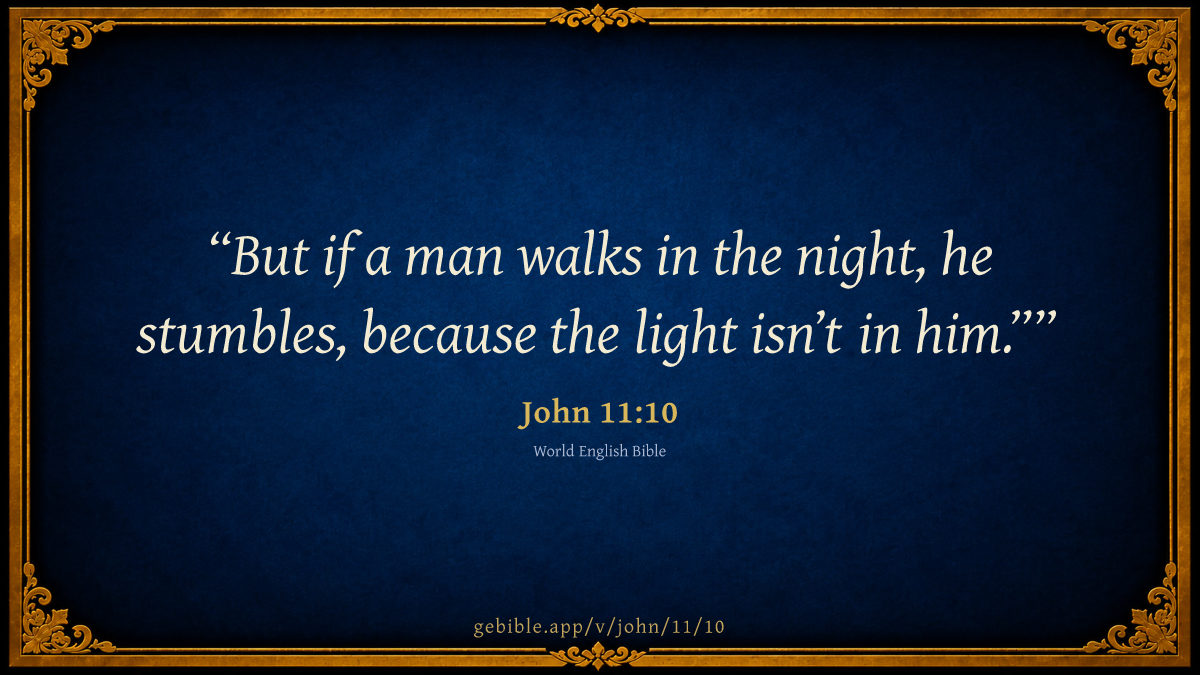
But if a man walks in the night, he stumbles, because the light isn’t in him.”
Parallel Translations
-
But if a man walks in the night, he stumbles, because the light isn’t in him.”
-
But yf a man walke in the nyght he stombleth because ther is no lyght in him.
-
But if a man walke in the night, hee stumbleth, because there is no light in him.
Cross-references (6)
Passages linked to John 11:10 in the Treasury of Scripture Knowledge, ordered by reader-vote popularity; verse text shown in World English Bible.
- Proverbs 4:18-19 But the path of the righteous is like the dawning light that shines more and more until the perfect day. The way of the wicked is like darkness. They don’t know what they stumble over.
- 1 John 2:10-11 He who loves his brother remains in the light, and there is no occasion for stumbling in him. But he who hates his brother is in the darkness, and walks in the darkness, and doesn’t know where he is going, because the darkness has blinded his eyes.
- Jeremiah 13:16 Give glory to Yahweh your God, before he causes darkness, and before your feet stumble on the dark mountains, and while you look for light, he turns it into the shadow of death, and makes it deep darkness.
- Jeremiah 20:11 But Yahweh is with me as an awesome mighty one. Therefore my persecutors will stumble, and they won’t prevail. They will be utterly disappointed, because they have not dealt wisely, even with an everlasting dishonor which will never be forgotten.
- Ecclesiastes 2:14 The wise man’s eyes are in his head, and the fool walks in darkness—and yet I perceived that one event happens to them all.
- Psalms 27:2 When evildoers came at me to eat up my flesh, even my adversaries and my foes, they stumbled and fell.
Cross-references from openbible.info (CC BY 4.0)
Explain this verse (9 sources)
Historical commentary, presented as a primary source — not an endorsement.
Private notes
Saved on this device only — never synced or sent anywhere.
John Trapp 1656 · Public Domain 10 But if a man walk in the night,…
10 But if a man walk in the night, he stumbleth, because there is no light in him.
Ver. 10. But if any man walk in the night] As good Josiah did, in that rash expedition against PharaohNecho; either hoping to ingratiate with the Assyrian, or fearing to have an overly strong neighbour of the Egyptian: he went up to battle, not so much as asking leave of the Lord, though he had Jeremiah at hand, and Zephaniah, and a whole college of seers besides. The best are sometimes miscarried by their passions to their cost.
John Trapp, A Commentary or Exposition upon All the Books of the Old and New Testament (1647–1656) — public domain. Text from a community e-Sword module.
Matthew Poole 1685 · Public Domain And there is a night also, wherein if men…
And there is a night also, wherein if men walk they will be very prone to stumble, because they are in darkness, and have no light to guide their feet. So there is a set time for all the issues of men; a time for their peace and liberty, and a time for their troubles and sufferings. God rules and governs the world. While men are in their callings and places, faithfully discharging their trust, and finishing the work which God hath given them to do, and their time is not come for their glorifying of God by suffering, they shall not stumble, nor be given up to the rage of their eagerest enemies; they are in their callings and places, and God will be light unto them: but when their working time is over, and the time of their night is come, then they will stumble; because then God withdraweth his light from them; they are not then under such a special protection of God, who hath done his work by and with them. This is as much as he had said before, Joh 8:20, No man laid hands on him, for his hour was not yet come; the twelve hours of his day were not all spent. This duty digested, is of infinite use to quiet the spirits of God’s people in the worst of times; every man hath his twelve hours, his day and set time, to honour God upon the stage of the world: he shall not stumble, he shall not miscarry, while those hours are spent; he shall not die, he shall not be disabled for duty, so long as God hath aught for him to do. But every man hath his night too, when he must not expect to converse in the world without stumbling.
Matthew Poole's English Annotations on the Holy Bible (1683–1685) — public domain. Text from a community e-Sword/MySword module.
John Gill 1763 · Public Domain But if a man walk in the night,.... After…
But if a man walk in the night,.... After the sun is set, and there is no light in the air and heavens to direct him:
he stumbleth; at everything that lies in the way,
Read full note →
because there is no light in him; there being none from above communicated to him. So our Lord suggests, that when the time of his death was come, he should then fall a prey into the hands of his enemies, but till then he should walk safe and secure; nor had he anything to fear from them, and therefore could go into Judea again, with intrepidity and unconcern.
John Gill's Exposition of the Whole Bible (1746–1763) — public domain (CC PDM 1.0). Text via the HelloAO Bible API.
John Wesley 1765 · Public Domain But if a man walk in the night -…
But if a man walk in the night - If he have not light from God; if his providence does no longer protect him.
John Wesley, Explanatory Notes Upon the Whole Bible (1754–1765) — public domain. Text via the GEBible commentary corpus.
Daniel D. Whedon 1874 · Public Domain 10. In the night—Opposed to this day of mission…
10. In the night—Opposed to this day of mission and duty there is a night-side of darkness and wandering. It is the hemisphere outside man’s true life.
No light in him—A man’s divinely-assigned path is a divinely-illumined path. The light is a blended light, combining rays of reason, conscience, Scripture, providence, and the blessed Spirit. And it is not only a light around a man, but a light in him. The dark wanderer, with no light in him, stumbleth.
Daniel D. Whedon (gen. ed.), Commentary on the Old and New Testaments (1874–1909) — public domain. Text from a community e-Sword module.
The Cambridge Bible for Schools and Colleges 1878 · Public Domain 10. he stumbleth] Christ’s night came when His hour…
10. he stumbleth] Christ’s night came when His hour came (Joh_17:1). Then the powers of darkness prevailed (Luk_22:53) and His enemies became a stumblingblock in His path, bringing His work to a close (Joh_19:30). The word for ‘stumble’ means literally to ‘knock the foot against’ something.
there is no light in him] Rather, the light is not in him. This shews that the meaning has slid from the literal to the figurative. ‘The light’ in Joh_11:9 is the physical light in the heavens; here it is the spiritual light in the heart.
The Cambridge Bible for Schools and Colleges (gen. ed. J. J. S. Perowne; Cambridge University Press, 1878–1918) — public domain. Text from a community e-Sword module.
Ellicott's Commentary for English Readers 1878 · Public Domain (10) But if a man walk in the night…
(10) But if a man walk in the night . . .—He passes in this verse from the material to the spiritual truth. This first clause still holds of the natural night, and the danger to men who walk in it, but it holds, too, of the darkness in which men walk who do not see, as He is seeing, the light of heaven falling upon the moral path. In the second clause the moral truth is expressed with a prominence which excludes the other.
Because there is no light in him.—The light is now not that “of this world,” but that which is within man.
A Bible Commentary for English Readers, edited by Charles John Ellicott (1878–1897) — public domain. Text from a community e-Sword module.
The Pulpit Commentary 1880 · Public Domain But if a man walk in the night, he…
But if a man walk in the night, he stumbleth, because there is no light in him. He shuts himself off from the light of God-given opportunity, and carries no lamp in his soul. There is no necessity to suppose, in Joh_9:4, that the day was drawing to a close, or that in this place a natural day was dawning; but there is some probability from this phraseology that John adopted the Babylonian rather than the Roman method of computing the hours of the day. This has decided bearing on several important questions. (notes, Joh_1:39 Joh_4:6, 52 19:14) The "twelve hours" shows, at all events, that the Jews at this time generally reckoned from sunrise to sunset. It must be remembered that the day differed considerably in length at different parts of the year, from fourteen hours to nine; but perhaps the emphatic use of the expression derives special interest from the fact that the equinox was approaching.
The Pulpit Commentary (1880–1919), ed. H.D.M. Spence-Jones & Joseph S. Exell — public domain. Text from a community e-Sword module.
unfoldingWord translationNotes 2017 · CC BY-SA 4.0 Connecting Statement:
Connecting Statement:
Jesus continues speaking to his disciples.
Read full note →
if he walks at night
Here "night" is a metaphor that refers to one's walking without God's light. (See: Metaphor)
the light is not in him
Possible meanings are 1) "he cannot see" or "he does not have God's light."
Our friend Lazarus has fallen asleep
Here "fallen asleep" is an idiom that means Lazarus has died. If you have a way of saying this in your language, you may use it here. (See: Idiom)
but I am going so that I may wake him out of sleep
The words "wake him out of sleep" form an idiom. Jesus is revealing his plan to bring Lazurus back to life. If you have an idiom for this in your language, you may use it here. (See: Idiom)
translationWords
walk
stumble
light
Lazarus
asleep
unfoldingWord translationNotes — © Distant Shores Media and the Door43 World Missions Community, licensed CC BY-SA 4.0. Source: git.door43.org/Door43/en_tn.