
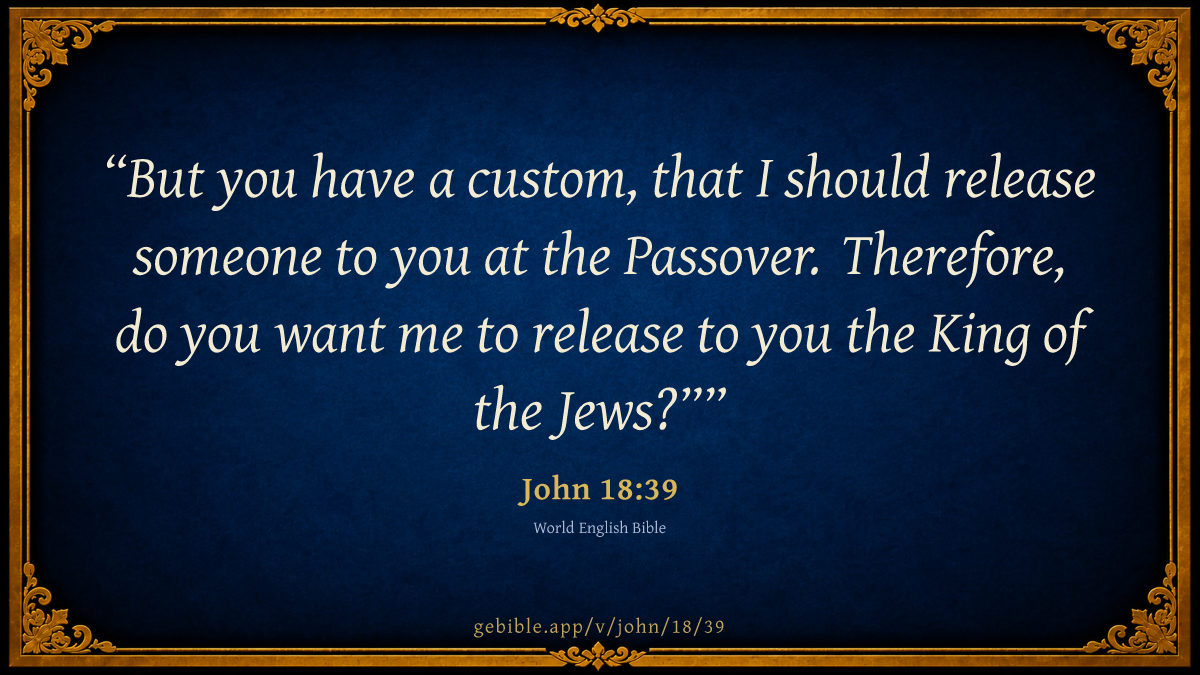
But you have a custom, that I should release someone to you at the Passover. Therefore, do you want me to release to you the King of the Jews?”
Parallel Translations
-
But you have a custom, that I should release someone to you at the Passover. Therefore, do you want me to release to you the King of the Jews?”
-
Ye have a custome that I shuld delyver you one lowsse at ester. Will ye that I lowse vnto you the kynge of the Iewes.
-
But you haue a custome, that I shoulde deliuer you one loose at the Passeouer: will yee then that I loose vnto you the King of ye Iewes?
Cross-references (4)
Passages linked to John 18:39 in the Treasury of Scripture Knowledge, ordered by reader-vote popularity; verse text shown in World English Bible.
- Matthew 27:15-18 Now at the feast the governor was accustomed to release to the multitude one prisoner, whom they desired. They had then a notable prisoner, called Barabbas. When therefore they were gathered together, Pilate said to them, “Whom do you want me to release to you? Barabbas, or Jesus, who is called Christ?” For he knew that because of envy they had delivered him up.
- Mark 15:6-14 Now at the feast he used to release to them one prisoner, whom they asked of him. There was one called Barabbas, bound with his fellow insurgents, men who in the insurrection had committed murder. The multitude, crying aloud, began to ask him to do as he always did for them. Pilate answered them, saying, “Do you want me to release to you the King of the Jews?” For he perceived that for envy the chief priests had delivered him up. But the chief priests stirred up the multitude, that he should release Barabbas to them instead. Pilate again asked them, “What then should I do to him whom you call the King of the Jews?” They cried out again, “Crucify him!” Pilate said to them, “Why, what evil has he done?” But they cried out exceedingly, “Crucify him!”
- Luke 23:16-23 I will therefore chastise him and release him.” Now he had to release one prisoner to them at the feast. But they all cried out together, saying, “Away with this man! Release to us Barabbas!”— one who was thrown into prison for a certain revolt in the city, and for murder. Then Pilate spoke to them again, wanting to release Jesus, but they shouted, saying, “Crucify! Crucify him!” He said to them the third time, “Why? What evil has this man done? I have found no capital crime in him. I will therefore chastise him and release him.” But they were urgent with loud voices, asking that he might be crucified. Their voices and the voices of the chief priests prevailed.
- Matthew 27:20-23 Now the chief priests and the elders persuaded the multitudes to ask for Barabbas, and destroy Jesus. But the governor answered them, “Which of the two do you want me to release to you?” They said, “Barabbas!” Pilate said to them, “What then shall I do to Jesus, who is called Christ?” They all said to him, “Let him be crucified!” But the governor said, “Why? What evil has he done?” But they cried out exceedingly, saying, “Let him be crucified!”
Cross-references from openbible.info (CC BY 4.0)
Explain this verse (13 sources)
Historical commentary, presented as a primary source — not an endorsement.
Private notes
Saved on this device only — never synced or sent anywhere.
John Calvin 1540 · Public Domain 39. But you have a custom. Pilate was all…
39. But you have a custom. Pilate was all along pondering in what way he might save Christ’s life; but, the people being so fiercely enraged, he attempted to keep a middle path, in order to allay their fury; for he thought that it would be enough if Christ, being dismissed as a malefactor, were marked with perpetual ignominy. He therefore selects Barabbas above all others, in order that, by a comparison with that man, the hatred which they bore to Christ might be softened down; for Barabbas was universally and strongly detested on account of his atrocious crimes. And, indeed, is there any thing more detestable than a robber? But Luke (Luke 23:19) relates that, in addition to this, he was guilty of other crimes.
That the Jews preferred him to Christ, did not happen without a singular interposition of the providence of God; for it would have been highly unbecoming, that the Son of God should be rescued from death by so dishonorable a price. Yet by his death, he was thrown into the deepest ignominy, so that, in consequence of the release of Barabbas, he was crucified between two robbers; for he had taken upon himself the sins of all, which could not be expiated in any other way; and the glory of his resurrection, by which it was speedily followed, caused his death itself to be a splendid triumph.
Read full note →
This custom, by which the Roman governor delivered up to the Jews, every year, at the passover, some criminal, involved a base and heinous crime. It was done, no doubt in order to honor the sacredness of the day, but was, in reality, nothing else than a shameful profanation of it; for Scripture declares, that
he who acquitteth the guilty is abomination in the sight of God, (Proverbs 17:15;)
and therefore he is far from taking delight in that improper kind of forgiveness. Let us learn by this example, that nothing is more ridiculous, than to attempt to serve God by our inventions; for, as soon as men begin to follow their own imaginations, there will be no end till, by falling into some of the most absurd fooleries, they openly insult God. The rule for the worship of God, therefore, ought to be taken from nothing else than from his own appointment.
John Calvin's Commentaries (1540-1563) — public domain. Text from the Calvin Translation Society English edition (1840s-50s) via the Christian Classics Ethereal Library (ccel.org). Calvin's coverage is partial (roughly two-thirds of the Bible); uncommented books and verses are honest gaps, never fabricated. The 19th-century editor's footnotes and remarks are omitted so the notes are faithfully Calvin's own voice.
John Trapp 1656 · Public Domain 39 But ye have a custom, that I should…
39 But ye have a custom, that I should release unto you one at the passover: will ye therefore that I release unto you the King of the Jews?
Ver. 39. But ye have a custom] An ungain, ungodly custom it was, Pro 17:15, whatever were the ground of it. In ista consuetudine turpe et crassum fuit vitium. In such a disgraceful custom, it was gross and criminal, (Calvin) Some think it was in memory of Jonathan, rescued from his father by the people. Others, that the feast might be celebrated with the greater joy and gladness. Others, more probably, in remembrance of their deliverance from the Egyptian bondage. But why should any Barabbas escape by it? "A bloody man shall flee to the pit, and no man may stay him," Pro 28:17.
John Trapp, A Commentary or Exposition upon All the Books of the Old and New Testament (1647–1656) — public domain. Text from a community e-Sword module.
Matthew Poole 1685 · Public Domain Whence this custom came is uncertain; most probably from…
Whence this custom came is uncertain; most probably from the Romans, who in some honour of this great festival of the Jews, and in humour of them, granted them the life of any criminal whom they desired. Pilate propounds Christ as the prisoner whom he had most mind to release, perceiving that his prosecution was of malice, rather than for any just cause.
Matthew Poole's English Annotations on the Holy Bible (1683–1685) — public domain. Text from a community e-Sword/MySword module.
John Gill 1763 · Public Domain But ye have a custom,.... Not a law, either…
But ye have a custom,.... Not a law, either of God or man's, but a custom; and which was not originally observed at the feast of the passover, and perhaps was not of any long standing; but what the Roman governors, by the order of Caesar, or of their own pleasure, had introduced to ingratiate themselves into the affections of the people; and being repeated once and again, was now looked for:
that I should release unto you one at the passover; which was at this time; and more than one it seems it was not customary, to release:
Read full note →
will ye therefore that I release unto you the King of the Jews? who they had said called himself so, and was so accounted by others, and which Pilate says, in a sneering, sarcastic way; though he was heartily willing to release him, and was in hopes they would have agreed to it, since nothing could be proved against him; however, he proposes it to them, and leaves it to their option.
John Gill's Exposition of the Whole Bible (1746–1763) — public domain (CC PDM 1.0). Text via the HelloAO Bible API.
Adam Clarke 1810 · Public Domain Verse 39. But ye have a custom] Nothing relative…
Verse 39. But ye have a custom] Nothing relative to the origin or reason of this custom is known. Commentators have swam in an ocean of conjecture on this point. They have lost their labour, and made nothing out: see the notes on Mt 27:15; Lu 23:17.
Adam Clarke's Commentary on the Bible (1810–1826) — public domain. Text from a community e-Sword/MySword module.
Albert Barnes 1834 · Public Domain See the notes at Mat 27:15-21.
See the notes at Mat 27:15-21.
Albert Barnes' Notes on the Bible (1834–1885) — public domain. Text from a community e-Sword/MySword module.
Robert Jamieson, A. R. Fausset & David Brown 1871 · Public Domain But ye have a custom that I should release…
But ye have a custom that I should release one unto you at the passover, &c.--See on Mar 15:7-11. "On the typical import of the choice of Christ to suffer, by which Barabbas was set free, see the sixteenth chapter of Leviticus, particularly Lev 16:5-10, where the subject is the sin offering on the great day of atonement" [KRAFFT in LUTHARDT].
Next: John Chapter 19
Jamieson, Fausset & Brown — Commentary Critical and Explanatory on the Whole Bible (1871) — public domain (CC PDM 1.0). Text via the HelloAO Bible API.
The Cambridge Bible for Schools and Colleges 1878 · Public Domain 39. ye have a custom] Nothing is known of…
39. ye have a custom] Nothing is known of this custom beyond what is told us in the Gospels. Prisoners were sometimes released at Rome at certain festivals, and it would be quite in harmony with the conciliatory policy of Rome to honour native festivals in this way in the case of subject nations. In Luk_23:17 the custom is said to be an obligation; ‘of necessity he must;’ but the verse is of very doubtful genuineness.
that I should] Literally, in order that I should. See on Joh_15:12.
Read full note →
the King of the Jews] Expressive of scornful contempt. Comp. Joh_19:15.
The Cambridge Bible for Schools and Colleges (gen. ed. J. J. S. Perowne; Cambridge University Press, 1878–1918) — public domain. Text from a community e-Sword module.
Ellicott's Commentary for English Readers 1878 · Public Domain (39) At the Passover.—Comp. Excursus F: The Day of…
(39) At the Passover.—Comp. Excursus F: The Day of the Crucifixion of our Lord.
The King of the Jews.—These words are of course said in mockery, but not at Jesus who was still in the palace. They seem to mean, “This is your king; Such is your national subjection, that He is bound in the Prætorium of the Roman governor. Shall I release Him unto you?”
A Bible Commentary for English Readers, edited by Charles John Ellicott (1878–1897) — public domain. Text from a community e-Sword module.
The Pulpit Commentary 1880 · Public Domain Vers. 39, 40. (c) Without the Praetorium. The Roman…
Vers. 39, 40. (c) Without the Praetorium. The Roman trial continued without the Praetorium, where Pilate declared Christ innocent, and made another effort to save him. The Barabbas-proposal. Before the scene which John here introduces with a but as though it followed immediately upon the utterance of a verdict of acquittal Luke tells us that casual reference was made to the circumstance that Jesus was a Galilaean, and was in Herod"s jurisdiction. Eager to quit himself" of a troublesome presence and business, Pilate caught at the expedient of sending Jesus at once to the court of Herod. (Luk_23:6-12) This issuing in no result except in fresh and hideous mockery of the King of kings, and in a renewed protestation of his innocence and harmlessness, so far as the Roman Pilate or the Herodian tetrarch could discover, Pilate offered to scourge the Son of God, and release him. The utter meanness and cowardice of his offer to add ignominious pain and insult to the brutal mockeries of Herod and his soldiers, brands Pilate with eternal shame. As soon as the word "release" broke upon their ears, there was a reminder from the people that Pilate should follow at the feast the custom for some time in vogue, of releasing a prisoner. Now, there was a notorious criminal, who had stirred up a bloody insurrection in the city, one which had resulted in murder. He may have been popular among the vehement anti-imperial party for some seditious proceedings against constituted authorities; he may, in fact, really have been guilty of the very charge brought wickedly against the holy Jesus. This is only conjecture. But there he stood Barabbas, and, according to some manuscripts, "Jesus" also by name, "Son of the Father," but a violent man, a lhsthv , statue with crime, whether he were a Gaulonite or not. The notion of releasing Barabbas, in accordance with a time honored custom, did, according to Luke, originate first of all with some of the people; and this apparent difference between the synoptic narrative and John"s is represented and referred to in this Gospel by the introduction of a palin (Ver. 40). For although John does not mention the first attempt to secure the safety of Barabbas, he implied that the infernal shout, "Not this Man, but Barabbas!" had already burst upon his ears, and was repeated so soon as Pilate had exclaimed, as John briefly reports, Ye have a custom, that I should release unto you one at the Passover. (or, kata de eorthn , Mar_15:6) We know nothing of the origin of this "custom," nor is it elsewhere referred to. The two classes into which critics are divided about the "day of our Lord"s death," here take opposite views as to the meaning of the phrase, en tw pasca . The one class press the fact that the Paschal meal must be over, and that this must have been the first day of unleavened bread, in order to justify this expression; the other critics urge that since the feast had not commenced, Pilate was prepared to grant release in time for Barabbas to take his place with his friends in all the national ceremonies. The phrase, according to Meyer and others, is so indefinite that it may most certainly belong to both the 14th and 15th days of Nisan, and no conclusive argument can, from its use, be drawn in favor of either day. Will ye therefore that I release unto you the King of the Jews? Again therefore they cried all, Not this Man, but Barabbas!
Now Barabbas was a robber. Possibly Pilate wished to find out whether among the oclov there were any sympathizers with Jesus, who might be gratified at the expense of the hated priests; for he "knew that by reason of envy they had delivered up Jesus to him." He wished to set the multitude and the priesthood at variance, and to save Jesus through their mutual recriminations. He would have made a diversion in favor of his Prisoner. He adroitly suspected that some of the surging crowd might have been the friends or accomplices of Jesus, and he would have been gratified to free himself from the responsibility of slaying an innocent man. The phraseology of Mark suggests that Pilate would have been justified in such a conjecture, for a momentary pause occurred. There were some symptoms of wavering in the crowd. But the suggestions of the chief priests passed to the people. Matthew (Mat_27:20) says, The chief priests and elders persuaded (epeisan) the multitudes that they should demand Barabbas, and destroy Jesus." They needed some persuasion, then: but, alas! they yielded to it. Mark (Mar_15:11) is still more explicit: "The chief priests stirred up the people (aneseisan), in order that he might release Barabbas unto them." The double phrase sets forth, in vivid touches, the eager circulation to and fro among the crowds of the hotheaded and malignant priests and elders, who thus secured, not without some difficulty, a popular confirmation of their malignant scheme. "NOT THIS MAN, BUT BARABBAS!" was the repeated cry of a stupefied crowd. The memory of all the gracious words and life-giving actions of Jesus did not subdue the raging passion of their lust; they could neither see with their eyes, nor hear with their ears, nor understand with their hearts. The light that was in them was darkened. They preferred that a murderer should be granted to them. "Not this Man, but Barabbas!" is their verdict. Human power and popular feeling and corporate conscience reached the bottomless abyss of degradation. Jerusalem that killed the prophets would have none of him. Even human nature itself must bear the shame which by this cry for vengeance against goodness was branded upon its brow for ever. Through this daemonic hatred of the noblest and the best, manifested by the world, the world is itself condemned. "Who is he," said John afterwards, "that overcometh the world? Even he who believeth that Jesus is the Son of God." The world has made its Sesostris, its Tiberius, its Nero, its Antinous, into sons of God; the world has ever cried, Not this Man not Jesus of Nazareth but Jesus Barabbas is son of God." It will find out its mistake too late.
Read full note →
The synoptic narrative (Mat_27:19-23 Mar_15:12-14 Luk_23:20-23) had already made the Church familiar with other details more or less connected with this incident, and which preceded the final sentence. John, who followed his Master as closely as possible, was acquainted with some interesting facts, full of suggestion, which throw additional light upon the conduct of Pilate, and bring forth some sublime traits in the character and bearing of our Lord. From the synoptists we learn that Pilate struggled for some considerable time to get his own way, and he remonstrated repeatedly with the people concerning their choice of Barabbas, the murderer and brigand, and their refusal to recall their malignant deliverance of Jesus to him as a malefactor. The bare idea that this gentle, silent, magnanimous Sufferer, bereft of his friends, mocked by Herod, deserted by his disciples, should have the faintest shadow of a claim to sovereignty in the only sense in which Pilate could understand such an idea, revolted his common sense. The message from his wife (Mat_27:19) had furthermore excited his semi-superstitious fears, and he maundered in a feeble fashion, "What shall I do with Jesus that is called Christ? him whom ye say is (accused of being) King of the Jews?" and for the first time the ominous and terrible cry is returned, "CRUCIFY HIM!" They do not ask that he be speared or beheaded, or treated like a convicted aspirant or usurper; nay, they will not be pacified until the doom of a common malefactor, the shameful death of a criminal slave, is meted out to him. Pilate is amazed, and even horrified, by the intensity of their spite and the cruelty of their hatred. Once and again Pilate said, "Why, what evil has he done? I found in him no proved occasion of any kind of death." The tumult was rising every moment, and Pilate would have been glad to compromise the matter by sending Barabbas to the cross; and before he took the course dictated by the angry mob, he washed his hands in a basin of water, and proclaimed the fact that he had, and would take, no responsibility for the judicial murder to which they would hound him. "I am guiltless of the blood of this Man: see you to it". (Mat_27:24, Mat_27:25) Many commentators refer this proceeding of Pilate to the moment when he finally uttered the cursed verdict: Ibis ad crucem. Matthew"s account is much more concise at this point than John"s. Heathen writers had repeatedly scoffed at the notion of water washing away the guilt of blood. We can hardly suppose that Pilate meant more than a disdainful repudiation of any sympathy with the infuriated crowd (see Steinmeyer). This act, instead of appeasing, served to madden the fury of the populace, who shouted in bitter earnest, His blood be upon us, and upon our childrena sentence of their own, which rankled in their memories, and came back a few months afterwards with grim earnestness. (Act_5:28) Then," says St. Matthew, "Pilate released Barabbas to them." To do this, the governor would return to the Praetorinm, and Jesus was thus once more face to face with him. Probably the gorgeous robe which Herod had thrown over his fettered limbs had been taken from him; and then Pilate, bewildered, weak, with some ulterior motive of staving off the madness of the Jews, and satiating their in human thirst for blood, adopted another expedient.
The Pulpit Commentary (1880–1919), ed. H.D.M. Spence-Jones & Joseph S. Exell — public domain. Text from a community e-Sword module.
B. W. Johnson 1891 · Public Domain 39–40. Ye have a custom. See notes on Matt.…
39–40. Ye have a custom. See notes on Matt. 27:15. He was eager to comply with the custom in order to release an innocent prisoner, but he had not measured the depths of the Jewish hate which could demand, instead, a robber and a murderer.
B. W. Johnson's The People's New Testament with Notes (1889–1891) — public domain. Electronic text from the Christian Classics Ethereal Library (CCEL) ThML edition.
William B. Godbey 1900 · Public Domain Mat 27:15-26; Mar 15:6-15; Joh 18:39-40; Luk 23:13-25. “And…
PILATE SEEKS TO RELEASE HIM IN LIEU OF BARABBAS
Mat 27:15-26; Mar 15:6-15; Joh 18:39-40; Luk 23:13-25. “And Pilate, having called together the high priests, rulers, and the people, said to them, You have brought to me this Man as revolutionizing the people; and, behold, I, having judged Him in your presence, found nothing in this Man criminal of those things which you accuse against Him; neither did Herod; for I sent you to him, and, behold, nothing worthy of death has been done by Him. Therefore, having scourged Him, I will release Him.” The cruelty of the Roman punishments actually beggars all description. This scourging which Pilate mentions was horrific in the extreme. Previously to the crucifixion of a man, they beat his naked body with thongs of rawhide, having in them steel points, which lacerated his flesh most excruciatingly, so that it was nothing uncommon for the poor victim to die during the scourging. Pilate, however, lights upon this as a dernier ressort to save the life of Jesus, thinking that a punishment so awful administered to an innocent man would certainly produce a reaction on the part of His enemies, constraining them to relax their apparently implacable animosity toward Him, so that they would consent to His release. Pilate, though a corrupt heathen ruler, in this matter underestimated the diabolical malice and hellish venom which was at that time the controlling principle of the big preachers and ruling elders, who were determined to have Him put to death. When the devil gets possession of religious people, they have in all ages proved more demoniacal than the wicked people of the world.
Read full note →
Mar 15:6-12. “But during the feast he was accustomed to release unto them one prisoner, whom they demanded. There was one called Barabbas, having been bound along with the insurrectionists, who had committed murder in the insurrection. The rabble, roaring, began to ask as he was always accused to do unto them. Pilate responded to them, saying, Do you wish that I shall release unto you the King of the Jews? For he knew that the high priests had delivered Him through envy.” It is said that Joseph’s brethren sold him to the Ishmaelites through envy. He was a beautiful type of Christ, sold for money, and suffered seven years in the loathsome State prison, thus vividly symbolizing Jesus, in His first coming, to suffer and to die. Finally, when promoted to the throne of Egypt, the ruling kingdom of the world, invested in royal robes, riding in a golden chariot, fifty couriers running before him, shouting, “Bow the knee for the king cometh,” how vividly does he emblematize our glorious King Jesus in His second advent, accompanied by the mighty angels, and crowned King of kings and Lord of Lords! Pilate is so anxious to release Jesus that he restricts their choice to the two — Jesus and Barabbas. Then, coming before them, he seeks to forestall their verdict by shouting aloud, “Shall I release unto you the King of the Jews?”
Mat 27:19. “He, sitting upon his tribunal, his wife sent to him, saying, Have thou nothing to do with that Righteous One; for I suffered many things this day in a dream on account of Him.” In common parlance, the day includes the night. Of course, the woman had the dream during the night. Tradition has given us the character of this dream. It is said that when the courier arrived from their suburban home at Bethany, bringing a letter from Lucia Metella, the governor’s wife, in the midst of this momentously exciting trial, Pilate took it hurriedly, and aiming to read inaudibly, was so excited that his tremulous utterances were overheard. “My Dear Husband, — Be sure that you have nothing to do with that Righteous One; for this very day I saw Him, in a vision seated on high Olympus, and all the gods and goddesses hurling their crowns at His feet! I tell you, my husband, He is one of the gods.” Of course, she and Pilate were Romans, believing in the many gods of the Roman Empire.
Luk 23:8-23. “And the whole: multitude cried out saying, Take Him away; but release unto us Barabbas, who , on account of a certain insurrection and murder in the city, had been cast into prison,” and Barabbas was a formidable robber chief, who had given them awful trouble, the Roman guards with difficulty having finally succeeded in arresting him, and thus breaking up his robber band. “Then Pilate again called to them, wishing to release Jesus. And they continued to cry out, saying, Crucify Him! crucify Him! And the third time he said to them, For what evil has He done? I have found nothing worthy of death in Him; therefore, having scourged Him, I will release Him.” You see Pilate’s plan was to move their sympathies and mitigate their cruel wrath by scourging Him, thinking they would then consent to His release.
“And they continued to lie on, with great voices demanding that He should be crucified; and the voices of them and the high priests continued to wax stronger and stronger.” As they were disappointed in their plan of killing Him in the night, and it is now eight o’clock, the news flying on the wings of the wind, and all who hear of it rushing to the scene of action, crowding the streets and alleys and the flat roofs of the houses all around Pilate’s judgment-hall, the high priests, Sanhedrin, and ruling elders feel that the crisis is on them, and if some-thing is not done quickly, the mob will rise and take Him out of their hands. Hence they roar and roar as if they would split their throats, demanding of the governor His crucifixion.
Mat 27:24-26. “And Pilate, seeing that he profits nothing, but the more is the uproar, taking water, washed his hands in presence of the multitude, saying, I am innocent, from the blood of this Just One; you shall see to it. And all the people, responding, said, His blood be upon us and our children. Then he released unto them Barabbas.”
Luk 23:24-25. “And Pilate decided that the request should be granted, and he released unto them the one who on account of sedition and murder had been cast into prison, and he delivered Jesus according to their choice.” Contemporary history says that Pilate had but few soldiers in Jerusalem at that time comparatively with the ordinary force which he kept on hand, having recently been under the necessity of sending away a large detachment to quell an insurrection in Syria. He was therefore apprehensive of a bloody revolution, surging like the waves of the stormy sea, and every moment threatening to break out, deluge the judgment-hall in blood, blockade the streets with the slain, and wrap Jerusalem in a terrible civil war. Consequently, resorting to a principle long rulable, especially in Oriental despotisms, that one innocent man would better die than for many to lose their lives, and having repeatedly pronounced Jesus innocent, he signs His death-warrant as a mere peace measure, in order to prevent a bloody conflict, in which many would certainly perish.
William B. Godbey, Commentary on the New Testament (1896–1900) — public domain. Text from a community e-Sword module.
J. W. McGarvey 1914 · Public Domain J. W. McGarvey's The Fourfold Gospel [CXXXI. Third Stage…
J. W. McGarvey's The Fourfold Gospel [CXXXI. Third Stage of Roman Trial].
CXXXI. THIRD STAGE OF THE ROMAN TRIAL. PILATE RELUCTANTLY SENTENCES HIM TO CRUCIFIXION. (Friday. Toward sunrise.) aMATT. XXVII. 15-30; bMARK XV. 6-19; cLUKE XXIII. 13-25; dJOHN XVIII. 39-XIX 16.
Read full note →
a15 Now at the feast [the passover and unleavened bread] the governor was wont { bused to release unto them athe multitude one prisoner, whom they would. bwhom they asked of him. [No one knows when or by whom this custom was introduced, but similar customs were not unknown elsewhere, both the Greeks and Romans being wont to bestow special honor upon certain occasions by releasing prisoners.] a16 And they had then b7 And there was aa notable prisoner, bone called Barabbas, lying bound with them that had made insurrection, men who in the insurrection had committed murder. [710] [Josephus tells us that there had been an insurrection against Pilate's government about that time caused by his taking money from the temple treasury for the construction of an aqueduct. This may have been the affair here referred to, for in it many lost their lives.] 8 And the multitude went up and began to ask him i to do as he was wont to do unto them. [It was still early in the morning, and the vast majority of the city of Jerusalem did not know what was transpiring at Pilate's palace. But they came thither in throngs, demanding their annual gift of a prisoner. Pilate welcomed the demand as a possible escape from his difficulties.] c13 And Pilate called together the chief priests and the rulers and the people [He did not wish to seem to take advantage of our Lord's accusers by releasing him during their absence. Possibly he knew of the triumphal entry the Sunday previous, and thought that the popularity of Jesus would be such that his release would be overwhelmingly demanded, and so called the rulers that they might see that he had released Jesus in answer to popular clamor. If he had such expectations, they were misplaced], b9 And a17 When therefore they were gathered together, bPilate answered them, saying, c14 and said unto them, bWill ye that I release unto you the King of the Jews? cYe brought unto me this man, as one that perverteth the people: and behold, I having examined him before you, found no fault in this man touching those things whereof ye accuse him: 15 no, nor yet Herod: for he sent him back unto us; and behold, nothing worthy of death hath been done by him. d39 But ye have a custom, that I should release unto you one at the passover: c16 I will therefore chastise him, and release him. dWill ye therefore that I release unto you the King of the Jews? aWhom will ye that I release unto you? Barabbas, or Jesus who is called Christ? 18 For he knew bperceived athat for envy they bthe chief priests had delivered him up. [Though Jesus had been declared innocent on the joint finding of himself and Herod, [711] Pilate did not have the courage to deliberately release him. He sought to please the rulers by scourging him, and the multitude by delivering him to them as a popular favorite, and himself by an adroit escape from an unpleasant situation. But he pleased nobody.] c18 But they cried out all together, saying, Away with this man, and release unto us Barabbas:-- 19 one who for a certain insurrection made in the city, and for murder, was cast into prison. [We see from Matthew's account that though the people had a right to name their prisoner, Pilate took upon himself the liberty of choosing which one of two it should be. By doing so he complicated matters for the Jewish rulers, asking them to choose between Jesus, who was held on an unfounded charge of insurrection, and Barabbas, who was notoriously an insurrectionist and a murderer and a robber as well. But the rulers were not to be caught in so flimsy a net. Without regard to consistency, they raised their voice in full chorus for the release of Barabbas and the crucifixion of Jesus.] a19 And while he was sitting on the judgment-seat, his wife sent unto him, saying, Have thou nothing to do with that righteous man; for I have suffered many things this day in a dream because of him. [This message of Pilate's wife suggests that the name and face of Jesus were not unknown to Pilate's household. Pilate would be much influenced by such a message. The Romans generally were influenced by all presages, and Suetonius tells us that both Julius and Augustus Cæsar attached much importance to dreams.] b11 But a20 Now the chief priests and the elders persuaded bstirred up the multitude, amultitudes bthat he should rather release Barabbas unto them. athat they should ask for Barabbas, and destroy Jesus. 21 But the governor answered and said unto them, Which of the two will ye that I release unto you? And they said, Barabbas. d40 They cried out therefore again, saying, Not this man, but Barabbas. Now Barabbas was a robber. c20 And Pilate spake unto them again, desiring to release Jesus; [712] b12 And Pilate again answered and said asaith unto them, What then shall I do unto Jesus who is called Christ? bhim whom ye call the King of the Jews? c21 but b13 and they cried out cshouted bagain, csaying, Crucify, crucify him. aThey all say, Let him be crucified. b14 And Pilate said unto them, cthe third time, Why, what evil hath this man ahe done? cI have found no cause of death in him: I will therefore chastise him and release him. aBut they cried out exceedingly, saying, bCrucify him. aLet him be be crucified. [Finding the mob cruelly persistent, Pilate boldly declines to do its will and turns back into the Prætorium declaring his intention to release Jesus. But he retires with the demands of the multitude ringing in his ears.] d1 Then Pilate therefore took Jesus, and scourged him. [Carrying out the program which he proposed, Pilate had Jesus removed from the Prætorium to the place of scourging, and inflicted that punishment upon him. We learn from Josephus and others that the law required that those about to be crucified should first be scourged. But Pilate hoped that scourging would suffice. He believed that the more moderate would take pity upon Jesus when they viewed his scourged body, for scourging was so cruel a punishment that the condemned person often died under its infliction. The scourge was made of thongs loaded at the extremity with pieces of bone or metal. The condemned person was stripped and fastened to a low post, this bending the back so as to stretch the skin. Blood spurted at the first blow.] 2 And the soldiers platted a crown of thorns, and put it on his head, and arrayed him in a purple garment; 3 and they came unto him, and said, Hail, King of the Jews! and they struck him with their hands. [The soldiers had no special malice against Jesus, but the Roman military system made men hard of heart. The occasion gave to these foreign legionaries a much-enjoyed opportunity to show their contempt for the Jews by mocking Jesus as their King. It is not known which one of the many thorny plants of Palestine [713] was used to form the Lord's crown. See Act_22:24). If Pilate had found Jesus guilty, he would have condemned him at once. As it was, he sought to return Jesus to the Sanhedrin as having committed no crime of which the Roman law could take note.] 5 Jesus therefore came out, wearing the crown of thorns and the purple garment. And i Pilate saith unto them, Behold, the man! [It was Pilate's original proposition to scourge Jesus and let him go ( Luk_23:16). Having already scourged him, he now hoped to effect his release. Presenting our Lord in this state of abject humiliation, he feels that he has removed him from every suspicion of royalty. He speaks of Jesus as no longer a king, but a mere man. Pilate's words, however, have a prophetic color, somewhat like those uttered by Caiaphas. All those of subsequent ages have looked and must continue to look to Jesus as the ideal of manhood. The "Ecce Homo" of Pilate is in some sense an echo of the words of the Father when he said, "This is my Son, my chosen: hear ye him." In Jesus we behold the true man, the second Adam.] 6 When therefore the chief priests and the officers saw him, they cried out, saying, Crucify i him, crucify him! [Thus Pilate's expectation came to naught, for not one of the Jewish rulers ever wavered in their demand for crucifixion.] Pilate saith unto them, Take him yourselves, and crucify him: for I find no [714] crime in him. [In this sentence, "ye" and "I" are both emphatic; for Pilate wishes to draw a contrast between himself and the Jewish rulers. His words are not a permission to crucify, but a bit of taunting irony, as if he said: "I the judge have found him innocent, but ye seem to lack the wit to see that the case is ended. If ye are so much superior to the judge that ye can ignore his decision, proceed without him; crucify him yourselves."] 7 The Jews answered him, We have a law, and by that law he ought to die, because he made himself the Son of God. [Perceiving that Pilate was taunting them, and practically accusing them of attempting to put an innocent man to death, they defended themselves by revealing the fact that in addition to the charges that they had preferred against Jesus, they had found him clearly guilty and worthy of death on another charge; viz.: that of blasphemy ( Lev_24:16). They had made no mention of this fact because Pilate was under no obligation to enforce their law; but they mentioned it now to justify their course. They probably felt sure that Jesus himself would convince Pilate of the truth of this latter accusation if Pilate questioned him.] 8 When Pilate therefore heard this saying, he was the more afraid [The words of Jesus at John xviii. 37 (see Joh_18:2, Joh_18:5 (the same word being translated both "betrayed" and "delivered"), but Judas did not deliver to Pilate, so Caiaphas as the representative of the Sanhedrin is here meant; and Pilate's sin is contrasted with that of the rulers. Both of them sinned in abusing their office (the power derived from above-- Psa_75:6, Psa_75:7, Isa_44:28, Rom_13:1); but Pilate's sin stopped here. He had no acquaintance with Jesus to give him the possibility of other powers--those of love or hatred, worship or rejection. The members of the Sanhedrin had these powers which arose from a personal knowledge of Jesus, and they abused them by hating and rejecting him, thereby adding to their guilt. Pilate condemned the innocent when brought before him, but the Sanhedrin searched out and arrested the innocent that they might enjoy condemning him.] 12 Upon this Pilate sought to release him [As we have seen, Pilate had before this tried to win the consent of the rulers that Jesus be released, but that which John here indicates was probably an actual attempt to set Jesus free. He may have begun by unloosing the hands of Jesus, or some such demonstration]: but the Jews cried out, saying, If thou release this man, thou art not Caesar's friend: every one that maketh himself a king speaketh against Caesar. [716] [Whatever Pilate's demonstration was it was immediately met by a counter one on the part of the rulers. They raise a cry which the politic Pilate can not ignore. Taking up the political accusation (which they had never abandoned), they give it a new turn by prompting Pilate to view it from Cæsar's standpoint. Knowing the unreasoning jealousy, suspicion and cruelty of the emperor, Pilate saw at once that these unscrupulous Jews could make out of the present occasion a charge against him which would cost him his position, if not his life.] 13 When Pilate therefore heard these words, he brought Jesus out, and sat down on the judgment-seat at a place called The Pavement, but in Hebrew, Gabbatha. [Pilate had already again and again declared Jesus innocent. He now mounts the judgment-seat that he may formally reverse himself and condemn him. The apostle as an eye-witness fixes by its two names the exact spot where this awful decision was rendered.] 14 Now it was the Preparation of the passover [see 1Sa_12:12), their faithful prophet, Samuel, warned them what the king of their choice would do, and what they should suffer under him. Thus Jesus also foretold what this Cæsar of their choice would do to them ( Luk_19:41-44, Luk_23:27-31). They committed themselves to the [717] tender mercies of Rome, and one generation later Rome trod them in the wine-press of her wrath.] c23 But they were urgent with loud voices, asking that he might be crucified. And their voices prevailed. [They overcame Pilate's weak resistance by their clamor.] a24 So when Pilate saw that he prevailed nothing, but rather that a tumult was arising, he took water, and washed his hands before the multitude, saying, I am innocent of the blood of this righteous man; see ye to it. 25 And all the people answered and said, His blood be on us, and on our children. [Pilate's act was symbolic, intended to show that he regarded the crucifixion of Jesus as a murder, and therefore meant to wash his hands of the guilt thereof. The Jewish law made the act perfectly familiar to the Jews ( Deu_21:1-9). Had the Jewish rulers not been frenzied by hatred, the sight of Pilate washing his hands would have checked them; but in their rage they take upon themselves and their children all the responsibility. At the siege of Jerusalem they answer in part for the blood of Christ, but God alone determines the extent of their responsibility, and he alone can say when their punishment shall end. But we know that it ends for all when they repentantly seek his forgiveness. The punishments of God are not vindictive, they are the awards of Justice meted out by a merciful hand.] b15 And Pilate, wishing to content the multitude, cgave sentence that what they asked for should be done. a26 Then released he unto them Barabbas; chim that for insurrection and murder had been cast into prison, whom they asked for; but Jesus he delivered up to their will. d16 Then therefore bJesus, when he had scourged him, to be crucified [Mark mentions the scourging to show that it preceded the crucifixion, but we see from John's account that the scourging took place somewhat earlier in the proceeding], bhe delivered him unto them to be crucified. [Pilate delivered Jesus to their punishment, but not into their hands; he was led forth and crucified by Pilate's soldiers, who first mocked him, as the next paragraph shows.] b16 And [718] a27 Then the soldiers of the governor took Jesus, bled him away within ainto the court, which is the Praetorium; and they called together aand gathered unto him the whole band. 28 And they stripped him, and put on him a scarlet robe. b17 And they clothe him with purple, a29 And they platted bplatting a crown of thorns, [and] they put it on him; aupon his head, and a reed in his right hand; and they kneeled down before him, and mocked him, b18 and they began to salute him, asaying, Hail, King of the Jews! 30 And they spat upon him, and took the reed b19 And they smote his head aand smote him on the head. bwith a reed, and spat upon him, and bowing their knees worshipped him. [After the sentence of death the soldiers take Jesus back into the Prætorium, and renew the mockeries and indignities which had been interrupted that Pilate might exhibit Jesus to the people, as John shows us. Moreover, the whole band, or cohort, are now gathered, where at first but a few took part. It is likely that the mock robe and crown were removed when Jesus was brought before Pilate to be sentenced, for it is highly improbable that a Roman judge would pronounce the death sentence while the prisoner was clothed in such a manner.]
[FFG 710-719]
J. W. McGarvey (with Philip Y. Pendleton), Commentaries on the New Testament (The Fourfold Gospel, 1914; Acts; and the epistles) — public domain. Text from a community e-Sword/MySword module.