
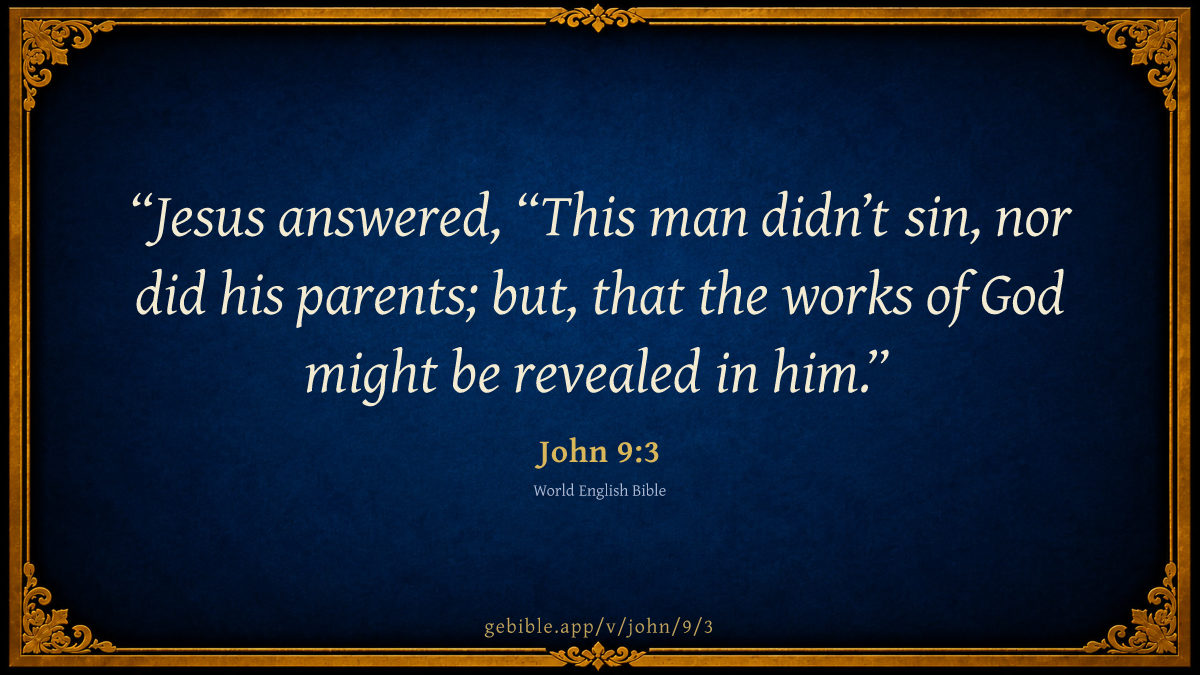
Jesus answered, “This man didn’t sin, nor did his parents; but, that the works of God might be revealed in him.
Parallel Translations
-
Jesus answered, “This man didn’t sin, nor did his parents; but, that the works of God might be revealed in him.
-
Iesus answered: Nether hath this man synned nor yet his father and mother: but that the workes of God shuld be shewed on him.
-
Iesus answered, Neither hath this man sinned, nor his parents, but that the workes of God should be shewed on him.
Examined in Scripture Analysis
Science (1)
Historical claims about the natural world, weighed against the scientific record.
Contradictions (2)
Questions where the Bible appears to say two different things, with the passages on each side set together.
Cross-references (11)
Passages linked to John 9:3 in the Treasury of Scripture Knowledge, ordered by reader-vote popularity; verse text shown in World English Bible.
- John 11:4 But when Jesus heard it, he said, “This sickness is not to death, but for the glory of God, that God’s Son may be glorified by it.”
- John 11:40 Jesus said to her, “Didn’t I tell you that if you believed, you would see God’s glory?”
- Ecclesiastes 9:1-2 For all this I laid to my heart, even to explore all this: that the righteous, and the wise, and their works, are in the hand of God; whether it is love or hatred, man doesn’t know it; all is before them. All things come alike to all. There is one event to the righteous and to the wicked; to the good, to the clean, to the unclean, to him who sacrifices, and to him who doesn’t sacrifice. As is the good, so is the sinner; he who takes an oath, as he who fears an oath.
- Job 2:3-6 Yahweh said to Satan, “Have you considered my servant Job? For there is no one like him in the earth, a blameless and an upright man, one who fears God, and turns away from evil. He still maintains his integrity, although you incited me against him, to ruin him without cause.” Satan answered Yahweh, and said, “Skin for skin. Yes, all that a man has he will give for his life. But stretch out your hand now, and touch his bone and his flesh, and he will renounce you to your face.” Yahweh said to Satan, “Behold, he is in your hand. Only spare his life.”
- Matthew 11:5 the blind receive their sight, the lame walk, the lepers are cleansed, the deaf hear, the dead are raised up, and the poor have good news preached to them.
- Job 42:7 It was so, that after Yahweh had spoken these words to Job, Yahweh said to Eliphaz the Temanite, “My wrath is kindled against you, and against your two friends; for you have not spoken of me the thing that is right, as my servant Job has.
- Acts 4:21 When they had further threatened them, they let them go, finding no way to punish them, because of the people; for everyone glorified God for that which was done.
- Job 1:8-12 Yahweh said to Satan, “Have you considered my servant, Job? For there is no one like him in the earth, a blameless and an upright man, one who fears God, and turns away from evil.” Then Satan answered Yahweh, and said, “Does Job fear God for nothing? Haven’t you made a hedge around him, and around his house, and around all that he has, on every side? You have blessed the work of his hands, and his substance is increased in the land. But stretch out your hand now, and touch all that he has, and he will renounce you to your face.” Yahweh said to Satan, “Behold, all that he has is in your power. Only on himself don’t stretch out your hand.” So Satan went out from the presence of Yahweh.
- Job 22:5-30 Isn’t your wickedness great? Neither is there any end to your iniquities. For you have taken pledges from your brother for nothing, and stripped the naked of their clothing. You haven’t given water to the weary to drink, and you have withheld bread from the hungry. But as for the mighty man, he had the earth. The honorable man, he lived in it. You have sent widows away empty, and the arms of the fatherless have been broken. Therefore snares are around you. Sudden fear troubles you, or darkness, so that you can not see, and floods of waters cover you. “Isn’t God in the heights of heaven? See the height of the stars, how high they are! You say, ‘What does God know? Can he judge through the thick darkness? Thick clouds are a covering to him, so that he doesn’t see. He walks on the vault of the sky.’ Will you keep the old way, which wicked men have trodden, who were snatched away before their time, whose foundation was poured out as a stream, who said to God, ‘Depart from us;’ and, ‘What can the Almighty do for us?’ Yet he filled their houses with good things, but the counsel of the wicked is far from me. The righteous see it, and are glad. The innocent ridicule them, saying, ‘Surely those who rose up against us are cut off. The fire has consumed their remnant.’ “Acquaint yourself with him, now, and be at peace. By it, good will come to you. Please receive instruction from his mouth, and lay up his words in your heart. If you return to the Almighty, you will be built up, if you put away unrighteousness far from your tents. Lay your treasure in the dust, the gold of Ophir among the stones of the brooks. The Almighty will be your treasure, and precious silver to you. For then you will delight yourself in the Almighty, and will lift up your face to God. You will make your prayer to him, and he will hear you. You will pay your vows. You will also decree a thing, and it will be established to you. Light will shine on your ways. When they cast down, you will say, ‘be lifted up.’ He will save the humble person. He will even deliver him who is not innocent. Yes, he will be delivered through the cleanness of your hands.”
- John 14:11-13 Believe me that I am in the Father, and the Father in me; or else believe me for the very works’ sake. Most certainly I tell you, he who believes in me, the works that I do, he will do also; and he will do greater works than these, because I am going to my Father. Whatever you will ask in my name, I will do it, that the Father may be glorified in the Son.
- Acts 28:4 When the natives saw the creature hanging from his hand, they said to one another, “No doubt this man is a murderer, whom, though he has escaped from the sea, yet Justice has not allowed to live.”
Cross-references from openbible.info (CC BY 4.0)
Explain this verse (18 sources)
Historical commentary, presented as a primary source — not an endorsement.
Private notes
Saved on this device only — never synced or sent anywhere.
John Calvin 1540 · Public Domain 3. Neither did this man sin, nor his parents.…
3. Neither did this man sin, nor his parents. Christ does not absolutely say that the blind man, and his parents, were free from all blame; but he declares that we ought not to seek the cause of the blindness in sin. And this is what I have already said, that God has sometimes another object in view than to punish the sins of men, when he sends afflictions to them. Consequently, when the causes of afflictions are concealed, we ought to restrain curiosity, that we may neither dishonor God nor be malicious towards our brethren. Wherefore, Christ assigns another reason. This man, he says, was born blind, —
That the works of God might be manifested in him. He does not, say a single work, but uses the plural number, works; for, so long as he was blind, there was exhibited in him a proof of the severity of God, from which others might learn to fear and to humble themselves. It was afterwards followed by the benefit of his cure and deliverance, in which the astonishing goodness of God was strikingly displayed. So then Christ intended, by these words, to excite in his disciples the expectation of a miracle; but at the same time reminds them in a general manner, that this must be abundantly exhibited on the theater of the world, as the true and lawful cause, when God glorifies his name. Nor have men any right to complain of God, when he makes them the instruments of his glory in both ways, whether he shows himself to be merciful or severe.
John Calvin's Commentaries (1540-1563) — public domain. Text from the Calvin Translation Society English edition (1840s-50s) via the Christian Classics Ethereal Library (ccel.org). Calvin's coverage is partial (roughly two-thirds of the Bible); uncommented books and verses are honest gaps, never fabricated. The 19th-century editor's footnotes and remarks are omitted so the notes are faithfully Calvin's own voice.
Geneva Bible translators 1599 · Public Domain Christ reasoneth here, as his disciples thought, which presuppose…
Christ reasoneth here, as his disciples thought, which presuppose that there come no diseases but for sins only: whereupon he answereth that there was another cause of this man’s blindness, and that was, that God’s his work might be seen.
Geneva Bible (1599) marginal notes — public domain.
John Trapp 1656 · Public Domain 3 Jesus answered, Neither hath this man sinned, nor…
3 Jesus answered, Neither hath this man sinned, nor his parents: but that the works of God should be made manifest in him.
Ver. 3. But that the works of God, &c.] Hinc Alexander Ales, Poena, inquit, duplicem habet ordinationem, Unam ad culpam, quae praecedit; alteram ad gloriara, quam praecedit. God sometimes afflicts for his own glory, but sin is ever at the bottom. And though God does not always afflict his for sin, as Job, yet Job shall do well to consider that God "exacteth of him less than his iniquity deserveth," as Zophar telleth him, Job 11:6.
John Trapp, A Commentary or Exposition upon All the Books of the Old and New Testament (1647–1656) — public domain. Text from a community e-Sword module.
Matthew Poole 1685 · Public Domain Our Saviour must not be understood here, as either…
Our Saviour must not be understood here, as either asserting the blind man or his parents free from sin, and a degree of sin deserving such a punishment; but as speaking to his disciples question strictly, and answering, that this affliction came not upon him, either for any personal sin of his own, (for he could not be guilty of any actual sin before he was born), nor yet for any sin that his parents had committed: but that the works of God might be made glorious in him; both his work of power in afflicting, and his work of mercy in healing him.
Matthew Poole's English Annotations on the Holy Bible (1683–1685) — public domain. Text from a community e-Sword/MySword module.
William Burkitt 1703 · Public Domain Christ’s answer must not be understood absolutely, as if…
Christ’s answer must not be understood absolutely, as if he denied this man and his parents to be guilty of sin, for both he and they had sin enough, not only to deserve temporal blindness, but eternal darkness.
The meaning is, that in afflicting this man, the Lord did not so much respect his or his parents sin, as the manifestation of his own glory, in this miraculous cure. Christ doth not deny but that a man’s own sin, and the sin of his parents, may be the procuring cause of blindness; but that neither the one nor the other was the cause in that man’s case; but that the power and mercy of God might be seen in restoring this man to his sight, therefore was he born blind.
Read full note →
Whence note, 1. That though sin be always the deserving, yet it is not always the procuring cause of affliction.
3. That we seldom think of, or hit upon, any other cause of affliction, but only sin; though the design of God looks beyond the sin of man in afflictions; yet man seldom looks beyond that or thinks of any other design of God in afflicting, but only punishing for sin.
William Burkitt's Expository Notes on the New Testament (1700–1703) — public domain. Text from a community e-Sword module.
John Gill 1763 · Public Domain Jesus answered, neither hath this man sinned, nor his…
Jesus answered, neither hath this man sinned, nor his parents,.... Not but that both were guilty of original sin, and had committed actual transgressions; but Christ's answer is to be considered agreeable to the design of the question; and the sense is, that it was not any sin that either of them had committed, whilst he was in the womb, or previous to his birth, that was the cause of this blindness; otherwise, all such irregularities and afflictions arise from sin, and the fall of man, as does that spiritual blindness with which all mankind are attended:
but that the works of God should be manifest in him; that is, that Christ might have an opportunity of working a miracle in the cure of him, whereby it might appear that he is truly and properly God, the Son of God, and the Messiah; and so spiritual blindness, which has followed the fall of man, takes place in the elect of God in common with others, that the power of divine grace might be displayed in bringing them out of darkness into marvellous light.
John Gill's Exposition of the Whole Bible (1746–1763) — public domain (CC PDM 1.0). Text via the HelloAO Bible API.
John Wesley 1765 · Public Domain Jesus answered, Neither hath this man sinned, nor his…
Jesus answered, Neither hath this man sinned, nor his parents - It was not the manner of our Lord to answer any questions that were of no use, but to gratify an idle curiosity. Therefore he determines nothing concerning this. The scope of his answer is, It was neither for any sins of his own, nor yet of his parents; but that the power of God might be displayed.
John Wesley, Explanatory Notes Upon the Whole Bible (1754–1765) — public domain. Text via the GEBible commentary corpus.
Adam Clarke 1810 · Public Domain Verse 3. Neither hath this man sinned, nor his…
Verse 3. Neither hath this man sinned, nor his parents] That is, the blindness of this person is not occasioned by any sin of his own, nor of his parents, but has happened in the ordinary course of Divine providence, and shall now become the instrument of salvation to his soul, edification to others, and glory to GOD. Many of the Jews thought that marks on the body were proofs of sin in the soul. From a like persuasion, probably arose that proverb among our northern neighbours - Mark him whom God marks.
Adam Clarke's Commentary on the Bible (1810–1826) — public domain. Text from a community e-Sword/MySword module.
Albert Barnes 1834 · Public Domain Neither hath this man sinned ... - That is,…
Neither hath this man sinned ... - That is, his blindness is not the effect of his sin, or that of his parents. Jesus did not, evidently, mean to affirm that he or his parents were without any sin, but that this blindness was not the effect of sin. This answer is to be interpreted by the nature of the question submitted to him. The sense is, “his blindness is not to be traced to any fault of his or of his parents.”
But that the works of God - This thing has happened that it might appear how great and wonderful are the works of God. By the works of God, here, is evidently intended the miraculous power which God would put forth to heal the man, or rather, perhaps, the whole that happened to him in the course of divine providence first his blindness, as an act of his providence, and then his healing him, as an act of mercy and power. It has all happened, not by the fault of his parents or of himself, but by the wise arrangement of God, that it might be seen in what way calamities come, and in what way God meets and relieves them. And from this we may learn:
Read full note →
To pity and not to despise and blame those who are afflicted with any natural deformity or calamity. While the Jews regarded it as the effect of sin, they looked upon it without compassion. Jesus tells us that it is not the fault of man, but proceeds from the wise arrangement of God. All suffering in the world is not the effect of sin. In this case it is expressly so declared; and there may be many modes of suffering that cannot be traced to any particular transgression. We should be cautious, therefore, in affirming that there can be no calamity in the universe but by transgression. We see the wise and wonderful arrangement of Divine Providence. It is a part of his great plan to adapt his mercies to the woes of men: and often calamity, want, poverty, and sickness are permitted, that he may show the provisions of his mercy, that he may teach us to prize his blessings, and that deep-felt gratitude for deliverance may bind us to him. Those who are afflicted with blindness, deafness, or any deformity, should be submissive to God. It is his appointment, and is right and best. God does no wrong, and the universe will, when all his works are seen, feel and know that he is just.
Albert Barnes' Notes on the Bible (1834–1885) — public domain. Text from a community e-Sword/MySword module.
Haydock's Catholic Bible Commentary 1859 · Public Domain When Christ says that neither he nor his parents…
When Christ says that neither he nor his parents had sinned, we must not understand that he was born without original sin, nor even that he had not committed other sins. For both he and his parents had sinned; but the meaning is, that this blindness was not a penal blindness inflicted in punishment of any sin either himself or his parents had committed; but, as is afterwards subjoined, it was sent him for the manifestation of the glory of God. (St. Augustine, tract. xliv. in Joan.)
George Leo Haydock (1774–1849), Haydock's Catholic Family Bible and Commentary, 1859 edition — public domain. Excludes Psalms (Douay-Rheims chapter numbering differs from Protestant) and Deuterocanonical books (Catholic canon only).
Robert Jamieson, A. R. Fausset & David Brown 1871 · Public Domain Neither . . . this man, &c.--The cause was…
Neither . . . this man, &c.--The cause was neither in himself nor his parents, but, in order to the manifestation of "the works of God," in his cure.
Jamieson, Fausset & Brown — Commentary Critical and Explanatory on the Whole Bible (1871) — public domain (CC PDM 1.0). Text via the HelloAO Bible API.
Daniel D. Whedon 1874 · Public Domain 3. Neither… this man… nor his parents—Our Lord does…
3. Neither… this man… nor his parents—Our Lord does not deny that they had sinned, but that they had sinned as the cause of his being born blind. Works of God—We do not understand our Lord to say that the single object for which this man was born blind was, that Jesus might work a miracle upon him. God is a divine teacher; awakening, instructing, and developing the minds of men, by the phenomena around them, to a full knowledge, both scientific and spiritual, of his works in nature and in history. Both the excellencies and defects of nature, the ordinary and the extraordinary providences, furnish subjects of study as illustrations of God’s works and his dealings with a sinful race.
Daniel D. Whedon (gen. ed.), Commentary on the Old and New Testaments (1874–1909) — public domain. Text from a community e-Sword module.
The Cambridge Bible for Schools and Colleges 1878 · Public Domain 3. Christ shews that there is a third alternative,…
3. Christ shews that there is a third alternative, which their question assumes that there is not. Moreover He by implication warns them against assuming a connexion between suffering and sin in individuals (see on Joh_5:14). Neither did this man sin (not ‘hath sinned’), nor his parents. The answer, like the question, points to a definite act of sin.
but that] i.e. he was born blind in order that. This elliptical use of ‘but (in order) that’ is common in S. John, and illustrates his fondness for the construction expressing a purpose: see on Joh_1:8 and Joh_8:56.
Read full note →
the works of God] All those in which He manifests Himself, not miracles only. Comp. Joh_11:4. There is an undoubted reference to this passage (1–3) in the Clementine Homilies (Joh_19:22), the date of which is about a. d. 150. Comp. Joh_10:9; Joh_10:27.
The Cambridge Bible for Schools and Colleges (gen. ed. J. J. S. Perowne; Cambridge University Press, 1878–1918) — public domain. Text from a community e-Sword module.
Ellicott's Commentary for English Readers 1878 · Public Domain (3) Jesus answered, Neither hath this man sinned, nor…
(3) Jesus answered, Neither hath this man sinned, nor his parents.—The answer is, of course, to be understood with the limitation of the question, “that he was born blind.” Neither his special sin nor theirs was the cause of the blindness. Our version does not give quite accurately the form of the answer. It should be, Neither did this man sin, nor his parents. Their question sought to establish a connection between the suffering and some definite act of sin. The answer asserts that no such connection exists, and our Lord’s words remain a warning against the spirit of judging other men’s lives, and tracing in the misfortunes and sorrows which they have to bear the results of individual sin or the proof of divine displeasure. There is a chain connecting the sin of humanity and its woe, but the links are not traceable by the human eye. In the Providence of God vicarious suffering is often the noble lot of the noblest members of our race. No burden of human sorrow was ever so great as that borne by Him who knew no human sin.
But that the works of God should be made manifest in him.—They had sought to trace back the result of sin which they saw before them to a definite cause. He will trace it back to the region of the divine counsel, where purpose and result are one. Evil cannot be resolved into a higher good: it is the result of the choice exercised by freedom, and without freedom goodness could not be virtue. Permitted by God, it is yet overruled by Him. It has borne its fearful fruit in the death and curse of humanity, but its works have led to the manifestation of the works of God in the divine plan of redemption. It is so in this instance. The blindness of this beggar will have its result, and therefore in the divine counsel had its purpose, in the light which will dawn upon the spiritual as well as upon the physical blindness, and from him will dawn upon the world.
A Bible Commentary for English Readers, edited by Charles John Ellicott (1878–1897) — public domain. Text from a community e-Sword module.
The Pulpit Commentary 1880 · Public Domain Jesus answered, Neither did this man sin, nor his…
Jesus answered, Neither did this man sin, nor his parents (that he should be born blind). There was no immediate connection between the special sin of the parents and this particular calamity. Our Lord does not assert in those words the sinlessness of those people, but severs the supposed link between their conduct and the specific affliction before them. But (he was born blind) that the works of God should be made manifest in him. The disciples will soon see in the history of this man the meaning of his lifelong blindness. In the man himself" the grace of God will work mightily, both a bodily and spiritual illumination. Evil in this case is to redound to greater good. This provides no opportunity for any to fasten on one or another some charge of special transgression, but, as all evil ought to do, it provides opportunity for the redeeming work which Christ came to accomplish, and which he permitted his disciples to share.
The final cause of human suffering.
Read full note →
No man, with an eye to observe and a heart to feel, can look abroad upon human life without being impressed and saddened by the spectacle presented to his view. There is so much of privation, of pain, of weariness, of disappointment, of distress, that it sometimes seems as if "the whole head were sick, and the whole heart faint." "Life," it has been said, "is a tragedy to those who feel." But men are so constituted that they cannot be satisfied to observe and to feel. They are compelled to think, and many are compelled to theorize. The prevalence of want and misery leads many to formulate a pessimistic philosophy, which accounts the evil in the world to exceed the good, and which seeks an explanation of the facts in the theory that there is no benevolent Deity, but that the supreme power in the universe is a brutal and unconscious Fate. This daring and blasphemous doctrine has, indeed, many advocates. But there are very many more who seek a less bold solution to the difficulty. It does not follow, because a speculation is comparatively modest, it is therefore sound. Our Lord"s disciples faced the fact of human suffering, and by suggesting an explanatory theory, which was altogether inadmissible, gave him an opportunity both of rejecting it and of offering an authoritative interpretation of the facts.
I SIN IS IN A GENERAL VIEW TO BE REGARDED AS THE CAUSE OF HUMAN PRIVATION AND SUFFERING Our Lord himself taught this on such occasions as that on which he said, "Sin no more, lest a worse thing come upon thee." Experience and observation teach us that violation of the Divine laws impressed upon nature is the cause of very many of the hardships, pains, and calamities that befall mankind. The link between sin and suffering is forged and riveted by the hand of the Divine Governor of the universe.
II MEN, WHOSE KNOWLEDGE IS VERY LIMITED, SHOULD BE SLOW TO ATTRIBUTE INDIVIDUAL PHYSICAL ILLS TO INDIVIDUAL SINS. Sin as a whole is answerable for most of human evils, and many are the evils which devolve upon every generation as an inheritance. But we should often do injustice did we charge a man"s sins, or the sins of his ancestors, with his bodily infirmities. Our Lord warned his disciples not to deem those Galilaeans sinners above others, on whom the tower of Siloam fell. And he expressly exonerated both the blind man and his parents from responsibility for his affliction and privation.
III IF WE CANNOT ALWAYS DISCOVER THE EFFICIENT CAUSE OF HUMAN PRIVATION AND SUFFERING, WE MAY ACCEPT OUR LORD"S REVELATION OF ITS FINAL CAUSE. There is a prevalent tendency of mind, especially among the scientific inquirers of our day, to disparage teleology. We are told to observe that a thing happens, to inquire how it happens, but not to venture into the speculation why it happens. Intention, design, are widely denied as the explanation of human actions, as the explanation of natural phenomena. Our Lord Jesus, the great Prophet, the Divine Enlightener of man, tells us that there is a reason for human infirmities and calamities. "That the works of God should be made manifest in him such was the reason why this man was born blind. Here opens up before our mental vision a vast field of inquiry and thought. For if this be so, then there is a purpose in physical evil, and that a moral purpose; then it is permitted and appointed by God, the All-Merciful. Then God does concern himself alike with the existence add the alleviation or cure of such evil; then the works of our beneficent God may be made manifest in the case of even a lowly sufferer. Thus there opens up before us the possibility and the prospect that the world may come to be pervaded by the illumination of Divine love and pity, and by the radiance of a blessed and glorious hope. "And even pain is not in vain; For out of discord springs a sweet harmonious strain. T.
The Pulpit Commentary (1880–1919), ed. H.D.M. Spence-Jones & Joseph S. Exell — public domain. Text from a community e-Sword module.
B. W. Johnson 1891 · Public Domain 3. Neither hath this man sinned, nor his parents.…
3. Neither hath this man sinned, nor his parents. Jesus does not affirm that they were sinless, but that their sins were not the cause of the calamity. We are not justified in asserting that the sufferer is a sinner. Job, Christ, Paul, and the whole army of martyrs disprove it. But that the works of God should be made manifest in him. By his miraculous cure the work of God shall be made manifest. It is the work of God to believe on Christ (John 6:29), and the blindness of this man was the occasion of faith being produced, not only in him, but others. Thus Christ shows a nobler use of suffering. “The Father chasteneth every son whom he loveth.”
B. W. Johnson's The People's New Testament with Notes (1889–1891) — public domain. Electronic text from the Christian Classics Ethereal Library (CCEL) ThML edition.
C. I. Scofield 1917 · Public Domain Sin. (See Scofield "Rom 3:23").
sinned
Sin. (See Scofield "Rom 3:23").
The Scofield Reference Bible (1917 edition), notes by C. I. Scofield — public domain. Text from a community e-Sword module.
unfoldingWord translationNotes 2017 · CC BY-SA 4.0 This "We" includes both Jesus and the disciples he…
We
This "We" includes both Jesus and the disciples he is talking to. (See: Inclusive "We")
Read full note →
day ... Night
Here "day" and "night" are metaphors. Jesus is comparing the time when people can do God's work to daytime, the time when people normally work, and nighttime to when they cannot do God's work. (See: Metaphor)
in the world
Here the "world" is a metonym for the people who live in the world. AT: "living among the people of this world" (See: Metonymy)
light of the world
Here "light" is a metaphor for the true revelation of God. AT: "the one who shows what is true just as light allows people to see what is in the darkness" (See: Metaphor)
translationWords
works
reveal
world
light
unfoldingWord translationNotes — © Distant Shores Media and the Door43 World Missions Community, licensed CC BY-SA 4.0. Source: git.door43.org/Door43/en_tn.