
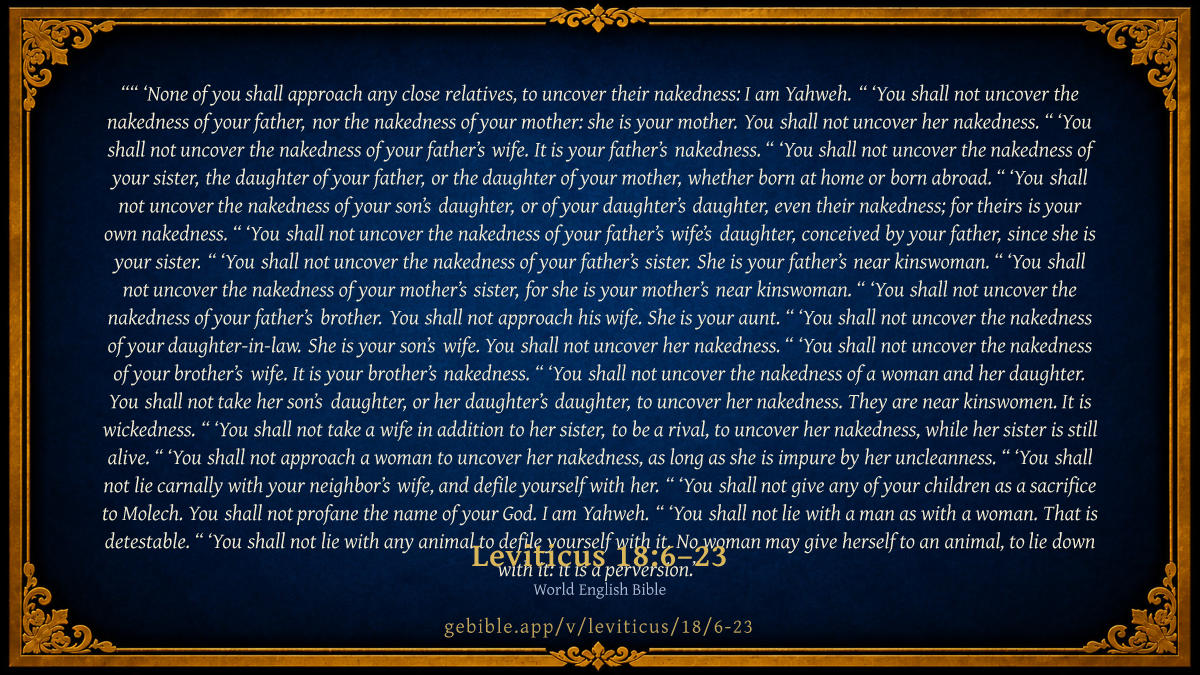
“ ‘None of you shall approach any close relatives, to uncover their nakedness: I am Yahweh.
“ ‘You shall not uncover the nakedness of your father, nor the nakedness of your mother: she is your mother. You shall not uncover her nakedness.
“ ‘You shall not uncover the nakedness of your father’s wife. It is your father’s nakedness.
“ ‘You shall not uncover the nakedness of your sister, the daughter of your father, or the daughter of your mother, whether born at home or born abroad.
“ ‘You shall not uncover the nakedness of your son’s daughter, or of your daughter’s daughter, even their nakedness; for theirs is your own nakedness.
“ ‘You shall not uncover the nakedness of your father’s wife’s daughter, conceived by your father, since she is your sister.
“ ‘You shall not uncover the nakedness of your father’s sister. She is your father’s near kinswoman.
“ ‘You shall not uncover the nakedness of your mother’s sister, for she is your mother’s near kinswoman.
“ ‘You shall not uncover the nakedness of your father’s brother. You shall not approach his wife. She is your aunt.
“ ‘You shall not uncover the nakedness of your daughter-in-law. She is your son’s wife. You shall not uncover her nakedness.
“ ‘You shall not uncover the nakedness of your brother’s wife. It is your brother’s nakedness.
“ ‘You shall not uncover the nakedness of a woman and her daughter. You shall not take her son’s daughter, or her daughter’s daughter, to uncover her nakedness. They are near kinswomen. It is wickedness.
“ ‘You shall not take a wife in addition to her sister, to be a rival, to uncover her nakedness, while her sister is still alive.
“ ‘You shall not approach a woman to uncover her nakedness, as long as she is impure by her uncleanness.
“ ‘You shall not lie carnally with your neighbor’s wife, and defile yourself with her.
“ ‘You shall not give any of your children as a sacrifice to Molech. You shall not profane the name of your God. I am Yahweh.
“ ‘You shall not lie with a man as with a woman. That is detestable.
“ ‘You shall not lie with any animal to defile yourself with it. No woman may give herself to an animal, to lie down with it: it is a perversion.
Geneva Bible translators 1599 · Public Domain On vv6, 8, 9, 10, 12, 14, 16, 18, 19, 21, 23 That is, to lie with her, though it be…
That is, to lie with her, though it be under title of marriage.
Geneva Bible (1599) marginal notes — public domain.
John Trapp 1656 · Public Domain On vv6–23 Lev 18:6 None of you shall approach to any…
Lev 18:6 None of you shall approach to any that is near of kin to him, to uncover [their] nakedness: I [am] the LORD.
Ver. 6. None of you shall approach,] viz., To couple carnally with them. {Eze 18:6 Isa 8:3} Yea, though it be under a pretext of marriage: for by marriage they seem to justify their incest, which makes it the worse, saith Tostatus, whose reason here I like better than that of Cardinal Campeius, though it sound somewhat like. If comparison should be made, said this carnal cardinal, much greater offence it is for a priest to have a wife than to have and keep at home many harlots. For they that keep harlots, said he, {a} as it is naught that they do, so do they acknowledge their sin; the other persuade themselves they do well, and so persist without repentance or conscience of their fact.
Read full note →
{a} Act. and Mon., fol. 790.
John Trapp, A Commentary or Exposition upon All the Books of the Old and New Testament (1647–1656) — public domain. Text from a community e-Sword module.
Matthew Poole 1685 · Public Domain On vv6, 7, 8, 9, 10, 11, 12, 14, 16, 17, 18, 19, 21, 23 None, Heb. no man, For though the women also…
None, Heb. no man, For though the women also be bound by this law, yet the men alone are mentioned, both because they are most active in the choice of their yoke-fellows, and therefore most likely to transgress these laws, and because they having authority over the women, could have the greater influence upon them, by their power, counsel, or example, to oblige them either to the observation or violation of them.
Approach: this word signifies the conjugal act here, as it doth Gen 20:4; Isa 8:3; but because it is ambiguous in itself, it is so limited and explained in the end of the verse.
Read full note →
To any that is near of kin to him: this is the general rule, which is particularly expounded and applied in the following instances. And these laws are so just and reasonable, that although the barbarous nations did allow of such incestuous marriages, yet wiser and civil heathens by the mere light of nature condemned them, as may be seen in Suetonius, Tacitus, Catullus, and others.
Their nakedness, i.e. their secret parts, so called to put us in mind of the fall of our first parents, whose first sense and shame of their nakedness had its rise from thence. This phrase notes the same thing with knowing, Gen 4:1; and with discovering one’s skirt, Deu 22:30; 27:20.
Matthew Poole's English Annotations on the Holy Bible (1683–1685) — public domain. Text from a community e-Sword/MySword module.
Matthew Henry 1710 · Public Domain On vv6, 19 These laws relate to the seventh commandment, and, no…
These laws relate to the seventh commandment, and, no doubt, are obligatory on us under the gospel, for they are consonant to the very light and law of nature: one of the articles, that of a man's having his father's wife, the apostle speaks of as a sin not so much as named among the Gentiles, Co1 5:1. Though some of the incests here forbidden were practised by some particular persons among the heathen, yet they were disallowed and detested, unless among those nations who had become barbarous, and were quite given up to vile affections. Observe,
I. That which is forbidden as to the relations here specified is approaching to them to uncover their nakedness, Lev 18:6.
Read full note →
1. It is chiefly intended to forbid the marrying of any of these relations. Marriage is a divine institution; this and the sabbath, the eldest of all, of equal standing with man upon the earth: it is intended for the comfort of human life, and the decent and honourable propagation of the human race, such as became the dignity of man's nature above that of the beasts. It is honourable in all, and these laws are for the support of the honour of it. It was requisite that a divine ordinance should be subject to divine rules and restraints, especially because it concerns a thing wherein the corrupt nature of man is as apt as in any thing to be wilful and impetuous in its desires, and impatient of check. Yet these prohibitions, besides their being enacted by an incontestable authority, are in themselves highly reasonable and equitable. (1.) By marriage two were to become one flesh, therefore those that before were in a sense one flesh by nature could not, without the greatest absurdity, become one flesh by institution; for the institution was designed to unite those who before were not united. (2.) Marriage puts an equality between husband and wife. "Is she not thy companion taken out of thy side?" Therefore, if those who before were superior and inferior should intermarry (which is the case in most of the instances here laid down), the order of nature would be taken away by a positive institution, which must by no means be allowed. The inequality between master and servant, noble and ignoble, is founded in consent and custom, and there is no harm done if that be taken away by the equality of marriage; but the inequality between parents and children, uncles and nieces, aunts and nephews, either by blood or marriage, is founded in nature, and is therefore perpetual, and cannot without confusion be taken away by the equality of marriage, the institution of which, though ancient, is subsequent to the order of nature. (3.) No relations that are equals are forbidden, except brothers and sisters, by the whole blood or half blood, or by marriage; and in this there is not the same natural absurdity as in the former, for Adam's sons must of necessity have married their own sisters; but it was requisite that it should be made by a positive law unlawful and detestable, for the preventing of sinful familiarities between those that in the days of their youth are supposed to live in a house together, and yet cannot intermarry without defeating one of the intentions of marriage, which is the enlargement of friendship and interest. If every man married his own sister (as they would be apt to do from generation to generation if it were lawful), each family would be a world to itself, and it would be forgotten that we are members one of another. It is certain that this has always been looked upon by the more sober heathen as a most infamous and abominable thing; and those who had not this law yet were herein a law to themselves. The making use of the ordinance of marriage for the patronizing of incestuous mixtures is so far from justifying them, or extenuating their guilt, that it adds the guilt of profaning an ordinance of God, and prostituting that to the vilest of purposes which was instituted for the noblest ends. But,
2. Uncleanness, committed with any of these relations out of marriage, is likewise, without doubt, forbidden here, and no less intended than the former: as also all lascivious carriage, wanton dalliance, and every thing that has the appearance of this evil. Relations must love one another, and are to have free and familiar converse with each other, but it must be with all purity; and the less it is suspected of evil by others the more care ought the persons themselves to take that Satan do not get advantage against them, for he is a very subtle enemy, and seeks all occasions against us.
II. The relations forbidden are most of them plainly described; and it is generally laid down as a rule that what relations of a man's own he is bound up from marrying the same relations of his wife he is likewise forbidden to marry, for they two are one. That law which forbids marrying a brother's wife (Lev 18:16) had an exception peculiar to the Jewish state, that, if a man died without issue, his brother or next of kin should marry the widow, and raise up seed to the deceased (Deu 25:5), for reasons which held good only in that commonwealth; and therefore now that those reasons have ceased the exception ceases, and the law is in force, that a man must in no case marry his brother's widow. That article (Lev 18:18) which forbids a man to take a wife to her sister supposes a connivance at polygamy, as some other laws then did (Exo 21:10; Deu 21:15), but forbids a man's marrying two sisters, as Jacob did, because between those who had before been equal there would be apt to arise greater jealousies and animosities than between wives that were not so nearly related. If the sister of the wife be taken for the concubine, or secondary wife, nothing can be more vexing in her life, or as long as she lives.
Matthew Henry's Commentary on the Whole Bible (1708–1710) — public domain (CC PDM 1.0). Text via the HelloAO Bible API.
John Gill 1763 · Public Domain On vv6–23 None of you shall approach to any that is…
None of you shall approach to any that is near of kin to him,.... Or to all "the rest of his flesh" (t), which together with his make one flesh, who are of the same flesh and blood with him, and are united together in the bonds of consanguinity; and such, with respect to a man, are his mother, sister, and daughter; his mother, of whom he was born, his sister, who lay in and sprung from the same "venter" he did, and his daughter, who is his own flesh; and with respect to a woman, her father brother, and son, who are in the same degree of relation, and both sexes are included in this prohibition; for though in the original text it is "a man, a man" (u), yet as it takes in every man, so every woman: hence, as Jarchi observes, it is expressed in the plural number, "do not ye approach", to caution both male and female; and it is also understood by the Talmudists (w) of Gentiles as well as Israelites, for they ask, what is the meaning of the phrase "a man, a man?" the design of it is, they say, to comprehend the Gentiles, who are equally cautioned against incests as the Israelites; and indeed the inhabitants of the land of Canaan are said to defile the land with the incests and other abominations hereafter mentioned, and for which they were driven out of it: now when man and woman are forbidden to "approach" to those of the same flesh and blood with them, the sense is not that they may not come into each other's company, or make use of any civil or friendly salutations, or have a free and familiar conversation with each other, provided that modesty and chastity be preserved; but they are not so to draw near as to lie with, or have carnal knowledge of one another, in which sense the phrase is used, Gen 20:4; or to tempt to it or solicit it, and as it follows, which explains the meaning of it:
to uncover their nakedness; that is, those parts, which, by a contrary way of speaking, are so called, which should never be naked or exposed to view; but should be always covered, as nature teaches to do, and as our first parents did, when they perceived themselves naked, and were ashamed, Gen 3:7, this phrase signifies the same as to lie with another, or have carnal knowledge of them, wherefore the following laws are generally understood of incestuous marriages; for if such an action is not to be done between persons standing in such a relation, as here in general, and afterwards more particularly described, then there ought to be no intermarriages between them; and if such marriages are forbidden, and such actions unlawful in a married state, then much more in an unmarried one; wherefore the several following instances are so many breaches of the seventh command, Exo 20:14, and so many explications and illustrations of it, and consequently of a moral nature, and binding upon all men, Jews and Gentiles:
Read full note →
I am the Lord; that gave this caution, and enjoined this prohibition, and would greatly resent and severely revenge the neglect of it: the particulars follow.
(t) "ad omnes reliquias carnis suae", Montanus; "ad quascunque reliquias carnis suae", Tigurine version. (u) "vir, vir", Montanus, Vatablus, Drusius. (w) T. Bab. Sanhedrim, fol. 57. 2. T. Hieros. Kiddushin, fol. 58. 2, 3.
John Gill's Exposition of the Whole Bible (1746–1763) — public domain (CC PDM 1.0). Text via the HelloAO Bible API.
John Wesley 1765 · Public Domain On vv6, 16, 18, 19, 21 To uncover their nakedness - I think Mark. Free…
To uncover their nakedness - I think Mark. Free has made it highly probable, that this phrase does not mean marriage, but fornication, throughout this chapter. So it unquestionably means in the twentieth chapter.
John Wesley, Explanatory Notes Upon the Whole Bible (1754–1765) — public domain. Text via the GEBible commentary corpus.
Adam Clarke 1810 · Public Domain On vv6, 16, 18, 19, 20, 21, 22, 23 Verse 6. Any that is near of kin] כל…
Verse 6. Any that is near of kin] כל שאר בשרו col shear besaro, any remnant of his flesh, i. e., to any particularly allied to his own family, the prohibited degrees in which are specified from Le 18:7-17 inclusive. Notwithstanding the prohibitions here, it must be evident that in the infancy of the world, persons very near of kin must have been joined in matrimonial alliances; and that even brothers must have matched with their own sisters. This must have been the case in the family of Adam. In these first instances necessity required this; when this necessity no longer existed, the thing became inexpedient and improper for two reasons:
1. That the duties owing by nature to relatives might not be confounded with those of a social or political kind; for could a man be a brother and a husband, a son and a husband, at the same time, and fulfil the duties of both? Impossible.
Read full note →
2. That by intermarrying with other families, the bonds of social compact might be strengthened and extended, so that the love of our neighbour, c., might at once be felt to be not only a maxim of sound policy, but also a very practicable and easy duty and thus feuds, divisions, and wars be prevented.
Adam Clarke's Commentary on the Bible (1810–1826) — public domain. Text from a community e-Sword/MySword module.
Joseph Benson 1811 · Public Domain On vv6, 7, 9, 14, 16, 17, 18, 19, 21 Lev 18:6. The first of these prohibitions is against…
Lev 18:6. The first of these prohibitions is against all improper and incestuous marriages, a thing very common among the Canaanitish nations and in Egypt, even to the last degree of unnatural mixtures. Diodorus Siculus relates, that it was permitted by law in the latter country, contrary to the custom of other nations, that a man might marry his own sister. None of you shall approach — The prohibition is absolute, and no advances were to be made toward its violation. Indeed the only way to avoid actual transgressions, is to resist and guard against the first motions of evil. Principiis obsta, withstand the first approach of sin, is a most important precept. And it is to be well observed, that as these laws forbade marriages between near relations, they certainly much more prohibited unchastity between them, and every approach to it. Any that is near akin to him — Hebrew, The remainder of his flesh; that is, his immediate relations, so near akin to him, that they are, as we say, his own flesh and blood; such as a man’s sister, mother, daughter. Indeed, had near relations been allowed to marry each other, the most mischievous and fatal consequences must have resulted from it. For being much together in youth, temptations to unchastity would frequently have been too powerful to have been resisted. But, by such a restriction as this, being taught to look upon all such intercourse as prohibited and incestuous, they were assisted to withstand temptations to evil.
Joseph Benson's Commentary on the Old and New Testaments (1811–1818) — public domain. Text from a community e-Sword module.
Albert Barnes 1834 · Public Domain On vv6, 7, 8, 9, 12, 16, 18, 21 Near of kin - See the margin. The term…
Near of kin - See the margin. The term was evidently used to denote those only who came within certain limits of consanguinity, together with those who by affinity were regarded in the same relationship.
To uncover their nakedness - i. e. to have sexual intercourse. The immediate object of this law was to forbid incest.
Albert Barnes' Notes on the Bible (1834–1885) — public domain. Text from a community e-Sword/MySword module.
Haydock's Catholic Bible Commentary 1859 · Public Domain On vv6, 7, 8, 9, 11, 12, 14, 15, 16, 17, 18, 19, 20, 21, 22, 23 Approach to marry, much less to gratify his sensual…
Approach to marry, much less to gratify his sensual appetite. (Haydock) --- To him. Hebrew, "None shall approach to any of their descendants;" ad omnes reliquias carnis suæ; to any of those who spring from the same stock. The Jews assert, that all are bound by the law of nature to abstain from their own mother and sister, from another’s wife, and from unnatural conjunctions. (Selden, Jur. v. 11.) (Calmet) --- Nakedness, or turpitude, which title the body deserves, when it is used in a manner contrary to the law of God.
George Leo Haydock (1774–1849), Haydock's Catholic Family Bible and Commentary, 1859 edition — public domain. Excludes Psalms (Douay-Rheims chapter numbering differs from Protestant) and Deuterocanonical books (Catholic canon only).
Robert Jamieson, A. R. Fausset & David Brown 1871 · Public Domain On vv6, 18, 21 None of you shall approach to any that is…
None of you shall approach to any that is near of kin to him--Very great laxity prevailed amongst the Egyptians in their sentiments and practice about the conjugal relation, as they not only openly sanctioned marriages between brothers and sisters, but even between parents and children. Such incestuous alliances Moses wisely prohibited, and his laws form the basis upon which the marriage regulations of this and other Christian nations are chiefly founded. This verse contains a general summary of all the particular prohibitions; and the forbidden intercourse is pointed out by the phrase, "to approach to." In the specified prohibitions that follow, all of which are included in this general summary, the prohibited familiarity is indicated by the phrases, to "uncover the nakedness" [Lev 18:12-17], to "take" [Lev 18:17-18], and to "lie with" [Lev 18:22-23]. The phrase in this sixth verse, therefore, has the same identical meaning with each of the other three, and the marriages in reference to which it is used are those of consanguinity or too close affinity, amounting to incestuous connections.
Jamieson, Fausset & Brown — Commentary Critical and Explanatory on the Whole Bible (1871) — public domain (CC PDM 1.0). Text via the HelloAO Bible API.
Daniel D. Whedon 1874 · Public Domain On vv6, 7, 8, 9, 11, 16, 17, 18, 19, 20, 21, 22, 23 PROHIBITION OF INCESTUOUS MARRIAGES, Lev_18:6-18.
PROHIBITION OF INCESTUOUS MARRIAGES, Lev_18:6-18.
These fall into three classes: 1.) blood-relationships proper, 7-13; 2.) the wives of blood-relations, 14-16; 3.) the blood relations of the wife. This prohibition is not grounded on the eternal principles of absolute morality, since the command to “multiply and replenish the earth” must have involved the marriage of brothers and sisters in the family of Adam, and since, also, Abraham married his half sister, Jacob two sisters at a time, Amram his aunt Jochebed, and Judah married Tamar, the widow of his own son, with no indication of the divine disapproval; and by the commandment of the Levitical law the brother must marry the wife of his deceased childless brother. Still it must be confessed that the horror naturalis, or revulsion of feeling at the thought of marrying one’s mother or daughter is very closely allied to the abhorrence of the violation of the seventh commandment.
Read full note →
6. Near of kin — Hebrew, the flesh of his flesh, or his blood kindred. In Lev_25:49, the same words are equivalent to “family,” and they are applicable to marriage relationship, since in Lev_18:17-18 they include the near blood relations of the wife.
Uncover… nakedness — This is the customary expression in the Pentateuch for the cohabitation of persons married or unmarried, though the former are chiefly referred to. This prohibition is addressed to males; the exceptions in Lev_18:7; Lev_18:14 are only apparent, not real.
Daniel D. Whedon (gen. ed.), Commentary on the Old and New Testaments (1874–1909) — public domain. Text from a community e-Sword module.
The Cambridge Bible for Schools and Colleges 1878 · Public Domain On vv6, 8, 10, 18, 21 6. A general exhortation (hence perhaps the plural; see…
6. A general exhortation (hence perhaps the plural; see above), introductory to the enumeration of specific cases. Baentsch attributes it to the author of the preceding verses.
The Cambridge Bible for Schools and Colleges (gen. ed. J. J. S. Perowne; Cambridge University Press, 1878–1918) — public domain. Text from a community e-Sword module.
Ellicott's Commentary for English Readers 1878 · Public Domain On vv6–23 (6) None of you shall approach.—Literally, man, man, ye…
(6) None of you shall approach.—Literally, man, man, ye shall not approach. It is part of the phrase used in Lev_17:3; Lev_17:8; Lev_17:13, and should accordingly be rendered by no man whatsoever shall approach. The absence of the words “of the house of Israel,” which, in the other instances, form part of this phrase, as we are assured by the authorities in the time of Christ, shows that these prohibitions are also binding upon the stranger who took up his abode among the Israelites, lest the land be defiled by his transgressions. Though primarily addressed to man, who, in these cases, takes the initiative, the punishment for violating any of these laws was visited upon both man and woman.
Near of kin to him.—Literally, the flesh of his flesh. (See Psa_73:26; Psa_78:20; Psa_78:27; Mic_3:2-3.) The combination of two synonymous expressions is often used to denote intensity. Thus the phrase rendered “my exceeding joy” in the Authorised Version (Psa_43:4), literally means the joy of my joy, or, as the Margin has it, “the gladness of my joy.” Accordingly, “the flesh of his flesh” signified “nearness of his flesh,” his near kin. This technical sense is assigned to the first of these two words by itself in Lev_18:12-13, &c, where it is translated “near kinswoman.” It expresses kinship of both consanguinity and mere affinity. (See Lev_18:17.)
Read full note →
To uncover their nakedness.—Upon the import of this phrase depends the interpretation of the laws laid down in this chapter and chapter 20, inasmuch as it furnishes the clue to the definition whether the interdicts refer to illicit commerce or to incestuous marriages. In the only other passage in the Pentateuch where it occurs, it does not appear to imply any unseemly intention (Exo_20:26). This is also its sense in Isa_47:3. In the seven instances in Ezekiel, however (Eze_16:36-37; Eze_22:10; Eze_23:10; Eze_23:18; Eze_23:29), which are the only other passages in the Bible where this phrase is used, it denotes unseemly exposure, sexual intercourse, etc. Hence some high authorities maintain that in the twenty-one instances in which it is used in this part of the legislation (Lev_18:6-19; Lev_20:11; Lev_20:17; Lev_20:20-21), it denotes extra-conjugal licentiousness, and is simply an explanatory addition to the phrase “approach to,” with which it is combined in Lev_18:6; Lev_18:14; Lev_18:18. From a comparison, however, of Lev_18:18 with Lev_18:19 to Lev_20:11, it will be seen that it is undoubtedly used to denote sexual intercourse both within and without the pale of matrimony. As cohabitation without any religious ceremony whatever constituted and consummated marriage amongst the early Hebrews, the euphemistic phrases “to take home,” “to approach to,” “to know,” etc., as well as the less veiled expressions, “to lie with,” “to uncover her nakedness,” etc., denote marriage in Hebrew, not excluding, however, the primary sense of illicit commerce or incestuous marriages. The context in which the phrase occurs must determine the sense in which it is used. The administrators of the law during the second Temple, whilst rightly interpreting it here generally to denote incestuous marriages, also apply it in some instances to fornication and adultery.
A Bible Commentary for English Readers, edited by Charles John Ellicott (1878–1897) — public domain. Text from a community e-Sword module.
The Pulpit Commentary 1880 · Public Domain On vv6, 7, 9, 10, 11, 12, 16, 17, 18, 19, 20, 21, 22, 23 The next thirteen verses contain the law of incest,…
The next thirteen verses contain the law of incest, or the prohibited degrees of marriage. The positive law of marriage, as implanted in the human heart, would be simply that any man of full age might marry any woman of full age, provided that both parties were willing. But this liberty is at once controlled by a number of restrictions, the main purpose of which is to prevent incest, which, however much one nation may come to be indifferent to one form of it, and another to another, is yet abhorrent to the feelings and principles of mankind. The Hebrew restrictive law is contained in one verse. None of you shall approach to any that is near of kin to him to uncover their nakedness: I am the Lord. All that follows (verses 9-18) is simply an amplification and an explanation of the words, near of kin to him. These words would be literally rendered, flesh of his flesh, or less probably (as in the margin), remainder of his flesh. They certainly include within the compass of their meaning those that are near by affinity, as much as those that are near by consanguinity. This is proved by the instances given below, where no difference is drawn between blood relations and relations by marriage, the latter being supposed to become the former, in consequence of the marriage that has taken place. Nearness of kin is generally counted by "degrees;" but, unfortunately, this word is itself ambiguous, for it is used in different senses by canonists and by civilians. So far as the direct line is concerned, the same method of calculation is observed by the canon and by the civil law. There is one degree from the son to the mother, two degrees to the grandmother; one degree from the father to the daughter, two degrees to the granddaughter. But this is not so with the collateral lines. A brother and sister, for example, are regarded by the canon law as in the first degree of kinship, because there is only one step to the father, in whom their blood meets; but the civil lawyers consider them as being in the second degree, because, as they calculate, there is one step from the brother to the father, and a second from the father to the sister. An aunt is, according to the canonists, in the second degree of propinquity, because there are two steps from her nephew to his grandfather, who is likewise her father, in whom their blood unites; but, according to the civilian"s calculation, there are three steps, namely, from her nephew to his grandfather, two steps, and a third from that grandfather to his daughter the aunt; and therefore the aunt and nephew are in the third degree of propinquity. The case of an uncle and niece is exactly the same as that of a nephew and aunt. On the same principle, according to the canonists, first cousins are in the second degree of kinship; according to the civilians, in the fourth. Propinquity by affinity is calculated in just the same way; so that the brother"s wife is in the same degree of relationship as the brother, and wife"s sister as the sister by blood. In the code before us, confirmed by that in Deuteronomy, marriage is forbidden with the following blood relations: mother (verse 7), daughter (verse 17), sister, (verse 9 Lev_20:17 Deu_27:22) granddaughter (verse 10), aunt; (verses 12, 13 Lev_20:19) and with the following relations by affinity: mother-in-law, (verse 17; chapter Deu_27:23) daughter-in-law, (verse 15; Lev_20:12) brother"s wife, (verse 16; Lev_20:21) stepmother, (verse 8 Lev_20:11, 14 Deu_22:30; see Gen_49:4 1Co_5:1) stepdaughter and step-granddaughter (verse 17), uncle"s wife, or aunt by marriage; (verse 14; Lev_20:20) putting aside for the present the question of who is meant by a wife to her sister, in verse 18. In these lists, according to the canonists" method of reckoning, the mother, the daughter, and the sister are related in the first degree of consanguinity; the wife"s mother, the wife"s daughter, the stepmother, the daughter-in-law, the brother"s wife, are related in the first degree of affinity. The granddaughter and the aunt are in the second degree of consanguinity; the wife"s granddaughter and the uncle"s wife in the second degree of affinity. According to the civilians" reckoning, the following would be the degrees of propinquity: The mother and the daughter would be in the first degree of consanguinity; the wife"s mother, the wife"s daughter, the stepmother, the daughter-in-law, would be in the first degree of affinity. The sister and the granddaughter would be in the second degree of consanguinity; the brother"s wife and the wife"s granddaughter would be in the second degree of affinity. The aunt by blood would be in the third degree of consanguinity, and the uncle"s wife, or aunt by marriage, would be in the third degree of affinity. The wife"s sister, with regard to whom it is questioned whether she is referred to or not in verse 18, is in the first degree of affinity (a man"s wife being regarded as himself) according to the canonists" reckoning, and in the second according to the civilians". There is no mention made in the code of the grandmother, the niece, and the cousin-german. All of these are in the second degree of consanguinity according to the canon law; and according to the civil law, the grandmother would be in the second degree, the niece in the third, and the cousin-german in the fourth. It may reasonably be supposed that by the expression, None of you shall approach to any that is near of kin to him, to uncover their nakedness, intercourse is forbidden between all those who are related by consanguinity or affinity in the first and second degrees according to the canonists" reckoning (except cousins-german, whose case is considered below); in the first, second, and third degrees "according to the civilians" method of calculating; whether they are mentioned by name in the list or not. It is only by implication, not by direct injunction, that marriage even with a daughter is forbidden (verse 17).
Vers. 6-23. Impurity its extent and source.
Read full note →
There are times when and conditions under which it is both our right and our duty to speak on this subject. We may offend delicacy by speech, and must therefore be careful what we say. But we may neglect obligation and opportunity by silence, and must therefore use fitting occasion for speech. There is a time to warn the young against an evil which may slay them with a mortal wound. We may glance, and only glance, at
I THE FEARFUL LENGTH TO WHICH IMPURITY MAY PASS. God made man male and female that, related to one another thus, they might be happy in one another"s fellowship; that husband, wife, and child might complete the harmony of human life. But for the confusing and disturbing element of sin, there would have been nothing but holy conjugal affection and happy human homes. How dark and sad a contrast to this does society present! How melancholy the thought that impurity should Dot only have tainted so many souls, but should have taken so may forms! that not only have the natural relations of the sexes been too unlimited, too unrestrained, but that sin of this description has taken unnatural, shocking, and abominable forms! that its dark and shameful manifestations are such as we hardly like to Dame, and do not dare to think of (verses 22, 23)! Only a holy compulsion will induce us even to make passing reference to such things. So low, to such dark depths, into such a "far country" of vileness does the sin of impurity extend.
II THAT GUILTY INDULGENCE IS THE ONLY EXPLANATION OF THIS EVIL PROGRESS. How can such things be? is the simple question of the pure heart. How by any possibility can human nature sink into such a gulf of depravity? How can we account for it that the soul which once knew the innocency of childhood finds an awful pleasure in such shameful deeds? The answer is undoubtedly here. The very possibility of it is a part of the penalty of the sins which have been committed. Sins of impurity leave a stain upon the soul; the seducer has not only to suffer the rebuke of God, the reproaches of the one he has wronged and ruined, and the stings of his own conscience some day to be awakened, but he has to "bear his iniquity" in adepraved taste, in a stained and injured nature, in a lowered and baser appetite. In this, as in other matters, perhaps more fearfully than in most, "he that sinneth against God wrongeth his own soul". (Pro_8:36) Let the man who gives way to impurity remember that he is traveling on a downward course that ends in saddest depravation of soul, and that will leave him open to those more vile temptations which would disgrace and even disgust him now.
III THE TRUE TREATMENT OF THIS DESTROYING SIN. Trace the evil back from its worst developments to its mildest form; from its fullest crime to its source in the soul. Incest, adultery, fornication, seduction, indecency, indelicate conversation, the impure thought. This last is the source of all. It is that which must be assailed, which must be expelled.
In this matter of the relation of the sexes, there are three main truths.
1. God gives to most of us the joy of conjugal love, and this is to be sanctified by being accepted as his gift. (Jam_1:17) Where it is denied we must be well satisfied with other mercies so freely given.
2. Its lasting happiness is only assured to the pure of heart. With all others its excellency will soon fade and die.
3. Therefore let us, by all possible means, guard our purity:
a. by avoidance of temptation (evil company, wrong literature);
b. by energetic expulsion of unworthy thoughts;
c. by realization of the presence of the heart-searching Holy One;
d. by earnest prayer; let us "keep our heart beyond all keeping,". C. (Pro_4:23)
The Pulpit Commentary (1880–1919), ed. H.D.M. Spence-Jones & Joseph S. Exell — public domain. Text from a community e-Sword module.
The Biblical Illustrator 1887 · Public Domain On v6 None of you shall approach to any that is…
Lev_18:6-30
None of you shall approach to any that is near of kin to him.
Read full note →
Consanguinity
1. God the institutor of marriage (Lev_18:6).
2. Faith in Christ not commanded in the law (Lev_18:5).
3. Of the several kinds of kindred by consanguinity or affinity.
4. Of the computation of the degrees of consanguinity.
(1) Consanguinity is a communicating in blood, derived from one stock.
(2) Affinity is a respective alliance and kindred which comes in by marriage.
(3) A line is a collection of persons coming from the stock.
(4) And it is threefold: the right line Ascending, as the father, grandfather; or descending, as the son, &c.; or collateral above, as the fathers brother--or in the middle, as brother, sister, uncles children--or below, as brothers son or daughter, and their sons and daughters.
(5) A degree is the distance of persons from the stock.
(6) In the right line ascending or descending, there are as many degrees as generations and persons.
(7) In the collateral line there are as many degrees as persons.
(8) In the collateral line the prohibition is extended to the fourth degree.
(9) In the right line ascending and descending, the impediment is perpetual when they are alive or dead, as grounded upon the law of nature.
(10) The same degrees are forbidden ascending and descending by the like analogy.
(11) The same degrees are restrained by the like analogy in both sexes.
(12) Where the degree further off is forbidden, the nearer are inclusively interdicted.
5. Of the computation of the degrees of affinity.
(1) In what degree of consanguinity the husband is distant, in the same degree of affinity the wife is removed, because man and wife are one flesh.
(2) One person added to another by carnal copulation changes the kind of affinity, not the degree: as the brothers wife is of affinity in the second degree, and first kind; if after she marry another husband, he is in the same degree of affinity, but in the second kind.
(3) There are three kinds of affinity--the near, middle, and remote: as the brothers wife is in the first kind, the brothers wifes second husband in the second, the second husbands second wife in the third.
(4) Affinity in the first kind is a perpetual impediment.
(5) Between such as are of kindred in blood to the husband, and them that are of kin to the wife, there is no affinity to hinder marriage: as, two brothers may marry two sisters.
(6) In the degrees of affinity ascending and descending in the right line, the prohibition is infinitely extended without any limitation: as, it is not lawful to marry the wifes daughters daughter, and so downward, nor the wifes mother, or grandmother, and so upward.
(7) In the collateral line, affinity is restrained to the third degree, as to uncles wife, who is in the same degree of affinity that her husband is in consanguinity.
(8) Of the agreements and differences between the degrees of consanguinity and affinity.
(1) Agreement.
(a) In what degree one is of consanguinity, the wife or husband is in the same degree of affinity.
(b) The impediment in both continues not only during life but afterward.
(c) The prohibition extends itself in both alike, in the right line ascending and descending without limitation; and in the collateral to the third degree expressly, and by a certain analogy to the fourth.
(2) Differences.
(a) The efficient cause of consanguinity is a natural obligation, without any relation to the will and consent of man, in the propagation and the line of consanguinity; but in affinity there is a voluntary bond or obligation by consent in marriage.
(b) Consanguinity is by generation from one, both father and mother; affinity is by the copulation of two. The first is real, the second by relation.
(c) In consanguinity, on both sides the bond holds, both by the father and mother, but the kinsmen of the husband are not of affinity to the kindred of the wife; on the contrary, affinity holds only in the first kind, which changes by a new copulation, though the degree alter not, as the brothers wifes second husband is not properly of affinity; but in consanguinity, the kind and degree hold out together.
6. Marriage of divers wives successively, lawful, though not together (Lev_18:18).
7. The Scripture most pure, even when it makes mention of impure and obscene things. (A. Willet, D. D.)
Moral observations
1. To walk constantly in the obedience of Gods law (Lev_18:4).
2. Against the monstrous sin of adultery (Lev_18:20).
3. Against the unnatural and most abominable sin of bestiality (Lev_18:23).
4. To profit by other mens examples, and to be warned by their punishments (Lev_18:25).
5. God not partial in His judgments, and therefore no man should presume (Lev_18:28). (A. Willet, D. D.)
On marriage with a deceased wifes sister
By the wording of the Hebrew text a man is permitted to marry his deceased wifes sister, but not to have two sisters for wives at the same time, or one after the other while both are living--this is the logical inference to be drawn from the qualifying addition in her lifetime; and yet by the spirit of the Levitical laws, the former alliance also is like an alliance with a sister, and therefore no less objectionable. Such scruples were indeed unknown to the Hebrews of earlier times, since even in Genesis Jacob is represented as the husband of the sisters Rachel and Leah; but they followed with necessity from the severe theory of marriage gradually worked out and adopted. Philo, in the oldest explanation of our law that has come down to us, observes that it is impious for one sister to usurp the place of the other, and to make the misfortune of the latter a stepping-stone of her own happiness; thus bitter jealousies and implacable enmities must be engendered; and it would be as if the different members of the body, abandoning their natural harmony and fellowship, were to quarrel with one another, thus inevitably causing incurable diseases and endless mischief. In this sense the prohibition has commonly been understood, and if the words of our verse alone are weighed, it can hardly be understood otherwise: and yet the matrimonial laws, taken as a whole, were not prompted by considerations of mere expediency, such as the prevention of unsisterly rivalry, since their main object was to warn against alliances between near relations (verse 6). From whatever side we weigh the question, we cannot help being struck by the incongruity of a code which permits a woman to marry, at least under certain conditions, her sisters husband, but expressly forbids a man to marry his brothers wife. If the wife dies, her husband does not cease to be the brother of that wifes sister; yet practical life seemed to demand some relief from the rigour of abstract logic, and the prohibition was limited to the lifetime of both sisters. It has bee contended that this was a concession analogous to the levirat and the permission of divorce; but the cases are not quite parallel: the Levitical legislators are entirely silent with regard to the levirat and divorce; for in their own time the former was unnecessary, and the latter was strongly opposed by contemporaries, such as Malachi; a direct repeal of the two statutes, known to the people as a part of Deuteronomy, or the Book of the Law, was unfeasible; and silence on these subjects was sufficiently significant. We need hardly add that these remarks are merely designed to elucidate the meaning and intention of the command, without attempting to decide upon its value or its binding force; the latter points must be left to individual judgment and feeling, which in no other sphere claim greater respect and freedom. The prevailing laws of matrimony may possibly, in the course of time, call for revision; and progress and liberty of action should not be checked by a misconception of Biblical authority. The very verse under consideration affords the strongest proof that the ordinances of the Levitical code are not final and unalterable; for this verse involves the sanction of polygamy, which, not even abrogated by Christ and the apostles, is now regarded by western Jews and Christians not merely as inexpedient, but as immoral. It is well known that from comparatively early times, many chiefs of the Christian Church indeed translated the words of our verse literally, yet weighing the spirit of the law, were strongly opposed to the marriage with the deceased wifes sister. By the Apostolic Canons (about 300) persons contracting such an alliance were for ever incapacitated for clerical functions. The Council of Illiberis (about 305) excluded them from holy communion for five years; St. Basil (375) imposed upon them for seven years the ecclesiastical penalties fixed for adultery; his celebrated letter on the subject proves that, in the Church a custom equivalent to a law, and handed down by holy men had been established against such marriages; it was in his time probably that the Septuagint (in Deu_27:23) received the interpolation found in the Vatican copy of that version, Cursed be he who lies with his wifes sister; and similar views were enforced by the emperors Constantius and Theodosius, Honorius, Theodosius II., and Justinian, and by all the leaders of the Greek and Latin Church: the only notable exception is Diodorus, bishop of Tarsus; but he was indignantly opposed by his contemporary St. Basil, who declared that such marriages are indeed permitted to the Jews because they are under the law and all its ceremonial enactments, but not to the free Christians, and asked how the offspring of the two sisters would be related to each other, whether they should be called cousins or brothers, since by a deplorable confusion they could claim both names. In England those marriages were forbidden in 1603 by the Convocation of the province of Canterbury in a Canon which has never been formally ratified by Parliament. Dispensations were, however, readily granted in the Roman Church; and since the last century many Protestant theologians and jurists, and among the first those of the pietistic schools, as Philip Jacob Spener, declared marriage with the deceased wifes sister unobjectionable, since the prohibition is not unequivocally enjoined in the Bible. It was disapproved of by the Karaites; but among the bulk of the Jews it has at all times not only been tolerated but encouraged. (M. M. Kalisch, Ph. D.)
Of unlawful marriages
As the chosen and covenant tribes of Israel were soon to take up their journey to the land of Canaan, the inhabitants of which were to be exterminated for their multifarious iniquities in the sight of God, a recital is here made of some of those aggravated forms of wickedness which were rife among them, and which God had determined signally to punish. This is done not only to illustrate the justice of the Divine proceedings in their excision, but also with a view to put the peculiar people themselves on their guard against yielding to the contagion of their pernicious example, and thus becoming obnoxious to the same fearful retributions which were now about to be visited upon the Canaanites. The particular class of abominations more especially pointed out in this chapter, and to which the brand-mark of the Divine reprobation is so conspicuously affixed, is that of incestuous connections. Not only had that abandoned race been guilty of a total apostacy from the worship of the true God, substituting in His room the sun, and moon, and host of heaven, and bowing down to stocks and stones and creeping things, but they had mingled with their idolatry every vice that could degrade human nature and pollute society. In the black catalogue of these the abominations of lust Stand pre-eminent; and whether in the form of adultery, fornication, incest, sodomy, or bestiality, they had now risen to a pitch of enormity which the forbearance of heaven could tolerate no longer, and of which a shuddering dread was to be begotten in the minds of the people of the covenant. And in order that no possible plea of ignorance or uncertainty might be left in their minds as to those connections which were lawful and those which were forbidden, the Most High proceeds in the present and in the 20th chapter to lay down a number of specific prohibitions on this subject, so framed, as not only to include the extra-nuptial pollutions, which had prevailed among the heathen, but also all those incestuous unions which were inconsistent with the purit and sanctity of the marriage relation. Both classes of crimes we think are in fact included; so that it is doing no violence to the spirit of the text to regard it as containing a system of marriage-laws by which the peculiar people were ever after to be governed. As this is the only passage in the compass of the whole Bible where any formal enactments are given on this subject, this and the connected chapters treating of this theme have always been deemed of peculiar importance in their relations to the question of the lawful degrees within which the marriage connection may now be formed by those who make the law of God the great standard of moral duty. (G. Bush.)
The wilderness a suitable place for the giving of these laws
The wilderness in which they now were was a very fit place for enjoining these laws upon the Israelites, as they were now removed from the snares and temptations of Egypt, and were not yet mingled with the people of Canaan. (Bp. Kidder.)
Need for marriage laws
The necessity for laws on this point at once discriminating, wise, and stringent, will be sufficiently obvious when we consider the strength of the passion to be controlled--constitutionally common to all ages of the world; the sacredness of the marriage relation and the inestimable value of moral purity in all human society--also common to all ages of the worlds history; and (peculiar to the earlier ages) the necessity of defining the limits of consanguinity within which marriage should be prohibited. Perhaps we need to remind ourselves that the race having sprung from a single pair and the world having been repeopled a second time from one family, those primitive examples may have sent down for many generations a certain looseness which called for special restraint and a carefully defining law. The crimes of Sodom, their polluting influence in so good a family as that of Lot; the low morals of Egyptian life; some sad manifestations in the early history of Jacobs family; the horrible contagion of Moab and Midian when the tribes of Israel came socially near them; these and kindred facts will be readily recalled as in point to show the necessity of vigorous legislation in the Mosaic code to counteract these untoward influences of their antecedent life and of surrounding society. (H. Cowles, D. D.)
.
The Biblical Illustrator, edited by Joseph S. Exell (c. 1880s–1900s) — public domain. Text from a community e-Sword module.
C. I. Scofield 1917 · Public Domain On v21 Called Moloch. Act 7:43.
Molech
Called Moloch. Act 7:43.
The Scofield Reference Bible (1917 edition), notes by C. I. Scofield — public domain. Text from a community e-Sword module.
Paul E. Kretzmann 1924 · Public Domain On v21 Unnatural Lusts
Unnatural Lusts
v. 21. And thou shalt not let any of thy seed pass through the fire to Molech, an ancient Canaanitish idol in the form of a hollow statue with the head of an ox, in whose worship such bestial practices of sacrificing children, in an excess of cruelty, were common; neither shalt thou profane the name of thy God, as would certainly happen through participation in such abominations. I am the Lord.
Read full note →
v. 22. Thou shalt not lie with mankind as with womankind, in the sin known as sodomy or as pederasty; it is abomination.
v. 23. Neither shalt thou lie with any beast to defile thyself there with; neither shall any woman stand before a beast to lie down thereto, to permit carnal intercourse; it is confusion, a most abominable and revolting defilement.
v. 24. Defile not ye yourselves in any of these things, in these bestial perversions of sexual desire: for in all these the nations are defiled which I cast out before you;
v. 25. and the land is defiled; therefore I do visit the iniquity thereof upon it, and the land itself vomiteth out her inhabitants. The story of Sodom shows to what extent unnatural vices were practiced by the inhabitants of Canaan, to a degree that nature itself could no longer endure them.
v. 26. Ye shall therefore keep My statutes and My judgments, and shall not commit any of these abominations, neither any of your own nation, nor any stranger that sojourneth among you ("The land which the ancestors of Israel were not allowed to possess because the iniquity of the Amorites not yet full, Gen 15:16, had now become filled with a mass of festering moral corruption. Its inhabitants were to be cast out and the holy people planted in their stead. It could not be allowed that ’the stranger’ should again introduce the pollutions which were now being so severely punished. " Lange),
v. 27. (for all these abominations have the men of the land done which were before you, and the land is defiled,)
v. 28. that the land spue not you out also when ye defile it, as it spued out the nations that were before you. The land is personified as a creature which is obliged to vomit forth some form of indigestible food with every indication of revulsion.
v. 29. For whosoever shall commit any of these abominations, even the souls that commit them shall be cut off from among their people.
v. 30. Therefore shall ye keep Mine ordinance, the precept covering this matter based upon natural law, that ye commit not any one of these abominable customs which were committed before you, and that ye defile not yourselves therein. I am the Lord, your God, and the just and holy God cannot endure such customs of abomination, as in those days, so in our times. There is a hint in this Chapter which has been sustained abundantly by history, namely, that any relaxation of sexual purity will usually be accompanied by the perversion or denial of some fundamental doctrine.
Paul E. Kretzmann, Popular Commentary of the Bible (1921–1924) — public domain. Text from a community e-Sword module.
unfoldingWord translationNotes 2017 · CC BY-SA 4.0 On vv6, 9, 12, 15, 17, 19, 21, 22 your father's wives
your father's wives
Sometimes men had more than one wife. God did not allow a son to sleep with any woman married to his father.
Read full note →
translationWords
had relations with
dishonor
unfoldingWord translationNotes — © Distant Shores Media and the Door43 World Missions Community, licensed CC BY-SA 4.0. Source: git.door43.org/Door43/en_tn.
Tyndale Open Study Notes 2022 · CC BY-SA 4.0 On vv6, 7, 9, 12, 14, 15, 16, 17, 18, 20, 21, 22, 23 18:6-7 have sexual relations with: Literally to uncover the…
18:6-7 have sexual relations with: Literally to uncover the nakedness of. Similar regulations in ch 20 use the Hebrew word shakab (“lie with”), a word frequently used to indicate an improper sexual relationship.
Tyndale Open Study Notes — © Tyndale Open Resources, licensed CC BY-SA 4.0. Text via the HelloAO Bible API.