
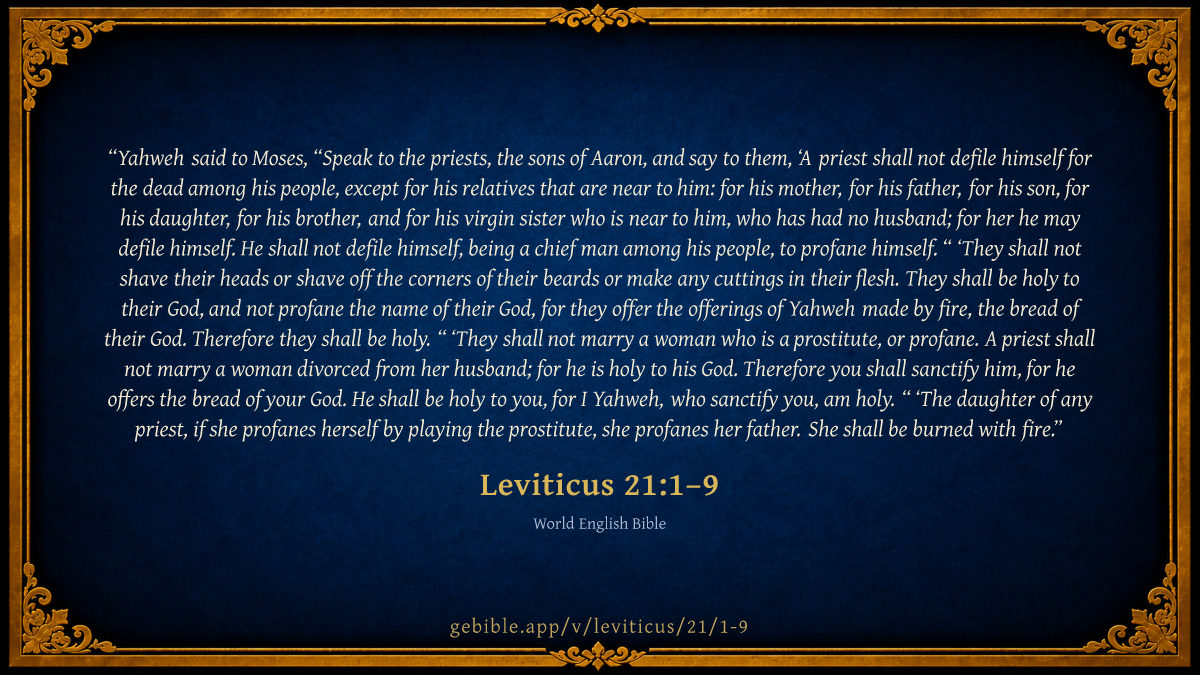
Yahweh said to Moses, “Speak to the priests, the sons of Aaron, and say to them, ‘A priest shall not defile himself for the dead among his people, except for his relatives that are near to him: for his mother, for his father, for his son, for his daughter, for his brother, and for his virgin sister who is near to him, who has had no husband; for her he may defile himself. He shall not defile himself, being a chief man among his people, to profane himself.
“ ‘They shall not shave their heads or shave off the corners of their beards or make any cuttings in their flesh. They shall be holy to their God, and not profane the name of their God, for they offer the offerings of Yahweh made by fire, the bread of their God. Therefore they shall be holy.
“ ‘They shall not marry a woman who is a prostitute, or profane. A priest shall not marry a woman divorced from her husband; for he is holy to his God. Therefore you shall sanctify him, for he offers the bread of your God. He shall be holy to you, for I Yahweh, who sanctify you, am holy.
“ ‘The daughter of any priest, if she profanes herself by playing the prostitute, she profanes her father. She shall be burned with fire.
Geneva Bible translators 1599 · Public Domain On vv1, 3, 4, 7, 8 By touching the dead, lamenting, or being at their…
By touching the dead, lamenting, or being at their burial.
Geneva Bible (1599) marginal notes — public domain.
John Trapp 1656 · Public Domain On vv1–9 Lev 21:1 And the LORD said unto Moses, Speak…
Lev 21:1 And the LORD said unto Moses, Speak unto the priests the sons of Aaron, and say unto them, There shall none be defiled for the dead among his people:
Ver. 1. There shall none be defiled for the dead.] This holy abstinence of the priests in matter of mourning, marriage, &c., figured the transcendent holiness of Christ: the devils could call him that Holy One of God. {Mar 1:24} It taught also both ministers and people, who are "a kingdom of priests"; (1.) Well to govern their passions, and to be patterns of patience; (2.) Ever to keep such a Sabbath of spirit, that by no dead works, or persons dead in trespasses and sins, they be hindered in the discharge of their duties of either calling.
John Trapp, A Commentary or Exposition upon All the Books of the Old and New Testament (1647–1656) — public domain. Text from a community e-Sword module.
Matthew Poole 1685 · Public Domain On vv1–9 To wit, by touching of the dead body, or…
To wit, by touching of the dead body, or abiding in the same house with it, or assisting at his funerals, or eating of the funeral feast. The reason of this law is evident, because by such pollution they were excluded from converse with men, to whom by their function they were to be serviceable upon all occasions, and from the handling of holy things, Num 6:6; 19:11,14,16; Deu 26:14; Hos 9:4. And God would hereby teach them, and in them all successive ministers of holy things, that they ought so entirely to give themselves to the service of God, that they ought to renounce all expressions of natural affections, and all worldly employments, so far as they are impediments to the discharge of their holy services. See Lev 10:3,7; Deu 33:9; Mat 8:22. Hereby also God would beget in the people a greater reverence to the priestly function, and oblige the priests to a greater degree of strictness and purity than other men.
Matthew Poole's English Annotations on the Holy Bible (1683–1685) — public domain. Text from a community e-Sword/MySword module.
Matthew Henry 1710 · Public Domain On v1 It was before appointed that the priests should teach…
It was before appointed that the priests should teach the people the statutes God had given concerning the difference between clean and unclean, Lev 10:10, Lev 10:11. Now here it is provided that they should themselves observe what they were to teach the people. Note, Those whose office it is to instruct must do it by example as well as precept, Ti1 4:12. The priests were to draw nearer to God than any of the people, and to be more intimately conversant with sacred things, and therefore it was required of them that they should keep at a greater distance than others from every thing that was defiling and might diminish the honour of their priesthood.
I. They must take care not to disparage themselves in their mourning for the dead. All that mourned for the dead were supposed to come near the body, if not to touch it: and the Jews say, "It made a man ceremonially unclean to come within six feet of a dead corpse;" nay, it is declared (Num 19:14) that all who come into the tent where the dead body lies shall be unclean seven days. Therefore all the mourners that attended the funeral could not but defile themselves, so as not to be fit to come into the sanctuary for seven days: for this reason it is ordered, 1. That the priests should never put themselves under this incapacity of coming into the sanctuary, unless it were for one of their nearest relations, Lev 21:1-3. A priest was permitted to do it for a parent or a child, for a brother or an unmarried sister, and therefore, no doubt (though this is not mentioned) for the wife of his bosom; for Ezekiel, a priest, would have mourned for his wife if he had not been particularly prohibited, Eze 24:17. By this allowance God put an honour upon natural affection, and favoured it so far as to dispense with the attendance of his servants for seven days, while they indulged themselves in their sorrow for the death of their dear relations; but, beyond this period, weeping must not hinder sowing, nor their affection to their relations take them off from the service of the sanctuary. Nor was it at all allowed for the death of any other, no, not of a chief man among the people, as some read it, Lev 21:4. They must not defile themselves, no, nor for the high priest himself, unless thus akin to them. Though there is a friend that is nearer than a brother, yet the priests must not pay this respect to the best friend they had, except he were a relation, lest, if it were allowed for one, others should expect it, and so they should be frequently taken off from their work: and it is hereby intimated that there is a particular affection to be reserved for those that are thus near akin to us; and, when any such are removed by death, we ought to be affected with it, and lay it to heart, as the near approach of death to ourselves, and an alarm to us to prepare to follow. 2. That they must not be extravagant in the expressions of their mourning, no, not for their dearest relations, Lev 21:5. Their mourning must not be either, (1.) Superstitious, according to the manner of the heathen, who cut off their hair, and let out their blood, in honour of the imaginary deities which presided (as they thought) in the congregation of the dead, that they might engage them to be propitious to their departed friends. Even the superstitious rites used of old at funerals are an indication of the ancient belief of the immortality of the soul, and its existence in a separate state: and though the rites themselves were forbidden by the divine law, because they were performed to false gods, yet the decent respect which nature teaches and which the law allows to be paid to the remains of our deceased friends, shows that we are not to look upon them as lost. Nor, (2.) Must it be passionate or immoderate. Note, God's ministers must be examples to others of patience under affliction, particularly that which touches in a very tender part, the death of their near relations. They are supposed to know more than others of the reasons why we must not sorrow as those that have no hope (Th1 4:13), and therefore they ought to be eminently calm and composed, that they may be able to comfort others with the same comforts wherewith they are themselves comforted of God. The people were forbidden to mourn for the dead with superstitious rites (Lev 19:27, Lev 19:28), and what was unlawful to them was much more unlawful to the priest. The reason given for their peculiar care not to defile themselves we have (Lev 21:6): Because they offered the bread of their God, even the offerings of the Lord made by fire, which were the provisions of God's house and table. They are highly honoured, and therefore must not stain their honour by making themselves slaves to their passions; they are continually employed in sacred service, and therefore must not be either diverted from or disfitted for the services they were called to. If they pollute themselves, they profane the name of their God on whom they attend: if the servants are rude and of ill behaviour, it is a reflection upon the master, as if he kept a loose and disorderly house. Note, All that either offer or eat the bread of our God must be holy in all manner of conversation, or else they profane that name which they pretend to sanctify.
Read full note →
II. They must take care not to degrade themselves in their marriage, Lev 21:7. A priest must not marry a woman of ill fame, that either had been guilty or was suspected to have been guilty of uncleanness. He must not only not marry a harlot, though ever so great a penitent for her former whoredoms, but he must not marry one that was profane, that is, of a light carriage or indecent behaviour. Nay, he must not marry one that was divorced, because there was reason to think it was for some fault she was divorced. The priests were forbidden to undervalue themselves by such marriages as these, which were allowed to others, 1. Lest it should bring a present reproach upon their ministry, harden the profane in their profaneness, and grieve the hearts of serious people: the New Testament gives laws to ministers' wives (Ti1 3:11), that they be grave and sober, that the ministry be not blamed. 2. Lest it should entail a reproach upon their families; for the work and honour of the priesthood were to descend as an inheritance to their children after them. Those do not consult the good of their posterity as they ought who do not take care to marry such as are of good report and character. He that would seek a godly seed (as the expression is, Mal 2:15) must first seek a godly wife, and take heed of a corruption of blood. It is added here (Lev 21:8), Thou shalt sanctify him, and he shall be holy unto thee. "Not only thou, O Moses, by taking care that these laws be observed, but thou, O Israel, by all endeavours possible to keep up the reputation of the priesthood, which the priests themselves must do nothing to expose or forfeit. He is holy to his God (Lev 21:7), therefore he shall be holy unto thee." Note, We must honour those whom our God puts honour upon. Gospel ministers by this rule are to be esteemed very highly in love for their works' sake (Th1 5:13), and every Christian must look upon himself as concerned to be the guardian of their honour.
III. Their children must be afraid of doing any thing to disparage them (Lev 21:9): If the daughter of any priest play the whore, her crime is great; she not only polluteth but profaneth herself: other women have not that honour to lose that she has, who, as one of a priest's family, has eaten of the holy things, and is supposed to have been better educated than others. Nay, she profaneth her father; he is reflected upon, and every body will be ready to ask, "Why did not he teach her better?" And the sinners in Zion will insult and say, "Here is your priest's daughter." Her punishment there must be peculiar: She shall be burnt with fire, for a terror to all priests' daughters. Note, The children of ministers ought, of all others, to take heed of doing any thing that is scandalous, because in them it is doubly scandalous, and will be punished accordingly by him whose name is Jealous.
Matthew Henry's Commentary on the Whole Bible (1708–1710) — public domain (CC PDM 1.0). Text via the HelloAO Bible API.
John Gill 1763 · Public Domain On vv1–9 And the Lord said unto Moses,.... According to some…
And the Lord said unto Moses,.... According to some Jewish writers this was said on the day the tabernacle was set up; no doubt it was delivered at the same time the above laws were given; and as care was taken for the purity and holiness of the Israelites in general, it was necessary that the priests that were concerned in a more especial manner in the service and worship of God should be holy also, and have some instructions given them to take care and keep themselves from all defilements; and particularly the Jewish writers observe, that this paragraph or section concerning the priests follows upon, and is in connection with the law concerning such as have familiar spirits, and wizards, to teach men, that in matters of doubt and difficulty they should not have recourse to such persons, but to the priests of the Lord:
speak unto the priests, the sons of Aaron; the priests, whether elder or younger, whether fit for service, and whether having blemishes, or not; for there are some things which concern them, and these are sons, male children of Aaron, as the Targum of Jonathan, and not daughters, as Jarchi and others observe; for they were not obliged to regard the laws and rules here given:
Read full note →
and say unto them, there shall none be defiled for the dead among his people; by entering into a tent or house where a dead body lay, by touching it, or by hearing it, or attending it to the grave, or by any expressions of mourning for it, see Num 19:11; that is, for any person in common that were of his people, that were not nearly related to him, as in the cases after excepted; so it was a custom with the Romans, as we are told (n), that such as were polluted by funerals might not sacrifice, which shows that priests were not allowed to attend funerals, which perhaps might be taken from hence; and so Porphyry says (o), that sacred persons and inspectors of holy things should abstain from funerals or graves, and from every filthy and mournful sight.
(n) Servius in Virgil. Aeneid. l. xi. ver. 3. (o) De Abstinentia, l. 2. c. 50.
John Gill's Exposition of the Whole Bible (1746–1763) — public domain (CC PDM 1.0). Text via the HelloAO Bible API.
John Wesley 1765 · Public Domain On vv1–9 Directions to the priests, ver. 1-9. To the high-priest,…
Directions to the priests, ver. 1-9. To the high-priest, ver. 10- 15. None of these must have any blemish, ver. 16-24.
Among his people - None of the priests shall touch the dead body, or assist at his funeral, or eat of the funeral feast. The reason of this law is evident, because by such pollution they were excluded from converse with men, to whom by their function they were to be serviceable upon all occasions, and from the handling of holy things. And God would hereby teach them, and in them all successive ministers, that they ought entirely to give themselves to the service of God. Yea, to renounce all expressions of natural affection, and all worldly employments, so far as they are impediments to the discharge of their holy services.
John Wesley, Explanatory Notes Upon the Whole Bible (1754–1765) — public domain. Text via the GEBible commentary corpus.
Adam Clarke 1810 · Public Domain On vv1, 4, 5, 7, 9 The priests shall not mourn for the dead, except…
CHAPTER XXI
The priests shall not mourn for the dead, except for near
Read full note →
relatives, such as mother, father, son, daughter, and sister
if a virgin, 1-4.
They shall not shave their heads nor beards, nor make any
cuttings in the flesh, because they are holy unto God, 5, 6.
A priest shall not marry a woman who is a whore, profane, or
divorced from her husband, 7, 8.
Of the priest's daughter who profanes herself, 9.
The high priest shall not uncover his head, or rend his clothes,
10;
nor go in unto a dead body, 11;
nor go out of the sanctuary, 12.
Of his marriage and off-spring, 13-15.
No person shall be made a priest that has any blemish nor
shall any person with any of the blemishes mentioned here be
permitted to officiate in the worship of God, 16-24.
NOTES ON CHAP. XXI
Verse 1. There shall none be defiled for the dead] No priest shall assist in laying out a dead body, or preparing it for interment. Any contact with the dead was supposed to be of a defiling nature, probably because putrefaction had then taken place; and animal putrefaction was ever held in detestation by all men.
Adam Clarke's Commentary on the Bible (1810–1826) — public domain. Text from a community e-Sword/MySword module.
Joseph Benson 1811 · Public Domain On vv1–9 Lev 21:1. Speak unto the priests — The next…
Lev 21:1. Speak unto the priests — The next laws concerned the behaviour and personal qualifications of the priests, and were intended to denote the dignity, and preserve the honour of the holy function. There shall none be defiled for the dead — None of the priests shall touch the dead body, or assist at his funeral, or eat at the funeral feast. The reason of this law is evident, because by such pollution they were excluded from converse with men, to whom, by their function, they were to be serviceable upon all occasions, and from the handling of holy things. And God would hereby teach them, and in them all successive ministers, that they ought entirely to give themselves to the service of God. Yea, to renounce all expressions of natural affection, and all worldly employments, so far as they are impediments to the discharge of their holy services.
Joseph Benson's Commentary on the Old and New Testaments (1811–1818) — public domain. Text from a community e-Sword module.
Albert Barnes 1834 · Public Domain On vv4–9 The sense seems to be that, owing to his…
The sense seems to be that, owing to his position in the nation, the priest is not to defile himself in any cases except those named in Lev 21:2-3. The Septuagint appear to have followed a different reading of the text which would mean, “he shall not defile himself for a moment.” The explanation in the margin of our version is hardly in keeping with the prohibition to Ezekiel on a special occasion. See Eze 24:16.
Albert Barnes' Notes on the Bible (1834–1885) — public domain. Text from a community e-Sword/MySword module.
Haydock's Catholic Bible Commentary 1859 · Public Domain On vv1, 3, 4, 5, 7, 8, 9 An uncleanness; viz., such as was contracted in laying…
An uncleanness; viz., such as was contracted in laying out the dead body, or touching it; or in going into the house, or assisting at the funeral, &c. (Challoner) --- At the death. Hebrew, "for a soul;" by which name the carcass is here denoted, because it had once been ruled by the soul. (St. Augustine, q. 81.) This law related only to the family of Aaron, when no absolute necessity or near relation required their attendance. When such offices of charity should be deemed defiling, it is not easy to say. But the ancients generally looked upon them in this light, chap. x. 6. Porphyrius enquired of Anebo, why the holy inspector touched not the dead, since in all sacred transactions, the death of animals generally intervenes. We know not the answer of this pretended prophet Egypt; and Jamblicus confesses, that the cannot resolve the difficulty. The Romans placed a branch of cypress before the door where a corpse was lying, lest any priest might see it unthinkingly, and be defiled. (Servius) "At their return from a funeral they sprinkled themselves with water, and passed over fire." (Festus) The Rabbins say, that no one could be buried in Jerusalem, nor in the towns of the Levites, on account of the sanctity of those places, and for fear lest the priests might thus contract some uncleanness. (Calmet) --- To account for all these regulations, we only need to observe that such was the will of God; and here it may surely be said, stat pro ratione voluntas. He might thus intend to exercise their obedience; to keep their minds from being too much depressed by the sight of the dead, and to remind us all that we ought carefully to avoid sin, which kills the soul, and renders us really unclean before God. (Haydock)
George Leo Haydock (1774–1849), Haydock's Catholic Family Bible and Commentary, 1859 edition — public domain. Excludes Psalms (Douay-Rheims chapter numbering differs from Protestant) and Deuterocanonical books (Catholic canon only).
Lange's Commentary on the Holy Scriptures 1864 · Public Domain On v1 Holiness on the Part of the Priests and Holiness…
PART SECOND
Holiness on the Part of the Priests and Holiness of the Offerings
Read full note →
“The sacred observance of the priestly position, of the sacrifice, and of the priestly calling.”—Lange
Leviticus 21, 22
A.—“THE DESECRATION OF THE PRIESTLY POSITION AND THE PRIESTLY CALLING.”—LANGE
Leviticus 21
1And the Lord said unto Moses, Speak unto the priests the sons of Aaron, and say unto them, There shall none be defiled for the dead among his people: 2but for his kin, that is near unto him, that is, for his mother, and for his father, and for his Song of Solomon , 3 and for his daughter, and for his brother, and for his sister a virgin, that Isaiah 4 nigh unto him, which hath had no husband; for her may he be defiled. But [omit but] he shall not defile himself, being a chief Man_1:1 among his people, to profane 5himself. They2 shall not make baldness upon their head, neither shall they shave off the corner of their beard, nor make any cuttings in their flesh. 6They shall be holy unto their God, and not profane the name of their God: for the offerings of the Lord made by fire, and [omit and3] the bread of their God they do offer: therefore they shall be holy.4
7They shall not take a wife that is a whore, or profane: neither shall they take a woman put away from her husband: for Hebrews 5 is holy unto his God. 8Thou shalt sanctify him therefore; for he offereth the bread of thy God: he shall be holy unto thee: for I the Lord, which sanctify you,6 am holy. 9And the daughter of any priest, if she profane herself by playing the whore, she profaneth her father: she shall be burnt with fire.
10And he that is the high priest among his brethren, upon whose head the anointing oil was poured, and that is consecrated to put on the garments, shall not uncover his head, nor rend his clothes; 11neither shall he go in to any dead body, nor defile himself for his father, or for his mother; 12neither shall he go out of the sanctuary, nor profane the sanctuary of his God; for the crown of the anointing oil of his God 13 is upon him: I am the Lord. And he shall take a wife in her virginity. 14A widow, or a divorced woman, or profane, or7 an harlot, these shall he not take: but he shall take a virgin of his own people to wife. 15Neither shall he profane his seed among his people: for I the Lord do sanctify him.
16And the Lord spake unto Moses, saying, 17Speak unto Aaron, saying, Whosoever he be of thy seed in their generations that hath any blemish, let him not approach to offer the bread of his God. 18For whatsoever man he be that hath a blemish, he shall not approach: a blind man, or a lame, or he that hath a flat nose, or 19, 20any thing superfluous, or a man that is brokenfooted, or brokenhanded, or crook-backt, or a dwarf,8 or that hath a blemish in his eye, or be scurvy, or scabbed, or hath his stones broken; 21no man that hath a blemish of the seed of Aaron the priest shall come nigh to offer the offerings of the Lord made by fire: he hath a blemish; he shall not come nigh to offer the bread of his God. 22He shall eat the bread of his God, both of the most holy, and of the holy. 23Only he shall not go in unto the vail, nor come nigh unto the altar, because he hath a blemish; that he profane not my sanctuaries:9 for I the Lord do sanctify them. 24And Moses told it unto Aaron, and to his sons, and unto all the children of Israel.
TEXTUAL AND GRAMMATICAL
Lev_21:4. לֹא יִטַּמָּא בַּעַל בְּעַמָּיו. The interpretation of this obscure clause is very various. The LXX., mistaking בַּעַל read οὐ μιανθήσεται ἐξαπίνα ἐν τῷ λαῷ αὐτοῦ, meaning that the priest shall not defile himself rashly or lightly. The Syr. and Vulg. have transferred the preposition בְּ from עַמָּיו to בַּעַל and read but he shall not be defiled for a prince, etc., a sense adopted by several expositors. The A. V. has followed the Targ. of Onk. and the Arab., which is interpreted to mean that the priest, as occupying a high official position, head of a family, etc., should not defile himself; if this sense can be sustained, it throws some light upon the occasional use of כּהֵן for prince. It is adopted by many expositors, as Von Gerlach and Keil. The Targ. Jonathan, and several Jewish expositors (Kalisch also, and Knobel) understand בַּעַל to mean husband, a sufficiently well-established meaning of the word, and one which is followed in the margin of the A. V.; but this requires for his wife to be supplied, for which there is no warrant, and it also seems highly improbable that mourning should be permitted for the relations mentioned in Lev_21:2-3, and forbidden for the wife. Michaels understands the high-priest to be intended by בַּעַל; but his conduct is the special subject of Lev_21:10-12. On the whole, no other interpretation seems sufficiently well-established to take the place of that in the A. V., although even that can hardly be considered as satisfactory. In any case it is better to omit the interpolated but at the beginning of the verse.
Lev_21:5. The K’ri יִקְרְהוּ indicated by the Masoretic punctuation of the text יִקְרְהֻה is sustained by the Sam. and all the versions.
Lev_21:6. The sense is rather obscured than helped by the interpolated and, which is better omitted.
Lev_21:6. The Heb. has קֹדֶשׁ in the sing., doubtless to be understood as an abstract term. The Sam. and all the versions have the plural.
Lev_21:7-8. The enallage of numbers creates a slight obscurity, but the A. V. faithfully follows the Heb.
Lev_21:8. The Sam., LXX., and Vulg., have the pronoun in the third person.
Lev_21:14. The missing conjunction is supplied in the Sam. and the versions.
Lev_21:20. דַּק signifies something small or thin. The text of the A. V., seems preferable to the margin, as it is scarcely to be supposed that the case of the dwarf would be omitted. Fuerst, however, renders it consumptive; Vulg., blear-eyed, and so Onk., and apparently the LXX. ἔφηλος. Syr. = little.
Lev_21:23. The LXX. has the sing. τὸ ἅγιον. The plural is generally understood to signify the holy place and the holy of holies; some interpreters, however, (Boothroyd, Rosenmueller) would translate my hallowed things.
EXEGETICAL AND CRITICAL
Lange: “The symbolic side of the Levitical law, which was brought out so powerfully at the close of the last chapter, is likewise not to be mistaken in the commands for keeping holy the priestly calling. Owing to the symbolic meaning of these commands they are connected by manifold analogies with heathen laws and customs enacted to secure the priestly dignity. Compare the references on this subject in Knobel, p. 517 sqq.; Keil, p. 141.” [Trans. p. 430, 432. “The testimonies which Knobel and several of the older commentators have collected to show that the priests of the Egyptians, Greeks, Romans and other nations avoided funerals and contact with the dead, afford but an imperfect parallel to these Levitical laws concerning the priests……… Wherever this feeling was recognized in a ceremonial usage, the priest, from his office, would naturally be expected to observe the highest standard of purity. But the laws which regulated the priesthood of the chosen people had a deeper basis than this. They had to administer a law of life.… St. Cyril truly observes that the Hebrew priests were the instruments of the divine will for averting death, that all their sacrifices were a type of the death of Christ, which swallowed up death in victory, and that it would have been unsuitable that they should have the same freedom as other people to become mourners. Glaphyra in Lev., p. 430.” Clark.—F. G.].
“In the first place it is to be noticed that there is here brought out a gradation of the symbolism that the laws in regard to dignity are stronger in the case of the high-priest than in the case of the sons of Aaron, the common priests. While these, who were at first Aaron’s sons, were elevated above the common people (as this also out-ranked the heathen in its sanctity), so the high-priest again was raised above his sons; he formed the symbolical centre and summit of the personal sanctity towards God, and of exclusion as respects the unclean or that which was Levitically ‘common.’ ” Lange.
With this chapter begins a new Parashah, or Proper Lesson of the law extending through Leviticus 24. “The parallel Haphtarah, or Proper Lesson of the Prophets, is Eze_44:15-31. which contains ordinances for the priests, and is the best commentary on the present chapter.” Wordsworth.
The purity and holiness required of the priesthood in this chap. is evidently a necessary consequence of the peculiar relation in which they stood to God and the people. It is substantially the same as that required of all the holy people, but is emphasized and extended somewhat beyond that which the people generally were able to bear, because it especially devolved upon them to “draw nigh unto the Lord.” For the same reason still more strict obligations are laid upon the high-priests. In Lev_21:1-6 they are forbidden to defile themselves by touching the dead, or by signs of mourning; in 7–9 they are required to contract a spotless marriage and maintain purity in their families; in 10–15 the same duties, somewhat extended, are still more emphatically required of the high-priest; and in conclusion, Lev_21:16-24, the physical impediments to the exercise of the priestly office are detailed.
Lev_21:1-4. The priest may not defile himself on account of a dead person (נֶפֶשׁ lit. a soul), with an exception however in the case of the very nearest of kin. The virgin sister, as yet unbetrothed, is included in the list; but after her betrothal or marriage, she passed into the family of another, and the exemption ceases. The principle of the exception seems to be simply a regard for human feelings. The fact that the tent or house was defiled, ipso facto, by the presence of a dead body, and therefore the priest could not avoid defilement in such cases (Keil) forms no sufficient explanation of the exception; for this would be true when a slave died in the house, which is not included, and would often not be true in the case of a father, which is included. It is remarkable that there is no mention of the wife—the Rabbins say because she and her husband were “one flesh.” Lange (see below) makes a distinction between a passive defilement which was inevitable in the case of a death in the house, and which is too self-evident to require especial mention; and the active defilement of proclaiming one’s grief, using the customary marks of mourning and burying the dead, which he considers were forbidden to the priest, as belonging to the class of the chief men, on occasion of the death of his wife. It seems more probable that the instances mentioned in Lev_21:2 are of the nature of limitations, and that the marriage relationship is not mentioned because it is nearer than any of them, and therefore included within them all. Notwithstanding the permission in the cases mentioned above, the priest, by contact with the dead, still became defiled for seven days, and was then required to offer a sin offering (see Eze_44:25-27). No penalty is provided for a violation of this law. On Lev_21:4 see Textual Notes.
Lev_21:5-6. The prohibition to the priests of the marks of mourning for the dead, customary among the surrounding nations, is extended in Deu_14:1 to the whole body of the people. The command to the priests is expressly made to rest upon their official duties. On the expression bread of their God see on Lev_3:11. לֶהֶם is indifferently rendered in the A. V. food, bread, and meat. Only the last is objectionable on account of the change in the use of the English word.
Lev_21:7-9. The marriage of the priests and the life of their families likewise must not be allowed to present a contrast to their holy calling. They might marry any reputable woman, whether Israelite or foreigner, excepting of course women from those idolatrous tribes of the Canaanites which were forbidden to all the people. Exo_34:16; Deu_7:3. In after times this law was made more stringent, Eze_44:22. They might not take to wife a common prostitute, nor one profane,i.e., a woman who had fallen, or as some Jewish authorities hold, one of illegitimate birth. Briefly, their wives must be of unblemished and spotless character, and hence they were forbidden to take one already repudiated. In Lev_21:8 the change of person is generally held to indicate a change of address to the people of Israel; but this is unnecessary. It is simply the ordinary form of direct command. Because it was the priest’s office to offer the bread of thy God, therefore his life and surroundings must be in harmony with his holy calling. The priest’s family, also, by a propriety felt in all ages, must be ordered in accordance with his sacred duties, and the outrageous violation of this in his daughter’s becoming a prostitute must not only be punished with death, but the dead body be visited with the symbolical punishment of burning.
Lev_21:10-15. The same commands are applied with greater emphasis, and with some extension, to the high-priest. He is described by the peculiar fulness of the anointing he had received (Lev_21:10; Lev_21:12), and by his being consecrated to put on the garments,viz., those appointed for the official costume of the high-priest, in which Aaron had been arrayed at his consecration, and which descended to his successors. To him the accustomed marks of mourning, and all contact with a dead body, even that of the nearest relative, are forbidden. He must not go out of the sanctuary for this purpose (not that the sanctuary was to be his constant abode, Bähr and Baumgarten), nor profane the sanctuary by this defilement of his person. He was also restricted in marriage to a virgin of Israel, Lev_21:14; by any other marriage he would profane his seed.
Lange: “Whatever may belong to the defilement by the dead, it is certainly to be noticed that nothing is here said in any way of dying persons, or of death itself, but of dead bodies. The recollection of Egypt, especially of the Egyptian cultus of dead bodies comes here into the foreground. The defilement by the dead included not merely the touching in itself, which is so natural to excited grief, but also the participation in the burial, and the customs of mourning. But that which among the heathen was an expression of horror, so that it was said even of Apollo himself, Let him shun the scenes of death, appears here rather as a prelude of the sublimity of the Christian view of death. The horror would indeed appear strongest at the sight of the dead body of a blood relative, yet here humanity places itself on the opposite side as a limit of the symbolism, and allows the defilement in the case of the nearest family relations with the exception of the married sister who now belongs to another family circle. Lev_21:4 certainly appears to say that a man as a husband shall not defile himself for the dead body of his wife, as the foregoing specification and determination concerning the married sister might already intimate. Concerning this, see below,” [above under Lev_21:4]. “The reason is well expressed in Lev_21:6 : for the offerings of the LORD made by fire, the bread of their God they do offer.—Since they know, or at least have some idea of what the sacrifice signifies—an entire resignation to the living God,—they cannot mourn and despair as those who have little or no hope, without strengthening the delusion of despair, by which the Israelites would dishonor the name of their God, Jehovah. There is an extravagance of lamentation which takes the appearance of a resentment and contention with God in regard to the dead; among the people of God this should be excluded by the feeling of reverence:—the Lord has done it.
“Three kinds of women are excluded from the priestly marriage: the whore, the profane, the divorced. To the high-priest the taking of a widow is also forbidden. We call to mind Thamar, Rahab, Ruth, and Bathsheba, who became ancestors in Israel (Matthew 1), and it is thus plain that the subject is here a purely Old Testament regulation of symbolical signification. By the marriage of the priest with a virgin is signified that the theocratic marriage could and should be consecrated to the rearing up of the hereditary blessing (see Joh_1:13-14). Thus also he was to appear to the people as a consecrated personality. But the dark contrast is the ruined priestly family,10 and the saddest instance is the ruined priest’s daughter; if she has only begun to be a whore, she has fallen under the judgment of fire.
“The third division treats of the sons of the priests having bodily defects, or afflicted with corporeal blemishes (wherein spiritual reasons are evidently included). Here also the prevailing symbolical purpose is not to be mistaken. The sacrificers must appear as the type of perfection, as also the sacrifice in the following section. Hence the blind and lame, the sons of Aaron with misshapen noses and limbs, having some bodily defect in hand or foot, etc. (Lev_21:18-20) correspond to the faulty sacrificial animals, Lev_22:23-25. The strong exclusion demanded by the cultus for the sake of its symbolism was compensated by the compassionate provision that they should have their portion of all sacrificial food of the active priests, whereby they are in some sort to be compared with Emeritus officials who draw their full salary. They do not offer the bread of their God, as the offerings are collectively called, inasmuch as these culminated in the shew-bread; but yet they eat the bread of their God, as well of the most holy as of the holy, i.e., not only of the wave offerings, firstlings, etc. (Num_18:11; Num_18:19; Num_18:26-29) but also of the peculiar priestly portion of the sacrifices, the oblations, etc. See Keil, p. 34 [Trans. p. 433]. But if the priestly access unto the vail and unto the altar is denied them, it appears that this is here spoken of their official functions. Moreover it is emphasized that Moses communicated these commands not only unto Aaron and to his sons; but unto all the children of Israel who ought to know how their priests should conduct themselves.” Lange.
A death in a dwelling defiled every thing in the dwelling, and every one who entered it. Deaths, however, must necessarily occur in priestly families beyond the limits of the allowable cases of defilement, and also in the house of the high-priest to whom no defilement whatever was allowed. Lange therefore well says, “A distinction must be made between passive sorrow and defilement, which might happen even to the high-priest in his own house, and active uncleanness which came about by the rending of the clothes and going to the dead body.” Accordingly the prohibition to the high-priest is couched in terms (Lev_21:10-12) indicating the active defilement.
Lev_21:16-24. These directions concerning the descendants of Aaron who should have any bodily defect are founded upon the general principle, appearing in every part of the law, that whatever is devoted to the service of God should be as perfect as possible in its kind. “As the spiritual nature of a man is reflected in his bodily form, only a faultless condition of body could correspond to the holiness of the priest; just as the Greeks and Romans required, for the very same reason, that the priests should be ὁλόκληροι, integri corporis (Plato de legg. 6, 759; Seneca excerpt. controv. 4, 2; Plutarch quæst. rom. 73). Consequently none of the descendants of Aaron in their generations,i.e., in all future generations (see Exo_12:14), were to approach the vail, i.e., enter the holy place, or draw near to the altar (in the court) to offer the food of Jehovah, viz., the sacrifices.” Keil. Persons thus incapacitated for the exercise of the active duties of the priesthood are yet especially allowed to partake of the priests’ portion of the sacrifices (Lev_21:22), and doubtless received their share of the tithes for the support of the priests. By custom they were employed in many duties pertaining to the priesthood which did not require the prohibited approach to the altar or entrance into the holy place; such as the examination of leprous persons, houses, and things, the carrying of the ashes without the camp, and many duties of a similar character.
At the beginning of the chapter Moses is directed to make this communication to the priests the sons of Aaron; at the end (Lev_21:24) we read that he told it not only to them, but unto all the children of Israel. This is in accordance with the whole character of the law. Each particular communication is immediately addressed to those whose duties it concerns; but at the same time, no part of the law was to be the exclusive possession, or under the exclusive guardianship of any class. Every part of it was to be diligently taught to every Israelite. The Divine law was the common heritage of all, and all were interested in seeing that it was observed.
DOCTRINAL AND ETHICAL
I. All the precepts of this chapter tend to a single point—the peculiar purity and symbolical holiness required of those who ministered before God. From the centre of the absolute Divine holiness spread out ever-widening circles, and to each is attached a minimum of symbolical holiness without which it cannot be entered. The heathen in the outermost circle, as human beings, still had the light of nature and conscience; these laid upon them duties for the violation of which they were cast out of their homes and destroyed; the people of Israel formed an inner circle of higher obligations; but those chosen from them to draw nigh to God on their behalf, must come under a still stricter rule. All this points unmistakably to the holiness of Him who is the centre of all, and shows that the partaking of His holiness is the necessary condition of approach to Him.
II. The families of the priests were so intimately associated with their own proper personality, that something of the requirements for the priests themselves must also be demanded of them. This rests upon a fundamental principle of fitness, and is again repeatedly insisted upon in the New Testament in regard to the Christian minister. See 1Ti_3:11-12; Tit_1:6.
III. The absolute holiness required of those who presented offerings to God could be only symbolical; but the fact that it was symbolical points to One who fulfilled the symbolism, even to Christ, who was alone perfect in holiness; therefore through Him alone can any acceptable gifts be offered to God.
V. Physical blemishes, because they symbolized spiritual defects, hindered the priests from ministering before God on man’s behalf; yet these did not prevent their eating of the sacrifices, thus at once receiving their own support, and representing God in the receiving of that which the sacrificer offered. Thus is brought out the two-fold relation in those who minister for the people toward God: on the one hand they may only draw nigh to Him on the basis of perfect holiness, and for sinful man this can be accomplished only through the mediation of Christ; on the other, the grace proceeding from Him is not hindered by the unworthiness of those through whom it comes. Always we must “have this treasure in earthen vessels.” The feeble stream from man to God would be turned back by the obstacles in its channel but for the all-availing efficacy of the intercession of Christ; but the full flow of God’s mercies in Christ is powerful enough to sweep by all such barriers.
HOMILETICAL AND PRACTICAL
“The person, life and house of the priest must especially be kept holy. For this, the law of God knows a more human way than the law of the Pope (Lev_21:13). The features of the symbolical consecrated state of the priest are spiritually explained. The fearful picture of a desecrated, profane, or very vicious priestly house. How far also can the sacrifice be designated as the bread of God? In reference to the Being of God Himself, the true sacrifice is an object of His good pleasure. In reference to the power of God, it is the noblest and most fitting means of drawing near to His fire. In reference to the idea of God in the world, it is a perpetual means of freshening, deepening, and strengthening it.” Lange.
The priestly requirement of holiness, symbolical of old for those whose office it was to draw near to God, must rest now in its literal force upon all Christians, “a royal priesthood,” who must ever draw near by the new and living way consecrated for them. As the headship of the priest over his household required that they also should present no striking contrast to his purity; so, on the same principle, it must be incumbent upon all men that those over whom they have influence and control should be so ordered in their lives as not to present to the world a contrast to the principles they themselves profess.
Excessive mourning is forbidden to the priests; all mourning is restricted to the circle of the nearest relations, and to the high-priest is forbidden altogether. Thus is clearly shown that however on earth something may be conceded to the weakness of sorrowing humanity, yet sorrow for the departed is not the proper garb in which to draw near to God. This is more fully declared through Him who is the Resurrection and the Life, and the Christian cannot sorrow for those who sleep in Him as men without hope. Thus the reproof of excessive indulgence in sorrow, so plainly brought out under the new dispensation, is here foreshadowed by the laws of the Mosaic covenant.
In Lev_21:24 we see that, although the priests were separated from the people by their special divine appointment, the laws for their government were yet communicated to all the people that they might be under the observation of the whole community in their conduct. So it must ever be if the ministry is to be preserved in its purity; and the germs of decay are already sown in that body which refuses to recognize its responsibility to the public opinion of the Christian community.
Footnotes:
[1]Lev_21:4. לֹא יִטַּמָּא בַּעַל בְּעַמָּיו. The interpretation of this obscure clause is very various. The LXX., mistaking בַּעַל read οὐ μιανθήσεται ἐξαπίνα ἐν τῷ λαῷ αὐτοῦ, meaning that the priest shall not defile himself rashly or lightly. The Syr. and Vulg. have transferred the preposition בְּ from עַמָּיו to בַּעַל and read but he shall not be defiled for a prince, etc., a sense adopted by several expositors. The A. V. has followed the Targ. of Onk. and the Arab., which is interpreted to mean that the priest, as occupying a high official position, head of a family, etc., should not defile himself; if this sense can be sustained, it throws some light upon the occasional use of כּהֵן for prince. It is adopted by many expositors, as Von Gerlach and Keil. The Targ. Jonathan, and several Jewish expositors (Kalisch also, and Knobel) understand בַּעַל to mean husband, a sufficiently well-established meaning of the word, and one which is followed in the margin of the A. V.; but this requires for his wife to be supplied, for which there is no warrant, and it also seems highly improbable that mourning should be permitted for the relations mentioned in Lev_21:2-3, and forbidden for the wife. Michaels understands the high-priest to be intended by בַּעַל; but his conduct is the special subject of Lev_21:10-12. On the whole, no other interpretation seems sufficiently well-established to take the place of that in the A. V., although even that can hardly be considered as satisfactory. In any case it is better to omit the interpolated but at the beginning of the verse.
[2]Lev_21:5. The K’ri יִקְרְהוּ indicated by the Masoretic punctuation of the text יִקְרְהֻה is sustained by the Sam. and all the versions.
[3]Lev_21:6. The sense is rather obscured than helped by the interpolated and, which is better omitted.
[4]Lev_21:6. The Heb. has קֹדֶשׁ in the sing., doubtless to be understood as an abstract term. The Sam. and all the versions have the plural.
[5]Lev_21:7-8. The enallage of numbers creates a slight obscurity, but the A. V. faithfully follows the Heb.
[6]Lev_21:8. The Sam., LXX., and Vulg., have the pronoun in the third person.
[7]Lev_21:14. The missing conjunction is supplied in the Sam. and the versions.
[8]Lev_21:20. דַּק signifies something small or thin. The text of the A. V., seems preferable to the margin, as it is scarcely to be supposed that the case of the dwarf would be omitted. Fuerst, however, renders it consumptive; Vulg., blear-eyed, and so Onk., and apparently the LXX. ἔφηλος. Syr. = little.
[9]Lev_21:23. The LXX. has the sing. τὸ ἅγιον. The plural is generally understood to signify the holy place and the holy of holies; some interpreters, however, (Boothroyd, Rosenmueller) would translate my hallowed things.
[10]“Or also the family of a pastor. In a poem by Heine it is depicted with dark touches.”
Lange's Commentary on the Holy Scriptures (Critical, Doctrinal, and Homiletical), ed. John Peter Lange, English translation edited by Philip Schaff (1864–1880) — public domain. Text from a community e-Sword module.
Robert Jamieson, A. R. Fausset & David Brown 1871 · Public Domain On vv4, 5, 7 But he shall not defile himself--"for any other," as…
But he shall not defile himself--"for any other," as the sense may be fully expressed. "The priest, in discharging his sacred functions, might well be regarded as a chief man among his people, and by these defilements might be said to profane himself" [BISHOP PATRICK]. The word rendered "chief man" signifies also "a husband"; and the sense according to others is, "But he being a husband, shall not defile himself by the obsequies of a wife" (Eze 44:25).
Jamieson, Fausset & Brown — Commentary Critical and Explanatory on the Whole Bible (1871) — public domain (CC PDM 1.0). Text via the HelloAO Bible API.
Daniel D. Whedon 1874 · Public Domain On vv1, 2, 4, 5, 6, 7, 9 THE PRIESTS’ MOURNING FOR THE DEAD, Lev_21:1-6.
THE PRIESTS’ MOURNING FOR THE DEAD, Lev_21:1-6.
The call to the priesthood and the holy anointing do not make the priests less human, nor eradicate the tender sensibilities which bind man to his fellow. Yet to preserve the dignity of the office, and to impress upon the priest the idea that his chief duties are to God and not to man, he is cut off from all acts of formal mourning except for those who are closely bound to him by the ties of blood. Since bodily deformities are often the results of sin in the parent or in the individual, and are, moreover, suggestive of moral failings, dwarfs and persons maimed and crippled were to be kept from the sacred office.
Read full note →
1. Be defiled — Contract ceremonial impurity and disqualification for the priestly offices by entering the tent or house where there is a dead body.
Num_19:14.
For the dead — Literally, “for a soul” in the sense of “person,” the word “dead” being understood. See Num_5:2, note.
HOLINESS IN THE PRIESTS, Lev_21:1 to Lev_22:16.
Jehovah, having given general statutes to conserve the purity of Israel, now proceeds to legislate for the priests, whose character and conduct are so intimately connected with his declarative glory. The mass of men must very largely obtain their conception of the moral character of God from the moral character of those who minister at his altars and are supposed to be in his favour. A pure religion cannot be promulgated by an impure priesthood. Hence these words were ever ringing in the ears of the sons of Aaron: “Be ye clean, that bear the vessels of the Lord.” Since a man’s family is in a sense a part of his personality, especially among the Hebrews, (Jos_7:24, note,) and reflects his character, the requirement of holiness extends to his wife and children, in which particular the offices of deacon and elder or bishop in the New Testament are strikingly similar to the Levitical priesthood. See 1 Timothy 3.
Daniel D. Whedon (gen. ed.), Commentary on the Old and New Testaments (1874–1909) — public domain. Text from a community e-Sword module.
The Cambridge Bible for Schools and Colleges 1878 · Public Domain On vv1–9 1. Speak unto the priests the sons of Aaron]…
1. Speak unto the priests the sons of Aaron] A quite unusual formula, not occurring elsewhere in the Pentateuch.
defile himself for the dead] The defilement caused by touching a dead body lasted for seven days, and required purification by the water in which the ashes of the red heifer have been mixed, Num_19:11-20 (P).
Read full note →
The Romans (Serv ad Aen. vi. 176) used to set up a branch of cypress in front of a house containing a dead body, lest one of the pontifices should inadvertently enter and so contract pollution.
The Cambridge Bible for Schools and Colleges (gen. ed. J. J. S. Perowne; Cambridge University Press, 1878–1918) — public domain. Text from a community e-Sword module.
Ellicott's Commentary for English Readers 1878 · Public Domain On vv1–9 (1) And the Lord said unto Moses.—The laws about…
XXI.
(1) And the Lord said unto Moses.—The laws about the purity and holiness of the Jewish community, and of every individual lay member, enacted in Lev_11:1 to Lev_20:27, are now followed by statutes respecting the purity and holiness of the priesthood who minister in holy things in behalf of the people, and who, by virtue of their high office, were to be models of both ceremonial and moral purity.
Read full note →
Speak unto the priests the sons of Aaron.—Moses is ordered to communicate these statutes to the priests as the sons of Aaron. The peculiar phrase “the priests the sons of Aaron,” which only occurs here—since in all other six passages in the Pentateuch it is the reverse, “the sons of Aaron the priests” (see Lev_1:5; Lev_1:8; Lev_1:11; Lev_2:2; Lev_3:2; Num_10:8; Note on Lev_1:5), is designed to inculcate upon them the fact that they are priests by virtue of being the sons of Aaron, and not because of any merit of their own, and that they are to impress the same sentiments upon their issue. This fact, moreover, as the authorities during the second Temple remark, imposes upon the priests the duty of bringing up their children in such a manner as to make them morally and intellectually fit to occupy this hereditary office. They also deduce from the emphatic position of the term “priests,” that it only applies to those of them who are fit to perform their sacerdotal duties, and not to the disqualified priests (see Lev_21:15).
There shall none be defiled for the dead.—
Better, He shall not defile himself for a dead person; that is, the priest is not to contract defilement by contact with the body of any dead person. What constitutes defilement is not specified, but, as is often the case, was left to the administrators of the Law to define more minutely. Accordingly, they enacted that not only touching a dead body, but coming within four cubits of it, entering the house where the corpse lay, entering a burial place, following to the grave, or the manifestation of mourning for the departed, pollutes the priest, and consequently renders him unfit for performing the services of the sanctuary, and for engaging in the services for the people. This they deduced from Num_19:11-16. The Egyptian priests were likewise bound to keep aloof from “burials and graves, from impure men and women.” The Romans ordered a bough of a cypress-tree to be stuck at the door of the house in which a dead body was lying, lest a chief priest should unwittingly enter and defile himself.
Among his people—That is, among the tribes or people of Israel, the Jewish community (see Deu_32:8; Deu_33:3, &c.). Hence the authorities during the second Temple concluded that when the corpse is among the people whose duty it is to see to its burial, the priest is forbidden to take part in it; but when a priest, or even the high priest, finds a human body in the road where he cannot call on any one to bury it, he is obliged to perform this last sacred office to the dead himself. When it is borne in mind how much the ancient Hebrews thought of burial, and that nothing exceeded their horror than to think of an unburied corpse of any one belonging to them, this humane legislation will be duly appreciated.
A Bible Commentary for English Readers, edited by Charles John Ellicott (1878–1897) — public domain. Text from a community e-Sword module.
C. H. Mackintosh 1880 · Public Domain On v1 Leviticus 21 - 22
Leviticus 21 - 22
These chapters unfold, with great minuteness of detail, the divine requirements in reference to those who were privileged to draw near as priests to "offer the bread of their God." In this, as in the preceding section, we have conduct as the result, not the procuring cause of the relationship. This should be carefully borne in mind. The sons of Aaron were, in virtue of their birth, priests unto God. They all stood in this relationship, one as well as another. It was not a matter of attainment, a question of progress, something which one had, and another had not. All the sons of Aaron were priests. They were born into a priestly place. Their capacity to understand and enjoy their position and its attendant privileges was, obviously, a different thing altogether. One might be a babe; and another might have reached the point of mature and vigorous manhood. The former would, of necessity, be unable to eat of the priestly food, being a babe for whom "milk" and not" strong meat" was adapted: but he was as truly a member of the priestly house as the man who could tread, with firm step, the courts of the Lord’s house, and feed upon "the wave breast" and "heave shoulder" of the sacrifice.
Read full note →
This distinction is easily understood in the case of the sons of Aaron, and, hence, it will serve to illustrate, in a very simple manner, the truth as to the members of the true priestly house over which our Great High Priest presides, and to which all true believers belong. (Heb. 3: 6) Every child of God is a priest. He is enrolled as a member of Christ’s priestly house. He may be very ignorant; but his position, as a priest, is not founded upon knowledge, but upon life. His experience may be very shallow; but his place as a priest does not depend upon experience, but upon life. His capacity may be very limited; but his relationship as a priest does not rest upon an enlarged capacity, but upon life. He was born into the position and relationship of a priest. He did not work himself thereinto. It was not by any efforts of his own that he became a priest. He became a priest by birth. The spiritual priesthood, together with all the spiritual functions attaching thereunto, is the necessary appendage to spiritual birth. The capacity to enjoy the privileges and to discharge the functions of a position must not be confounded with the position itself. They must ever be kept distinct. relationship is one thing; capacity is quite another.
Furthermore, in looking at the family of Aaron, we see that nothing could break the relationship between him and his sons. There were many things which would interfere with the full enjoyment of the privileges attaching to the relationship, A son of Aaron might "defile himself by the dead." He might defile himself by forming an unholy alliance. He might have some bodily "blemish." He might be "blind or lame."’ He might be "a dwarf." Any of these things would have interfered, very materially, with his enjoyment of the privileges, and his discharge of the functions pertaining to his relationship, as we read, "No man that hath a blemish of the seed of Aaron the priest shall come nigh to offer the offerings of the Lord made by fire: he hath a blemish: he shall not come nigh to offer the bread of his God. He shall eat the bread of his God, both of the most holy and the holy; only he shall not go in unto the veil, nor come nigh unto the altar, because he hath a blemish; that he profane not my sanctuaries: for I the Lord do sanctify them." (Lev. 21: 21-23) But none of these things could possibly touch the fact of a relationship founded upon the established principles of human nature. Though a son of Aaron were a dwarf, that dwarf was a son of Aaron. True, he was, as a dwarf, shorn of many precious privileges and lofty dignities pertaining to the priesthood; but he was a son of Aaron all the while. He could neither enjoy the same measure or character of communion, nor yet discharge the same elevated functions of priestly Service, as one who had reached to manhood’s appointed stature; but he was a member of the priestly house, and, as such, permitted to "eat the bread of his God." The relationship was genuine, though the development was so defective.
The spiritual application of all this is as simple as it is practical. To be a child of God, is one thing; to be in the enjoyment of priestly communion and priestly worship, is quite another. The latter is, alas! interfered with by many things. Circumstances and associations are allowed to act upon us by their defiling influence. We are not to suppose that all Christians enjoy the same elevation of walk, the same intimacy of fellowship, the same felt nearness to Christ. Alas! alas! they do not. Many of us have to mourn over our spiritual defects. There is lameness of walk, defective vision, stunted growth; or we show ourselves to be defiled by contact with evil, and to be weakened and hindered by unhallowed associations. In a word, as the sons of Aaron, though being priests by birth, were, nevertheless, deprived of many privileges through ceremonial defilement and physical defects; so we, though being priests unto God, by spiritual birth, are deprived of many of the high and holy privileges of our position, by moral defilement and spiritual defects. We are shorn of many of our dignities through defective spiritual development. We lack; singleness of eye, spiritual vigour, whole-hearted devotedness. Saved we are, through the free grace of God, on the ground of Christ’s perfect sacrifice. "We are all the children of God, by faith in Christ Jesus;" but, then, salvation is one thing; communion is quite another. Sonship is one thing; obedience is quite another.
These things should be carefully distinguished. The section before us illustrates the distinction with great force and clearness. If one of the sons of Aaron happened to be "broken-footed, or broken-handed," was he deprived of his sonship? Assuredly not. Was he deprived of his priestly position? By no means. It was distinctly declared, "He shall eat the bread of his God, both of the most holy and of the holy." What, then, did he lose by his physical blemish? He was forbidden to tread some of the higher walks of priestly service and worship. "Only he shall not go in unto the veil, nor come nigh unto the altar." These were very serious privations; and though it may be objected that a man could not help many of these physical defects, that did not alter the matter. Jehovah could not have a blemished priest at His altar, or a blemished sacrifice thereon. Both the priest and the sacrifice should be perfect. "No man that hath a blemish of the seed of Aaron the priest shall come nigh to offer the offerings of the Lord made by fire." (Lev. 21: 22) "But whatsoever hath a blemish, that shall ye not offer; for it shall not be acceptable for you." (Lev. 22: 20)
Now, we have both the perfect priest, and the perfect sacrifice, in the Person of our blessed Lord Jesus Christ. He, having "offered himself without spot to God," passed into the heavens, as our great High Priest, where He ever liveth to make intercession for us. The Epistle to the Hebrews dwells elaborately upon these two points. It throws into vivid contrast the sacrifice and priesthood of the Mosaic system and the Sacrifice and Priesthood of Christ. In Him we have divine perfectness, whether as the Victim or as the Priest. We have all that God could require, and all that man could need. His precious blood has put away all our sins; and His all-prevailing intercession ever maintains us in all the perfectness of the place into which His blood has introduced us. "We are complete in him;" (Col. 2); and yet, so feeble and so faltering are we in ourselves; so full of failure and infirmity; so prone to err and stumble in our onward way, that we could not stand for a moment, were it not that "He ever lives to make intercession for us." These things have been dwelt upon in the earlier chapters of this volume; and it is, therefore, needless to enter further upon them here. Those who have anything like correct apprehensions of the grand foundation truths of Christianity, and any measure of experience in the Christian life, will be able to understand how it is that, though "complete in him who is the head of all principality and power, they, nevertheless, need, while down here amid the infirmities, conflicts, and buffetings of earth, the powerful advocacy of their adorable and divine High Priest. The believer is "washed, sanctified, and justified. (1 Cor. 6) He is "accepted in the beloved." (Eph. 1. 6) He can never come into judgement, as regards his person. (See John 5: 24, where the word is krisin and not katakrisin) Death and judgement are behind him, because he is united to Christ who has passed through them both, on his behalf and in his stead. All these things are divinely true of the very weakest, most unlettered, and inexperienced member of the family of God; but yet, inasmuch as he caries about with him a nature so incorrigibly bad, and so irremediably ruined, that no discipline can correct it, and no medicine cure it, inasmuch as he is the tenant of a body of sin and death - as he is surrounded, on all sides, by hostile influences - as he is called to cope, perpetually, with the combined forces of the world, the flesh, and the devil - he could never keep his ground, much less make progress, were he not upheld by the all-prevailing intercession of his great High Priest, who bears the names of His people upon His breast and upon His shoulder.
Some, I am aware, have found great difficulty in reconciling the idea of the believer’s perfect standing in Christ with the need of priesthood. "If," it is argued, "he is perfect, what need has he of a priest?" The two things are as distinctly taught in the word as they are compatible one with another, and understood in the experience of every rightly-instructed Christian. It is of the very last importance to apprehend, with clearness and accuracy, the perfect harmony between these two points. The believer is perfect in Christ; but, in himself, he is a poor feeble creature, ever liable to fall. Hence, the unspeakable blessedness of having One who can manage all his affairs for him, at the right hand of the Majesty in the heavens - One who upholds him continually by the right hand of His righteousness - One who will never let him go - One who is able to save to the uttermost - One who is "the same yesterday, today, and for ever" - One who will bear him triumphantly through all the difficulties and dangers which surround him; and, finally, "present him faultless before the presence of his glory with exceeding joy." Blessed for ever be the grace that has made such ample provision for all our need in the blood of a Spotless Victim and the intercession of a divine High Priest!
Dear christian reader, let it be our care so to walk, so to "keep ourselves unspotted from the world," so to stand apart from all unhallowed associations, that we may enjoy the highest privileges and discharge the most elevated functions of our position as members of the priestly house of which Christ is the Head. We have "boldness to enter into the holiest, through the blood of Jesus" - "we have a great High Priest over the house of God." (Heb. 10) Nothing can ever rob us of these privileges. But, then, our communion may be marred - our worship may be hindered - our holy functions may remain undischarged. Those ceremonial matters against which the sons of Aaron were warned, in the section before us, have their antitypes in the Christian economy. Had they to be warned against unholy contact? So have we. Had they to be warned against unholy alliance? So have we. Had they to be warned against all manner of ceremonial uncleanness? So have we to be warned against "all filthiness of the flesh and spirit." (1 Cor. 7) Were they shorn of many of their loftiest priestly privileges by bodily blemish and imperfect natural growth! So are we, by moral blemish, and imperfect spiritual growth.
Will any one venture to call in question the practical importance of such principles as these? Is it not obvious that the more highly we estimate the blessings which attach to that priestly house of which we have been constituted members, in virtue of our spiritual birth, the more carefully shall we guard against everything which might tend in any wise, to rob us of their enjoyment? Undoubtedly. And this it is which renders the close study of our section so pre-eminently practical. May we feel its power, through the application of God the Holy Ghost! Then shall we enjoy our priestly place. Then shall we faithfully discharge our priestly functions. We shall be able "to present our bodies a living sacrifice, holy and acceptable unto God." (Rom. 12: 1) We shall be able to "offer the sacrifice of praise to God continually, that is, the fruit of our lips, giving thanks to his name." (Heb. 13: 15) We shall be able, as members of the "spiritual house" and the "holy priesthood," to "offer up spiritual sacrifices, acceptable to God by Jesus Christ." (1 Peter 2: 5) We shall be able, in some small degree, to anticipate that blissful time when, from a redeemed creation, the hallelujahs of intelligent and fervent praise shall ascend to the throne of God and the Lamb throughout the everlasting ages.
C. H. Mackintosh, Notes on the Pentateuch — public domain. Text from a community e-Sword module.
The Pulpit Commentary 1880 · Public Domain On vv1, 7 The two remaining chapters of this division of the…
The two remaining chapters of this division of the book (chapters 21, 22) deal with the ease of defilements attaching to the priesthood, over and above those which affect other men, whether ceremonial (Lev_21:1-6, 10-12 22:1-9) or moral; (Lev_21:7-9, Lev_21:13-15) with the physical defects disqualifying men of the priestly family from ministering at the altar; (Lev_21:16-21) with the privilege of eating of the holy things; (Lev_22:10-13) ending with the injunction that the sacrificial victims, no less than the priests who sacrificed them, should be unblemished and perfect of their kind.
Vers. 1-6. The first paragraph refers to ceremonial uncleanness derived to the priest from his family relations. The priest may not take part in any funeral rites, the effect of which was legal defilement, except in the case of the death of his father, mother, son, daughter, brother, and unmarried sister. These are all that appear to be mentioned. But what, then, are we to understand regarding his wife? Was the priest allowed to lake part in mourning ceremonies for her or not? It is thought by some that her case is met by verse 4, But he shall not defile himself, being a chief man among his people, to profane himself. The literal translation of this verse is. He shall not be defiled, a lord (haul) among his people. The word baal, or lord, is commonly used in the sense of husband. The clause, therefore, may be understood to forbid the priest to mourn for his wife, being rendered, He shall not defile himself as a husband (i.e., for his wife) among his people. This, however, is something of a forced rendering. The words arc better understood to mean, He shall not defile himself as a master of a house among his people; that is, he may not lake part in the funeral rites of slaves or other members of the household, which ordinarily brought defilement on the master of a house. Then is the priest forbidden to mourn for his wife? This we can hardly believe, when he might mourn for father and mother, son and daughter, brother and sister. Nor is it necessary to take this view. For the case of the wife is covered by the words. For his kin, that is near unto him.... he may be defiled. The wife, being so closely attached to the husband, is not specifically named, because that was not necessary, but is included under the expression, his kin, that is near unto him, just as daughter, grandmother, niece, and wife"s sister, are covered by the phrase, "near of kin," without being specifically named in chapter 18 (see note on Lev_6:18). Even when mourning is permitted, the priest is to use no excessive forms of" it, still less any that have been used by idolaters. They shall not make baldness upon their head, neither shall they shave off the corner of their beard, (see Lev_19:27) nor make any cuttings in their flesh. (see Lev_19:28) And the reason why they are to avoid ceremonial uncleanness in some cases, and to act with sobriety and gravity in all, is that they are dedicated to God, to offer the offerings of the Lord made by fire, the bread of their God; that is, the sacrifices which are consumed by the fire of the altar symbolizing the action of God (see note on Lev_3:11).
Read full note →
HOMILIES BY R.M. EDGAR Chapter 21Priestly qualifications.
Heb_7:26-28; cf. 1Ti_3:1-12. From the moralities of the common people we have now to pass to the morality of the priestly class. As special officers, they require special qualifications. Not that there are to be two moralities in the Church of God. This idea is most baneful. Rather do the Divine regulations contemplate the rise of the whole people eventually into an ideal, which both classes are only distantly striving after. The priests, by conforming to certain regulations, were really showing to the people what all should eventually be as the people of God. Keeping this in view, we may profitably notice three requisites of the priesthood.
I PHYSICAL PERFECTION. God ordained that he should be served only by men physically perfect. A physical blemish disqualified a man from office, though not from support. This was surely to show that it is the perfect whom God purposes to gather around him. It is not descent nor connection, but personal perfection, which qualifies for Divine service.
Now, in this present life, the ideal was only once realized, viz. in the person of the Great High Priest, Jesus Christ. He was physically and he was spiritually perfect. He was "holy, harmless, undefiled, and separate from sinners." In him, therefore, God secured a perfect servant.
And although God"s servants do not as yet realize this idea of personal perfection, they are on the way to realize it. This constitutes the kernel of our Christian hope. The will of God is our sanctification; that is, our perfect adaptation in body, soul, and spirit for his service. Through the grace of God we are "going on to perfection," and a time is coming when we shall be presented "without spot, or wrinkle, or any such thing" before God. Hence we take this physical perfection required of the priests as a promise of perfection through grace in God"s own time, that we may all serve him as priests in the sanctuary on high.
II DOMESTIC PURITY. The Jewish priesthood were educated in the family for their work in the Church of God. Celibacy and isolation were not deemed conducive to sanctity of service. The priest was to be the head of a household, particular in selecting a pure and suitable wife, and ruling his household well. It may be safely asserted that it is only in such circumstances that a full experience of human nature and society can ordinarily be secured. The family is the Divine unit, the training-school for the larger society, the Church. Unless the priests, therefore, had a proper position at home, and governed properly their own households, they were not likely to rule well in the Church of God. Eli"s case is surely one in point. A slack hand at home, he showed similar slackness in his public administration, and the interests of religion suffered.
And just as in the former case physical perfection betokened the personal perfection of the future life which the Lord"s servants are to secure, so the domestic purity of the priesthood betokens the perfect society into which the Lord"s people are to come. We see a similar adumbration of this in the New Testament direction about bishops and deacons being the husbands of proper wives and ruling their households well. The government in families is the preparation for the government in the Church of God. The reason is that the Church is the larger family. And so is the completed Church above to be a perfect family. We are on the way to a family circle and a family life of which the home circle on earth is the shadow. God wilt give his people the opportunity of serving him amid perfect social conditions.
It is in following up this thought that the Church collectively is likened to a pure and perfect bride the Lamb"s wife. It is the same thought which likens heaven to an everlasting home. And, indeed, society, as thus constituted and secured, is but the outcome of that Divine nature which, as a Trinity in unity, secured for itself perfect society from everlasting, and creates the same in the glorious purposes of grace.
III PUBLIC SPIRIT. We mention this as a third characteristic of the priesthood. This was illustrated in perfection by the high priest, who was to allow no private sorrow to interfere with his public service. The other priests were allowed more liberty in this regard, although theirs also had very definite limits; but the one great principle reinforced by these regulations was public spirit. The priest was to feel that, as a public officer, a representative man, it was his duty to sacrifice the personal and private to the common weal.
Now, it is instructive to observe that it was this principle which Jesus carried out all through. His life and death were the sacrifice of the private and the personal to the public need. The same spirit is imparted by the grace of God, and is more or less faithfully carried out by the Lord"s people. Moreover, we are on the way to its perfect illustration in the felicities of the heavenly world. There none shall be for self or for a party, but all for the common weal. Lord Macaulay represents ancient Rome as the embodiment of public spirit. "Then none was for a party: Then all were for the State; Then the great man helped the poor. And the poor man loved the great; Then lands were fairly portioned; Then spoils were fairly sold: The Romans were like brothers In the brave days of old.
However faithfully this reflects the condition of things in the golden age of Rome, one thing is certain, that the public spirit it indicates shall have its perfect embodiment in the society above. Public life, divested of all suspicion of selfishness, will characterize God"s redeemed ones. All personal and private interests shall then merge themselves in the common weal, and as his servants serve God, they shall see his face and live out his public spirit. R.M.E.
HOMILIES BY R.A. REDFORD Vers. 1-24. Law of holiness for the priests.
In all circumstances and relations of life the priests must be an example of purity. The higher the office, the more conspicuous the example, and therefore the more solemn the duty of preserving both body and soul from defilement.
I THE BLAMELESSNESS OF THE MINISTRY A NECESSITY OF THE CHURCH"S LIFE.
1. Spiritual leaders a natural requirement and a Divine appointment. We want teachers both in word and act. The priesthood of the old dispensation was abolished, but in the new there are those who, both by their superior knowledge and piety and by their consecration of life to the sanctuary, become the responsible leaders of the Church.
2. An impure priesthood the greatest calamity to the cause of religion. Like priest, like people. The corruptions of the Middle Ages mainly traceable to the defilement of those who should have been first and foremost in faithfulness to truth and duty. The hindrance to the spread of Christianity now is largely the indifference and blindness and worldliness of those who serve the sanctuary. The life of the public representative of religion should be above reproach in all things.
II GOD"S HOUSE AND CAUSE SHOULD HAVE THE CHOICEST AND BEST OF HUMAN CAPACITY AND ENERGY DEVOTED TO IT.
1. That the Church itself may be edified and become a praise unto God. Our religion demands and satisfies our highest efforts. The truth of God"s Word is inexhaustible food for the mind and delight to the heart. Endless scope for the development of human powers in the service of God. Worship should be spotlessly pure, a glorifying of humanity in the light of Divine favour.
2. The world is won to God, not by hiding the graces of God"s people, but by making the light to shine before men. No limit to the demand upon the talents and energies of the Church. We should urge those naturally gifted and superior to take their proper places. Yet natural defects can be wonderfully supplied by special Divine gilts. Much work has been done by the physically weak, and even by those whose characters were faulty. R.
HOMILIES BY W. CLARKSON Vers. 1-15. Distinctions and degrees in obligation.
In the kingdom of God there is, as a rule, but one law for all subjects. What applies to one applies to another. The same principles of righteousness are obligatory on both sexes, on all classes, conditions, nations, generations of men. This is importantly true; but it is a truth subject to certain not unimportant qualifications. Of this latter we have
I ILLUSTRATIONS IS THE MOSAIC LAW.
1. Respecting ceremonial defilement certain distinctions were drawn.
(1) The commonalty were bound to avoid all defilement (by touching the dead, etc.), whenever it was practicable to do so; but it was anticipated that they would be compelled, sometimes, to become unclean, and legal purifications were accordingly enjoined.
(2) But the priests were to take peculiar care not to incur this ceremonial defilement (verses 1-4). Allowance was made for natural human feeling (verses 2, 3), but the occasions when they might permit themselves to become unclean were carefully prescribed.
(3) And the high priest was not permitted to incur defilement by "going in to any dead body" under any circumstances whatever, not even "for his father, or for his mother" (verse 11).
2. So, respecting marriage alliances:
(1) the whole people were under certain severe prohibitions; (Deu_7:3, Deu_7:4) but
(2) the priests were more circumscribed (verse 7); and
(3) the high priest was still more limited in his choice (verses 13, 14). The Hebrew nation was holy unto the Lord, and was required to separate itself from the actions of surrounding peoples; the priests were peculiarly holy, and must, therefore, be especially careful to walk in purity; the high priest was, in position and function, the holiest of all, and on him it was most particularly incumbent to shun every possible defilement, and to do that which was purest and worthiest in the sight of God. We have to consider what are
II THE ILLUSTRATIONS OF THIS PRINCIPLE UNDER THE GOSPEL.
1. Respecting the avoidance of evil, we may say that
(1) the members of the Church of Christ are bound to avoid all appearance of wrong. They who bear the Name of the holy Saviour, though humblest members of the smallest Church, are, as professed followers of his, bound to walk as becometh the gospel of Christ, in all purity of heart and blamelessness of life; but
(2) ministers of his Church, and their sons and daughters (verses 9, 15), are especially bound to shun everything which would bring discredit on the holy Name of the Divine Redeemer. (see 1Ti_3:2-7 Tit_1:6-9)
2. And respecting the contraction of intimate alliances (especially the lifelong alliance, marriage), we may contend that
(1) all who are the avowed followers of Christ arc bound to be circumspect in this most important matter. (see 1Co_7:39 2Co_6:14) The subject of forming a life-long alliance, by which such serious spiritual consequences must inevitably follow to two human souls, and such great and immeasurable results may follow, affecting numbers of human hearts and lives, and reaching to the most distant time, is not to be dismissed to the region of harmless but helpless humour, nor is it to be left to the direction of careless fancy or of worldly policy; it is a matter for the exercise of the fullest, profoundest, heavenliest wisdom which man and woman can command.
(2) Of those who minister in the Church of Christ, it is yet more urgently demanded that in the intimacies they form and the life-long friendships they contract, they shall have regard not to a transient whim, nor to worldly advantage, but, first and foremost, to the glory of Christ and the well-being of those whom they live to serve. C.
HOMILIES BY J.A. MACDONALD Vers. 1-24. The perfection of the priesthood.
The priests, when officiating, and eminently so the high priest, were types of Christ. It was, therefore, needful that they should be holy and without blemish. They were also types of Christians, in which capacity also they must be holy, for true Christians are so, though not always without blemish. In any case, then
I THE PRIESTS MUST BE HOLY.
1. They must be holy, as types of Christ.
(1) They "offered the bread of their God." So the "offerings made by fire" are called (verse 6). The fire of the altar of Calvary is the Godhead in which the body of Christ became a sacrifice upon which the justice and mercy of God can feast. Christ, as our Priest, thus offers himself unto God.
(2) They are "crowned" with the "anointing oil of their God" (verses 10, 12). The anointing represented the luster of the Holy Spirit"s grace. When Jesus was "anointed with the oil of gladness" on the holy mount, he was "crowned with glory and honour," and that too "for the suffering of death". (comp. Heb_2:9 2Pe_1:17) Thus was he "consecrated to put on the garments" of his resurrection, to enter the holy places for us (verse 10).
2. They must not defile themselves by mourning for the dead.
(1) If not officiating, they might defile themselves for kindred of the first degree. For a mother, father, son, daughter, brother, and for a sister that is a virgin. But not for a sister that is married. She is "one flesh" with her husband, incorporated in another family.
(2) For his wife he shall not mourn (see verse 4, margin; also Eze_24:16-18). The wife of the true Priest is his Church; and she can never die; the gates of Hades cannot prevail against her. (Mat_16:18) Even her members do not suffer through death; it is but the gate of their promotion. (Joh_11:25, Joh_11:26)
(3) He must not make marks of distraction baldness, quarters in the beard, cuttings in the flesh (verse 5). What has the type of Christ to do with the abominations of the heathen? In profaning themselves they profaned their God (see verse 6; and comp. Joh_1:14).
(4) The priest officiating must not mourn; nor shall he leave the sanctuary to defile it. Jehovah dwells in the sanctuary of Christ"s Body. The priesthood can never leave that sanctuary. (verse 12; Heb_7:23-28)
3. They must be holy in their marriage.
(1) No priest must marry a whore, or one deflowered or divorced (verse 7). The Babylonish harlot, then, however impudent and specious her pretensions, cannot be the Bride of Christ. Those who would be joined to Christ must not seek membership with her. (Rev_17:1-5 Rev_18:4)
(2) The bride of the high priest must be a virgin of his own people (verses 13, 14). The descriptions of the true Church of Christ are widely different from those of the woman of the seven-hilled city. (see 2Co_11:2 Eph_5:27 Re 12 and Re 21)
(3) His children must be holy (verse 14). They are the children of the truth; the seed of Abraham"s faith. If his daughter play the whore, she defiles him; and to purify himself he must give her up to be burnt with fire. (verse 9 Gen_38:24) Such, accordingly, is to be the fate of the scarlet lady. (Rev_17:16, 17 18:9, 10 19:2, 3)
II THE PRIESTS MUST BE WITHOUT BLEMISH.
1. Those who typified Christ must be so.
(1) We have an enumeration of blemishes, any of which would disqualify for that sacred office (verses 18-20). No doubt Jesus was physically, as well as mentally and spiritually, a perfect human being. Those expressions in Isaiah (Isa_52:14 Isa_53:2) obviously had reference to his sufferings and humiliations.
(2) He that had a blemish among the sons of Aaron "must not come nigh to offer the bread of his God." Had not Christ been perfectly free from sin, he could not have atoned for us. (verse 17; 1Pe_1:19)
(3) "He shall not go in unto the vail" (verse 23). He shall not represent him that is the Way to heaven, who is qualified to sanctify the people with his own blood. (Heb_7:26-28 Heb_13:10)
2. Blemished priests might represent Christians.
(1) "The bread of their God they may eat" (verse 22). Men that have infirmities may live on Christ; but he that represents that Bread must be without blemish.
(2) Blemished ones might eat of the holy things, but unclean ones must not. Between infirmities and sins there is a wide difference. Infirmities do not exclude men from fellowship with God, but sins do. (Isa_59:1, 2 Rom_8:35-39) Those who eat the bread of the Eucharist should be holy in life, else they profane the Name they profess to revere.
(3) Too frequently have blemished priests represented gospel ministers. The New Testament gives laws to ministers and their wives; and those who instruct others should do so by example as well as precept. (1Ti_3:11 1Ti_4:12) They should not be "blind," viz. to the meaning of God"s Word. They should not be "lame" in hand or foot, but able to show an example in working and walking. They must have nothing superfluous nor deficient. "They must not be wise above," or wise without, "that which is written." The priest who was "holy to his God" was, therefore, to be holy to his people (verses 6-8); and so must the gospel minister be esteemed for his work"s sake. J.A.M. (1Th_5:13)
The Pulpit Commentary (1880–1919), ed. H.D.M. Spence-Jones & Joseph S. Exell — public domain. Text from a community e-Sword module.
The Biblical Illustrator 1887 · Public Domain On v1 Speak unto the priests the sons of Aaron.
Lev_21:1-24
Speak unto the priests the sons of Aaron.
Read full note →
--
Sacred relationship demands sanctity of life
If there is one fact more notably emphasised than another in this address to priests, it is this: their--
I. Absolute and indestructible relationship. Every son of Aaron was a priest. Of this union with Aaron it is observable that--
1. It results from a living relationship. By birth he was connected with Aaron, a lineal descendant of Gods high priest. And no truth is more a truism than that every Christian is by birth-relationship connected with Christ--the moment he is quickened and becomes a believing and a living soul, he is a priest unto God. By no process of spiritual development or self-culture or studied effort does the convert to Christ become a priest; he is that by virtue of his living relationship to the High Priest: for as all the sons of Aaron were priests, so are all the sons of God through their connection with Christ.
2. The relationship is inalienable and indestructible. Conduct is not the basis of relationship with Christ, but life. A son of Aaron may be defiled for the dead (Lev_21:2), yet he did not thereby cease to be related to Aaron. If we were only priests to God as our conduct was faultless, who could stand? We are all unclean; defile ourselves continuously with the dead, the guilty and contaminating things of earth. But our life is hid with Christ in God; and by virtue of that life-union we remain priests.
3. Imperfections of nature and character do not sever relationship. A blemish, deformity of body, prove a disqualification for ministry, but did not destroy association with Aaron. Yes; there is exclusion from high and honoured services in consequence of irremediable defect and fault; and Christians with incurable weakness of disposition, worldliness of sympathy, infirmities of character, vacillation of purpose, are thereby set aside from honour in the Church and highest ministries for their Lord; yet still the relationship to Christ continues, for it is a birth-relationship, based upon a life-union with Jesus. But though relationship is absolute and indestructible--
II. Privilege is dependent and conditional.
1. Defilement is a disqualification for near fellowship and highest enjoyment of the priestly relationship.. Contact with the dead was forbidden; it excluded the priest from the service of God until cleansed anew and so reinstated. All contamination works disqualification, therefore touch not, taste not, handle not. A priestly life should be pure.
2. Defect is a disqualification for highest service for our Lord.
(1) Physical deformities even now form a natural barrier to the loftiest offices in the Church of Christ. Not unfitting the sufferer for many lowlier and less public ministries; for sacred grace is not dependent upon physical form and comeliness.
(2) Defects of character, of mental and moral constitution, also exclude from loftiest stations and services in the Christian kingdom. They are a barrier to such positions in the Church as require noblest qualities of character: for eminence gives influence; and he who moves in the public gaze must be free from such weaknesses of will, or principle, or conduct as would lay him open to inconstancy. (W. H. Jellie.)
Holy unto their God.
Holy priests
I. The honourable position of the priests.
1. They are sanctioned by God, consecrated to His especial service, they bear His stamp upon them, wear His livery, and receive of the honour that belongs to Him.
2. They perform the high function of offering the bread of God. This phrase included not only the placing of the shewbread in the sanctuary, but also the presentation to God of the various sacrifices which become the materials for His glory and praise. The enlarged priesthood of the New Testament, embracing the whole body of believers in Christ Jesus, are similarly dedicated to sacred office. They present spiritual sacrifices, they showforth the excellences of Him who called them out of darkness into His marvellous light.
II. Honour involves obligation and restriction. Many acts permissible to the people were not so to the priests. They were evidently to be models of holiness in their persons, families, and social relationships. Men like the idea of occupying posts of dignity, but do not sufficiently realise the responsibilities thence accruing. We are always more anxious to get than to give; sinecure livings are at too high a premium of estimation.
III. Perfect holiness implies beauty, life, and joy. It is in opposition to disfigurement, death, and sorrow. How different this conception of holiness from that of gloom and moroseness which many entertain. Let young people know that God loves pretty children, and handsome men and women, when the glory of the Spirit is thus reflected in the outer person; He delights in the vigour and innocent mirth of the young, and in the happy enthusiasm, the lively rejoicing of their elders, when these are the outcome of righteousness and devoted service. The imperfection of this present state is evident in the fact that holiness does not mean exemption from anxiety and tribulation. It sometimes appears as if the most faithful children of God were visited with heaviest chastisements. We are assured of a future state where these contradictions shall be removed. The ideal shall not only be approximated, but attained to; death shall be no more, neither shall there be mourning nor crying, nor pain any more: the first things are passed away, symbolical and ascriptional righteousness shall give place to real perfect holiness; in the presence of God there shall be fulness of joy. (S. R. Aldridge, B. A.)
Personal requirements of the priests
It is a truth which ought ever to be before the minds of those who minister in holy things, and deeply graven on their hearts, that righteousness of life and consistency in private conduct is the most vital element of a preachers power. Let his ordination, his talents, his attainments, his eloquence, be what they may, without a life corresponding to his teachings he is only as sounding brass, or a tinkling cymbal. Actions speak louder than words. Character is more eloquent than rhetoric. What a man is always has more weight than what he says. And in the same proportion that an unholy life weakens a ministers influence, does uprightness, fidelity, and consistency, enhance it. A truly honest and good man, whatever his sphere, will always have weight. However people may revile his profession, they always feel rebuked in his presence, and pay homage to him in their secret souls. There is might in virtue. It tells upon a man in spite of him. It strikes at once into the heart and conscience. And when a minister has a pure and spotless life to sustain his profession, he becomes a host in strength. Jehovah says of His priests, They shall be holy unto their God, and not profane the name of their God. He that ruleth among men must be just, ruling in the fear of the Lord. But the law prescribes for the domestic relations and social surroundings of the priest as well as for his personal perfections. Upon this point also it becomes a minister to be particular.
I. The ancient priest was required to be physically perfect. Otherwise he could not be a fit representative of that perfect humanity which was found in our Saviour. He was required to be without bodily blemish, that Israel might know what sort of a Priest Messiah to expect. Their eyes were to be directed to Jesus as one altogether lovely.
II. The ancient priest was required to be properly and purely mated. As a type of Christ in all other respects, so was he also in his espousals. The Lamb is not alone. He has His affianced bride--His holy Church. He hath chosen her as a chaste virgin--as one whom the daughters saw and blessed. Not a divorced woman--not a vile offender--not an unclean thing--is the Church of Jesus. And the priests wife had to be pure to typify these pure espousals of the Lamb, and the excellencies of that Church which He has chosen for His everlasting bride.
III. It was required of the ancient priest that his children should be pure. The transgression of his daughter degraded him from his place. It is one of the demands laid upon Christian pastors to have faithful children that are not accused of riot, nor unruly. The reason is obvious. A ministers family, as well as himself, is made conspicuous by the very nature of his office. Their misdeeds are specially noticed by the world, and readily laid to his charge. Any unholiness in them operates as a profanation of his name. It is so much taken from his power. The Holy Ghost therefore calls upon him to rule well his own house, having his children in subjection. But the law was typical. It relates to Christ and His Church. It points to the fact that everything proceeding from His union with His people is good and pure.
IV. There are other requirements which were made of the ancient priests, both in the twenty-first and twenty-second chapters, which I will sum up under the general name of holiness. They were not to defile themselves with the dead, or by eating improper food, or by contact with the unclean, or by irreverence towards the holy things. They were to be very particular about all the laws, and to devote themselves to their office as men anointed of God. In one word, they were to be holy; that is, whole, entire, complete, fully separated from all forbidden, and fully consecrated to what was commanded. This was necessary for personal and official reasons; but especially for the high priest as a type of Christ. It was a requirement to shadow forth the character of Jesus, and the sublime wholeness and consecration which were in Him. Men have despised and desecrated the sanctity of everything else related to religion; but when they came to the character of Jesus, their hands grew powerless, their hearts failed, their utterance choked, and they turned aside in reverent awe of a goodness and majesty which could not be gainsaid. Infidelity itself has freely and eloquently confessed to His matchless excellence. Paine disavows the most distant disrespect to the moral character of Jesus Christ. Rousseau is struck with admiration at His excellence. What sweetness, what purity in His manner! What an affecting gracefulness in His delivery! What sublimity in His maxims! What profound wisdom in His discourses l What presence of mind, what subtlety, what truth in His replies! How great the command of His passions! Where is the man, where the philosopher, who could so live, and so die, without weakness and without ostentation?. . . Yea, if Socrates lived and died like a sage, Jesus lived and died like a God. What would man be without Christ--without His holy life? In Him, and in Him alone, earth rises into communion with heaven, and light shines in upon our benighted humanity.
V. There is yet one particular in the requirements concerning the ancient priests to which I will refer. It is said of the high priest, he shall not uncover, &c. (Lev_21:10-12). That is to say, he was not to allow any natural sympathies to interfere with the pure and proper discharge of the duties of his high office. Some have regarded this as a coldness and harshness thrown around the old priesthood, which has nothing to correspond to it in the Christian system. I do not so understand it. The very reverse is the truth. The high priest was a great religious officer for the entire Jewish nation. He belonged more to the nation than to his family or himself. It would therefore have been a most heartless thing to allow a little natural domestic sympathy and affection to set aside all the great interests of the Hebrew people. So far from throwing a chilliness around the high priesthood, it gave to it a warmth and zeal of devotion, and showed an outbreathing of heart upon the spiritual wants of the congregation, superior to the love of father or mother. And it was meant to shadow forth a precious truth: viz., that Christ, as our High Priest, consecrated all His highest, warmest, and fullest sympathies in His office. He loved father and mother, and was properly obedient to them; but when it came to the great duties of His mission, the interests of a perishing world were resting upon His doings, and He could not stop to gratify domestic sympathies. Rising then above the narrow circle of carnal relationships, He stretched forth His hand toward His disciples, and said, Behold My mother and My brethren! His sympathies are those of the spirit, and not of the flesh. (J. A. Seiss, D. D.)
Any blemish.--
Blemishes affect service, not sonship
To be a child of God is one thing; to be in the enjoyment of priestly communion and priestly worship is quite another. This latter is, alas! interfered with by many things. Circumstances and associations are allowed to act upon us by their defiling influence. We are not to suppose that all Christians enjoy the same elevation of walk, the same intimacy of fellowship, the same felt nearness to Christ. Alas! alas! they do not. Many of us have to mourn over our spiritual defects. There is lameness of walk, defective vision, stunted growth; or we allow ourselves to be defiled by contact with evil, and to be weakened and hindered by unhallowed associations. In a word, as the sons of Aaron, though being priests by birth, were, nevertheless, deprived of many privileges through ceremonial defilement and physical defects; so we, though being priests unto God by spiritual birth, are deprived of many of the high and holy privileges of our position by moral defilement and spiritual defects. We are shorn of many of our dignities through defective spiritual development. We lack singleness of eye, spiritual vigour, whole-hearted devotedness. Saved we are through the free grace of God, on the ground of Christs perfect sacrifice. We are all the children of God, by faith in Christ Jesus; but, then, salvation is one thing, communion is quite another. Sonship is one thing, obedience is quite another. These things should be carefully distinguished. The section before us illustrates the distinction with great force and clearness. If one of the sons of Aaron happened to be broken-footed, or broken-handed, was he deprived of his sonship? Assuredly not. Was he deprived of his priestly position? By no means. It was distinctly declared, He shall eat the bread of his God, both of the most holy and of the holy. What, then, did he lose by his physical blemish? He was forbidden to tread some of the higher walks of priestly service and worship. Only he shall not go in unto the vail, nor come nigh unto the altar. These were very serious privations; and though it may be objected that a man could not help many of these physical defects, that did not alter the matter. Jehovah could not have a blemished priest at His altar, or a blemished sacrifice thereon. Both the priest and the sacrifice should be perfect. Now we have both the perfect priest and the perfect sacrifice in the Person of our blessed Lord Jesus Christ. (C. H. Mackintosh.)
The Biblical Illustrator, edited by Joseph S. Exell (c. 1880s–1900s) — public domain. Text from a community e-Sword module.
The Expositor's Bible 1887 · Public Domain On v1 Lev_21:1-24; Lev_22:1-33
THE LAW OF PRIESTLY HOLINESS
Lev_21:1-24; Lev_22:1-33
Read full note →
THE conception of Israel as a kingdom of priests, a holy nation, was concretely represented in a threefold division of the people, -the congregation, the priesthood, and the high priest. This corresponded to the threefold division of the tabernacle into the outer court, the holy place, and the holy of holies, each in succession more sacred than the place preceding. So while all Israel was called to be a priestly nation, holy to Jehovah in life and service, this sanctity was to be represented in degrees successively higher in each of these three divisions of the people, culminating in the person of the high priest, who, in token of this fact, wore upon his forehead the inscription, "HOLINESS TO JEHOVAH."
Up to this point the law of holiness has dealt only with such obligations as bore upon all the priestly nation alike; in these two chapters we now have the special requirements of this law in its yet higher demands upon, first, the priests, and, secondly, the high priest.
Abolished as to the letter, this part of the law still holds good as to the principle which it expresses, namely that special spiritual privilege and honour places him to whom it is given under special obligations to holiness of life. As contrasted with the world without, it is not then enough that Christians should be equally correct and moral in life with the best men of the world; though too many seem to be living under that impression. They must be more than this; they must be holy: God will wink at things in others which He will not deal lightly with in them. And, so, again, within the Church, those who occupy various positions of dignity as teachers and rulers of Gods flock are just in that degree laid under the more stringent obligation to holiness of life and walk. This most momentous lesson confronts us at the very opening of this new section of the law, addressed specifically to "the priests, the sons of Aaron." How much it is needed is sufficiently and most sadly evident from the condition of baptized Christendom today. Who is there that will heed it?
Priestly holiness was to be manifested, first (Lev_21:1-15), in regard to earthly relations of kindred and friendship. This is illustrated under three particulars, namely, in mourning for the dead (Lev_21:1-6), in marriage (Lev_21:7-8), and (Lev_21:9) in the maintenance of purity in the priests family. With regard to the first point, it is ordered that there shall be no defilement for the dead, except in the case of the priests own family, -father, mother, brother, unmarried sister, son, or daughter. That is, with the exception of these cases, the priest, though he may mourn in his heart, is to take no part in any of those last offices which others render to the dead. This were "to profane himself." And while the above exceptions are allowed in the case of members of his immediate household, even in these cases he is specially charged (Lev_21:5) to remember, what was indeed elsewhere forbidden to every Israelite, that such excessive demonstrations of grief as shaving the head, cutting the flesh, etc., were most unseemly in a priest. These restrictions are expressly based upon the fact that he is "a chief man among his people," that he is holy unto God, appointed to offer "the bread of God, the offerings made by fire." And inasmuch as the high priest, in the highest degree of all, represents the priestly idea, and is thus admitted into a peculiar and exclusive intimacy of relation with God, having on him "the crown of the anointing oil of his God," and having been consecrated to put on the "garments for glory and for beauty," worn by none other in Israel, with him the prohibition of all public acts of mourning is made absolute (Lev_21:10-12). He may not defile himself, for instance, by even entering the house where lies the dead body of a father or a mother!
These regulations, at first thought, to many will seem hard and unnatural. Yet this law of holiness elsewhere magnifies and guards with most jealous care the family relation, and commands that even the neighbour we shall love as ourselves. Hence it is certain that these regulations cannot have been intended to condemn the natural feelings of grief at the loss of friends, but only to place them under certain restrictions. They were given, not to depreciate the earthly relationships of friendship and kindred, but only to magnify the more the dignity and significance of the priestly relation to God, as far transcending even the most sacred relations of earth. As priest, the son of Aaron was the servant of the Eternal God, of God the Holy and the Living One, appointed to mediate from Him the grace of pardon and life to those condemned to die. Hence he must never forget this himself, nor allow others to forget it. Hence he must maintain a special, visible separation from death, as everywhere the sign of the presence and operation of sin and unholiness; and while he is not forbidden to mourn, he must mourn with a visible moderation; the more so that if his priesthood had any significance, it meant that death for the believing and obedient Israelite was death in hope. And then, besides all this, God had declared that He Himself would be the portion and inheritance of the priests. For the priest therefore to mourn, as if in losing even those nearest and dearest on earth he had lost all, were in outward appearance to fail in witness to the faithfulness of God to His promises, and His all-sufficiency as his portion.
Standing here, will we but listen, we can now hear the echo of this same law of priestly holiness from the New Testament, in such words as these, addressed to the whole priesthood of believers: "He that loveth father or mother more than Me is not worthy of Me"; "Let those that have wives be as though they had none, and those that weep as though they wept not"; "Concerning them that fall asleep sorrow not, even as the rest, which have no hope." As Christians we are not forbidden to mourn; but because a royal priesthood to the God of life, who raised up the Lord Jesus, and ourselves looking also for the resurrection, ever with moderation and self-restraint. Extravagant demonstrations of sorrow, whether in dress or in prolonged separation from the sanctuary and active service of God, as the manner of many is, are all as contrary to the New Testament law of holiness as to that of the Old. When bereaved, we are to call to mind the blessed fact of our priestly relation to God, and in this we shall find a restraint and a remedy for excessive and despairing grief. We are to remember that the law for the High Priest is the law for all His priestly house; like Him, they must all be perfected for the priesthood by sufferings; so that, in that they themselves suffer, being tried, they may be able the better to succour others that are tried in like manner. {2Co_1:4 Heb_2:18} We are also to remember that as priests to God, this God of eternal life and love is Himself our satisfying portion, and with holy care take heed that by no immoderate display of grief we even seem before men to traduce His faithfulness and belie to unbelievers His glorious all-sufficiency.
The holiness of the priesthood was also to be represented visibly in the marriage relation. A priest must marry no woman to whose fair fame attaches the slightest possibility of suspicion, -no harlot, or fallen woman, or a woman divorced (Lev_21:7); such an alliance were manifestly most unseemly in one "holy to his God." As in the former instance, the high priest is still further restricted; he may not marry a widow, but only "a virgin of his own people" (Lev_21:14); for virginity is always in Holy Scripture the peculiar type of holiness. As a reason it is added that this were to "profane his seed among his people"; that is, it would be inevitable that by neglect of this care the people would come to regard his seed with a diminished reverence as the separated priests of the holy God. From observing the practice of many who profess to be Christians, one would naturally infer that they can never have suspected that there was anything in this part of the law which concerns the New Testament priesthood of believers. How often we see a young man or a young woman professing to be a disciple of Christ, a member of Christs royal priesthood, entering into marriage alliance with a confessed unbeliever in Him. And yet the law is laid down as explicitly in the New Testament as in the Old, {1Co_7:39} that marriage shall be only "in the Lord"; so that one principle rules in both dispensations. The priestly line must, as far as possible, be kept pure; the holy man must have a holy wife. Many, indeed, feel this deeply and marry accordingly; but the apparent thoughtlessness on the matter of many more is truly astonishing, and almost incomprehensible.
And the household of the priest were to remember the holy standing of their father. The sin of the child of a priest was to be punished more severely than that of the children of others; a single illustration is given (Lev_21:9): "The daughter of any priest, if she profane herself by playing the harlot, shall be burnt with fire." And the severity of the penalty is justified by this, that by her sin "she profaneth her father." From which it appears that, as a principle of the Divine judgment, if the children of believers sin, their guilt will be judged more heavy than that of others: and that justly, because to their sin this is added, over like sin of others, that they thereby cast dishonour on their believing parents, and in them soil and defame the honor of God. How little is this remembered by many in these days of increasing insubordination even in Christian families!
The priestly holiness was to be manifested, in the second place, in physical, bodily perfection. It is written (Lev_21:17): "Speak unto Aaron, saying, Whosoever he be of thy seed throughout their generations that hath a blemish, let him not approach to offer the bread of his God."
And then follows (Lev_21:18-20) a list of various cases in illustration of this law, with the proviso (Lev_21:21-23) that while such a person might not perform any priestly function, he should not be debarred from the use of the priestly portion, whether of things "holy" or "most holy," as his daily food. The material and bodily is ever the type and symbol of the spiritual; hence, in this case, the spiritual purity and perfection required of him who would draw near to God in the priests office must be visibly signified by his physical perfection; else the sanctity of the tabernacle were profaned. Moreover, the reverence due from the people toward Jehovahs sanctuary could not well be maintained where a dwarf, for instance, or a humpback, were ministering at the altar. And yet the Lord has for such a heart of kindness; in kindly compassion He will not exclude them from His table. Like Mephibosheth at the table of David, the deformed priest may still eat at the table of God.
There is a thought here which bears on the administration of the affairs of Gods house even now. We are reminded that there are those who, while undoubtedly members of the universal Christian priesthood, and thus lawfully entitled to come to the table of the Lord, may yet be properly regarded as disabled and debarred by various circumstances, for which, in many cases, they may not be responsible, from any eminent position in the Church.
In the almost unrestrained insistence of many in this day for "equality," there are indications not a few of a contempt for the holy offices ordained by Christ for His Church, which would admit an equal right on the part of almost any who may desire it, to be allowed to minister in the Church in holy things. But as there were dwarfed and blinded sons of Aaron, so are there not a few Christians who-evidently, at least to all but themselves - are spiritually dwarfs or deformed; subject to ineradicable and obtrusive constitutional infirmities, such as utterly disqualify, and should preclude, them from holding any office in the holy Church of Christ. The presence of such in her ministry can only now, as of old, profane the sanctuaries of the Lord.
The next section of the law of holiness for the priests {Lev_22:1-16} requires that the priests, as holy unto Jehovah, treat with most careful reverence all those holy things which are their lawful portion. If, in any way, any priest have incurred ceremonial defilement, -as, for instance, by an issue, or by the dead, -he is not to eat until he is clean (Lev_21:2-7). On no account must he defile himself by eating of that which is unclean, such as that which has died of itself, or has been torn by beasts (Lev_21:8), which indeed was forbidden even to the ordinary Israelite. Furthermore, the priests are charged that they preserve the sanctity of Gods house by carefully excluding all from participation in the priests portion who are not of the priestly order. The stranger or sojourner in the priests house, or a hired servant, must not be fed from this "bread of God"; not even a daughter, when, having married, she has left the fathers home to form a family of her own, can be allowed to partake of it (Lev_21:12). If, however (Lev_21:13), she be parted from her husband by death or divorce, and have no child, and return to her fathers house, she then becomes again a member of the priestly family, and resumes the privileges of her virginity.
All this may seem, at first, remote from any present use; and yet it takes little thought to see that, in principle, the New Testament law of holiness requires, under a changed form, even the same reverent use of Gods gifts, and especially of the holy Supper of the Lord, from every member of the Christian priesthood. It is true that in some parts of the Church a superstitious dread is felt with regard to approach to the Lords Table, as if only the conscious attainment of a very high degree of holiness could warrant one in coming. But, however such a feeling is to be deprecated, it is certain that it is a less serious wrong, and argues not so ill as to the spiritual condition of a man as the easy carelessness with which multitudes partake of the Lords Supper, nothing disturbed, apparently, by the recollection that they are living in the habitual practice of known sin, unconfessed, unforsaken, and therefore unforgiven. As it was forbidden to the priest to eat of those holy things which were his rightful portion, with his defilement or uncleanness on him, till he should first be cleansed, no less is it now a violation of the law of holiness for the Christian to come to the Holy Supper having on his conscience unconfessed and unforgiven sin. No less truly than the violation of this ancient law is this a profanation, and who so desecrates the holy food must bear his sin.
And as the sons of Aaron were charged by this law of holiness that they guard the holy things from the participation of any who were not of the priestly house, so also is the obligation on every member of the New Testament Church, and especially on those who are in official charge of her holy sacraments, that they be careful to debar from such participation the unholy and profane. It is true that it is possible to go to an extreme in this matter which is unwarranted by the Word of God. Although participation in the Holy Supper is of right only for the regenerate, it does not follow, as in some sections of the Church has been imagined, that the Church is therefore required to satisfy herself as to the undoubted regeneration of those who may apply for membership and fellowship in this privilege. So to read the heart as to be able to decide authoritatively on the regeneration of every applicant for Church membership is beyond the power of any but the Omniscient Lord, and is not required in the Word. The Apostles received and baptised men upon their credible profession of faith and repentance, and entered into no inquisitorial cross-examination as to the details of the religious experience of the candidate. None the less, however, the law of holiness requires that the Church, under this limitation, shall to the uttermost of her power be careful that no one unconverted and profane shall sit at the Holy Table of the Lord. She may admit upon profession of faith and repentance, but she certainly is bound to see to it that such profession shall be credible; that is, such as may be reasonably believed to be sincere and genuine. She is bound, therefore, to satisfy herself in such cases, so far as possible to man, that the life of the applicant, at least externally, witnesses to the genuineness of the profession. If we are to beware of imposing false tests of Christian character, as some have done, for instance, in the use or disuse of things indifferent, we are, on the other hand, to see to it that we do apply such tests as the Word warrants, and firmly exclude all such as insist upon practices which are demonstrably, in themselves always wrong, according to the law of God.
No man who has any just apprehension of Scriptural truth can well doubt that we have here a lesson which is of the highest present day importance. When one goes out into the world and observes the practices in which many whom we meet at the Lords Table habitually indulge, whether in business or in society, -the crookedness in commercial dealings and sharp dealing in trade, the utter dissipation in amusement, of many Church members, -a spiritual man cannot but ask, Where is the discipline of the Lords house? Surely, this law of holiness applies to a multitude of such cases; and it must be said that when such eat of the holy things, they "profane them"; and those who, in responsible charge of the Lords Table, are careless in this matter, "cause them to bear the iniquity that bringeth guilt, when they eat their holy things" (Lev_21:16). That word of the Lord Jesus certainly applies in this case: {Mat_18:7} "It must needs be that occasions of stumbling come; but woe to that man through whom the occasion cometh!"
The last section of the law concerning priestly holiness {Lev_22:17-33} requires the maintenance of jealous care in the enforcement of the law of offerings. Inasmuch as, in the nature of the case, while it rested with the sons of Aaron to enforce this law, the obligation concerned every offerer, this section (Lev_22:17-25) is addressed also (Lev_22:18) "unto all the children of Israel." The first requirement concerned the perfection of the offering; it must be (Lev_22:19-20) "without blemish." Only one qualification is allowed to this law, namely, in the case of the free-will offering (Lev_22:23), in which a victim was allowed which, otherwise perfect, had something "superfluous or lacking in his parts." Even this relaxation of the law was not allowed in the case of an offering brought in payment of a vow; hence Malachi, {Mal_1:14} in allusion to this law, sharply denounces the man who "voweth, and sacrificeth unto the Lord a blemished thing." Lev_22:25 provides that this law shall be enforced in the case of the foreigner, who may wish to present an offering to Jehovah, no less than with the Israelite.
A third requirement (Lev_22:27) sets a minimum limit to the age of a sacrificial victim; it must not be less than eight days old. The reason of this law, apart from any mystic or symbolic meaning, is probably grounded in considerations of humanity, requiring the avoidance of giving unnecessary suffering to the dam. A similar intention is probably to be recognised in the additional law (Lev_22:28) that the cow, or ewe, and its young should not both be killed in one day; though it must be confessed that the matter is somewhat obscure. Finally, the law closes (Lev_22:29-30) with the repetition of the command {Lev_7:15} requiring that the flesh of the sacrifice of thanksgiving be eaten on the same day in which it is offered. The slightest possibility of beginning corruption is to be precluded in such cases with peculiar strictness.
This closing section of the law of holiness, which so insists that the regulations of Gods law in regard to sacrifice shall be scrupulously observed, in its inner principle forbids all departures in matter of worship from any express Divine appointment or command. We fully recognise the fact that, as compared with the old dispensation, the New Testament allows in the conduct and order of worship a far larger liberty than then. But, in our age, the tendency, alike in politics and in religion, is to the con-. founding of liberty and license. Yet they are not the same, but are most sharply contrasted. Liberty is freedom of action within the bounds of Divine law; license recognises no limitation to human action, apart from enforced necessity, -no law save mans own will and pleasure. It is therefore essential lawlessness, and therefore is sin in its most perfect and consummate expression. But there is law in the New Testament as well as in the Old. Because the New Testament lays down but few laws concerning the order of Divine worship, it does not follow that these few are of no consequence, and that men may worship in all respects just as they choose and equally please God.
To illustrate this matter: It does not follow, because the New Testament allows large liberty as regards the details of worship, that therefore we may look upon the use of images or pictures in connection with worship as a matter of indifference. If told that these are merely used as an aid to devotion, -the very argument which in all ages has been used by all idolaters, -we reply that, be that as it may, it is an aid which is expressly prohibited under the heaviest penal sanctions in both Testaments. We may take another present day illustration, which, especially in the American Church, is of special pertinence. One would say that it should be self-evident that no ordinance of the Church should be more jealously guarded from human alteration or modification than the most sacred institution of the sacramental Supper. Surely it should be allowed that the Lord alone should have the right to designate the symbols of His own death in this most holy ordinance. That He chose and appointed for this purpose bread and wine, even the fermented juice of the grape, has been affirmed by the practically unanimous consensus of Christendom for almost nineteen hundred years; and it is not too much to say that this understanding of the Scripture record is sustained by the no less unanimous judgment of truly authoritative scholarship even today. Neither can it be denied that Christ ordained this use of wine in the Holy Supper with the most perfect knowledge of the terrible evils connected with its abuse in all ages. All this being so, how can it but contravene this principle of the law of holiness, which insists upon the exact observance of the appointments which the Lord has made for His own worship, when men, in the imagined interest of "moral reform," presume to attempt improvements in this holy ordinance of the Lord, and substitute for the wine which He chose to make the symbol of His precious blood, something else, of different properties, for the use of which the whole New Testament affords no warrant? We speak with full knowledge of the various plausible arguments which are pressed as reasons why the Church should authorise this nineteenth-century innovation. No doubt, in many cases, the change is urged through a misapprehension as to the historical facts, which, however astonishing to scholars, is at least real and sincere. But whenever any, admitting the facts as to the original appointment, yet seriously propose, as so often of late years, to improve on the Lords arrangements for His own Table, we are bold to insist that the principle which underlies this part of the priestly law of holiness applies in full force in this case, and cannot therefore be rightly set aside. Strange, indeed, it is that men should unthinkingly hope to advance morality by ignoring the primal principle of all holiness, that Christ, the Son of God, is absolute and supreme Lord over all His people, and especially in all that pertains to the ordering of His own house!
We have in these days great need to beseech the Lord that He may deliver us, in all things, from that malign epidemic of religious lawlessness which is one of the plagues of our age; and raise up a generation who shall so understand their priestly calling as Christians, that, no less in all that pertains to the offices of public worship, than in their lives as individuals they shall take heed, above all things, to walk according to the principles of this law of priestly holiness. For, repealed although it be as to the outward form of the letter, yet in the nature of the case, as to its spirit and intention, it abides, and must abide, in force unto the end. And the great argument also, with which, after the constant manner of this law, this section closes, is also, as to its spirit, valid still, and even of greater force in its New Testament form than of old. For we may now justly read it in this wise: "Ye shall not profane My holy name, but I will be hallowed among My people: I am the Lord that hallow you, that have redeemed you by the cross, to be your God."
William Robertson Nicoll, ed., The Expositor's Bible (London: Hodder & Stoughton, 1887–1910) — public domain. 65 of 66 books (1 Corinthians is not separately keyed, as that volume carries no machine-parseable verse references); section-level commentary keyed to the opening verse. Introductory and overview sections not keyed to a specific passage are excluded.
The Preacher's Complete Homiletical Commentary 1892 · Public Domain On v1 Purity of the Priesthood
Purity of the Priesthood
SUGGESTIVE READINGS
Read full note →
Lev_21:1.—Speak unto the priests … there shall none be defiled. If it was important that the whole community of Israel should maintain ceremonial and moral purity, it was certainly not less urgent for “the priests, the sons of Aaron.” Through the past ten chapters the laws have had reference to the “congregation of Israel”; the divine word now comes to His ministers within the sanctuary.
These priests were types of Christ, and also of the sacred character and sacerdotal ministry of believers: their life and service should therefore be inviolate, consecrated, worthy. For Christ was “holy, harmless, separate from sinners”; and His followers, who maintain His witness in the world, are also to be “holy and unblamable.” This sanctity is now to be typically enacted and foreshadowed in the conduct and ministry of these priests.
Lev_21:2-4.—Contact with the dead entailed ceremonial uncleanness, and excluded from the sanctuary for a week. For a priest to be disqualified for his functions was both derogatory to his sacred office and a most serious interruption of his duties. In Christians who are “priests unto God” there may be neither disqualification for, nor interruption of, their ministry. Human claims, and even domestic sorrows, may not intercept the Christian life: that must be maintained unchecked whatever befalls us. Happy we that the succour of our Lord so supports us in our griefs and bereavements that, instead of checking us in our Christian life and work, they qualify us for even a richer ministry for Christ among men.
Lev_21:5-6.—Marks of mourning prohibited. For they who live near God’s presence, in the joy of His favour, both have such consolations in Him as to temper grief over bereavement, and also realise the world beyond the dark veil which has fallen between them and their loved ones. Therefore, by moderating their distress, they would teach us how to “sorrow not as others who have no hope.” Even in our darkest sorrow let us never “profane the name” which we are to glorify; remembering our high office and privileged standing in Christ.
Lev_21:7-9.—They shall not take a wife, etc. Called himself to a hallowed life, the priest must preserve himself from faulty alliances. Marriage should be regulated by fitness. There should be moral harmony, spiritual sympathy, between man and wife; emphatically so with all who profess Christ. “Be ye not unequally yoked together.”
Lev_21:10-15.—He that is the high priest, etc. The ordinary priests were allowed, when death fell on their nearest relationships, to relax their ministries awhile; but not so the high priest; for his absence from the tabernacle would arrest all the services of the sanctuary, while his contact with the dead would disqualify him to intercede for the people before God.
Lev_21:16-24.—He that hath any blemish, let him not approach, etc. Physical malformations necessarily unfit men for solemn public offices when they attract observation, disturb reverence, and induce ridicule. Yet, although bodily infirmities still offer a natural obstruction to any one so afflicted entering the ministry of the Christian Church, they create no barrier to usefulness in many other honourable and hallowed paths of service. Within a deformed body may dwell a beautiful soul; and “our feeble frame” need not disqualify us for gracious and loving work in the Church of our Lord.
Our Divine Priest was in all points perfect—“without blemish”; in Him God was “well pleased.” No defect mars His acceptance as He appears in the presence of God for us, and no infirmity in person or character exposes Him to the depreciation of men. He is the faultless Jesus; “fairest among ten thousand, and altogether lovely.”
SECTIONAL HOMILIES
Topic: SACRED RELATIONSHIP DEMANDS SANCTITY OF LIFE
“Speak unto the priests, There shall none be defiled; the bread of their God do they offer, therefore they shall be holy” (Lev_21:1-6).
If there is one fact more notably emphasised than another in this address to priests, it is this: their
I. ABSOLUTE AND INDESTRUCTIBLE RELATIONSHIP.
Every son of Aaron was a “priest.” Of this union with Aaron it is observable that—
1. It results from a living relationship. By birth he was connected with Aaron, a lineal descendant of God’s High Priest. And no truth is more a truism than that every Christian is by birth-relationship connected with Christ—born a priest, entering the spiritual life a “priest”; not rising later into the priestly relationship, but the moment he is quickened and becomes a believing and a living soul, he is a “priest unto God.”
By no process of spiritual development or self-culture or studied effort does the convert to Christ become a “priest”; he is that by virtue of his living relationship to the High Priest: for as all the sons of Aaron were priests, so are all the sons of God through their connection with Christ. The spiritual priesthood is the appendage of our spiritual birth.
2. The relationship is inalienable and indestructible. Conduct is not the basis of relationship with Christ, but life. A son of Aaron might be defiled “for the dead” (Lev_21:2), yet he did not thereby cease to be related to Aaron. If we were only priests to God as our conduct was faultless, who could stand? If none remained a “priest” longer than he preserved himself undefiled, who would hold the spiritual office an hour? We are all unclean; defile ourselves continuously with “the dead,” the guilty and contaminating things of earth. But “our life is hid with Christ in God”; and by virtue of that life-union we remain priests.
3. Imperfections of nature and character do not sever relationship. A “blemish,” deformity of body, proved a disqualification for ministry, but did not destroy association with Aaron. Yes; there is exclusion from high and honoured services in consequence of irremediable defect and fault; and Christians with incurable weakness of disposition, worldliness of sympathy, infirmities of character, vacillation of purpose, are thereby set aside from honour in the Church and highest ministries for their Lord; yet still the relationship to Christ continues, for it is a birth-relationship, based upon a life-union with Jesus. Christ is our life, and Christ liveth in us. We are therefore in priestly connection with our High Priest.
But though relationship is absolute and indestructible—
II. PRIVILEGE IS DEPENDENT AND CONDITIONAL.
1. Defilement is a disqualification for near fellowship and highest enjoyment of the priestly relationship. Contact with “the dead was forbidden; it excluded the priest from the service of God until cleansed anew and so reinstated. All contamination works disqualification, therefore “touch not, taste not, handle not.” A priestly life should be pure. “Keep thyself pure.” “The temple of God is holy.” “Unspotted from the world.” Spiritual favours are surrendered by the Christian the moment he defiles himself. Privilege is connected with purity. Near fellowship is for the uncorrupt.
2. Defect is a disqualification for highest service for our Lord. [See Lev_21:17, etc.]
Physical deformities even now form a natural barrier to the loftiest offices in the Church of Christ. Not unfitting the sufferer for many lowlier and less public ministries; for sacred grace is not dependent upon physical “form and comeliness.” [See Addenda to chapter, Bodily Infirmities.]
Defects of character, of mental and moral constitution, also exclude from loftiest stations and services in the Christian kingdom. They are a barrier to such positions in the church as require noblest qualities of character: for eminence gives influence; and he who moves in the public gaze must be free from such weaknesses of will, or principle, or conduct as would lay him open to inconstancy. For such infirmities would bring reproach and derision on the Holy Name we bear. There is till for the weak and defective a relationship with Christ “for by grace are they saved”; but not eminent position in the Church. “He shall eat the bread of his God: only he shall not go in unto the veil, nor come nigh unto the altar, because he hath a blemish” (Lev_21:22-23). [See Addenda to chapter, Bodily Appearance.]
A. All imperfections in Christians work deprivation.
(a) Loss of near fellowship with God in most privileged secresy.
(b) Forfeiture of rights to most sacred services in connection with the sanctuary.
(c) Refusal to represent God before men, exclusion from the solemnities of priestly station and function.
B. Sacred relationship summons to exalted sanctity.
(a) Avoidance of all forms and causes of contamination (Lev_21:1).
(b) Customs, harmless in themselves and not forbidden to others, must be shunned by priestly souls (Lev_21:5-6).
(c) Indulgences and relationships are to be regulated by our exalted standing in Christ (Lev_21:9).
(d) Life must be lived under the power of the “annointing” (Lev_21:10), the “unction of the Holy Ghost.”
Only thus can we maintain ourselves as “a spiritual priesthood to offer up spiritual sacrifices, acceptable to God by Jesus Christ” (1Pe_2:5).
Topic: DIGNITY OF THE PRIESTHOOD TO BE KEPT INVIOLATE
That the Levitical priests were to be blameless and without blemish, indicated the peculiar sanctity of their office, and the holiness of Jehovah, whom they represented among the people. The priesthood filled the gap between the Holy God and sinful man, the offerings they presented were the means of securing fellowship at the mercy seat, pardon for national and individual offences. The directions to the priests respecting their qualifications for the service of the tabernacle were repeated before all Israel, that the people might recognise the office and dignity of those who were solemnly set apart for sacerdotal duties. The directions of this chapter taught the priests—
I. THAT THEIR PATRIOTISM WAS TO BE SUBORDINATE TO THEIR SUPERIOR SAINTLY OFFICE.
When tidings came to the priests of any great sorrow in the camp, of Israel, of suffering and death, human sympathy would prompt them to repair to the spot and condole with the bereaved; but they were not to “be defiled for the dead among the people, “nor surround the dead body, nor join in the necessary obsequies However patriotic they might feel, and however much they loved their people, the claims of their office were paramount; they had a great work to do, and could not turn aside to mourn for the dead, except under very special circumstances. Even natural, as well as national sympathy, was to be suppressed, nothing was to be done that would in any way produce ceremonial defilement. These restrictions would be for the best interests of the people, as in obeying them the priests would not neglect those duties in the discharge of which priceless blessings came from the presence of Jehovah to Israel.
II. THAT THEIR PERSONAL APPEARANCE WAS TO BE APPROPRIATE TO THEIR SAINTLY OFFICE.
Directions had already been given respecting vestments. [See former Homilies.] The heathen priests mutilated their bodies, disfigured their features, corrupted themselves with vicious habits; the Hebrew hierarchy were not to practise such things, their bodies, as well as their hearts and minds, were to be kept whole and pure. The exquisite beauty of nature—even in the minutest things—betokens the tastefulness of the great Creator. He loves the lovely, is pleased with the beautiful; the unsightly and discordant are incompatible with His glorious purposes. It is a serious deficiency in the equipment for efficient service, when the physical powers are feeble, or bodily appearance repellent. Those who minister before the Lord should be free as possible from all physical defects, mental obliquity, and moral obtuseness, as well as from flagrant wrongdoing.
III. THAT THEIR CONJUGAL ALLIANCES WERE TO BE HELPFUL TO THEIR SAINTLY OFFICE.
Celibacy was not imposed upon the Levitical priesthood, but full and strict directions given respecting their matrimonial engagements. They were not to marry persons beneath them in dignity, or concerning whose chastity and morality anything detrimental was known to exist. For a priest to take an unsuitable wife would be to beset his office with insuperable embarrassments. By her evil communications his good manners would become corrupted. None of his family could act wrongly without some unfavourable reflection being cast on him. This ancient statute has a good lesson for modern days. Too much care cannot be exercised by Christian ministers in the selection of help-meets for life; the Church, as well as the home, will be affected for good or evil as the wife and children of the minister or Christ conduct themselves before the people.
As the ages progress, less importance will become attached to physical blemishes than to mental and moral defects. The moral standard of human measurement is divine, and will outlive all other authority. The cause of Christ has often been injured by its members yoking themselves with unsuitable partners; the purity and harmony of home life will conduce to the light and sweetness of church life. The house of the Lord must not be profaned, nor must anything be allowed in the character of its ministers calculated to bring its hallowed services into ridicule or contempt. Ministers of Christ should aim to live above suspicion, to be renowned for moral worth, and to be highly esteemed for their work’s sake. Such favour will be the foreshadowing of the approval of the Master in the last great day.—F. W. B.
Topic: QUALIFICATIONS FOR SACRED SERVICE (Lev_21:4)
Impossible that the ceremonial rites and observances, and the elevated spiritual teachings of Leviticus could have been the inventions of the Hebrew priesthood. Uninspired men, under the sway of human passions, would have exempted themselves from disabilities and censures and accorded to themselves unrestrained license. Though the priests were peculiarly honoured, and permitted to draw very near to God, yet they needed to observe ceremonies for spiritual cleansing, they needed to resist temptation, and seek forgiveness the same as ordinary men. The priests—
I. WERE TO BE FREE FROM PHYSICAL BLEMISHES arising from heredity, accident, acquired malformation, or self infliction.
II. WERE TO AVOID ALL CONTACT WITH EVIL. Everything that would disqualify and detain them from regular consecrated service was to be sedulously avoided, (a) all contact with things ceremonially unclean, (b) all unholy alliances of a social and domestic character. These directions needed because the priests—
III. WERE THE REPRESENTATIVES OF THE LORD. Bore His name, reflected His nature, executed His laws. He sanctified them, set them specially apart to be mediators between Himself and the people.
IV. WERE THE EXEMPLARS OF THE PEOPLE. Possessing special advantages, called to exalted duties, exempted largely from other cares, the priests were expected to exhibit conspicuous holiness, to become examples to Israel in all things that Jehovah commanded.
V. WERE TYPES OF THE PREDICTED REDEEMER. Especially was this so in the character and work of the high priest. His sanctification from all defilement, admission into the holiest of all, presentation of the blood of the atonement before the mercy seat, etc.; all were, as the epistle to the Hebrews teaches, typical of Him, who, in the fulness of time, would abrogate the ceremonial law of Moses.
In the Christian dispensation, where all believers are kings and priests unto God, spiritual qualifications are required for sacred services. Freedom from physical blemishes, avoidance of contact with contaminating influences, non-association with uncongenial companions, will tend to make service for Christ more efficient. Every physical, mental, and spiritual excellence is necessary to adequate equipment for the work of the ministry, for the service of the sanctuary. Persons may serve God well who are encumbered with various deficiences, but they can serve Him better who have few, and could serve Him best if they had none. We are called upon to be imitators of God; the world is to see the divine likeness in us. The Christliness of our lives is to be so un-mistakable that men shall recognise us as having been with Jesus. “Let your light so shine before men,” etc.—F. W. B.
Topic: ALLOWANCE FOR HUMAN INFIRMITY (Lev_21:22-23)
How fitting that the priests who were commanded to offer spotless sacrifices should themselves be without blemish. How fitting, also, that in a dispensation of types and symbols, respect should be paid to the purity and perfection of the body, which would naturally be regarded as mirroring the faculties of the soul. Impressions are produced upon the spirit through the corporeal senses, the physical appearance of the priests, therefore, as they officiated at the altar, would affect the tone of devotion in the people. It would be for the best interests of Israel, as well as for the glory of Jehovah, that no one with a blemish should take a prominent part in the services of the tabernacle. Consider—
I. THE INFLUENCE PHYSICAL INFIRMITIES OUGHT TO EXERT UPON THE HUMAN MIND.
They are often the cause of perplexity and pain, but they should always awaken (a) Reflection: Why has disease invaded the frame so “fearfully and wonderfully made”? Why such malformations and imperfections in organs originally designed for healthy and harmonious activities? The reply comes—Sin has done all the mischief, caused all the infirmities and pains. (b) Caution: If the body is so liable to disease and injury, to many disqualifications for fulfilling the great purposes of life, surely we cannot exercise too much vigilance in warding off injury, in avoiding everything that would vitiate the springs of life, or disorganize and corrupt our mortal bodies. (c) Humility: A body so liable to disease, weakness and death, so marred by sin, is not a thing to be proud of and idolised; at the best it is a body of death, only the feeble vehicle of the soul, a muddy vestment of decay grossly shutting us in from hearing and seeing the beauties and harmonies of heaven. The soul demands our first, constant, supreme care.
II. THE HINDRANCE PHYSICAL INFIRMITIES MAY PROVE IN THE DISCHARGE OF SACRED DUTIES
Though the heart might be consecrated, the mind willing, priests with physical defects were not allowed to perform sacerdotal duties. Though no such exclusive regulations are in force in the Christian Church, yet physical defects are serious drawbacks to efficient service; lameness, deafness, blindness, loss of voice, general debility, deformity, deficiency, etc., not only make the appearance unattractive, but unfit the person for complete and thorough service. There may be full and acceptable service rendered in the heart, the frail body disqualified for outward service may become a temple of the Holy Ghost. “They also serve who wait.”
III. THE CONSIDERATION PHYSICAL INFIRMITIES RECEIVE FROM HIM WHO MADE US.
Those disqualified to serve at the altar of the tabernacle were not wholly excommunicated, were not expelled from the precincts of the sanctuary or deprived of its sacred provisions. They might eat the priest’s portions of the meat, sin, and trespass offerings, of the shewbread, and other priestly perquisites; probably also they aided the officiating priests by performing various subordinate duties. Thus we get an illustration of the fact mentioned by David, “He knoweth our frame, He remembereth that we are dust.” Evidently (a) physical features are not an invariable index to the qualities of the soul. Some of the most lovely looking creatures are the most ferocious and deadly—tigers, serpents, etc. Some of the most uncomely frames have been known to possess exquisite minds, sublime spirits; and vice versa. (b) Physical features are not the signs by which Jehovah judges of real worth. Priests with blemishes were simply excluded from prominent conspicuous duties, the Lord owned them, “He shall eat the bread of his God.” The Lord looketh not upon the outward appearauce (as a rule, and never when judging of real worth) but upon the heart. To Him, character, not circumstances or appearances, is the criterion by which the favour is bestowed. All through the Bible, election and promotion are based upon character. (c) Physical features will neither distort nor disqualify in the future life. The believer’s body of humiliation is to be fashioned like unto the Saviour’s glorious body; no imperfection of any kind in the perfect state of the purified. Those who suffer from physical infirmities may gather comfort from foregoing considerations; those who are largely exempt from them shall bear the infirmities of the weak. Our blessed Master will not break the bruised reed or quench the smoking flax. He can make us strong in weakness, we may glory in infirmities that the power of Christ may rest upon us.—F.W.B.
ILLUSTRATIVE ADDENDA TO CHAPTER 21
CELIBACY:
“Lust may be in the heart though it be not seen by others; as guests may be in the house though they look not out of the window.”—BOWES.
BODILY INFIRMITIES:
“Our bodily infirmities, blessed be God, cannot exclude us from His heavenly glory. And they who, on many accounts, may be disqualified for the work of the ministry, may serve God with comfort in other stations in His Church.”—SCOTT.
“Though such blemishes do not disable men from the ministry of the gospel, such remarkable deformities as apparently procure contempt should discourage any from undertaking that work, except where such persons feel irresistibly called to it. But that which in the Evangelical ministry is most liable to exception is such blemishes in the mind or manners as render such men incompetent to teach others and unfit to be public examples.”—Assembly’s Annotation.
BODILY APPEARANCE:
Auxilium non leve vultus habet.
[A pleasing countenance is no slight advantage].—OVID.
“ ’Tis not a lip, or eye, we beauty call,
But the joint force and full result of all.”
—POPE.
‘I pray Thee, O God, that I may be beautiful within.”—SOCRATES.
“Let none presume
To wear an undeserved dignity.”
—Merchant of Venice, II. 9.
“Though nature with a beauteous wall
Doth oft close in pollution, yet of thee
I will believe, that thou hast a mind to suit
With this thy fair and outward character.”
—SHAKESPEARE.
“Handsome is that handsome does.”
—GOLDSMITH, Vicar of Wakefield, I.
“Charms strike the sight, but merit wins the soul.”—POPE.
Gratior ac pulchro veniens in corpore virtus.
[Even virtue is fairer when it appears in a beautiful person.]—VIRGIL.
“How this grace
Speaks his own standing! What a mental power
This eye shoots forth! How big imagination
Moves in this lip! To the dumbness of the gesture
One might interpret.”—Timon of Athens, I. i
“What tender force, what dignity divine;
What virtue consecrating every feature!”
—YOUNG.
The Preacher's Complete Homiletical Commentary (gen. ed. Joseph S. Exell; Funk & Wagnalls, c. 1892) — public domain (pre-1929). A full-Bible homiletical/sermon-outline anthology covering 65 of 66 books (2 John is absent from the source module). Text from a community e-Sword module.
F. W. Grant 1903 · Public Domain On v1 Subdivision 2. (Lev 21:1-24; Lev 22:1-33.)
Subdivision 2. (Lev 21:1-24; Lev 22:1-33.)
Precepts for the priesthood.
Read full note →
We come now to the laws for the priesthood, in which we find a higher separation naturally required of those who draw near to God. It is well to remember here that all Christians are priests, and that as brought nearer to Him than Judaism could ever accomplish, indeed only now really nigh, the holiness required from us must have a character corresponding. In Israel much was merely typical and outward. We have to do with the realities of what was with them typical.
The five sections here are marked out for us each as a separate word of Jehovah.
1. The first of these insists upon abstinence from defilement for the dead, except in the case of the nearest relatives, on the part of men who present Jehovah’s offerings; also upon all impurity being refused in his relations, those especially which, being most important, are nevertheless most loosely, and at the dictates of mere passion, entered into. We have then the high-priest, specially characterized as one anointed with the holy oil, marked out for a still loftier separation.
2. The second section relates to personal blemish in the priest which would unfit for public ministration, though not for partaking of the holy things. Here we are reminded of the sacrificial victims, of which the same unblemished perfectness was required. A blemished priest would not suit an unblemished offering, for both the one and the other speak of Christ. If we approach to God, it can only be as in the perfectness of Christ before Him. On the other hand, lame legs do not hinder a Mephibosheth from being entertained at the king’s table. So the poor lame priest "shall eat the bread of his God, both of the most holy and the holy things." Royal grace!
3. The third section legislates against the profanation of consecrated things, which was to profane God’s holy name. Defilement of the priest cut him off from partaking of them while the defilement lasted. Nor could any stranger, not being of the priestly house, partake, nor even the daughter of the priest, married and living out of the priestly household.
4. The fourth section takes up the subject of blemishes in the sacrifice, and is addressed through Moses to all Israel. It concerned them all. All kinds of imperfection are forbidden in the sacrifices, except only in a free-will offering, where, because such, something in defect or excess might be permitted. Nor was mutilation of God’s creatures to be practised in the land.
5. Lastly, when all this had been complied with, there were still conditions of acceptable offering, which are here detailed. As to age, the law of circumcision is the law of offering, and for a similar reason: in its first seven days it was unclean, the stamp of the old creation was upon it -a thing of which, strikingly, nothing is said with regard to the dove or pigeon, the bird of heaven. Here the old creation is set aside; in the second commandment not to kill the young and its mother on the same day, the natural links are shown as recognized however; while in the third, the repetition of the commandment to leave none of the thank-offering to the second day, we are bidden to beware of the entrance of mere nature into the things of God.
F. W. Grant, The Numerical Bible (4th ed., 1903) — public domain. Text from a community e-Sword module.
J. R. Dummelow 1909 · Public Domain On v1 Laws relating to the Priesthood and Sacrifice
Laws relating to the Priesthood and Sacrifice
The principle laid down in this and the following chapter is the far reaching one, that whatever comes near or is presented to God must be perfect of its kind: see on Exo_12:5. Priests, therefore, must be free from physical defects or ceremonial impurity, and sacrifices must be without blemish.
Read full note →
That this section is put together from different sources is shown by the interchange of the singular and plural and. of the second and third persons (cp. e.g. Lev_21:4-5, Lev_21:8) by the introduction of fresh headings (Lev_21:1, Lev_21:16; Lev_22:1, Lev_22:17, Lev_22:26), and by the fact that in the body of the laws the 'seed of Aaron 'is spoken of, whereas in the headings and conclusions it is his 'sons.'
1-3. As contact with the dead defiles, priests are forbidden to attend to the funeral rites of any save their nearest relatives. But this exception does not apply to the high priest (see Lev_21:11): see on Lev_10:4.
5. See on Lev_19:27, Lev_19:28.
6. Bread of their God] see on Lev_3:11.
7. Profane] having lost her chastity.
10. Uncover his head] RV 'let the hair of his head go loose.' The law is more strict with regard to the high priest. The higher the office the greater the responsibility.
12. Go out of the sanctuary] i.e. intermit his sacred duties: cp. Lev_10:6, Lev_10:7. Crown] RM 'consecration.'
16-24. No priest with any physical defect may officiate at the altar, though he may partake of the sacrificial gifts (Lev_21:22) which fall to the lot of the priests for their maintenance.
18. Flat] RM 'slit.'
22. See on Lev_2:3.
J. R. Dummelow, A Commentary on the Holy Bible (Macmillan, 1909) — public domain. Text from a community e-Sword module.
C. I. Scofield 1917 · Public Domain On v8 Lev 21:8 illustrates the O.T. holiness or sanctification--a person…
sanctify
Lev 21:8 illustrates the O.T. holiness or sanctification--a person set apart for the service of God.
Read full note →
sanctify
Heb. "qodesh." (See Scofield "Gen 2:3").
The Scofield Reference Bible (1917 edition), notes by C. I. Scofield — public domain. Text from a community e-Sword module.
Arno C. Gaebelein 1922 · Public Domain On v1 4. Laws for the Priests
4. Laws for the Priests
CHAPTER 21
Read full note →
1. Laws concerning the person of the priests (Lev 21:1-6)
2. Laws concerning their family (Lev 21:7-9)
3. Laws concerning the high priest (Lev 21:10-15)
4. Concerning blemishes (Lev 21:16-24)
We come now to the special laws and precepts for the priestly class among the people. The preceding laws concerned the nation as such. The requirements of the priests are the highest in the entire book of Leviticus. Responsibility is always according to relationship. The priests, as we have seen before, typify the church. The grace of God has given to us the place of nearness in Christ, access into the Holiest and constituted us priests. The holiness required of the New Testament believers corresponds to this blessed relationship.
Many are the lessons given here. 2Ti 3:16-17 applies to this part of Leviticus. These divine requirements and laws are given even for us “for reproof, for correction, for instruction in righteousness.” May we read with prayer and ponder over these words of Jehovah. We point again to the marriage relation. This was especially guarded. Only a virgin of his own people was he permitted to take for wife. A woman upon whose character there was a spot, who was immoral or divorced, could not be the wife of a priest. And should not God’s people in the New Testament, as holy priests, be equally cautious? We have an answer in 1Co 7:39. No child of God, a holy priest, should unite in marriage with an unbeliever. The harvest from the acts of disobedience in unholy alliances is often disastrous.
Interesting is this section concerning blemishes in the priestly generations. These blemishes were: blindness, lameness, deformity of the nose, any outgrowths in the skin, broken footed, broken handed, crookbacked or of small stature, etc. Such a one was not permitted to come nigh to offer the bread of his God. He could not go in unto the vail nor come nigh unto the altar. Nevertheless, he could eat the bread of his God, both of the most holy and of the holy. His deformity or blemish deprived him not of his priestly position, nor was he anything less than a son of Aaron. He was excluded from the functions of the holy priesthood. Our spiritual defects, the blemishes which often are upon us as a holy priesthood, typified by lameness (defective walk), blindness (defective sight), arrested growth (dwarf), etc., all these blemishes do not affect our sonship nor our priestly position. But they do interfere with the enjoyment of the communion into which grace has brought us. On account of spiritual defects we cannot enter into the fullest exercise of our priestly privileges and functions. Yet grace permits us to eat of the bread of God.
And Christ as our Priest is without any defect or blemish. “For such an high priest became us, who is holy, harmless, undefiled, separate from sinners, and made higher than the heavens” (Heb 7:26).
Arno C. Gaebelein, The Annotated Bible (1913–1922) — public domain. Text from a community e-Sword module.
Paul E. Kretzmann 1924 · Public Domain On v1 Their Outward Appearance and Relations.
Their Outward Appearance and Relations.
v. 1. And the Lord said unto Moses, Speak unto the priests, the sons of Aaron, and say unto them, There shall none be defiled for the dead among his people (for a person became unclean not only by touching a dead body, but also by being in the same tent or room with a deceased person, Num 19:11-14)
Read full note →
v. 2. but for his kin that is near unto him, that is, for his mother, and for his father, and for his son, and for his daughter, and for his brother,
v. 3. and for his sister, a virgin, as long as she is unmarried,that is nigh unto him, which hath had no husband; for her may he be defiled. After her marriage she belonged to her husband’s family, and the intimate ties of relationship were naturally severed. A daughter always retains her affection for her parents, while a married sister is usually estranged from her brother
v. 4. But he shall not defile himself being a chief among his people, to profane himself; that is, he was not permitted to become unclean on account of any person related to him by marriage, but only on account of blood-relatives.
v. 5. They shall not make baldness upon their head, by shaving off the hair, neither shall they shave off the corner of their beard, crop or trim the edges, nor make any cuttings in their flesh, all these being extreme marks of severe mourning and grief. Cf Lev 19:27-28; Deu 14:1.
v. 6. They shall be holy unto their God, and not profane the name of their God, as they would do by expressions of passionate grief, which are often equivalent to rebellion against His dispensations; for the offerings of the Lord made by fire, and the bread of their God, they do offer, thus serving Jehovah, drawing near to the Lord who has revealed Himself to His people as the Holy One; therefore they shall be holy.
v. 7. They shall not take a wife that is a whore, a public prostitute, or profane, a fallen woman, or one of illegitimate birth; neither shall they take a woman put away from her husband, a divorced woman; for he (the priest) is holy unto his God. The wives of the priests had to be of unblemished and spotless character.
v. 8. Thou shalt sanctify him therefore; for he offereth the bread of thy God, in the various sacrifices; he shall be holy unto thee; for I, the Lord, which sanctify you, am holy. The entire life and surroundings of the priests were to be in harmony with their calling.
v. 9. And the daughter of any priest, if she profane herself by playing the whore, she profaneth her father, brings disgrace not only upon his person, but also upon his office; she shall be burned with fire, after having suffered the punishment of death.
v. 10. And he that is the high priest among his brethren, selected for that position from among his brethren, the children of Levi, upon whose head the anointing oil was poured, and that is consecrated to put on the garments, shall not uncover his head, go about with unkempt hair, nor rend his clothes, another of the accustomed marks of mourning, a precept which was disregarded by Caiaphas during the trial of Christ, Mat 26:65;
v. 11. neither shall he go into any dead body, nor defile himself for his father or for his mother, contact with the dead body of even these nearest relatives being forbidden;
v. 12. neither shall he go out of the Sanctuary, namely, for the purpose of visiting the home of his relatives at such a time, nor profane the Sanctuary of his God by bringing uncleanness upon his person in this manner; for the crown of the anointing oil of his God is upon him. I am the Lord. As a high priest of the Lord, set apart for the work of the Sanctuary by the oil of consecration, he was strictly to avoid all contamination, since this would bring disgrace upon Jehovah.
Paul E. Kretzmann, Popular Commentary of the Bible (1921–1924) — public domain. Text from a community e-Sword module.
unfoldingWord translationNotes 2017 · CC BY-SA 4.0 On vv1, 4, 7 make himself unclean
make himself unclean
A person who is not acceptable for God's purposes is spoken of as if the person were physically unclean. (See: Metaphor)
Read full note →
among his people
"among the Israelites"
virgin
This can also be translated as "young woman"
translationWords
Yahweh
Moses
priest
son
Aaron
clean
die
people group
virgin
house
unfoldingWord translationNotes — © Distant Shores Media and the Door43 World Missions Community, licensed CC BY-SA 4.0. Source: git.door43.org/Door43/en_tn.
Tyndale Open Study Notes 2022 · CC BY-SA 4.0 On vv1, 5, 6, 7 21:1–22:33 This section, which covers priestly regulations, is punctuated…
21:1–22:33 This section, which covers priestly regulations, is punctuated six times with the phrase I am the Lord who makes . . . holy (21:15, 23; 22:9, 16, 32; cp. 21:8). The words reaffirm the necessary connection between the holiness of God and the holiness expected of the priesthood, and by extension, of all Israel (see 8:10; 11:44-45; 19:2). Priests are specifically addressed in 21:1–22:16, while both clergy and laity are included in 22:17-33.
21:1-4 Touching a dead body rendered a person unclean for seven days. Because a priest had to be prepared to deal with holy things at all times, he was not allowed to handle a dead body, even of a relative, or else he could be unfit to minister when needed. The only exceptions were his closest relatives because there might not be anyone else who could bury the bodies.
Tyndale Open Study Notes — © Tyndale Open Resources, licensed CC BY-SA 4.0. Text via the HelloAO Bible API.