
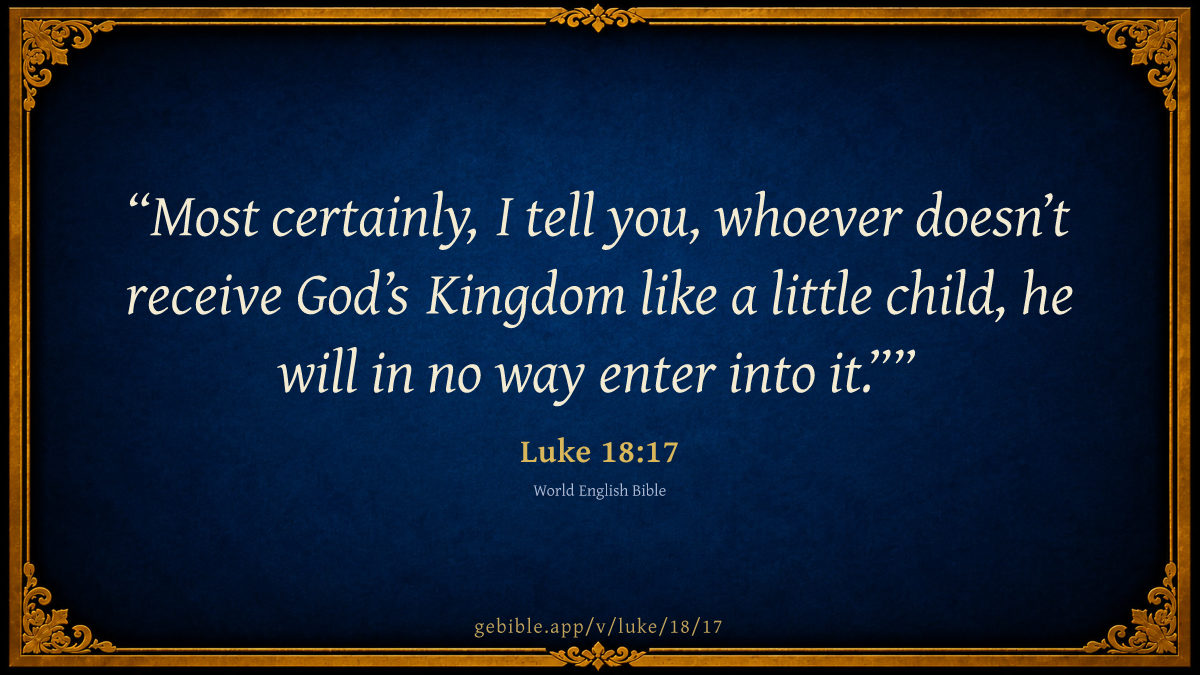
Most certainly, I tell you, whoever doesn’t receive God’s Kingdom like a little child, he will in no way enter into it.”
Parallel Translations
-
Most certainly, I tell you, whoever doesn’t receive God’s Kingdom like a little child, he will in no way enter into it.”
-
Verely I saye vnto you: whosoever receaveth not the kyngdome of God as a chylde: he shall not enter therin.
-
Verely I say vnto you, whosoeuer receiueth not the kingdome of God as a babe, he shall not enter therein.
Examined in Scripture Analysis
Contradictions (1)
Questions where the Bible appears to say two different things, with the passages on each side set together.
Cross-references (4)
Passages linked to Luke 18:17 in the Treasury of Scripture Knowledge, ordered by reader-vote popularity; verse text shown in World English Bible.
- Matthew 18:3 and said, “Most certainly I tell you, unless you turn, and become as little children, you will in no way enter into the Kingdom of Heaven.
- Psalms 131:1-2 Yahweh, my heart isn’t arrogant, nor my eyes lofty; nor do I concern myself with great matters, or things too wonderful for me. Surely I have stilled and quieted my soul, like a weaned child with his mother, like a weaned child is my soul within me.
- Mark 10:15 Most certainly I tell you, whoever will not receive God’s Kingdom like a little child, he will in no way enter into it.”
- 1 Peter 1:14 as children of obedience, not conforming yourselves according to your former lusts as in your ignorance,
Cross-references from openbible.info (CC BY 4.0)
Explain this verse (7 sources)
Historical commentary, presented as a primary source — not an endorsement.
Private notes
Saved on this device only — never synced or sent anywhere.
Geneva Bible translators 1599 · Public Domain Childlike innocence is an ornament of Christians.
Childlike innocence is an ornament of Christians.
Geneva Bible (1599) marginal notes — public domain.
John Trapp 1656 · Public Domain 17 Verily I say unto you, Whosoever shall not…
17 Verily I say unto you, Whosoever shall not receive the kingdom of God as a little child shall in no wise enter therein.
Ver. 17. {See Trapp on "Mat 19:14"}
John Trapp, A Commentary or Exposition upon All the Books of the Old and New Testament (1647–1656) — public domain. Text from a community e-Sword module.
John Gill 1763 · Public Domain Verily I say unto you,...., Christ takes an occasion…
Verily I say unto you,...., Christ takes an occasion from hence to teach his disciples humility, and guard them against pride and vanity:
whosoever shall not receive the kingdom of God; the King Messiah, the doctrines of the Gospel, and the ordinances of it, even the whole Gospel dispensation;
Read full note →
as a little child; without prejudice, pride, ambition, and vanity, with meekness, and humility:
shall in no wise enter therein; a very unfit and improper person to be a professor of the Gospel; or to be admitted to Gospel ordinances: or be a member of a Gospel church; or be reckoned a subject of the Messiah's kingdom, which is of a spiritual nature; and as he has not a meetness for, and a right unto the kingdom of glory, he shall never see it, and enjoy it.
John Gill's Exposition of the Whole Bible (1746–1763) — public domain (CC PDM 1.0). Text via the HelloAO Bible API.
Daniel D. Whedon 1874 · Public Domain 17. Receive the kingdom of God as a little…
17. Receive the kingdom of God as a little child—It is plain that the little child here specified must be a literal infant. And when it is asked in what respect is the converted adult to become as a little child, we must reply, just in that respect by which a child is a member of the kingdom of God. He must come back to that state of acceptance with Christ which he possessed before actual sin. See note on Mat_18:3.
Daniel D. Whedon (gen. ed.), Commentary on the Old and New Testaments (1874–1909) — public domain. Text from a community e-Sword module.
The Pulpit Commentary 1880 · Public Domain Whosoever shall not receive the kingdom of God as…
Whosoever shall not receive the kingdom of God as a little child shall in no wise enter therein. Jesus here reminds men that if they hope to enter the kingdom, it must be in the spirit of children, who never think of putting forward any claim of merit or paying any price for kindness showed them. His late parable of the Pharisee and publican was evidently in the Master"s mind when he said this.
The child of man and the kingdom of God.
Read full note →
Jesus Christ not only opened the gate of his kingdom to the little child as he opened his arms to the little children whom the mothers of Judah brought to him; he also took the little child as a type of the true disciple. He taught us that if we wish to enter his kingdom, our spirit must be the child-spirit. Whosoever shall not receive the kingdom of God as," etc. And what is this spirit? It is that of
I DOCILITY, or readiness to accept what is told us. The ideal child is teachable; it will learn because it is ready to receive; it has not found out the way of distrust and of rejection; it takes in the light, the truth, which is offered and it grows thereby. Men of mature years and powers, who have had all the advantages of Christian privileges, often stand without the kingdom because they will not receive the truth that is offered them; their mind is preoccupied with theories, systems, imaginations, of their own. They seem to know much; they believe they know much, for they are familiar with some things of which many (perhaps most) are ignorant; they could easily puzzle their neighbours by asking questions which these could not answer; they have a number of facts and laws, and a much larger number of names at their command; they "seem to be wise". (1Co_3:18) But their knowledge is very small in comparison with all that has to be acquired; it is partly (largely) local, temporary, evanescent; (1Co_13:8) it is nothing to the wisdom of God. It becomes them, as it becomes us all, to feel toward God as our little children feel towards us to cherish a spirit of docility. How much more he has to tell us than we have to teach them! How much greater is our ignorance in his sight than theirs is in ours! He who will not accept the doctrine of the Divine Fatherhood; he who will not yield himself to a Divine Saviour; he who will not pursue the path of holy service, hoping to find at the end of it a heavenly home, because this does not square with some favourite theories, or because it transcends the range of some intellectual faculties, cannot enter the kingdom of truth, and therefore shuts himself out of the kingdom of God. We shall fail to stand on the first rung of the ladder that reaches heavenly wisdom unless we realize that we are all of us but very little children in the presence of our Father, and unless with docile spirit we come to his feet and say, "Lord, we are very ignorant; wilt thou teach us?" "Lead us, O Father, in the path of truth; Unhelped by thee, in error"s maze we grope.
II SIMPLICITY. The little child (of our thought and our affection) is simple, transparent, sincere; he says just what is in his mind, does not pretend he is naughty when he believes himself to be good is real. This God demands of us in the inward parts," sincerity of spirit. It does not further our cause with him to affect a piety that is not genuine; to simulate a penitence of which our heart knows nothing; to use the language of humility while pride is reigning within. He would rather we tell him just what we feel, just what we are, than adopt the most appropriate confessions or petitions. We must be like the children of our home; we must mean what we say when we draw nigh to him.
III TRUSTFULNESS. Christianity is a religion which centres in a Person, in one Divine Being. "He that believeth in me," "that abideth in me, that is the prevailing note. Trust in Jesus Christ as the Teacher, Saviour, Sovereign of the human soul, is the way of life. He who has that stands within "the kingdom of God." Where shall we learn to trust? Is it not of the little child? As the child flees for refuge to its parent"s arms, confides itself and all it has or hopes for to its parent"s wisdom and love, so the human soul is invited to commit itself and all its everlasting interests to the Almighty Saviour, to say with implicit, childlike confidence and self-surrender"Jesus. Refuge of my soul, Let me to thy bosom fly. C.
The Pulpit Commentary (1880–1919), ed. H.D.M. Spence-Jones & Joseph S. Exell — public domain. Text from a community e-Sword module.
The Biblical Illustrator 1887 · Public Domain Receive the kingdom of God as a little child
Luk_18:17
Receive the kingdom of God as a little child
Read full note →
Receiving the kingdom of God as a little child
I.
To begin with, let me deal with THE SECRET THOUGHT OF THE DISCIPLES, expressed by their actions though not spoken in words.
1. And, first, it is pretty clear that the disciples thought the children were too insignificant for the Lords time to be taken up by them.
2. Again, I suppose that these grown-up apostles thought that the childrens minds were too trifling. Despise not children for trifling when the whole world is given to folly.
3. Ay, say they, but if we should let the children come to Christ, and if He should bless them, they will soon forget it. No matter how loving His look and how spiritual His words, they will go back to their play, and their weak memories will preserve no trace of it at all. This objection we meet in the same manner as the others. Do not men forget?
4. Perhaps, too, they thought that children had not sufficient capacity.
5. To put the thought of the apostle into one or two words: they thought that the children must not come to Christ because they were not like themselves--they were not men and women. The child must not come to the Master because he is not like the man. How the blessed Saviour turns the tables and says, Say, not, the child may not come till he is like a man, but know that you cannot come till you are like him. It is no difficulty in the childs way that he is not like you; the difficulty is with you, that you are not like the child. Instead of the child needing to wait until he grows up and becomes a man, it is the man who must grow down and become like a child.
II. Now we pass to our second head, namely, THE OPEN DECLARATION OF OUR LORD, wherein He sets forth His mind upon this matter,
1. Looking at it carefully, we observe, first, that He tells the disciples that the gospel sets up a kingdom. Was there ever a kingdom which had no children in it? How then could it grow?
2. Next, our Lord tells us that the way of entering the kingdom is by receiving. Whosoever shall not receive the kingdom of God as a little child shall in no wise enter therein. We do not enter into the kingdom of God by working out some deep problem and arriving at its solution; not by fetching something out of our selves, but by receiving a secret something into us. We come into the kingdom by the kingdoms coming into us: it receives us by our receiving it. Now, if this entrance into the kingdom depended upon something to be fetched out of the human mind by study and deep thought, then very few children could over enter it; but it depends upon something to be received, and therefore children may enter,
3. The next thing in the text is that if we receive this kingdom, and so enter into it, we must receive it as children receive it.
III. THE GREAT ENCOURAGEMENT given by our Lord in the text. (C. H.Spurgeon.)
The Biblical Illustrator, edited by Joseph S. Exell (c. 1880s–1900s) — public domain. Text from a community e-Sword module.
Tyndale Open Study Notes 2022 · CC BY-SA 4.0 18:17 receive the Kingdom of God like a child:…
18:17 receive the Kingdom of God like a child: Entrance into the Kingdom of God requires childlike faith and dependence on God.
Tyndale Open Study Notes — © Tyndale Open Resources, licensed CC BY-SA 4.0. Text via the HelloAO Bible API.