
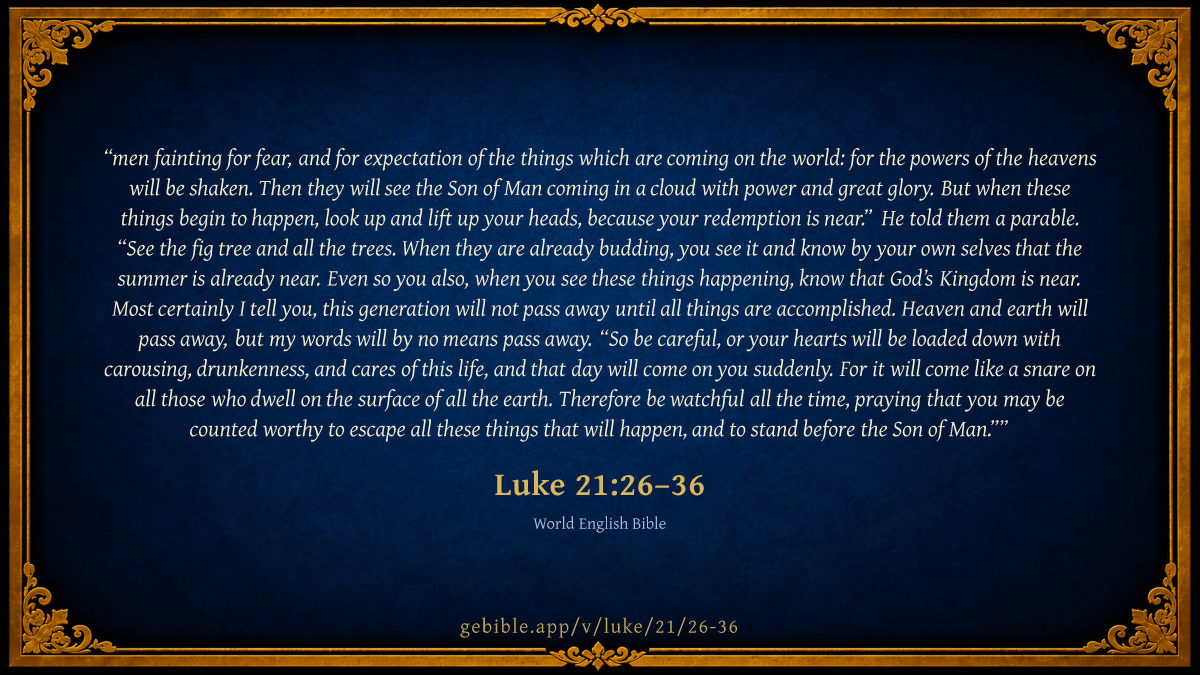
men fainting for fear, and for expectation of the things which are coming on the world: for the powers of the heavens will be shaken. Then they will see the Son of Man coming in a cloud with power and great glory. But when these things begin to happen, look up and lift up your heads, because your redemption is near.”
He told them a parable. “See the fig tree and all the trees. When they are already budding, you see it and know by your own selves that the summer is already near. Even so you also, when you see these things happening, know that God’s Kingdom is near. Most certainly I tell you, this generation will not pass away until all things are accomplished. Heaven and earth will pass away, but my words will by no means pass away.
“So be careful, or your hearts will be loaded down with carousing, drunkenness, and cares of this life, and that day will come on you suddenly. For it will come like a snare on all those who dwell on the surface of all the earth. Therefore be watchful all the time, praying that you may be counted worthy to escape all these things that will happen, and to stand before the Son of Man.”
Geneva Bible translators 1599 · Public Domain On vv26, 29, 35, 36 After divers tempests, the Lord will at the length…
After divers tempests, the Lord will at the length plainly appear to deliver his Church.
Geneva Bible (1599) marginal notes — public domain.
John Trapp 1656 · Public Domain On vv26, 27, 28, 29, 33, 34, 35, 36 26 Men’s hearts failing them for fear, and for…
26 Men’s hearts failing them for fear, and for looking after those things which are coming on the earth: for the powers of heaven shall be shaken.
Ver. 26. Men’s hearts failing them] What marvel though wicked men be dispirited, and even ring their bells backwards, when they shall see all on a light fire? Moses himself may tremble at the terror of the mount, and Abraham show some trepidation in such a fright.
John Trapp, A Commentary or Exposition upon All the Books of the Old and New Testament (1647–1656) — public domain. Text from a community e-Sword module.
Matthew Poole 1685 · Public Domain On vv27, 29, 34 Matthew seemeth to expound this, Mat 24:31; so doth…
Matthew seemeth to expound this, Mat 24:31; so doth Mar 13:27. Both speak to the same sense: And he shall send his angels with a great sound of a trumpet, and they shall gather together his elect from the four winds, from, one end of heaven to the other. This is certainly to be understood of the day of judgment, when the saints shall be glorified as the sons of God by adoption, and obtain the redemption of the body, Rom 8:23.
Matthew Poole's English Annotations on the Holy Bible (1683–1685) — public domain. Text from a community e-Sword/MySword module.
William Burkitt 1703 · Public Domain On vv29, 34 In these words our Saviour declares the certainty of…
In these words our Saviour declares the certainty of his coming to visit Jerusalem for all her barbarous and bloody cruelty towards himself, his prophets, and apostles; he is pleased to set forth this by the similitude of the fig-tree, whose beginning to bud declares the summer at hand; thus our Saviour tells them, that when they should see the fore-mentioned signs, they might conclude the destruction of their city and temple to be near at hand; and accordingly some of that generation, then living, did see these predictions fulfilled.
Learn, that God is no less punctual in the execution of his threatenings upon incorrigible sinners, than he is faithful in the performance of his promises towards his own people: the truth and veracity of God is as much concerned to execute his threatenings, as it is to fulfill his promises.
William Burkitt's Expository Notes on the New Testament (1700–1703) — public domain. Text from a community e-Sword module.
Matthew Henry 1710 · Public Domain On v29 Here, in the close of this discourse,
Here, in the close of this discourse,
I. Christ appoints his disciples to observe the signs of the times, which they might judge by, if they had an eye to the foregoing directions, with as much certainty and assurance as they could judge of the approach of summer by the budding forth of the trees, Luk 21:29-31. As in the kingdom of nature there is a chain of causes, so in the kingdom of providence there is a consequence of one event upon another. When we see a nation filling up the measure of their iniquity, we may conclude that their ruin is nigh; when we see the ruin of persecuting powers hastening on, we may thence infer that the kingdom of God is nigh at hand, that when the opposition given to it is removed it shall gain ground. As we may lawfully prognosticate the change of the seasons when second causes have begun to work, so we may, in the disposal of events, expect something uncommon when God is already raised up out of his holy habitation (Zac 2:13); then stand still and see his salvation.
Read full note →
II. He charges them to look upon those things as neither doubtful nor distant (for then they would not make a due impression on them), but as sure and very near. The destruction of the Jewish nation, 1. Was near (Luk 21:32): This generation shall not pass away till all be fulfilled. There were some now alive that should see it; some that now heard the prediction of it. 2. It was sure; the sentence was irreversible; it was a consumption determined; the decree was gone forth (Luk 21:33): "Heaven and earth shall pass away sooner than any word of mine: nay, they certainly shall pass away, but my words shall not; whether they take hold or no, they will take effect, and not one of them fall to the ground," Sa1 3:19.
III. He cautions them against security and sensuality, by which they would unfit themselves for the trying times that were coming on, and make them to be a great surprise and terror to them (Luk 21:34, Luk 21:35): Take heed to yourselves. This is the word of command given to all Christ's disciples: "Take heed to yourselves, that you be not overpowered by temptations, nor betrayed by your own corruptions." Note, We cannot be safe if we be secure. It concerns us at all times, but especially at some times, to be very cautious. See here, 1. What our danger is: that the day of death and judgment should come upon us unawares, when we do not expect it, and are not prepared for it, - lest, when we are called to meet our Lord, that be found the furthest thing from our thoughts which ought always to be laid nearest our hearts, lest it come upon us as a snare; for so it will come upon the most of men, who dwell upon the earth, and mind earthly things only, and have no converse with heaven; to them it will be as a snare. See Ecc 9:12. It will be a terror and a destruction to them; it will put them into an inexpressible fright, and hold them fast for a doom yet more frightful. 2. What our duty is, in consideration of this danger: we must take heed lest our hearts be overcharged, lest they be burdened and overloaded, and so unfitted and disabled to do what must be done in preparation for death and judgment. Two things we must watch against, lest our hearts be overcharged with them: - (1.) The indulging of the appetites of the body, and allowing of ourselves in the gratifications of sense to an excess: Take heed lest you be overcharged with surfeiting and drunkenness, the immoderate use of meat and drink, which burden the heart, not only with the guilt thereby contracted, but by the ill influence which such disorders of the body have upon the mind; they make men dull and lifeless to their duty, dead and listless in their duty; they stupify the conscience, and cause the mind to be unaffected with those things that are most affecting. (2.) The inordinate pursuit of the good things of this world. The heart is overcharged with the cares of this life. The former is the snare of those that are given to their pleasures: this is the snare of the men of business, that will be rich. We have need to guard on both hands, not only lest at the time when death comes, but lest at any time our hearts should be thus overcharged. Our caution against sin, and our care of our own souls, must be constant.
IV. He counsels them to prepare and get ready for this great day, Luk 21:36. Here see, 1. What should be our aim: that we may be accounted worthy to escape all these things; that, when the judgments of God are abroad, we may be preserved from the malignity of them; that either we may not be involved in the common calamity or it may not be that to us which it is to others; that in the day of death we may escape the sting of it, which is the wrath of God, and the damnation of hell. Yet we must aim not only to escape that, but to stand before the Son of man; not only to stand acquitted before him as our Judge (Psa 1:5), to have boldness in the day of Christ (that is supposed in our escaping all those things), but to stand before him, to attend on him as our Master, to stand continually before his throne, and serve him day and night in his temple (Rev 7:15), always to behold his face, as the angels, Mat 18:10. The saints are here said to be accounted worthy, as before, Luk 20:35. God, by the good work of his grace in them, makes them meet for this happiness, and, by the good will of his grace towards them, accounts them worthy of it: but, as Grotius here says, a great part of our worthiness lies in an acknowledgment of our own unworthiness. 2. What should be our actings in these aims: Watch therefore, and pray always. Watching and praying must go together, Neh 4:9. Those that would escape the wrath to come, and make sure of the joys to come, must watch and pray, and must do so always, must make it the constant business of their lives, (1.) To keep a guard upon themselves. "Watch against sin, watch to every duty, and to the improvement of every opportunity of doing good. Be awake, and keep awake, in expectation of your Lord's coming, that you may be in a right frame to receive him, and bid him welcome." (2.) To keep up their communion with God: "Pray always; be always in an habitual disposition to that duty; keep up stated times for it; abound in it; pray upon all occasions." Those shall be accounted worthy to live a life of praise in the other world that live a life of prayer in this world.
V. In the last two verses we have an account how Christ disposed of himself during those three or four days between his riding in triumph into Jerusalem and the night in which he was betrayed. 1. He was all day teaching in the temple. Christ preached on week-days as well as sabbath days. He was an indefatigable preacher; he preached in the face of opposition, and in the midst of those that he knew sought occasion against him. 2. At night he went out to lodge at a friend's house, in the mount of Olives, about a mile out of town. It is probable that he had some friends in the city that would gladly have lodged him, but he was willing to retire in the evening out of the noise of the town, that he might have more time for secret devotion, now that his hour was at hand. 3. Early in the morning he was in the temple again, where he had a morning lecture for those that were willing to attend it; and the people were forward to hear one that they saw forward to preach (Luk 21:38): They all came early in the morning, flocking to the temple, like doves to their windows, to hear him, though the chief priests and scribes did all they could to prejudice them against him. Sometimes the taste and relish which serious, honest, plain people have of good preaching are more to be valued and judged by than the opinion of the witty and learned, and those in authority.
Matthew Henry's Commentary on the Whole Bible (1708–1710) — public domain (CC PDM 1.0). Text via the HelloAO Bible API.
John Gill 1763 · Public Domain On vv26–31 So likewise when ye see these things come to…
So likewise when ye see these things come to pass,.... The signs before mentioned, in Luk 21:8.
Know ye that the kingdom of God is nigh at hand: a more visible and glorious display of the kingdom of the Messiah, in the destruction of his enemies, the Jews; see Mar 9:1.
John Gill's Exposition of the Whole Bible (1746–1763) — public domain (CC PDM 1.0). Text via the HelloAO Bible API.
John Wesley 1765 · Public Domain On vv28, 29, 30, 31, 32, 34, 35, 36 Now when these things - Mentioned ver. 8, 10,…
Now when these things - Mentioned ver. 8, 10, &c., begin to come to pass, look up with firm faith, and lift up your heads with joy: for your redemption out of many troubles draweth nigh, by God's destroying your implacable enemies.
John Wesley, Explanatory Notes Upon the Whole Bible (1754–1765) — public domain. Text via the GEBible commentary corpus.
Adam Clarke 1810 · Public Domain On vv26, 29, 31, 32, 34, 35, 36 Verse 26. Men's hearts failing them for fear] Or,…
Verse 26. Men's hearts failing them for fear] Or, Men fainting away through fear, (αποψυχοντων), being ready to die.
Coming on the earth] Or, Coming upon this land, οικουμενη. See this translation of the word vindicated in Clarke's note on "Lu 2:1".
Adam Clarke's Commentary on the Bible (1810–1826) — public domain. Text from a community e-Sword/MySword module.
Joseph Benson 1811 · Public Domain On vv27, 29, 34 Luk 21:27-28. Then shall they see the Son of…
Luk 21:27-28. Then shall they see the Son of man coming in a cloud — They shall see the accomplishment of what Daniel foretold, by the figurative expression of, “the Son of man coming in the clouds of heaven;” for the destruction of the Jewish nation by the Roman armies, and, in after ages, of other persecuting and antichristian powers, and the spreading of my gospel in consequence thereof, according to this my prediction, shall demonstrate to all unprejudiced persons, that I am the Son of man, prophesied of by Daniel, and that the conversion of the world to Christianity is the glorious universal kingdom which Daniel foretold was to be given to the Son of man; and this is the true sign from heaven, about which the Jews have been so solicitous. See note on Mat 24:30-31. With regard to the destruction of the Jewish nation, and the consequent downfall of their religious institutions, which they all along opposed to Christianity, it may be observed, that no events whatever could have contributed so effectually to the conversion of both Jews and Gentiles.
“For it is a known fact, that while the Jewish constitution subsisted, the spreading of the gospel was hindered, both by the believing and unbelieving Jews; the former disgusting the Gentiles, by endeavouring to subject them to the law of Moses; and the latter, terrifying them by the persecutions which they raised against the disciples, even in heathen countries. But the abolition of the Mosaical institutions confuted the error of the one, and the destruction of the nation brake the power of the other. The success, therefore, of the gospel, depending in a great measure upon the downfall of the Jewish state, was very properly predicted as the natural consequence thereof. Moreover, as this prophecy described so minutely the catastrophe of the Jewish state, its accomplishment could not but make a strong impression upon the minds of the Gentiles, as we know in fact it did bring over many of them to Christianity.” When these things begin to come to pass — The things I have been predicting; then look up — With firm faith; and lift up your heads — With joy; for your redemption — Out of many troubles; draweth nigh — By God’s destroying your implacable enemies.
Joseph Benson's Commentary on the Old and New Testaments (1811–1818) — public domain. Text from a community e-Sword module.
Haydock's Catholic Bible Commentary 1859 · Public Domain On vv26–27 The powers of heaven, &c. Some explain this of…
The powers of heaven, &c. Some explain this of the angels, who shall be terrified and tremble at the sight of so many calamities. Others understand it of the heavenly bodies, the sun, moon, stars, &c. which shall in some sort, likewise, be confused in the general dissolution. The prophets often make use of such expressions, when speaking of the fall of monarchies, or the ruin of nations. The heavens shall be astonished and moved, &c. (Ezechiel xxxii. 7; Joel iii. 15.) (Calmet)
George Leo Haydock (1774–1849), Haydock's Catholic Family Bible and Commentary, 1859 edition — public domain. Excludes Psalms (Douay-Rheims chapter numbering differs from Protestant) and Deuterocanonical books (Catholic canon only).
Robert Jamieson, A. R. Fausset & David Brown 1871 · Public Domain On vv28, 32, 34, 36 redemption--from the oppression of ecclesiastical despotism and legal bondage…
redemption--from the oppression of ecclesiastical despotism and legal bondage by the total subversion of the Jewish state and the firm establishment of the evangelical kingdom (Luk 21:31). But the words are of far wider and more precious import. Matthew (Mat 24:30) says, "And then shall appear the sign of the Son of man in heaven," evidently something distinct from Himself, mentioned immediately after. What this was intended to mean, interpreters are not agreed. But as before Christ came to destroy Jerusalem, some appalling portents were seen in the air, so before His personal appearing it is likely that something analogous will be witnessed, though of what nature it is vain to conjecture.
Jamieson, Fausset & Brown — Commentary Critical and Explanatory on the Whole Bible (1871) — public domain (CC PDM 1.0). Text via the HelloAO Bible API.
Daniel D. Whedon 1874 · Public Domain On vv26, 28, 32 26. The powers of heaven shall be shaken—As if…
26. The powers of heaven shall be shaken—As if that Coming would disturb for the time the fixedness of the planetary system. But the shaking may be apparent only; the words expressing optical or visible truth.
Daniel D. Whedon (gen. ed.), Commentary on the Old and New Testaments (1874–1909) — public domain. Text from a community e-Sword module.
The Cambridge Bible for Schools and Colleges 1878 · Public Domain On vv26, 27, 28, 29, 32, 33, 34, 35, 36 26. men’s hearts failing them] Literally, “men fainting.”
26. men’s hearts failing them] Literally, “men fainting.”
on the earth] Literally, “on the habitable world.”
Read full note →
the powers of heaven] i.e. the “bright dynasts” (Aesch. Ag. 6)—the Hosts of the Heavens.
The Cambridge Bible for Schools and Colleges (gen. ed. J. J. S. Perowne; Cambridge University Press, 1878–1918) — public domain. Text from a community e-Sword module.
Ellicott's Commentary for English Readers 1878 · Public Domain On vv26, 28, 29, 31, 32, 34, 35, 36 (26) Men’s hearts failing them for fear.—The verb so…
(26) Men’s hearts failing them for fear.—The verb so rendered is used by St. Luke only in the New Testament. Its literal meaning is to breathe out the soul, and it was, therefore, a word which would naturally enter into the vocabulary of a physician, both in its primary and figurative sense. The mental state which it expresses exactly agrees with that described in Act_27:20, in connection with the tempest.
For looking after those things.—Literally, for expectation, the noun being used only by St. Luke in the New Testament.
A Bible Commentary for English Readers, edited by Charles John Ellicott (1878–1897) — public domain. Text from a community e-Sword module.
The Pulpit Commentary 1880 · Public Domain On vv28, 29, 32, 33, 34, 36 Vers. 28-36. Practical teaching arising the foregoing prophecy respecting…
Vers. 28-36. Practical teaching arising the foregoing prophecy respecting the Jerusalem and the last things.
And when these things begin to come to pan, then look up, and lift up your heads; for your redemption draweth nigh. There is no doubt that the first reference in this verse is to the earlier part of the prophecy the fate of the city and the ruin of the Jewish power. "Your redemption" would then signify "your deliverance from the constant and bitter hostility of the Jewish authority." After A.D. 70 and the fall of Jerusalem, the growth of Christianity was far more rapid than it had been the first thirty or forty years of its It had no longer to cope with the skillfully ordered, relentless opposition of its deadly Jewish foe. Yet between the lines a yet deeper meaning is discernible. In all times the earnest Christian is on the watch for the signs of the advent of his Lord, and the restless watch serves to keep hope alive, for the watcher knows that that advent will be the sure herald of his redemption from all the weariness and painfulness of this life.
Read full note →
The second redemption.
"Lift up your heads; for your redemption draweth nigh." Jesus Christ led his disciples to think that beyond the redemption which he was working out for them, and subsequent to it in time, was another great deliverance which should prove of unspeakable value to them. This is true now of our discipleship; we look for and we sorely need a second redemption.
I ITS CHARACTER. It is not, like the first, distinctively and purely spiritual. That was; men were yearning for a political revolution and redemption. But the kingdom of heaven was not to be "of this world;" it was to be wholly inward and spiritual; it was to be our redemption from sin and restoration to the favor and the likeness of our Divine Father. But the second redemption is not distinctively and primarily that of the soul; it is to be "the redemption of our body". (Rom_8:23) It will have a gracious and beneficent effect, a redeeming and elevating influence, upon the soul; but in the first instance it is a redemption from a troublous and trying condition; it is being taken away, by the appearance of Christ, in the providence of God, from a state in which happy service is almost impossible; it is a removal from storm to calm, from hostile to friendly forces, from turbulence to serenity; from hard conflict, or tense anxiety, or painful suffering, to "the rest which remaineth for the people of God." It is a blessed and merciful change from unfavourable to favorable conditions.
II OUR HUMAN NEED OF IT. We are not of this world, we who have been redeemed by Jesus Christ and renewed by the Spirit of God. And we may be nobly, even grandly, victorious over it, being "always caused to triumph" by that Divine Spirit that dwells within us, and strengthens us with all might." Yet are we actually, and by universal experience, seriously affected by it, and we suffer many things as we pass through it. We may suffer, as the early Christians did (to whom these words were addressed), from persecution, and thereby be made "most miserable". (1Co_15:19) Our life may be made worthless, or worse than worthless, to us by the cruelties of our fellow-men. Or we may suffer so much from privation of privilege, or from the struggles of daily life, or from grief and disappointment, or from a steadily advancing decrepitude, that we may earnestly long for this second redemption, the redemption of our body. We may be in sore need of its approach, of its presence.
III ITS KINDLY SHADOW. It will then be much to us, perhaps everything; that our redemption draweth nigh.
1. It is something that at any moment we may be within a step of the heavenly sphere; for anything we know, Christ may be about to say concerning us, "This day ye shall be with me in Paradise.
2. It is more that we may be confident that a life of holy activity will rapidly pass away and bring us to the day of rest and of reward.
3. It is very much indeed that the duration of the blessed future will prove to be such that any number of years of earthly trouble will be nothing in comparison.
4. It is also a truth full of hope and healing that every day spent in faithful service or patient waiting brings us that distance nearer to the blessedness that lies beyond. "We nightly pitch our moving tent A day"s march nearer home.
Beneath the varied and heavy burdens of time we are fain to bow our heads; but we shall lift them up with strength and eager-hearted expectation as we realize that every step forward is a step onward to the heavenly horizon. C.
The Pulpit Commentary (1880–1919), ed. H.D.M. Spence-Jones & Joseph S. Exell — public domain. Text from a community e-Sword module.
The Biblical Illustrator 1887 · Public Domain On vv29, 34, 36 Behold the fig-tree and all the trees
Luk_21:29-33
Behold the fig-tree and all the trees
Read full note →
The parable of the fig-tree
I.
TEACHING OF THE PARABLE.
1. Shows course and sequence of events as certain and necessary as the processes of nature. All is in progress. Be sure of the issue. Be alive to the tokens of its approach.
2. The incongruity of the comparison is its instruction. Its purpose to fix attention not on an end, but on a beginning; not on what going, but on what coming; not on tokens of dissolution, but on hidden life stirring beneath, after last storm to break out into the kingdom of God.
II. USE OF ITS TEACHING.
1. See that it belongs to you.
2. Live under the sense of what is coming. You need it--
(1) To prevent this present world from absorbing you.
(2) To prevent it from depressing you. (Canon T. D. Bernard.)
The big clock
Do you know that God has a big clock, bigger than any one you have ever seen, bigger indeed than Big Ben at Westminster. But this big clock does not make any noise, you can never hear it ticking; and it does not strike, but yet it goes on, year after year, year after year, marking the time. What do you think is the face of this clock? It is the earth; the fields and meadows and hedgerows in every part of the world--that is the face of this clock. And what do you think are the figures upon this dial? They are flowers and birds and leaves. Gods big clock does not tick, but it lives; it does not strike the hours, only some flowers open out or die away when the hour has come. Isnt that what Jesus meant when He said, Look at the fig-tree and all the trees; they are beginning now to put out buds. Very well; you know by that that this is spring-time, and by that you know that summer is coming near. The buds tell what oclock it is by the time of year. When you were learning to tell the time on the face of the clock on the mantel-shelf, how did you begin? Was it not by first learning the quarters? When the long hand was half-way down on the right, you knew it was a quarter past; when it was half-way up on the left, you knew it was a quarter-to; and when it was down between these, you knew it was half-past; and when it was up between them you knew the clock was going to strike the hour. Well, just as there are four quarters in our clocks so there are four quarters in this big clock we are speaking about. The first quarter is springtime, half-past is summer, quarter-to is autumn, and when winter comes the year is ended. When you look at the trees and flowers you can pretty well tell what oclock it is by the year. But standing between the quarters of the clock there are other figures. How many of these are there altogether? Twelve, are there not? And how many months are there in a year? You know--twelve. So, you see, this clock has got all the figures, and, what is stranger still, it marks all the figures by flowers and fruits; for there are different flowers that come out every month of the year. If a smart boy were to keep his eyes about him, and understood things as he walked in the country, when he found certain trees beginning to bud and certain flowers beginning to peep up, he would say, This must be the month of January; for these always come out in January. Later on, if he saw some others, he would say, This must be February; for these always come out in February. And so through all the year, if he was clever, he would find the flowers and trees telling him what month it was. But there is something stranger still about this clock of Gods; and you must remember it, so that from time to time during the year you may learn to use your eyes and notice what God is doing in the fields. It is this: Gods clock tells the hours of the day as well as the months of the year. The months are the twelve figures; but you know that between the twelve figures there are the little minutes, and these minutes are made up of moments. Now the minutes in Gods big clock are days, and the moments are hours, and the clock tells them all. What then can be the meaning of this big clock? Surely it is to tell us that time is passing. Does it not plainly say that if we do not grow right in the springtime of our life, we shall not be able, when the summer comes, to go back to the springtime and mend what has been wrong? You would not like to grow up wicked, would you? Then learn to grow as the flowers grow. How is that? By always looking at the sun, and taking its light, and following it, for the flowers follow the sun with their heads, and so they become beautiful. Do you the same with Jesus--follow Him with your hearts. (J. R. Howatt.)
Heaven and earth shall pass away
Heaven and earth shall pass away
It is something to startle us, and make us ask ourselves, if indeed such things can be; whether He is in earnest who says so, and whether the world which practises upon us by its looks as though it were eternal, is indeed such an imposter, and we who believe it, so foolish and so ignorant! Yet so it is. Now, it seems to some of you, I dare say, as to most men, that this is a great deal more astonishing than that anything so inconsiderable, materially considered, as a man, should pass away, as you see happen every day by death. It seems a pity to break to pieces so goodly a machine as heaven and earth, and uproot its adamantine basis. But if so, I think you are wrong. It seems to me nothing at all astonishing, that anything for which we have no longer a use should finally be thrown aside, or broken up, and the old materials put to some other purpose, be it an ordinary implement, or be it a world. It seems to me very reasonable and very likely in itself, that, in the infinite wisdom and power of God, one world should be ripened, so to say, out of another, as you see the fruit come out of the flower, and the flower out of the bud, so that the first shall decay before the higher one can be perfected. It is very reasonable that, as a mere manifestation of power, in order to show to his creatures the strength of His right hand, and the absolute independency of His will, God should dash in pieces, from time to time, or consume by the breath of His nostrils, what was made by His word, and stood only by His sufferance. Besides, in the elements out of which heaven and earth are made, there is no thought or feeling; they are brute, dead things; and are capable neither of pain nor pleasure. Whether they abide or not in the forms into which God has thrown them, it is the same to them; no harm is inflicted on them; they are as unconscious of change as they are impotent to feel or will. But, if heaven and earth must pass away, another consequence will follow, which is to every one of us of awful importance. If the earth, such as it now is, shall be utterly destroyed, manifest it is, that our present life, and cares, and pleasures, and occupations, all that men make their happiness of, will likewise he brought to an end. And this brings me to another point--and a reason for the passing away of the present world, which I have not yet mentioned, though it might easily occur to any thoughtful mind. It is a condemned world; sentence is passed upon it! And it is condemned, because it is guilty, and all over polluted! And do not wonder at this, for you know with what feelings we regard a chamber or a house in which a murder, or some abominable crime, has been committed; how we shrink from it and abhor it, and hate the sight of it, and should think it the greatest misery in the world, if we have any feelings worthy of man, to be compelled to take up our abode within it. A sort of guilt, as well as involuntary pollution, seems to attach to the very floors and senseless walls which have witnessed the crime, and have not fallen down or opened upon the wicked in the midst of their wickedness. And we should rejoice at seeing them pulled down to the ground, and the last memorial of the crime removed from our eyes! Well, so it is exactly in regard to the world in which we live, with all its majestic mechanism, its living forces, and all the ornaments which Gods hand has thrown round about it. It is stained with six thousand years of sin. And this brings us to another portion of the question. If heaven and earth shall pass away, shall anything succeed into their room, or shall that space which they occupied be utterly blank and desolate? The answer is, no. So to say, there shall rise two new worlds, or such a change as comes to the same thing, out of the ruins of it; even as out of the earth destroyed by the flood there sprung forth that in which we now dwell. There shall be the new heavens and new earth, in which dwelleth righteousness, and the face of Gods countenance shineth for evermore--the habitation of those who have lived and died in the Lord. And on the other hand, the world, where the light is darkness, and the life is death, and the good is evil, and weeping, and wailing, and gnashing of teeth are the voice thereof--even the habitation of the ungodly for ever and ever. And this gives you the true reason, dear brethren, why the judgment is now suspended, and sun and moon are shining, and night and day, and spring and harvest, come and go, and all things remain as at the beginning. It is that Gods last dispensation upon earth may have full room and time to display itself in all its combinations with human good and evil, before the voice from the throne shall proclaim that it is finished. It is that, in the sight of all His creatures, the patience and long-suffering of God, which leadeth to repentance, might have full space and opportunity in which to show themselves, and vindicate to the uttermost the exceeding forbearance of our heavenly Father even towards them that perish I It is that, year after year, His saints may be gathered in till, in the fulness of time, the flock which he has given to Christ shall have been called out of all nations and languages, and the Saviour be satisfied in the sight of His souls travail. (J. Garbett.)
My words shall not pass away
The words of Jesus permanent
I. The words of Jesus Christ, the words which He spoke for our direction, for our purification, for our comfort, for our redemption, have not passed, and shall not pass away. Our human intellect accepts them with reverence, and must ever retain them. Our human passions acknowledge their salutary power, and look up to them for perpetual control and guidance. Our human fears are soothed by them, and cannot let them go. Our human hopes are informed, elevated, and sanctified by them, and constantly resort to them for refuge, and lean upon them for rest. All our human affections have borrowed from them Divine light and warmth, and must reflect that light and warmth for ever.
II. Heaven and earth shall pass away. Giving to this sentence an individual application, we may feel that heaven and earth pass away from the sight of all of us. Fancies as brilliant as the blue vault above us, promises as fair, expectations and resolves as high, and possessions which we have deemed as firmly founded as the earth itself, have vanished, and will again vanish; and what is there left behind? The words of Christ are left, when the visions break, and the possessions disappear--words of patience, and courage, and comfort, always left for the strengthening of our hearts, if our hearts will hear and accept them. The words of Jesus arc the promises of God the Father to the souls of men. When eyes are growing dim, and the heart is ceasing to beat, and heaven and earth are passing away, as they surely will from all of us, what remains for the souls help and reliance but the words of Jesus, which are the promises of God?
III. And let us remember that the words of Jesus, attested as they arc by the Father who sent Him, permanent as time has proved them, true, and satisfying, and lasting as the human soul has found them, are not only the promises of God for mans hope and trust, but the law of God for mans final judgment. As such they will remain, when heaven and earth, in any and every sense, have passed away. The words of Christ, essentially permanent, and surviving all change, will meet our souls in the last day, and be pronounced upon them, for acquittal or for doom. And certain and necessary it is, that the sentence which will be adjudged unto us hereafter by those words, will be in strict accordance with the observance or the neglect with which we treated them here, before our present heaven and earth had passed away. (F. W. P. Greenwood, D. D.)
The ineffaceable word
On one occasion when William Dawson, the Yorkshire Preacher, was giving out a hymn, he suddenly stopped and said: I was coming once through the town of Leeds, and saw a poor little halfwitted lad rubbing at a brass plate, trying to rub out the name; but the poor lad did not know that the harder he rubbed the brighter it shone. Now, friends, sing:--
Engraved as in eternal brass
The mighty promise shines;
Nor can the powers of darkness rase
Those everlasting lines.
Then, as though he saw the devil rubbing, he said:
Satan cannot rub it off--
His hand hath writ the Sacred Word
With an immortal pen.
The enduring words
An infidel in London had a wife who possessed a Bible which she regularly read; being annoyed at this, the man, who had frequently threatened to do so, threw the book upon the fire. This appears to have taken place at dinner-time. He then left home to go to his work, but soon returned to see if the last vestige of the volume had disappeared. The woman, who naturally felt distressed at her loss, said she thought it must be completely burned; but her husband stirred the ashes to see if such was the case, when he read what fastened itself upon his mind, and led to his conversion--Heaven and earth shall pass away, but My word shall not pass away. The sister of this man was the wife of a London pastor; and just when the Bible was burning she was earnestly praying for her brothers conversion. (Sword and Trowel.)
The Biblical Illustrator, edited by Joseph S. Exell (c. 1880s–1900s) — public domain. Text from a community e-Sword module.
B. W. Johnson 1891 · Public Domain On v34 34–36. Take heed to yourselves. The words here, but…
34–36. Take heed to yourselves. The words here, but not the ideas, are peculiar to Luke. See notes on Matt. 24:37–51.
B. W. Johnson's The People's New Testament with Notes (1889–1891) — public domain. Electronic text from the Christian Classics Ethereal Library (CCEL) ThML edition.
C. I. Scofield 1917 · Public Domain On vv27–28 Son of man
Son of man
(See Scofield "Mat 8:20").
The Scofield Reference Bible (1917 edition), notes by C. I. Scofield — public domain. Text from a community e-Sword module.
Paul E. Kretzmann 1924 · Public Domain On vv28, 34 The comfort of the believers:
The comfort of the believers:
v. 28. And when these things begin to come to pass, then look up and lift up your heads; for your redemption draweth nigh.
Read full note →
v. 29. And He spake to them a parable: Behold the fig-tree and all the trees;
v. 30. when they now shoot forth, ye see and know of your own selves that summer is now nigh at hand.
v. 31. So likewise ye, when ye see these things come to pass, know ye that the kingdom of God is nigh at hand.
v. 32. Verily I say unto you, This generation shall not pass away till all be fulfilled.
v. 33. Heaven and earth shall pass away; but My words shall not pass away.
When there is a beginning of all these things, when these tokens begin to be fulfilled. The events upon which the children of the world will gaze with helpless terror should be for the believers a voice awakening in their hearts the most joyful hope and expectation. The heads which have so often been bowed under all manner of misery and persecution should now be lifted up in happy anticipation of the final, glorious deliverance. This admonition Jesus tries to impress by means of a parable. No matter what tree may be chosen for an example, for instance, the fig-tree, the same truth holds good of all of them. When they put forth their leaves, all ordinary people that are acquainted with trees at all immediately known, without further demonstration, that summer must be near. In the same way the believers, seeing these signs which are to precede the coming of Christ to judgment fulfilled, conclude and know at once that the kingdom of God is near, that the final revelation of the Church of Christ in the glories of heaven will take place, that the believers in Him will enter, from the trials and tribulations of the Church Militant into the everlasting bliss of the Church Triumphant. "Therefore let us also learn this art and new language and become accustomed to it, that we may be able to picture these signs before us in such a comforting way, and look upon them and judge them according to the Word. For if we follow our reason and wisdom, we can do nothing but become terrified and flee before them. For our reason does not like to see things appear dark and unpleasant, that it lightens and thunders, that it roars and is noisy, as though everything would be turned topsy-turvy. But a Christian should pay no attention to that, but take hold of the Word, with which He wants to open our eyes and explain how He means it, as though we were approaching the beautiful summer-time, and as though there were nothing but beautiful roses and lilies that bloom to delight the eye, and that nothing but joy and delight will come after this abominably evil way and misfortune in which we now are " And He gives them a further sign, namely, that this generation, the race of the Jews, will not pass away, will not lose its identity as a separate race, but retain its characteristics among the nations and in their very midst, in spite of all persecutions, until the end of time, until the great Day of Judgment. And so far as the whole discourse is concerned, with its threats and warnings, as well as with its comforting promises, it is true what, the Lord claims for His Word as a whole: Heaven and earth will pass away rather than that a single word of the Lord remain unfulfilled or fall to the ground. In the midst of the return of primeval chaos, in the midst of the destruction of worlds and the very universe itself, the Word of the Lord will stand in eternity as a rock of trust and confidence for all believers.
Paul E. Kretzmann, Popular Commentary of the Bible (1921–1924) — public domain. Text from a community e-Sword module.
unfoldingWord translationNotes 2017 · CC BY-SA 4.0 On vv27, 29, 32, 34, 36 Son of Man coming
Son of Man coming
Jesus is referring to himself. AT: "me, the Son Man, coming" (See: First, Second, or Third Person)
Read full note →
coming in a cloud
"coming down in a cloud"
with power and great glory
Here "power" probably refers to his authority to judge the world. Here "glory" may refer to a bright light. God sometimes shows his greatness with a very bright light. AT: "powerfully and gloriously" or "and he will be powerful and very glorious"
stand up
Sometimes when people are afraid, they crouch down in order to avoid being seen or hurt. When they are no longer afraid, they get up. AT: "stand up with confidence"
lift up your heads
Lifting the head is a metonym for looking up. When they lift their heads up, they will be able to see their rescuer coming to them. AT: "look up" (See: Metonymy)
because your deliverance is coming near
God, who delivers, is spoken of as if he were the deliverance that he causes. The word "deliverance" is an abstract noun that can be translated as a verb. AT: "because God will soon deliver you" (See: Metonymy and Abstract Nouns)
translationWords
Son of Man
power
glory
unfoldingWord translationNotes — © Distant Shores Media and the Door43 World Missions Community, licensed CC BY-SA 4.0. Source: git.door43.org/Door43/en_tn.
Tyndale Open Study Notes 2022 · CC BY-SA 4.0 On vv31, 32, 33, 34, 36 21:31 All these things refers to the events described…
21:31 All these things refers to the events described in 21:25-30.
Tyndale Open Study Notes — © Tyndale Open Resources, licensed CC BY-SA 4.0. Text via the HelloAO Bible API.