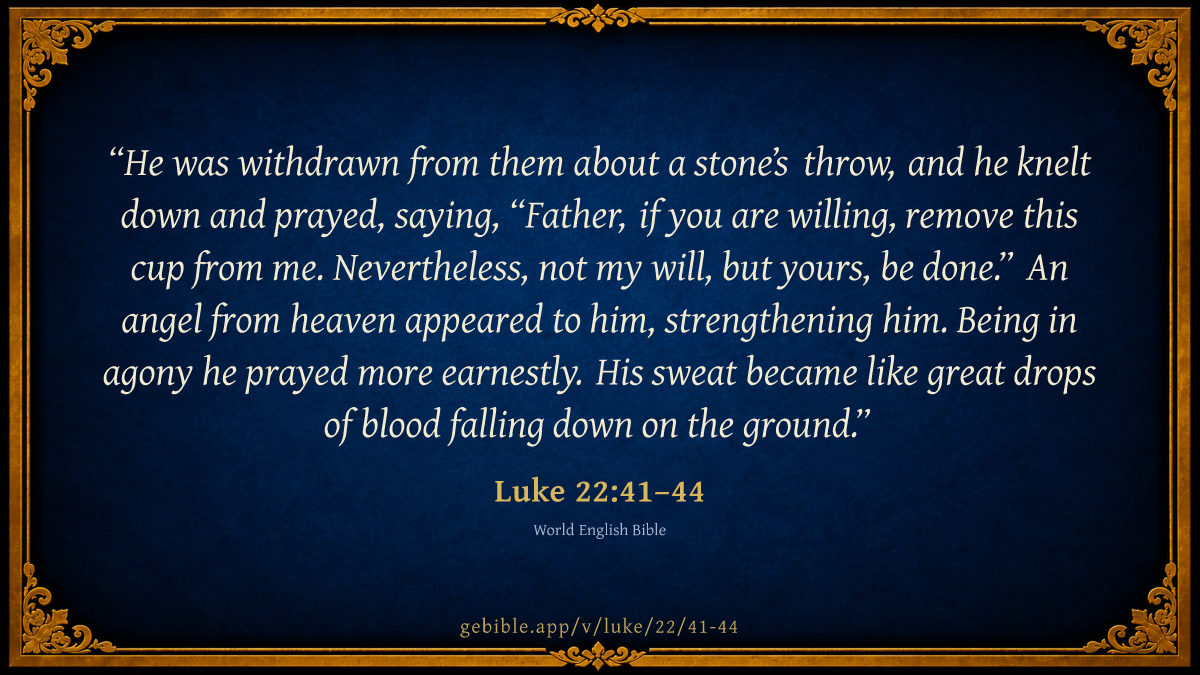
41He was withdrawn from them about a stone’s throw, and he knelt down and prayed,42saying, “Father, if you are willing, remove this cup from me. Nevertheless, not my will, but yours, be done.”
43An angel from heaven appeared to him, strengthening him.44Being in agony he prayed more earnestly. His sweat became like great drops of blood falling down on the ground.
Questions where the Bible appears to say two different things, with the passages on each side set together.
Did Jesus ask God to save him from crucifixion?In the Synoptic Gethsemane scene (Matt 26:36-42, Mark 14:35-36, Luke 22:41-42) Jesus prays explicitly that the cup of suffering pass from him — 'let this cup p…
John 12:27-28(v42)“Now my soul is troubled. What shall I say? ‘Father, save me from this time?’ But I came to this time for this cause. Father, glorify your…
Matthew 26:39(vv41–42)He went forward a little, fell on his face, and prayed, saying, “My Father, if it is possible, let this cup pass away from me;…
Matthew 26:42(v42)Again, a second time he went away, and prayed, saying, “My Father, if this cup can’t pass away from me unless I drink it, your desire be…
Mark 14:36(v42)He said, “Abba, Father, all things are possible to you. Please remove this cup from me. However, not what I desire, but what you desire.”
Psalms 40:8(v42)I delight to do your will, my God. Yes, your law is within my heart.”
Show all 46 cross-references
John 18:11(v42)Jesus therefore said to Peter, “Put the sword into its sheath. The cup which the Father has given me, shall I not surely drink it?”
Matthew 4:11(v43)Then the devil left him, and behold, angels came and served him.
Matthew 20:22(v42)But Jesus answered, “You don’t know what you are asking. Are you able to drink the cup that I am about to drink, and be baptized with the…
John 5:30(v42)I can of myself do nothing. As I hear, I judge, and my judgment is righteous; because I don’t seek my own will, but the will of my Father…
Lamentations 1:12(v44)“Is it nothing to you, all you who pass by? Look, and see if there is any sorrow like my sorrow, which is brought on me, with which Yahweh…
John 6:38(v42)For I have come down from heaven, not to do my own will, but the will of him who sent me.
John 4:34(v42)Jesus said to them, “My food is to do the will of him who sent me and to accomplish his work.
Hebrews 10:7-10(v42)Then I said, ‘Behold, I have come (in the scroll of the book it is written of me) to do your will, O God.’ ” Previously saying, “Sacrifices…
Matthew 26:53(v43)Or do you think that I couldn’t ask my Father, and he would even now send me more than twelve legions of angels?
Hebrews 5:7(v44)He, in the days of his flesh, having offered up prayers and petitions with strong crying and tears to him who was able to save him from…
Psalms 91:11-12(v43)For he will put his angels in charge of you, to guard you in all your ways. They will bear you up in their hands, so that you won’t dash…
Luke 22:17-20(v42)He received a cup, and when he had given thanks, he said, “Take this, and share it among yourselves, for I tell you, I will not drink at…
Hebrews 1:14(v43)Aren’t they all serving spirits, sent out to do service for the sake of those who will inherit salvation?
Psalms 22:12-21(v44)Many bulls have surrounded me. Strong bulls of Bashan have encircled me. They open their mouths wide against me, lions tearing prey and…
Isaiah 51:22(v42)Your Lord Yahweh, your God who pleads the cause of his people, says, “Behold, I have taken out of your hand the cup of staggering, even the…
1 Timothy 3:16(v43)Without controversy, the mystery of godliness is great: God was revealed in the flesh, justified in the spirit, seen by angels, preached…
Hebrews 1:6(v43)When he again brings in the firstborn into the world he says, “Let all the angels of God worship him.”
Job 4:3-4(v43)Behold, you have instructed many, you have strengthened the weak hands. Your words have supported him who was falling, You have made firm…
Matthew 4:6(v43)and said to him, “If you are the Son of God, throw yourself down, for it is written, ‘He will command his angels concerning you,’ and, ‘On…
Luke 4:10-11(v43)for it is written, ‘He will put his angels in charge of you, to guard you;’ and, ‘On their hands they will bear you up, lest perhaps you…
Luke 22:32(v43)but I prayed for you, that your faith wouldn’t fail. You, when once you have turned again, establish your brothers.”
Romans 8:32(v44)He who didn’t spare his own Son, but delivered him up for us all, how would he not also with him freely give us all things?
Deuteronomy 3:28(v43)But commission Joshua, and encourage him, and strengthen him; for he shall go over before this people, and he shall cause them to inherit…
Psalms 130:1-2(v44)Out of the depths I have cried to you, Yahweh. Lord, hear my voice. Let your ears be attentive to the voice of my petitions.
Isaiah 53:10(v44)Yet it pleased Yahweh to bruise him. He has caused him to suffer. When you make his soul an offering for sin, he will see his offspring. He…
Matthew 26:44(v42)He left them again, went away, and prayed a third time, saying the same words.
John 12:27(v44)“Now my soul is troubled. What shall I say? ‘Father, save me from this time?’ But I came to this time for this cause.
Daniel 10:16-19(v43)Behold, one in the likeness of the sons of men touched my lips. Then I opened my mouth, and spoke and said to him who stood before me, “My…
Daniel 11:1(v43)“As for me, in the first year of Darius the Mede, I stood up to confirm and strengthen him.
Mark 14:35(v41)He went forward a little, and fell on the ground, and prayed that, if it were possible, the hour might pass away from him.
Acts 18:23(v43)Having spent some time there, he departed, and went through the region of Galatia, and Phrygia, in order, establishing all the disciples.
Hebrews 2:17(v43)Therefore he was obligated in all things to be made like his brothers, that he might become a merciful and faithful high priest in things…
Genesis 32:24-28(v44)Jacob was left alone, and wrestled with a man there until the breaking of the day. When he saw that he didn’t prevail against him, the man…
Psalms 143:6-7(v44)I spread out my hands to you. My soul thirsts for you, like a parched land. Hurry to answer me, Yahweh. My spirit fails. Don’t hide your…
Lamentations 3:53-56(v44)They have cut off my life in the dungeon, and have cast a stone on me. Waters flowed over my head. I said, “I am cut off.” I called on your…
Jonah 2:2-3(v44)He said, “I called because of my affliction to Yahweh. He answered me. Out of the belly of Sheol I cried. You heard my voice. For you threw…
Jeremiah 25:15(v42)For Yahweh, the God of Israel, says to me: “Take this cup of the wine of wrath from my hand, and cause all the nations to whom I send you…
Luke 18:11(v41)The Pharisee stood and prayed to himself like this: ‘God, I thank you that I am not like the rest of men, extortionists, unrighteous,…
Psalms 22:1-2(v44)My God, my God, why have you forsaken me? Why are you so far from helping me, and from the words of my groaning? My God, I cry in the…
Psalms 69:14-18(v44)Deliver me out of the mire, and don’t let me sink. Let me be delivered from those who hate me, and out of the deep waters. Don’t let the…
Psalms 88:1-18(v44)Yahweh, the God of my salvation, I have cried day and night before you. Let my prayer enter into your presence. Turn your ear to my cry.…
46 distinct cross-references across this passage (47 total citations).
Cross-references from openbible.info (CC BY 4.0)
Explain this passage (14 sources)
Historical commentary, presented as a primary source — not an endorsement.
Geneva Bible translators1599 · Public DomainOn vv41, 44Prayers are a sure succor against the most perilous…
Prayers are a sure succor against the most perilous assaults of our enemies.
Geneva Bible (1599) marginal notes — public domain.
John Trapp1656 · Public DomainOn vv41–4441 And he was withdrawn from them about a…
41 And he was withdrawn from them about a stone’s cast, and kneeled down, and prayed,
Ver. 41. And he was withdrawn] For privacy’ sake to pray, though loth to leave their company, through extreme perplexity, which made him return so often to them, calling upon them to watch with him.
John Trapp, A Commentary or Exposition upon All the Books of the Old and New Testament (1647–1656) — public domain. Text from a community e-Sword module.
Matthew Poole1685 · Public DomainOn vv41–43Whether from the eight, or from Peter, James, and…
Whether from the eight, or from Peter, James, and John also, the evangelist doth not tell us; but some are of opinion, that he took the three disciples along to join with him in prayer, from whom some account might be given of the substance of his prayer, which followeth. I rather think he was alone.
Matthew Poole's English Annotations on the Holy Bible (1683–1685) — public domain. Text from a community e-Sword/MySword module.
John Gill1763 · Public DomainOn vv41–44Saying, Father, if thou be willing,.... If it be…
Saying, Father, if thou be willing,.... If it be consistent with thy will of saving sinners, and which thou hast declared to me, and I have undertook to perform: the other evangelists say, "if it be possible"; See Gill on Mat 26:39.
remove this cup from me; meaning, either his present sorrows and distress, or his approaching sufferings and death, which he had in view, or both:
Read full note →
nevertheless not my will; as man, for Christ had an human will distinct from, though not contrary to his divine will:
but thine be done; which Christ undertook, and came into this world to do; and it was his meat and drink to do it, and was the same with his own will, as the Son of God; See Gill on Mat 26:39, and See Gill on Mat 26:42.
John Gill's Exposition of the Whole Bible (1746–1763) — public domain (CC PDM 1.0). Text via the HelloAO Bible API.
John Wesley1765 · Public DomainOn vv43–44Strengthening him - Lest his body should sink and…
Strengthening him - Lest his body should sink and die before the time.
John Wesley, Explanatory Notes Upon the Whole Bible (1754–1765) — public domain. Text via the GEBible commentary corpus.
Adam Clarke1810 · Public DomainOn vv43–44Verse 43. There appeared an angel - from heaven]…
Verse 43. There appeared an angel - from heaven] It was as necessary that the fullest evidence should be given, not only of our Lord's Divinity, but also of his humanity: his miracles sufficiently attested the former; his hunger, weariness, and agony in the garden, as well as his death and burial, were proofs of the latter. As man, he needs the assistance of an angel to support his body, worn down by fatigue and suffering. See Clarke on Lu 22:44.
Adam Clarke's Commentary on the Bible (1810–1826) — public domain. Text from a community e-Sword/MySword module.
An angel ... strengthening him. Christ, our Redeemer, was truly God and truly man. And being made man by a real union of his divine person and nature, to our weak and infirm human nature, he likewise took upon him our infirmities, sin excepted. We must consider him as man, when we read of his being tempted in the wilderness, (Matthew iv.) when he wept at the raising of Lazarus out of the grave, (John xi.) as often as we read of his praying; and here, when we read of his praying, and redoubling his prayer in the garden, when we find him seized with fear, sadness, and grief: for though, as God, he could prevent and hinder these passions and affections natural to man, yet he could also permit them to affect his human nature; as he permitted himself to be seized with hunger, after fasting forty days; and so he permitted his human nature to be seized with fear and grief in this garden of Gethsemani. As angels came and ministered to him after his fast in the wilderness, so an angel came as it were to propose to him the divine decree, that he was to suffer and die for the redemption of mankind; and as man, he is said to be strengthened and comforted by the angel: he, who as God, was Lord and maker of the angels, and so needed not to be strengthened by his creatures. Besides what happened to Christ as man, were ordained as instructions for us. We are taught by angels appearing, that they were not only ready to assist and wait upon Christ, but that, by the order of divine Providence, they are also ready to assist us in our temptations and afflictions. --- In an agony. This Greek word signifies, a strife, or combat; not that there could be any opposition or contrariety in the interior of Christ, whose human will was always perfectly subject to his divine will, and the sensitive part to reason: yet, inasmuch as he was truly man, his human nature dreaded all those sufferings which at that time were represented to his soul, and which in a few hours he was to undergo. (Witham)
George Leo Haydock (1774–1849), Haydock's Catholic Family Bible and Commentary, 1859 edition — public domain. Excludes Psalms (Douay-Rheims chapter numbering differs from Protestant) and Deuterocanonical books (Catholic canon only).
Daniel D. Whedon1874 · Public DomainOn vv41, 43, 4441. Withdrawn from them—He first withdrew from the body…
41. Withdrawn from them—He first withdrew from the body of the disciples, attended by Peter, James, and John. He now withdraws from the three.
About a stone’s cast—A customary measurement in the Greek and Roman writers.
Daniel D. Whedon (gen. ed.), Commentary on the Old and New Testaments (1874–1909) — public domain. Text from a community e-Sword module.
The Cambridge Bible for Schools and Colleges1878 · Public DomainOn vv41–4441. he was withdrawn] Literally, “He was taken away,”…
41. he was withdrawn] Literally, “He was taken away,” or ‘He tore Himself away’ (comp. Luk_21:1), shewing the reluctance with which He parted from this support of loving sympathy under the imperious necessity of passing through His darkest hour alone. Perhaps He withdrew deeper into the shadow of the ancient olive-trees. (In estimating the force of such words as ekballo, apospao, &c., it should however be borne in mind that in Hellenistic Greek their old classical force was weakened by colloquialism. See 2Ma_12:10.)
and kneeled down] “and fell on His face,” Mat_26:39.
The Cambridge Bible for Schools and Colleges (gen. ed. J. J. S. Perowne; Cambridge University Press, 1878–1918) — public domain. Text from a community e-Sword module.
Ellicott's Commentary for English Readers1878 · Public DomainOn vv41–44(41) About a stone’s cast.—The descriptive touch, implying a…
(41) About a stone’s cast.—The descriptive touch, implying a report coming directly or indirectly from an eye-witness, is peculiar to St. Luke.
Kneeled down, and prayed.—Literally, and was praying. The tense of the latter verb implies continuous and sustained prayer.
A Bible Commentary for English Readers, edited by Charles John Ellicott (1878–1897) — public domain. Text from a community e-Sword module.
The Pulpit Commentary1880 · Public DomainOn vv42–44Saying, Father, if thou be willing, remove this cup…
Saying, Father, if thou be willing, remove this cup from me: nevertheless not my will, but thine, be done. The three synoptists give this prayer in slightly varying terms; "but the figure of the cup is common to all the three; "it was indelibly impressed on tradition. This cup, which Jesus entreats God to cause to pass from before (para) his lips, is the symbol of that terrible punishment, the dreadful and mournful picture of which is traced before him at this moment by a skillful painter with extraordinary vividness. The painter is the same who in the wilderness, using a like illusion, passed before his view the magical scene -f the glories belonging to the Messianic kingdom" (Godet). If thou be willing. He looked on in this supreme hour, just before "the Passion" really began, to the Crucifixion and all the horrors which preceded it and accompanied it to the treason of Judas; the denial of Peter; the desertion of the apostles; the cruel, relentless enmity of the priests and rulers; the heartless abandonment of the people; the insults; the scourging: and then the shameful and agonizing lingering death which was to close the Passion; and, more dreadful than all, the reason why he was here in Gethsemane; why he was to drink this dreadful cup of suffering; the memory of all the sin of man! To drink this cup of a suffering, measureless, inconceivable, the Redeemer for a moment shrank back, and asked the Father if the cross was the only means of gaining the glorious end in view the saving the souls of unnumbered millions. Could not God in his unlimited power find another way of reconciliation? And yet beneath this awful agony, the intensity of which we are utterly incapable of grasping beneath it there lay the intensest desire that his Father"s wish and will should be done. That wish and will were in reality his own. The prayer was made and answered. It was not the Father"s will that the cup should pass away, and the Son"s will was entirely the same; it was answered by the gift of strength strength from heaven being given to enable the Son to drink the cup of agony to its dregs. How this strength was given St. Luke relates in the next verse.
Self-surrender.
Read full note →
"Not my will, but thine, be done." These words are suggestive as well as expressive. They suggest to us
I THE ESSENTIAL NATURE OF SIN. Where shall we find the root of sin? Its manifold fruits we see around us in all forms of irreligion, of vice, of violence. But in what shall we find its root? In the preference of our own will to the will of God. If we trace human wrong-doing and wrong-being to its ultimate point, we arrived that conclusion. It is because men are not willing to be what God created them to be, not willing to do what he desires them to do; it is because they want to pursue those lines of thought and of action which he has forbidden, and to find their pleasure and their portion in things which he has disallowed, that they err from the strait path and begin the course which ends in condemnation and in death. The essence of all sin is in this assertion of our will against the will of God. We fail to recognize the foundation truth that we are his; that by every sacred tie that can bind one being to another we are bound, and we belong to him from whom we came and in whom we live, and move, and have our being. We assume to be the masters of our own lives and fortunes, the directors of our own selves, of our own will; we say, "My will, not thine, be done." Thus are we radically wrong; and being radically wrong, the issues of our hearts are evil. From this fountain of error and of evil the streams of sin are flowing; to that we trace their origin.
II THE HOUR AND ACT OF SPIRITUAL SURRENDER. When does the human spirit return to God, and by what act? That hour and that act, we reply, are not found at the time of any intellectual apprehension of the truth. A man may understand but little of Christian doctrine, and yet may be within the kingdom of heaven; or, on the other hand, he may know much, and yet remain outside that kingdom. Nor at the time of keen sensibility; for it is possible to be moved to deep and to fervent feeling, and yet to withhold the heart and life from the Supreme. Nor at the time of association with the visible Church of Christ. It is the hour at which and the act by which the soul cordially surrenders itself to God. When, in recognition of the paramount claims of God the Divine Father, the gracious Savior of mankind, we yield ourselves to God, that for all the future he may lead and guide us, may employ us in his holy service; when we have it in our heart to say, "Henceforth thy will, not ours, be done; then do we return unto the Lord our God, and then does he count us among the number of his own.
III THE HIGHEST ATTAINMENT OF CHRISTIAN ENDEAVOUR. When do we reach our highest point? Not when we have fought our fiercest battle, or have done our most fruitful work, or have gained our clearest and brightest vision of Divine truth; but when we have reached the point in which we can most cheerfully and most habitually say, after Christ our Lord, "Not my will, but thine, be done;" when under serious discouragement or even sad defeat, when after exhausting pain or before terrible suffering, when under heavy loss or in long-continued loneliness, or in prospect of early death, we are perfectly willing that God should do with us as his own wisdom and love direct. C.
The Pulpit Commentary (1880–1919), ed. H.D.M. Spence-Jones & Joseph S. Exell — public domain. Text from a community e-Sword module.
C. I. Scofield1917 · Public DomainOn vv42–43(See Scofield "Mat 26:39").
cup
(See Scofield "Mat 26:39").
The Scofield Reference Bible (1917 edition), notes by C. I. Scofield — public domain. Text from a community e-Sword module.
unfoldingWord translationNotes2017 · CC BY-SA 4.0On vv41, 43about a stone's throw
about a stone's throw
"about the distance that someone can throw a stone." AT: "a short distance" or with an estimated measurement like "about thirty meters" (See: Idiom)
Read full note →
Father, if you are willing
Jesus will bear the guilt of every person's sin on the cross. He prays to his Father, asking if there is another way.
Father
This is an important title for God. (See: Translating Son and Father)
remove this cup from me
Jesus refers to what he will soon experience as if it were a cup of bitter liquid that he would have to drink. AT: "allow me to not drink from this cup" or "allow me to not experience what is about to happen" (See: Metaphor)
Nevertheless not my will, but yours be done
This can be stated in active form. AT: "However, do what is according to your will rather than what is according to my will" (See: Active or Passive)
Tyndale Open Study Notes2022 · CC BY-SA 4.0On vv42–4422:42 please take this cup of suffering away: A…
22:42 please take this cup of suffering away: A cup is a metaphor for experiencing either judgment or blessing (see, e.g., Pss 23:5; 75:8; 116:13; Isa 51:17). Jesus felt all the emotions of his humanity, including fear and anxiety.

Geneva Bible translators 1599 · Public Domain On vv41, 44 Prayers are a sure succor against the most perilous…
Prayers are a sure succor against the most perilous assaults of our enemies.
Geneva Bible (1599) marginal notes — public domain.
John Trapp 1656 · Public Domain On vv41–44 41 And he was withdrawn from them about a…
41 And he was withdrawn from them about a stone’s cast, and kneeled down, and prayed,
Ver. 41. And he was withdrawn] For privacy’ sake to pray, though loth to leave their company, through extreme perplexity, which made him return so often to them, calling upon them to watch with him.
John Trapp, A Commentary or Exposition upon All the Books of the Old and New Testament (1647–1656) — public domain. Text from a community e-Sword module.
Matthew Poole 1685 · Public Domain On vv41–43 Whether from the eight, or from Peter, James, and…
Whether from the eight, or from Peter, James, and John also, the evangelist doth not tell us; but some are of opinion, that he took the three disciples along to join with him in prayer, from whom some account might be given of the substance of his prayer, which followeth. I rather think he was alone.
Matthew Poole's English Annotations on the Holy Bible (1683–1685) — public domain. Text from a community e-Sword/MySword module.
John Gill 1763 · Public Domain On vv41–44 Saying, Father, if thou be willing,.... If it be…
Saying, Father, if thou be willing,.... If it be consistent with thy will of saving sinners, and which thou hast declared to me, and I have undertook to perform: the other evangelists say, "if it be possible"; See Gill on Mat 26:39.
remove this cup from me; meaning, either his present sorrows and distress, or his approaching sufferings and death, which he had in view, or both:
Read full note →
nevertheless not my will; as man, for Christ had an human will distinct from, though not contrary to his divine will:
but thine be done; which Christ undertook, and came into this world to do; and it was his meat and drink to do it, and was the same with his own will, as the Son of God; See Gill on Mat 26:39, and See Gill on Mat 26:42.
John Gill's Exposition of the Whole Bible (1746–1763) — public domain (CC PDM 1.0). Text via the HelloAO Bible API.
John Wesley 1765 · Public Domain On vv43–44 Strengthening him - Lest his body should sink and…
Strengthening him - Lest his body should sink and die before the time.
John Wesley, Explanatory Notes Upon the Whole Bible (1754–1765) — public domain. Text via the GEBible commentary corpus.
Adam Clarke 1810 · Public Domain On vv43–44 Verse 43. There appeared an angel - from heaven]…
Verse 43. There appeared an angel - from heaven] It was as necessary that the fullest evidence should be given, not only of our Lord's Divinity, but also of his humanity: his miracles sufficiently attested the former; his hunger, weariness, and agony in the garden, as well as his death and burial, were proofs of the latter. As man, he needs the assistance of an angel to support his body, worn down by fatigue and suffering. See Clarke on Lu 22:44.
Adam Clarke's Commentary on the Bible (1810–1826) — public domain. Text from a community e-Sword/MySword module.
Haydock's Catholic Bible Commentary 1859 · Public Domain On vv43–44 An angel ... strengthening him. Christ, our Redeemer, was…
An angel ... strengthening him. Christ, our Redeemer, was truly God and truly man. And being made man by a real union of his divine person and nature, to our weak and infirm human nature, he likewise took upon him our infirmities, sin excepted. We must consider him as man, when we read of his being tempted in the wilderness, (Matthew iv.) when he wept at the raising of Lazarus out of the grave, (John xi.) as often as we read of his praying; and here, when we read of his praying, and redoubling his prayer in the garden, when we find him seized with fear, sadness, and grief: for though, as God, he could prevent and hinder these passions and affections natural to man, yet he could also permit them to affect his human nature; as he permitted himself to be seized with hunger, after fasting forty days; and so he permitted his human nature to be seized with fear and grief in this garden of Gethsemani. As angels came and ministered to him after his fast in the wilderness, so an angel came as it were to propose to him the divine decree, that he was to suffer and die for the redemption of mankind; and as man, he is said to be strengthened and comforted by the angel: he, who as God, was Lord and maker of the angels, and so needed not to be strengthened by his creatures. Besides what happened to Christ as man, were ordained as instructions for us. We are taught by angels appearing, that they were not only ready to assist and wait upon Christ, but that, by the order of divine Providence, they are also ready to assist us in our temptations and afflictions. --- In an agony. This Greek word signifies, a strife, or combat; not that there could be any opposition or contrariety in the interior of Christ, whose human will was always perfectly subject to his divine will, and the sensitive part to reason: yet, inasmuch as he was truly man, his human nature dreaded all those sufferings which at that time were represented to his soul, and which in a few hours he was to undergo. (Witham)
George Leo Haydock (1774–1849), Haydock's Catholic Family Bible and Commentary, 1859 edition — public domain. Excludes Psalms (Douay-Rheims chapter numbering differs from Protestant) and Deuterocanonical books (Catholic canon only).
Daniel D. Whedon 1874 · Public Domain On vv41, 43, 44 41. Withdrawn from them—He first withdrew from the body…
41. Withdrawn from them—He first withdrew from the body of the disciples, attended by Peter, James, and John. He now withdraws from the three.
About a stone’s cast—A customary measurement in the Greek and Roman writers.
Daniel D. Whedon (gen. ed.), Commentary on the Old and New Testaments (1874–1909) — public domain. Text from a community e-Sword module.
The Cambridge Bible for Schools and Colleges 1878 · Public Domain On vv41–44 41. he was withdrawn] Literally, “He was taken away,”…
41. he was withdrawn] Literally, “He was taken away,” or ‘He tore Himself away’ (comp. Luk_21:1), shewing the reluctance with which He parted from this support of loving sympathy under the imperious necessity of passing through His darkest hour alone. Perhaps He withdrew deeper into the shadow of the ancient olive-trees. (In estimating the force of such words as ekballo, apospao, &c., it should however be borne in mind that in Hellenistic Greek their old classical force was weakened by colloquialism. See 2Ma_12:10.)
and kneeled down] “and fell on His face,” Mat_26:39.
The Cambridge Bible for Schools and Colleges (gen. ed. J. J. S. Perowne; Cambridge University Press, 1878–1918) — public domain. Text from a community e-Sword module.
Ellicott's Commentary for English Readers 1878 · Public Domain On vv41–44 (41) About a stone’s cast.—The descriptive touch, implying a…
(41) About a stone’s cast.—The descriptive touch, implying a report coming directly or indirectly from an eye-witness, is peculiar to St. Luke.
Kneeled down, and prayed.—Literally, and was praying. The tense of the latter verb implies continuous and sustained prayer.
A Bible Commentary for English Readers, edited by Charles John Ellicott (1878–1897) — public domain. Text from a community e-Sword module.
The Pulpit Commentary 1880 · Public Domain On vv42–44 Saying, Father, if thou be willing, remove this cup…
Saying, Father, if thou be willing, remove this cup from me: nevertheless not my will, but thine, be done. The three synoptists give this prayer in slightly varying terms; "but the figure of the cup is common to all the three; "it was indelibly impressed on tradition. This cup, which Jesus entreats God to cause to pass from before (para) his lips, is the symbol of that terrible punishment, the dreadful and mournful picture of which is traced before him at this moment by a skillful painter with extraordinary vividness. The painter is the same who in the wilderness, using a like illusion, passed before his view the magical scene -f the glories belonging to the Messianic kingdom" (Godet). If thou be willing. He looked on in this supreme hour, just before "the Passion" really began, to the Crucifixion and all the horrors which preceded it and accompanied it to the treason of Judas; the denial of Peter; the desertion of the apostles; the cruel, relentless enmity of the priests and rulers; the heartless abandonment of the people; the insults; the scourging: and then the shameful and agonizing lingering death which was to close the Passion; and, more dreadful than all, the reason why he was here in Gethsemane; why he was to drink this dreadful cup of suffering; the memory of all the sin of man! To drink this cup of a suffering, measureless, inconceivable, the Redeemer for a moment shrank back, and asked the Father if the cross was the only means of gaining the glorious end in view the saving the souls of unnumbered millions. Could not God in his unlimited power find another way of reconciliation? And yet beneath this awful agony, the intensity of which we are utterly incapable of grasping beneath it there lay the intensest desire that his Father"s wish and will should be done. That wish and will were in reality his own. The prayer was made and answered. It was not the Father"s will that the cup should pass away, and the Son"s will was entirely the same; it was answered by the gift of strength strength from heaven being given to enable the Son to drink the cup of agony to its dregs. How this strength was given St. Luke relates in the next verse.
Self-surrender.
Read full note →
"Not my will, but thine, be done." These words are suggestive as well as expressive. They suggest to us
I THE ESSENTIAL NATURE OF SIN. Where shall we find the root of sin? Its manifold fruits we see around us in all forms of irreligion, of vice, of violence. But in what shall we find its root? In the preference of our own will to the will of God. If we trace human wrong-doing and wrong-being to its ultimate point, we arrived that conclusion. It is because men are not willing to be what God created them to be, not willing to do what he desires them to do; it is because they want to pursue those lines of thought and of action which he has forbidden, and to find their pleasure and their portion in things which he has disallowed, that they err from the strait path and begin the course which ends in condemnation and in death. The essence of all sin is in this assertion of our will against the will of God. We fail to recognize the foundation truth that we are his; that by every sacred tie that can bind one being to another we are bound, and we belong to him from whom we came and in whom we live, and move, and have our being. We assume to be the masters of our own lives and fortunes, the directors of our own selves, of our own will; we say, "My will, not thine, be done." Thus are we radically wrong; and being radically wrong, the issues of our hearts are evil. From this fountain of error and of evil the streams of sin are flowing; to that we trace their origin.
II THE HOUR AND ACT OF SPIRITUAL SURRENDER. When does the human spirit return to God, and by what act? That hour and that act, we reply, are not found at the time of any intellectual apprehension of the truth. A man may understand but little of Christian doctrine, and yet may be within the kingdom of heaven; or, on the other hand, he may know much, and yet remain outside that kingdom. Nor at the time of keen sensibility; for it is possible to be moved to deep and to fervent feeling, and yet to withhold the heart and life from the Supreme. Nor at the time of association with the visible Church of Christ. It is the hour at which and the act by which the soul cordially surrenders itself to God. When, in recognition of the paramount claims of God the Divine Father, the gracious Savior of mankind, we yield ourselves to God, that for all the future he may lead and guide us, may employ us in his holy service; when we have it in our heart to say, "Henceforth thy will, not ours, be done; then do we return unto the Lord our God, and then does he count us among the number of his own.
III THE HIGHEST ATTAINMENT OF CHRISTIAN ENDEAVOUR. When do we reach our highest point? Not when we have fought our fiercest battle, or have done our most fruitful work, or have gained our clearest and brightest vision of Divine truth; but when we have reached the point in which we can most cheerfully and most habitually say, after Christ our Lord, "Not my will, but thine, be done;" when under serious discouragement or even sad defeat, when after exhausting pain or before terrible suffering, when under heavy loss or in long-continued loneliness, or in prospect of early death, we are perfectly willing that God should do with us as his own wisdom and love direct. C.
The Pulpit Commentary (1880–1919), ed. H.D.M. Spence-Jones & Joseph S. Exell — public domain. Text from a community e-Sword module.
C. I. Scofield 1917 · Public Domain On vv42–43 (See Scofield "Mat 26:39").
cup
(See Scofield "Mat 26:39").
The Scofield Reference Bible (1917 edition), notes by C. I. Scofield — public domain. Text from a community e-Sword module.
unfoldingWord translationNotes 2017 · CC BY-SA 4.0 On vv41, 43 about a stone's throw
about a stone's throw
"about the distance that someone can throw a stone." AT: "a short distance" or with an estimated measurement like "about thirty meters" (See: Idiom)
Read full note →
Father, if you are willing
Jesus will bear the guilt of every person's sin on the cross. He prays to his Father, asking if there is another way.
Father
This is an important title for God. (See: Translating Son and Father)
remove this cup from me
Jesus refers to what he will soon experience as if it were a cup of bitter liquid that he would have to drink. AT: "allow me to not drink from this cup" or "allow me to not experience what is about to happen" (See: Metaphor)
Nevertheless not my will, but yours be done
This can be stated in active form. AT: "However, do what is according to your will rather than what is according to my will" (See: Active or Passive)
translationWords
pray
God the Father
will of God
unfoldingWord translationNotes — © Distant Shores Media and the Door43 World Missions Community, licensed CC BY-SA 4.0. Source: git.door43.org/Door43/en_tn.
Tyndale Open Study Notes 2022 · CC BY-SA 4.0 On vv42–44 22:42 please take this cup of suffering away: A…
22:42 please take this cup of suffering away: A cup is a metaphor for experiencing either judgment or blessing (see, e.g., Pss 23:5; 75:8; 116:13; Isa 51:17). Jesus felt all the emotions of his humanity, including fear and anxiety.
Tyndale Open Study Notes — © Tyndale Open Resources, licensed CC BY-SA 4.0. Text via the HelloAO Bible API.