
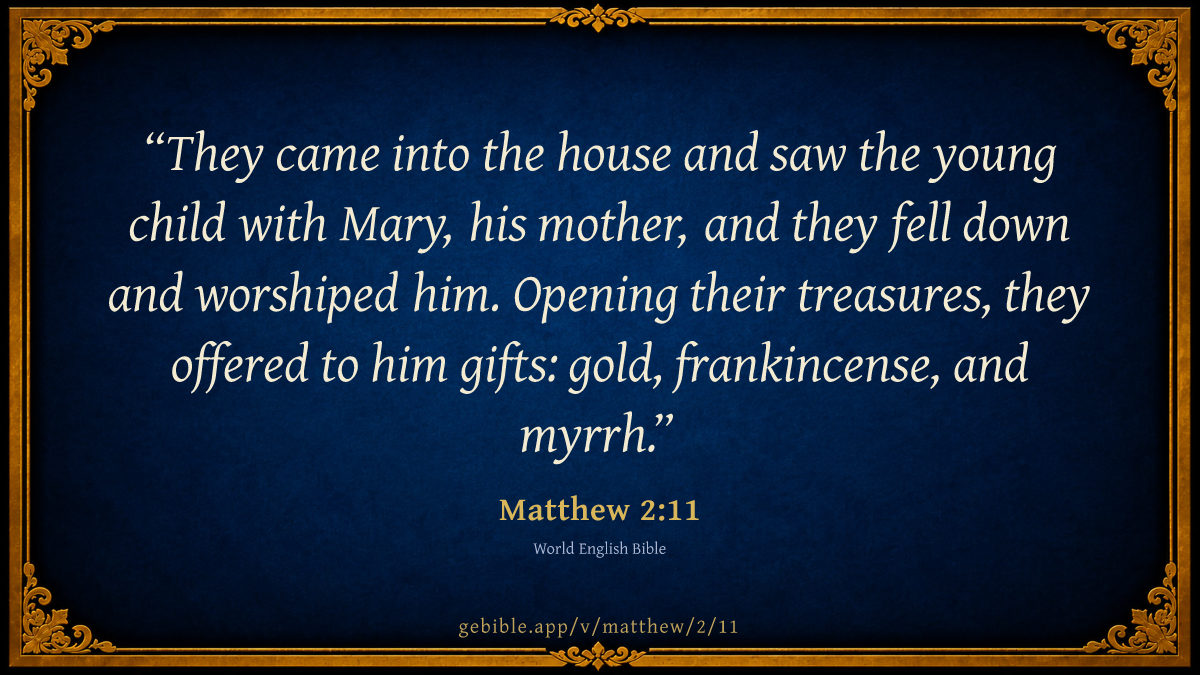
They came into the house and saw the young child with Mary, his mother, and they fell down and worshiped him. Opening their treasures, they offered to him gifts: gold, frankincense, and myrrh.
Parallel Translations
-
They came into the house and saw the young child with Mary, his mother, and they fell down and worshiped him. Opening their treasures, they offered to him gifts: gold, frankincense, and myrrh.
-
and went into the house and found the chylde with Mary hys mother and kneled doune and worshipped hym and opened their treasures and offred vnto hym gyftes gold frackynsence and myrre.
-
And went into the house, and founde the babe with Mary his mother, and fell downe, and worshipped him, and opened their treasures, and presented vnto him giftes, euen golde, and frankincense, and myrrhe.
Examined in Scripture Analysis
Contradictions (2)
Questions where the Bible appears to say two different things, with the passages on each side set together.
Cross-references (28)
Passages linked to Matthew 2:11 in the Treasury of Scripture Knowledge, ordered by reader-vote popularity; verse text shown in World English Bible.
- Isaiah 60:6 A multitude of camels will cover you, the dromedaries of Midian and Ephah. All from Sheba will come. They will bring gold and frankincense, and will proclaim the praises of Yahweh.
- Psalms 72:10 The kings of Tarshish and of the islands will bring tribute. The kings of Sheba and Seba shall offer gifts.
- Luke 2:16 They came with haste, and found both Mary and Joseph, and the baby was lying in the feeding trough.
- Matthew 2:2 “Where is he who is born King of the Jews? For we saw his star in the east, and have come to worship him.”
- Psalms 95:6 Oh come, let’s worship and bow down. Let’s kneel before Yahweh, our Maker,
- Numbers 7:14 one golden ladle of ten shekels, full of incense;
- 1 Kings 10:2 She came to Jerusalem with a very great caravan, with camels that bore spices, very much gold, and precious stones; and when she had come to Solomon, she talked with him about all that was in her heart.
- Psalms 72:15 They shall live, and to him shall be given of the gold of Sheba. Men shall pray for him continually. They shall bless him all day long.
- Acts 10:25-26 When Peter entered, Cornelius met him, fell down at his feet, and worshiped him. But Peter raised him up, saying, “Stand up! I myself am also a man.”
- John 5:22-23 For the Father judges no one, but he has given all judgment to the Son, that all may honor the Son, even as they honor the Father. He who doesn’t honor the Son doesn’t honor the Father who sent him.
- Revelation 5:8 Now when he had taken the book, the four living creatures and the twenty-four elders fell down before the Lamb, each one having a harp, and golden bowls full of incense, which are the prayers of the saints.
- Matthew 14:33 Those who were in the boat came and worshiped him, saying, “You are truly the Son of God!”
- Luke 2:26-32 It had been revealed to him by the Holy Spirit that he should not see death before he had seen the Lord’s Christ. He came in the Spirit into the temple. When the parents brought in the child, Jesus, that they might do concerning him according to the custom of the law, then he received him into his arms, and blessed God, and said, “Now you are releasing your servant, Master, according to your word, in peace; for my eyes have seen your salvation, which you have prepared before the face of all peoples; a light for revelation to the nations, and the glory of your people Israel.”
- Luke 2:38 Coming up at that very hour, she gave thanks to the Lord, and spoke of him to all those who were looking for redemption in Jerusalem.
- Revelation 19:10 I fell down before his feet to worship him. He said to me, “Look! Don’t do it! I am a fellow bondservant with you and with your brothers who hold the testimony of Jesus. Worship God, for the testimony of Jesus is the Spirit of Prophecy.”
- Revelation 22:8-10 Now I, John, am the one who heard and saw these things. When I heard and saw, I fell down to worship before the feet of the angel who had shown me these things. He said to me, “See you don’t do it! I am a fellow bondservant with you and with your brothers, the prophets, and with those who keep the words of this book. Worship God.” He said to me, “Don’t seal up the words of the prophecy of this book, for the time is at hand.
- Genesis 43:11 Their father, Israel, said to them, “If it must be so, then do this: Take from the choice fruits of the land in your bags, and carry down a present for the man, a little balm, a little honey, spices and myrrh, nuts, and almonds;
- Leviticus 6:15 He shall take from there his handful of the fine flour of the meal offering, and of its oil, and all the frankincense which is on the meal offering, and shall burn it on the altar for a pleasant aroma, as its memorial portion, to Yahweh.
- Numbers 7:86 the twelve golden ladles, full of incense, weighing ten shekels apiece, according to the shekel of the sanctuary; all the gold of the ladles weighed one hundred twenty shekels;
- 1 Samuel 10:27 But certain worthless fellows said, “How could this man save us?” They despised him, and brought him no present. But he held his peace.
- Matthew 4:9-10 He said to him, “I will give you all of these things, if you will fall down and worship me.” Then Jesus said to him, “Get behind me, Satan! For it is written, ‘You shall worship the Lord your God, and you shall serve him only.’ ”
- Exodus 30:23 “Also take fine spices: of liquid myrrh, five hundred shekels; and of fragrant cinnamon half as much, even two hundred and fifty; and of fragrant cane, two hundred and fifty;
- Exodus 30:34 Yahweh said to Moses, “Take to yourself sweet spices, gum resin, onycha, and galbanum; sweet spices with pure frankincense. There shall be an equal weight of each.
- 1 Kings 10:10 She gave the king one hundred twenty talents of gold, and a very great quantity of spices, and precious stones. Never again was there such an abundance of spices as these which the queen of Sheba gave to king Solomon.
- Psalms 2:12 Give sincere homage to the Son, lest he be angry, and you perish on the way, for his wrath will soon be kindled. Blessed are all those who take refuge in him.
- Psalms 45:8 All your garments smell like myrrh, aloes, and cassia. Out of ivory palaces stringed instruments have made you glad.
- Malachi 1:11 For from the rising of the sun even to its going down, my name is great among the nations, and in every place incense will be offered to my name, and a pure offering: for my name is great among the nations,” says Yahweh of Armies.
- Leviticus 2:1-2 “ ‘When anyone offers an offering of a meal offering to Yahweh, his offering shall be of fine flour. He shall pour oil on it, and put frankincense on it. He shall bring it to Aaron’s sons, the priests. He shall take his handful of its fine flour, and of its oil, with all its frankincense, and the priest shall burn its memorial on the altar, an offering made by fire, of a pleasant aroma to Yahweh.
Cross-references from openbible.info (CC BY 4.0)
Explain this verse (17 sources)
Historical commentary, presented as a primary source — not an endorsement.
Private notes
Saved on this device only — never synced or sent anywhere.
Geneva Bible translators 1599 · Public Domain A kind of humble and lovely reverence.
A kind of humble and lovely reverence.
The rich and costly presents, which they brought him.
Geneva Bible (1599) marginal notes — public domain.
John Trapp 1656 · Public Domain 11 And when they were come into the house,…
11 And when they were come into the house, they saw the young child with Mary his mother, and fell down, and worshipped him: and when they had opened their treasures, they presented unto him gifts; gold, and frankincense, and myrrh.
Ver. 11. And when they were come into the house] Not a palace prepared for the purpose, as the Porphyrogeniti in Constantinople had, but in an inn was Christ born, as ready to receive all that come unto him (πανδοχειον); and in a hole of the earth, an underground den, as Justin Martyr, Epiphanius, Eusebius, and Origen witness. In hoc terrae foramine (saith St Jerome, ad Marcell. tom. 1) coelorum conditor natus est, hic involutus pannis, hic visus a pastoribus, hic adoratus a Magis, hic circumcisus, &c.: In this cell or hole was the world’s Creator born, swathed, visited, adored, circumcised.
Read full note →
They saw the young child] For this Ancient of days, by joining his majesty to our vileness, his power to our weakness, suspended and laid aside his own glory, wherewith he was glorified with the Father before the world began, and voluntarily abased himself to the shape and state of a poor, feeble, helpless infant, that we might come to the fulness of the age in Christ. Eph 4:13.
With Mary his mother] Without any other assistance or attendance. Joseph haply was at work, or otherwise absent, lest the wise men should mistake him for the true father of the child.
And when they had opened their treasure, they presented unto him gifts] No great matters to make him rich; for then, what needed the holy Virgin, at her purification, to have offered two young pigeons, as a token of her penury, that could not reach to a lamb? Yet something it was, gold, frankincense, and myrrh (sent them in by a special providence of God), to help to bear their charges into Egypt, whither they were now to flee.
Gold, frankincense, and myrrh] The best commodities of their country, doubtless; thereby (as by a peppercorn or trifle, in way of homage or chief rent) they acknowledged Christ to be the true Proprietary and Lord of all. Of the elephant it is reported, that coming to feed, the first sprig he breaks he turns it toward heaven. Of the stork Pliny tells us, that she offers the firstfruits of her young ones to God, by casting one of them out of the nest. {a} God is content we have the benefit of his creatures, so he may have the glory of them: this is all the loan he looketh for, and for this, as he indents with us, Psa 50:15, so the saints promise in return, Gen 28:22. But he cannot abide that we pay this rent to a wrong landlord, whether to ourselves, as Deu 8:17, or to our fellow creatures, as they to their sweethearts, Hos 2:5.
Gold, frankincense, and myrrh] Aurum, Thus, Myrrham, Regique, Hominique, Deoque. A little of each, as Gen 43:11. Lycurgus made a law that no man should be too costly or bountiful in his offering of sacrifice, lest at length he should grow weary of the charge, and give God up. {b} Ought we not (saith one) often in soul to go with the wise men to Bethlehem, being directed by the star of grace, and there fall down and worship the little King; there offer the gold of charity, the frankincense of devotion, the myrrh of penitence; and then return, not by cruel Herod or troubled Jerusalem, but another way, a better way, unto our long and happy home? (Sutton’s Disce Virere.)
{a} Hinc pietatis cultrix a Latinis dicitur, Hafida ab Hebraeis. Amasii Trem.
{b} ινα μηποτε τιμωντες το θειοιν καταλειπωσιν. Plut.
John Trapp, A Commentary or Exposition upon All the Books of the Old and New Testament (1647–1656) — public domain. Text from a community e-Sword module.
Matthew Poole 1685 · Public Domain How long the virgin Mary and her holy Child…
How long the virgin Mary and her holy Child had been there is not expressed; those that think these wise men came within six weeks or two months, judge that Joseph and Mary came thither from Jerusalem after that he had been there offered, to the Lord, of which you read Luk 2:22; but they are forced, to uphold this, to interpret Luk 2:39, which saith that after they had performed all things according to the law of the Lord, they returned into Galilee, to their own city Nazareth, of a considerable time after they had performed these things, which seemeth something hard and needless, especially considering Nazareth was Joseph’s own city, i.e. the city where his fixed habitation was. It is most probable that they, after so long absence, went right home, and if the wise men (which is said) found them in Bethlehem, they were gone thither again to visit some relations.
They saw the young child with Mary his mother; under what other circumstances the Scripture saith not, but questionless they were very poor and mean, which is a very strong inducement to us to believe that they had a spiritual Divine revelation, that this was a King whose kingdom was not of this world, the true Messiah and Saviour of the world; they would hardly else have treated a poor infant, in an ordinary house and no more attended, at the rate they did, for the text saith they
Read full note →
fell down and worshipped him; a usual homage indeed which the Eastern nations paid to princes, but they used then to have better evidences of their royal state and dignity than these wise men seemed to have had, if they had not, besides the star, a Divine revelation what manner of King this was to be. We may therefore rather judge that their revelation extended not only to the birth of a King, but of such a King as indeed he was, the eternal Son of God clothed with human flesh; and that their falling down and worshipping him is to be understood of a Divine worship they paid to him, as the Saviour of the world: and so they were the first fruits of the Gentiles, owning and believing in the Lord Jesus Christ. And that their following offerings to him were upon that account, for opening
their treasures, they presented to him gold, frankincense, and myrrh. The guesses of those who think that they offered him gold as to a King, frankincense as a High Priest, and myrrh to sweeten the place where he was, I take to be but the product of luxuriant fancies. It is most certain that those Eastern people seldom came to their princes without some presents, and that their presents were usually of the most choice things their country afforded. This is plain from Gen 43:11; and if what naturalists tell us be true, that myrrh was only to be found in Arabia, and frankincense in Sabea, (a part of Arabia) and that country also had gold, which it is plain that it had from 2Ch 9:14, it makes a very probable argument, that these wise men came from Arabia, which was full of men that were astrologers. The providence of God was wonderfully seen in these presents, by them providing for the sustenance of Joseph, and Mary, and Jesus in that exile which they were soon after to endure. For other allegorical and mystical significations of these presents, they are but conjectures, and the exuberances of men’s fancies.
Matthew Poole's English Annotations on the Holy Bible (1683–1685) — public domain. Text from a community e-Sword/MySword module.
John Gill 1763 · Public Domain And when they were come into the house,.... Which…
And when they were come into the house,.... Which they entered without making any inquiry, being fully assured by the star's standing right over it, that this was the house, and here was the king of the Jews, whom they were come to worship; and having entered in "they saw" some copies read
they found the young child, with Mary his mother; in her lap, or arms, or in the house with her, for by this time he might go alone. Joseph perhaps was not at home, but about his business; and which might be so ordered by the providence of God, that so these men might only see the mother of Christ, who had no real father as man; who had they seen Joseph, might have took him to be his proper father. Upon the sight of the young child,
Read full note →
they fell down on their knees or faces to the ground, agreeably to the custom of their country,
and worshipped him as a king; giving him the same civil honour and respect, as they were wont to do to their own kings and princes; which custom began with Cyrus: for so Xenophon (c) says, that
"when the people saw him, , they all worshipped him; either because some were ordered to begin this custom; or else being amazed at the apparatus; or because he seemed to appear so great and beautiful; for before that time none of the Persians worshipped Cyrus.''
And when they had opened their treasures, that is, their purses, bags or boxes, in which they put those things they brought with them necessary for their journey;
they presented, or offered to him
gifts, gold, frankincense and myrrh: such things as they had; it being usual, not only with the Persians, but other eastern nations, to make presents to kings and great persons, when they made any addresses to them; which generally, among other things, consisted of gold, spices, myrrh, and the like, see Gen 43:11. Which last passage referred to, being a prophecy of the Messiah, has been thought by some now to have had its accomplishment, together with Isa 60:6 where frankincense as well as gold is mentioned, "they shall bring gold and incense" or frankincense; upon which a noted Jewish writer (d) observes, that gold and frankincense shall be brought privately as a present to the king Messiah. According to the Ethiopians, these wise men were three, whose names they give us; the name of him that offered the gold, was Annoson; he that offered the frankincense, was Allytar; and he that offered the myrrh, Kyssad (e). The Papists call them the three kings of Colen, and say they lie buried in that place.
(c) Cyropaedia, l. 8. sect. 23. (d) R. David Kimchi. (e) Ludolph. Lex. Ethiop. p. 539, 542, 543.
John Gill's Exposition of the Whole Bible (1746–1763) — public domain (CC PDM 1.0). Text via the HelloAO Bible API.
John Wesley 1765 · Public Domain They presented to him gifts - It was customary…
They presented to him gifts - It was customary to offer some present to any eminent person whom they visited. And so it is, as travelers observe, in the eastern countries to this day. Gold, frankincense, and myrrh - Probably these were the best things their country afforded; and the presents ordinarily made to great persons. This was a most seasonable, providential assistance for a long and expensive journey into Egypt, a country where they were entirely strangers, and were to stay for a considerable time.
John Wesley, Explanatory Notes Upon the Whole Bible (1754–1765) — public domain. Text via the GEBible commentary corpus.
Adam Clarke 1810 · Public Domain Verse 11. They presented unto him gifts] The people…
Verse 11. They presented unto him gifts] The people of the east never approach the presence of kings and great personages, without a present in their hands. This custom is often noticed in the Old Testament, and still prevails in the east, and in some of the newly discovered South Sea Islands.
Gold, and frankincense, and myrrh.] Some will have these gifts to be emblematic of the Divinity, regal office, and manhood of Christ. "They offered him incense as their God; gold as their king; and myrrh, as united to a human body, subject to suffering and death." Aurum, thus, myrrham, regique, DEO, HOMINIQUE, dona ferunt. JUVENCUS. Rather, they offered him the things which were in most esteem among themselves; and which were productions of their own country. The gold was probably a very providential supply, as on it, it is likely, they subsisted while in Egypt.
Adam Clarke's Commentary on the Bible (1810–1826) — public domain. Text from a community e-Sword/MySword module.
Albert Barnes 1834 · Public Domain The house - The place where he was born,…
The house - The place where he was born, or the place where they lived at that time.
Fell down - This was the usual way of showing respect or homage among the Jews, Est 8:3; Job 1:20; Dan 3:7; Psa 72:11; Isa 46:6.
Read full note →
Worshipped him - Did him homage as King of the Jews. See the notes at Mat 2:2.
Had opened their treasures - The treasures which they had brought, or the boxes, etc., in which they had brought their gold, etc.
They presented unto him gifts - These were presented to him as King of the Jews, because they supposed he was to be a distinguished prince and conqueror. It was customary in the East to show respect for persons of distinction by making presents or offerings of this kind. See Gen 32:14; Gen 43:11; 1Sa 10:27; 1Ki 10:2; Psa 72:10-15. This custom is still common in the East, and it is everywhere there unusual to approach a person of distinguished rank without a valuable present.
Frankincense - Frankincense is a white resin or gum. It is obtained from a tree by making incisions in the bark, and suffering the gum to flow out. It is highly odoriferous or fragrant when burned, and was therefore used in worship, where it was burned as a pleasant offering to God. See Exo 30:8; Lev 16:12. It is found in the East Indies, but chiefly in Arabia; and hence it has been supposed probable that the wise men came from Arabia.
Myrrh - This was also a production of Arabia, and was obtained from a tree in the same manner as frankincense. The name denotes bitterness, and was given to it on account of its great bitterness. It was used chiefly in embalming the dead, because it had the property of preserving dead bodies from putrefaction. Compare Joh 19:39, it was much used in Egypt and in Judea. It was obtained from a thorny tree, which grows 8 or 9 feet high. It was at an early period an article of commerce Gen 37:25, and was an ingredient of the holy ointment, Exo 30:23. It was also used as an agreeable perfume, Est 2:12; Psa 45:8; Pro 7:17. It was also sometimes mingled with wine to form an article of drink. Such a drink was given to our Saviour, when about to be crucified, as a stupefying potion, Mar 15:23; compare Mat 27:34. The offerings here referred to were made because they were the most valuable which the country of the Magi or wise men produced. They were tokens of respect and homage which they paid to the new-born King of the Jews. They evinced their high regard for him, and their belief that he was to be an illustrious prince; and the fact that their deed is recorded with approbation shows us that we should offer our most valuable possessions, our all, to the Lord Jesus Christ. Wise men came from far to do him homage, and bowed down, and presented their best gifts and offerings. It is right that we give to him also our hearts, our property, our all.
Albert Barnes' Notes on the Bible (1834–1885) — public domain. Text from a community e-Sword/MySword module.
Haydock's Catholic Bible Commentary 1859 · Public Domain And going into the house. Several of the Fathers…
And going into the house. Several of the Fathers in their homilies, represent the wise men adoring Jesus in the stable, and in the manger. yet others, with St. John Chrysostom take notice, that before their arrival, Jesus might be removed into some little house in Bethlehem. --- Prostrating themselves, or falling down, they adored him, not with a civil worship only, but enlightened by divine inspiration, the worshipped and adored him as their Saviour and their God. --- Gold, frankincense, and myrrh.[2] Divers of the ancient Fathers take notice of the mystical signification of these offerings; that by gold was signified the tribute they paid to him, as to their king; by incense, that he was God; and by myrrh, (with which dead bodies used to be embalmed) that now he was also become a mortal man. See St. Ambrose lib. 2. in Luc. chap. ii.; St. Gregory &c. (Witham) --- The Church sings, "hodie stella Magos duxit ad præsepium," but it is not probable that the blessed Virgin should remain so long in the open stable, and the less so, because the multitude, who hindered Joseph from finding accommodations either among his relatives or in the public caravansaries, had returned to their own homes. (Estius) --- They adored Him. Therefore, in the eucharist also, Christ is to be adored. For it is of no consequence under what appearance he is pleased to give himself to us, whether that of a perfect man, a speechless child as here, or under the appearance of bread and wine, provided it is evident that he is there; for in whatever manner or place he appears, he is true God, and for that alone he is to be adored. Frivolous is the objection of certain sectarists, that Christ does not give himself to us in the blessed eucharist to be adored, but to be eaten. For Christ was not in Bethlehem, nor did he descend from heaven to be adored: He tells us in the xxth chap. of Matthew, ver. 28, that the Son of Man came not to be ministered unto, but to minister; yet he was adored on earth, even while he was in his mortal state, by the magi, by his disciples, by the blind man that was cured of his blindness, &c. &c. "Let us imitate the magi. Thou seest him not now in the crib, but on the altar; not a woman holding him, but the priest present, and the Holy Ghost poured out abundantly upon the sacrifice." (St. John Chrysostom, hom. xxiv. in 1 Cor. Hom. vii. de Sancto Philog.)
===============================
Read full note →
[BIBLIOGRAPHY]
Aurum, &c. Pulcherrime, says St. Jerome on this place, Juvencus Munerum Sacramenta comprehendit, Thus, Aurum, Myrrham, Regique, Hominique, Deoque,
Dona ferunt. See St. Ambrose in Luc. lib. ii. chap. ii. St. Gregory hom. x. in Evang. &c.
George Leo Haydock (1774–1849), Haydock's Catholic Family Bible and Commentary, 1859 edition — public domain. Excludes Psalms (Douay-Rheims chapter numbering differs from Protestant) and Deuterocanonical books (Catholic canon only).
Robert Jamieson, A. R. Fausset & David Brown 1871 · Public Domain And when they were come into the house--not the…
And when they were come into the house--not the stable; for as soon as Bethlehem was emptied of its strangers, they would have no difficulty in finding a dwelling-house.
they saw--The received text has "found"; but here our translators rightly depart from it, for it has no authority.
Read full note →
the young child with Mary his mother--The blessed Babe is naturally mentioned first, then the mother; but Joseph, though doubtless present, is not noticed, as being but the head of the house.
and fell down and worshipped him--Clearly this was no civil homage to a petty Jewish king, whom these star-guided strangers came so far, and inquired so eagerly, and rejoiced with such exceeding joy, to pay, but a lofty spiritual homage. The next clause confirms this.
and when they had opened their treasures they presented--rather, "offered."
unto him gifts--This expression, used frequently in the Old Testament of the oblations presented to God, is in the New Testament employed seven times, and always in a religious sense of offerings to God. Beyond doubt, therefore, we are to understand the presentation of these gifts by the Magi as a religious offering.
gold, frankincense, and myrrh--Visits were seldom paid to sovereigns without a present (Kg1 10:2, &c.; compare Psa 72:10-11, Psa 72:15; Isa 60:3, Isa 60:6). "Frankincense" was an aromatic used in sacrificial offerings: "myrrh" was used in perfuming ointments. These, with the "gold" which they presented, seem to show that the offerers were persons in affluent circumstances. That the gold was presented to the infant King in token of His royalty; the frankincense in token of His divinity, and the myrrh, of His sufferings; or that they were designed to express His divine and human natures; or that the prophetical, priestly, and kingly offices of Christ are to be seen in these gifts; or that they were the offerings of three individuals respectively, each of them kings, the very names of whom tradition has handed down--all these are, at the best, precarious suppositions. But that the feelings of these devout givers are to be seen in the richness of their gifts, and that the gold, at least, would be highly serviceable to the parents of the blessed Babe in their unexpected journey to Egypt and stay there--that much at least admits of no dispute.
Jamieson, Fausset & Brown — Commentary Critical and Explanatory on the Whole Bible (1871) — public domain (CC PDM 1.0). Text via the HelloAO Bible API.
Daniel D. Whedon 1874 · Public Domain 11. Worshipped him — Something more than human homage;…
11. Worshipped him — Something more than human homage; for emphatically it was offered to him, and not to his mother, in whose arms he was. Gold and frankincense — The very sort of presents predicted in Isa_60:6 : “All they from Sheba shall come; they shall bring gold and incense.” This is a sample and type of the conversion of the Gentile nations to Christ. “The Gentiles shall come to thy light, and kings to the brightness of thy rising.” Isa_60:3.
Incense, or frankincense, is a resinous gum, flowing from a tree, gashed for the purpose, growing in Arabia and Lebanon. Myrrh is also a gum obtained from a tree similar to the Acacia, growing in Arabia.
Read full note →
From the nature of these presents it has been argued that the Magi came from Arabia, the land which abundantly produces them; but this sort of wealth abounded through all the East. They were the kind of presents which it was customary to bring when admitted into the presence of princes or gods.
Daniel D. Whedon (gen. ed.), Commentary on the Old and New Testaments (1874–1909) — public domain. Text from a community e-Sword module.
The Cambridge Bible for Schools and Colleges 1878 · Public Domain 11. the house] St Matthew gives no hint that…
11. the house] St Matthew gives no hint that “the house” was an inn, or that the babe was lying in a manger. Perhaps here as in other places we are misled by the ideas suggested by great pictures; and in truth the visit of the Magi should be placed at least some days after the events recorded in Luk_2:1-38.
their treasures] Properly caskets or chests in which treasures were placed. Such offerings to kings were quite in accordance with Eastern usage. Seneca says “No one may salute a Parthian king without bringing a gift;” cp. Psa_68:29; Psa_72:10.
Read full note →
frankincense and myrrh were products of Arabia, and, according to Herodotus, of that country only. They were both used for medicinal purposes and for embalming; cp. Joh_19:39.
The Cambridge Bible for Schools and Colleges (gen. ed. J. J. S. Perowne; Cambridge University Press, 1878–1918) — public domain. Text from a community e-Sword module.
Ellicott's Commentary for English Readers 1878 · Public Domain (11) Opened their treasures.—The word points to caskets, or…
(11) Opened their treasures.—The word points to caskets, or chests, which they had brought with them.
Gold, and frankincense, and myrrh.—These were natural enough as the traditional gifts of homage to a ruler. Compare the gifts sent by Jacob to Joseph (Gen_43:11), and Psa_45:8, for the myrrh and spices; Psa_72:15, for the gold; Isa_60:6, for gold and incense. The patristic interpretation of the gifts as significant—the gold, of kingly power; the incense, of Divinity; the myrrh, of death and embalmment—interesting as it is, cannot be assumed to have been definitely present to the mind of the Evangelist. It is noticeable that there is here no mention of Joseph. Looking to his prominence in St. Matthew’s narrative, we must assume that his absence on the night of their arrival was accidental.
A Bible Commentary for English Readers, edited by Charles John Ellicott (1878–1897) — public domain. Text from a community e-Sword module.
The Pulpit Commentary 1880 · Public Domain And when they were come into the house. For…
And when they were come into the house. For after the enrolment the caravanserai would not be so crowded. (Luk_2:7) But whether it was now the caravanserai or a private house, we have no evidence to show. They saw (eidon , with the uncials and most of the versions). The translators in this case followed the text of the Complutensian (1514) and of Colinaeus" edition (1534), rejecting the false euron of the Vulgate and the Received Text. The young Child with Mary his mother, and fell down, and worshipped him (ver. 2, note). In this latter clause Mary is not mentioned. And when they had opened. Neither the Authorized Version nor the Revised Version brings out the exact correlation of the six aorists in this verse. Their treasures (so the Revised Version); perhaps, more strictly, treasuries, coffers. There is the same ambiguity about "treasure" in old English (cf. Jer_10:13 Jer_51:16; Ecc 43:14) as in the Greek. They presented unto him gifts. Thus fulfilling in germ the predictions of offerings being made to Messiah and Messiah"s people by the Gentile nations. (Isa 60 Hag_2:7 Psa_72:10) Presented; offered (Revised Version). The verb used (prosferw) seems to lay stress on the persons to whom and by whom the offering is made, the personal relation in which they stand to each other; anaferw (cf. Bishop Westcott, on Heb_7:27) and paristhmi on the destination and use of the offering. (Jam_2:21 Rom_6:13) Observe the three stages in this verse vision, submission, consecration. Gifts; without which one does not approach an Eastern monarch. (cf. 1Ki_10:2) Gold, and frankincense, and myrrh. Wealth and delights, the material and the aesthetic.
Vers. 11, 12. Gentile worshippers.
Read full note →
Guided by the providence of God, the devout scientists from the East, who inquired in Jerusalem for the King of the Jews, are arrived at Bethlehem. Now they enter the house of the carpenter. Let us also enter, that we may see and worship with them.
I WHAT DO THEY SEE?
1. They behold the King of the Jews.
(1) He is denoted by the star. Some think it entered the dwelling and formed as a nimbus round the Infant"s head. This notion was ancient, and has suggested to painters their practice of depicting a glory surrounding the head of Jesus. The evidence in favour of this opinion is not very clear. The star sufficiently indicated the Prince of Israel as it stood blazing in the atmosphere directly over his dwelling. No palace was ever so honoured as this humble residence. The morning star" indicates the place and rising of the sun.
(2) He is denoted by the prophet. The passage cited from Micah by the Sanhedrin, together with the star, declared the Babe of Bethlehem to be the "Ruler whose goings forth have been from the days of eternity. " The greatness of Christ is conspicuous in his gentleness.
(3) He is denoted by the angel. For the Magi were warned of God in a dream presumably by the angel of the Lord who afterwards in a dream appeared to Joseph. Note: The testimony concerning the Messiahship of Jesus is ample. (cf. Deu_19:15 Mat_18:16) Unbelief is as perilous as it is defenceless. (see Deu_17:6)
2. They see him veiled in humanity.
(1) His humanity was real. "The young Child." Born as other children, though very differently conceived. "With his mother." Nourished as an ordinary infant.
(2) Note in the truth of the humanity of Jesus:
(a) The reality of our interest in his mission and work.
(b) The reality and perfection of his sympathy with us.
(3) So let us be encouraged
(a) to open all our anxieties to him;
(b) to trust him with a perfect confidence.
3. They see Immanuel in humiliation.
(1) He is the "King of the Jews;" but, in this humble dwelling, in what contrast to the magnificence of Solomon! Note: True grandeur is spiritual. Mind is above matter.
(2) How much greater still is the contrast! The "King of the Jews," in the carpenter"s house, attended only by his poor mother; and the King of glory, in the heights of heaven, attended by his myriad retinue of angels!
(3) Let us read in this
(a) how humanity is dignified in Christ;
(b) how in him the Divine royalty of man is and may be asserted amidst circumstances of reverse.
4. They see a heavenly vision.
(1) Whether God warned them by his Shechinah or by his angel, when in their dream or trance, in that revelation their faith was richly rewarded.
(2) Their obedience to the heavenly vision also became a means to the important end of preserving Christ from the fury of Herod. So are faithful defenders of Christ and his cause still the honoured instruments of preserving his life in his Church.
(3) Their obedience secured also their own safety. For had they rather obeyed Herod and returned to him, they might have fallen victims to his tyranny under a construction of treason in acknowledging a rival King of the Jews. The way of duty is safety as well as honour.
II HOW DO THEY WORSHIP?
1. They worship Jesus as the King of the Jews.
(1) "They fell down," etc., put themselves into that attitude which Orientals are accustomed to assume in presence of royalty.
(2) "Opening their treasures," etc. It was also customary in the East to bring gilts to kings. Note:
(a) "The powers that be are ordained of God," and should therefore be religiously respected.
(b) Kings exist for the order and happiness of states, and should therefore be religiously sustained in the due exercise of their functions.
2. They worship Jesus as the Christ of God.
(1) They did not journey from the distant East to pay respect to an ordinary prince. The star had marked this prince as extraordinary and supernatural. Prophecy also had declared him to be Divine.
(2) These Gentiles, in coming to the King of the Jews, claimed an interest in his kingdom. They did not honour Herod as they honoured Jesus. Neither did they pay religious worship to Mary.
(3) The humble circumstances in which they found the Christ did not discourage their faith. Now, since nations have come to acknowledge him, faith has become fashionable.
3. They worshipped him with gifts.
(1) They presented themselves. This, in the first place, is most important. The living sacrifice. The reasonable service.
(2) They consecrated their substance. "Gold," etc. (see Psa_72:10) Some will give to Christ personal service, but withhold property. Others will give property, but withhold personal service. The Magi gave both. Christ is worthy of all homage.
4. Their worship was typical.
(1) The mention of "gold and frankincense" refers us back to Isa_60:6, where the gathering of the Gentiles is foretold. (see also Hag_2:8) "The respect paid to Christ by these Gentiles was a happy presage and specimen of what would follow when those who were afar off should be made nigh by Christ" (Henry).
(2) The shepherds of Bethlehem found Christ before the Magi found him. The gospel came "to the Jew first." But, though Bethlehem was but half a dozen miles from Jerusalem, the Magi do not appear to have been accompanied by any of the Sanhedrin or citizens. The Gentiles received the gospel when it was rejected by the Jews. Heathendom is accepting it as Christendom is rejecting it. "Those nearest to the means are often furthest from the end". (cf. Mat_8:11, Mat_8:12)
5. their gifts were symbolical.
(1) Some think the "gold" was given as tribute to the "King;" the "frankincense" in recognition of his Divinity, because God is honoured with incense; and the "myrrh" in recognition of his humanity, and that as man he should die, because myrrh was used in embalming. (see Joh_19:39)
(2) Perhaps their purpose was to confess Christ as universal King. They presented themselves as representing the "kingdom of men," and the whole animated creation at whose head man stands. The "frankincense and myrrh" would represent the vegetable kingdom. "Gold" in like manner would represent the mineral. Christ, who carried his miracle-working into every kingdom of nature, is destined to receive universal homage. (see Eph_1:10, 20-23 Php_2:9-11Col_1:16 Rev_4:11)
(3) Or perhaps they may have designed to express simply their faith in Jesus as the Christ. Thus they came seeking the "King of the Jews," and now they give him "gold," or pay tribute to him as such. But then the King of the Jews is the King Messiah. Their faith in Jesus as such would be expressed in the "myrrh," which was a leading ingredient in the composition of the holy anointing oil. (see Exo_30:23) The ointment in composition they could not present, for it would have been unlawful for them to compound it. But further, since all excellences in perfection existed in Christ, they would express this in their donation of "frankincense;" for this was a principal ingredient in the holy perfume, viz. that which common persons must neither compound nor use. (Exo_30:34) The Bridegroom, in the Canticles, is described as "coming out of the wilderness, like pillars of smoke, perfumed with myrrh and frankincense, with all powders of the merchant" (Song of Son_3:6). The cloud of the Shechinah, the holy oil, and the holy perfume are here together associated to describe the qualities of Christ. J.A.M.
Worshipping a Babe.
The word "worship" is a confusing word. It is applied to human beings, and it is applied to God. It means, "offer homage as to a king;" it means, "reverently acknowledge as Divine." Really the word seems only to mean, acknowledge the worth of." We speak of magistrates as "your worship." We speak of the service of the Churches as "worship." But when we use the word carefully, we limit it to "paying Divine honours," "venerating with religious rites." We cannot, however, assume that these Eastern Magi worshipped the Babe in the higher, spiritual sense, recognizing in him the manifested God. We have simply that anticipative homage which was due to one who would prove to be a great King. Their attitude implies the Eastern homage offered to a King,
I WORSHIPPING THE BABE WAS AN ACT OF FAITH. They could not worship on the ground of what the Babe actually was. He was only an ordinary world"s Babe, with commonplace cottage surroundings. There was nothing whatever to suggest kingly claims. The Magi could only have worshipped on the ground of their belief in his royalty and future kingship; and that belief must have been founded on evidence that was kin to them, and satisfactory to them. It is not necessary that what satisfied them should also satisfy us. If they were convinced, their conduct in worshipping the Babe was fully justified. Show that faith must be founded on evidence, but the evidence must be relative to the capacity and associations of each individual. We are responsible for our beliefs. And, whatever they are, we are bound to act upon them. If we believe that Christ is a born King, then our place is with the Magi, worshipping him. What, then, do you believe concerning Christ?
II WORSHIPPING THE BABE WAS AN ACT OF LOYALTY, That is, it meant acknowledging this King as their King, and declaring themselves ready to enrol themselves in his kingdom whenever that kingdom should be established. And this certainly is the true and full significance of the worship of Jesus, as now the exalted and spiritual King. It is the declaration and reaffirmation of our loyalty. Every act of worship should be an act of consecration and devotion, a reassertion of our full readiness to serve the King. R.T.
Ver. 11. Representing ourselves by our gifts.
Traditions have gathered round this story. The Magi are said to have been three. Their names are given Melchior, Caspar, and Balthazar. Their gifts were threefold; each had a symbolic meaning, and each was the representative gift of the individual who presented it. The details of the tradition are given in Farrar"s "Life of Christ." No great value can attach to it, but it does emphasize the facts on which we now dwell, that the gifts of the Magi were their own; were representative; were representative strictly of themselves. These gifts may be shown to have been
(1) from their own country;
(2) of their own property;
(3) by their own selection;
(4) expressing their own meaning; and
(5) therefore they strictly represented and carried themselves.
I FROM THEIR OWN COUNTRY. And so representative of their particular associations and interests. See the precision of the gifts selected by Jacob for Pharaoh"s vizier: (Gen_43:11) "Carry down the man a present, a little balm, and a little honey, spices, and myrrh, nuts, and almonds." These were the products of the district. Arabia and the East are the spice-countries, and from them caravans bore myrrh and frankincense for trading in other lands. So the Magi seemed to bear the homage of their country.
II FROM THEIR OWN PROPERTY. Illustrate by the noble spirit of David, who would not give, for the service of the Lord, what cost him nothing, and who generously devoted of his own private property of his "own proper good." People are ready enough to give away common property, on committees; but the same people are mean enough when claim is made on their own property. Yet there never can be any real nobility in the gift unless we can say, "It is mine, and I give it to you.
III BY THEIR OWN SELECTION. No doubt the question was anxiously discussed, "What shall we take?" They would be anxious to find something suitable, but each would have his idea of suitability. They were going to offer homage to a King: so all might agree that a present of gold would be wise. But, then, it was a Babe: so it seems they agreed at last on carrying the scents and spices which would be useful in tending the Babe. Whether those imaginative Easterns attached symbolical ideas to their gifts does not appear. Such ideas have been attached for them. Myrrh was for the human nature, gold for the King, and incense for the Divinity. Gifts ought to carry thought.
IV EXPRESSING THEIR OWN MEANING. Though all meant one thing, each gave a special individuality and tone to the meaning. Let several join in a gift, and the gift will really be manifold, and not just one.
V CARRYING THEMSELVES. A gift is nothing save as it represents the giver. Give what we may to God, the gift, to be acceptable, must give ourselves. R.T.
The Pulpit Commentary (1880–1919), ed. H.D.M. Spence-Jones & Joseph S. Exell — public domain. Text from a community e-Sword module.
The Biblical Illustrator 1887 · Public Domain Worshipped Him-Gold and frankincense and myrrh.
Mat_2:11
Worshipped Him-Gold and frankincense and myrrh.
Read full note →
Action, Prayer, Sorrow
I. Gold may be taken as representing our substance, our goods, our material wealth. All work, all material, have their worth in gold. This oblation, represents the efficiency of that which is external to us, and can be detached from us.
II. The frankincense is a substance which, once kindled, sends up sweet clouds to the sky it is the symbol of religious thought directing itself lovingly and longingly towards God. It typifies what is inward. There is a life of contemplation as well as of action.
III. The last offering completing the text is myrrh. This stands for sorrows; in this we are equal before God. We can offer to Him our pains and repentance. (M. Dix.)
The character of their worship
1. Devout.
2. Believing.
3. Self-sacrificing.
4. Intelligent.
5. Obedient (ver. 12). (D. C. Hughes, M. A.)
Give the best you have to Jesus
It matters not how poor the offering be, if it is the best you can give. A legend tells us how once u little boy in church had no money to place among the offerings on the altar, so he gave a rosy apple, the only gift he had to offer. Presently, when the priest removed the alms from the altar, he found there an apple of pure gold. The simplest gift is in the eyes of God as pure gold. (H. J. Wilmt Buxton.)
A Christmas-time address-Gifts for the child Jesus.
From this visit of the magi has grown up our idea of keeping Christmas with gifts. We will try to see the inner meaning of the good old custom.
I. Our chief idea in keeping Christmas is to make everybody happy. Jesus came to make us all happy-blessed of God.
II. Making everybody happy can be done best by giving gifts. All sorts needed-should be adapted-make everybody happy because they bless both him who gives and him who takes.
III. In giving gifts we remember especially the little ones. Because we think of Jesus as a child, etc. Show how suggestive are the magis gifts.
IV. Then we rise beyond the little ones to all those whom Jesus taught us to think of as His brethren. Those who are poorer than ourselves, etc. Every child may make somebody a little happier with their love-gift to-day. (R. Tuck, B. A.)
The Biblical Illustrator, edited by Joseph S. Exell (c. 1880s–1900s) — public domain. Text from a community e-Sword module.
B. W. Johnson 1891 · Public Domain 11. And they came into the house. Not, probably,…
11. And they came into the house. Not, probably, the stable where the Lord was born, but a temporary home obtained after the crowd had left Jerusalem. Many suppose that Joseph and Mary remained at Bethlehem until the forty days of purification were passed; that the young child was presented in the temple as recorded in Luke 2:22; that then they returned to Bethlehem; were visited shortly after by the wise man, and thence fled into Egypt. If this is correct, the young child must have been six or seven weeks old at the time of the visit. With Mary his mother. The child was probably in the mother's arms. They fell down and worshipped him. Observe that no adoration is offered his mother. When they had opened their treasures. They had brought these all the way from the East as an offering. They offer to him gifts such as were offered to kings by embassadors or vassals. Gold. A usual offering to kings. Frankincense. A costly and fragrant gum distilled from a tree in India and Arabia. Myrrh. An aromatic gum produced from a thorn-bush that grew in Arabia and Ethiopia. The providence of God is seen in these gifts. It provided the means necessary for the flight to Egypt that was to follow at once, and to sustain the holy family in a foreign land.
B. W. Johnson's The People's New Testament with Notes (1889–1891) — public domain. Electronic text from the Christian Classics Ethereal Library (CCEL) ThML edition.
unfoldingWord translationNotes 2017 · CC BY-SA 4.0 Connecting Statement:
Connecting Statement:
Here the scene shifts to the house where Mary, Joseph, and the young Jesus were living.
Read full note →
They went
"The learned men went"
They fell down and worshiped him
"They knelt down and put their faces close to the ground." They did this to honor Jesus. (See: Symbolic Action)
their treasures
Here "treasures" refers to the boxes or bags they used to carry their treasures. AT: "the containers that held their treasures" (See: Metonymy)
God warned them
"Afterwards, God warned the learned men." God knew that Herod wanted to harm the child.
dream not to return to Herod, so
This can be translated as a direct quotation. AT: "dream, saying, 'Do not go back to King Herod,' so" (See: Direct and Indirect Quotations)
translationWords
Mary
worship
gold
frankincense
myrrh
dream
Herod the Great
unfoldingWord translationNotes — © Distant Shores Media and the Door43 World Missions Community, licensed CC BY-SA 4.0. Source: git.door43.org/Door43/en_tn.
Tyndale Open Study Notes 2022 · CC BY-SA 4.0 2:11 The wise men offered extravagant gifts of gold,…
2:11 The wise men offered extravagant gifts of gold, frankincense, and myrrh to the King (see Ps 72:10-17; Isa 60). The tradition that there were three wise men originated from the number of gifts, but the text does not specify how many wise men there were.
Tyndale Open Study Notes — © Tyndale Open Resources, licensed CC BY-SA 4.0. Text via the HelloAO Bible API.