
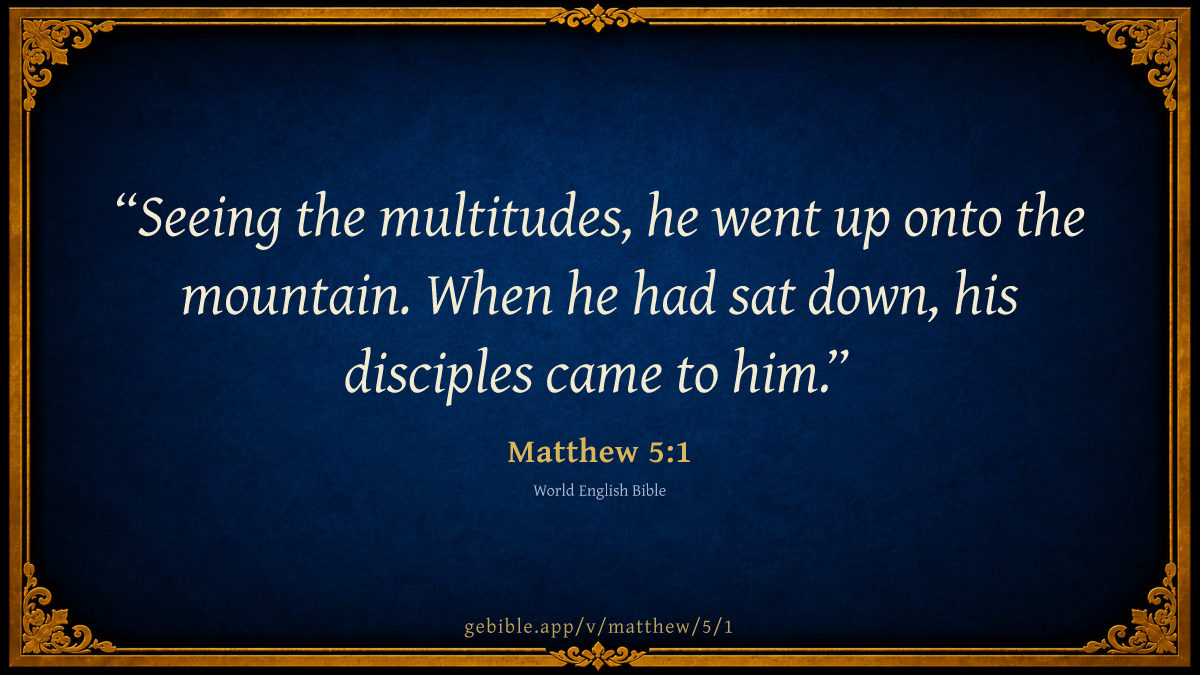
Seeing the multitudes, he went up onto the mountain. When he had sat down, his disciples came to him.
Parallel Translations
-
Seeing the multitudes, he went up onto the mountain. When he had sat down, his disciples came to him.
-
When he sawe the people he went vp into a mountayne and when he was set his disciples came to hym
-
And when he sawe the multitude, he went vp into a mountaine: and when he was set, his disciples came to him.
Examined in Scripture Analysis
Contradictions (1)
Questions where the Bible appears to say two different things, with the passages on each side set together.
Cross-references (10)
Passages linked to Matthew 5:1 in the Treasury of Scripture Knowledge, ordered by reader-vote popularity; verse text shown in World English Bible.
- Mark 3:13 He went up into the mountain, and called to himself those whom he wanted, and they went to him.
- Matthew 15:29 Jesus departed from there, and came near to the sea of Galilee; and he went up into the mountain, and sat there.
- Mark 4:1 Again he began to teach by the seaside. A great multitude was gathered to him, so that he entered into a boat in the sea, and sat down. All the multitude were on the land by the sea.
- John 6:2-3 A great multitude followed him, because they saw his signs which he did on those who were sick. Jesus went up into the mountain, and he sat there with his disciples.
- Mark 3:20 The multitude came together again, so that they could not so much as eat bread.
- Matthew 4:25 Great multitudes from Galilee, Decapolis, Jerusalem, Judea and from beyond the Jordan followed him.
- Matthew 10:2-4 Now the names of the twelve apostles are these. The first, Simon, who is called Peter; Andrew, his brother; James the son of Zebedee; John, his brother; Philip; Bartholomew; Thomas; Matthew the tax collector; James the son of Alphaeus; Lebbaeus, who was also called Thaddaeus; Simon the Zealot; and Judas Iscariot, who also betrayed him.
- Luke 6:13-16 When it was day, he called his disciples, and from them he chose twelve, whom he also named apostles: Simon, whom he also named Peter; Andrew, his brother; James; John; Philip; Bartholomew; Matthew; Thomas; James, the son of Alphaeus; Simon, who was called the Zealot; Judas the son of James; and Judas Iscariot, who also became a traitor.
- Matthew 4:18-22 Walking by the sea of Galilee, he saw two brothers: Simon, who is called Peter, and Andrew, his brother, casting a net into the sea; for they were fishermen. He said to them, “Come after me, and I will make you fishers for men.” They immediately left their nets and followed him. Going on from there, he saw two other brothers, James the son of Zebedee, and John his brother, in the boat with Zebedee their father, mending their nets. He called them. They immediately left the boat and their father, and followed him.
- Matthew 13:2 Great multitudes gathered to him, so that he entered into a boat, and sat, and all the multitude stood on the beach.
Cross-references from openbible.info (CC BY 4.0)
Explain this verse (29 sources)
Historical commentary, presented as a primary source — not an endorsement.
Private notes
Saved on this device only — never synced or sent anywhere.
John Trapp 1656 · Public Domain 1 And seeing the multitudes, he went up into…
1 And seeing the multitudes, he went up into a mountain: and when he was set, his disciples came unto him:
Ver. 1. And seeing the multitudes] As sheep without a shepherd, or as grain ripe and ready, falling, as it were, into the hands of the harvest man. The "children cried for bread, and there was none to break it," Lam 4:4. His eye therefore affected his heart, and out of deep commiseration,
Read full note →
He went up into a mountain] This mount was his pulpit, as the whole law was his text. It is said to be in the tribe of Naphtali, and called Christ’s mount to this day. As Moses went up into a mount to receive the law, so did the Messiah to expound it, and so must we to contemplate it. Sursum corda. Wind we up our hearts, which naturally bear downward, as the poise of a clock.
And when he was set] Either as being weary, or as intending a longer sermon. This at his first onset upon his office, and that at his last (when he left the world and went to his Father, Joh 14:15-17), being the longest and liveliest that are recorded in the Gospels. He preached, no doubt, many times many hours together. But as his miracles, so his oracles, are no more of them written than might suffice to make us believe, and live through his name, Joh 20:31. As the prophets of old, after they had preached to the people, set down the sum of their sermons, the heads only, for the use of the Church in all ages, so did the apostles record in their diaries the chief things in our Saviour’s sermons, out of which they afterwards (by the instinct and guidance of the Spirit of God) framed this holy history. (Scultet. Annal. epist, dedic.)
His disciples came unto him] To sit at his feet and hear his word. Among the Jews the Rabbi sat, termed יושב or the sitter; the scholar, מתאבק or one that lieth along in the dust, a token of the scholar’s humility, subjecting himself even to the feet of his teacher. Thus Mary sat at Jesus’ feet, and heard his word, Luk 10:39. Thus all God’s saints are said to "sit at his feet, every one to receive his word," Deu 33:3. Thus Paul was brought up at the feet of Gamaliel, a great doctor in Israel, Act 22:3. And this custom it is thought St Paul laboured to bring into the Christian Church, 1Co 14:1-40.
John Trapp, A Commentary or Exposition upon All the Books of the Old and New Testament (1647–1656) — public domain. Text from a community e-Sword module.
Matthew Poole 1685 · Public Domain The last chapter concluded with telling us that a…
The last chapter concluded with telling us that a great multitude followed Christ, which he observing, that he might with more convenience to himself, and advantage to them, speak what he had to say,
he went up into a mountain; and sitting down, after the manner of the Jewish doctors to show their authority, which our Saviour also at other times observed, Mat 26:55; Luk 4:20; Joh 8:2,
Read full note →
his disciples came unto him; both those strictly so called, and others also, viz. the multitude, mentioned in the last chapter, or some of them; and he began to speak to them with freedom, so as the multitude might hear. Christ thought it as lawful to preach in the mountain as in the synagogues; nor did his disciples doubt the lawfulness of hearing him, wherever he thought fit to speak.
Matthew Poole's English Annotations on the Holy Bible (1683–1685) — public domain. Text from a community e-Sword/MySword module.
William Burkitt 1703 · Public Domain Observe here, 1. The preacher; he, that is, Christ,…
Observe here, 1. The preacher; he, that is, Christ, the great prophet and teacher of his church.
Observe, 2. The place where he preached, upon a mountain; probably for conveniency to himself, and advantage to his auditors; though some will have a mystery in it; that as the law at first was given on a mountain, so Christ would now explain it upon a mountain; or to shew the sublimity of his doctrine and precepts.
Read full note →
Observe, 3. The posture in which he preached, sitting: When he was set, he taught, according to the custom of the Jewish doctors who sat, to shew their authority.
Observe, 4. The sermon itself, which begins with beatitudes and blessings, and is accompanied with promises of reward. Not as the law was delivered on Mount Sinai, with threatenings and thunder, with fire and earthquake, but in a still and soft voice. Our Lord’s lips are full of grace, they drop as the honeycomb. Blessings and promises are our encouragements to obedience.
William Burkitt's Expository Notes on the New Testament (1700–1703) — public domain. Text from a community e-Sword module.
Matthew Henry 1710 · Public Domain We have here a general account of this sermon.
We have here a general account of this sermon.
I. The Preacher was our Lord Jesus, the Prince of preachers, the great Prophet of his church, who came into the world, to be the Light of the world. The prophets and John had done virtuously in preaching, but Christ excelled them all. He is the eternal Wisdom, that lay in the bosom of the Father, before all worlds, and perfectly knew his will (Joh 1:18); and he is the eternal Word, by whom he has in these last days spoken to us. The many miraculous cures wrought by Christ in Galilee, which we read of in the close of the foregoing chapter, were intended to make way for this sermon, and to dispose people to receive instructions from one in whom there appeared so much of a divine power and goodness; and, probably, this sermon was the summary, or rehearsal, of what he had preached up and down in the synagogues of Galilee. His text was, Repent, for the kingdom of heaven is at hand. This is a sermon on the former part of that text, showing what it is to repent; it is to reform, both in judgment and practice; and here he tells us wherein, in answer to that question (Mal 3:7), Wherein shall we return? He afterward preached upon the latter part of the text, when, in divers parables, he showed what the kingdom of heaven is like, ch. 13.
Read full note →
II. The place was a mountain in Galilee. As in other things, so in this, our Lord Jesus was but ill accommodated; he had no convenient place to preach in, any more than to lay his head on. While the scribes and Pharisees had Moses' chair to sit in, with all possible ease, honour, and state, and there corrupted the law; our Lord Jesus, the great Teacher of truth, is driven out to the desert, and finds no better a pulpit than a mountain can afford; and not one of the holy mountains neither, not one of the mountains of Zion, but a common mountain; by which Christ would intimate that there is no such distinguishing holiness of places now, under the gospel, as there was under the law; but that it is the will of God that men should pray and preach every where, any where, provided it be decent and convenient. Christ preached this sermon, which was an exposition of the law, upon a mountain, because upon a mountain the law was given; and this was also a solemn promulgation of the Christian law. But observe the difference: when the law was given, the Lord came down upon the mountain; now the Lord went up: then, he spoke in thunder and lightning; now, in a still small voice: then the people were ordered to keep their distance; now they are invited to draw near: a blessed change! If God's grace and goodness are (as they certainly are) his glory, then the glory of the gospel is the glory that excels, for grace and truth came by Jesus Christ, Co2 3:7; Heb 12:18, etc. It was foretold of Zebulun and Issachar, two of the tribes of Galilee (Deu 33:19), that they shall call the people to the mountain; to this mountain we are called, to learn to offer the sacrifices of righteousness. Now was this the mountain of the Lord, where he taught us his ways, Isa 2:2, Isa 2:3; Mic 4:1, Mic 4:2.
III. The auditors were his disciples, who came unto him; came at his call, as appears by comparing Mar 3:13, Luk 6:13. To them he directed his speech, because they followed him for love and learning, while others attended him only for cures. He taught them, because they were willing to be taught (the meek will he teach his way); because they would understand what he taught, which to others was foolishness; and because they were to teach others; and it was therefore requisite that they should have a clear and distinct knowledge of these things themselves. The duties prescribed in this sermon were to be conscientiously performed by all those that would enter into that kingdom of heaven which they were sent to set up, with hope to have the benefit of it. But though this discourse was directed to the disciples, it was in the hearing of the multitude; for it is said (Mat 7:28), The people were astonished. No bounds were set about this mountain, to keep the people off, as were about mount Sinai (Exo 19:12); for, through Christ, we have access to God, not only to speak to him, but to hear from him. Nay, he had an eye to the multitude, in preaching this sermon. When the fame of his miracles had brought a vast crowd together, he took the opportunity of so great a confluence of people, to instruct them. Note, It is an encouragement to a faithful minister to cast the net of the gospel where there are a great many fishes, in hope that some will be caught. The sight of a multitude puts life into a preacher, which yet must arise from a desire of their profit, not his own praise.
IV. The solemnity of his sermon is intimated in that word, when he was set. Christ preached many times occasionally, and by interlocutory discourses; but this was a set sermon, kathisantos autou, when he had placed himself so as to be best heard. He sat down as a Judge or Lawgiver. It intimates with what sedateness and composure of mind the things of God should be spoken and heard. He sat, that the scriptures might be fulfilled (Mal 3:3), He shall sit as a refiner, to purge away the dross, the corrupt doctrines of the sons of Levi. He sat as in the throne, judging right (Psa 9:4); for the word he spoke shall judge us. That phrase, He opened his mouth, is only a Hebrew periphrasis of speaking, as Job 3:1. Yet some think it intimates the solemnity of this discourse; the congregation being large, he raised his voice, and spoke louder than usual. He had spoken long by his servants the prophets, and opened their mouths (Eze 3:27; Eze 24:27; Eze 33:22); but now he opened his own, and spoke with freedom, as one having authority. One of the ancients has this remark upon it; Christ taught much without opening his mouth. that is, by his holy and exemplary life; nay, he taught, when, being led as a lamb to the slaughter, he opened not his mouth, but now he opened his mouth, and taught, that the scriptures might be fulfilled, Pro 8:1, Pro 8:2, Pro 8:6. Doth not wisdom cry - cry on the top of high places? And the opening of her lips shall be right things. He taught them, according to the promise (Isa 54:13), All thy children shall be taught of the Lord; for this purpose he had the tongue of the learned (Isa 50:4), and the Spirit of the Lord, Isa 61:1. He taught them, what was the evil they should abhor, and what was the good they should abide and abound in; for Christianity is not a matter of speculation, but is designed to regulate the temper of our minds and the tenour of our conversations; gospel-time is a time of reformation (Heb 9:10); and by the gospel we must be reformed, must be made good, must be made better. The truth, as it is in Jesus, is the truth which is according to godliness, Tit 1:1.
Matthew Henry's Commentary on the Whole Bible (1708–1710) — public domain (CC PDM 1.0). Text via the HelloAO Bible API.
John Wesley 1765 · Public Domain And seeing the multitudes - At some distance, as…
And seeing the multitudes - At some distance, as they were coming to him from every quarter. He went up into the mountain - Which was near: where there was room for them all. His disciples - not only his twelve disciples, but all who desired to learn of him.
John Wesley, Explanatory Notes Upon the Whole Bible (1754–1765) — public domain. Text via the GEBible commentary corpus.
Adam Clarke 1810 · Public Domain Christ begins his sermon on the mount, 1, 2.
CHAPTER V.
Christ begins his sermon on the mount, 1, 2.
Read full note →
The beatitudes, 3-12.
The disciples the salt of the earth, and light of the world,
13-16.
Christ is not come to destroy, but confirm and fulfil, the Law
and the Prophets, 17-19.
Of the righteousness of the scribes and Pharisees, 20.
Interpretation of the precepts relative to murder, anger, and
injurious speaking, 21, 22.
Of reconciliation, 23-26.
Of impure acts and propensities, and the necessity of
mortification, 27-30.
Of divorce, 31, 32.
Of oaths and profane swearing, 33-37.
Of bearing injuries and persecution, 38-41.
Of borrowing and lending, 42
Of love and hatred, 43-46.
Of civil respect, 47.
Christ's disciples must resemble their heavenly Father, 48.
NOTES ON CHAP. V
Verse 1. And seeing the multitudes] τους οχλους, these multitudes, viz. those mentioned in the preceding verse, which should make the first verse of this chapter.
He went up into a mountain] That he might have the greater advantage of speaking, so as to be heard by that great concourse of people which followed him. It is very probable that nothing more is meant here than a small hill or eminence. Had he been on a high mountain they could not have heard; and, had he been at a great distance, he would not have sat down. See Clarke on Mt 5:14.
And when he was set] The usual posture of public teachers among the Jews, and among many other people. Hence sitting was a synonymous term for teaching among the rabbins.
His disciples] The word μαθητης signifies literally a scholar. Those who originally followed Christ, considered him in the light of a Divine teacher; and conscious of their ignorance, and the importance of his teaching, they put themselves under his tuition, that they might be instructed in heavenly things. Having been taught the mysteries of the kingdom of God, they became closely attached to their Divine Master, imitating his life and manners; and recommending his salvation to all the circle of their acquaintance. This is still the characteristic of a genuine disciple of Christ.
Adam Clarke's Commentary on the Bible (1810–1826) — public domain. Text from a community e-Sword/MySword module.
Joseph Benson 1811 · Public Domain Mat 5:1-2. And seeing the multitudes — A vast…
Mat 5:1-2. And seeing the multitudes — A vast concourse of people assembled from all parts to attend him, some with their sick to obtain cures, for he never rejected any who applied to him; some out of curiosity to see his miracles, and hear his extraordinary doctrine; some with a design to find fault and censure; and some, doubtless, to hear and be edified by his discourses, which seldom failed to make a deep impression on those who had any share of good sense or true piety: — the Son of God, beholding such a vast multitude of men, bewildered in the darkness of ignorance, and lost in sin and wretchedness, had compassion on them, and feeling in himself a strong desire to give them more particular instruction than he had yet done in the infinitely important matters of religion; that he might deliver what he had to say to them on this most momentous subject, with more convenience to himself and advantage to them, he went up into a mountain — Which afforded room for all, and where, addressing them from an eminence, he could be seen and heard by great numbers. And when he was set — After the manner of the Jewish doctors, who, to show their authority, were wont to sit when they taught; his disciples came unto him — To be instructed by him as a teacher come from God. By his disciples here, not only those strictly so called, viz., the twelve, who were afterward chosen to be his apostles, are intended, but as many of the multitude as were willing to learn of him. And he opened his mouth — A phrase which, in the Scriptures, generally denotes the solemnity of the speaker, and the importance of what he delivers, and here signifies that he uttered the following weighty truths with great seriousness and earnestness. And taught them — As the great prophet and lawgiver of his church, the one way to present and future happiness, at the same time that he corrected those false notions of the Messiah’s kingdom which so generally prevailed, and which he foresaw would prove of destructive tendency to those who continued to be governed by them. Observe, reader! Christ thought it as lawful to preach on a mountain as in a synagogue; nor did his disciples doubt the lawfulness of hearing him wherever he thought fit to speak. Our Lord, it must be observed, pursues the most exact method in this divine discourse; describing, 1st, viz., in this chapter, the nature, excellency, and necessity of inward holiness; 2d, chap. 6., that purity of intention which must direct and animate our outward actions to render them holy; 3d, cautioning us against the grand hinderances of religion, and pointing out the chief means of attaining it: Mat 7:1-20; Matthew , , 4 th, making an application of the whole, Mat 7:21-28.
Joseph Benson's Commentary on the Old and New Testaments (1811–1818) — public domain. Text from a community e-Sword module.
Albert Barnes 1834 · Public Domain And seeing the multitudes - The great numbers that…
And seeing the multitudes - The great numbers that came to attend on his ministry. The substance of this discourse is recorded also in Luke 6. It is commonly called the “Sermon on the Mount.” It is not improbable that it was repeated, in substance, on different occasions, and to different people. At those times parts of it may have been omitted, and Luke may have recorded it as it was pronounced on one of those occasions. See the notes at Luk 6:17-20.
Went up into a mountain - This mountain, or hill, was somewhere in the vicinity of Capernaum, but where precisely is not mentioned. He ascended the hill, doubtless, because it was more convenient to address the multitude from an eminence than if he were on the same level with them. A hill or mountain is still shown a short distance to the northwest of the ancient site of Capernaum, which tradition reports to have been the place where this sermon was delivered, and which is called on the maps the Mount of Beatitudes. The hill commonly believed to be that on which the sermon was delivered is on the road from Nazareth to Tiberias, not far from the latter place. The hill is known by the name of Kuran Huttin, the Horns of Huttin. Of this hill Professor Hackett (Illustrations of Scripture, pp. 323, 324) says: “Though a noontide heat was beating down upon us with scorching power, I could not resist the temptation to turn aside and examine a place for which such a claim has been set up, though I cannot say that I have any great confidence in it. The hill referred to is rocky, and rises steeply to a moderate height above the plain. It has two summits, with a slight depression between them, and it is from these projecting points, or horns, that it receives the name given to it. From the top the observer has a full view of the Sea of Tiberias. The most pleasing feature of the landscape is that presented by the diversified appearance of the fields. The different plots of ground exhibit various colors, according to the state. of cultivation: some of them are red, where the land has been newly plowed up, the natural appearance of the soil; others yellow or white, where the harvest is beginning to ripen, or is already ripe; and others green, being covered with grass or springing grain. As they are contiguous to each other, or intermixed, these particolored plots present at some distance an appearance of joyful chequered work, which is really beautiful.
Read full note →
“In rhetorical descriptions of the delivery of the Sermon on the Mount, we often hear the people represented as looking up to the speaker from the sides of the hill, or listening to him from the plain. This would not be possible with reference to the present locality; for it is too precipitous and too elevated to allow of such a position. The Saviour could have sat there, however, in the midst of his hearers, for it affords a platform amply large enough for the accommodation of the hundreds who may have been present on that occasion.”
And when he was set - This was the common mode of teaching among the Jews, Luk 4:20; Luk 5:3; Joh 8:2; Act 13:14; Act 16:13.
His disciples came unto him - The word “disciples” means “learners,” those who are taught. Here it is put for those who attended on the ministry of Jesus, and does not imply that they were all Christians. See Joh 6:66.
Albert Barnes' Notes on the Bible (1834–1885) — public domain. Text from a community e-Sword/MySword module.
Haydock's Catholic Bible Commentary 1859 · Public Domain What is said here, does not follow immediately what…
What is said here, does not follow immediately what was said in the preceding chapter. See Luke vi.
George Leo Haydock (1774–1849), Haydock's Catholic Family Bible and Commentary, 1859 edition — public domain. Excludes Psalms (Douay-Rheims chapter numbering differs from Protestant) and Deuterocanonical books (Catholic canon only).
John Nelson Darby 1862 · Public Domain Matthew Chapter 5
Matthew Chapter 5
He then gathers around Him those who were definitively to follow Him in His ministry and His temptations; and, at His call, to link their portion and their lot with His, forsaking all beside.
Read full note →
The strong man was bound, so that Jesus could spoil his goods, and proclaim the kingdom with proofs of that power which were able to establish it.
Two things are then brought forward in the Gospel narrative. First, the power which accompanies the proclamation of the kingdom. In two or three verses, [16] without other detail, this fact is announced. The proclamation of the kingdom is attended with acts of power that excite the attention of the whole country, the whole extent of the ancient territory of Israel. Jesus appears before them invested with this power. Secondly (chaps. 5-7) the character of the kingdom is announced in the sermon on the Mount, as well as that of the persons who should have part in it (the Father’s name withal being revealed). That is, the Lord had announced the coming kingdom, and with the present power of goodness, having overcome the adversary; and then shews what were the true characters according to which it would be set up, and who could enter, and how. Redemption is not spoken of in it; but the character and nature of the kingdom, and who could enter. This clearly shews the moral position which this sermon holds in the Lord’s teaching.
It is evident that, in all this part of the Gospel, it is the Lord’s position which is the subject of the teaching of the Spirit, and not the details of His life. Details come after, in order fully to exhibit what He was in the midst of Israel, His relations with that people, and His path in the power of the Spirit which led to the rupture between the Son of David and the people who ought to have received Him. The attention of the whole country being thus engaged by His mighty acts, the Lord sets before His disciples-but in the hearing of the people-the principles of His kingdom.
This discourse may be divided into the following parts:- [17] The character and the portion of those who should be in the kingdom (Mat 5:1-12). Their position in the world (Mat 5:13-16). The connection between the principles of the kingdom and the law (Mat 5:17-48). [18] The spirit in which His disciples should perform good works (Mat 6:1-18). Separation from the spirit of the world and from its anxieties (Mat 6:19-34). The spirit of their relation with others (Mat 7:1-6). The confidence in God which became them (Mat 7:7-12). The energy that should characterise them, in order that they might enter into the kingdom; not however merely enter, many would seek to do that, but according to those principles which made it difficult for man, according to God-the strait gate; and then, the means of discerning those who would seek to deceive them, as well as the watchfulness needed that they might not be deceived (Mat 7:13-23).
Real and practical obedience to His sayings, the true wisdom of those that hear His words (Mat 7:24-29).
There is another principle that characterises this discourse, and that is the introduction of the Father’s name. Jesus puts His disciples in connection with His Father, as their Father. He reveals to them the Father’s name, in order that they may be in relation with Him, and that they may act in accordance with that which He is.
John Nelson Darby — Synopsis of the Books of the Bible: the New Testament (c. 1857–1862) — public domain. Text from a community e-Sword module.
Lange's Commentary on the Holy Scriptures 1864 · Public Domain Christ manifesting Himself in outward obscurity as the true…
PART SECOND
Christ manifesting Himself in outward obscurity as the true Saviour, by His works; and proving Himself the promised Prophet, Priest, and King, in His continual conflict with the spurious notions entertained by the Jews concerning the Messiah (Mat_5:1 to Mat_16:12).
Read full note →
_____________
FIRST SECTION
CHRIST MANIFESTING HIMSELF AS THE PROPHET. A. AS TEACHER OF THE KINGDOM OF HEAVEN. THE SERMON ON THE MOUNT, CH. 5–7
Structure of the Sermon on the Mount.—The grand fundamental idea of the Sermon on the Mount is to present the righteousness of the kingdom of heaven in its relation to that of the Old Testament theocracy. This idea is arranged in three parts. Part first, which comprises the Sermon on the Mount in the narrower sense, presents the nature and character of the righteousness of the kingdom of God, from the commencement of spiritual life to its completion. Mat_5:1-16.—At the close of this section, the contrast between this righteousness and that of Jewish traditionalism is brought out in its fullest manifestation (to suffer persecution for Christ’s sake). This induces the Lord to explain, in Part 2, the relation between the righteousness of the kingdom of heaven (in doctrine and life) and that of the Jewish theocracy. The former is the genuine fulfilment of the Old Testament theocracy (of the Law and the Prophets), in opposition to that false development of Jewish traditionalism, which only preserved the letter of the law and the prophets. Mat_5:17 to Mat_7:6.—As the first section contained a description of the elevation of the blessed to their final reward in heaven, although their course seems to the world one of continual humiliation; so the second section exhibits the righteousness of the Pharisees in its real character and results, to the judgment which shall finally sweep it away (beneath “dogs and swine”), although to the world it seems to rise to the greatest height of exaltation. Lastly, Christ shows in the third and practical section, how to avoid the false and choose the right way; indicating, at the same time, the mode and manner of genuine spiritual life ( Mat_7:7-27). The concluding verses ( Mat_5:28-29) record the impression produced by this sermon of Jesus.
Literature:—Comp. Tholuck, Comment, on the Sermon on the Mount, 4th ed., 1856 [transl. into Engl. by R. Lundin Brown, Edinb. and Philad., 1860]; Kling, Die Bergpredigt Christi, Marburg. 1841; Arndt, Die Bergpredigt Jesu Christi, Magdeb., 1837 and 1838; Braune, Die Bergpredigt unseres Herrn Jesu Christi, 2d ed., Altenburg 1855.—For the older literature of the subject, see Winer, Danz, and Heubner.
I
The Sermon on the Mount in the narrower sense. The law of the Spirit. The fundamental laws of the kingdom of heaven as fundamental promises and beatitudes of the Gospel. Gradual progress upward to perfectness in righteousness, or, what is the same, in Christ.
Mat_5:1-16
( Mat_5:1-12, the Gospel for the 27th Sunday after Trinity.)
1And seeing the multitudes, he went up into a mountain; and when he was set [had sat down], his disciples came unto [to] him: 2And he opened his mouth, and taught3them, saying, Blessed are the poor in spirit: for theirs is the kingdom of heaven.5Blessed are they that mourn: for they shall be comforted. Blessed are the meek: 6for they shall inherit the earth.1 Blessed are they which do hunger and thirst after 7righteousness: for they shall be filled. Blessed are the merciful: for they shall obtain 9mercy. Blessed are the pure in heart: for they shall see God. Blessed are the peacemakers: 10for they shall be called the children of God. Blessed are they which are persecuted for righteousness’ sake: for theirs is the kingdom of heaven. 11Blessed are ye, when men shall revile you, and persecute you, and shall say all manner of evil againstyou falsely,2 for my sake. 12Rejoice, and be exceeding glad; for great is your reward in heaven: for so persecuted they the prophets which [who] were before you. 13Ye are the salt of the earth: but if the salt have lost its savour, wherewith shall it be salted? it is thenceforth good for nothing, but to be cast out, and to be trodden under foot of men. 14Ye are the light of the world. A city that is set on a hill cannot be hid.15Neither do men light a candle and put it under a [the]3 bushel, but on a candlestick; and it giveth light unto all that are in the house. 16Let your light so shine before men, that they may see your good works, and glorify your Father which [who] is in heaven.
EXEGETICAL AND CRITICAL
General Remarks on the Sermon on the Mount.—The Sermon on the Mount may be regarded as the central-point of Christ’s ministry in Galilee. It was delivered during the first year of His public career, some time between the winter of 781 and the spring of 782 A. U. “The activity of John by the banks of Jordan probably continued till toward the winter of the year 781. While he baptized in Galilee, Christ labored in Judæa. About the time that John was imprisoned in Galilee, the Sanhedrim of Jerusalem began to view with dislike the growing authority of Jesus. On this account, He left Judæa, and retired to Galilee. In the spring of the year 782, John was still in prison. At that time he sent the well-known embassy to Christ. From Mat_11:1-2, we gather that this inquiry was made at the close of the first journey of Christ through Galilee; hence before His attending the feast of Purim, which is related in the Gospel of John ( Matthew 5). Soon afterward the execution of John took place, probably between Purim and Easter of the year 782” (see my Leben Jesu, ii. 1, p. 162).
We mark three stages in the journey of Jesus through Galilee. The first comprises the journey of Christ through the mountainous district of Upper Galilee. This is alluded to in general terms by Matthew in Mat_4:23. The calling of the first four Apostles, together with the miraculous draught of fishes, Luk_5:1, and the sermon of the Lord by the Lake of Galilee, preceding that miracle, formed the commencement of this journey. Its close is marked by the Sermon on the Mount. On His second journey, the Lord passed beyond the bounds of Galilee proper into Upper Peræa. This tour commenced with His second sermon by the Lake of Galilee, on which occasion the Lord probably uttered the greater part of the parables concerning the kingdom of God. Other three Apostles were now added to the former. That journey closed with the expulsion of the Lord from Gadara, and some conflicts between Jesus and the Pharisees, and a few of the disciples of John (Matthew 19). During His third tour, the Lord passed through the towns on the Lake of Galilee to Lower Galilee, and toward Samaria and Judæa. The number of the assistants and followers of Jesus was now increased from seven to twelve, who are set apart as His Apostles. The four companions of His first journey, and the seven who attended Him during the second, had only been His followers; but others are now added to their number. They are set apart to be His Apostles; and the Lord sends them before Him,—as yet, however, with limited powers, and for a definite purpose. The narrative of this journey commences with the calling of the Apostles, and with the instructions given to them. While the Apostles precede the Lord, holy women gather around and minister unto Him (Luk_8:1-3). The towns of Magdala, in the southern part of the western shore of the lake, and Nain, between the southern side of Mount Tabor and the Lower Hermon, are mentioned as special points touched during this journey. Its goal—as appears from the sending of the twelve Apostles—was Jerusalem, where, according to John 5, Jesus attended the feast of Purim. This journey, which was intended to terminate in Judæa, was interrupted by two events—the resolution of the Sanhedrim at Jerusalem to compass the death of Jesus (Joh_7:1), and the execution of John the Baptist (Mat_14:12; Mar_6:30; Luk_9:10).
A close review of this tour shows that Jesus undertook three public journeys to Jerusalem in order to awake the attention of His people, and to lead them to decide for the truth (Joh_2:13; John 5; Joh_12:9).
It is important to understand the relation between the Sermon on the Mount as given by Matthew and the account of it in Luk_6:12 sqq.
According to Augustine (De consensu evang. ii. 19), Andr. Osiander, Büsching, Hess, Storr, Gratz, and others, the two sermons were delivered at different times. But most modem interpreters are agreed that they are only two different accounts of one and the same sermon of Jesus. Calvin, Schneckenburger, and Olshausen hold that the account in Matthew is the less authentic of the two; while Tholuck, Ebrard, and Meyer (p. 168), think that Luke derived his narrative from Matthew. Lastly, according to Strauss, neither of the two accounts is strictly authentic. In our opinion, they should be regarded as two different sermons delivered in close succession,—the one on the summit of a mountain in Galilee, the other, on a lower ridge of the same mountain; the one, addressed only to His disciples; the other, to all the people who had followed Him. Still, so far as their fundamental ideas and real subject-matter are concerned, the two sermons are identical, differing only in form and adaptation,—that reported by Matthew being addressed to the disciples, and hence esoteric in its form; while that given by Luke is exoteric, being addressed to the people. The fundamental idea of both is evidently the same—the exaltation of the humble and the humiliation of the proud. This idea is couched so as to correspond to the description of the Jewish year of jubilee, and expressed in the form of beatitudes. But the different aspects under which this fundamental truth is presented, show that originally two sermons had been delivered by the Lord; for, 1. the number of the beatitudes is not the same in the two sermons, and the beatitudes themselves are differently couched; 2. in the Gospel by Luke, there is always a woe to correspond to each of the beatitudes. This contrast appears, indeed, also in that portion of the sermon, as reported by Matthew, which treats of the righteousness of the Pharisees and its consequences, but in a form quite different from that in Luke. Add to this, 3. the difference in the account of the locality and the audience. According to Matthew, Jesus delivered the sermon on the top of a mountain, and sitting; while Luke relates that He came down and stood in the plain or on a plateau, to preach to the people. According to Matthew, “seeing the multitudes,” He retired among His disciples; while Luke records that He came down with His disciples, and stood among the multitude in order to address them. “Thus we have evidently two different discourses on the same subject, and containing the same elements; and, before we adopt any hypothesis which would represent the one as inferior to the other, we should first endeavor to study them more closely, and to understand the peculiar characteristics of the two Gospels. Viewed in that light, these discourses bear each a distinctive character. The Sermon on the Mount, strictly so called, is a discourse which Christ could not, at the time, have addressed to the people generally. This remark specially applies to His description of the Pharisees and scribes, and of their righteousness, and to His exposition of the contrast between His own teaching and theirs. Manifestly, Jesus could not have addressed in this manner the Jewish people generally, without thereby needlessly exposing His own followers. Nor were the people prepared to understand or receive such doctrine. And even though we were to assume that the Evangelist had introduced into this discourse some things said on other occasions, yet this sermon is so thoroughly connected in its structure, that it is impossible to ascribe its composition, so far as its leading features are concerned, to the Evangelist himself.” (Leben Jesu, ii. 2, p. 369.) Manifestly, this discourse is esoteric—an exposition of the fundamental doctrines of the kingdom of heaven in their relation to the teaching of the Old Testament, and to the ordinances and practices of a spurious traditionalism, which could only have been intended for the disciples. Hence the choice of the locality, the retirement from the multitude, and the gathering of the disciples around Him. The Evangelist, indeed, records at the close, “that the people were astonished at His doctrine;” but this apparent inaccuracy—on our supposition—only confirms the view that, after His descent from the mountain, the Lord addressed to the people generally the discourse communicated by Luke. The latter is just what we would have expected in the circumstances—a popular and lively address, short, and illustrated by similes. This exoteric form agrees with the context as mentioned by Luke, who records that Jesus delivered this address standing among the people, though His eye would, no doubt, chiefly rest in blessing upon the disciples.
The time when these two discourses were delivered.—From some events recorded by Luke before his account of the Sermon on the Mount ( Mat_6:1, etc.), it might appear to have been delivered at a later period. But this apparent inaccuracy must have been occasioned by considerations connected with the structure of his Gospel. The context shows that both Evangelists record it as having taken place at the same time. Both in Luke and in Matthew the history of the centurion of Capernaum immediately follows the Sermon on the Mount. Manifestly, then, the two discourses were delivered during the same journey of Jesus through Galilee. Similarly, the circumstances mentioned by Luke prove that the discourse reported by him followed immediately upon that reported by Matthew. According to Matthew, Jesus left the multitude, and retired with His disciples to the top of the mountain; while Luke relates that He again descended from the mountain, with His disciples, “into the plain” (ἐπὶ τὀπου πεδινοῦ), among the waiting multitude. If to this we add the manifest internal connection between the two discourses, we obtain a very distinct view of the subject. On the top of the mountain Jesus addressed to His disciples the discourse about the kingdom of heaven in an esoteric form: while immediately afterward He repeated it in an exoteric form, in the midst of the people, on a plateau of the same mountain.
The locality, or the mountain.—According to Latin tradition, the Mount of Beatitudes was what is now called the “Horns of Hattin,” between Mount Tabor and Tiberias. Robinson gives the following description of this mountain (ii. p. 370): “The road passes down to Hattin on the west of the Tell; as we approached, we turned off from the path toward the right, in order to ascend the Eastern Horn.—As seen on this side, the Tell or mountain is merely a low ridge, some thirty or forty feet in height, and not ten minutes in length from east to west. At its eastern end is an elevated point or horn, perhaps sixty feet above the plain; and, at the western end, another not so high; these give to the ridge, at a distance, the appearance of a saddle, and are called Kurun Hattin, ‘Horns of Hattin.’ But the singularity of this ridge is, that, on reaching the top, you find that it lies along the very border of the great southern plain, where this latter sinks off at once by a precipitous offset, to the lower plain of Hattin, from which the northern side of the Tell rises very steeply, not much less than 400 feet..… The summit of the Eastern Horn is a little circular plain; and the top of the lower ridge between the two horns is also flattened to a plain. The whole mountain is of limestone.”—The situation and the appearance of this mountain agree well with the supposition that it was the Mount of Beatitudes. It lay in a southwesterly direction, about seven miles from Capernaum. We can well conceive that, when, on His return from the journey through Galilee, Jesus reached this point, He partly dismissed the multitudes who had followed Him. The description of the top of the mountain, and of “the plain,” agrees with the requirements of the case. Robinson has indeed shown that no weighty grounds can be urged in favor of this tradition (ii. p. 371). It is found only in the Latin Church, and is first mentioned in the 13th century by Brocardus [about a. d. 1283]; while this tradition is apparently contradicted by another, which designates the same mountain as the spot where Christ fed the five thousand with the five loaves. Still, no valid ground can be urged against it. A striking historical illustration, by way of contrast, is connected with the Horns of Hattin, assuming that ridge to be the Mount of Beatitudes. On the spot where Jesus had described the kingdom of heaven, and pronounced the meek and the peacemakers blessed, the most bloody battles have been fought! (See C. v. Raumer, p. 37.) On the 5th of July, 1187, the celebrated battle of Hattin took place, in which the last remnant of the Crusaders was destroyed on the height of Tell Hattin, after the army had been beaten by Sultan Saladin in the valley. Again, on the plain of Jezreel, Bonaparte defeated, in 1799, with 3000 men, an army of 25,000 Turks.—From the frequent repetition of the expression, Jesus went up into a mountain, εἰς τὸ ὄρος, Gfrörer and Bruno Bauer have inferred that the mountain was merely mythical, and that it always referred to one and the same locality. But in all these narratives, the term “mountain” is used in contradistinction to the places where the people were encamped (Leben Jesu, ii. 2, p. 676). Ebrard (Kritik, etc., p. 349) suggests that the expression is sufficiently explained by the circumstance, that throughout Palestine there was no plain from which mountains rose, but that the country was an extended plain intersected by valleys. But this is only partially true, as there are considerable mountain-tops in the country; although the configuration of Palestine may partly have given rise to such a general mode of expression as “to go up into a mountain.”
Occasion of this address.—According to Wiescler (Chronologische Synopse, p. 205), the year from the autumn 779 to that of 780 had been a sabbatical year. Thus the remembrance of the jubilee was still fresh in the minds of the people. For, although the peculiar ordinances connected with the jubilee were no longer observed even at the time of the prophets, the symbolical import of the institution must still have been cherished by the people. The passage from Isaiah 61, which Jesus had shortly before read in the synagogue at Nazareth (Luk_4:14, etc.), referred to the year of grace of the Lord. The symbolical idea of this institution which had pervaded the song of Mary, was fully unfolded and developed in the Sermon on the Mount. (Leben Jesu, ii. 2, p. 571.)
Relation between the Sermon on the Mount as reported by Matthew, and the parallel passages in Luke and Mark.—This relation is explained, 1. by the difference between the two discourses; 2. by the circumstance that Luke records in other passages the admonitions which were specially addressed to the disciples. This remark applies more especially to the Lord’s Prayer, Luk_11:1-4; to the admonition to prayer, Mat_5:9-13; to the simile in Mat_5:34-36; and to the warning against excessive care for the things of this life, Luk_12:22-31. Still, it is possible that some of the statements in the first Sermon on the Mount, which recur in the other Gospels, may have been repeated on other occasions: for example, Mar_9:50; Luk_12:34; Luk_13:24; Luk_16:13; Luk_16:17-18. Others, again, may have been introduced by the Evangelist in another context: for example, Luk_12:58.
Mat_5:1. And seeing the multitudes, ἰδὼνδὲ κ. τ. λ.—This is evidently meant to account for the delivery of the Sermon on the Mount. Jesus frequently saw multitudes around Him, but here a peculiar emphasis is laid on that circumstance. The question then arises, whether the crowding of the multitude around had induced Him to deliver the Sermon on the Mount in their presence, and that with all which it contains concerning the scribes and Pharisees; or whether, on the contrary, it had induced Him to explain these truths in a confidential manner to His disciples alone. We adopt the latter view, which is supported by the analogy of Mar_3:12-13; Luk_6:12-13; Joh_6:23, comp. with Mat_5:15.
His disciples.—It is evident that at that period Jesus had already made a separation between His disciples and the people. But Matthew distinguishes between this and the later choice of the twelve Apostles, Mat_10:1. The expression implies that a larger circle of friends and assistants had gathered around Jesus, among whom the twelve occupied a prominent place.
Mat_5:2. And He opened His mouth.—The phrase ἀνοίγειν τὸ στόμα, פָּהִח פֶּה, is, in the first place, oriental and pictorial; secondarily, it indicates an important element, that of confidential and solemn communication: Job_3:1; Dan_10:16. This applies especially to the moment when the Incarnate Word opened His mouth to enunciate the eternal principles of the New Covenant. We note here the contrast, as between Sinai and the Mount of Beatitudes, the law and the Gospel, so also between the speaking of God during the Old Testament, accompanied as it then was by thunder and lightning, and Jesus “opening His mouth” under the New Testament.
Mat_5:3-16. The Sermon on the Mount, in the narrower sense ( Mat_5:3-16) comprises the seven beatitudes, and their application to the disciples of Jesus under the twofold simile of the salt of the earth, and the light of the world; the latter being again arranged under two similes—that of the city on the hill, and that of the candlestick. The seven admonitions are rightly characterized as so many beatitudes. From this we infer, above all, the evangelical character of this discourse of Jesus, since, 1. He designates each stage in the development of the spiritual life a beatitude, because it imparts beatitude. The blessedness which Himself at the first imparts, is succeeded by being blessed, even unto perfect beatitude in glory. 2. Since, on that account, He does not prescribe any course of action conformable to the law or to His teaching, but a life conformable to the law, as a manifestation of His teaching. 3. He presents the great outlines of New Testament righteousness as consisting in self-knowledge, felt want, suffering, emptiness, or susceptibility, which the Lord will meet out of the heavenly fulness of His own kingdom. 4. He presents the blessings of the kingdom of heaven in their perfectness as spiritual in their character, and as the property of the beatified. 5. In the succession of these beatitudes He marks the development of the new life from its commencement to its completion. Luther: “This is indeed a fair, sweet, and pleasant commencement of His preaching and teaching. For He does not come in like Moses, or like a teacher of the law, with commands, threats, and terrors, but in the most kindly manner, with attractions, and allurements, and most sweet promises.” The old arrangement into seven beatitudes is perfectly correct. The seventh beatitude, “Blessed are the peacemakers,” marks the climax: “They shall be called the children of God.” In the eighth beatitude, the other seven are only summed up under the idea of the righteousness of the kingdom of heaven in its relation to those who persecute it; while the ninth is a description of the eighth, with reference to the relation in which these righteous persons stand to Christ. The seven beatitudes, therefore, describe the blessedness of the righteousness of God, as it appears in the last instance, on the one hand, in being persecuted for righteousness’ sake, and on the other, for Christ’s sake. This also casts a new light upon each of the seven beatitudes: they are a conflict with false righteousness for true righteousness’ sake: they are for Christ’s sake, and they are a conflict for His sake.
The seven beatitudes form an ascending line, in which the new life is traced from stage to stage, from its commencement to its completion. At the basis we have poverty in spirit, the grand final result of the Old Testament discipline. But, in studying this ascending line of Christian righteousness or virtue, which rests on the basis of spiritual poverty, we must not lose sight of the parallels which they contain. Manifestly, each of the beatitudes expresses a new (religious) relationship toward God, and, side by side with it, a new (moral) relationship toward the world. This will appear more clearly from the following table:—
89504e470d0a1a0a0000000d49484452000002160000007708000000007a1b56d90000000c636d50504a436d703037313200f80103eacc609500006bae49444154785ed57d05809555faf779ebf6343343379858e08a0a26ea622b6bad6be3eaeadaadab6b2b76acddbbe6ba62078a8a8a4887740c359d37df8ef3fd9ef7ce0c30777006c1ffee771498b9f78d13cf79f2f73c47e06ccbb6e977015f70467f77a7d98a672a12138c106346c80c76e79edff21a3dcc5c81899e68ca12c31f4ff0c7c3dbc6d3f66fdbe7626b673c518dba76c011944c8c313ca5b5b5cd8b2b332dc2056e07ac00b324c9c0a0f1dcee4ed36f39648c0e731f61cc113188ed7a53db6cb43f44686d597ae8fe685d470ccb69410bb9298fb1a0b35dbdda0137875d2ed822338da06b3341325a47d236bcf681b57ddef64a97055c3d248a9cc5b8e9c96edbe76d378adc0c310354e3ca8627492c84d1a698b9037abc031e814e4658133603db3eaa6042476ed1be3bb2f3b50ddb80c78bb187b09104a60739eda1ff6ac3466fe55999b0e4c8dded8bc76c703adb0da932d84c6e4b14821f5a8174148423a4f334a398d811ebfe0bbadb915f791db857262a68e1ee6fe8ce5eb455b2d8e65eb96a3e4b143a6e302385b9d1ce7cb7f9393be806572221e2d94aba8816b9db4fa5fbf490cc7421c45cced4828e773aa22d04b448a2d0b6231022f89a64e6366c9f6e77e5575d68065dc91341b8bfeaeeb69b7284c8af7e9a94976685cc0b9ab180ebcbf1ff6e33999312ebe4b057e4a4149165badb1b49d7a518f85d38a8324994dba982b736267bc1000fb14255915d5167ac9e853846dcdde7ffd6d7059b255b34d8f651c5d6850809906d502d182325a7a907ab5dba7f448db154fe6f3dfe2e9e4f5c3d39768fbe3ff692ab3f6db866e231ddec8fe704186461953904c24213036dfba64dd87257aece875ac7e4547e43fd08430cd80a6488f05f179aade3f3a59916d1a88bdbd1da764127ff7ade2f7cd9f12b9327b8c59d13a4439673dbd8861b7fab4b758337b2572ba3afce905673b633e71e5a672fdbf2738d7b699b2f2ada2fc5799a7333e70ec36365197a1a77a241eef18c97e4ff0be34547fd917c5cf8a38395d8be962344da99259805fddfdd16700b5c29b37ba2e9ab9d7539f05f374498170a9a428fe37baa43f6efbfd8bdfa60e27e349c4de36b1f99ff795b0b31272678bb9fbd6f5e92c51c3b871973593874bc43b608af3ffe4a4d587634cb63416b1b66aabb33fa2baec3e0dc5dae3ce2cf4c6cb7a07ec553e8968e5495e6496ea6b89de636cfb8dcdd1ad5b9aebbc5e633b8ee785ff5b03b7cbc7d44bb1d773bd8e78b7673d26c863de303e7ee7155d36b0d9337be3b278187da76cd336ac377b5dcb5cc2f7e4ab9baabcf59e6aa29aeab9ae3719dc713165f6fd9b53ca3722d036e50bf216958e94c3aaebbaaea628e1ceee8dc72f8c73d93dcdbfeedb91d23dd74abe7b9aec655b7e4c5ad2e1b776ce26d9db04d9bf30c26c6c313123c872c789ca731a36093cd1e77f1a7bbcdc274ee3b99ffaf90850b519658a3c50b2a38afe72f08778e1155b7a9ff7bc75d656a36d7a617b3432eec33d7f66ebdf35f876b66fcc82bf7be95bf1f7af88a7d5c4be50d130373f883d1b34e60f3b8ed72475dc06e883555169d77d39fef71d4e157a78d733ef8c7db8d23ffa3abe32227563a20a4ff854664412bb77218c9bfad34cb04157722f56808ae038a017de4928595f892f384f17113c9d5ad135dee3b1d87dbac112c649b5492df6c36a1233820fb1a6515f774f7d598cb6333f9f58cd70c58d544e3fa9798d63f8b795ff54ff0332fe3071fef39d1b9fa9ebb4c8f7dc9a155d4f579ca5a5772ab7d217335cfe57ae15bc63fd6d87b06ab5a86fcc77d612f6e0decbf20b2e2f6fe9e7be5d1cda480d05cfed79b3ff7ba95e46cc5d6fbe26b4b209f0e4de38605ea26cee81a3c47b750e4e33ffae28767ce7879465dc0708d6e8b2657725d39182799f63f61acc9ccf658d82ab3054bd0c505c7f28cdcdb9d1f9878cb06ab8861c30c0cc782bb671a5e1b57e08d792f31e34ec198f07a68e835a33e1bc1f2322ccc372aa5fa55e2c1652c2ca4cdd069e71f3eb35cbefaba1e4537dd2614c8ccbafef97e553bed55ec88e5c30b99a0d9dd9ea7dff2429a783de445b5811bb7fa1aee318b313147f90b1b41c50c59512b688bb29543165ac6bc68fc434f855f1d7752554891e1dafda5b6495bf3982cda66b102ffeb6f39f26e3f5bb1034a52082c8b680127caea1c2916f65235573ff8f2bc3cd108897252d159ad58b87321d3329623e69bd139cbf9ef9605c7165a769445065bccd4c25e6942f4bc58b0f99857bcff2c600b15c5a8340427de1c5d972e2960764231178d105729113f30f2df6f987c9905c54875f956bdf182c81cddf67254e964c8d6838e34ed807a814bb8a8438ba4ee59d4f8d9a2c15fd61d79b9e1b02edc5d9b684082d99291ff37768d3f24c766054ac362e1b61639e04ea9b2320db38a26de5fc47f5aee862c9795380961594f77c497566ceaf8a2835f81ad7983956c810e1e10858cdc3cdc90f3e3f22ab82e04cb2a3aef0fdf7c77af296d1403b5e57a3a14710ae6182c65da3cb8f39cc6efeb177aff1b7b01c3560cd76476ac53673fc90d16b0236125d7bb07bf5d9825a53756aa22d7b1981d9a15f7e564b3f145794fc8e01c9949f2abb56d71a7cb0db7a97045f755d4df5812430d34dc7511e9e061435baca58322733e53f6ce98bb05d8ce29eeaadcfe98fdfef2d20ddc7af08ab35923afdce9b153c6a88db1c8131958196efa9d7c61fd3b8c3d59ceee3235ce9b58cfb9f73cc727b1f92b82a92a269d6f87f2e79849c65ed15f60177f7332abdb5e47c10e9b0d1d2b600d9dd9e9f368dd4ccf832d46576dd99cb4af37a7d773159a520e59d83cf5a032f8df16ff70b7771d186b1d5b1b4d388eb385d16141f18a33eb7f42f5a23e7b50ad4c9811d0bafd514001852ac5d7ace118373e7dee40b5ce732c976fac57b965d99fcf745d2bd5d8041ddeb6b9beb1c5a84b562c5bd1f03d163c6d54d7ccaae1fcce73d7bfdc64676aaaecf4ba751b797c75e51298b41bacb9a719ff33dbc1e4aac37b4ce98c2cfca54be8dee70eacee8e17c017b15218af3dbdd8b7657242654efc8ea6634a5e37df0c1a92e2475db2cd7503ccb0f35c119e6d1b120cb11857645ebb4cb50246a8a97f6de8b7065a74d723dfd1bf44b80adc2bd80885492237fefae146280422f74401213111b1685f55169819308266b8ddf3dfeef4f6647643c32b669b50c6f3f040deaeb3779422393896ecd3777c23c1b0994207e7b7231f78e371392f72254764e2bcfde5b56794bd93cedbf27b725d560fb8fdef5c8de9218639ca21ab979f2186f8f61a9b5b267658fbf77ad6116c81cfbcf0e9675f63e7391cb65b5b837bc7ad672d3b8c19eea807b57137b29cc1de482aba8e936988b2d16456c207471f60aff8a6b5e769b4ef1dcf6a33b3dbee073ff820c05ef01dccd4f028e241ad77fd378d727f58ed0d2be2f2d11fe44c1f4403966cc584070f31f8fedf77e416e4ca7ff86d7e3db77fb7a4895b7a8e4aa9c6338a6dbb6fba1ec33edaa472a642e00f994c5c023c65e38b473fe3ef86cda89f765e987561b8ecf8bdb20d4f145ad901134429108ad77c07308915ca0e01dfb58e252498690f289bb607b7c16f826977afef168ed13be07872603ddbd0a11d74a920d2426dd63833a153773425548698f0bc4bafbd94eb833f053becd05ce9b4bb2a67d4fe6df6c0921a25948bb748f5293cb36452bf1f43764070a4cd5ee80a3cdd3703cc9362b399d74e0b0910309bc10c2c8949a1cae2ffb6a5d6c6bcdb3ade2e047c218288b1e07962763318418c85848b97250a3f0804989f2f33c51c8e0f2889636f278ea4bb22f0d7530c6c222e8cb8f9b48eeb009b5448e61bbdae9cb9affe78435e8781a05f6af0edb3f2d2bd1694bb922de59085ed591ffca776d23e050c381f0027daa6d7716481cb034f195954c21b9de0336f86b7240b04a35d2958d1ebb7268b362ed55176772483cec9823ef55cc1a7f6c65247f4b88ce52772a18520bad00201a68ab2d27101d379807b6d03b8a5b3fed167bf857a914344bbde7266c7cf40ed99981558f3f0cbae3b67f78eb02478bbb11b5a56ec1694644731945c6ea1dbf908d62fef5904a4a82000ac946df483259ef7fa800d8a8d08e961ef75200b57141c37b26ac8afa7f3eedd899ddde9855d4d77abca09c816b10d8f1b12d44a811158a21d9ae82f9bf65df128c9055236f789aee0751b57914316ad1f74d5cfeecdc22f5c85f5f786df7a4ec72bb8a046d5a86534c524295f34bc2df1181cc6437366802bf197ce77159f46b66c5ea6e091650fdd3c12c24904cdb48f8233470bc86fadfaa1a1d26ace2ce89525fc4d83c7640b42de6f3ee82cbb6f97e89b7ee8ee74fad86f419263e106c61d06aa204dded7bcfdc726233f2c936c9e03917554cf76c54ee19d9d9369873e669ffe7fe002f63ce69a668e9267b85137cad4bee7f42828e42c94230ce18c3c509312536f72140bda57c7310956bf95174c792386c0814862b8ed7b983711cf7b6258bfd25225ac36afef384001bc2450aafcf6408b6ece6d9b2aded6ffb6feca12cc07c765062bb4c44e7cfb61e7997f036b9533ad525450022edbdc8dbb054ea32bb2fc3f20886c174871f272e11f61490372b9c0f98f23663ea9cd859ecaf19ed57afc8af12991058cdc988813bdf0c9b95f7d5cdcc88206135cb89013980a8b59c0c65be2d90045f2c6fbf73fc8224b0fb3db3e7d0e3887b92ed16d8475c765eb38ad49a8d3583b18847832fec7a07474041f0253875103ab89a05fc2d15c2391caa4520df18cae26e32d4da98a0c4b656cdb86e90902d06dd773558de9309e81936006b1416c7a9905a03f88ae67c097e1e13d0286d2c8d2cdbbef993c2be909c820c0e8f4d61986d4014bc165c88661dc601abe84810e17bba77286fe380e53a9533605a21060e4640ab8b6cbb04f60c6fbb8165a2cbcc4c33080e3c1a51883ff373e3113b498db0b9ea1770a4c530ab49ced4e591196271aa72d78f98af323828e3e91570ff302abc5106cab80af080d5e326504963914c8d52d1a8a14ddd977b54b59321c891250ca0c989e2035854119879261353bd5fd7b285b0a0c4fb415a360fe2e3b0c33ec13b4ea3edc10af5ad37ff7bac5439e1b5bca6a6211661b2c2473574969b266b01eb261206ce1052547678ae83a856a8fc846ccbc240bc1b067466a4bf32bc4def5c10ceb2557caab979e70dad2b5bd52d2f0f2c615034f2a5d3ed70d07bd40d829afae3d64e17730c3ff3da1faa167a2bb6a578cae4c869395430b0a598b5edca7d6b30cd393e448b9b02431125b2a19b7238164d39e09eec42d37ce4ae49e4a82377df0ce9c5bf6a92def95ce88f94e4ba0ac31a66452c1de3d17a969a124d4b03ebf976b8675b3ac29dd50ac076aed01c13183762beb25322300142950e45db19d2ebe87d74a90f63ef3da9ccb683e79e580b0beebc6cc86fe2c2b07c0f0f0af1a1112a2158af199e545ef4d340330403bb21b23e471c97967d888b019b415d70a8a3c518827a6f30c49d6afbe538eb86191ad3ef75b90c596ac085e80d27943b77354edb73ba219cea4ee7861f0f00105d1b2586daf3dfbbf3b34bfaa2a16ce2c5d2eecb253c04ce70fcf4f9b41c9b403a2ed0eae5cc787f46a5ad9af9754969f84192a1a09d34b35b94396d5ee9268dadf6c2acd538cd913e41f7aa507561588cfe7edde67ee27ca41cdd0a52d8c3831801f5635a8c7f028f244bc96d557d58df5a636e4153872dc084a860bd3c47399120c78e03cbd47ae5e118eca9acac341470bc502d1805a5da49422029518f6ee927b769f552054559a65e1b4933f7ae1127997de2deb8383cb2d3518930d7da9bb87362f7164dadca3776f436a5abe74a5ec89157d5245cc75b6df478c7187d8a8093776d4f23c234464376704e84e0f9862d0b7d63997f5307cd9e99b9e29cc402b510adc1690662e0c27ee23770060cae2745cdb03cccbaee7406d416a0c8b0edaebd0037e5f2a1f8e4803a2229bb939e169734ad7ef28e724f9ea343e60d83ac06910b003afe708e6c0ff6a9a26b9560d7855d13d1b9cdcf5c35478bd493df771478665022c06a811a21df4bd8d1000dc7c8d3404bac98074c11b2cc818bfc310371e303b0806201ec2e3061cbaf43c0c1051a5968c6321f86e530c080fd4f0443847f152d7a05008de80669ae404c6e5cdfed3f049a6110829083acfd274023d91ccc5a708c8e0c2245e43002a0def371a1a5297f56fa4f015bd7dbb1bfab3db9d34f68ecd545b303b367fe6149a88ec9c71071157f4fba1d357cf9cb7b2694dd5dff1a96be50a1107210264ce082d79014e940796908ec1ef0305c3c8dffbce3dc23f3e77c8ef1b070fa030c2e6fe2cec3aaffcc7e13b8a5bd8a21efbe1b495794c435cdc45b29a1ad5c348d4916488622e4944fa2e4c034af7f1633324edd01cd943cc83f823f60b7a688b6d2676bc088cda0a359688a97c62a114d9813a00c7052588019a4392d2544c051f9b326ea76431d185bb86ec359f33623fe1f59e19c5bdbe2b1479522e664168cd2a838127a483482ea22d98bd470d66d52d4392a03ac8595f1978371803c42ef9cd1c05f2f90f654f530edc76a68efa72016bd5ff82bfe5f88fe041c0b71bfe3a42ffa1f68b9d30682c1e27d3c81535454cc885f0cb3810b3bd6ccabeed48523eed03124fb484b008009fb4e7b803d8af677bd5be637d03a2218e0f1cdc0c2b8aade4e6751ed0fd951b40bff40eda82a6e722768130275735ec386a5932a74e9ab46b01d4e5140c7535fceb23d25c9df6bfabe35bc732553c85b62e6d159b980cb7c141b27b37bb6d2c1a97dba883e2b07f35048308076bfb21140e38a29341c4d88fc4a669dbd3bff4627a593644828e6142700de68bb8980b2c0640c0068528f0263bfb22f05e7f44f814b7e3ad7830308580092e2b02abda219850ea7ad9df7323ba00e4d5f1061043616067845069f814d349a93454f482565be517e569c43473417b66c6e331196002d311bf35b8a2eb76e2ceb79d409ece64fee0bbab96ac7a752565fae2a1449beddc818291567247310ba8f67ae01fb759b2cabc8c28dba1485ad695a08364ec6c3a84c582b2a97b94de238a8ac224a48e090185b47a0c5d0c51f7c420b464490944028e13cb60a99860ca826c646c5986d3d666d108a488eb40496741cd107b842015614908018f05c1d0e9d93a07d770a5a8041644cb1e13282e6f3831859ce8c8888181427e5224ebe3034902a3c5eaca6240b0100c007490939f4f8ee86450d18e952c5b165c037632581ce7d18c1b72f2ea06dd1b85e44682daf64e2017601680b9767c8e1a62e1f244d38deeebcbcc031a231c583a8b5c8379919f6c06dc8da0cae7f62890decf482ccae33942c48dcf1e8df4ca7b6f0949aca5e48068a84a48e42f7eed4c17033783bbb794ad1c71e85d1ec91662419bbf1caa6a60f2b1dd1d56c7d845ce7de0c2a61bf144225d338887334c2762187ef4ce838904a1457c100e6c894374f8bf62011d995b3040fde502739704c79345ac1c45d0ad80a7c590a96c33c5e3901df80bc3c2cd4847b6901ee63f3e13401983ecd3482611a2c0b7c3b3a3cdc4a05a9315460ff03b4d1d84f4e0b42f489811b386e20ec9e60970fd64357e4a38b19002c8b5283d195e74ea9d2b404c7307d2cc0891448105bcbdc1034f4046fdf0d3efcc99cf6481678bdeb145bb7f39f4c74f86485e226e05233267f57bacea0bf12148f5e3debaf5ce57075cac40aab50b11da81d4cc06a5dff17b0d083682c5550df9f75d79577cfccf11f206aedac483af6cd0531a456573551a2885bcefc75dc251702fd83da412781741b33570503053e47090ea48ca1e7153077a10b43a02cee07f28c00054e1239fd9438ba3103f50642ef4485ced6395fd540d4a6e01f608f752b4f9bf19edce919b482ac1671a84068dd184bb033dc707e82aa5b4100bf77d4106c44d8bff435637a6ebf05197f3daf64288a9343ff1fc9cf70392447881afc5efe6e60dd54dd7fb81b1b210930521540d649d9371373ecca72e4f33bccc8553a6b5b5bfb7523af79dc7fe3e944433af49f06f546e66de9a4b7d86b6cd79c57a0df9323e2a61cb4682b6bc6bb2e00dcd8bd6ad6fd9d0ecfd8c2163ae2ccc54123f801fc394009be64d3657171f360ddf01a36ef124a808321a793dbee961f2b4c6755f589b06bae5e8c8e8c1b86ce43c6140484bf02d81ff2da2008085ed3478e82925c7eb530ecf703893f01f8d0524a093bd629269c333290c3189a16530d60f9f6ef0690902d3d3ba9d9a810b1df7b02b3bcd0fc23bc8f25255d2672e08e84b4fa9aadf882409b28960891dac248133e05e3374e38eab6ba4e6b83cb57e18528740d3dc7c3399e289db5773d8650e94961226f57a25e1e4a69f10288e177e9c432d1d3fd00f881c2417ed2feea70e638d06580cac3d6c7d0f5bc220439288fdad7a5e151a9de669d21d692096f5986fe381181ce845781711480b59a72a9163367d878c56ea3275bd3303adcbbefd96173c3370e5b9a52daf49e9e5ac0af97a94b887cefadd4c10d00ed38bfde6fb016cb053f091370a2fb42d103df18d56d5b83b1d84c2ed1d725bcef84dd2d049f9cde02b7054b7aa8a4f463290e71cbe14d36723b3ce6a705bfe9ed668217354cea03c4a34a367608b169b01211d5876fc857f1af5c1d074d8b125277ce2153f1cf2e8b465b0e8721a873f18ea5a574d485ef6e191dab479a5919f5012c00926b985322285ae1b51519981c2dc31fb22ddecf37c3ecc5164e487a00642d8fcc3631a2212115750e07c05e014356ef298da224620d811e8776ccd0a0a0d52408d0774b1f87f0f0f641e36fc2081ff612761609fa0a7450379b62c0504d1b4e2ac20a00525b8a1c388dcf3429696152fe9f1f0f8219aac382160e84c16ee7ec20ec20442c9a65856db7a04a0a1a3c01393a34c370a3c55ecd5c738e4cfb312c6ecaffb3304c539263b2f6df5de18861e65e4face8d392951fc6ea668a4108d083ab73d92a87b69819787341a4d58bbf1eafd0e3bedfe3bdc100a3bfccac68f2e283929d0f758ce83259ea2171801b30e58806589409556a7c034361241ddb059b935dd8575bdf1832ac4035fabf8b02a22a7c2de516f7f366aa571db3e4c0aa6de3ce7d180f9ef72e3eb41b70aeb4efef6aadb56954f7c28efa414d212bc7674d5afece50ebf4dfb8bd7240422070b46f5bc8a8519d3513eb8753e345ab148fb7081b27255c05ed822b9b2fdd39b200a59aa166048eec3d2c10d96160342a4fba169aac41269e8ec7ad271e1ae16c3018d452d9385f2af195b1cf9fd1731546f413da9e6fc8515bd469e9c84af1616c5968d0cb4bf3d73fc69814425bb15fc866cf5660f7a621acc594b8c71f9a3f7edfa75673c8dc465c1475dab46b7d5781f0bf5bcdab4fa3d3126b294dbd5bbb0717c43017becaf6c0259f2e6eee56c1630f8cf3e80ce4d2fab64f3b91d1dff2a3c73199e1ec6aeac6372fae532ddb8f921bba2bfadb11fcc3bf20ce7707637b357b0e93c741b577dc6fbbfd51c4d7f63441a21efc4fec2fcdd4b5cefd5099fb3b73de89cee39027bba4f78f484ded5163ffaec3b8a92ee03bb4e3837ad1dfe4675298b644837f5d5d36e3572b458c74dc8b956278face14354c9210ba115e75ecaf9deb27ccd051a7ad58fda838ff3e3abc99ed89c2cb27e1975f491af4f7ee966b3e992151cf2a8721fc68a3e839500c96ff2057f33fec69680a9779229009955f65197aa910deff0e4fdc8acd0c31bbce3ae4f73f87d475fcd9bcbd69b03e86395af0d2ce676d3e586becb9ba94927f20bff68b5cc8ec257656076d69726f821d7db0d25f5000858e9e0ca96c2457c7a90bb57dc60af4b578f4a9b13ae802207dfdbff941d82554af39702aa8d89641aff9ef18432933fc2a06c234f7af0eb7c7928ceafbe8fcfe8816cf19fd232d24853ce353ff007ee4e61572231bedbb9cf5805c73cf0ec4ebce8d0dc618e34219d677e23f635e9fbdac453531bfe44ba2efeacfaa899993563219f7973bb10c1e7beb56a063e9e72da49e7dca1143d35900bb275f81fab4f5f78d7f7f013792b6bd91e37052ea9df49679de06d0430a86eb06eb9d8cbbcb598c377ed944484bf7c146baafa717d2ae814df72d9b437e0ac022c2a600fb79931361808ee16b8faa89f3e2f520a06eeef36a34a588837e445d97e03c5826639194b8b31737111ac954c1e82d70be57eb1605d44d84b855b2242fee56dc243ec70a9d1e1815c61a122db1395ea21e1c488985bcf4f7ce28e687dbe279b2c3eca093911a6ac64f312d31f1d10fb9e590d6c92b8fcb56b9c5bf2589100f06cb703ab12f4bb80db2f4739b0687165b6e0d4a29ea347652216477e873361f0ce4eff29dfe97614150c4a3fdcf5da7563e7d4e471bb58048e013a06f44501a066d7beb37c114002ebe6ebf0f701d1e799c2d5bdffd1fba6cf8034e0235ed585885358f6f4873e3861cb06e7a2c38a2bba8eabeb6254291702a61919046f51d856e4d505b36e97d859df9f384c66a870c763dc9d9a72e60321a04aab7e1ef16801b3161f28bc0b7fa3e0966e14bcafcb5d27a016649a25387f7423cf6a2ca330ba25f1022121c0a12d35d950e17cffd3367b0d77342db57680a7145609859a5b8555f1022b2305c27327261697d9a21ab44c68984ec06b09b3c65e075d5eb1dbfbe31082bf5b1858b5fee6460b380ea88add86d43bf0c5b11e7373517704b6139dd17b7c3bf5da72844f059d85a68cbee95cddb8f64d51a11049fea3cb1eec3d67656f5d02988a0289903814fa802378ea5155bb441afe3aba705f040c39ace8cc498dc659ff3ab2c2029b39ef4df89adcca20fba6332987ebed9d9fe852fe9133ecf4180c73e4a0d57b53cb5af8d9cd86f3196a8b3cfa2487320309b0a6f0ee1ff947a35a38bbdb3af528675cd145a99979efbc08c1c0cdb3e4653c3026fd66f03ee387de754fedcbf9a3eccde16ca675bcf023cfec24beb3a0773ff5425641310aea4bd7ba4e47e56a9beff8e521b73e0ec6f5e27dd81218e22b8b1ee1b3a5667eeacd7c3d3c9c30b76b853ff2b78478eaa831fc8be2a6f4da596b91a8c57f52afbcdddb6f67d3ab7bdbaf54d2cd063669f2338fef2cf911ee1e3e1e6110dd4a212e8e58afbaf327d33f99cbeac975e2ab638d70faa49be07e603a1567c8867f60f17eb09a2f99605434f307e720139304e2dc7bf9b9fda743f8a478cbd2e76f98c82e9efad44cbd13431acfd17ff76a97930a72382bc88e83cb6a52e8ad65a7b27ff125ec8de7e7c38339bbde229dc0b0b409a1bf370e39ae3679cc25c996d0451fec35896fbcef8c75b0ac39ffdd399fadbafce675cfddf78657f348ecb866c3559f9eb1f19145cedc57d6717efb97733f7de7ed9a97ce4e585be4d474734a7d3aea7204dbf0b04d74e9395fec73d289635e33e2ef9f76035ff3c7970c7560c16eaf538c9dbf547ad03d13f7fdf35d07c6aaf9113b3dbb573ddfbbf4cef01a3d2ff2eabee1bd52e7b0b5ea6600862e5e6fc1d7c82f3d39878e4cc41ae7272aa26fc43734bd5f4b06046fce34ee83e2885f61d68908083000b74f7d15152ac96e28b89590b4cacdf737f079c7f17b9cc62baac8154b4a9e09c241be32e5983af6ca7b0fbec571bfc8c960c423e045f18e79abeb39b357bff7c3d7dfd621df77fdda64550d92d516ff7b751c51c56beb3116bf8a4b5d956b1b28d3c4eb75276e7a5a0bf75458aee83515f0a186efd0db9465b4fa88e11bc537a85e64f81ea2168a6c76dd95ceaef8adc882bbe0b75a35854c91e99e01b7d4b1fb5c0dea647db3d3e8f196f52a8899cffda9112bf1f567cd4e4dbaa1baae6e39ff7a1f3b5ba2a65b0d6e31875f714c27ee3c731130d8f9a4a4f4ac2764089993b52d355f3a2982ae005c62100c8302bcb685d8bf413165f21cda19befc62befe10ed9fac70906e5a0608c27960d2b42fefddf5dfbedbd0003918eb6e2f7fb015edb2793fc1253d7ef8235d2f06cd0e021870b821520e99ea0794f9ca47a63d84682fe2233e6164e0efc6c4213c0e22c6c5599ed81a8bc980629d143e827a8ef83582e818220d124e739fe721beded275473a9fe5df8a2c30f79e01602ab69f4be1764f430a31ac3287466598ba4fee36dcff3017f03fcc816c891daa50e6a97ed8a47b0d3e757ec9e81cb240899f5903bf4dd36eb7febd061e617c9098050da27928d9aca8044594020f678a180dc8822650034e91fad17cd947e73fa9f2e463a115b458c879dfabe723bb9f58380b1112d8a7c4a05cbef2239bdcb45b368f4047a3aeef92aafdb80635f4024684ef01410cfb7306974353f62bc023fccc770a13e0a1161805a6d38f95c5fd105bf601a05935cb5fc80b4ed6383ec7bce233ccebaf6dbf1559501c04ac177da7e01ec643344d95eb10f4f1834d3c03fa70311cec4f5a13039bd6f756e76697ffe2d8306be65f77cfad9d0581500171516dda9524acf1bee6c905339b9aab840a97361ad79a9a79c5431bd12120108015f39a40aa58f7243aa081b3d9ba9abab8899bf8c9513fd0814cb9fc4b3019f29f530c930a3ee4361f0677fc635d9205ada98f4d21e70284006a3d5100d4acaca3ba4d44252ef076e80efcf426a2b6f888f034e81abec3b58833c1dec6549250813728ee071af1335152f6ed40c4516f7f5dfbcdc8023b097c8c56dc05540ffd551121cbd09ae367278175843c21fc9c61e00b62d4d9f1808a52fe3276b341de98f71d98431684acc25c3d967f2eff7c5c2579a4d47b8b59fe00593881a40566b6929d75073ba9bc8a96992106b960c298495ff6f81bed32ccb555db0892b5b4f8075712fc0a19eafc41f63e481831605f7011a113282aa7d9fcd6695dbab3fc201e3419f29f66d18fc08442ef328883d1da8329d1f490064b6f2306474829fac02f9f0a56426f06d70365d064d286b240ae289bea8798f0074fe9e624e65cf65b9105d83352d9d05b8a4ce3071f32808e533c9d4c043fd00709e82353a9f718a9898c251f03d6c620bb31283fe4face699dc850b05bc0fe672ff39c9a43fc39725bce6b34d40cde0219603b0d4f73f667e77cfc627232851ac3b5b3a57f2e7b1c34092f6862bfb030b867797e48dcd704e3d135db9eb7162919349034c606e41c4449ceb4d3f6b74e7eb31b1ddff292b6c2005917eba606de00deda8ac0f53db6f80b736af968416832f897eea03490cdef23a9032c0001e23c4a1521bee1e25f42e292fe43583aba8302d0fe574462148bb7fc5f3da01b80fd404e4956cb6b476d5864aed146f2b777b65031fdebb34e12020402213e472b092e079dd27f3a41f608a54c5fa111cff5070af726360749086c31a80e640b74a2b26df37c0241c69d3967e6dc67fa380f2484e02d4f5c49706682f6ba787312be086c74a369e207ec437524b89a9d1183721dbfac6732f8a722d38ae291ace0cc597573168d9e565ff94500a53eee2daf993b595deb0575388762f0c744c280be01e9daa1016164233cb75dc5b3368fef44b81e101d0457d125f24b01ce0437aac7154980ebc5c3690dd9dc3d1989b234ef6db09b80e529113540f05b8e6bb2a83ea42203d70728165027c8201150fc8d405d00ce891250a9224a8508741a0d2cb368d3ebf7c9acc87609004c106180f1c0997445f6718a02baa4ea8007038f4b9e2a394c0949016603f0cb9922a0dc20e53b8b565440a411e02c7450d704d102660b0061266904ab4527f2b90c6820476c1401531ef002d8029bd58df8d54e574a92f5dc1539c5b1020c3d7682cf476e78f2af975f55a0069d5440fdf681b756bebd73354adebb8160d838f1848afd1658ac81a2acd848bf5b7ec8b7dfc91f13a602e0a704e8c8fcf94bd035b1e84f9b78e1dcea311a692288fe5b4e3ac337d046eed008f1ca277ebbcdd4dd7643076641557241a4843c4046022588f9b524e1790364171c031b12a44e959a36b745e921007852855d28fdd8a7d88e0eed73b0660bdd07af214c8f8fd5a53b09ee0bb220b6ed2bd4e02d2abfe6afd0cb7d2527fb781fb58f0bf046ba92e0615a56bd7275cd7f1bcd8d5f668cf41de0266872f0c7c1abf1faac9a43b10aea37710b9b9c45d0e77c1c8eff7cb0158fc6daa50cee727e09c4eccdee9da35b808326303cfde9dfed7b5f82fa8abe352a85871cd1835567c5b56d5472a7ae8a989ec3a0e26b0dec7d6fe9e45a9a29c3d05ff9cff4451bf65887f81a449f31556d648da9538944c037fd212ebc19f6634eff4874fee5cd5f2dd3739e876923ad9c1aa0df3e7bf615634a2124f71bcd60bbf40048bbb5d15509427ad15266393715bb69554749cba74ff00515b2c183fc37f8eb9dca7eb914c5eac8120798ce7fb7ffb59d9566e8072c470b320632a7ede520358285658d7c1778387a19296a24947c51c88d4d912ec8bcec9dad3395d5d24cd0bb8f06ffd5aa72dbfc81105dfedd805c530c5d20cbceffa285005f700bfdcdd53deb504d8319ba62c20d9c37608dd306f692e05a8aa4b9315374c380793696b2f8b1ab8ef9baf1ee8be4309216b4c812e5aefdc7ed79fa4b1250a8ae1e4bab6f4c6a7cf8ea4d6778b5733b4054ed67cb4fdcce832cda1f87935bb801d40d01b8c9c16f4ba28114a890e471307ec30893ec20b62b62233b9615806c9120509c9a4060488d98108312903a001f00176cf250d840d001a19c48d4d59c00016f656ee3182d5723443718bb5ed614b3aa43952f7fbb5cdff3cea305492a04921b496b160f0aaea8601501108728884bf9f122db5482a0bc2033ccb08833cb14d788613914247003908c82317648041bb284882502591b0094d6426e09e451c4610100bf6d398607b9921a05e2d8141038447c279be0b2bd0dfdfccfdd333bc6d6f4b0e73d7b26abb2620dab6eff78846406d530c0df51669ef48ff2a8bb62eff17f5a7d198ae0a71181524cc46e94fa711b271d3dfa2f971702408d2ce095c57d18ce5c0238d956d49038afe62825119645094a5f64e1a18941ff69aa3b2bb7723e41b3d95705bfdbde41b5dd4f25da5c23aa7f51bfb6c68c14c782f51b16240ba27dab132921a6e819a20a6c51486b44c57c98191528602c1a107afcf0bbfa086a32331994212992a5f37044b7241422900ac6d6ad699144cb1342dc94f203966e3b225257ed982afec17bbfb8df45a7c46cf5cf33927aac9f99b4d53c003a90ffcf2284f3978261250155a270fe947f6ecc0f985cd6e2bdcd266cf4b0579871cb84e670112bb137e8c572a297a33b2297620d9e04b8b925146532886181927bba75c1a1c24665d786823e29b76e38a2837d0f3b5409d14126ad2950db358774a0c89bcf4eedb83d1dc9ac1d35fa5321dfe897bf6ceac81003223e70cc94a3cbe72cd28256a8f6e5abc358fdeab200580150e95a98d50d9ca1571e37871d820ff05020e3910055331025e7703aa067cf8c0f1c8634ac781ebe4a7e91a9b8b9faeb2be9d4bf8e0d07b03cb9db01dd8e007735762380bdfaeea5c714f4eedfa700e4ea055be412a788a7521ce836e46b40b3420eb8abc8922c8b200b52f071bcc7e086c240bab02588f48f80ec98a87c03dd4f923d03d5a71928cacab09804e4335248c4900883109b5942fe490c658dd5422184d4eb80d3dc63b95cae65bc145e138e9a754dd64007598e388fa8b95fe18a4537556c34f3f3e48064a46245e9a5b33323f7d6eb9d416c7db89f521e4e5bb2d634a0a63edc2f94d2fba4c4427d4332345cd7a10d31a1d7f254b1b59e0d48f5b34b0a54b73e3ee447ce1e961f1b53400a77b60acb76353a20eb93fb7ee884efd8c7ddbaef59f7f763f155bbe70942530f237dda614556fee948fdc07b61e3e76bcedda5d719168e08227fc959f555d7d63c380ff629f990d27fdbfdd4b3f71f3507aa0514af8561600dfb6e245108550a5ea6bb8b18b03339a11868eb1e3faf6b886f8e0eb1b50fc87df1de49640efa6a27cc01d89a706565857d3692934d30dbdc40456c015fc00e279718fd81de4897f8607b3892b20a83af6cf80fa05fb3162e2885d24e2d1bd29efc1eb0c9fd24037a7d5be5743f6f098a041444dfeaf4dfe1bb9d7c3d02786a5263c9c54d0518b2e66fd6eecd3e82aea6de50b7a190c08ea50ba04355f4ff22454edf1da07362a4deb7bbe4ac0fd45bca9af0eb25c2a4a07837e51b785e3a9b3d8721dc0115a3a990b211c0e7584017ca777bb9f7fb7be699948cc94f7eeda451c7481557bd2b9b11c627ac34ef48cebc0af51bcc70c05b2184df78e2fd600407a51103476b033480257b5e618f2e091d184258501aeeb3a9f6c356cba438012e59afbe1056a9624f1a3b5e00935543b644d522c08de181c03fa20b502980c02ab2d0fceab1cc2a825f8c4435a18a489bc00e0523216806844cd023a682ac9d2c2a0d3003d01abe27ae037ee3ca126aa1284c06c221cc8212e18a48b369adc1e6d7bf448a2ad25a4962d186c40778b0cc903e844c2ce84384fcf02b2991192488c4a43c54c17004807455b24cf17ea841e8ba0c21c724883f2fc6faccff7dd8a6ac5ed4ce806e82db35d6e291ed4bbdcc86347d55aacb66a1cbe809ee0092c6c19fb6a605d02b33f4f9ebcf5e1b9c25c1bfcd6467857496f9fad12e4a6cc8a93fc98f1e3e30d823a5792866c2e0f26e66e7ac9dbd0a9e190a6b64ac53de80337ed1bffc4894c6476adedff75a76b0bfc5f48cf6ea6de3e62cfabb6fae66b32fdb363bed09e3f855dd6106f05df3b88e000155d9ddea0d7860f2314a8e3460b9a126227980f0dab68a98b4f74cdf5034e199f1fd8359d793efe1c4d91050f95bb355fd8ded1f8ae37bc2e8af4d0727f8d4e48b9f2cdbc0664382b91f21daa6d66e09b5de85c9a3842af27ee994d5e43f9f8e71e9f064b25fc043d2858042665d66f42b7cd1f851e7699592543170dad7dd76c0d66f40a628187b36efb6add919402526f5bae8bedbf75d4c9fa5f5f4842f1670fec28398b016defc8938e9abcfbf5ae8872041856aa67e26e881982f199e06af438413be01fc0e63ec897bf96952710627f4d0a33cc7689a2f1c41711f9f83fb4cd877dc01a163f2723808bb683acdb8cfe2101f8097606b0d9304ff80cfa29141e25f974444649361ec9f76024721ce24f3e3676d0d738f504bab0c693561e9b72d5ed4397e81269e9cee64836e6fa3800d423614ee822313273af9a7f7e4521b3e2191667f9bb2283448c9d4fe55987fa83dd40bfa29eb1bed0eada63900bb5adf5aff80a4cd641265a280bc80d1b6787d856a62b98dea2b1d3833aedf971bc85a8143c0f1c35daa9b018bb64cfd694c31400dcd3fdf9ba018cda2c32e18dfc01b80f4c6458d3ff044034d3cb93c280acebd8d6fc621e85bbbda4a164802f2cca316753d99b80daf48519cc337eeb77607c53fd2bc2e1b41a1a56abdd87f2df502c2b105934874087fd0267f898d1c6c5f63c85e962db4bbe92daddc66f3196effde9f79bf479d4603bb1edce657f8b9ebe874d2d731c8a546a19ddca0415603f11b780a56c241fa9003d244780c730e72a2a2196a77c982bc3df1cc89f75216914109a29b5acad2d5bbbee556c32b0be843a4b05f34f88e29e303089cd11c67d6dc316b0ff10a8a7370d684dffb32565cb253b0801d4f4ad62bd1d34af7578093a1e01dd6ff85895f131bb33c5bb5134d2dbee346df254eaa4b9b08c05c6bb706d84bdd497faaa793befcf829fdbf75f70d52e2fc9008444806b15c6e6410afa8226bd09f4607780cbc7ec5bc8a2c26a7953c3dedb1ef088ed31a31691739ad128426ab556ab44e97ef1edb54f2de731a97219f6007342c28a822a937272b37a46dafaa162eda1c4530bb9fc9b196a67d46bb0eccc1d788a1d6528d149a2aea5eb7c982e4b2618c591ca715dc34bf18533d8b08c54552582999044ee4ab0857f467a367d33a609693ec6316acdee36750721c6a999ade4f9bf57072fdca95cdc8dae00d7b55191f3b4b8f26c9049ebaf2f4938e1d11acf67572cedf1a79db317fbaf2a2f141a5118f6d2746da652bd77db80bed8c2e9ab5e4cee727bfffe63fdfb33e7c0a51b7ad37bcadf1e0bba08158fcbbdde6666353f5670c507d4380dc9d8458697e2b10c6172d50065a9b3698adcbc6d5b6685bea309b738f0e17a66f8abe456a5657e3e8ea7bd26670cdcd6cfcae832fedf560e3b14757d12d39dcd1379928be453013f296fa7273cef5d56927f9e901d0f0c8111fbff53fdd250b0acac2bdb7ac403c3081e2249b28dc6949c5ce9cb7766145dddaebbfcc9ee6896f673526009484003178cd79fa9023f9993392d8f0cc0578774cea7561b6578bb94c5956e3093cbeb076491ff2dac3e21af0aaa95b8b7e4f448b6edf16bcf99e37469cf3ef9bdf043a8a028f9ba60f6f9a7e4a37b8ef3de2d17d030ff70c1b4f2bd0b272e1226dbb98220627ee41bf1953c40fd39839acff1bc550304831f0551dda602f22de4501d0b643d29cfad245644492f686144e8a8210f5b6eb9f54fec96bc5fffaafa2d009c550b22e7218b8e33ff2a31bdbddd04dcf8c3dc5871cc1ffb4bff9af2300c8a4777724d8ac19eddbb63e7978405d7a4f0adf70fda1bd6e2aa9d36c68ae4bc3f051764fb72048266cced3062e3240619ba617a3d41ecd066278331831d4b126ad71385b09470fa15e40b1ac5ffe6373d96ce25764c925f72a2aab9b1b9a8a1d4716c689a7f33b81c527d10665a71730d95ecd4eb077a9cf954407d62ab0739a3a32badb47e9206e50bab24badc87ef150fe0933d32cc507aef9257809656bd71d443a2029a9748e1c7eb005082f7f22c133c06b2aaa67f4c06e6afe566d3fdc4465ab5115cf4baaa69e4a668c54464dd3decf6432aa0e5c4f4d8b6e9b3a14dfd666ab898c8d13036c3f02e73a75eed8f7b703c5d34e4cbedb22c9031975c412b7ee1cbe767f8219025bb2e5312c3e8dfa379115887f28f09db1ac0d360a0af28dd7f861128d5f839a2add230b9f2165be3b9dfef58b3cb437a0225c7ed00a9f61416cd2f98ea1c9afcc74679d443870b0de59ece24f7b0e5e0548400ac164cd2bb9102f3fe57d07ea03c5f9beb09a9601e302c421c094f75cd2801a7057e215a85fe0cda8aad353dfff0b7c02444272ba5d6a807939fc92b7ba64bec671f79a9f066cfbf1167be79975953af85cfc85795c5fb971d592ca7f36c212e3afbd36ebfbcf67bcfbd22cabba5fc5a2efb9b3eac15a4ffdf1b23d9721d9ea84ab4f004e56059100b175d9c849ca709efaba60fc908f093806796ea8ecbd4bc52ff8f3ec5964f4ae5fc5849b7b1ce53a4de279bbec1c6e34c70c2bfa801f2bef57700a005e24d5d7159ea14ce3574703f70c394ae535f7cf7e814da5aa1bdbdbc81f0666789dea0cbcd8726af8b2a3a65cf5312cd50da79ffd328587b59a3fbe36f7f219e61b3701deab567df081a77e58b96c5edc359e9bbc3665afc44936c25a97cf4ff0ca244f3c8fc4eccd501bbfd039f04964e695fa26e816cd47017176f2f393810e04fc1fd8a7c4113c33853f7c011523a0aa21b897af725016c24f36acff238f63a1e949c4d58df885973eb101144205a86c7dda64be7439788c1f427d92950feb3f741da14c4cc4a737f72f92697ec3035dcea636b5864fc55beb7862ef333e13efe7c9e6619f162f3027b17dbe65c7c341cc9b17b1e269a581c581d779a378ff86b133f83af62dff69efea1b21f184279245a7c3e16120e2c5df11b97575beebeebe84bf5982f2005867d8c938bbf4dd419a537a89b346ca78d714d43981f7dd0927f357e42f527fbfd07965b83743fce094310447b52ce750c61f388027cf8c6aeb905d72d927bc6ef874f09f5cb06a9723eb7801204cc0b8f0a6830e760dcddd10fa31a17c6de87d5671611d4d6562087bbd5219f7dd55c7baf6ba510d473ec14b6327b349e6de8f4d61fcb3a20dfcb3f021c9ea5e33cd1b1583ff9b0287b006bb966d54969037c55677ec0d5c4d58357ec6c65572ffbd6761ad1aa1721e7bc27317dd119b073e9c3a67215ff4f02d8f9c1385a6ea57a9c5543aaba9dc8c83703c9ef6b932f291e16c15d9447079e083148f3f6ba4015c47f8756acd9a0adf09ed4bf8362732f5011a20ffc73ddd983cd3fb77300e71a50d9a696f8c34f07e3ff02f98a69d7387832a2d38e284eb171c658cd893dfda90ae515c7ed75dba214d4eefff84fb65d9f24424e93e37d85f335cfb480c874bf5d6a66310cdec05f20040cea406fce4d60d6ee67bbec20d792d7f7cbf040f4ee5273fc75f2460cede7327b0a6b8aca5e6927d0fae5af5f897c34e578195e646b0d9e9b544e7231eeaccbfd08d816d7189ef6d270872f5b80984475fbb8b639f7f357f6e17ad21787502f2d79e3f801b271ecf1ba55a2efec43f95f972a63d35fb27c54c0797aac5951852a3c6f7fed15ccf787c5a10416fa0ce72830e1dfbe55781ab166b72fb0be161f00382a5c5a1890d4845a072328d2116183e85ea81ac8c9d6eec26ed7bd21806c787ce451711e79af06e42f14f8e244a21cf6ba848cfbd6429dfbb1175b99c58a8f9b058b130e0e2604cb2cb04de77bf5e43068b09a6825e10904618b3ddb90a84132b1cdc6579e226c495ab25148075c3fbe449812141b3faf15bdf1e63854fb9a3e2783760cb21cbba73ced5e7af293bb434e69c60b13d5786f8e0e1b1401d3b70fa4e055a8330b2319f59ba1972d47596640e477437e432b5842acf22926e466a4a3d7d6d88f79b9d66bc272f120b58314befff62f3b4254e521c197d3355e204d7e58d24e7357a2bdcd1f7422962ef37ce0ec4d64865c521b7cf4028345d8ea32b2f343ce3160c4266f648f5880063d62cc5e5f0015ed9f2375e7af0cc022e197232a107fa9c61c75ca5c1bbebc29bef54859dcd4bf6b9e4b0406cc5ae62a654750647c2e6c6881243713cc1d44a4d25829a5f5dbd17234249482fb7eeab8d4ccea0bb789f01cf679e2f29e62acbf3bc1e295e3fff50e6167bc357bd2c7d129ffdca0f0d41430839a21c6289912f572c9ffbcc7238c913ae5876b4ea04657d70296a486aa6b16cef451b2adf697433cc4b5bd69cc33e5b3eed932bad5d8aea50f63a5beab1b5894876ada183037eb9f54879de40d3d1bc90be28e6041b8341fefb1b6ffe21c0c6ed73c0e51100ea6c25bf77efb7feba677a4f16cf9b2b58f1986ec55c56c7c488be2a33a448f857bf14aa312b2c123d4fae0dced29cc106549ce4044bb010530e357bb3d1f3301b5619fdd8ad62b186e6b455160dbf2c3cbd9b1c1ca9edecfdd02ca8452ca3a1269e22aa87ecbfcbbc541d77e72989e66a7ef9177afd4f73441eea76cee7d6462b7932ea6c0498a2367d890044a034d2c3b1eb9cbd7b4cbcf1fc7c0fd83f531f10b6df89285aa91c083ef3c282cba3e1958528a8fb57c67ad5d8fdd744a36b4d4bca7370bea663050a90b99cb1514ab8abf945500665498030ecd02c6c1b54961bfede5b67f415d7322d0fe2417cebc10dffe87b55b56232ad57585ed66b6dc82b8a53a115866c9199511499b0521f3793e432cd65bb5efbcf7b5995d742261e4fcd46e88123d6e1db3aab580950274ff383d9ba6c39da766147793eee05ef7769896808663e07fbc752b511df3b4d6ca173fa1b0e7fa6d9d59e3a066fd71d843332cf1f9e7e39029d70398b67c6b2fa38cbd717b0cfa70c486b6c6a15ebb5c6a46a6ae0a927eef250cf92fbf994eb670fb895d44498aacefd01963c15d9abb5070c3db0ac741d2b796e3adb377ed0cea3470d4d22eff5f8a3ffd8784f20d6809e134e4f7f9d1d72625e71654fe1b5e3074b1bf8d9d73ecb424bfcca4cdbd9c8083475f5d90b24f6558637e5e557d414b266abf4d4c4095725289365f7e8671bd8a8fa25ec15f7c6c1cde923b4cf14b86796e5afd4aefcb9b1f079be288047ec751e7f131583a68a6ef3b53349d277d5c88bccd321680e1d344e722870b37779aff0f1939ab210c19ae8c2f9f9b5c9db7cd194d19e7c144ec3453a10f8949a9c51f76be6a71f75e617147fc605c6e2a3d93ed5501b504dd9317eee7fe6339f9f59443e82045c1ccd26af7432a655054f22799637e940e4bafff3435d9285cbbfcd43d0f13a83ff4b1a74ddcd913fdb5a791ff96dcd75eb7fe2f534149855f3e7f0fa17b0cc9feeb76ae54b7765663d735ddc78a780cd731b6b566696bffcb50fc08605dbfc9f65eb17d5e8defac7eb91d60cd3152739ba8daa13577184a595e0890d3cd3e0d639097ed5b84fafde1f65db9b674d5f851045a56dc1710e658aeb6be2e944c6c9e84e2dec05d35de5685fc0d9bffd41118b6688f3573fac583663b9667e5d91487ffc4d424bee2d9c5a4daeaeda8bbef9fcf1db9eb9f9b6bf3e609ac323a1a7bcf3c5be8661edd24b0ef1c648af172fcfbff247ecc3489fe03e0f468b4fb901e8184a4decaac1bbe42482184287469ff34c79d18f94e2416bd7cc9b8ed59edf9faf3e156936d4d7cfcaa7fffca0000e90c1390098e0aa531b9ebb619e8fa4f740c6948961af02ee94b4ca278afe72c1bea107fd89220046f30ad23e293ce5e32137bd9b2cb2bbafefd24085576aa16d5541df019e03d449de9005f59463f0e122bc99f20b09784b25f68815c1f9ee175b83bf877ea3f818763248967ae9c31ea8b837900484bef4119c7e6a8e8f70204715a225e45ea956689d4f6bcea6e6530a128649d635a0c0d9e7667dccad86e9f61345366f80502214280646d677f8f83f502630ba48bf2304429300eba101c36bf1c7a6af6d845708899fa643850411734dd759a94462d5f8cffce85b570dbbca6a5472c8828aa9c182b8df4fcb449d6f72527b777dc59edd107d852a33a21347087d0bf68e56d084a00ca36ad6cf817b331b5e42b73333affde795c3c711501a7356d9804027c26d40b7d2506e65e280d1b59485e44fdda6580cd6d2b39ebfb6ab4eb707b009b942014b0a0539aa6d9df0c54b9559173e956622994561534a94475d677c0272852fd7243f9dcfa408be4b7065a4eb510d6a97ca2f827b92e317134e930de310de4eca3bc4790e47de5bb1fefe9360d822c585fcf8f8437e05ca8c016d82cf5088055b04114562d4e475f257a0eb65e862c4befb8a9e883f147bf18b53a3119abd35d2e13b3e09570e37503b54b9f5f5eddbac63e07e6baf45a0d4f39a03399608cd03f24e51cb98481f99a3f05aa9d66e3f26bebdb59ac4290cc965554800aea0aad53a22a87c19db03675ffaae5f7430fe766cdc8d570cafa381d0d625d050fdba4658b1e041efeebe3ed1bc6c340213e47ff66313ed0d32e9c9bf76b9cf5a27c30f70528a1bed6f2cb0b63bab40123de88492f2086144ce3a7fb13065f0bef8e93c49ac633dd7b2380288ca8c4f01f8126b8cebb1f73244cd2af2168045827794e2d4291d5976c6cf2fdffd8edfdb26cf4b112229eea3a0910391655af80b928992fa50151c7c64c79105ad776b486c33b2687b7e1626022c97ff0f08a7bdf95499d3badc7760bfa8de972b44b8e987a0288c9b216ec5132a5fc3be804f82aaa563f1548a87bae9168af932b827d2bf7f1c93d14a168ef3c1729ae575c8450363cb541d2fc682fdd9c47ffbd47df56a2aeb785f05297718829f0c986dd8c5ba57b5b0cb5eb79105f9487d8f2f42b8548c9730f8f81f2b9ea27f4d07213262ec94d5edcb0d401610ffcdf8a53570012002860d910819e31f9a9ee28f7de3ef4830e67727431a926b00a545fdf42e30242c3e1850d62b0b6148ea669c82037eaa30a427a889a271d836942d948d59ed8846dcc247a6d02253b8b6b5b53d3efb2d457ac9a5bfe9b8dd6cec644b22e94e7ffc3c5613a1850e2deb054f50395b7405738833d5edd377a55a320da4519257e39e438edc35b49024002a4192446e63751e36e9277faf5b97fa2e08c141abf294b07ccde4b7fb1ef75dda01da71c5fd1e1f1e3d430728d2dfe79b9cc4be6abb066a6b172d4b16fe2627f106366fba536ea59759fca13b3597525d29a794ac1c080dca15c4def6f1009c3f72243b1bd5dcc836f2d31e401a3e04848459ad54eaf7074cf4cac86ad02cf039957e163b85267d7514cfc950b15fe2a31e05eef15090b78dc7f979e17e2d1e60bd7cb2d83154d1bab05922db02f7d13a4f6ddc626b64d05de1b169dac1fb1aa3eb3a2e830f4620034b735ccc36ea9e00ddfcf581cbe62dfdfdb9543c19354c2e8dde7dffbbca52304ef2721244aab9353392228db729653859e34f9c8aca26ad0d1720b8923e99b44102f67ef4a8fec1151b08739305126d6a9446fbf4c15da2b3369b1e4a1173135fa9bc25b6080e5637356000e93e1aaa5e9006e4cd9947244ed520fcc35a4caf8119ef9e3416d14ed218d2087791331fce7b3f83d39881047df2bc82c8830dbef6b6b107294590e384d642dab71f8aca0a209f2434d29aa9fc13c921d211e938332257889f1d4415adf3d31ae6eae4a11d0360db4e065b120069e36ef381fea6de6279209a016ffc8c2c73da0dfe4cdc58c46201f6084064d8e5de0598785eb7107b11f5d7fce2d3b824db3f2fed5c71f36aa3d6dc409b893e49ce439e1afec5411ae0d6be460d1ef4e4b7d8e6c4f6da5e4dd061fbd9bdba74da6779232d376ea01228385a21b3c77a320d70c08f6f3b643dbc29feb727c0da1109f0884ef099fde548906ddfb4a3ab3098082409baa00d40c8389eaa06b9f005550e0c4336bdb90adf7ccd3ec505b3bf2487fa0d27a330d4f27a7b756546379eb9eee3f486cfaa6b66e0e9bcf29af576bd7ece9d9fa8fccb775edee8ab283b982a3aaed16ff8bb9f0a8d2cc08e2debf170f71d07ad03a02f628e9afdcec72a6f4ca186b6afbd2f789ab7188ffe44616d2c0a9967343d593e07270718719a243e017134e7ab41917d1ee1f07a39786055de13d79e76c1f9bd4b036f13e8dec74cb6b6247e79edb0eef9814805238481ced78eeaf996e79eb0aae54d2827af7eacf3efaad6cee16b7aee7f0e16951d8645e2569267ced975625a5f5c268e712f0e4aeff346c64af9fbf2c0085bcf1be11e93f660e137237f74d49dce38b0373b8f8fb9f0c5e8cdf65c41da57550f3e74dce9ae36eeecaf7a577a837ba8f7b045c6e47f2f11d7ae639151caceaef3337b4e5ec0f79b7d6d41fca573bf61ef113876478039bbb9f4dd026876f359fe6510b87ae5b04e0a62b8d0d652c32247ff713516d79f7c5d5397d667d67abae698221cd4c54a2c185846416c20d0b31cbb8d2c2cfe255b52b1db294f11d005aadcb7d1db0e39f54a448f884de80b777ef3d947c6943ef3e4443885688fb6930558b7e1bc3e6eabb09a8e23a3f23638f8e5c540ec768d1fb0287343a9ce4f16b82a97ddc6ea86ba4d51adb278520d0c0ce82ceacd65da1f6e31d5eb222bdc0fa164ebf24c3ee64db34c793cf4186aa5a062e459ef326fe24d4e45c4b24a1ed08de19f1935414d3ffc54eece1d84b33c562f40cee0d385ce5ba8f232e43defcf5f5a3f26dcc889660b4ba78a7e44d954ad6f4be229e7b84fd4779fa712143eee7ac7b45f4049f85f658586bf9eb9f2e457748192b1bd0625b7ec2fd42f708989f57c7fa9e8f24f29f31b1263307ba1b1f7adb0365b0efe2699d9b87e59e3a55f012489c4840e4de7b72ce7915778a809281c5c3ffa677b723d1f0be306b80d18022e8eb878952cfd0e8d1891f5c2c1dd062af8ac09eaf7a9c3f1a8eb3fe4f15092afc68161a75ce23e12677757bdc32df14782a99280bbf3447d8f8b2c6b16ca7554499ab73cf841d5ef44efaa3db4190db0d3333cf0025fcdcfbe86af2f340ca5d1e1e7aee54d620bbffd28d7bbbcd703938459878d36f9cac2a61ffa726de83ff8cf52de75cdbcc71d809b58eb827fba67afe1f6be6cc843e90d62e1c82a324636039dfd8a95f9afde62904ad0128ce76c434862e8997f1abe5f68c8db0b26f5db48ece0e05515d7f1c44072f935f9063e9c68c0cd5ab92704849832b0c538c23d3e86436890c0cb0a64f3e5a9d3234186c3da8262a511d49c379a8339b96c586441c943f18b6d6cfd91d3d8fc3c8284b0387b9507d8713abfbcf099db075f1a57a49e6a9310a4a3716f1dfa8f1e31512e5b52b426df4bd5ade25f8727a7ec7972788f524f7470007283d3bf69cf9fedbe435bbebfaa8760a39487e879ead8b4582ff6bd64a2b9af3440366b12254ac2d24bfb3a83d4c79ffb9815965a3c968898374d5cb052b867ca35d7da76e3bf165c8cb06ad03f8df7ffcf16146547d4738f829722ae19d3a59235e2a2157fd8eb62e3fc605c49eaa5b37ab19a3cd791d59b07062e08cc2a794929560d25f780012fb5c70b7fe8fbae2ca3b008721385b7ff600ebfe92c2f21aa2c98722a861794c74a0fcfcb9e22b879f34f54959d6e1c1db1e57da10d6c65c9212d38ea37c066e108d9a61e120eb6b06b9dcf5352bce56e581cb210daff8d6bf7f6be7284a6018bf343a1ea35f61dd13edf077a490909e74f89252c7f831ce831bdc6f0e6c8874c4a30e5f315ca86a01b695c3aedda8b576bc553fef6d23b46f045c58a097a66f67c6dfcf2f3d6becd6abf0c2435b7b8fff365c6be2fde74d0a977cc3e2c79ecba0afbd9d74c266d7932fdff4f144207350386d8b1cb7e765e50daf9f3ef86cb70a5ea426d112fb8bfff2577ed73e0fd38ba432ea8b15ee223d7eba2168d64d1595b3448a025d3925a6a3558292a3e78306a8c46944281ca098b74e3292be62f5fe1ebea390d6548fe33b6dba8a6362172bb72e37d269b60d6a0d2ff1bd24cfbd470156f16fe95bee6236bdc88091fe22db6ae9d5938794cbf9d9bc6169d3affbab2d28bb5877bccbf7962c309f24d50a9e192f889453eb6ea95bcef57950e2aecf529af1a7ac4940bf38fe1eb87173fc277ef71d0808dfcb6fd4f95d75be6257b8f1ed3a3e686df4fbc78e3f4bc617f3a20faa8bb8e1db6eff3cdc3263c7a43e39d03ce3b626a4b699e03b4e77f55126cc7cbc9687757e67a39fdb0024484b1aa3633c3e1ab704200b0354b2e3ffa88a9dc8bf3c44d3048c81c9cf00dd0b2b964e13a9f55c0addd340a110adfa65f792f1b723399c18403ad23df29e259b94982a436399f1cdcede96c238bc63d238d95275ff1fc557dee6cb8f4d867b523462fd4ec838e287b956b99f1cf58000e598e5d7bdaa3eb26bf98faecdb2fd3b54d4f018479fba02b9af8cf4baa519c07e6b255bdbe8e37271d6bedee6ffde785e29f78633c9389d7a7785d25d4ac9a75f5d06fd77f8631185663328d606b633263eb715c946eb078cdc2d5aed5545f8b21b6ac814f757253b715a4ed58bedfea563f57bb9ae5e81664f653b24071f832bedffd744a9c5f8fcc994d30378f2f9b4621064ce693a7b9a879da09b7780c960a0b8da5da28707ba4fbced7ea2f09193aa50d81221c2ddd69822685669d2f0fee2441a6f30968230b8a5d100a13f66ad63d067b1428482af60743895ceabeabd6c7f773785ac9a9e1d31e6544faaa2f05507c93d2b2c26fe2a21bbfcaa6895028c4216fb7ef77419e7e1a80708aab24f02acbaf854671d7386ef78373aa3f2e3f708b70c1ffbf0d8bdface4706dc24c6089aeb97ef1ddbcb677026e626449a9d74a4a687c53c6b35ace80f702a9faf65804cb512f2667f8e9fbde696ea9baef632c8c8a08eff76b28ca78bf86e953b184983932420835dda18166ec6fc674db406d230bac025812d12ef96429608f64a00caa09f81e4c1d19cc35d94ae8d5b86a490d62801810946adfcd9d46b40ebe2a8a3ffb27053e90bf20f951493a8e503c95a752896260c143e9c66124d40c4aeb6c3d49902ae5c2134ee91c140e267b1c7210b11422982e437effbb64832045739078df968dfc0b8637a2d6be85d7ee8abd403beb9e91eb32efeff33c9580fc7ed0150f3ffac0242620f084028c1def36f9672df041b84791331bf1a39abb3734265347d5350e5b06f2a0d0a31fb7cc6d34e13f1dda6dfedb4e16a05248339502bf8862a0bc045e417da6a2ab141821db1efe4f4a99850b167449bc85d69ac6e92776529ffc6286a6bde42fd7bcb40ade14025df855a3e181a0102b65cb802540454274165117dc85a80e4648717dca50f7cb7be23b3adbd6e744ffbf360c40e3cda1351dfb8f71d146fb29ba4bf87af1cff03610f4e348dae7ee140da5c7f974545508b2eb32746624f4d30e4de3ef8d9ffae2b5c70e43509d9494456c8ff242168e28ec3dcc16254f639a916f96f35a9aee6f0675e9fceeee7453c9328a3852356a3fcce3c73a11806ef5c552341884d11a9944d8ddf56bda515eafefca25440005bd5a17d8a31cfb56748f7f9c3645cb080943ee5d4a18694da845c176bf5e3e68d00ffd53a4d51f6c1b3e02d382d4237a02e1d730687a00228df43cca04a22d43af22ef31093ebf7e286510b68649fd5a05f46a3f5b395b9f0f509bee4e4b97d75120c38b53cec1968dfa4283fd6e68507835333a45f00be79227ace696e76fe3df8c45e0a06ec5a4f708794923cd3935d9137f382894b7fbc027625a0875cbec771e3e60a71121afd90a8c47219dc08c19e717bf7b4829c7d1bc39cd08ad3b71467407197374a830d537f11b5563c17ff8092727b77e4485a850b0a4ed94613aea1e48743a59c63fcd997ba81a96ad39447546e0827170ca34e0d874c41bd6a4cd023564d8da9841c281a3b696807a4156a0a598ee73b2d547e954646e511d4e9c828cdf09d8ec0a6a1e9dc88c2273fe81e464e83b3860285b9125e07a3201e351a834c79077f1b06cff5032854ac2f9f5b22c779b1d3e5b99672ea0c455a66c43cf0edf1b0a3a6fe110eaa02ef3c08de70ff7cc803476815e102f69e1e2311f99413d8c7b151b355dfcc2295b36db592d8c4885650153c3b588e0a43045346a9c211de0eb760b9e75fc91673da7fbf3b665831764d111cb3b76677ba88426d9f1b08eae8be2ac9e15a67a30442ed90aae74ae369da7ed138f4d8e135a1c1c8e8dda34b8167464c9d90ffd4b4c09076373e4e1645d71388fdb5f499f00e85faab40ac26f56275f8e8aab78231d9c4ec76ca3b08d84b38d889ce8450a4af34828b0e5930d4a157aa8a845fda05f5119100722857deaa09366f180d65390c8e8a39a6f3e193b1e30e1d9660671a025ce62df71cdc13991a5396441338315648d6a8bb7483bbd947a9b39bcd7ee85a1e2fc96e784ef8c28d1274ae9d1d46c3a4c7b13cb49b99fcc5f91f0e532f822c59ba96aa4e7975aae1dc73f5bac5ef67da77e0beefc148b77c9e5ba7fc116310230e72d2a5f43c4f8c94b001342f3f0e19f14cca05800a14c5bab3693d423514369e024327c300c8e6720c593c40b957b8656039e4e7608451f3d64c8e22959ae8e42b1d9eacc6de385d4804ee3834809e643f9980457f701657e6768d2fcbadea80949263b403dd99cf4b661fb304712679044c01afaaa1309adee4fcb2f5fe98bb184b0bee35550afa0b919ab241c1f2bdd4d02ce6e36a7f916826336e33c0938805aebac20493bc789ad33799709fbef5cb441b204c8182b4c94ada03414c83be4f53c3d5ef262eaeb419478d3b18986d4bbcf8e2acb8987531564ff1db64945b6c003f05f160180465f102f46a92bd4dac3b9ba5c52444189eab84ea1045f861917b1c5b18d098486025660a1024b5902f23270f8170a2fd3a6c63d01d46f362332b26eb0e0267f8bb130aa57a1e81647fd67d4b812b18c1268c0a047339408039fcd70b025700717030ee00f3ea2f47f8f2996a990b89314057fa32ca4e89775c6c3f03afc254b0ef40daa308dd29f8228a30ea210b0dc1ded55cd29b315040b45f1e9056fe82d9955bd10326572a13c264609cc6ea0b84ca947a152015d46e214ea9be69045884d1a9f9ab25e3fb53980828bc84e42a52f5493425554ac8395b8b0cf65cff53ab58444ed96cd3331f85472ab25d2b69d49fa3441d6828255745162152c1a1523891c449a6b5f8ef85b99aa301ba0704bb3585836355b5430e732bac4dcb42ba23ea300061940d69c99ce0f40018426290a54e7d5b6706eb18be38451781504857a68f658f7a3d057ba97b651370d95c7601661638042955008155e319b322a86e36847a4f21841086c350dfd0007f821738c0a8bbb01c51590594ff83ccb62417490884621c147321b55ec1445c186442937c46d982103364283db410df20c47a42bb959651e0bb5b040493424467baf8d28214d15052981e26e31593714a71c5900f52ecba08e1ca93d1dc9cad3c67e513e3db2cb9e73f3a96ea7e8d009d7cc82680f10c062e82ecf958825285099330a54f474178e69da512a67f6f928296a683806dac6b9be11b1261031898551321bd2fcb92838968e72ad0eaae911021015d6242559a3f51eaa342d2842859e7cdb6a2e0eaa76348c833c4b1a85fc5ae1f7ab3600b2039785120e42208889da70a91b2891532bd6c58646562f71efb82cb27e7cd3d0c2be2538a192276271355010b08d7050c13920ae3094840f2b1d60d7022c5f104a22d340760c310c3a88e4b986d074a2343902315e9ef2228221e7051494f013641915f5d053d7a91722455194720db16018a59f027224ed96071c5fa6ef9886ea8999d2f5bd3b3ccc153de90aa7efa24f8edd63f1db67bc02059379a942a8462287a6cd182aad9ef5e6bf2730d4f645e42c872cb8f058e2c6ea23d4fbce41597b146794153de8fa6cd1b2a3cc48cb45c8948d0548f1dfa2612f2b4e72b715853b666cbe4181cab9ce8df3573aa211285e5f303832c70e59d80c6016e013601792e0d882224398a3b4a2c903411100dfa852bcf7f0ca1f4303a2b256844a1691ccba74cf01052b23bd579afd8d5ec7cd5c138d34d6d9e948af3e4ada0a242a8a07271241cf1938b0b0a0ac50da358aa3de5b8c6f8cd2f4c25a39b92e3f16d6eab5c29ed3a251498cf52ca95a5715eb1b2bdba9ece77ad447741279c5426d1d0f22c29457144612b5f06a6442d08e1881755a79b8458bac02a3803227eb904690814ec8f04241175a050be7235526a8c95ec0b38ebb67c40e9a375772259e28ae18dce1795cf084527b7ce901cbaa067c5af21e3160e20bbe2d21a0703776e08d1bdfe1c2ac5ebd7094760e59a851f7c4379a86ac1a46f254dbb4f77d6bcf60ae1ed4e307ad8cf9c6dee60d24c458f5f1538bba181e9e82fe20d712542409e84ec7eeb7fe0e3b4bd4c373c75e70d6ce2e0f84f46484f7688e99210dd9b9f144a04482ba0f9d3f64b61ab1b038fc131960c1a2e7adc322e5a3f5796dffb6edcacd3edfe2007308aa2df237db7eb1496ae1cf26ee9afda6ed77230c6d03168c20260b6022c11ca0ef295b3adb70062a281ad18356534ac19112b0f8316dde86b58ddfbdf1c9785b716414b46e35b26101a17c284af2b6cf4ff67939c9a51d2710d6b85bdb6ffede1d3ec7bc64de3a03096b5ce4dada61749e465bffb3d25a305ebee2e2da861faebf1fe65f0e5930559d1f1c3bb30f1ba0912a0593a6b565c2623a9f099111c9fabc859d2cbe2b3a42dd91b33ba9fabc650761d6c3284355541492d620c9b6d2a0a3c96ce551f3a502985200a8074126b8d4a7235743896cfc865f608266e79f96937e205512823e3b9b9b91c5d6de437c70f3a9865cedf4525c979dbe2d9669d3ef82ee45a192fade153068137aec1657fbf7832cda4c51fc08a68782d8188e15d6961eb3a840510ca444b71eea2b800e373fb5c5f7dad0ea6d6d206d9fc3f1c0eb86adecd3e13a576a285bf55561e0a8a8949622e9bcb6afdb082d136b99f8fef16a63f55fee349166dcd19049f12f7ad7ff34e8cb93702e1c9d15d6d6fc549cb47dd2ba84fa492fb5939a576494350eead26b4c7e6af293938b396b0477dee09e8ef3eb1ec295f08ee3a9f81dc8733a30c72f0be31b9b6d65503775d2cfc4f08388ed58b80e8fef0a594d563115746d1f77eb0d1d7fef88c1cc868e4d83427c9d15706c4b30f08b78658dd6ac110cf8397944f73a123fc3046f0d0a6413f6e8c4b66d6d08ebb80dd195b9062abc71ec1e80f6610b233577d3bab6fe94e29faec6db7ea2ca6f7a8ea683a3a917165d7cee1145295d82bad96e8892996a47a5a706842273eb342d8729c0fc82729f40ade55f6e16b68022a678c8e4748cd156b945d06485ae783cc39948d081e8e421576141b05eb828e19002de87b3180a3cb7b9e15bb9835fa879f33ddd557fb27b7053dde436abb85bf76d76510829f8b055839898a00776d8be1b37ad4fb68bfe7687060fda231b07a20427d9dbce1db3742f13cc3213df1b267b40f077ff6cf5f6178a82c5425665c7fe07a1950daabcb9cc0a39e98d8f19edda411bf77163eca87ecf9dfedde89e71d4d0eec4f9fdecc891d22cf1f2f78be1f9dbac623d0e3648e7f9bf47eebc524a741423304e3ca765604547e69533bda6a41307235d2459903bf96d4c1adcb8be9ce9120931282336182cea7c852c98d6242460315b5ec808b48b80566648bec44dc558bae4b8adeff7fd8f9b353ac4a433bad8c26cdbf2e17470868693adcc304fd1b0b2fdd9a40bf896351144eb7321f4fcaeba1e4a7d7388c2a67c0c153e9156a72ca477abe774db08d4c3c409c992a98774bccd0c9ae12bf6d606c6bd79ffc99f11c9f1ab9ac1257b2a3c92c0184d78813a36bbfaa1836f371f3a85327d37f11a023b201cef243e3ffdece99d3ae5281ad4dc1730962e1a6519f8256a29648a8ce2ad30799f9b92efcfa0e0179c8d94a08c4c473ab28e2ae2f9a9ab94649c4d6f81cbd33f48368ba6a64cc61c20f52ff6ab3d5695fda16b987eae1021d18603bdb2500fe4415207360923ffa1fe2714586bad469e7d0899bc0048a966b64063568ce14a44aab790c95d778a9e469e9c2a21a79e32660407da00a61a6045cae539186644169387549bbcfee2333dcf800f3f87183579c330035a47b2c090a01cb77e6f2b082270e19c0ff69936ee7757e675766c08ced239745a57ee3a355a5b94c9937423125ddf5fccc4dab9434e3f12853a62510a992d5c8d11c7a8e89ddfcebe2c27d238676c9e45c5fa29a8d6aa12faffe074906c44adbbdc627346d1cd9b3ada04f0f0a41ef0bcc3bca5ce2deb5fb90131b2ce2d87b62e91ff8a7eb67128128c454fa9e98dd00c39d9c86084f7140741190ace68686b3e1fec4ee7605d360f98bb4b87f9046f653bdf7f2c2af9d6b387bf5ce49f5eb2a99183d67ef2ca901e7e62eecb0eccbd9c3d646e106ef0261df810ca7f676bdcb73650bfc33704e2b553f829b33a8989507645f368d469eba2d9bf0b4be5e5bb05fed11c3d1eb554b7a6020232419107c41a3cd47df043df4bc55b091541150c28446cfc2df41dd5a7c8beafadf43f310a239546c8a163da45571d6b7dce56f664c7a7e55c96e4ebc2d75f17b8eb7e1411604fb61ea0b0d94904ad1539fd4c75e276ae0dc647734af11c1a2aa0fc7e7a1f5d60a93d06fe07df5155826cdb5470f697c7e15768e0033aa9be6edabd6e02270107aeeed58149d3f30df7efa7cf9df5a0020423050b3a345bad78943f36ce99b8948ebedbc4c5fc1ea7bfefed344fe27f7c3bb76b849b73d2a10d5d4d3e34cd4b1bfb9cc24fbfda1d5f4479c994ee42b50a2135e8084fbffe807f1e29616900e0a39180ed221bdade7d323167df2a41de8a6e446713e1026f8c69a64304a93820c5acecc3dec7f1827e6a58b741845df57b6bdfb752259d8e3d3bda92129a78df9ff8a847117bf3fc4ac38839c0ab8aec70e8fe083752bc8ee03e0ece3fc0f453a1e46cb80dff53d0ce21b49d07f9b8b6e43a3a1691ec368a7e419222ab9e6a88f847296e1d9f41033679ff991dfb8bc9548b034c5c4f5520363bbe020441053fd44f9fe3fce16804457cd3786b8e662587a68fd5de3a506a664a23eb416773661b52464c3d36c0fc297643df05a7dac98e3c9f344141ecd1a5ef1be7bd5dd5c31dc7ee9a6bfc631fd9c591aaf0ac1be0a5123cdc1906353a20a4e34c88220a667af9e9a00857204cf1901096179f44a59ae3866ce8800585d2e5526d5ab114435ea0a282d9d2aa7444c8a4f4149336b4548425388e2c273736b06d1a5cb7afb6dd907e7a510d57cccb1c162af056e030ac90b56c1e7723b295d782da021b5af400e73fd729b293de602b12b4e826d17170145e08f13bc4b1b81048483882d4b5439e3d283e405625c50e9a70ba8b19e03790c123e0309f908043d7b67e3c0f82584cb2ea6a3a761c8e9ec8473fccfeba003342a7ec6c924d040a31e317dc69b0ab57ace0fb36c7e095cbe1161e9f31e6d5d0136732aa7980dddade28ccee58b3ffb0f1d947ea7dec65c70618527a8f2e554e2fbe2b6f6253cdc6a9ce9cbd569eff22f20cd4b386bf466027b3e5d1c7a78fbead517beeecda96c351c8f59f8b1f7c38e9aeb87ed85a3ac738f3cece8bf89765af5f159ae263ef9a127b963f3f6a314a8d9e3b7144a57de9a163f7d48c07fb1c36e68cefe483ff409990d6af3f6abddbcca38d5b00d6b57aa331556ae0993afb76f6e04917a00ec0848f26be0068a8a9af0e8c39f8e41171cf39fbc8233e4fd5ef54fa3bb885e267ec731cbc047f1d731d5fbfe7ed0f1cb8ca3cf214f094bab376c641b32e9b9ef9feddefa0e6dff38c63acae6fa9769b57ddf4f987dcaa2789b9f5fe91e0d7d8271d2f4089199f7911980c776fe697a12b33eb06997603c11c1f5a64b768b942048269fde3d3331937034036258ab63668f7d9d36a31dd5469288728e883e428bf0cfe2f353ae9db96d7986098d307ccafecf18da30ea9709419188ccbdf137b2ebbed587b8538d79c304ab7f6662f84be8edf945e5d889c060006f22e4ba76379fc484647a8a0b2c95ea3f83414ffbaec68fec3a19cad3058c66b56defb266c0516410cd1991ca4dbffb6ad8d2c90c9861f17334050b97dc8d53c15aa8a5f7010df880224e43aba5e49f38bc75bcbf2b47585fcec4b79f042ee1df0675e32d03bf9517ee93dee65cafa056268d5f87d2d4b7c6b72641962fa3ff39dd973a61a9cf2c2487e5e71393b684d69d540d42321e36ceb42846a6e3b7aa4b3fa3330e30889d95664bc7d5e48bf69b93174538fa367dd7896b48a646faecae9279168a8eaecfcbc7873fb08b446052f284f911c901d9b3fff99fd726a36e55cd8dcc28dbe1f50e1b49f4bd3fce8775393115aee3709058a4c5e55b61667682fe7a8bebbb4b7e64c3988bf91bcfb29cced1a2a7ce29e7822e73b2db6ebcad7fac096a65d5668d5408c29f7fd747e49e3cf535628f0eded5d934adb172e01dd1382a8cb721bdb4d336d64e143791a3700ff022ce8435f43fa36f0b1c1238f1882638891727fff3e28a3505c31724ff35cd6b8f6e324bb4f5b1ca84c1effa7da9e1f68cf49f6e4db392ffc88abe1b4da639126cf77cdbcf9a9bdb142579fad72b63ecdde7fec968baf4ffe7411144a6c57e093b7d208cfaa6bc19c9adff0a5faa9f83e4476cb7b09cbeaad398895b3d2fc22f63af89895a35b20c6a7895a787ad9adaf1ebe089661bb8c824c82bf253f908c022450982373015d8423b41b90c4e222235e65ba8223e71f1e337bbe97b76ef7d5ef5c7a9e15ce0b38bd1a24db3b70393bacce2e181876fb3666ce88fd785373c9a49eb0a73461578ec2968260b794bb19c1348b578583521f6380670fbc635dc95235e614b3cc1a232fc6ceecbf72b5e4e158cc6e14bdedb6f6d0c58569d18bf4f0a4022bcf0ccc590b03be87fec3b7ef3ef77def809b6f4683f9961c6f19587050c3ad8d3d8c99157d04b991c7f2fff972a26ed6e4d887f2fa849eda6f8859a90bdecf2f3eed14ea42c9c4e2f1aa927864cde7d7e7479da2132eb8f3fe67fb5faee1fc52c091c88dd779a3b0a8a29839de66c5c5d17a28d84a401518c1ed3703f241512461c837e6d175758d2def0f28e2526e0eaa12504372441bfb4dd3c4096792e6d7da74601b42cc50330588278770fa5d8746be034f686e0b186e750e0dd50b85fb2f96506ebcfe5d1eec37dace37879d7343816201ce62cbf90aafc551b421e5cd86a4970f6c181f74438972c93a54a68d58acd22819592d96d9ae14b3c3c1c4213f9bf9f596153ab62c3fd172463826cdab8ae2385b553a44ff215df3bc8a60e20e83b774453d99fcb4c09dafd97cc10dc6dfe9c59afb2e0b5ffc8a3228f9ae21224ada731a4bcd3dcb5195be3de515c7ecb77775c01dac64ac824fab7b9c7efa1f079bc54de1c8b4a85c1c8e48bb5c7169787654a93c75ce632d5a21db6dc2d5891e387a2926f28a2797fe2b13d2850c21adb6d6003cc5b73988611f4b6ab5fade3b440708026b48d2cba566207de25016a7dcec0e8d64052c14f019301d48e7f6065683225468d0e3fc4351b66cc4a06c23baba4baeecf20d9f1486e7a779eabd9ecb337d4699aaf028ffe70a5fb788b387f892019a79f0815543a5a9fc21b6ca71e649abf4a33f7100936a10032b57b053d73f56fc872455c949b2d0aa4bd9cdd6bbece51b47ea51b18f18be7f8190dfc8d553d8befa6436a3ad5c5e977dda8e0b3619a838f92d9fc5d8d10d564520f6f3f9c57f729bfbfcf1f7ac860a08d835ecb605f242db667f782dda78a37483c2c639578a9fde72a1f3186bd8c8f415ac61757014bf5da96e645fdc2ff6fd87c3aec948fde2de75fb197cc1d27a368d3b77bde55694a5bebb06d1b85f48c72189104739980e8dac5cdf64cf1ea7b3d9ba92bc25db974c7d4add841f820ca32d5b9b2f1fc816821774b549dabf873b14e7b49f75fa0994438f43cbb716033342c6cdcb877e3ef2e1bee6cb338feef3b675c390a6bdabc6bd596a05ac40aaf0e0e2fa5787d8de1de93f4dd3fefe941abbd40ebe7b99fdf0b9b691e72dfed4d8f5c0cff3464d89ae3a7f986b2b89356eb1c8f2ca8559575f748a20ac1b287f72a4dc1288843c5573fbac78edda58d0212057f707d1edd1e65e48e034cd14653518551c4b0a2471e87bc49c3ef5d2be461008f40f2e5c5153da03c0ebdbbef860cfba8d83ac1ff6196ebffdc2ee8f2beae3b794bebbf74bace7d2c0cc5dd7387bdd7dcf53470cfec7e2caa3870d8b2f345787cff92e56f0d1ab77c90b07bd75cdaef2e0db46d634f6c0b0b63628e026425efdb069a3b6632cb83577d7fb9fb41e48dcfd6d448755703e6d00ca5d5a484cda2a396731d72dd9bc42f2bd18a0de24719f0c62ccd39156ebe3b1fd7388513b116e2d1494f4cbeb92fe4bd6905f0bcf37b1c0bd287995dc45f435b84d2ba0db36e1a2c141797e8ca1fb63d89e2bc948a38d6810e01b2fa62a22783d99c82eba75632f4a89454548f4d5b7ee91320b251ae61422284dd8a8e4a3f20be161b3a2a0958b29c2bf715cf7f38f28469ac4b9117ac3da15bafd149244372f4ed5a1d3a847a67bd3039dd4e5dc96d16d952cb6e521746db626a9f3c7de0d384fee97600228254b7137dd87ed03f64616571a1f90a1b362fc5cb03a07f3411e614a3544a1560dc7fec1130e20ae99cd21f673e65b051cd2d9fd83427554d3435dd96c26bdaf6afbd5141d2a1ef77fd3dae92f1bbaf35f4a1e02df6fbfbc4ff83cd401f3635f9456492776a3df94ffda0ac440d624a60d0902c01d676b01c2dbeb9f398acbe93824c25ef8e9707e0dfb5f18163ca9c2d0ed4c30e82454f6ebb80f023ee09db23bb89a55f5c691165b13220802b95a161b442853683b99582646f172e434bd70d9a01f8b7c3c98e9856dc50c6a11421c52f48b42763e7409a79c488469c2ad4808424a1325821168cb0a38321dac908d588b6a080ab5daa5d7f5d78db6b3bb08388559400e1bc5c6e1bf441a05c0e48a6703e4fb7559e31885d084b62d915f133132076a21ba2b029bc70149f533a11cc556b4b0a705037ef25a1aff226f89528c18827f36f098c0a8e98043e4baa7db4c032555bb7bfeda92ed1bd70e240b2f00100433334eb96d47da23af39dd2370b06346918ee0afa0d18e2a4ce7795628131445931cc3b88ff2de08aa47b4e3624268bd3dc991cd20d69f642bbd0f38671b8fc0356a94300fad679c002aca0540d7ffcf5a5b44d5cfbcf173cab20db809e08843327a8f6d900962606a08d915b6802f400c949022c24624d2b6021806f0c0982293898475754d19d96b7a1e6ec5dfd959f14065ed3997b9e3b3865615ae28eb0ccab20d73d119596c1e33ee1a3bd8fa324013913ce2d86143146563eba82294ca02985c914d0c0e835523382d0707a380046442992347d04fe3f302840e3042b64470f52c3ac5651666078c02bb06c918c8ea20e59612fe3418af985203c7e6f85066ff8f8ae40f96cacff6afdbe3d886b9dbe25222478a8913d5fb3989c4f42010431687bd87c5d703920ad83fe81c2cac0d380f2d24ea933df59398a1275a019df9d98a98240f7e06601cc083886f50222ce2f74ec816738b54b575c6d35e1835520ae67a1eb669605d9145b71f867ea4f291330086e70892266c2dd516986f1bbbdd0a98a242699104d4f577019825582e2dba8cb945b8c8cfcff411eb7ef2afa5d05c8001681124d8d2473ed7466c0d6f94b32805df0fe3ba02d0dfc49bb380609f2a7e7373c4ef0cd103a597d1f2025008caf7d32830360027b29c801232e00112298f15b61be64066ba9d477075e04af0107caf49411b895b90889263f962149f13ef343d09a9c561c70a6fd5ba42e607929e1057dbaef6ff00e6c0997db4cd11020000000049454e44ae426082
Blessed are ye, the disciples, if ye are such. Thus shall ye be:—
(a) The salt of the earth. (b)The light of the world.
1. A city set on a hill.
2. A candle put on a candlestick.
Mat_5:3. Blessed, Μακάριοι, אִשְׁרֵי, Psa_1:1.—“From the explanatory sentences, which commence with ὅτι ( Mat_5:3-10), we gather what blessedness Jesus has in view—that of the kingdom of Messiah.” Again, Jesus declares those blessed whom the men of the world would hold to be most unhappy. He designates by that term circumstances which, to those looking merely at the outside, would appear far from enviable, and traits of character running directly contrary to the carnal views and the legal righteousness of the Jews. Hence these sentences are so many paradoxes. “Although these statements of Christ run directly counter to the carnal prejudices of His contemporaries, His utterances contain nothing that was either entirely new or unknown, since all these beatitudes are based upon passages of the Old Testament (Isa_57:15; Isa_61:1-3; Psa_34:11-19; Psa_37:11; Psa_73:1; 1Sa_2:5; Psa_51:17; Ecc_7:4, etc.).” O. von Gerlach. It is worthy of notice, that, like the beatitudes of Jesus, that in Psalms 1 both presupposes a corresponding state of mind, and admonishes believers to cherish and seek such a spiritual disposition.
The poor in spirit, οἱπτωχοὶ τῷ πνεύ ματι.—The dative is here used to designate them more particularly: in their spirit, or in reference to their spirit, or spiritual life; those who feel themselves spiritually poor, and hence realize their deep and inexpressible want of the Spirit, and long for the religion of the Spirit (The opposite of this in Rev_3:17.) Hence the expression does not imply poverty of spirit in reference to man, far less intellectual poverty (as Fritzsche thinks). The idea, that it refers to external poverty, voluntarily chosen, or to a vow of voluntary poverty, as some of the older Roman Catholic commentators imagine (Maldonatus, Cornelius à Lap.), deserves no further notice. The addition, τῷπνεύματι, forms a primary and essential characteristic of Christianity. Although wanting in the corresponding passage in Luke, the expression refers there also to spiritual poverty. Köstlin fancies that the omission in Luke is due to Ebionite leanings; while Matthew purposely added the words, “in spirit,” to mark the difference. But this hypothesis is only an attempt to carry out the theory of Baur, that the first Christians had been Ebionites. It is indeed true that the expression bears special reference to the poor and needy of the Old Testament theocracy (Isa_61:1; Isa_66:2). But those Ebionites were not poor in the sense of their entertaining carnal expectations of the Messiah, but in that of spiritual longing for true righteousness. This feeling of spiritual poverty, which appeared at the time of the prophets, had now attained full maturity. It had been “fulfilled;” and hence coincided with the μετάνοια in its origin, as this grace unfolds in the two succeeding beatitudes, and forms the germ of the ταπεινοφροσύνη. The full meaning of the expression is brought out in the following remark of Tholuck:–“To translate accurately, we must render the term by egeni and mendici, for this is the meaning of πτωχός, while πένης corresponds to the Latin pauper.” On the humility cherished by Gentile sages, especially on that of Socrates, comp. Heubner, p. 50.
Mat_5:4. They that mourn, οἱ πενθοῦντες, Isa_61:2.—We must not apply the term (with Chrysostom and most of the older interpreters) to deep mourning on account of sin, nor yet to sadness and sorrow in general. This state of mind is explained by the poverty in spirit from which it springs, and tends toward hungering and thirsting after righteousness. From the first, the righteousness of the kingdom of heaven was the great object aimed after,—even in poverty of spirit, much more in mourning. But as yet this object has not been clearly realized by the consciousness. Hence it implies spiritual mourning, divine sorrow, in opposition to the sorrow of the world (2Co_7:10). This mourning in God (by His Spirit), after God (His blessings), and for God (His glory), includes not only mourning on account of sin, but also on account of its consequences; more particularly, is it the expression of a state of mind when the world, with its possessions and pleasures, is no longer capable of satisfying, gladdening, or comforting. Those who thus mourn are to be comforted—of course, in the same sense in which they mourn; but their consolation is to be absolute (see Rom_8:18; 2Co_4:17; Joh_14:3). This comfort necessarily implies the forgiveness of sins; it also includes the promise that their godly sorrow shall, in every respect, be removed by the kingdom of heaven, which is promised to the poor in spirit.
Mat_5:5. The meek.—Psa_37:11, according to the Septuagint: οἱ δὲ πραεῖς κληρονομήσουσι γῆν. They who suffer in love, or love in patience; they who, in the strength of love, boldly yet meekly, meekly yet boldly, bear injustice, and thereby conquer. In this beatitude, the promise of the Holy Land (the enemies being driven out) is a symbol of the kingdom of heaven; still, outward possession, and that in all its fulness, is also referred to in the expression: the land, the earth.
Mat_5:6. Hunger and thirst after righteousness.—A figurative mode of indicating a desire so intense as to be painful. Wetstein. (The substantive is here in the accusative, τὴν δικαιοσύνην, though commonly in the genitive.) Δικαιοσύνη, with the article, the only genuine righteousness, the righteousness of the kingdom of heaven; but, above all, righteousness not as a work of our own, but as a gift,—a fact not of the outer, but of the inner life. Hence the expression refers neither to the Christian religion (Kuinoel) nor to uprightness, the restoration of which was, according to Meyer, the grand object of Christ. Righteousness is correspondence to the law; the righteousness of the kingdom of heaven, that to the law of the Spirit.
They shall be filled, i. e., with righteousness.—This promise applies neither exclusively to justification by faith, nor to final acquittal in judgment; but includes both justification, sanctification, and final acquittal,—all of which, indeed, are inseparably connected with justification.
Mat_5:7. The merciful, according to the standard of the righteousness of the kingdom of heaven. De Wette applies this in the first place to the members of the theocracy, who, victorious over the Gentiles, should not execute vengeance upon them. The idea is correct, if taken in a higher and a spiritual sense. They are the meek, who, having formerly been on the defensive, have now taken the offensive. The meek bear the injustice of the world; the merciful bravely address themselves to the wants of the world. They shall obtain mercy, as being the objects of mercy. As mourning, they are delivered from the sorrows of life; as longing after righteousness, from the guilt of life; and now as the merciful, from all the misery of life. But this is only the negative element; the positive appears in the gradation: they shall be comforted, they shall be satisfied, they shall obtain mercy, be inwardly renewed and restored. And all this, in accordance with the grand fundamental principle of the kingdom of God. See Mat_7:2.
Mat_5:8. The pure in heart, οἱκα θαραὶ τῇ κασ δίᾳ. —This must refer to righteousness as the ruling principle of the heart and inner life. Purity of heart consists in that steady direction of the soul toward the divine life which excludes every other object from the homage of the heart. Hence “inward moral integrity” is not sufficient; irrespective of the fact, that such integrity bears reference to an external moral standard. Our Lord, however, does not require absolute purity; else He would have said: They behold God. The term refers to a life pure in the inmost tendency and direction of the heart, because it is entirely set upon what is eternally and absolutely pure. Hence it applies to walking in the Spirit, or to a life of sanctification, or to being born of God (1Jn_3:9). When thus the inmost heart is pure. its outgoings in life will also be pure. The inner life will ever manifest itself more and more clearly as “seeing God.”
They shall see God.—The expression does not refer merely to an internal knowledge of God (according to Gregory of Nyssa, Theophylact, Tholuck, etc.), nor (according to de Wette) to direct spiritual communion with God here and hereafter,—far less to Messianic beatitude generally (Kuinoel and others), under the Oriental figure of a man beholding his king, or appearing before him. These ideas are, however, included in the final and perfect seeing of God. But, on the other hand, we cannot agree with Meyer, that it refers to the beatific vision of saints, when in the resurrection body they shall behold the glory of God in the kingdom of His Son (Rev_22:4). For it is evident that in all these seven promises no interval of space or time intervenes between the longing and the satisfaction. This vision of God commences when the eye of the soul opens, or when spiritual vision begins in the regenerate heart (Eph_1:18): it is perfected when in eternity we shall see Him face to face (1Co_13:12; 1Jn_3:2).
Mat_5:9. The peacemakers, οἱ εἰρηνο ποιοί.—The peacemakers of the true theocracy, not merely the peaceful, εἰρηνικοί, Jam_3:17. It denotes the exertions made by the pure heart on behalf of the kingdom of heaven, alluding more particularly to the messengers of peace under the New Testament,—not with reference to their official capacity, but to the power and truth of the word which they bear (Col_1:20; Pro_12:20). The promise which immediately follows, corresponds with their exalted position as here indicated.
They shall be called the sons of God (in the full theocratic sense, as children of age, υἱοί, and not merely τέκνα).—The term is not simply equivalent to such expressions as υἱοθεσία and κληρονομία, in Rom_8:17, and Gal_4:5-7 (Meyer), nor to being beloved of God (Kuinoel), nor to being like unto God (Paulus); but indicates that, by their fellowship with the Son, and their dependence upon Him, they enjoy the exalted rank of full-grown children of God. They are the children of God as the messengers of Christ, the instruments of His kingdom, and the organs of the Holy Ghost. The term sons may have been used, because the only begotten Son had not yet fully revealed Himself in that character; after which they appear as His friends, His representatives, His messengers, and His organs. Their dignity and glory in the kingdom of heaven—viewed spiritually—constitutes the promise given to them. Hence “κληθήσονται, not erunt (Kuinoel), but what they really are, is here expressly recognized by the name given to them.”—Meyer.
Mat_5:10. They which are persecuted, δεδιωγμένοι.—Here the conflict between the new spiritua theocracy and its old degenerate form is introduced forming a transition from the ideal representation of the disciples to the circumstances in which they were actually placed, and which are specially referred to in the following verse.—By righteousness is not merely meant here the grace alluded to in Mat_5:6; it rather comprises the substance of all the seven beatitudes,—i. e., righteousness not merely in its grand manifestation, but also in its first origin and final completion, more especially in the form in which it appears in the peacemakers, exciting the resistance of the world (see Matthew 10; 1Pe_3:14.)
Theirs is the kingdom of heaven.—The same expression as in Mat_5:3. Nor, indeed, could the kingdom of heaven be here different from what it was at the outset; only the manner of its possession and enjoyment is now other than it had been. To the poor in spirit the kingdom of heaven consists, in the first place, in their being comforted; while those who are persecuted for righteousness’ sake will, according to Mat_5:12, partake of that great reward in heaven itself which is promised to all who suffer for the sake of Christ. In Mat_5:3, we have the kingdom of heaven with all that it implies,—here, with all that it imparts; there, as objectively set before us,—here, as our own personal and actual possession.
Mat_5:11. Blessed are ye when men shall revile you, etc., for my sake.—This is the special application of what the Lord had above declared, or the interpretation of the language used in Mat_5:10. The disciples are those who are blessed; righteousness is personified in the Lord. Yet there is this difference: the Lord is so unconditionally; the disciples conditionally, viz., in as far as they prove themselves disciples. We are not inclined, with Beza, to limit the expressions, “revile and persecute,” to outward sufferings by the civil magistrate. The expression ἕνεκενἐμυῦ refers to all the three verbs, and the word ψευδόμενοι is accordingly superfluous.
By pointing to the great reward in heaven, the Lord sets the fact more clearly than ever before His hearers, that the kingdom of Messiah is not of this world, and that perfectness will only be attained there, while here we are to prepare for it by suffering and witness-bearing on behalf of Christ.
Mat_5:12. For so persecuted they the prophets.—The example of the prophets was intended to show the disciples that this struggle between them and carnal Judaism was not of recent date, but had been carried on even at the time of the prophets (Act_7:51-52). But it would also convince them that they stood on the same level with the seers of old, and that they were to continue and complete Divine revelation under the New Testament.
Mat_5:16. The high calling of the disciples had been announced in the beatitudes. The Lord now proceeds to show more fully both its necessity and its glory. Viewing their calling, 1. in its spiritual and inward aspect, the disciples are the salt of the earth; 2. viewed externally, and in their corporate capacity, they are the light of the world, viz., (a) a city set on a hill, as being the Church of God, and (b) candle on a candlestick, in their capacity as Apostles. These two ideas, however, must not be viewed as exclusive of each other.
Mat_5:13. The salt of the earth.—A figure of the element of nourishment and preservation in the kingdom of heaven, preventing corruption, preserving nutriment, giving savor to it, and rendering it healthy. A similar use of the term “salt” occurs in many of the proverbs and symbols of the ancients.—The idea, that the term salt is here used to indicate an indispensable commodity (Fritzsche), is far too vague; nor does it exclusively refer to the use of salt in sacrifices,—the expression implying that they were the salt of the whole earth.—The term “earth” is figurative, denoting, not mankind generally, but society as then existing, both in the theocracy and the Gentile world,—being the definite form which the world had assumed (Psalms 93; Joh_2:12; Rev_13:11). The disciples were destined, as the salt of the ancient theocratic world, to arrest the corruption which had commenced, and to impart a fresh and lasting savor.
But if the salt have lost its savor, μωρανθῆ.—In Mar_9:50, ἄναλον γέιηται. Comp. with this the following extract from Maundrell’s Journey to Palestine: “In the salt-valley, about four hours from Aleppo, there is a declivity of about twelve feet, caused by the continual removal of salt. I broke off a piece where the ground was exposed to the rain, the sun, and the air; and found that, while it glittered and contained particles of salt, it had wholly lost its peculiar savor. But the portions within, which were in juxtaposition to the rock, still retained the savor of salt.” Comp. also Winer sub Salz [and other Biblical Encyclops]. Salt which is quite pure cannot lose its savor, but only if it have any, foreign admixture. The same remark applies to our spiritual life. Viewed in itself, it remains pure salt; but in its human form, and with the admixture of human elements, it may lose its savor. At the same time the Lord here speaks hypothetically: if the salt have lost its savor. The point of comparison in the figure lies in the idea: salt which has lost its savor cannot be salted again, nor a corrupted evangelist be evangelized anew. Jansen: non datur sal sails. (Comp., however, 2Pe_2:21; Heb_6:4.) For the salt is the thing to be salted [as the Com. E. Vers, correctly translates: “wherewith shall it be salted?”], comp. the following εἰς οὐδὲν, etc., and not the food, as Luther’s version would make it: “Womit soll man salzen?” (“Wherewith shall men salt?”) An apostate from the faith has, so far as he is concerned, made void the saving power of salvation; nor is there another and higher substitute for the spiritual office of the ministry, if once it have become degenerate.
There remains, then, only the judgment. Salt which has lost its savor is only fit to be cast out, and trodden under foot of men. Those who are henceforth to carry on and continue the history of the world, will tread it under foot as they pass on their way. According to Theophylact, it refers to exclusion from the office of teacher; according to Chrysostom, to greatest contempt; according to Luther, to rejection by Christ.
Mat_5:14. Ye are the light of the world.—Comp. Joh_9:5. In all these descriptions of the disciples, the Lord presupposes that His Spirit and His righteousness have become the principle of their life. They are the light of the world, as deriving their light from Him who is the true light of the world (Eph_3:9; Php_2:15), just as they are the sons of God in Him who is the eternal Son of God.—Thus He awakens in them the knowledge of His own dignity by a sense of their destiny.
A city set on a hill.—It is generally supposed that Jesus had at the time the town of Sated in view, which lies on the top of a hill. But Robinson has shown [iii. p. 425] that this supposition is, to say the least, improbable, since it is doubtful whether Safed then already existed.
Mat_5:15. Under a bushel.—The common measure used in houses, holding about a peck. “In the East, the practice is to place a candle on the floor, and to cover it with a measure used for corn, when it is desired to keep it burning and yet to prevent its effects for a time” (?).—Tholuck. Just as the candlestick is the means of diffusing the light, so the bushel that of confining it; or, realizing the full idea of an upturned bushel, confining it within very narrow limits. The same relation exists between the limited measure of officialism, of intellect, of asceticism, of traditionalism in life or teaching, and the infinite fulness of light issuing from living Christianity.
The candle on the candlestick.4—The ministry should not conceal the light of knowledge, but hold it up, so that its brightness may be diffused as widely as possible throughout the apartment.
Mat_5:16. Your light.—This proves that the light by which they become candlesticks is not their own, but given from above. It is this light which is to shine before all men; in other words, they are openly and boldly to come forward with the message of the New Testament, in accordance with their vocation as disciples.
That they may see your good works.—From the wording of the passage, we infer, that by the good works something different is meant from the light mentioned above. We regard them as the special graces and manifestations of the disciples (such as miracles, the creation of a new life, the fruits of regeneration), which must be viewed in the light of Christianity, and may serve as a practical commentary on the word.
Glorify your Father.—A most glorious prospect is here opened up to those who are reviled and persecuted. A lively representation this, also, of the conviction wrought in men, and of the blessed certitude resulting from the conduct of the disciples. Men shall glorify the Father of the Christians; and hence, also, adopt their faith and their acknowledgment of God in Christ, and thus become blessed. But all the glory is to be the Lord’s.
DOCTRINAL AND ETHICAL
1. In the Sermon on the Mount, the whole doctrine of Christ is exhibited in the first stage of its development, as afterward it is expounded in a somewhat analogous manner in the Epistle of James. We have here the new Christian life as the eternal law of the Spirit, or else the old law in its Christian transformation as a new life. If it is said that the Lord here exhibited the law, or Old Testament righteousness, in all its fulness, we add, that this fulness of the law removed the legal character of the law. The spirit of the law transforms the outward letter into something internal, into a power of life and vital principle; it substitutes one reality in place of many ordinances; and instead of the series of ten commandments (and ten is the number of the world, while seven is that of the sanctuary), a succession of seven stages of sacred and spiritual development of the new life. The former contrast between the demands of God and the performances of man—between the Judge and the guilty sinner—becomes now that of blessing and receiving, between a gracious Father and merciful Saviour, and the humble believer. In short, righteousness in all its fulness consists in this, that Christ Himself is all righteousness, and that His righteousness is imparted to man through the grand medium of reception, viz., poverty in spirit.
As the passage under consideration describes the kingdom of heaven in its principles, power, and graces, so Matthew 10 details its organization, which marks the second stage in the development of the teaching of Christ.
2. The contrast between the Old and the New Covenant is here strikingly brought out,—(a) In its representations and outward manifestation: Moses and Christ.—Mount Sinai in the rocky wilderness, and the Mount of Beatitudes in the midst, of a populous district in the Holy Land.—Moses alone, concealed from view by the clouds of an awful thunder-storm; Christ surrounded by His disciples, and sitting among them.—Mount Sinai, with bounds set about it, and the people at a distance; the Mount of Beatitudes encompassed by multitudes.—In the one case, the people fleeing from the mountain; in the other, crowding toward its summit, and waiting on its ridge. (b) In its essential characteristics: Moses received the law from Jehovah by the ministry of angels, while in a state of ecstasy; but Christ brought it forth from the depths of His theanthropic heart, in full and calm consciousness.—The law of Moses written upon tablets of stone, the word of Christ on the hearts of His disciples.—In the one case, thunder and lightnings; in the other, only beatitudes.—In the one case, successive demands, each isolated, and each taking away all hope of life; in the other, successive blessings, connected together and creative, almost like the six days of creation.—In the one case, the first tables of the law broken in pieces by Moses, in his wrath at the apostasy of the people, and other tables substituted with sacrificial injunctions, stricter than the former; in the other case, the first sermon delivered on the Mount, and at its second delivery, adapted to the wants and the weaknesses of the people.—In the one case, everything from without, in the objective form of outward commandments; in the other, everything committed to the heart—everything from within, wafted, so to speak, in the life-giving breezes of the holy mountain,—In the one case, the ancient Gospel-promise transformed into law; in the other, even the law with its demands—such as poverty of spirit, etc.—transformed into Gospel.—In the one case, the theocracy founded in the shadows of the letter; in the other, the kingdom of heaven in the reality and life of the Spirit. (c) In its results: Sinai was adapted to a particular era, to a particular nation, and for a definite educational purpose.5 But the word of Christ equally applies to all times and to all peoples, being the guide to salvation.—The law terrifies the people, and makes them flee; the Sermon on the Mount addresses itself to their hearts, and draws them to the Lord.
3. There is an obvious connection between the Mount of Beatitudes and the other holy mountains. The first beatitude (that of the poor in spirit) brings us to Sinai; the second and third (the mourning, and the meek) point to Moriah and Zion; the fourth and fifth (those who hunger and thirst after righteousness, and the merciful) direct to Golgotha, in its twofold import (as the Mount of the Curse and that of Reconciliation); while the sixth and seventh remind us of Gethsemane and the Mount of Olives, and of Bethany and the Mount of Olives, or also of Mount Tabor.
4. It were a great mistake to place the seven beatitudes of the Sermon on the Mount in the same category with the ten commandments of the law. This were not to enrich, but to make them all the poorer. Their fulness consists in this, that each of these beatitudes comprises all the ten commandments, only from a higher and more comprehensive point of view, as summed up in the law of the Spirit. Even the first quality of poverty in spirit comprises Mount Sinai, with all its commandments, inasmuch as this state of feeling is the aim, the object, the spiritual effect, and the substance of the entire legislation; and hence, also, the germ of the whole new life. It is impossible to feel poor in spirit, without at the same time longing for the riches of the Spirit of God, or of the kingdom of heaven. Hence we draw the following inferences as to the succession of the beatitudes: (1) Each new stage contains again the first stage in a new form. (2) Each new stage preserves all the former stages. (3) In the last, they are summed up and presented under the form of life which has attained its perfection. For, first, it is evident that the seven beatitudes are in reality only one beatitude. Secondly, the seven graces or spiritual states constitute one grand direction in reference to God and to our neighbor, even the direction of the heart unto truth. Lastly, the seven promises are not seven distinct elements, but seven successive forms under which the kingdom of heaven is presented. Under the first form, the kingdom of heaven itself is presented, but mainly objectively; while in the last form it reappears, but this time mainly subjectively, as finally possessed by the saints.
5. The following contrasts exhibit the relation between the apparent descent, and the actual ascent of souls, as presented in the seven beatitudes.
(1) To be poor in spirit, and—To possess the kingdom of heaven, as the object set before us, or as possession of the heart.(2) To mourn without measure,—To be comforted without measure.(3) Meekly to bear injustice upon earth,—To obtain the dominion of the earth by spiritual triumphs.(4) To hunger and thirst in spirit after righteousness (to bear the judgment of God),—To be satisfied in the highest sense, and absolutely (to obtain food and drink).(5) In the service of mercy, to devote our life to the wants of the world,—To rest in the bosom of infinite mercy.(6) Purity of heart: absolute renunciation of the world, death of our own will,—To behold God. Absolute possession of all in this vision God. Blessed enjoyment of this vision.(7) To be peacemakers. To be sent and cast into every burning controversy of the world. To descend as mediators to the very gates of hell,—The glory and beauty of the sons of God, or of those who are princes in His eternal kingdom. The vehicles of the blessing which cometh’s from God. Transformed into the image of the Son of God.Generally: To suffer for righteousness’ sake,—Actual inward possession of the kingdom of heaven.To suffer for Christ’s sake,—A new world: the eternal inheritance, the great reward in heaven.6. The paradox exhibited in these contrasting statements, which probably comes out most distinctly in the first beatitude, indicates the relationship between Christianity and the world, and the judgment of the world generally. Christianity itself is that “foolishness of God” which is wiser than the wisdom of this world, and that truth of God which sweeps away the delusive appearances of the world (comp. 1Co_1:17, etc.).
7. It is evident that the seven stages here described may be arranged under twice three stages, based upon poverty in spirit, and indicating a threefold relationship toward God and toward the world: 1, religious and moral relationship to God: mourning, hungering, and thirsting; purity of heart; 2. moral and religions relationship toward the world: meekness, mercy, peacemaking. But besides, it is important to notice how each of these stages is always the result of that which precedes it. Thus poverty in spirit leads to mourning; mourning renders meek; meekness obtains a view of eternal righteousness; hungering and thirsting after this righteousness renders infinitely merciful and compassionate; mercy surrenders everything, renounces all, and thus becomes purity of heart, which surrenders all, and devotes all. Purity of heart is the disposition requisite for the Divine commission of bringing peace into the world. The peacemakers necessarily suffer for righteousness’ sake (Isa_52:7); and in measure as they apprehend the kingdom of love in its essential features, will they see and understand that all is but suffering for Christ’s sake.
This progress from poverty in spirit to the highest stage of peacemaking and suffering for Christ’s sake, is the effect of Divine grace acting upon and influencing the soul which is humbled under a sense of spiritual poverty. Accordingly, the first effect of beholding the kingdom of heaven, is to mourn.—Similarly, to be really comforted, leads to meekness.—The consciousness of special victory achieved by bearing wrong, issues in hungering and thirsting after righteousness.—Those who are satisfied are merciful, etc.
8. The Sermon on the Mount, which embodies the spiritual principles of the kingdom of heaven in all its bearings and aspects, may be compared with other forms of religious and moral legislation. In the passage succeeding it, a comparison is instituted between this new form of the eternal law and the law of Moses and the traditions of the Pharisees. Not that the Sermon on the Mount is a rectification, but a harmonious development, the continuation and application, of the law of God under the Old Covenant; while the contrast with traditionalism is strongly and markedly brought out (On the relation between the Sermon on the Mount and the sayings of heathen sages, comp. Tholuck’s Commentary. On the false application of the Sermon on the Mount to civic and political relationship, by Quakers and other sectaries, Comp. Stier’s Discourses of Jesus.)
HOMILETICAL AND PRACTICAL
Glorious accomplishment of the prediction of Moses: “A Prophet like unto me,” etc.; Deu_18:15.—Mount Sinai, and the obscure, unknown Mount of Beatitudes.—The sacred mountains.—Import of the expression: “He went up into a mountain.”6—The law of the letter spiritually explained, and the law of the Spirit expressed in the letter.—Outward and inward tradition: Cain and Abel, Ishmael and Isaac, Esau and Jacob, Caiaphas and Christ.—The first and the second Sermon on the Mount, or the disciples and the people.—The place whence Christ taught, a symbol of Christian teaching: 1. A stone on the summit (let our doctrine be simple); 2. the summit of a mountain (let our doctrine be exalted); 3. a place of prayer (let it be holy, derived from heaven); 4. a place of pilgrimage (let it be from life, and for life).—“He opened His mouth:” this the completion of Revelation 7—The Old Covenant with its ten commandments; the New with its seven beatitudes.—The law given by Moses: grace and truth appeared by Jesus Christ.—The one beatitude of Christians unfolding into seven beatitudes.—“Blessed are:” we must be blessed in order to become blessed.—Necessity of a state of grace in the kingdom of God. 1. Such a state is the condition of further attainments. 2. It precedes all gracious action.—The seven beatitudes marking deepening humiliation.—The seven beatitudes marking growing exaltation.—Correspondence of this humiliation and exaltation.—“Blessed are the poor in spirit: for,” etc. (Similarly each of the other beatitudes by itself furnishing a theme for precious meditation.)—The kingdom of heaven in its grand outlines: comfort, gain, satisfaction, enjoyment of mercy, vision of God, adoption into the family of God.—Or again, the kingdom of peace and of joy; of love and of meekness; of righteousness; of mercy; of blessed knowledge; of heavenly peacemaking and of glory.—Poverty in spirit the fruit of the law (of the Old Covenant), and the germ of the Gospel (of the New Covenant).—The crowning glory of the law is poverty in spirit.—The triumph of the law consists in that it makes poor; that of the Gospel, in that it makes rich.—A well-marked and definite state consists in a definite and well-marked tendency of mind and heart: poverty in spirit is longing for the entire kingdom of heaven.—A view of the kingdom of heaven in its nearness leads to mourning.—He who has been comforted by a manifestation of the kingdom of heaven, becomes meek.—Victory over men and the earth leads to hungering and thirsting after the righteousness of God.—If we have been satisfied in the house of God, we shall learn to be merciful.—He who reposes on eternal mercy may well surrender all, and be pure in heart.—One glimpse of this vision of God converts man into a messenger of peace. 1. He has seen the peace of the Spirit, and carries it to other spirits; 2. he has seen the peace of the blessed, and brings it to men; 3. he has seen the peace of nature, and introduces it into society.—The children of God, the image of the Son of God.—The righteousness of the kingdom of heaven springing from a sevenfold sense of unrighteousness: poverty, mourning, etc.—To suffer for righteousness’ sake, is to suffer for Christ’s sake, and vice versâ.—Holy suffering the most glorious doing: 1. As the crown and seal of every deed of faith; 2. as the victory over temptation to evil-doing; 3. as the victory over the evil deeds of men; 4. as a testimony to the deed of God.—“Falsely,” or “for My sake.”—It is only if we really suffer for His sake that the Lord charges Himself with it.—Blessed are they which are persecuted for Christ’s sake.—Even revilers contribute to our blessedness.—Christians as companions of the prophets, 1. in their sufferings; 2. in their blessedness.—The persecutions of the world designed to prepare believers for being the salt of the earth and the light of the world.—The disciples of the Lord, the salt of the earth, the light of the world.—The disciples are to be the salt of the earth, 1. by consuming death, 2. by preventing corruption, 3. by promoting life.—If the salt have lost its savor, nothing can remedy the evil; so also with a dead profession, and a dead ministry.—Salt that has lost its savor is cast on the great road of life, as exemplified, 1. by heathen antiquity, 2. by theocratic Judaism, 3. by mediæval traditionalism.—The disciples of the Lord the light of the world through the great light of heaven.—Only in the light of the Lord can we diffuse light.—The Church of God a city set on a hill.—The candle of the ministry in the house of God.—The candle is not to be put under the bushel, but on a candlestick: (a) Not under the bushel of the letter merely, or of officialism, or of our limited understanding, or of our narrow sympathies; but (b) on the candlestick of a sound confession, of ecclesiastical order, of spiritual liberty, and of a Christian life.—The stake of martyrs the lofty candlestick of the Church.—Let your light shine, 1. to enlighten men, 2. to throw light on Christian works, 3. to glorify the Father of lights (James 1).—Our Father in heaven is glorified by poverty in spirit, 1. because He bestows it; 2. because it leads to Him; 3. because in Him it obtains the kingdom of heaven.
Starke:—Christ will give us also a mouth and wisdom, Luk_21:15.—A preacher must open his mouth without fear or hesitation; confess the truth without being afraid; nor spare any one, whoever he be, Isa_58:1.—The larger the audience, and the more anxious it is, the more gladly should the preacher open his mouth.—It ought to be the great concern of man to obtain eternal life, Php_2:12.—By pride have we fallen from the kingdom of God, and by humility must we again enter it, Jam_4:10.—God bestows all in return for all, or rather, in return for nothing.—The greater our faith, the deeper our humility.—The more wretched a man is in his own eyes, the more exalted and acceptable is he in the sight of God.—Sufferings borne for the sake of God, and tears shed for our own sins and for those of our neighbors (Psa_119:136) are the well-spring of true comfort, Isa_61:3.—The comfort of man only increases our sorrow, Job_16:2; but Divine consolation makes the heart joyous and assured, Psa_94:19.—Meekness builds up, while hot and rash zeal pulls down.—The ungodly have no title to their possessions in this world, and death shall at last deprive them of all, Psa_49:16.—Luther: Where real hunger and earnestness are awanting, fair appearances will lead to no result.—True hunger seeks for that which affords nourishment and satisfaction.—Whoever showeth mercy shall obtain fresh mercy from God.—You forgive a small error, but God will forgive all your sins. But woe to the unmerciful, Jam_2:13; Mat_25:42; Luk_16:25.—By nature no man is pure in heart, Jer_17:9; Gen_8:21; Pro_20:9 : God creates it in us, Psa_51:10.—Without holiness no man can see the Lord, Heb_12:14.—Happy he who, having been born blind, obtains his sight; but more blessed by far the man who, being born spiritually blind, is enabled to see God, Rev_3:17-18.—Those who love to quarrel, to dispute, and to make strife, are the children of the devil.—It is a sign that we are the children of God, if we love peace and advance it.—Not only what we do, but what we suffer, is a fruit of faith, Heb_11:33; Heb_11:36.—Believers are hated, reviled, and persecuted on account of the things for which they should be loved and blessed, Joh_10:32.—Persecution for righteousness’ sake has a great reward.—The more painful to flesh and blood the preaching of the cross, the more readily should it be received, Luk_9:44.—Luther: What comfort that the Son of God Himself calls us blessed, let whoever may speak ill of us! 1Co_4:3-5.—Christians, and especially ministers, must submit to reviling and persecution: this has always been the lot of the Church; nor is it a good sign when a servant of God is without it, Gal_6:12.—The Church is preserved despite the fury of Satan.—Let persecutors rage, since Christ offers us such blessed comfort.—He who in his inmost heart rejoices not in the cross of Christ, is not worthy of Him, Jam_1:2.—To be reviled and persecuted by the world for conscience’ sake, is to be commended and crowned, Rev_2:10.—By suffering we enter into communion with the prophets and the Lord Jesus Himself.—The inheritance of the saints is in heaven.—Teachers are not only to have salt in themselves, but also to make right use of their salt, so as to apply neither too much nor too little of the pungent, 1Ti_4:16.—When the children and servants of God remain stedfast under persecutions, they prove themselves good salt; but if they give way, the salt has lost its savor.—While attempting to avoid persecution, we shall all the more expose ourselves to it.—Believers should be united, that the world may recognize a visible Church, Heb_10:25.—The eyes of all are set upon religious men, especially upon those who are teachers, and placed over a church: if they act in accordance with their profession, many are edified; if otherwise, the scandal is all the greater, 2Co_6:3.—Every Christian must be anxious to bring others to the light and knowledge of the truth, Luk_22:32.—A candle does not put itself upon a candlestick, neither does a minister take upon himself the sacred office, Eph_4:11.—He who hides the grace of sanctification, shall lose it.—Blessed the household over which even one believing soul sheds its light.—Faith alone leads to truly good works.—Faith does not stop to inquire whether it is necessary to do good works: it is its nature to manifest itself in good works.—The grand object of good works is the glory of God, 1Co_10:31.
Lisco:—In the kingdom of Christ, possession of the world is attained, not by might, but by meekness.—What the sun is to this world as the light of the earth, that the disciples of Christ should be to mankind generally.
Gerlach:—The first four beatitudes apply to those who are seeking; the last, to those who know how to preserve what they have found.—The meek shall inherit the earth. Possession of his inheritance commences, spiritually, immediately, since all things belong to believers, and all contributes to their salvation (1Co_3:21-23; Rom_8:28). But it also literally commences on earth, since the Church of God outlasts all the kingdoms of this world (Dan_7:17-18), and is destined to become the most extensive kingdom of this world. Lastly, it shall be fully accomplished, when Christ, who is our life, shall appear, and we shall appear with Him in glory.—The highest reward of love to God, is the love of God.—If salt is pungent, it is also savory; if light penetrate and reveal, it also quickens and revives: similarly the servants whom the Lord has furnished for His own work.
Heubner:—If we would listen to the Saviour, we also must ascend with Him from what is earthly to what is heavenly.—On the manifestations of God witnessed in sacred mountains.—When Jesus opens His mouth let us open our hearts.—Luther on the passage: These are the three points which go to make a good preacher: He must come boldly forward; 2. he must open his mouth before all men, and say something worth hearing; 3. he must know when and where to stop.8—Spiritual poverty, Psa_34:19; Psa_51:19; Isa_41:17; Isa_54:6; Isa_57:15; Isa_61:1; Isa_66:2.—Humility stands at the top of all the Beatitudes.—Luther: It is the prerogative of God to make something out of nothing.—To be destitute of spiritual poverty, is to be destitute of all practical religion.—Augustine, Enarr. in Psalms 134 : “multi flent fletu Babylonio, quia et gaudent gaudio Babylonio. Qui gaudent lucris et flent damnis, utrumque de Babylonia est. Flere debes sed recordando Sion.”—Let us always bear in mind Rev_7:17; Rev_21:4 : “God will wipe away all tears from their eyes.” But how can we hope to enjoy this blessed privilege, if we have not actually shed tears on earth?—Spiritual hungering and thirsting an evidence of spiritual health.—It is our highest honor to bear the cross of Christ.—We shall be rendered perfect by enduring affliction.—The gradation here indicated is absolutely necessary; not one of the steps may safely be left out.
Mat_5:12. (Pericope.) The order of grace, or of beatitude: 1. It commences with repentance ( Mat_5:3-5); 2. it rests on faith ( Mat_5:6); 3. it requires continual sanctification ( Mat_5:7-9); 4. it is evidenced by suffering (Mat_5:10-12).
ADDENDA
BY THE AMERICAN EDITOR
The Sinaitic Manuscript of the Bible, which Professor Tischendorf rescued from the obscurity of the Convent of St Catharine on Mount Sinai, and carefully edited in two editions in 1862 and 1863,* two years after the issue of the third edition of Dr. Lange’s Commentary on Matthew, has been carefully compared in preparing the American edition of this work from Chapter 8 to the close of the Gospel of Matthew. I thought I was the first to do so, but just before I finished the last pages of this volume, I found that Bäumlein, in his Commentary on the Gospel of St. John,** and Meyer, in the fifth edition of his Commentary on Matthew, both of which appeared in 1864, had preceded me, at least in print. No critical scholar can ignore this manuscript hereafter. For it is the only complete, and perhaps the oldest of all the uncial codices of the Bible, or at least of the same age and authority as the celebrated Vatican Codex (which is traced by some to the middle of the fourth century), and far better edited by the German Protestant Professor, Tischendorf, than the latter was by the Italian Cardinal, Angelo Mai. In the absence of a simpler mark agreed upon by critics (the proposed designation by the Hebrew א has not yet been adopted, and is justly objected to by Tregelles and others on the ground of typographical inconvenience), I introduce it always as Cod. Sin., and I find that Dr. Meyer in the fifth edition does the same. As I could not procure a copy of the printed edition of this Codex till I had finished the first seven chapters, I now complete the critical part of the work by adding its more important readings in the first seven chapters where they differ from the textus receptus, on which the authorized English, as well as all the older Protestant Versions of the Greek Testament are substantially based.
*Novum Testamentum Sinaiticum, sive Novum Testamentum cum Epistola Barnabœ et Fragmentis Pastoris (Hermæ). Ex Codice Sinaitico auspiciis Alexandri II., omnium Russiarum imperatoris, ex tenebris protracto orbique litterarum tradito accurate descripsit Ænotheus Friderious Constantinus Tischendorf, theol. et phil. Dr., etc. etc. Lipsiæ, 1863. The text is arranged in four columns and covers 148 folios; the learned Prolegomena of the editor 81 folios. There is besides a magnificent photo-lithographed fac-simile edition of the whole Sinaitic Bible, published at the expense of the Emperor of Russia, in 4 volumes (3 for the Old and 1 for the New Testament, the latter in 148 folios), under the title: Bibliorum Codex Sinaiticus Petropolitanus. Auspiciis augustissimis imperatoris Alexandri II. ed. Const. Tischendorf. Petropoli, 1862. A copy of this rare edition I have also consulted occasionally, in the Astor Library of New York. For fuller information on this important Codex (in the words of Tischendorf: “omnium codicum uncialium solus integer omniumque antiquissimus”), we must refer the reader to the ample Prolegomena of Tischendorf, also to an article of Hilgenfeld in his Zeitschrift für wissenschaftliche Theologie, vol. vii. (1864), p. 74 ff. (who is disposed to assign it to a somewhat later age), and to Scrivener’s treatise, which I have not seen.
**Hengstenberg, in his Commentary on John, concluded in 1863, pays no attention whatever to this Codex, and is very defective in a critical point of view
Mat_5:11.—Cod. Sin. sustains the lect. rec. ψευδόμενοι (E. V. falsely), which was suspected by Griesbach, and thrown out of the text by Fritzsche, Lachmann, Tischendorf, and Meyer, who says (fifth ed. p. 135) rather too dogmatically: “Das entbehrliche und den Nerv der Rede nur schwächende Wort ist ein frommer, ungefügiger, und daher auch verschieden gestellter Zuzatz. Comp Crit. Note 2 on p. 98.
Footnotes:
[1] Mat_5:5.—The transposition of the second and third beatitudes in Lachmann’s and Tischendorf’s editions is not sufficiently sustained by the testimony of Cod. D., the Vulgate, etc., and is at war with the logical order of the beatitudes.
[2] Mat_5:11.—Falsely, ψευδόμενοι, is poorly supported, and superfluous on account of the words: for My sake. [The evidence against ψευδόμενοι is hardly sufficient to justify its removal from the text. The Vatican codex (as given by Buttmann) and other weighty MSS. and ancient versions have it, and Alford, Wordsworth, and Tregelles retain it, but Tregelles marks it as doubtful. As to the connection, ψευδόμενοι belongs to εἴπωσι, or all the three preceding verbs, but not to ἕνεκεν ἐμοῦ.—P. S.]
[3] Mat_5:15.—[The definite article here indicates the familiar household measure.—P. S.]
[4][Dr. Conant substitutes lamp on the lamp stand, since the C. V. may make a false impression; the candlestick being necessary to this use of the candle, whether hid under a vessel or not. “The lamp (λύχνος), being low, was placed on a support (λυχνία) sufficiently high to give light through the room; and this latter would be equally necessary to the candle with its candlestick, as we use the terms.”—P. S.]
[5]We Note here, how Sir Humphry Davy and Coccejus independently arrive at the same conclusion: “The usages and ceremonies which Moses instituted appear to have been superadded to its spiritual worship, for the purpose, of adapting that religion to a certain climate, and to the peculiar state of the Jewish people. They served rather as the garb of that religion, than as forming an essential part of it” We should rather say, that they were the legal and symbolical form of that religion,—a form in which even the moral law was clothed.
[6][Chr. Wordsworth, in Mat_5:1 : “Christ had four places of spiritual retirement from the bustle of the world—all, in a certain sense, exemplary: 1. τὴν ἔρημον, for fasting and temptation, conflict with Satan. 2. τὸ ὄρος, for prayer, teaching, miraculous feeding, transfiguration, finally ascension. 3. τὸ πλοῖον (type of the Church), for teaching and miracles. 4. The garden of Gethsemane. agony.”—P. S.]
[7][Dr. Wordsworth, quoting from the fathers on ἀνοίξας τὸ στόμα αν̓τοῦ: “He who before had opened the mouth of Moses and all the Prophets, now opens His own mouth,—He who had taught the world by them concerning Himself, now teaches in His own Person—God with us and He delivers in the Sermon on the Mount a perfect code of Christian Duty.”—P. S.]
[8][If I remember rightly, Luther once gave this homiletical advice (derived from the words: He opened His mouth) in a more pointed form than Heubner, viz.: Tritt frisch auf; thu’s Maul auf; hör bald auf! i.e., “Get up boldly; open the mouth widely; be done quickly.”—P. S.]
Lange's Commentary on the Holy Scriptures (Critical, Doctrinal, and Homiletical), ed. John Peter Lange, English translation edited by Philip Schaff (1864–1880) — public domain. Text from a community e-Sword module.
Daniel D. Whedon 1874 · Public Domain 1. Seeing the multitudes — Gathered together, doubtless with…
§ 36. — SERMON ON THE MOUNT
1. Seeing the multitudes — Gathered together, doubtless with the understanding that a great discourse was to be uttered. As Luke informs us, he had spent the night previous in the Mount in solitary prayer. In the morning he called and formally chose his twelve apostles. Luke says he then walked down with the twelve to the level plain, or “table-land.” There it was that the mighty multitudes met him; from Tyre and Sidon north, from Judea and Jerusalem south, they had assembled in vast volume. He had prepared authority for his teachings by countless miracles. The loving multitudes pressed upon him, for power went forth out of him to heal them. At this point Matthew’s history commences, beginning with the opening words of this verse: seeing the pressing multitudes he went up into THE (not A, as in our translation) mountain.
Read full note →
What mountain this was is not said by either evangelist. Tradition, however, has selected a mount, which has been called from the event, “The Mount of Beatitudes,” which is thus beautifully described by Stanley, a writer not remarkable for ready credulity for tradition:
“The undulating table-land, which skirts the hills of Galilee on the east, is broken by a long low ridge rising at its northern extremity into a square shaped hill with two tops, which give it the modern name of ‘the Horns of Hattin,’ Hattin being the village on the ridge at its base. This mountain or hill — for it only rises sixty feet above the plain — is that known to pilgrims as the Mount of the Beatitudes, the supposed scene of the ‘Sermon on the Mount.’ The tradition cannot lay claim to any early date; it was in all probability suggested first to the Crusaders by its remarkable situation. But that situation so strikingly coincides with the intimations of the Gospel narrative, as almost to force the inference that, in this instance, the eye of those who selected the spot was, for once, rightly guided. It is the only height seen in this direction from the shores of the Lake of Gennesaret. The plain on which it stands is easily accessible from the lake, and from that plain to the summit is but a few minutes’ walk. The platform at the top is evidently suitable for the collection of a multitude, and corresponds precisely to the ‘level place’ (τοπου πεδινου) to which He would ‘come down’ as from one of its higher horns to address the people. Its situation is central both to the peasants of the Galilean hills and the fishermen of the Galilean lake, between which it stands, and would therefore be a natural resort both to ‘Jesus and his disciples’ when they retired for solitude from the shores of the sea, and also to the crowds who assembled ‘from Galilee, from Decapolis, from Jerusalem, from Judea, and from beyond Jordan.’ None of the other mountains in the neighbourhood could answer equally well to this description, inasmuch as they are merged into the uniform barrier of hills round the lake; whereas this stands separate, ‘the mountain,’ which alone could lay claim to a distinct name, with the exception of the one height of Tabor, which is too distant to answer the requirements.”
From this description we see that there are, in the locality, three grades of elevation above the ordinary level of ground. First, the “table-land;” second, the broad area on the hill-top; from which rise, third, the “Horns.” We rather suppose that Jesus spent the previous night of devotion in one of the “Horns;” his inauguration of his apostles is upon the level hill-top; whence he descends with the twelve and meets the multitude upon the “table-land,” or level plain of Luke. Had we Luke’s account alone, we should infer that the sermon was delivered upon the “tableland,” which is, indeed, a part proper of “the Mount.” But from Matthew’s words, “seeing the multitudes, he went up into the mount,” we learn that Jesus led up the multitudes from the “table-land to the broad level upon the hill.” This he doubtless did for the high symbolic reasons that induced the choice of Sinai, Gerizim, Ebal, and Zion for scenes of sublime inaugurations. Herein it will be seen that we differ from Stanley in our identifying the “level plain” (τοπαυ πεδινου) with the “table-land,” rather than with the level “hill-top.” This view completely conciliates the preparatory statements of the three evangelists.
When he was set — The Jewish rabbi sat in delivering instruction to his pupils. Disciples came — And formed the inmost circle of auditors.
Daniel D. Whedon (gen. ed.), Commentary on the Old and New Testaments (1874–1909) — public domain. Text from a community e-Sword module.
The Cambridge Bible for Schools and Colleges 1878 · Public Domain 1. a mountain] Accurately, the mountain, the high land…
1. a mountain] Accurately, the mountain, the high land bordering on the Lake, behind Tell Hûm or Et Tabigah, which the inhabitants of those places would naturally call “the mountain” (see map). It was the Sinai of the New Law. Cp. Psa_72:3.
he was set] The usual position of a Jewish teacher. In the Talmud “to sit” is nearly synonymous with “to teach.”
Read full note →
his disciples came unto him] This may be regarded as the beginning of the Christian Church.
The Cambridge Bible for Schools and Colleges (gen. ed. J. J. S. Perowne; Cambridge University Press, 1878–1918) — public domain. Text from a community e-Sword module.
Ellicott's Commentary for English Readers 1878 · Public Domain (1) What is known as the Sermon on the…
V.
(1) What is known as the Sermon on the Mount is obviously placed by St. Matthew (who appears in the earliest traditions connected with his name as a collector of our Lord’s “Oracles” or discourses) in the fore-front of his record of His work, as a great pattern-discourse, that which more than any other represented the teaching with which He began His work. Few will fail to recognise the fitness of its position, and the influence which it has exercised wherever the Gospel record has found its way. More than any other part of that record did it impress itself on the minds of men in the first age of the Church, and more often is it quoted by the writers of that period—St. James, and Barnabas, and Clement of Rome, and Ignatius, and Polycarp. More than any other portion, in recent time, has it attracted the admiring reverence even of many who did not look on the Preacher of the Sermon as the faith of Christendom looks on Him. Not unfrequently its teaching, as being purely ethical, has been contrasted with the more dogmatic character of the discourses that appear in St. John. How far that contrast really exists will appear as we interpret it. Two preliminary questions, however, present themselves: (1) Have we here the actual verbatim report of one single discourse? (2) Is that discourse the same as that which we find in Luk_6:20-49, and which, for the sake of distinctness, we may call the Sermon on the Plain? Following the method hitherto adopted in dealing with problems which rise from the comparison of one Gospel with another, the latter inquiry will be postponed till we have to meet it in writing on St. Luke’s Gospel. Here it will be enough to state the conclusion which seems to be most probable, that the two discourses are quite distinct, and that each has traceably a purpose and method of its own. The other question calls for discussion now.
Read full note →
At first sight there is much that favours the belief that the Sermon on the Mount is, as it were, a pattern discourse, framed out of the fragments of many like discourses. Not only is there a large element common to it and to the Sermon on the Plain, but we find many other portions of it scattered here and there in other parts of St. Luke’s Gospel. Thus we have:—
(1) Mat_5:13 . . .Luk_14:34(2) Mat_5:18. . .Luk_16:17(3) Mat_5:25-26. . .Luk_12:58(4) Mat_5:32. . .Luk_16:18(5) Mat_6:9-13. . .Luk_11:2-4(6) Mat_6:19-21. . .Luk_12:33-34(7) Mat_6:22-23. . .Luk_11:34-36(8) Mat_6:24. . .Luk_16:13(9) Mat_6:25. . .Luk_12:22-23(9) Mat_6:26-34. . .Luk_12:24-31(10) Mat_7:7-11. . .Luk_11:9-13(11) Mat_7:13. . .Luk_13:24(12) Mat_7:22-23. . .Luk_13:25-27In most of these passages St. Luke reports what served as the starting-point of the teaching. It conies as the answer to a question, as the rebuke of a special fault. We might be led to think that the two Evangelists, coming across a collection more or less complete of our Lord’s words (I use the term as taking in a wider range than discourses), had used them each after his manner: St. Matthew by seeking to dovetail them as much as he could into a continuous whole; St. Luke by trying, as far as possible, to trace them to their sources, and connect them with individual facts. This line of thought is, however, traversed by other facts that lead to an opposite conclusion. In chapters 5 and 6 of the Sermon on the Mount there is strong evidence of a systematic plan, and therefore of unity. The Beatitudes and the verses that immediately follow (Mat_5:2-16) set forth the conditions of blessedness, the ideal life of the kingdom of heaven. Then comes the contrast between the righteousness required for it and that which passed current among the scribes and Pharisees; and this is carried (1) through their way of dealing with the Commandments (Mat_5:17-48), and (2) through the three great elements of the religious life—almsgiving, prayer, and fasting (Mat_6:1-18). This is followed by warnings against the love of money, and the cares which it brings with it, as fatal to the religious life in all its forms (Mat_6:19-34). In the precepts of chapter 7 there is less traceable sequence, but its absence is as natural on the supposition of missing links in the chain, as on that of pearls threaded on a string, or a tesselated mosaic made up of fragments. The Sermon, as it stands, might have been spoken in thirty or forty minutes. There is no reason to think that this was the necessary or even customary limit of our Lord’s discourses. Assume a discourse somewhat longer than this, heard by a multitude, with no one taking notes at the time, but many trying, it may be some years afterwards, to put on record what they remembered; and then think of the writer of a Gospel coming to collect, with the aid of the Spirit (Joh_14:26), the disjecta membra which all held so precious; comparing, if he himself had heard it, what others had written or could tell him with what he recalled; placing together what he thus found with a visible order, where the lines had been left broad and deep; with an order more or less latent, where the trains of thought had been too subtle to catch the attention of the hearers—and we have a process of which the natural outcome is what we find here. On these grounds, then, we may reasonably believe that we have substantially the report of a single discourse, possibly with a few additions from other similar discourses,—the first great prophetic utterance, the first full proclamation of “the perfect law of liberty” (Jas_1:25), the first systematic protest against the traditions of Pharisees and scribes—that protest in which we find the groundwork of holiness, and the life of Jesus translating itself into speech. That it was not more than this; that it did not reveal doctrines which, from our Lord’s own teaching and that of His apostles, we rightly hold to be essential to the true faith of Christians; that it is therefore wrongly made, as some would fain make it, the limit of theology—is explained by the fact that our Lord spake the word as men were able to hear it; that this was the beginning, not the end, of the training of His disciples; that the facts on which the fuller doctrines rested as yet were not. And so He was content to begin with “earthly things,” not “heavenly” (Joh_3:12), and to look forward to the coming of the Comforter to complete what He had thus begun. Those who would follow His method, must begin as He began; and the Sermon on the Mount, both in its negative and positive elements, is therefore the eternal inheritance of the Church of Christ, at all ages “the milk for babes,” even though those of full age may be capable of receiving the food of higher truths.
A Bible Commentary for English Readers, edited by Charles John Ellicott (1878–1897) — public domain. Text from a community e-Sword module.
The Pulpit Commentary 1880 · Public Domain And seeing the multitudes; i.e. those spoken of in…
And seeing the multitudes; i.e. those spoken of in Mat_4:25 the multitudes who were at that point of time following him. He went up. From the lower ground by the lake. Into a mountain; Revised Version, into the mountain (eiv to orov); i.e. not any special mountain, but "the mountain nearest the place spoken of the mountain near by" (Thayer); in contrast to any lower place, whether that was itself fairly high ground (as probably Luk_9:28) or the shore of the lake. (Mat_14:23 parallel passages: Mar_6:46 Joh_6:15 Joh_15:2-9) The actual spot here referred to may have been far from, or, and more probably, (Mat_4:18) near to, the Lake of Gennesareth. It cannot now be identified. The traditional "Mount of Beatitudes" is Karn-Hattin, "a round, rocky hill" (Socin"s Baedeker, p. 366), "a square-shaped hill with two tops" (Stanley, p. 368), about five miles north-west of Tiberias. This tradition, dating only from the time of the Crusades, is accepted by Stanley (cf. also Ellicott, "Hist. Lects.," p. 178), especially for the reasons that
(1) to orov is equivalent to "the mountain" as a distinct name, and this mountain alone, with the exception of Tabor which is too distant, stands separate from the uniform barrier of hills round the lake;
Read full note →
(2) "the platform at the top is evidently suitable for the collection of a multitude, and corresponds precisely to the "level place" (topou pedinou , Luk_6:17) to which our Lord would "come down," as from one of its higher horns, to address the people." But these reasons seem insufficient. And when he was set; Revised Version, had sat down; as his custom was when preaching. (Mat_13:1 Mat_24:3 Mar_9:35) His disciples; i.e. the twelve, and also those others out of whom they had, as it seems, just been chosen. (Luk_6:12, Luk_6:20) The word is used of all those personal followers who, as still more distinctly indicated in the Fourth Gospel, attached themselves to him to learn of him, at least until the time of the crisis in Joh_6:66, when many withdrew (cf. also infra, Mat_8:21, and for an example in the end of his ministry, Luk_19:37) In English we unavoidably miss some of the meaning of mayhthv , to our loss, as may be seen from the saying of Ignatius, "Magn.," Mayhtai autou genomenoi maywmen kata Cristianismo Came unto him (proshlyan autw). Came up to him, and, presumably, sat down in front of him to listen.
Vers. 1-16. The sermon on the mount. The first part of the sermon: the law of the kingdom of heaven.
I THE BEATITUDES.
1. The first Beatitude.
(1) Blessedness. It is a deeper word than "happiness." Short-sighted and unwise, we call men happy when the world goes well with them, when they are cheerful, good-natured, loved by relations and friends. We do not always call them blessed. That word, we feel instinctively, implies more heavenly affections, a deeper, holier joy. Blessedness is inward and abiding; outward prosperity cannot give it, nor can adversity take it away. It is like the depths of the ocean: the surface is changeful; sometimes calm and waveless, sometimes tossed hither and thither by the restless winds; while far and deep below there is ever the same changeless rest, silence, and peace unbroken and eternal. This deep meaning was felt by the heathen writers. The simplest form of the Greek word (makar) was used in old Greek poetry first Of the gods the blessed gods as opposed to mortal men then of the dead who were supposed to dwell in "the islands of the blest" (compare the use of the German selig and the French feu, derived from felix). The collateral form makariov , sometimes used with the same higher reference, was not unfrequently degraded into a more worldly sense, the rich and the better educated; as people say "the better classes" now. The New Testament has rescued. the word from this mistaken application, and filled it with a high and holy meaning. The world is wrong. Good fortune is not blessedness; blessedness is the gift of God; what he gives cannot be taken away by the chances and changes of this mortal life. Blessedness is not an outward ornament of life; it is a man"s own, for God has given it; it is in the heart, wrought into the inner being; it is holy, spiritual, heavenly. It is the character, the privilege of the children of the kingdom, for they must bear the image of their King: "As is the heavenly, such are they also that are heavenly." He first exhibited the heavenly life upon earth; it had never been seen there before. The conception of that life is absolutely original; it had never entered into the thoughts of ancient poets or sages. It is altogether different from the portraitures of virtue drawn by the old heathen philosophers. The Lord Jesus is at once Example and Teacher. His life is the blessed life. He bids us learn of him; there, and there only, shall we find rest for our souls. This blessedness which is learned of Christ dieth not; it is the beginning of the blessedness of heaven. We must be blessed here to be blessed there; we must have the Beatitudes of the sermon first, then shall we have the Beatitude of the holy dead which die in the Lord.
(2) The poor in spirit are blessed. Not necessarily, or always the poor in worldly means; nor, again, the poor in the endowments of the soul, in intellect, strength of will, elevation of character. This was the scoff of the Emperor Julian the Apostate; but, blessed be God, not only many men of rank and wealth, but also many of great natural gifts and highly cultivated minds have learned of the Lord Jesus this first Beatitude. "With men this is impossible, but not with God; for with God all things are possible." The seat of this evangelical poverty is the spirit. The spirit, when distinguished from the soul in the sacred writing, is that highest part of man"s immaterial being, which was breathed into his nostrils by God; which enables him, alone of the animal creation, to feel after God, to form, more or less imperfectly, an idea of God; which is receptive of the Holy Spirit, and can, when illuminated by his gracious presence, abide in communion with God. The spirit of the true Christian is brought into an intimate relation with God. Such a one feels his own littleness, his own sinfulness, in the presence of the Almighty, the Most Holy. Led by the Spirit of God, he is brought near to Christ, and learns the grace of lowliness from him who, being in the form of God, made himself of no reputation, humbled himself, and became obedient unto death. Poverty of spirit comes first in the description of the blessed life. Lowliness is the beginning of holiness; we can make no real progress in the spiritual life without it. Christ was lowly in heart. He raised that word, which the world regarded as equivalent to mean or abject, to be the name of a high Christian grace. Those who would be near to him, great in the kingdom of heaven, must be like their King, unaffectedly humble. They must lay aside earthly ambitions, they must be willing to take the lowest place, they must learn the difficult lesson, "In lowliness of mind let each esteem other better than themselves;" for this is the fixed, immutable law of the kingdom of heaven, "Whosoever shall exalt himself shall be abased, and he that shall humble himself shall be exalted.
(3) The reason. "Theirs is the kingdom of heaven." The kingdom of grace is theirs now, in their heart. In their lowliness they have by God"s grace put down self from the throne of their heart, and Christ reigneth there alone. They submit themselves to him in deep humility and reverence. The heart that is emptied of self is filled with Christ. The kingdom of glory is theirs by hope, by the sure promise of God. They are sealed with that Holy Spirit of promise, which is the earnest of the heavenly inheritance. The kingdom of heaven is theirs; for the law of that kingdom is written in their hearts, marking them as citizens of the heavenly country, loyal subjects of the heavenly King.
2. The second Beatitude.
(1) "Blessed are they that mourn.
(a) It seems a paradox. Sorrow and joy are opposed to one another; but the Lord says that there is a sorrow which is blessed. Life is full of sorrows. There is more sorrow in the world than joy, more pain than pleasure. Outward sorrows are blessed if they are meekly borne, in patience and in trustful faith. When the sorrow is recognized as a chastisement, it yieldeth the peaceable fruit of righteousness; when the pain is taken as a cross, it lifts the suffering Christian nearer to him who died upon the cross, who giveth peace.
(b) But the connection seems to imply that the mourning of the text is spiritual mourning. The poverty of the first Beatitude is in the spirit; so must be the mourning of the second. Poverty in spirit leads to mourning mourning for past sins and unworthiness, mourning for the slowness of our spiritual progress. He who is poor in spirit is in the kingdom of God and near to the King. He looks on him whom he has pierced, and mourns for him. He must mourn, in sympathy with the Saviour"s sufferings, in sorrow for his own unworthiness of the Saviour"s love, for his many sins against that great love, for his want of gratitude, for the coldness of his heart. The world runs heedlessly after pleasure, amusement. The Lord says, "Blessed are they that mourn." He himself was "a Man of sorrows and acquainted with grief." "Is it nothing to you," he seems to say, "all ye that pass by." Is there any sorrow like unto my sorrow?" Then we Christians, who live under the shadow of the cross, must learn the blessedness of mourning. "Godly sorrow worketh repentance unto salvation not to be repented of." Blessed are they who mourn with that godly sorrow. It worketh repentance, that deep and holy change of heart, that change out of the image of the earthy into the image of the heavenly, which is not to be repented of, which none who by God"s grace have passed through it can ever regret, though it was wrought out in much sorrow and mourning; for it is unto salvation a present salvation, salvation from sin now; and a future salvation everlasting life with God in heaven.
(2) The reason of their blessedness. "They shall be comforted." "They the word is emphatic. That comfort is not for all; it is for those who have mourned. "God shall wipe away all tears from their eyes;" but they must have wept, there muse have been tears. The mourning is spiritual, so is the comfort. Christ himself giveth comfort. He is the Christus Consolator; he was sent "to comfort all that mourn;" he was the Consolation of Israel for which the holy Simeon waited. "Come unto me," he saith, "all ye that labour and are heavy laden, and I will give you rest." But there is "another Comforter," whom the Lord will send from the Father to abide for ever with his people God the Holy Ghost. The first Christians walked in the comfort of the Holy Ghost; (Act_9:31) we pray that we may evermore rejoice in the same holy comfort, He comforts the hearts of his chosen, for he strengthens them with all might in the inner man. He fills them with peace and joy in believing; the fruit of his Divine indwelling is love, joy, peace. They shall be comforted who sorrow after a godly sort; now, by the gracious influences of the Holy Spirit; hereafter, by the unclouded vision of the glory of God.
3. The third Beatitude.
(1) "Blessed are the meek." What is meekness? According to Aristotle, the virtue which consists in the due regulation of the natural passion of anger is without a name; for meekness does not lie in the mean between the two opposite vices it tends rather towards the defect. The meek man is not given to retaliate injuries, but rather to forgive; and it is a slavish thing, he says, for a man to take insult calmly. Such was the teaching of the Greek philosopher. The Lord Jesus says, "Blessed are the meek." His life, his teaching, changed for ever the position of the gentler virtues. He was meek and lowly in heart. Christian meekness is of great price in the sight of God. We see what meekness is when we look at the life of Christ. It is, first, a willingness to take wrong patiently, (see 1Pe_2:19-25) and, secondly, gentleness in dealing with others. A meek man will not think overmuch of himself, his claims, his position, his dignity; he will not allow his temper to be ruffled by slights and provocation; he will not expect to be always treated with respect and reverence; he will do his duty in the station where God has set him gently, lovingly, seeking not honour from men, ambitious only to be well pleasing unto God. True meekness is a grace, one of the fruits of the Spirit. Natural meekness may be no better than timidity, shyness, weakness of character, it may, as Aristotle says, imply a want of sensibility, of quick perception; it may be dull, weak, abject. But true meekness is a strong thing. It is found sometimes in men who were naturally the reverse of meek, like the holy apostle St. John. It comes from the working of the Holy Spirit, which gives strength and energy to the character, while it disciplines it into gentleness and patience. Christian meekness may outwardly resemble its natural counterfeit; inwardly it is very different. It implies strength of purpose, holy courage, sustained perseverance in self-control. We see it in the character of the Lord Jesus Christ. We see in him a most lofty fortitude joined with the most tender gentleness in dealing with penitent sinners, the most wonderful meekness in the midst of insult and outrage. Meekness is hard to learn; but it is a necessary lesson for us, for it was characteristic of the Master, and he declares it blessed.
(2) The reason. "They shall inherit the earth." It is a quotation from the thirty-seventh psalm; it sounds like the Old Testament. But the New Testament too presents here and there the "promise of the life that now is". (1Ti_4:8) The Epistle to the Ephesians re-echoes the Old Testament promise to those who honour father and mother; and the Lord himself promises a hundredfold more in this time to those who are ready to forsake earthly things for his love. The meek shall inherit the earth. The quiet strength of Christian meekness will win its way where violence fails. Gentleness is a power in the world; it exerts a strange influence over rougher natures; it often comes to the front and gains a high place among men. And when this is not the case, it has a joy of its own a deep inner contentment, a holy restfulness which gives a sweetness to this present life on earth. Such are the tendencies of meekness tendencies which have not always their full scope, do not realize their full blessedness amid the selfishness, the hardness, the violence of the world. But "we, according to his promise, look for new heavens and a new earth, wherein dwelleth righteousness." There shall meekness have its perfect work, and win its perfect blessedness.
4. The fourth Beatitude.
(1) "Blessed are they which do hunger and thirst after righteousness.
(a) Righteousness here is equivalent to holiness personal, spiritual holiness, holiness of heart and life. It is the sum of all Christian graces. But we have no righteousness of our own: "All our righteousnesses are as filthy rags." Christ is made unto us Righteousness: "This is his name whereby he shall be called, The Lord our Righteousness." If only we are his, grafted once into the true Vine, abiding in him now, then his righteousness is ours, for he himself is ours. "My Beloved is mine, and I am his.
(b) We must hunger and thirst after this righteousness. The desire of the Christian heart is righteousness; not simply happiness hereafter, but righteousness now. All men wish for happiness, present and future. The true Christian wish is for righteousness first; happiness will follow. "The work of righteousness shall be peace; and the effect of righteousness quietness and assurance for ever." It is righteousness that the Christian soul desireth. And that desire must be like hunger and thirst; not a faint hesitating wish, but a strong longing desire a desire that cannot be satisfied till it has attained its object. Hunger and thirst imply a previous void, a want. The desire of righteousness implies a sense of sin and weakness. There is a felt want in the soul, a craving, an aching void a longing like that of David expressed in the fifty-first psalm; not the fear of punishment, but a longing after a clean heart after the Holy Spirit of God. To hunger and thirst after righteousness is to hunger and thirst after Christ. He is our Example here as always. His meat was to do the will of him that sent him, and to finish his work. He hungered for our souls, he thirsted for our salvation; and we must hunger and thirst after him, who is the Life of our souls, the true Bread that came down from heaven, whose flesh is meat indeed, whose blood is drink indeed, who alone can fill our restless craving hearts. "He that cometh to me shall never hunger; and he that believeth on me shall never thirst.
(2) The reason of their blessedness. "They shall be filled." For Christ desireth us; he longs to give himself to us, as he has given himself for us. "Behold," he says, "I stand at the door, and knock." He asks us only to open; he will enter in and sup with us, and we with him. We may hunger and thirst after many things, and never gain them; if we do gain them, they often become mere ashes in our mouth, vanity and vexation of spirit. But they who hunger and thirst after righteousness, after Christ, cannot fail to attain the object of that longing desire; for the word of Christ is pledged, "They shall be filled." And he hath all things who hath Christ. He needeth nothing more who hath chosen the good part, the one thing needful. "As for me, I will behold thy face in righteousness; I shall be satisfied, when I awake, with thy likeness.
5. The fifth Beatitude.
(1) "Blessed are the merciful." "The Lord," St. James says, (Jam_5:11) "is very pitiful, and of tender mercy." It was pity, tender pity for humanity in its sin, its darkness, its misery, its hopelessness, which moved the Eternal Son to take upon him our human nature. In that human nature he had shown the sweet self-forgetting tenderness of his Divine compassion, as he moved among the sick and suffering of Galilee. His disciples must follow the example of the Master; they must be pitiful. It is the principle, the inner affection of pity, which is commended here. The pity which is blessed is like the sacred pity of Christ. It is wide in its range, coextensive with human sin and suffering. The Lord pitied not only the afflicted and the poor, but also the proud Pharisee, the cold-hearted Sadducee that Jerusalem, self-satisfied and unbelieving, that would not seek shelter beneath the wings of his mercy. Human sin as well as human suffering moves the Christian heart with pity. Indignation against sin must ever be mingled with pity for the sinner. The thoughtless sinner who lives in wealth and luxury is an object of the Christian"s pity as well as the sick and helpless poor. This holy pity lies deep in the heart. It expresses itself in intercessory prayer, in gentle words and looks, and, when it is possible, in acts of mercy.
(2) The reason. "They shall obtain mercy." Mercy, in the well-known words of our great poet, is twice blessed; it blesses him that gives and him that takes. It is blessed in its own reflex action on the merciful soul, in the sweetness, the inner joy, which the exercise of mercy brings to the heart. But the Lord states another ground of its blessedness. The merciful shall obtain mercy. We all need the mercy of our God. What would the best of us be without his tender pity? We look back upon our past lives; we see a waste of sin, of hardness, of unloving ingratitude. God pitied us, God called us. We heard the voice of Jesus, "Come unto me." We came in awe, in contrition, in trembling hope; we found rest for our souls. He pitied us. We need that sacred pity still for our daily sins and shortcomings; and oh! we shall need it in the hour of death and in the day of judgment. It is pledged to the merciful: they shall obtain mercy; "they" (the word is emphatic): they shall be pitied. Then the sense of our own sin and weakness, our own need of God"s mercy, our hope of that mercy at the last, should quicken in our hearts the holy feelings of pity and sympathy with every form of distress and misery, and lead us to delight in deeds of mercy.
6. The sixth Beatitude.
(1) "Blessed are the pure in heart." The Pharisees thought much of legal purity, of the Levitical distinctions between the clean and the unclean. The Lord Jesus insists on purity of heart. The pure heart is the clean heart, clean from taint of every kind, from everything that defileth. To eat with unwashen hands defileth not a man, as the Pharisees thought it did; but evil thoughts, murders, adulteries, fornications, thefts, false witness, blasphemies, these evil things, whether only conceived in thought, or carried out in deed, these defile the man. The pure heart is clear, bright, transparently sincere; it seeks not to deceive. It has no hidden motives, no selfish aims underlying a fair outside; its aim is to be, not to seem. Especially the pure heart is clean from those corrupting thoughts, those foul imaginations, those unholy deeds, which the name unclean, impure, seems especially to designate. This one kind of defilement gains such a terrible hold upon the imagination, it so entirely corrupts the whole heart and mind, it separates a soul from God so utterly, with such fearful rapidity, that it occurs first to our thoughts when we meditate on this Beatitude. The pure heart is clean, for in some measure even here it sees God. "The world sooth me no more," the Lord said, "but ye see me." It is that blessed vision, the vision of God, which keeps the heart of the Christian pure. For this purity is a Christian grace; it comes from the abiding presence of God the Holy Ghost, who purifies the heart in which he deigns to dwell. That presence cleanses, refines, illuminates; it shines through the dark places of the heart; it shows the plague-spots, and through confession, contrition, repentance, it cleanses them away. Then blessed are the pure and the purified; those who were once impure, unclean, but who, having confessed their sins, have found the truth of that most gracious promise, so full of sweetness to the penitent, "He is faithful and just to forgive us our sins, and to cleanse us from all unrighteousness." Once they sat in darkness and the shadow of death, now they walk in the light; and if we walk in the blessed light of his presence, then "the blood of Jesus Christ his Son cleanses us from all sin." It is cleansing us daily, hourly, if we are living in the faith of the cross, in the faith of the Son of God, "who loved me, and gave himself for me." How many souls, now at rest in the paradise of God, were once impure, unholy! But the constraining love of Christ drew them to himself; and they washed their robes, and made them white in the blood of the Lamb. There is a Fountain opened for sin and for uncleanness. It is open always. The impure, the sin-defiled, come daily. Not all of them, alas! but the penitent, the sorrowing they wash, and are clean.
(2) The reason. "They shall see God." They see him now by faith. Purity of heart cleanses the mental vision; the pure in heart see mysteries of grace, mysteries of love and holiness which are hidden from the eyes of the unclean. He manifests himself to those who keep his Word. But the promise opens out a more glorious vision. "When he shall appear, we shall be like him; for we shall see him as he is. And every man that hath this hope in him purifieth himself, even as he is pure." They who hope to see him as he is, in his glory, must purify themselves; they must take the Saviour"s spotless purity as their high example. The pure in heart shall see the King in his beauty; they, and they only. He is of purer eyes than to behold evil. The impure cannot bear his all-seeing, heart-searching glance,
7. The seventh Beatitude.
(1) "Blessed are the peacemakers." God is the God of peace; the Messiah is the Prince of peace, his birth was welcomed with the angels" hymn, "Peace on earth." He is the great Peacemaker. He made peace through the blood of his cross. They that are his must follow his example. If they are truly his, they have his peace; it keepeth their hearts, it ruleth there. Those who have peace themselves are the best peacemakers. It is not an easy thing to be a peacemaker; it requires tact, wisdom, courage, love. There is so much party spirit of various kinds in every town or village, so much ill will, so much envy and jealousy, so many little feuds dividing men from men, that it is very hard to win the blessing of this seventh Beatitude. But it is one of the elements in the truly Christian character; we must practise it if we would be children of the kingdom.
(2) The reason.
(a) Peacemakers are happy in themselves. Which are the happiest the cross-grained, the irritable, the conceited, always ready to take offence, perhaps even loving to stir up strife? or the gentle, the kindly, the affectionate, who love peace, who do all they can to make peace in their family, in their parish, among all their neighbours and friends; and that for Christ"s sake, out of love for Christ, in humble imitation of Christ"s example? "Blessed are the peacemakers.
(b) But especially blessed in this that "they shall be called the children of God." They shall be called his children, because they imitate his only begotten Son; because they keep the first of all the commandments, and the second, which is like unto it; because they bring forth the fruit of the Spirit love, joy, peace. Only those who are led by the Spirit are, in the deepest and holiest sense, the sons of God.
8. The eighth Beatitude.
(1) "Blessed are they which are persecuted for righteousness" sake." Christ prophesied that his followers should suffer persecution. It came to pass as he had said. We know how, since the days of Stephen the first martyr, valiant Christian men and noble women too have again and again endured for Christ"s sake the prison and the torture, the sword, the fire, the lion. They are blessed; they were persecuted for righteousness" sake; theirs is the kingdom of heaven. The offence of the cross has not ceased; there is persecution still. It exists still in many households, schools, villages. The cold looks, the misrepresentations, the nicknames, the taunts, sometimes the ill-treatment of relations, fellow-servants, schoolfellows, fellow-workmen, are hard to bear. Holiness is not everywhere popular. The worldly feel it as a rebuke to themselves; they resent it; they sometimes persecute. And these modern forms of persecution are greater in extent, for they sometimes spread over a long period, and affect all the circumstances of life, and perhaps in some cases cause no less suffering than the acuter outbreaks in the old days of cruelty. "Blessed are they that are persecuted for righteousness" sake," and because they belong to Christ; "for my sake," the Lord says in ver. 11. Such should rejoice. It is a high privilege to be counted worthy to suffer shame for his Name: great is their reward in heaven.
(2) The reason. "Theirs is the kingdom of heaven." The Beatitudes begin with the kingdom; they cud with the kingdom; they contain the law of the kingdom, they describe the character of its citizens. The children of the Beatitudes are the children of the kingdom. Only the poor in spirit can enter into it, and its highest places are reserved for those who have patiently suffered for Christ"s sake, who have drunk of the cup that he drank of, and have been baptized with the baptism wherewith he was baptized.
II THE DIGNITY OF THE CHILDREN OF THE KINGDOM.
1. They are the salt of the earth. They have salt in themselves. The salt is the grace of God; (comp. Mar_9:50 and Col_4:6) but those who have that salt in themselves are, in God"s great condescension, called the salt of the earth. Salt preserves from corruption. The grace of God preserves his saints. They preserve the earth in which they live. They check the progress of corruption. Their purifying influence spreads more or less through the mass, which would otherwise fester and decay. Their prayers avert the sore judgments of God; ten righteous men might have saved the wicked Sodom. They must take heed not to lose the heavenly salt themselves; without it their usefulness is gone. The profession of religion without the power of the Spirit is dead and worthless. If that is lost, nothing else can supply its place. Forms, words, outward show, cannot fill the place of the Spirit. A Church without the Spirit, a Christian without the Spirit, is like the Church of Sardis: "Thou hast a name that thou livest, and art dead.
2. They are the light of the world.
(1) The Lord Christ is the Light of the world. They who abide in him, the true Light, are themselves light. His light, burning within them, shines forth in their looks, their words, their actions, and illuminates the world around. Each true Christian is a centre of light, as he walks in the light and reflects its brightness.
(2) The possession of that light makes them conspicuous, like a city set on a hill; they cannot be hid. "The fierce light that beats upon the throne" beats in a measure on all Christians, especially upon those who are set in the chief places of the Church. They are seen and known of all men. Their conduct is watched, narrowly scrutinized; their character in some sense is public property. Therefore
(3) they must not hide the light. Their sloth, and, still more, their selfishness and worldliness, bring discredit on the gospel and check its progress. They must let their light shine before men, not making a display of their religion, their alms, and their prayers, not priding themselves, not vaunting the presence of the heavenly light, but allowing it to shine, as shine it will, if not hidden. "Far as a little candle sheds its beams, so shines a good deed in a naughty world." The candle of the Lord shines in a Christian"s life; it sheds its soft and holy radiance all around. Men see its beauty and brightness. It draws others into the circle of its light and warmth. But
(4) they must be careful not to seek their own glory. They may, they must sometimes, let men see their good works, but it must not be for the sake of human praise. The Christian"s desire is to draw others, by the brightness of his example, to the true Light which gives him light. He desires that other men should glorify, not himself (he knows his sin and unworthiness), but his Father which is in heaven. He is strong who seeks only the glory of the Lord. His light will shine before men; not with the fitful gleams that are of the earth, but with the calm, steady, holy light which comes from heaven. Men will feel its warmth; they will recognize its truth, its reality. It shines with no uncertain, wavering glimmer. It will lead them to the Lord. "Unreality betrays itself by word, look, tone. Real holiness makes itself felt; it is a power in the world. And herein is its depth, its strength: it seeks only the glory of the Lord, and that with steadfast, unwavering perseverance.
LESSONS
1. Blessedness is exceeding precious, deeper than all joys; it may be ours.
2. The blessed life is very lovely; all admire, few only imitate.
3. Live the Christ-like life; so shall you share the Christian blessedness.
4. Quench not the Spirit; stir up the gift of God; so shall the holy light shine far and wide, and men will glorify the Lord.
HOMILIES BY P.C. BARKER Vers. 1, 2. Teaching for the multitude.
We hold that the discourse to which these two verses in St. Matthew"s Gospel are an introduction is one with that given in the sixth chapter of St. Luke"s Gospel; and that although, judging from the closest context in both passages, it might at first be supposed that "these sayings of Jesus" were spoken to the lesser circle of his disciples exclusively, they were really spoken, if not from the very beginning, yet, as regards the large proportion of them, to the widest circle of his disciples, and even to "the multitudes". (Mat_7:28 Luk_7:1) The second Passover of our Lord was now past; and this discourse was not as near the beginning of his public life as its apparent early place in St. Matthew"s Gospel would ordinarily lead one to infer. To remember, its later place is to vindicate more clearly its seasonableness to the minds of the disciples and people, and its usefulness as another higher standard in the "teaching" of the world. In these two preliminary and introductory verses we may notice as, at all events, suggestions that lie on the surface, the following things.
I IN THE BORN TEACHER OF MORALS, AND ESPECIALLY RELIGION, THE SIGHT OF "THE MULTITUDES" IN ITSELF A PROMPT AND STRONG IMPULSE. Trace the fact historically, that it is the moral gaze on "the people" that is the spring of this impulse; and that otherwise the ages have rather hedged up knowledge to the few; and that the world"s greater teachers have been prone and glad to avert their teaching-thought when the multitudes have been thrust before their eye by any accident.
II A TYPICAL INSTANCE OF A MORAL IMPULSE; PROMPT AND VERY STRONG, IT DOES NOT PAUSE AT THOUGHT, NOR EXHAUST ITSELF IN FEELING: IT IS PRACTICAL. Point out the illustration of this that is spoken in Christ"s pursuit of method, and in his use of intermediate agents and in his measured calmness herein. But through and after all there is a sure outcome of action and something practical.
III THE MOUNTAIN-PLATFORM A MORAL VANTAGE-GROUND. For it secured at the same time some apparently very various results and ends, each very desirable.
1. It cannot be denied that it fairly challenges the observation of earth and heaven.
2. But it does at the same time win much retirement from the noise of earth, and shall foster thought and high feeling rather than distract them.
3. It speaks the large sweep and outlook of moral and religious truth.
4. And at the same time the large room and welcome that the truth offers to all who will receive it. One may imagine at this point, in a literal sense, the position of Jesus himself, with all that his eye overlooked and surveyed each moment, and moral analogies will rise not slowly in the wake of the literal facts.
IV A TYPICAL INSTANCE OF THE TRUE TRADITION, OF HEAVENLY WISDOM, HEAVENLY TEACHING, AND THE GREAT MASTER"S OWN WORK, INTO THE CHARGE OF MEN.
1. The work of Christ is to be carried on by the living instrumentality of living men, imperfect as they are sure to be, and far removed from the goodness, grace, power, and wisdom of the Master.
2. These men must be in real character disciples.
3. They must be progressing learners as well.
4. It must be of the things they themselves in very truth have learned of the great Teacher that they are to tell others. They must not only be, for instance, hearers, but must be of the taught, the successfully and humbly taught.
V THE FINAL SUMMONS TO AN UNTAUGHT, LISTLESS WORLD TO GIVE EAR AND LISTEN. Jesus "opened his mouth and taught.
1. What an authoritative summons!
2. What an encouraging summons!
3. What a rewarding and comforting summons! B.
HOMILIES BY J.A. MACDONALD Vers. 1, 2. The preparation for a great sermon.
Christ magnified the Law, and honoured the sabbath. On the sabbath he wrought many of his miracles and uttered many of his parables. So, after spending the night in prayer, on the sabbath he delivered his sermon on the mount. The preparation for that discourse is the subject of the text. In order to a great sermon there should be
I A SUITABLE PLACE.
1. Noble edifices have been raised by the piety of men.
(1) Even heathenism has its gorgeous temples ancient; modern.
(2) Wonderful cathedrals have been raised in England; on the continent of Europe.
(3) Solomon"s temple must have exceeded all others in magnificence. The plan was Divine. The workmen were inspired.
2. Here was a cathedral worthy of the occasion.
(1) The roofing. The blue dome so vast as to bound the range of sight. So wonderfully constituted that wherever we go we are still in its very centre.
(2) The pavement. It is set in mosaics of living foliage and flowers of ever-varying form and hue. Each tessellation will bear the microscope, and under its scrutiny discover inexhaustible beauties and glories.
(3) The lighting. The sun is the one sufficient lamp. The electric light looks black upon its disc. The glories of the night are lost in its brightness.
(4) The pulpit. The "mountain." Mountains had been chosen theatres of memorable events Eden, Ararat, Horeb, Sinai, Hor, Nebo, Zion, Carmel. The New Testament also had its mountains Tabor, Calvary, Olivet, Zion, this mount.
(5) The consecration. Human consecrations have their uses. Sometimes their abuses to superstition. Divine consecration is essential. The whole earth was consecrated to preaching by the sermon on the mount. Open-air preaching has the highest sanction and encouragement.
II A SUITABLE CONGREGATION.
1. Here were multitudes.
(1) In actual presence. Not multitudes of mere units. Immortal men. Tremendous destinies. Glorious possibilities.
(2) In representative presence. Each person was the centre of a vast influence. Each individual represented a social series.
2. Multitudes with whom Jesus.sympathized. "Seeing the multitudes," etc.
(1) He estimated their personal value as no one else could. He paid the enormous price of their redemption.
(2) He estimated their representative value as no one else could. He saw the end from the beginning.
(3) How profoundly should we sympathize with men! Our neighbour with whom we converse. The heathen at home; abroad.
3. Ever-increasing multitudes.
(1) That congregation included all the congregations of Christendom from that time to the present. The sentences of the sermon upon the mount have echoed from millions of pulpits to hundreds of millions of men.
(2) How many hundreds of millions yet unborn are destined to hear the echoes of the sermon on the mount!
4. Jesus teaches the world through his Churches.
(1) "His disciples came unto him, and he opened his mouth and taught them. " The disciples formed an inner circle. In the morning of this day, after the night of prayer, he had chosen from the large number of his disciples his twelve apostles. (cf. Mar_3:13-19 Luk_6:12-49)
(2) He taught the outside multitude in parables. To his disciples apart he revealed the mysteries of the kingdom.
(3) So it is still. "The natural man perceiveth not the things of the Spirit of God." We must become disciples of Jesus if we would learn the spiritual and saving truth of his doctrine.
III A SUITABLE PREACHER.
1. The sermon presupposes the preacher.
(1) Great preachers are not made in universities. Universities have their uses. Learning is of very great importance. He that despises learning is a fool.
(2) God"s ministers are raised up and qualified by himself. The "Lord of the harvest" finds his "labourers." He gives them the spiritual qualification needed for spiritual work.
(3) His people should "pray" him.
2. Christ was an incomparable Preacher.
(1) The promised Messiah. As such attested by prophecy.
(2) Heralded by the Baptist. "All men accounted John that he was a prophet indeed.
(3) Approved by heavenly signs. The wonders at his birth. The voice of the God of glory at his baptism.
(4) Self-authenticated by miracles. Turning water into wine at Cana. (Joh_2:1-11) Driving the hucksters out of the temple at Jerusalem. (Joh_2:13-22) Working many wonders in Galilee. (Mat_4:12-24)
3. He claim, all attention.
(1) "When he was set," viz. according to the custom of the Jewish doctors. "Sitting" among the rabbins is synonymous with teaching. The assumption of that posture was a claim for respect. This claim sets forth the value of knowledge. No such knowledge as the knowledge of God.
(2) "He opened his mouth and taught." "Man is the mouth of creation, Christ is the mouth of humanity" (Lange).
(3) Here is an admirable case. He had perfect knowledge of man"s ignorance and need. Also of heaven"s secrets. His human intelligence was radiated by the Divine.
(4) Here also is an idea of profusion. Teaching wells from his lips as from a fountain. It is gracious teaching. "Grace is poured upon his lips." Beatitudes stream forth.
Let us learn from the lips of Jesus. Search his Word. Invoke his Spirit. J.A.M.
The Pulpit Commentary (1880–1919), ed. H.D.M. Spence-Jones & Joseph S. Exell — public domain. Text from a community e-Sword module.
John A. Broadus 1886 · Public Domain Matthew 5-7. Sermon On The Mount.
Matthew 5-7. Sermon On The Mount.
General Introduction To The Sermon On The Mount
Read full note →
The discourse in Matthew 5-7 is well known by the traditional name of The Sermon on the Mount. Several general questions in regard to it require to be answered.
(1) Unity of the discourse. Some contend that we cannot, or need not, suppose Jesus to have spoken on a single occasion all that Matthew here gives, but that he has grouped together things said at different times, for the purpose of furnishing a comprehensive exhibition of our Saviour’s teachings. This they argue partly from the fact that many things contained in the discourse as given by Matthew are recorded by Luke, and even by Matthew himself, as said on other occasions (see on Mat 5:13, Mat 5:15, Mat 5:18, Mat 5:25, Mat 5:29, Mat 5:32, Mat 6:9, Mat 6:22, Mat 6:24-25, Mat 7:2, Mat 7:7, Mat 7:17, Mat 7:23), and partly from the manifest design on Matthew’s part to compose not so much a chronological narrative as a historical argument, in which things are so arranged as to bring out the points he wishes to make prominent. But in grouping the miracles of Matthew 8-9, he does not at all say that they occurred in that order, nor that the discourse of Matthew 5-7 preceded them all; while he does distinctly say that this discourse was delivered on a single occasion (compare Mat 5:1, and Mat 8:1), and if the facts were otherwise his account of the matter would be definitely erroneous, which cannot be admitted until it is proven. And as to the occurrence of similar sayings elsewhere, why may we not suppose that our Lord would repeat substantially the same sayings? It would have been very unnatural had he not done that which is freely practised by all travelling teachers, and which, apart from any question as to the speaker’s resources, is really demanded by the similarity in the condition and wants of different audiences. And we have abundant evidence, from passages having no connection with the Sermon on the Mount, that he frequently made such repetitions, with greater or less variation of statement, and particularly in the case of brief, pithy sayings, such as would naturally be introduced in different connections, and of very important doctrines and exhortations, such as various audiences would alike need. e. g.,"He that hath ears to hear, let him hear," Mat 11:15; Mat 13:9; "Except ye become as little children, "etc., Mat 18:3; Mat 19:14, and add the repeated inculcation of humility in other ways, Mat 20:26 Joh 13:13 ff.; Luk 12:24 ff. (Compare also Mat 23:12; Luk 14:11; Luk 18:14.) "If ye have faith as a grain of mustard seed," etc., Mat 17:20, Mat 21:21; Luk 17:6. "Whosoever shall confess me," etc., Mat 10:32; Luk 12:8, Luk 9:26;. "The servant is not greater than his Lord," Mat 10:24 Luk 6:40 Joh 18:16, Joh 15:20; in the last of which passages Jesus refers to his having told them the same thing before, as he does also in Joh 13:33. (Compare Joh 7:34, Joh 8:21) "He that finds his life shall lose it, and he that loses his life for my sake shall find it," Mat 10:38-39, Mat 16:24 f.; Luk 17:33; Joh 12:25. See also the image of taking up the cross and following him, in Mat 10:38, Mat 16:24; Luk 14:27; Mar 10:21. With such facts before us, it is manifest that the recurrence in other connections of particular ideas and expressions which appear in this discourse, is no proof that it was not all delivered on the occasion before us. Thus both the supposed reasons fail, and we have no ground for setting aside the view which an unprejudiced reader of Matthew would naturally adopt, that he has recorded what was actually spoken by Jesus as he sat on the Mount. It is not said that nothing else was spoken; and the supposition that Matthew’s report is somewhat condensed (as often in the Gospels), will account for the apparent lack of connection in some places (see on Mat 7:1-12), and for the rapid succession of separate points, which some have thought (Bleek) that a miscellaneous out-door audience could hardly follow or retain. Neander: "The discourse is made up of many sententious passages, calculated separately to impress the memory of the hearers, and remain as fruitful germs in their hearts; but, on the other hand, bound together as parts of an organic whole."
(2) Is this the same discourse as that given by Luke, in Luk 6:20-49? They are held to be different discourses by Augustine, after him by nearly all writers till the Reformation (Bleek), and by a few writers since, as Erasmus, Doddridge, Macknight, Alexander, Lange, G. W. Clark, Coleridge, Plumptre; some of these thinking the two were delivered on the same day, and others with a longer interval. They are taken as different reports of the same discourse by Origen and Chrys., by Calvin, and by almost all recent expositors. In favour of this view are the obvious facts that the two begin and end exactly alike, and nearly everything which Luke gives is also given by Matthew; and that both are immediately followed by the record of the same events, viz., the entrance into Capernaum and the healing of the centurion’s servant. The objections (well stated in Clark’s Harm.) rest on supposed differences of place, time, circumstances, and contents. (a) But Luke (Luk 6:17) does not say ’stood in the plain,’ but ’stood on a level place,’ which might very naturally be a bit of level ground, or a narrow plain in the mountain region, exactly what is found at the traditional place (see on Mat 5:1).[1] (b) As to the time and circumstances, Luke’s discourse follows the choice of the Twelve, and Matthew’s seems to come earlier, soon after the beginning of the ministry in Galilee. But Matthew’s arrangement in Matthew 8-13, is obviously topical rather than chronological, and so it is natural that without saying at what precise period of the ministry it was spoken, he should give at the outset this great discourse, which would set before his Jewish readers the relation of Jesus’ teaching to the law of Moses, and the true nature of the Messianic reign. (See the connection traced on Mat 4:12) And if the events preceding the discourse seem different in Matthew, it must be observed that he does not at all state just when the discourse was delivered. (e) As to contents, Luke omits the large portions (Mat 5:17-37, and Mat 6:1-18) which were specially important and interesting to Jews, but less so to the Gentile readers whom Luke had chiefly in view; and also omits some portions, probably because he gives substantially the same thing elsewhere, as said by our Lord on other occasions (e. g., Mat 6:9-18 Luk 11:2-4 Mat 6:25-34 Luk 12:22-31) We thus account for every omission of any great importance. There are various other instances also (as in Matthew 10, 11, 18, 25) in which Matthew has recorded an extensive discourse of which Mark or Luke gives only a part. Some conclude from these examples that Matthew was quite in the habit of collecting into one discourse many things said at different times; but the facts do not in any of the cases require this view, and therefore do not justify it, since we must take for granted, unless the contrary has been proven, the inspired apostles’ accuracy. At the same time we may suppose that Matthew has here given, at least in some places, only a summary report of what was said, for he has several times omitted matters which Luke records (e. g., compare Mat 5:12 with Luk 6:23-26; Mat 5:47; with Luk 6:33-35, Luk 7:12 with Luk 6:31-40) In regard to the general fact that the Evangelists sometimes differ as to details in reporting the same saying, see on "Mat 3:17".
[1] The Greek word pedinos is commonly used with reference to a plain as opposed to a mountain (a natural opposition), but sometimes for a plain or flat valley among mountains, or a flat place on a mountain. Thus in Jer 21:13 Jerusalem is called ’rock of the plain,’ and in Isa 13:2 we have in Sept. ’lift up a signal upon a level (flat) mountain’ (ep orous pedinou), Hebrew, ’upon a bare hill,’ not covered with trees. This latter passage is obscure (see Gesen., Schleus., and commentaries on Isaiah), but either this or the use in Jeremiah seems to furnish a parallel for the use in Luke.
(3) Design of the discourse. Our Lord had been proclaiming, (Mat 4:17) as John had done before him, that the reign of heaven was near, and that therefore the people ought to repent. In this discourse he sets forth the characteristics of those who are to be subjects of this reign and share the privileges connected with it, and urges upon them various duties. In particular, he clearly exhibits the relation of his teachings to the moral law, in order to correct any notion that he proposed to set the law aside, or to relax its rigor, when, on the contrary he came to inculcate not merely an external but a deeply spiritual morality. It is a strange fancy of some that Jesus was a revolutionary reformer, overturning existing ideas and institutions to substitute his own, when he himself expressly declares the contrary (see on "Mat 5:17"). Neander: "The connected system of truths unfolded in this discourse was intended to exhibit to the people the kingdom of God as the aim of the Old Dispensation; as the consummation for which that dispensation prepared the way. The Sermon on the Mount, therefore, forms the point of transition from the Law to the Gospel; Christianity is exhibited in it as Judaism spiritualized and transfigured." Regarded as addressed especially to the Twelve, it becomes the great opening lecture in a course of instruction by which they were to he fitted for their work as his witnesses and representatives; just as the farewell discourse of John 14-17 may be called (Bernard) the closing lecture. It is quite an error if men expect to find in the discourse an epitome either of Christian doctrine or of Christian ethics. Many of the distinguishing and fundamental doctrines of Christianity were never distinctly and fully taught by the Saviour himself, because men could not understand them till after the great facts on which they rest, his death, resurrection, and ascension, had taken place. And while he here teaches us many weighty and precious lessons for the proper conduct of life, they are by no means presented as a complete system of morals, but seem to be introduced chiefly as contributing to, or incidentally connected with, the discussion of his great theme, the nature and requirements of the Messianic reign. It is therefore very unwise and presumptuous to single out this one discourse and propose to live by it, in disregard of the further teachings of Christ and his apostles. True, he here gives a single precept, (Mat 7:12) which he lays ’is the law and the prophets.’ But that no more warrants the neglect of everything beyond this discourse, than the closing precept ’Fear God and keep his commandments, for this is the all of man,’ would warrant us m neglecting the Old Testament for the one Book of Ecclesiastes. He who spoke the Sermon on the Mount has also said, ’Except a man be born again, he cannot see the kingdom of God,’ and ’even so must the Son of man be lifted up, that whosoever believeth in him should riot perish, but have eternal life,’ and he in departing promised his apostles the Holy Spirit to ’lead them into all the truth,’ and set them before the world as authoritative teachers of Christian doctrine and duty. It is not honouring the Sermon on the Mount, or its Author, to represent this as all that met. need, seeing he has given us much more.
The unrivalled beauties of our Lord’s thought and style, the lofty simplicity, the charming freshness and perfect naturalness, the familiar and vivid illustration, the pointed and sometimes paradoxical and startling statement, which even when imperfectly understood could never be forgotten, the sublime elevation of sentiment, and the inimitable tone which marks all his teachings, shine conspicuous in this address, which is sweet to the heart of a child, and before which the noblest intellects in every age have bowed in devout admiration. Well might Daniel Webster say, in the inscription he left for his tomb, "My heart has always assured and re-assured me, that the gospel of Jesus Christ must be a divine reality. The Sermon on the Mount cannot be a merely human production."[1]
[1] Edersheim remarks that our Lord’s use of phrases and modes of teaching current at the time, ’renders more striking the contrast between this discourse and the Jewish contemporary teaching as to the whole spirit and tone. The supposed Rabbinic parallels are in general only superficially similar, and often exactly opposite in spirit. See examples in Edersheim, Book iii., ch. 18.
(4) Analysis. The discourse, as given by Matthew, admits of being analyzed in various ways, the connection being less obvious in some places, and the arrangement of the whole being very simple and inartificial. The following analysis may be useful, though we must take care not to draw too broadly the lines of division between the different sections.
I. Characteristics and privileges of the subjects of the Messianic reign, Mat 5:3-12.
II. Their influence and responsibility, Mat 5:13-16.
III. Relation of Christ’s mission to the Moral Law, Mat 5:17-48.
1. This relation stated in general, Mat 5:17-19.
2. Superiority of the morality he enjoined to that taught and practised by the Scribes and Pharisees, Mat 5:20-48. Illustrated by reference to murder, etc. (Mat 5:21-26), adultery and divorce (Mat 5:27-32), oaths (Mat 5:33-37), requital of injuries (Mat 5:38-42), love of enemies (Mat 5:43-48).
IV. Good works to be performed out of regard to God’s approval rather than man’s, Mat 6:1-18, e.g., alms-giving (Mat 6:2-4), prayer (Mat 6:5-15), fasting (Mat 6:16-18.)
V. Single-hearted devotion to God, as opposed to worldly aims and anxieties, Mat 6:19-34.
VI. Censoriousness must be avoided, Mat 7:1-6.
VII. Encouragement to pray to God for strength to fulfill this and all the preceding requirements, Mat 7:7-11.
VIII. General principle or rule, which sums up all the (moral) teachings of the discourse, and of the Old Testament, Mat 7:12.
IX. Concluding exhortations to practice as well as hear and profess, Mat 7:13-27.
Mat 5:1-12.
The Beatitudes
Mat 5:1. The multitudes—or, crowds—viz., the ’great crowds’ spoken of in the preceding sentence (see on "Mat 4:25".) The connection goes right on without any break, the paragraph of Mat 4:23-25 forming a sort of introduction to the discourse. (For the general connection, see on "Mat 4:12".) On some occasion, in the course of the labours just described, occurred that which Matthew proceeds to narrate. He went up. Was it to avoid the crowds, as some think, or was it not rather that the presence of such crowds made it proper to address them in an extended discourse, setting forth the nature of that Messianic kingdom, or reign, which he had been declaring to be at hand? Into a—the[1]— mountain. This more probably means the mountain-region, just as persons among us who live near such a region familiarly speak of it as "the mountain "— "He isn’t at home, he’s gone up in the mountain." The word ’mountain’ is used for a mountain-region in Gen 19:17, Gen 19:19, Gen 19:30, and elsewhere in O.T. The most common scene of all this part of our Lord’s ministry was the lake-shore, and with this would easily contrast in the apostle’s mind the adjacent mountain-region. So in Mat 14:23, ’the mountain’ is the mountain-region east of the lake, near where he had just fed the five thousand, and in Mat 15:29, the same region further south. That such is tile meaning here becomes highly probable (if we hold Luke’s discourse to be the same) from Mar 3:13, where the same expression ’he goes up into the mountain’ occurs on the same occasion,—viz., the choice of the twelve, (Mar 3:13-19) which Luke (Luk 6:17) shows to have been immediately followed by the discourse—and the preceding connection (Mar 3:7-9) evidently makes it there mean that he goes up from the lake-shore into the mountain-region. This also best fits in Luk 6:12. The phrase ’the mountain,’ might mean the particular mountain near them at the time (Meyer), or the well-known mountain (DeWette), as one or the other is probably meant in Luk 9:28, the Mount of the Transfiguration; though of this we know nothing. But the preponderance of usage and probability is for the other sense, the mountain-region. There is then nothing in the history to indicate what particular part of the adjacent mountain-region is meant. The connection in Mark, and the statement of Matthew (Mat 8:5) and Luke (Luk 7:1) that he afterwards went to Capernaum, show that it was on the west side of the lake; but the latter statement does not, as so often urged, show that it was near Capernaum. There is no important objection to the tradition placing it at the double-top mountain now called "Horns of Hattin," which (Stanley) strikingly corresponds to the circumstances, since Jesus might well have spent the night on one of the two summits, and the next morning descended to the fiat space between the two, and there delivered the discourse. But the tradition is unknown to the Greek and Eastern writers, and among Latins first found in Brocardus, about A. D. 1283. (Robinson.) We can only say, therefore, that this may quite possibly have been the spot. When he was set, or, had sat down, sitting being among the Jews the customary posture for one engaged in teaching. Luke’s expression (Luk 6:17) ’stood,’ does not conflict with this, for that denotes simply the end of the descent, and not the posture in teaching. His disciples. The Greek word rendered ’disciple,’ like the Latin discipulus, which we have borrowed, signifies a ’learner,’ as opposed to a ’teacher,’ and is used in that general sense in Mat 10:24, literally, ’A learner is not above his teacher, nor a slave above his master.’ The Greeks frequently applied it to the pupils of a philosopher, as denoting those who received his instructions and were supposed to adopt his opinions. In a like sense we read of the ’disciples of the Pharisees’, (Mat 22:16) and the ’disciples of John’; (Mat 9:14, Mat 11:2, Mat 14:12; Mar 2:18, etc.) and similarly the ’disciples’ of Jesus, in the present passage, and in general, are those who habitually heard his teachings, and were supposed to receive them as true. But the term, as there used, would have a more lax and a more strict application, sometimes denoting the whole crowd of those who followed him for a while, and apparently believed his teachings (e. g., Joh 6:66), but commonly used of those who really did believe, and submit themselves to his authority as a teacher. In some passages (as Mat 14:15 ff.) the connection shows that it means ’the disciples’ by excellence, viz., the Twelve. After our Lord’s ascension the application of the term was very naturally widened to embrace all who received as true the teachings of the Christian religion, Christ being in reality still their teacher, though he taught through others. We cannot here understand the term as denoting all who were present and listened to his teachings, for it is nowhere used in so loose a way; it must mean his disciples, as distinguished from others who were not such. This would include the four mentioned in Mat 4:18 ff., but would not be confined to them. Matthew has not previously had the word but he employs it in that general sense with which all had become familiar at the time when he wrote. From Luk 6:12-20 we learn that, before delivering the discourse Jesus had selected the Twelve who were to be his special attendants; but Luke also mentions, (Luk 6:17, literally) a ’crowd of his disciples’ as present when it was spoken. Matthew does not refer to the Twelve as a body till he comes to speak of their being sent forth two and two, (Mat 10:1 ff.) just as he gives an account of John’s imprisonment only in connection with the story of his death (compare on Mat 4:12, Mat 14:3). Came unto him, drew near after he had thus assumed the posture of a teacher. Or, came near while the people at large stood farther off.
[1] The article is here disregarded by all the early English translators, who learned Greek through the medium of the Latin, and so had little feeling for the article, which they often omit or insert in a curiously arbitrary fashion.
Mat 5:2. This expanded statement is in accordance with that circumstantially in description which is characteristic of the Hebrew language and adds beauty to the Scripture narratives. It serves, in a case like this, to fix attention upon the important discourse which follows. (Compare Job 3:1; Act 8:35, Act 10:34) Taught is imperfect tense, and describes the teaching as in progress—you see it going on. The English ’was teaching’ or ’went to teaching,’ would here be too strong. Them refers especially to his disciples, who are especially distinguished in the preceding verse from the crowds, (compare Luk 6:20) and are especially addressed in such passages of the discourse as Mat 5:11, Mat 5:13-16, etc.; but that the crowds also heard would be naturally suggested by the connection, and is affirmed in Mat 7:28 f.
Mat 5:3. In Mat 5:3-12 our Lord sets forth the characteristics and privileges of the subjects of the kingdom of heaven. These sentences are commonly called the "beatitudes," from beatus, ’blessed’ or ’happy,’ the word here employed in the Latin versions, and by some are called macarisms, from the Greek word. Some writers compare with these the benedictions of Deuteronomy 28; but the cases are not similar. Others mark out an elaborate parallel to the giving of the Ten Commandments; but this is highly artificial, and tends to divert attention from our Lord’s real design. It would be more appropriate to compare such passages as Psa 1:1, Psa 31:1 f.; Psa 144:15; Pro 3:13 Dan 12:12, where a character is described as well as happiness declared. The Jews expected great felicity under the reign of Messiah; witness the saying of one of them (Luk 14:15. lit.), ’Happy he who shall eat bread in the kingdom of God.’ Our Lord, by telling who are the happy in the Messianic kingdom, gives at once a very distinct glimpse into the nature and requirements of that kingdom. It is immediately seen to be quite the reverse of the carnal expectations cherished among the Jews. Not the rich, the rejoicing and proud, not conquering warriors nor popular favourites, are the happy under the Messianic reign, but these—the poor, the mourning and meek, the peacemakers, the persecuted. Most of these sayings are therefore striking paradoxes, and the whole forms a singularly felicitous introduction to his discourse, touching a chord that vibrates in all human hearts—happy, happy—instantly awakening the liveliest attention, and also conveying important instruction as to the great theme. Luther: "Now that’s a fine, sweet, friendly beginning of his teaching and preaching. For he goes at it, not like Moses or a teacher of the law, with commands and threats, but in the very friendliest way, with nothing but attractions and allurements and lovely promises." It was also a beautifully natural introduction (Weiss), because he came to preach the ’good news’ of the kingdom, (Mat 4:23) the fulfilment of all the Messianic hopes and promises.
Blessed. Happy more nearly expresses the sense of the Greek word than ’blessed.’ It is rendered ’happy’ in the common version of Joh 13:17 Act 26:2; Rom 14:22; 1Co 7:40; 1Pe 3:14, 1Pe 4:14, and the corresponding verb in Jas 5:11; and this might be used almost everywhere, leaving ’blessed’ to translate another term found in Mat 21:9, Mat 23:39, Mat 25:34, etc., and a kindred word in Mar 14:61; Rom 9:5, etc. Our ’happy’ could not, it is true, be applied to God, as in 1Ti 1:11, 1Ti 6:15 (Bib. Un. Ver. ’blissful’), where ’blessed,’ though familiar to us, is really also inadequate. But more is gained than is lost by keeping the terms distinct, for the difference is often quite important. The shock which many persons feel at the introduction of ’happy’ here, is partly a reproduction of the surprise felt by our Lord’s first hearers—happy the poor, happy the mourners, etc.—the paradox is really part of the meaning.[1] The sense is quite similar (and the same Greek word is used) in Mat 16:17; Rom 4:6-8; 1Co 7:40; Jas 1:12; 1Pe 3:14; Rev 14:13. The original has in this case no verb—not ’happy are,’ but simply ’happy the poor,’ etc. So in the Greek of Psa 1:1, etc. The poor. The Jews looked upon wealth, being one of the chief elements of worldly prosperity, as a sure proof that its possessor was the object of God’s favour, an error which our Lord subsequently sought to correct in the parable of the rich man and Lazarus. (Luk 16:19) In like manner they no doubt supposed that in Messiah’s kingdom the rich, the "better class," would enjoy the highest privileges. In striking opposition to these expectations, he says, ’Happy the poor, for theirs is the kingdom of heaven.’ This is all that Luke (Luk 5:20, lit.) gives; and certainly the poor were more likely to share the privileges of the Messianic reign than the rich, because more likely to he humble and looking for Messiah’s coming.[2] (Compare Mat 11:5, Mat 19:23 Luk 4:18; Isa 61:1, Isa 66:2; Jas 2:5; and below on Mat 5:4-5) But while men need not, they might misunderstand or misrepresent this general term (as well as ’hunger,’ ’weep,’ in Luk 6:21) Thus the Emperor Julian mockingly said he wished to confiscate the property of the Christians, in order that as poor men they might enter the kingdom of heaven. Now Matthew’s account shows that our Lord took pains to define more precisely what he meant, by saying the poor in spirit. Poverty, want, sorrow, do not of themselves secure spiritual blessings; these are promised to such as have the corresponding state of thought and feeling. The grammatical construction ’poor in the spirit’ is the same as in ’pure in the heart.’ (Mat 5:8) The meaning may be (Bleek) (a) ’poor in the (sphere of the) spirit,’ in spiritual matters, or (b). ’poor in their spirit,’ consciously poor. Probably the former is here meant by the phrase, while the latter thought is suggested by the connection. The poor, not outwardly only, but in the inner man; not in the temporal but the spiritual sphere; and it is involved, in the nature of the case, that they are conscious of their spiritual destitution (compare Isa 66:2, and contrast Rev 3:17). Those who in the sphere of the spirit, in the spiritual life, are destitute, and feel their need. A good example is the publican of the parable. It is quite possible for a man rich in the temporal sphere to be at the same time poor in spirit.[3] Edersheim quotes from the Mishna, "Ever he more and more lowly in spirit, since the expectancy of man is to become the food of worms," and calls it the exact counterpart of this saying, "marking not the optimism, but the pessimism of life." For. It would be a little more exact to render ’because’ in all the beatitudes (see on "Mat 5:12"). Theirs has in the original an emphatic position; it is theirs, they are precisely the persons who possess and enjoy the riches, dignities, privileges of Messiah’s reign (see on "Mat 3:2"). Compare Jas 2:5 These privileges already belong to them, and shall henceforth be enjoyed by them—notice the future tense in the following sentences. How different is all this from worldly kingdoms. In Luk 6:24, is recorded the opposite of this first beatitude,"Woe to you who are rich, for you have received your consolation," have all the consolation you will get.
[1] The distinction between macarios and eulogetos (and kindred terms) is maintained throughout the Septuagint as it is in the Hebrew words. The Peshitta Syriac version of N. T. translates ’happy’ here and in Mat 11:6, Mat 18:16, Mat 16:17, Mat 24:46, and uses ’blessed’ for eulogemenos in Mat 21:9, etc. The Gothic likewise maintains the distinction. But the Latin versions used beatus for both the Greek words, probably for two reasons; (a) beatus really means happy as well as blessed, (b) the other Latin word felix had idolatrous associations, which would have made it incongruous in Scripture, somewhat as ’lucky’ would be now. But this confounding of the two Greek words in the Latin versions has caused much confusion in modern European versions, and great arbitrariness of rendering in the early English versions. Tyndale used ’happy’ in Joh 13:17, etc., followed by Cranmer, Geneva, and King James; but Tyndale also used it in Mat 11:6, Mat 16:17, Mat 24:46 Gal 4:15 Jas 1:12, Jas 1:25, followed by Cranmer or Geneva, or both, but not by King James.Neither rendering is in our passage entirely satisfactory, but ’happy’ best conveys the idea.
[2] Some (Gill, others) take the word ptochos in its common classical sense of beggar, and understand those who come to God as beggars. Tertullian once expresses that view: "Happy the beggars—for so requires the meaning of the Greek word." But it is very unlikely that such is here the meaning. Ptochos is in the N. T. the common word for poor, being found thirty-five times, while the other word penes is found only in 2Co 9:9 (from Septuagint) and penichros in Luk 21:2. In the Septuagint is penes used nearly as often as ptochos, and for the most part to translate the same Hebrew words These facts forbid insisting on the distinctive classical sense of beggar in every N. T. passage; and in the present case it seems quite inappropriate to introduce the notion that they beg.
[3] Barnabas Mat 19:2 has the same grammatical construction: "Thou shalt be simple in heart and rich in spirit." Many Fathers understood our Lord to mean poor by free will, contentedly or voluntarily poor, and some applied it, as most Romanists now do, to monastic vows of poverty, and the like. But ’spirit’ will not yield this (Maidon. in vain quotes Mat 26:41), and the able Romanist commentator Arnoldi calls it a manifestly artificial interpretation. ’Poor in intellect,’ weak-minded, was another of Julian’s jests, and is gravely proposed by Fritzsehe and Grimm, but seems to need no refutation. Achelis makes it poor in the matter of the Holy Spirit, poor, and thus prepared to receive the Holy Spirit, whom Messiah was to give (Mat 3:11), but this is extremely forced. These interpretations are Instructive as showing that the expression is really difficult.
Mat 5:4. The regular gradation which some endeavour to point out in the several beatitudes is artificial, if not imaginary. They are simply grouped in a natural way, and the transition from the poor to the mourners is natural enough.[1] Observe (Tholuck) that the three first classes, poor, mourning, meek, are all in the prediction of Isa 61:1-3, to which our Lord repeatedly referred as fulfilled in his ministry. (Mat 11:5 Luk 4:17-21)
[1] Tischendorf and others transpose Mat 5:4 and Mat 5:5, putting the meek first, according to D, Latin, Old Syriac, several Fathers. This group of "Western "authorities is now well known to contain many arbitrary alterations of the text. The design of the alteration here probably was to have the meek come next to the poor in spirit, as an appropriate sequence.
Happy they that grieve, is a very striking paradox, suited to awaken attention and lead to reflection. They that mourn, over any of the distresses of life, temporal or spiritual; but with the implication that if over temporal distresses, they mourn in a religious spirit. Under the reign of Messiah they shall be comforted—the kind of comfort corresponding of course to the kind of distress, and suited to their highest good. The second part of Isaiah begins, (Isa 40:1) with ’comfort ye my people,’ and is pervaded throughout by that idea, it being distinctly declared (Isa 61:2) that Messiah is to comfort all that mourn. The later Jews caught this conception, and in the Talmud the Messiah is sometimes called Menahem, ’comforter.’ At the time of his birth some truly devout ones were ’waiting for the consolation of Israel.’ (Luk 2:25) They is emphatic, and so in Isa 61:5-8. In Luk 6:25 is recorded the opposite of this beatitude.
Mat 5:5. The sayings of this verse, and of Mat 5:7-10, are wanting in Luke’s briefer report. The expression here used is derived from Psa 37:11. The Hebrew word for meek and that for ’poor’ are from the same root, and certainly meekness is akin to poverty of spirit. Our Lord declares that not the ambitious and arrogant, the irascible and violent, such as usually become prominent in the outbreak of revolutions, are the happy under Messiah’s reign, but the meek. The term ’meek’ is hard to define, in Hebrew, Greek, or Eng., but it includes freedom from pretension, (1Pe 3:4, 1Pe 3:15) gentleness, (Mat 11:29 Jas 3:13) and patient endurance of injury—where it is proper to endure. The Messianic king himself is meek, (Mat 21:5) and the meek shall be his happy subjects. Shall inherit the earth, or, land.[1] It was promised to Abraham that he should ’inherit’ the ’land’ of Canaan. (Gen 13:15, Gen 15:7, etc.) This was partly realized by his descendants under Joshua. (Jdg 2:6, in the Hebrew) Their possession of it was always imperfect and sometimes interrupted, but still they cherished the promise made to Abraham, and hoped for its complete fulfilment. The Psalmist distinguishes two classes in Israel, the wicked and the meek; those who amid all trials meekly trust and serve God, and declares (Psa 37:9, Psa 37:11, Psa 37:22, Psa 37:29) that these shall ’inherit the land.’ Isaiah promises (Isa 57:13, Isa 60:21) that after the captivity those who trust in God shall ’inherit the land.’ The apocryphal story of Tobit represents devout Jews during the captivity as cherishing the hope that the seed of the patriarchs shall ’inherit the land.’ (Tob 4:12.) And just as the ’kingdom of heaven’ (Mat 5:3) takes in our Lord’s discourses a higher and more spiritual meaning, so with this phrase. The meek shall be full citizens in the Messianic kingdom (like those holding real estate), enjoying all rights and privileges. This would of course mean especially religious privileges (compare ’inherit the kingdom,’ in its full and perfected state, Mat 25:34, 1Co 6:10, 1Co 15:50 Gal 5:21 Eph 5:5, etc.) The explanation that Christians shall have as much of the earth as is really desirable for them is superficial, and the other, that Christianity is finally to take possession of the whole earth, is artificial. The O. T. and the N. T. usage seems to leave no doubt as to the meaning. The poor in spirit, the mourners, the meek, obviously represent kindred traits of character, and should not be conceived of as three entirely distinct classes of persons. So as to the other beatitudes.
[1] ’Earth’ all the early Eng. versions except Rheims, and most of the recent versions. Rheims, McClellan ’land,’ Darby hesitates.
Mat 5:6. Hunger and thirst. A natural and strong expression for desire, common in all languages. Luke (Luk 6:21) gives only ’hunger,’ the other term merely expanding the image; (compare Psa 63:1) and does not say for what. (Compare above on Mat 5:3) Righteousness here must not by any means be understood of imputed righteousness, but (as even Luther admits) of personal righteousness; the being and doing what is right, as in Mat 3:15, Mat 5:20; Luk 1:75, etc. The attempt (Schaff and others) to make it include both ideas, is futile. It is very doubtful whether the Pauline idea of imputed righteousness occurs anywhere in the Gospels, not even in Joh 16:10. Filled. The original word is of frequent occurrence, signifying to feed, to satisfy with food, originally used of feeding animals, in later Greek of feeding men. (Compare in Mat 14:20 Luk 16:21; Jas 2:16; Php 4:12; Rev 19:21) They who hunger and thirst for righteousness shall, under Messiah’s reign, be fed full, completely satisfied. It of course does not mean satisfied once for all, so as to have no desire any more. That is here true which Wisdom says in Sirach (Ecclus.) Sir 24:21, ’They that eat me shall still hunger, and they that drink me shall still thirst.’ The Scriptures teach that this satisfaction will be progressive in the present life, and become perfect as we enter upon the perfect world.—Observe (Tholuck) that after righteousness there follow three elements of righteousness, viz., pity, purity, peace.
Mat 5:7. Merciful. The original word includes also the idea of compassion, as in Heb 2:17; Pro 14:21, and implies a desire to remove the evils which excite compassion. It thus denotes not only mercy to the guilty, but pity for the suffering, and help to the needy. See Luk 3:11 Mat 25:37-40 Jas 2:13. To be merciful is not the ground of receiving mercy from God, but an occasion and condition thereof. (Mat 18:33 f.) Compare the relation between forgiving and being forgiven, as explained on Mat 6:12. The Jerusalem Talmud gives as a saying of Gamaliel, "Whensoever thou hast mercy, God will have mercy upon thee; if thou hast not mercy, neither will God have mercy upon thee."
Mat 5:8. Pure in heart, as contrasted with mere external, bodily purification, about which the Jews, and especially the Pharisees, were very scrupulous. (Mat 23:25, Mat 23:28) The phrase should not be limited to the absence of unchaste feelings, but includes freedom from all the defiling influences of sin upon the inner man. Origen: "Every sin stains the soul." The ’heart’ in Scripture use is the seat of thought and will as well as of feeling. (Compare on Mat 6:21) We must shun defiling thoughts, purposes, and feelings. Calvin here understands especially freedom from trickery and cunning. So James (Jas 4:8) says, ’Purify your hearts, ye double-minded.’ A like breadth of meaning is implied in the connection of Psa 24:4. Compare for various applications of the phrase, Psa 51:10, Psa 73:1; 1Ti 1:5; 2Ti 2:22. The meaning is thus seen to be very comprehensive, as when we speak of a pure character, pure motives, etc. There is nothing here said as to the way in which this purity is to be obtained; that was afterwards fully revealed through the apostles. (Act 15:9; 1Jn 1:7, 1Jn 1:9; Eph 5:26; 1Co 7:1) Shall see God. The expression is derived ’from the usages of Oriental courts, where kings live in great seclusion, and it is a rare and distinguished privilege to be admitted into the very presence of the monarch, and see him face to face. See 1Ki 10:8; Est 1:14 Heb 12:14; Rev 22:4, and an equivalent expression in Mat 18:10. With the whole verse here compare Psa 24:3 f.: ’Who shall ascend into the hill of the Lord? or who shall stand in his holy place? He that hath clean hands and a pure heart.’—It is a kindred, but quite distinct thought that we find in 1Jn 3:2, that of the immediate perception and thorough knowledge of God in the future life, as tending to make us like him.
Mat 5:9. Here the contrast to worldly kingdoms, which runs through the whole passage, is particularly great. In them the highest honour and esteem are given to warriors, but under the Messianic reign to peacemakers, those who bring about peace between enemies. It may be taken for granted that they will be peaceable in their own disposition and conduct, will strive to maintain peace as well as to restore it when disturbed; but that is not included in the meaning of the word. Morison: "This delightful beatitude must have sounded like a clap of thunder over the hearts of some of those who were revelling in the imagination that the time had arrived when war to the bitter end was to be proclaimed against the surrounding principalities of the Gentiles." It is difficult to determine whether they is here emphatic, as it is in Mat 5:4-8.[1] The difference would here be slight. Called the children, or sons—of God, as being like him (Mat 5:45), objects of his special affection, etc. They shall not only be sons of God, but shall be called such, recognized as such in his kingdom—not merely subjects of the kingdom, but sons of the king. We need not wonder at this exalted promise to peacemakers, for theirs is a very difficult and very noble achievement. They must often be content to bear bitter complaint from both sides, must exercise great self-control, unwearied patience, and loving tact, and must be manifestly impartial and unselfish. There is no more Godlike work to be done in this world than peacemaking.
[1] The external evidence for omitting autoi (and thus leaving ’they’ without emphasis) is strong, but not conclusive. It is more probable that the word was inserted by copyists to make this like the other beatitudes than that it was omitted.
Mat 5:10. They which are—or, that have been—persecuted, the form of expression according with the fact that the chief rewards of such sufferers do not so much attend on the persecution as follow it. The expression obviously points forward to the persecution of his followers, but it is well to remember that at the probable time of his delivering this discourse, Jesus himself was already beginning to be bitterly hated and reviled, and his life sought. (Luk 6:7, Luk 6:11; Mar 3:6) Persecution usually involved taking away one’s possessions, leaving him in poverty and want; and so theirs is the kingdom of heaven is here a manifestly appropriate form of blessing, as in Mat 5:3. Compare Heb 10:34. Chrys.: "Although he gives different names to the rewards, yet nothing else but the kingdom does he shadow out by all these sayings." Alexander: "Thus, by a beautiful reiteration of his own expressions, he comes back to the point from which he started, in declaring for whose sake his kingdom was to be erected, or of whom it was to be composed. Not the rich, the gay, the fierce, the full, the cunning, the warlike, or the favourites of earthly rulers, were, as such, to be distinguished in his kingdom; but the poor, the sorrowful, the meek, the hungry, the sincere, the peaceful, and the persecuted, who endured all this for his sake, and who longed for spiritual no less than for secular relief." —An addition to the text, said by Clement of Alexandria to be made by some, suggests a pleasing thought: "Happy they that have been persecuted for my sake, for they shall have a place where they will not be persecuted." Heb 10:10 f. seem to be referred to in 1Pe 3:14, 1Pe 4:14. Various sentiments of the Sermon on the Mount are apparently alluded to by James, Paul, and Peter.
Mat 5:11. Here Luke (Luk 6:22) again comes in, having omitted what we have above in Mat 5:5 and Mat 5:7-10. Mat 5:11 f. contain an elaboration and express application to Christ’s disciples of the general declaration of Mat 5:10. Here for the first time we have the second person. Blessed, or, happy, are ye. But ’ye’ is not expressed by a separate Greek word, and so is not emphatic. In Luke (Luk 6:20 ff.) all the beatitudes given are in the second person. When would be more literally whenever, i. e., in all cases. They shall revile you, (no emphasis on ’they’), is an impersonal expression, like the Eng. ’they say,’ or, ’they tell me.’ And shall say all manner of evil against you,[1] same expression in Act 28:21. Luke (Luk 6:26) strengthens the promise by pronouncing a woe upon them when universally well spoken of, Falsely is omitted from the text by some critics,[2] but on insufficient authority; and the idea it conveys would at any rate have to be supplied, from the very nature of the ease. (Compare 1Pe 4:15 f.) For my sake. Reproaches and cruel treatment endured on some other account, however unmerited, are not here in question.
[1] Many authorities add rema, ’every evil word’ but this is probably not genuine. It makes no difference in the meaning.
[2] By D. and Old Latin (many copies), which make so many arbitrary alterations; here probably following Luke (Luk 6:22), as they do twice in Mat 5:12.
Mat 5:12. Closely connected with the preceding Rejoice, and be exceeding glad. The first is the common word for ’rejoice’; the second a rarer word, denoting great delight and exultation, which is used several times by Luke, John, and Peter. Both words are combined, as here, in 1Pe 4:13 Rev 19:7, and together constitute a very strong expression. Luke has ’rejoice and leap (for joy).’ There is a beautiful instance of the apostles rejoicing under persecution, in Act 5:41. For great is your reward. The ’for’ would be more exactly rendered ’because,’ as in all the other beatitudes. In the next clause is the word properly rendered ’for.’ The form of expression, ’your reward,’ implies a definite reward (the Greek having an article), designed for them, and kept for them in heaven, literally, the heavens. (Compare Mat 25:34; Col 1:15; 1Pe 1:4; Heb 11:26) As to the plural, ’the heavens,’ see on "Mat 3:2" For so they persecuted they, impersonal, as in Mat 5:11. Alford: "For instance, Jeremiah was scourged, Jer 20:2; Zechariah, son of Jehoiada, was stoned, 2Ch 24:21; Isaiah, according to Jewish tradition, was sawn asunder by Manasseh." Similar reference to persecutions is made in Neh 9:26; Mat 21:35, Mat 23:32 ff.; Act 7:52; 1Th 2:15. The fact that the prophets were persecuted in like manner, furnishes a ground for assurance that the persons addressed will be rewarded. They are following the footsteps of the prophets, and shall, like them, have a great reward. (Compare Mat 10:41 Jas 5:10) The reward is however not merited by the persecutions, but is a gift of God’s grace.
Luke (Luk 6:24-26) here adds four woes, corresponding to the four beatitudes he has recorded. If it be thought that these would not enter naturally into Matthew’s connection, we have to remember that each apparently gives only a sketch of what was said. (See "Mat 5:1", Introd. to the discourse).
It will be observed that in Matthew the word ’happy’ occurs nine times; but as Mat 5:11 is substantially a repetition of Mat 5:10, we see that there are eight beatitudes (or macarisms). Some exclude from the count that of Mat 5:10 -as being different in tone from the others—in order to make just seven, the sacred number. But this is utterly arbitrary. In fact the eight, although following each other in a sufficiently natural order, have no stiffness of arrangement. Our Lord here, and often elsewhere, speaks with a certain rhythmical movement such as is natural to elevated sentiment; but still all is inartificial and simple.
Homiletical And Practical
Mat 7:1. Sermon on the Mount: (1) The preacher. (2) The hearers. (3) The sermon—its leading thoughts. (4) The effect stated, Mat 7:28.—Stier: "All apostolical preaching of the gospel must begin with the gracious commencement of this sermon, the conclusion of all apostolic preaching must coincide with its awful conclusion; but intermediate lies all that progressive teaching and exhortation, which through faith in its fulfiller establishes the law in the believer.—Moses, amid the awful splendours of Mount Sinai, gave a law which condemns; Christ, on the quiet mountain in Galilee, a gospel which saves." (Heb 2:3)
Mat 7:2. Schaff: "When the Lord opens his mouth, we should open our ears and hearts."
Mat 7:3. In general, the beatitudes teach that true happiness in life depends on character rather than circumstances.—Burns:
It’s no’ in titles nor in rank,
It’s no’ in wealth like Lon’on bank,
To purchase peace and rest.
If happiness has not her seat
And centre in the breast,
We may be wise, or rich, or great,
But never can be blest.—
A homiletical classification of the beatitudes (many might of course be given): (1) The poor in spirit, the mourners, the meek. (2) The hungering, etc., and the pure in heart. (3) The merciful, the peacemakers. (4) The reviled and persecuted.—Stier: "The eight Benedictions, with their conditions, are in a certain sense found united in every child of God, and no member of this wonderful series may be altogether wanting from the time that the first poverty of spirit has received the gift of grace; yet is there an actual and gradual growth of one out of the other. And here does the law apply in all its significance, that the gift received must be preserved, exercised, and increased; and that to him only who has, shall more be given in order to his having all."
corn. a lapide: "There are three sorts of poor: (1) those who are so actually, as beggars; (2) in spirit, but not actually—as Abraham, who was rich in fact, poor in spirit; (3) both in fact and in spirit." —Chrys.: "As pride is the fountain of all wickedness, so is humility the principle of all self-command.". —Stier: "Oh, that the richly endowed and worldly blessed of our day, to whom the beginning of the Sermon on the Mount must come with the full force of most direct contrast and contradiction, would only meekly hear it."
Mat 7:4. Theophyl.: "Those who mourn-always, and not simply once " (as if it were mourned).
Mat 7:5. Theophyl.: "The meek are not those who are never at all angry, for such are insensible, but those who feeling anger control it, and who are angry when they ought to be. Meekness excludes revenge, irritability, morbid sensitiveness, but not self-defense, or the quiet and steady maintenance of rights."The Christian inheritance in the Messianic kingdom, is, like that of Israel (according to the divine plan), a gift directly from God, (Gen 17:8) and therefore (1) inalienable; (Lev 25:23) (2) imperishable. (1Pe 1:4)
Mat 7:7. Theophyl.: ":Not by means of money only are you to be merciful, but also by words; and even if you have nothing, by tears."—In this world of sin and sorrow, there is frequent, nay constant occasion for being merciful in one way or another. Henry: "A man may be truly merciful, who has not wherewithal to be bountiful or liberal." Chrys (condensed in Aq.): "The reward here seems at first to be only an equal return; but indeed it is much more; for human mercy and divine mercy are not to be put on an equality." Shak.:
Mercy..... is twice blessed;
It blesseth him that gives, and him that takes:
...And earthly power doth then show likest God’s,
When mercy seasons justice.—
—But not mercy at the expense of justice, as too often in trial by jury.
Mat 7:8. Not merely clean garments, clean person ("cleanliness is next to godliness "), hands clean from blood or pelf, but also cleanness of thought, motive, feeling.
Mat 7:9. Peacemaking.
I. Difficulties which the task involves: (1) In our own defects, (2) in the faults of the parties at variance, (3) in the foolish or wicked interference of others.
II. Inducements to undertake the task. (1) Evils which flow from variance and strife. (2) Blessed effects of reconciliation. (3) The work is Godlike, and will have God’s special aid and reward.—while not expressing, this passage naturally suggests the fact that God is in Christ, reconciling the world unto himself and ’making peace’; (Col 1:20, same word as here) and that we also ought to be busy in reconciling our fellow-men to God. shay: God’s benison go with you, and with those That would make good of bad, and friends of foes. corn. a lapide: "Father Gaspar so excelled in peacemaking, that the lawyers said they should die of hunger."
Mat 7:10. The same persons who are pure in heart and peacemakers may be reviled, and that for the sake of him who was perfectly pure and the greatest of peacemakers.
Mat 7:11. Luther (in Lange): "What comfort that the Son of God himself calls us blessed, let whoever may speak ill of us." (1Co 4:3-5)—Henry: "There is no evil so black and horrid, which at one time or another has not been said, falsely, of Christ’s disciples and followers." Stier: "The daring disregard of truth with which the world is wont audaciously to calumniate the children of God. the Satanic cunning with which its lies are woven, would he altogether incredible, if it were not matter of fact." Plumptre: "The witnesses for unwelcome truths have never had, anywhere or at any time, a light or easy task." Griffith: "Violent outbursts, indeed, of ill-will are now but rare. Culture has softened manners, and made ferocity ill-bred. But the native dislike of falsehood to truth, of worldliness to godliness, of evil to good, still dwells in the heart; it oozes out in bitter, though quiet drops; it leaps forth sometimes in words which, though smoother than oil, are very swords."
Mat 7:12. It is often a melancholy consolation in time of sore trial or temptation to remember that no trial has taken you but such as is common to man (1Co 10:13)
Mat 15:1-20.
Jesus Disregarding Tradition
This is found also in Mar 7:1-3. When the great miracle of feeding the five thousand was wrought, the Passover was near (see on "Mat 14:19"); which, according to the view commonly held (see on "Mat 12:1"), was the third Passover of our Lord’s public ministry, and one year before its close. To this last year belong half the chapters and considerably more than half the pages of Matthew’s Gospel and a still larger proportion of the Gospels of Mark, Luke, and John. Jesus failed to go to this Passover because the people in Judea were seeking to kill him (as mentioned afterwards, Joh 7:1), but continued his labours in Galilee, as described in general terms in Mat 14:35 f. The particular incident here recorded would seem to have occurred some little time after the Passover, as it would not be natural for Pharisees to leave Jerusalem shortly before tile feast. The scene of this occurrence was somewhere in Galilee, apparently in the Plain of Gennesaret, (Mat 14:34-36) and probably at Capernaum, his usual place of abode. The fault-finding inquiry by the Pharisees and Scribes (Mat 14:1 f.) is severely retorted upon them, (Mat 14:3-9) and then answered by a most important general principle, to which the special attention of all present is called, (Mat 15:10 f.) and of which the disciples afterwards seek an explanation in private. (Mat 14:12-20)
Mat 15:1. Then (see on "Mat 3:13") does not necessarily mean at the time just before mentioned, (Mat 14:34-36) but is naturally so taken, unless there be proof to the contrary, which is not here the case. Scribes and Pharisees, the common order, was easily inserted by copyists in place of Pharisees and Scribes, the correct text. Come from Jerusalem, was, in like manner, changed to which were of Jerusalem by inserting an apparently needed article. Jerusalem was the seat of the great schools, as well as of the temple worship, and the most eminent men were congregated there; these persons were therefore regarded in Galilee with special reverence. Their object in coming may have been partly to satisfy curiosity about Jesus, excited by accounts given at the Passover, and partly to prevent him from gaining too much influence in Galilee. It is not unlikely that they were sent as a deputation to observe Jesus, as afterwards in Luk 11:54, and still later in Mat 22:15; compare Mat 12:24, (Mar 3:22) and the deputation sent to John the Baptist. (Joh 1:19, Joh 1:24) As to the Pharisees, see on "Mat 3:7"; and as to the Scribes, on Mat 2:3. They begin by censuring, not Jesus himself, but the disciples. (Compare on Mat 9:14) On probably a later occasion Jesus himself excited the same complaint.
Mat 15:2. The tradition of the elders. The word rendered ’tradition’ signifies that which is passed along, or given from one to another. It is sometimes applied by Paul to teachings handed over by him to the churches for their observance. (2Th 2:15, 2Th 3:6; 1Co 11:2) But here and in Gal 1:14 Col 2:8, it denotes things handed down from generation to generation, which is what we mean by the similar Latin word tradition. It is a favourite evasion of Roman Catholic controversialists to confound these two senses of the term. The word ’elders’ here means not officials, but the men of former times. (Heb 11:2, and compare Mat 5:21) The immense mass of traditions which the later Jews so reverenced, were held by them to consist partly of oral laws given by Moses in addition to the written law—which they supposed to be referred to in Deu 4:14; partly of decisions made from time to time by the judges, (Deu 17:9 ff.) and which became precedent and authority; and partly of the explanations and opinions of eminent teachers, given individually or sometimes by the vote of assemblies. These oral traditions continued to accumulate after the time of Christ till they were written down in the Mishna and its commentaries. (See on "Mat 3:7".) They were highly esteemed by all of the nation, except the Sadducees. Indeed some reckoned them more important than the written law. The Talmud of Jerusalem says, "The words of the Scribes are more lovely than the words of the law; for the words of the law are weighty and light, but the words of the Scribes are all weighty." And the Talmud somewhere declares that it is a greater crime to "transgress the words of the school of Hillel" than the law. So again: "My son, attend to the words of the scribes, more than to the words of the law." In this as in so many respects Judaism has coloured the Christianity of the Church of Rome, which teaches the observance of numerous traditions professedly coming from early times, and some of them from the apostles, though these often directly violate the spirit, and even the letter, of Scripture. Among Protestants also there is sometimes greater solicitude for the observance of custom than of Scripture; and more emphasis laid on "the rule of the church" than on the law of God. They wash not their hands. It is worth while to distinguish several Greek words which our English Versions render ’wash.’ (1) Nipto, used only of washing some part of the body, as the face, hands, feet; found in Mat 6:17, Mat 15:2; (Mar 7:3) Mat 27:24 (compound); Joh 9:7, Joh 9:15, Joh 13:5, Joh 13:14; 1Ti 5:10. (2) Brecho, to wet, moisten, sprinkle, and hence commonly to rain; found in Luk 7:38, Luk 7:44. (3)Pluno, used especially of washing clothes and the like; found in Luk 5:2 Rev 7:14. (4) Lukevo, to bathe, or wash the whole body; found in Joh 13:10, "he that is bathed (lone), needeth not save to wash (nipto) his feet;" also in Act 9:37, Act 16:33, Act 22:16 (compound); 1Co 6:11 (compound); Heb 10:22, 2Pe 2:22 Rev 1:5 , and a noun derived from it in Eph 5:26; Tit 3:5. (5) Baptizo, to immerse, dip (see on "Mat 3:6") is rendered wash in Mar 7:4 Luk 11:38, and a noun derived from it in Mar 7:4 Heb 9:10, in all which places the idea is that of immersion. Mark, who wrote especially for Gentile readers, here paused (Mar 7:3 f.) to give details about the scrupulous and elaborate purifications of the singular Jewish people.[1] This ceremonial hand-washing before eating, the Rabbis tried to support by Lev 15:11. It very naturally arose, along with the similar washing after the meal, from the fact that the ancients habitually ate with their fingers. At a later period a third washing was practised by some persons, in the course of the meal The Mishna (Berachoth 8, 1) mentions a difference between Hilleland Shammai as to whether one must wash the hands before or after filling the glasses. The Talmud shows that hand-washing was reckoned a matter of high importance. Some Rabbis declare the neglect of it to be as bad as licentiousness or other gross crimes. One said,"It is better to go four miles to water than to incur guilt by neglecting hand-washing"; and a story is told of the famous Rabbi Akiba that when imprisoned, and having his allowance of water reduced, he took what little there was to wash his hands before eating, instead of drinking it, saying that he had rather die than transgress the institutions of his ancestors.
[1] The law required frequent and sometimes very thorough purifications, as bathing the person, and in some cases washing beds, saddles, and vessels of every kind except earthenware, which must be broken (Leviticus 15.) In general, the Hebrew terms do not show how this washing of vessels, etc., was to be performed, but in Lev 11:32 they must be "put into water"; compare "divers baptisms (immersions)," Heb 9:10. The scrupulous later Jews often adopted this most thorough purification even when not required by the law (see Jdt 12:7; Sir 31:30, and numerous directions in the Talmud). With this agrees Mark’s statement that when they come "from the market place, except they immerse, they eat not, "which may mean immerse their hands for thorough washing, as distinguished from the simpler mode of washing hands carefully described in the Talmud, but more probably means immerse themselves. So in Mishna Chagiga, 2, 5, two recent Jewish authorities differ as to whether "dipping" means washing the hands by dipping them (Würsche, and so Edersheim.), or taking a bath (Schwab, tr. of Talm. Jerus.). Those who cannot believe that under such circumstances they would immerse the whole person might read Herodotus II., 47, who says that if any Egyptian "touches a swine in passing with his clothes, he goes to the river and dips himself (bapto) from it." Some early Christian students or copyists, not understanding this Jewish scrupulosity, changed baptisontai, ’immerse themselves,’ into rantisontai, "sprinkle themselves;" for though found in à B, nine cursives, and the late Father Euthym., this is obviously a correction to avoid a difficulty, as is also the omission of ’couches’ at the end of Mar 7:4 by à B L A, three cursives, Memph. How can any one account for the insertion of ’couches,’ and the change of ’sprinkle’ to ’immerse’?—The question here is not of traditional usage or the mere mode of performing a ceremony, but of the principle of strict obedience to a divine command.
Mat 15:3-6. Before proceeding to the great principle (Mat 15:11) involved in his justification of the disciples for neglect of the hand-washing, our Lord retorts upon the Pharisees and Scribes their charge of "transgression." (Compare the ad hominem argument in Mat 12:27) Why do ye also transgress, and that not a mere tradition of men, but the commandment of God by (because of) your tradition? ’By your tradition’ does not correctly render the Greek. They had said ’the tradition of the elders,’ but he says simply your tradition; no matter what was its origin, they were now making it the occasion of transgressing the law of God. This charge he proves by an example, not connected with hand-washing or other purifications, but drawn from a most sacred duty, as acknowledged by mankind, and enjoined in a peculiarly solemn command (Eph 6:2) of God’s law. Our Lord himself declared (Mat 10:37 Luk 14:26) that his service is above filial duty; but (Plumptre) he claimed supernatural authority, which the Scribes did not claim. For God said, the true reading, was easily changed by copyists into for God commanded, saying, because ’the commandment’ had just been mentioned. The first clause is quoted from Exo 20:12, the second from Exo 21:17, both taken from the Sept., and correctly translating the Hebrew, The second was introduced to show that this command which they practically annulled was one of the highest importance, since the penalty of its violation, among the Hebrews, was to be death without fail. Compare very strong language on the subject in Deu 27:16 Pro 20:20, Pro 30:17. He that curseth; speaketh evil of, or ’reviles,’ is the exact rendering; ’curses’ would be a different Greek word. The Hebrew means primarily ’belittle,’ ’make light of,’ and derivatively ’curse.’ So the command is very broad. Let him die the death, or better, let him surely die (margin Rev. Ver.), the form of expression being much used in the Old Testament, and oftener denoting the certainty than the severity of the punishment. The connection here shows that we must honour parents not merely in our feelings but by our acts; see similar uses of "honour" in Pro 8:9; 1Ti 5:3. And the Jews recognized this duty. Sir 8:8,"Honour thy father and mother both in word and deed"; Talm. Jerus.: "A son is bound to nourish his father, yea, to beg for him." The case here supposed is of a needy parent, requiring help from the son, which he refuses on grounds justified by tradition. But ye say, ’ye’ being expressed in the original, and thus strongly emphatic. It is a bad position for men to occupy, when what they say is directly opposed to what God says. By whatsoever (or that wherewith) thou mightest be (have been) profited by me, is a general expression, covering all sorts of cases, and is often found in the Talmud (Lf., Edersheim) in connection with this same subject. Is a gift, or perhaps ’let it be a gift,’ the Greek having no copula. ’A gift’ evidently means a gift to God, and Mark (Mar 7:11) presents the Hebrew word Corban, which the Talmud shows they were accustomed to employ in such cases, denoting an offering, anything dedicated to God, or donated for the use of the temple. The Peshito has the same word in Matt., and it is used in Mat 27:6 to denote the ’treasury,’ the aggregate of all such offerings. If a man’ s father or mother wanted any article from him—it might be food or clothing, or what not-be could just say, Corban, it is a gift, a thing consecrated to God, (compare Lev 27:9, Lev 27:16) and he was then, according to the traditional rules, not only at liberty to withhold it from his parent, but solemnly bound to do so. The Mishna ("Vows," 9, 1) tells of a former discussion as to whether a vow could be set aside through regard for parents, and all but one Rabbi declared in the negative. The Jews reached this conclusion by arguing that vows, as they had respect to God, were more important than things pertaining to men; and hence that devoting a thing to God was sufficient to set aside the highest obligation, even that to one’s parents. Here was a correct principle, greatly abused in the application. We learn from the Talmud, which has copious directions on this subject, that a man was not bound, after saying Corban, actually to dedicate the article in the temple, but might keep it indefinitely for his own use, or might give it to some other person, only not to the one had in mind when he made the vow. Corban might therefore be said just for the nonce, as an excuse for withholding; and with people as ’money-loving’ as the Pharisees, (Luk 16:14) the license thus offered would often be shamefully abused. Even more; it appears from the Talmud that a man might not merely say Corban with reference to any particular object, but might say it once for all, as applying to everything which he possessed, and that one word spoken in passion or greed, would make it impossible that he should ever do anything for the person in question, though it were his parent. We are told of a son in Bethhoron who had taken such a vow against his father, and afterwards wishing to supply the father’s need, donated his own house and dinner to a friend on condition that his father should share the dinner; but the friend immediately declared the house and meal sacred to heaven, and so the scheme failed. Mishna ("Vows," 5, 6). The Talmud mentions various ingenious expedients for evading Corban and other vows, when one afterwards changed his mind. Several Fathers state that a Jewish creditor could constrain an ugly debtor by saying "what you owe me is Corban," and so it had to be paid, as a debt to God. From all this we see how monstrous were the practices to which our Lord was referring. It is lamentable to think that they have been rivalled by teachings of modern Jesuits.
There is some difficulty as to the Greek text and the meaning in the latter part of Mat 27:5 and Mat 27:6. The best supported text most naturally yields the meaning given by Rev. Ver., (see Moulton in Winer, p. 750); viz., you, according to your tradition, virtually say that when he has once for all made this vow he is not to honour his father.[1] The ’not’ is a strong doubled negative. If ’and’ be retained, then something must be silently supplied. But it cannot be as in Com. Ver., because ’honour’ is certainly future. It must be somehow so: whoever says to his father or his mother, ’that wherewith thou mightest have been profited by me is given to God,’ is not bound by the law, but must observe his vow in preference; (compare Mar 7:12) what follows giving the consequence, ’and (thus) he will not honour his father,’ as the law requires him to do. The general thought is the same upon both interpretations. Have ye made void God’s authoritative word, and not merely transgressed it (Mat 15:3).—A practice somewhat similar to this Corban vow of the Jews formerly existed in the Sandwich Islands. Barnes: "The chiefs and priests had the power of devoting anything to the service of the gods by saying that it was tabu, i.e., consecrated to the service of religion; and no matter who had been the owner, it could then be appropriated to no other use." From this Polynesian usage comes our word taboo, to forbid all intercourse with a certain person or use of a certain thing.
[1] ’And’ is omitted by à B, C, D, some other manuscripts, and several versions. The ground for hesitation is that ’and’ is the difficult reading. But the verb ’honour’ should clearly be future tense, as given by nearly the same authorities, and not subjunctive, as in the common Greek text. The future indicative after ou me is unclassical, though not uncommon in later Greek, and would thus be readily changed by copyists into the regular classical subjunctive, as in many other places. (Compare Mat 26:35, and see Buttm, p. 213.) In this way’ honour’ came into the same formas ’say,’ and then it might easily occur to a copyist that these ought to be connected by ’and,’ ’whosoever shall say... and shall not honour.’ Thus the text of the oldest authorities accounts for the other readings. ’Or his mother’ (Mat 15:6) is omitted by à B, D, and Old Syriac. The addition of this clause would be instantly suggested by the foregoing phrases to (Mat 15:4 f.), while we cannot imagine any reason for its omission if originally present. In like manner ’the word’ read by B, D, and a corrector of à, and by many early versions and some Fathers would easily be changed to ’the commandment,’ to suit Mat 15:3, and this may have been changed to ’the law,’ read by several documents (margin Rev. Ver.), because the second saying in Mat 15:4 is not a part of the Decalogue.
Mat 15:7-9. Hypocrites, see on "Mat 6:2". They made great pretence of devotion to God, and insisted strenuously on the externals of his service, while at heart they did not love him, and were even ready to set aside his express commands for the sake of their traditions. The persons particularly addressed were from Jerusalem, (Mat 15:1) and an early Rabbi is related to have said that "there are ten parts of hypocrisy in the world, nine at Jerusalem, and one in the whole world." This seems to be the first instance of our Lord’s openly denouncing the Pharisees, as we shall often find him doing hereafter. The strong denunciations of Luke 11-12, are much better placed at a later period, according to the harmonistic arrangement of Wieseler, followed by Tischendorf’s "Synopsis" and Clark’s "Harm." (Compare on Mat 12:22) Well, i.e., finely, aptly, with admirable appropriateness, (compare Mat 13:14) Yet our Lord does not simply say that he finds the words of Isaiah to his contemporaries exactly applicable to these persons, and himself makes the application, but he says, Well did Esaias (Isaiah) prophesy concerning you. Isaiah spoke directly to the men of his own time, but his words were also I designed by the Spirit of inspiration to refer to the contemporaries of Messiah. For ’Isaiah,’ instead of the changed Greek form Esaias, see on "Mat 1:2". The citation is from Isa 29:13. The words in common Greek text, draweth nigh unto me with their mouthy and are not genuine here, but were added from the Sept.[1] Matthew quotes from the Sept. as he oftenest does, and here in Isa 29:9 departs considerably from the Hebrew, which reads, "and their fear towards me is the commandment of men, (a thing) taught," i.e., their piety is merely a lesson they have learned from men, and not a thing learned from and conformed to the word of God. For this the Sept. has, "but in vain do they worship me, teaching precepts of men and teachings." (As to the difference between Hebrew and Septuagint, compare Toy.) Matthew and Mark (Mar 7:7) have slightly modified the Septuagint into ’teaching teachings (which are) precepts of men.’ This not only improves the phraseology of the Sept., but brings out the prophet’s thought mere clearly than would be done by a literal translation of the Hebrew, for Isaiah means to distinguish between a worship of God that is taught by men, and that which is according to the teaching of God’s word. As to quoting Sept. instead of Hebrew, see on "Mat 3:3"; and as to verbal changes to bring out the sense more plainly, compare on Mat 2:6. For the different words rendered ’teaching,’ see on "Mat 7:28". Instead of commandments, Rev. Ver. here uses ’precepts’ (as in Tyn., Cram, Gen.), because the Greek word is somewhat different from that of Mat 7:3, though substantially equivalent. In vain, i.e., it is not acceptable to God, nor profitable for themselves. So at the present day many persons claim a divine authority for ideas and practices which are simply of human origin (compare on Mat 15:2). We are not only under no obligation to conform to these, but it is our duty to oppose them wherever they tend to the violation or neglect of God’s commandments. It must also be remembered that our common human nature is very prone to be intent upon the forms of religion and neglect its spirit; to honour God with the lips, while the heart is far from him.
[1] They are wanting in nearly all the early versions, in the earliest Greek manuscripts, and in many Patristic citations. To enlarge a quotation by bringing in something more from the Sept. was a very common and natural mode of altering the copies. The clause cannot have been omitted in Matt. by way of assimilation to Mark, for that would have led rather to its insertion in Mark, according to the custom of the copyists. Some MSS. of the Sept. omit this clause, perhaps by way of accommodation to the Gospels.
Mat 15:10 f. When he retorted their question upon themselves, (Mat 15:3) it was not for the purpose of avoiding an answer, and he now publicly proclaims a principle which goes to the heart of the matter. Called (unto him) the multitude, or crowd, the mass of the people, as distinguished from the Pharisees and Scribes, who had pressed up around him. He wished all to hear what he was about to say; and in fact the crowd were more likely to receive it than the others, being less prejudiced and sophisticated. Hear, and understand. It was something important, and demanded attentive consideration. The disciples presently called it a ’parable’, (Mat 15:15) yet he was not now employing obscure expressions as a judgment, (Mat 13:18) but with great desire that all (Mar 7:14) should understand. And they must not merely hear, but understand; for he will not recite decisions and opinions of the ancients, as the Scribes did, but will speak by his own authority, (Mat 7:29) directly to the understanding and conscience of the people. Defileth a (the) man, i.e., the man concerned in any particular case. So in the second clause, and in Mat 15:18, Mat 15:20. Tyn., Cran, and Gen. give the article in Mat 15:11 and Mat 15:18, but not in Mat 15:20; King James gives it only in Mat 15:18. The word rendered ’defileth’ is literally, makes common. Some kinds of food were specially set apart, as alone proper for God’s chosen people, and were thus in a certain sense sacred, all other things being ’common’; (Act 10:14) for an Israelite to partake of these forbidden things would destroy his exclusiveness, make him common. Hence ’to make common’ came to mean to defile, pollute. This saying of Jesus was to the Jews in the highest degree surprising, paradoxical, revolutionary. (compare Mat 12:8) They saw at once that it applied not merely to hand washing, but to the whole matter of clean and unclean food, and this seemed to them one of the most vital parts of the law. So they knew not what to make of the saying, "Not what goes into the mouth defiles the man, but what comes out of it." The Pharisees stumbled at such a saying, could not admit the divine mission of one who uttered it, (Mat 15:12) and even the disciples failed to understand it. (Mat 15:15 f.) Ceremonially, various things did defile by entering the mouth; but this was only designed to represent the idea of moral pollution, while the great mass of the Jews, however scrupulous about the representative purity, were careless of the inward purity. Our Lord therefore, by this saying directs attention to the internal and real impurity. Here, as with reference to the Sabbath, (Mat 12:1 ff.) and to so many points in the Sermon on the Mount, he is leading the people to deeper and more spiritual views of the morality which the law designed to teach, and thus not abrogating or correcting, but ’completing’ the law. (Mat 5:17) His teachings did prepare the way for laying aside the ceremonies of the law, but this only by developing it into something higher. Accordingly, he does not abrogate the Mosaic directions about unclean food, but lays down a general principle applying to the point in hand, (Mat 15:20) and really covering the whole matter, though not now further applied. Many things taught in principle by Jesus, were to be fully developed by his inspired followers, as men should become prepared to understand them. Compare 1Co 10:31 Rom 14:14 ff.; 1Ti 4:4 Tit 1:15. Besides educating the Israelites to the appreciation of moral purity, the law about clean and unclean food was also designed to keep the chosen people separate from other nations, and so Peter was taught to set it aside when the time came for preaching freely among the Gentiles. (Act 10:9 ff.)
Mat 15:12-14. This is found in Matthew only. It appears that the conversation occurred after Jesus and his immediate followers had retired from the crowd into a house. (Mar 7:17) There had thus been a little interval since the saying of Mat 15:11 was uttered, and the disciples had heard how the Pharisees were talking about it. They felt that the opinions of these distinguished men from Jerusalem (Mat 15:1) were very important. Knowest thou. It seemed likely that he did not, or he would be hastening to explain and thus recover the sympathy of such important hearers. Were offended (see on "Mat 5:29"), made to stumble, finding an obstacle to their believing reception of Jesus’ teachings (as in Mat 11:6). When they heard this (the) saying, not that of Mat 15:3-9 (Fritz. and others), but the great saying of Mat 15:11, addressed to the crowd, but heard by the Pharisees also (Mey., Block, Weiss, and others). The Pharisees doubtless declared the saying to be in direct opposition to the law about clean and unclean food. The disciples themselves looked upon it as extremely obscure and strange, (Mat 15:15) and sympathized not a little with the prejudices involved. Our Lord’s reply is to the effect that it matters not what such men think, whose authority is merely human, and who are as blind as the multitude they lead. Every plant, etc. Every doctrine which did not come from God, which is of merely human origin, (Mat 15:9) will lose its influence and cease to be believed. My heavenly Father, see on "Mat 6:9". Let them alone, i.e., do not trouble yourselves about them, as to what they teach, or whether they approve my teaching. The Great Teacher did not expect, and did not try, to please all his hearers. Such as were blinded by prejudice, hardened in unbelief, or wilful in their opposition, could only be let alone. They be (are) blind leaders, guides (oldest Greek MSS. and some versions) was easily enlarged by adding of the blind from the immediately following expression. ’Guides’ (Rheims) is a more exact translation than ’leaders’ (Wyc., Tyn., and followers). If the blind lead (guide) the blind. Both Greek words are singular and indefinite, ’if a blind man guide a blind man,’ but the definite form makes a smoother English expression. It seems likely from Rom 2:19, that guide of the blind was a common designation of the Rabbis. Both shall (will) fall late the ditch (a pit), the same word as in Mat 12:11, and denoting (Liddell and Scott) a pit dug in the field to hold water, as was very common. The word is rendered ’pit’ by Tyn., Cram, Gen., and Com. Ver., in Mat 12:11, but here they all adopted ’ditch,’ probably from supposing the image to be that of the ditch beside a road. But the word does not mean ditch, and the image is that of blind persons walking in the open field, and falling into a pit—a much more serious calamity. This saying has tile air of a proverb, such as our Lord repeatedly employed (see on "Mat 7:5"), and it had already been used by him in the Sermon on the Mount. (Luk 6:39) Various similar sayings are found in classical writers. (Wet.)
Mat 15:15. Then answered Peter, not a specific reply to what Jesus had just said, but in a general sense a response, keeping up the conversation. (See on "Mat 11:25".) Peter’s expression, declare unto us, shows by the plural that he speaks for all, and Jesus in reply says ’ye.’ (Compare Mar 7:17) Peter is therefore spokesman for the Twelve, as he so often is. (See on "Mat 16:18".) This (the) parable; here copyists readily changed ’the’ into ’this.’ The word here denotes an obscure expression. (See on "Mat 13:13".) The reference is not to the figurative saying of Mat 15:14, called in Luk 6:39 a parable, but to Mat 15:11, already spoken of in Mat 15:12 as ’the saying.’ This is plain from our Lord’s reply, and confirmed by the connection in Mar 7:15-17, who has not given the intermediate matter of Mat 15:13 f., and with whom ’the parable’ must necessarily refer to the great saying.
Mat 15:16-20. And Jesus(strictly he) said, the copyists inserting ’Jesus,’ as in Mat 14:14 and often. Are ye also, as well as the masses and the Pharisees. Yet. The Greek has a strong word, not elsewhere used in the New Testament, but which in later Greek has even yet as a well-established meaning; ’even yet,’ after all the instruction you have received, compare Mat 16:9 Heb 5:12. He had not given any instruction that we know of on this particular subject, but his teachings in Matthew 5 and Matthew 13, and his general influence, ought to have prepared them to take spiritual views of things. In Mat 15:17, do ye not yet understand (or perceive), was strengthened by copyists by introducing ’yet,’ because of the expression in Mat 15:16, and perhaps with a reminiscence of Mat 16:9. ’Perceive’ (Tyn., Gen.) is here better than ’understand’ (Wyc., Cran., Rheims, Com. Ver.), in order to distinguish from the different Greek word used in Mat 15:10 and Mat 15:16. The Jews had come very largely to confound ceremonial with moral defilement. To correct this confusion of ideas, our Lord points out that articles of food cannot really pollute, because they pass through the body and out of it, and do not ’enter the heart’, (Mar 7:19) cannot affect the spiritual nature; but the sinful things which are uttered through the mouth, and proceed from the heart, constitute a real pollution. Compare on Mat 15:11. Into the belly. The Greek signifies the whole hollow, or internal cavity of the body, including stomach and other viscera; and the English word formerly had a similar latitude of meaning. Into the draught, (2Ki 10:27) sink, or privy (Rheims), literally, place for sitting apart. Mark adds (Mar 7:19) that by this saying Jesus cleansed all articles of food, i.e., declared them to be clean. (Act 10:15) With Mat 15:18 compare on Mat 12:34 f. In Mat 15:19 our Lord does not confine himself absolutely to such things as are spoken, in order to keep up the contrasted image, but passes to the more general notion of whatever comes forth from the heart, has its origin from within us. There is, therefore, no occasion for inquiring, as some do, how speech has to do with all the forms of sin here mentioned. Mark (Mar 7:18-23) does not mention the mouth, but only the more general idea of entering and coming forth from the man, the heart. We have seen on Mat 6:21 and elsewhere, that the heart was conceived of by the Hebrews, and is spoken of by the Bible, as the seat of thought and volition as well as of emotion. After the general phrase evil thoughts, our Lord speciates violations of the sixth, seventh, eighth, and ninth Commandments in order. Mark adds some other sins not mentioned by Matthew. The plural forms which Matthew has throughout (even ’false witnessings’) remind us of the numerous instances and different varieties of these several sins. Blasphemies (see on "Mat 9:3"); a literal translation of the Greek is in Rev. Ver. ’railings.’ In English we confine it to railing against God. Philo Judaeus paraphrasing Plato, says that through the mouth "mortal things go in, but incorruptible things come out. For by it enter food and drink, the corruptible body’s corruptible nourishment; but through the mouth words come forth, the immortal soul’s immortal laws, through which the natural life is governed."
Mat 15:20. This first sums up the previous discussion, and then connects it all with the starting point in Mat 15:1. Our Lord has now not only denounced the Pharisees as hypocrites, (Mat 15:7) but boldly antagonized their cardinal tenet of the authority of tradition. The conflict must inevitably wax fierce, and he soon begins to withdraw from their virulent opposition, and the fanaticism of his friends.
Homiletical And Practical
Mat 15:3-6. Two oppositions. (1) Human tradition versus divine commandment. (a) Men are prone to make old religious usage an authority. It can claim respect, but not obedience. (b) Men often come to take more interest in long-established usage than in the express teaching of revelation—this through personal associations and through controversial heat. (c) Men sometimes practically alter a divine commandment to make it harmonize with established custom; the Saviour represents this as a grave sin. (Mat 15:6.) (2) Ceremonial services versus moral duties. (a) Human nature naturally tends to be more interested in the external than in the moral and spiritual. Compare Mat 23:23 ff.(b) To neglect a high moral duty for the sake of a mere religious usage, is to disgrace our religion.
Mat 23:4. Honouring parents. (1) Honour them in your thoughts. (2) Honour them in your speech, Mat 23:4. (latter part). (3) Honour them in your actions, Mat 23:5 f. —Bengel: "Young people, notice." Henry: "That which men say, even great men, and learned men, and men in authority, must be examined by that which God saith."
Mat 23:7-9. Hypocrisy, In the days of Isaiah, and of Jesus, and in our days. (1) Two forms of hypocrisy. (a) Religious talk without religious character. (Mat 15:8.) (b) Human precepts put in place of divine commands. (Mat 15:9.) (2) The successes of hypocrisy. (a) It may deceive men—other persons—even the hypocrite himself. (b) It never deceives God—it is "in vain," (Mat 15:9).
Mat 23:10 f. Preaching to the people. (1) The common people are often more ready to receive new religious ideas than the teaching class, Mat 23:10; compare Mat 15:12 ff. (2) The greatest of religious teachers had to ask special attention when giving strange and unpalatable instruction, Mat 15:10. (3) Even he was imperfectly understood by some (Mat 15:16), and found fault with by others. (Mat 15:12.) (4) Yet the common people heard him gladly, (Mar 12:37) and all that the Father gave him came unto him. (Joh 6:37) Henry: "Not only scholars, but even the multitude, the ordinary people, must apply their minds to understand the words of Christ—There is need of a great intention of mind and clearness of understanding, to free men from those corrupt principles and practices which they have been bred up in and long accustomed to; for in that case the understanding is commonly bribed and biased by prejudice."
Mat 15:11. Many sayings of Jesus that were revolutionary at the time are now Christian common places—this fact is a ground for rejoicing.
Mat 15:11. Pollution. (1) Ceremonial defilement was but an object lesson, a symbol of polluted character; and so ceremonial purity of moral purity. (2) Evil thoughts and desires arise from a polluted nature, and their expression in speech or action pollutes the whole being, Mat 15:18 f. (3) Evil environment endangers character, but pure character can conquer the worst environment.
Mat 15:12-14. Blind guides. (1) Long-established religious teachers may meet new truth with blind prejudice, Mat 15:12. (2) Highly popular religious teachings may have no divine approval or support, Mat 15:13. (3) Greatly honoured religious instructors may be but the blind guiding the blind, Mat 15:14. (4) Plausible objections from distinguished sources must sometimes be quite disregarded, Mat 15:13. Chrys.: "It is a great evil merely to be blind, but for a man to be in such a case and have none to lead him, nay, to occupy the place of a guide, is a double and triple ground of censure. For if it be a dangerous thing for the blind man not to have a guide, much more so that he should even desire to be guide to another."
Mat 15:16. Ignorance of Christian truth is blameworthy, (1) in any ono who has opportunity to know, (2) especially in a Christian, (3) most of all in one who has long been a Christian, and has had superior advantages for learning.
Mat 15:20. Origen: "It is not eating with unwashed hands, but, if one may use so bold an expression, it is eating with an unwashed heart, that defiles a man." Chrys.: "Even in the church we see such a custom prevailing amongst the generality, and men giving diligence to come in clean garments, and to have their hands washed; but how to present a clean soul to God, they make no account."
John A. Broadus, Commentary on the Gospel of Matthew (American Baptist Publication Society, 1886) — public domain. Text from a community e-Sword module.
The Biblical Illustrator 1887 · Public Domain And taught them.
Mat_5:1-2
And taught them.
Read full note →
The Disciples
I. Who they are, not the rich, gay, self-asserting, satisfied. It. Their peculiar felicity.
1. Secure.
2. Manifold.
3. Ever-enlarging.
III. Their beneficent influence.
1. One effect of such a character is to provoke resistance.
2. But there comes out a more pleasing effect, salt, light.
3. Is your character such as the Saviour describes? (Sermons by the Monday Cloth.)
The Preacher
Jesus Christ was every way ennobled and qualified for the work of the ministry.
I. Christ was an intelligent preacher. He
(1) had the spirit without measure (Joh_3:34);
(2) Knew how to speak a word in due season, when to humble, when to comfort. He
(3) understood what doctrine would best suit with them; as the husbandman can tell what sort of grain is proper for such a soil.
II. Christ was a powerful preacher. He
(1) spake with authority;
(2) could set mens sins before them, and show them their very hearts.
(3) He preached to the conscience;
(4) breathed as much zeal as eloquence: He often touched upon the heart-strings.
III. Christ was a successful preacher.
1. He had the art of converting souls.
2. Many believed on Him.
IV. Christ was a lawful preacher.
(1) He had His unction from His Father, so
(2) His mission. (Thomas Watson.)
The Pulpit
Christ expounds on the mount. From whence observe that Christs ministers, according to His pattern, must embrace every opportunity of doing good.
I. Their commission.
(1) God hath entrusted them as ambassadors. As an ambassador waits for a day of audience, and then faithfully and impartially delivers the mind of his prince, so
(2) Christs ministers, having a commission delegated to them to negotiate for souls, should be glad when there is a day of audience, that they may
(3) impart the mind and will of Christ to His people.
II. Their titles.
1. Gods seeds-men (1Co_9:11). Therefore they must upon all occasions use the blessed seed of the Word.
2. Stars: therefore they must shine by word and doctrine, in the firmament of the Church.
3. Christ calls them the light of the world (Mat_5:14), therefore they must be always giving forth their lustre. (Thomas Watson.)
The occasion
I. Christs ministers must catch at all occasions of doing good to others, in regard of the work they are about, and that is, saving of souls.
1. The soul is a flower of eternity, here in the bud, in heaven fully ripe and blown.
2. It is one of the richest pieces of embroidery God ever made; the understanding bespangled with light; the will invested with liberty; the affections, like musical instruments, tuned with the finger of the Holy Ghost.
3. The soul is Christs partner, the angels familiar. Oh, how zealously industrious should Christs ministers be to save these souls!
II. Christs ministers, seeing the multitude must ascend the mount, because so many emissaries of Satan wait to subvert souls.
1. Ministers must not only be pastors, but praeliatores; in one hand holding the
(1) bread of life, and feed the flock of God; in the other hand they must hold the
(2) sword of the Spirit, and fight against error.
III. Christs ministers should wait for all opportunities of soul service.
(1) Never did pilot meet with so many euroclydons and cross winds in a voyage as the
(2) spiritual pilots of Gods Church do, when they are transporting souls to heaven. (Thomas Watson.)
The Sermon
I. Some hearers have bad memories like leaking vessels; all the precious wine of holy doctrine poured in, runs out presently. Ministers cannot find a truth so fast as others can lose it.
(1) How many truths have they been robbed of which might have been so many death-bed cordials!
(2) If the Word preached slides so fast out of the memory, ministers had need go oftener up the preaching mount, that at least some truth may abide.
II. The ears of many hearers are stopped with cares of the world, that the Word preached will not enter.
(1) If a man be in a mill, though you speak never so loud to him, he doth not hear you for the noise of the mill.
(2) We preach to men about matters of salvation, but the mill of worldly business makes such a noise that they cannot hear.
(3) Therefore ministers need often ascend the mount, and lift up their voices like a trumpet, that the deaf ear may hear what the Spirit saith to the Churches.
III. Others have a stone in their hearts. Ministers must, if possible, pierce the heart of stone. When the earth is sun-scorched, it is so hard and crusted together that a shower of rain will not soften it; there must be shower after shower before it will be moist or fertile. So the hardened heart oft needs precept upon precept. Our doctrine must distil as dew, etc. (Deu_32:2). They that are teachers shall shine-not as lamps or tapers, but as stars; not as planets, but fixed stars in the firmament of glory for ever. (Thomas Watson.)
Introductory
I. The illustrious personage introduced to us.
1. He is wonderful in Person.
2. His extraordinary condescension.
3. His deep humiliation.
4. The work He came to accomplish.
II. The interesting objects which attract His attention. The multitudes, etc. Many circumstances rendered them interesting.
1. They were Gods creatures.
2. They were of the human race.
3. They were endowed with rational faculties.
4. They were immortal creatures.
5. They were the creatures He came to save.
III. The line of conduct which our Lord pursued.
1. He went up into a mountain; convenient for Him, and free from noise.
2. He sat down. The priests of the Mosaic economy sat down to deliver their instructions.
3. He opened His mouth and taught.
(1) What did He teach? Purity of worship; pure morality.
(2) How did He teach? With simplicity; with authority; with tenderness. Give attentive ear to all our Lord has taught; be doers of the Word. (J. Jordan.)
Christ a Teacher
I. The character of Jesus as a Teacher. Greater than the prophets or the angels. He possessed infinite knowledge and wisdom, holiness and truth, goodness and love, condescension and patience. He enforced and ratified all by Divine power and authority.
II. The subjects of His instructions. They were all important, chiefly practical, perfect and abiding.
III. The claims of Christ as a Teacher. Profound reverence, intense attention, highest gratitude, prompt obedience. (Types and metaphors.)
A concise view of the beatitudes
They all agree in three things.
1. They are all spiritual.
2. They are all unpopular.
3. They are all present. (F. Wagstaff.)
I. Happiness. Nine of these verses begin with blessed. The meaning of that word. Jesus came to bring happiness (Luk_2:14). How to be happy is everybodys question. Jesus answers it in these beatitudes.
II. True happiness is within. Not in pleasure, wealth, etc.
III. This happiness is endowed with many promises.
IV. This happiness may continue in adverse circumstances (vers. 10-12).
V. Such happiness is diffusive (vers. 13-16). (W. O. Simpson.)
The Christian character
I. Christian character, or the proper disposition for Christs disciples.
II. The influence which such character is sure to exert.
III. The persecutions which such characters must expect to meet with.
IV. The effort we must make to secure the exertion of good influence. Learn
(1) That the world may honour the strong and self-asserting, but Christ honours the meek;
(2) that only the penitent and the humble can receive forgiveness;
(3) that those who are forgiven will want to be made pure and righteous;
(4) that they must not wander if earnest piety brings outward persecution; and
(5) that if we have won any graces and virtues we must earnestly watch over them, and nourish them, lest they should be lost.
The Biblical Illustrator, edited by Joseph S. Exell (c. 1880s–1900s) — public domain. Text from a community e-Sword module.
The Expositor's Bible 1887 · Public Domain Chapters 7
Chapters 7
The Gospel of the Kingdom
Read full note →
("Sermon on the Mount") - Matt. 5, 6 & 7
IT may seem almost heresy to object to the time-honoured title "Sermon on the Mount"; yet, so small has the word "sermon" become, on account of its application to those productions of which there is material for a dozen in single sentences of this great discourse, that there is danger of belittling it by the use of a title which suggests even the remotest relationship to these ephemeral efforts. No mere sermon is this, only distinguished from others of its class by its reach and sweep and power: it stands alone as the grand charter of the commonwealth of heaven; or, to keep the simple title the evangelist himself suggests, {Mat_4:23} it is "The Gospel (or good news) of the Kingdom." To understand it aright we must keep this in mind, avoiding the easy method of treating it as a mere series of lessons on different subjects, and endeavouring to grasp the unity of thought and purpose which binds its different parts into one grand whole.
It may help us to do this if we first ask ourselves what questions would naturally arise in the minds of the more thoughtful of the people, when they heard the announcement, "The kingdom of heaven is at hand." It was evidently, to such persons the Lord addressed Himself. "Seeing the multitudes," we read, "He went up into the mountain," perhaps for the purpose of selecting His audience. The idle and indifferent would stay down on the plain; only those who were in some measure stirred in spirit would follow Him as He climbed the steep ascent from the shore of the lake to the plateau above; and in their minds they would in all probability be revolving such questions as these:
(1) "What is this kingdom, what advantages does it offer, and who are the people that belong to it?"
(2) "What is required of those that belong to it? what are its laws and obligations?" And it these two questions were answered satisfactorily, a third would naturally follow-
(3) "How may those who desire to share its privileges and assume its obligations become citizens of it?" These, accordingly, are the three great questions dealt with in succession.
I. THE NATURE AND CONSTITUTION OF THE KINGDOM
(Mat_2:16 first in itself, and then in relation to the world).
1. In Itself ("The Beatitudes"),
The answer to the questions in the peoples hearts is given in no cold didactic way. The truth about the heavenly kingdom comes warm from a loving heart yearning over the woes of a weary and heavy-laden humanity. Its first word is "Blessed"; its first paragraph, Beatitudes. Plainly the King of Heaven has come to bless. There is no thunder nor lightning nor tempest on this mount; all is calm and peaceful as a summers day.
How high the key-note struck in this first word of the King! The advantages usually associated with the best earthly government are very moderate indeed. We speak of the commonwealth, a word which is supposed to mean the common welfare; but the common welfare is quite beyond the power of any earthly government, which at most can only give protection against those enemies that would hinder the people from doing what they can to secure their own welfare. But here is a kingdom which is to secure the well-being of all who belong to it; and not well-being only, but something far beyond and above it: for "eye hath not seen, nor ear heard, neither have entered into the heart of man, the things which God hath prepared for them that love Him," and which His ambassador wrapped up in that great word "Blessed," the key-note of the Gospel of the Kingdom.
As he proceeds to show wherein this blessedness is to be found, we are struck by the originality of the conception, and its opposition to vulgar ideas. What the ordinary way of thinking on the subject is to this day can be readily seen in that very word "wealth," which in its original significance means welfare, but from the mistaken idea that a mans life consists in the abundance of the things which he possesses has come to mean what it means now. Who can tell the woes that result from the prevalence of this grand mistake-how men are led off in pursuit of happiness in a wrong direction altogether, away from its true source, and set to contending and competing with one another, so that there is constant danger-a danger averted only by the degree in which the truth enshrined in the Beatitudes prevails-that "the common wealth" will become the common woe?
What a different world this would be if only the teaching of Christ on this one subject were heartily accepted-not by a few here and there, but by society at large! Then should we see indeed a kingdom of heaven upon earth.
For observe wherein our new King finds the universal weal. We cannot follow the beatitudes one by one; but glancing over them we see, running through them all, this great truth-that blessedness is essentially spiritual, that it depends not so much on a mans condition as on his character, not so much on what he has as on what he is. It needs no great effort of imagination to see that if men in general were to make it their main object and endeavour in life to be what they ought to be, rather than to scramble for what they can get, this earth would speedily become a moral paradise.
In expounding the blessedness of the kingdom the Master has unfolded the character of its members, thus not only explaining the nature of the kingdom and the advantages to be enjoyed under it, but also showing who those are that belong to it. That this was intended seems evident from the first and the last of the beatitudes, both ending with the emphatic words "theirs is the kingdom of heaven." It is as if on the two gates at the hither and farther end of this beautiful garden were inscribed the words, "The truly blessed ones, the citizens of the commonwealth of heaven, are those who are at home here." Originality of conception is again apparent. A kingdom so constituted was an entirely new thing in the-world. Previously it had been a matter of race or of place or of forced subjection. The forefathers of these people had belonged to the kingdom of Israel, because they belonged to Israels race; themselves belonged to the empire of Rome, because their country had been conquered and they were obliged to acknowledge Romes sway; moreover, they were subjects of Herod Antipas, simply because they lived in Galilee. Here was a kingdom in which race distinctions had no place, which took no account of territorial limits, which made no appeal to force of arms or rights of conquest-a kingdom founded on character.
Yet it is no mere aristocracy of natural virtue. It is not a Royal Academy of the spiritually noble and great. Its line seems rather to stretch down to the lowest, for who else are the poor in spirit? And the mourners and the meek are no elect classes of natures nobility. On the other hand, however, it runs up to heights even quite out of sight of the easy-going virtue of the day; for those who belong to this kingdom are men full of eager aspirations, bent on heart purity, given to efforts for the good of others, ready even to suffer the loss of all things for truth and righteousness sake. The line is stretched so far down that even the lowest may enter; yet it runs up so high that those have no place in it who are satisfied with mere average morality, who count it enough to be free from vices that degrade the man, and innocent of crimes that offend the state. Most respectable citizens of an earthly commonwealth such honest men may be; but no kingdom of heaven is open to such as they. The foundations of common morality are of course assumed, as is made specially evident in the next division of the great discourse; but it would have been quite misleading had the Herald of heavens kingdom said "Blessed are the honest." or "Blessed is the man who tells no lies." The common virtues are quite indispensable; but there must be something beyond these-first a sense of need of something far higher and better, then a hungering and thirsting after it, and as a necessary consequence some attainment of it, in order to citizenship in the kingdom of heaven and enjoyment of its blessedness.
The last beatitude breaks forth into a song of joy. No light-hearted joy, as of those who shut their eyes to the dark things in life, but joy in facing the very worst the world can do: "Blessed are ye when men shall revile you, and persecute you, and shall say all manner of evil against you falsely, for My sake. Rejoice, and be exceeding glad." O wonderful alchemy of heaven, which can change earths dust and ashes into purest gold Think, too, what riches and royalty of spirit in place of the poverty with which the series began.
These eight beatitudes are the diatonic scale of heavens music. Its keynote is blessing; its upper octave, joy. Those who heard it first with quickened souls could no longer doubt that the kingdom of heaven was at hand; indeed, was there on the mountain that day!
2. In Relation to the World {Mat_5:13-16}.
The original promise to Abraham was twofold: "I will bless thee," "Thou shalt be a blessing." {Gen_12:2} The beatitudes correspond to the former, the passage before us to the latter. The beatitudes are, so to speak, the home affairs of the kingdom of heaven; the passage which follows is occupied with foreign relations. Those spoke of blessedness within, this speaks of usefulness without; for the disciples of Christ are known not only by their personal character and disposition, but also by their influence on others.
The relations of the members of the kingdom to "those that are without" is a complex and difficult subject; but the essence of it is set forth with surpassing clearness, comprehensiveness, and simplicity by the use of two unpretentious but most expressive figures, almost infinite in their suggestiveness-salt and light. This is our first experience of a well-known characteristic of the teaching of Christ-viz., His use of the simplest and most familiar objects of nature and circumstances of daily life, to convey highest and most important truth; and at once we recognise the touch of the Master. We cannot fail to see that out of all natures infinity He has selected the two illustrations, -the only two, which exactly fit and fill the purpose for which He employs them. To the thoughtful mind there is something here which prepares for such tokens of mastery over nature as are found later on in the hushing of the storm and the stilling of the sea.
"Salt" suggests the conservative, "light" the liberal, side of the politics of the kingdom; but the two are not in opposition, they are in fullest harmony, the one being the complement of the other. Christian people, if they are what they profess to be, are all conservatives and all liberals: conservators of all that is good, and diffusers of all that is of the nature of light. Each of these sides of Christian influence is presented in succession.
"Ye are the salt of the earth." The metaphor suggests the sad fact that, whatever tendency to upward development there may be in the world of nature, there is a contrary tendency in the world of men, so far as character is concerned The world has often made great advances in civilisation; but these, unless counteracted by forces from above, have always been accompanied by a degeneracy in morals, which in course of time has brought about the ruin of mighty states. All that is best and most hopeful in mere worldly civilisation has in it the canker of moral evil,
"That rotting inward slowly moulders all."
The only possible counteractive is the introduction of an element into society which will hold in check the forces that make for unrighteousness, and be itself an elevating and purifying influence. Such an element Christians were to be in the world.
Such, to a large extent, they have been. That they were the salt of the Roman empire during the evil days of its decline, no student of history can fail to see. Again, in the Dark Ages that followed, we can still trace the sweetening influence of those holy lives which were scattered like shining grains of salt through the ferment and seething of the times. So it has been throughout, and is still. It is true that there is no longer the sharp distinction between Christians and the world which there was in days when it cost something to confess Christ. There are now so many Christians in name who are not so in reality, and, on the other hand, so many in reality who are not so in name, and moreover so many who are Christians neither in name nor in reality, but who are nevertheless unconsciously guided by Christian principles as the result of the wide diffusion of Christian thought and sentiment-that the conservative influence of distinctive Christianity is very difficult to estimate and is far less appreciated than it should be. But it is as real and efficient as ever. If Christianity, as a conservative force in society, were to be suddenly eliminated, the social fabric would fall in ruins; but if only the salt were all genuine, if Christian people everywhere had the savour of the eight beatitudes about them, their conservative power as to all that is good, and restraining influence as to all that is evil, would be so manifest and mighty that none could question it.
If the salt would only keep its savour-there is the weak point. We know and feel it after the experience of all these centuries. And did not our omniscient Lord lay His finger on it at the very outset? He needed not that any one should tell Him what was in man. He knew that there was that in His truth which would be genuinely and efficiently conservative; but He knew equally well that there was that in man which would to a large extent neutralise that conservative power, that the salt would be in constant danger of losing its savour. Hence, after the encouraging words "Ye are the salt of the earth," He gives an earnest warning which necessarily moderates the too sanguine anticipations that would otherwise have been excited.
Alas! with what sad certainty has history proved the need of this warning! The salt lost its savour in the churches of the East, or it would never have been cast out and trodden under foot of the Mohammedan invaders. It lost its savour in the West, or there would have been no papal corruption, growing worse and worse till it seemed as if Western Christendom must in turn be dissolved-a fate which was only averted by the fresh salt of the Reformation revival. In modern times there is ever the same danger, sometimes affecting all the churches, as in the dark days preceding the revival under Whitefield and Wesley, always affecting some of them or some portions of them, as is too apparent on every hand in these days in which we live. There is as much need as ever to lay to heart the solemn warning of the King. It is as pungent as salt itself. "Of what use," He asks, "is tasteless salt? It is fit only to be cast out and trodden under foot of men." Equally useless is the so-called Christian, who has nothing in character or life to distinguish him from the world; who, though he may be honest and truthful and sober, a very respectable citizen of an earthly kingdom, has none of the characteristic marks of the kingdom of heaven, none of the savour of the beatitudes about him. It is only because there are still so many savourless Christians that the value of the Church as a conservative influence on society is so little recognised; and that there are so many critics, not all unintelligent or wilfully unfair, who begin to think it is time that it were cast out and trodden under foot of men.
"Ye are the light of the world." We need not stay to show the liberality of light. Its peculiar characteristic is giving, spending; for this purpose wholly it exists, losing its own life in order to find it again in brightness diffused on all around.
Observe, it is not "Ye carry the light," but "Ye are the light." We are apt to think of light in the abstract-as truth, as doctrine, as something to be believed and held and expounded. We quote the familiar words, "Great is the Truth, and it shall prevail," and we imagine they are true. They are true indeed, in the long run, but not as often understood, certainly not in the region of the moral and spiritual. Of course truth in the abstract, especially moral and spiritual truth, ought to prevail; but it never does when mens interests lie, or seem to lie, in the contrary direction. Such truth, to be mighty, must be vitalised; it must glow in human hearts, burn on human tongues, shine in human lives. The King of truth knew this well; and hence He placed the hope of the future, the hope of dispelling the worlds darkness, not in abstract truth, but in truth incarnate in the true disciple: "Ye are the light of the world."
In the strictest and highest sense, of course, Christ Himself is the Light of the world. This is beautifully set forth in discourses reported by another Evangelist; {Joh_8:12; Joh_9:5} and, indeed, it has been already taught by implication in the Evangel before us, where, as we have seen, the opening of Christs ministry is likened to sunrise in the land of Zebulon and Naphtali. {Mat_4:16} But the personal Christ cannot remain upon the earth. Only for a few years can He be in this way the Light of the world, as He expressly says in one of the passages above referred to Joh_9:5; and He is speaking now not for the next few years, but for the coming centuries, during which He must be represented by His faithful disciples, appointed to be His witnesses {Act_1:8} to the ends of the earth; so at once He puts the responsibility on them, and says, "Ye are the light of the world."
This responsibility it was impossible to avoid. As a matter of course, the kingdom of heaven must be a prominent object in the sight of men. The mountain of the Lords house must be established on the top of the mountains, {Isa_2:2} and therefore may not be inconspicuous: "A city set on a hill cannot be hid." It has been often said, but it will bear repeating, that Christians are the worlds Bible. People who never read a word of either Old or New Testament will read the lives of those who profess to draw their inspiration thence, and will judge accordingly. They will form their opinions of Christ and of His kingdom by those who call themselves or are called by others Christians. "A city set on a hill cannot be hid." Here we have a truth complementary to that other conveyed in the symbol of salt. It taught that true Christians exert a great deal of silent, unobserved influence, as of salt hidden in a mass; but, besides this, there is their position as connected with the kingdom of heaven which forbids their being wholly hid.
Indeed, it is their duty to see to it that they are not artificially hid: "Neither do men light a lamp, and put it under the bushel, but on the stand; and it shineth unto all that are in the house" (R.V.). How beautifully does the illustration lend itself to the needed caution against timidity, without giving the least encouragement to the opposite vice of ostentation! Why does light shine? Simply because it cannot help it; it is its nature; without effort or even consciousness, and making no noise, it, quietly does its duty; and in the doing of it does not encourage but even forbids any looking at itself-and the brighter it is, the more severely does it forbid it. But while thereis no ostentatious obtrusiveness on the one hand, there is no ignoble shirking on the other. Who would ever think of kindling a light and then putting it under a bed? Yet how many Christians do that very thing when they are called to work for Christ, to let the light He has given them shine in some of the dark places where it is most needed!
Here, again, our Lord lays His finger on a weak spot. The Church suffers sorely, not only from quantities of savourless salt, -people calling themselves Christians who have little or nothing distinctively Christian about them, -but also from bushel-covered lights, those who are genuinely Christian, but who do all they can to hide it, refusing to speak on the subject, afraid to show earnestness even when they feel it most, carefully repressing every impulse to let their light shine before men, doing everything, in fact, which is possible to render their testimony to Christ as feeble, and their influence as Christians as small, as it can be. How many in all our Christian communities are constantly haunted by a nervous fear lest people should think them forward! For one person who makes a parade of his Christianity there are a hundred or a thousand who want always to shrink into a corner. This is not modesty; it is the sign of an unnatural self-consciousness. The disciples of Christ should act simply, naturally, unconsciously, neither making a display on the one hand nor hiding their light on the other. So the Master puts it most beautifully and suggestively: "Let your light so shine before men, that they may see your good works" (not the worker-that is of no consequences-but the works), "and glorify your Father which is in heaven."
So closes the first great division of the Manifesto of the King. It had begun with "goodwill to men": it has shown the way of "peace on earth"; it closes with "glory to God in the highest." It is a prolonged echo of the angels song. The Gospel of the Kingdom, not only as set forth here in these beautiful paragraphs, but in all its length and breadth and depth and height, in all its range and scope and application, is but an expansion of its very first proclamation: "Glory to God in the highest, on earth peace, goodwill to men."
II. THE LAW OF THE KINGDOM. {Mat_5:17-48 - Mat_6:1-34 - Mat_7:1-12}
1. General Principles {Mat_5:17-20}.
After blessing comes obligation-after beatitude, law. It is the same order as of old. The old covenant was in its origin and essence a covenant of. promise, of blessing. Mercy, not duty, was its key-note. When God called Abraham to the land of promise, His first word was: "I will bless thee, and make thy name great; and thou shalt be a blessing." {Gen_12:2} Later on came the obligation resulting, as in Gen_17:1 "Walk before me, and be thou perfect." So in the history of the Nation, the promise came first and the law followed it after an interval of four hundred years-a fact of which special use is made by the Apostle Paul. {Gal_3:17-18} The Mosaic dispensation itself began by an acknowledgment of the ancient promise "I am the God of your fathers,"- {Exo_3:6} and a fresh declaration of Divine mercy "I know their sorrows, and am come to deliver them."- {Exo_3:7-8} When Mount Sinai was reached, the entire covenant was summarised in two sentences, the first reciting the blessing, the second setting forth the resulting obligation: "Thus shalt thou say to the house of Jacob, and tell the children of Israel; Ye have seen what I did unto the Egyptians, and how I bare you on eagles wings, and brought you unto Myself. Now, therefore, if ye will obey My voice indeed, and keep My covenant, then ye shall be a peculiar treasure unto Me-above all people." {Exo_19:3-5} The very Decalogue itself is constructed on the same principle; for before a single commandment is given, attention is called to the great salvation which has been wrought on their behalf: "I am the Lord thy God, which brought thee out of the land of Egypt, out of the house of bondage." Thus closely does the proclamation of the new kingdom follow the lines of the old; far above and beyond it in respect of development, in essence it is the same.
It was therefore most appropriate that, in entering on the subject of the law of His kingdom, Christ should begin with the caution, "Think not that I am come to destroy the law or the prophets." On this point there would necessarily be the greatest sensitiveness on the part of the people. The law was their glory-all their history had gathered round it, the prophets had enforced and applied it; their sacred Scriptures, known broadly as "The Law and the Prophets," had enshrined it. Was it, then, to be set aside for new legislation? The feeling was quite natural and proper. It was necessary, therefore, that the new King should set Himself right on a matter so important. He has not come to overturn everything. He accepts the old covenant more cordially and thoroughly than they do, as will presently appear; He will build on it as a sure foundation; and whatever in His legislation may be new grows naturally out of the old. It is, moreover, worthy of notice that while the Mosaic economy is specially in His mind, He does not entirely leave out of consideration the elements of truth in other religious systems; and therefore defines the attitude He assumes as a Legislator and Prophet, in terms of the widest generality: "I am not come to destroy, but to fulfil."
While in the widest sense He came not to destroy, but to fulfil, so that He could with fullest liberality acknowledge what was good and true in the work of all former teachers, whoever and wherever they had been, thus accepting and incorporating their "broken lights" as part of His "Light of the world," {compare Joh_1:9} He can speak of the old covenant in a way in which it would have been impossible to speak of the work of earths greatest and best. He can accept it as a whole without any reservation or deduction: "For verily I say unto you, Till heaven and earth pass, one jot or one tittle shall in no wise pass from the law, till all be fulfilled." Observe, however, that this statement is not at all inconsistent with what He teaches concerning the temporary character of much of the Mosaic legislation; it simply makes it clear that whatever passes away, does not pass by destruction, but by fulfilment-i.e., the evolution of lets hidden life-as the bud passes into the rose. The bud is there no longer; but it is not destroyed, it is fulfilled in the rose. So with the law as infolded in the Old Testament, unfolded in the New. How well fitted to inspire all thoughtful minds with confidence must have been the discovery that the policy of the new kingdom was to be on the lines, not of brand-new experimental legislation; but of Divine evolution!
Not only does He Himself do homage to the law, but takes order that His followers shall do the same. It is no parting compliment that He pays the old covenant. It is to be kept up both in the doing and in the teaching, from generation to generation, even in its least commandments. Not that there is to be such insistence on very small matters as to exclude altogether from the kingdom of heaven those who do not press every jot and tittle; but that these will be reckoned of such importance, that those who are lax in doctrine and practice in regard to them must be counted among the least in the kingdom; while those who destroy nothing, but seek to fulfil everything, will be the great ones. What a foundation is laid here for reverence of all that is contained in the law and the prophets! And has it not been found that even in the very smallest features of the old covenant, even in the details of the tabernacle worship, for example, there is for the devout and intelligent Christian a treasury of valuable suggestion? Only we must beware of putting jots and tittles in the place that belongs to the weightier matters of the law, of which we have warnings sufficient in the conduct of the scribes and Pharisees. Their righteousness had the appearance of extending to the minutest matters; but, large as it seemed in popular eyes, it was not nearly large enough; and accordingly, in closing this general definition of His relation to the old covenant, our Lord had to interpose this solemn warning: "I say unto you, that except your righteousness shall exceed the righteousness of the scribes anti Pharisees, ye shall in no case enter the kingdom of heaven." Theirs was a righteousness as it were of the tips of the fingers, whereas He must have "the whole body full of light"; theirs was a righteousness that tithed mint and anise and cummin, and neglected judgment, mercy, and faith; theirs was in the narrow sphere of the letter, that which He demanded must be in the large and lofty region of the Spirit.
2. Illustrations from the Moral Law (Mat_5:21-48).
The selection of illustrative instances is made with consummate skill. Our Lord, avoiding that which is specially Jewish in its interest, treats of matters that are of worldwide importance. He deals With the broadest principles of righteousness as adapted to the universal conscience of mankind, starting at the lowest point of mere earthly morality and rising to the very highest development of Christian character, thus leading up to the magnificent conclusion: "Be ye therefore perfect, even as your Father which is in heaven is perfect."
He begins with the crime which the natural conscience most strongly and instinctively condemns, the crime, of murder; and shows that the scribes and Pharisees, and those who had been like them in bygone days, really destroyed the sixth commandment by limiting its range to the muscles, so that, if there were no actual killing, the commandment was not broken; whereas its. true sphere was the heart, the essence of the forbidden crime being found in unjustifiable anger, even though no word is uttered or muscle moved, -a view of the case which ought to have been suggested to the intelligent student of the law by such words as these: "Thou shalt not hate thy brother in thine heart"; {Lev_19:17} or again: "Whoso killeth his neighbour ignorantly, whom he hated not in time past, is not worthy of death, inasmuch as he hated him not in time past." {Deu_19:4} Hatred in the heart, then, is murder. How searching! And how terribly severe the sentence! Even in its least aggravated form it is the same as that decreed against the actual shedding of blood. All the three sentences are death-penalties, only there are aggravations in the penalty where there are aggravations in the offence. Such is the Saviours teaching on the great subject of sin. Yet there are those who imagine that the Sermon on the Mount is all the gospel they need!
The two practical applications which follow press the searching subject home. The one has reference to the Throne of Grace, and teaches that all offences against a brother must be put away-before approaching it. The other has reference to the Throne of Judgment, and teaches by a familiar illustration drawn from common experience in the courts of Palestine that it is an awful thing to think of standing there with the memory of a single angry feeling that had not been forgiven and utterly removed. {Mat_5:26}
The crime of adultery furnishes the next illustration; and He deals with it on the same lofty principles and with the same terrible severity. He shows that this crime, too, is of the heart-that even a wanton look is a commission of it; and again follows up His searching exposition by a twofold practical application, first showing that personal purity must be maintained at any cost {Mat_5:29-30}, and then guarding the sacredness of home, by that exaltation of the marriage bond which has secured the emancipation of woman and her elevation to her proper sphere, and kept in check those frightful evils which are ever threatening to defile the pure and sacred spring from which society derives its life and sustenance {Mat_5:31-32}.
Next comes the crime of perjury-a compound sin, which breaks at the same time two commandments of the Decalogue, the third and the ninth. Here, again, our Lord shows that, if only due homage is paid in the heart to reverence and to truth, all swearing is superseded. Let a man habitually live in the fear of the Lord all the day long, and "his word is as good as has oath"-he will always speak the truth, and will be incapable of taking the name of the Lord in vain. It is of course to be remembered that these are the laws of the kingdom of Christ; not laws meant for the kingdoms of this world, which have to do with men of all sorts, but for a kingdom made up of those who hunger and thirst after righteousness, who seek and find purity of heart. This passage accordingly has no bearing on the procedure of secular courts of justice. But, though the use of oaths may still be a necessity in the world, in the kingdom of heaven they have no place. The simple "Yea, yea," "Nay, nay," is quite enough where there is truth in the inward parts and the fear of God before the eyes; and the feeling of reverence, not only for God Himself, but for all the works of His hands, will effectually prevent the most distant approach to profanity.
The sin of revenge furnishes the next illustration. The Pharisaic perversion of the old law actually sanctioned private revenge, on the ground of a statute intended for the guidance of the courts of justice, and given for the sake of curbing the revengeful spirit which without it would lead a prosecutor to demand that his enemy should suffer more than he had inflicted. In this way they really destroyed that part of the Mosaic legislation, whereas He fulfilled it by developing still further, -bringing, in fact, to perfection, -that spirit of humanity which had dictated the law at the first. The true spirit of the Mosaic legislation was to discourage private revenge by assigning such cases to the courts, and curbing it still further by the limitation of the penalty imposed. Was not this spirit most nobly fulfilled, carried to its highest development, when the Saviour laid it down as the law of His kingdom that our revenge is to be the returning of good for evil?
The four practical illustrations {Mat_5:39-42} have been a source of difficulty, but only to those who forget that our Saviour is all the while warning against "the letter that killeth," and showing the need of catching "the spirit" of a commandment which "giveth life" to it. To deal with these illustrations according to the letter, as telling us exactly what to do in particular cases, is not to fulfil, but to destroy the Saviours words. The great thing, therefore, is to catch their spirit; then they will be found of use, not for so many specified cases, but for all cases whatever. As an illustration of the difficulties to which we refer, mention may be made of the prejudice against the passage which suggests the turning of the other cheek, on the ground that it encourages a craven spirit. Take it as a definite command, and this would be in many cases the result. It would be the result wherever fear or pusillanimity was the motion. But where is there in all this passage the least trace of fear or pusillanimity? It is all love and magnanimity. It is the very antipodes of the craven spirit. It is the heroism of self-denying love!
The last illustration cuts at the root of all sin and crime, the tap-root of selfishness. The scribes and Pharisees had made use of those regulations, most needful at the time, which separated Israel from other nations, as an excuse for restricting the range of love to those prepared to render an equivalent. Thus that wonderful statute of the old legislation, "Thou shalt love thy neighbour as thyself," was actually made a minister to selfishness; so that, instead of leading them to a life above the world, it left them not a whit better than the lowest and most selfish of the people. "If ye love them which love you, what reward have ye? Do not even the publicans the same?" Thus was the noble "royal law according to the Scripture" destroyed by the petty quibbling use of the word "neighbour." Our Lord fulfilled it by. giving to the word neighbour its proper meaning, its widest extent, including even those who have wronged us in thought or word or deed, "I say unto you, Love your enemies, bless them that curse you, do good to them that hate you, and pray for them which despitefully use you, and persecute you."
How lofty, how far beyond the reach of the natural man!-but not impossible, or it would not have been demanded. It is one of the things of the kingdom concerning which the assurance is given later on: "Ask, and ye shall receive; seek, and ye shall find." Still, the Master knows full well that it is no small demand He is making of poor human nature. So at this point He leads our thoughts upward to our Father in heaven, suggesting in that relationship the possibility of its attainment (for why should not a child be like its father?) and the only example possible, for this was a range of righteousness beyond the reach of all that had gone before-He Himself as the Son of the Father would later set it forth before the eyes of men in all its lustre. But that time is yet to come, and meantime He can only point upward to the Highest, and urge them to this loftiest height of righteousness by the tender plea, "That ye may be the children of your Father which is in heaven: for He maketh His sun to rise on the evil and on the good, and sendeth rain on the just and on the unjust."
How beautiful and expressive are these symbols from nature, and how encouraging the interpretation of nature His use of them suggests! And what shall we say of their suggestiveness in the higher sphere of the spirit? Already the Sun of Righteousness is rising with healing in His wings; and in due time the rain of the Spirit will fall in fulness of blessing; so shall His disciples receive all that is needful to raise them to the very highest in character and conduct, in beatitude and righteousness; and accordingly their Master may well finish His whole exposition of the morals of the kingdom with the stirring, stimulating call, "Be ye therefore perfect, even as your Father which is in heaven is perfect."
3. Illustrations from Religious Duty {Mat_6:1-18}.
The righteousness of the kingdom is still the great subject; for the reading of the Revised Version in the first verse of the chapter is evidently the correct one. The illustrations of the preceding passage have all come under the head of what we call morality as distinguished from religion, but it is important to observe that our Lord gives no sanction to the separation of the two.
Morality divorced from religion is a flower without root, which may bloom for a while, but in the end must wither away; religion without morality is - nothing at all; worse than nothing, for it is a sham. It is evident, of course, that this great word "righteousness," as used by our Lord, has a far wider scope than is given to it by those who take it merely as the equivalent of truth and honesty, as if a man could in any proper sense of the word be righteous, who was ungenerous to his neighbours, unfilial to God, or not master of himself.
Again, we have a principle laid down: "Take heed that ye do not your righteousness before men, to be seen of them" (R. V.). It is the same great principle as before, though the caution in which it is embodied is different. For if we compare Mat_5:20 of the preceding chapter, and remember its subsequent development in the verses which follow, we find that it agrees with the warning before us in insisting on righteousness of the heart as distinguished from that which is merely outward. The difference lies in this, that whereas, in the cases already dealt with, external conformity with the law is good so far as it goes, but does not go nearly far enough ("except your righteousness shall exceed," exceed, i.e., by reaching back and down to the deepest recesses of the heart), in the cases now to be taken up external conformity is not good in itself, but really evil, inasmuch as it is mere pretence. Accordingly the caution now must needs be much stronger: "Be ye not as the hypocrites."
It is not, however, the being seen which is condemned, otherwise the caution would be at variance with the earnest counsel in Mat_5:16, and would, in fact, amount to a total prohibition of public worship. As before, it is a matter of the heart. It is the hidden motive which is condemned: "Take heed that ye do not your righteousness before men, to be seen of them."
The principle is applied in succession to Almsgiving, to Prayer, to Fasting.
Almsgiving is no longer regarded as distinctively a religious duty. Nor can it be put under the head of morality according to the common idea attached to that word. It rather occupies a kind of borderland between them, coming under the head of philanthropy. But whence came the spirit of philanthropy? Its foundation is in the holy mountains. Modern philanthropy is like a great fresh-water lake, on the shores of which one may wander with admiration and delight for great distances without discovering any connection with the heaven-piercing mountains. But such connection it has. The explorer is sure to find somewhere an inlet showing whence its waters come, a bright sparkling stream which has filled it and keeps it full; or springs below it, which, though they may flow far underground, bring the precious supplies from the higher regions, perhaps quite out of sight. If these connections with the upper springs were to be cut off, the beautiful lake would speedily dry up and disappear. Almsgiving, therefore, is in its right place here: its source is in the higher regions of the righteousness of the kingdom. And in these early days the lakes had not been formed, for the springs were only beginning to flow from the great Fountain-head.
The general object our Lord has in view, moreover, leads Him to treat the subject, not in relation to those who receive, but to those who give. There may be good done through the gifts of men who have no higher object in view than the sounding of their own trumpet; but, so far as they themselves are concerned, their giving has no value in the sight of God. Everything depends on the motive: hence the injunction of secrecy. There may indeed be circumstances which suggest or even require a certain measure of publicity, for the sake of the object or cause to which gifts are devoted; but so far as the giver is concerned, the more absolute the secrecy the better. For though it is possible to give in the most open and public way without at all indulging the petty motive of ostentation, yet so weak is human nature on that side of it, that our Lord puts His caution in the very strongest terms, counselling us not only to avoid courting the attention of others, but to refrain from even thinking of what we have done; for that seems to be the point of the striking and memorable words "Let not thy left hand know what thy right hand doeth."
The trumpet-blowing may be a great success. What the Master thinks of that success is seen in the caustic irony of the words "Verily I say unto you, they have their reward." There it is - and you can see just how paltry and pitiful it is; for there is nothing a man is more ashamed of than to be caught in even the slightest attempt to parade himself. But if the praise of men is never thought of, it cannot be said "they have their reward." Their reward is to come; and though it doth not yet appear, it will certainly be worthy of our Father Who seeth in secret.
Under the head of Prayer two cautions are given. The one may be dismissed in a few words, not only because it exactly corresponds with the preceding case, but because among us there is scarcely any temptation to that against which it is directed. The danger now is all the other way. The temptation for true children of the kingdom is not to parade their devotion for show, but to conceal it for shame. Still there are some directions in which even yet the caution against ostentation in prayer is needed - as, for instance, by those who in public or social prayer assume affected tones, or try in any way to give an impression of earnestness beyond what is really felt. Of the sanctimonious tone we may say that it has its reward in the almost universal contempt it provokes.
The other caution is directed, not against pretence, but against superstition. It will be seen, however, that the two belong to the same category, and therefore are most appropriately dealt with together. What is the sin of the formalist? It is that his heart is not in his worship. What is the folly of the vain repetitionist? It is the same - that his heart is not in his words. For there is no discouragement of repetition, if it be prompted by genuine earnestness. Our Lord again and again encouraged even importunate prayer, and Himself in the Garden offered the same petition three times in close succession. It is not, then, repetition, but "vain repetition," - empty of heart, of desire, of hope - that is here rebuked; not much prayer, but "much speaking," the folly of supposing that the mere "saying" of prayers is of any use apart from the emotions of the heart in which true prayer essentially consists.
To guide us in a matter so important, our Lord not only cautions against what prayer ought not to be, but shows what it ought to be. Thus, incidentally as it were, He hands to us this pearl of great price, this purest crystal of devotion, to be a possession of His people for ever, never to lose its lustre through millenniums of daily use, its beauty and preciousness becoming rather more and more manifest to each successive generation.
It is given especially as a model of form, to show that, instead of the vain repetitions condemned, there should be simplicity, directness, brevity, order - above all, the plain, unadorned expression of the heart's desire. This main object is accomplished perfectly; a whole volume on the form of prayer could not have done it better, or so well. But, besides this, there is instruction as to the substance of prayer. We are taught to rise high above all selfish considerations in our desires, seeking the things of God first; and when we come to our own wants, asking nothing more than our Father in heaven judges to be sufficient for the day, while all the stress of earnestness is laid on deliverance from the guilt and power of sin. Then as to the spirit of prayer, mark the filial reverence implied in the invocation, - the fraternal spirit called for by the very first word of it, and the spirit of forgiveness we are taught to cherish by the very terms in which we ask it for ourselves. All this and more is superadded to the lesson for the sake of which the model prayer has been given.
The third application is to Fasting. In another place (Mat_9:14) will be found the principle to be followed in regard to times of fasting. Here it is taken for granted that there will be such times, and the principle announced at the beginning of the chapter is applied to the exercise. Let it be done in secret, before no other eye than His Who seeth in secret; thus only can we have the blessed recompense which comes to the heart that is truly humbled in the sight of God.
This principle plainly condemns that kind of fasting which is done only before men, as when in the name of religion people will abstain from certain kinds of food and recreation on particular days or at appointed times, without any corresponding humbling of the heart. The fasting must be before God, or it is a piece of acting, "as the hypocrites," who play a part before men, and when they go home put off the mask and resume their proper life. "Be ye not as the hypocrites;" therefore see that your fasting is before God; and then, if the inward feeling naturally leads to restriction of the pleasures of the table or of society, or to any other temporary self-denial, let it by all means be followed out, but so as to attract just as little attention as possible; and not only so, but if any traces of the secret exercise still remain when the penitential hour with God alone is over, these are to be carefully removed before returning to the ordinary intercourse of life. Our "penitence and prayer" are for ourselves only, and for God. Before men our light should shine.
The three illustrations cover by suggestion the whole ground; for prayer may well be understood in that large scriptural sense in which praise is included, and fasting is suggestive of all mortification of the flesh and humbling of the spirit. The first shows true religion in its outgoing, the second in its upgoing, while the third abases self; and all three are mutually helpful, for the higher we soar God-ward in praise and prayer, the lower shall we bend in reverent humility, and the further will our hearts go out in world-wide charity.
All depends on truth in the inward parts, on the secret life of the soul with God. How impressively is this stated throughout the whole passage! Observe the almost rhythmical repetitions: "Be ye not as the hypocrites," three times repeated; "Verily I say unto you, they have their reward," the very words three times repeated; "Let thine alms be in secret" "Pray to thy Father which is in secret" "That thou appear not unto men to fast, but unto thy Father which is in secret") and once more, three times repeated, "Thy Father which seeth in secret Himself shall reward thee." No vain repetitions these. They press the great lesson home with a threefold force.
4. Duty in relation to the World and the things of it (Ch 6:19 - 7:12).
From this point onwards the plan of the discourse is not so apparent, and some have given up the idea of finding orderly sequence in it; yet there seems to be no insuperable difficulty, when the right point of view is taken. The perplexity seems to have arisen from supposing that at this point an entirely new subject begins, whereas all that follows on to Mat_7:12, arranges itself easily under the same general head - the Righteousness of the Kingdom. According to this arrangement of the discourse there is an introduction of fourteen verses (Mat_5:3-16), and a concluding passage of almost exactly the same length (Mat_7:13-27); while the main discussion occupies nearly three chapters, the subject throughout being the Righteousness of the Kingdom, dealt with, first as morality (Mat_5:17-48), second as religion (Mat_6:1-18), and finally as spirituality (Ch 6:19-7:12), beginning and ending with a general reference to the law and the prophets (Mat_5:17; Mat_7:12). The first of these divisions had to do with righteousness as between man and man;* the second with righteousness before God alone; while the third, on the consideration of which we now enter, deals with righteousness as between the children of the kingdom and the world in the midst of which it is set up. And just as in the paragraphs already considered we have been shown that our Lord came not to destroy but to fulfil the code of ethics, and the rules for Divine service in the law and the prophets, so in this it will be made equally apparent that He came not to destroy but to fulfil the principles involved in the political code by which Israel was separated from the nations of the world to be the Lord's peculiar people.
*It is true that under the head of oaths comes the duty of reverence, which scarcely seems to fall under this head; but it will be remembered that this point comes in by way of a very natural suggestion in dealing with falsehood and the regulation of conversation, which evidently belongs to righteousness as between man and man.
The subject before us now, therefore, is the relations of the children of the kingdom to the world and it is dealt with -
(1) As regards the good things of the world. From the Beatitudes we have already learned that the blessedness of the children of the kingdom is to consist not in the abundance of the things they possess, but in qualities of soul, possessions in the realm of the unseen. Yet the children of the kingdom cannot do without the good things of this world; what, then, has the law of the kingdom to say in regard to their acquisition and use? The subject is large and difficult; but with amazing clearness and force, comprehensiveness and simple practical utility, it is set forth in a single paragraph, which is also characterised by a surpassing beauty of language. As before, the straight and narrow path is marked off by cautions on the right and on the left. On the one side must be shunned the Scylla of greed, on the other the Charybdis of care. The one is the real danger of seeking too much, the other the supposed danger of having too little, of "the good things of life."
It is not, however, a question of quantity. As before, it is a question of the heart. On the one hand, it is not the danger of having too much, but of seeking too much; on the other, it is not the danger of having too little, but of fearing that there will not be enough. It is a mistake, therefore, to say that the one caution is for the rich and the other for the poor. True, indeed, the rich are in greater danger of Scylla than of Charybdis, and the poor in more peril from the pool than from the rock; still a rich man may be, often is, a victim of care, while a poor man may readily have his heart far too much set on the yearly or weekly increase of his little store. It seems better, then, to make no distinction of classes, but to look at each caution as needed by all.
(a) Against seeking the good things of the world too earnestly (Mat_6:19-24). It is important to notice the strong emphasis on the word "treasure." This is evident not only from the reduplication of it - for the literal translation would be, "Treasure not for yourselves treasures upon the earth" - but also from the reason against it assigned in Mat_6:21 : "Where thy treasure is, there will thy heart be also." It is clear, then, that there is no prohibition of wealth, but only of making it "thy treasure." But against this the law of the kingdom is in the highest degree decided and uncompromising. The language is exceedingly forcible, and the reasons marshalled are terribly strong. With all faithfulness, and with growing earnestness, the Master shows that to disobey this law is foolish, pernicious, fatal. It is foolish for all earthly treasures are perishable, eaten by moth, consumed by rust, stolen by thieves, while the heavenly treasures of the spiritually-minded are incorruptible and safe for evermore. It is not only foolish, but most pernicious, - injurious to that which is most sensitive and most precious in the life, that which is to the soul what the eye is to the body, the darkening of which means the darkening of the whole body, not the mere clouding of the vision, but the condition suggested by the awful words "full of darkness"; while the corresponding deterioration in the lower ranges of the life is indicated by what follows: "If therefore the light that is in thee be darkness, how great is that darkness!" It is not only foolish and most pernicious, but fatal, for "No man can serve two masters "; so that to set the heart on the world means to give up the kingdom. It is vain to try to satisfy two claimants of the heart. One or other must be chosen: "Ye cannot serve God and mammon."
(b) Against anxiety about the things of the world. The Revised Version has, by its correct translation, now removed the difficulty which seemed to lie in the words "Take no thought." To modern ears these words seemed to encourage thoughtlessness and to bless improvidence. Our translators of the seventeenth century, however, had no such idea. It is the result of a change of meaning in a current phrase. At the time the translation was made, "to take thought" meant to be anxious, as will appear from such a passage as that in the first book of Samuel (1Sa_9:5), where Saul says to his servant, "Come and let us return; lest my father leave caring for the asses, and take thought for us," evidently in the sense of "be anxious about us."* It is then, manifestly, not against thoughtfulness and providence, but against anxious care that the caution is directed.
*This complete change of meaning, amounting in fact to the destruction and almost to the inversion of the sense, is one of many illustrations of the absolute need of revision from time to time of translations, not only to make them more correct, but even to keep them as correct as they were at first.
Although this evil seems to lie in the opposite direction from that of avarice, it is really the same both in its root and its fruit, for it is due to the estrangement of the heart from our Father in heaven, and amounts, in so far as it prevails, to enslavement to the world. The covetous man is enslaved in one way, the anxious man in another; for does not our common language betray it every time we think or speak of "freedom from care"? We need not wonder, then, that our Lord should connect what He is about to say on this evil so closely with what He has said on the other, as He does by use of the word therefore: "Therefore I say unto you, Be not anxious for your life."
But though, like the other, it is slavery, the sin of it is not nearly so great, and hence the difference of tone, which cannot but be observed as this new caution is given. It is no longer strong condemnation, but gentle expostulation; not dark threatening now, but tender pleading. As before, reason after reason is given against yielding to the all too natural weakness of the human heart. We are encouraged to remember what God has given already: the life, with such amazing powers and capabilities; the body, with all its marvellous intricacy and adaptation: and can it be supposed that He is likely to withhold the food to maintain the life, the raiment to clothe the body? - to remember how the little birds of the air and the modest lilies of the field are not forgotten: how then can we think that our Father would forget us, who are of so much more value than they? - to remember that the very fact that we know Him as our Father should be guarantee enough, preventing us from an anxious solicitude pardonable in the heathen, who have no such knowledge of a Father in heaven Who knoweth what His children need; - to remember also how vain and fruitless is our care, seeing we cannot in the very smallest lengthen the life for which we fret, while our times are wholly in the hand of Him Who gave it at first and daily satisfies its wants. Such is a bare outline of the thought in this passage, to attempt to expound or illustrate which would be to spoil it. The best way to deal with such a passage is first to study it carefully to see that its meaning and the point of all its parts is clearly apprehended, and then quietly, slowly, lovingly to read it over and let its heavenly music enter into the soul. Then, when the reading is finished and the great lesson has filled the heart with trustful love, we may look back upon it and observe that not only is a great spiritual lesson taught, but incidentally we are encouraged and directed to interrogate nature and learn what she has to teach, to gaze on her beauty and lovingly look at what she has to show. Thus we find, as it were by the way, in the simple words of our King, the germ principles of science and of art.
But these are wayside pearls; no special attention is called to them. These glimpses of nature come so naturally from the Lord of nature that nothing is made of them - they "flash along the chords and go"; and we return to the great lesson which, now that the cautions have been given, can be put in its positive form: "Seek ye first the kingdom of God, and His righteousness; and all these things shall be added unto you" (Mat_6:33.) Seek ye first His kingdom, and His righteousness. Already, as we have seen, this lesson has been implied in the Lord's Prayer; but it is well that it should be expressly set down - this will insure that the treasure is above, that the eye is clear, that the life is one: "and all these things shall be added," so that to-morrow need not trouble you. Trouble there must be in the world, but no one need have more than each day brings: "Sufficient unto the day is the evil thereof."
(2) As regards the evil in the world. The transition from the good things of the world to the evil that is in it comes quite naturally from the turn the Master's thought has taken in the close of the preceding paragraph. It is important to observe, however, that the whole subject of the evil in the world is not in view at this point. Has not the evil in the world in the large sense been in view from the beginning throughout; and has not the great subject of righteousness had all along as its background the dark subject of sin? The one point here is this: the attitude of the children of the kingdom to the evil which they cannot but see in the people of the world by whom they are surrounded.
Here, as before, there are two warnings, each against a danger lying in opposite directions: the one, the danger of making too much of the evil we see, or think we see, in others; the other, that of making too little of it.
(a) As against making too much of it - the danger of censoriousness (Mat_7:1-5). Here, again, the language is very strong, and the warning given is solemn and earnest - a sure sign that the danger is real and great. Again, too, considerations are urged, one after another, why we should beware. First, there is so much evil in ourselves, that we should be most careful how we condemn it in others, for "with what judgment ye judge ye shall be judged; and with what measure ye mete, it shall be measured to you again." Moreover, severity is a sign not of purity but of the reverse: "Why beholdest thou the mote that is in thy brother's eye, but considerest not the beam that is in thine own eye?" Our severity should be applied to ourselves, our charity to others; especially if we would have any success in the correcting of our neighbour's faults: "How wilt thou say to thy brother, Let me cast out the mote out of thine eye; and lo, the beam is in thine own eye?" (R.V.) Otherwise we are hypocrites, nnd we must thoroughly reform ourselves before we have any idea even how to begin to improve others: "Thou hypocrite, first cast out the beam out of thine own eye; and then shalt thou see clearly to cast out the mote out of thy brother's eye." Of what exceeding value is this teaching just where it stands! The Saviour has been summoning His people not only to pure morality and true godliness, but to lofty spirituality of mind and heart; and knowing what was in man - knowing that dangers lurked on his path at every turn, and that even the highest spirituality has its special danger, its besetting sin - He points it out, paints it in all its blackness, spares not the sin of the saint any more than the sin of the sinner, calls the man that gathers his skirts about him with the word or the thought "I am holier than thou" by the same ugly name with which He brands the poor fools who disfigure their faces that they may be seen of men to fast. Yet, severe as it is, is it not needed? does not our best judgment approve and applaud? and are we not glad and grateful that our Lord has warned us so earnestly and impressively against a danger it might never have occurred to us to fear?
But there is another side to the subject; so we have another warning, in relation to the evil we see in the men of the world. It is -
(b) Against making too little of it (Mat_7:6). Though we may not judge, we must discriminate. It may be wrong to condemn; but it may be necessary to withdraw, otherwise sacred things may be profaned and angry passions stirred, and thus much harm may be done though only good was intended. Such is the manifest purport of the striking caution: "Give not that which is holy unto the dogs, neither cast ye your pearls before swine, lest they trample them under their feet, and turn again and rend you."
The Saviour is now about to close what He has to say on the Righteousness cf the Kingdom in its relation to the Law and the Prophets; and He does it by setting forth in most memorable words a great privilege and a compact, comprehensive, portable rule - a privilege which will keep the heart right with God, a rule which will keep the heart right with man (Mat_7:7-12). The former is of course the more important of the two, so it comes first and has much the larger space. It is the mighty privilege of prayer. When we think of the height and the depth, the length and the breadth, of the righteousness of the kingdom - when we think of the dangers which lurk on every hand and at every stage in our life-journey - we may well cry, "Who is sufficient for these things?" To that cry of the heart this is the answer: "Ask, and it shall be given you." We have had prayer before; but it was prayer as a part of righteousness, prayer as a religious duty. Now it is prayer as a power, as the one sure and only means of avoiding the terrible evils on every side, and obtaining the unspeakable blessings, the "good things" (Mat_7:11) of the kingdom of heaven. This being so, it was of the greatest importance that we should have faith to use it. Hence the repeated assurance, and the plain strong language in which it is conveyed; hence, too, the simple, strong and touching arguments to dispel our doubts and encourage our trust (Mat_7:9-11).
Here, again, of what priceless value are these few words of our blessed Lord! Just where they are needed most they come, bringing "strength to the fainting heart" in view of the seemingly inaccessible heights of God's holy hill, on which the city of His kingdom is set. Why need we faint or fear, now that we can ask and be sure of receiving, can seek and be sure of finding, can knock at door after door of these halls of Sion, and have them, one after another, opened at our touch?
Again as before, prayer to God is closely connected with our behaviour to men. In the model prayer we were taught to say "Forgive us our debts, as we forgive our debtors "; and not only so, but a special warning was added, that if we do not forgive others, we cannot be forgiven. So here too we are reminded that if we are to expect our Father to act in a fatherly way to us by giving us good things, we must act in a brotherly way to our neighbours. Hence the golden rule which follows, and hence its connection with the prayer-charter by the word "therefore." And now that our relations to God and man have been summed tip in the filial relation embodied in prayer, and in the fraternal relation embodied in the golden rule, all is complete, and the proof of this is furnished in the appropriate concluding words: "This is the Law and the Prophets."
III. INVITATION TO ENTER THE KINGDOM.- {Mat_7:13-29}
The Master has now said everything necessary in order to clear away popular misapprehensions, and place the truth about His kingdom fairly before the minds of His hearers. He has explained its nature as inward and spiritual, setting forth the character of those who belong to it, the blessedness they will enjoy, and the influence they will exert on the world around them. He has set forth clearly and fully the obligations that wilt rest upon them, as summed up in the comprehensive requirement of righteousness un-understood in a larger and deeper sense than ever before-obligations of such stringency as to make it apparent that to seek the kingdom of God and His righteousness is no holiday undertaking, that it is no easy thing to be a Christian, but that it requires self-restraint, self-humbling, self-denial; and that therefore His kingdom cannot be attractive to the many, but must appeal to those who are earnest-spirited enough to ask and seek and knock for admittance.
Now that all has been fully and faithfully set forth-now that there is no danger of obtaining disciples under misapprehension-the great invitation is issued: Enter ye in. It is the free universal invitation of the Gospel, as large and liberal as that later one, "Whosoever will, let him come," though given in such a way as to keep still prominently before the minds of all comers what they may expect, and what is expected of them: "Enter ye in by the narrow gate: for wide is the gate, and broad is the way, that leadeth to destruction, and many be they that enter in thereby. For narrow is the gate, and straitened the way, that leadeth unto life, and few be they that find it" (R.V.).
The terms of this first invitation are very significant. The motives of fear and hope are appealed to; but not directly or specially. In the background lies, on the one hand, the dark doom of "destruction," and on the other the glorious hope of "life"; but neither the one nor the other is made emphatic. The demand for "righteousness" has been elaborated in full, and warnings against sin have been multiplied and pressed with intensest earnestness; but Christ does not now, as on account of the hardness of mens hearts He felt it needful later on to do, set forth in language that appeals vividly to the imagination the fate of those who take the broad way of easy self-indulgence; nor does He endeavour to picture the things which eye hath not seen, nor ear heard, nor heart conceived, which God hath prepared for them that love Him; He simply suggests in the briefest manner, by the use of a single word in each case-and that word characterised not so much by strength as by suggestiveness-what will be the fate of one, the goal of the other. Suggestive as both words are in the highest degree, they are not emphatic, but lie as it were in the background, while the attention is kept on the present alternative: on the one hand the wide gate, the broad way, the many thronging it; on the other, the narrow gate, the straitened way, the few finding it. Our Lord summons not so much to a choice that will pay, as to a choice that will cost; and in so doing makes His appeal to all that is noblest and highest and best in human nature.
Throughout the whole discourse He has been leading up to this point. He has been setting forth no prospect of happiness "to draw the carnal eye," but an ideal of blessedness to win the spiritual heart. He has been unfolding a righteousness, which, while it cannot but be repulsive to mans natural selfishness, profoundly stirs and satisfies his conscience; and now, in strict keeping with all that has gone before, the appeal is made in such a way as shall commend it, not to the thoughtless, selfish crowd, but to those whose hearts have been drawn and whose consciences have been touched by His presentation of the blessedness they may expect and the righteousness expected of them. From all this there is surely to be learned a most important lesson, as to the manner in which the Gospel should usually be presented-not by sensational descriptions of the glories of heaven or the horrors of hell, nor by the mere reiteration of exhortations to "come to Jesus," but by such information of the mind, awakening of the heart, and stirring of the conscience as are found in perfection in this great discourse of the Master.
It is characteristic of the large view our Lord takes of human life that He speaks of only two paths. There seem so many, leading off in all different directions; and so there are on a limited view of lifes horizon; but when eternal issues are in sight, there are but two: the easy path of self-indulgence leading down to death, and the difficult path of duty leading up to life.
It is worthy of remark that there is not a trace of asceticism in our Lords representation. The straitness referred to is not outward, any more than the righteousness is; so that there is no encouragement given to self-imposed restrictions and limitations, as in the monastic vows of "poverty, chastity, and obedience." The way is strait enough in itself without any effort of ours to make it straiter. It is enough that we set ourselves to keep all the commandments: so shall we have a sufficiency of exercise to toughen our spiritual fibre, to strengthen our moral energies, to make us men and women instead of slaves of lust or tools of mammon. For; be it ever remembered, the way we take leads on naturally and unavoidably to its end. Destruction is no arbitrary punishment for self-indulgence; nor is life an arbitrary reward for self-discipline and surrender to the will of God. The path of self-indulgence "leadeth to destruction," by a law which cannot be annulled or set aside. But the path of self-restraint and self-surrender (for these are what make of us men, and not "blind mouths," as Milton expressively puts it), the path which is entered by the strait gate, and is continued along the narrow way, is one which in the course of natural development "leadeth unto life."
The call to enter is followed by words of solemn warning against certain dangers which might beset even those who wish to enter. First, the danger of false guidance: "Beware of false prophets." The danger lies in the future. Hitherto, while speaking throughout of present duty, there have been backward glances over the past, as our Lord has made it evident, point after point, that the righteousness of His kingdom was not the destruction, but the fulfilment of the law and the prophets. Now, however, He anticipates the time when there will be those claiming to speak in the name of God, or in His own name, whose doctrines will not be a fulfilment, but a destruction of the Truth, and a constant danger to those who may be exposed to their wolf-like ravages. There is manifestly no reference to such differences of opinion as divide real Christians from each other in these days. The doctrine throughout this manifesto is not speculative, but practical; it nowhere brings into prominence matters of opinion, or what are called theological tenets, but everywhere lays stress on that which immediately and powerfully affects the life. So it is here also, as is evident from the criterion suggested for the detection of false teachers: "By their fruits ye shall know them." Besides, the connection in which the caution occurs makes it evident that our Lord had specially in view those teachers who would lead their disciples astray as to the way of life, especially those who would dare to make that easy which he had shown to be "strait," who would set before their hearers or readers a broad path instead of the narrow one which alone leadeth unto life. This is a danger which besets us in these days. There is so strong a sentiment abroad in favour of liberality-and liberality properly so called is so admirable, and has been so much astranger in times past-that we are in danger of accepting in its name easy-going representations of the Christian life which amount to a total abolition of the strait gate and the narrow way. Let us by all means be liberal enough to acknowledge all who have entered by the strait gate of genuine repentance, and are walking in the narrow way of faith and obedience, however much they may differ from us in matters of opinion, forms of worship, or modes of work; but let us beware how we give even the smallest encouragement to any on the broad road to imagine that they can continue as they are, and find it all right in the end. So to tamper with truth in the guise of liberality is to play the wolf in sheeps clothing.
The test our Lord gives for "discerning the spirits" is one which requires time for its application, but it is the only sure one; and when we remember that the Master is now looking forward into the future history of His kingdom, we can see why He should lay stress on a test whose operation, though slow, was sure. It is of course assumed that the first criterion is the Word of the Lord Himself. This is - the law of the kingdom; but, knowing well what was in man. the Lord could not but foresee that there would be those who could so twist any words that might be spoken on those great subjects as to lay snares for the unwary; and therefore, besides the obvious appeal "to the law and to the testimony," He supplied a practical test which, though less speedy in its application, was perfectly sure in its results.
The announcement of so important a test leads to the development of the general principle on which its validity depends-viz., the vital connection between essential doctrine and life. In the long run the one is always the outcome of the other. In the spiritual as in the natural world every species brings forth fruit "after its kind." "Do men gather grapes of thorns, or figs of thistles? Even so every good tree bringeth forth good fruit: but a corrupt tree bringeth forth evil fruit. A good tree cannot bring forth evil fruit, neither can a corrupt tree bring forth good fruit." The law being so absolute, making it certain, on the one hand, that where there is truth in the inward parts there will be good fruit in the outward life, and on the other, that where there is corrupt fruit in the outward life there must be that which is corrupt in the hidden man of the heart, it follows that the criterion is so sure as to be without appeal: "Every tree that bringeth not forth good fruit is hewn down, and cast into the fire," {Mat_7:19} and therefore may well determine the question as to who are trustworthy teachers in the Church: "Wherefore by their fruits ye shall know them."
In the development of the principle the Masters thought has been enlarged so as to include not teachers only, but all His disciples; and His range of view has been extended so as to embrace the last things. The great day of Judgment is before him. He sees the multitudes gathered around the throne. He foresees that there will be many on that great day who will discover, when it is too late, that they have allowed themselves to be deceived, that they have not been careful enough to test their spiritual guides, that they have not been careful enough to try themselves and make sure that their fruits were such that the Lord of the vineyard could recognise them as His own. He is filled with sympathy and sorrow at the prospect; so He lifts up His voice in earnest warning, that, if possible, none of those to whom the words will ever come may allow themselves to fall into so fatal an error: "Not every one that saith unto me, Lord, Lord, shall enter into the kingdom of heaven; but he that doeth the will of My Father which, is in heaven."
How naturally, and as it were unconsciously and inevitably, He has passed from the Teacher to the Judge! Not as a personal claim. In His earliest teaching He kept personal claims as much in the background as possible. But now it is impossible to avoid some disclosure of His divine authority. He must speak of the Judgment; and He cannot speak of it without making it appear that He is Judge. The force of this is all the greater that He is, as it were, surprised into it; for He is evidently not thinking of Himself at all, but only of those who then were or would afterwards be in danger of making a most fatal mistake, leading to consequences awful and irreparable. We can well imagine that from this point on to the end there must have been a light on His face, a fire in His eye, a solemnity in His tone, a grandeur in His very attitude, which struck the multitude with amazement, especially at the authority {Mat_7:29} with which He spoke: "Many will say to Me in that day, Lord, Lord, did we not prophesy by Thy name, and by Thy name cast out devils, and by Thy name do many mighty works? And then will I profess unto them, I never knew you: depart from me, ye that work iniquity" (R.V.).
Again, observe the form the warning takes, revealing the consciousness that to depart from Him was doom-one of the many tokens throughout this discourse that none else than the Lord of life and glory could possibly have spoken it. Yet how many vainly think that they can accept it without acknowledging Him!
The same solemn and regal tone is kept up throughout the impressive passage which closes all, and presses home the great warning against trusting to any experience short of the surrender of the life to do the will of God as set forth in the words of Christ His Son. The two classes He has now in view are not the two great classes who walk, the one in the broad and the other in the narrow way. They are two classes of hearers. Most of those that throng the broad way are not hearers at all; they have no desire or intention of seeking any other than the broad way-they would as little think of going up into a mountain and listening to a discourse on righteousness, as they would of wearing a hair shirt or doing any other kind of penance; but those our Lord has now in view all have the idea of seeking the right way: their very attitude as hearers shows it-they are all of the churchgoing class, to translate into modern phrase; and what He fears is that some of them may deceive themselves by imagining that because they hear with interest and attention, perhaps admiration, therefore they are in the narrow way. Accordingly He solemnly warns them that all this may amount to nothing: there may be attention, interest, admiration, full assent to all; but if the hearing is not followed by doing, all is in vain.
It may almost go without saying that, after what our Lord has just been teaching as to the vital connection between the faith of the heart and the "fruits" of the life (Mat_7:15-23), there is no "legalism" here. In fact, the doing is not outward; it is a doing of the heart. The righteousness He has been expounding has, as we have seen, been a righteousness of the heart, and the doing of it, as a matter of course, is a heart-work, having its root in faith, which is the beginning of the doing in every case, according to His own word in another place: "This is the work of God, that ye believe on Him Whom He hath sent."
The illustration with which He presses home the warning is in the highest degree appropriate and forcible. The man who not only hears, but does, makes thorough work, digs deep (as St. Luke puts it in his record), and founds the house he is building for time and eternity upon solid rock; while the man who hears but does not, is one who takes no care as to his foundation, but erects his house just where he happens to be, on loose sand or earth, which the first storm will dislodge and sweep away. Meanwhile testing times are coming-rains, floods, winds-the searching trials of life culminating in the final judgment in the life to come. These all test the work of the builder, and render apparent the wisdom of the man who provided against the coming storm by choosing the rock foundation, for his house abides through all; and the folly of the other, who without a foundation carelessly risked all, for his house gives way before the storm, and great is the fall of it.
Alas for many hearers of the Word! Alas for many admirers of the "Sermon on the Mount!" Where will they be-when everything turns on the question "Wert thou a doer of it?"
William Robertson Nicoll, ed., The Expositor's Bible (London: Hodder & Stoughton, 1887–1910) — public domain. 65 of 66 books (1 Corinthians is not separately keyed, as that volume carries no machine-parseable verse references); section-level commentary keyed to the opening verse. Introductory and overview sections not keyed to a specific passage are excluded.
B. W. Johnson 1891 · Public Domain 1. Seeing the multitudes. We gather from Luke, chapter…
1. Seeing the multitudes. We gather from Luke, chapter 6, that the Lord passed the night in the mountain in prayer; in the morning he chose and ordained the twelve; he then came down to the plain, where he found a vast multitude, whom he taught. Went up into a mountain. Thought to be the “Horns of Hattin,” a mountain about seven miles south of Capernaum, near the Sea of Galilee. When he was set. Eastern teachers usually sat while teaching. His disciples came. Not the apostles only, but all anxious to learn and follow him. Disciple means a learner.
B. W. Johnson's The People's New Testament with Notes (1889–1891) — public domain. Electronic text from the Christian Classics Ethereal Library (CCEL) ThML edition.
The Preacher's Complete Homiletical Commentary 1892 · Public Domain The aim and contents of the “Sermon.”—No mere sermon…
CRITICAL NOTES
GENERAL REMARKS ON THE SERMON ON THE MOUNT
Read full note →
The aim and contents of the “Sermon.”—No mere sermon is this, only distinguished from others of its class by its reach and sweep and power; it stands alone as the grand charter of the commonwealth of heaven; or, to keep the simple title the Evangelist himself suggests (Mat_4:23), it is “the gospel (or good news) of the kingdom.” To understand it aright we must keep this in mind, avoiding the easy method of treating it as a mere series of lessons on different subjects, and endeavouring to grasp the unity of thought and purpose which binds its different parts into one grand whole. It may help us to do this if we first ask ourselves what questions would naturally arise in the minds of the more thoughtful of the people, when they heard the announcement, “The kingdom of heaven is at hand.” It was evidently to such persons the Lord addressed Himself.… In their minds they would, in all probability, be revolving such questions as these:
1. “What is this kingdom, what advantages does it offer, and who are the people that belong to it?”
2. “What is required of those that belong to it? What are its laws and obligations?” And if these two questions were answered satisfactorily, a third would naturally follow.
3. “How may those who desire to share its privileges and assume its obligations become citizens of it?” These, accordingly, are the three great questions dealt with in succession (J. M. Gibson, D.D.).
The originality of the Sermon.—We are not careful to deny, we are eager to admit, that many even of the most admirable sayings in the Sermon on the Mount had been anticipated by heathen moralists and poets (S. Cox, D.D.). To affirm that Christ was not in the world, nor in the thoughts of men, until He took flesh and dwelt among us, is no more to honour Him than it is to affirm that, when He came into the world, He showed Himself to be no wiser than the men whose thoughts He had previously guided and inspired.… His teaching, we may be sure, will not be new in the sense of having no connection with the truths He had already taught by them; but it will be new in this sense, that it will perfect that which in them was imperfect; that it will gather up their scattered thoughts, free them from the errors with which they had blended them, and harmonise, develop, and complete them (S. Cox, D D.).
Is the Sermon on the Mount evangelical?—You have heard, as I have, that there is no “Cross” in this Sermon on the Mount; that we are at the foot of Sinai listening to Moses, and not at Calvary “beholding the Lamb of God who taketh away the sin of the world.” Let us not be deceived. You might as well say there is no sun in a coal-pit or a geyser because you do not see his form there. Your British coalfields are as truly the-children of the sun as is the ray of light that last fell upon our eyes, and the high-pitched morality of this sermon is as really the offspring of the death and resurrection of Christ as the first pulse-beat of joy on the reception of the forgiveness of sins. Will you say that the writer of Todhunter’s Trigonometry is unfamiliar with the first four rules of arithmetic because he assumes instead of stating and proving them? No more should we conclude that salvation by the sacrifice of the Son of God for men is absent from the Sermon on the Mount, because it is not expressly stated and argued as it is in the third of the Romans. There is not a benediction that does not take us to Calvary. There is not a warning that may not urge us to Christ. There is not a mountain elevation of holiness that will not force from us the cry, “Lord, help me, or I perish.” The Sermon is full of the great principles we have to preach, and those principles are all embodied in the Speaker Himself. Teaching Him we teach the principles of this Sermon, and it is of little use teaching the ideas of this Sermon without also teaching Him (J. Clifford, D.D.). The Lord Jesus did not give the world His best wine in this cup, marvellous and precious though it be. The best thing in the Gospels is the gospel itself—that manifestation of the righteousness and love of God in the person, the life, and the death of His Son by which He wins our love and makes us righteous (S. Cox, D.D.).
The relation between the Sermon on the Mount as reported by St. Matthew and the account of it in St. Luke 6—Commentators are divided in opinion as to whether or not these are two versions of the same discourse. Augustine suggests a solution of the difficulty by saying that the two discourses are entirely distinct, though delivered on the same occasion—that reported by St. Matthew, on the mountain to the disciples; that of St. Luke, delivered on the plain just below to the multitude. Dean Vaughan concurs in this view, and says: “Men have doubted whether the discourse in St. Matthew is to be regarded as an ampler account of that which is reported by St. Luke. The general scope and purport is the same. Yet, as St. Matthew says expressly that Jesus spake ‘sitting on the mountain,’ and St. Luke says that He spake ‘standing on the plain,’ it seems not very unnatural to suppose that the one (that given by St. Matthew) was a discourse delivered, as it were, to the inner circle of His disciples, apart from the crowd outside; the other (preserved by St. Luke), a briefer and more popular rehearsal of the chief topics of the former, addressed, immediately afterwards, in descending the hill, to the promiscuous multitude.” Lange also favours this view. Carr (Cambridge Bible for Schools) states the arguments in favour of the identity of the “Sermon on the Mount” with the “Sermon on the Plain,” thus:
1. The beginning and end are identical as well as much of the intervening matter.
2. The portions omitted—a comparison between the old and the new legislation—are such as would be less adapted for St. Luke’s readers than for St. Matthew’s.
3. The “mount” and the “plain” are not necessarily distinct localities. The plain is more accurately translated “a level place,” a platform on the high land.
4. The place in the order of events differs in St. Luke, but it is probable that here as well as elsewhere St. Matthew does not observe the order of time.
Mat_5:1. He went up into a mountain.—Perhaps for the purpose of selecting His audience. The idle and indifferent would stay down on the plain (Gibson). The mountain was probably that known at this day as the Kurn Hattin, or “Horns of Hattin.” It is an upland rather than a mountain, rising to about a thousand feet above the level of the sea, and distinctly marked out from the neighbouring eminences by the two humps, or horns, which rise some sixty feet above and crown the summit. Between these “horns” there is a wide stretch of grass, a natural amphitheatre, in which a great multitude might easily gather within hearing of a single voice (Cox). Set.—This the custom of the Jewish doctors when they taught in their schools and synagogues. Disciples.—It is evident that at that period Jesus had already made a separation between His disciples and the people (Lange).
THE BEATITUDES.—So called from the opening word “beati” (blessed) in the Vulgate. Their number.—Though eight in number, there are here but seven distinct features of character. The eighth one—the “persecuted for righteousness sake”—denotes merely the possession of the seven preceding features, on account of which it is that they are persecuted (2Ti_3:12). Accordingly, instead of any distinct promise to this class, we have merely a repetition of the first promise. This has been noticed by several critics, who, by the sevenfold character thus set forth, have rightly observed that a complete character is meant to be depicted, and by the sevenfold blessedness attached to it, a perfect blessedness is intended (D. Brown, D.D.). Their purpose.—This Sermon on the Mount seems to be particularly levelled against the common indispositions of heart and errors of life, which they were guilty of who looked for the kingdom of the Messiah; for in it our Saviour acquaints the people and His disciples who are the blessed persons who shall be admitted to that kingdom, namely, not the covetous and ambitious, but the poor in spirit; not the luxurious and licentious, but the serious, penitent mourners; not the fierce and haughty, but the meek and lowly; not they who gaped after, and hoped to possess themselves of, their neighbours’ estates by unjust conquest, but they who studied an exact honesty and uprightness in all their dealings; not the cruel and hard-hearted, but the merciful and charitable; not the lewd and unclean, but the pure in heart; not the fighting and contentious, but the quiet and peaceable; not the persecutors, but the persecuted for Christ’s sake and their duty. So that all the beatitudes are the setting up of so many quite contrary dispositions of mind to those they were prepossessed with, and only more particular instances of the general doctrine, that they were to repent because the kingdom of heaven, or the kingdom of the Messiah, was at hand (J. Blair, M.A.).
Mat_5:3. Blessed.—Of the two words which our translators render “blessed,” the one here used (μακάριοι) points men to what is inward, and so might be rendered “happy” in a lofty sense; while the other (εὐλογημένοι) denotes rather what comes to us from without (as Mat_25:34). But the distinction is not always nicely carried out (Brown). Poor in spirit.—In this and in the fourth beatitude there appears at first sight to be a real difference between St. Matthew and St. Luke, beyond what can be explained by mere verbal variety with substantial argument. Dean Mansel, in the Speaker’s Commentary, suggests as the true explanation that St. Luke records these beatitudes as they were actually spoken by our Lord, while St. Matthew (one of the twelve to whom it was given to know the mysteries of the kingdom of heaven) reports them in such a manner as to give their full meaning, rather than their figurative expression. The one gives the words, the other the mind of Christ.
Mat_5:6. Righteousness.—A normal disposition or mode of action which takes the will of God as its supreme norm (Wendt).
Mat_5:7. Obtain.—Not “merit.”
Mat_5:12. Be exceeding glad.—Spring upward in joyful hope toward your reward in heaven (Stier).
Mat_5:13. Salt—It is suggested by the Rev. T. H. Darlow, M.A. (Expositor, Fourth Series, VIII. 239) that it was the familiar trade of fish curing which prompted, or at least pointed, our Lord’s references to salt. Professor G. A. Smith says, “The pickled fish of Galilee were known throughout the Roman world.” We can understand in this connection why our Lord speaks of refuse salt in such a wholesale fashion, “Cast out and trodden under foot of men.” Lost his savour.—This realisable, at least, when we occupy a point of observation that is simply popular. Dr. W. M. Thomson says, “I have often seen just such salt, and the identical disposition of it that our Lord has mentioned” (see Land and Book, pp. 381, 382).
Mat_5:14. A city that is set on an hill.—Assuming the Sermon on the Mount to have been preached from one of the hills of Galilee near the “Horns of Hattin,” our Lord may have looked or pointed at Safed, two thousand six hundred and fifty feet above the sea, commanding one of the grandest panoramic views in Palestine (Plumptre).
Mat_5:15. A bushel, the bushel (R.V.), i.e. the common measure found in every Jewish house. Candle … candlestick, lamp … lampstand (R.V.). The lamp in a Jewish house was not set on a table, but on a tall pedestal or stand, sometimes made with a sliding shaft (Carr).
MAIN HOMILETICS OF THE PARAGRAPH.—Mat_5:1-16
A singular benediction.—There is something of a “State” character about this “Sermon on the Mount.” Leaving the plain for the “mountain” (R.V.), He “sat down” and “opened His mouth.” Great “multitudes” (Mat_4:23; Mat_4:25; Mat_5:1) had been attracted to His teaching. Some among them had already professed themselves His “disciples.” It was right that they should know—and that others with them should know—the exact character of His teaching. This, accordingly, He now proceeds, in this most deliberate manner, to give them; beginning here with the cardinal question of what those who became His disciples must look for and expect, and setting before them in that connection a gracious assurance in the first place; a faithful warning in the second place; complete re-assurance in the last.
I. A gracious assurance.—All those who followed Him might expect to be “blessed.” That is how He begins. That word “blessed” is the first word that falls from His lips. Whatever other distinctions there might be about His disciples in other respects, there would be none on this point. Some among them would have this blessing, some would have that. All would have much. Nine times over, in emphatic succession, does he assure them of this (Mat_5:1-11). Also, afterwards, and because of this, He bids all of them to be glad (Mat_5:12, beginning). Such is, as it were, the “dominant note” of this opening strain. Such is the thought which those who followed Him were to take in first and in full. As one of those who heard Him then, afterwards said (1Pe_3:9), as though in remembrance of this, they were “called to inherit a blessing.” As the Saviour Himself afterwards said both to this disciple and to others as well (Mat_16:17; Mat_13:16), so also at this time, which is the solemn opening of all, He thus loudly proclaims, Blessed is the man that “followeth” Me!
II. A faithful warning.—Deeply true and thoroughly reliable as was this assurance, it was not one which would appear such at first in the judgment of many. In the judgment of most? This would be so, on the one hand, on account of that which would be expected by Christ from those who were His. He would expect them to be “poor in spirit” (Mat_5:3); to be men “mourning” for sin (Mat_5:4); to be persons hungering and thirsting for “righteousness” (Mat_5:6); and “meek” and “merciful” (Mat_5:5; Mat_5:7); and heart-lovers of purity (Mat_5:8); and men not contentious for anything except for that which causes contention to end (Mat_5:9; 1Th_4:11, margin, R.V.). In other words, He expects from them that—and He shows that He does so most effectually by simply treating it as taken for granted—which, in the judgment of most, would not be to gain advantage but throw it away. Who ever heard before of such men as these being “blessed”? Also men would judge this, on the other hand, because of what His disciples are taught here that they must expect from the world. As the Saviour most distinctly warns them here, they must expect its resentment. They must expect to be reviled and ill-treated and persecuted. So it had always been in the past with men of this stamp. So it would be even worse in the future. How then were such men to be blessed? Men thus doubly cursed in the judgment of men? Men missing thus all that is good? Men incurring thus all that is bad? It is a most serious question; but it is not evaded by Jesus. Those who would be His disciples must face it in full! Must face it in full from the very beginning!
III. A complete re-assurance.—The Saviour conveys this to His disciples in two different ways. He does so, first, by a reference to the nature of their hopes. The losses He has warned them of are all such as to bring about in the end a far larger proportion of gain in the exactly opposite direction. The “poor in spirit” are to be “kings.” Those who “mourn” for sin to be “comforted” doubly (see Isa_40:1-2). Those who hunger and thirst after righteousness to be filled indeed (Isa_55:1-3; Joh_6:35, etc.). Those who as “meek” seem to have no portion on earth, to “inherit” it all. And all those, in a word, who for Christ’s sake thus lose something for a time in this world to gain infinitely more in consequence, and that for ever, partly in this world, and still more in the next (cf. Rom_8:17-18; 2Co_4:17; Luk_18:29-30; 1Ti_4:8, etc.). The Saviour re-assures His disciples, next, by a reference to the nature of their calling. To be thus “persecuted” is to belong to all the “sons of God” in the past (Mat_5:12). To be thus “peacemakers” is to be acknowledged as such (Mat_5:9). More than that, to be as these are, is to be like God Himself is in the world; to preserve it, as “salt” does (Mat_5:13); to instruct it, as “light” does (Mat_5:14-15); to convert it, in short, and so to teach it to glorify God in its turn (Mat_5:16). Nothing is better than this! Nothing is to be more dreaded than to fail in this—to “lose” this “savour”—to “quench” this “light.” Of all blessings there is none surpassing this of thus “glorifying” God before men. Happy those of whom this shall be found true at the last (2Th_1:10). “Blessed” indeed—twice “blessed”—thrice “blessed” are such!
In all this, note—
1. The reliability of this teaching.—Evidently we have here the whole of the case. All the evil as well as all the good. There is no “reserve” here—no ex parte statement, no special pleading, no holding back. The worst is before us as well as the best. All the more precious therefore—all the surer—that best (cf. Joh_14:2).
2. The depth of this teaching.—Distinguishing appearance from reality, embracing the future as well as the present, seeing the “light” that is “sown for the righteous” even in the darkness which now conceals it (cf. Gen_42:36; Psa_97:11).
3. The sum of this teaching.—“Man’s chief end is to glorify God and enjoy Him for ever.”
HOMILIES ON THE VERSES
Mat_5:1-2. The Sermon on the Mount.—
I. The Preacher.—Jesus Christ. The best of preachers.
1. An intelligent preacher.—He had the Spirit without measure (Joh_3:34), and knew how to speak a word in due season—when to humble, when to comfort.
2. A powerful preacher.—He could set men’s sins before them and show them their very hearts (Joh_4:29) That is the best glass, not which is most richly set with pearl, but which shows the truest face. Christ was a preacher to the conscience. What is said of Luther is more truly applicable to Christ, He spake as if He had been within a man.
3. A successful preacher (Joh_10:42; Joh_12:42).
4. A lawful preacher.—As He had His unction from His Father, so His mission (Joh_8:18).
II. The pulpit where Christ preached. A mountain. The law was first given on the mount; and here Christ expounds it on the mount.
III. The occasion of Christ’s ascending the mount. “Seeing the multitudes.” The people thronged to hear Christ, and He would not dismiss the congregation without a sermon. From whence observe, that Christ’s ministers according to Christ’s pattern must embrace every opportunity of doing good to souls.
IV. The sermon.—Christ doth not begin His Sermon on the Mount, as the law was delivered on the mount, with commands and threatenings, but with promises and blessings.—Thos. Watson.
Mat_5:3-12. The beatitudes tests.—They are like a dash of cold water on the fiery, impure enthusiasms which were eager for a kingdom of gross delights and vulgar conquest. And, no doubt, Jesus intended them to act like Gideon’s tests, and to sift out those whose appetite for carnal good was uppermost.—A. Maclaren, D.D.
The beatitudes.—In one of Goethe’s tales he tells of a wonderful silver lamp, which, when placed in a fisherman’s hut, changed the hut and all within it to silver. The object of Christ’s beatitudes, when admitted to a human heart, is to change it into moral beauty, transforming its selfishness, hardness, cruelty, and inhumanity to love, gentleness, kindness, sweetness, ministry. These words of Christ are really transcripts of heaven’s laws. These are the qualities that belong to heavenly inhabitants. All life there is lowly, meek, merciful, hungry for more of God, pure-hearted.—Christian World Pulpit.
Mat_5:3. The poor in spirit.—The Sermon on the Mount sums up the Saviour’s teaching, the beatitudes sum up the Sermon. Here we have evidently the keynote of the whole series. All the classes successively named might be included in the description “poor in spirit.” So that, if the beatitudes sum up the Sermon, this first beatitude presents us with the sum and essence of the rest.
I. Those blessed.—“The poor in spirit.” The strangest of all paradoxes! If the benediction stopped at the word “poor,” and meant only the indigent, it would have been more intelligible. For we see the perils of wealth. We can discern in the roughness of earthly discomfort an influence waking better longings and raising looks for help from heaven. But poverty in the soul is a kind of indigence which seems to have no redeeming feature, and all wise men shrink from it. Christ speaks from the consciousness of bringing infinite wealth within reach of the souls of men, and, from His point of view, those were most blessed who had most room within them for the heavenly wealth He brought. As what is glorious has no glory in the presence of a glory that excelleth, so what is rich has no preciousness if it prevents our gaining something richer still. This is most solemn as well as most comforting. For it warns us in our contentment as much as it cheers us in our despair.
II. Their blessing.—“The kingdom of heaven.” Every blessing of relationship and grace. Christ’s demand is only need. Grace, like air, fills every vacuum of the heart.—Richard Glover.
The poor in spirit.—All poverty is not blessed.
I. I shall use a four-fold distinction.
1. I distinguish between poor in estate and poor in spirit.
2. Between spiritually poor and poor in spirit.—He who is without grace is spiritually poor, but he is not poor in spirit (Rev_3:17).
3. Between poor-spirited and poor in spirit.—They are said to be poor-spirited who have mean, base spirits.
4. Between poor in an evangelical sense and in a Romish sense.—By poor in spirit the Papists understand those who, renouncing their estates, vow a voluntary poverty, living retiredly in their monasteries. By the poor in spirit we are to understand those who are brought to the sense of their sins, and, seeing no goodness in themselves, despair in themselves and sue wholly to the mercy of God in Christ.
II. I shall propound several questions.
1. Why doth Christ here begin with poverty of spirit?—To show that poverty of spirit is the very basis and foundation of all the other graces that follow. When the heart becomes a valley, and lies low by poverty of spirit, then the springs of holy mourning run there. A man must first be sensible of want before he can hunger and thirst after righteousness.
2. What is the difference between poverty of spirit and humility?—They differ as cause and effect. He that is sensible of his own vacuity and indigence, with the violet hangs down his head in humility.
3. What is the difference between poverty of spirit and self-denial?—In some things they agree, in some things they differ. The self-denier parts with the world for Christ, the poor in spirit parts with himself for Christ, i.e. his own righteousness.
III. I shall establish a doctrine, that Christians must be poor in spirit.—
1. Till we are poor in spirit we are not capable of receiving grace.
2. Till we are poor in spirit Christ is never precious.
3. Till we are poor in spirit we cannot go to heaven. The great cable cannot go through the eye of the needle; but let it be untwisted and made into small threads, and then it may. Poverty of spirit untwists the great cable, and now an entrance shall be made unto him richly into the everlasting kingdom. How shall I know that I am poor in spirit? He that is poor in spirit
(1) is weaned from himself;
(2) is a Christ admirer;
(3) is ever complaining of his spiritual estate;
(4) is lowly in heart;
(5) is much in prayer. A poor man is ever begging;
(6) is content to take Christ upon His own terms;
(7) is an exalter of free grace.—Thos. Watson.
Mat_5:2-3. The good news.—
I. The first words of the Lord on this occasion were “Blessed are the poor in spirit,” etc. The man who does not house self has room to be his real self—God’s eternal idea of him. How should there be in him one thought of ruling or commanding or surpassing! He can imagine no bliss, no good in being greater than someone else. He is unable to wish himself other than he is, except more what God made him for, which is indeed the highest willing of the will of God. His brother’s well-being is essential to his bliss. The thought of standing higher in the favour of God than his brother would make him miserable. He would lift every brother to the embrace of the Father. Blessed are the poor in spirit; for they are of the same spirit as God.
II. The kingdom of heaven is theirs.—G. Macdonald, LL.D.
Mat_5:3. The heirs of the kingdom.—Long ago the philosophers warned unheeding crowds that the secret of happiness consists in what a man is rather than in what he has. Cicero has left in many an eloquent page the lesson that he who would taste bliss must cultivate virtue. Seneca, the tutor of Nero, wrote the memorable sentence, “The happy man is he to whom nothing is good and nothing evil but a good and a bad disposition, who finds true pleasure in the contempt of pleasures, to whom virtue is the only good and vice the only evil.” But neither Cicero nor Seneca could instruct men how to change the bad disposition into the good. The gospel of our Lord Jesus Christ solves the problem by the master-key of human faith laying hold upon divine love. Yet, as if to warn us that apart from Him real happiness has no existence, see how Christ’s conceptions of blessedness clash with the common maxims of the world.
I. The objects of this beatitude.—
1. The abrupter form in which Luke quotes the beatitude—“Blessed are ye poor”—is proof that our Saviour had in view, first of all, those who are literally poor. Did He then mean that poverty, as such—the poverty which abridges pleasures, hinders usefulness, limits generosity, multiplies cares, and exposes to temptation—is in reality a blessed state? Poor men will find it difficult to believe this, and when they remember that poverty is threatened as a divine judgment upon idleness and upon ill-chosen society, their hesitation will seem justified. Yet the condition of the poor man is, perhaps, more blessed than that of his wealthy neighbour. This view seems to be gradually developed as we advance through the Bible. In the writings of Moses poverty is regarded as constituting a claim to pity; but that conception is greatly modified in the prophets. And when we reach the Incarnation we find the Son of God selecting the condition of a poor man as that in which He, at least, could most effectively do His appointed work. The pious are not always poor, however; nor are the poor always pious.
2. While, therefore, there is reason for affirming that poverty is not without its recompense of blessing, it is obvious that some additional factor or factors remain to be considered; and here the remembrance that these beatitudes contemplate character rather than condition, directs us to Matthew’s version, “Blessed are the poor in spirit.
II. The reward of the poor in spirit.—“Theirs is the kingdom of heaven.”
1. In relation to gospel blessings the statement is historically true. Not only did Jesus turn from the rulers of Israel to the poor populace, but also He pointed to this very fact as evidence that He was the promised King of Righteousness (ch. Mat_11:5).
2. Much more, we perceive a Divine blessing upon the poor in spirit (Isa_57:15).
III. Why the poor in spirit are rewarded.—
1. Surely that we may cease from a desire to lay up treasures upon earth.
2. Surely, also, that we may learn to mortify our members which are upon the earth, and to live soberly, righteously, and godly in this present world.
3. Surely, again, that we may have faith in Divine providence, confidence in Divine bounty, and contentment with Divine arrangements—the very graces which poverty exercises.
4. If any wonder that the poor in spirit should be heirs of the kingdom of heaven, let them remember that God loves humility, and that they whose self-abasement is most profound, are but imitators at a long distance of the Son of God.—W. J. Woods, B.A.
Christ and “the survival of the fittest.”—As we look back over the measureless ages, beyond the beginning of human history, beyond the first mute period of primitive man, beyond the beginning even of animal life, to the first appearance of the first blade of vegetation upon the earth, or further even still—when we look back over this to us practically infinite series, we see one broad stream of tendency continually asserting itself. There is a struggle for existence; the weakest perishes, the strongest and fittest survives. So comprehensive is this law that it seems a pardonable exaggeration to suppose that no other law existed beside it; so fixed and rooted that it extends not only to man, but to animals; not only to animals, but to vegetation, if it stops even there. We see this one constant inevitable law—so broad in its grasp upon space, so immense in its reach over time—and then we see a figure as of a simple Galilean peasant, surrounded by a number of peasants and fishermen like Himself. He opens His mouth to speak to them; and His first utterance is, as it were, to fling down defiance to this seemingly omnipotent principle, to meet it with a flat contradiction, to revoke its decision, and to pronounce a solemn blessing on the one character of all others that it had not pronounced blessed: “Blessed are the poor in spirit, for theirs is the kingdom of heaven.” Surely there is a Divine audacity here!—W. Sanday, D.D.
Poverty of spirit.—Dean Plumptre, in his delicious Life of Bishop Ken, writes that he rejoiced to find that text woven into his linen and engraved on his plate:—“Seekest thou great things for thyself? Seek them not.”
Theirs is the kingdom of heaven.—The poor in spirit, vacant of self, waiting for God, conscious of a poverty that only the Divine indwelling can change into wealth, feeling, like the wondrous beggar in Martensen’s Meister Eckhart, that they “would sooner be in hell and have God, than in heaven and not have Him,” are already citizens; theirs is the kingdom of heaven.—A. M. Fairbairn, D.D.
Mat_5:4. Mourning.—
I. An assertion.—That mourners are blessed persons. There is a twofold mourning which is far from making one blessed.
1. A carnal mourning, when we lament outward losses.
2. A diabolical mourning.
(1) When a man mourns that he cannot satisfy his impure lust (2Sa_13:2; 1Ki_21:4),
(2) When men are sorry for the good which they have done (Exo_14:5). There are two objects of spiritual mourning:
1. Sin.—
(1) Our own sin. Its guilt. Its pollution. There is a five-fold mourning which is false and spurious: (a) A despairing kind of mourning, like that of Judas. (b) A hypocritical mourning, (c) A forced mourning, when tears are pumped out by God’s judgments. (d) An extrinsical mourning (Mat_6:16). (e) A vain, fruitless mourning. What is the right gospel mourning? (a) It is spontaneous and free. (b) Mourning for sin rather than suffering, (c) It sends the soul to God. (d) Mourning for sin in particular, (e) Gospel tears must drop from the eye of faith. (f) Gospel mourning is joined with self-loathing. (g) Must be purifying. We must so weep for sin as to weep out sin. (h) Must be joined with hatred of sin. (i) In some cases is joined with restitution. (k) Must be a speedy mourning. (l) Constant.
(2) The sin of others.
2. Misery.—Including the afflictions of the church. Special seasons of mourning.
(1) When there are tokens of God’s wrath breaking forth in the nation.
(2) Before performing the solemn duties of God’s worship, as fasting or receiving the Lord’s Supper.
(3) After scandalous relapses.
II. A Reason.—“They shall be comforted.” Observe:
1. Mourning goes before comfort, as the lancing of a wound precedes the cure.
2. God keeps His best wine till last.
3. Gospel tears are not lost; they are seeds of comfort. Reason why the mourner shall be comforted. Because the mourning has this as its end and the mourner is the fittest person for comfort. The comforts two-fold:—
1. Comforts here.—The Spirit comforts mediately, by the promises; or immediately, by a more direct act presenting God to the soul as reconciled. These comforts are
(1) real,
(2) sanctifying,
(3) humbling,
(4) unmixed,
(5) sweet,
(6) satisfying,
(7) glorious, (1Pe_1:8),
(8) infinitely transporting and ravishing,
(9) powerful (Heb_6:18),
(10) heart-quieting,
(11) abiding (Joh_14:16). God’s mourners sometimes want comfort,
(1) through mistake; they go to their tears when they should go to Christ’s blood; or they slacken the strings of duty;
(2) through discontent and peevishness;
(3) through not applying the promises;
(4) through too much earthly-mindedness;
(5) through falling asleep in security.
2. Comforts hereafter.—The greatness of these celestial comforts is most fitly in Scripture expressed by the joy of a feast (Rev_19:9).—Thomas Watson.
The mourners blessed.—
I. What is meant by them that mourn.—In general, I take it to be something that guards us against that frolicsome, jovial, carnal mirth, of which the people expected a large share in the kingdom of the Messiah. And with this view it will take in several very considerable Christian virtues, as to which their wrong notions of Christ’s kingdom gave their minds a very bad disposition and temper. I shall name the chief of them.
1. Sobriety and temperance.—He who is endowed with these virtues is prepared for the hardest fare and the meanest entertainment he can meet with in this world. As luxury effeminates a soldier and unfits him for the laborious part of his office, so it is in the spiritual warfare; pleasure effeminates a soldier of Christ, whereas a steady preparation of mind for bearing the cross, hardens and confirms him in his duty.
2. Contrition and penitence, by which I understand not any transient act of sorrow, but such a deep repentance as leaves lasting impressions and makes us put on the habit of mourners. There are many things contribute towards the begetting and keeping up of this serious penitent temper.
(1) The consideration of past sins.
(2) A sense of unmortified corruptions.
(3) Imperfect graces.
(4) The sins of others.
(5) A sense of God’s judgments, either threatened or impending, or executed.
3. A distaste of the world and a longing for heaven.
II. Consider how blessed they are from the comforts they shall reap both here and hereafter.—This mourning or penitential sorrow is like ground well prepared, ready manured and watered, fit to receive the seeds and to bring forth the fruits of all Christian virtues, which bring in a rich harvest of comfort and felicity. If the fruits of this temper are so great in this life, what will they be in heaven?
III. Draw some inferences from the doctrine of this beatitude.—
1. The folly of those who place their happiness in an affluence of everything that may gratify their luxury.
2. That we should endeavour to be always deeply affected with a godly sorrow in regard of our past sins and follies, and a holy fear of falling into the like again.
3. The sweetness and easiness of Christ’s yoke, the hardest of whose service (i.e. repentance) is attended with so much inward peace and satisfaction.—James Blair, M.A.
Mourners comforted.—
I. The mourning which is here specified.
1. Negatively.—
(1) It is not the mourning of a melancholy disposition, that continually murmurs, whines, and rebels.
(2) It is not a sorrow that springs from afflictions, disappointments, bereavements, destitution, adversity, etc.
(3) It is not a mourning in view merely of the consequences of sin.
(4) It is not therefore an affected penitence. “I am the chief of sinners,” said the cardinal to the confessor. “It is true,” said the monk. “I have been guilty of every kind of sin,” sighed the cardinal. “It is a solemn fact, my son,” said the monk. “I have indulged in pride, ambition, malice, and revenge,” pursued his Eminence. The confessor assented without one word of pity or doubt. “Why, you fool!” at last said the exasperated cardinal, “you don’t imagine I mean all this to the letter?” “Ho! ho!” said the monk, “so you have been a liar too, have you?” Many profess to be under deep conviction, and cry aloud that they are sinners, but when it comes to the point, will not own that they have broken one of the commandments.
2. Affirmatively.—
(1) It is a sorrow for sin. “Real repentance consists in the heart being broken for sin and from sin.” The old divines used to describe it as consisting of attrition and contrition. Attrition is when a rock is broken by the springing of a mine. Contrition is when an iceberg floating southward is gradually melted by the warmth of the Gulf Stream and the sun. The first comes by the law, which reveals to us our sin; the second comes by the gospel, which discloses to us the loving mercy of God.
(2) It is sorrow on account of the sins we see around us (Jer_9:18),—the sins of the world; inconsistency of the church.
(3) It is a sympathising sorrow for others’ afflictions and distresses.
II. The comfort which is here promised.—Self-love, pride, and covetousness have their tears, but God wipes away only those of humility and repentance. “Out of the saltest waters God can brew the sweetest liquor.” “The bee gathers the best honey from the bitterest herbs.” “The darkest hour is nearest the dawn.”
1. The Saviour’s promise is already realised in this life.—God is to them “the God of consolation” (Rom_15:5). “When God comforts,” says Chrysostom, “then, though sorrows come upon thee by thousands, like snowflakes, thou wilt surmount them all.”
2. The Saviour’s promise is destined to have its complete fulfilment in the life to come.—“Holy mourning,” says St. Basil, “is the seed out of which the flower of eternal joy doth grow.”—J. Harries.
Sorrow the pledge of joy.—
I. Grief, sorrow, pain of heart, mourning is no partition-wall between man and God.—The Lord congratulates them that mourn. There is no evil in sorrow. True, it is not an essential good, a good in itself, like love; but it will mingle with any good thing, and is even so allied to good that it will open the door of the heart for any good. The gladsome child runs farther a field; the wounded child turns to go home. The weeper sits down close to the gate; the Lord of life draws nigh to him from within. God loves not sorrow, yet rejoices to see a man sorrowful, for in his sorrow man leaves his heavenward door on the latch, and God can enter to help him. So good a medicine is sorrow, so powerful to slay the moths that infest and devour the human heart, that the Lord is glad to see a man weep. Grief is an ill-favoured thing, but she is Love’s own child, and her mother loves her.
II. The promise to them that mourn.—Is not the kingdom of heaven, but that their mourning shall be ended, that they shall be comforted. To mourn is not to fight with evil; it is only to miss that which is good. It is not an essential heavenward condition, like poorness of spirit or meekness. Mourning is a canker-bitten blossom on the rose-tree of love. Is there any mourning worthy the name that has not love for its root? Men mourn because they love. The Greek word here used means those that mourn for the dead. It is not in the New Testament employed exclusively in this sense, neither do I imagine it stands here for such only; there are griefs than death sorer far, and harder far to comfort—harder even for God Himself, with whom all things are possible; but it may give pleasure to know that the promise of comfort to those that mourn may specially apply to those that mourn because their loved have gone out of their sight, and beyond the reach of their cry.—Geo. Macdonald, LL.D.
Mat_5:5. The blessedness of the meek.
I. Describe the virtue here recommended.—
1. The first and chief ingredient in this meekness is an inward calmness and tranquillity of mind.
2. This shows itself in an outward, affable, courteous, kind, and friendly behaviour to men.
3. The meek man is slow to anger.
4. He is prudent and moderate in his passion, tempering it with a spirit of calmness and moderation.
5. He lets go his anger as soon as he can in reason, at least he suffers it not to settle into a fixed hatred or lasting resentment, but is ready to embrace all overtures of reconciliation.
6. Meekness is always joined with humility, resignation, contentment, cheerfulness, courtesy, gratitude, moderation, peaceableness, kindness, patience, forgiveness of injuries, charity, and all other social and good-natured virtues. With most of these it is so connected in the Scriptures that I do not know whether they ought not to enter into the definition of it.
II. Consider the blessing annexed to the meek.—The words are a quotation from Psa_37:11, where, no doubt, David understood it of this earth of ours, or of the land of Canaan. It is not promised that the meek shall have great affluence (see Luk_12:15). If we look into that part of the psalm from whence this quotation is brought, these three—protection, a competency, and contentment—appear plainly to have been signified by the promise (Psa_37:9-11). The like temporal promises we have in the New Testament (1Ti_4:8; Mat_6:33). It may seem strange that, supposing this to be true of good men in general, such a promise should be here annexed to the virtue of meekness, a virtue which of all others seems to expose a man the most to oppression and injuries of all sorts. But consider:
1. That our blessed Lord might choose to instance the meek for this very reason, because he is more exposed to injuries, and seemingly more naked and defenceless than others (see Psa_12:5). I take this promise in my text to be a particular declaration that God will take the humble, meek man under His protection, and that the less he goes about either to hurt others, or to avenge himself, God will so much the more defend him.
2. Though the meek man, if we consider him as standing alone, seems to be very much overmatched by the proud and fierce oppressor; yet if we will consider him as he is commonly fenced and guarded with the countenance and protection of laws and government, and with the friendship and love of his neighbours, and the general good opinion of all men, we shall find the meek man is not so much overmatched as at first sight he would seem to be.
(1) He is so peaceable and good-conditioned, that he seldom has any quarrels or controversies with his neighbours.
(2) He is so good a subject, and so obedient to government, that he will live quietly and peaceably under it if he can; and therefore he is in less danger than other men of being engaged in factions, rebellions, and insurrections, which destroy men’s estates and peace.
(3) He is more like to have the great blessing of peace at home in his own family than other angry and ill-conditioned men; and this makes husbands and wives, children and servants, love their homes, and mind their business with pleasure and delight.
(4) He has commonly many friends, and but few enemies; and his friends are generally of the best, and his enemies of the worst sort of men.
(5) Being in his temper well disposed to be a good subject, he has generally the protection of laws, and favour of government.
(6) If such a man, who has been kind and good to all, should happen to meet with crosses and losses in the world, he will be sure to find more pity, countenance, and relief, in his adversity, than other men, who never were good themselves, nor good to their neighbours in their prosperity.
(7) Whatever portion the meek man has of the good things of this life, be it great or small, he enjoys it with a quiet, contented mind, and God’s blessing (1Ti_6:6).—Jas. Blair, M.A.
The meek.—In some arrangements of the Sermon on the Mount this is the second beatitude, and that order has been preferred by such expositors as Augustine and the late Archbishop Trench. Poverty of spirit, which is humility toward God, is held to pair with meekness, which is humility toward man, and the inheritance of the kingdom of heaven in the one saying is regarded as matching the inheritance of the earth in the other. If, however, we view the first three beatitudes as a group explaining the sequences of early Christian experience, the usual order must be preferred; for, so understood, “they form,” as Dr. Dykes finely says, “the trilogy of gospel humiliation—the descending steps—low, lower, lowest—by which the soul is converted.” When the light of God’s Spirit shining within a man’s conscience convicts him of sin, the first effect is to show him how bankrupt he is of all goodness; in the light of that discovery he becomes “poor in spirit.” Next, he is made to perceive how the same sin which has stripped and left him naked has been a grievous wrong done to his Father in heaven; in the shame of this perception he becomes “a mourner.” Next, the sense of his unworthiness forbids him to walk haughtily amongst his fellow-men; in cleansing fire his vanity is consumed, and “out of the ashes of self-love and on the grave of pride” springs forth the fair sweet flower of meekness—a grace the poets have forgot to praise, a virtue the world little understands, but a disposition which conquers and will conquer all the earth!
I. The disposition.—“Blessed are the meek.”
1. Meekness is not weakness.—Mr. William Cullen Bryant, describing the languor of October light, writes, in a charming poem—
Suns grow meek and the meek suns grow brief.
He evidently means that suns grow weak and the weak suns grow brief, and that confusion of mightiness with weakness is much too common.
2. The elements of a meek disposition are entire submission to God, courtesy to men, forbearance to evil-doers, and loyalty to principle.
II. The special blessing which rewards this disposition.—“They shall inherit the earth.”
1. This promises a future possession of the earth.—By many the sentence is regarded as a quotation from Psa_37:11, where David is speaking of the land of Canaan—an acknowledged type of heaven. So understood, the promise means that the meek will be rewarded in the world to come.
2. It promises also a present possession of the earth.—Godliness has the promise of the life that now is (Mar_10:29-30). Of all men upon earth the meek have the best capacity for enjoying its blessings. Violence and ill-temper, impatience and unkindness, may snatch the sceptre for a season; but no gains of that kind carry with them ability to enjoy God’s earth.—W. J. Woods, B.A.
The unappreciated beatitude.—The meek are few; so few that we hardly understand the meaning of the name. It has come to suggest feebleness of spirit, the passive character that accepts instead of conquering fate, the apologetic existence, grateful for sufferance and void of high ambitions. As to the old Greeks, so to the modern Christian, lowliness of mind is apt to wear the aspect of infirmity. Our heathen forefathers on this island, according to the Roman historian, found a reason for insurrection in the argument that “men got nothing by meekness, but an increase of their burdens.” And that old heathen strain seems in our blood still. It is not difficult to understand this imperfect appreciation. The days of outward persecution are ended, and with them the great stage for the display of heroic meekness. Yet, we never can get into any circumstances where any Christian grace is a superfluity.
I. Those blessed.—The meekness here blessed of Christ is:
1. The lowliness of the spiritual.
2. Patience under injury.
3. The meekness of the benefactor (1Co_4:11-13).
II. Their blessing.—“They shall inherit the earth.” If Jesus had said “heaven” His word would have sounded less strange. For in their action there is much that betokens meetness for the inheritance of the saints. But when He says “they shall inherit the earth,” His word surprises us. For they seem quite unfitted to gain or keep any earthly heritage. They will not condescend to take part in the strife; they sacrifice their rights; permit themselves to be ill-used; seem to be at everybody’s mercy, and bound “to go to the wall.” Yet, in the fullest sense of the word, they do “inherit the earth.”
1. More than all other classes they enjoy whatever God sends them.
2. They possess more of the earth than others.—Fighting is not a thing that pays. Sharp men cut their own fingers. The meek prosper because their calmness gives judgment, their content gives safety, their fairness attracts confidence. All men like to deal with men they can trust. Character helps, it does not hurt, business. Besides, God is on their side, whispering wisdom, blessing their going out and coming in; and God’s favour tells, whatever men may think of it.
3. The meek are rewarded by a sovereignty that none else can reach.—They are calm advisers to whom men listen. “The man Moses was very meek, above all the men which were upon the face of the earth,” and what an empire over the souls of men he has wielded in the last three thousand years. Within four centuries of the obscure birth of the church of Jesus, she is found wielding the powers of the Roman empire. Her meekness has been the church’s might in far-off heathen lands and on our own shores as well. Wear thy crown of thorns and on a painless brow thou shalt wear many crowns.—Richard Glover.
Inheriting the earth.—
I. The meek are those that do not assert themselves, do not defend themselves, never dream of avenging themselves, or of returning aught but good for evil. They do not imagine it their business to take care of themselves. The meek man may, indeed, take much thought, but it will not be for himself. He never builds an exclusive wall, shuts any honest neighbour out. He will not always serve the wish, but always the good of his neighbour. His service must be true service. Self shall be no umpire in affair of his. His nature lies open to the Father of men, and to every good impulse is, as it were, empty.
II. In meekness only are we the inheritors of the earth.—
1. Meekness only makes the spiritual retina pure to receive God’s things as they are, mingling with them neither imperfection nor impurity of its own.
2. To inherit the earth is to grow ever more alive to the presence in it and in all its parts, of Him who is the life of men.
3. Which is more the possessor of the world—he who has a thousand houses, or he who, without one house to call his own, has ten in which his knock at the door would rouse instant jubilation? Which is the richer, the man who, his large money spent, would have no refuge; or he for whose necessity a hundred would sacrifice comfort? Which of the two possessed the earth, King Agrippa or tent-maker Paul? Which is a real possessor of a book, the man who has its original and every following edition, and shows, to many an admiring and envying visitor, now this, now that, in binding characteristic, with possessor-pride; yea, from secret shrine is able to draw forth and display the author’s manuscript, with the very shapes in which his thoughts came forth to the light of day, or the man who cherishes one little, hollow-backed, coverless, untitled, bethumbed copy, which he takes with him in his solitary walks and broods over in his silent chamber, always finding in it some beauty or excellence or aid he had not found before, which is to him in truth as a live companion?—Geo. Macdonald, LL.D.
True ownership.—How little is the man able to make his own who would ravish all! The man who, by the exclusion of others from the space he calls his, would grasp any portion of the earth as his own, befools himself in the attempt. The real owner of his demesne is that pedlar passing his gate, with a Divine soul receiving the sweetness which not all the greed of the so-counted possessor can keep within his walls; it overflows the cuplip of the coping, to give itself to the footfarer. The motions aerial, the sounds, the odours of those imprisoned spaces, are the earnest of a possession, for which is ever growing his power of possessing. In no wise will such inheritance interfere with the claim of the man who calls them his. Each possessor has them his, as much as each in his own way is capable of possessing them.—Geo. Macdonald, LL.D.
Mat_5:6. Hungering and thirsting after righteousness.—
I. Righteousness.—It is a very great word in Scripture, having two meanings.
1. It means conformity to God’s law as opposed to sin, which is lawlessness.
2. But when we turn to the gospel we find that God justifies the ungodly who believe in Jesus. There is evidently a new view of righteousness.
II. Blessed are they that hunger and thirst after righteousness.—This is a very strong expression. It is no uncommon thing to say, “Oh, I am so hungry, I am so thirsty”; how few of us know what the words really mean! This comparison of hungering and thirsting is a very severe touchstone or test of character. Now, suppose that we try to take to pieces this great idea of righteousness, what does it mean? In the ordinary details of daily life towards others, for example, it means, briefly, truthfulness, sincerity in speech and conduct, evenhanded justice, unbiassed by any thought of our self-interest; kindness, not only as a superfluous overflow of goodness, but as a part of justice, because God has made it our duty to do unto others as we would have them do unto us. “Love is the fulfilling of the law.” It includes spotless honour, considerate thoughtfulness, courtesy, gentleness, the mind of Christ. What does it mean towards God? It means supreme, heartfelt love, unswerving, prompt obedience, absolute trust, unquestioning, invariable preference of His will, His service, His glory, to any desire or apparent interest of my own. And this does not exhaust the list, but taking it so far, no one can say that there is anything superfluous, anything exaggerated, in any of these details. Can we honestly say, “That is myself as I would be, as I would fain be, as I strive to be, and pray to be: that is myself as I ought to be: I long, nay, I hunger and thirst to be righteous as He is righteous?” Now, surely, it is not possible to have this noble ambition—what our Saviour here calls this hungering and thirsting—and this high idea of character and conduct, without having a true humbling sense of our own defects, our own want. Hunger and thirst are not only healthy appetites, which bring enjoyment and satisfaction when they are met, but they are torments, tortures, if they are not satisfied.
III. But in proportion to the keenness of the spiritual appetite is the joy of satisfaction.—None taste the joy of salvation like those who hunger and thirst after righteousness, and, therefore, here comes the blessing. How are they to be filled? When are they to be filled? He who spoke this blessing and promise is alone able to answer and to fulfil. He who believes is already delivered from condemnation, and shall be delivered from the power of sin. He is already perfectly justified. He shall be perfectly sanctified.—E. R. Conder, D.D.
Soul hunger.—The universal connection between demand and supply. “Righteousness,” a generic word for all spiritual blessings. To crave intensely after these is blessed. Because—
I. The supply begins as soon as the demand.
II. The supply continues as long as the demand.
III. The supply is in proportion to the demand.
IV. The supply is of the same nature as the demand.
V. The supply satisfies, never satiates.—The more we receive, the more we crave. Blessed hunger! Blessed thirst!—J. S. Swan.
Hunger after righteousness.—The Saviour employs “righteousness” in its old Bible sense, as meaning all that is beautiful in loving-kindness, all that is stately in holiness, all that is gracious in honour.
I. Those blessed.—The perfecting of our character is the supreme good. It is the state of our soul, not of our circumstances, that chiefly determines our bliss. This righteousness is our only safety.
II. Their blessing.—“Filled.” This is the strangest part of this strange greeting; for it promises satisfaction in a matter in which satisfaction seems impossible. Consider what hungerers after righteousness really find which fills and satisfies them.
1.They find a grace of God, assisting repentance, consecration, and every duty.
2. In the pursuit of righteousness, the soul can realise a larger growth than in any other direction.
3. What grace begins and growth develops, heaven will perfect.—Richard Glover.
Moral hunger.—Man is the centre of longings; the animal part for food, the intellectual part for knowledge and truth, the moral part for God and righteousness. As the primeval law of gravitation pierces all depths, and makes all matter bound together by an unconscious relationship, tend to the centre, even so our moral nature is obedient to one law of motion, the centre of gravity—God.
I. Man’s moral hunger.—The natural man may hunger for that which brings him gain, such as wealth, ease, and honour. The raven held a banquet amid the putrefactions of death. Raven-like, unregenerated man seeks to allay his appetites by feeding on the perishable and corrupt. But the Christian’s hunger and his deepest and intensest want is righteousness.
1. This spiritual hunger is a sign of life.
2. This spiritual hunger is the condition of refreshment.
3. This spiritual hunger is wholesome. “After righteousness.”
II. God’s gracious supply.—The blessings bestowed by God are not given in doses or in small measures. God does not give His supplies merely once and afterwards let His saints want; His supply is boundless. But let us learn here:
1. That the supply continues only as the demand is made.
2. That the supply is in proportion to our desire.
3. God’s supply is infinite, inexhaustible, and free for the asking.—J. Harries.
The blessing of the hungry.—
I. Righteousness is set forth not as something the lack of which will entail suffering and loss, but as a thing which can satisfy the cravings of the soul. Christ does not say, “Blessed are those who follow after or practice righteousness”; He is not simply proclaiming the happiness of virtuous conduct; He has done that elsewhere in other beatitudes: “Blessed are they which hear the Word of God, and keep it. If ye know these things, happy are ye if ye do them.” It is a state of heart, an attitude of soul that He is blessing here—the mood of increasing aspiration after goodness. And He takes the most familiar of physical cravings to illustrate that desire. The peculiarity of the hunger and thirst which He blesses is that they must remain hunger and thirst always. He does not say, “Blessed are they who have hungered and thirsted,” but “Blessed are they who are still hungering and thirsting.” Is there any other craving on which our Lord has uttered His benediction? I know of none. Christianity gave precedence to the pursuit of righteousness over every other ambition and desire. More than this, it did not offer to man a mere vague sentimental shadow of excellence; it gave to the world an incarnation of it. It set before them no other standard than the measure of the stature of the fulness of Christ. The gospel has put its veto upon stationary religion. “The measure of our desire for good,” says Archbishop Magee, “is the measure of our religious life.” But, may we not also remind ourselves that this hunger and thirst is not a selfish thing; it cannot be that, or Christ could not have blessed it. The sure token that we have the love of it in our hearts is the burning desire to see it triumphant in the hearts of others.
II. The promised reward.—“They shall be filled.” Christ cannot mean that the sacred craving shall be appeased in the sense that all aspirations shall come to an end, and the longing which is so blessed shall never be felt again. Satiety is not to be the outcome of man’s holiest endeavours: the extinction of his craving for righteousness for himself and the world would be the worst calamity that could befall him. And yet, paradoxical as Christ’s promise is, who can say that He does not fulfil it? Those who are foremost in the craving for good, find it most. The promise reaches beyond the present. Its true fulfilment belongs to the hereafter.—Canon Duckworth.
The reward of righteousness.—That men may be drawn to taste and see and understand, the Lord associates reward with righteousness. The Lord would have men love righteousness, but how are they to love it without being acquainted with it? How are they to go on loving it without a growing knowledge of it? To draw them toward it that they may begin to know it, and to encourage them when assailed by the disappointments that accompany endeavour, He tells them simply a truth concerning it—that in the doing of it there is great reward. Let no one start with dismay at the idea of a reward of righteousness, saying virtue is its own reward. Is not virtue, then, a reward? Is any other imaginable reward worth mentioning beside it? True, the man may, after this mode or that, mistake the reward promised; not the less must he have it, or perish. Who will count himself deceived by overfulfilment? Would a parent be deceiving his child in saying, “My boy, you will have a great reward if you learn Greek,” foreseeing his son’s delight in Homer and Plato—now but a valueless waste in his eyes? When his reward comes, will the youth feel aggrieved that it is Greek, and not bank notes?—Geo. Macdonald, LL.D.
Filled with righteousness.—To be filled with righteousness will be to forget even righteousness itself in the bliss of being righteous, that is, a child of God. The thought of righteousness will vanish in the fact of righteousness. When a creature is just what he is meant to be, what only he is fit to be; when, therefore, he is truly himself, he never thinks what he is. He is that thing; why think about it? It is no longer outside of him that he should contemplate or desire it.—Ibid.
Mat_5:7. Mercifulness.—These verses, like the stairs of Solomon’s temple, cause our ascent to the Holy of holies. We are now mounting up a step higher. “Blessed are the merciful,” etc.
I. The merciful man is a blessed man.—A curse hangs over the head of the unmerciful man (Psa_109:6-16). But the blessings of the Almighty do crown and encompass the merciful man (2Sa_22:26; Psa_37:26; Psa_41:1).
1. What is meant by mercifulness?—It is a melting disposition, whereby we lay to heart the miseries of others, and are ready on all occasions to be instrumental for their good.
(1) Love and mercy differ somewhat. Love is like a friend that visits them that are well. Mercy is like a physician that visits only them that are sick.
(2) Mercy riseth higher than nature; it proceeds from a work of grace in the heart.
2. The several kinds of mercy.—Mercy is a fountain that runs in five streams.
(1) We must be merciful to the souls of others—(a) In pitying them. “If I weep,” saith Austin, “for that body from which the soul is departed, how should I weep for that soul from which God is departed.” (b) In advising and exhorting them. (c) In reproving refractory sinners. There is a cruel mercy, when we see men go on in sin, and we let them alone; and there is a merciful cruelty when we are sharp against men’s sins, and will not let them go to hell quietly. (d) In praying for others.
(2).We must be merciful to the names of others. The ground of unmercifulness to names is: (a) Pride. It cannot endure to be out-shined. (b) Envy. Envy, consulting with the devil, lays a train and fetches fire from hell to blow up the good name of another. We may be unmerciful to the names of others (a) By misreporting them (Exo_23:1). (b) By receiving and repeating a slander (Lev_19:16). (c) By diminishing from their just worth and dignity—making more of their infirmities and less of their virtues (Jas_4:11). Unmerciful men know how to boil a quart to a pint. (d) By refraining from vindicating them when we know them to be calumniated. (e) By bearing false witness against them.
(3) We must be merciful to the estates of others. If a man be thy debtor, and Providence hath frowned upon him, that he hath not wherewithal to pay, do not crush him when he is sinking.
(4) We must be merciful to the offences of others (Pro_19:11; Act_7:60). Bishop Cranmer was of a merciful disposition; if any who had wronged him came to desire a courtesy of him he would do all that lay in his power for him, insomuch that it grew to a proverb, Do Cranmer an injury, and he will be your friend as long as he lives.
(5) We must be merciful to the wants of others. This the text chiefly intends. There should be (a) A judicious consideration (Psa_41:1). Consider: (i.) That it might have been your own case, (ii.) How sad a condition poverty is. (iii.) That the wise God has suffered an inequality in the world because He would have mercy exercised. (iv.) How quickly the balance of poverty may turn (Rth_1:21.) (b) A tender commiseration (Isa_58:10; Mat_15:32). (c) A liberal contribution (Deu_15:8; Jas_2:15-16).
II. The merciful man shall be rewarded.
1. In this life.—He shall be blessed
(1) In his person (Psa_41:1).
(2) In his name (Psa_112:6).
(3) In his estate (Pro_11:25).
(4) In his posterity (Psa_37:26).
(5) In his negotiations (Deu_15:10).
(6) With long life (Psa_41:2).
2. In the life to come.—Remember, whatever alms you distribute
(1) You shall have good security (Pro_19:17; Ecc_11:1; Luk_6:38).
(2) You shall be paid with overplus. The interest comes to infinitely more than the principal.—Thomas Watson.
The merciful.—
I. The source of Christian mercy.
1. Christian mercy must be carefully distinguished from natural tenderness of heart.—We should justly deem ourselves almost inhuman if the spectacle of distress were not grievous.
2. Christian mercy is that state of heart which is created by experience of the mercy of God.—Now the mercy of God differs from mere tenderness in two respects; unlike natural sensibility, which is an unreasoning impulse, it is actuated by principle; and unlike leniency, which is often vicious, it is always just.
II. The operation of Christian mercy.—
1. Negatively, Christian mercy implies a forgiving disposition.
2. In its positive manifestions Christian mercy operates in a wide field.—
(1) “A merciful man is merciful to his beast.”
(2) Yet kindness to animals is the merest beginning of Christian mercy. To man much more than beasts its kindness extends.
III. The reward of Christian mercy.—
1. A merciful man has the joy of dispensing blessing. He dwells among his neighbours like God’s sunlight.
2. A merciful man has his supreme reward in receiving blessing. “Blessed are the merciful, for they shall obtain mercy.” They shall obtain mercy from men because they have spent themselves for others. Moreover, God blesses the merciful man.
3. In acquiring a habit of mercifulness a man gains likeness to the Holiest!—W. J. Woods, B.A.
The merciful.—The first flower that grows on the tree of a righteous life is the grace of mercy.
I. A Godlike quality.—The word mercy among the Jews signified two things, the pardon of injuries and almsgiving. The word in Latin is very expressive, misericordia, composed of two words miseria, misery, and cor, heart; meaning a heart touched and pained at the misery of another, a tender heart. There is implied, therefore:
1. An object in distress.—Distress arising from a suffering body, an anxious mind, and a guilty conscience.
2. A disposition of the heart.—The merciful enter into the miseries of their fellow-creatures.
3. A practical purpose.—It is not a mere sentimental tenderness; it is not a mere pity over the world in misery, nor merely a lively emotion at distress: but it is a practical love which energises the faculties, stirs every limb, and grasps every opportunity to serve humanity.
4. A universal duty.—“Merciful,” not to any nation, party, sect, or church, but to all, irrespective of creed or colour.
II. A reciprocal reward.—Mercy is not purchased at the price of mercy. That is, we cannot plead the exercise of mercy to others as giving us any claim upon so undeserved a blessing, but we remove out of the way an insuperable barrier to the obtaining of God’s mercy by being merciful.—J. Harries.
The merciful obtaining mercy.—Mercy cannot get in when mercy goes not out. The outgoing makes way for the incoming. God takes the part of humanity against the man. The man must treat men as he would have God treat him (Mat_6:14; Mat_25:40). But the demand for mercy is far from being for the sake only of the man who needs his neighbour’s mercy; it is greatly more for the sake of the man who must show the mercy. It is a small thing to a man whether or not his neighbour be merciful to him; it is life or death to him whether or not he be merciful to his neighbour. The greatest mercy that can be shown to man is to make him merciful; therefore, if he will not be merciful, the mercy of God must compel him thereto. The reward of the merciful is that by their mercy they are rendered capable of receiving the mercy of God—yea, God Himself, who is Mercy.—Geo. Macdonald, LL.D.
Mat_5:8. Heart purity.—
I. Heart purity.
1. Its nature.—It is a sacred, refined thing, standing diametrically opposite to whatsoever defileth. We must distinguish:
(1) There is a primitive purity, which is in God originally and essentially as light in the sun.
(2) A created purity. Thus holiness is in the angels and was once in Adam.
(3) An evangelical purity. A face may be said to be fair which hath some freckles in it. Where there is a study of purity, and a loathing ourselves for our impurity, this is to be pure in heart. Civility is not purity; nor is profession. Purity consists in, (a) rectitude of mind, a prizing holiness in the judgment, (b) conformity of will, an embracing of of holiness in the affections.
2. Its subject.—The heart. Purity of heart is the main thing in religion; there can be no purity of life without it.
3. Its reasons.—
(1) It is called for in Scripture (1Pe_1:16).
(2) We are filthy and cursed before purity is wrought in us.
(3) None but the pure in heart are interested in the covenant of grace (Eze_36:25).
(4) Purity is the end of our election (Eph_1:4; Rom_8:29.)
(5) Purity is the end of our redemption (Tit_2:14; 1Pe_1:18-19).
(6) If the heart be not pure we differ nothing from a pharisaical purity (Mat_23:25).
(7) The heart is the chief seat of God’s residence (Isa_57:15).
(8) If the heart be holy all is holy.
4. Its signs.—
(1) A sincere heart is a pure heart.
(2) A pure heart breathes after purity.
(3) A pure heart abhors all sin.
(4) Avoids the appearance of evil.
(5) Performs holy duties in a holy manner.
(6) A pure heart will have a pure life. The clock hath not only its motion within, but the finger moves without upon the dial.
(7) A pure heart is so in love with purity that nothing can draw him off from it.
5. Its necessity.—It is necessary:
(1) In respect of ourselves. He who had the leprosy whatsoever he touched was unclean. A foul hand defiles the purest water; an impure heart defiles prayers, sacraments, etc.
(2) In respect of God. The holy God and the sinner cannot dwell together.
(3) In regard of the angels. What should unholy hearts do among those pure angelical spirits?
(4) In regard of the saints glorified.
(5) In regard of heaven.
6. Its means.—
(1) Often look into the Word of God (Joh_15:3; Joh_17:17).
(2) Go to the bath (Zec_13:1).
(3) Get faith (Act_15:9).
(4) Breathe after the Spirit. “The Holy Spirit.” Compared to fire, wind, water.
(5) Take heed of familiar converse and intercourse with the wicked.
(6) Walk with them that are pure.
(7) Wait at the posts of wisdom’s doors. Reverence the Word preached.
(8) Pray for heart Purity.
II. The great incentive to heart purity.—“They shall see God.”
1. In this life, i.e. spiritually, by the eye of faith (Heb_11:27).
2. In the life to come. This will be the heaven of heaven; the diamond in the ring. This sight of God in glory is partly intellectual and partly corporeal, i.e.d. we shall with bodily eyes behold Jesus Christ, through whom the glory of God, His wisdom, holiness, mercy, shall shine forth to the soul. Put a back of steel to the glass, and you may see a face in it; so the human nature of Christ is, as it were, a back of steel, through which we may see the glory of God.—Thomas Watson.
Purity of heart.—Purity of heart stands in direct opposition to external affectations.
I. The quality extolled.—Purity. The word includes—
1. Absence of the corrupt.
2. The presence of the pure.
II. The seat of purity.—“In heart.” The heart here is set forth as the centre of our spiritual being; that inward part of man which comprehends the mind and soul with all their faculties, affections, motives, inclinations, and purposes; “out of it are the issues of life.” Hence, according to the nature and character of the fountain will be the character of the stream. The heart may be compared to a reservoir which supplies a large town with its hundreds of streets and thousands of houses. The water is conveyed by some thousands of pipes. If the water be pure in the reservoir it will be conveyed in its purity through the pipes to the inhabitants; but if turbid there, it will be impure at its destination. The heart is the reservoir from which life flows. The mouth, hands, feet, looks, actions, etc., are the pipes. If the heart is pure, purity will be manifested in life.
III. The great favour attendant on purity of heart.—“Shall see God.” Your best and bosom friends are not always seen by the natural eye. You see them best in their kindness, goodness, and faithfulness. Learn here:
1. That purity is the only condition of true spiritual insight.
2. That purity is the only true condition of fellowship with God.
3. Purity of heart is the only way to true happiness and to heaven.—J. Harries.
The strength of purity.—
I. Blessed are the pure in heart.—By that limitation our Lord no doubt designed to exclude from His benediction those whose purity was the miserable purity of the scribes and Pharisees. But surely He meant also to distinguish the secret purity of the soul from the outward purity of act. There is impurity of act, there is impurity of speech; and if a man be guiltless of these he escapes the censure of the strictest moralist. Yet such innocence is not enough to satisfy the rule of Christ, whose words, according to His wont, penetrate to the hidden springs of character and conduct.
II. What is the meaning of the blessing promised to the pure in heart.—that they shall see God?—I do not take it to refer to any reward that shall be bestowed after death. It is true that those who attain to eternal life will dwell in the presence of God. They will see the invisible God, in a sense inscrutable to us, but plainly different from any sense in which a man can be said to see God now. But, so interpreted, the blessing would lose some of its peculiar appropriateness to the virtue to which it is attached; and such an interpretation will be incongruous with the other beatitudes. Let us ask, then, who are they who in this life see God? Now and then, sometimes in our reading, sometimes, thank God, in real life, we meet with men and women who are justly called saintly. Now, if you have any appreciation of the beauty of these rare natures, you cannot but recognise that such men may justly be said to see God, and to see Him, not now and then, but constantly. This is a metaphor, indeed, but a simple one. The beatific vision that comes to common men at rare intervals of spiritual exaltation is with these an abiding presence. There is only one perfect character, and the men I have tried to describe have, no doubt, faults, if you choose to look for them. But there is one sin which it is impossible to imagine in such a nature. We are certain that the imagination of such a man is never tainted by an impure thought. At the other extremity of the range of human character there are men whose lives are utterly godless. These men never see God. That such blindness is the result of sin is evident. But of what sin especially? I am not speaking at random when I declare the belief that no sin produces this state of mind so often as the sin of impurity—whether impurity of act and word, or the habit of sensual imagination. History abounds in proof of this, and especially the history of literature. By some mysterious law of our nature, impurity has a more universal effect on the soul than any other vice. It lowers the tone, it corrupts the whole tissue, of character. From this pollution arise the mists that obscure the Sun of Righteousness like a November fog.—C. A. Vince, M.A.
The vision of God.—In the middle ages, and sometimes since, men who desired earnestly to see the vision of God strove to attain it by asceticism—that is, by a sort of forced, mechanical purity. The mechanism, we believe, failed, for it was not appointed of God, but was a clumsy contrivance of men. Yet the attempt showed a recognition, however perverse, of the truth which Christ puts here so beautifully and simply. The same truth inspired the chivalrous legend of the Holy Grail. Many brave and worthy knights addressed themselves to the quest of the Sangreal, yearning to see the vision of the chalice that brimmed red with the very blood of God Incarnate, and to win the mysterious blessings which that vision brought. But to none was it given to accomplish the quest save to the pure in heart. The knight who could sing,
“My strength is as the strength of ten
Because my heart is pure”—
he it was who was sanctified and consoled by the mystic vision.—Ibid.
Purity of heart.—
I. Its nature.
1. A pure heart is one that is simple.—A substance is called pure when it is without admixture, when it is one thing, and not two or more. Pure gold is gold without alloy. Purity of heart means that single eye to the glory of God which aims, whether at home or abroad, to be well-pleasing unto Him, works heartily as unto the Lord and not unto men, and craves no other recognition than the promised recompense from the Lord’s own hand.
2. A pure heart is one that is clean.—We call wine pure when it is without admixture, but water, when it is free from pollution; i.e.d. a thing may be pure in the sense of being unadulterated without being so in the sense of cleanness. In like manner a man’s devotion to God may be quite simple in its aims yet be far from blameless. In truth, when we remind ourselves that heart purity must include cleanness as well as simplicity, we are brought to a very sorry view of human nature.
II. Its attainment.—
1. Is not possible to our own unaided strength.
2. Yet the Lord Jesus Christ can give a pure heart even to the chief of sinners.
III. Its blessedness.
1. They that are pure in heart attain a holy faculty.—In Oriental language the highest felicity of a subject was to see the king’s face, and so in the court of heaven the blessedness of the pure in heart is to see God. That is a sight no impenitent man craves. Believer, you see God in all His works. You see God behind the various forms of suffering humanity, in every needy child that craves support and every piteous invalid that inspires compassion. You see God in your domestic relations, in the father keeping the household and the husband cherishing the wife. You see God in providential events. You see God in the means of grace. Above all, you see God in Jesus Christ, the revelation of the Father.
2. They that are pure in heart shall enjoy the beatific vision.—W. J. Woods, B.A.
Mat_5:9. The peacemakers.—
I. Those blessed.—If there is need of any grace in fullest exercise, it is of the grace of peacemaking. Peace is not a single advantage, one amongst many comforts, but it is the element in which all blessings thrive. There is no waste of energies like that which takes place in discord. There is nothing that wears men like strife. Nothing chills their hearts like it. There is no trouble like its suspense. It is the nurse of anger, unfairness, outrage, of pride, revenge, injustice. Much in each one of us tends to produce discord, and much tends to augment discord between others. But there are some too saintly, too self-forgetful, to do anything but deplore this waste, and labour to prevent its increase. Blessed are:—
1. Those who do all in their power to prevent peace being broken.—There are such, not perhaps endued with the weight of character necessary to compose a quarrel, but still full of the ardent affections that are very potent in preventing quarrels arising.
2. Those who compose the strifes which disturb their fellows.
3. The statesmen who seek to maintain peace between the nations of the earth.
4. Those who labour, and labour successfully, to make peace between man and God.
II. Their blessing.—They shall be specially owned by God, as full of His own life and Spirit; as the Divinest souls on earth; as thus likest to God in heart, in feeling. They are sons of God. There is no greater proof of our sonship to God than brotherhood to man. The true children of God are all marked on the brow, and the love that maketh peace is their divine stamp. The great God is ceaselessly playing the peacemaker. And peacemakers being children of God, the promise proves that they will be owned as such. There are strange endorsements that come to gracious lives even now. Their words carry strange weight, as if oracles of God. And yet there is something more than this. In “that day” the peacemakers, more than penitents, higher than servants, shall be owned as sons, with the richest, most endeared, and delightful of all welcomes, as sons of God, heirs of God, joint-heirs with Christ, fittest of all souls for His highest heavenly work and service.—Richard Glover.
The peacemakers and their privilege.—
I. The description of the virtue itself.—As to the virtue of peacemaking, in it our Lord meets with another of the wrong dispositions of mind His hearers were prepossessed with concerning the kingdom of the Messiah; for they fancied it would be a fierce and warlike kingdom. In these words our Saviour acquaints them that it was men of quiet and peaceable principles and practices, and studious to advance the same among others, who were the fittest subjects of that heavenly kingdom. The whole duty of peacemaking is reduced to this—to consider and put in practice such methods of peacemaking as are lawful in themselves, and suited to that station which we hold in the world.
II. The meaning of being called the children of God.—
1. What is meant by being the children of God? In Scripture they are figuratively denominated the children of any person, who resemble that person in his qualities, good or bad; thus the children of Abraham are they who imitate the faith of Abraham; children of Belial are wicked men, who take after a wicked person. In this sense a child of God is one who imitates God (see Luk_6:35). Another notion of it is they who are beloved of God (Luk_20:36).
2. What is it to be called the children of God? This may denote
(1) the honourable esteem such persons meet with among good men in this world;
(2) the favourable approbation of God himself, with the rewards of grace here, and glory hereafter.
III. How this virtue entitles us to such a promise.
1. This temper makes us resemble God.—Martial men we call the sons of Mars; voluptuous men the sons of Venus; learned men the sons of Apollo; so peaceable men the sons of God. One of the titles God takes to Himself is the God of Peace; Christ is called the Prince of Peace; and therefore peacemakers are the sons of this God. Again, as one great part of God’s work is to reconcile us to Himself, so another part of it is to reconcile us to one another.
2. Peaceableness and peacemaking dispose us for the reception of those graces which are the peculiar characters of the children of God here, and for that eternal happiness which is prepared for them in heaven (see e.g. Psa_25:9).
3. The inheritance due to God’s children is promised to the peaceable (Psa_133:3).—Among the things which exclude from the kingdom of heaven are hatred, variance, emulations, etc. (Gal_5:20).—Jas. Blair, M.A.
The peacemaker.—John Dickinson, Esq., of Birmingham, was often called, by way of distinction, “the peacemaker”; and such was his anxiety to keep the bonds of peace from being broken, such was his solicitude to heal the breach when made, that he would stoop to any act but that of meanness, make any sacrifice but that of principle, and endure any mode of treatment, not excepting even insult and reproach. From the high estimate in which his character was held, he was often called upon to act as umpire in cases of arbitration; and it was but rarely, if ever, that the equity of his decisions was impeached. On one occasion, two men were disputing in a public-house about the result of an arbitration, when a third said, “Had John Dickinson anything to do with it?” “Yes,” was the reply. “Then all is right, I am sure;” and in this opinion the whole party concurred, and the disputation ceased.—Biblical Museum.
Mat_5:10-12. The persecuted.—The last crowns the series of the beatitudes. From poverty to crucifixion, the Saviour’s life unfolded, exhibiting all the graces, activities, and experiences here commended. He expects that the new life which begins in the hearts of the disciples in poverty of spirit will grow till it reaches that vigour of holiness, mercy, and usefulness which finds a cross and has power to bear it.
I. Those blessed.—A little thought will show how constant must be the antagonism of the world to sanctity, for observe:—
1. Every saint of God is a “disturber of Israel.”—He is an embodied conscience. His character is a law of God brought nigh to men. His purity reproves, his honour shames men. The gravity of his purpose and his aims seems to light up the solemnities of the unseen world.
2. Every saint of God offends the pride as well as disturbs the peace of men.—It is no small hatred that envious evil feels to goodness. “Away with Him,” etc.
3. True saintliness will always be an aggressive thing. Where it is such its activities arouse enmity.—“I came not to send peace,” etc. The Christian has to be the reformer in a world of vested interests. “This our craft is in danger.” There is but little persecution experienced by the church of God to-day. Why? Partly, no doubt, because the Saviour’s authority pervades society, and the evils which we oppose are feebler, more apologetic and less dominant than in other days. But has lukewarmness not something to do with our comfort?
4. There are those faithful ones who, in matters of philanthropy or social or civil good, plead for causes with which they deem the well-being of men is bound up, but for causes which are unpopular.
II. Their blessing.—
1. Theirs is the kingdom in actual blessed participation of its grace and comforts.—By their persecution all powers of the soul are strengthened, and faith makes sure of its ground. Solitude strengthens them to stand alone. Nothing compels men to prove all things so much as the contradiction of those around them. “Methinks they strew roses at my feet,” said one James Bainam, as the faggots were lighted beneath him. As Argyle laid his head upon the block his physician found his pulse full and calm as in his usual health. The persecuted for righteousness have habitually reached a consolation, a strength, a rapture, which showed that theirs was in very deed the kingdom of heaven.
2. This bliss is enhanced by the blessed influence they exert: they rank with the prophets when they share their fate.—The glory of the prophets was their usefulness.
3. Great is their reward in heaven.—We are children of immortality, and the main question of our life is what that immortality is going to prove. For all goodness there is reward, but for the persecuted there is “great reward.” Their large souls expand above, and for highest rulership and divinest joys find ample fitness within them.—Richard Glover.
Suffering for the truth’s sake.—
I. We cannot be servants of the truth and of righteousness—in other words, we cannot be the servants of Jesus—without suffering.—This ending of the beatitudes looks like a paradox. How does it come to pass that men of broken heart, full of meekness and forbearance, can provoke the enmity of their fellows? There is an absolute contrariety between such as are poor in spirit and all that surround them. The world proceeds on directly opposite principles. Its delight is in haughty opulence and proud self-contentment, and here we have humility and self-renouncement. If a man is raised up who fully realises this holy ideal, a man who really shows what love is, by laying down his life for his brethren, a man answering in every respect to the first beatitudes, it will be impossible to reproach and persecute him enough. Such a Man appeared, and He called Himself “the Man of sorrows.” The Son of man suffered, not only because of the sacred oracles which predicted His death, but also, and especially, because of the natural antipathy existing between the world and God, between darkness and light. You are witnesses for Christ; you must declare the divine message in season and out of season; and if, in doing this, you make men feel its urgent character, you are sure to meet, first with disdain, then with hatred, and lastly with persecution.
II. Suffering is a source of happiness.—“Happy are ye, when men,” etc.
1. It is a happiness to suffer for a noble cause.
2. The fact that suffering for truth brings with it its own reward is also a reason for real joy, as it ensures the triumph of our cause.—It is a noble and powerful evidence in favour of truth that it is loved to such a degree. If the children of darkness cast you out in their rage, the children of light, who are seeking it with a sincere heart, come to you, attracted by the strength of your convictions.
3. “Your reward is great in heaven.”—The cross leads to glory. “Our bonds,” we read in the Acts of the Martyrs, “are the jewels of our holy betrothal to Christ, and our crown blooms on the thorns which lacerate our brows. When the winter is past, and the storm is over, the flowers will appear.”
4. This triumph of truth in heaven is not enough. It must have its glorious revenge on the very theatre of its humiliations and conflicts.—The world must see how mistaken it was in rejecting it, and one day it will be forced to exclaim, “O Galilean, Thou has overcome!” The last word of history must belong to God, otherwise God would not be God.—E. De Pressensé, D.D.
Sufferers for righteousness.—
1. The eighth beatitude has a corrective function, guarding against misuse of the previous sayings. Thus Chrysostom remarks, “This follows the beatitude upon the peacemakers, lest we should imagine peace at any price to be a blessing,” and we may add, it warns us not to allow our humility to degenerate into servility, nor our meekness into sinful compliance. In a word, it requires strength as well as gentleness, and that principles be maintained in spite of persecution.
2. It has a distinct peculiarity, inasmuch as the seven preceding words were blessings upon character, whereas this affirms the blessedness of a condition in which that character is exercised.
3. Very surprising is this last of the beatitudes. On the top of the sevenfold delineation of character which has marched as to the music of blessings, down through the valleys of poverty, mourning, and meekness, and up across the highlands of right desire, and mercy, and purity, and peacemaking—this intimation that the heirs of the kingdom shall nevertheless be persecuted, reads like an anti-climax.
I. The subjects of the beatitude.—
1. The Apostles and early disciples of Jesus are first intended.—“Blessed are ye.” The change of pronoun shows the earnestness of the Speaker in affirming a difficult doctrine, marks also an additional directness of appeal, but especially indicates a particular application of the matter in hand to the persons actually addressed.
2. What was foretold of Apostles in particular is in some measure true of all the heirs of the kingdom.—If we look at the analysis of persecution which our blessed Lord gives in the passage under review, it is notable that actual brute-force persecution is neither the first nor the last item, but that these are “reproach” and “evil-speaking,” both cruelties of the tongue. To be stung to death by insects is probably worse than to be felled by the leaping tiger.
II. The conditions of the beatitude.—The persecution must be unmerited.—Certain of the early Christians denounced themselves to the heathen magistrates that they might win the crown of martyrdom; but that was suicide; not receiving the crown, but snatching it. In like manner there are foolish people to-day who obtrude their religious notions upon their neighbours with an offensive manner which may earn them persecution, but not a part in Christ’s blessing.
III. The benefits of the beatitude.—
1. In this life they who are persecuted for Christ’s sake are blessed.—The Scriptures are never ashamed to encourage righteous men with hopes of reward.
2. In the life to come “great is their reward in heaven.”—The phrase is plainly used to intimate a high degree even of celestial bliss.—W. J. Woods, B.A.
Mat_5:10. Persecution.—
I. The condition of the godly in this life.—They are persecuted. It is a saying of Ambrose, there is no Abel but hath his Cain. Put the cross in your creed.
1. What is meant by persecution?—To vex and molest, sometimes to prosecute another, to arraign him at the bar, and to pursue him to death.
2. The several kinds of persecution.—Twofold,
(1) of the hand;
(2) of the tongue. There have been many punished for clipping of coin; of how much sorer punishment shall they be thought worthy who clip the names of God’s people to make them weigh lighter.
3. Why there must be persecutions.—
(1) In regard to God; (a) his decree (1Th_3:3). (b) His design. (i.) Trial. Persecution is the touch-stone of sincerity. (ii.) Purity. The cross is physic, it purgeth out pride, impatience, love of the world, etc.
(2). In regard of the enemies of the church (Gen_3:15). Vultures have an antipathy against sweet smells, so in the wicked there is an antipathy against the people of God; they hate the sweet perfumes of their graces.
4. The chief persecutions are raised against ministers (Mat_5:12; Jas_5:10; Act_9:15-16; 2Ti_4:6).
5. What that persecution is which makes a man blessed.—Not that
(1) when we pull a cross upon ourselves;
(2) when we suffer for our offences (1Pe_4:15);
(3) when we suffer to keep up a faction. We are blessed in suffering persecution;
(1) when we suffer in a good cause;
(2) when we suffer with a good conscience;
(3) when we have a good call (Mat_10:18);
(4) when we have good ends in our suffering, viz. that we may glorify God, set a seal to the truth, show our love to Christ. The primitive Christians did burn more in love than in fire;
(5) when we suffer as Christians (1Pe_4:16).
II. Their reward after this life.—Theirs is the kingdom of heaven. The cross is a golden ladder by which we climb up to heaven.—Thos. Watson.
Mat_5:11. For Christ’s sake.—Just as when you look at any object through coloured glasses, the colour of the object seems to have changed to the colour of the glass; in the same manner any disagreeable duty, when looked at through Christ, in the light of His marvellous love to us, will have changed its hue, so that we can thereafter contemplate it with pleasure and joy.—S. Macnaughton, M.A.
Mat_5:12. Rejoicing under persecution.—
I. A comfortable direction when we suffer for Christ or duty. “Rejoice,” etc. There is no sort of people contribute more to bring up a bad report on religion, than those uneasy, melancholy, discontented persons, who are always fretting and repining at every thing. They are like the evil spies whom Joshua sent to view the land of Canaan.
1. The nature and importance of this duty of rejoicing when we suffer for Christ.—The mirth of the world is commonly a vain, foolish, and unreasonable thing, as being either a suppression of thought, under pretence of laying aside all care, or as occasioned by some temporary felicity and success in acquiring a large share of the things of this world. But the rejoicing of the text is a much more solid and serious thing.
(1) The principal act of this rejoicing, and which is the foundation of all the rest, is a prevalent love to God, which disposes us to a conformity to His blessed will in all things, and rejoices in everything that may fit us for the enjoyment of Him be it ever so afflicting and grievous at present.
(2) Another act of this duty of rejoicing, when we are reviled and persecuted for Christ’s sake, is the great duty of self-resignation (Mat_26:39).
(3) Patience under troubles.
(4) Contentment.
(5) A lively hope of good things to come in a future state.
(6) From all these results a permanency of joy (Psa_112:4; Psa_112:6-7).
(7) A sedate courage not to be conquered by all the most formidable things in nature (Rom_8:36).
2. The grounds of the duty.—
(1) It is a point of honour thus cheerfully to suffer for Christ (Act_5:41; Act_9:16; Php_1:29).
(2) It will be honoured by God with the highest honours in heaven.
(3) It is the greatest service which can be done for the church, whether for propagating the faith among infidels or for confirming true believers.
(4) It fits us to set about every duty with courage and alacrity.
(5) It is a good mark of the right way to heaven and happiness.
3. The ways and means to facilitate the practice of it.—
(1) A lively faith in Christ (Joh_14:1; 1Pe_1:5).
(2) Keeping a good conscience (2Co_1:12).
(3) A faithful discharge of great and difficult duties (Jas_1:2; Act_5:41; Heb_10:34).
(4) A confirmed sincerity or Christian perfection (2Co_13:11; Psa_97:11).
(5) Promoting the work and service of God.
(6) A new prospect of the joys of heaven (Rom_5:2; 2Ti_4:8).
II. The reasons of the direction.—
1. The greatness of the reward in heaven.
2. The honourable rank which joyous suffering for Christ gives on earth, viz. the company of the prophets.—Jas. Blair, M.A.
Slander.—I am getting rather proud, for I see that my character is more and more defamed.—Luther.
The persecuted prophets.—
I. It is matter of comfort and joy to be found in the same way with good men that have gone before us, and to meet with the same treatment that they met with from the world.
II. The prophets, notwithstanding all their extraordinary qualifications, were reviled, calumniated, and persecuted in their days, for doing their duty.
III. The circumstances of the prophets and those of our Lord’s disciples were similar.—
1. The prophets had to do with the same perverse people as the Christians had to treat with.
2. The business of the prophets was much the same with that of the Christians. The prophets had an immediate commission and unction from God to go and reform that sinful people, the Jews, and prepare them for the reception of the Messiah. Christ’s disciples had the like unction and commission to prepare people to believe in the Messiah already come. The old prophets had to contend with idolatry and false prophets among the Jews. Christians had idolatry to encounter all the world over, together with the scribes and Pharisees among the Jews. The old prophets boldly reproved vice in all ranks of men. And so our Saviour’s disciples were brought before magistrates and kings for His sake, and with wonderful freedom and boldness told them their duty. The old prophets denounced God’s judgments against an impenitent people in their days, and so did our Saviour and His disciples denounce God’s heavy judgments, more particularly in the destruction of Jerusalem.
3. The obstacles the prophets met with were the very same with those of the Christians. And, therefore, it was but reasonable to conclude their treatment would be much the same. The men in power, both in church and state, were possessed with a spirit of pride and covetousness, ease and luxury, which was an utter enemy to all reformation, and to all thoughts and notions of a spiritual kingdom. This was not only a worldly, but a bloody spirit, employing the utmost carnal force to withstand the truth. They had, both of them, to do with the most inveterate prejudices and prepossessions of education, temper, and worldly interest, against the truth, backed with force, power, and authority; and they were both of them destitute of any other means to promote the truth, except the power and demonstration of the Spirit. So that it might well be expected the same attempts upon the same sort of people would have the same effects—namely, to raise a great storm of persecution against the reformers.
IV. Inferences with relation to our duty may be drawn both from the good examples of the courage and patience of the persecuted prophets, and from the bad examples of the persecuting world.—
1. Let us learn an honesty, courage, and steadfastness in doing our duty.
2. The patience of the prophets under the cross is an example well worthy of our imitation.
3. Though they were persecuted in their own time, yet all men became quickly sensible of the unjust ill-usage they had, and therefore blessed and honoured their memories.—Jas. Blair, M.A.
Mat_5:13. The metaphor of salt.—The point of the illustration rests on the power of salt, coarse or fine, to preserve animal tissues from decay. This substance was taken by the ancients as an emblem of wit and piquant wisdom; but our Lord gave it a larger and deeper meaning. He had described in the beatitudes the features and elements of that character which should be formed by His disciples, and would make them useful to other men. If we may speak of it as of a tree, its root is in the soil of meekness and humility, watered by godly sorrow. Its strong stem is the desire of righteousness, and its fruits are mercifulness, purity of heart, and the love of peace. The Master warned His disciples that possession of such a character would not gain for them the world’s favour. On the contrary, it would provoke persecution and reproach. But such as had this salt in themselves could never be without a beneficial influence on the society around them. Wherever they might dwell, they would be the salt of the land. The Latin church, in its materialistic fashion, employs actual salt in the baptismal service. The priest puts it into the mouth of the person, adult or infant, who is baptised. It is an unauthorised ceremony; but it is a sort of traditional witness to the obligation lying on all Christians to have in themselves that which salt might symbolise. Our Lord requires that all who follow Him shall have that style of character which savours of the kingdom of heaven, and so exert a morally antiseptic influence on others. Noah, as a just man, was salt in the old world, but he was not enough to save mankind, when “all flesh had corrupted his way upon the earth.” Lot was as salt among the dwellers in Sodom, when, “in seeing and hearing, he vexed his righteous soul from day to day with their lawless deeds;” but it was more than he could do to stay that terrible corruption. Ten righteous men might have saved the city, but not one. The Lord Jesus, purposing to effect a vast and permanent moral change, not only in the land of Judæa, but in the corrupt Gentile world, set Himself to provide a sufficient quantity of salt. A candid view of the influence of Christianity on that wicked world into which Apostles and Evangelists pushed their way, and in which the primitive churches were planted, must lead anyone to the conclusion that a species of moral “salt” was then applied to a society otherwise hastening to decay; and it is important to remember that this influence was exerted not by the diffusion of a literature, or by the performance of prodigies, or by the hand of authority, but simply by the individual and social life of men and women—a few of high degree, but far more in humble station, and not a few of them slaves—who had some new element of wisdom and goodness in their minds and hearts—who, in fact, had salt in themselves.—D. Fraser, D.D.
Christians as salt.—To be salt of the land is to be in the highest sense useful to our fellow-men.
I. Usefulness is a duty.—It is the end which the Lord has in view in calling us to be His disciples. He teaches us that we may teach others; blesses us that we may bless others. This method may be traced through all history.
II. The great secret of usefulness is goodness.
III. The faculty for usefulness may decay.—Our Saviour warned the disciples against losing the savour of salt. Those who heard Him could be at no loss to understand the phrase. They were aware that the salt of Syria, when long exposed to sun and air and rain, became quite insipid. Various travellers have reported on this in modern times. And such spoilt salt is good for nothing. It must not be thrown on land, for it would blight its fertility. Nothing can be done with it but to lay it as a sort of rough gravel on the roads, where it is trodden under foot. So useless are those Christians who lose the savour of goodness and wisdom from on high, having a form of godliness without the power.—Ibid.
The citizens of the kingdom as salt of the earth.—It is said that “salt and sunlight” are the two great essentials which keep the world alive and pure. So spiritually, in the text, Christ sets forth His disciples as “salt,” exercising an influence for good on the world.
I. The disciples’ peculiar character. “Salt.”—There is implied:
1. A sad fact, a corrupted condition.
2. A moral antidote.
3. The efficiency of the means used. This influence is exerted:
(1) In conserving the good. Salt is antiseptic. It preserves flesh and some kind of fruit from being destroyed by corruption and decay. In the sacrifices of the Jewish law no leaven could be used and no honey, because both were liable to speedy fermentation and corruption, and could not, therefore, be fitting offerings to the God of purity and holiness. But in all the meat-offerings—as in the sacred incense—salt was used; first, to preserve the flesh offered on the altar from taint; secondly, to symbolise the enduring character of the covenant of mercy. History tells us that the disciples of Christ were the salt of the Roman Empire during the evil days of its decline, and preserved Christianity as a moral force in society. The heroes of the Reformation were the salt of England and Europe in the fourteenth and fifteenth centuries, and saved the churches from a moral wreck. England, Wales, and Scotland are to-day the homes of the free, champions of the slave, leaders in the van of progress, civilisation, and evangelisation, because of the noble, faithful, and heroic saints in the past.
(2) In counteracting the evil. Christian people exercise a counteracting influence against the moral corruption of society, the world’s selfish pleasures, its degraded lust, its trickeries, and its mad revelries, and they save humanity from careless recklessness, curse, and ruin.
II. The Master’s solemn warning.—“If the salt have lost,” etc. Jesus Christ here implies:—
1. A possible false position.—He is alluding to those who are Christians and disciples in name only—the backslider, the lukewarm, and many who hold an outward profession, but have no life or power.
2. A possible deterioration.—A Christian may lose his “first love” and his relish for Divine things. Christ declares—
3. A woeful consequence.—“It is good for nothing,” etc.—J. Harries.
The salt losing its savour.—
I. A supposition—that the salt may lose its savour. There are two things here insinuated, if not foretold, by our Saviour, which deserve serious consideration.
1. That private Christians may, by negligence and abuse of their talents, lose all right sense of religion and virtue.
2. That the Christian church in general should in time be exceedingly corrupted, that that wonderful virtue it had to awaken and reform the world, should be lost, and Christianity thereby become very contemptible.—
II. The fatal consequences of this unsavouriness.—
1. To Christians themselves. “Wherewith shall it be seasoned?”
2. To the world. They are then of no manner of use, but deservedly expose themselves to the utmost contempt. “It is thenceforth good for nothing,” etc.—James Blair, M.A.
Scatter it.—Every farmer will tell you that seed-corn is of no value until it is planted, and his heap of fertilisers is of no use until it is scattered over the soil. Jesus Christ tells his disciples that they are the salt of the earth, but everything depends upon its being put into the right place. A barrel of salt set in the corner of a butcher’s stall is of no more use than a barrel of sawdust; it must be brought into contact with every inch of the meat in order to prevent decomposition. Spiritual salt is of little value to the community as long as it is barrelled up in a church, however orthodox may be the brand stamped on it. The salt must be scattered so as to touch and to season those who are tending to moral corruption. How tenderly did the Lord Jesus Christ put Himself in contact with the diseased and the depraved! The Book of the Acts of the Apostles is the narrative of unbarrelling and scattering the salt in communities infected with heathenism. The secret of the success of the Salvation Army is just this; they do not barrel up the salt; they scatter it where the stench of depravity is the worst.—T. L. Cuyler, D.D.
Mat_5:14-16.The citizens of the kingdom as the light of the world.—
I. The interesting metaphor employed.—“Light” is a special type of the Deity. “God is light”—signifying that God is the source of purity, beauty, joy, and glory. In the strictest sense, Christ Himself is “the Light of the world.” Christ’s satellites—by whom, in virtue of their recipient relations to Him, they hold forth the Christly light—reflect it, and shed it on men. As the moon or stars reflect the light of the sun, so the followers of Christ reflect His light; teaching us:
1. That the Christian’s light is derived.
2. The Christian is a light-reflector.—The Christian life reflects the great Exemplar and Saviour of the world. Christ shines through His people.
3. The Christian is a light-diffuser.
II. The moral obligation enforced.—“Let your light,” etc. The words imply that effort is necessary to develop the proper influence of the Christian character. Either from want of moral courage, or want of fidelity to truth and profession, or spiritual indifference, we may hide our light under a bushel.
1. Shine.—That which does not shine is not light.
2. Shine brightly.—“So shine.” The light of some of the stars is not large in volume, yet very bright. It is not the largeness of our endowments we have to consider, but the transparent lustre of our life. There should be nothing in us to hinder the light. In Christian perfection or character that shines brightly there must be seven prismatic colours—all the beatitudes—which compose the pure ray of Christly light.
3. Shine conspicuously.—“A city that is set on a hill,” etc.
4. Shine constantly—Fitful Christians do very little good. It is not the blazing comet or the wandering star that guides the mariner; but the fixed star.
5. Shine usefully.—“Neither do men light a candle and put it under a bushel.” We do not light a candle in open day or in twilight, and then put it out when it is dark, though in religion this kind of thing is frequently done, in the presence of the world.
III. The supreme end designed.—“That they may see your good works, and glorify,” etc.
1. That the chief end of the Christian life is to glorify God.—There are some painters whose favourite works are portraits of themselves. There are many writings whose central figures are the authors. Here God, not self, is the emphatic end of all our actions.
2. That such a noble end in our life is manifested by “good works.”
3. That such good works seen in Christian people are calculated to induce others to glorify God.—J. Harries.
Mat_5:14.Christians the light of the world.—
I. In what respect Christians are compared to the light.
1. In what respect men are said to be in darkness.—In respect of the darkness
(1) of ignorance;
(2) of error;
(3) of unbelief;
(4) of inconsideration;
(5) of vice.
2. In what way Christians ought to be instrumental in bringing men out of this darkness.—
(1) By teaching.
(2) By controversy where sufficient skill and knowledge are possessed.
(3) By testimony (Mar_5:19; Joh_4:29).
(4) By exhortation.
(5) By reproof (Lev_19:17; Gal_6:1).
(6) There is one way more universal than any of the rest, and perhaps more directly here meant, i.e. the light of good example.
II. What is implied by this addition “of the world?”—
1. That the bounds of the church were to be enlarged, that the Gentiles were to be called in to be partakers of the glorious light of the gospel.
2. That those very persons who were now our Saviour’s auditors, should have the honour to propagate the gospel all the world over.
3. That they must be much more eminent and exemplary, to become lights of the world, than the Jews, who were only lights of that particular country of Judæa; as a great room requires a greater illumination, to enlighten it, than a smaller one.—Jas. Blair, M.A.
The analogies of light.—
I. Christian life, like the light, is active.—Light, like heat and sound, is not a substance, but a mere motion. The waves of light are very small, but their motion is inconceivably rapid. The vitality of religion is maintained by effort.
II. Christian life, like the light, is pure.—Water and fire are often used as representions of things pure and holy. Water cleanses and fire purifies. But water becomes less pure itself by washing, and fire, while it purifies one metal, contaminates other objects, by evaporating the impurities, or by making them combine with other bases at a high temperature. Water comes into contact with filth, dissolves it and carries it to a locality that was pure. Fire attacks the scene of corruption, turns all to vapour and noxious gases, which become injurious to life all around. But look at light! It comes beautiful and pure from the sun. It enters some scene of corruption, and mingles with decay and death; and then it passes on in its glorious pathway, having brightened and blessed every object in its way. It goes, however, as it came, absolutely pure. Real Christian life is not injured by contact with sin. The history of Christian enterprise shows that the holiest men are those who, for the sake of Christ, have often come in contact with most unholy scenes.
III. Christian life, like the light, is life-giving.—Plants grow towards the light. While the light fosters and feeds the growing vegetation, it only acts as an instrument in the hands of God. The Christian church is destined, instrumentally, to convert the world.
IV. Christian life, like the light, is silent in its mode of operations.—The sun rises, and without a whisper or sound, chases the darkness away. The noise of a growing forest would not destroy an infant’s sleep. Thus, God carries on His work of grace.
V. Christian life, like the light, has various forms.—Light has colours and an immense variety of shades, and yet is every shade of colour truly “light.” It is the fault of some men that they will not recognise as religion anything which does not shape itself according to the form which religion has taken in themselves.—Evan Lewis, B.A., F.R.G.S., F.E.S.
Christianity: domestic and public. I. The figure of the house-lamp suggests domestic Christianity.—Home religion! Is there anything more needed? It is a mere mockery of this to have a house full of vanity and discord, with a daily routine of family prayer.
II. The city on a hill, where it catches the strong sunshine, is seen far and wide over the plains; and this suggests the collective testimony of Christians. The church may be invisible as respects the secret of its life, power, and endurance in God; but it should be visible in its influence on society and its benevolent activities, “a city that cannot be hid.”—D. Fraser, D.D.
The city on the hill.—I. The city is the church (Psa_87:3).
II. The mountain whereupon the city stands is Christ (Dan_2:35).
III. The citizens of this city are the saints (Eph_2:19).
IV. The towers of this city were the prophets who were most eminent in the church.
V. The gates of this city were the Apostles, by whose ministry men were brought into the church.
VI. The walls of this city are the ministers of the Word, and the Apostles’ successors, who are as ramparts to defend the church against the assaults of sin, superstition and error.—Richard Ward.
Church responsibility.—Sometimes you notice on the corner of the street a fine edifice springing up. You are told it is a new church coming into being. Once a pastor was asked, as he stood unrecognised upon the walls, “When will this building be completed?” He easily gave the time. “Will the congregation be in debt?” continued the stranger. “Oh yes, awfully,” answered the thoughtful man; “sometimes it frightens me to think of it!” Then came the question, “Why did you begin when you had not the money?” Then the minister of God answered, “Oh, we have money enough; we shall have no such debt as that; but think, think how much a church like this is going to owe the community and the world! How they will look to us for man’s love and God’s grace!”—C. S. Robinson, D.D.
Mat_5:15. The light to be seen.—The candle is not to be put under the bushel, but on a candlestick.
I. Not under the bushel of the letter merely, or of officialism, or of our limited understanding, or of our narrow sympathies, but:
II. On the candlestick of a sound confession, of ecclesiastical order, of spiritual liberty, and of a Christian life.—J. P. Lange, D.D.
Lighted lamps.—Every one of us should have a lamp, or rather be a lamp, to shine out into the darkness of the world.… Now there are four things necessary to a lamp’s giving light properly. It must be:—
I. Lighted.—Lighted by another; cannot light itself, any more than it can make itself. Only God can light us. Teachers can polish the vessel.
II. Set.—Not under a bushel; prominent place. Sheltered, or may be blown out. Set, so as to shine for useful purpose.
III. Fed.—Continually, day by day. With proper oil. In proper way. Only God has the oil of grace to keep the light burning.
IV. Trimmed.—Cutting off what would hinder the brightness of the flame. Careful trimming and constant feeding needful to bright shining.—J. Edmond, D.D.
Mat_5:16. On doing good.—If it be true that “charity begins at home,” I am quite sure it is still more true that any kingdom of God for which we are earnestly caring will begin in our own hearts, in a practical holiness which will cost us more self-denial than the seemingly zealous efforts men put forth, as they say, to save the souls of others.
I. In seeking our own improvement or growth in holiness, it is not merely our own personal advantage that we pursue.—We are seeking that which will ensure our doing good to others; the unconscious influence of a good man’s life being wider in its scope and more certain in its results, than studied efforts directly to benefit mankind.
II. He who attains to the greatest amount of personal holiness or excellence, invariably and inevitably does the most good in the world.—We sometimes think that they are the most useful men who give away most, and who perform most seemingly generous acts; but it is a far nobler gift to the world when we subdue in ourselves some passions or vices that would corrupt mankind, and when we cultivate some Christian virtues that shed light on our human path. He who lives an unselfish life does more to banish selfishness from the world than he who proclaims all his life against it. It is one fault of our age that we make the hope of the world’s regeneration depend so much on loud talking and so little on holy living.
1. We learn this lesson from the history of the past. Who are the men who have moved the heart of the world?
2. The teachings of Christ lead us to the same conclusion. He teaches that if we are godly ourselves the kingdom of God will certainly come with power.
3. Our experience of life shows us how much more influence we may exert by our actions than by our speech. “Example is better than precept.” A fact is always mightier than an assertion. Moreover, the power of a man’s speech depends on its sincerity; and life, revealing character, is the test of sincerity.—S. Edger, B.A.
Good Works.—A good work is only that which is done:
1. By a child of God.
2. In obedience to God his Father’s command.
3. For the good of men.
4. For the glory of God.—David Dickson.
The light must shine.—A Christian mother told me once, with eyes full of bitter tears, that she had had a reproof the day before from her son, a young man for whom she had prayed and agonized during many long years, apparently in vain, which had almost broken her heart. She said, “You know, Mrs. Smith, how I have wanted to have my son and my husband converted, and how I have worked and prayed for it. Well, lately we have had some great anxieties in our family life, and I confess I was very much cast down, and did get cross over it, and go about groaning and sighing, and looking and acting as if I was miserable. Yesterday, as I was sitting at my work with the tears dropping from my eyes, and looking the picture of woe, my son said to me, ‘Mother, you have been wanting father and me to be Christians for a good many years, and have wondered why we did not yield. I will tell you why. It is because you show us in your life such an unhappy picture of Christianity that it has never looked in the least attractive to us. In this trouble, for instance, just look how much better father and I bear it than you do, and we make no professions of having a Saviour to help us. If your religion doesn’t amount to anything more than the thing you live out before us, you cannot wonder that we do not care to have that sort of religion.’ ”—Mrs. H. W. Smith.
The Preacher's Complete Homiletical Commentary (gen. ed. Joseph S. Exell; Funk & Wagnalls, c. 1892) — public domain (pre-1929). A full-Bible homiletical/sermon-outline anthology covering 65 of 66 books (2 John is absent from the source module). Text from a community e-Sword module.
William B. Godbey 1900 · Public Domain Matthew 5-7, and Luk 6:20-49. A few days ago…
CHAPTER 16
SERMON ON THE MOUNT
Read full note →
Matthew 5-7, and Luk 6:20-49. A few days ago it was my privilege to spend two beautiful bright days at the sea of Galilee, sailing over it, and visiting the places of historic note. Our dragoman escorted us up Mt. Hattin, which hangs over the city of Tiberias on the west coast, and said to us, “This is the Mount of Beatitudes.” I correct this mistake, lest you fall into it. While perhaps all the guides through that country would corroborate our dragoman, the Word of the Lord is the end of all controversy. Mt. Hattin, so celebrated as the battlefield on which the Christian Crusaders suffered their last and final defeat by Saladin, the Mohammedan general, A.D. 1189, after which the Cross retreated from the Holy Land, the Crescent superseding even till this day, is twenty miles from Capernaum overland, and ten by sea. Hence this can not be the Mount of Beatitudes, as we see (Matthew 8 and Luke 7) that when our Lord concluded this sermon, and they descended from the mount, they were at the city of Capernaum, which is on the north coast. From these Scriptures, we see very clearly that the great mountain, rising in his majesty, immediately back of Capernaum, is really and unmistakably the Mount of Beatitudes. This conclusion satisfies the Scripture at all points — i.e., the location of the mountain; the plateau, about midway from the summit down to the sea, where Jesus descended with his apostles; and the city of Capernaum, down on the plain, hard by the sea.
“Seeing the multitudes, He went up into the mountain, and having sat down, His disciples came to Him.” Our Lord, having already this morning done a mighty work of bodily healing and soul saving, retires from the multitude, leaving them on that “level place” — i.e., plateau, on the southern slope of the Mount of Beatitudes, Capernaum and the sea of Galilee being down at the base — retires back into the mountain, where He had spent the preceding night in prayer, organizing the Apostolate about sunrise. Though at the beginning only His disciples came to Him, the multitudes doubtless follow on.
“Opening His mouth, He continued to teach them, saying, Blessed are the poor in spirit, because theirs is the kingdom of the heavens.” Luke: “Lifting up His eyes toward His disciples, He said, Blessed are ye poor, because yours is the kingdom of God.” Here, as uniformly in the Scriptures, “heaven” (E.V.) is “heavens” in the Greek, corroborating the astronomical revelation of many worlds constituting the celestial universe. “Kingdom of heaven” and “kingdom of God” are everywhere precisely synonymous — here, Matthew giving the former, and Luke the latter; simply meaning the Divine government, including all the saints and angels in glory, and the holy people under the reign of grace on the earth. Spiritual poverty stands at the head of these seven wonderful, spiritual Beatitudes, corroborating the uniform teaching of God’s Word, setting forth humility as the fundamental and primary grace of the Holy Spirit, without which every other is defective and evanescent. Conviction, superinduced by the straight preaching of the awful Sinai gospel is prerequisite in every substantial work of grace. John Fletcher was once interrogated, “What is the most important Christian grace?” He answered, “Humility.” “What is the next?” His response was, “Humility.” To the third inquiry he gave the same answer. When John Wesley preached the funeral sermon of that good man, he said: “The most saintly man I ever saw lies in that coffin, and I never expect to see another such till I go to glory.” Perfect humility is the corner-stone of all Christian perfection.
“Blessed are they that mourn, because they shall be comforted.” When the Holy Spirit transmits His wonderful light into the deep interior of the sinner’s heart, revealing to him his absolute destitution and hopeless bankruptcy, he is inundated with a Bochim of weeping, refusing to eat or sleep; but crying to God out of a broken heart, mourning night and day, despite all efforts to comfort him, till Jesus sends into his troubled breast the infallible Comforter. Hence, you see the logical connection of these two Beatitudes — “poverty of the spirit” preparing the way for the comfort of the Holy Ghost.
“Blessed are the meek, because they shall inherit the earth.” Meekness is a strong, clear case of humility, bringing us down low at the feet of Jesus, there to abide in the bottom of the valley of humiliation, from which we can never fall, as we are already on the bottom, and no place into which to fall. The meek here signifies the genuine humble saints of God in all ages and nations, in whom the Holy Ghost has wrought the glorious work of pride’s extermination. Here our Savior flashes out a glorious anticipation of the Millennial Theocracy, when the humble saints of God, who have lived and died in poverty, many of them sealing their faith with their blood, shall be promoted to the thrones and principalities, and, as the subordinates of the glorified Christ, rule the world. We are very sure that the Lord’s meek and holy people have not yet inherited this earth. With very little exception, it is in the hands of Satan’s people. The Word of the Lord can not fail. I am living in constant anticipation of the trumpet call, responsive to which the saints, living and dead, will fly up to meet the Lord in the air. (1Th 4:13-18.)
“Blessed are they who do hunger and thirst after righteousness, because they shall be filled.” Here we have another beautiful couplet of these Beatitudes; meekness, which is perfect humility, puts us in position to be filled with the Holy Ghost. Are you hungry? Do you not hear the invitation ringing? Your chair is vacant at the table of the Lord, which is groaning beneath the very bounty of heaven, the blessed Master sitting at the head, and saying to all, “Help yourselves,” while the angels are all around you, with smiling solicitations to partake of this and that, and everything sweet, delicious, and nutritious; the fatted calf floating in his gravy, bread enough and to spare, milk and honey flowing, delicious grapes of Eshcol, strawberries, cream, and every edible desirable or conceivable, without money and without price. Are you thirsty? The crystal river of life is flowing at your feet, and Jesus is ready to turn the water into wine.
It is your privilege to eat to gluttony and drink to intoxication. I fear the trouble is, that you do not hunger and thirst. Thirty thousand promises in God’s Infallible Word assure you, that heaven is full of salvation, and you have nothing to do but tap the ocean by faith and you will get full. Even now is the auspicious moment for you to eat and drink and be filled.
“Blessed are the merciful, for they shall obtain mercy.” The merciful man is merciful to everything that has feeling. His heart leaps over the ocean, and breaks with sympathy for the heathen millions, “sitting in the valley and the shadow of death.” He cries to God to make him a blessing to all his neighbors and friends. O how gushingly and genuinely he loves his enemies! He is full of kindness to the horse, cow, hog, sheep, dog, cat, chicken, and every living creature. He longs to do good to everybody and everything. O how he loves the antiholiness people, who fight him so pugnaciously! He does not feel like leaving his Church, where God needs him to show mercy to the unsaved. If they turn him out, he is still the more flooded with loving sympathy and tender mercy, crying out, “Father, forgive them; they know not what they do.” This blessing takes away all your horns, hoofs, claws, sharp teeth, and leaves you harmless as a wasp whose sting has been extracted. These Beatitudes run in couplets: Spiritual poverty puts you down where you can mourn and be comforted.
Meekness is still a deeper humiliation, preparatory for the filling of the Holy Ghost. From the bottom of a deep well, you can look up and see stars at noonday. If you want to see the deep things of God, close your eyes. The blessing of mercy is still progressive in the sphere of humiliation, and a glorious preparatory school for the happy graduation, which follows in the next Beatitude; i.e., a clean heart.
“Blessed are the pure in heart, because they shall see God.” Our Savior has decreed that none shall see the kingdom unless they are “born from above;” and now we hear the irrevocable decree ringing out, “None but the pure in heart shall see God.” The heart is never pure, so long as it contains any malevolent affection; — i.e., pride, vanity, folly, envy, jealousy, revenge, selfishness, bigotry, sectarianism, anger, malice, ambition, avarice, lust, or any other incentive out of harmony with pure love, the character of Jesus, the inspiration of the Holy Ghost, and the will of God. The precious blood of Jesus, applied by the Holy Spirit, through humble faith, preceded and accompanied by complete consecration and obedience to God, is the heavenly elixir for the purification of the heart.
“Blessed are the peacemakers, because they shall be called the children of God.” Things are very apt to be called what they are. The Bible was first written in Hebrew, which is a rigidly significant language, every name having a meaning. Consequently, when Adam, before the black darkness of sin fell on his intellect, looked on the animals which God had created and brought to him, he had no trouble to name them all, not haphazardously, but significantly of their character, by the wonderful intuition of his unfallen intellect looking into the very nature of every animal, diagnosing its constitution, recognizing its character, and calling it just what it was. That mutation is still in the world in a modified state, as a rule calling everything by its right name; i.e., what it is. When you receive a clean heart, you, ex-officio, become a peacemaker; i.e., like a ministering angel, you make peace among all the inmates of your house, not only with one another, but with God, thus rendering your home a little heaven. You become a peacemaker in your community, reconciling alienated friends; rising above partisan strife, whether political or ecclesiastical; shedding a benignant, heavenly influence all around. Is there any serious trouble between neighbors or Church members? You run, lest some one may anticipate you, and take the blessing which God has for the peacemaker, and you may miss it. Religious professions which do not illustrate and verify these Beatitudes are all counterfeit and spurious.
“Blessed are they who are persecuted for righteousness’ sake, because theirs is the kingdom of the heavens.” Such is the importance of the blessing of persecution that our Lord here repeats it in a more elaborate form: “Blessed are ye when they may revile you, and persecute you, and say every evil word against you falsely, for My sake. Rejoice, and be exceedingly glad, because great is your reward in the heavens; for thus they persecuted the prophets who were before you.” Luke gives this blessing so grand and beautiful, we give you the full benefit of his testimony: “Blessed are ye when the people may hate you, and when they may turn you out of the Church, despise and cast out your name as evil, for the sake of the Son of man. Rejoice in that day, and leap for joy; for, behold, your reward is great in heaven, for according to these things their fathers were accustomed to do unto the prophets.” The old prophets, like the apostles, suffered a terrible persecution all their lives, many of them sealing their faith with their blood. You wonder why I give you this Scripture from Luke, “Turn you out of the Church.” The word which our Savior used is aphorisosin, and means separate — i.e., separate you from their fellowship; i.e., turn you out of the Church, which was currently customary during all the persecutionary ages, when they burned the heretics, invariably excommunicating them from the Church antecedently to their martyrdom. When they burned Bishops Latimer and Ridley at Smithfield, during the reign of Bloody Mary, the Roman Catholic bishop turned them out of the Church before they took their lives. Much of this excommunication is now going on — a matter of great encouragement to God’s true people, because it is a literal fulfillment of our Savior’s prophecy. What shall we do amid all these persecutions, excommunications, and everything they dare to undertake? as they certainly would expose God’s people to martyrdom now, as in bygone ages, if the civil arm would only enforce ecclesiastical law. Our Savior tells us what we are to do amid all these persecutions, (Luk 6:23), “Rejoice in that day, and leap for joy; for, behold, your reward in heaven is great; for according to these things their fathers were accustomed to do unto the prophets.” Hence, you see, it is no time to put on a long face, turn blue, and complain, “O they have done me so much evil, and even turned me out of the Church.” Do you not know that all your murmuring and complaining grieves the Holy Spirit and pleases the devil, and at the same time shows to the world that your place is down low at the altar, where you are to stay until you get a clean heart? Do you not see here that persecution is a blessing, and actually climaxes the preceding six? If you were sanctified wholly, then persecution would be a blessing to you, and you would rejoice in it. The joy of perfect love can not be quenched out by the devil’s cold water. When you get this catalogue of blessings, as you see, culminating in a clean heart, then you will be in fix to obey the Savior, who commands you to rejoice in your persecutions, and leap for joy, even in case that they turn you out of the Church, ignoring you as a heathen or a publican. Rely upon it, this is all true.
These Beatitudes are a glorious and ineffable reality. If you are not sanctified wholly, having a genuine case, in harmony with the Scriptures, wrought by the Holy Ghost, persecution will not be a blessing to you; as it is very likely to upset you, provoke you to commit sin, and bring you under condemnation. While, if you really have a clean heart, filled with the Holy Ghost, you will stand on an eminence, not only above, but out of reach of persecution, so that you will actually get happy, rejoice and leap for joy, amid the persecutions; not that you rejoice over the persecution, but your eye is on that great reward in heaven, the persecution serving as an exceedingly valuable test, throwing wide open the door through which God pours a flood of blessed assurance, which lifts you above all the raging storms and black tornadoes which earth and hell combined can raise against you. Remember, the blackest clouds are white as snow on the upper side, where the sun is shining in his beauty. These seven Beatitudes are the sapphire steps of Jacob’s ladder, by which you climb above every storm, tread the bright plateaus of the Delectable Mountains, where the Sun of righteousness eternally shines in His undimmed glory, and the fadeless flowers of Paradise emit their heavenly fragrance on celestial airs, their fadeless tints and hues flashing in the gorgeous glory of the Sun that never sets.
“Moreover, woe unto you rich people, because you exhaust your consolation;” not, as E.V., “have your consolation,” as in that case it would read echete, whereas we have apechete, which means exhaust. How is this? Why the rich, worldly people have only the consolation of this world, which is fleeting and transitory. Therefore they exhaust their happiness in this life — i.e., use it all up and have none left for eternity.
“Woe unto you who have been filled, because you shall hunger.” Still speaking of these rich, worldly, unsaved people, who have been filled — i.e., satisfied with the bounty of this world, which they must quickly leave, and go away to hunger through all eternity. “Woe unto you who laugh now, because you shall weep and mourn.” It is impossible to live for this world and for heaven at the same time, as they are utterly out of harmony, either with other. Here is the turning-point in human destiny.
We are all brought face to face with the issue: Take this world or heaven.
“Woe unto you when all the people may speak well of you; according to these things their fathers were accustomed to do unto the false prophets.” During an Annual Conference, a petition was brought before the Cabinet, requesting them to send a preacher who would please, not only the Methodists, but other denominations and the outsiders, specifying, “We want a well-rounded man.” The presiding bishop observed, “There is but one round figure, and that is zero, all the rest having sharp corners; so go and tell them I haven’t got the man. But be of good comfort; for they can pick him up anywhere, as there are plenty of them.” It is a significant fact that the climacteric effort is made in pulpit and pew to please everybody, which is inevitably selfcondemnatory, at the same time illustrating their unhappy identity with the false prophets, and confirming the sad conclusion that we live in an age of fallen Churches and false prophets; also warranting the conclusion that the false prophets of the old dispensation were the popular preachers, beloved and applauded by the people, who believed them to be orthodox, genuine, and true, while they persecuted Elijah, Elisha, John the Baptist, and all the glorious prophetical procession from righteous Abel down to the present day.
CHAPTER 17
SALT
“Ye are the salt of the earth; if the salt may become vitiated, in what shall it be salted? It is yet good for nothing, except having been cast out, to be trodden under foot by the people.” The salt in the ocean preserves it from putrefaction and stagnation. Consequently the ocean is the great conservator of atmospheric purity. Hence sea voyages always improve the health. These Commentaries in that respect have been a blessing to me, giving me eleven thousand miles plowing through oceans and seas. If the salt were not in the ocean, its waters would stagnate, generate malaria, which the winds would carry throughout all the continents and islands, rendering the atmosphere so pestilential as to be uninhabitable by man and beast; thus ultimating in the depopulation of the globe, and the destruction of all the air-breathing animals, turning the world into a boneyard. Hence the tremendous force of our Savior’s metaphor, involving the conclusion that if all the Christians were out of the world, the human race would be hopeless, as the inmates of hell, not ignoring the possibility of salvation, but the probability. This illustrates the necessity for the destruction of the antediluvians, as God knew they would never repent, but get worse indefinitely, as every stream falls in its onward flow. I’ve seen this vitiated salt in the vicinity of the Dead Sea. It is an utter and hopeless deadener of the soil, and an incorrigible preventive of all production. We do not want it in the “washes,” as we desire that they shall accumulate soil and become productive. As Jesus here well says, it is fit for nothing but to make walks, for the convenience of people who want to keep out of the mud. O what an appalling truth! The Christian religion is the salt which God uses to save the world. The Holy Ghost is the savor. Therefore when religion is without the Spirit, consisting only of the dead form, it is fit for nothing on earth except to make walks for the convenience of the multitudes traveling down to hell.
LIGHT
“Ye are the light of the world. A city located on a mountain can not be hidden; neither do they light a candle, and place it under a bushel, but on a candlestick, and it giveth light to all who are in the house. Let your light so shine before the people, that they may see your beautiful works, and glorify your Father who is in the heavens.” In the Old World, nearly all the cities are built away up on the mountains. The dispersion of the population throughout the country, every man living on his own farm, is peculiar to America, as we see almost nothing of it in the great East, the people as a rule living in cities and villages, and going away into the country to till the soil. We see no wooden houses in the Old World, except thatched huts of the peasantry, which is not at all common, as they more generally use mud, stone, or live in caves. As the stone on the mountains is the most available building material, cities are built on the mountains, the valleys and plains being devoted to agriculture. I am here reminded of the great castles built on all the lofty mountains in Europe and Asia during the Dark Ages, that memorable period of a thousand years, Satan’s millennium, during which not one man in a thousand could read or write. As life and liberty were only held by the stern arbitrament of the sword, and there was no civil government on earth competent to protect its citizens, therefore the people erected these formidable castles on all the mountain summits, whither they could fly for refuge, and protect themselves from marauding bands and invading armies. These castles beautifully illustrate the impossibility of hiding a city located on a mountain; whether on sea or land, we see them a great way off. Therefore the light of a true Christian can not be hidden from men or devils. Our Savior’s warning here against putting our light under a bushel, and His admonition to us to put it in a conspicuous place, where nothing will obstruct the emission of its hallowed rays in all directions, and their utmost availability in the expulsion of the black darkness with which Satan has enveloped this poor fallen world, are exceedingly pertinent to those holiness people who spend their time in little isolated bands, working hard, with no material to work on, wasting their ammunition on one another when they do not need it.
The bands are all right, but they should work in the Churches, on the streets, or preach from house to house, utilizing the light which God has given them to expel the darkness in which Satan has wrapped his millions while he is leading them to hell. For the sake of the dying millions for whom Jesus bled, when you hold your little band meeting, and wait before the Lord till he fills you with the Spirit, be sure you go out and let your light shine on the people who sit in darkness. For this reason you may glorify God by retaining your membership in a dead, worldly Church, as there you have a precious opportunity to “let your light shine, in order that they may see your beautiful works, and glorify your Father who is in the heavens.” The adjective “beautiful,” here qualifying “works,” means the beauty of holiness. O the power this beautiful holiness wields no tongue can tell! When the Edomites, Moabites, and Ammonites had all united against Judea, King Jehoshaphat went out with his army, not to fight, but to “sing the beauty of holiness.” Meanwhile a hundred thousand voices rang out the “beauty of holiness;” God utterly defeated their enemies, so they fled from the field, leaving the earth burdened with rich spoils. Both in 1895 and 1899, when I was there, I visited the Vale of Berachah — i.e., the Valley of Blessing — where Jehoshaphat assembled all Israel in a three-days’ Hallelujah Convention, that they might bless the Lord for his great deliverance.
LAW
“Do not think that I come to destroy the law or the prophets; I come not to destroy, but to fulfill. For truly I say unto you, That till heaven and earth may pass away, one iota or one point can in no wise pass from the law until all may be fulfilled. Whosoever may break one of the least of these commandments, and teach the people so, shall be called least in the kingdom of the heavens; but whosoever may do and teach them, the same shall be called great in the kingdom of the heavens.” This is very plain and explicit. The climax of all the commandments is perfect love; i.e., “Thou shalt love the Lord with all thy soul, mind, and strength, and love thy neighbor as thyself.” Hence, when you experience and verify perfect love, you fulfill the whole law:
“Love is the fulfilling of the law.” (Rom 13:10)
A terribly wicked delusion is frequently propagated from the pulpit, ignoring the law, and telling the people that as we are not under the law dispensation, we do not have to keep the law, thus loosening the obligations of the popular conscience, which every preacher should endeavor to his utmost to tighten up. While it is true that we are not under the law dispensation, we should remember the words of Jesus, that He came not to destroy the law, but to fulfill it. Hence, the province of the gospel is to fulfill the law, and the man that doesn’t do it is out of harmony with the gospel dispensation. The bloody rites and sacrifices all typified Christ, and received their fulfillment when He bled and died, and normally evanesced. In a similar manner the Decalogue, and all other commandments given to man, must be verified in our experiences and lives. There is some terribly pestilential preaching along this line. Lord help us to be true to the words of Jesus! O what a withering woe He has pronounced on those who break even the least of the commandments and so teach the people! “The same shall be called least in the kingdom” — i.e., they shall not be at all recognized as citizens of our Lord’s kingdom; while a most inspiring blessing is here pronounced on all who do and teach these commandments: “The same shall be called great in the kingdom” — i.e., they shall not only have a place in the kingdom, but as members of the bridehood, shall be promoted to extraordinary honors and emoluments.
RIGHTEOUSNESS
“For I say unto you, That unless your righteousness may superabound that of the scribes and Pharisees, you can not enter into the kingdom of the heavens.” The scribes were the pastors of the popular Churches, and the Pharisees the influential members and officers. So you see plainly that our Savior preaches a standard of salvation which throws the popular religion, with its members and preachers, into total eclipse. “But the Churches are better now than then?” On this statement it certainly would be very risky for us to depend. Doubtless some of them were better and others worse. It is certainly very unsafe for us to discount, or in any way evade, the force of our Savior’s statement. The safe plan is to take it as He gave it. In that case, you see positively that unless your religion goes ahead of the popular Churches, including pulpits and pews, you are without hope. This reminds us of that remarkable affirmation, “The saved are few.” Instead of taking the preachers and Church members for our paragon as to holy living, we should take Jesus Himself, whose biography we fortunately have transmitted to us by four inspired evangelists, who are now playing on their golden harps. Instead of taking their experiences as our paragon, we should take the infallible Word of God: “You must be born from above;” “Without holiness no one shall see the Lord.”
RIGHTEOUS RETRIBUTION
“You have heard that it was said to the ancients, Thou shalt not murder, and whosoever may murder shall be subject to the judgment. But I say unto you, That every one who is angry with his brother shall be subject to the judgment; and whosoever may say to his brother, You scoundrel, shall be subject to the Sanhedrin; and whosoever may say, Thou fool, shall be subject unto a hell of fire.” In every village there was a committee of three to seven appointed to investigate and enforce the law against criminals, while the graver offenses were referred to the Sanhedrin, the council of seventy elders. Our Lord here refers to these institutions of judicial administration by way of illustrating similar and infinitely graver adjudications in the kingdom of God, adding also that most terrible and dreadful of all retributive judgments, which consigned offenders to hell-fire. Now this word raka, E.V., which means “scoundrel,” and “fool,” which is moros — i.e., a natural fool, simpleton, or idiot — and not aphron, used in reference to our Savior and Paul saying, “Thou fool,” “O, ye fools,” which has a spiritual signification, meaning fools for the want of that spiritual illumination which is freely given to all who will receive it appreciatively. Consequently, if you are an aphron — i.e., a fool because you reject the light which the Holy Spirit alone can shed on your intellect you alone are responsible for your folly; but moros, which means a natural simpleton, is utterly irresponsible, and consequently becomes a term, like scoundrel, fraught with debasement and reproach. Now why are you in that case, not only in danger of condemnation and the reprobation of the heavenly Sanhedrin, but even exposed to hell-fire, if you apply these epithets to your brother or sister? The solution is easy. The very use of these opprobrious epithets prove demonstratively the indulgence of evil tempers, which, if not sanctified away, will plunge you into hell-fire. The phrase “hell-fire,” here occurring, is gehennan tou puros. This phrase among the Jews originated from the Valley of Hinnom, southwest of Jerusalem, which is a deep gorge, down at the foot of Mt. Zion. From the time of Solomon, Moloch, the Ammonitish god, was worshipped in that valley. His image, in the shape of a man with the head of an ox, his arms reaching up to receive the infants they placed in them for sacrifices, was hollow, and heated by an internal fire, so that the children laid in his arms would be burned to death. The Bible alludes to this appalling idolatry, stating that they caused their children to pass through the fires of Moloch. He was regarded as an evil demon, whose anger was to be appeased by placing these infants in his fiery arms. When Josiah became king, under the happy tuition of the holy prophetess Huldah, he wrought a radical purification from idolatry throughout all the land. So he destroyed the shrine and broke up the worship of Moloch in the Valley of Hinnom, commanding the offal and the dead animals of the city to be thrown into it, which they burned, thus keeping perpetual fires in that valley. In this way it became the symbol of the eternal fires which consume the wicked in the world of despair. Here our Savior refers to the judgment, Sanhedrin, and the perpetual fires in the Valley of Hinnom, all of which were familiar and forcible to His Jewish audience, in order to elucidate the corresponding adjudications and retributions awaiting all the people who indulge in evil and angry tempers. O what a warning, and what an incentive to us all to get sanctified wholly, having all of these angry tempers, which lead us to offer insults to our fellow-travelers in this probationary pilgrimage, expurgated away!
CHAPTER 18
CONFESSION
“If therefore you may bring your gift to the altar, and there remember that thy brother has something against you, leave there thy gift before the altar, and go, first be reconciled to thy brother, and then having come, offer thy gift.” This is the missing keystone from the fallen arches of so many Christian characters — some little thing between you and your neighbor, which stands like a mountain between You and God, towering high as heaven, reaching down deep as hell, and projecting its Briarean arms around the world. It can only be taken away by an honest confession. A young lady was in deep agony at the altar. A worker asked her if she had not something that she ought to confess. Rising, she goes to the rear of the audience, throws her arms around her young comrade, and said, with gushing tears, “O Lizzie, please forgive me for everything I have done or said about you!” That moment her face brightens, and she shouts aloud. Lizzie is struck with deep conviction, and rushes to the altar to seek the blessing her companion has so recently found. Will you not cut the work short in righteousness by confessing to everybody, and thus getting every obstruction out of the way, so God can pour on you showers of blessing? Whole Churches thus get stranded, pulpit and pew all blockaded, and no access to a throne of grace. Satan has bagged them solidly, and is dragging them into hell.
RECONCILIATION
“Be thou reconciled with thy adversary quickly, while thou art in the way with him, lest the adversary may deliver thee to the judge, and the judge to the officer, and thou mayest be cast into prison. Truly, I say unto thee, That thou canst not go out from thence until thou hast paid the uttermost farthing.” The symbolism of this paragraph is plain, clear, and forcible, illustrating human destiny by a judicial transaction. Adversary means an opposer, who is endeavoring to resist a trend and turn it the other way. This world is going pell-mell, helter-skelter, down to hell. Jesus came into the world six thousand years ago, in ample time, and with abundant resources, ready to save all who will let Him. Hence He is the Opposer of humanity, rushing headlong to perdition. While in probationary life, you are “in the way with Him.” So lose not a moment in your expedition to be reconciled to Him, lest “the adversary may deliver thee to the judge.” Now, who is the judge? We have already learned that the Son of God will judge the world. He is now bringing into availability all of His omnipotent grace to save you. If you will not let Him, you must quickly stand condemned at His tribunal, dumbfounded, and confessing judgment against yourself, because the very Judge on the bench actually died to save you, and you would not let Him. Thus the Mediatonal Christ is your Adversary, actually blockading hell with His crucified body in order to keep you out. While the Judge in this Scripture is the Judicial Christ to whom the Mediatorial Christ delivers you in case of non-reconciliation, now who is the officer? Satan is the officer of hell. What is the prison? The bottomless pit. So if you will not have the Mediatorial Christ, you must stand before the Judge of quick and dead, who can only turn you over to the devil, with whom you have staid till the last opportunity of escape has fled away. The devil is the officer of hell, and has no other place to put you. Hence, the Pandemonium is your inevitable doom. Will you not hasten to be reconciled, while you are in the way with Him? What about paying the uttermost farthing? The simple truth is, you have nothing to pay with, neither in this world nor in the world to come. Therefore it is utterly impossible for you ever to satisfy the Divine law, which requires a holy heart, as you have already rejected the last opportunity to receive the sanctifying work of Christ.
ADULTERY
“You have heard that it was said, Thou shalt not commit adultery. But I say unto you, That every one looking on a woman, in order to lust after her, hath already committed adultery with her in his heart. If thy right eye offend thee, pluck it out, and cast it from thee; for it is profitable for thee that one of thy members may perish, and not that thy whole body may be cast into hell. If thy right hand offend thee, cut it off, and cast it from thee; for it is profitable for thee that one of thy members may perish, and not that thy whole body may depart into hell.” “Man looks on the outside, but God looketh on the heart.” The immortal spirit, dwelling in the body, is the man himself, and not the body. God sees our spirit through and through, reading every thought of the heart, diagnosing every emotion of the soul. Hence, the inward thought and volition really constitute the act, and not the outward verification through the body. This exegesis of adultery, locating it in the heart, independently of all physical reciprocation, gives light on the entire problem of sin, as the same is true of murder, theft, and every item of the black catalogue. “Offend” here is scandalizo, from scandalon, “a stumbling-block.” Here you are traveling to heaven, and are sure to get there if you don’t fall, and you can never fall unless you stumble. “Right eye” and “right hand” emblematize all things which we count dear and valuable, and symbolize the unequivocal conclusion that we are to permit nothing conceivable or inconceivable to deflect us from the narrow way. The stumbling precedes the fall. You may fall instantly when you stumble. If you stumble much, you are certain to fall. Hence, the true policy is simply to take away every stumbling-block, and thus clear the road for heaven. This is your only safe economy. Anything else exposes you to an awful risk. When Sister Glide, of Sacramento, California, whose husband is a millionaire, was seeking sanctification, and saw the Salvation Army women running round in their plain, cheap costume, visiting the poor, the sick, and the fallen, distributing tracts and holiness literature, her heart turned away with contempt. Fortunately, grace prevailed. She put on a plain dress and coarse shoes, and put out, loaded with tracts and holiness literature, running into the hovels of poverty, dens of iniquity, and sinks of debauchery; down on her knees, on the dirty floors, praying, and with tearful eyes exhorting them to flee the wrath to come, and at the same time cheering their hearts with temporal benefactions, till God flooded her soul with a sunburst of glory, which has been shining and shouting ever since. Thus she beat the devil at his own game. Dear soul, as I shall meet you at the judgment-bar, I beg you never to leave a handle anywhere for the devil to get hold of. If you do not want to fall and plunge into hell, clear the way of all stumbling-blocks at every cost.
DIVORCEMENT
“But it was said, Whosoever may send away his wife, let him give her a divorcement. But I say unto you, That every man sending away his wife, except for the cause of fornication, causeth her to commit adultery; and if any one may marry her who has been sent away, he committeth adultery.” A very sad mistake, in the E.V. in this thirty-second verse, has led the popular mind to stray, as, you see from my translation, the prohibition from marrying the divorced woman is not in this passage nor any other. The case here is plain and simple, and very pertinent to those Jews who so frequently sent away their wives for no justifiable cause. Apoleluminen, translated in E.V. “her that is divorced,” is the perfect passive participle, from the verb apoluo, which simply means “send away.” Consequently, instead of “her that is divorced,” the correct reading is, “her that has been sent away;” i.e., this woman who has not been divorced, but simply driven away from home by her husband. The reason why the man marrying her commits adultery is, because she is a married woman, the wife of the man who drove her away from home. Apotasion, the word for divorce, just means apostasy. Now you know that the apostate from the kingdom of God has become a poor, lost sinner, as he was before he was converted. Hence, you see that as apostasy nullifies and reverses the work of grace in the heart, so the divorce, when legally given (not by State law, but the law of God, which permits it only for the cause of fornication), radically rescinds the matrimonial alliance, returning the parties to the ranks of celibacy whence they came, and thus conferring on them marriageable privileges again. So if this “castoff” woman were Scripturally divorced from her cruel husband, she would have a right to marry again, and the man would have a right to marry her “only in the Lord.” (1Co 7:39.) Divorcement is a Divine provision for the benefit of the innocent party, and, as a normal consequence, liberating the guilty also. We see here that fornication is the only justifiable cause for a divorce. This follows as a logical sequence from the very nature of matrimony, which unifies the wedded; since this violation of the matrimonial covenant, in its very nature, destroys the unity, the formal divorce merely ratifying the matrimonial dissolution, which has already taken place, and thus protecting injured innocence. It is really deplorable to see the Bible ignored by the State authorities on all sides, granting divorces for a diversity of causes other than the Scriptural one.
What shall be done in case of the innumerable unlawful marriages? Shall they all separate? We fear that in many such cases the last error would be worse than the first. These matters should all be diligently turned over to God, who will in every case give light and grace to qualify you to choose the less of two evils. Moses granted divorces for a vast diversity of causes, on that principle of choosing the less of two evils, one of which being inevitable. As this was out of harmony with Christian perfection, the standard of the gospel dispensation, our Savior repudiated it, coming back to first principles, which recognize husband and wife as “one flesh,” which unity is only destroyed by adultery.
PERJURY & PROFANITY
“You have heard that it was said to the ancients, Thou shalt not swear falsely, but shall perform unto the Lord thine oaths. But I say unto You, Swear not at all: neither by heaven, because it is the throne of God; nor by the earth, because it is the footstool of His feet; nor by Jerusalem, because it is the City of the Great King; nor swear by the head, because thou art not able to make one hair turn white or black. But let your speech be Yea, yea; Nay, nay; but whatsoever is more than these is of the evil one;” i.e., the devil, as tou ponerou, the concrete, actually means the devil himself — “evil,” E.V., the abstract, being entirely too weak. There is a close affinity between false swearing and profanity, as they really resolve themselves mutually, the one into the other. The profane man is constantly swearing falsely, while the perjurer is black with profanity. This rigid prohibition of swearing has no reference to legal oaths, administered by magistrates and other persons in authority, as we see, in Mat 26:63, our Savior Himself responded to Caiaphas when he administered to Him the legal oath. Also, Paul (1Th 5:27), administers the same legal oath to the saints at Thessalonica, “I swear you, in the name of the Lord, that this letter shall be read to all the brethren.” Hence, when we see Jesus and Paul — the former responding when under legal oath, and the latter administering it to the saints — we can not conclude that it is included in these strong prohibitions. Moreover, the specifications show up and authenticate the conclusion that He is simply abnegating and condemning all sorts of profane oaths: from the specifications, we see that the prohibition excludes the use of bywords and all sorts of insignificant slang, condemning them as coming from the evil one — i.e., the devil. God requires purity of speech, as well as heart, our language being the invariable exponent of the soul. Hence, you can decipher the contents of the heart by the utterances of the lips. “Out of the abundance of the heart, the mouth speaketh.”
RETALIATION
“You have heard that it has been said, An eye for an eye, and a tooth for a tooth: but I say unto you, Resist not evil; but whosoever smiteth thee on the right cheek, turn to him also the other; and to him wishing to prosecute thee at law and take away thy coat, give to him the cloak also. And whosoever shall compel thee to go one mile, go with him two. Give to him asking thee, and turn not away from him wishing to borrow from thee.” The great utility of the law is conviction, which is primary in every work of grace, all professions proving spurious without genuine conviction. Consequently the stern rigor of the Mosaic law requires a full requital of every injury inflicted. While this is true, it is simply a matter of just retribution, perfectly free from all the carnal complexity of retaliation, characteristic of worldly people, having nothing in it after the similitude of revenge; but still the Divine vengeance is close on the track of every transgressor, as God says, “Vengeance is Mine, and I will repay.” While the law says, “Pay me what thou owest me,” the gospel says, “I freely forgive thee all.” The law says, “You owe me your coat, and I must have it;” the gospel says, “Here, take my coat and my cloak also” — as the Jews wore two garments, the inner and the outer. The law says, “You owe me one-mile’s journey;” the gospel says, “All right; here I give you two.” Hence, you see the gospel economy, not only satisfies the law in the administration of justice in every case, but goes infinitely beyond, and overcomes evil with good.
CHRISTIAN PERFECTION
“You have heard that it is said, Thou shalt love thy neighbor and hate thine enemy.” (Lev 19:19.)
The latter clause of this passage, “Thou shalt hate thine enemy,” appears only in the gloss of the Rabbis; however, it follows as a logical sequence from the organization of the Jews as a theocratic people, secluded from the world and looking upon all Gentiles as enemies — a state of things eminently qualified to develop jealousy and animosity toward all other nations. “But I say unto you, Love your enemies, and pray for those who persecute you; in order that you may be the sons of your Father who is in heaven, because He makes His sun to rise upon the wicked and the good, and sends rain upon the just and the unjust.” If we are going up to live with God in heaven through all eternity, we must get like Him before we leave this world, otherwise disharmony would mar the glory of the celestial universe. The rain and the sunshine are the greatest temporal blessings, which God bestows indiscriminately on the righteous and the wicked. Hence we must become like Him, doing good to our enemies and friends indiscriminately. “For if you love them that love you, what reward have you? Do not even the publicans the same? And if you salute your brethren only, what do ye more? Do not even the publicans the same? Therefore ye shall be perfect, as your heavenly Father is perfect.”
Luk 6:33 : “If you do good to those doing good, what grace is there to you? for the sinners do the same. If you borrow from those from whom you hope to receive, what grace is there to you? for sinners lend to sinners, in order that they may receive an equivalent. Moreover, love your enemies:do good and lend, hoping nothing in return, and your reward shall be great, and you shall be the sons of the Highest; because He is good to the ungrateful and the wicked. Be ye therefore merciful, as your Father is merciful.” We see from these deliverances of our Savior that we are to do good indiscriminately, without any reference to temporal remuneration, aggrandizement, or emolument; i.e., we are to loan, simply actuated by the love of God and humanity, without any reference to the probability of reciprocation. In that case, we are living in anticipation of our reward in heaven, which is infinitely better and greater than any reciprocation of favor possible in this world. Our Savior is a plain Preacher, and transcendently practical. Now He climaxes this beautiful paragraph on the Divine love, which the Holy Ghost has poured out in our hearts (Rom 5:5), reaching out indiscriminately to the good and the bad, doing good and not evil, from the simple fact that sanctifying grace has taken out the latter, leaving the former to reign without a rival, — by the summary commandment, “Ye shall be perfect, as your Father who is in heaven is perfect.” Just as He has Divine perfection and the angels angelic perfection, so must we have Christian perfection, if we are going up to live with them in heaven. All this is homogeneous, showing up the fact, as illustrated above, by this Divine love bestowed indiscriminately on all sides — illustrated by the unutterable benigaity of our Heavenly Father. Special force here in the imperative “shall,” peculiar to the Decalogue, giving Christian perfection the full force of the Ten Commandments, leaving no loop-hole through which to evade the issue, and no defalcation; but it is rigidly applicable to every one: “Ye shall be perfect.”
William B. Godbey, Commentary on the New Testament (1896–1900) — public domain. Text from a community e-Sword module.
The Sermon Bible 1900 · Public Domain Mat 5:1-10
Mat 5:1-10
I. The Beatitudes open that discourse which, whatever may be the difficulties of particular parts of it, has always been recognized as the most important part of the New Testament. It is, as it has been well called, the magna charta of Christianity.
Read full note →
II. The Beatitudes put before us what are those qualities and what are those results which alone the Founder of our religion regarded as of supreme excellence. Often in revivals and in confessions on our death-beds people ask us, "Are you happy?" "Are you saved?" Christ gives us the answer: "You are happy, you are saved, if you seek the happiness (1) of modesty, (2) of compassion with sorrow, (3) of gentleness, (4) of an eager desire for justice, (5) of purity and singleness of purpose, (6) of kindness to man and beast, (7) of pacific and loving intercourse, (8) of perseverance in spite of difficulty."
III. Again, the Beatitudes, as they are called, or in other words declaring the happiness of those who fulfil these things in their own lives, is perhaps the best way of leading us to practise them. He does not say, "Be merciful," or "Be pure in heart," but He says, "Happy are the merciful, happy are the pure in heart"—that is to say, He points out that the happiness of which we all of us, rich or poor, are in search can be found in one or other of these Divine qualities.
IV. The Beatitudes furnish to us the great goal or end which will solve to us many difficulties in the great battle of life which we all have before us. Those qualities of which our Saviour spoke are within the reach of all of us; and they amply serve to sustain us in all the conflicts of poverty and distress with which many of us are encompassed.
A. P. Stanley, Christian World Pulpit, vol. xix., p. 385.
Mat 5:1-2
General Outline of the Sermon on the Mount.
The Sermon on the Mount consists—
I. Of an introduction, beginning at Mat 5:3 and ending with Mat 5:16 of Matt. 5 The peculiar characteristic of these opening sentences is, the kind of man whom Christ pronounces happy. The Beatitudes open up to us a new world of spiritual character and holy beauty, and consequent joy, such as had not entered into the heart of man to conceive. They show us that happiness lies, not in outward circumstances, but in inward life.
II. The text or topic of the discourse (Mat 5:17-19): "Think not that I am come to destroy the law, or the prophets: I am not come to destroy, but to fulfil." This appears to me to be the great leading principle discussed and illustrated in the remainder of the sermon. Christ did not come to destroy the law. Indeed, no true servant of God is ever sent merely on a work of destruction. He may have to pluck up, to pull down, but he has also to build and to plant.
III. Such being the great theme of this sermon, the rest of it appears to me intended to illustrate and enforce this statement. And He explains this principle by showing that the law must be kept, and not in the letter only, but in the spirit. (2) The second illustration of the great idea of the sermon is comprised in the first eighteen verses of the sixth chapter, and it is to the effect that God’s law can only be fulfilled by utter sincerity and truthfulness. (3) The theme of the sermon is further enforced by a series of warnings and illustrations directed specially against a worldly spirit, and enjoining a practical faith in God, and this third part occupies the remainder of chap. vi., from Mat 5:19 to the end. (4) The last illustration of the way in which the law is to be fulfilled is finely expressed in chap. Mat 7:12: "Whatsoever ye would that men should do to you, do ye even so to them." This is the great law of sympathy, without which we cannot do the will of our Father in heaven.
W. C. Smith, The Sermon on the Mount, p. 1.
References: Mat 5:1, Mat 5:2.—Homiletic Magazine, vol. ix., p. 77; J. C. Jones, Studies in St. Matthew, p. 92; Clergyman’s Magazine, vol. iii., p. 209; C. Morris, Preacher’s Lantern, vol. iii., p. 503; Parker, Inner Life of Christ, vol. i., p. 149. Mat 5:1-3.—H. Wace, Christian World Pulpit, vol. xxix., p. 104; Bishop Cotton, Marlborough Sermons. p. 254. Mat 5:2.—S. Baring-Gould, Village Preaching for a Year, vol. ii., Appendix, p. 13. Mat 5:2-10.—E. M. Goulburn, Thoughts on Personal Religion, p. 274.
Mat 5:3-4
I. "Blessed are the poor in spirit." This, like so many of our Saviour’s words, is, as it were, a little parable in itself. As the poor man is with regard to the substance of this world, so is the poor man in spirit with regard to the various attractions of the soul and spirit. It is, as we should say, "Blessed are the unselfish; happy are those who live for others, and not for themselves; happy are those who leave a large margin in their existence for the feelings which come to us from what is above, and also from what is around us. It is well said that theirs is the kingdom of heaven. We do not, perhaps, perceive at once the success of those who are thinking of higher things; but nevertheless, in the long run, it is sure to be theirs. There is a story told of a Welsh chieftain, who, on coming with his followers to a river, said, "He who will be master must first make himself a bridge;" and he carried them, one after another, on his back until they reached the opposite shore. That is what we must do; we must make ourselves the slaves of others, doing their work, securing their interests; if we wish to be in a high sense their lords and masters, we must be all of us in our way servants of the public, not by doing their bidding, but by defending their interests, not by listening to their follies, but by seeking their good.
II. "Blessed are they that mourn." There is in grief a tranquillizing, solemnizing, elevated wisdom, which transports even the most hardened into a region beyond himself. Any one who thinks how greatly he would regret bitter or foolish words or acts against the dead as they lie before him has a constant reminder that such acts and words are against the best spirit of man as he lives and moves among his fellows.
A. P. Stanley, Christian World Pulpit, vol. xix., p. 401.
Mat 5:3-12
Introductory Beatitudes.
I. The first Beatitude pronounces a blessing on those who are Poor in Spirit. Let the limitation, the "in spirit," be carefully borne in mind. Poverty itself is not a blessing, nor does it always inherit a blessing.
II. The Lord blesses those that Mourn. Again, let me say that sorrow, no more than poverty, is a blessed thing in itself. God made laughter as well as tears, and grief is no more Divine than gladness. The grief, like the poverty, must be of a godly sort ere it profit much.
III. The Meek are blessed. The meek are those who go through the world in a gentle, unobtrusive way, without forward self-assertion. They shall inherit the earth; they do not lay any claim to it, and on that very account it shall be given to them.
IV. Those who hunger and thirst after righteousness shall be blessed. Blessed, verily, is that man, for he shall be satisfied, His longing shall find peace in Jesus Christ the righteous. He shall drink of the living water and never thirst again.
V. The Merciful are blessed. Mercy is twofold. We call it pity when it has compassion on those who are suffering; we call it mercy when it extends forgiveness to those who have done us wrong. The meek man endures an injury; the merciful man forgives it.
VI. The Pure in Heart are blessed. By this it is not meant to indicate men who are altogether sinless, for in that case, few as there may be now to inherit the blessing, they would be fewer still,—or rather, there would be none at all. The pure in heart are they who seek spiritual cleansing, who would purge out every evil thought, and all the leaven of unrighteousness.
VII. The Peacemaker is blessed. Very beautiful, surely, is the office of the peacemaker, well befitting the man whose God is a God of Peace, whose Saviour is the Prince of Peace, whose hope is in the Gospel of Peace, whose joy is that the very Peace of God keeps his heart and soul.
VIII. The Persecuted are blessed—those who are evil spoken of and evil entreated for Christ’s sake. The world hates them, but the world is not worthy of them.
W. C. Smith, The Sermon on the Mount, p. 20.
Reference: Mat 5:9-12.—J. M. Neale, Sermons in a Religious House, vol. ii., p. 554.
Mat 5:4
(with Luk 6:21-25)
I. In all mourning, be it for the dead or for the living, or for what worldly loss or calamity it may, there is hid, as it were, a beginning and seed of blessedness. If instead of putting it from us as an unwelcome visitor, we will meekly sit at its feet to hear its voice, it will fetch forth from its dark bosom the very consolations of God. It is not difficult to understand how this should be so: (1) All real mourning makes the heart softer and the spirit humbler; (2) it preaches sin and calls to repentance.
II. When a sinner has become, in the words of the first blessing, "poor in spirit," he has not exhausted, by a great deal, the feelings proper to an adequate view of his whole condition before God. He has, in truth, taken in but one side of his condition, and that its lower and earthward side. In proportion as the light of hope dawns, the soul is able to entertain another view of its own state. Set free in any measure from the pressure of sin upon himself, as ruinous to his own prospects a man can the better enter into its intrinsic evil as against God; its wrongness and the stain it leaves, its full burden of shameful and sorrowful heinousness in the sight of the jealous and Holy One. This is the second stage of experience; the deeper, nobler mourning which survives the anguish of the first anxiety, and settles into an abiding frame of spiritual life.
III. The hour of repentance does not stand alone. To a spiritual man there is pain in the mere presence of sin. A Christian carries within him what may make all his days a time of heaviness. Sin within us and without is a fact too central, too omnipresent, and too depressing ever to let the Christian escape from beneath its shadow. He is a man who has learnt neither to forget nor to despise the dark side of life; for he has opened himself with Christ to the curse, and bent with Christ to the cross. Yet in this mourning one is blessed. To do this brings a man into the fellowship with the sorrowing Christ, and thus within the region of Christ’s own comforts. It is comfort, too, which will grow at last to perfect bliss. The sources of mourning will be dried up when sin is for ever dead; and the source of comfort will be reached when God is at last enjoyed.
J. Oswald Dykes, The Beatitudes of the Kingdom, p. 45.
References: Mat 5:4.—Bishop Barry, Cheltenham College Sermons, p. 97; J. Oswald Dykes, The Manifesto of the King, p. 47; Thursday Penny Pulpit, vol. vii., p. 229.
Mat 5:5
The first three Beatitudes form the trilogy of Gospel humiliation, the descending steps—low, lower, lowest—by which the soul is converted, becomes as a little child.
I. In our endeavours to understand more exactly the quality of meekness, it will be suitable to start from the two Beatitudes already considered. When God brings a man to see that he is without resource, and must be lost in his own evil unless he will cry for help, it is commonly a considerable surprise and discomfiture to the man. The step down from an average state of content with himself to abject poverty of spirit is a deep step and must be taken with a shock. The pride of independence is broken for good. But whom God first breaks He afterwards melts. Sorrow softens, and the state which results from this twofold process of breaking and of softening—the attitude to God in which the "hammer" and the "fire" leave a man—is meekness. For I think this meekness is first of all a state towards God, not man. It is that tameness of spirit which ensues on the death of self-righteousness or self-assertion before our heavenly Father.
II. Let us next approach the text from its other side, the side of the promise. This promise has a history in Scripture. It dates back as far as the call of Abraham. Its form then was a promise to inherit, not the earth, but the land, though one term is used for both with such studied duality of reference as to baffle translation. Just as the "seed of Abraham" was an ambiguous expression, enclosing within its obvious national reference, as in a shell, a hidden kernel of spiritual significance, one day to burst and outgrow the national, so the promise of the land foreshadowed and enwrapt the much more magnificent promise of "the earth." From the worldly God wrests even this their chosen beatitude, and gathers up at last this crumb also for children’s bread, that not even earth’s old loveliness of material worth, and the primal blessing which it wore, may be lost or wasted. He will not let the saints lose what the saints count loss for Him.
J. Oswald Dykes, The Beatitudes of the Kingdom, p. 61.
The Meek and their Inheritance.
I. Who are the meek? whom, at least, would Christ be intending by the term? You know how it is generally applied. He is meek, we say, who submits uncomplainingly and with gracious resignation to inevitable ills; or who bears patiently, without passionate resentment, without seeking to retaliate, insult or injury. But if we would understand what it was that Christ meant by this term, we ought perhaps to look back to the Scriptures from which He is quoting, and see how it is employed there. The meek, on the page of the Psalmist, are those who, in spite of what is calculated to irritate, to unsettle, to stagger, to dishearten, or to draw aside from adherence to the true, are found calmly, quietly persisting in their allegiance. And would not such be the meekness which Christ was contemplating—the meekness which, believing deeply, serenely holds on, in fidelity to its best vision, whatever there may be to vex or beguile?
II. Meekness, you will find, is frequently indicated in our sacred Scriptures as a prominent trait of the ideal teacher and the ideal governor; while we may think of it mostly in connection with pupils and with subjects, these Scriptures are found connecting it again and again with teaching and with governing. The meek governor is he who can be content to move slowly, to bide his time, to continue quietly steadfast in the apparently barren labour of laying sure foundations, that the building, however decayed, may be stable and firm—in which sense God Almighty is the meekest of governors.
III. What is the inheritance of the earth promised to the meek? Suppose we take the land, as we well may, to represent what is most solid, substantial, and enduring; is it not true that meekness tends to inherit that? Men exhaust themselves, wear themselves out, in anxious devisings and weary working for things—for pleasure, for influence, for repute, for standing—when, if nobly at rest from impetuous self-seeking, and surrendered to calm, undistracted persistence in truth and duty, they would wake to find themselves presently in ample possession of these; for "Blessed are the meek: for they shall inherit the earth."
S. A. Tipple, Sunday Morning at Norwood, p. 55.
References: Mat 5:5.—Bishop Barry, Cheltenham College Sermons, p. 107; J. Oswald Dykes, The Manifesto of the King, p. 63; H. W. Beecher, Sermons, 3rd series, p. 373.
Mat 5:5-6
I. "Blessed are the meek." The word "meek" hardly expresses the quality which is meant in the original. It is too passive a word; it does not sufficiently represent the actual character which is intended. In the French translation it is, "Bienheureux sont les debonnaires;" that is, "Happy are the gracious, graceful Christian characters who by their courtesy win all hearts around them, and smooth all the rough places of the world." Perhaps "Blessed are the gentle" would best express it.
II. The next quality which our Saviour blesses is thus expressed: "They who hunger and thirst after righteousness." He does not say those who have attained righteousness, but those who have a hungering and craving after that which they, perhaps, have not reached; and, perhaps, which they never, in this life, may fully attain to; but which to seek after is the truest ambition of the children of God. When we look out into the world, when we see how much there is of falsehood and injustice and oppression all around, there is one consoling thought, and that is to see some who are filled with earnest desire to make things better than they are. There is a representation in the Catacombs, on Christian tombs, and as the first sign of Christian life, of a stag drinking eagerly at the silver stream. This is the true likeness of hungering and thirsting after righteousness. When we toil towards the close of our earthly course, or in any especial period of it; when we feel stifled by the sultry and suffocating sense of the hardness and selfishness of the world about us; when our breath is, as it were, choked by the dust and trifles and forms and fashions of the world’s vast machinery, we may still join the cry, "I thirst, for the refreshing sight of any pure, upright, generous spirit; I thirst, for the day when I may drink freely of God’s boundless charity; I thirst, for the day when I shall hear the sound of abundance of rain, and a higher heaven than that which now encloses us round." Happy are they who, when they see generous deeds and hear of generous characters higher than their own, long to be like them. It is our business to keep up the chase; not to cease our efforts to quench this thirst; never to be weary in well-doing; and to believe that in this hunger and thirst is the spring of true religion.
A. P. Stanley, Christian World Pulpit, vol. xx., p. 8.
Mat 5:4-6
The Ladder of Perfection. Though there is, and evidently there is meant to be, a progression, an ascent upwards, both in the characters that are blessed and in the blessings that are given, yet it is not meant that we are to be perfect in the lower character before we proceed to the higher. Far otherwise, for indeed the very first of all is humility; but if we waited till we were perfect in humility, before we attempted to rise to that which stands next above it, we should wait all our lives. A certain measure of humility is the condition of being a Christian at all, and perfect humility is the crown of Christian perfectness.
I. So, then, it is true that mourning for sin stands on a lower level than hungering and thirsting for righteousness. But for all that, we are not to wait till our sorrow for our faults shall be in some way commensurate with the evil of them before we endeavour to rise above faults altogether, and to render positive service. To mourn over faults and fight against them is not only right, it is indispensable. But some men’s lives are quite filled with this. Such men are in some degree a burden both to themselves and others on this account. They have a much keener sense of the wrong of doing wrong than than the necessity of doing right. They hate disobedience, but their obedience is too anxious, too disturbed by fears that they are not obedient enough, to be hearty and cheerful.
II. While both are needed, both true penitence and true longing for holiness, yet the latter is the higher. It is of course possible, perhaps it is not very uncommon, to have neither the the one nor the other. But I speak to those who, while conscious that they are often wanting either in the one or the other, yet are not altogether without a sense of both. And to them I say it must be remembered that the desire for good is higher in its own nature than the sorrow for evil. The Christian is penitent, and the Christian strives to be a loving child of God, but he knows that the love is more than the repentance. Let not, then, your sorrow for sin stop at sorrow. Try to attain nobleness of obedience, and not mere preciseness.
Bishop Temple, Rugby Sermons, 2nd series, p. 210.
What is hunger? It is to want, to crave, to feel an aching sense of emptiness, to long for that for the lack of which the very life seems to fail, the wheels of being to move slower—to want and not to get. Hunger is the goad of nature that makes us work; but the natural man hungers for that which effort can gain him. He hungers for bread. He hungers for wealth, for ease, for honour, for affection. We expect of life and of human organizations of it that hunger of other kinds should gain its satisfaction. But the Christian hunger is hunger that must remain hunger. The very paradox of the blessing pronounced is that those who follow the shadow shall find it the substance: "they shall be filled." The impossible is, in a deeper sense, the possible, the real. It is those who clutch, as they think, the substance, the solid, calculable "good things of this world," who find them turn to emptiness in their grasp. What does the text mean for us?
I. For ourselves in our own hearts, remember that the blessing, the high place in the kingdom, the real attainment of what they long for, is for those who hunger for goodness, in whose heart it is a real, passionate, unsatisfied craving.
II. Not for ourselves only. God has not set us each by himself to purify, as best we may, each his own heart. He has set us together. He has formed us into societies one with another, binding us by a thousand links to our fellows, so that none can stand without helping others to stand, nor fall without dragging others down with him; linking even generation to generation, so that the effect of our acts seems to echo through all time. We shall not love goodness, hunger and thirst for it, in ourselves, unless we love it, long and crave and cry and strive to see it also ruling in the world about us.
III. "They shall be filled." To be filled is to be satisfied, and to be satisfied is to cease from hungering; and that in this case would be death, not life. Yet in many cases it is a truth which we can verify. Those that hunger most have most. It means (1) that those who long most to find good in this world find it most—in place sundreamed of, in hearts given up as desperate. (2) That if they do not see it, those who look on see the wilderness round them blossoming; and, even if they do not fully realize it, that must carry peace into their hearts and joy of the Holy Ghost. (3) That God’s chief way of rewarding effort is to open the way to further effort.
E. C. Wickham, Wellington College Sermons, p. 51.
I. Though springing out of the three first Beatitudes, which I call the circle of humiliation, there is a new element apparent in this fourth one. These were negative: they weakened, they lowered, they discouraged; they were the emptying, saddening, and bruising, consequent on a knowledge of sin. This one, on the contrary, is positive and strong. It lifts itself up with wholesome and cheerful desire, and reaches out after far and high achievements in virtue. It is when Christian experience has plunged to the bottom and touched ground that, like the fabled giant, it leaps up with mightiest resolve to win heaven.
II. The features of special blessedness in the moral appetite of the Christian next deserve notice. (1) The Christian appetite has in it this excellent blessedness—that it has found the right object of desire. The soul’s true food has been set before his eyes, and he has been taught to hunger after that. The hunger of a Christian soul after righteousness is now a hunger simply to be like Jesus, a hunger whetted evermore by the vision of Him in His beauty. The conformity of righteousness is desired now, not as conformity to a hard or cold imperative from heaven, but as assimilation through sympathy to the very heart which for ever beats and glows in holy love within the Beloved of our hearts. (2) A second blessedness, and the central one, attached to this Christian appetite for righteousness is that it shall be filled. Those who have tasted once of the Lord’s grace need never suffer the pain and hopeless consumption of unsatisfied desire; but they ought to have a hunger, more regular, if less painful—hunger day by day for daily bread. Satisfaction, contentment for Christian men, there can be none short of righteousness in its supreme form—the righteousness of the Son’s perfect likeness to the Father’s character. For that let us hunger on; after that let us thirst: so shall ours be the blessedness, first, of desire, and then the better blessedness of attainment; for we "shall be filled."
J. Oswald Dykes, The Beatitudes of the Kingdom; see also The Manifesto of the King, p. 81.
References: Mat 5:6.—H. W. Beecher, Christian World Pulpit, vol. ii., p. 221, vol. xxii., p. 92; Preacher’s Monthly, vol. x., p. 56; Bishop Barry, Cheltenham College Sermons, p. 119; C. G. Finney, Sermons on Gospel Themes, p. 398; F. W. Farrar, In the Days of Thy Youth, p. 21.
Mat 5:7
"Blessed are the merciful." This does not mean the soft and easy natures which confound the distinctions of right and wrong. Nor does it mean that mere humanity and kindliness which are native to some spirits, and which find a pleasure in seeing all around them happy. But the mercifulness of the text is a principle and a grace. It comes from the happy sense of forgiveness. It is the mercifulness of one who not only seeks to obtain mercy, but who has obtained it already.
I. Mercifulness is commiseration for suffering men. Though under the government of a God of love, this world is the abode of much suffering, because it has been, and still is, the theatre of much sin. God leaves the Christian here that he may be the channel of God’s beneficence and the perpetuation of His Master’s kindness.
II. Mercifulness is compassion for the souls of men. This sort of mercy is a surer test of piety. Blessed are they whose pity, like the Divine compassion, seeks the lost.
III. The merciful man is considerate of the comfort and feelings of others—of their health and comfort. From want of forethought, or want of timely activity on their own part, people who are not cruel often perpetrate great cruelties. Blessed are they whose thoughtful vigilance and sympathetic delicacy make them the guardians and the comforters of acute and tender natures, a balm to those feelings which are over-exquisite, and a tonic to those which are too susceptible.
IV. The merciful man is considerate of his neighbour’s character. Perhaps there is no production of our world so rare and precious, and yet none which has so many enemies or is so generally attacked, as character. We are apt, in needlessness or bitterness, to take up or even get up a prejudice against particular persons; their oddities, their opposition to our opinions, their successful rivalry in our own line of life, make us severe or hostile censors, and too ready to believe or repeat what is spoken to their disadvantage. But nothing can be more alien to the spirit of the Gospel. It urges us to resemble God Himself, who is the great Guardian of reputations and the Avenger of injured rectitude.
V. The merciful man is merciful to his beast. Blessed are the merciful; for their merciful disposition is an indication of what they are, and an earnest of what awaits them. They have found mercy, and they shall obtain mercy.
J. Hamilton, Works, vol. vi., p. 1.
References: Mat 5:7.—Preacher’s Monthly, vol. x., p. 37; Bishop Barry, Cheltenham College Sermons, p. 131; Bishop Magee, Three Hundred Outlines of Sermons on the New Testament, p. 4; J. Oswald Dykes, The Manifesto of the King, p. 101; F. W. Farrar, Christian World Pulpit, vol. xxvii., p. 385; J. Keble, Sermons on Various Occasions, p. 1.
Mat 5:7-8
I. "Blessed are the merciful." The object of the Beatitudes is to bring out one particular quality, without commending the other qualities which may exist in the same character. We see many men of very imperfect morality, and yet in whom this quality of mercy is such that we feel that, if it were universal among mankind, the whole world would be the happier for it, and that in those in whom it is found it is a redeeming virtue in the proper sense of the word—a virtue which redeems from condemnation and detestation the whole character in which it is found embedded. We cannot believe that the generous and merciful acts of such men as these can ever be lost in the sight of God by reason of the other faults with which they are surrounded. It is the very quality on which our Saviour’s blessing has been most distinctly pronounced. "Forgive," He says, "and ye shall be forgiven." And the feeling of posterity, and the feeling of contemporaries, is, after all, some slight index of what we may call in this respect the final judgment of God.
II. "Blessed are the pure in heart." The words may bear a twofold meaning—pure, disinterested love of truth, and pure, clean aversion to everything that defiles. (1) Pure love of truth. How very rare, yet how very beneficent! Look at Sir Isaac Newton, the most famous name which Westminster Abbey contains. It was said by those who knew him that he had the whitest soul they had ever known—the whitest especially in this, that no consideration ever came across his desire of propounding and of ascertaining the exact truth on whatever subject he was engaged. (2) Purity from all that defiles and stains the soul. Filthy thoughts, filthy actions, filthy words—we know what they are without attempting to describe them. Of all the obstacles which may intervene between us and an insight into the virtue which is the nature of the Invisible and the Divine, nothing presents so coarse and so thick a veil as, on the one hand, a false, artificial, crooked way of looking at truth, and, on the other hand, at the indulgence of brutal and impure passions, which lower our sight; and nothing can so clear up our better thoughts, nothing leave our minds so open to receive the impression of what is good and noble, as the single eye and the pure conscience.
A. P. Stanley, Christian World Pulpit, vol. xx., p. 24.
Mat 5:8
To see God—that has been the deep desire of living souls through all time. Men of earnest spirits have ever felt, instinctively, that the highest blessedness of life must consist in the vision of God—not in a vision of His glory, revealed to the perishing eye of the body, but that spiritual vision of Him which belongs to the soul that has fellowship with the Divine.
I. We begin by inquiring into the meaning of purity of heart; for it is only by understanding in what that purity consists that we shall see how the vision of God rises from it. There is no true purity apart from the absolute enthronement of God in the affections. It is not the absence of unholy affections, it is the presence of a holy and surpassingly earnest love, that makes us really pure. The soul is so supremely an altar that it must worship something in its inmost shrine, and unless it worship God there it cannot be pure. His presence there, and it alone, can rob temptation of its charm, dispel all carnal longings, throw back the fierce onset of ancient and besetting sins, and make the heart utterly holy.
II. Purity of heart gives the vision of God. In proceeding to illustrate this, let us observe emphatically that the phrase "see God" does not refer to any manifestation of His glory visible to the eye of sense. It is to the far deeper sight of the soul that Christ refers: to feel in the spirit His presence—to exult in the fellowship of the Infinite, Perfect, and Eternal One—that is to see God. (1) None but the pure in heart can see Him. The proof of this lies in the fact that the vision of the soul rises from its affections; the heart can see that only which it loves. (2) To the pure in heart the full glory of the Divine nature reveals itself.
III. That vision is its own exceeding blessedness. (1) It is blessed because to see God satisfies the longings of the heart. The restlessness vanishes. The distractions of change cease. Man’s soul is at home with God. Therefore, "Blessed are the pure in heart." (2) It is blessed because it clothes life in glory. (3) It is blessed because it is the dawning of immortal hope.
E. L. Hull, Sermons, 1st series, p. 180.
Mat 5:8
(with Tit 1:15)
The two texts are two motives. With one voice they enforce purity, but each by its own argument and with its own persuasion. The one looks rather at the future, the other at the present; the one tells us how purity shall enable us to move healthily and wholesomely among our fellows, the other how it shall fit and qualify us for that beatific vision which is, being interpreted, the inheritance of the saints in light.
I. St. Paul is addressing a loved convert, charged with the temporary oversight of the young Church of Crete. "To the pure," he says, "all things are pure; but to the defiled nothing is pure." If the heart be defiled, the result must be the contamination of the living and moving and acting man. Sin secretly cherished becomes not more a disease than a pestilence. To the impure nothing is pure; he carries defilement with him. St. Paul speaks of the intellect and the conscience as sharing the purity or else the impurity of the heart. The impure heart makes the conscience itself impure. By degrees it not only loses its sensitiveness to right and wrong; worse far than all this, it comes even to confuse, to distort, and to invert its own vision, and to be no longer a trustworthy index, when the man for once would consult it on some question of practical duty.
II. The motive was a strong one which said, "To the pure all things are pure." Be pure in heart, and you shall find or else make purity everywhere. Be pure in heart, and intellect shall be pure, and conscience; no film shall cloud the mental vision, no stain shall sully the mirror of duty. But "blessed are the pure in heart: for they shall see God." This lifts the matter into a higher region still, and tells how, not mind alone, not conscience alone, but the very spirit and soul of the man, hangs upon purity of heart for its welfare and for its life. If there be in any of us the desire hereafter or here to see God, to see Him in His beauty, and to see Him in His goodness, and to see Him in His truth—if we feel that not to see Him is misery, that never to see Him would indeed be the "second death"—we must become pure in heart.
C. J. Vaughan, Oxford and Cambridge Journal, November 4th, 1880; see also Temple Sermons, p. 390, and Christian World Pulpit, vol. xx., p. 52.
I. Purity of heart is the absence of anything that troubles, that darkens—passion, greed, selfish ambition. Purity of heart! not merely freedom from ceremonial defilement: that was only the husk intended to protect the ripening fruit, the precious idea, within. When the seed is ripe the husk parts and breaks away. Purity of heart! not merely purity of act; cleanness, soundness of affections as well as will, the spirit to which evil gives no pleasure, rather inspires loathing and contempt.
II. And now the blessing: "For they shall see God." Of what time is this said? Of the sight of Him in the world beyond the grave, the Beatific Vision? We must not exclude this meaning, if for no other reason, because it is a meaning which the beloved Apostle saw in the words. Yet we shall be going against the spirit of all the Beatitudes if we make that the only meaning. The blessings promised throughout are not merely future blessings, but present: "Blessed are..." They are the graces, beauties, dignities, of the kingdom of heaven; and the kingdom of heaven is not future only, but present, set up, even as our Lord spoke, among men. The Beatific Vision itself is to begin on earth. "Blessed are the pure in heart: for they shall see God," not only by-and-by, but even now.
III. We see in our Lord’s words an image of the manner in which the highest spiritual truth is attained by man, and of the hindrances which prevent his attaining it. The image naturally suggested by His words, taken together, is of a man looking down into water and seeing the moon and the stars, the glories of heaven, mirrored in it. If the sight is to be firmly and clearly seen, the surface must be clean and still like some deep, calm mountain lake, not clouded with scum and weeds, nor blackened by gusts or cross-currents, not fretted like the shallow rapid stream over the inequalities of its pebbly bed. God reveals Himself—so the thought seems to run in the heart—if the heart be clean and still. The man whose heart is distracted with the cares and ambitions of the world, blackened with gusts of evil passion, cannot see God; the faculty is paralyzed, gone. He may try to look, may catch a broken sight for a moment, but he cannot look steadily, or there has gathered a film over the surface and he can see nothing.
E. C. Wickham, Wellington College Sermons, p. 59.
"Call no man happy till he dies" is what the old Greek sage said, and it was supposed to be a very sage saying indeed. The happiness which is implied in that poor comfort is of a very negative kind. It simply means that you will be happy because you will have done with things. It hopes for the calm of a corpse, for the rest of the grave—knows nothing of any open gates beyond. The greatest philosopher, the grandest sage of all, says, "Happy are the pure in heart." If you can only get purity, then you can reap your harvests in mid-winter, you can bask in sunlight when the sky is dark, and your fireside shall glow in grateful content when there is no fire behind the bars.
I. Happiness and the heart are put together. This happiness is real, because its home is in the heart. That is its seat of power.
II. Even Jesus cannot give you happiness while self and Satan rule. He cannot pair happiness with iniquity. If you are to be happy, sin must die. Christ came to kill it; hence that grandest of texts, "Behold the Lamb of God, who taketh away the sin of the world." If you will open your heart to admit Jesus, that He may come on His sin-killing errand, then as surely as He crosses the threshold, so surely shall you see two twin angels coming just behind Him with brows laden with glory; and the name of the one is Happiness, and the name of the other is Purity.
III. The pure in heart shall see God. The sight and knowledge of God are the cause and current of the Christian’s joy. The pure in heart shall stand in the face of the King, in the presence of the eyes of Royalty; and the gifts which they receive shall be according to His infinite love, and according to His infinite power.
IV. They shall see God (1) in nature’s mirror. Creation’s visions and voices in every colour and in every key-note will prompt the pure in heart with remembrance of the Father that made them all. (2) In His providence. (3) In the mysteries they cannot understand.
J. Jackson Wray, Penny Pulpit (New Series), No. 1,114.
References: Mat 5:8.—Christian World Pulpit, vol. ii., p. 350; W. Dorling, Ibid., vol. vi., p. 168; J. Lloyd, Ibid., vol. xxix., p. 238; J. E. Vaux, Sermon Notes, 1st series, p. 92; Bishop Barry, Cheltenham College Sermons, p. 143; J. Oswald Dykes, Manifesto of the King, p. 119; G. Salmon, Contemporary Pulpit, vol. ii., p. 129; J. M. Neale, Sermons for Children, p. 88.
Mat 5:9
The Church as a Peacemaker.
I. Christ the Peacemaker, Christ the Peacegiver, Christ who is to be yet the King of universal peace, is the Christ we worship and serve; and this threefold peace—the peace that Christ has wrought for us in reconciling us to God, the peace that Christ works in our hearts as we believe in Him, the perfect peace He will yet bring to a restored world and a rejoicing Church—makes the faith and the hope and the joy of the Church now. We not only believe in and enjoy and look for this peace, but we are or ought to be engaged in making it now on earth. That is the description He Himself gives of His Church. The text is the one beatitude of all the seven which pictures for us the Church of Christ in action; and the one distinctive work, the great thing Christ has given in charge to His Church to do on earth, is to make peace. "Blessed are the peacemakers: for they shall be called the children of God."
II. While Christ bids His Church be a peacemaker in the world, He marks her out also to be the Church militant here on earth. Now this double character, this character of warlike-ness and peacefulness, is not only stamped upon the Church by Christ Himself in her history, but we see it in His own life. Never was there such a peacemaker; and never, on the other hand, was there such a warrior; never was there one who spoke so sternly as a prophet, so sharply and resolutely as a judge, so keenly, so searchingly and provocatively as a reformer, as Christ our Lord, Christ the Warrior, whose warfare is as a consuming fire; Christ the Peacemaker, whose words are all tenderness and love.
III. The mission and purpose of Christ in this world was the destruction of all evil. All evil, whether it be evil of error or whether it be the evil of sin in practice, opposes itself to the mission and purpose of Christ and His Church, and must be removed if that mission is to succeed. Christianity is necessarily an intolerant religion, and as such it provokes strife, and as such we must not fear to provoke it. And yet we, in our warfare for truth, have need to remember that we are also peacemakers. If we honestly desire truth and hate error, then we must honestly recognise truth wherever we meet it. We must take heed lest with our statement of the truth we provoke and intensify, by any fault in our statement, by any error in our conception of it, the very error that we are warring against. The Church in her dealing with error is to be ever militant as her Master was, ever to be peace-loving, peace-bringing, peace-seeking, even as He was too, and for His sake.
Bishop Magee, The Family Churchman, March 2nd, 1887.
I. The world is full of peacebreakers.
II. The world’s heart is the same in every age.
III. The world listened to a Peacemaker.
IV. The world is at variance with the Divine philosophy.
V. The world has no pedigree so illustrious as that of the Peacemaker.
W. M. Statham, Christian World Pulpit, vol. xiii., p. 232.
References: Mat 5:9.—Spurgeon, Sermons, vol. vii., No. 422; Ibid., Evening by Evening, p. 77; Preacher’s Monthly, vol. iii., p. 366; Bishop Barry, Cheltenham College Sermons, p. 153; J. Oswald Dykes, Manifesto of the King, p. 139; H. W. Beecher, Christian World Pulpit, vol. xxxi., p. 27. Mat 5:10-12.—E. De Pressensé, The Mystery of Suffering, p. 74; J. Oswald Dykes, Manifesto of the King, p. 161.
Mat 5:11
The words of the text contain a distinct and cogent motive for religious life and service. We are to be religious men and to do religious things "for Christ’s sake."
I. The urgency of such a motive involves a very distinct doctrine concerning Christ. It has important and suggestive bearings upon His distinctive character. (1) Is it not, to say the least, a remarkable, nay a unique principle, of religious obligation? The claim is so daring, it is preferred so frequently and in such a lofty style of conscious right, He who prefers it is so intelligent and calm, so holy and so humble, that there is but one satisfactory explanation of it. There did pertain to our Lord a distinctive and Divine character, which made it congruous for the lowliest and calmest of men to claim the highest of prerogatives. (2) But clearly the urgency does not rest upon Divine prerogative merely or mainly. A deep human element enters into this claim of our Lord. He appeals to the great mystery and love of His incarnation. He solicits our religious affections by all the claims that a human embodiment of the Divine gives Him upon our human affections; thus gathering into His urgency every conceivable element of pathos and power—Divine and human—of heaven and of earth.
II. Look at the pertinence and power of this new and peculiar motive of the religious life, and at some of the practical applications of it. It applies a new motive power which makes the truth that it teaches resistless: the sentiment of personal love for Him whose teaching we receive, the strong masterful passion that is the constraint of all true service, a power of constraint that the most selfish and sinful and indolent cannot resist. Christ urges this motive as a reason (1) for the consecration of the religious life; (2) for sacrifice and endurance; (3) for martyrdom itself.
Note (1) what a power of assurance there is in the personal and tender relationships thus established between the Master and His disciples. (2) What power of constraint such a motive exerts upon our practical religious life. (3) What a power of judgment there is in such an urgency.
H. Allon, The Vision of God, p. 339.
I. What is the nature of Jesus’s claims and demands? The words before us are few, but the obligations involved are exceeding broad. Those who are expected to respond to these words are supposed to believe on Jesus, to trust Him, and to love Him, and the claim made is for the recognition of His own worthiness, and of our personal obligations. (1) Jesus claims work for His sake. Real work is no light matter. It is, in fact, the conquest of certain difficulties. There can be no work where there are no difficulties to be overcome. Jesus Christ claims work, the kind of work by which bread is earned and money gained, wrought for His sake. (2) We owe to Jesus Christ the patient endurance of suffering for His sake. Thorough and continuous work must, sooner or later, more or less, involve suffering. The prospect of suffering should not, however, prevent our undertaking work, nor should the endurance of it lead to our abandonment of work. The sorrows that are often incident to a sober, righteous, and godly life should not drive us from the path of righteousness. (3) Jesus claims cheerful and generous gifts for His sake. The gifts which He asks are according to that which we have, according to our ability and opportunity, time, power, influence, property, and ourselves as life-sacrifices. (4) Jesus Christ claims attachment to life, with a readiness to die for His sake. (5) Jesus claims the devotion of ourselves to Him. This is not necessarily included in the claims already named. The servant gives work, and in some cases suffering; the benefactor bestows gifts and services, but the wife has yielded herself to her husband. The true Christian is a servant of Christ, but something more; a disciple, but something more; the saved by Christ, but something more: Christ betroths His redeemed to Him for ever, and He claims the consecration of themselves.
II. Look at some of the means by which we may stir up ourselves to recognize the claims of Christ more cordially and perfectly. (1) Distinct ideas of the person of Christ are essential to our being moved by considerations which originate in Himself. (2) As another means of aiding our devotion to Jesus Christ we may name frequent meditation on the service He has rendered.
S. Martin, Rain upon the Mown Grass, p. 295.
We have here—
I. A Person. Religions can accomplish more than philosophers, because philosophers concern themselves with ideas and abstractions, and religions concern themselves with persons. It is true that religions may have their philosophies, too, as there is no religion without its creed; but it is equally true that a person is a greater power than a creed, and men will die for a person when they will not die for a creed or an abstract principle. Retain the essential and reject the personal, you cannot. The essential is the personal, and the personal is the essential. Christianity, so far as it embodies spiritual force and motive, so far as it meets man in his sin, weakness, sorrow, and despair, is Christ—nothing less than Christ. Christianity has a personal voice—the voice of one person to another, the voice of Christ to man, and its voice is, "For My sake."
II. A unique Person. Upon what are the claims of the Saviour founded? The answer is twofold: (1) on what Christ is in His essential nature; (2) on what He has done for the benefit of man. The first ground is that of dignity, and the second is that of redemption, love, and service.
III. A unique Person who claims to be Lord of our life. And what, then, are we to do for the sake of Christ? (1) We are to labour for His sake; (2) we are to suffer for His sake. This is the one principle which will give unity to a life which, in the case of all of us, tends evermore to distraction, incoherency, fragmentariness, and therefore weakness. It will prove not merely an impulse, but one of undying might. Other motives may be powerful, but they are fitful too, and are like a summer brook, which today rushes and brawls, but tomorrow discovers nothing but a dry pebbly bed. "For Christ’s sake"—its analogies are the great central unchanging forces of Nature; like the sun, which has no variableness, neither shadow of turning. And while it is the highest motive, it is also the clearest light for our guidance as to what is right and what is wrong.
E. Mellor, The Hem of Christ’s Garment, p. 87.
References: Mat 5:11.—W. J. Knox-Little, Characteristics of the Christian Life, p. 162; W. M. Taylor, Three Hundred Outlines of Sermons on the New Testament, p. 5. Mat 5:11-12, Mat 5:16.—H. W. Beecher, Christian World Pulpit, vol. i., p. 536.
Mat 5:13
Consider:—
I. The high task of Christ’s disciples as here set forth. "Ye are the salt of the earth." The metaphor wants very little explanation. It involves two things: a grave judgment as to the actual state of society, and a lofty claim as to what Christ’s followers are able to do to it. Society is corrupt, and tending to corruption. You do not salt a living thing; you salt a dead one, that it may not be a rotting one. (1) Salt does its work by being brought into close contact with the thing which it is to work upon. And so we are not to seek to withdraw ourselves from contact with the evil. The only way by which the salt can purify is by being rubbed into the corrupted thing. (2) Salt does its work silently, inconspicuously, gradually. We shall never be the light of the world, except on condition of being the salt of the earth. You have to do the humble, inconspicuous, silent work of checking corruption by a pure example before you can aspire to do the other work of raying out light into the darkness, and so drawing men to Christ Himself.
II. The grave possibility of the salt losing its savour. There is manifest on every side, first of all the obliteration of the distinction between the salt and the mass into which it is inserted; or, to put it into other words, Christian men and women swallow down bodily and practise thoroughly the maxims of the world as to life, and what is pleasant, and what is desirable, and as to the application of morality to business. There can be no doubt that the obliteration of the distinction between us and the world, and the decay of the fervour of devotion which leads to it, are both to be traced to a yet deeper cause, and that is the loss or diminution of fellowship with the Lord Jesus Christ.
III. Is there a possibility of resalting the saltless salt, of restoring the lost savour? There is no obstacle in the way of a penitent returning to the Fountain of all power and purity, nor of the full restoration of the lost savour, if a man will only bring about a full reunion of himself with the Source of the savour.
IV. One last word warns us what is the certain end of the saltless salt. God has no use for it; man has no use for it. If it has failed in doing the only thing it was created for, it has failed altogether.
A. Maclaren, A Year’s Ministry, 1st series, p. 179.
The words before us suggest—
I. A dignity. "Ye are the salt of the earth." I need hardly remind you of the worth and honour of salt in the estimation of antiquity. Salt was the indispensable accompaniment of every sacrifice, because of its power to stay the progress of corruption, to keep that on which it was sprinkled, or with which it was mingled, pure and wholesome and sweet; and it was this property of salt, no doubt, that Christ had in His eye, transferring it to spiritual things, when He said to His disciples, "Ye are the salt of the earth." They were salt, because they had been themselves salted with grace, salted with the purifying fire of the Holy Ghost, and so capable of imparting a savour of incorruption to others.
II. A danger; and what is this? That the salt of the earth should lose its own savour, and so become incapable of imparting a savour to others. We know in the natural world how easily a little damp, a little moisture in the atmosphere, will affect the quality of salt; will deprive it of much, if not all, its sharp and biting and seasoning powers; will leave it flat and blunt and strengthless; useless, or nearly useless, for the one purpose to which it is designed. No less a danger besets us. The world in which we live is no favourable atmosphere for us, set as we are to be the salt of the earth. Many things are against us here; many things at work to cause us to abate our edge, to come down from our heights, to lose our saltness. What need, therefore, earnestly to watch against this so urgent a danger!
III. A doom. "It is thenceforth good for nothing, but to be cast out, and to be trodden under foot of men." Observe that "trodden under foot of men," which follows the being cast out or rejected of God; for therein lies the stress of the doom, the immeasurable humiliation of it. A Church, from which the savour and strength of Divine grace has departed, perishes not by the immediate hand of God—that were too noble a destiny—but of men, often the very men whom it sought to conciliate by becoming itself as the world.
R. C. Trench, Sermons Preached in Ireland, p. 106.
I. This sentence takes for granted the well-known doctrine of the general corruption and decay of the world around us. We little know how much we are indebted to the Christianity or, as we call it sometimes, the civilization of the world around us—how many men are sober and chaste simply because religion has so seasoned the society round them that they would lose their position if they were not so.
II. "If the salt have lost his savour, wherewith shall it be salted?" It is possible, then, to have a thing which has lost its essence. A traveller to the Euphrates tells us that when he came to the Valley of Salt he broke off a piece that had been exposed to the rain, sun, and air, and he found that, although it had all the sparkle of the crystal, and all the other qualities of salt, it had lost its savour. And is not this so with many professing Christians? Do they not possess all the outward qualities of the Christian character, being pure in morals outwardly, respectable, decorous in general conduct? But they have allowed themselves to be so exposed, unprotected, to the temptations of the spirit of worldliness around them that all savour is gone—all power of giving Christian purpose to the society in which they live. They are like crystals in the Valley of Salt.
III. If you have a secret consciousness that you have lost your savour, let me point out how you may become salt again Go to Him from whom comes out virtue. Go to Him by daily prayer, by daily effort, by daily meditation, by daily repentance, by daily obedience to His voice, as far as you have heard it.
IV. If your desire is to salt the world, you must begin with yourself. You cannot salt other things if you have lost your saltness. If you want to do good, you must be good. Be unobtrusive; do not thrust your advice on any one; and often, when least you expect it, a heart will be opened to you, and God will permit you to save a brother from suffering or from sin or shame.
C. E. R. Robinson, Penny Pulpit, New Series, No. 622.
I. This declaration involves the idea that there is in humanity the liability to corruption.
II. Christ’s method for the preservation of society is a personal one. The seasoning influence must come through men.
III. To this seasoning influence godliness is a vital necessity. Godliness is the true and only inspiration to goodness.
W. Garrett Horder, Christian World Pulpit, vol. xxvii., p. 180.
Mat 5:13-16
Influence of Christian Character.
I. Christians—such Christians as those to whom the Beatitudes of the previous verses belong—are called to be, and will be, the "salt of the earth," and they are exhorted not to let "the salt" lose its savour. Two things seem to be involved in these words: (1) Salt gives relish to what would otherwise be tasteless or unpleasant; and Christ’s people are, if we may so speak, the relishing element in the world, which prevents it from being loathsome altogether to the Lord; (2) salt is a preserving agent, arresting the natural tendency to corruption. Christ’s people are called to this duty; they are to be the salt of the earth; let them take heed to fulfil their high calling. People we hear often sorrowfully complaining that the world is waxing worse and worse. Let those who complain of it bethink them whether they are playing their part as salt to check this corruption.
II. The second aspect under which the Christian influence is presented here is, Believers are to be the light of the world. This figure carries the matter into a somewhat higher region. Salt makes the world endurable, bad as it is. Salt also prevents it from becoming still worse. But light quickens life; light shows the way of God, and leads into it; light at once develops and exhibits all the beauty of earth; light helps us to fellowship one with another; light awakens the voice of adoration and praise. (1) The Christian must be a light-bearer. He who brings the lamp is not himself a light, yet he brings light; and every man of God has it laid on him to do something in this way. (2) It is implied here that Christians are to be light-givers as well as light-bearers. To be a proper light-bearer, one must also be a true light-giver. For one soul saved by Christian precept, you shall find twenty saved by Christian example. The greatest sermon one can preach is the silent sermon of a true and pious life.
W. C. Smith, The Sermon on the Mount, p. 37.
References: Mat 5:13.—Preacher’s Monthly, vol. x., p. 28; J. G. Greenhough, Christian World Pulpit, vol. xxi., p. 263; G. W. McCree, Ibid., p. 365; A. Jessopp, Norwich School Sermons, p. 54. Mat 5:13-15.—H. W. Beecher, Christian World Pulpit, vol. xvii., p. 202. Mat 5:13-16.—Clergyman’s Magazine, vol. i., p. 18; Parker, Inner Life of Christ, vol. i., p. 158; J. Oswald Dykes, The Manifesto of the King, p. 181.
Mat 5:14
I. Contemplate the Christian man as light in himself. Notice some of the instances in Scripture in which light is spoken of in reference to the people of God. (1) The Psalmist says, "Light is sown for the righteous, and gladness for the upright in heart." Here light is viewed as something distinct from the righteous, as something which he may possess and which he may enjoy, just as the husbandman enjoys the fruits of the earth of which he has cast in the seeds. (2) The Apostle, in addressing Christians, says, "Ye are the children of the light." Here we are conducted to a still higher view of the believer’s privileged condition and estate. There is not only light sown for him that he may reap and enjoy, he is himself a child or son of light—a Hebraistic mode of strongly expressing the luminosity that completely suffuses, as it were, the Christian man. (3) But to a still higher reach we are conducted by the Apostle when he says to believers, "Ye are light in the Lord." Here they are identified with the light itself; and just as God is said to be a light, so are His people in their measure and in their degree said to be a light.
II. "Ye are the light of the world." Our Saviour seems to say to His people, "Not only have ye light for yourselves, not only has God in His grace given you light and made you to be light; but you are to be the light by which others are to be spiritually illuminated and guided for their souls’ salvation." We do not need to make efforts to make the light shine, it shines of its own accord. Christianity is essentially diffusive. Its light cannot be confined. Its law is the law of beneficence. It has freely received, and it freely gives. The light with which the true Christian has to shine is (1) the light of Divine knowledge, (2) the light of moral purity. If Christian people would be true benefactors of the world, they must let their light shine, that men seeing their good works may glorify their Father who is in heaven.
L. Alexander, Penny Pulpit, New Series, No. 524.
I. We read of a time when this earth, so full of fair shapes and wonderful provisions, was without form and void. The Lord that giveth life was pleased to summon out of this confusion the arrangements and the capacities of a world. But before all this His work one word was uttered—one element called into being—which was necessary for every function of created nature. God said, "Let there be light, and there was light;" and from that first day to this the natural light of this world has never failed. There must be light in nature, or the plant will dwindle, the animal will pine, the world will become joyless and waste; there must be light, too, in the world of spirits, or discord and confusion will reign where harmony and order ought to be. And man’s spirit had light, even the only light which can light it to its well-being—the light of the consciousness of God.
II. Let this conformity with God’s appointment be established in nature, and as long as nature lasts God will be glorified. But in the higher world of spirits there is another necessary condition which nature has not. Wherever there is spirit there must be responsibility, and there cannot be responsibility without free will. Nature, in her lower and more rigidly prescribed arrangements, cannot extinguish the light of her world; but man’s spirit may extinguish the light of his. And man’s spirit did extinguish that light, and the spiritual world became anarchy and confusion.
III. If nature decays, she possesses no power of self-renewal. Her extinct tribes she may not recall; her faded flowers she cannot recover. Not thus did God create His more wonderful spiritual world. That the spirit should, by His aid, struggle upwards through darkness into the recovery of light, was His own purpose respecting us. In God’s good time the Light which was to lighten every man came into the world. Now, the whole passage of man’s life, from the cradle to the grave, is full of light. According to our place in life, so God expects from us that we should shine out in the darkness of the world which yet knows not Him.
H. Alford, Sermons, vol. iii., p. 406.
Mat 5:14
There is little difficulty in fixing the dominant idea contained in the metaphor. The city upon a hill is the landmark for all the country round. It is at once the crown of the district and the central point round which the life of the neighbourhood turns. It is visible afar off; it overtops the lower country, so that the people cannot, if they wish, shut their eyes and refuse to see it. The one idea is that of publicity. What does this teach us as to the Church of Christ? There are two sides of religion—neither in the least degree opposed to the other, though entirely distinct. In one point of view it is a secret principle, working noiselessly in the soul of a man, subduing gradually his evil propensities, weakening and destroying his corrupt appetites. There is another side of the Christian religion—namely, that of witnessing for God in the midst of perverse generations. This is the way in which it fulfils the language of the text. This witness is maintained in two ways: (1) by creeds; (2) by the maintenance of forms of outward worship.
II. From what has been said we may enter into the full meaning of that article in the Creed, "I believe in the Holy Catholic Church." In what sense is the Church a proper object of belief or faith? Belief has nothing to do with that which is obvious to sight. We do not believe in that which we see. Do you ask what I mean by the words "I believe in the Holy Catholic Church"? The answer is, "I believe that Jesus Christ founded, eighteen centuries ago, a Christian kingdom—a city, a community, having certain fixed laws of order and rules of living, a principle of continuity by a ministerial succession—for the purpose of maintaining certain truths and dispensing certain heavenly gifts; that Christ pledged to it His own perpetual presence and superintending providence." This, you perceive at once, is a thing to be received by faith. Get rid of the Divine origin of the Church, make it the creation of. man’s policy, or the outgrowth of circumstances, and the mention of it has no business in the Creed. I must refer its beginning to a power not of this earth before it can present itself as an object of my faith.
Bishop Woodford, Sermons on Subjects from the New Testament, p. 1.
Profession without Ostentation.
I. Much might be said on that mode of witnessing Christ which consists in conforming to His Church. He who simply did what the Church bids him do (if he did no more) would witness a good confession in the world, and one which cannot be hid, and at the same time with very little, if any, personal display.
II. Consider how great a profession, and yet a profession how unconscious and modest, arises from the mere ordinary manner in which any strict Christian lives. Your life displays Christ without your intending it. Your words and deeds will show where your treasure is, and your heart.
III. Still it is quite true that there are circumstances under which a Christian is bound openly to express his opinion on religious subjects and matters; and this is the real difficulty—how to do so without display. (1) We must never countenance sin and error. Now the more obvious and modest way of discountenancing evil is by silence, and by separating from it: for example, we are bound to keep aloof from deliberate and open sinners. Such conduct on our part requires no great display, for it is but conforming to the rules of the Church. (2) A more difficult duty is that of passing judgment (as a Christian is often bound to do) on events of the day and public men. This may be done without injury to our Christian gentleness and humbleness, though it is difficult to do it. We need not be angry nor use contentious words, and yet may firmly give our opinion and be zealous towards God in all active good service, and scrupulously and pointedly keep aloof from the bad men whose arts we fear. (3) Another and still more difficult duty is that of personally rebuking those we meet with in the intercourse of life who sin in word or deed, and testifying before them in Christ’s name. It is difficult at once to be unassuming and zealous in such cases. Supposing it be clearly our duty to manifest our religious profession in this pointed way before another, in order to do so modestly we must do it kindly and cheerfully, as gently as we can; not making matters worse than they are, or showing our whole Christian stature when we need but put out a hand or give a glance.
J. H. Newman, Parochial and Plain Sermons, vol. i., p. 152.
Mat 5:14-16
I. "Ye are the light of the world." The words are, so to speak, a reflection of a higher and more perfect truth which was to be spoken hereafter by our Lord Himself. "I am," He said, "the Light of the world." There are two different words that in the New Testament are used for light. The one signifies light in itself, shining by its own inherent rays. In this sense the word properly belongs to God. The phrase "Ye are the light of the world" applies to Christians only, because they reflect His light as the moon or the planets shine by the light of the sun, or, to use a more Scriptural metaphor, because Christ is in them, and His light shines through their humanity. Then there is another word applied by our Lord to St. John the Baptist—he was "a burning and a shining light;" and this is a word which signifies artificial light—a light that has to be kindled, a light which is to be applied, and which, before it goes out, has to transmit its flame to others. Now this is the word which properly belongs to us: individuals, nations, and Churches, we are but secondary lights kindled from one source.
II. We do not realize the whole meaning of the words, "Christian knowledge." What is that knowledge which is a necessity and a light to man as man? It is (1) a knowledge of things, (2) a knowledge of man, (3) a knowledge of God. The faith of Christ tinges it with a diviner life, not only in one province, but in all.
III. How is this Christian knowledge to be spread? How is it to be diffused over the whole world? I answer from history, not from theory, that it must be spread from man to man. In order to kindle the light of the Gospel, God became man, and in order to spread it He not only merely gave the word, but He founded a Church. "Ye are the light of the world." From one little centre at Jerusalem that light spread to Jew, to Greek, and to Roman; and every point of light which was formed became a new centre from which the kindling rays spread to others, until, even in this sense, the words of the Son of man flashed like lightning from one end of the earth to the other.
Bishop Barry, Christian World Pulpit, vol. xiii., p. 49.
I. Note, first, the great conception of a Christian man’s office which is set forth in that metaphor, "Ye are the light of the world." Christian men individually, and the Christian Church as a whole, shine by derived light. There is but One that is light in Himself. We shall be light if we are in the Lord. It is by union with Jesus Christ that we partake of His illumination.
II. If we are light we shall shine. The nature and property of light is to radiate. It cannot choose but shine; and in like manner the little village perched upon a hill there, glittering and twinkling in the sunlight, cannot choose but be seen. Take the thoughts—(1) All earnest Christian conviction will demand expression; (2) all deep experience of the purifying power of Christ upon character will show itself in conduct.
III. This obligation of giving light is still further enforced by the thought that that was Christ’s very purpose in all that He has done with us and for us. The homely figure here implies that He has not lighted the lamp to put it under the bushel, but that His purpose in lighting it was that it might give light. God has made us partakers of His grace, and has given it to us to be light in the Lord, for this, among other purposes, that we should impart that light to others.
IV. If you are light, shine. The lighthouse-keeper takes no pains that the ships tossing away out at sea may behold the beam that shines from his lamp, but all that he does is to feed it and tend it. And that is all you and I have to do—tend the light, and not, like cowards, cover it up. Modestly, but yet bravely, carry out your Christianity, and men will see it. Do not be as a dark lantern, burning with the slides down—illuminating nothing and nobody. Live your Christianity, and it will be beheld. And remember, candles are not lit to be looked at. Candles are lit that something else may be seen by them. Men may see God through your words, through your conduct, that never would have beheld Him otherwise, because His beams are too bright for their dim eyes.
A. Maclaren, A Year’s Ministry, 1st series, p. 191.
References: Mat 5:14.—Spurgeon, Sermons, vol. xix., No. 1109; A. F. Barfield, Christian World Pulpit, vol. vi., p. 96; H. P. Liddon, Three Hundred Outlines of Sermons on the New Testament, p. 5; J. C. Hare, The Mission of the Comforter, vol. i., p. 181. Mat 5:14-16.—Homiletic Quarterly, vol. i., p. 106; G. Matheson, Moments on the Mount, p. 241. Mat 5:15.—S. Cox, Expositor, 2nd series, vol. i., p. 187. Mat 5:15, Mat 5:16.—Spurgeon, Sermons, vol. xxvii., No. 1594.
Mat 5:16
True religion a Manifestation.
I. It is the design of God that His true servants should show the world around them what they are, and should not only possess faith, love, and the other fruits of the Spirit within their own hearts, but should manifest their religious character to the world, and let it be seen that they are of such and such a temper and will, that they have such and such affections and aims and hopes. It was never intended by God that religion and goodness should be a secret locked up in the heart itself, which none should know but the individual himself, and that it should pass from birth to the grave an unseen treasure. It was intended that goodness should be seen, and that the sight of it should inspirit others. It was intended that the minds of others should be raised, and their affections warmed by the sight of it, that thus every good man should spread a circle of light round him.
II. We are intended by God to be witnesses for Him in the world, to bear witness to the truth of religion, to the power and excellence of the Gospel; and on this account it is necessary that our light and good works should shine before men. The greatest testimony which can be given on behalf of Divine truth is the testimony of our own lives. We are bound, then, to give this testimony, and to give it with the purpose that others should see it.
III. This large and animated Gospel view is opposed to a very favourite corrupt notion of the human heart—viz., that a man may be a true Christian and yet a secret Christian; that he may be a Christian by a mere inward feeling and sentiment which he has cherished through life, without any active manifestation of the principle in his course and standard of life; in a word, that a man may be a true Christian, and yet not a witness to Christianity. This is impossible. The Gospel declares that goodness must be visible, must show itself, must be an object for the minds of those around it to rest on, otherwise that there is no real goodness.
J. B. Mozley, Sermons Parochial and Occasional, p. 212.
The world is in darkness in reference to the highest and most momentous of human interests. Its votaries, indeed, are enlightened enough in all matters pertaining to business or pleasure. But in spiritual things men are in darkness. They do not know God, and though they feel within them the gnawings of a guilty conscience, they know not how that agony may be removed, or how their sins may be forgiven. The Lord Jesus came to dissipate this darkness by revealing God to us, and showing us not only how we may obtain forgiveness, but also how we may attain to His image and become partakers of His nature. Christ is the hidden source of the world’s enlightenment; but Christians, united to Him by faith, draw off from Him that influence by which they are enabled, each in his own place and in his own measure, to dispel some portion of the darkness by which they are surrounded.
I. Note, first, the positive injunction that Christians are to do everything in their power to secure that their light shall shine as brightly as possible. This is to be done (1) by the position we take up. A lamp on the floor will not send its rays so widely out as if it were suspended from the ceiling. So the Christian should connect himself with the Church, and should, not only for the sake of his Master, but also for that of the outlying world, accept any place in the company of the faithful to which he may be called. (2) By the character which we form. The influence that a man exerts depends on his character, even as the fragrance of a flower depends on its nature, or the fruit of a tree on its kind. (3) This injunction is to be obeyed by the exertions which we make for the conversion of our fellowmen.
II. Look at the negative side of the injunction, which requires that we remove everything which tends either to hide or to obscure our light, or which so affects it as to make it suggestive of ourselves rather than of God. That means (1) that we should get rid of the undue reserve by which multitudes are characterized, and which keeps their real character from being as powerful an influence for good as otherwise it might have been. (2) This injunction implies that we should avoid all self-display. The purpose of letting our light shine is that God, not ourselves, may be glorified.
W. M. Taylor, Christian World Pulpit, vol. xi., p. 254.
References: Mat 5:16.—Preacher’s Monthly, vol. i., p. 31; W. M. Taylor, Three Hundred Outlines of Sermons on the New Testament, p. 6; E. M. Goulburn, Thoughts on Personal Religion, p. 266; H. W. Beecher, Sermons, 2nd series, p. 244; see also Christian World Pulpit, vol. xxiv., p. 578, and vol. xxx., p. 120; B. F. Westcott, Expositor, 3rd series, vol. v., p. 258; J. Keble, Sermons for Christmas and Epiphany, p. 382; H. N. Grimley, The Temple of Humanity and Other Sermons, p. 145.
Mat 5:17
I. A fulfiller and a destroyer. Let us first clearly understand the difference. (1) Look at it in nature. What is the truly majestic power of the earth? Surely not destruction. There are such forces, but the thought about the world which made those forces seem the venerable and admirable forces, the forces to which men’s worship and admiration ought to be given, would be horrible. It is the forces of fulfilment, the forces which are always crowding every process forward to its full activity, crowding every being and structure out to its completest realization of itself—the forces of construction and growth: these are the real vital forces of the world. (2) Go farther on, and think of what man does to his fellowmen. Your child, your scholar, your servant: you may fulfil him or you may destroy him. There are some men who call out the best of their brethren everywhere. There are men in history whose whole work has been of this sort. There are other men whose whole mission is to destroy. The things which they destroy are bad and ought to be destroyed, but none the less the issue of the work of such men is for disheartening and not for encouragement. (3) Fulfilment of itself involves destruction. The fulfilment of the good involves the destruction of the bad.
II. Note how the method of fulfilment, as distinct from the method of destruction, is, and always has been, distinctively the method of the Christian faith. Christianity from the beginning adopted the method of fulfilment for its own propagation. Christ comes to give us Divine enthusiasms, celestial love. But it is not as strange unnatural things that He would give them. It is as the legitimate possessions of our human nature, as the possessions which, unconscious, undeveloped, are ours already. The kingliness of nature which the human side of the Incarnation declared to be man’s possible life, the Divine side of the Incarnation makes to be the actual life of every man who really enters into its power.
Phillips Brooks, Twenty Sermons, p. 210.
References: Mat 5:17.—J. C. Jones, Studies in St. Matthew, p. 111; C. Morris, Preacher’s Lantern, vol. iii., p. 688; R. Lee, Sermons, p. 388; J. M. Wilson, Anglican Pulpit of Today, p. 356; S. A. Brooke, Christ in Modern Life, p. 31; G. S. Barrett, Three Hundred Outlines on the New Testament, p. 8; S. Macnaughten, Real Religion and Real Life, p. 221; H. Wonnacott, Christian World Pulpit, vol. xiv., p. 94. Mat 5:17-19.—Parker, Inner Life of Christ, vol. i., p. 166; J. Oswald Dykes, The Manifesto of the King, p. 52; H. W. Beecher, Christian World Pulpit, vol. xxix., p. 280. Mat 5:17-20.—W. Gresley, Parochial Sermons, p. 147; J. Oswald Dykes, The Laws of the Kingdom, p. 3; Ibid., The Manifesto of the King, p. 203. Mat 5:18.—Spurgeon, Sermons, vol. xxviii., No. 1660.
Mat 5:19
I. There are two instincts implanted by God in the soul as seeds out of which our spiritual life is to grow; one of these is the instinct of duty, the other is the instinct of love. Throughout the New Testament we are taught that of these two the instinct of love is the greater. The instinct of duty, when it conies to its full strength, thinks first of that great law which governs all the universe, the law of holiness and justice. The instinct of love ever turns its eyes not so much on the law as on the Lawgiver, not on holiness but on God. We constantly make all sorts of allowances for those who show underneath their faults a heart susceptible of real love, the love of God and of Christ. For we know that there are a life and a genial heat in the instinct of love which can work miracles on the soul, and change the man into a new creature.
II. All this is plain enough. But the text, so far from saying that the commandments are of no consequence in comparison with the spirit which rules our life—so far from telling us that if we give our hearts to God all faults and neglects of duty are trifles hardly to be thought of—declares that neglect of even the least commandment lowers a man’s rank in the kingdom of heaven. Whatever may be the value of love, duty has still its place, and must not be lightly thrust aside. The fact is, that if duty be not so holy a power as love, yet as long as we remain here we need the strength of duty as much as we do the fire of love. If we compare our characters to our bodies, duty corresponds to the bones, love to the veins, and nerves, and vital organs. Without duty our character becomes weak, loose, inconsistent, and soon degenerates or even perishes for want of orderliness and self-control. Without love our character is a dead skeleton—with all the framework of a living creature, but without the life.
III. Love is higher than duty, just as it is more excellent to worship God than to hold fast by a rule, however excellent that rule may be. But the reason is that love in reality contains duty in itself. Love is duty and something more. If the instinct of love is ever to reach its true perfection, it must absorb the instinct of duty into itself, and make the sense of duty stronger and deeper and keener, and the obedience more careful and more inflexible.
Bishop Temple, Rugby Sermons, 1st series, p. 35.
The Perilous Harmfulness of Little Sins.
I. Consider the minor violations of the moral law, as they are considered in relation to the Lawgiver Himself. It seems no paradox to say that little sins are peculiarly offending in the sight of God because they are little; in other words, because we run the risk of offending Him for what, upon our own showing, we care very little about, or which we only expect to yield us a very small and insignificant return. Your little sin sets God at defiance as much as a great one, ignores His authority as much, contradicts His will as much as any violation of the prohibition to murder or to blaspheme; in fact, says, in regard to this one commandment, "God shall not reign over me." We reason so in other things. It would aggravate the venality of a judge that the bribe was so very paltry for which he sullied the purity of his ermine; and we feel that we could more easily have excused the profaneness of Esau, if it had not been that for one morsel of meat he was willing to sell his birthright.
II. Notice next the awful danger of little sins in regard to ourselves; the pernicious effect they must have upon religious character, and the certainty that the least of them, if not renounced, will be large enough to bar us out from the kingdom of heaven. Thus, one effect of the practice we are condemning is, that it maintains and keeps up a habit of sinning, making us so awfully familiar with moral disobedience that all our moral perceptions become blinded, and we forget what an infinite evil sin is. Little ones are sure to draw greater ones after them. With little sins Satan has not much to do, but as the habit of yielding to them gets forward, and a bias towards evil is found to be taking deeper root, he finds something to work upon, and then his advances are cautious, stealthy, alluring us on to greater encroachments upon the law of God by little and little, carefully concealing from us at the beginning what he proposes our end shall be. The yoke of sin must fit itself to the shoulder gradually; conscience must accustom itself to use a sliding and shifting scale of evil; the beginning of sin is "as when one letteth out water."
D. Moore, Penny Pulpit, No. 3,107.
Reference: Mat 5:19.—Bishop Temple, Rugby Sermons, 1st series, p. 145.
Mat 5:20
It is of the greatest possible importance that we understand, as accurately as we can, what is the nature of that righteousness which God accepts from us. For heaven is only for the righteous; all the promises arc to the righteous; it is the righteous man’s prayer that availeth much. Our Lord’s description of the righteousness which is required of us is this: it is an "exceeding righteousness;" it is a righteousness in excess of the righteousness of the most scrupulous moralist.
I. A Christian’s righteousness exceeds a natural or a Jewish righteousness in this, that it is positive and not negative. It inculcates a certain state of mind, and a particular line of conduct arising out of it. A negative command circumscribes, and therefore always gives a sense of bondage; a positive command has no limit, and is therefore perfect liberty.
II. All other righteousness does the orders of God; this does His will. It is pleasant to do what we are told by one we love; but it is far pleasanter to do what we are not told. And here lies the greater part of a believer’s obedience: it is in doing what he knows will please, though it was never laid down.
III. The motive is different Another man does good, either because he is afraid to do wrong, or because he hopes, by doing good, to obtain a recompense. The Christian has both these feelings, but neither is his actuating motive. His spring is love: he is loved, and he loves back again. It is the love in it which makes the service; and by love the righteousness "exceeds."
IV. And hence two more things result. As the moving power is within, so the righteousness is first an inward righteousness. There is an inner life before the outer one. The outer life is only the reflection of what has been first within—therefore the Christian’s righteousness is primarily in his thoughts and affections.
V. And no wonder that such an inner righteousness, when it is brought out, goes very deep and soars very high. It does not calculate how little it may do, but how much it can do, for God; it does not stop at one mile, but is glad to go twain.
J. Vaughan, Fifty Sermons, 7th series, p. 40.
The Pharisees.
I. Christ’s denunciation of the Pharisees is a part of the language of the Gospels which strikes us as very remarkable. The language is part of the judicial language of the first advent. Christ’s first advent was not indeed a judgment of the world in a final sense; but it was a judgment in this sense, that it laid the foundations of the final judgment. It was essential for this purpose that a great revelation should be made of human character, a great disclosure of its disguises and pretences; unmasking the evil in it, and extricating and bringing to light the good. But how was this decision to be made? In no other way than by declaring what was the very structure of morality—that particular virtues are nothing without the general ones. The Gospel was an active religion, and Pharisaism was an active religion too; particular virtues were common to both; but the Gospel was an active religion founded upon love, and Pharisaism was an active religion founded upon egotism. Upon this one fundamental point mankind divided into two parts; the great block split asunder, and our Lord judicially declared and announced this division—the division of mankind upon this law and by this criterion.
II. The condemnation of Pharisaism is prophetic; it was a lesson provided for the world’s progress. A civilized world wanted it, because it is the very nature of civilization to amplify the body of public virtues without guarding in the least the motive to them. A Christian world wanted it, because it is the law of goodness to produce hypocrisy; it creates it as naturally as the substance creates the shadow; as the standard of goodness rises the standard of profession must rise too.
J. B. Mozley, University Sermons, p. 25.
The scribes and Pharisees represent to us the formalists of all ages, and that in two divisions—the scribes, those who are formalists in their treatment of God’s Word; the Pharisees, the formalists in religious life.
I. Note, first, the former class. God gave us His Word to be a light to our feet—to guide, and cheer, and strengthen us in our way. Therefore let all possess the Scriptures; let all study the Scriptures. The more of this knowledge the better. For we are, far too many of us, as the scribes were, with reference to our Bibles. We are stiffened in certain undiscriminating, unintelligent notions, with regard to their sacred contents. We want now, not a Bible apologized for, but a Bible understood; not Gospels harmonized, but Gospels appreciated and loved and yearned over, and lived; the longer the world lasts, the longer the Church lasts, the more thorns grow over the narrow path, the stiffer turns the latch of the strait gate. We want more firmness of hand to grasp the one, more steadiness of step to tread the other; more courage to look on the wounds of our pilgrimage undismayed, and better medicines to heal them. Verily, if the Scriptures are to lead us to life, if they are to testify to Christ, if they are to carry on the work of the Spirit, then our wisdom in them, our upright dealing with them, our profiting by them, must exceed the righteousness of the scribes among us, or we can in no case enter the kingdom of heaven.
II. Consider the second division of that class whom we are to exceed in righteousness: the formalist in conduct. There has ever been a tyranny of conventionalities in religious practice, and amidst the many blessings of an age of more outward attention to the duties of religion, there is one disadvantage, that this tyranny becomes more widely spread and more rigidly exercised. The whole history of the Church may be described as an alternation of awakenings to the Divine life and relapses into formalism. Our righteousness—our obedience to God, our devotion to Christ by faith (for that is our only righteousness)—must exceed the righteousness of the Pharisees, of all those who, having the form of godliness, are practically denying the power thereof.
H. Alford, Quebec Chapel Sermons, vol. iii., p. 50.
References: Mat 5:20.—J. Edmunds, Sermons in a Village Church, p. 209; J. C. Jones, Studies in St. Matthew, p. 130; H. W. Beecher, Christian World Pulpit, vol. iii., p. 51; vol. ix., p. 27; Spurgeon, Ibid., vol. xxvi., p. 169; Parker, Inner Life of Christ, vol. i., p. 174; Clergyman’s Magazine, vol. i., p. 16; W. M. Taylor, Three Hundred Outlines on the New Testament, p. 20. Mat 5:20-26.—Homiletic Quarterly, vol. i., p. 343; Clergyman’s Magazine, vol. iii., p. 9.
Mat 5:21-26
The Law kept by Love.
I. In dealing with this principle our Lord adduces certain examples by way of illustration, and asserts for Himself a high right and authority to declare to the people the very will of God in this matter. He reminds them of certain things which had been said by "them of old time." Of these sayings some are selected from the Ten Commandments, some from other parts of the Mosaic law, and some apparently from the glosses of the scribes and Pharisees. But no matter with what authority they had been spoken, Jesus claims it as His prerogative to enlarge, or to alter, them by His own authority.
II. The first of the Divine commandments which He handles here, with the view of showing its real spiritual character, is that which concerns the preservation of human life. It had been said by them of old time, and, in fact, by God, "Thou shalt not kill." Christ taught that, in the sight of God, the causeless anger, the cruel scorn, the malignant speech were all infractions of this law, and would all receive one day their merited and fitting punishment. There might be gradations in the amount of guilt, and all these would doubtless be taken into account, and the penalty rightly adjusted to the crime. But this, at any rate, is certain, the law "Thou shalt not kill" might be broken not merely by the violent invasion of life, but also by the wicked tongue and the cruel thought; and for all these alike God will bring us into judgment.
III. In its true spirit this law can be kept only when we love each other as Christ hath loved us. And if we yield ourselves either to wrathful and bitter thoughts, or to contemptuous and malicious words, our offerings, and prayers, and devotions, and all other our most pious services, in which we seem to delight, shall not be accepted at the throne of grace, shall not obtain the blessing from the God of our salvation, and shall not bring to us the joy which they are meant to bring.
W. C. Smith, The Sermon on the Mount, p. 82.
References: Mat 5:21.—H. D. Rawnsley, Christian World Pulpit, vol. xxxii., p. 154. Mat 5:21, Mat 5:22.—Parker, Hidden Springs, p. 301. Mat 5:21-26.—J. Oswald Dykes, The Laws of the Kingdom, p. 23; Ibid., The Manifesto of the King, p. 223. Mat 5:21-32.—Parker, Inner Life of Christ, vol. i., p. 183. Mat 5:23.—J. M. Neale, Sermons in Sackville College, vol. ii., p. 70. Mat 5:23, Mat 5:24.—Clergyman’s Magazine, vol. iii., p. 89.
Mat 5:25-26
The literal and the figurative application of this precept are each of them so important that it would be difficult to assign to either a claim upon us more momentous than the other. The moral duty of an equitable adjustment with one who has anything against us, and the spiritual duty of making timely peace with God in respect of anything of which conscience condemns us, are of equal obligation.
I. In giving the principal prominency in this passage to the spiritual meaning we must be careful not to impugn the more secular and homely obligation legible upon the very surface of the words. Nay, we are bound distinctly to declare that they convey to us not only the recommendation, but the peremptory command of Christ, that we be swift in settling disagreements of whatever kind; true and just in all our commercial dealings; and in social differences and estrangements of another kind seeking the blessedness of peacemakers.
II. Our Saviour employs in the text a transaction of secular familiar life, as a parabolic and impressive method of propounding a most solemn spiritual admonition. He presents to the mind’s eye two men, between whom there is a difference. It is obvious that the person addressed is supposed to be in the wrong, and that he knows himself to be in the wrong, and that his adversary has justice on his side. The adversary, the plaintiff, must win the day; unless some timely compromise and adjustment with him can be brought about, the judge must deliver the defaulter over to the officials of the law. How, then, to make agreement with the adversary? By prompt repentance of all that has been amiss. By that kind of repentance which recoils from sin, not only because it is dangerous, but because it is committed against the promptings of conscience, against a heavenly Father. To such a lively repentance as this must be added faith in Christ,—not forgetting that faith in Christ means acceptance of Christ’s whole Gospel, not of part of it; not its atoning promises only, but its vigorous calls for exertion; not its future crown only, but if needs be its present cross.
W. H. Brookfield, Sermons, p. 58.
References: Mat 5:25, Mat 5:26.—C. Kingsley, All Saints’ Day and Other Sermons, p. 247. Mat 5:26.—G. Macdonald, Unspoken Sermons, 2nd series, p. 118. Mat 5:27-32.—J. Oswald Dykes, The Laws of the Kingdom, p. 45; The Manifesto of the King, p. 245. Mat 5:28.—Christian World Pulpit, vol. ix., p. 103.
Mat 5:29-30
This is one of the texts which the mass of mankind, if they would confess it, feel rather as a blow when they read it. They feel it as a text which it would be disagreeable to them to think much of. They feel disposed to pass it over with the general hope that they will never act contrary to it, avoiding any direct consideration of what it claims from them. The reason is evident.
I. The text suggests the general idea of having to make definite, distinct, and sometimes even sudden and sharp sacrifices for the sake of religion. We like an easy and comfortable prospect before us, as well as a comfortable present; and this prospect, though not actually taken from us, is somewhat modified by this thought, and we feel the solidity and permanency of our world here to be somewhat shaken.
II. But this is not, after all, the main account of the peculiar significance and formidableness of the text; for this reason is mainly connected with the future, and is concerned with possibilities, whereas it is not necessary to go to the future or to possibilities to discover the peculiar application of the text and the reason of its force. From the wording we see at once that its main bearing is upon the present. "If thy right eye or hand offend thee," it says; that is to say, if they offend thee now, the time is present, the thing to occasion the act, and calling for the treatment, exists now.
III. The text stands in most direct and uncompromising opposition to what is just the most cherished attitude of the human mind toward sin. It tells us not to suppose that we can encourage ourselves in approximations to any special indulgence to which we are drawn, and have none of the sin of it. All such approaches to and tampering with sin are sin, and they enervate and corrupt the mind, destroy its simplicity and singleness, and withdraw it from God.
IV. With respect to the way in which the text must be supposed to operate in ordinary life, (1) the text implies that men have some knowledge of themselves, and observe their own weaknesses and the bad tendencies of their minds. (2) We are to cut off ourselves as strongly and decidedly as possible from all avenues and approaches to our particular sins. We are to keep ourselves carefully out of the way of temptation. The text is in harmony with the petition in the Lord’s Prayer, "Lead us not into temptation, but deliver us from evil."
J. B. Mozley, Sermons Parochial and Occasional, p. 1.
Mat 5:33-37
I. Our Lord does not here forbid a solemn oath, such as may be required, for example, in a court of justice. The law clearly allowed such an oath for confirmation. When the high priest adjured Jesus by the living God, Jesus found no fault with it. And therefore it seems to me the act, not of an enlightened, but of an over-scrupulous conscience to refuse an oath in such circumstances. Christ does not allude to solemn adjurations, but only to the flippant expletives which were and are so eagerly used, in such a way as to impair the perfect simplicity and veracity of men’s souls.
II. Our Lord here obviously forbids all profane swearing. For other sins, it has been said, one may have something to show. But in the case of a profane swearer a man sells his soul absolutely for nought. It is the veriest wilful and wanton outrage of God’s law, without advantage to the sinner himself, and most revolting to every well-constituted mind. It is an utterly profitless vice, a degrading of God’s good gift of speech, without reason and without excuse. Therefore, "Let your yea be yea, and your nay, nay: for whatsoever is more than these cometh of evil."
III. I apprehend that our Lord’s special object here is to insist on His people practising the habit of absolute truthfulness, which will not need any oath to confirm it, and which is apt to be greatly weakened by the use of such language. The needless taking of oaths tends to lessen a man’s sense of truth, and enfeeble his regard for it. Men who swear much by heaven or by earth do not regard such oaths as very binding; and once they have accustomed themselves to untruth in this way, bigger and rounder adjurations will be needed, and will be found equally useless, until the whole soul becomes corrupted with that worst of all rottenness—an utterly lying spirit.
W. C. Smith, The Sermon on the Mount, p. 116.
References: Mat 5:33-37.—J. Oswald Dykes, The Laws of the Kingdom, p. 65; Ibid., The Manifesto of the King, p. 265. Mat 5:33-48.—Parker, Inner Life of Christ, vol. i., p. 193. Mat 5:34.—J. N. Norton, The King’s Ferry Boat, p. 146; R. Newton, Bible Warnings, p. 334.
Mat 5:37
I. A very few examples will show us that, as in the case of submission to injury, so in that of abstinence from swearing, our Lord laid down a principle and not a positive precept, and had regard rather to a frame of mind than to definite actions. He Himself, when the high priest adjured Him by the living God to answer his questions, which was a form of putting him on his oath, did not refuse to reply. We read in the Epistle to the Hebrews that God, "willing more abundantly to show unto the heirs of promise the immutability of His counsel, confirmed it by an oath," etc.
II. The two great evils into which we are liable to fall when our communication is more than yea and nay, are (1) untruthfulness, and (2) irreverence. Thus we may account for the strength of language in which St. James reiterates the injunction: "Above all things, my brethren, swear not;... but let your yea be yea, and your nay, nay; lest ye fall into condemnation." No one can imagine him to mean that swearing is the greatest offence that we can commit; but if the foundation of the Christian society is mutual trust and confidence, then whatever tends to weaken that confidence or to lower our estimate of truth is above all things to be shunned. Let us remember that the two virtues of truthfulness and reverence are closely connected with each other, and are the beginning and foundation of all Christian faith and holiness. For "every one who is of the truth heareth God’s voice;" Christ came into the world to bear witness of the truth. Any Christian profession which does not spring from the love of truth and the fear of God is unworthy of the name it bears; and therefore in reflecting either on our outward life or on our inmost feelings and convictions these are the two principles to which we must ever recur, and which we must pray God to confirm and strengthen in our hearts.
Bishop Cotton, Marlborough Sermons, p. 234.
Reference: Mat 5:37.—Arthur Mursell, Christian World Pulpit, vol. xviii., p. 24.
Mat 5:38-42
I. The principle of the Mosaic law—and it is a principle of no little importance in its own place—is that there should be as far as possible a just proportion between the offence and the punishment; that the penalty to be inflicted should neither be too light nor too severe, but that the one should be a fair equivalent for the other. While granting to the full the exceeding wisdom of the Mosaic law on this head, I must add that even in its judicial aspect it by no means comes up to the requirements of the Gospel. There is nothing indeed more beautiful than justice and more Divine. But Christian men, Christian society, Christian legislators, have other duties even to the criminal population besides punishing their offences. It may be necessary, it is necessary, to inflict punishment on the wrongdoer; but it is equally necessary to put away all wrath and revenge, and go to him in the spirit of brotherly love, and heap also coals of fire on his head, to turn him, if possible, to better thoughts and better ways.
II. For the right understanding of what our Lord says here it must be remembered that, while this law properly belonged to the judicial procedure of Israel, it was often applied by the people as a rule of private conduct. Our Lord is here dealing in general with the principle of private revenge, which He is anxious to destroy, because it is most fatal at once to the spiritual and social life of men. But, as usual, He goes for this purpose down into principles of moral duty, which lie far deeper than the precise question on hand; because His object is not merely to prevent a certain evil from being done, but to implant another spirit altogether in our hearts. Therefore He tells them that they are not only not to avenge themselves, but that they are not even to resist evil, but rather to overcome evil with good. Evil is never overcome with evil, but only with good. Your fire will not put out your neighbour’s; rather they will combine and make a double conflagration, his wrong and your wrath together vexing the world.
W. C. Smith, The Sermon on the Mount, p. 131.
References: Mat 5:38-42.—J. Oswald Dykes, The Laws of the Kingdom, p. 87; Ibid., The Manifesto of the King, p. 287. Mat 5:39.—H. Melvill, Penny Pulpit, No. 1,552. Mat 5:39-41.—W. Gresley, Practical Sermons, p. 257. Mat 5:39-42.—E. J. Hardy, Faint, yet Pursuing, p. 258.
Mat 5:43-48
I. Our Lord does not say here that all men are to be equally dear to us, or equally esteemed by us. He does not substitute a vague principle of universal philanthropy in the room of those special affections which arise either out of kindred or kindness; neither does He teach us to show equal honour to the evil and the good, the just and the unjust. What He means is to assert in all its fulness the law of God, "Thou shalt love thy neighbour," and to deny in all its application the corollary of the scribes, "Thou shalt hate thine enemy." He forbids hate altogether, and will not allow it any rightful place in our hearts.
II. The wonderfully simple and effective parable of the Good Samaritan clears up in a moment the whole matter before us; for it teaches us that the offices of neighbourly love are nowise dependent either on the character of him who claims them, or on his treatment of us. It is in a sense natural to hate our enemies; but it is only natural because our better nature has been miserably changed and corrupted. It is the instinct not of true, but of fallen humanity to burn with wrath and return evil for evil.
III. Observe the reasons Christ gives for this law. It is that ye may be the children of your Father which is in heaven, and that ye may be perfect, as your Father is perfect. This is the spirit of Christian perfection, for love is the fulfilling of the law. This is the spirit of the Lord, for God Himself is love. Though there is a peculiar love which clasps in a fond embrace the chosen, redeemed, and believing ones, there is also in God’s heart a most pitiful, yearning, compassionate love which does good to all, striving to make them good. People sometimes persuade themselves that, while they should love their own enemies, they ought to hate those who are enemies of God, and no sooner does this idea get a footing in their thoughts than it spreads and extends its domain, and under covert of a pious duty all malice, hate, and uncharitableness riot in their deceitful hearts. But the Lord’s word is most absolute and without qualification. Love is due to all, good and evil, just and unjust; for our duty does not depend on theirs, neither is our spirit to be regulated by theirs.
W. C. Smith, The Sermon on the Mount, p. 146.
References: Mat 5:43.—Spurgeon, Morning by Morning, p. 72. Mat 5:43-45.—H. W. Beecher, Christian World Pulpit, vol. xxxi., p. 53. Mat 5:43-48.—Ibid., vol. xx., p. 188; G. Macdonald, Unspoken Sermons, p. 217; J. Oswald Dykes, The Laws of the Kingdom, p. 111; Ibid., The Manifesto of the King, p. 311. Mat 5:44.—C. Taylor, Expositor, 3rd series, vol. vi., p. 364. Mat 5:45.—Spurgeon, Sermons, vol. xxiv., No. 1414; S. Cox, Expositions, vol. ii., p. 58; R. W. Dale, The Evangelical Revival, p. 193. Mat 5:46.—H. W. Beecher, Christian World Pulpit, vol. xxiv., p. 356. Mat 5:46, Mat 5:47.—R. W. Dale, Evangelical Revival, p. 60. Mat 5:47.—Spurgeon, Sermons, vol. xviii., No. 1029.
Mat 5:48
If we are to obey the injunction of the text it is necessary that we have faith in the fact.
I. It is implied in our text, it is taught throughout the New Testament, and it is confirmed by experience, that there is nothing so morally helpful as faith in God. We shall not be surprised at the practical value and the moral effects of faith, if we consider for a moment all that it implies. It implies, first of all, a conviction that the forces of nature are being made to work together for good, under the guidance and control of an intelligent and beneficent will. If so, it is worth our while to strive after perfection. On the Christian view the universe is rationally organized and morally governed, and therefore attempting to act morally and rationally is attempting to bring oneself into harmony with one’s surroundings. Whereas, on the atheistic view, since there is no rationality or goodness outside of us, endeavouring to be wise or good is, in reality, going contrary to nature, acting in opposition to the laws of the universe.
II. Faith implies much more than conviction. Belief is not faith. Suppose a man believes in the righteousness and binding force of the Ten Commandments and breaks them all, his belief, so far from making him a good man, is the strongest proof of his unutterable degradation. The faith which St. James says cannot save is the faith of mere belief. The faith which St. Paul says can save is the faith that worketh by love. The proper synonym for faith is trust, and trust is an affection of the heart, not a faculty of the head. It is the acting out of belief. To have faith in God is to have had one’s heart beating in sympathetic unison with God’s heart; to have been inspired with the Divine enthusiasm for righteousness; to have felt one with God in nature, in sympathy, in aim.
III. Once more, faith implies joy in the present life and hope for the future; and these are states of mind peculiarly conducive to right-doing. The man of faith may be happy amid external disasters,—ay, too happy to do wrong.
A. W. Momerie, The Origin of Evil, p. 73.
I. The Sermon on the Mount is often regarded as merely a code of morality, which may be isolated with advantage from the metaphysics of the Christian creed. But if we regard the Sermon on the Mount as merely a moral code we are at once struck by its intense, its impracticable, idealism. "Blessed are the poor in spirit;" "Judge not;" "Be ye perfect,"—these and the like commandments, however much they may have been anticipated in India, or practised by Essene recluses, or thought out independently by Stoics here and there, are in too defiant contradiction of the apparent laws of social progress ever to have commanded the assent of the most practical portion of our race, except in the conscious assurance of a superhuman law under the human paradox, a Divine power under the human life. And it is to this assurance that the whole of the Sermon on the Mount appeals. "Be ye perfect, even as your Father in heaven is perfect." It puts before us an absolutely perfect Being as the ultimate standard for our conduct, consecrating all our ideal aspirations, by assuring us that they are not the mere mental fringes of our experience as it fades into unknown space, but justifiable appropriations by anticipation of a reality now outside us, but in time destined to be ours.
II. Christianity not only provides us with an absolute end for conduct, which, as being real, makes our moral ideals speculatively justifiable, but it provides us with an adequate knowledge of that end in the teaching and character and life and death of Jesus Christ—that is, with a standard for conduct which, as having been realized in human history, makes our moral ideals practically possible. If the Sermon on the Mount had been and remained a code of ethics, written upon tables of stone, it might have been liable to the charges of inadequacy and exaggeration which have so often been brought against it. But in the face of the life of Jesus Christ it is wilful perversity to call the Sermon on the Mount exaggerated. In the face of the fruits of His death it is impossible to call it inadequate, or to deny that the gradual amelioration of our servile, our domestic, our social, our political, our intellectual, our moral life was all contained by implication in the precept, "Be ye perfect," and has been wrought out under the influence of the Christian faith in obedience to the Christian sanction.
J. R. Illingworth, Oxford Review and Journal, April 26th, 1883.
I. To whom are the words spoken? They are not meant for all. The words are for His disciples, and for them only.
II. Here is Christ’s idea of His holy religion. This is what it is to do for us—it is to make us like God.
III. Holiness is the healthy development of the Divine nature that is within us. It means that in all this round of life we seek first the kingdom of God and His righteousness.
M. G. Pearse, Thoughts on Holiness, p. 3, also p. 23.
I. Look at the raw material out of which Christ makes His saints. (1) Blessed are the poor in spirit. Begging of Jesus, taking from Jesus, depending on Jesus,—that is the A B C of holiness. (2) Blessed are the meek. This is constantly associated with a willingness to learn. A quiet teachableness is the next mark of the disciple. (3) Blessed are they that do hunger and thirst after righteousness. God’s yearning to give met by my great longing to receive.
II. See where the disciple is found. "His disciples came unto Him." We separate the word from Him, and so we lose it. Let this truth sink down into the soul’s depths; holiness is all in Jesus, and we can find it nowhere else.
III. The next great step in holiness. On our part it is the great step. He who takes this will at once find himself on the high level. Read carefully Mat 5:13, Mat 5:14. "Ye are the salt of the earth;... ye are the light of the world." "The Son of man came not to be ministered unto, but to minister, and to give His life a ransom for many." We are to surrender ourselves to Christ, that this great purpose of His coming shall claim and possess the whole life. We are to live like God, to bless others. "Ye are My disciples," saith the Master,—but not for your own sakes, not that you may be safe and comfortable; but that I, through you, may glorify the Father in blessing and saving others.
M. G. Pearse, Thoughts on Holiness, p. 39.
References: Mat 5:48.—J. Keble, Sermons for Saints’ Days, p. 434; C. Girdlestone, Twenty Parochial Sermons, 2nd series, p. 309; Homiletic Quarterly, vol. i., p. 116; F. W. Robertson, Sermons, 3rd series, p. 143; G. Butler, Sermons in Cheltenham College, p. 215; W. Garrett Horder, Christian World Pulpit, vol. xxxii., p. 300. Matt 5, Matt 7—Expositor, 1st series, vol. 1., p. 196; S. Cox, Expository Essays and Discourses, p. 1; J. Martineau, Hours of Thought, vol. i., p. 72.
The Sermon Bible, ed. William Robertson Nicoll (1888–1900) — public domain. Text from a community e-Sword module.
F. W. Grant 1903 · Public Domain Subdivision 3. (Mat 5:1-48; Mat 6:1-34; Mat 7:1-29.)
Subdivision 3. (Mat 5:1-48; Mat 6:1-34; Mat 7:1-29.)
The Kingdom in its Inner Spirit and Holiness.
Read full note →
We shall be called back to these thronging multitudes again; to learn in detail their various needs and the way in which God had provided for them. But first the inspired history bids us listen to the Lord’s own statement of what His Kingdom is; not in the form it should take, but in its inner spirit. The Old Testament prophets had already announced the form it would, and will yet, assume, when the "promises" still belonging to Paul’s "kindred according to the flesh" (Rom 9:3-4) shall be fulfilled. Introduced by a coming in glory which every eye shall see, the Kingdom of that day will be_ established in power that shall smite down all opposition as with a rod of iron (Psa 2:9). The law will then go forth from Zion; and the word of the Lord once more from Jerusalem, then to be the place of His special manifestation upon the earth, men coming up from all parts of it to worship Him (Isa 2:1-22; Mic 4:1-13; Zec 14:5-21).
The whole picture is, in many of its features, so unlike that into which Christianity has introduced us, - is, in fact, such apparent retrogression when seen as coming after this, that many find it impossible to understand it except as a figure; but as such no one will find it possible to understand it really. It is not Christianity certainly; it is not the heaven in which our portion is; it is a future - and still not final - state of the earth. It is a last dispensation before the eternal state begins, - a dispensation of sight, rather than of faith and yet in many ways lower in character than that which faith now enjoys. "Blessed" in a higher sense, truly, "are they that have not seen and yet have believed." Yet, in perfect accordance with this, the glory is then manifest and visible, as now it is not. And once more, and beyond all in the past, Jerusalem will be the candlestick for the light, where all may see it. Granting the apostle’s interpretation to be the true one, and that to "Israel in the flesh" the promises belong, - and the prophets themselves unmistakably show this, - no other reading of Scripture is possible at all than the simple and literal one.
When John the Baptist proclaimed the Kingdom as at hand, he had before him no vision of Christianity, but just what the prophets of old had announced. And when the Lord takes up, with more emphasis and fuller demonstration, the Baptist’s message, He is still speaking of the same thing. But Israel rejected Him through whom alone those promises could be fulfilled to them: "He came unto His own, and His own received Him not." Thus, as Daniel had predicted, "Messiah" was "cut off, and had nothing" (Dan 9:26, margin). As far as Israel’s blessing was concerned, the fair vision vanished. The world too, and not Israel merely, understood not the day of its visitation: "He was in the world, and the world was made by Him, and the world knew Him not." Thus the predicted blessing of the earth also is delayed, and only after nineteen centuries are the streaks of dawn beginning to be seen on the horizon.
Yet the Kingdom has come: the Baptist was not mistaken; the signs given could not deceive. Yes, it has come, and more than that which it promised has been brought in for faith. Yet it has come in a different way. Grace repelled will still triumph over hindrances; its flood will rise but higher to overtop the barriers which would hem it in. And out of the world which has taken Satan for its prince, and rejected and crucified the Son of God, God has been all this time taking out for Himself a heavenly people - a people to share with Christ rejection upon the earth, yet to share with Him also His reign over it, and to have with Himself a place of nearer, dearer intimacy than even this might imply - "members of His body," partners soon of His throne, where He is, for eternity to be with Him.
These things we shall find the Lord beginning to unfold to His disciples, as soon as it is clearly seen that Israel will have none of Him; and here, where He speaks of "things which have been kept secret from the foundation of the world" (Mat 13:35), we shall have no difficulty in finding that which is our own - a fullness of blessing that Israel’s portion does indeed figure, but only figure. This - the nation’s as such - is earthly: ours is heavenly. There is to be a "new earth" also "wherein dwelleth righteousness," and with which Israel’s seed and name are permanently connected (Isa 66:22), as on the other hand, a "heavenly city" for God’s pilgrims of today.
In the "sermon on the mount" we have, then; the principles of the Kingdom of heaven; with very plain reference to the millennial earth. It is the earth that the meek are to inherit, though there is a "reward in heaven" also, at which we shall have to look in its place (vers. 5, 12). The first statement is from Psa 37:1-40, the application of which will be perfectly evident to all who consider it. Jerusalem also is spoken of, not in its desolate, disowned condition, but as "the city of the great King" (ver. 35), and we shall see further indications of this nature, as we take up the study of what is before us here.
Yet let it not be thought that this takes from us the application to ourselves, which Christians seek in it. The fuller revelation only completes the partial one; the higher blessing but transcends the lower. Through all dispensations God is the same God; and we are "blessed with all spiritual blessings in heavenly places in Christ Jesus." Of many things we can only argue, indeed, a more perfect - or at least a fuller application to ourselves than to them. To take from Israel what is hers is only to diminish her and not enrich ourselves; nay, what has been called in this way the spiritualizing of the promises has led most surely and emphatically to the carnalizing of the Church.
1. The "sermon on the mount" is the manifestation, then, of the Kingdom in its inner spirit and holiness, - still, of course, as a Kingdom to come, and not actually come. There are seven parts (the number of perfection); and the first (vers. 1-16) fittingly consists of "beatitudes," blessings pronounced by the King Himself upon the heirs thereof: first, in view of their personal character (1-9); then as sufferers in the midst of a world hostile to them (10-12); lastly, in face of that hostility, they are set in it as ministers of a blessing to be fully realized, when the long expected Kingdom at last is come (13-16).
The old covenant also had its blessings, but which, conditioned upon legal obedience, proved only the hopelessness of blessing under it so that the very "song" of the lawgiver is a witness against the people, and his blessing of the tribes has to look for its fulfilment in times beyond the law; in fact, in the very times of the Kingdom which the Lord here announces. How suited that the Minister of the new covenant should begin with blessing - blessing still upon obedience (for in the nature of things there can be no other) but now with a positiveness and assurance which imply the grace which that covenant, with its glorious "I wills" so royally expresses. (Heb 8:8-12.) For those under it there is no Mount Ebal, no curse or woe at all. The sweet authority of divine love constrains and restrains together. Christ is King of a Kingdom like which there is no other, where the "engrafted word" is law, but a "law of liberty," and every individual conscience is His throne.
(1) There are seven blessings pronounced on character, and (as in most sevens elsewhere throughout the Word) the first four are distinguished from the last three by being connected with what is more negative and external - related here to position in the world while the last three give us more specific divine lineaments which are found in all the children of God, as partakers of the divine nature. The first four show us the heart set upon a blessing which is not yet come, - upon the Kingdom of heaven itself: governed, therefore, by the unseen, and finding itself in the midst of all that is its moral opposite in the world around. It is an empty, barren scene, and the soul is conscious of poverty and distress and moral failure only in the midst of it. The last three give us the positive energy and activity of good amid the unceasing conflict of evil with it.* But we must look at them more particularly in their order and connection with one another, all which has its importance spiritually and for us.
{*I give the meaning of these numerically here, it being difficult to do this with sufficient conciseness and intelligibility in the margin as usual.
(a) the Kingdom itself controlling, though unseen: -
1 the barrenness of things here;
2 mourning is here love’s judgment of the ruin.
3 meekness, the fruit of realizing one’s possessions assured by God.
4 the complete failure of the world’s system felt.
(b) the more positive Christ-like features: -
1 mercy, only righteousness with such as we are; (see notes).
2 purity (separation from evil);
3 peace-making, - recovering energy.}
First, and therefore of first importance here we have "Blessed are the poor in spirit." This is in contrast with mere external poverty, and yet like it in its own sphere. When the heart is set upon things to come, present things of necessity lose proportionately their value. There is absence of mind," as we call it, - the heart on the unseen. And this is characteristic of faith ever, which is "the substance of things hoped for, the evidence of things unseen." Yet this poverty of spirit is only the negative side of faith, the emptying and not the filling. Still there is power in it, as deliverance from a world in which men are walking in a vain show, and disquiet themselves in vain. The soul’s bonds are cut: it can move, it can make progress. To such an one God’s word becomes a necessity, as the one link with the invisible. And such a seeking has its welcome and assurance from the Lord Himself: - "theirs is the Kingdom of heaven."
How much more, not less forceful for us should this be, than for those to whom the Lord is directly speaking, or even for the people who will stand upon the threshold of the Kingdom in days soon to come. True, the earth’s crisis will be upon it, and Israel’s travail-time of intense anguish, out of which, as in a day, a nation will be born to God. But we have the revelation of a brighter inheritance, higher as heaven is above the earth, the meeting-place of the redeemed of the present and the past, the dwelling-place of God and the Lamb. Had we divine affections proportionate to the revelation made to us how little would mere circumstances here have power over the formation of a character like this! Granting that Satan’s tactics for us have changed, and that, instead of funeral pyres for martyrs, there are now only premiums in abundance for unfaithfulness to Christ - a condition of things formed by compromise between the Church and the world, - should this have power to dim the eyes of faith? What would it be to say this, but to own it right and reasonable that Satan should gain his object?
Christ in the world at least must be poor in it. It was the place, without any question; of His poverty. If then; He be the example for us, how much does this imply? If He, too, gone out of the world, be the object for our hearts, where will our hearts be?
The second blessing is that of those who mourn; and here I do not think that it is a question of personal sin. Christ was "a man of sorrows and acquainted with grief," and necessarily, as the Son of God in a world astray from Him. "For the zeal of Thy house hath eaten Me up," He says, "and the reproaches of them that reproached Thee are fallen upon Me" (Psa 69:9). His tears fell over Jerusalem. The Cross He bore for men was fullest witness to the intensity of His anguish upon their account, while justifying the holiness of God in all He suffered for them. The mourning that He blesses here is, we may be sure, like His own, love’s judgment of the ruin that is everywhere around: little need to dwell upon the causes for mourning in the world, such as we know it. Its open sores are revealed enough day by day, in a time when the most hidden things are revealed as a matter of course before the public gaze, as having unquestioned right to know everything. And yet, after all, the mass of evil is too great even to be so gauged and realized. What must have been the opposition of it to Him whose eye saw through it all, and whose heart had none of the callousness with which we can throw off, or the weakness which makes us faint under, so great a burden.
But "they shall be comforted." There is a rest of God to come, a rest into which we shall enter; a sabbath-rest, where rest shall not only be allowed but sanctified. How sweet the thought of a rest of God, where He shall rest - rest, as alone He can do, "in His love." And this shall be.
Approached from this direction, the next point is soon reached, the character of the meek. Amid the lusts and strife of earth, if like others you have your portion to seek, you must strive as they do. If you have nothing here to live for but God’s will, you can afford to be quiet. Be sure for yourself of a Father’s love and care always over you, - infinite love and wisdom concerning itself with all your path, and such realization will of necessity subdue all rashness of self-assertion; and make you careful only to give God His way, to cease from the folly of your own. Here too the Lord leads his people, "Learn of Me," He says, "for I am meek and lowly in heart; and ye shall find rest unto your souls." There is the present blessing of it, and how great it is! - "rest to your souls:" rest from all restlessness; quiet in the knowledge that God is God; what an inestimable joy is this!
When the "meek shall inherit the earth" will be, of course, still the time of the Kingdom to which we are here continually looking forward. It will be a wonderful thing in this world, whose history has been one long strife of ambition; and whose heroes have been so often made such by the hecatombs of the slain; to have the inheritance at last belong to the meek! The promise for an earthly people as it is, we shall still enjoy it, and in a better way. "Heirs of God, and joint-heirs with Christ," we shall reign with Him over the earth. We have no need, therefore, to covet Israel’s promises, and should not be enriched by them in the least. Here the Lord is quoting, as has been said, from Psa 37:1-40, and the reference is obvious. It shows of whom these blessings primarily speak; and "the gifts and calling of God are without repentance."
There is yet one special form of sorrow to be noted, and it is one that men are feeling intensely today; not that there is more of it than in the past ages, or at least not that there is necessarily more. Rather, perhaps, because all these questions press more for solution as the day of settlement nears and the harvest of the earth approaches ripeness. "Judgment shall" yet "return to righteousness," long divorced as they have been; but it is not yet so. Still the cry because of oppression goes up into the ear of God, and He is quiet, and men think He regards not. And because they think so, they are rising up today to take things into their own hands, and settle them after their own fashion. Yet they can never be so settled: where are the righteous that are fit to rule? Are the few that have shown their unfitness other than fair samples of the many who have not had a chance to try? And if they could get one perfectly righteous, would they submit rejoicingly to him? What says the Cross as to that? The One they need has come and been rejected. "We have no King but Caesar" was the cry then; and it has been answered by the long reign of Caesar. Would they choose otherwise today? Caesar may not be in the fashion: they enjoy too well the scramble for the spoils of office. Try experiments in politics they may, and dethrone Caesar; but Christ will never get His own until God makes His enemies as a foot-stool for His feet.
But "blessed are they that hunger and thirst after righteousness" - righteousness; not merely to get their own necks out of the collar: there is no particular moral character about that. But craving for righteousness shall at last be satisfied. The coming of the Lord alone can accomplish this. There is One who can be safely trusted - only One: He, one who had power in His hand once, on earth, and used it, but never for Himself. Personal interests He had indeed, and wrought for them - a joy on account of which He endured the cross, despising the shame: the cross, even He could not despise. He too, blessed be God, shall be satisfied: "He shall see fruit of the travail of His soul, and shall be satisfied." Amen.
The last three blessings upon character, to which we now come, relate to that in which the children of God manifest most distinctly their divine origin. In mercy, in purity, in peace-making, the character of God Himself is manifested as Light and Love. It is directly said of the peace-makers that they "shall be called the sons of God" - recognized in their relation to Him; and here assuredly is the great office Christ Himself assumed. In the first epistle of John, where the possession of eternal life by the possessors of Christianity is in question, similar things are given as the signs of it. There it is, indeed, that we have the statements, "God is light" and "God is love:" and consequently, "he that doeth not righteousness is not of God, neither he that loveth not his brother." The two things must be found in the same person; as in God they belong together. Love is not truly love that is not holy; holiness is not that, if separated from love.
These seven beatitudes are in like manner one sevenfold blessing. Blessing cannot dwell with cursing; nor the child of light be the child of darkness also. Such cross-checks as to reality are of the greatest possible importance for practical use. In a world of shams there is nothing but needs testing: and with the flesh still in us there is abundant room for self-deception. Saddest of all it is, that even Christians may not be unwilling to be a little blinded; with this additional necessity, of course, that they cannot dictate the limit of this: the enemy to whom they capitulate will be bound by no terms.
It will be thought strange, no doubt, to put down "mercy" under the head of "righteousness" rather than of love; yet this is what I believe its numerical place enforces. Of course, it is not to be doubted that love is shown in it; but that results from what we have just been saying, that one moral attribute, just so far as it is that, will be penetrated, as it were, by other elements. You cannot absolutely separate one part of moral character from another: each is dependent and will not stand alone. Granting that, however, it will still be thought that mercy is more the fruit of love than of righteousness, and that it is artificial to characterize it in this way. Let us turn, then; to Scripture itself to see if it has any help for us.
Now we shall find such in this very "sermon on the mount," and only in the third section of it (Mat 6:1-2). In our common version you find there, "Take heed that ye do not your alms before men to be seen of them;" but the R.V. rightly substitutes there "righteousness" for alms. It will be seen when we come to speak of it, that the character formed by the realization of the presence of God is described for us in three different ways, - manward, Godward, self-ward. In each case His examples are different, possibly, from what we might have expected. Manward, He specifies "alms" as righteousness; prayer, as characteristic Godward-fasting, selfward. The truth and wisdom of this we surely cannot doubt, when we realize who is the Speaker here; but here, then; as I have claimed to be the case in the beatitudes, mercy is given as a form of righteousness: for undoubtedly alms-giving has the character of mercy.
The parable of the unmerciful servant in this same gospel will throw light upon all this (Mat 18:23-34). He demands but his due from his fellow-servant, and so might not seem unrighteous; but there is more than this that must come into account. "O thou wicked servant, I forgave thee all that debt, because thou desiredst me: shouldest not thou also have had mercy on thy fellow-servant, even as I had mercy on thee?"
Mercy was with him clearly but righteousness; and so it is with us ever, being what we are, and God being to us what He ever is. Notice distinctly how this is brought out in the recompense. The mercy that the merciful shall find will be, as elsewhere with the enjoyment of these blessings, in the coming Kingdom, and we might expect perhaps something more than this; but all the reward there is mercy, and it is well and needful to be reminded of it. So the apostle, after speaking of the self-forgetting love of Onesiphorus, who had refreshed and ministered to him in his bonds at Rome, prays, "The Lord grant unto him that he may find mercy of the Lord in that day" (2Ti 1:18). At our best, as at our worst, it is to grace that we are debtors. Grace crowns, even as grace saves.
And now we have clearly the character of God as Light. "Blessed are the pure in heart, for they shall see God," If we remember that the eyes are in the heart (Eph 1:18, R.V.), the connection is most obvious. Indeed this must be the qualification for seeing anything that is worth seeing. When Christ, the image of God, was in the world, the world knew not its Maker. And why? Not because there was not abundant evidence. He Himself declared the reason in that pregnant question which admitted but of one answer: "How can ye believe who receive honor one of another, but seek not the honor that cometh from God only?" The reason for lack of faith is always a moral one: the pure in heart alone can see God.
The Pharisee may cleanse the outside with most religious care and see nothing, - or see indeed the very opposite of the truth; but the soul brought by its very misery to self-judgment, with its back on the world and self, shall see the glorious Vision which lies over against these, unseen by their votaries. And oh, for the bliss that lies beyond this! for the possibilities of vision beyond all that any one yet has made his own! for such is the unrealized wealth of our possession even here. To us the sanctuary is completely open; the veil is rent from top to bottom; and Christ is entered in, to give us entrance. Yet we imitate so much the unbelief of those who in days past besought God to put distance when He was drawing nigh, and to put a creature of His, though it were a Moses, abidingly between themselves and Him.
The last beatitude, "Blessed are the peace-makers," recognizes the strife and unrest that have come in, while it shows the energy of divine grace which has come to restore and bring back out of it. As the final blessing we see in it the result of what has gone before. There is in it the consciousness of a Voice which has spoken peace with power to still the disorder and reach down to the very root of it. How wonderful to know that that which is the basis of true peace is that in which we see also evil in its worst, but overpowered, made subject, transformed into glorious good. The world’s worst crime, the bitter growth of its many centuries of hostility to God, its awful act of allegiance to the prince that it had chosen; has been the Cross. But just its worst is that which, in the triumph of good over it, gives absolute peace. The worst that man could do has but disclosed the infinite good in God; nay, He has met the full power of the enemy in all the weakness of a Son of man. Goodness, with no power but what is inherent in it, has defeated evil with all its accumulated strength. "Out of the eater has come forth meat, and out of the strong, sweetness."
Henceforth, to despair of good is to despair of God. He has made peace by the blood of His cross. How blessed now are the feet of those who are but the messengers of the gospel of peace! who go forth with the trumpet of jubilee to proclaim the fruits of the day of atonement for the Israel of God! the feeblest may recount the praises of that weakness which has defeated the strong, and out of weakness brings forth strength everlasting.
Blessed, then; are the peacemakers! God is Himself that. They, then; shall be called the sons of God. Henceforth, whatever the roughness of the road, their feet are "shod with the preparation of the gospel of peace:" shoes that, like those of Israel of old, never wear out. Well may they be the publishers of this grace to others.
(2) The blessings connected with character are now followed by two which are divine encouragement to those suffering from the consequent opposition of the world. For the world is in opposition to God, as the Cross has once for all proved, and so to those who resemble Him or remind it of Him. This opposition may be indeed disguised in many ways, and so that those who exhibit it may be unconscious of what they are doing - unconscious even (such is the deceitfulness of the heart) that they are of such a spirit. For few indeed will own to themselves a condition so terrible as this. Hence have come in the false gods which have been invented to satisfy the religious principle in man, and yet allow him to follow his lusts and passions without check, or even with the approbation of a misguided conscience. And hence, even under the form of Christianity, people can picture a God after their own heart, and serve him with quite unconscious heathenism.
The persecution of which the Lord speaks here is of two kinds - for righteousness and for His sake. In the first case it is for character, but it is to be noticed that it is represented as less violent and radical than the latter is. Correspondingly, the blessing pronounced is in the latter case greater.
With righteous conduct there may not be linked the open testimony which brings out opposition; and, if it be without personal claim on the beholder, it may even be admired, or at least approved, by him. It is another thing when it does make this claim; when the honesty of a servant, for example, interferes with his employer’s profit. Then he may have to suffer; and this is so common a case that it calls for little remark.
When suffering is for Christ’s sake, it is because suffering for Christ presses His claim upon the conscience, and it is felt, however little admitted, that one has to do with Him. As often said, a man who smiles at a Mohammedan may curse a Christian; and he who will quietly enough, discuss the Koran, grows hot and angry in disputing against Scripture. Truth carries with it its own evidence sufficiently to make this difference; which is, therefore, but unwitting homage paid by those who mean nothing of this. Christ turns from the mere abstract they" in the former case, to speak, as it were, directly into the hearts of these sufferers: "Blessed are ye when men shall revile you, and persecute you, and say all manner of evil against you, falsely, for My sake." With this comes the fuller recompense: "Rejoice, and be exceeding glad, for great is your reward in heaven: for so persecuted they the prophets which were before you."
This "reward in heaven," addressed (as few realize it to have been) to Jewish saints, whose portion as such would be earthly, (and so the Lord has before applied the language of the 37th psalm,) and in immediate anticipation of the Kingdom being set up on earth, - is really stranger than it looks to those who contemplate it merely from a Christian standpoint. Our portion is rightly recognized as being in heaven; and it is so much the accustomed thing to think of all saints as dying and going there, that we have largely lost sight of the meek inheriting the earth, or else injuriously misapply it. For it is certainly not the rule with the meek now, and in seeking to make it such they would lose their character.
But the Lord, with all Israel’s blessings in His hand, and offering Himself to them as Messiah to bring them in for them, naturally speaks according to the Scripture which has in view the time when He will be received and they will be blessed under Him upon earth. According to this view, it is the reward in heaven which becomes more exceptional and difficult to understand.
But these blessings - millennial as we call them - being then lost to them through unbelief, belong, in their primary sense, to the future yet; - to a remnant brought to God in a time of trial such as has never yet been known; and who will have to pass through it to enjoy their promises. Of these many will be persecuted even to death, and thus lose what we may call their proper portion. But they will thus receive, in the goodness of God, a higher blessing. Deprived of an earthly, they will enter into a heavenly inheritance, and so are seen in the book of Revelation (Rev 20:4-6) as a special company of martyrs, added to the saints of the first resurrection (the saints of Christian and previous times) who will be already on their thrones.
But besides this, and apart from martyrdom (of which the Lord does not here directly speak), there will be also a preserved remnant, who, passing through the trial of this time, will have a special link with heaven; such as all will not possess (Rev 14:3-4).*
{*For this, upon which it is not the place here to dwell, I may refer to my "Revelation of Christ" pp. 159-162; 208-212.}
For us there is, of course, no difficulty in an application; which is as true for us as if there were no others who had concern in it. The prophets, of whom our Lord speaks in this connection; dealt with men by the word of God which was given them to communicate, and themselves suffered, not merely as righteous, but as men of God. Yet as to the professing people of God even it could be said, "Which of the prophets did not your fathers persecute?"
The apostle Peter speaks similarly of these two causes of persecution (1Pe 3:14; 1Pe 4:14), and with corresponding emphasis of blessing for those "reproached for the name of Christ." With him it is present, however: "the Spirit of glory and of God resteth upon you;" but who can measure what is implied in this?
(3) Such treatment at the world’s hand involves also in itself a place of privilege and responsibility from God, which is two-fold, answering to this two-fold rejection. First, "ye are the salt of the earth." Salt is that which resists corruption; there being in it also a special diffusibility, which makes it a suited image of active and aggressive power. Mere passivity is, in fact, inconsistent with righteousness itself; even what we call "passive resistance" is more than this. There is the government of moral principle, in obedience to which the whole man braces himself up, if but to endure. Example also becomes precept, and that of the most convincing kind: words may be merely words, and light as the breath that forms them. The willing sufferer is so truly the witness, that the old word for witness has come to belong to him. The "martyr" is preeminently the "witness."
But this leads on to the second thing, which is just a place of testimony: "Ye are the light of the world: a city which is set on a hill cannot be hid. Neither do men light a lamp and put it under the bushel, but on a stand; and it giveth light to all that are in the house. "So let your light shine before men, that they may see your good works, and glorify your Father who is in heaven."
From it being said, "let men see your good works," people often imagine that these are the light itself, and thus make the two things we are considering practically one. Indeed they are made for one another: separate them, and there is at once a fatal deficiency in each. What testimony to Christ can there be, if there be not the life giving evidence? But again, what evidence in the life if the lips are silent as to Christ? Nay, this may be construed so as to make the life of no consequence: -
"For modes of faith let graceless zealots fight:
He can’t be wrong, whose life is in the right."
But it is truth which sanctifies: and the life cannot be right that is not governed by it. And this is still the most serious effort of the enemy where Scripture is sought to be maintained: "For Satan himself is transformed into an angel of light," says the apostle; "therefore it is no great thing if his ministers also be transformed into the ministers of righteousness: whose end shall be according to their works" (2Co 11:14-15). Here these ministers of righteousness press the life, to deny the truth; and as no more successful argument can be found than the evil lives of professors of it, so (next to this and in the same line with it) the good deeds of those who are without or who deny the truth, is Satan’s wisest one.
Thus it needs the light to shine upon the good works, that they may be seen as such, and glorify your Father who is in heaven. Apart from this, they may glorify humanity, or glorify any lie under the sun. Christ is He with whom in the full reality of it, "light is come into the world," and if "men love darkness rather than light," it is, as He Himself says, "because their deeds are evil" (Joh 3:19). We must not be afraid to say this after Him. There are some, thank God, who are profoundly conscious that in His light alone they have seen light, and that there is no light for the world but only in Him. Thus if any are to be in any sense a light of the world, there is but one way of it - by reflecting Him. Let us remember, then; the responsibility we have, of bold confession of Him. It is not even righteous to hide from men in need what He has done for them. No: the lamp is not for the bushel, - but for the lampstand: it is not for ourselves that we are made light: the world has right to it, and can produce that right under the broad seal of Christ’s commission.
One may perhaps object: "But my good works! Alas, that is just my difficulty. With all my inconsistency, I fear that it would more dishonor Christ than honor Him, for me to confess Him." One can understand such language; one can even respect the motive, and yet it involves an essential mistake. We are never called to show our good works, or even to be conscious of them. The Lord’s lesson as to alms-giving perfectly illustrates the rule as to all such things, which is "let not thy left hand know what thy right hand doeth." He is not here, we may be sure, teaching a contradictory principle. He takes for granted that there will be good works indeed: true faith in Him will surely have its fruit; but faith is the very opposite of self-occupation; and certainly of self-satisfaction.
If it be Christ that occupies us, the apprehension of His perfection will give us true self-judgment: it will be as impossible to be careless of evil, as it will to be self-pretentious. We shall "boast in Christ Jesus, and have no confidence in the flesh" (Php 3:3). This will make the confession of Him both sweet and safe. We shall let our light shine before men; and, poor as we shall ever be in our own account, there will be fruit seen in us which shall glorify our Father. This joy in Christ itself will be the best evidence to commend Him to others.
2. We have now a new and very distinct section of the "sermon on the mount," in which the Lord takes the place of One greater than Moses, confirming, expounding, and bringing out the spirituality of the law, while He at the same time supplements and perfects it; not hesitating to put His own words in a place of higher authority than that of those spoken "to them of old time." For the law made nothing perfect" (Heb 7:19), and what Moses had to concede on account of the hardness of their hearts (Mat 19:8) could now, in the light which had come with Christ into the world, no longer be permitted.
There are fittingly seven subsections here, ending with the enjoining of this very perfection as required of the children of the perfect Father in heaven; who were to manifest as that their Father’s character. The higher the place accorded, the higher the standard necessarily. But there are many questions which the whole subject raises, and which we must take up seriously and consider patiently in the order of their suggestion.
(1) First of all, the authority of the law is affirmed, and in the fullest way; but we have to consider in what sense it is affirmed, for it is here that many and grave mistakes are made.
"The law and the prophets" was the recognized phrase for the Old Testament as a whole, the Scriptures of a dispensation already past, but which had not passed themselves with the dispensation. Thus in the Gospel of Luke He says again (Luk 16:16): "The law and the prophets were until John; since that time the Kingdom of God is preached." Thus it could be said that they were passed, and that they were not passed. They were passed as the sole and governing truth: that was now come, or at least was at hand, for which they had been preparing the way; and necessarily this must be now the higher truth, but which must by the very fact bear witness to and establish what has gone before it. No truth can pass away. The more complete that is, to which we have arrived, the more surely must it embrace and set in their place all lower and partial truths which have anticipated and led on to it.
Thus then Christ came not to destroy the law and the prophets. He came to fulfil, or rather complete, - fill them out. What would the Old Testament be without the New? Very much like a finger, pointing into vacuity!
It is plain that the Lord is not here speaking simply of the ten commandments, though these have their place, and a foremost place, in His thoughts, as is manifest by what follows. But the law, in its use in Scripture, is by no means confined to this, and the addition of the "prophets" shows that it must be taken in its widest significance.
The "fulfilment" could not be therefore simply by His obedience to the law, though He was fully obedient, but implies the bringing in something additional, as plainly even the mere fulfilment of the prophets must be by the addition of something to the prophecy.
But He goes on now to affirm with His emphatic "verily," that "not one jot or one tittle, - not the smallest letter, nor the projection of a letter k - "shall pass from the law till all come to pass." This, though translated in our own version "be fulfilled," is a different word from that just used; and such coming to pass could not refer to the keeping of commandments. The ten commandments could not be spoken of as something which had to come to pass. But this experience would naturally have to do with the law in its larger significance, which must even, one would say, include the prophets also; and thus the phrase "until heaven and earth pass" would be the real equivalent of all things being fulfilled. For beyond this the Old Testament gives us only the promise of "new heavens and a new earth," about which it says little or nothing (Isa 65:17; Isa 66:22).
{*Which in several Hebrew letters is the only distinction between them: as between the "r" and the "d," the "h" and the "ch," etc.}
Every jot and tittle of the Old Testament remains then never to pass away through the ages of time. It is all confirmed as divine, and therefore stable; but which, of course, does not mean that types and shadows were not to give way to the substance when it should come, or that the "new covenant" would not replace the old: for this would be a contradiction of the Old Testament itself which affirms it. No; the law abides in all its details; and therefore in all the limits it imposes on itself, and for all the purposes for which it was given, and for no other. This is simple enough, surely, to understand; and yet it is not understood by those, for instance, who would from words like these impose the yoke of the law upon the necks of Christians. For this it is not enough to tell us that the law abides. It is none the less necessary, as the apostle says, that "a man use it lawfully." And he adds to this, in illustration, that "the law is not made for a righteous man, but for the lawless and disobedient" (1Ti 1:8-10).
But the Lord’s next words, for many, show without any doubt the perpetual and universal obligation of the law. For here He speaks plainly about doing or not doing, teaching or not teaching, even one of the least of its commandments, and of the recompense or retribution following for this. But while this is certain; it is no less clear that it is to Jews - to men under law - that He is addressing Himself. Christianity is not come, nor the Kingdom of heaven, nor is the former even announced as yet. The Lord is simply making a special application of the principle He has declared, to the case of those before Him; whether this is to be in fact wider is not to be inferred from this particular case.
When we do come to Christianity we find, especially in the epistles to the Romans and Galatians, the relation of the law to the saints of the present dispensation carefully argued out. And here two things are emphasized for us. First, that the "righteousness of the law" is "fulfilled in us, who walk not after the flesh, but after the Spirit" (Rom 8:4). There is not, there cannot be, any giving up of what is righteous - of what is according to the character of God Himself. The Christian standard cannot be lower, at is in fact higher than the legal one, in the same proportion as the Christian position is higher than the Jewish, and as the power communicated in Christianity transcends any that was known in Judaism. The Christian position is in Christ before God. The Christian standard is therefore to walk as Christ walked. The Christian power is that of the indwelling Spirit of Christ. As the greater includes the less, so the righteousness of the law is fulfilled in Christian righteousness.
But, secondly, this does not mean that we are under the law. We are dead to it, that we might be married to Christ, says the apostle, that we might bring forth fruit unto God (Rom 7:4). It is not that the law is dead,* but we are; and thus it is carefully guarded from the least possible conflict with what the Lord has here said.
{*See margin, and R.V.}
It is not the place here to discuss this doctrine, but the simple statement of it should be enough. It is not the possible meaning of a few texts but the whole doctrine of the apostle, fully argued out, that denies that the Christian is under the law; and to say that it is merely the ceremonial part that is in question; is simply impossible for any one who will read his argument with any care. Is it the ceremonial law that says, "Thou shalt not covet" (Rom 7:7)? Is "the good that I would I do not" (ver. 19) ceremonial? It is impossible to say this.
The Lord, here in Matthew, is speaking to Jews, to those confessedly under the law, and in view of the coming Kingdom, which (because of their rejection of the King) has yet not come for them, and which, when it does come, will bring in a different condition of things from. Christianity, as indeed the sermon on the mount itself assures us. This we shall have to look at in a little while.
(2) But now the Lord proceeds to develop the righteousness that He requires, in contrast with that of scribes and Pharisees, those zealots for the external. The second table of the law is here pressed, rather than the first: evidently because on this side man is most accessible, - his conscience is most easily roused. Men can invent all sorts of coverings to hide from themselves their state Godward; but if this be tested by their conduct toward men, made in His image, it is not so possible to conceal from oneself the truth. Corruption and violence were of old the characteristics of a world which had reached the limit of divine long-suffering (Gen 6:11-13). The Lord takes therefore the sixth and seventh commandments of the law - the second and third of the second table - to illustrate the righteousness which He proclaims, expanding and spiritualizing what was said to them of old time, so as to make it a new moral revelation to those that hear Him. Moses, commandments become thus, as it were, His own, who is shown as One greater than Moses, - the Prophet of the new dispensation.
The "judgment," the "council" (or Sanhedrin), and the "hell (Gehenna) of fire" are three grades of penalty, as is evident; but in the Kingdom of heaven all under one authority. "Thou shalt not kill" stood as the sixth commandment of the law. God had long before declared that "whoso sheddeth man’s blood, by man shall his blood be shed." The executive law in Israel could go no further than this. It could not deal with the state of the heart but with the outward act only. But the law as expressed on the tables of stone applied not merely to the outward act, and their appending in the way they did the executive to the moral law, inferred that the two were equal in what they covered; as they were not. The state of the heart was thus left out of view in the estimate of accountability toward God, and the practical bearing of the law was nullified for the many.
But now, the kingdom of heaven was drawing nigh, in which another estimate of things would be made and acted on. Anger in the heart, where causeless, and the railing charges which men so lightly bring against one another, would be all crimes against an authority which had at its command not mere physical penalties, limited by the temporal life, but the awful Gehenna of fire - hell itself. It is not meant that under this divine government no mercy would be shown: that is not the point, nor what the words express. But such things would be within the range of jurisdiction; and man would be made to realize that there a God who judgeth the hearts, and by whom actions are weighed.
But this cuts deep: it is meant to do so, and to rouse the conscience of the hearers to the impossibility of any mere human righteousness in the presence of God. That of scribes and Pharisees would never do for Him who is of purer eyes than to behold iniquity, and who cannot look upon sin. Their whole method was a false one. They valued apparently God’s altar, loading it, Cain-like, with gifts defiled by the hands that offered them. The Lord warns them that they must be reconciled to their justly offended brethren; before presuming to bring such offerings: and while the application here is evidently to Israel, the principle as manifestly applies to every one of us today. A sinner coming as such to God is not at all in question: for he can only come as what he is, and has the explicit assurance that he will be received. The Pharisees said truly of the Lord, though they meant it as a reproach, "This man receiveth sinners and eateth with them;" and the Lord answered, justifying His ways as the Physician of sin-sick souls. Abel, too, bringing his sacrifice to God, obtained witness that he was righteous, God testifying." - not of his works nor of his character, but - "of his gifts" (Heb 11:4). How impossible otherwise to have any assurance at all! for as to how much could we never set ourselves right with brethren! Blessed be God, it was for our sins that Jesus died; and our sins are the best of titles to a Saviour of sinners.
But while God would never turn away a sinner thus seeking Him, or delay-even for a moment the reception of such an one, this is not to hinder any possible restitution to those we may have injured, but the very contrary. For now we come under the rule before us, and as saints are to lift up holy hands; but for a saint this is absolutely necessary for communion. And how many suffer sadly in their souls because of an unjudged condition in this respect! For such the Lord’s words here have the gravest importance.
Those to whom they were addressed, however, were Jews, in no wise taking the place of sinners, nor yet truly saints, but legalists: going on with the law, in which they boasted, and not realizing that Moses, in whom they trusted, was necessarily their greatest adversary (Joh 5:45). Judgment must be the end, if they did not in the meanwhile reconcile themselves to him by the offering of which already the law had spoken; and which the glorious speaker Himself was to provide. This He does not, however, go on to in this place. He is convicting them of a need without the consciousness of which all revelation of God’s way of grace would be impossible to be understood. The judgment reached, they would in no wise come out from it until they had paid the uttermost farthing.
Hopeless then was their confidence in the law. But the Lord had not done with it for the purpose of conviction; and of clearing it from the mistakes and perversions of the scribes. He goes over, therefore, from the sixth to the seventh commandment, to show once more that out of the heart the positive transgression comes, and that what was in the heart to do was in fact done as to the guilt of it. Opportunity might be lacking, which altered nothing: the sin was in the heart.
And He urges that if the right eye or hand cause men to stumble, it were better to cut them off and go on maimed through life, than to preserve these and go with a whole body into hell. Better sacrifice what might seem most necessary than give oneself up to the sure penalty of sin. Clearly no asceticism or self mutilation is intended by such an injunction; but men excuse on the plea of necessity what they find to be a constant provocative of sin. God’s law admits no pretext of the kind.
(3) In connection with this commandment, the Lord takes up also the law of marriage, to refuse the laxity which even Moses had had to bear with, and still more the license of the rabbins. Moses on account of the hardness of their hearts had only been able to modify somewhat the existing custom of divorce. The "writing" which he had "commanded" was in the interests of social order, not of license, which the prevailing school of Hillel favored in the most shameless manner. The Lord, peremptorily and on His own authority, restricts the allowance of it to that one ground which plainly destroys the very idea of marriage; and declares the putting away of one’s wife for any other cause, to be making her commit adultery by another marriage. Also he who marries one so divorced is committing adultery.
The Lord’s words cannot surely be less binding upon Christians of the present day; Christianity cannot be content with a lower morality than He enforces here, not as a national or ecclesiastical regulation; but just as morality. What was adultery then to Him must ever be adultery; and no human law can alter this in the slightest degree. Let the Lord’s people look to it, in a day when men are doing their own wills with continually more audacity.
(4) He proceeds now to another matter, in which again what was tolerated under the law is now forbidden in the new morality which He is enforcing. "Thou shalt not forswear thyself, but shalt perform unto the Lord thine oaths," plainly speaks of vowing. There had been great abuse of it, as Israel’s history makes manifest: men not hesitating to vow recklessly to God at the dictate of their pride and passion and self-will, to find themselves then entangled by what seemed now their duty. Careless profanity had come in at the heels of this, and God’s name been profaned by light appeals to it on every occasion; modified by conscience or the lack of it, by every kind of circumlocution and indirect expression of what they dared not openly give utterance to.
The Lord sweeps into His prohibition all these evasions of the third commandment, putting them into the same category, with that which was once permitted. Man’s utter weakness, so fully and simply demonstrated by his inability even to change the color of a hair, is made (at least in part) the basis of the prohibition. God might swear, for He could accomplish, and knew, too, all the consequences of that to which He pledged Himself. Beautifully we find Him doing it when seeking to assure the soul of His creature, so ready to doubt the perfect faithfulness even of his God. "Wherefore God, willing to show unto the heirs of promise the immutability of His counsel, confirmed it by an oath; that by two immutable things" -His word being really as certain as His oath, but not so to man - "wherein it was impossible for God to lie, we might have strong consolation, who have fled for refuge to lay hold upon the hope set before us" (Heb 6:13-18).
We then on our part should be far from what is so suited to His strength, so ill-suited to His feeble creatures. The legal covenant had, however, in its essential features the character of an oath; and the last chapter of Leviticus contemplates typically their failure under it, in contrast with the One who did not fail (see notes). The law, therefore, until man was fully proved by it, could not forbid the vow, while it is anachronism, and worse, that it should be imported into Christianity, and that we should hear of covenant-vows, the baptismal vow, etc., so contrary to the simplicity of Christ’s institutions for us, and to the grace which we know to be alone our strength. The vow is wholly passed, away, but to make room for Christ’s strength to rest upon us, our very infirmities to be gloried in on this account (2Co 12:9-10). God’s oath is sworn to us, that His abundant grace shall be our sufficiency.
(5) The Lord now takes up the necessary principle of law, to contrast it with that non-resistance of evil which He enjoins upon His disciples. The righteousness of the law of course remains righteousness, but it does not require of any that they should exact for personal wrongs. There is no supposition of the abrogation of law or of its penalties. The government of the world is not in question, but the path of disciples in it. Where they are bound by the law, they are bound, and have no privileges. They are bound, too, to sustain it in its general working, as ordained of God for good. Within these limits there is still abundant room for such practice as is here enjoined. We may still turn the left cheek to him that smites the right, or let the man that sues us have the cloak as well as the coat which he has fraudulently gained: for that is clearly within our rights. If the cause were that of another, we should have no right of this kind, nor to aid men generally in escape from justice or in slighting it. The Lord could never lay down a general rule that His people should allow lawlessness, or identify themselves with indifference to the rights of others. He speaks only of what is personal to oneself, - "smite thee," "sue thee," "compel thee:" and here the law itself would recognize one’s liberty.
His disciples are not only to yield, but to show readiness, at least, to do more. They are not to be overcome of evil, but to overcome it with good. They are under a higher than any earthly government, which will take abundant care of them, and are freed from the need of advocating their own cause, or taking arms in their own defense. And they are partakers of such royal bounty that they are to be themselves bountiful. "Give to him that asketh of thee, and from him that would borrow of thee turn not thou away."
All this needs wisdom in following out, that it may answer its end: - that God may be honored in it, and men be blessed. It must not be allowed to degenerate into a moral laxity which may counterfeit it, but will then be its opposite. True love alone will find its way here, but will certainly find it, - clear-sighted, as all true love is. To this, therefore, the Lord now goes on.
(6) Men understand, at least, that they ought to love their neighbor: but their qualifications narrow even their idea of such a duty, while they have invented a duty of hate, which no law-giver perhaps would dare inscribe upon his tables, but to which there is given nevertheless a too ready and practical obedience. "Thou shalt love thy neighbor and hate thine enemy" is what he would justify to his conscience, as he approves it in his heart. But the law has no other word than "neighbor" here, as it has no other duty than to love him; and the Lord specifically puts even our enemies into this class. "But I say unto you, Love your enemies;" not even do them good merely, though that might seem much, but "love them." Hard work, indeed, and impossible, save in the light of a greater love: for every day that the sun shines or the rain falls upon this evil world which has turned away from God, such love is demonstrated, leading men to repentance. God blesses those who curse Him, does good to those that hate Him, - sets us the sweetest and most wonderful example of infinite compassion; which He who was Speaker here has filled out to the full, by taking His place among those despitefully used and persecuted, and pouring out not only His heart, but His heart’s blood for His persecutors. Thus that which might seem impossible even with God, is in God become Man made actual.
When the Lord spoke, this last word had not yet been uttered; but He was there who was to utter it, the Son of the Father, and opening to men the way into divine relationship, which He encourages His disciples to apprehend and realize in a way unknown till now. "That ye may be the children of your Father which is in heaven" implies acceptance of this wondrous place in such a way as to let it be manifest in the character displayed. And how responsible are they to whom such grace is given! To live in it is to acquire power to fill it out.
(7) They must not, then; with this high place accept the moral code that would suit even those typical sinners, the publicans or tax-gatherers - those instruments of Roman greed and oppression. For these even were capable of returning love for love. For those whose Father is in heaven; nothing can be permitted as the standard but perfection - His own moral perfection. "Be ye therefore perfect, even as your Father which is in heaven is perfect" is supreme, flawless perfection. And nothing else would do as a standard. The moment we admit evil into this, the evil has become part of the standard, and God is made to go with what He hates.
We must, however, distinguish between having perfection before us, - condemning ourselves for whatever is not that, and honestly pressing after it - and the self-flattery that can assert "we have attained it." It is in fact because perfection is before us that we cannot say so. Will any one indeed venture to assert that he is morally perfect as God is? The highest pretension must surely shrink a little from making such a claim. Yet here is the pattern: we are to be "imitators of God as dear children" (Eph 5:1, Gk), aspiring after that which will always be beyond us, and which as being so, will always work in us self-abasement and humiliation, instead of self-complacency.
This, then, is to be the aim: and while it is owned that we fall short, let us remember that the very falling short implies an aim: if we do not aim, we cannot fall short. If we aim at something lower, the standard is given up: we are then doing our own will, and not God’s.
Let us remember also that there are two kinds of perfection; which it is important to distinguish from one another: perfection in degree, something that cannot be exceeded, and perfection as wholeness, entireness. We say of a wheel, it is perfect, because it has all its parts; while, as to its workmanship, it may be very imperfect. Now, the child of God may be feeble, and is; but as a "partaker of the divine nature" he should not be maimed. In God, love and light belong together: no one of these, apart from the other, could represent His nature. Love without righteousness could not be divine love. Righteousness without love, would not be divine righteousness. So love, too, just to those who love us, may be, as the Lord tells us, only a publican’s love, but not God’s: it is not a feeble likeness, but a distortion. Where the new nature is, there the moral character of God is found, - infantile, perhaps, as to development, and yet in it the Father’s image shines. "Love," then, "your enemies," says the Lord, "that ye may be the children of your Father which is in heaven."
This closes the second part of the sermon on the mount with the seal of divine perfection. In it the greater Prophet than Moses speaks, with a brighter glory in His face than Moses, face could show.
3. The third section occupies the first eighteen verses of the sixth chapter. It has upon it plainly the seal of a third section; as bringing us into the sanctuary, and teaching us to realize the Father’s presence and act as before Him.
The first verse furnishes the principle, which is then illustrated, amplified and enforced, in three different applications. The text is: "Take heed that ye do not your righteousness before men, to be seen of them: otherwise ye have no reward of your Father who is in heaven." The word is allowed to be "righteousness" here, as in the Revised Version, and not "alms," as in the common one. In the following verses "alms" is right.
This is then illustrated in three different applications, manward, Godward and selfward, - alms-giving, prayer and fasting. Each of these is, of course, but an illustration of the principle; but the illustration is in each case chosen in divine wisdom, and must therefore have special suitability.
(1) Alms-giving is chosen to express what is "righteousness" toward men. So it is distinctly called, and indeed was by the Rabbins also. Thus we can see how the Lord, in reproving a righteousness done before men, naturally takes this up as a most showy form of it, and which indeed was lauded in the most extravagant terms by the senseless formalists of the day.* He speaks of men sounding a trumpet before them, in the synagogues and in the streets, when they gave them: language which is perhaps only symbolical of the way in which they blazoned abroad their acts of charity, but for which also they might assign the most plausible reasons. In fact, among all people, at all times, alms-giving is a charity which readily enough has been accepted at its fullest value. While it can be practised with so little personal sacrifice, it yet ministers to need so various and so palpable, - it has so much the form of benevolence, that it seems like cynicism to question if the spirit be there; it is in itself so right, and puts one so plainly in the company, at least, of those who do right: all this makes it of priceless value, therefore, to those who seek the praise of men. They can in no way, perhaps, so readily attain their object: but then, alas, "they have their reward:" it is all they will possess for ever.
{*Edersheim quotes a specimen as all-sufficient: "He that says, ’I give this sela as alms, that my sons may live, and that I may merit the world to come,’ behold, this is the perfectly righteous."}
But, on the other side, alms-giving, as here classed by the Lord Himself as a form of righteousness, is a significant witness to us that mercy is not something supererogatory, but the ministry of love is itself a debt - a due. A man who withholds from another what he can give him for his need is not even righteous; and this removes also the thought of merit from the mercy shown. Only in a world of habitual unrighteousness could the thought of the fulfilment of duty associate with it any thought of merit. "To him that knoweth to do good and doeth it not, to him it is sin," says the apostle (Jas 4:17). And the Lord bids us on the other hand, "When ye shall have done all things that are commanded you, say, We are unprofitable servants: we have done" - not we have not done - "that which was our duty to do" (Luk 17:10). And with the comparative righteousness which is all that is ours at best, - a righteousness that still leaves us inners, - how impossible should be the claim of merit! But to love, with all that this implies, is mere commanded duty; yea, to love one’s neighbor as oneself is the injunction of the law. While the Christian standard rises higher still in its law of self-sacrifice, and all the marvelous enforcement of this in the example of Him who has given us life through His death. For those who have known this, there is no possible margin of devotedness outside of that duty which His love has endeared.
Alms-giving shrinks in this way into a small thing indeed; while this diminution of it cannot make it less imperative. All this, then; that our Lord addresses to a Jewish audience, our Christianity only emphasizes for us in every particular. We are of all men - to all men - the witnesses of grace. Debtors to it, absolutely, ourselves, we are debtors to show it to others.
And as to the secrecy of alms-giving, alas, how have Christians forgotten such words in their displayed charities, justifying the display as letting their light shine! The contrast is too manifest here to need enlargement.
(2) The second illustration of the need of being before God is furnished by what is itself a duty Godward. Prayer is the expression of creature-need and dependence. It is utterly inconsistent with any thought of pride and self-satisfaction. Yet, alas, we can unite these incompatible things together: think of the utter and awful contradiction in terms, of praying to God, in order to be seen of men! "As the hypocrites do," says the Lord; and yet, is it not a hypocrisy which creeps often into public prayers, where those who pray cannot, after all, be so characterised? Are not those who lead the prayers of others especially liable to act, in some measure, in this way? the consciousness of being before others influencing them often in the matter and style of their petitions! How much shorter, how much simpler, how different in various ways, might many of our prayers be, if we were alone before God, instead of in the prayer-meeting!
What records would not our chambers - our secret hours - afford, of our true state in respect of conscious dependence on and seeking after God, if we were perfectly faithful to ourselves in these respects! In secret prayer it is that our souls above all lay hold of God, and faith roots itself in His omnipotence. That prayer with us is to be characteristically in secret is here quite unmistakable. And this will of itself very much exclude the vain repetitions against which our Lord warns His hearers, and which Christianity has by no means banished from our midst. If there be little need to explain or apply, the warning still needs serious attention on the part of Christians.
Our Lord follows this with that divine model for prayer, which for fullness combined with perfect directness and simplicity, so manifestly fulfils the conditions indicated. More than this, the order and proportion of the petitions are (with all else) perfect, and claim our earnest attention. They betoken a condition of heart which, where it is found, must ensure answer, - the state of one over whom God’s will is supreme; for whom He is first and last, beginning and end. To realize such a condition would make us realize the meaning of those words of the Lord, "Ye shall ask what ye will, and it shall be done to you." Clearness of apprehension would go with it, and confidence of success: "the effectual fervent prayer of the righteous man availeth much" (Jas 5:16).
A perfect model of prayer this is and must be: whether designed for a form, and especially whether intended for Christians, is another matter. The differences in Luke (11: 2-4), now recognized in the Revised Version; would of course be the simplest argument against the first. Apart from this, the gift of the Spirit to Christians, for those who realize what is the characteristic feature of the present dispensation (Joh 16:7; Rom 8:26-27), and who is distinctly named as the Intercessor within us according to God, would still more hinder such from interpreting it as a form to be used by Christians now. That it is not in the Lord’s Name is evident upon the face of it, and confirmed (if it need confirmation) by His words to His disciples afterward: "Hitherto have ye asked nothing in My Name" (Joh 16:24); and this is a difference which cannot be remedied by supplying an omission where there is none, and making that really imperfect which is perfect. This very perfection, if we consider the state of the disciples at the time it was given them, would suggest once more its not being intended for Christians in the Christian state.
One is more concerned, however, to point out the actual perfection of the prayer, than to dwell upon such distinctions, - even though they have to do with differences vital to Christianity; but here is not the place for their examination. Let us consider now briefly the petitions in it, and what they imply.
The whole prayer is an address to God as Father: "Our Father who art in heaven." What underlies this title given to God is in fact a relationship never before made known in its true character, between Him and the true disciples of this blessed Teacher. "I have declared unto them Thy Name," He says elsewhere, "and will declare it, that the love wherewith Thou hast loved Me may be in them, and I in them" (Joh 17:26). This name of "Father" is something wholly different from those Old Testament titles, which have declared as the "Almighty" His power, or as "the Most High" His supremacy, or as "Jehovah" His enduring immutability. "Father" declares what His heart is toward us, while it gives us title to enjoy the love implied. The character of the tie is such as gives claim and confidence, - a claim He cannot deny. How great an encouragement to the prayer of faith!
No doubt, there had been long before anticipations of what is here conveyed. At the very birth of the nation God had announced, "Israel is my son; even my first-born" (Exo 4:22). And this, which had been repeated in the law, and made the foundation of preceptive argument - "Ye are the children of Jehovah your God" (Deu 14:1), - might seem in itself to justify Israelites such as were these disciples who had gathered round the Lord, in taking the place He gives them here. But in fact this, in the national ruin that had intervened, had passed away. Israel was now Lo-ammi, "not my people," though with a promise for the future, of a restoration not yet fulfilled, whereby they should be called "the sons of the living God" (Hos 1:9-10). They could not comfort themselves with assurances thus forbidden to them, nor with a legal covenant to which God’s faithfulness on His part could but make them partakers of a curse, rather than a blessing.
God is, however, the God of grace and of resurrection. He does not, indeed, patch an old garment with new cloth. He does not even merely restore what has failed and gone. But He can replace it with that which is better; and so much better, that the old and removed blessing shall be but the shadow of that which replaces it. Both together thus witness, if on the one hand to the failure of man, on the other to the changeless goodness and grace in God.
The old relationship to the Unchangeable had after all changed. The "children of Jehovah" were now as a nation outcast from Him. That tie, stable as it might look, had not the elements of endurance in it. As we look back upon it from the standpoint of the new revelation, it is simple to understand that Israel’s sonship was not the result of new birth, as now it is for those in Christian relation. An Israelite was not necessarily, because that, a true believer in that God who had drawn nigh to him. A Jew was, as the apostle says (Gal 2:15), a "Jew by nature;" but that nature was not a new nature. The child of law, as he afterwards shows by the type of Hagar and Ishmael (Gal 4:22-31), was but "born after the flesh," and showed the nature of the "wild man," as Ishmael did (Gen 16:12). Thus there was no real nearness to God or fellowship with Him necessarily implied in sonship of this kind. Adoption there was in it, but not regeneration. Consequently it never secured from eternal judgment, nor even from day to day, except as obedience lasted or God’s pity spared.
But the Father of whom Christ now spoke to His own; was not the Father of the nation in such a manner. Only the pure in heart should see Him; only the peacemakers be called His children. Even before this, though we do not find it in this Gospel, He had taught Nicodemus the absolute necessity of new birth, and that, while that which was born of the flesh was only "flesh," that which was born of the Spirit - a divine Person - was "spirit," - divine in nature (Joh 3:6). Here, it is plain, is the foundation of relationship to God, a real new yet divine life communicated, which is therefore "eternal life." For eternal life is not that simply which, when it begins, abides and has no ending. It is that which, though
in us it begins, in itself never did. Receiving this, we are not merely adopted sons; we are that, truly; but none the less are we born into the family of God, and partakers of the divine nature (2Pe 1:4), children of God indeed.
How far all this had been entered into by the disciples as yet, is another question. That it was what was in the Lord’s mind we know, and what He was leading them into, - what therefore underlies the teaching of the prayer. This Father in heaven; known for what He is, becomes thus rooted in the affections, supreme in the heart that has learned the cry of children. Of this, at least, the prayer is the expression. The first petition is one that shows how jealous for this Name revealed to it is the soul that has truly entered into the revelation: "Father, hallowed be Thy Name." May no thought come in to profane this wondrous intimacy now existing; may grace not be abused to license; may all thy people worship with unshod feet in this place of nearness. Such surely will be the first cry of the heart that has felt - and in proportion as it has felt - the ecstatic joy of God so made known to us.
But the world knows not this joy, and the abounding evil in it is but the shadow upon hearts and lives that have turned away from the light of God. Hence the next cry necessarily is, "Thy Kingdom come! Thy will be done on earth as it is in heaven!"
This, if true prayer, must be the outcome of a heart that is itself obedient. And what an absorbing desire this should be to us! The misery and moral ruin and dishonor to God on every side may well force from us such a prayer as this. Where is there another like it for the magnitude of that which is embodied in it? God, as it were, everywhere set in His place, every thing finding its relation to Him as the planets to their central sun; here is universal blessedness beyond which we can conceive no greater: all peace, happiness, goodness, are implied in it. And this is the practical power and glory of faith that it sets us where, from a full heart, such a prayer can well; that it enthrones God of its own free choice upon that absolute throne which alone His throne can be; that it realizes His will to be only the expression of His glorious nature, - in which every divine attribute blends and harmonizes.
For this Kingdom of the Father we must look beyond all dispensations to the sabbath of God’s own rest. To confound it with the millennium would be an entire mistake, and necessarily lower its character terribly. The millennium, with all its blessedness, is but a step toward this glorious consummation. It is earth’s "regeneration" (Mat 19:28); but after which, as in our own case, (not in it,) must come the eradication of evil and the change to eternal conditions. The millennium ends in an outbreak of evil, the most defiant that the world has ever seen (Rev 20:7-10). The judgment that follows reaches to the very frame-work of material things, and the earth and its heavens - the "firmament" of the second day (Gen 1:1-31) - pass away in fire, to make way for that new heaven and earth in which righteousness shall dwell. Then; with all evil subdued and all things made anew, the Son of God, having brought about the very condition for which He teaches His disciples here to pray, will give up His separate human Kingdom to the Father (1Co 15:24-28) and the Kingdom of the Father here contemplated will at last have come.
Important it is not to confound the temporary with the eternal, the divine outcome with any intermediate step. Such confusion is no less mischievous for the heart than for the mind; for only where God rests should our hearts find rest. But for us it is true that the Kingdom of the Father will have come even before the millennium, when; caught up at the coming of the Lord to be ever with Him, the Father’s house receives us into its "many mansions." And thus it is that in the parables of the Kingdom, (in the Gospel we are now considering,) when the present form of it is closed by the appearing of the King, it is said, "Then shall the righteous shine forth as the sun, in the Kingdom of their Father" (Mat 13:43). To this even then we shall have come.
With this petition for the coming of the Father’s Kingdom, the first half of the prayer ends: the petitions following are of a different character. But what happiness would it not be for us, if the glory of God were thus, and as taught of the Spirit, the first desire of the heart, the first thing to utter itself, therefore, in our prayers!
But the remainder of the petitions are, as just said, personal; and here all is characterized by the most perfect moderation. A sense of dependence, of failure, and of frailty, manifests itself conspicuously in them; while the needs felt are realized as those of others of the same family of faith, who are associated, therefore, in all the petitions. The prayer is, indeed, a family prayer throughout; the expression of a common interest from which no one withdraws himself to walk alone. How well we should be cared for, indeed, if all were thus remembered by all, and the family tie united all the family.
It is not straining the request for daily bread, to make it comprehend also a spiritual application. With the Lord it would be simply impossible, while remembering the need of the body, to forget the immensely greater need of the soul. In both ways also the supply must be continual. The manna must be fresh every morning, and freshly gathered as the morning comes: hoarded, it breeds worms and stinks. There is no release from a dependence, which makes us sensible only of the love which constantly ministers, and keeps us near to the gracious Hand of Omnipotence. It is only treating us as children who are at home with the Father, not to provide for independence or absence from Him. We are not to renew the prodigal’s experience, after being brought back from the far-off country; and it is not stint but love that deals thus with us.
The petition following needs more care to apprehend it, and Christians have lost much here by not realizing the fuller grace that has now come in for us, so far beyond what these disciples, though so near the Lord, could know. The great sacrifice was not yet offered, and the precious fruits of it could not yet be understood. The place of acceptance in the Beloved - identification with Him who has represented us before God in His atoning death, and now represents us in unending life - was yet among the things which could not be communicated. But with this, as quickened together with Him, is necessarily joined the forgiveness of all trespasses (Col 2:13). "By one offering He hath perfected for ever those that are sanctified" (Heb 10:14).
Now it is certainly true that with this the prayer before us is in no wise in contradiction. The Lord could not mean to teach His disciples here that sins were only remitted from time to time, in answer to prayer about them. Yet those ignorant of the settled acceptance which the gospel teaches have used it, and continually use it, in this very way. On the other hand some would press, on account of such implication, the impossibility of the intelligent use, by the Christian; of such a petition. Both views are wrong, the prayer itself being perfectly in keeping - how could it be otherwise? - with the fullest revelation of divine grace. The simple fact that it is to the Father removes every difficulty. It is thus a Father’s forgiveness that is besought by those who distinctly take the place of relationship. As between God and His creatures, the precious blood of Christ perfects forever those who, in faith, have taken shelter under it; but that only brings such under a Father’s government who," without respect of persons, judgeth according to every man’s work" (1Pe 1:17), and who cannot but take notice of the conduct of His children, just because they are that, and of His love to them as that. Loss of communion; with chastening for restoration, are consequences of these trespasses; and the conditions implied in the petition itself, and emphasized by the Lord just afterward, show the holy character of this government. We must forgive, if we are to be forgiven. With an unforgiving spirit toward others we cannot enjoy communion with Him whose nature is love, and who must have His image reproduced in us.
This seen, there is no contradiction to the grace of Christianity. And yet it is true that in it we have nowhere any exhortation to prayer to the Father for what is here besought. It is Christ Himself rather who is declared to be our "Advocate with the Father" (1Jn 2:1); and the same blessed Person offers Himself for the cleansing of our feet from the defilements of the way, that we may have part with Him (Joh 13:8). But all this awaited expression necessarily till the crowning work was done; and as to the last the Lord’s own words are: "What I do thou knowest not now, but thou shalt know afterwards" (ver. 7). That we are not exhorted to prayer of this kind may well be due to the danger of such confusion of different things as we know to have been made here; while it could not be urged that such prayer intelligently used is in any wise inconsistent with Christian position.
Again; the sense of frailty comes out in the closing petition not to be led into temptation; but delivered from the evil. It is not in opposition to this that James bids us "count it all joy when we fall into divers temptations" (Jas 1:2). The first is the expression of that self-distrust which is the fruit of self-knowledge. Who that knows himself but must realize this? and fear, therefore, what the hour of trial may manifest as to his weakness? But then this is just the spirit in which, if it be the will of God to bring him into circumstances of this kind, he will cleave to the only Source of strength and find it. In the trial he needs the consoling assurance of God’s hand over it and working through it; and if he has come into it, not in self-confidence but in the path with Him, every element of it will work for good to him: it may well be a time of truest joy. Patience will be that which will work experience, and experience hope; and, patience having its perfect work, he will be "perfect and entire, needing nothing."
It would seem to be rightly here "deliver us from the evil," rather than "from the evil one," though either rendering is possible; but the larger view includes the narrower, and is therefore more suitable. The evil one is a most real and powerful enemy; but the evil in ourselves is still more to be dreaded, as only through this can he gain advantage over us. In this most concise prayer, the fullest meaning is the best.
It is characteristic of the law that, with all its forms, no form of prayer was ever prescribed to the people. When the disciples ask for one, as we are told they did (Luk 11:1), they refer to John the Baptist as having taught his disciples, and not to Moses. The people of God, as conscious of their need, had always expressed it, and of course the Old Testament is full of examples of this: but all the more striking is it that the law did not prescribe anything of the kind. It was God’s schoolmaster to teach man his weakness, but then it did this by claiming from him strength.
(3) In fasting the Lord touches that inward mortification which expresses the realization of what man is in the sight of God: in one’s own sight, therefore, in proportion as we have attained to oneness of mind with Him. In the mount with God neither Moses nor Elijah ate or drank. "If then ye be risen with Christ," says the apostle, - "mortify your members which are upon the earth" (Col 3:1; Col 3:5). Fasting is treating them as if they did not exist, - not ministering to self: an unnatural condition which implies fallen nature; you can do nothing with it, but leave it out. The apostle speaks of this as the true characteristic of the children of God (Rom 8:13-14): "if ye through the Spirit mortify the deeds of the body, ye shall live; for as many as are led of the Spirit of God they are sons of God." It is as self-realization before God, that fasting comes here in its numerical place.
In fact, in Israel, with the Pharisaic externalism which characterized the nation; fasting was abused to its very opposite. It was made to accredit self, instead of discrediting it. It brought it into prominence, instead of setting it aside. And it has always been a feature, not merely in asceticism (which the Lord is plainly not rebuking here), but in formalism also. He extinguishes this by making it a thing to be before the Father and not before men: before the eyes of Him who sees in secret. As to the practice of it, He does not really decide anything; and as to its place in Christianity, we must inquire about that elsewhere. That the true life is one that is to be lived before God is the main point upon which He is here insisting.
F. W. Grant, The Numerical Bible (4th ed., 1903) — public domain. Text from a community e-Sword module.
J. R. Dummelow 1909 · Public Domain The Sermon on the Mount
The Sermon on the Mount
Joh_5:1 to Joh_7:29. The Sermon on the Mount: see Luk_6:20. This sermon is so similar to the sermon reported by St. Luke (Luk_6:20), that it is best to regard them as identically the same. It is true that it has been plausibly suggested that our Lord during His preaching tours often repeated nearly the same sermon to different audiences, and that St. Matthew has given us the sermon as delivered at one place and St. Luke as delivered at another, but the resemblances are so extremely close, and the divergencies for the most part so naturally accounted for, that to regard them as identical is more natural. St. Luke's version is much shorter than St. Matthew's (30 vv. against 107), and it contains nothing that is not in St. Matthew except the four woes (Luk_6:24-26). There are, however, striking parallels to St. Matthew's sermon in other parts of St. Luke's Gospel. No less than 34 vv. scattered through his later chapters correspond to utterances in St. Matthew's sermon, so that altogether the two Gospels contain about 61 parallel vv. The natural inference from this is that, upon the whole, St. Luke gives the sermon as our Lord actually delivered it, and that St. Matthew (or, rather, his authority) has inserted at appropriate places in the sermon other utterances of our Lord dealing with the same or similar subjects. In a literal sense, therefore, St. Luke's report is, speaking generally, the more trustworthy, but St. Matthew's is the more valuable as containing numerous authoritative explanations of its meaning. The discourse was probably what we should call an ordination sermon, delivered, as St. Luke states, immediately after the choice of the twelve apostles (Luk_6:20). St. Matthew, however, inserts it appropriately enough at the beginning of the Galilean ministry, in order to give the reader a general idea of the Master's teaching at this period.
Read full note →
The great interest of the sermon is that it is a more or less full revelation of Christ's own character, a kind of autobiography. Every syllable of it He had already written down in deeds; He had only to translate His life into language. With it we may compare the wonderful self-revelation in John 17, but there is an important difference. There we have His self-revelation as Son of God, holding communion with the Father in a manner impossible to us; here we have Him pictured in His perfect humanity as Son of man, offering us an example, to which, if we cannot in this life completely attain, we can at least approximate through union with Him. In this sermon Christ is very near to us. The blessedness which He offers to the humble and meek, the merciful, the pure in heart, the peacemakers, the seekers after righteousness, and the persecuted for righteousness' sake, He first experienced Himself, and then commended to others. And the power by which He lived this life is the very power by which we also must live it—the power of secret prayer (Mat_6:5.) St. Luke tells us that the night before this sermon was delivered was spent entirely in private prayer (Luk_6:12).
The sermon is very important for a right understanding of Christ's conception of 'the kingdom.' It is 'the kingdom of the heavens.' It exists most perfectly in heaven itself, where angels and glorified saints live the ideal life of love and service, finding their whole pleasure in doing God's will and imitating His adorable perfections. This blessed life of sinless perfection Christ brings down to earth in His own person, and makes available for man. Every baptised Christian is taught to pray, 'Thy kingdom come,' and that is interpreted to mean, Let Thy will be done by men on earth as it is done by angels and saints in heaven. The kingdom, then, is just the heavenly life brought down to earth, and its aim and standard is nothing short of the perfection of God Himself, 'Be ye therefore perfect—especially be ye perfect in love—even as your Father which is in heaven is perfect' (Mat_5:48). Of this kingdom God the Father is King (cp. the phrase 'kingdom of God,' used by the other evangelists, and the ancient Doxology to the Lord's prayer), but Jesus Himself exercises the immediate sovereignty, being the Father's full representative and endowed with all His powers. He is expressly called King only in Mat_25:34-40, but His regal authority is sufficiently implied in the Sermon on the Mount, where He appears in the character of a divine legislator (Mat_5:21.), as the judge of quick and dead (Mat_7:21-23), and as the sole revealer of absolute truth (Mat_7:24-26).
The inward and spiritual view of the kingdom, which is prominent in the Sermon on the Mount, is not inconsistent with its identification elsewhere with the visible Church of Christ (Mat_16:18-19), which includes both worthy and unworthy members (Mat_13:47). Our Lord identifies His Church with the kingdom of heaven (Mat_16:18-19), because it is the divinely appointed means of establishing it. To it is entrusted the awful responsibility of implanting and nourishing the spiritual life of God's children. As to unworthy members of the Church, although they are 'in' the kingdom, they are not 'of' it.
The profound impression which the Sermon made at the time has been surpassed by the impression which it made on subsequent generations. The Mount of Beatitudes has become to all the chief nations of the world what Sinai was to Israel, the place where an authoritative moral code, and what is more than a code, an authoritative moral ideal, was promulgated. Not even the most sceptical deny that it shows originality and genius of the highest order, and reveals a character of unequalled moral sublimity. The many parallels and resemblances to this sermon adduced from rabbinical writings, some of which are quoted in the commentary, rather enhance than detract from its unique character. Its use of current rabbinical phraseology only throws into greater prominence its matchless originality and independence. But what struck the hearers even more than its moral splendour and originality, was the tone of authority with which it was delivered (Mat_7:29). Jesus spoke, not as a scribe dependent on tradition, nor even as a prophet prefacing His words with a 'Thus saith the Lord,' but as one possessed of an inherent and personal claim upon the allegiance and obedience of His hearers. In His own name and by His own authority He revised the Decalogue spoken by God Himself on Sinai, and declared Himself the Lord and Judge of the human race, before whom, in the last great day, every child of man will stand suppliant-wise to receive his eternal recompense. It is sometimes said that the Sermon on the Mount contains little Theology and no Christology. In reality it expresses or implies every claim to supernatural dignity which Jesus ever made for Himself, or His followers have ever made for Him.
Analysis of the Sermon.
I. The Beatitudes. What kind of persons are really blessed or happy (Mat_5:3-12).
II. The relation of Christ's disciples to the world as its salt and light (Mat_5:13-16).
III. The relation of the New Teaching to the Law and the prophets as their fulfilment. It repeals ancient ordinances which were imperfect and transitory, expands the moral and spiritual principles of the OT. to their full development, and in so doing enables Judaism to become the religion of the human race (Mat_5:17-48).
IV. Practical instructions in righteousness for the citizens of the kingdom, forming a striking contrast to the ideas of righteousness current among the Scribes and Pharisees. Alms, prayer, forgiveness, fasting, wealth, freedom from anxiety, rash judgments, reserve in communicating sacred knowledge, persistence in prayer, the two ways, the necessity of good works, stability of character (Mat_6:1 to Mat_7:27).
I. The multitudes] viz. those mentioned in Mat_4:25. A (RV 'the') mountain] The traditional site is the Horns of Hattin, or Mount of Beatitudes, a low, square-shaped hill with two summits, about 7 m. SW. of Capernaum. St. Luke says that the sermon (if indeed he is speaking of the same one) was delivered 'in the plain' (AV), or 'on a level place' (RV). If we wish to harmonise, we can say that 'the level place' was half-way down the mountain.
Was set] The usual attitude of Jewish rabbis in teaching, indicating authority. So in the early church the preacher sat, and the congregation (including the emperor) stood. His disciples] i.e. not only the Twelve, as would be the probable meaning in the Fourth Gospel, but Christ's followers in general. The Twelve had already been chosen, although St. Matthew places the event later (Mat_10:2-4), and this sermon was their ordination address: see Luk_6:13.
1-12. The Beatitudes. Properly speaking, the beatitudes are seven in number, Mat_5:10-11, Mat_5:12, forming an appendix. These three vv. being counted in, the number of beatitudes is raised, according to different methods of division, to eight, or nine, or ten, the last corresponding to the number of the ten commandments. St. Luke has only four, the first, fourth, second and eighth, in that order. As recorded in St. Luke the beatitudes are more paradoxical and startling. They appear to bless actual poverty, hunger, and mourning, and are followed by four woes upon the wealthy and those who receive their consolation in this life. In form St. Luke's beatitudes are possibly more original than St. Matthew's—they are certainly more difficult—but the sense is best expressed by St. Matthew. The beatitudes express, (1) the qualifications necessary for admission into Christ's kingdom; (2) the blessedness or happiness of those who possess those qualifications; (3) in St. Luke expressly, and in St. Matthew by implication, the misery of those who do not. Observe that the qualifications of the citizens of the kingdom are not the performance of certain legal acts, but the possession of a certain character, and that the 'sanctions' or promised rewards, unlike those of the Decalogue, are of a spiritual nature. The beatitudes must have been a painful disillusionment to those whoi believed that the coming kingdom of thé Messiah would be a temporal empire like that of Solomon, only differing from it in its universal extension and unending duration. The virtues here regarded as essential, humility, meekness, poverty of spirit, are the very opposite of those ambitions, self-assertive qualities, which the carnal multitude admired. We cannot doubt that Jesus intended the beatitudes, and indeed the sermon generally, to act like Gideon's test, and to sift out those who had no real sympathy with His aims. Somewhat later He carried the sifting process still further, and some who had stood this test, 'went back, and walked no more with Him' (Joh_6:66).
Scheme of the Beatitudes (after 'The Teacher's Commentary'):—
1. The poor in spirit (From this fundamental condition the other virtues mentioned grow.)
Scheme of the Beatitudes (after 'The Teacher's Commentary'):—I. The poor in spirit(From this fundamental condition the other virtues mentioned grow.)(The inner life towards God) (Its outward manifestation towards man)II. They that mournanswering toIII. The meekIV. They that hunger after righteousness" "V. The mercifulVI. The pure in heart" "VII. The peacemakers (supplemental)VIII. The patient in persecutionsFirst Beatitude
3. Blessed] The beatitude type of utterance, like the parable, is not without example in the OT. (Psa_1:1; Psa_41:1; Psa_65:4; Psa_84:5-7; Psa_89:15; Psa_119:1-2; Psa_128:1-2, etc.), but Christ has made both types peculiarly His own. Beatitudes express the essential spirit of the New Covenant, in contrast to the Old, which was prodigal of denunciations (Deuteronomy 27, 28, 29, etc.). The thunders of Sinai proclaiming the Decalogue form a striking contrast to the gentle voice of the Son of man on the Mount of Beatitudes proclaiming the religion of love. Blessedness is higher than happiness. Happiness comes from without, and is dependent on circumstances; blessedness is an inward fountain of joy in the soul itself, which no outward circumstances can seriously affect. Blessedness consists in standing in a right relation to God, and so realising the true law of a man's being. According to Christ, the blessed life can be enjoyed even by those who are unhappy, a paradox which the ancient world, with the exception perhaps of the Stoics, did not understand. The Greeks thought that the blessed life was possible only for a very few. It was impossible for slaves, for the diseased, for the poor, and for those who die young. Christ taught that it is possible for all mankind, for the meanest slave, and the most wretched invalid, as well as for the wealthy, the prosperous, and the great. He went even beyond the Stoics. They taught that the wise man is blessed. Jesus opened the blessed life to the simple and uneducated.
The poor in spirit] St. Luke, 'Blessed are ye poor.' The expression is difficult, and is interpreted in two ways. (1) 'The poor in spirit' are those who feel themselves spiritually poor, and in need of all things, and so approach God as penitents and suppliants, beseeching Him to supply their needs, clothe their nakedness, and enrich their poverty. Poverty of spirit is the opposite of pride, self-righteousness, and self-conceit; the spirit of the publican rather than of the Pharisee; the spirit of those who wish to learn rather than to teach, to obey rather than to command, and are willing to become as little children in order to enter into the kingdom of heaven. (2) Others, following St. Luke's version, see in the saying a more definite reference to actual riches and poverty. They understand our Lord to mean that a Christian, whether rich or poor, must have the spirit of poverty, i.e. he must possess his wealth as if he possessed it not, and be willing to resign it at any moment without regret, and to say with Job, 'The Lord gave, and the Lord hath taken away; blessed be the name of the Lord.' This interpretation makes a spirit of detachment from the world and all its allurements, of which wealth is for most men the chief, the first condition of the blessed life.
For theirs is the kingdom of heaven] not only 'shall be theirs hereafter,' but 'is theirs now.' The kingdom is here regarded, like eternal life in the Fourth Gospel, as a present possession. Usually it is regarded in this Gospel as something future, manifested only at the end of the world. On 'the kingdom' see prefatory note and Intro.
The rabbinical parallel to this beatitude is chiefly interesting by way of contrast. It runs, 'Ever be more and more lowly in spirit, since the expectancy of man is to become the food of worms.'
Second Beatitude
4. They that mourn] St. Luke (following a different recension of the Sayings) has, 'Blessed are ye that weep now, for ye shall laugh.' That sorrow of the acutest kind (and that is what the Gk. indicates) can minister to blessedness, is a paradox which the world cannot understand, but which is profoundly true in the experience of believers. (1) The sorrows that God sends or permits, if received with humility and submission, ever refine and ennoble the character, and elevate it into closer union with the Father of spirits. Hence the apostle can even 'glory in tribulations also: Knowing that tribulation worketh patience; and patience, experience' (i.e. tried and proved character); 'and experience, hope' (Rom_5:3-4); and a follower of his can write, 'Now no chastening for the present seemeth to be joyous, but grievous: nevertheless afterward it yieldeth the peaceable fruit of righteousness unto them that have been exercised thereby' (Heb_12:11). (2) Those who mourn for the sorrows of others out of Christian sympathy, are rewarded by the very exercise of that sweet act of compassion, and find many comforters in their own real sorrows. (3) Those who mourn for sin with a godly sorrow, saying with the publican, 'God be merciful to me a sinner,' are comforted by the removal of the burden of sin, and the forgiveness of its guilt. (4) Those who mourn for the sins of others, who pray earnestly for their conversion, are often comforted by the success of their prayers.
Comforted] the word implies strengthening as well as consolation. The faculty which is exercised by the true mourner is strengthened by use. Those who bear their sorrows patiently grow in patience; those who sorrow for others grow in sympathy; those who sorrow for their own sin deepen their penitence; those who intercede for the sins of the world grow in the likeness of the great Sin-bearer and Intercessor. The comfort comes from the exercise of the spiritual faculty, and from the consciousness of growing more like God; but there is also that final comfort in the world to come, when 'God shall wipe away all tears from their eyes' (Rev_7:17).
Third Beatitude (not in St. Luke)
5. The meek] A quotation from Psa_37:11. The 'earth' is not only the new earth spoken of 2Pe_3:13; Rev_21:1, but refers also to the present world. The words are a prophecy that meekness will prove a greater power in the world than pride. This was revolutionary doctrine. Judaism meant pride of race and privilege; Babbinism, pride of learning; Roman imperialism, pride of power; Greek culture, either pride of intellect or pride of external magnificence. All agreed that the meek man was a poor creature, and the worldly world thinks so still. Nevertheless, meekness is irresistibly attractive, and exercises a wider spiritual influence than any other type of character. 'He hath put down the mighty from their seat, and hath exalted the humble and meek.' See further on Mat_18:4.
Meekness is a virtue which can be exercised both towards God and towards man; and inasmuch as it involves self-control, it is not a weak but an heroic quality. 'He that is slow to anger is better than the mighty; and he that ruleth his spirit than he that taketh a city' (Pro_16:32). A meek man is one who is not easily provoked or irritated, and forbearing under injury or annoyance.
Fourth Beatitude
6. That hunger and thirst after righteousness] St. Luke, 'ye that hunger now.' Righteousness here is goodness or Christian perfection in its widest sense: cp. Mat_5:48, Psa_42:1, Psa_42:2.
Filled] i.e. shall attain completely to the character at which they aim.
Fifth Beatitude (not in St. Luke)
7. The merciful] Our salvation is made dependent upon our showing mercy to every creature that can feel. Every kind of cruel amusement, or cruel punishment, as well as every wanton act of cruelty, is strictly forbidden. It should be remembered that cruel speeches no less than cruel acts are forbidden by this commandment. Words can lacerate more deeply than stripes. By the ancient Greeks and Romans the emotion of pity was generally regarded as a fault, or at least as a weakness. The Stoics were in practice humane men, but they regarded pity in the abstract as a vice. 'The wise man,' they said, 'succours, but does not pity.'
Sixth Beatitude
8. The pure in heart] The 'heart,' both in the OT. and NT., stands for a man's inmost soul, and so the purity here required is not the ceremonial cleanness of the Levitical law, nor even the blamelessness of outwardly correct conduct, but complete purity of inward thought and desire. A thing is pure when it contains no admixture of other substances. Benevolence is pure when it contains no admixture of self-seeking; justice is pure when it contains no admixture of partiality; love is pure when it contains no admixture of lust. A man's heart is pure when it loves only the good, when all its motives are right, and when all its aspirations are after the noble and true. Purity here is not synonymous with chastity, but includes it. See God] Just as the liar does not understand truthfulness, and does not recognise it when he encounters it, so the unholy person does not understand sanctity, and cannot understand the all-holy God. But those who cleanse their hearts understand God in proportion to their purity, and one day, when they are cleansed from all sin, will see Him face to face (Heb_12:14; 1Jn_3:2-3; Rev_22:4).
Seventh Beatitude (not in St. Luke)
9. The peacemakers] Peacemakers are, (1) those who reconcile men at variance, whether individuals, or classes of men (e.g. employers and employed), or nations; (2) those who work earnestly to prevent disputes arising or to settle them peaceably (e.g. by arbitration); (3) those who strive to reconcile men to God, and so to bring peace to their souls. They shall be called the children (RV 'sons') of God] Because in this aspect they are especially like their heavenly Father, who has sent peace and goodwill down to earth in the person of His dear Son, who is charged with a message of reconciliation.
Eighth Beatitude
10. Which are persecuted] RV 'that have been persecuted.' The reference is not to past persecutions of OT. saints, but to those of the disciples, which Jesus sees to be inevitable, and graphically represents as already begun.
12. The prophets which were before you] By ranking His disciples with the OT. prophets, Jesus seems to imply that they also are prophets. It is this possession of prophetical gifts by the first disciples which justifies the Church in regarding the NT. as the inspired Word of God: see Act_11:27; Act_13:1; Act_15:32; Act_21:10; 1Co_12:28; 1Co_14:1; Eph_2:20; Eph_3:5; Eph_4:11, etc.
13-16. The relation of Christ's disciples to the world. Nothing corresponding to this section is found in St. Luke's sermon, but parallels occur in Luk_14:34-35 and Luk_11:33. The section is well placed by St. Matthew. The connexion of thought is clear and natural. Having spoken of their persecutions, Jesus proceeds to encourage His disciples by speaking of the greatness of their mission in the world. They are to be the salt of society. Salt preserves food from corruption, and seasons it, making it wholesome and acceptable. So the disciples are to purify the society in which they move, setting a good example and counteracting every corrupt tendency. For this purpose their Christianity must be genuine. Men must feel that they are different from the world, and have a savour of their own. The salt which has lost his savour is the Christianity which is only worldliness under another name. Again, the disciples are to be the light of the world, being the representatives of Him who is the world's true Light (Joh_8:12). They are to enlighten it as its teachers, and also by the examples of their lives. They are also to be as a city set on a hill, which cannot be hid. In this figure they are contemplated not as individuals but as a visible society, or Church. The old city set on a hill was Jerusalem (Psa_48:2). This was shortly to be trodden under the foot of men as having lost its savour, and the new society was to take its place. Christ here solemnly warns us that the standard of living in the Church must be visibly higher than the standard of living in the world. A Church which tolerates a corrupt ministry, or laxity of life among its communicante, is not bearing its witness before the world.
13. Wherewith, etc.] i.e. either, 'Wherewith shall the world be salted?' or 'Wherewith shall the salt' (i.e. the disciples) 'be salted?' cp. Mar_9:50; Luk_14:34. Salt in Palestine, being gathered in an impure state, often undergoes chemical changes by which its flavour is destroyed while its appearance remains.
15. A candle] RV 'a lamp': see Mar_4:21; Luk_8:16; Luk_11:33. A bushel (Lat. modius)] RV 'the bushel,' i.e. the one which is kept in the house for measuring the corn or meal for the daily provision of bread. The modius here is probably the Heb. seah = 1½ pecks.
16. Let your light] This is not inconsistent with the command to be humble and to do good by stealth, especially as the collective good works of the Christian brotherhood as a whole are chiefly spoken of. 'Our light is to shine forth though we conceal it,' says St. Hilary. Origen and other writers testify that the good works of Christians did more to convert the world than miracles or preaching.
17-20. Christianity as the fulfilment of the Law and the Prophets. This section is especially appropriate in St. Matthew's Jewish Gospel. St. Luke's sermon, being for Gentile readers, has nothing similar, and in his whole Gospel there is only one parallel v. (Luk_16:17). In one aspect Christ's attitude to the Law was conservative. He regarded Christianity as continuous with, and in a true sense identical with, the religion of the Law and the Prophets. He could even repeat the current teaching of the rabbis that the Law was eternal, and that not a jot or tittle could be taken from it. He severely rebuked such of His disciples as should presume to despise or undervalue the smallest part of the OT. They should not indeed be excluded from His kingdom, but they should be the least in it (Mat_5:19). On the other hand, He made it clear that this eternal validity did not belong to the Law as Moses left it, but to the Law as 'fulfilled,' i.e. developed, or completed by Himself. He superseded the Law and the Prophets by fulfilling them, and He fulfilled them in all their parts. The spiritual and moral teaching of the Law and of the Prophets He freed from all lower elements and carried forward to their ideal perfection. The political teaching of the Law He completed by laying down the principles of the perfect state. Even the ceremonial law He fulfilled. The Law of Sacrifice was fulfilled in His sacrificial death, and in the spiritual sacrifices of prayer and praise and thanksgiving in which His precious death is pleaded. Circumcision became 'the circumcision made without hands,' i.e. Holy Baptism. The Passover became the Lord's Supper. The sanctification which the Law gave to one day in seven, was extended by Christ to every day in the week, and even the sabbath itself was, in a certain sense, perpetuated and continued by Him as the Christian 'Lord's Day.' Even such minor matters as ceremonial ablutions and the distinction of meats received their due fulfilment when Christ made possible the inward holiness which these outward observances symbolised.
Above all, the prophets were fulfilled by Christ in a most comprehensive way. He was not content simply to carry out their idea of the Messiah, wonderful as it was. He improved upon it, or, in His own words, 'fulfilled it.' No careful student of the OT. can fail to see how infinitely the actual NT. fulfilment exceeded the expectation of even the most enlightened OT. prophets. This, and not the mere literal fulfilment of their predictions, is what Jesus meant by 'fulfilling the prophets.'
18. One jot (Gk. iota)] stands for Yod, the smallest letter in the Heb. alphabet. Tittle (lit. 'little horn')] is one of those minute projections by which otherwise similar Heb. letters are distinguished: cp. Luk_16:17. The rabbis taught, 'Not a letter shall perish from the Law for ever.' 'Everything has its end: the heaven and the earth have their end; there is only one thing excepted which has no end, and that is the Law.' 'The Law shall remain eternally, world without end.' Christ uses the rabbinical language in a new meaning of His own (see above).
19. A warning against the disparagement of the OT., now so common.
20. The sense is, 'I mention doing as well as teaching, for unless you practise what you preach, you will be unable, like the Scribes and Pharisees, to enter into the kingdom of heaven.'
21-26. Revision of the Law of Murder (not in St. Luke's sermon, but a parallel to Mat_5:25-26 occurs in Luk_12:58-59). Christ now shows by a few illustrative examples how the Law is to be understood and practised by His disciples; in other words, how it is to be 'fulfilled.' The old law punished only the act of murder. The Law of Christ condemns the emotion of anger in its very beginnings. Unreasonable anger is declared a crime in itself, to be punished as such by the local tribunal (the judgment). Its mildest expression in word (Raca) is to be considered a capital offence, to be dealt with by the supreme Sanhédrin (the council). Its more abusive expression (thou fool) is worthy of hell-fire. Murder itself is not mentioned as being an impossible act for a disciple of Christ. The language is, of course, rhetorical. Its intention is to mark the immense gulf that separates the morality of the Law from the morality of the Gospel.
The passage is interesting as being the first clear reference in the NT. to Christianity as a Church or Organised Society. The Church is spoken of under Jewish terms ('the judgment,' 'the council,' 'the gift brought to the altar'), but a Christian sense is certainly to be read into them. It is implied that the Church will exercise moral discipline over its members, and that its public worship will be in a certain sense sacrificial: cp. Heb_13:10. If it be asked whether the graduated punishments mentioned are temporal or eternal, ecclesiastical or divine, the answer is 'both'; for, according to Christ's promise, the discipline of the Church on earth, when rightly exercised, will be ratified in heaven (Mat_16:19; Mat_18:18 cp. Joh_20:23).
21. It was said by them of old time] RV 'to them of old time.' It was said by God Himself. Hence Christ, in adding to it by His own authority ('But I say unto you'), claims to be equal to God. So also in Mat_5:28, Mat_5:32, Mat_5:34, Mat_5:39, Mat_5:43 : see Exo_20:13. The judgment] i.e. the local tribunals of seven men appointed in every village (Deu_16:18; 2Ch_19:5, Jos. 'Antiq.'
4.8.14). They appear to have had the power of the sword.
22. Brother] either a fellow-Christian or a fellow-man. Without a cause] RV omits.
Raca (Aramaic)] i.e. 'Empty-head': cp. Jdg_9:4; Jdg_11:3. The council] i.e. the supreme Sanhedrin of seventy-one members at Jerusalem having cognisance of the most serious offences, such as blasphemy. Thou fool] i.e. 'thou wicked and godless man': see Psa_14:1. Some think that the word here (more) is not Gk. but Heb. (=moreh, rebel). Hell fire] RV 'the hell of fire,' lit. 'the Gehenna of fire.' 'Gehenna,' i.e. the valley of Hinnom (an unknown person), was the place in or near Jerusalem where children were made to pass through the fire to Moloch, and, according to Jewish tradition, where the bodies of criminals were burnt. Hence Gehenna became a synonym for hell, the place of final punishment.
25. Thine adversary] The injured brother of Mat_5:22 is now represented under the figure of a creditor who has power to bring the debtor before the judge, and to cause him to be cast into prison. Prison] i.e. divine punishment in general, whether in this world or beyond the grave in the intermediate state (Hades), from which release was regarded as possible (Mat_12:32). Not, however, in hell (Gehenna), from which there is no release (Mat_18:8). The idea is that God will exact the full penalty for all offences against the law of love. In 1Pe_3:19; 'prison' refers exclusively to punishment in the intermediate state: cp. Jdg_1:6.
26. Farthing (Lat. quadrans)] about half-a-farthing. Lk (Luk_12:59) has lepton, i.e. about a quarter of a farthing.
27-30. Revision of the Law of Adultery. Jesus expands the Mosaic prohibition of adultery into a law of inward purity of the strictest kind, and gives important counsel to the tempted.
27. By them of old time] RV omits: see Exo_20:14.
29-30. This saying is found in Mar_9:43, but in a less natural connexion. It is repeated Mat_18:8. Its meaning is that those who are seriously tempted should discipline themselves with the greatest severity, depriving themselves even of lawful pleasures. Thus certain amusements and certain kinds of reading, in themselves harmless, are to some occasions of sin. Such persons ought to avoid them altogether. Others find drink such a temptation that they ought to be teetotalers. Others find friendships that they value so dangerous that they ought to give them up. This giving up of what is pleasant and lawful, because to us personally it is a spiritual peril, is what our Lord means by plucking out the right eye and cutting off the right hand. Asceticism of this kind is different from the asceticism of those Eastern religions which regard the body as evil. Its principle is that it is better to live a sinless than a complete life.
29. Hell] i.e. Gehenna, the place of final punishment.
31, 32. Revision of the Law of Divorce. Christ restrained the excessive licence of divorce which existed at the time, and declared marriage to be (with possibly a single exception) absolutely indissoluble. Since St. Matthew alone mentions the exception, and all other NT. passages speak of Christian marriage as absolutely indissoluble (Mar_10:2; Luk_16:18; Rom_7:3; Cor Rom_7:10-11), it is maintained by very many, probably the majority, of recent critics, that the words 'except for fornication' both here and in Mat_19:9 are an interpolation, introduced by Jewish Christians to modify the excessive strictness of the original utterance, and that Christ Himself forbade divorce altogether. On the principles of criticism now generally accepted, this view is highly probable.
If we accept the words 'except for fornication' as authentic, it is best to understand them as meaning 'except for adultery,' and thus to bring our Lord's teaching into line with that of Shammai, who, in opposition to the laxer view of Hillel, who allowed divorce for any, even the most trivial cause, permitted it only for adultery. The other view that 'fornication' here means prénuptial sin, for which, when discovered, a Jewish husband was allowed to repudiate his newly-married bride (see Deu_22:13.), is not so probable, though it is, of course, possible. The question of remarriage after divorce presents considerable difficulty. The remarriage of the guilty party is condemned by our Lord in strong terms: 'Whosoever shall marry her when she is put away' (or, 'whosoever shall marry a divorced woman') 'committeth adultery.' Whether the innocent party is permitted after a divorce to marry again is a disputed point among Christians. The Eastern Church permits it; the Western Church, upon the whole, forbids it. The stricter rule, though it sometimes inflicts hardships upon individuals, seems the more desirable from the point of view of public policy, seeing that it best maintains the stability of the family, the sanctity and indissolubility of marriage, and the possibility of repentance and reconciliation after sin.
31. See Deu_24:1, and on Mat_19:3.
32. Shall marry her that is divorced] i.e. for adultery; or, 'shall marry a divorced woman.'
33-37. Revision of the Law of Oaths. The prohibition 'Swear not at all' is to be taken in its widest sense, and not simply as forbidding the common oaths of conversation. Christ looks forward to a time when truthfulness will be so binding a duty that oaths will no longer be necessary even in courts of justice. This is one of those ideal commands which cannot be fully carried out in the present state of society. Our Lord Himself at His trial allowed Himself to be put on oath (Mat_26:63). But one day there will come a time when a man's word will be as good as his oath.
33. By them] RV 'to them': see Num_30:2; Deu_23:21, etc.
34. Oaths that did not expressly invoke the name of God were considered less binding than those that did. Jesus cuts at the root of the practice by showing that the oaths 'by heaven,' etc., were really in essence, if not in form, oaths by God.
37. Quoted by St. James (Jam_5:12). Of evil] RV 'of the evil one,' i.e. the devil: cp. Mat_6:13.
38-42. Abolition of the Law of Retaliation: cp. Luk_6:29, Luk_6:30. It is a difficulty to some that God should ever have sanctioned the barbarous principle of 'an eye for an eye and a tooth for a tooth' (Exo_21:24). They do not reflect that in its own age this principle represented a farreaching moral reform. The thirst for vengeance is not naturally satisfied with an eye for an eye; it goes on to demand a life. Hence when Moses allowed the injured man to exact an eye and no more, he was imposing a salutary check on private vengeance. Our Lord goes further, and forbids private vengeance altogether. It is true that vengeance contains a good element, viz. righteous anger against wrong, but this is so bound up with personal vindictiveness, and so certain, if gratified, to let loose a man's worst passions, that our Lord forbids it altogether. Christians are not to resent injuries, they are not to attempt to retaliate, they are, in our Lord's figurative language, to turn the cheek to the smiter. Does this forbid us on fitting occasions to expostulate with a wrong-doer, or to bring him to punishment? By no means. There are occasions when in the interests of society, and in the interest of the criminal himself, it is necessary to resist evil and to bring the wrong-doer to justice. Our Lord elsewhere fully recognises this (Mat_18:15).
38. See Exo_21:24; Lev_24:20; Deu_19:21.
39. Resist not evil] RV 'Resist not him that is evil,' i.e. the person that would injure you. Right cheek] This is only a figurative illustration of the general principle: cp. Mat_5:40-41, Mat_5:42.
40. Thy coat (Gk. chiton)] 'Vest' or 'shirt' would be better. The cloke (himation) is the outer garment, used also as a covering by night: see on Joh_19:23.
41. Shall compel] RM 'impress.' When Roman troops passed through a district, the inhabitants were compelled to carry their baggage. This compulsory transport was a recognised form of taxation, and is probably what is alluded to here. Translated into modern language, the saying, means that Christians ought to pay their taxes and undertake other public burdens cheerfully and willingly. The word translated 'compel' is Persian, and had reference originally to the royal couriers of the Persian empire, who had power to impress men and beasts for the king's service. In Mat_27:32 it is used of Simon of Syrene, who was compelled to bear our Lord's cross.
42. Give to him, etc.] Not an exhortation to indiscriminate charity, but to that brotherly love which Christians ought to feel even towards the improvident and wicked. It is right to give to him that asks, but not always right to give him what he asks. The best form of giving or lending is that which helps people to help themselves.
43-48. Hatred of enemies forbidden, love enjoined (Luk_6:27-36). The maxim 'Thou shalt love thy neighbour' is found in Lev_19:18. The words 'Thou shalt hate thine enemy' are nowhere found in the Pentateuch, which indeed contains isolated texts of an opposite tendency, e.g. Exo_23:4. Nevertheless, our Lord's words are a fair general description of a code which allowed the law of retaliation, and preserved the rights of the avenger of blood. Even in the Psalms, which represent a later revelation, personal hatred for enemies is openly expressed (e.g. Psalms 109). The law of love here proclaimed by our Lord in its most comprehensive sense is the most characteristic feature of Christian morality. In the NT. God is revealed as Love, as a Father who loves his children with impartial affection. And as His supreme perfection consists in Love, so those who would be perfect must love their fellow-men, even their enemies, as He loves them (Mat_5:45).
44. Love your enemies] The word for 'love' is carefully chosen. It is not demanded that we should love our enemies with a natural and spontaneous affection (philein), but with the supernatural Christian love that comes by grace (agapan). Pray for them, etc.] Jesus fulfilled His own injunction when He prayed for those who crucified Him (Luk_23:34): see also Act_7:60; 1Co_6:12.
46-48. 'The love Christ enjoins is not to be confused with the good feeling and even affection that may exist between members of the same class, the love that is found even among despised tax-gatherers. But “ye shall be perfeet” in the obligation of universal love.'
46. Publicans] In classical literature 'publicans' are wealthy Bomans who bought from the Roman government the right of collecting the taxes in a certain district. The publicans of the NT. are the actual tax-collectors. In NT. times only duties on exports, not direct taxes, were collected by publicans. Publicans bore a bad reputation among the Jews, partly for their dishonesty and extortion, and partly for their unpatriotic conduct in collecting taxes for a foreign power. The rabbis ranked publicans with cutthroats and robbers.
48. Perfect] Glorious words! The perfection spoken of is the perfection of Love, the supreme virtue both of God and man (1Co_13:13; 1Jn_4:16).
J. R. Dummelow, A Commentary on the Holy Bible (Macmillan, 1909) — public domain. Text from a community e-Sword module.
J. W. McGarvey 1914 · Public Domain J. W. McGarvey's The Fourfold Gospel [XLII. A. The…
J. W. McGarvey's The Fourfold Gospel [XLII. A. The Sermon on the Mount].
XLII. THE SERMON ON THE MOUNT. (Concerning the Privileges and Requirements of the Messianic Reign. A Mountain Plateau not far from Capernaum.) Subdivision A. INTRODUCTORY STATEMENTS. aMATT. V. 1, 2; cLUKE VI. 17-20.
Read full note →
c17 and he came down with them [the twelve apostles whom he had just chosen], and stood on a level place [Harmonists who wish to make this sermon in Luke identical with the sermon on the mount recorded by Matthew, say that Jesus stood during the healing of the multitude, and that he afterwards went a little way up the mountain-side and sat down when he taught ( Mat_5:1). The "level place" is meant by our translators to indicate a plateau on the side of the mountain, and not the plain at its base. In this translation they were influenced somewhat by a desire to make the two sermons one. It is more likely that the sermons were not identical, yet they were probably delivered about the same time, for in each Evangelist the sermon is followed by an account of the healing of the centurion's servant. As it is a matter of no great importance whether there was one sermon or two, and as they contain many things in common, we have taken the liberty of combining them to save time and space. The sermon is an announcement of certain distinctive features of the kingdom of heaven, which was said to be at hand], and a great multitude of his disciples, and a great number of people from all Judæa and Jerusalem, and from the sea coast of Tyre and Sidon, who came to hear him, and to be healed of their diseases; 18 and they that were troubled with unclean spirits were [227] healed. 19 And all the multitude sought to touch him; for power came forth from him, and healed i them all. [By comparing this with the foregoing section, we shall find that Mark had described this same crowd; the only difference between him and Luke being that he tells about it the day before Jesus chose the twelve apostles, while Luke describes its presence on the day after the event. Thus one substantiates the other.] a1 And seeing the multitudes, he went up into the mountain: and when he had sat down, his disciples came unto him [In sitting he followed the custom of Jewish teachers. The instruction of Jesus was at no time embellished with oratorical action. He relied upon the truth contained in his words, not upon the manner in which he uttered it.]: c20 And he lifted up his eyes on his disciples [Luke notes the eloquent look of Jesus here and elsewhere ( Luk_22:61). While spoken to all, the sermon was addressed to the disciples, revealing to them the nature of the kingdom, and contrasting with it: 1. Popular expectation; 2. The Mosaic system; 3. Pharisaic hypocrisy], a2 and he opened his mouth, and taught them, cand said, asaying, [Jesus spoke with the full-toned voice of power--with open mouth.]
[FFG 227-228]
J. W. McGarvey (with Philip Y. Pendleton), Commentaries on the New Testament (The Fourfold Gospel, 1914; Acts; and the epistles) — public domain. Text from a community e-Sword/MySword module.
Arno C. Gaebelein 1922 · Public Domain 5. The Proclamation of the King concerning His Kingdom.…
5. The Proclamation of the King concerning His Kingdom. Chapters 5-7
1. The Characteristics of the heirs of the Kingdom.(Mat 5:1-16.)
Read full note →
2. The Confirmation of the Law and its Expansion.( Mat 5:17-48.)
CHAPTER 5
In the closing of the last chapter we saw our Lord Jesus Christ surrounded by a great multitude of people, which followed Him and who were attracted by the King’s presence, before whom the various diseases had to flee. If we turn to the eighth chapter we find the continuation of these scenes we had in the last half of the fourth chapter. Between these two chapters are three very important ones, which are as such found only in this Gospel. The contents of the fifth, sixth and seventh chapters are in the form of a continued discourse of our Lord, commonly called “the sermon on the mount,” an expression which the reader knows is nowhere found in the Gospels. If we look through Mark, Luke and John we do not find any such report there of a lengthy discourse; indeed, except a number of fragments in the Gospel of Luke, we find nothing whatever in them about these sayings. When we turn to the Gospel of Luke, we find that the portions of this discourse reported there are in an entirely different setting. We point to that which is generally called “the Lord’s prayer.” In Luke we read (chapter 11) that as He was praying in a certain place, when He ceased, one of His disciples said unto Him, Lord, teach us to pray, even as John also taught his disciples. And he said unto them, When ye pray, say, Our Father, etc. Now in Matthew there is no such incident, but the disciples hear it in a continual flow of speech. We also call attention to the fact that the call of Matthew is reported in the ninth chapter, the call of the twelve disciples in the tenth, here his discourse is placed before these historical events. The Holy Spirit, to carry through the wonderful scope of the first Gospel, has put the words of our Lord together into one continued address to His disciples, in the very midst of the most positive evidences that the King has come and Jehovah is in the midst of His people. When the King is manifest He utters His proclamation. Such is the discourse before us here in Matthew, the proclamation of the Lord Jesus Christ as King. And if the King proclaims, makes known His proclamation, it must be concerning the Kingdom which He came to bring, preached and offered to the people. Let this, then, be the starting-point of our analysis of this discourse. The so-called sermon on the mount is a proclamation concerning the Kingdom, the magna charta of the Kingdom of heavens.
In the next place let us consider three false applications which are being made of the discourse of our Lord before us.
1. The application to the unsaved, unbelieving mass of Christendom and others, as if in the sermon on the mount the way to righteousness is revealed and human nature’s development (as they say) were here shown, for which every man should strive. This, of course, is the grossest error possible. The discourse speaks of the characteristics of persons who are saved, who have redemption. There is nowhere found in it the word redemption, nor is salvation mentioned and pointed out; in other words, the way a sinner is saved is not revealed here, but, as the greater part of the discourse was addressed exclusively to disciples, the Lord is speaking about such who are saved and not sinners. Yet how little this is understood.
In our days more than ever before we notice an astonishing misuse of the sermon on the mount. The saddest of all is that many preachers of various evangelical denominations fall back upon it as the most important document of Christendom; for them it seems to become more and more the Gospel, and the consequences are that we hear in our times more ethical preaching, more about becoming better, doing good, improving your better self, etc., than ever before. It would require much time and a great deal of space to show up all the errors which are springing from this application. It is the Gospel of works and of evolution. And as this is done there is less preaching of the utter corruption of man, his lost condition and utter helplessness to be righteous (that which the discourse makes very clear), and the salvation of God in our Lord Jesus Christ, the absolute necessity of being born again, the reception of eternal life, the new nature. As the teachings of the Epistle to the Romans have been and are being abandoned in Christendom, the false application of the discourse here in Matthew has been taken up. There is therefore a continual increase of teaching about lifting man out of his lost place into a better sphere by means of ethical teachings taken from the sermon on the mount. This is done also under the garb of a social Christianity, union of worshippers (?), the Fatherhood of God and the brotherhood of man. Not long ago we were told of a reformed rabbi who read in his synagogue on Saturday portions of the sermon on the mount and preached on it to his hearers. This was hailed as a favorable sign of the progress made toward the lifting up of humanity. Surely, if evangelical preachers (in creed at least) continue to progress in this awful direction by substituting ethical teachings for salvation by the precious blood of the Lord Jesus Christ, and declare, as not a few have done, “the sermon on the mount is a large enough Bible for us,” a general apostasy from the faith will soon be reached. There is a lifting up of the sinner from his miserable place into sonship and making him the heir of God, but that is never by the sermon on the mount, by striving to obtain the heavenly righteousness revealed here.
2. There are others who give the discourse in Mat 5:1-48; Mat 6:1-34; Mat 7:1-29 an exclusively Christian application.
This is the second false application. We cannot put into the discourse exclusively church teachings and say that all found here is to be applied to the church, and that it is the guide for the church, as some have said. If the Lord had had the church in her heavenly calling and character in mind, the place given to the discourse would be all wrong. The Lord mentions the church the first time in the sixteenth chapter, and if following the sixteenth chapter He had spoken these words we might say that we should find in it the church. He said something to His disciples after He had declared that He would build His church, which applies to the church. A good deal in the sermon on the mount appears mostly in connection with the earth. The meek are to inherit the earth. The church, however, is heavenly. Not here, but in the Epistles, written after the death, resurrection and ascension of our Lord Jesus Christ and after the Holy Spirit had come down from heaven, do we find all about the church. The magna charta of the church is in the Epistles of Paul, to whom the full revelation of the church was given. Out of this misconception has sprung a good deal of error. People attempt to make the sermon on the mount the standard of their lives; they apply it to themselves in the least details and get into legal bondage. The flesh given so much to legality likes this only too well. Here the greatest mischief comes in, that believers do not see clearly what grace has done, and that their heavenly walk does not spring from a contemplation of a series of descriptions of the character and actions of regenerated persons, but by the fact that we look upon ourselves as lifted into the highest heaven once and for all in the person of our perfect High Priest. A heavenly walk is the outcome of a heavenly contemplation. But this not being seen, professing Christendom, amongst it many true believers, stumble around in the sermon on the mount. In this way it has come about that the “Our Father” (the name next to “Lord’s prayer” given to the prayer, our Lord taught His disciples.) has become the ritualistic prayer of Christendom, repeated at numerous occasions.
3. The last false interpretation is that one, which makes the sermon on the mount exclusively Jewish.
There are not a few who refuse to consider the three chapters in Matthew as having any reference to Christian believers at all and as if there is no application to be made in this direction and the believer could afford to pass them by entirely and not be concerned about it. This is the other extreme and equally wrong.
In our exegesis of the three chapters, (which of necessity we have to condense considerably) we shall always in every part look upon the sermon on the mount as the proclamation of the King concerning the Kingdom. That Kingdom is not the church, nor is the state of the earth in righteousness, governed and possessed by the meek, brought about by the agency of the church. It is the millennial earth and the Kingdom to come, in which Jerusalem will be the city of a great King. We read in the Old Testament that when the Kingdom comes, for which these Jewish disciples of our Lord were taught to pray, the law will go forth out of Zion and the Word of the Lord from Jerusalem . While we have in the Old Testament the outward manifestations of the Kingdom of the heavens as it will be set up in the earth in a future day, we have here the inner manifestation, the principles of it. Yet this never excludes application to us who are His heavenly people, members of His body, who will share the heavenly throne in the heavenly Jerusalem with Him. Israel ‘s calling is earthly; theirs is an earthly kingdom, ours is altogether heavenly. “In the sermon on the mount we have, then, the principles of the Kingdom of heaven, with very plain references to the millennial earth Yet let it not be thought that this takes from us the application to ourselves which Christians seek in it. The fuller revelation only completes the partial one; the higher blessing but transcends the lower. Through all dispensations God is the same God, and we are ‘blessed with all spiritual blessings in heavenly places in Christ Jesus.’ Of many things we can only argue, indeed a more perfect (or at least a fuller application) to ourselves than to them. To take from Israel what is hers is only to diminish her and not enrich ourselves. Nay, what has been called in this way the spiritualizing of the promises has led most surely and emphatically to the carnalizing of the church.” (F.W. Grant on Matthew, page 70.)
The Kingdom has, then, a heavenly and an earthly side. Both are seen in the discourse, but the earthly is predominant. In itself the discourse is most perfect. The sevenfold division is well known. We mention them here, and will take up each for a very brief consideration.
1. The characteristics of the Heirs of the Kingdom (Mat 5:1-16).
2. The Law goes forth from Zion . It is confirmed and expounded by the King (Mat 5:17-48).
3. The better righteousness (Mat 6:1-18).
4. Kept in the world. Single-eyed, trusting in God (Mat 6:19-34).
5. The judgment of righteousness (Mat 7:1-14).
6. Warning against false prophets (Mat 7:15-20).
7. Warning against false professors (Mat 7:21-29).
Most of these sections may again be divided into seven parts. The number seven is the perfect number, and as He is the divine King, the perfect King, all that proceeds out of His mouth is perfection. We have seven expansions of the law, seven parts of the better righteousness, and seven petitions in the prayer our Lord taught His disciples.
The first section in the fifth chapter from the first verse to the sixteenth is before us. Seeing the crowds He went up into the mountain, and having sat down, His disciples came to Him; having opened His mouth He taught them. Moses the mediator of the old covenant went up into the mountain where he received the law; but here is a greater one than Moses, the Mediator of a better covenant and the King at the same time. He begins with blessings, the blessings of grace.
The blessings in themselves are most wonderful in their scope and inexhaustible in their meaning. We can but call the attention to a few thoughts in connection with them.
We notice seven beatitudes which show forth the character of those who are the heirs of the kingdom. These are:
Blessed are the poor in spirit, for theirs is the kingdom of the heavens.
Blessed they that mourn, for they shall be comforted.
Blessed the meek, for they shall inherit the earth.
Blessed they who hunger and thirst after righteousness, for they shall be filled.
Blessed the merciful, for they shall find mercy.
Blessed the pure in heart for they shall see God.
Blessed the peacemakers, for they shall be called the sons of God.
These seven blessings must be divided into two parts. The division is into four and three. Four is the earthly number and three the heavenly. In the first four we see the characteristics of the heirs of the kingdom in their position in the earth, waiting for the kingdom of the heavens and the inheritance of the earth, and in the last three the inner characteristics as the heirs of the kingdom have them by having become the partakers of the divine nature. Let us remind ourselves once more that the Lord does not speak to unsaved persons, but to His disciples. The blessings do not speak of what a person should be, or strive to be, but what they are. All here is contrary to the natural man, everything is strange to his disposition. It is only the Grace of God in Christ Jesus which can produce this. The gift of God is eternal life in our Lord Jesus Christ. He Himself is the true God and the eternal life, which has been manifested and which is communicated to every one who believes and thus hath the Son. Believing in Him we receive life and are partakers of the divine nature. Here we have the description of one who is in possession of this new nature and as it manifests itself. (The first Epistle of John shows the same characteristics). One has said very pointedly: “At the beginning of His career, Christ draws the picture of the person who is to be the result of His work. This is the ideal man whom the Saviour is to make actual by saving him from sin.” (Western on Matthew) How great then the blindness of those teachers in Christendom who make the sermon on the mount, the beatitudes, the Gospel, and who attempt to reform the world by it.
In the first place let us consider that in the seven blessings we have the Lord Jesus Christ Himself. He is the fullest expression of all. He is the highest illustration of these characteristics. It is a most blessed study to see how the Word speaks of Him as the one who was poor and needy, who became poor for our sake. He took that place for us. He could say, “I am poor and sorrowful” (Psa 69:29). and, “Bow down thine ear, O Jehovah, for I am poor and needy” (Psa 86:1), and again, “For I am poor and needy, and my heart is wounded within me” (Psa 109:22). And He who humbled Himself receives the kingdom. He was while on earth the man of sorrows and acquainted with griefs. He Himself took our infirmities and bare our diseases. Jesus wept at the grave of Lazarus and over Jerusalem, and in that night of deepest gloom He offered both supplications and entreaties to Him who was able to save Him out of death with strong crying and tears (Heb 5:7). He was the great mourner and He was comforted; heard because of His piety and raised from the dead. We know Him as the One who was meek and lowly in heart. He did not cry, nor lift up, nor cause His voice to be heard in the street (Isa 41:2). And now the earth is surely the Lord’s and the fulness thereof; the world and they that dwell therein (Psa 24:1-10). Thou madest Him to have dominion over the works of thy hands; thou hast put all things under His feet (Psa 8:1-9). As the hungering and thirsting One, He was here, too, hating iniquity and loving righteousness, His meat and drink to do the will of Him who sent Him. And surely He sees and shall see the travail of His soul and shall be satisfied. Mercy and Purity and Peace were embodied in Him.
Every one then who is born of God has by grace these characteristics. Poor in spirit is the very first characteristic. The unsaved sinner knows nothing of it. It is altogether the work of the Holy Spirit. It means to take the right place before God, which is in the dust in absolute helplessness. It is the continued attitude of a saved person in the earth, poverty in spirit and entire dependence upon the Lord. The mourning which comes next should not be made to mean grieving on account of personal sin. It is rather over the results of sin, the present conditions of things in the earth. Thus our Lord grieved and mourned. The comfort is that coming redemption from the presence of sin and entrance into that heavenly inheritance which belongs to us in Christ Jesus. But having taken the true place before God, and knowing the evil and mourning on account of it, what is to be our path on the earth? Blessed are the meek! Blessed are they that hunger and thirst after righteousness! This is the way of the heirs of the kingdom, waiting for the manifestation of it.
When we come to the next three blessings, we find the divine origin of the children of God brought out. It would be very helpful to compare these last three beatitudes with the first Epistle of John. God is righteous, God is light and God is love. Everyone who is born of God is righteous, he is in the light and he loves. The love of God which comes down from heaven is perfected in Him. Merciful would stand for Righteousness, purity in heart for Light and peacemaker for Love. These are then called the sons of God and shall see God.
But while all this is a true application or rather a faint outline of that which is so richly told out here, we must not forget that there is also a direct application to the believing remnant of Israel . This remnant of Israel will pass through the great tribulation through which the Church (which of course can never be put into the first part of Matthew) will never pass. They will then be waiting in the midst of great tribulations, persecutions and sufferings for the kingdom to come. When the kingdom at last comes, in the return of the king, the Son of man, they will enter in. Let us look at the first four beatitudes from this standpoint. This people will be poor in spirit. The remnant is described in Zep 3:12-13, “I will leave in the midst of thee an afflicted and poor people, and they shall trust in the name of Jehovah. The remnant of Israel shall not do iniquity, nor speak lies, neither shall a deceitful tongue be found in their mouth, for they shall feed and lie down and none shall make them afraid.” In Isa 66:2: “To this man will I look, even to him that is poor and of a contrite spirit and that trembleth at my Word.” This elect remnant will mourn in the earth in the evil day. Here is a prophetic description of the mourning of this remnant: “Woe is me! for I am as when they have gathered the summer fruits, as the grape gleanings of the vintage; there is no cluster to eat; my soul desireth the first ripe fig. The godly man is perished out of the earth and there is none upright among men; they all lie in wait for blood, they hunt every man his brother with a net. Their hands are upon that which is evil to do it diligently. ... The son dishonoreth the father, the daughter riseth up against her mother, the daughter-in-law against her mother-in-law, a man’s enemies are the men of his own house. (compare with Mat 24:10 and Mat 10:21-23). But as for me, I will look unto the Lord; I will wait for the God of my salvation; my God will hear me” (Mic 7:1-7). They shall then be comforted. Their comfort, however, will not be in the heavenlies, but they shall be comforted in Jerusalem , for He shall come and deliver them from all their enemies and restore the kingdom to Israel . They will be as the meek of the earth and inherit the earth when the king comes. Inheriting the earth is Israel ‘s promise; ours is to rule and reign with Him in the heavenlies over the earth. The thirty-seventh Psalm forms a perfect commentary to this beatitude “Blessed are the meek.” There we find what meekness includes, both in ourselves as believers and the future believing remnant. “Fret not thyself” -- “Neither be thou envious” -- “Trust in the Lord” -- “Delight thyself in the Lord” -- “Commit thy way unto the Lord” -- “Rest in the Lord.” The meek waiting for the Lord are thus described. But it is of the believing remnant we read in that Psalm. Some day it shall be as it is written there: “Evildoers shall be cut off. But those that wait upon the Lord they shall inherit the land. For yet a little while and the wicked shall not be, but the meek shall inherit the land, and shall delight themselves in the abundance of peace” (Psa 37:9-11). They will also be hungering and thirsting for righteousness and shall be filled in the day of His manifestation.
The seven beatitudes are followed by two others which describe the heirs of the kingdom as sufferers and persecuted in the earth. Therefore, because we are children of God, the world knoweth us not, for it knew Him not. Do not wonder, brethren, if the world hate you. Our Lord here, too, is the great exemplar. “For to this have ye been called, for Christ also has suffered for you, leaving you a model that you should follow His steps: who did no sin, neither was guile found in His mouth; who, when reviled, reviled not again; when suffering threatened not” (1Pe 2:21). The first blessing is for the persecuted for righteousness’ sake, but in the second we read, “Blessed are ye when they reproach and persecute you, and say every wicked thing against you, lying, for my sake. Rejoice and exult, for your reward is great in the heavens, for thus have they persecuted the prophets who were before you.” This second beatitude stands in connection with the last three blessings. In the first the Lord says “They” and that “theirs is the kingdom of heaven,” but in the second He says, “Ye.” In the first it is the kingdom of heaven, in the second it is the great reward in heaven. The latter is more than the earthly glory of that coming kingdom. This finds unquestionably its fulfillment during that time of Jacob’s trouble. There will be the suffering for righteousness’ sake during the tribulation as never before and many will be slain of these faithful Jewish witnesses for His sake. The latter will receive great reward (read Rev 20:4). It will be the comfort for His earthly people in the coming day of trouble. The suffering of the church, outside of the camp bearing His reproach is revealed in the Epistles.
From the 13th-16th verses (Mat 5:13-16)we hear what the heirs of the kingdom are in the earth. “Ye are the salt of the earth; but if the salt has become insipid, wherewith shall it be salted? It is no longer fit for anything but to be cast out and to be trodden under foot by men.”
This is in reference to the first beatitudes. Salt preserves from corruption. Thus is the heir of the kingdom to be in the midst of all that which is corruption. But what when the salt becomes insipid? It becomes absolutely worthless and is trodden under foot. It was so with Jerusalem , it has become worthless; it has been trodden down by the Gentiles and Christendom will be that, nay is, in the age of Laodicea . Ye are the Light of the world. This is in reference to the last three beatitudes. This is followed by the exhortation: “Let your light thus shine before men so that they may see your upright works, and glorify your Father who is in the heavens.” But what light is it which is to shine? Surely this can mean only the reflection of Him who is the Light. “He does not say let your good works shine, but let your light shine; that is, let Christ shine in your life; not that ye may see your good works, but that men see them; not to your glory, but to the glory of your Father.”
Because it is the God who spoke that out of darkness light should shine who has shone in our hearts, for the shining forth of the knowledge of the glory of God in the face of Jesus Christ (2Co 4:6). Salt and Light, to preserve and to shine -- this is then our responsibility and our testimony we have. But the salt, the preserving, hindering power will at last be taken away from the earth, and the light will shine no longer. What will be left, but unspeakable corruption and the gross darkness which will cover the earth?
The second section of the great proclamation of the King contains the confirmation of the law and its expansion. We can but give a very brief outline and exposition and will be obliged to guard against digressions, which might be made at almost every verse.
We now see our Lord speaking as the one who is greater than Moses (Heb 3:12). Sitting upon the mount, He speaks with greater authority than Moses or any one before Him, because He has greater authority. He who speaks concerning the law and the prophets, confirming and expanding, is the one who gave it to Moses, whose fingers wrote upon the tables of stone, whose Spirit revealed the visions to the prophets and testified in them and through them beforehand, concerning the suffering and the glory that should follow. The question which comes to the Jewish mind after reading the opening of the discourse, the description of the characteristics of the heirs of the kingdom is the question concerning the law and the prophets; that is, the whole Old Testament. Did He then come to set them aside? Did He come to make the law and the prophets void? He states at once that He came not to make void the law and the prophets, but to fulfill, and adds, “For verily I say unto you until the heaven and earth pass away, one iota or one tittle shall in nowise pass from the law until all come to pass.”
A good deal of wrong teaching has been taken from these words; the most erroneous is the one which puts a Christian believer still under the law and teaches from this passage that inasmuch as Christ came not to make void the law so, every believer is obliged to fulfill the law. This is a favored argument with Seventh Day people and others. It springs from forgetting the fact that here we have no teaching concerning the Church or the individual believer as it was made known subsequently in the Epistles. The Epistles make very clear the relation to the law which the true believer sustains, who has eternal life and is in Christ. “So that, my brethren, we also have been made dead to the law by the body of Christ, to be another who has been raised up from among the dead in order that we might bear fruit to God” (Rom 7:4). We are dead to the law, yet the law in itself is not dead; it is as much alive as ever, and holy, just and good. However, the new nature which we have Is the perfect law of liberty; it is something altogether new; yet the old law still exists and has its power, but never for him who is a new creation in Christ Jesus. “The law has been our tutor up to Christ, that we might be justified on the principle of faith, but faith having come we are no longer under a tutor, for ye are all God’s sons by faith in Christ Jesus” (Gal 3:24-25). The law could make nothing perfect, but Christ came, and perfection is in Him and through Him. What is the meaning of “to fulfill”? It means to give the fullness, to make full, to fill out the law and the prophets. The wrong interpretation comes generally from having only the ten Commandments in view, but there is more than that and more than the Lord’s full obedience to the law and fulfilling Himself all that which the law and the prophets had spoken concerning Him. In the true sense of the word the meaning is, that He came to make good the whole scope of the law and prophets. He is come to reveal the completeness of that which the law and the prophets had but pointed out. All that which the law and the prophets teach and predict, the fullness, is of Him and will be fulfilled in Him who came and who will come again. The eighteenth verse makes this clear. Even the smallest letter, the Hebrew “jod,” shall come to pass; not even the least letter can be set aside, but all will be accomplished. Here we have one of the strongest words for the verbal inspiration and infallibility of the Bible. Even the “jod” is of Him, and “until the heavens and the earth pass away one iota or one tittle shall in nowise pass from the law till all come to pass.” All then is divine, infallible and will come to pass. What a solemn declaration of the great King this is! This is in full harmony with the entire testimony of the Word. “Forever, O Lord, Thy Word is settled in the heavens” (Psa 119:89). “Thou hast magnified Thy Word above all Thy name” (Psa 130:2). “The law of the Lord is perfect, converting the soul; the testimony of the Lord is sure, making wise the simple; the statutes of the Lord are right, rejoicing the heart; the commandment of the Lord is pure, enlightening the eyes; the fear of the Lord is clean, enduring forever; the judgments of the Lord are true and righteous altogether. More to be desired are they than gold, yea, than much fine gold, sweeter also than honey and the honeycomb. Moreover, by them is thy servant warned, and in keeping of them is great reward” (Psa 19:1-14). In the 119th Psalm the perfection and excellency of the Word is told out in each of the 176 verses, with the exception of two, and the declaration is made, “Thy Word is true from the beginning.” What an awful sin, what a heinous thing, the rejection of the inspiration of the Word of God is!
In the nineteenth and twentieth verses (Mat 5:19-20) the King speaks of the doing and teaching of the commandments. Here we are, of course, altogether on Jewish ground. Then there is to be a surpassing righteousness, or better righteousness for the one who is to enter into the kingdom of the heavens. Their righteousness was their own and insufficient for the entering into the kingdom of the heavens. But does our Lord here teach that a person is by a better righteousness of his own to enter into the kingdom of the heavens and that he is by his own efforts to produce this righteousness? Certainly not. Still the false application, the ethical teachings in Christendom substituting now so universally the preaching of the glad tidings of our salvation, teaches that man is to lift himself up into heaven by his own righteousness. Our Lord speaks not to sinners here, but to such who are saved, and the saved sinner has a better righteousness than the scribes and the Pharisees, who were only natural men. In possession of his righteousness we do rejoice. “But now without the law the righteousness of God is manifested, borne witness to by the law and the prophets; righteousness of God by faith of Jesus Christ towards all, and upon all those who believe, for there is no difference, for all have sinned and come short of the glory of God; being justified freely by His grace through the redemption which is in Christ Jesus, whom God hath set forth a mercy seat through faith in His blood for the showing forth of His righteousness; in respect of the passing by the sins that had taken place before, through the forbearance of God; for the showing forth of His righteousness in the present time, so that He should be just and justify him that is of the faith of Jesus” (Rom 3:21-26). “For what the law could not do, in that it was weak through the flesh, God, having sent His own Son in the likeness of flesh of sin, and for sin, has condemned sin in the flesh, in order that the righteous requirement of the law should be fulfilled in us, who do not walk according to the flesh, but according to the Spirit” (Rom 8:3-4). And the outflow of the righteousness of God we are in Him, is His righteousness. But these words stand also in relation to Israel , converted at last and entering into the kingdom (Eze 36:25, etc).
And now after He had confirmed the law and made known its immutability, He begins to teach that surpassing righteousness which He demands. He teaches the law in its fullest and deepest spiritual meaning. Here we see all the majesty of the King and the lawgiver. Six times He says “I say unto you.” It is divine “I” of Jehovah, who speaks. And as He speaks here and sends forth the expansions of the law, so will He speak again. Out of Zion shall go forth the law and the Word of the law from Jerusalem (Isa 2:3). And when that time comes, then surely righteousness and peace will kiss each other, and Israel, new-born, having the laws in their inmost parts and written in their hearts and the Spirit upon them, will walk in His statutes, and nations will be converted.
Not alone does He show in these expansions of the law, in declaring the true righteousness, His divine authority, but He uncovers the human heart and shows its deep corruption and the hopelessness that the natural man could ever attain to such a righteousness. It condemns every human being. As mentioned before, thousands of unsaved persons, Jews and Gentiles have made this first discourse of our Lord in the Gospel of Matthew the standard for what they call “their religion.” It is a sad statement which is now heard from all sides: “The sermon on the mount is my creed,” or “Our preacher preaches only from the Gospels and the sermon on the mount, and never touches the Old Testament or the Epistles” (this was told us), etc. Are these people really honest, and do they know the cutting words of our Lord, words like a two-edged sword, penetrating to the division of soul and spirit, a discerner of the thoughts and intents of the heart? If they read and are sincere they find themselves all uncovered and naked before Him whose eyes are like flames of fire, before whom indeed all things are naked and laid bare. The words show the sinner his ruin and his corruption. Condemnation comes from every word to the natural man.
Let us look but briefly to the different teachings our Lord giveth, both to show the true righteousness He demands and to uncover the corruption of the heart.
He takes some of the commandments which He wrote on the second table of stone and begins with the commandment: “Thou shalt not kill.” Murder was the first awful fruit after the fall, sprung as it was from envy in the heart. The penalty of murder is the judgment. This, then, is the letter of the law. It dealt with the outward deed, but the heart itself it did not touch. Now He speaks. “I say unto you, that every one that is _lightly angry with his brother shall be subject to the judgment.” (The word “lightly” belongs in here. It was dropped in some manuscripts, but stands in the oldest. It is not angry alone outwardly, but even the remotest feeling of displeasure is meant.) It shall be as if he had committed the deed “thou shalt not kill.” Every one that hates his brother is a murderer (1Jn 3:15). “Whosoever shall say to his brother, Raca (a word embodying hatred and contempt) shall be called before the Sanhedrin; but whosoever shall say, Fool, shall be subject to the penalty of the hell fire.” It will be so, no doubt, when the kingdom will be come into the earth; swift judgment will overtake the offender. But the words lay bare the heart and show the impossibility of man to stand before God, who judges the heart, in their own righteousness. The believer being the partaker of the divine nature, is righteous and loves his brother. Only the reception of eternal life, which is Christ Himself, can produce righteousness and love. “Whosoever has been begotten of God does not practice sin, because His seed abides in him and he cannot sin, because he has been begotten of God. In this are manifest the children of God and the children of the devil. Whoever does not practice righteousness is not of God, and he who does not love his brother” (1Jn 3:9-11). The believer walking in the Spirit will in no way fulfill flesh’s lust.
The 23rd and 24th verses (Mat 5:23-24) refer primarily to Israel ; in principle they are applicable during this Christian age.
The words which follow are: “Make friends with thine adverse party quickly, while thou art in the way with him; lest some time the adverse party deliver thee to the judge and the judge deliver thee to the officer and thou be cast into prison. Verily I say to thee, Thou shalt in nowise come out thence till thou hast paid the last farthing.” The words contain an allegorical exhortation to Israel . It is a short outline of their history the Lord here introduces. Following the expansion of the law concerning murder and hatred, that which they were about to do with their own Brother, it is significant. Israel were the adversaries of Him who had come, and treated the royal Person in their midst as an adversary. They did not agree with Him and have been put into the prison (nationally) under punishment till the last farthing is paid. The lord will perform His whole work (punitive) upon Mount Zion and on Jerusalem (Isa 10:12), and then it will be “that her warfare is ended” or, as the marginal reading gives it (Isa 40:2), “her punishment is accepted,” and “her iniquity is pardoned and she hath received of the Lord’s hand double “(in blessing) for all her sins.” Thus explained these words fit in the whole.
The next two expansions of the law are concerning purity and divorce. Not alone the deed itself, which was punishable by a severe penalty, is sin, but every one who looks upon a woman to lust after her has already committed adultery with her in his heart. Out of the heart the transgression comes, and the heart is evil. And this is what so many persons in Christendom say is their creed and standard for “religion”! It is the word which condemns them altogether.
The plucking out of the right eye and the sacrificing of the right hand is, of course, never to be understood in the literal sense, but stands for the inner exercise of the believer, who in self-judgment puts that away which is a snare or a stumbling block. But what sinner can do it or will do it? Let him try it. And while there is in our day an increased boasting in a better morality, a higher standard, and a “social Christianity” is attempted and built upon certain words of our Lord in this discourse, it becomes more and more evident that the lust of the eye and the lust of the flesh are honeycombing all classes of the professing church and are practiced as never before. So it is with divorce. What dreadful things might be mentioned here! Among the Jews the greatest laxity prevailed in this direction. Even now through talmudical laws the marriage relations may be dissolved on a mere pretext. Our Lord says with the voice of authority, binding ever: “Whosoever shall put away his wife except for cause of fornication makes her commit adultery, and whosoever marries one that is put away commits adultery.”
In the fourth place He speaks against swearing, not against oaths such as are demanded by law, but in a profane way. Heaven, earth and Jerusalem are mentioned because these were mostly used in profane swearing. Significant here is the description of Jerusalem as the city of the great King. This will be during the millennial reign. When the kingdom has come praise will be heard in the heavens, in the earth and in Jerusalem . Now the earth is full of swearing and wicked words, but in that coming day the offences will be gathered out of the kingdom.
The law of retaliation comes next (Mat 5:38). He teaches not to resist evil. This is again a great principle for His disciples. The author of the Numerical Bible says: “There is no supposition of the abrogation of law or of its penalties. The government of the world is not in question, but the path of the disciple in it. Where they are bound by the law, they are bound and have no privileges. They are bound, too, to sustain it in its general working, as ordained of God as good. Within these limits there is still abundant room for such practice as is here enjoined. We may still turn the left cheek to him that smites the right, or let the man that sues us have the cloak as well as the coat which he has fraudulently gained, for that is clearly within our rights. If the cause were that of another, we should have no right of this kind, nor to aid men generally in escape from justice or slighting it. The Lord could never lay down a general rule that His people should allow lawlessness or identify themselves with indifference to the rights of others. He speaks only of what is personal to one’s self -- smite thee, compel thee and sue thee.”
The last expansion brings forth love. “Ye have heard that it has been said, Thou shalt love thy neighbor and hate thine enemy. But I say unto you, Love your enemies, bless those who curse you, do good to those that hate you and pray for those who insult you and persecute you,” etc. (Mat 5:43-48), ending with “Be ye therefore perfect, as your heavenly Father is perfect.” It is the same exhortation as in Eph 5:1: “Be imitators of God as dear children.” The standard for the heirs of the kingdom is then His own moral perfection.
The day will come when such righteousness and love and perfection as the King here describes will dwell amidst His earthly people and will be manifested in the earth. It will be in the day when the kingdom has come and His will be done in earth as it is in heaven. But every child of God born anew has put before him the highest standard, which includes all that which the King here expounds and that is in possession of Himself, who is the true God and the eternal life, “to walk even as He walked.” “Be ye therefore perfect as your heavenly Father is perfect.”
Arno C. Gaebelein, The Annotated Bible (1913–1922) — public domain. Text from a community e-Sword module.
Paul E. Kretzmann 1924 · Public Domain The Beatitudes.
The Beatitudes.
The section of Matthew’s Gospel included in chapters 5-7 is one of the most beautiful and impressive in the entire New Testament. In the simplest language, but with singular force and pertinency Jesus here gave a summary of His moral teaching, the doctrine "of the fruits and good works of a Christian," as Luther writes. For the Sermon on the Mount is not the proclamation of the Gospel but preaching of the Law. To awaken and promote the realization and the sense, not only of comparative weakness and insufficiency in spiritual matters, but of a total and utter inability to think and speak and act in conformity with the holy will of God; to bring about the humiliating, but incidentally the most blessed conviction as to one’s being wretched, and miserable, and poor, and blind, and naked in spiritual things, Rev 3:17; and to teach the regenerated that without Him we can do nothing, and thus lead them on the way of true sanctification: that was the object of Christ in delivering this wonderful sermon.
Read full note →
The time and place for this great lesson were chosen by Jesus with particular care. He had spent the night in prayer on a mountain and had then separated twelve of His disciples to be apostles, Luk 6:12-16. He was now on His way to the valley:
v. 1. And seeing the multitudes, He went up into a mountain.
The people were crowding to Him in increasing numbers. They came to hear Him, they insisted upon touching Him, to be healed of various diseases, Luk 6:17-19. To get away from the crowds below, whose eagerness threatened to overwhelm Him, Jesus ascended the mountain once more. Its name and location would be interesting for sentimental reasons only. On the higher slopes of the hill the people had no chance to throng Him:
v. 1. And when He was set, His disciples came unto Him.
Not only the apostles, though they were surely in the front ranks, but His disciples in general, now become a considerable band, gathered about Him. To them His discourse was chiefly addressed, though the others were by no means excluded. Here was an ideal location to give instruction without distraction, far from the din of the jostling crowd, above the bustle and the sultry heat of the region below.
Paul E. Kretzmann, Popular Commentary of the Bible (1921–1924) — public domain. Text from a community e-Sword module.
unfoldingWord translationNotes 2017 · CC BY-SA 4.0 Connecting Statement:
Connecting Statement:
This is the beginning of a new part of the story in which Jesus begins to teach his disciples. This part continues through the end of chapter 7 and is frequently called the Sermon on the Mount.
Read full note →
General Information:
In verse 3, Jesus begins to describe the characteristics of people who are blessed.
He opened his mouth
This is an idiom. AT: "Jesus began to speak" (See: Idiom)
taught them
The word "them" refers to his disciples.
the poor in spirit
This means someone who is humble. AT: "those who know they need God" (See: Idiom)
for theirs is the kingdom of heaven
Here "kingdom of heaven" refers to God's rule as king. This phrase is only in the book of Matthew. If possible, keep "heaven" in your translation. AT: "for God in heaven will be their king" (See: Metonymy)
those who mourn
Possible reasons they are sad are 1) the sinfulness of the world or 2) their own sins or 3) the death of someone. Do not specify the reason for mourning unless your language requires it.
they will be comforted
This can be stated in active form. AT: "God will comfort them" (See: Active or Passive)
translationWords
Jesus
disciple
bless
spirit
kingdom of God
unfoldingWord translationNotes — © Distant Shores Media and the Door43 World Missions Community, licensed CC BY-SA 4.0. Source: git.door43.org/Door43/en_tn.
Tyndale Open Study Notes 2022 · CC BY-SA 4.0 5:1–7:29 This is the first of five lengthy discourses…
5:1–7:29 This is the first of five lengthy discourses in Matthew (see also 9:35–11:1; 13:1-53; 18:1–19:2; 23:1–26:1). The theme of the Sermon on the Mount is the Messiah’s call to righteousness. Paul understood righteousness in terms of God’s saving acts and of a person’s standing before God. Jesus uses the term for moral behavior that conforms to God’s will, as James does. Specifically, righteousness is doing the will of God as Jesus reveals it. This “revelation of righteousness” unifies the entire Sermon.
Tyndale Open Study Notes — © Tyndale Open Resources, licensed CC BY-SA 4.0. Text via the HelloAO Bible API.