
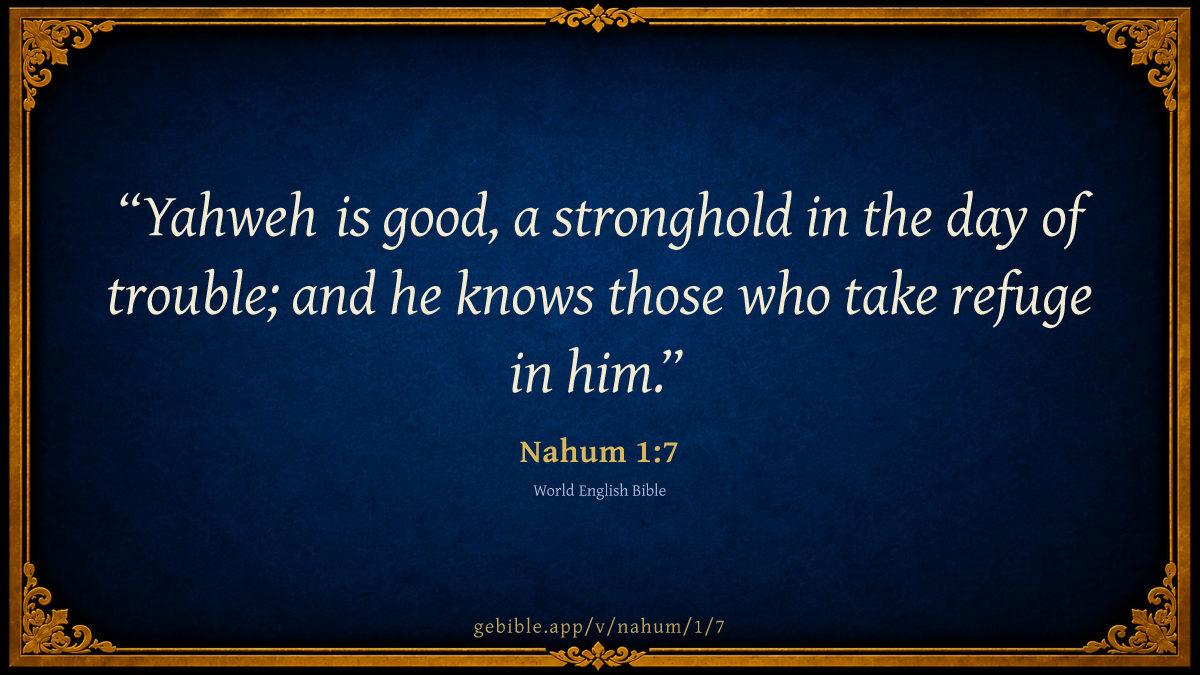
Yahweh is good, a stronghold in the day of trouble; and he knows those who take refuge in him.
Parallel Translations
-
Yahweh is good, a stronghold in the day of trouble; and he knows those who take refuge in him.
-
The LORD is good, a strong hold in the day of trouble; and he knoweth them that trust in him.
-
The LORD is good, a stronghold in the day of trouble; and He knoweth them that take refuge in Him.
Examined in Scripture Analysis
Contradictions (1)
Questions where the Bible appears to say two different things, with the passages on each side set together.
Cross-references (42)
Passages linked to Nahum 1:7 in the Treasury of Scripture Knowledge, ordered by reader-vote popularity; verse text shown in World English Bible.
- John 10:27 My sheep hear my voice, and I know them, and they follow me.
- 2 Timothy 2:19 However God’s firm foundation stands, having this seal, “The Lord knows those who are his,” and, “Let every one who names the name of the Lord depart from unrighteousness.”
- Lamentations 3:25 Yahweh is good to those who wait for him, to the soul who seeks him.
- John 10:14 I am the good shepherd. I know my own, and I’m known by my own;
- Psalms 91:1-2 He who dwells in the secret place of the Most High will rest in the shadow of the Almighty. I will say of Yahweh, “He is my refuge and my fortress; my God, in whom I trust.”
- Psalms 100:5 For Yahweh is good. His loving kindness endures forever, his faithfulness to all generations.
- Psalms 27:5 For in the day of trouble, he will keep me secretly in his pavilion. In the secret place of his tabernacle, he will hide me. He will lift me up on a rock.
- Proverbs 18:10 Yahweh’s name is a strong tower: the righteous run to him, and are safe.
- Psalms 1:6 For Yahweh knows the way of the righteous, but the way of the wicked shall perish.
- Galatians 4:9 But now that you have come to know God, or rather to be known by God, why do you turn back again to the weak and miserable elemental principles, to which you desire to be in bondage all over again?
- Isaiah 25:4 For you have been a stronghold to the poor, a stronghold to the needy in his distress, a refuge from the storm, a shade from the heat, when the blast of the dreaded ones is like a storm against the wall.
- 1 Chronicles 16:34 Oh give thanks to Yahweh, for he is good, for his loving kindness endures forever.
- Psalms 18:1-2 I love you, Yahweh, my strength. Yahweh is my rock, my fortress, and my deliverer; my God, my rock, in whom I take refuge; my shield, and the horn of my salvation, my high tower.
- Jeremiah 17:7-8 “Blessed is the man who trusts in Yahweh, and whose confidence is in Yahweh. For he will be as a tree planted by the waters, who spreads out its roots by the river, and will not fear when heat comes, but its leaf will be green, and will not be concerned in the year of drought. It won’t cease from yielding fruit.
- Psalms 84:11-12 For Yahweh God is a sun and a shield. Yahweh will give grace and glory. He withholds no good thing from those who walk blamelessly. Yahweh of Armies, blessed is the man who trusts in you.
- Psalms 86:7 In the day of my trouble I will call on you, for you will answer me.
- Jeremiah 33:11 the voice of joy and the voice of gladness, the voice of the bridegroom and the voice of the bride, the voice of those who say, ‘Give thanks to Yahweh of Armies, for Yahweh is good, for his loving kindness endures forever;’ who bring thanksgiving into Yahweh’s house. For I will cause the captivity of the land to be reversed as at the first,” says Yahweh.
- Isaiah 26:1-4 In that day, this song will be sung in the land of Judah: “We have a strong city. God appoints salvation for walls and bulwarks. Open the gates, that the righteous nation may enter: the one which keeps faith. You will keep whoever’s mind is steadfast in perfect peace, because he trusts in you. Trust in Yahweh forever; for in Yah, Yahweh, is an everlasting Rock.
- Isaiah 32:2 A man shall be as a hiding place from the wind, and a covert from the storm, as streams of water in a dry place, as the shade of a large rock in a weary land.
- Psalms 25:8 Good and upright is Yahweh, therefore he will instruct sinners in the way.
- Psalms 50:15 Call on me in the day of trouble. I will deliver you, and you will honor me.”
- Daniel 3:28 Nebuchadnezzar spoke and said, “Blessed be the God of Shadrach, Meshach, and Abednego, who has sent his angel, and delivered his servants who trusted in him, and have changed the king’s word, and have yielded their bodies, that they might not serve nor worship any god, except their own God.
- Psalms 71:3 Be to me a rock of refuge to which I may always go. Give the command to save me, for you are my rock and my fortress.
- Psalms 91:15 He will call on me, and I will answer him. I will be with him in trouble. I will deliver him, and honor him.
- 1 John 4:8-10 He who doesn’t love doesn’t know God, for God is love. By this God’s love was revealed in us, that God has sent his one and only Son into the world that we might live through him. In this is love, not that we loved God, but that he loved us, and sent his Son as the atoning sacrifice for our sins.
- Psalms 59:16 But I will sing of your strength. Yes, I will sing aloud of your loving kindness in the morning. For you have been my high tower, a refuge in the day of my distress.
- Psalms 62:6-8 He alone is my rock and my salvation, my fortress. I will not be shaken. My salvation and my honor is with God. The rock of my strength, and my refuge, is in God. Trust in him at all times, you people. Pour out your heart before him. God is a refuge for us.
- Psalms 136:1-26 Give thanks to Yahweh, for he is good; for his loving kindness endures forever. Give thanks to the God of gods; for his loving kindness endures forever. Give thanks to the Lord of lords; for his loving kindness endures forever: to him who alone does great wonders; for his loving kindness endures forever: to him who by understanding made the heavens; for his loving kindness endures forever: to him who spread out the earth above the waters; for his loving kindness endures forever: to him who made the great lights; for his loving kindness endures forever: the sun to rule by day; for his loving kindness endures forever; the moon and stars to rule by night; for his loving kindness endures forever: to him who struck down the Egyptian firstborn; for his loving kindness endures forever; and brought out Israel from among them; for his loving kindness endures forever; with a strong hand, and with an outstretched arm; for his loving kindness endures forever: to him who divided the Red Sea apart; for his loving kindness endures forever; and made Israel to pass through the middle of it; for his loving kindness endures forever; but overthrew Pharaoh and his army in the Red Sea; for his loving kindness endures forever: to him who led his people through the wilderness; for his loving kindness endures forever: to him who struck great kings; for his loving kindness endures forever; and killed mighty kings; for his loving kindness endures forever: Sihon king of the Amorites; for his loving kindness endures forever; Og king of Bashan; for his loving kindness endures forever; and gave their land as an inheritance; for his loving kindness endures forever; even a heritage to Israel his servant; for his loving kindness endures forever: who remembered us in our low estate; for his loving kindness endures forever; and has delivered us from our adversaries; for his loving kindness endures forever: who gives food to every creature; for his loving kindness endures forever. Oh give thanks to the God of heaven; for his loving kindness endures forever.
- Daniel 6:23 Then the king was exceedingly glad, and commanded that they should take Daniel up out of the den. So Daniel was taken up out of the den, and no kind of harm was found on him, because he had trusted in his God.
- Romans 11:22 See then the goodness and severity of God. Toward those who fell, severity; but toward you, goodness, if you continue in his goodness; otherwise you also will be cut off.
- 2 Chronicles 16:8-9 Weren’t the Ethiopians and the Lubim a huge army, with chariots and exceedingly many horsemen? Yet, because you relied on Yahweh, he delivered them into your hand. For Yahweh’s eyes run back and forth throughout the whole earth, to show himself strong in the behalf of them whose heart is perfect toward him. You have done foolishly in this; for from now on you will have wars.”
- 2 Chronicles 32:21 Yahweh sent an angel, who cut off all the mighty men of valor, and the leaders and captains, in the camp of the king of Assyria. So he returned with shame of face to his own land. When he had come into the house of his god, those who came out of his own body killed him there with the sword.
- Matthew 7:23 Then I will tell them, ‘I never knew you. Depart from me, you who work iniquity.’
- 1 Chronicles 5:20 They were helped against them, and the Hagrites were delivered into their hand, and all who were with them; for they cried to God in the battle, and he answered them, because they put their trust in him.
- Matthew 27:43 He trusts in God. Let God deliver him now, if he wants him; for he said, ‘I am the Son of God.’ ”
- 2 Chronicles 32:8 An arm of flesh is with him, but Yahweh our God is with us to help us and to fight our battles.” The people rested themselves on the words of Hezekiah king of Judah.
- 2 Chronicles 32:11 Doesn’t Hezekiah persuade you, to give you over to die by famine and by thirst, saying, ‘Yahweh our God will deliver us out of the hand of the king of Assyria?’
- Ezra 3:11 They sang to one another in praising and giving thanks to Yahweh, “For he is good, for his loving kindness endures forever toward Israel.” All the people shouted with a great shout, when they praised Yahweh, because the foundation of Yahweh’s house had been laid.
- Psalms 144:1-2 Blessed be Yahweh, my rock, who teaches my hands to war, and my fingers to battle: my loving kindness, my fortress, my high tower, my deliverer, my shield, and he in whom I take refuge, who subdues my people under me.
- Psalms 145:6-10 Men will speak of the might of your awesome acts. I will declare your greatness. They will utter the memory of your great goodness, and will sing of your righteousness. Yahweh is gracious, merciful, slow to anger, and of great loving kindness. Yahweh is good to all. His tender mercies are over all his works. All your works will give thanks to you, Yahweh. Your saints will extol you.
- Isaiah 37:3-4 They said to him, “Hezekiah says, ‘Today is a day of trouble, and of rebuke, and of rejection; for the children have come to the birth, and there is no strength to give birth. It may be Yahweh your God will hear the words of Rabshakeh, whom the king of Assyria his master has sent to defy the living God, and will rebuke the words which Yahweh your God has heard. Therefore lift up your prayer for the remnant that is left.’ ”
- Psalms 20:1 May Yahweh answer you in the day of trouble. May the name of the God of Jacob set you up on high,
Cross-references from openbible.info (CC BY 4.0)
Explain this verse (18 sources)
Historical commentary, presented as a primary source — not an endorsement.
Private notes
Saved on this device only — never synced or sent anywhere.
John Calvin 1540 · Public Domain The Prophet expresses more clearly here what we referred…
The Prophet expresses more clearly here what we referred to in our last lecture, — that God is hard and severe toward refractory men, and that he is merciful and kind to the teachable and the obedient, — not that God changes his nature, or that like Proteus he puts on various forms; but because he treats men according to their disposition. As then the Prophet has hitherto taught us, that God’s wrath cannot be sustained by mortals; so now, that no one might complain of extreme rigor, he, on the other hand, shows that God favors what is right and just, that he is gentle and mild to the meek, and therefore ready to bring help to the faithful, and that he leaves none of those who trust in him destitute of his aid.
First, by saying that God is good, he turns aside whatever might be objected on the ground of extreme severity. There is indeed nothing more peculiar to God than goodness. Now when he is so severe, that the very mention of his name terrifies the whole world, he seems to be in a manner different from himself. Hence the Prophet now shows that whatever he had hitherto said of the dreadful judgment of God, is not inconsistent with his goodness. Though God then is armed with vengeance against his enemies he yet ceases not to be like himself, nor does he forget his goodness. But the Prophet does here also more fully confirm the Israelites and the Jews in the belief, that God is not only terrible to the ungodly, but that, as he has promised to be the guardian of his Church, he would also succor the faithful, and in time alleviate their miseries. Good then is Jehovah; and it is added for help The intention of the Prophet may be hence more clearly understood, when he says that he is for strength in the day of distress; as though he said, — “God is ever ready to bring help to his people:” And he adds, in the day of distress, that the faithful may not think that they are rejected, when God tries their patience by adversities. How much soever then God may subject his people to the cross and to troubles, he still succors them in their distress.
Read full note →
He lastly adds, He knows them who hope in him. This to know, is no other thing than not to neglect them. Hence God is said to know them who hope in him, because he always watches over them, and takes care of their safety: in short, this knowledge is nothing else but the care of God, or his providence in preserving the faithful. The Prophet, at the same time, distinguishes the godly and sincere worshipers of God from hypocrites: when God leaves many destitute who profess to believe in him, he justly withholds from them his favor, for they do not from the heart call on him or seek him.
We now then understand the Prophet’s meaning. He shows, on the one hand, that God is armed with power to avenge his enemies; And, on the other, he shows that God, as he has promised, is a faithful guardian of his Church. How is this proved? He sets before us what God is, that he is good; and then adds, that he is prepared to bring help. But he does not in vain mention this particular, — that he takes care of the faithful, who truly, and from the heart, hope in him; it is done, that they may understand that they are not neglected by God, and also that hypocrites may know that they are not assisted, because their profession is nothing else but dissimulation, for they hope not sincerely in God, however they may falsely boast of his name. It now follows —
John Calvin's Commentaries (1540-1563) — public domain. Text from the Calvin Translation Society English edition (1840s-50s) via the Christian Classics Ethereal Library (ccel.org). Calvin's coverage is partial (roughly two-thirds of the Bible); uncommented books and verses are honest gaps, never fabricated. The 19th-century editor's footnotes and remarks are omitted so the notes are faithfully Calvin's own voice.
Geneva Bible translators 1599 · Public Domain Lest the faithful should be discouraged by hearing the…
Lest the faithful should be discouraged by hearing the power of God, he showeth them that his mercy appertain unto them, and that he hath care over them.
Geneva Bible (1599) marginal notes — public domain.
John Trapp 1656 · Public Domain Nah 1:7 The LORD [is] good, a strong hold…
Nah 1:7 The LORD [is] good, a strong hold in the day of trouble; and he knoweth them that trust in him.
Ver. 7. The Lord is good] To Israel (though terrible to the Assyrians, as hath been plainly and plentifully set forth), to the pure in heart, Psa 73:1, and he doth good, Psa 119:68, to those that are good, that are upright in their hearts, Psa 125:4. These shall taste and see that the Lord is good: these shall feelingly say, "Oh, blessed is the man that trusteth in him," Psa 34:8, "Oh, praise the Lord, for he is good," &c.
Read full note →
A strong hold in the day of trouble] Praesidium, aut fortalitium, A strong fort or fortification, better than a tower of brass or town of war: "the righteous run thereinto and are safe," Pro 18:10. Hezekiah (for whose sake this is spoken) had the experience of it. He had a day of trouble, and of rebuke, and of blasphemy: the children were come to the birth, and there was not strength to bring forth, Isa 37:3. To God, therefore, he runs in this doleful day of his, and had present help. And what though the gods of the nations had not delivered them; yet Hezekiah’s God, in whom he trusted, did not deceive him, as Sennacherib said he would, Nah 1:10; Nah 1:12. He is the champion of his Church, and will be the strong hold of his people, when the heathen’s tutelar gods and the Papists’ patron saints will leave them in the lurch. England was sometime said to have a warlike George, but the Papists being offended with us (to do us, as they suppose, a mischief), have robbed us of our George, and left us God alone to be our champion: for which honour and favour all true English hearts are bound to thank them, and can merrily sing, as he did once, Contemno minutulos istos deos, mode Iovem propitium habeam, We care not for their he-saints or she-saints to shelter us, so that the great God will be good to us, a stronghold in the day of trouble.
And he knoweth them that trust in him] That hover and cover under his wings, as the chickens do under the hen’s: for that is the force of the Hebrew word here used. Such as these God knoweth for his, 2Ti 2:19; he knoweth their soul in adversity, Psa 31:7; he knoweth how to deliver them, as he did the righteous Lot, 2Pe 2:9; then, when they know not what to do, as Jehoshaphat, 2Ch 20:12, yet if their eyes be toward him, their affiance in him, he will extricate and deliver them. So well pleased is he with those that trust in him (for that is meant here by his knowing of them, Psa 1:6 cf. Job 9:29 1Th 5:12), he taketh such complacence and delight in them Psa 147:11; Psa 33:18, and such continual care of them (as hath been proved by a universal experience, not one instance can be given to the contrary), that they shall be sure to have whatsoever heart can wish or need require, 2Sa 22:2-3, even miraculous lovingkindness from God in a strong city, Psa 17:7; Psa 31:21, so great as cannot be uttered, Psa 31:19. This is for the comfort of God’s Israel. But lest the wicked (as they are apt) should meddle with children’s meat, which was never meant for them; lest Nineveh should please herself in a fond conceit of God’s goodness to her also, and so turn it into wantonness, the prophet brings in a stinging "but" in the next words.
John Trapp, A Commentary or Exposition upon All the Books of the Old and New Testament (1647–1656) — public domain. Text from a community e-Sword module.
Matthew Poole 1685 · Public Domain The Lord is good; though so terrible to his…
The Lord is good; though so terrible to his enemies, to obstinate sinners, yet he is as gentle, kind, and good to his people, to Israel; so the Chaldee paraphrast.
Is good; in his just severity he continueth to be good. None of that consuming anger comes from any want of goodness in God; yea, it is as much an effect of his goodness, as just punishments on incorrigible malefactors are the effects of goodness in a judge or magistrate. But here the prophet intends rather the kindness and grace of God towards his people, to whom he doth good, and will do more. Psa 73:1; 119:68.
Read full note →
A strong hold; it might have been rendered, good to be a strong hold, as the Hebrew affix imports, and is sometimes rendered. Though Israel seems to be exposed to the violence of enemies, and to be without any munition or fortress, yet verily the Lord their God is for a defence and fortress to them, Psa 31:3; 61:3; Pro 18:10, and is their strength also in that fortress.
In the day of trouble; at all times of affliction and danger, when outward pressures fill us with anguish and fears.
Knoweth; discerneth, approveth, owneth, and will make it appear that he doth preserve, that he may deliver his peculiar ones. He knows the wicked, and will restrain, rebuke, and destroy them; he knows the good, and will protect, rescue, and save them.
Them; whether you consider them in a body and community, or by themselves apart, or singly.
That trust; believe, depend, and wait on God, they that depend by faith, and wait with hope.
In him; on God, or on Christ, or on the word and promise of God. So God was to those that trusted in his word of promise in Hezekiah’s time.
Matthew Poole's English Annotations on the Holy Bible (1683–1685) — public domain. Text from a community e-Sword/MySword module.
John Gill 1763 · Public Domain The Lord is good,.... To Israel, as the Targum…
The Lord is good,.... To Israel, as the Targum adds; to Hezekiah and his, people, that betook themselves to him, and put their trust in him; whom he defended and preserved from the king of Assyria, to whom he was dreadful and terrible, destroying his army in one night by an angel; and so delivered the king of Judah and the inhabitants of Jerusalem from that terror that had seized them, and that danger they were exposed unto; and so the Lord is good in himself, in the perfections of his nature, in the works of his hands, in all his persons to his people, that fear him, trust in him, and seek him, and wait for him, and on him:
a strong hold in the day of trouble; or, he is "good for a strong hold" (w), &c. it was a day of trouble, rebuke, and blasphemy, with Hezekiah and his people, when they were besieged by the army of Sennacherib king of Assyria, and had received from Rabshakeh by his orders a railing and reproaching letter; and then the Lord was a strong hold to them, to whom they betook themselves, and he protected and defended them. The whole time of this life is a time of trouble to the saints, though it is but a day, a short time; in which they meet with much from their own corrupt hearts, and the sin that dwells in them; from Satan and his temptations; from carnal professors, their principles and practices; and from a profane and persecuting world; and from the Lord himself, who sometimes lays his afflicting hand upon them, and hides his face from them; and yet he is their rock and their refuge, their strong tower and place of defence; where they find safety and plenty in all their times of distress and want:
Read full note →
and he knoweth them that trust in him; in his word, as the Targum; and they are such that know him, and are sensible of the vanity of all other objects of trust; who betake themselves to him for shelter and protection; lean and stay themselves upon him, and commit all unto him, and expect all from him: these he knows, loves, and has the strongest affection for; he approves of them, and commends their faith and confidence; he takes notice of them, visits them, and makes himself known unto them, even in their adversity; he owns and acknowledges them as his own, claims his right in them now, and will confess them hereafter; and he takes care of them that they perish not, whoever else do; see Psa 1:6; he knows the necessities of those that trust in him, as Jarchi; he knows them for their good, takes care of them, provides for, them, and watches over them, as Kimchi. The ancients formerly had their and "notores" (x), such as knew them, and were their patrons and defenders; as when a Roman citizen was condemned to be whipped or crucified in a province where he was not known, and claimed the Roman privileges, such persons were his witnesses and advocates; and thus the Lord is represented as one that knows his people, and is their patron and advocate. The goodness of God expressed in this text is set off with a foil by the terribleness of his wrath and vengeance against his enemies.
(w) "bonus Dominus ad robur", Burkius; "bonus est Jehovah in arcem", Cocceius. (x) Dannhaver, apud Burkium in loc. Vid. Turnebi Adversar. l. 29. c. 36.
John Gill's Exposition of the Whole Bible (1746–1763) — public domain (CC PDM 1.0). Text via the HelloAO Bible API.
John Wesley 1765 · Public Domain Knoweth - He approves, owns, and preserves them.
Knoweth - He approves, owns, and preserves them.
John Wesley, Explanatory Notes Upon the Whole Bible (1754–1765) — public domain. Text via the GEBible commentary corpus.
Adam Clarke 1810 · Public Domain Verse 7. The Lord is good] In the midst…
Verse 7. The Lord is good] In the midst of judgment he remembers mercy; and among the most dreadful denunciations of wrath he mingles promises of mercy. None that trust in him need be alarmed at these dreadful threatenings; they shall be discriminated in the day of wrath, for the Lord knoweth them that trust in him.
Adam Clarke's Commentary on the Bible (1810–1826) — public domain. Text from a community e-Sword/MySword module.
Joseph Benson 1811 · Public Domain Nah 1:7. The Lord is good — But though…
Nah 1:7. The Lord is good — But though God is thus terrible in his power, yet he is merciful, gracious, and beneficent in his nature, and is a sure refuge and protection to those who worship and serve him sincerely, and put their trust in him; and he knows and pays a particular regard to all such, so that they are never overlooked or neglected by him; he approves, owns, and preserves them.
Joseph Benson's Commentary on the Old and New Testaments (1811–1818) — public domain. Text from a community e-Sword module.
Albert Barnes 1834 · Public Domain The Lord is good: a stronghold in the day…
The Lord is good: a stronghold in the day of trouble - “Good and doing good,” and full of sweetness; alike good and mighty; good in giving Himself and imparting His goodness to His own; yea “none is good, save God” Luk 18:19; Himself the stronghold wherein His own amy take refuge; both in the troubles of this life, in which “He will not suffer us to be tempted above that we are able” 1Co 10:13, and in that Day, which shall hem them in on every side, and leave no place of escape except Himself.
And He knoweth them that tuust in Him - So as to save them; as Rahab was saved when Jericho perished, and Lot out of the midst of the overthrow and Hezekiah from the host of Sennacherib. He knows them with an individual, ever-present, knowledge. He says not only, “He shall own them,” but He ever “knoweth them.” So it is said; “The Lord knoweth the way of the righteous” Psa 1:6; “The Lord knoweth the, days of the upright” Psa 37:18; and our Lord says, “I know My sheep” Joh 10:14, Joh 10:27; and Paul, “The Lord knoweth them that are His” 2Ti 2:19. God speaks of this knowledge also in the past, of His knowledge, when things as yet were not, “I have known thee by name;” or of loving kindness in the past, “I knew thee in the wilderness” Hos 13:5, “you alone have I known of all the families of the earth” Amo 3:2, its contrariwise our Lord says, that He shall say to the wicked in the Great Day, “I never knew you” Mat 7:23. That God, being what He is, should take knowledge of us, being what we are, is such wondrous condescension, that it involves a purpose of love, yea, His love toward us, as the Psalmist says admiringly, “Lord, what is man that Thou takest knowledge of him?” Psa 144:3.
Read full note →
Them that trust in Him - It is a habit, which has this reward; “the trusters in Him,” “the takers of refuge in Him.” It is a continued unvarying trust, to which is shown this everpresent love and knowledge.
Yet this gleam of comfort only discloses the darkness of the wicked. Since those who trust God are they whom God knows, it follows that the rest He knows not. On this opening, which sets forth the attributes of God toward those who defy Him and those who trust in Him, follows the special application to Nineveh.
Albert Barnes' Notes on the Bible (1834–1885) — public domain. Text from a community e-Sword/MySword module.
Haydock's Catholic Bible Commentary 1859 · Public Domain Hope. Septuagint, "fear." He approves of his faithful servants.…
Hope. Septuagint, "fear." He approves of his faithful servants. (Haydock)
George Leo Haydock (1774–1849), Haydock's Catholic Family Bible and Commentary, 1859 edition — public domain. Excludes Psalms (Douay-Rheims chapter numbering differs from Protestant) and Deuterocanonical books (Catholic canon only).
Robert Jamieson, A. R. Fausset & David Brown 1871 · Public Domain Here Nahum enters on his special subject, for which…
Here Nahum enters on his special subject, for which the previous verses have prepared the way, namely, to assure his people of safety in Jehovah under the impending attack of Sennacherib (Nah 1:7), and to announce the doom of Nineveh, the capital of the Assyrian foe (Nah 1:8). The contrast of Nah 1:7-8 heightens the force.
he knoweth--recognizes as His own (Hos 13:5; Amo 3:2); and so, cares for and guards (Psa 1:6; Ti2 2:19).
Jamieson, Fausset & Brown — Commentary Critical and Explanatory on the Whole Bible (1871) — public domain (CC PDM 1.0). Text via the HelloAO Bible API.
Daniel D. Whedon 1874 · Public Domain Overthrow of Nineveh; deliverance of Judah, Nah_1:7-15.
Overthrow of Nineveh; deliverance of Judah, Nah_1:7-15.
In Nah_1:7-15, the prophet applies the general truths expressed in Nah_1:2-6, to the case in hand. The divine wrath will manifest itself in the overthrow of the enemies of God’s people, chief among whom is Assyria, with its capital, Nineveh. With this power out of the way, the excellence of Judah may be restored. Nah_1:7-8 are still, in a sense, introductory; they affirm in general terms the fact that Jehovah is the stronghold of those who put their trust in him, and, on the other hand, that he “pursues his enemies into darkness.”
Read full note →
7. Jehovah is good, a stronghold in the day of trouble — LXX., “Good is the Lord to those who trust in him in the day of trouble,” which gives a sentence parallel in thought to the one following. Nowack and others think that neither the present Hebrew text nor LXX. has preserved the original; he reconstructs 7a, partly to secure his alphabetic arrangement, “Good is Jehovah to those who trust in him, a stronghold in the day of trouble.”
Stronghold — A place of defense, of shelter. Whatever the exact wording of the original, the sense is that Jehovah cares for those who put their trust in him even in the hour of deepest distress (Psa_37:39). Hence Judah, though oppressed, need not despair.
He knoweth — See on Hos_8:4. Here in a favorable sense, “care,” “guide” (Hos_13:5; Psa_1:6). “God is said to know them who hope in him, because he always watches over them, and takes care of their safety; in short, this knowledge is nothing else but the care of God, or his providence in preserving the faithful” (Calvin).
Daniel D. Whedon (gen. ed.), Commentary on the Old and New Testaments (1874–1909) — public domain. Text from a community e-Sword module.
The Cambridge Bible for Schools and Colleges 1878 · Public Domain 7. is good, a strong hold] More naturally: is…
7. is good, a strong hold] More naturally: is good for (as) a stronghold, construction as Gen_3:6. Sept. renders: is good to those who wait on him, which gives a better parallelism to the next clause. Cf. Psa_37:39, “He is their strength in the time of trouble,” virtually the same words as Heb. here.
knoweth them that trust] Psa_1:6, “The Lord knoweth the way of the righteous.” Gen_18:19; Amo_3:2.
Read full note →
7–15. Jehovah will make an utter end of the enemies of his people
The preceding verses have been general, speaking of the attributes of Jehovah and their manifestation, and conclude with the inference that none can stand before His wrath. Now the prophet approaches his more immediate theme, the pouring of Jehovah’s anger on Nineveh. Nah_1:7 forms an antithesis to Nah_1:8 : Jehovah is the friend of His friends, Nah_1:7, and the foe of His enemies, Nah_1:8, of whom He will make an utter end.
The Cambridge Bible for Schools and Colleges (gen. ed. J. J. S. Perowne; Cambridge University Press, 1878–1918) — public domain. Text from a community e-Sword module.
The Pulpit Commentary 1880 · Public Domain Vers. 7-11. The prophet prepares the way for proclaiming…
Vers. 7-11. The prophet prepares the way for proclaiming the punishment of Nineveh lay deriding that the wrath of God falls not on those who trust in him, but is reserved for his enemies.
The Lord is good. The Targum adds unnecessarily, "for Israel". (Psa_25:8) He is "good," in that he is a stronghold in the day of trouble, as in the perilous time when the Assyrians attacked Judaea. (comp. Psa_27:1 Jer_16:19) He knoweth; loves and cares for. (Psa_1:6 Psa_37:18 2Ti_2:19; and see note on Amo_3:2)
Read full note →
Vers. 7, 8. Consolation in God.
I IN HIS LOVE. "The Lord is good.
1. Revealed in his Word.
a. Made known to Moses; (Exo_33:19 Exo_34:6)
b. proclaimed by David; (Psa_52:1 Psa_100:5 Psa_119:68)
c. announced by Jeremiah; (Lam_3:25)
d. confirmed by Christ. (Mat_19:17)
2. Attested by his works.
(1) In creation, God having made the earth to be an abode of happiness for innumerable myriads of creatures: "the earth is full of the goodness of the Lord". (Psa_33:5)
(2) In providence, by his being good unto all, (Psa_145:9) and making all things work together for good to his people. (Rom_8:28)
(3) In grace, by the gift of his Son to be man"s Redeemer, (2Co_9:15) and by the various blessings of salvation he for Christ"s sake bestows upon them pardon, peace, adoption, holiness, light, strength, life, heaven.
3. Experienced by his saints. From the beginning of time downwards, good men have been partakers of, and delighted to bear testimony to, the goodness of God, saying, like David, "The Lord is my Shepherd," etc.; (Psa_23:1) "He hath dealt bountifully with me"; (Psa_13:6) confessing, like Solomon, "There hath not failed one word of all his good promise"; (1Ki_8:56) acknowledging, like Jacob, "He hath fed me all my life long unto this day". (Gen_48:15)
4. Illustrated by his Son. The highest, clearest, and fullest evidence that God is good was furnished by Jesus Christ, who was good in himself, (Joh_10:11) and went about continually doing good. (Act_10:38)
II IN HIS POWER. "He is a Stronghold in the day of trouble.
1. Accessible.
(1) To all troubled ones, amongst his believing people, (Psa_46:1 Pro_14:26 Isa_25:4) and amongst mankind generally, if they care to avail themselves of it. (Psa_91:9)
(2) From every quarter of the globe, from every rank and condition of society. Jehovah the God, not of the Jew only, but also of the Gentile; (Rom_3:29) not of the rich and learned and outwardly virtuous, to the exclusion of the poor, ignorant, and degraded, nor of these to the disadvantage of those with him is no respect of persons. (2Ch_19:7 Rom_2:11 Eph_6:9 Col_3:25)
(3) In every form of calamity in the day of national adversity, such as had often befallen Israel undivided, (Exo_14:10 Jud_1:6:1, 2 1Sa_4:2) and Judah in separation, (2Ch_14:9 2Ch_20:1 2Ch_32:1) and such as was soon to threaten the latter again, if not from the Assyrian, from the Babylonian power; in the day of domestic tribulation, such as overtook Job, (Job_1:13-19) David, (2Sa 15-18) Jacob, (Gen_42:36) Jairus, (Mat_9:18) the centurion, (Luk_7:2) the widow of Nain, (Luk_7:12) the nobleman, (Joh_4:46) and the household of Bethany; (Joh_11:1) in the day of personal affliction, which may be either spiritual like the distress which fell on David Psa_38:3), or material like that which overtook Lot, (Gen_19:29) bodily like that which struck Hezekiah, (Isa_32:1) or mental like that which crushed Jeremiah, (Jer_9:1) occasional like that which happened to Manasseh, (2Ch_33:12) or perpetual like that which was the lot of Paul. (2Co_4:10)
2. Impregnable. This inevitable, considering what kind of a fortress it is Divine, and by what munitions it is guarded, the royal battalion of the Divine attributes, by Jehovah"s omnipotence, omniscience, omnipresence, faithfulness, wisdom, holiness, love, Against this manifestly no weapon can prevail. "Mine omnipotency shall be your guard. I am God Almighty, your Almighty Protector, your Almighty Benefactor. What though your enemies are many? More are they that are with you than they that are against you; for I am with you. What though they are mighty? they are not almighty," etc. (Alleine"s "Heaven Opened," pp. 256, 257).
3. Sufficient. Every succour the soul needs in its day of trouble is found in God, and found oomph rely for the soul"s guilt, pardon; (Isa_1:16 Isa_43:25) for its pollution, cleansing; (Eze_36:25) for its anxiety,; (Isa_26:3 Mat_11:28) for its weakness, strength; (Isa_45:24) for its darkness, light; (Psa_118:27 1Jn_1:5) for its death, life. (Isa_25:8 Rom_4:17)
III IN HIS KNOWLEDGE. "He knoweth them that put their trust in him." He knoweth them:
1. Collectively. All that belong to the body of his believing people he exactly and always knows, so that he can think and speak of them as his people, (Isa_32:18 2Ti_2:19) as Christ does of those who are his. (Joh_10:14)
2. Individually. Not in the mass merely, but separately and singly, he knows them, (2Sa_7:20 Psa_139:1 1Co_8:3,heb 1Co_4:13) as Christ also calls his own sheep by name. (Joh_10:3)
3. Thoroughly.
(1) Their characters seeing that he searches the heart. (1Ki_8:39 Jer_17:10 Psa_139:2 Luk_16:15 Act_1:24 Act_15:8 1Th_2:4) Hence he can never err as to their persons.
(2) Their conditions since nothing can be hid from him, neither person (Jer_23:24 Hos_5:3) nor thing, (Psa_139:15 Jer_16:17) but both alike are manifest in his sight. (Heb_4:13) Hence he can never mistake as to their circumstances, but must always understand precisely what they need.
4. Efficiently. Different from the wicked, whom he knows afar off, (Psa_138:6) i.e. as persons estranged from and hostile to him elf, them that put their trust in him he knows appreciatively and helpfully, so as to love, cherish, protect, and assist them. "Though the Lord be-high, yet hath he respect unto the lowly to their persons to love them, to their characters to admire them, to their wants to supply them, to their souls to save them.
CONCLUSION. Note:
1. The characters of those for whom this consolation exists they put their trust in God. Remark upon the simplicity and efficacy of faith.
2. The evil fate of them who, being destitute of faith, are his enemies they shall be destroyed by an overrunning flood, their habitations swept away, their persons engulfed, their hopes disappointed, their projects defeated, their ambitions scattered to the winds; they shall be pursued by (or into) darkness (see next homily).
The Divine goodness.
"The Lord is good." The word "good" is used herein the sense of the desire to promote happiness. The prophet affirms that "the Lord" possesses this disposition that whilst he is powerful he exerts this power in saving, not in destroying, "judgment" being "his strange work;" that whilst his presence fills all space, and his omniscient eye penetrates all, he is concerned, in his watchfulness, that none of the creatures he has formed should lack the blessings his bounteous hand has to bestow; and that as he is eternal in his duration, so the streams of his bounty shall ever continue to flow. "The Lord is good." This inspiring truth was revealed even from the earliest times, and is inscribed in Scripture upon every page. Abram in the vision by night, (Ge 15) Jacob in his weary wanderings, (Gen_28:10-22) and Moses in "the holy mount", (Exo_33:19) were alike favoured with special revelations of it. The very thought of God thus woke up within the psalmist the faculty of song, and led him to strike his lyre and to sing with holy fervour, "Thou, Lord, art good and ready to forgive"; (Psa_86:5) "They shall abundantly utter the memory of thy great goodness," etc.; (Psa_145:7) "Oh, taste and see," etc. (Psa_34:8) And prophets unite with psalmists in bearing this testimony. (Jer_33:11 Isa_63:7) Very different was the conception formed by the heathen. We think of the tyranny, caprice, and revenge supposed to characterize heathen deities, the acts of cruelty ascribed to them, the impurity of heathen rites, and the wearisomeness of heathen penances, and we rejoice that the voice from heaven has spoken unto us, and that the truth which heathen worshippers did not know has been so clearly revealed to us in the bright assurance, "The Lord is good." "The Lord is good." Nature, with bar ten thousand voices, bears emphatic testimony here. Benevolence marks all the operations of the Creator"s hands. All his works declare his goodness. The majestic sun, the full-orbed moon, the stars countless in number and sparkling in the vault of heaven, the refreshing and fertilizing shower, the gentle breeze, the woods reechoing with the notes of little songsters, the varied landscape, the carpeted earth, the tinted flowers, all seem to speak and to say, "The Lord is good." "O Lord, how excellent is thy Name in all the earth!"; (Psa_8:1) "O Lord, how manifold," etc.! (Psa_104:24) "The Lord is good." As in creation so in providence, the same testimony is borne. Specially is this so in the Divine dealings with men, supplying his wants, ministering to his necessities, scattering blessings in his path, and daily, yea, hourly, sustaining and preserving him from peril and danger. His goodness, too, is seen in that he is "kind even to the unthankful," and bestows his flowers not only upon "the just" but also upon "the unjust," sustaining even these who live in rebellion against him. Nor does the fact that whilst the ungodly often seem to "prosper in their way," "waters of a full cup are wrung out to his people," militate against the declaration of this text; for God"s providence takes into account the entire welfare of his servants, and adverse scenes may be necessary in order to the promotion of this; and, the discipline accomplished, deliverance shall be theirs, whilst the arm of the oppressor shall be bracken (vers. 12, 13). "The Lord is good." This truth, impressed upon the pages of the Old Testament, receives its highest exemplification in the records of the New. In him whose advent prophets predicted, and whose work was shadowed forth in type and symbol, and in the free redemption he has wrought; in the seeking and self-sacrificing love and the compassionate mercy and grace of God as thus expressed, we see the noblest, purest, brightest token that "the Lord is good." In this Divine goodness, ever watchful to guard us; almighty, and hence equal to every emergency of our life; immutable too, and therefore an unfailing dependence amidst the mutations and fluctuations of our earthly lot, let us rest with unswerving trust, until at length, every bond sundered, we, as "the ransomed of the Lord, come to Zion with songs and everlasting joy upon our heads," there with adoring gratitude to reflect upon the memory of his great goodness, and to praise him for his mercy and grace and love forevermore. S.D.H.
God our Stronghold.
Great, indeed, is the honour sustained by the man who fulfils the mission of being a comforter to others, who is enabled to minister to sorrowing and stricken ones, who watches with them in their Gethsemanes, and by his gentle words and tender sympathy imparts consolation to their wounded hearts. "I dwelt as a king in the army; as one that comforteth the mourners". (Job_29:25) No service makes a greater demand upon a man than this, yet he has an abundant reward for the self-sacrifice involved, in beholding the objects of his regard no longer in "ashes," but raised out of the dust and made comely; no longer with disfigured countenance through grief, but radiant with joy; no longer arrayed in gloom, but clad in the beautiful garments worn on festal days. (Isa_61:2, Isa_61:3) Nahum, whilst the minister of condemnation to the Ninevites, was also the minister of consolation to his own people in their sadness and sorrow. Only a few of his words to Israel are recorded, but they are words full of consolation and hope. Here he pointed to God as the Stronghold of his servants. "He is a Stronghold in the day of trouble" (ver. 7). We have here
I A COMMON UNIVERSAL EXPERIENCE. "Trouble." Man is born to this. Trials arise; conflicts must be engaged in; the cares and anxieties of life press; hopes are frustrated; injustice triumphs; slander blights; sickness, disease, death, prevail; our best and dearest pass away from our view; graves are opened; the tears fail fast; and immunity from all this is granted to none, each must pass through dark experiences and encounter adverse influences: this is the discipline of life. "In this vain world the days are not all fair; To suffer is the work we have to do; And every one has got a cross to bear, And every one some secret heart, ache too.
II A DEEP INWARD NEED ARISING OUT OF THIS EXPERIENCE. It is implied here that man circumstanced thus needs help. He knows not how to bear the ills of life unaided and alone. He who has to face the pitiless storm needs to be robed to resist the stress of adverse weather, and he who has to confront the foe requires to be armour clad. This need of the sorrowing heart cannot be supplied by earthly sources. The world"s cheer then comes to the man like songs to a heavy heart, and he has no taste for its music. Scepticism can east no bow of promise across the cloud; whilst human philosophy may counsel the cherishing of the spirit of indifference, but which under the pressure it is impossible to cultivate.
III THIS NEED AMPLY MET IN GOD. "He is a Stronghold in the day of trouble." The figure is a very striking one. There stands the castle with its thick walls and buttresses and its brave defenders ready to resist any attack. The foes attempt a landing, and the inhabitants, old and young, hasten to the fortress. The drawbridge is lifted, the moat is filled with water, and all are safely lodged in the stronghold, and in the day of visitation are securely guarded and safely kept. Even thus is it with the good in "the day of trouble." So David cried, "Thou hast been a Shelter for me and a Strong Tower from the enemy". (Psa_61:3, Psa_61:4) God was his "Light and his Salvation", (Psa_27:1) his "Pavilion", (Psa_27:5) the Solace of his every grief as well as the Centre of his every joy. He loved him, he trusted him, he knew that the dearest experience in life is the experience of God"s love and care. So Hezekiah and his people when threatened by Sennacherib. The Assyrian army gathered in all its strength around "the city of God," and Jerusalem became as a mountain shaken by the swelling of the sea, portions of which were crumbling and falling through the violence of the waves, and the whole of which seemed ready to be borne entirely away; yet the king and his subjects were calm and tranquil; they committed their cause to "the Strong One," and rested in his protection, and cried with holy fervour, "God is our Refuge and Strength," etc. (Isa 36 Isa 37 Ps 46) And let us only realize that Jehovah is to us a living Presence, the Source of our inspiration, the Strength of our hearts and our abiding Portion, and we shall give to the winds all craven fear, and in our darkest seasons shall singA sure Stronghold our God is he, A timely Shield and Weapon; Our Help he"ll be, and. set us free From every ill can happen.
And were the world with devils filled, All eager to devour us, Our souls to fear shall little yield, They cannot overpower us. S.D.H.
The Divine regard for trusting hearts.
"And he knoweth them that trust in him." Something more than mere acquaintance is involved here; the meaning undoubtedly is that he intimately and lovingly regards those who commit themselves and their way unto him, and will tenderly care for them and promote their weal; yea, still more, even that he knows and cares thus for such personally and individually, not overlooking any of them in the multitude, but regarding thus each and every such trusting heart.
I THIS TRUTH ADMITS OF AMPLE CONFIRMATION. There is something very wonderful in this thought. Is it not almost past conception that he who has the direction of all worlds dependent upon him, and whose dominions are so vast, should look upon his servants in this small world of ours, separately and with loving regard, and should interest himself in our personal concerns? So too, awed and humbled as we stand in the midst of the vast and mighty works of God, we feel impelled to cry, "When I consider thy heavens." etc (Psa_8:3) Yet that it is so is abundantly confirmed in the teachings of Scripture.
1. See this truth taught in type. Call to remembrance the breastplate of the Jewish high priest, that splendid embroidered cloth which covered his breast, and in which were set precious stones bearing the names of the tribes of Israel. And did not those precious stones, worn so near the heart of the high priest, symbolize the truth that all sincere servants of God are dear unto him; that he not only bears them up in his arms with an almighty strength, but bears them also upon his heart with the most tender affection?
2. See this truth taught in prophecy. It is therein declared that there is nothing so impossible as that God should forget his trusting children. "Zion said, The Lord hath forgotten me, and my Lord hath forsaken me". (Isa_49:14, Isa_49:15) And in response to this fear the Lord declared that this could never be, and that his love and care are even more enduring than that of mothers. "Can a woman," etc.?; (Isa_49:15) "I have graven thee upon the palms of my hands". (Isa_49:16) Undying remembrance surely! The name is inscribed there, never to be obliterated, a ceaseless memorial before his face.
3. The New Testament unites with the Old in bearing this bright testimony; for does not Christ, as the good Shepherd, declare that "he calleth his own sheep by name, and leadeth them out"? do we not read also the assurance, "The Lord knoweth them that are his"? (2Ti_2:19) yea, is it not even affirmed that this Divine knowledge and care respecting the good shall be perpetuated evermore? (Rev_7:15-17 Rev_21:3, Rev_21:4)
II THIS TRUTH IS CALCULATED TO EXERT A STRENGTHENING AND STIMULATING INFLUENCE. This thought, if more intensely realized by us, would prove helpful in many ways.
1. It would render us less dependent than we are upon human supports.What over anxiety is felt by us at times in reference to the success of our plans and projects, or for the continuance to us of those in whom our prosperity, humanly speaking, centres! But if we grasped fully the assurance here expressed, we should be led to depend less upon earthly sources and more upon him who has loved us with an everlasting love; who, though unseen by us, ever encompasses our path, and who, in the season of their deepest extremity, will guide and strengthen all who stay themselves on him.
2. It would give increased reality to the sacred exercise of prayer. We too often draw nigh unto God as though we were seeking One who, because he is invisible, is necessarily at an infinite distance from us, and who may or may not regard our cry, and perhaps it is not too much to say that we sometimes draw nigh without any distinct apprehension of the Being to whom we profess to come, and whose aid we invoke; but then we should indeed feel prayer to be a reality and not a merely formal exercise, and by such intimate and hallowed communion should renew our spiritual strength.
3. It would strengthen and aid us in our conflicts with sin. In this strife we sometimes suffer defeat; and in our endeavours after the Christian character and life we are painfully conscious at seasons of failure. How cheering in such circumstances is the thought that all our aspirations after truth and purity and goodness are known unto our God; that he is acquainted with all tile circumstances of our case; that he is conscious we have not designedly strayed from him; and that he follows us, with loving regard, in all our wanderings, with a view to bringing us back to his fold! S.D.H.
Vers. 7, 8. Opposite types of human character, and opposite lines of Divine procedure.
"The Lord is good, a Stronghold in the day of trouble; and he knoweth them that trust in him. But with an overruning flood he will make an utter end of the place thereof, and darkness shall pursue his enemies." The previous verses were introductory to the subject which the prophet now takes up, namely, the safe keeping of the Jews by Jehovah, in view of the tremendous attack the King of Nineveh was about making on their country and their city, and also to announce the terrible doom of Nineveh, the capital of the Assyrian foe. In these verses there is a very striking and significant contrast
(1) between the characters of men, and
(2) between the lines of Divine procedure in relation to them. Here we have
I TWO OPPOSITE TYPES OF HUMAN CHARACTER.
1. Here we have the friends of God. There is here a twofold description of them.
(1) "They trust in him." This is the universal character of the good in all ages. Instead of placing their chief confidence in the ever-changing creature, they centre it in the immutable Creator. They trust his love ever to provide for them, his wisdom as their infallible guide, and his power as their strength and their shield. "Blessed is the man that trusteth in the Lord.
(2) He acknowledges them. "And he knoweth." This means that he recognizes them as his loyal subjects and loving children, his people. In Hos_13:5 he saith, "I did know thee in the wilderness," which means, "I did acknowledge thee, and took care of thee!" The words imply the cognizance of special sympathy with the just. He knows them; they are always in his mind, his heart. "Can a mother forget her sucking child," etc.?
2. Here we have the enemies of God. "Darkness shall pursue his enemies." The men who misrepresent our characters, oppose our expressed wishes, seek to undermine our influence, and are ever in association with those who are opposed to us such men, whatever may be their professions of regard and friendship, we are bound to regard as enemies. Is it not so with men in relation to God? Those who pursue a course of life directly opposite to the moral laws of Heaven, whatever they may say, are his enemies. How numerous are God"s enemies! These two great classes comprehend the human race today. The race may be divided into very numerous classes on certain adventitious principles, but on moral grounds there are but two God"s friends and God"s enemies.
II TO OPPOSITE LINES OF DIVINE PROCEDURE. God"s procedure is very different towards these two opposite classes of men.
1. He affords protection to the one. When the hosts of Sennacherib were approaching Jerusalem, Hezekiah the king, under Divine inspiration, said to the people, "Be strong and courageous, be not afraid nor dismayed for the King of Assyria, nor for all the multitude that is with him: for there be more with us than with him: with him is an arm of flesh; but with us is the Lord our God to help us, and to fight our battles. And the people rested themselves upon the words of Hezekiah King of Judah". (2Ch_32:7, 2Ch_32:8) Thus it is ever. God is always the Refuge and Strength of his people in times of tribulation. As a Refuge, he is:
(1) Ever accessible. However suddenly the storm may come, the refuge is at your side, the door is open. "I will never leave thee," etc.
(2) Ever secure. The sanctuary once entered, no injury can follow. Amidst the most violent convulsions of nature, the wreck of worlds, the shatterings of the universe, there is no endangering the security of those who avail themselves of this refuge.
2. He sends destruction to the other. "But with an overrunning flood he will make an utter end of the place thereof, and darkness shall pursue his enemies." The image of a flood which breaks through every barrier is not unfrequently used in the Bible to represent overwhelming armies of invasion. The primary allusion here, no doubt, is to the way which Nineveh was captured by means of the Medes and Babylonians. A flood in the river, we are told, broke down the wall for twenty furlongs. The rolling tide burst its barriers, bore away the defences of the city, and opened an easy and unexpected way for the invading armies. On all finally impenitent men destruction must come as irresistibly as a flood. The destruction, however, of existence, conscience, or moral obligations would be the destruction of all that would make existence worth having.
CONCLUSION. The grand question of every man is How do I stand in relation to God? If I am his friend, his procedure is in my favour, it guards me and blesses me every step. It I am his enemy, his procedure is not in my favour, not because he changes, but because I put myself against him, and it must be my ruin if I change not. As he proceeds in his beneficent and undeviating march, he showers blessings on the good, and miseries on the evil, and this forever. D.T.
The Pulpit Commentary (1880–1919), ed. H.D.M. Spence-Jones & Joseph S. Exell — public domain. Text from a community e-Sword module.
The Biblical Illustrator 1887 · Public Domain The Lord is good, a stronghold in the day…
Nah_1:7
The Lord is good, a stronghold in the day of trouble.
Read full note →
Goodness a stronghold
The great design of religion is to bring us to God and true blessedness. In order to this, there must be full and practical confidence in God,--submission to His providence and law,--unquestioning repose in Himself. The text, though not possessing the form of a promise, is a declaration concerning God Himself, which includes the whole system of promise. Such is God. If such is God, then happy the people that is in such a case; yea, blessed they whose God is the Lord.
I. The Lord is Good.
1. The expression reminds us of the absolute goodness of the Divine nature, and especially of the Divine benevolence. Whatever goodness there is in the creature is derived--God is its source; it is limited--in God it is unbounded; dependent--in God it is essential and independent; mutable--in God it is changeless.
2. The active character of the Divine goodness. He doeth good. In inanimate creation are displayed His perfections. All living beings look up to God. He universally provides. But we are of more value than many sparrows. And He cares for us.
3. Gods goodness in its suitableness to mans present condition. He is a sinner. Providential blessings continued. Evil tendencies of sin checked. A wisely ordered scheme of redemption; and hence, forbearance, salvation.
II. A stronghold in the day of trouble. Figure forcible in the East, where predatory expeditions are usual. God a stronghold for defence of His people. Recollect what He is in Himself. All His attributes are employed for the benefit of His people. In the day of trouble they are shut up with God.
III. He knoweth them that trust in him. To trust in God implies satisfied persuasion He will be and do as He has said. Two results--we shall seek all good in Him. We shall abide with Him. Trust in God and doing good are ever conjoined--in nature as well as duty. (G. Cubitt.)
The goodness of God in seasons of calamity
This book is The Burden of Nineveh. Nahum was contemporary with Hezekiah. The immediate design of the prophecy was to minister comfort to the afflicted and alarmed Jews; for the defeat of the enemies of the Church involves its deliverance. The name of the prophet indicates this design;--it signifies comfort or comforter. The text teaches that the Lord is good, even in seasons of calamity.
1. Such seasons are not only not inconsistent with the Divine goodness, but m various ways manifest it. There is always much affliction in the world. When we suffer under calamities, unworthy thoughts of God are apt to rise within us, and especially suspicions of His goodness. If we indulge these suspicions, they will alienate our hearts from God and His service, and prompt us to impatience, murmuring, and impiety. But they are not inconsistent with Gods goodness. The punishment of transgression is not in consistent with goodness. Days of judgment on us may be merciful warnings, to others. They are often means of delivering and purifying the Church. They are instructors and monitors to future ages.
2. In seasons of calamity the Lord is good, for He reveals Himself to us as a stronghold, and invites us to flee to Him for safety and comfort.
3. In days of trouble the Lord is good, for He affectionately watches over all who honour Him with their trust. (James Stark, D. D.)
The Divine goodness a refuge in trouble
These words have been well compared to a burst of sunshine on a cloudy tempestuous day. The prophet opens his commission with setting forth the terrors of the Lord. But on a sudden this appalling strain ceases. As though impelled by an inward feeling which had obliged him to look around for something to uphold him amid these terrors, he thinks and speaks of the goodness of the Lord.
I. What this goodness is. We are not to understand here the Divine purity, or holiness, but the benevolence, the kindness, the graciousness of the Lord. The goodness of God, taken in this sense, is that perfection of His nature which inclines Him to deal graciously with His creatures; rich and happy in Himself, to give out of His riches and happiness, and make His creatures partakers of them, as far as their different capacities will admit. This goodness of God is, like every other perfection of His nature, infinite. By this I mean, it cannot be added to, it could not be greater. And His is holy goodness. It always moves and acts in conformity with His just and holy nature. Here it is that we make such mistakes in thinking of God. We take one of His attributes, and we look on it alone, as though God had no other attribute but that; and then a mystery comes over His nature and doings. This goodness is also self-moved, spontaneous, free. It requires nothing in us to call it into exercise towards us; it requires nothing whatever out of God to bring it into operation. It is not the Cross and work of the Lord Jesus that makes God good and gracious to us sinners. He was good and gracious to us before. It was Gods love to us that found for us a Saviour. The Cross and mediation of Christ is the way the Divine goodness has opened for itself into our world. It is the channel through which it flows to us, not the fountain whence it takes its rise.
II. What this God of goodness is to His people in the day of their trouble. A stronghold. This language conveys the idea of protection and defence. The countries in which the Old Scriptures were written were scenes of almost incessant warfare. Men were continually exposed to hostile inroads and invasions, and were obliged to have fortresses or holds to flee to for security. God is this refuge to the troubled soul in various ways. Sometimes keeping impending trouble off. At other times removing His people out of reach of trouble. More frequently giving them strength to bear their trouble. The prophet here intimates that the Lords goodness shall be the stronghold, the strength and the support. The mere thought of His goodness is to be a consolation and a stay.
III. What assurance they who trust Him have that He will be this to them. He knoweth them that trust in Him. This brings the infinite knowledge of God to bear upon their case. When I make a living Being my refuge, when I fly to Him to protect me, it is clear that He must know I am come to Him for protection, and know too what my dangers are that He may shield me against them. He knows both us and our troubles. It is impossible for words to exaggerate the attention God pays to His suffering people. The mere act of trusting in God seems to be something spoken of here as something like a claim on His attention and care. Then if you are in affliction, encourage yourselves in the Lord your God. He is all-sufficient in Himself. Make Him the centre of your affections, desires, and consolations. Flee to Him to hide you. (C. Bradley.)
God a refuge
At Holyhead there is a splendid breakwater which cost a million and a half of money. Rising thirty feet above the waves it defies their utmost fury. We are not surprised that it should be built on so massive a scale, for in a great storm each wave strikes with the sledge hammer force of three tons to the square foot. Though a hurricane blow, and the sea be mountains high, shipping sheltered behind it ride in perfect safety. This is a type of the security God is to those Who trust Him.
God is our refuge
A heathen could say, when a bird, scared by a hawk, flew into his bosom for refuge, I will not kill thee, nor betray thee to thine enemy, seeing thou fliest to me for sanctuary: much less will God either slay or give up the soul that takes sanctuary in His name. (W. Gurnall.)
Secure in God
Readers of Darwin will recall the description he gives of a marine plant which rises from a depth of one hundred and fifty to two hundred feet, and floats on the great breakers of the western ocean. The stem of this plant is less than an inch through; yet it grows and thrives and holds its own against the fierce smitings and pressures of breakers which no masses of rock, however hard, could long withstand. What is the secret of this marvellous resistance and endurance? How can this slender plant face the fury of the elements so successfully, and, in spite of storm and tempests, keep its hold, and perpetuate itself from century to century? The answer has leaped to every lip: It reaches down into the still depths, where it fixes its grasp after the fashion of the instinct that has been put into it, to the naked rocks; and no commotion of the waters can shake it from its fastenings. When a man has deep and inner clingings to God, when the roots of his life go down and take hold on God, mere surface agitation and pressures will not overcome him. He may be floated here and there within a given sweep like a plant bosomed on the sea, and there may be times when it is very rough arid the strain is great, but he will survive it all and preserve his integrity. (F. A. Noble.)
Gods shielding love
Astronomers tell us that every year millions of meteoric bodies make their way towards our earth with a speed many times greater than that of the swiftest cannon-ball. These, beyond doubt, would strike the earth and destroy its inhabitants but for the air which surrounds it, That air, soft and yielding as it seems, offers so powerful a resistance to the swift motion of the falling meteors that they become vaporised through increased heat, and if they reach the earth at all, it is only in the form of minute meteoric dust. This physical fact has its counterpart in the spiritual realm. The influences Of evil which assail the Christian as he goes through the world are often enough to crush and kill in him all spiritual life and joy and beauty, but round about him there is the atmosphere of the Divine love, and that love resists all evil, being as a consuming fire, keeping back from contact with the trusting soul everything that would destroy its purity and blast its blessedness. The love of God is a perfect protection to every Christian believer; with it around us we can walk with untrembling tread, knowing that no weapon formed against us can prosper, (Great Thoughts.)
God a refuge
I once heard of a lonely traveller who sought to cross one of the western prairies. The only thing he had to guide him was a path that had been made by other travellers in the rank grass. But he had not gone very far before the snow began to fall, at first in scattered flakes, like large white feathers, but by and by with thick and blinding fierceness. He soon lost every trace of the path along which he travelled. He was lost, bewildered, and as the darkness began to gather around him he was greatly alarmed. He cried out for help, but the wild winds only laughed at him as hey swept by. He was almost in despair when he saw through the blinding flakes a flickering light. Toward it he bent his exhausted energies. Stumbling and falling, over the drifts that had accumulated here and there, he at length came to a settlers cottage. Can you imagine his thankfulness and joy when-he found the storm behind him, in that friendly hut? He was safe. He was happy. In the moment of greatest peril he had found a refuge. Now that is just what God is to every traveller caught in the storm of life. If you but see the light that streams out from the windows of His palace, of His heart, and follow it, you will be safe from harm. The door of mercy is always open; the fires of His love and forgiveness are always glowing; the welcome which He gives is always abundant.
Gods ways with friends and enemies
The sentiment of the passage is, that the same power which the Almighty displays for the destruction of His enemies, He employs for the protection of His friends.
I. The benignity of the ever-blessed God. The Lord is good. Goodness is associated with every idea it is possible to form of the Most High. Goodness is the perfection of His nature, the foundation of His actions, and comprehends all His other attributes, When His goodness supplies the needy, it is bounty; when it visits the miserable, it is pity; when it pardons the guilty, it is mercy; when it performs His promises, it is faithfulness; when it protects our persons, it is His power; when it orders events to our advantage, it is His wisdom; and when it converts and saves the soul, it is His grace. But where shall we look for its especial display? Not in providence but in redemption. His goodness here is love. This love is,--
1. Comprehensive in its objects.
2. Satisfying in its nature.
3. Exalting in its influence.
4. Perpetual in its existence.
II. THE REFUGE HE AFFORDS HIS AFFLICTED PEOPLE. He is a stronghold.
1. The distressing period to which the text refers. Such as national calamities; family trouble; soul trouble.
2. The refuge unfolded to our view. A stronghold, i.e., a fortification, a place of strength and defence.
III. The approbation he expresses in their confidence. He knoweth them that trust in Him. It is supposed that we betake ourselves to the shelter which Divine goodness provides foe our safety. A refuge, unless it be embraced, is no refuge at all.
1. What is the trust of which the text speaks? It is the fruit of faith.
2. What is the import of the term, He knoweth them? It is designed to express a distinguishing and an approving knowledge. He regards their confidence in Him with peculiar favour. (J. B. Good.)
How good God is
Two kinds of persons are spoken of here.
I. Those who are in trouble.
1. Trouble may be the result of our own imprudence. Or perhaps worse, of our sinfulness.
2. It may arise from family or business perplexities. Sometimes trouble is allowed to come and go unheeded. The rod is felt, but not the hand that brought it down. Sometimes trouble is received angrily or peevishly. It is very hard to contend against these feelings.
II. The characters that calmly wait for God; expecting some further development of His mind, and not venturing to judge according to present appearances.
I. Trusting in God supposes there is some occasion for trust. The work of faith is to trust in God when all outward things go wrong, and there is nothing but the Word of God to rely on.
2. Trusting in God is the highest manifestation of real principle.
3. Trusting in God is not an adventure. His revealed will puts a peradventure out of the question. (W. G. Barrett.)
The Lords favour to those who trust in Him
The Bible abounds with the most sublime descriptions of God, and represents, in a variety of passages, His awful character and glorious perfections. On reading the description in the passage connected with the text It may appear to contain a contradiction. It may seem to represent the Almighty under two different characters. We may be ready to think that He cannot be at once a jealous God and good, slow to anger. There is no real difficulty. God is in Himself the same, infinitely glorious in all perfections. The seeming differences in His character arise from the different characters of those with whom He has to deal. In this respect His character, like the cloud which accompanied Israel, has a dark side and a bright side. To His adversaries He is a jealous God. To His people He is rich in mercy. The description here given--
I. Of the people of God. They that trust in Him. Trust is often used for the whole of religion. It signifies a confidence in His power and faithfulness for protection and support, and for a supply of all things necessary to life and godliness. Things which characterise this confidence are--
1. It is habitual.
2. It is practical.
3. It is a patient and persevering trust.
4. It is a solid and well- grounded confidence.
Trust in God must be founded on His promise.
II. Of the favour of God to his people.
1. The Lord is good. God is goodness. Even His severity against sin is the effect of His goodness.
2. He is a stronghold in the day of trouble. The Lord s people are not exempt from trouble. But if they have peculiar trials they have peculiar support under them.
3. The Lord knoweth them that are His. He sees, distinguishes, approves. Especially has He respect to them as putting their trust in Him. He sees the humble confidence with which they repose in His truth and faithfulness. Surely blessed arc the people who make the Lord their trust. (E. Cooper.)
Nah_1:7-8
He knoweth them that trust in Him; but with an overrunning flood He will make an utter end of the place thereof.
Opposite types of human character, and opposite lines of Divine procedure
I. Opposite types of character.
1. The friends of God.
(1) They trust in Him. This is the universal character of the good in all ages. They trust His love ever to provide for them; His wisdom as their infallible guide; and His power as their strength and shield.
(2) He acknowledges them. And He knoweth. This means, that He recognises them as His loyal subjects and loving children, His people. In Hos_13:5 He saith, I did know thee in the wilderness, which means, I did acknowledge thee and took care of thee! The words imply the cognisance of special sympathy with the just. Here we have the enemies of God. Darkness shall pursue His enemies. Those who pursue a course of life directly opposed to the moral laws of heaven, whatever they may say, are His enemies. How numerous are Gods enemies!
II. Two opposite lines of Divine procedure. Gods procedure is very different towards these two opposite classes of men.
1. He affords protection to the one. When the hosts of Sennacherib were approaching Jerusalem, Hezekiah, the king, under Divine inspiration, said to the people, Be strong and courageous, be not afraid nor dismayed for the king of Assyria, nor for all the multitude that is with him: for there be more with us than with him. With him is an arm of flesh, but with us is the Lord our God to help us, and to fight our battles. And the people rested themselves upon the words of Hezekiah, king of Judah. Thus it is ever; God is always the refuge and strength of His people in times of tribulation. As a refuge He is--
(1) Ever accessible. However suddenly the storm may come, the refuge is at your side, the door is open. I will never leave thee, etc. He is--
(2) Ever secure. Once entered, and no injury can follow. He sends destruction to the other. But with an overrunning flood He will make an utter end of the place thereof, and darkness shall pursue His enemies. The primary allusion here, no doubt, is to the way which Nineveh was captured by the means of the Babylonians. Conclusion--The grand question for every man to ask is, How do I stand in relation to God? (Homilist.)
The varied destinies of men
How various are the destinies of men! One goes to honour and life, another to disgrace and death. There are two lakes high up in the Alps, which lie so near that the bystander may throw a stone from the one to the other. Lago Blanco the one is named, or the White Loch, because it is of a light green colour; while its neighbour is Lago Nero, or the Black Loch, because it is dark and gloomy looking. But though they are so close, they are on different inclines of the watershed. Lago Blanco sends its overflow down to the Adriatic, but Lago Nero is connected with the Black Sea. I look at the one, and I think about Venice and sunny Italy; I look at the other, and I think about Sebastopol and the wintry Crimea. So I may be side by side in one home, in one business, in one Christian congregation, with a man who is yet on the different slope of the watershed. We receive the same messages of warning and of salvation. We enjoy much the same opportunities. But one of us believes God, and the other does not. One of us passes into glorious liberty, and the other into darkness and despair. Ah, let me watch in which direction I turn. (A. Smellie, M. A.)
The Biblical Illustrator, edited by Joseph S. Exell (c. 1880s–1900s) — public domain. Text from a community e-Sword module.
C. I. Scofield 1917 · Public Domain he knoweth them that trust Psa 1:6; 2Ti 2:19…
he knoweth them that trust Psa 1:6; 2Ti 2:19 (See Scofield "Psa 2:12").
The Scofield Reference Bible (1917 edition), notes by C. I. Scofield — public domain. Text from a community e-Sword module.
unfoldingWord translationNotes 2017 · CC BY-SA 4.0 a stronghold ... those who take refuge in him
a stronghold ... those who take refuge in him
Nahum speaks of Yahweh as if he were a place where people can be safe from those who wish to harm them, and of those who trust Yahweh to protect them as if they were taking refuge inside that safe place. (See: Metaphor)
Read full note →
in the day of trouble
"in times of trouble" or "when troubles happen." The word "day" here refers to a general period of time.
he will make a full end to his enemies
The idiom "make a full end" refers to causing his enemies to die. AT: "he will completely destroy his enemies" or "he will kill all his enemies" (See: Idiom)
with an overwhelming flood
Nahum speaks of Yahweh destroying his enemies in such a way that they will be powerless to avoid death as if Yahweh caused them to drown in a great flood of water. (See: Metaphor)
he will pursue them into darkness
Here the word "darkness" represents the place of the dead, which is characterized as a dark place. Nahum speaks of Yahweh killing his enemies as if he were chasing them into this dark place. AT: "he will cause all his enemies to die" (See: Metonymy and Metaphor)
translationWords
Yahweh
stronghold
refuge
adversary
flood
darkness
unfoldingWord translationNotes — © Distant Shores Media and the Door43 World Missions Community, licensed CC BY-SA 4.0. Source: git.door43.org/Door43/en_tn.
Tyndale Open Study Notes 2022 · CC BY-SA 4.0 1:7-11 This second stanza (see study note on 1:2-11)…
1:7-11 This second stanza (see study note on 1:2-11) concentrates on God’s sovereignty, righteousness, and justice in dealing with all people.
1:7 The Lord is good: God acts equitably when he judges the wicked. He also provides refuge for those who trust in him. He accepts them and protects them in the midst of life’s trials (Pss 18:2; 62:5-7). God’s rich goodness can lead individuals to repentance (Rom 2:2-4).
Tyndale Open Study Notes — © Tyndale Open Resources, licensed CC BY-SA 4.0. Text via the HelloAO Bible API.