
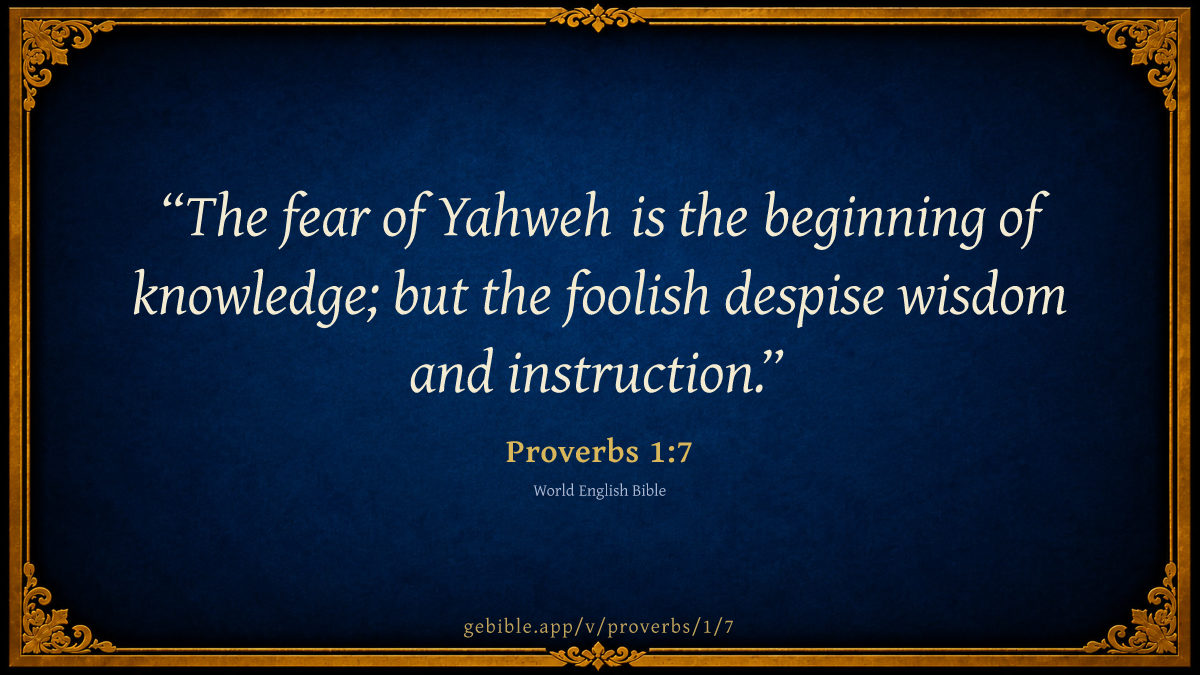
The fear of Yahweh is the beginning of knowledge; but the foolish despise wisdom and instruction.
Parallel Translations
-
The fear of Yahweh is the beginning of knowledge; but the foolish despise wisdom and instruction.
-
The fear of the LORD is the beginning of knowledge: but fools despise wisdom and instruction.
-
The fear of the LORD is the beginning of knowledge; but the foolish despise wisdom and discipline.
Examined in Scripture Analysis
Contradictions (1)
Questions where the Bible appears to say two different things, with the passages on each side set together.
Cross-references (12)
Passages linked to Proverbs 1:7 in the Treasury of Scripture Knowledge, ordered by reader-vote popularity; verse text shown in World English Bible.
- Job 28:28 To man he said, ‘Behold, the fear of the Lord, that is wisdom. To depart from evil is understanding.’ ”
- Psalms 111:10–112:1 The fear of Yahweh is the beginning of wisdom. All those who do his work have a good understanding. His praise endures forever! Praise Yah! Blessed is the man who fears Yahweh, who delights greatly in his commandments.
- Ecclesiastes 12:13 This is the end of the matter. All has been heard. Fear God and keep his commandments; for this is the whole duty of man.
- Proverbs 9:10 The fear of Yahweh is the beginning of wisdom. The knowledge of the Holy One is understanding.
- Proverbs 15:33 The fear of Yahweh teaches wisdom. Before honor is humility.
- Proverbs 18:2 A fool has no delight in understanding, but only in revealing his own opinion.
- Proverbs 1:22 “How long, you simple ones, will you love simplicity? How long will mockers delight themselves in mockery, and fools hate knowledge?
- Proverbs 1:29-30 because they hated knowledge, and didn’t choose the fear of Yahweh. They wanted none of my counsel. They despised all my reproof.
- Romans 1:28 Even as they refused to have God in their knowledge, God gave them up to a reprobate mind, to do those things which are not fitting;
- Proverbs 15:5 A fool despises his father’s correction, but he who heeds reproof shows prudence.
- John 3:18-21 He who believes in him is not judged. He who doesn’t believe has been judged already, because he has not believed in the name of the one and only Son of God. This is the judgment, that the light has come into the world, and men loved the darkness rather than the light; for their works were evil. For everyone who does evil hates the light, and doesn’t come to the light, lest his works would be exposed. But he who does the truth comes to the light, that his works may be revealed, that they have been done in God.”
- Proverbs 5:12-13 and say, “How I have hated instruction, and my heart despised reproof; neither have I obeyed the voice of my teachers, nor turned my ear to those who instructed me!
Cross-references from openbible.info (CC BY 4.0)
Explain this verse (22 sources)
Historical commentary, presented as a primary source — not an endorsement.
Private notes
Saved on this device only — never synced or sent anywhere.
John Trapp 1656 · Public Domain Pro 1:7 The fear of the LORD [is] the…
Pro 1:7 The fear of the LORD [is] the beginning of knowledge: [but] fools despise wisdom and instruction.
Ver. 7. The fear of the Lord is the beginning.] Or, The chief and principal point {a} of wisdom, as the word here signified; yea, wisdom itself. {Job 28:28} This Solomon had learned by the instruction of his father, as it is in the next verse, who had taught it him of a child, {Pro 4:4 Psa 111:10} and therefore sets it here in the beginning of his works as the beginning of all. As in the end he makes it the end of all, {Ecc 12:13} yea, the all of man, {b} without which he counts him not a complete man, though never so wise to the world ward. Heathen sages, as Seneca, Socrates, &c., were wise in their generation, and had many excellent gifts, but they missed of the main; there was no fear of God before their eyes: being herein as alchemists, who miss of their end, but yet find many excellent things by the way. These merchants found goodly pearls, but "the pearl of price" {Mat 13:45-46} they failed of. The prophet calls the fear of God "our treasure." {Isa 33:6}
Read full note →
But fools despise.] Fools; so are all such as fear not God, "being abominable, disobedient, and to every good work reprobate," or injudicious. {Tit 1:16} Evil is Hebrew for a fool; Nebulo of Nabal; fool of Fαυλος. When one highly commended the Cardinal Julian to Sigismund, he answered, Tamen Romanus est; yet he is a popeling. So, yet he is a fool, because void of God’s true fear. "Behold they have rejected the word of the Lord, and what wisdom is in them?" {Jer 8:9}
{a} The head or firstfruits; the head and height.
{b} Hoc est enim totus homo.
John Trapp, A Commentary or Exposition upon All the Books of the Old and New Testament (1647–1656) — public domain. Text from a community e-Sword module.
Matthew Poole 1685 · Public Domain The fear of the Lord; reverence and obedience to…
The fear of the Lord; reverence and obedience to God, or his worship and service, as this word is commonly used.
The beginning; either the foundation, or the top, and perfection, or chief point, without which all other knowledge is vain and useless.
Read full note →
Fools; wicked men, called fools through this whole book; such as do not fear God.
Despise wisdom and instruction; are so far from attaining true wisdom, that they despise it, and all the means of getting it; which fully proves what he now said, that the fear of the Lord is the beginning of wisdom.
Matthew Poole's English Annotations on the Holy Bible (1683–1685) — public domain. Text from a community e-Sword/MySword module.
Matthew Henry 1710 · Public Domain Solomon, having undertaken to teach a young man knowledge…
Solomon, having undertaken to teach a young man knowledge and discretion, here lays down two general rules to be observed in order thereunto, and those are, to fear God and honour his parents, which two fundamental laws of morality Pythagoras begins his golden verses with, but the former of them in a wretchedly corrupted state. Primum, deos immortales cole, parentesque honora - First worship the immortal gods, and honour your parents. To make young people such as they should be,
I. Let them have regard to God as their supreme.
Read full note →
1. He lays down this truth, that the fear of the Lord is the beginning of knowledge (Pro 1:7); it is the principal part of knowledge (so the margin); it is the head of knowledge; that is, (1.) Of all things that are to be known this is most evident, that God is to be feared, to be reverenced, served, and worshipped; this is so the beginning of knowledge that those know nothing who do not know this. (2.) In order to the attaining of all useful knowledge this is most necessary, that we fear God; we are not qualified to profit by the instructions that are given us unless our minds be possessed with a holy reverence of God, and every thought within us be brought into obedience to him. If any man will do his will, he shall know of his doctrine, Joh 7:17. (3.) As all our knowledge must take rise from the fear of God, so it must tend to it as its perfection and centre. Those know enough who know how to fear God, who are careful in every thing to please him and fearful of offending him in any thing; this is the Alpha and Omega of knowledge.
2. To confirm this truth, that an eye to God must both direct and quicken all our pursuits of knowledge, he observes, Fools (atheists, who have no regard to God) despise wisdom and instruction; having no dread at all of God's wrath, nor any desire of his favour, they will not give you thanks for telling them what they may do to escape his wrath and obtain his favour. Those who say to the Almighty, Depart from us, who are so far from fearing him that they set him at defiance, can excite no surprise if they desire not the knowledge of his ways, but despise that instruction. Note, Those are fools who do not fear God and value the scriptures; and though they may pretend to be admirers of wit they are really strangers and enemies to wisdom.
II. Let them have regard to their parents as their superiors (Pro 1:8, Pro 1:9): My son, hear the instruction of thy father. He means, not only that he would have his own children to be observant of him, and of what he said to them, nor only that he would have his pupils, and those who came to him to be taught, to look upon him as their father and attend to his precepts with the disposition of children, but that he would have all children to be dutiful and respectful to their parents, and to conform to the virtuous and religious education which they give them, according to the law of the fifth commandment.
1. He takes it for granted that parents will, with all the wisdom they have, instruct their children, and, with all the authority they have, give law to them for their good. They are reasonable creatures, and therefore we must not give them law without instruction; we must draw them with the cords of a man, and when we tell them what they must do we must tell them why. But they are corrupt and wilful, and therefore with the instruction there is need of a law. Abraham will not only catechize, but command, his household. Both the father and the mother must do all they can for the good education of their children, and all little enough.
2. He charges children both to receive and to retain the good lessons and laws their parents give them. (1.) To receive them with readiness: "Hear the instruction of thy father; hear it and heed it; hear it and bid it welcome, and be thankful for it, and subscribe to it." (2.) To retain them with resolution: "Forsake not their law; think not that when thou art grown up, and no longer under tutors and governors, thou mayest live at large; no, the law of thy mother was according to the law of thy God, and therefore it must never be forsaken; thou wast trained up in the way in which thou shouldst go, and therefore, when thou art old, thou must not depart from it." Some observe that whereas the Gentile ethics, and the laws of the Persians and Romans, provided only that children should pay respect to their father, the divine law secures the honour of the mother also.
3. He recommends this as that which is very graceful and will put an honour upon us: "The instructions and laws of thy parents, carefully observed and lived up to, shall be an ornament of grace unto thy head (Pro 1:9), such an ornament as is, in the sight of God, of great price, and shall make thee look as great as those that wear gold chains about their necks." Let divine truths and commands be to us a coronet, or a collar of SS, which are badges of first-rate honours; let us value them, and be ambitious of them, and then they shall be so to us. Those are truly valuable, and shall be valued, who value themselves more by their virtue and piety than by their worldly wealth and dignity.
Matthew Henry's Commentary on the Whole Bible (1708–1710) — public domain (CC PDM 1.0). Text via the HelloAO Bible API.
John Gill 1763 · Public Domain The fear of the Lord is the beginning of…
The fear of the Lord is the beginning of knowledge,.... Here properly the book begins, and this is the first of the proverbs, and an excellent one; it is such an one as is not to be found in all the writings of the Heathens. By "the fear of the Lord" is not meant a servile fear, a fear of punishment, of hell, wrath, and damnation, which is the effect of the first work of the law upon the conscience; but a filial fear, and supposes knowledge of God as a father, of his love and grace in Christ, particularly of his forgiving love, from whence it arises, Psa 130:4; it is a holy, humble, fiducial fear of God; a reverential affection for him, and devotion to him; it includes the whole of religious worship, both internal and external; all that is contained in the first table of the law, and the manner of performing it, and principle of acting: this is the first of all sciences to be learned, and it is the principal one; it is the basis and foundation of all the rest, on which they depend; and it is the head, the fountain, the root an source, from whence they spring; and unless a man knows God, knows God in Christ, and worships him in his fear, in spirit and in truth, according to his revealed will, he knows nothing as he ought to know; and all his knowledge will be of no avail and profit to him; this is the first and chief thing in spiritual and evangelical knowledge, and without which all natural knowledge will signify nothing; see Job 28:28;
but fools despise wisdom and instruction; the same with "knowledge" before; they do not desire the knowledge of God, and of his ways and worship, but despise it, make no account of it, but treat it with contempt; especially the knowledge of God in Christ, in which lies the highest wisdom, for this is "life eternal", Joh 17:3; they despise Christ "the Wisdom of God", and the Gospel, and the truths of it, which are "the hidden wisdom" of God; and all "instruction" into it, and the means of it; they despise the Scriptures, which are able to make a man "wise unto salvation"; and the ministry of the word, and the ministers of it: such sort of "discipline" (n) was this, as the word signifies, they dislike and abhor; and especially "correction" or "chastisement" (o), which is also the sense of it; suffering reproach and affliction for the sake of wisdom, a profession of Christ and his Gospel; and they are fools with a witness that despise all this; such fools are atheists, deists, and all profane and wicked men. The Septuagint render it, "the ungodly"; and such sort of men are all along meant by "fools" in this book.
Read full note →
(n) "disciplinam", Tigurine version, Piscator, Cocceius, Schultens, (o) "Castigationem, correctionem", Vatablus.
John Gill's Exposition of the Whole Bible (1746–1763) — public domain (CC PDM 1.0). Text via the HelloAO Bible API.
John Wesley 1765 · Public Domain The fear - Reverence and obedience to God. Beginning…
The fear - Reverence and obedience to God. Beginning - The foundation without which all other knowledge is vain. Fools - That is, wicked men, are so far from attaining true wisdom, that they despise it, and all the means of getting it.
John Wesley, Explanatory Notes Upon the Whole Bible (1754–1765) — public domain. Text via the GEBible commentary corpus.
Adam Clarke 1810 · Public Domain Verse 7. The fear of the Lord] In the…
Verse 7. The fear of the Lord] In the preceding verses Solomon shows the advantage of acting according to the dictates of wisdom; in the following verses he shows the danger of acting contrary to them. The fear of the Lord signifies that religious reverence which every intelligent being owes to his Creator; and is often used to express the whole of religion, as we have frequently had occasion to remark in different places. But what is religion? The love of God, and the love of man; the former producing all obedience to the Divine will; the latter, every act of benevolence to one's fellows. The love of God shed abroad in the heart by the Holy Spirit produces the deepest religious reverence, genuine piety, and cheerful obedience. To love one's neighbour as himself is the second great commandment; and as love worketh no ill to one's neighbour, therefore it is said to be the fulfilling of the law. Without love, there is no obedience; without reverence, there is neither caution, consistent conduct, nor perseverance in righteousness.
This fear or religious reverence is said to be the beginning of knowledge; ראשית reshith, the principle, the first moving influence, begotten in a tender conscience by the Spirit of God. No man can ever become truly wise, who does not begin with God, the fountain of knowledge; and he whose mind is influenced by the fear and love of God will learn more in a month than others will in a year.
Read full note →
Fools despise] אוילים evilim, evil men. Men of bad hearts, bad heads, and bad ways.
Adam Clarke's Commentary on the Bible (1810–1826) — public domain. Text from a community e-Sword/MySword module.
Joseph Benson 1811 · Public Domain Pro 1:7. The fear of the Lord — That…
Pro 1:7. The fear of the Lord — That is, reverence for and obedience to God; is the beginning of knowledge — The foundation and source of it; without which all other knowledge is vain and useless. Mark well this sentence, reader: all wisdom, which is not founded in religion, in the true and genuine fear of God, is empty and unprofitable, and will be found such in the time of affliction, in the hour of death, and at the day of judgment. But fools — Wicked men, or men devoid of true religion, called fools throughout this whole book, despise wisdom and instruction — Are so far from attaining it, that they despise it, and all the means of getting it.
Joseph Benson's Commentary on the Old and New Testaments (1811–1818) — public domain. Text from a community e-Sword module.
Albert Barnes 1834 · Public Domain The beginning of wisdom is found in the temper…
The beginning of wisdom is found in the temper of reverence and awe. The fear of the finite in the presence of the Infinite, of the sinful in the presence of the Holy (compare Job 42:5-6), this for the Israelite was the starting-point of all true wisdom. In the Book of Job 28:28 it appears as an oracle accompanied by the noblest poetry. In Psa 111:10 it comes as the choral close of a temple hymn. Here it is the watchword of a true ethical education. This fear has no torment, and is compatible with child-like love. But this and not love is the “beginning of wisdom.” Through successive stages and by the discipline of life, love blends with it and makes it perfect.
Albert Barnes' Notes on the Bible (1834–1885) — public domain. Text from a community e-Sword/MySword module.
Charles Bridges 1846 · Public Domain The preface has stated the object of this Book…
The preface has stated the object of this Book of Wisdom. The book itself now opens with a noble sentence. ’There is not’ — as Bishop Patrick observes — ’such a wise instruction to be found in all their books (speaking of Heathen ethics), as the very first of all in Solomon’s, which he lays as the ground of all wisdom.’†1 The fear of the LORD is the beginning of knowledge. So Job had pronounced before. (Job 28:28 .) So had the wise man’s father. (Psa 111:10 .) Such is the weight of this saying, that Solomon again repeats it.†2 Nay — after having gone round the whole circuit; after having weighed exactly all the sources of knowledge; his conclusion of the whole matter is this, that the fear of God in its practical exercise "is the whole of man" (Ecc 12:13 . Compare Job 28:12-14, with Job 28:28 ) — all his duty; all his happiness; his first lesson and his last. Thus, when about to instruct us from the mouth of God, he begins at the beginning, the principle part. All heathen wisdom is but folly. Of all knowledge, the knowledge of God is the principal. There is no true knowledge without godliness. (Compare Deu 4:6-7 .)
But what is this fear of the LORD? It is that affectionate reverence, by which the child of God bends himself humbly and carefully to his Father’s law. His wrath is so bitter, and his love so sweet; that hence springs an earnest desire to please him, and — because of the danger of coming short from his own weakness and temptations — a holy watchfulness and fear, "that he might not sin against him." (Heb 12:28-29 .) This enters into every exercise of the mind, every object of life. (Pro 23:17 .) The oldest proficient in the Divine school seeks a more complete molding into its spirit. The godly parent trains up his family under its influence. (Gen 18:19 . Eph 6:4 .) The Christian scholar honours it as the beginning, the head, of all his knowledge; at once sanctifying its end, and preserving him from its most subtle temptations.
Read full note →
Why then do multitudes around us despise wisdom and instruction? Because the beginning of wisdom — "the fear of God — is not before their eyes." (Psa 36:1 .) They know not its value. They scorn its obligation. Wise they may be in their own sight. But surely God here gives them their right name. For fools they must be, to despise such a blessing (Jer 8:9 ); to rush into willful ruin (Pro 1:22, Pro 1:24-32 . Compare 1Sa 2:25 . 1Ki 12:13 . Jer 36:22-32 ); to treasure up work for despairing repentance. (Pro 5:12-13 ; Pro 29:1 .) Good Lord! May the childlike fear be my wisdom, my security, my happiness!
Footnotes
†1 Preface to his Paraphrase.
†2 Pro 9:10. Compare the fine description by the son of Sirach. Sir 1:14-20, Sir 1:27.
Excerpts from Ecclesiasticus 1 (Douay version):
The fear of the Lord is honour, and glory, and gladness, and a crown of joy. The fear of the Lord shall delight the heart, and shall give joy, and gladness, and length of days. With him that feareth the Lord, it shall go well in the latter end, and in the day of his death he shall be blessed. The love of God is honourable wisdom. And they to whom she shall shew herself love her by the sight, and by the knowledge of her great works. The fear of the Lord is the beginning of wisdom, and was created with the faithful in the womb, it walketh with chosen women, and is known with the just and faithful. The fear of the Lord is the religiousness of knowledge. Religiousness shall keep and justify the heart, it shall give joy and gladness. It shall go well with him that feareth the Lord, and in the days of his end he shall be blessed. To fear God is the fulness of wisdom, and fulness is from the fruits thereof. She shall fill all her house with her increase, and the storehouses with her treasures. The fear of the Lord is a crown of wisdom, filling up peace and the fruit of salvation: And it hath seen, and numbered her: but both are the gifts of God. Wisdom shall distribute knowledge, and understanding of prudence: and exalteth the glory of them that hold her. The root of wisdom is to fear the Lord: and the branches thereof are long-lived. In the treasures of wisdom is understanding, and religiousness of knowledge: but to sinners wisdom is an abomination. The fear of the Lord driveth out sin: For he that is without fear, cannot be justified: for the wrath of his high spirits is his ruin. A patient man shall bear for a time, and afterwards joy shall be restored to him. A good understanding will hide his words for a time, and the lips of many shall declare his wisdom. In the treasures of wisdom is the signification of discipline: But the worship of God is an abomination to a sinner. Son, if thou desire wisdom, keep justice, and God will give her to thee. For the fear of the Lord is wisdom and discipline: and that which is agreeable to him, Is faith, and meekness: and he will fill up his treasures. Be not incredulous to the fear of the Lord: and come not to him with a double heart.
King James Version:
14 To fear the Lord is the beginning of wisdom: and it was created with the faithful in the womb.
15 She hath built an everlasting foundation with men, and she shall continue with their seed.
16 To fear the Lord is fullness of wisdom, and filleth men with her fruits.
17 She filleth all their house with things desirable, and the garners with her increase.
18 The fear of the Lord is a crown of wisdom, making peace and perfect health to flourish; both which are the gifts of God: and it enlargeth their rejoicing that love him.
19 Wisdom raineth down skill and knowledge of understanding standing, and exalteth them to honour that hold her fast.
20 The root of wisdom is to fear the Lord, and the branches thereof are long life.
27 For the fear of the Lord is wisdom and instruction: and faith and meekness are his delight.
(The verse numbers and some of the content of this chapter varies between the KJ & Douay versions, so an attempt has been made to include from the Douay version all of the verses that relate to the fear of the LORD.)
Charles Bridges, An Exposition of the Book of Proverbs (1846) — public domain. Text from a community e-Sword module.
Haydock's Catholic Bible Commentary 1859 · Public Domain Fear. Thus we arrive at charity. (St. Augustine, in…
Fear. Thus we arrive at charity. (St. Augustine, in ep. Jo. ix.; Job xxviii. 28., &c.) This fear includes religion, but not barren speculations. (Calmet) --- It implies a desire to act, and not simply to understand.
George Leo Haydock (1774–1849), Haydock's Catholic Family Bible and Commentary, 1859 edition — public domain. Excludes Psalms (Douay-Rheims chapter numbering differs from Protestant) and Deuterocanonical books (Catholic canon only).
Robert Jamieson, A. R. Fausset & David Brown 1871 · Public Domain The fear of the Lord--the principle of true piety…
The fear of the Lord--the principle of true piety (compare Pro 2:5; Pro 14:26-27; Job 28:28; Psa 34:11; Psa 111:10; Act 9:31).
beginning--first part, foundation.
Read full note →
fools--the stupid and indifferent to God's character and government; hence the wicked.
Jamieson, Fausset & Brown — Commentary Critical and Explanatory on the Whole Bible (1871) — public domain (CC PDM 1.0). Text via the HelloAO Bible API.
Daniel D. Whedon 1874 · Public Domain 7. As the preceding five verses may be regarded…
7. As the preceding five verses may be regarded as stating the object of the book, so this may be considered as the motto, proposition, or text, which the author places at its head as containing the sum and substance of the whole, and which he designs to prove and illustrate.
The fear of the Lord — יהוה— JEHOVAH — is the name commonly applied to the Divine Being in this book; seldom אלהים, ELOHIM — God. The Septuagint adds to the first clause of this verse, as if exegetically, “And there is good understanding to all that practise it; and piety toward God is the beginning of discernment.”
Read full note →
The fear of Jehovah is a comprehensive expression, embodying, according to the conception of the Hebrew mind, the whole of piety or religion. (Job_28:28; Psa_9:10; Psa_111:10.) It implies a knowledge of the true God, of his existence, attributes, and works, and also of his relations to us as far as these several things were revealed in that day. As the idea of the great and everlasting God, our Maker and our Judge, strikes the mind with awe and reverence, from which proceed respect for his revealed will, and humiliation of mind, (Job_42:5-6,) so this term, the fear of the Lord, or reverence for Jehovah, comprehends both experimental and practical godliness, worship, and obedience. This fear of the Lord, then, resting on an intelligent apprehension of the divine majesty and his relations to us as revealed in his word, is the beginning, or the chief part, of knowledge — of the intellectual attainments of a truly wise man. There is no study so high, so noble, so grand, so wholesome, so beneficent, as this. All others, which a man really wise pursues, are subordinate to this, and comprehended in it. The man who has a just conception of God and his relations to him can think of nothing that is not somehow related to this great theme, either as being in accordance with God’s will or contrary to that will — as being forbidden or allowed. Hence all right learning and true science tends to honour God, as it tends to cultivate man. Moreover, the glorious idea of God in the mind is a quickening, elevating, and impelling element, that gives life, dignity, and force to mental action. It is only where this knowledge of God exists that man can rise to his true dignity as a rational, moral, and religious being. There is no motive to mental effort and high intellectual cultivation so powerful as that which true religion affords.
Many a youth “living after the flesh,” caring only for the things of the flesh, having no relish for other than sensual pleasures, neglects and rejects opportunities of mental improvement; but let him come under the dominion of religious feeling and principle — let him attain to the fear of God, or, as Christianity has taught us to say, the love of God — and his soul is immediately athirst for all useful knowledge. He feels that the improvement of his mind is one of his noblest privileges and highest duties; for only thus can he glorify and serve aright the Author of his being and salvation. These remarks elucidate the latter part of the verse.
Fools — אוילים, (evilim,) the gross, sensual, stupid.
Despise — Trample under foot.
Wisdom and instruction — מוסר, (musar,) restraint, discipline. (See under Pro_1:2.) Compare on latter clause 1Ki_12:13; 1Sa_2:12-25; Act_17:18.
Daniel D. Whedon (gen. ed.), Commentary on the Old and New Testaments (1874–1909) — public domain. Text from a community e-Sword module.
The Cambridge Bible for Schools and Colleges 1878 · Public Domain 7. This verse stands out as the motto, or…
7. This verse stands out as the motto, or key-note, both of the whole Book, and of the whole subject of which the Book treats. I am offering, the writer would seem to say, to give you the right of entering into the House of Knowledge, to conduct you through some of its goodly chambers, to display to you a portion of the rich and varied treasures with which it is stored. But as you approach the portal, note well the inscription which is traced above it: The fear of the Lord is the beginning of knowledge. The House is not a Palace only, but a Temple. They only who reverence the Deity who inhabits it are admitted within the shrine. It is the Temple of God; yet not that only but of Jehovah, the God of Israel, the God of revelation and of covenant. To recognise this is the beginning, the necessary condition, the essential pre-requisite of knowledge. Those who seek knowledge in any other spirit or by any other path, really “despise wisdom and discipline,” and in so doing shew themselves to be not wise men but “fools.” See further, Introd. ch. i. p. 10.
The fear] not slavish dread, the “fear that hath torment” (1Jn_4:18), but childlike reverence. See Mal_3:16-17; Luk_12:5; Luk_12:7. In the LXX. this verse has been amplified by the addition of ἀρχὴ σοφίας φόβος κυρίου, σύνεσις δὲ ἀγαθὴ πᾶσι τοῖς ποιοῦσιν αὐτήν, from Psa_111:10.
Read full note →
the beginning] “the beginning and foundation of all knowledge,” Maur. This is better than the chief part, R.V. marg. Comp. Pro_9:10, where however the Heb. is different.
instruction] Rather, discipline. See note Pro_1:2.
The Cambridge Bible for Schools and Colleges (gen. ed. J. J. S. Perowne; Cambridge University Press, 1878–1918) — public domain. Text from a community e-Sword module.
Ellicott's Commentary for English Readers 1878 · Public Domain 2.—FIFTEEN DIDACTIC POEMS, OR DISCOURSES ON VARIOUS SUBJECTS (Pro_1:7…
2.—FIFTEEN DIDACTIC POEMS, OR DISCOURSES ON VARIOUS SUBJECTS (Pro_1:7 to Pro_9:18).
(a) First Discourse:—Against Companionship in Robbery (Pro_1:7-19).
Read full note →
(7) The fear of the Lord is the beginning of knowledge.—The first discourse is prefaced by a distich, which serves as a key-note to all the teaching of the book. This expression, “the fear of the Lord,” occurs thirteen times in the Proverbs, and plays a prominent part throughout the Old Testament.
“When God of old came down from heaven,
In power and wrath He came.”
That law which was given amid “blackness, and darkness, and tempest” was enforced by the threat, “Cursed is every one that continueth not in all things which are written in the book of the law to do them” (Gal_3:10). Men had to be taught how hateful sin was to God, and the lesson was for the most part instilled into them by the fear of immediate punishment. (Comp. Deuteronomy 28) But when the lesson had been learnt, and when mankind had found by experience that they were unable to keep the law of God by their own strength, then the new covenant of mercy was revealed from Calvary, even free justification “by God’s grace, through the redemption that is in Christ Jesus” (Rom_3:24). And with this new message a new motive to obedience was preached. The “fear of the Lord” was now superseded by the higher duty of the “love of God,” and of man, for His sake. “The love of Christ constraineth us,” says St. Paul. “We love Him because He first loved us,” writes St. John. Now, it was seen that, although the “fear of the Lord” may be the “beginning of wisdom,” yet something better still may be aimed at: that “he that feareth is not made perfect in love;” and so the teaching of St. John, the last New Testament writer, is summed up in the words, “If God so loved us, we ought also to love one another” (1Jn_4:11).
Fools (’evîlîm).—Self-willed, headstrong persons, who will listen to no advice.
A Bible Commentary for English Readers, edited by Charles John Ellicott (1878–1897) — public domain. Text from a community e-Sword module.
The Pulpit Commentary 1880 · Public Domain Ver. 7-ch. Pro_9:18. It consists of a series of…
Ver. 7-ch. Pro_9:18. It consists of a series of fifteen admonitory discourses addressed to youth by the Teacher and Wisdom personified, with the view to exhibit the excellence of wisdom, and generally to illustrate the motto, "The fear of the Lord is the beginning of knowledge," or wisdom. It urges strong encouragements to virtue, and equally strong dissuasives from vice, and shows that the attainment of wisdom in its true sense is the aim of all moral effort.
The fear of the Lord is the beginning of knowledge. This proposition is by some commentators regarded as the motto, symbol, or device of the book (Delitzsch, Umbreit, Zockler, Plumptre). Others, following the Masoretic arrangement of the Hebrew text, consider it as forming part of the superscription (Ewald, Bertheau, Elster, Keil). As a general proposition expressing the essence of the philosophy of the Israelites, and from its relation to the rest of the contents of this book, it seems rightly to occupy a special and individual position. The proposition occurs again in the Proverbs in Pro_9:10, and it is met with in similar or slightly modified forms in other books which belong to the same group of sacred writings, that is, those which treat of religious philosophy the Khokhmah; e.g. Job_28:28 Psa_111:10 Ecc_12:13; Ecc_1:16, Ecc 1:25. With this maxim we may compare "The fear of the Lord is the instruction of wisdom". (Pro_15:33) The fear of the Lord (hwOhy taryi, yir"ath y"hovah); literally, the fear of Jehovah. The expression describes that reverential attitude or holy fear which man, when his heart is set aright, observes towards God. The original word, taryi (yir"ath) for "fear," is properly the infinitive of arey, (yare), "to fear or reverence," and as a substantive means "reverence or holy fear" (Gesenius). Servile or abject fear (as Jerome, Beda, Estius) is not to be understood, but filial fear (as Gejerus, Mercerus, Cornelius a Lapide, Cartwright), by which we fear to offend God that fear of Jehovah which is elsewhere described as "to hate evil", (Pro_8:13) and in which a predominating element is love. Wardlaw remarks that the "fear of the Lord" is in invariable union with love and in invariable proportion to it. We truly fear God just in proportion as we truly love him. The fear of the Lord also carries with it the whole worship of God. It is observable that the word Jehovah (hwOhy) is used in the Hebrew, and not Elohim ( a peculiarity which is invariably marked in the Authorized Version by small capitals. The beginning; Hebrew, tyviare (reshith). This word has been understood in three different senses:
Read full note →
(1) As initium, the beginning; i.e. the initial step or starting point at which every one who wishes to follow true wisdom must begin (Gejerus, Zockler, Plumptre).
(2) As caput; i.e. the most excellent or principal part, the noblest or best wisdom. This sense is adopted in the marginal reading (comp. also Pro_4:7) (Holden, Trapp).
(3) As the principium (Vulgate); i.e. the origin, or basis, as in Mic_1:12, "She is the origin, or basis (reshith) of the sin of the daughter of Zion." Delitzsch regards the original, reshith, as embracing the two ideas of commencement and origin, in the same way as the Greek arch . Wisdom has its origin in God, and whoever fears him receives it if he prays in faith (cf. Jam_1:5, sqq.) (Vatablus, Mercerus, Delitzsch). That the first sense, viz. that of beginning, is to be understood here appears from the parallel passage in Pro_10:10, where the corresponding word is tLjiT. (t"killath), "beginning," from the root llj (khalal ), "to begin;" cf. also the LXX arch , in this sense, and the initium of the Syriac and Arabic Versions. All previous knowledge to "the fear of the Lord" is comparative folly. He who would advance in knowledge must first be imbued with a reverence or holy fear of God. But fools despise wisdom and instruction; or, according to the inverted order of the words in the original, wisdom and instruction fools despise, the association of ideas in the three words, "knowledge," "wisdom," and "instruction," thus being more continuously sustained. This arrangement links on the two latter words with "the fear of the Lord," and so helps towards the elucidation of the sense in which "fools" is to be understood Fools; (evilim), plural of lYwia (evil), from the root lwa (aval), "to be perverse," here properly designates the incorrigible, as in Pro_27:22, and those who are unwilling to know God, (Jer_4:22) and hence refuse and despise wisdom and salutary discipline, those "who set at nought all his counsel, and will none of his reproof." The word is opposed to the "prudent" (Pro_12:16) and to the "wise". (Pro_10:14) Delitzsch understands it as "thick, hard, stupid," from the root aval, coalescere, incrassari. Schultens uses paceiv , equivalent to erassi pro stupidis, to represent the original. Dunn takes it in the same sense as "gross or dull of understanding." Fuerst, adopted by Wordsworth, regards it in the sense of having no moral stamina, from the root meaning "to be slack, weak, lax, or lazy." But none of these explanations seems, in my opinion, to coincide sufficiently with the evil and depraved activity expressed in the verb "despise," which follows, and which describes the conduct of this class. The LXX renders the word or action by asebeiv , equivalent to impii, "godless," "profane," and the Vulgate by stulti. Despise; WzB (bazu) is perfect, but is properly translated by the present, because the perfect here represents a condition long continued and still existing (Gesenius, cf. the Latin odi, memini, etc. The LXX uses the future exouyenhsousin , i.e. they will set at nought; the Vulgate, the present (despiciunt). The radical meaning is most probably contemptuous trampling under the feet (Geseuius). Wisdom and instruction (see ver. 2). The latter clause of this verse is antithetical to the former, but the antithesis is obscurely expressed. In the Authorized Version it is marked by the adversative conjunction "but," which, however, is not in the original. The LXX has a striking interpolation in this verse between the first and second clauses, which is partly taken from Psa_111:10 (Sunesiv de agayh pasi toiv poiousin authn eusebeia de eiv Yeo aisyhsewv , "And a good understanding have all they that do it: and reverence towards God is the beginning of knowledge"). Compare the Arabic Version, which has the same interpolation: Et intellectus bonus onmibus facientibus eam. Sana religio in Deum est initium prudentiae.
Ver. 7. The relation of religion to knowledge.
"The fear of the Lord" being the most common Old Testament name for religion, we must take it here in its large and general sense, and understand that religion in all its relations is set forth as the true basis of knowledge; though it may welt be that awe and reverence for the majesty and mystery of God have a special prominence in regard to the pursuit of truth.
I RELIGION IS AN IMPORTANT REQUISITE FOR THE ACQUISITION OF ALL KINDS OF KNOWLEDGE. Religion not theology claims this position. The progress of science was arrested for a thousand years by the claims of theology to dominate all regions of inquiry. Theology, or human speculations about Divine things, is the most difficult, and therefore in many respects the most uncertain, of all the sciences. When the schoolmen made the dogmatic assumptions of patristic theology, combined with elaborate deductions from Aristotelian philosophy, the touchstone of all truth, they set up an impenetrable barrier before the investigation of nature. Even when theological dicta are absolutely true, it is irrelevant to bring these to bear upon physical science. Unquestionably Bacon did a great service to the cause of truth in banishing final causes from the science of nature. But the relation of religion to science is of a totally different nature. That relation consists in the influence that religious experience, religious character, religious feelings and motives, must necessarily have upon scientific research. Religion influences all life; intellectual life is no exception.
1. Religion should excite the thirst for truth. It is a mistake to suppose that religion inclines to indolence and ignorance. It inspires all the noblest, endeavours. It is on the side of light and truth. Rightly understood, it will impose the pursuit of science as a duty. Without religion this pursuit is too likely to be followed only from mere inclination, or possibly for ends of self-interest.
2. Religion tends to induce the most wholesome scientific temper. There is great resemblance between the Christian graces and the special dispositions requisite for the successful discovery of truth. The Sermon on the Mount contains the best possible precepts for the character of the model man of science. Loyalty to truth, unselfishness in sacrificing prejudices and crotchets, justice to the work of rivals, diligence in uninteresting but needful inquiries, patience in waiting for solid results, conscientiousness in refraining from mere sensationalism, humility in confessing the smallness of the area really conquered, calmness and generosity under criticism, are among the most essential requisites for the pursuit of science, and they are among the best fruits of religion.
3. Religion tends to open the eyes to truth. It raises us from the gross animalism which is intellectual death. Elevating the whole man, it enlarges the intellect.
II RELIGION IS THE NECESSARY FOUNDATION OF SPIRITUAL KNOWLEDGE. This fact agrees with the great modern doctrine of inductive philosophy. Experience is the basis of knowledge. To know God we must have personal relations with him. Spiritual truths in regard to human life depend on the same Source. We must do the commandment in order to know the doctrine. Indeed, there is a constant interaction between knowledge and experience every enlargement of experience increasing our knowledge, and every increment of knowledge throwing light on our way fur future experience; till, in consequence of these two processes, we rise, as one has said, by a sort of "spiritual spiral," to the coexistent perfection of knowledge and of character. Our independence upon an external and superhuman revelation for our knowledge of Divine things is no exception to this principle, as two considerations will show.
1. Revelation was first vouchsafed through religious men. The fear of God was the beginning of knowledge in the prophets; the love of Christ is its basis in the apostles. Nebuchadnezzar could not have written the prophecies of Isaiah, nor could Judas have written St. John"s Gospel.
2. Revelation can only be understood by religious men. A bad man may be a good verbal commentator, but the essential truth, the spirit which quickens as distinguished from the "letter that killeth," can only be discerned by those who are in sympathy with it, because "spiritual things are spiritually discerned.
Religion the true beginning.
This is the motto of the book. It is often found. (Pro_9:10 RAPC Sir 1:16, 25, 26 Psa_111:10) The Arabs have adopted it at the head of their proverbial collections.
I THE OLD TESTAMENT DESIGNATION OF RELIGION. It is the fear of Jehovah. That is reverence for him who is One, who is eternal, incomparable with any of the gods of the heathen, the Deliverer of Israel in the past and ever, the All-holy, just and merciful One. Such reverence includes practical obedience, trust, gratitude, and love. With this expression we may compare walking before Jehovah and the service of Jehovah, as designations of the practical aspect of religion, as the former indicates the emotional and intellectual.
II SUCH RELIGION IS THE TRUE GERM OF SOUND KNOWLEDGE. Men have divorced by a logical abstraction science, and often sense, from religion. But ideally, psychologically, historically, they are in perfect unity. Religion is "the oldest and holiest tradition of our race" (Herder). From it as the beginning the arts and sciences sprang. It is ever so. True science has a religious basis.
1. In both the Infinite is implied and is sought through the finite.
2. Both run up into mystery science into the unknowable ground or substance behind all phenomena, religion before the inscrutable and unutterable God.
3. The true mood is alike in both, that of profound humility, sincerity, self-abnegation, impassioned love of the truth, the mood of Bacon, of Newton, etc.
III THE REJECTION OF RELIGION FOLLY. The Hebrew word for "fool" is strong; it is crass, stupid, insensible. "A stock, a stone, a worse than senseless thing." Folly is always the reversal of some true attitude of the mind and temper. It is the taking a false measure of self in some relation. It is the conceit of a position purely imaginary amusing in a child, pathetic in a lunatic, pitiful in a rational man. True wisdom lies in the sense that we have little, in the feeling of constant need of light and direction; extreme folly, in the notion that the man "knows all about it." Most pitiable are learned fools. Without religion, i.e. the constant habit of reference to the universal, all knowledge remains partial and shrunk, is tainted with egotism, would reverse the laws of intelligence, and make the universal give way to the particular, instead of lifting the particular to the life of the universal. Beware of the contemptuous tone in books, newspapers, and speakers. Reserve scorn for manifest evil. The way to be looked down upon is to form the habit of looking down on others. To despise any humblest commonplace of sense and wisdom is to brand one"s self in the sight of Heaven, and of the wise, a fool. J.
The foundation truth.
These words invite our attention to
I THAT WHICH CONSTITUTES THE FEAR OF GOD. "The fear of the Lord" was the chief note of Hebrew piety. It expressed itself in that form. (see Gen_42:18 Exo_18:21 Lev_19:14 Neh_5:15 Psa_66:16 Ecc_12:13, etc.) What did it signify? Evidently something more and other than mere dread. The piety of the Jews was an immeasurably higher thing than the abject terror with which the heathen shrank from the capricious and malignant power of the deities they worshipped. It included:
1. Reverence for his Divine nature.
2. Sense of the Divine presence: "The Lord before whom I stand.
3. Regard for the Divine will, shown in the two ways of
a. obedience to his commands, and
b. submission to his appointments.
II THE FACT THAT THE FEAR OF GOD CONSTITUTES THE FOUNDATION ON WHICH WE BUILD. "The fear of the Lord is the beginning of knowledge." The sense of God, the belief that he is, that he reigns, that he is the Source and Fountain of all life and blessing this is the foundation on which all wisdom, all success, all excellency, rests. How truly fundamental is this fear of God is seen when we consider:
1. That it is implanted, as one of the earliest thoughts, in the human mind. The very little child can entertain it; it enters his opening mind with the first conceptions which are cherished there. As soon as we begin to think we begin to fear God. That sentiment, which never once affected the life of the most intelligent of the brute creation in any land or age, strikes deep root and bears fairest fruit in the spiritual nature of the "little child." "The fear of the Lord is the beginning of knowledge," even in time.
2. That the acceptance of God is the basis on which all truth must rest. There are mysteries in theism which may baffle and sometimes perplex us. But in atheism we are utterly at sea. Not to start from the acceptance of an originating, designing, fashioning, con., trolling, out-working Intelligence is to be "all abroad" in the region of human investigation and inquiry. Accepting that, the universe is indeed mysterious, but it is not an all-shrouding mist in which we ourselves and everything around us are hopelessly lost. The fear of the Lord, the reverent acceptance of the truth that God is, and that he reigns, lies at the foundation, is the beginning, of knowledge of the truth which makes the world comprehensible to the understanding, and life valuable to the soul.
3. That the fear of God is the ground of all heavenly wisdom. We cannot know our own Divine Father, our own spiritual nature with all its high and ennobling capacities, the excellency of moral and spiritual worth, the supreme blessedness of self-surrender, if we do not know God, if we have not the mind of Christ revealed to us and accepted by us. The fear of the Lord is the beginning, and is the very substance of that knowledge which constitutes the "life eternal". (Joh_17:3)
III THE FOLLY OF SPIRITUAL INDIFFERENCE. "Fools despise wisdom and instruction." The foolish man does not care even to begin to know; he despises the very elements of instruction; he will not take the first step in the path of wisdom. He wanders off at his own will, and he goes in the direction of the thick darkness. He is turning from him who is the Light of life, and is travelling to that dreary region where it is always night, away from God, from wisdom, from holiness, from love. C.
The Pulpit Commentary (1880–1919), ed. H.D.M. Spence-Jones & Joseph S. Exell — public domain. Text from a community e-Sword module.
The Biblical Illustrator 1887 · Public Domain The fear of the Lord is the beginning of…
Pro_1:7
The fear of the Lord is the beginning of knowledge.
Read full note →
The first rudiments of knowledge
The fear of the Lord is an abiding and reverent sense of the presence of God and of accountableness to Him: For this to exist God must be that real, personal Being which we have every reason to believe God has revealed Himself to be: such in character, as to love, holiness, and justice, as He has declared Himself in His Word. Why is this fear the beginning of knowledge?
1. Because knowledge being the apprehension of facts, and application of them to life, it cannot properly begin, or be based on a right foundation, without first apprehending and applying a fact which includes and which modifies all other facts whatever.
2. Because knowledge is the food of the soul. And what is the soul? What ought its stores and its accumulated powers to be, and to be useful for? The knowledge which is to feed and train the soul must begin, continue, and end, in the apprehension of Him.
3. Because knowledge, as the mere accumulation of facts, is in-operative upon life. If you would be worth anything to society, worth anything to your own families, worth anything to yourselves, the fear of God must come first in your thoughts and lives. The fear of God is the first thing; the consciousness of Him about you, the laying down His revealed facts respecting Himself and you as your greatest facts; the setting up of His will as the inner law of your being. (Dean Alford.)
How is the fear of the Lord the beginning of knowledge?
1. It quickens the intellect, and sustains its activity.
2. It restrains from those follies and corruptions which weaken the powers, and divert from high themes.
3. This fear starts thought from the right centre and in right directions.
4. This fear is the root of that right living and wise conduct, that forethought, purity, temperance, uprightness, and obedience to God, which we may call vital knowledge; knowledge in the heart and life, as well as in the head. (Monday Club Sermons.)
The root of knowledge
The fear of the Lord implies a right state of heart towards God, as opposed to the alienation of an unconverted man. Though the word is fear, it does not exclude a filial confidence and a conscious peace. What God is inspires awe; what God has done for His people commands affection. See here the centrifugal and centripetal forces of the moral world. Knowledge and wisdom are in effect synonymous--the best knowledge wisely used for the highest ends. The fear of the Lord is the foundation, knowledge is the imposed superstructure. He who does not reverentially trust in God knows nothing yet as he ought to know. His knowledge is partial and distorted. The knowledge of God--His character and plans, His hatred of sin, His law of holiness, His way of mercy--is more excellent than all that an unbelieving philosopher has attained. It is a knowledge more deeply laid, more difficult of attainment, more fruitful, and more comprehensive, than all that philosophers know. Men speak of the stupendous effects which knowledge, in the department of mechanical philosophy, has produced on the face of the world, and in the economy of human life; but the permanence of these acquisitions depends on the authority of moral laws in the consciences of men. The moral encircles and controls the economic in the affairs of men. The knowledge of God is the root of knowledge. (William Arnot, D. D.)
A plea for reverence
Reverence is the alphabet of religion. As you cannot acquire knowledge without the knowledge of the alphabet, so you cannot acquire anything of the religious life without the spirit of reverence. Self-conceit is precisely the negative of reverence. It is the absence of the spirit that looks up to anything above us. It is the spirit that leads one to say, I am the greatest and the best. There are many conditions in our life which tend to produce the spirit of self-conceit and tend to counteract the spirit of reverence. The absence of any traditions in America tend against the spirit of reverence. Across the ocean, in the Old World, we stand in cathedrals a thousand years or more old, in the presence of customs hoary-headed with antiquity; we walk by the city walls which have seen many a battle between liberty and despotism; and these old cathedrals, these old cities, these old customs, awaken in us some spirit of reverence. But we have no such cathedrals. The absence of any class distinctions in America tends against the spirit of reverence. We are all on the same level. There is no class to which we can look up with reverence. The reaction against Puritanism has tended against reverence. It is no longer customary in our homes to teach reverence of children to their parent, or in schools to teach reverence of pupils to teachers. In the olden time every boy bowed reverently to the minister; now the minister gets along very well if the boy does not cry out, Go up, thou baldhead! The spirit of criticism, the scientific spirit, has tended against reverence. Many things which of olden time men superstitiously feared they fear no longer. We have analysed until all great things have been picked to pieces in our laboratory. We will not allow any mysteries. You cannot revere what you are criticising. The two processes never can go on simultaneously in the same mind. The sectarian spirit has been against the spirit of reverence. The Congregationalist has sneered at the ritual of the Episcopalian, and the Episcopalian has shrugged his shoulders over the non-ritual of the Congregationalist. The spirit of antagonism between the different denominations has despoiled those symbols which were before the common objects of a mutual reverence. Finally, our democratic theology has tended against the old spirit of reverence. Just because we no longer reverence a king in the nation we do not reverence the King in the heavens. Now, if it be true that reverence is a fountain of life, and reverence is a beginning of wisdom, how in this age, under these circumstances, are we to develop reverence in ourselves, in our churches, and in our children? In the first place, then, the old notion of holy places is gone. We cannot recover it. In truth there is very little foundation for it. For it we are to substitute this larger, grander, more awe-inspiring conception--that every place is holy place, every ground is holy ground, and God is in all Nature. God is as truly here as He ever was in Palestine, as truly in the White Mountains or the Rocky Mountains as He ever was in the Sinaitic Mountains; He is everywhere, always speaking, in all phenomena. This must come into our hearts to take the place of the older and narrower conception of holy places. We cannot re-establish a united ritual, nor all agree to climb to Gods throne by the steps worn by the knees of many centuries. But we must learn the broader, the larger, more catholic, aye, and profounder reverence which sees God in every form of worship; for wherever the human heart is seeking God, there God is. We are to recognise Christ in all truth. The old reverence for the Bible as a book without any error whatever, and as a conclusive and final guide on questions of science, literature, history, philosophy, and religion, is passing away. Our reverence is not for the tables of stone that are broken and lost, nor for the words that were inscribed upon them--we do not know exactly what form of words were inscribed upon them--but for the great fundamental principles of the moral life which those Ten Commandments embody. There is many a man who has reverence for the book and none for the truth that is in the book. Woe to us if, throwing away the old mechanical reverence for the outer thing, we fail to get the deeper reverence for the inward truth! What reverence has God shown for truth! Think of it one moment. He has launched into human history this volume of literature. The ablest scholars are not agreed on such questions as who wrote these various books, at what dates, for what purpose, and with what immediate intent. The great majority of the books are anonymous; the great majority of them are without definite and positive date. What does this mean? It means this: God has launched truth without a sponsor into the world, and left the truth to bear witness to itself. Truth answers to the human mind as cog to cog; and the reverence for the shell is to be lost only that reverence for the kernel may take the place. We find it difficult, many of us, to have any reverence for the events that are taking place in America, and the leaders who are participating in them. We cannot cure that irreverence towards leaders and politicians by pretending respect for a man whom we do not respect, who has won his way to office by dishonourable and disreputable methods. We must go further, we must look deeper, we must see that, as God is in all worship and in all truth, so God is in all history. We are to see God in every man, and in all of life. There are times when there seems nothing more awe-inspiring than a simple, single human soul. Said Phillips Brooks once to me, There is no man so poor, so ignorant, so outcast, that I do not stand in awe before him. As the old reverence for the priest and the robe and the pulpit fade away, reverence for man as the battle-ground between good and evil must come in to take its place, or reverence will disappear. The fear of God is the fountain of life. I think it is Goethe who has drawn the distinction between fear and reverence. Fear, he says, repels; reverence attracts. It is not the fear of God that repels, it is the reverence for God which attracts, which is the fountain of life. And when this reverence has found its place in our hearts, it is to be the fountain of all our life; of our reason, and we are not to be afraid of being too rational; of our commercial industries, and we are not to be afraid of being too industrious; of our humour, and we are not to be afraid of a good hearty laugh; reverence in all our life. You cannot have reverence on Sunday and irreverence in the week; reverence in the church and irreverence in the daily life. And, leaving in the past that reverence which was fragmentary, broken, and largely idolatrous, we are to press forward to a grander, broader, nobler, diviner reverence in the future. (L. Abbott, D. D.)
The fear of the Lord
1. The fear of God will urge us to a profitable study of the Holy Scriptures.
2. The fear of God will especially influence us in our devotions.
3. The fear of God will bring us to the business of the day in the right frame of mind to carry it on.
4. The fear of God will enable us to bear the trials and disappointments of life.
5. In the last trial of all, in the hour of death, we shall assuredly reap the fruit of having lived in the fear of the Lord, for then we shall have nothing else to fear. (J. Edmunds.)
Piety
I. Piety is reverence for God. Filial reverence is meant by fear. Reverence implies two things, a recognition of Divine greatness, and a recognition of Divine goodness. An impression of goodness lies at the foundation of reverence, and hence, too, gratitude, love, adoration enter into this reverence.
II. Piety is initiatory to knowledge. It is the beginning of it. But what knowledge? Not mere intellectual knowledge. Many an impious man knows the circle of the sciences. The devil is intelligent. It is spiritual knowledge--spiritual knowledge of self, the universe, Christ, and God. True reverence for God is essential to this knowledge. Religious reverence is the root of the tree of all spiritual science. He knows nothing rightly who does not know God experimentally. (Homilist.)
Filial love
Filial love stands near and leans on godliness. It is next to reverence for God. That first and highest commandment is like the earths allegiance to the sun by general law; and filial obedience is like day and night, summer and winter, budding spring and ripening harvest, on the earths surface. There could be none of these sweet changes and beneficent operations of nature on our globe if it were broken away from the sun. So when a people burst the first and greatest bond--when a people cast off the fear of God, the family relations, with all their beauty and benefit, disappear. (W. Arnot, D. D.)
Practical piety
I. Speculative piety, or a due knowledge of God and of our duty towards Him, is the first foundation of true wisdom.
1. The proper exercise of true wisdom consists in directing and conducting us to the chiefest happiness which human nature is capable of.
2. That religion is the only method by which we are directed and conducted towards the attainment of this chief happiness.
3. That a due knowledge of God, and of our duty towards Him, is the basis and groundwork of true religion.
II. Practical piety, or the regulating of our actions according to knowledge, is the height and perfection of understanding.
1. To be habitually conversant in the exercises of piety is an instance of the truest and most considerate wisdom, because it is the most effectual means to promote our happiness and well-being in this life. There are four things for the attainment of which we are chiefly solicitous. A clear reputation. A comfortable fortune. A healthful body. A quiet mind.
2. The constant exercise of religious duties is an instance of the truest and most considerate wisdom, because it is the most effectual means to promote our eternal happiness in the world to come. (N. Brady.)
A reverent fear of God
I. Religiousness, or a reverent fear of God, is the best wisdom. Because it brings a man to acquaintance with God. It teaches us how to converse with God rightly by true worship and obedience, and how to come to live with God for ever.
II. Things of greatest worth should be of greatest account with us. The affections should ever follow the judgment well informed.
III. Irreligious persons are in Gods account the fools of the world. They want Gods fear, as natural fools want wisdom.
IV. None despise heavenly wisdom but such as know not the value of it. The excellency of it is so great, that it would allure men to look after it, had they spiritual eyes to see it. Knowledge hath no enemy but an ignorant man.
V. They that slight the means of knowledge slight knowledge itself. We account so in outward things. We ask sick men refusing physic if they make no account of their lives. Neglect of the means of grace is a real slighting of wisdom. (Francis Taylor.)
The Biblical Illustrator, edited by Joseph S. Exell (c. 1880s–1900s) — public domain. Text from a community e-Sword module.
The Expositor's Bible 1887 · Public Domain "The fear of the Lord is the beginning of…
CHAPTER 2
THE BEGINNING OF WISDOM
Read full note →
"The fear of the Lord is the beginning of knowledge."- Pro_1:7
"The fear of the Lord is the beginning of wisdom: And the knowledge of the Holy One is understanding."- Pro_9:10
"To fear the Lord is the beginning of wisdom: and it was created with the faithful in the womb"- Ecclesiasticus 1:14; also Psa_111:10
THE book of Proverbs belongs to a group of works in the Hebrew literature the subject of which is Wisdom. It is probably the earliest of them all, and may be regarded as the stem, of which they are the branches. Without attempting to determine the relative ages of these compositions, the ordinary reader can see the points of contact between Proverbs and Ecclesiastes, and a little careful study reveals that the book of Job, though fuller, and richer in every respect, belongs to the same order. Outside the canon of Holy Scripture we possess two works which avowedly owe their suggestion and inspiration to our book, viz., "The Wisdom of Jesus the Son of Sirach," commonly called Ecclesiasticus, a genuinely Hebrew product, and "The Wisdom of Solomon," commonly called the Book of Wisdom, of much later origin, and exhibiting that fusion of Hebrew religious conceptions with Greek speculation which prevailed in the Jewish schools of Alexandria.
Now, the question at once occurs, What are we to understand by the Wisdom which gives a subject and a title to this extensive field of literature? and in what relation does it stand to the Law and the Prophets, which form the great bulk of the Old Testament Scriptures?
Broadly speaking, the Wisdom of the Hebrews covers the whole domain of what we should call Science and Philosophy. It is the consistent effort of the human mind to know, to understand, and to explain all that exists. It is, to use the modern phrase, the search for truth. The "wise men" were not, like Moses and the Prophets, inspired legislators and heralds of Gods immediate messages to mankind; but rather, like the wise men among the earlier Greeks, Thales, Solon, Anaximenes, or like the Sophists among the later Greeks, Socrates and his successors, they brought all their faculties to bear in observing the facts of the world and of life, and in seeking to interpret them, and then in the public streets or in appointed schools endeavored to communicate their knowledge to the young. Nothing was too high for their inquiry: "That which is far off, and exceeding deep; who can find it out?" {Ecc_7:24} yet they tried to discover and to explain that which is. Nothing was too lowly for their attention; wisdom "reaches from one end to another mightily, and sweetly orders all things." {RAPC Wis 8:1} Their purpose finds expression in the words of Ecclesiastes, "I turned about, and my heart was set to know and to search out, and to seek wisdom and the reason of things." {Ecc_7:25}
But by Wisdom is meant not merely the search, but also the discovery; not merely a desire to know, but also a certain body of conceptions ascertained and sufficiently formulated. To the Hebrew mind it would have seemed meaningless to assert that Agnosticism was wisdom. It was saved from this paradoxical conclusion by its firmly rooted faith in God. Mystery might hang over the details, but one thing was plain: the whole universe was an intelligent plan of God; the mind might be baffled in understanding His ways, but all that existence is of His choosing and His ordering was taken as the axiom with which all thought must start. Thus there is a unity in the Hebrew Wisdom; the unity is found in the thought of the Creator; all the facts of the physical world, all the problems of human life, are referred to His mind; objective Wisdom is Gods Being, which includes in its circle everything; and subjective wisdom, wisdom in the human mind, consists in becoming acquainted with His Being and all that is contained in it, and meanwhile in constantly admitting that He is, and yielding to Him the rightful place in our thought.
But while Wisdom embraces in her wide survey all things in heaven and in earth, there is one part of the vast field which makes a special demand upon human interest. The proper study of mankind is man. Very naturally the earliest subject to occupy human thought was human life, human conduct, human society. Or, to say the same thing in the language of this book, while Wisdom was occupied with the whole creation, she specially rejoiced in the habitable earth, and her delight was with the sons of men.
Theoretically embracing all subjects of human knowledge and reflection, the Wisdom of the Hebrew literature practically touches but little on what we should now call Science, and even where attention was turned to the facts and laws of the material world, it was mainly in order to borrow similitudes or illustrations for moral and religious purposes. King Solomon "spake of trees, from the cedar that is in Lebanon even unto the hyssop that springeth out of the wall: he spake also of beasts, and of fowl, and of creeping things, and of fishes." {1Ki_4:33} But the Proverbs which have actually come down to us under his name refer almost exclusively to principles of conduct or observation of life, and seldom remind us of the earth, the sea, and the sky, except as the dwelling-place of men, the house covered with paintings for his delight or filled with imagery for his instruction.
But there is a further distinction to be drawn, and in attempting to make it plain we may determine the place of the Proverbs in the general scheme of the inspired writings. Human life is a sufficiently large theme; it includes not only social and political questions, but the searchings and speculations of philosophy, the truths and revelations of religion. From one point of view, therefore, wisdom may be said to embrace the Law and the Prophets, and in a beautiful passage of Ecclesiasticus the whole covenant of Jehovah with Israel is treated as an emanation of wisdom from the mouth of the Most High. Wisdom was the inspiration of those who shaped the law and built the Holy House, of those who ministered in the courts of the Temple, and of those who were moved by the Holy One to chide the faults of the people, to call them to repentance, to denounce the doom of their sin, and proclaim the glad promise of deliverance. Again, from this large point of view Wisdom could be regarded as the Divine Philosophy, the system of thought and the body of beliefs which would furnish the explanation of life, and would root all the decisions of ethics in eternal principles of truth. And this function of Wisdom is presented with singular beauty and power in the eighth chapter of our book, where, as we shall see, the mouth of Wisdom shows that her concern with men is derived from her relation with the Creator and from her comprehension of His great architectural design in the construction of the world.
Now, the wisdom which finds expression in the bulk of the Proverbs must be clearly distinguished from wisdom in this exalted sense. It is not the wisdom of the Law and the Prophets; it moves in a much lower plane. It is not the wisdom of chapter 8, a philosophy which harmonizes human life with the laws of nature by constantly connecting both with God.
The wisdom of the Proverbs differs from the wisdom of the Prophets in this, that it is derived not directly, but immediately from God. No special mind is directed to shape these sayings; they grow up in the common mind of the people, and they derive their inspiration from those general qualities which made the whole nation in the midst of which they had their birth an inspired nation, and gave to all the literature of the nation a peculiar and inimitable tone. The wisdom of the Proverbs differs, too, from the wisdom of these introductory chapters in much the same way; it is a difference which might be expressed by a familiar use of words; it is a distinction between Philosophy and Proverbial Philosophy, a distinction, let us say, between Divine Philosophy and Proverbial Philosophy.
The Proverbs are often shrewd, often edifying, sometimes almost evangelical in their sharp ethical insight; but we shall constantly be reminded that they do not come with the overbearing authority of the prophetic "Thus saith the Lord." And still more shall we be reminded how far they lag behind the standard of life and the principles of conduct which are presented to us in Christ Jesus.
What has just been said seems to be a necessary preliminary to the study of the Proverbs, and it is only by bearing it in mind that we shall be able to appreciate the difference in tone between the nine introductory chapters and the main body of the book; nor should we venture, perhaps, apart from the consideration which has been urged, to exercise our critical sense in the study of particular sayings, and to insist at all points on bringing the teaching of the wise men of old to the standard and test of Him who is Himself made unto us Wisdom.
But now to turn to our text. We must think of wisdom in the largest possible sense, as including not only ethics, but philosophy, and not only philosophy, but religion; yes, and as embracing in her vast survey the whole field of natural science, when it is said that the fear of the Lord is the beginning of wisdom; we must think of knowledge in its fullest and-most liberal extent when we read that the fear of the Lord is the beginning of knowledge.
In this pregnant truth we may distinguish three ideas: first, fear, or, as we should probably say, reverence, is the pre-requisite of all scientific, philosophical, or religious truth; second, no real knowledge or wisdom can be attained which does not start with the recognition of God; and then, thirdly, the expression is not only "the fear of God," which might refer only to the Being that is presupposed in any intelligent explanation of phenomena but the "fear of the Lord," i.e., of Javeh, the self-existent One, who has revealed Himself in a special way to men as "I AM WHAT I AM"; and it is therefore hinted that no satisfactory philosophy of human life and history can be constructed which does not build upon the fact of revelation.
We may proceed to dwell upon these three thoughts in order.
1. Most religious people are willing to admit that "the fear of the Lord is a fountain of life, to depart from the snares of death." {Pro_14:27} But what is not always observed is that the same attitude is necessary in the intellectual sphere. And yet the truth may be illustrated in a quarter which to some of us may be surprising. It is a notable fact that Modern Science had its origin in two deeply religious minds. Bacon and Descartes were both stirred to their investigation of physical facts by their belief in the Divine Being who was behind them. To mention only our great English thinker, Bacons "Novum Organum" is the most reverent of works, and no one ever realized more keenly than he that, as Coleridge used to say, "there is no chance of truth at the goal where there is not a childlike humility at the starting-point."
It is sometimes said that this note of reverence is wanting in the great scientific investigators of our day. So far as this is true, it is probable that their conclusions will be vitiated, and we are often impressed by the feeling that the unmannerly self-assertion and overweening self-confidence of many scientific writers augur ill for the truth of their assertions. But, on the other hand, it must be remembered that the greatest men of science in our own, as in all other ages, are distinguished by a singular simplicity, and by a reverence which communicates itself to their readers. What could be more reverent than Darwins way of studying the coral-insect or the earthworm? He bestowed on these humble creatures of the ocean and of the earth the most patient and loving observation. And his success in understanding and explaining them was in proportion to the respect which he showed to them. The coral-diver has no reverence for the insect; he is bent only on gain, and he consequently can tell us nothing of the coral reef and its growth. The gardener has no reverence for the worm; he cuts it ruthlessly with his spade, and flings it carelessly aside; accordingly he is not able to tell us of its lowly ministries and of the part it plays in the fertilization of the soil. It was Darwins reverence which proved to be the beginning of knowledge in these departments of investigation; and if it was only the reverence of the naturalist, the truth is illustrated all the better, for his knowledge of the unseen and the eternal dwindled away, just as his perception of beauty in literature and art declined, in proportion as he suffered his spirit of reverence towards these things to die.
The gates of Knowledge and Wisdom are closed, and they are opened only to the knock of Reverence. Without reverence, it is true, men may gain what is called worldly knowledge and worldly wisdom; but these are far removed from truth, and. experience often shows us how profoundly ignorant and how incurably blind pushing and successful people are, whose knowledge is all turned to delusion, and whose wisdom shifts round into folly, precisely because the great prerequisite is wanting. The seeker after real knowledge will have little about him which suggests worldly success. He is modest, self-forgetful, possibly shy; he is absorbed in a disinterested pursuit, for he has seen afar the high, white star of Truth; at it he gazes, to it he aspires. Things which only affect him personally make but little impression on him; things which affect the truth move, agitate, excite him. A bright spirit is on ahead, beckoning to him. The color mounts to his cheek, the nerves thrill, and his soul is filled with rapture, when the form seems to grow clearer and a step is gained in the pursuit. When a discovery is made he almost forgets that he is the discoverer; he will even allow the credit of it to pass over to another, for he would rather rejoice in the truth itself than allow his joy to be tinged with a personal consideration.
Yes, the modest, self-forgetful, reverent mien is the first condition winning Truth, who must be approached on bended knee, and recognized with a humble and a prostrate heart. There is no gainsaying the fact that this fear, this reverence, is "the beginning" of wisdom.
2. We pass now to an assertion bolder than the last, that there can be no true knowledge or wisdom which does not start from the recognition of God. This is one of those contentions, not uncommon in the Sacred Writings, which appear at first sight to be arbitrary dogmas, but prove on closer inquiry to be the authoritative statements of reasoned truth. We are face to face, in our day, with an avowedly atheistic philosophy. According to the Scriptures, an atheistic philosophy is not a philosophy at all, but only a folly: "The fool hath said in his heart, there is no God." We have thinkers among us who deem it their great mission to get rid of the very idea of God, as one who stands in the way of spiritual, social, and political progress. According to the Scriptures, to remove the idea of God is to destroy the key of knowledge and to make any consistent scheme of thought impossible. Here certainly is a clear and sharp issue.
Now, if this universe of which we form a part is a thought of the Divine mind, a work of the Divine hand, a scene of Divine operations, in which God is realizing, by slow degrees, a vast spiritual purpose, it is self-evident that no attempt to understand the universe can be successful which leaves this, its fundamental idea, out of account; as well might one attempt to understand a picture while refusing to recognize that the artist had any purpose to express in painting it, or indeed that there was any artist at all. So much everyone will admit.
But if the universe is not the work of a Divine mind, or the effect of a Divine will; if it is merely the working of a blind, irrational Force, which realizes no end, because it has no end to realize; if we, the feeble outcome of a long, unthinking evolution, are the first creatures that ever thought, and the only creatures who now think, in all the universe of Being; it follows that of a universe so irrational there can be no true knowledge for rational beings, and of a scheme of things so unwise there can be no philosophy or wisdom. No person who reflects can fail to recognize this, and this is the truth which is asserted in the text. It is not necessary to maintain that without admitting God we cannot have knowledge of a certain number of empirical facts; but that does not constitute a philosophy or a wisdom. It is necessary to maintain that without admitting God we cannot have any explanation of our knowledge, or any verification of it; without admitting God our knowledge can never come to any roundness or completeness such as might justify our calling it by the name of Wisdom.
Or to put the matter in a slightly different way: a thinking mind can only conceive the universe as the product of thought; if the universe is not the product of thought it can never be intelligible to a thinking mind, and can therefore never be in a true sense the object of knowledge; to deny that the universe is the product of thought is to deny the possibility of wisdom.
We find, then, that it is not a dogma, but a truth of reason, that knowledge must start with the recognition of God.
3. But now we come to an assertion which is the boldest of all, and for the present we shall have to be content to leave behind many who have readily followed us so far. That we are bound to recognize "the Lord," that is the God of Revelation, and bow down in reverence before Him, as the first condition of true wisdom, is just the truth which multitudes of men who claim to be Theists are now strenuously denying. Must we be content to leave the assertion merely as a dogma enunciated on the authority of Scripture?
Surely they, at any rate, who have made the beginning of wisdom in the fear of the Lord should be able to show that the possession which they have gained is actually wisdom, and does not rest upon an irrational dogma, incapable of proof.
We have already recognized at the outset that the Wisdom of this book is not merely an intellectual account of the reason of things, but also more specifically an explanation of the moral and spiritual life. It may be granted that so far as the Intellect alone claims satisfaction it is enough to posit the bare idea of God as the condition of all rational existence. But when men come to recognize themselves as Spiritual Beings, with conceptions of right and wrong, with strong affections, with soaring aspirations, with ideas which lay hold of Eternity, they find themselves quite incapable of being satisfied with the bare idea of God; the soul within them pants and thirsts for a living God. An intellectual love of God might satisfy purely intellectual creatures; but to meet the needs of man as he is, God must be a God that manifests His own personality, and does not leave Himself without a witness to His rational creature. A wisdom, then, that is to truly appraise and rightly guide the life of man must start with the recognition of a God whose peculiar designation is the self-existent One, and who makes Himself known to man by that name; that is, it must start with the "fear of the Lord."
How cogent this necessity is appears directly the alternative is stated. If Reason assures us of a God that made us, a First Cause of our existence and of our being what we are; if Reason also compels us to refer to Him our moral nature, our desire of holiness, and our capacity of love, what could be a greater tax on faith, and even a greater strain on the reason, than to declare that, notwithstanding, God has not revealed Himself as the Lord of our life and the God of our salvation, as the authority of righteousness or the object of our love? When the question is stated in this way it appears that apart from a veritable and trustworthy revelation there can be no wisdom which is capable of really dealing with human life, as the life of spiritual and moral creatures; for a God who does not reveal Himself would be devoid of the highest qualities of the human spirit, and the belief in a God who is inferior to man, a Creator who is less than the creature, could furnish no foundation for an intelligible system of thought.
Our text now stands before us, not as the unsupported deliverance of dogma, but as a condensed utterance of the human reason. We see that starting from the conception of Wisdom as the sum of that which is, and the sufficient explanation of all things, as including therefore not only the laws of nature, but also the laws of human life, both spiritual and moral, we can make no step towards the acquisition of wisdom without a sincere and absolute reverence, a recognition of God as the Author of the universe which we seek to understand, and as the Personal Being, the Self-existent One, who reveals Himself under that significant name "I AM," and declares His will to our waiting hearts. "To whom hath the root of wisdom been revealed? or who hath known her wise counsels? There is one wise, and greatly to be feared, the Lord sitting upon His throne." {Ecc_1:6; Ecc_1:8}
In this way is struck the keynote of the Jewish "Wisdom." it is profoundly true; it is stimulating and helpful. But it may not be out of place to remind ourselves even thus early that the idea on which we have been dwelling comes short of the higher truth which has been given us in Christ. It hardly entered into the mind of a Hebrew thinker to conceive that "fear of the Lord" might pass into full, whole-hearted, and perfect love. And yet it may be shown that this was the change effected when Christ was of God "made unto us Wisdom"; it is not that the "fear," or reverence, becomes less, but it is that the fear is swallowed up in the larger and more gracious sentiment. For us who have received Christ as our Wisdom, it has become almost a truism that we must love in order to know. We recognize that the causes of things remain hidden from us until our hearts have been kindled into an ardent love towards the First Cause, God Himself: we find that even our processes of reasoning are faulty until they are touched with the Divine tenderness, and rendered sympathetic by the infusion of a loftier passion. And it is quite in accordance with this fuller truth that both science and philosophy have made genuine progress only in Christian lands and under Christian influences. Where the touch of Christs hand has been most decisively felt, in Germany, in England, in America, and where consequently Wisdom has attained a nobler, a richer, a more tender significance, there, under fostering powers, which are not the less real because they are not always acknowledged, the great discoveries have been made, the great systems of thought have been framed, and the great counsels of conduct have gradually assumed substance and authority. And from a wide observation of facts we are able to say, "The fear of the Lord is the beginning of wisdom and knowledge"; yes, but the Wisdom of God has led us on from fear to love, and in. the Love of the Lord is found the fulfillment of that which trembled into birth through fear.
William Robertson Nicoll, ed., The Expositor's Bible (London: Hodder & Stoughton, 1887–1910) — public domain. 65 of 66 books (1 Corinthians is not separately keyed, as that volume carries no machine-parseable verse references); section-level commentary keyed to the opening verse. Introductory and overview sections not keyed to a specific passage are excluded.
The Preacher's Complete Homiletical Commentary 1892 · Public Domain Pro_1:7. Fools, derived from a word meaning to be…
CRITICAL NOTES.—
Pro_1:7. Fools, derived from a word meaning to be gross and dull of understanding. Gesenius understands it to signify “one who turns away,” the “perverse.”
Read full note →
MAIN HOMILETICS OF THE PARAGRAPH.—Pro_1:7-9
THE ROOT OF TRUE KNOWLEDGE AND THE MEANS OF ITS ATTAINMENT
When the husbandman comes to examine a fruit-tree, he disregards everything in the way of leaf and branch; if he does not also find evidence of fruit in the appointed season, he considers that the end of planting is not attained. God, the great Husbandman, here declares that all human wisdom and intelligence avail nothing unless they have for their basis that fear of Him which enables a man to attain the end for which he was created.
I. The fear of the Lord springs
(1) from a practical recognition of His existence. God, to the vast majority of mankind, is but a name; they no more recognise the personality and moral character of the Divine Father than they recognise a personality and moral attributes in the wind or the sunlight. He has no influence upon their hearts; to them, practically, there is no God. There is no fear of God before their eyes, because there is no God.
2. From an experimental knowledge of His kindness. The mightiest being cannot be reverenced for his power; that may produce the “fear which hath torment,” but not the “reverence and godly fear” which leads to willing obedience. When a king’s character is such that his subjects taste of his kindness and feed upon his bounty, it begets a reverence which makes them fear to break his law. The “fear of the Lord” is synonymous with heart-religion, and must be born of a personal experience of Divine mercy. This fear says, “O taste and see that the Lord is good: blessed is the man that trusteth in Him” (Psa_34:8).
II. The means by which this beginning of knowledge ought to be attained. The rule in creatures below man is, that they instruct their offspring as soon as they are capable of instruction. The eagle teaches her young to fly: she “stirreth up her nest, fluttereth over her young, spreadeth abroad her wings, taketh them, beareth them on her wings.” (Deu_32:11.) And this is what God expects every parent to do in a moral sense. A child ought to get his first ideas of God from his parent, and his father’s and mother’s love ought to be the stepping-stones by which he rises to apprehend the love of his Father in heaven. This exhortation takes for granted that the parents will be possessors of this true knowledge, and will impart it to their children.
III. The reason given to the young for receiving and retaining parental instruction. The coronet on the brow of the noble proclaims his place in society—sets forth his high position. The necklace of pearls on the young and beautiful maiden proclaims the wealth of the wearer, and adds to her attractiveness. So the obedience of a good son to a true father proclaims him to belong to the noble in spirit—sets a crown upon his character. And a daughter’s reverential love to a good mother is a true indication of moral wealth. That mother’s words, treasured in the memory and translated into life, are so many precious pearls of soul-adornment, and are in the sight of God of great price.
OUTLINES AND SUGGESTIVE COMMENTS
Pro_1:7. This, “the fear of the Lord,” comes as the motto of the book. The beginning of wisdom is found in the temper of reverence and awe. The fear of the finite in the presence of the Infinite—of the sinful in the presence of the Holy; self-abhorring, adoring, as in Job’s confession (Job_42:5-6), this for the Israelite was the starting point of all true wisdom. What the precept “Know thyself” was to the sage of Greece, that this law was for him. In the book of Job (Pro_28:28) it appears as an oracle accompanied by the noblest poetry. In Psa_111:10, it comes as the choral close of a temple hymn. Here it is the watch-word of a true ethical education. This, and not love, is the beginning of “wisdom.” Through successive stages, and by the discipline of life, love blends with it and makes it perfect.—Plumptre.
Why is this the only way that God hath pointed out for the attaining to ?Wisdom
1. One reason may be the falseness of man’s spirit. The heart is deceitful above all things, and so God will not entrust it with such estimable treasures of durable wisdom before a trial hath been upon it. “To him will I look, even to him that is of a pure and contrite spirit, and trembleth at my words.”
2. Here is another argument, viz., impossibility. “The natural man perceiveth not the things of the spirit of God,” &c. “The eye sees not the sun, unless it bear the image of the sun in it;” nor could it receive that impression if it were covered with dirt and filth. So the necessary foundation of true wisdom is unfeigned righteousness and pureness. The purging of a man’s soul takes away the main impediments to true knowledge,—such as self-admiration, anger, envy, impatience, desire of victory rather than of truth, blindness proceeding out of a love of riches and honour, the smothering the active spark of reason by luxury and intemperance, &c.—Henry Moore.
Where God is, there is the fear of God; and where the fear of God is, there are all things which God requireth.—Jermin.
The fear of the Lord consists, once for all, in a complete devotion to God,—an unconditional subjection of one’s own individuality to the beneficent will of God as revealed in the law (Deu_6:13; Deu_10:20; Deu_13:4; Psa_119:63, &c.)
How, then, could they be regarded as fearing God, who should keep only a part of the Divine commands, or who should undertake to fulfil them only according to their moral principles, and did not seek also to make the embodying letter of their formal requirements the standard of life.—Lange’s Commentary.
Pro_1:8. The relation of the teacher to the taught is essentially fatherly.—Plumptre.
In Scripture and that oriental speech framed to be its vehicle, narrow examples stand often for a universal class. “Honour thy father and mother,” means—obey all superiors. “Thou shalt not steal,” means—keep clear of every fraud. In those patriarchial countries, obedience to a father was the finest model of subordination.… Let the child take the first and obvious meaning; let the man look deeper. The earlier principles having been settled, the Proverbs have begun with a grand practical direction—that we are to listen to our teachers; that we are to begin at our firesides, and obey all the way up to God.—Miller.
Pro_1:9. The instruction and discipline of wisdom do at first seem difficult and hard, and are like fetters of iron restraining the corruption and rebellion of nature; but at length they are like chains of gold, worn like ornaments and no burden at all.—Jermin.
Nothing so beautifies as grace doth. Moses and Joseph were “fair to God,” (Act_7:20) and favoured of all men. Trapp.
As Christ prays, “Hallowed be thy name,” as his first petition, so Solomon puts first in his promises mere beauty, the mere prize of being right. The best thing in being pious is the mere comeliness of piety.—Miller.
The Preacher's Complete Homiletical Commentary (gen. ed. Joseph S. Exell; Funk & Wagnalls, c. 1892) — public domain (pre-1929). A full-Bible homiletical/sermon-outline anthology covering 65 of 66 books (2 John is absent from the source module). Text from a community e-Sword module.
C. I. Scofield 1917 · Public Domain Also; Pro 1:29, (See Scofield "Psa 19:9")
fear
Also; Pro 1:29, (See Scofield "Psa 19:9")
The Scofield Reference Bible (1917 edition), notes by C. I. Scofield — public domain. Text from a community e-Sword module.
Paul E. Kretzmann 1924 · Public Domain A Fundamental Trait of Wisdom is the Avoidance Of…
A Fundamental Trait of Wisdom is the Avoidance Of Wickedness
v. 7. The fear of the Lord, the reverence of Jehovah flowing from childlike faith in Him, is the beginning of knowledge, the basis of all true wisdom, both in understanding the Word and will of the Lord and in applying this understanding in one’s entire conduct, in every situation of life; but fools despise wisdom, learning and knowledge of every kind, and instruction, the moral training which follows understanding.
Read full note →
v. 8. My son, hear the instruction of thy father, his discipline, his teaching, as applied to all matters and conditions of life, and forsake not the law of thy mother, setting aside her doctrine, her instructive precepts;
v. 9. for they shall be an ornament of grace unto thy head, a lovely wreath, or diadem, adorning the head, and chains about thy neck, the teachings of wisdom being like a necklace of pearls imparting grace and charm to the wearer. The general admonition is now followed by a specific warning.
v. 10. My son, if sinners, habitual transgressors of the law, criminals, entice thee, literally, "open the way," making it seem inviting and alluring, consent thou not, an outright refusal being the only way to cope with such a situation.
v. 11. If they say, Come with us, let us lay wait for blood, without any reason for revenge, merely out of the lust for slaying; let us lurk privily for the innocent without cause, like the huntsman hidden near a game trail;
v. 12. let us swallow them up alive as the grave, their murder bringing them down to the realm of the dead, and whole, while they are living in uprightness and in full possession of God’s blessings, as those that go down into the pit, who descend into the grave, their plans thus contemplating a most heinous crime, cold-blooded murder;
v. 13. we shall find all precious substance, rich booty of all kinds, robbery following murder; we shall fill our houses with spoil, namely, in this career of ruthless killing and robbing;
v. 14. cast in thy lot among us, joining them on an equal basis, also in the division of the booty; let us all have one purse, one treasury in which they would all share. Such a proposal might place glittering prospects before the eyes of inexperienced youth, and therefore the warning is repeated with great emphasis:
v. 15. My son, the tender form of address being very effective in influencing a young person for good, walk not thou in the way with them, every form of association with the wicked being dangerous; refrain thy foot from their path, the mention of a single member of the body increasing the impressiveness of the passage;
v. 16. for their feet run to evil and make haste to shed blood, wherefore all godly people will shun the pathway of crime.
v. 17. Surely in vain the net is spread in the sight of any bird, literally, "in the eyes of everything possessing wings," that is, if even a bird will flee from the net which is openly spread in his sight, how much more should a God-fearing young person shun the allurement of crime held out with such boldness!
v. 18. And they lay wait for their own blood, it is their own lives which are finally taken, either on account of treachery in their own ranks or because murder will be punished at last; they lurk privily for their own lives, being caught in the net which they spread for others.
v. 19. So are the ways of every one that Is greedy of gain, that is the fate of all those who choose a career of crime in serving the vice of avarice, which taketh away the life of the owners thereof, unjust gain invariably bringing punishment upon the criminal. The love of money is the root of all evil, drawing men into many foolish and hurtful lusts, which drown them in destruction and perdition, 1Ti 6:9-10.
Paul E. Kretzmann, Popular Commentary of the Bible (1921–1924) — public domain. Text from a community e-Sword module.
unfoldingWord translationNotes 2017 · CC BY-SA 4.0 General Information:
General Information:
A father teaches his child.
Read full note →
The fear of Yahweh is the beginning of knowledge
The abstract nouns "fear," "beginning," and "knowledge" can be stated as verbs. AT: "You must first fear Yahweh in order to begin to know what is wise" or "You must first honor and respect Yahweh in order to learn what is wise" (See: Abstract Nouns)
Yahweh
This is the name of God that he revealed to his people in the Old Testament. See the translationWord page about Yahweh concerning how to translate this.
fools despise wisdom and instruction
"those who do not value what is wise and instructive are fools"
do not lay aside
This is an idiom that means "do not ignore" or "do not reject" (See: Idiom)
they will be a graceful wreath for your head and pendants hanging from your neck
The rules and instructions that parents teach their children are so valuable and important that they are spoken of as if they were a beautiful wreath or pendant that a person wears. AT: "they will make you wise just as wearing a wreath on your head or a pendant around your neck makes you beautiful" (See: Metaphor)
wreath
an woven circle made of leaves or flowers
pendants
jewelry that is worn around the neck
translationWords
fear
Yahweh
know
fool
wise
ancestor
unfoldingWord translationNotes — © Distant Shores Media and the Door43 World Missions Community, licensed CC BY-SA 4.0. Source: git.door43.org/Door43/en_tn.
Tyndale Open Study Notes 2022 · CC BY-SA 4.0 1:7 Fear of the Lord recognizes total dependence on…
1:7 Fear of the Lord recognizes total dependence on God for everything, including knowledge and wisdom (9:10). It is not just a mental attitude but involves service, love, and obeying God’s laws (see Deut 10:12-13). Fear of the Lord is the basis of all knowledge. How can we understand life without knowing the most fundamental truth about it—that it is God’s creation?
Tyndale Open Study Notes — © Tyndale Open Resources, licensed CC BY-SA 4.0. Text via the HelloAO Bible API.