
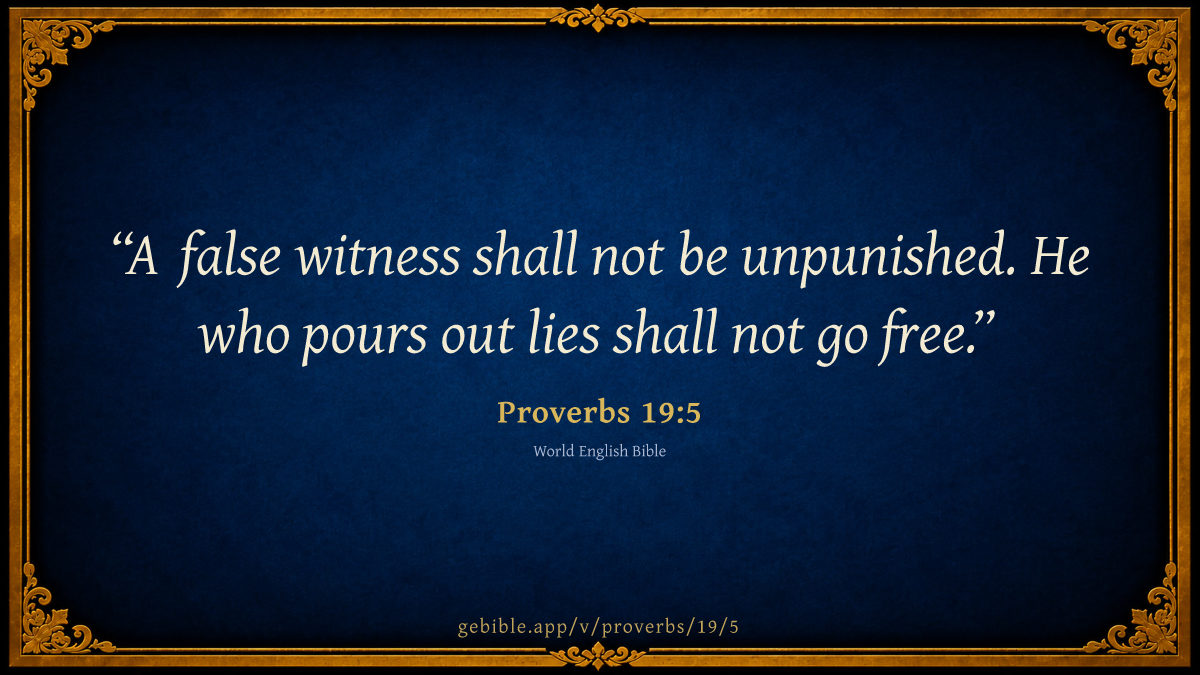
A false witness shall not be unpunished. He who pours out lies shall not go free.
Parallel Translations
-
A false witness shall not be unpunished. He who pours out lies shall not go free.
-
A false witness shall not be unpunished, and he that speaketh lies shall not escape.
-
A false witness shall not be unpunished; and he that breatheth forth lies shall not escape.
Cross-references (9)
Passages linked to Proverbs 19:5 in the Treasury of Scripture Knowledge, ordered by reader-vote popularity; verse text shown in World English Bible.
- Proverbs 21:28 A false witness will perish. A man who listens speaks to eternity.
- Exodus 23:1 “You shall not spread a false report. Don’t join your hand with the wicked to be a malicious witness.
- Proverbs 6:19 a false witness who utters lies, and he who sows discord among brothers.
- Proverbs 19:9 A false witness shall not be unpunished. He who utters lies shall perish.
- Deuteronomy 5:11 “You shall not misuse the name of Yahweh your God; for Yahweh will not hold him guiltless who misuses his name.
- Deuteronomy 19:16-21 If an unrighteous witness rises up against any man to testify against him of wrongdoing, then both the men, between whom the controversy is, shall stand before Yahweh, before the priests and the judges who shall be in those days; and the judges shall make diligent inquisition; and behold, if the witness is a false witness, and has testified falsely against his brother, then you shall do to him as he had thought to do to his brother. So you shall remove the evil from among you. Those who remain shall hear, and fear, and will never again commit any such evil among you. Your eyes shall not pity: life for life, eye for eye, tooth for tooth, hand for hand, foot for foot.
- Daniel 6:24 The king commanded, and they brought those men who had accused Daniel, and they cast them into the den of lions, them, their children, and their wives; and the lions mauled them, and broke all their bones in pieces, before they came to the bottom of the den.
- 1 Kings 2:9 Now therefore don’t hold him guiltless, for you are a wise man; and you will know what you ought to do to him, and you shall bring his gray head down to Sheol with blood.”
- Psalms 120:3-4 What will be given to you, and what will be done more to you, you deceitful tongue? Sharp arrows of the mighty, with coals of juniper.
Cross-references from openbible.info (CC BY 4.0)
Explain this verse (16 sources)
Historical commentary, presented as a primary source — not an endorsement.
Private notes
Saved on this device only — never synced or sent anywhere.
Geneva Bible translators 1599 · Public Domain Deut. 19:19; Dan. 13:62
Deut. 19:19; Dan. 13:62
Geneva Bible (1599) marginal notes — public domain.
John Trapp 1656 · Public Domain Pro 19:5 A false witness shall not be unpunished,…
Pro 19:5 A false witness shall not be unpunished, and [he that] speaketh lies shall not escape.
Ver. 5. A false witness shall not be unpunished.] Many poor people care not to lend their rich friend an oath at a need; and many rich, though they think ill of pillory perjury, yet they make little conscience of a merry lie. Neither of these shall pass unpunished. And this sentence may be to them, as those knuckles of a man’s hand were to Belshazzar, to write them their destiny, or as Daniel was to him, to read it unto them.
John Trapp, A Commentary or Exposition upon All the Books of the Old and New Testament (1647–1656) — public domain. Text from a community e-Sword module.
Matthew Poole 1685 · Public Domain Shall not be unpunished; though he escape the observation…
Shall not be unpunished; though he escape the observation and punishment of men, yet he shall not avoid the judgment of God.
That speaketh lies; that accustometh himself to lying, either in judgment or in common conversation.
Matthew Poole's English Annotations on the Holy Bible (1683–1685) — public domain. Text from a community e-Sword/MySword module.
Matthew Henry 1710 · Public Domain Here we have, 1. The sins threatened - bearing…
Here we have, 1. The sins threatened - bearing false witness in judgment and speaking lies in common conversation. Men could not arrive at such a pitch of impiety as to bear false witness (where to the guilt of a lie is added that of perjury and injury) if they had not advanced to it by allowing themselves to speak untruths in jest and banter, or under pretence of doing good. Thus men teach their tongues to speak lies, Jer 9:5. Those that will take a liberty to tell lies in discourse are in a fair way to be guilty of the greater wickedness of false-witness-bearing, whenever they are tempted to it, though they seemed to detest it. Those that can swallow a false word debauch their consciences, so that a false oath will not choke them. 2. The threatening itself: They shall not go unpunished; they shall not escape. This intimates that that which emboldens them in the sin is the hope of impunity, it being a sin which commonly escapes punishment from men, though the law is strict, Deu 19:18, Deu 19:19. But it shall not escape the righteous judgment of God, who is jealous, and will not suffer his name to be profaned; we know where all liars will have their everlasting portion.
Matthew Henry's Commentary on the Whole Bible (1708–1710) — public domain (CC PDM 1.0). Text via the HelloAO Bible API.
John Gill 1763 · Public Domain A false witness shall not be unpunished,.... He that…
A false witness shall not be unpunished,.... He that bears false witness against his neighbour in an open court of judicature; though be may not be detected by men, and so escape the punishment due to such offenders by the laws of God and men; yet God, who knows all hearts and actions, will not suffer him to go with impunity; if not punished in this world, he shall be in the world to come; for bearing false witness, or perjury, is a grievous offence to God;
and he that speaketh lies shall not escape; even he that useth himself to lying in private conversation shall not escape the reproach of men; for nothing is more scandalous than lying; nor the wrath of God, such shall have their portion in the lake which burneth with fire and brimstone, Rev 21:8.
John Gill's Exposition of the Whole Bible (1746–1763) — public domain (CC PDM 1.0). Text via the HelloAO Bible API.
Joseph Benson 1811 · Public Domain Pro 19:5. A false witness shall not be unpunished…
Pro 19:5. A false witness shall not be unpunished — Though he escape the observation and punishment of men, yet he shall not avoid the judgment of God. And he that speaketh lies — That accustoms himself to lying, either in giving evidence in courts of justice, or in common conversation; shall not escape — The righteous judgment of God, though he may flatter himself with hopes of impunity, for the Lord is jealous of his honour, and will not suffer his name to be profaned.
Joseph Benson's Commentary on the Old and New Testaments (1811–1818) — public domain. Text from a community e-Sword module.
Charles Bridges 1846 · Public Domain If "a true witness delivereth souls" (Pro 14:25 ),…
If "a true witness delivereth souls" (Pro 14:25 ), a false witness destroyeth them. Fearful guilt and responsibility! reaching, without the atoning sacrifice, throughout eternity. Can we wonder that the detection should bring him under certain condemnation? (Deu 19:16-21 .) It is an offense against both tables of the law. The perjurer takes "God’s name in vain." The false witness is a direct transgression against the law of our neighbor. This wickedness does not however come to this height at once. But the habit of speaking lies, the allowance of untruth under the pretense of a good end (Rom 3:8 ), or only in play, grows to this aggravation.†1
In this view a strict attention to truth forms a primary point in a Christian education. The boundary line must never be trifled with. Not even a child can pass it with impunity. It will soon lose its respect, if it be not reverenced at any sacrifice, and under all circumstances. A child must never be suffered to play with a falsehood. Ever press upon him that anything less than truth is a lie. Even if no one is deceived by it, a habit is fostered, of which we cannot tell to what it may grow. "He that is unfaithful in that which is least, is unfaithful also in much." (Luk 16:10 .) The indulgence of a lie soon banishes all fear of an oath. The careless liar, if occasion needs, scruples not to become a false witness. But neither in the higher or lower indulgence will falsehood be forgotten. It may escape detection from man. But it lies open and unveiled before the eye of God. It shall not be unpunished; it shall not escape there. The liar may perhaps have thought or intended no harm. But no palliation is admitted at the bar of God. "All liars shall have their part in the lake that burneth with fire and brimstone." (Rev 21:8 .)
Read full note →
Footnotes:
†1 Jer 9:3-5. There is much instruction in the wise reply of Solon on first seeing the rude theatricals of Thespis. Asking him, how he dared to tell so many lies before the people, and receiving for answer, that he only did it in play — ’Yes’ — said the legislator, striking his staff with force into the ground, — ’But if we begin with telling lies in play, we shall end with telling them in earnest.’
Charles Bridges, An Exposition of the Book of Proverbs (1846) — public domain. Text from a community e-Sword module.
Robert Jamieson, A. R. Fausset & David Brown 1871 · Public Domain Compare Pro 19:9, where perish explains not escape here…
Compare Pro 19:9, where perish explains not escape here (compare Psa 88:9-10).
Jamieson, Fausset & Brown — Commentary Critical and Explanatory on the Whole Bible (1871) — public domain (CC PDM 1.0). Text via the HelloAO Bible API.
Daniel D. Whedon 1874 · Public Domain 5. Not be unpunished — Better, as margin, not…
5. Not be unpunished — Better, as margin, not “held innocent.”
Shall not escape — Namely, not escape punishment. The first clause is equivalent to, shall be guilty; the second, shall not go unpunished. Compare Pro_19:9; Pro_6:19; Pro_14:5.
Daniel D. Whedon (gen. ed.), Commentary on the Old and New Testaments (1874–1909) — public domain. Text from a community e-Sword module.
The Cambridge Bible for Schools and Colleges 1878 · Public Domain 5. speaketh] Lit. breatheth out; and so in Pro_19:9…
5. speaketh] Lit. breatheth out; and so in Pro_19:9 below.
The Cambridge Bible for Schools and Colleges (gen. ed. J. J. S. Perowne; Cambridge University Press, 1878–1918) — public domain. Text from a community e-Sword module.
The Pulpit Commentary 1880 · Public Domain This verse is repeated below (ver. 9). It comes…
This verse is repeated below (ver. 9). It comes in awkwardly here, interrupting the connection which subsists between vers. 4 and 6. Its right place is doubtless where it occurs below. The Law not only strictly forbade false witness, (Exo_20:16 Exo_23:1) but it enacted severe penalties against offenders in this particular; (Deu_19:16, etc.) the lex talionis was to be enforced against them, they were to receive no pity: "Life shall be for life, eye for eye, tooth for tooth, hand for hand, foot for foot." He that speaketh lies shall not escape. The Septuagint confines the notion of this clause to false accusers, O de egkalwn adikwv , "He who maketh an unjust charge shall not escape," which renders the two clauses almost synonymous. We make a distinction between the members by seeing in the former a denunciation against a false witness in a suit, and in the second a more sweeping menace against any one, whether accuser, slanderer, sycophant, who by lying injures a neighbour. The History of Susanna is brought forward in confirmation of the well deserved fate of false accusers. Qeudh toon lumainetai . "A slander is an outrage on man"s life.
The Pulpit Commentary (1880–1919), ed. H.D.M. Spence-Jones & Joseph S. Exell — public domain. Text from a community e-Sword module.
The Biblical Illustrator 1887 · Public Domain A false witness shall not be unpunished.
Pro_19:5
A false witness shall not be unpunished.
Read full note →
The woe of the untruthful
The man who gives wrong evidence. The man of untruthfulness in common conversation. Such men are always punished in one way or another. Nothing is more frequently inculcated in Holy Scripture than the practice of truth, justice, and righteousness. The commandments of God are called truth, because in keeping of them lie our truest advantages and everlasting comforts. All kinds of fraud and deception are abominable in the sight of God, and inconsistent with the ordering of any civil government. For--
1. Fraud in commerce and dealing is but a species of robbery.
2. Haughtiness of spirit unfits a man for those offices of meekness, courtesy, and humanity which make society agreeable and easy.
3. No less unsociable is a tongue addicted to calumny, talebearing, and detraction. It is impossible for men of these dispositions not to meet with their punishment in their own mischievous ways. The law of Moses requires the judge who discovers any man bearing false witness against another to inflict the same pains upon him as the accused should have suffered had the allegations proved true. Among the Athenians an action lay, not only against a false witness, but also against the party who produced him. The punishment of false witness among the Old Romans was to cast the criminal headlong from the top of the Tarpeian rock. Later false witnesses were branded with the letter K. By our own statute law the false witness is to be imprisoned for six months and fined twenty pounds. This is a short specimen of such human penalties as have been awarded to false witnesses, considered as pests of mankind and enemies of the laws and governments of the respective communities to which they belong. Yet if such receive no correction from the hand of man, they cannot hope to escape the wrath of God. (W. Reading, M. A.)
The Biblical Illustrator, edited by Joseph S. Exell (c. 1880s–1900s) — public domain. Text from a community e-Sword module.
The Preacher's Complete Homiletical Commentary 1892 · Public Domain Pro_19:5. Speaketh lies, rather “whose breath is lies.”
CRITICAL NOTES.—
Pro_19:5. Speaketh lies, rather “whose breath is lies.”
Read full note →
Pro_19:6. The prince, rather “the noble or generous man.” It seems to refer to one of rank, who is also of a benevolent disposition. “Entreat the favour,” literally “stroke the face.”
Pro_19:7. He pursueth them, &c. This clause is variously rendered. Zockler reads, “He seeketh words (of friendship), and there are none;” Delitzsch, “Seeking after words which are vain;” Miller, “As one snatching at words, they come to stand towards him;” Maurer and others, “He pursueth after (the fulfilment of the) words (of their past promises to him), and these (promises) are not (made good).
Pro_19:8. Wisdom. Literally heart.
Pro_19:9. Speaketh lies, “whose breath is lies.”
MAIN HOMILETICS OF Pro_19:5; Pro_19:9
THE END OF A FALSE TONGUE
We have before had proverbs dealing with the evil of lying (see Homiletics on chap. Pro_12:17-19, Pro_14:25, pages 274 and 379), and the constant recurrence of the subject, together with the repetition of the verses here, shows us the vast importance which the inspired writer attached to truth, and the many and great evils which flow from a disregard of it. Again and again he holds up the liar to view as a monster of iniquity, and seeks, both by the threatening of the retribution which awaits it and by the misery which it causes to others, to deter men from yielding to this sin. If we consider what mischief a false man can do, we shall not be surprised at the prominence which the wise man gives to this subject (see page 274). But the most dangerous element of the lying tongue is the fact that in nine cases out of ten no human tribunal can bring to justice, and perhaps few human tribunals would care to do so. “The world,” says Dr. David Thomas (“Practical Philosopher,” page 414) “abounds in falsehood. Lies swarm in every department of life. They are in the market, on the hustings, in courts of justice, in the senate house, in the sanctuaries of religion; and they crowd the very pages of modern literature. They infest the social atmosphere. Men on all hands live in fiction and by fiction.” If we allow that this picture is a true one, and, alas! we can cannot deny that it is, we can see that the evil is one with which no human hand can deal. A tiger may come down from a neighbouring forest and enter the city, and spread terror and dismay all round, and even kill a dozen of its inhabitants. But he is a tangible creature, he can be faced and attacked with weapons which can pierce his skin and make him powerless to do any further mischief. But into the same city may enter upon the summer wind impalpable particles of matter charged with a poison which may slay not ten men but ten thousand, and no weapon that has ever been forged by human hand can slay these destroyers. The plague will keep numbering its victims until the poison has spent itself or until a pure and healthful breeze scatters the deadly atmosphere. So with lying in comparison with more palpable and gross crimes. The thief can be caught and imprisoned, the murderer is generally traced and hanged; but the sin of lying so permeates the whole social atmosphere that nothing but the diffusion of heavenly truth can rid the world of the poison. But the liar, however he escapes some forms of retribution, “shall not go unpunished.”
1. He shall be self-punished. His own conscience will be his judge and executioner in one. The fear of discovery here will generally haunt him as a shadow does the substance, but if this ghost is laid there will be times, however hardened he may be, when that witness for truth that is within him will scourge him in the present and fill him with forebodings concerning the future.
2. Men will punish him, by not believing him when he speaks the truth. In proportion as a man’s veracity is doubted will be the suspicion with which his word is received. He may tell the truth on two occasions out of three, but if his falsehood on the third is found out, his truth-telling on the first and second will not avail him much. It is a terrible thing to live always in an atmosphere of distrust, but it is one of the punishments of a liar.
3. God will punish him after he leaves this world. Concerning him and some other great transgressors it is written that—“they shall have their part in the lake which burneth with fire and brimstone: which is the second death (Rev_21:8). Whatever may be the precise meaning of these terrible words, we know that they were spoken by one whose every word was “true and faithful” (see Pro_19:5 of the same chapter), and they are but an intensified form of the last clause of our texts—“He that speaketh lies shall perish.”
OUTLINES AND SUGGESTIVE COMMENTS
Falsehood is fire in stubble. It likewise turns all around it into its own substance for a moment—one crackling, blazing moment, and then dies. And all its contents are scattered in the wind without place or evidence of their existence, as viewless as the wind which scatters them.—Coleridge.
“He whose breath is lies shall be lost.” Breath means the inborn and natural impulse. The root of the verb translated “shall perish” means to lose oneself by wandering about. The cognate Arabic means to flee away wild in the desert. The spirit, therefore, that habitually breathes out falsities, and so acts constitutionally athwart of what is true, is best described by keeping to the original; that is, instead of perishing in the broader and vaguer way, he wanders off and is lost in the wilderness of his own deceptions.—Miller.
The thief doth only send one to the devil; the adulterer, two; the slanderer hurteth three—himself, the person of whom, the person to whom he tells the lie.—T. Adams.
MAIN HOMILETICS OF Pro_19:6-7
TWO PROOFS OF HUMAN SELFISHNESS
I. The servile regard which men pay to rank and wealth. A prince is a man in whose hand there is power to advance the material interests of other men, and this makes him a loadstone to the godless man whatever his character may be. As the magnet will attract all the steel dust within its reach, so the prince is a magnet which attracts all the self-seeking and the worldly who can by any possibility obtain any favour from him. To gain that favour they will fawn upon him and flatter him, and will stoop even to become suppliants at his feet. Let him be one of the most contemptible of human creatures, there will not be wanting those who may be in many respects his superiors who will serve him from hope of advancing their own interests. We know that this is not universally the case—that there have been noble men in all ages who would scorn to entreat the favour of any man, simply because he was a man of power; but Solomon here speaks of the rule and not of the exception, and the fact that it is so testifies to the self-seeking which is the characteristic of men in general.
II. The treatment which the poor man often receives from his more wealthy kinsfolk. The proverb implies that those who hate him and pass him by with disdain are richer than himself, and therefore not only bound to pity his poverty but able to lighten his burden. But the same selfishness which draws men to the rich causes them to shun the poor in general, and especially their poor relations, for they feel conscious that these latter have a stronger claim upon them than those who are not so related. And even if the poor man does not need the help of his richer brethren he will often find himself unrecognised by them, simply because he occupies a lower social station. He has nothing to give them in the way of material good—his favour is worth nothing in the way of promoting their worldly interests—the very fact that he is poor and yet is more or less nearly connected by family ties is supposed to dim the lustre of their greatness, and they therefore cherish towards him a positive dislike which they manifest by avoiding his society as much as possible, and by receiving all his advances towards friendship with coolness and disdain. If we had no other proof of the depth to which man has fallen since God created him in His own image, the regard which men pay, not to what a man is, but to what he has, would be one sad enough (See also Homiletics on chap. Pro_14:20, page 370).
OUTLINES AND SUGGESTIVE COMMENTS
Princes need not pride themselves in the homage that is paid to them, for their favour is sought by men, not so much out of regard to their persons, as from a regard to their power. Kindness and liberality have a greater influence for gaining the hearts of men, than dignity of station. There are many that seek the ruler’s favour, but every man loves him that is generous. When power and generosity meet in the same person, he becomes an object of universal esteem, like Marcus Antoninus, who was lamented by every man when he was dead, as if the glory of the Roman empire had died with him.
How inexcusable are we, if we do not love God with all our hearts. His gifts to us are past number, and all the gifts of men to us are the fruits of His bounty, conveyed by the ministry of those whose hearts are disposed by His providence to kindness. “I have seen thy face,” said Jacob to Esau, “as the face of God.” His brother’s favour he knew to be a fruit of the mercy of Him with whom he spake and prevailed at Bethel.—Lawson.
For Homiletics on Pro_19:8-9 see Pro_19:2; Pro_19:5 of this chapter, also on chapters Pro_8:36 and Pro_9:12, pages 122 and 128.
The Preacher's Complete Homiletical Commentary (gen. ed. Joseph S. Exell; Funk & Wagnalls, c. 1892) — public domain (pre-1929). A full-Bible homiletical/sermon-outline anthology covering 65 of 66 books (2 John is absent from the source module). Text from a community e-Sword module.
Paul E. Kretzmann 1924 · Public Domain v. 5. A false witness shall not be unpunished,…
v. 5. A false witness shall not be unpunished, his lies being recorded in God’s records, and he that speaketh lies, constantly breathing them out, shall not escape, an emphatic way of saying that he shall surely perish.
Paul E. Kretzmann, Popular Commentary of the Bible (1921–1924) — public domain. Text from a community e-Sword module.
unfoldingWord translationNotes 2017 · CC BY-SA 4.0 A false witness will not go unpunished
A false witness will not go unpunished
This can be written in positive and active form. AT: "They will certainly punish a false witness" (See: Double Negatives and Active or Passive)
Read full note →
he who breathes out lies will not escape
This means that he will be captured. AT: "they will capture the one who breathes out lies" (See: Litotes)
breathes out lies
This is an idiom. Here "breathes" refers to lying constantly. See how you translated this phrase in Proverbs 6:19. AT: "constantly lies" (See: Idiom)
a generous person
someone who often gives away things
everyone is a friend
The word "everyone" is an exaggeration. AT: "it seems that everyone is a friend" or "almost everyone is a friend" (See: Hyperbole and Generalization)
translationWords
corrupt witness
punish
breath
favor
gift
unfoldingWord translationNotes — © Distant Shores Media and the Door43 World Missions Community, licensed CC BY-SA 4.0. Source: git.door43.org/Door43/en_tn.
Tyndale Open Study Notes 2022 · CC BY-SA 4.0 19:5 God will make sure that liars are punished…
19:5 God will make sure that liars are punished (see 12:17, 19; 14:5, 25; 19:9).
Tyndale Open Study Notes — © Tyndale Open Resources, licensed CC BY-SA 4.0. Text via the HelloAO Bible API.