
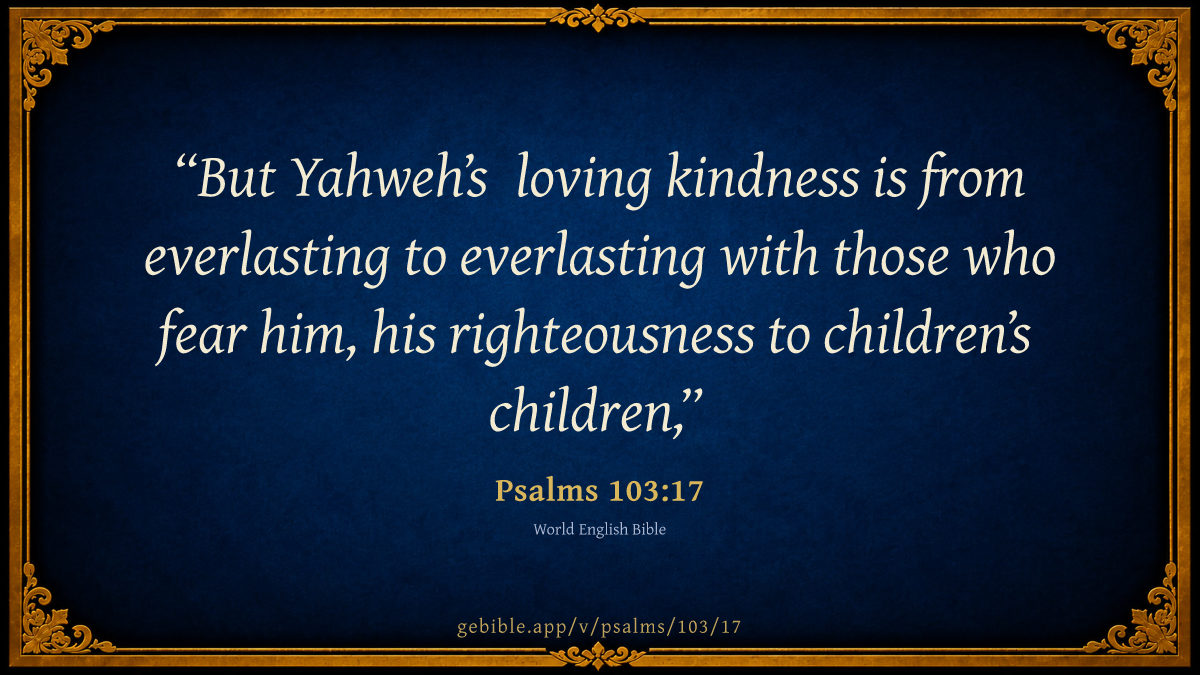
But Yahweh’s loving kindness is from everlasting to everlasting with those who fear him, his righteousness to children’s children,
Parallel Translations
-
But Yahweh’s loving kindness is from everlasting to everlasting with those who fear him, his righteousness to children’s children,
-
But the mercy of the LORD is from everlasting to everlasting upon them that fear him, and his righteousness unto children’s children;
-
But the mercy of the LORD is from everlasting to everlasting upon them that fear Him, and His righteousness unto children's children;
Examined in Scripture Analysis
Contradictions (1)
Questions where the Bible appears to say two different things, with the passages on each side set together.
Cross-references (26)
Passages linked to Psalms 103:17 in the Treasury of Scripture Knowledge, ordered by reader-vote popularity; verse text shown in World English Bible.
- Psalms 100:5 For Yahweh is good. His loving kindness endures forever, his faithfulness to all generations.
- Ephesians 2:4-7 But God, being rich in mercy, for his great love with which he loved us, even when we were dead through our trespasses, made us alive together with Christ—by grace you have been saved— and raised us up with him, and made us to sit with him in the heavenly places in Christ Jesus, that in the ages to come he might show the exceeding riches of his grace in kindness toward us in Christ Jesus;
- 2 Timothy 1:9 who saved us and called us with a holy calling, not according to our works, but according to his own purpose and grace, which was given to us in Christ Jesus before times eternal,
- Exodus 20:6 and showing loving kindness to thousands of those who love me and keep my commandments.
- Romans 1:17 For in it is revealed God’s righteousness from faith to faith. As it is written, “But the righteous shall live by faith.”
- Isaiah 51:6 Lift up your eyes to the heavens, and look at the earth beneath; for the heavens will vanish away like smoke, and the earth will wear out like a garment. Its inhabitants will die in the same way, but my salvation will be forever, and my righteousness will not be abolished.
- Romans 8:28-30 We know that all things work together for good for those who love God, for those who are called according to his purpose. For whom he foreknew, he also predestined to be conformed to the image of his Son, that he might be the firstborn among many brothers. Whom he predestined, those he also called. Whom he called, those he also justified. Whom he justified, those he also glorified.
- Ephesians 1:4-8 even as he chose us in him before the foundation of the world, that we would be holy and without defect before him in love, having predestined us for adoption as children through Jesus Christ to himself, according to the good pleasure of his desire, to the praise of the glory of his grace, by which he freely gave us favor in the Beloved, in whom we have our redemption through his blood, the forgiveness of our trespasses, according to the riches of his grace, which he made to abound toward us in all wisdom and prudence,
- 2 Thessalonians 2:13-14 But we are bound to always give thanks to God for you, brothers loved by the Lord, because God chose you from the beginning for salvation through sanctification of the Spirit and belief in the truth, to which he called you through our Good News, for the obtaining of the glory of our Lord Jesus Christ.
- Psalms 25:6 Yahweh, remember your tender mercies and your loving kindness, for they are from old times.
- Psalms 118:1 Give thanks to Yahweh, for he is good, for his loving kindness endures forever.
- Jeremiah 31:3 Yahweh appeared of old to me, saying, “Yes, I have loved you with an everlasting love. Therefore I have drawn you with loving kindness.
- Jeremiah 33:24-26 “Don’t consider what this people has spoken, saying, ‘Has Yahweh cast off the two families which he chose?’ Thus they despise my people, that they should be no more a nation before them.” Yahweh says: “If my covenant of day and night fails, if I have not appointed the ordinances of heaven and earth; then I will also cast away the offspring of Jacob, and of David my servant, so that I will not take of his offspring to be rulers over the offspring of Abraham, Isaac, and Jacob: for I will cause their captivity to be reversed and will have mercy on them.”
- Micah 6:5 My people, remember now what Balak king of Moab devised, and what Balaam the son of Beor answered him from Shittim to Gilgal, that you may know the righteous acts of Yahweh.”
- Acts 13:32-34 We bring you good news of the promise made to the fathers, that God has fulfilled this to us, their children, in that he raised up Jesus. As it is also written in the second psalm, ‘You are my Son. Today I have become your father.’ “Concerning that he raised him up from the dead, now no more to return to corruption, he has spoken thus: ‘I will give you the holy and sure blessings of David.’
- Romans 3:21-25 But now apart from the law, a righteousness of God has been revealed, being testified by the law and the prophets; even the righteousness of God through faith in Jesus Christ to all and on all those who believe. For there is no distinction, for all have sinned, and fall short of the glory of God; being justified freely by his grace through the redemption that is in Christ Jesus; whom God sent to be an atoning sacrifice, through faith in his blood, for a demonstration of his righteousness through the passing over of prior sins, in God’s forbearance;
- Romans 15:8 Now I say that Christ has been made a servant of the circumcision for the truth of God, that he might confirm the promises given to the fathers,
- 2 Peter 1:1 Simon Peter, a servant and apostle of Jesus Christ, to those who have obtained a like precious faith with us in the righteousness of our God and Savior, Jesus Christ:
- Deuteronomy 10:15 Only Yahweh had a delight in your fathers to love them, and he chose their offspring after them, even you above all peoples, as it is today.
- Psalms 22:31 They shall come and shall declare his righteousness to a people that shall be born, for he has done it.
- Psalms 90:16 Let your work appear to your servants, your glory to their children.
- Psalms 136:1-26 Give thanks to Yahweh, for he is good; for his loving kindness endures forever. Give thanks to the God of gods; for his loving kindness endures forever. Give thanks to the Lord of lords; for his loving kindness endures forever: to him who alone does great wonders; for his loving kindness endures forever: to him who by understanding made the heavens; for his loving kindness endures forever: to him who spread out the earth above the waters; for his loving kindness endures forever: to him who made the great lights; for his loving kindness endures forever: the sun to rule by day; for his loving kindness endures forever; the moon and stars to rule by night; for his loving kindness endures forever: to him who struck down the Egyptian firstborn; for his loving kindness endures forever; and brought out Israel from among them; for his loving kindness endures forever; with a strong hand, and with an outstretched arm; for his loving kindness endures forever: to him who divided the Red Sea apart; for his loving kindness endures forever; and made Israel to pass through the middle of it; for his loving kindness endures forever; but overthrew Pharaoh and his army in the Red Sea; for his loving kindness endures forever: to him who led his people through the wilderness; for his loving kindness endures forever: to him who struck great kings; for his loving kindness endures forever; and killed mighty kings; for his loving kindness endures forever: Sihon king of the Amorites; for his loving kindness endures forever; Og king of Bashan; for his loving kindness endures forever; and gave their land as an inheritance; for his loving kindness endures forever; even a heritage to Israel his servant; for his loving kindness endures forever: who remembered us in our low estate; for his loving kindness endures forever; and has delivered us from our adversaries; for his loving kindness endures forever: who gives food to every creature; for his loving kindness endures forever. Oh give thanks to the God of heaven; for his loving kindness endures forever.
- Isaiah 41:8 “But you, Israel, my servant, Jacob whom I have chosen, the offspring of Abraham my friend,
- Isaiah 46:13 I bring my righteousness near. It is not far off, and my salvation will not wait. I will grant salvation to Zion, my glory to Israel.
- Psalms 89:1-2 I will sing of the loving kindness of Yahweh forever. With my mouth, I will make known your faithfulness to all generations. I indeed declare, “Love stands firm forever. You established the heavens. Your faithfulness is in them.”
- Daniel 9:24 “Seventy weeks are decreed on your people and on your holy city, to finish disobedience, and to make an end of sins, and to make reconciliation for iniquity, and to bring in everlasting righteousness, and to seal up vision and prophecy, and to anoint the most holy.
Cross-references from openbible.info (CC BY 4.0)
Explain this verse (15 sources)
Historical commentary, presented as a primary source — not an endorsement.
Private notes
Saved on this device only — never synced or sent anywhere.
John Calvin 1540 · Public Domain 17. But the goodness of Jehovah, etc The Psalmist…
17. But the goodness of Jehovah, etc The Psalmist leaves nothing to men to rely upon but the mercy of God; for it would be egregious folly to seek a ground of confidence in themselves. After having shown the utter emptiness of men, he adds the seasonable consolation, that, although they have no intrinsic excellence, which does not vanish into smoke, yet God is an inexhaustible fountain of life, to supply their wants. This contrast is to be particularly observed; for whom does he thus divest of all excellence? The faithful who are regenerated by the Spirit of God, and who worship him with true devotion, these are the persons whom he leaves nothing on which their hope may rest but the mere goodness of God. As the Divine goodness is everlasting, the weakness and frailty of the faithful does not prevent them from boasting of eternal salvation to the close of life, and even in death itself. David does not confine their hope within the limits of time — he views it as commensurate in duration with the grace on which it is founded. To goodness is subjoined righteousness, a word, as we have had occasion frequently to observe before, denoting the protection by which God defends and preserves his own people. He is then called righteous, not because he rewards every man according to his desert, but because he deals faithfully with his saints, in spreading the hand of his protection over them. The Prophet has properly placed this righteousness after goodness, as being the effect of goodness. He also asserts that it extends to the children and children’s children, according to these words in Deuteronomy 7:9, “God keepeth mercy to a thousand generations.” It is a singular proof of his love that he not only receives each of us individually into his favor, but also herein associates with us our offspring, as it were by hereditary right, that they may be partakers of the same adoption. How shall He cast us off, who, in receiving our children and children’s children into his protection, shows to us in their persons how precious our salvation is in his sight?
John Calvin's Commentaries (1540-1563) — public domain. Text from the Calvin Translation Society English edition (1840s-50s) via the Christian Classics Ethereal Library (ccel.org). Calvin's coverage is partial (roughly two-thirds of the Bible); uncommented books and verses are honest gaps, never fabricated. The 19th-century editor's footnotes and remarks are omitted so the notes are faithfully Calvin's own voice.
Geneva Bible translators 1599 · Public Domain His just and faithful keeping of his promise.
His just and faithful keeping of his promise.
Geneva Bible (1599) marginal notes — public domain.
John Trapp 1656 · Public Domain Psa 103:17 But the mercy of the LORD [is]…
Psa 103:17 But the mercy of the LORD [is] from everlasting to everlasting upon them that fear him, and his righteousness unto children’s children;
Ver. 17. But the mercy of the Lord is from everlasting] God is from all eternity and unto all eternity kind to all that fear him, in what age of the world soever they live.
Read full note →
And his righteousness unto children’s children] That is, his kindness or bounty; for so the word tsedachah should be taken, according to Psa 112:8-9 2Co 9:9.
John Trapp, A Commentary or Exposition upon All the Books of the Old and New Testament (1647–1656) — public domain. Text from a community e-Sword module.
Matthew Poole 1685 · Public Domain But though we quickly decay and perish, yet God’s…
But though we quickly decay and perish, yet God’s mercy to us doth not die with us; but as it was from eternity exercised in gracious purposes, so it will be continued unto eternity in that future and endless life.
Upon them that fear him: see before on Psa 103:11. His righteousness; either his faithfulness, or (that this branch may answer to the former) his mercy or benignity; this word being frequently used in both these senses, as hath been proved before. But it is here called righteousness, to intimate that God’s kindness to the posterity of his people is not only an act of his goodness, but also a discharge of his obligation under which he put himself to them, as elsewhere, so Exo 20:6, to which this place seems to relate. Hence it is called mercy to Abraham and truth to Jacob, Mic 7:20.
Matthew Poole's English Annotations on the Holy Bible (1683–1685) — public domain. Text from a community e-Sword/MySword module.
John Gill 1763 · Public Domain The Lord hath prepared his throne in the heavens,....…
The Lord hath prepared his throne in the heavens,.... The heaven is his throne; here he sits enthroned in all the glory of his majesty, with all his attendants upon him, and courtiers about him. The Lord Christ is now in heaven; and where he will continue to the restitution of all things, and from whence his people expect him at the last day. Here he is on the same throne with his divine Father; which throne he has "prepared" or "established" (d), so as it cannot be moved: when others are cast down, this shall stand; his throne is for ever and ever. The Targum in the king's Bible is,
"the Word of the Lord hath prepared, &c.''
Read full note →
And his kingdom ruleth over all; over all created beings; over angels, good and bad; over men, righteous and wicked; over the greatest of men, the kings and princes of the earth. Good angels are subject to him devils tremble at him; saints acknowledge him as their King; the wicked he rules with a rod of iron; and kings reign by him, and are accountable to him; see Psa 22:28.
(d) "stabilivit", Junius & Tremellius, Piscator.
John Gill's Exposition of the Whole Bible (1746–1763) — public domain (CC PDM 1.0). Text via the HelloAO Bible API.
Adam Clarke 1810 · Public Domain Verse 17. The mercy of the Lord is from…
Verse 17. The mercy of the Lord is from everlasting to everlasting] חסד chesed signifies more particularly the exuberant goodness of God. This is an attribute of his nature, and must be from everlasting to everlasting; and hence, his righteousness (צדקת tsidketh) - his merciful mode of justifying the ungodly, is extended from one generation to another.
Unto children's children.] It is still in force, and the doctrine of reconciliation through Christ shall continue to be preached till the conclusion of time.
Adam Clarke's Commentary on the Bible (1810–1826) — public domain. Text from a community e-Sword/MySword module.
Joseph Benson 1811 · Public Domain Psa 103:17-18. But the mercy of the Lord is…
Psa 103:17-18. But the mercy of the Lord is from everlasting, &c. — But though we quickly decay and perish, yet God’s mercy to us doth not die with us, but, as it was from eternity exercised in gracious purposes, so it will be continued unto eternity in that future and endless life which is before us; upon them that fear him — That is, upon them that are truly religious: see above on Psa 103:11. And his righteousness unto children’s children — Either his faithfulness, or his benignity, the word being frequently used in both these senses, as has been shown before. But it is here called righteousness, to intimate that God’s kindness to the posterity of his people is not only an act of his goodness, but also a discharge of the obligation under which he had laid himself to them, as elsewhere, so especially Exo 20:6, to which this place seems to relate. To such as keep his covenant — To them that, through his grace, perform the condition of God’s covenant, that sincerely love and obey him. Such restrictions are often added, as, in the general, to overthrow the presumptuous hopes of ungodly men, so particularly to admonish the Israelites not to rest too much on the privileges of their parents, or the covenant made with them, nor to expect any benefit by it but upon condition of their continuance in God’s covenant. And to those that remember his commandments — That have them much in their thoughts, and practise them in the course of their lives.
Joseph Benson's Commentary on the Old and New Testaments (1811–1818) — public domain. Text from a community e-Sword module.
Albert Barnes 1834 · Public Domain But the mercy of the Lord - The favor…
But the mercy of the Lord - The favor of the Lord; or, his loving-kindness.
Is from everlasting to everlasting - Is from the eternity past to the eternity to come. It had its foundation in the eternal decrees of God; it has its security in his purpose that where it is conferred, it shall not be withdrawn. It had no beginning; it will have no end. There never was a period in the past when it was not the purpose of God to save his people; there never will be a period in the future when it will be said that his saving mercy has ceased. It would be difficult to think of a statement which would at the same time, in so few words, confirm at once the doctrine of the divine decrees, and the doctrine of the perseverance of the saints. If either of these doctrines is denied, then what is here stated by the psalmist is not true: if the doctrine of the divine decrees is denied, then his purpose of mercy had a beginning, and is not “from everlasting;” if the doctrine of the perseverance of the saints is denied, then his mercy has an end, and is not “to everlasting.”
Read full note →
Upon them that fear him - In respect to those who are his true worshippers, or his true people.
And his righteousness - His righteous purpose; or, his purpose in regard to their “becoming” righteous.
Unto children’s children - literally, “sons of sons.” That is, his purposes embrace the children and children’s children of the righteous; or, they are included in the covenant of mercy. See the notes at Act 2:39. Compare Exo 20:6.
Albert Barnes' Notes on the Bible (1834–1885) — public domain. Text from a community e-Sword/MySword module.
Daniel D. Whedon 1874 · Public Domain 17. But the mercy of the Lord—The adversative sense…
17. But the mercy of the Lord—The adversative sense of the conjunction marks the contrast between the perishable and frail in man, (vers. 15, 16,) and the everlasting “mercy” and faithfulness of God to “such as keep his covenant.” Psa_103:17-18.
Everlasting to everlasting—From eternity to eternity. By a law of interpretation the words are limited only by the nature of the subject.
Read full note →
Unto children’s children—A quotation from Exo_20:6; Exo_34:7; Deu_7:9
Daniel D. Whedon (gen. ed.), Commentary on the Old and New Testaments (1874–1909) — public domain. Text from a community e-Sword module.
The Cambridge Bible for Schools and Colleges 1878 · Public Domain 17. Men may pass away, but Jehovah’s lovingkindness and…
17. Men may pass away, but Jehovah’s lovingkindness and righteousness, i.e. His covenant faithfulness, endure. The eternity of God is the rock upon which faith can repose in view of the mutability of man. Cp. Psa_90:1; Psa_102:12; Psa_102:27; Isa_40:8. Those who fear Him can securely commit their posterity to His care. Cp. Psa_102:28. Both the assurance, and the condition introduced by Psa_103:18, rest upon Exo_20:6; Deu_7:9.
The Cambridge Bible for Schools and Colleges (gen. ed. J. J. S. Perowne; Cambridge University Press, 1878–1918) — public domain. Text from a community e-Sword module.
The Pulpit Commentary 1880 · Public Domain But the mercy of the Lord is from everlasting…
But the mercy of the Lord is from everlasting to everlasting upon them that fear him (comp. vers. 11, 13). Through this "everlasting mercy" of God, man, though so feeble and fragile, does not wholly pass away, but continues to be the recipient of God"s bounty. And his righteousness unto children"s children. God"s "righteousness" is his everlasting justice, by which he gives to men according to their deserts.
The Pulpit Commentary (1880–1919), ed. H.D.M. Spence-Jones & Joseph S. Exell — public domain. Text from a community e-Sword module.
Charles H. Spurgeon 1885 · Public Domain Ver. 17. But the mercy of the LORD is…
Ver. 17. But the mercy of the LORD is from everlasting to everlasting upon them that fear him. Blessed but! How vast the contrast between the fading flower and the everlasting God! How wonderful that his mercy should link our frailty with his eternity, and make us everlasting too! From old eternity the Lord viewed his people as objects of mercy, and as such chose them to become partakers of his grace; the doctrine of eternal election is most delightful to those who have light to see it and love wherewith to accept it. It is a theme for deepest thought and highest joy. The "to everlasting" is equally precious. Jehovah changes not, he has mercy without end as well as without beginning. Never will those who fear him find that either their sins or their needs have exhausted the great deep of his grace. The main question is, "Do we fear him?" If we are lifting up to heaven the eye of filial fear, the gaze of paternal love is never removed from us, and it never will be, world without end.
And his righteousness unto children's children. Mercy to those with whom the Lord makes a covenant is guaranteed by righteousness;it is because he is just that he never revokes a promise, or fails to fulfil it. Our believing sons and their seed for ever will find the word of the Lord the same: to them will he display his grace and bless them even as he has blessed us. Let us sing, then, for posterity. The past commands our praise and the future invites it. For our descendants let us sing as well as pray. If Abraham rejoiced concerning his seed, so also may the godly, for "instead of the fathers shall be the children, "and as the last Psalm told us in its concluding verse, "the children of thy servants shall continue, and their seed shall be established before thee."
Read full note →
Ver. 17. But the mercy of the Lord is from everlasting to everlasting. No human benevolence is perpetually the same; but by expelfence we see that those who are kind today, may be changed into tyrants tomorrow. Examples of this we have in the life of Nero, and many other rulers. Therefore lest we should suspect the goodness of God to bear any similar character, it is said with inconceivable consolation, that it shall never cease, but is prepared for ever for all those who fear and serve God. Musculus.
Ver. 17. From everlasting to everlasting. From everlasting, by predestination; to everlasting, by glorification: the one without beginning, the other without end. Bernard.
Psalms 103:18*
Charles H. Spurgeon's The Treasury of David (1869–1885) — public domain. Psalms only. Text from a community e-Sword/MySword module.
The Biblical Illustrator 1887 · Public Domain But the mercy of the Lord is from everlasting…
Psa_103:17
But the mercy of the Lord is from everlasting to everlasting upon them that fear Him.
Read full note →
Man and mercy
Verses 15-19 form a beautiful contrast between mans life and Gods mercy.
I. There is a contrast in their strength.
1. Mans life is weak. All men in all places and at all times are like grass, and will soon pass away. But the mercy of the Lord is not weak, feeble, and easily consumed; it is almighty. The almightiness of mercy is proved by its wonderful achievements.
2. Mans life is a disappointment. As for man, his days are like grass. Grass soon withers away. Such is human life. It is frail, and full of disappointments. But Gods mercy is everlastingly green.
II. A contrast in their beauty. (Isa_40:6). This figure refers to human beauty. The apostle calls the beauty of man his glory (1Pe_1:24). Mans glory is his health, energy, beauty, talent, wisdom. His vigour is soon gone; his beauty fades, his wisdom ceases. But the beauty of the Lord--the beauty of holiness--the beauty of mercy never fades away.
III. A contrast in their duration.
1. Man cannot carry out his designs after death, but mercy executes her plans independent of his presence.
2. Mercy distributes her invaluable blessings among families throughout all generations. (Homilist.)
The character and privileges of Gods people
I. Their character.
1. They fear Him. By this we are to understand obedience to all the duties of religion.
2. They keep His covenant. This implies that they walk agreeably to their baptismal and Lords Supper engagements; that they resist the devil, the world, and the flesh.
3. They remember His commandments to do them.
II. The privileges of Gods people are innumerable, and are almost all summed up in this one word mercy. They are all summed up in Christ.
1. Original mercy. This, in God, is like a fountain that runs night and day--that is never diminished or dried up.
2. Communicative mercy. It is over all Gods works. Since the earth was created, it has been full of temporal and spiritual mercies.
3. Tender mercy coming from the heart. It is exercised towards miserable objects, immediately and in the very time of need.
4. Free in its exercise towards us, without any deserving on our part.
5. Great mercy. God is plenteous in mercy; rich in mercy; abundant in mercy; He has manifold mercies; He keeps mercies for thousands (Exo_34:7).
6. Infinite mercy. Far above the heavens (Isa_55:7; Isa_55:9). Deeper than the sea (Mic_7:19).
7. Eternal mercy. His compassion fails not; His mercy endureth for ever.
III. Improvement.
1. Those who have experienced this mercy are happy. Finding the end of this mercy is like finding the end of a ring--impossible.
2. Those who have never experienced this mercy are truly miserable. (James Kidd, D.D.)
The mercy of the Lord to the children of those who fear Him
The word righteousness here, as in many other places, is equivalent to mercy or beneficence; and the ever-enduring lovingkindness of our God, described in the first clause as from everlasting to everlasting, is in the second more precisely defined, as continued to the childrens children of those who fear Him. The Almighty hath done nothing in vain. Every power, every affection of the human soul, is implanted in it by Him for some valuable end, and is operated on by the means which His wisdom hath appointed for carrying forward our improvement here, and accomplishing our preparation for happiness hereafter. Of those principles, there is no one more universal, more powerful, or more obviously beneficial, than parental affection. In the inferior animals, with whom it is merely instinctive, it exercises a power to which every other habit and propensity seems to be subordinate. Under its dominion the most ferocious become mild and gentle, the most fearful, fierce and daring in the defence of their offspring, the feeblest and most indolent, indefatigable in providing for their subsistence. By its operation, the living tribes of earth are, in almost each individual instance, trained up to maturity, and prevented from perishing from off the surface of the globe. In man, especially when he is enlightened and civilized, it assumes a loftier bearing, and holds a more important place. When it is guarded by religious principle and sound judgment from the abuses to which all the feelings of mortality are liable, when it is purified and refined by the sacred and endearing habits of domestic life, and hallowed by the hope of immortality, it triumphs over every selfish inclination, and connects the successive generations of men by ties equally blessed to the present and the future inhabitants of earth. It is obvious, that under the diversified government of God, this, like every other principle, is made to produce the most valuable fruits. His providence employs it to control selfishness, to restrain turbulent passion, to draw forth useful exertion from the individual, to supply a most powerful motive for acting uprightly and honourably. Yet it is not only by its direct operation that parental love influences the human mind for good. The Almighty appeals to it in His Word as a motive to cherish godly fear and holy obedience. To mankind He holds out a blessing on their posterity, as a most powerful incentive to compliance with the requisitions of His law (Exo_20:5-6; Gen_22:17-18; Psa_112:1-2). Though the Christian revelation, in directing our views to another and a better world, renders the vicissitudes of this life less marked and less momentous, still an attentive observer may discern the fulfilment of this gracious declaration in the ordinary and general course of human affairs. You see the unsullied fame of the parent descend on the son and recommend him to notice, confidence, and employment. Were it given you to enter more deeply into the counsels of the Almighty, and to trace more accurately than you now do the ways of His providence, you might behold proofs still more decisive of His righteousness to the children of His servants, in soothing their afflictions, in supplying their wants. Such views of the Divine procedure must fill our minds with admiration of the wisdom of Him by whom our souls and bodies were formed, and who governs and conducts us by laws and motives adapted to every branch of that nature in which He hath created us. In filling the hearts of parents with an indelible attachment to their children, He not only prompts them to those exertions which contribute so largely to the happiness and improvement of mankind, but renders them capable of appreciating, and disposed to comply with those inducements to obedience which are suggested by His promise of a blessing on their posterity. What parent who reflects can resist their influence? who, with a heart to feel, would not endeavour to keep His covenant and remember His commandments to do them, when assured that His mercy is from everlasting to everlasting on them that fear Him, and His righteousness to childrens children? If there be one branch of Christian conduct in which, more than in another, it becomes you to be followers of God as dear children, it is in doing good to the children of those who have loved and served Him. In so doing you imitate those dispensations of His providence in which His unerring wisdom is most conspicuously displayed. You copy the most amiable and affecting manifestation of His fatherly benevolence. (D. Macfarlan, D.D.)
The Biblical Illustrator, edited by Joseph S. Exell (c. 1880s–1900s) — public domain. Text from a community e-Sword module.
unfoldingWord translationNotes 2017 · CC BY-SA 4.0 the covenant faithfulness of Yahweh is
the covenant faithfulness of Yahweh is
The abstract noun "faithfulness" can be translated with an adjective. AT: "Yahweh is faithful to his covenant" (See: Abstract Nouns)
Read full note →
is from everlasting to everlasting
This means that Yahweh's love continues forever. AT: "will continue forever" (See: Merism)
their descendants
"the descendants of those who honor him"
They keep his covenant and remember to obey his instructions
These two phrases have similar meanings. (See: Parallelism)
Yahweh has established his throne in the heavens
Here Yahweh's reign as king is referred to as his "throne." AT: "Yahweh has taken his seat in the heavens where he rules as king" (See: Metonymy)
has established
"has made"
his kingdom rules
Here Yahweh is referred to by "his kingdom" to emphasize his authority as king. AT: "he rules" (See: Metonymy)
translationWords
covenant faithfulness
eternity
righteous
descend
covenant
obey
throne
heaven
kingdom
rule
unfoldingWord translationNotes — © Distant Shores Media and the Door43 World Missions Community, licensed CC BY-SA 4.0. Source: git.door43.org/Door43/en_tn.
Tyndale Open Study Notes 2022 · CC BY-SA 4.0 103:17-19 the love of the Lord remains forever: The…
103:17-19 the love of the Lord remains forever: The Lord’s kingdom is everlasting, so he commits himself to his people across many generations.
Tyndale Open Study Notes — © Tyndale Open Resources, licensed CC BY-SA 4.0. Text via the HelloAO Bible API.