
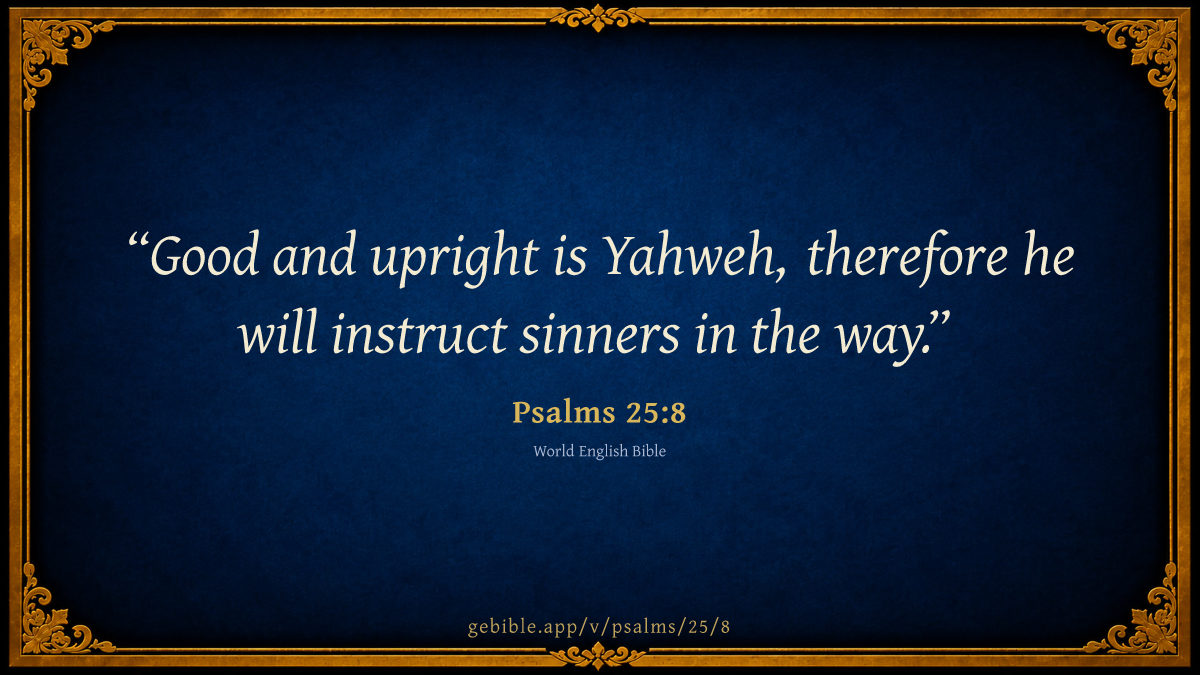
Good and upright is Yahweh, therefore he will instruct sinners in the way.
Parallel Translations
-
Good and upright is Yahweh, therefore he will instruct sinners in the way.
-
Good and upright is the LORD: therefore will he teach sinners in the way.
-
Good and upright is the LORD; therefore doth He instruct sinners in the way.
Examined in Scripture Analysis
Contradictions (1)
Questions where the Bible appears to say two different things, with the passages on each side set together.
Cross-references (15)
Passages linked to Psalms 25:8 in the Treasury of Scripture Knowledge, ordered by reader-vote popularity; verse text shown in World English Bible.
- James 1:5 But if any of you lacks wisdom, let him ask of God, who gives to all liberally and without reproach, and it will be given to him.
- Ephesians 1:17-18 that the God of our Lord Jesus Christ, the Father of glory, may give to you a spirit of wisdom and revelation in the knowledge of him, having the eyes of your hearts enlightened, that you may know what is the hope of his calling, and what are the riches of the glory of his inheritance in the saints,
- Psalms 32:8 I will instruct you and teach you in the way which you shall go. I will counsel you with my eye on you.
- John 6:44-45 No one can come to me unless the Father who sent me draws him, and I will raise him up in the last day. It is written in the prophets, ‘They will all be taught by God.’ Therefore everyone who hears from the Father and has learned, comes to me.
- Psalms 92:15 to show that Yahweh is upright. He is my rock, and there is no unrighteousness in him.
- Matthew 9:13 But you go and learn what this means: ‘I desire mercy, and not sacrifice,’ for I came not to call the righteous, but sinners to repentance.”
- Proverbs 9:4-6 “Whoever is simple, let him turn in here!” As for him who is void of understanding, she says to him, “Come, eat some of my bread, Drink some of the wine which I have mixed! Leave your simple ways, and live. Walk in the way of understanding.”
- Isaiah 26:7 The way of the just is uprightness. You who are upright make the path of the righteous level.
- Matthew 11:29-30 Take my yoke upon you, and learn from me, for I am gentle and humble in heart; and you will find rest for your souls. For my yoke is easy, and my burden is light.”
- Psalms 119:68 You are good, and do good. Teach me your statutes.
- Proverbs 1:20-23 Wisdom calls aloud in the street. She utters her voice in the public squares. She calls at the head of noisy places. At the entrance of the city gates, she utters her words: “How long, you simple ones, will you love simplicity? How long will mockers delight themselves in mockery, and fools hate knowledge? Turn at my reproof. Behold, I will pour out my spirit on you. I will make known my words to you.
- Proverbs 2:1-6 My son, if you will receive my words, and store up my commandments within you, so as to turn your ear to wisdom, and apply your heart to understanding; yes, if you call out for discernment, and lift up your voice for understanding; if you seek her as silver, and search for her as for hidden treasures: then you will understand the fear of Yahweh, and find the knowledge of God. For Yahweh gives wisdom. Out of his mouth comes knowledge and understanding.
- Micah 4:2 Many nations will go and say, “Come! Let’s go up to the mountain of Yahweh, and to the house of the God of Jacob; and he will teach us of his ways, and we will walk in his paths.” For the law will go out of Zion, and Yahweh’s word from Jerusalem;
- 2 Corinthians 4:6 seeing it is God who said, “Light will shine out of darkness,” who has shone in our hearts to give the light of the knowledge of the glory of God in the face of Jesus Christ.
- Luke 11:13 If you then, being evil, know how to give good gifts to your children, how much more will your heavenly Father give the Holy Spirit to those who ask him?”
Cross-references from openbible.info (CC BY 4.0)
Explain this verse (19 sources)
Historical commentary, presented as a primary source — not an endorsement.
Private notes
Saved on this device only — never synced or sent anywhere.
John Calvin 1540 · Public Domain 8. Good and upright is Jehovah. Pausing for a…
8. Good and upright is Jehovah. Pausing for a little as it were in the prosecution of his prayer, he exercises his thoughts in meditation upon the goodness of God, that he may return with renewed ardor to prayer. The faithful feel that their hearts soon languish in prayer, unless they are constantly stirring themselves up to it by new incitements; so rare and difficult a thing is it to persevere steadfastly and unweariedly in this duty. And, indeed, as one must frequently lay on fuel in order to preserve a fire, so the exercise of prayer requires the aid of such helps, that it may not languish, and at length be entirely extinguished. David, therefore, desirous to encourage himself to perseverance, speaks to himself, and affirms that God is good and upright, that, gathering new strength by meditating on this truth, he may return with the more alacrity to prayer. But we must observe this consequence — that as God is good and upright, he stretches forth his hand to sinners to bring them back again into the way. To attribute to God an uprightness which he may exercise only towards the worthy and the meritorious, is a cold view of his character, and of little advantage to sinners, and yet the world commonly apprehends that God is good in no other sense. How comes it to pass that scarcely one in a hundred applies to himself the mercy of God, if it is not because men limit it to those who are worthy of it? No on the contrary, it is here said, that God gives a proof of his uprightness when he shows to transgressors the way; and this is of the same import as to call them to repentance, and to teach them to live uprightly. And, indeed, if the goodness of God did not penetrate even to hell, no man would ever become a partaker of it. Let the Papists then boast as they please of their imaginary preparations, but let us regard this as a sure and certain doctrine, that if God do not prevent men by his grace, they shall all utterly perish. David, therefore, here commends this preventing grace, as it is called, which is manifested either when God in calling us at first renews, by the Spirit of regeneration, our corrupt nature, or when he brings us back again into the right way, after we have gone astray from him by our sins. For since even those whom God receives for his disciples are here called sinners, it follows that he renews them by his Holy Spirit that they may become docile and obedient.
John Calvin's Commentaries (1540-1563) — public domain. Text from the Calvin Translation Society English edition (1840s-50s) via the Christian Classics Ethereal Library (ccel.org). Calvin's coverage is partial (roughly two-thirds of the Bible); uncommented books and verses are honest gaps, never fabricated. The 19th-century editor's footnotes and remarks are omitted so the notes are faithfully Calvin's own voice.
Geneva Bible translators 1599 · Public Domain That is, call them to repentance.
That is, call them to repentance.
Geneva Bible (1599) marginal notes — public domain.
John Trapp 1656 · Public Domain Psa 25:8 Good and upright [is] the LORD: therefore…
Psa 25:8 Good and upright [is] the LORD: therefore will he teach sinners in the way.
Ver. 8. Good and upright is the Lord] i.e. Gracious and righteous, or faithful; and hence it is that our God is merciful, as Psa 116:5; hence it is that we poor creatures are not overwhelmed, aut magnitudine peccatorum, aut mole calamitatum, either with the greatness of our sins, or the multitude of our miseries.
Read full note →
Therefore will he teach sinners in the way] i.e. Sensible sinners, meek and mortified, as in the next verse, self-judging, and self-condemned; those will he teach to turn to him, and to walk before him in all well pleasing; and this doctrine of election must needs be good, because he is good; and certain, because he is upright.
John Trapp, A Commentary or Exposition upon All the Books of the Old and New Testament (1647–1656) — public domain. Text from a community e-Sword module.
Matthew Poole 1685 · Public Domain Good, i.e. bountiful and gracious to sinners, ready to…
Good, i.e. bountiful and gracious to sinners, ready to do good, and delighting in it.
Upright, or, right, i.e. holy and true, sincere in making promises, and in all his declarations and offers of mercy to sinners, and faithful in fulfilling them. Being such a one, he will not be wanting to such poor sinners as I am, but will guide them by his word, and Spirit, and gracious providence into the way of life and peace. By
Read full note →
sinners he doth not understand all that are so; not such as are obstinate, and proud, and scornful, whom God hath declared that he will not teach nor direct, but will leave them to the errors and lusts of their own hearts, and will blind and harden them to their ruin, as is often expressed in Scripture; but only such as, being truly sensible of their sins, do humbly and earnestly seek God for his grace and mercy, or such as are meek, as the next verse explains it; for these he will not fail to assist and relieve.
Matthew Poole's English Annotations on the Holy Bible (1683–1685) — public domain. Text from a community e-Sword/MySword module.
Matthew Henry 1710 · Public Domain God's promises are here mixed with David's prayers. Many…
God's promises are here mixed with David's prayers. Many petitions there were in the former part of the psalm, and many we shall find in the latter; and here, in the middle of the psalm, he meditates upon the promises, and by a lively faith sucks and is satisfied from these breasts of consolation; for the promises of God are not only the best foundation of prayer, telling us what to pray for and encouraging our faith and hope in prayer, but they are a present answer to prayer. Let the prayer be made according to the promise, and then the promise may be read as a return to the prayer; and we are to believe the prayer is heard because the promise will be performed. But, in the midst of the promises, we fine one petition which seems to come in somewhat abruptly, and should have followed upon Psa 25:7. It is that (Psa 25:11), Pardon my iniquity. But prayers for the pardon of sin are never impertinent; we mingle sin with all our actions, and therefore should mingle such prayers with all our devotions. He enforces this petition with a double plea. The former is very natural: "For thy name's sake pardon my iniquity, because thou hast proclaimed thy name gracious and merciful, pardoning iniquity, for thy glory-sake, for thy promise-sake, for thy own sake," Isa 43:25. But the latter is very surprising: "Pardon my iniquity, for it is great, and the greater it is the more will divine mercy be magnified in the forgiveness of it." It is the glory of a great God to forgive great sins, to forgive iniquity, transgression, and sin, Exo 34:7. "It is great, and therefore I an undone, for ever undone, if infinite mercy do not interpose for the pardon of it. It is great; I see it to be so." The more we see of the heinousness of our sins the better qualified we are to find mercy with God. When we confess sin we must aggravate it.
Let us now take a view of the great and precious promises which we have in these verses, and observe,
Read full note →
I. To whom these promises belong and who may expect the benefit of them. We are all sinners; and can we hope for any advantage by them? Yes (Psa 25:8), He will teach sinners, though they be sinners; for Christ came into the world to save sinners, and, in order to that, to teach sinners, to call sinners to repentance. These promises are sure to those who though they have been sinners, have gone astray, yet now keep God's word, 1. To such as keep his covenant and his testimonies (Psa 25:10), such as take his precepts for their rule and his promises for their portion, such as, having taken God to be to them a God, live upon that, and, having given up themselves to be him a people, live up to that. Though, through the infirmity of the flesh, they sometimes break the command, yet by a sincere repentance when at any time they do amiss, and a constant adherence by faith to God as their God, they keep the covenant and do not break that. 2. To such as fear him (Psa 25:12 and again Psa 25:14), such as stand in awe of his majesty and worship him with reverence, submit to his authority and obey him with cheerfulness, dread his wrath and are afraid of offending him.
II. Upon what these promises are grounded, and what encouragement we have to build upon them. Here are two things which ratify and confirm all the promises: - 1. The perfections of God's nature. We value the promise by the character of him that makes its. We may therefore depend upon God's promises; for good and upright is the Lord, and therefore he will be as good as his word. He is so kind that he cannot deceive us, so true that he cannot break his promise. Faithful is he who hath promised, who also will do it. He was good in making the promise, and therefore will be upright in performing it. 2. The agreeableness of all he says and does with the perfections of his nature (Psa 25:10): All the paths of the Lord (that is, all his promises and all his providences) are mercy and truth; they are, like himself, good and upright. All God's dealings with his people are according to the mercy of his purposes and the truth of his promises; all he does comes from love, covenant-love; and they may see in it his mercy displayed and his word fulfilled. What a rich satisfaction may this be to good people, that, whatever afflictions they are exercised with, All the paths of the Lord are mercy and truth, and so it will appear when they come to their journey's end.
III. What these promises are.
1. That God will instruct and direct them in the way of their duty. This is most insisted upon, because it is an answer to David's prayers (Psa 25:4, Psa 25:5), Show me thy ways and lead me. We should fix our thoughts, and act our faith, most on those promises which suit our present case. (1.) He will teach sinners in the way, because they are sinners, and therefore need teaching. When they see themselves sinners, and desire teaching, then he will teach them the way of reconciliation to God, the way to a well-grounded peace of conscience, and the way to eternal life. He does, by his gospel, make this way known to all, and, by his Spirit, open the understanding and guide penitent sinners that enquire after it. The devil leads men blindfold to hell, but God enlightens men's eyes, sets things before them in a true light, and so leads them to heaven. (2.) The meek will he guide, the meek will he teach, that is, those that are humble and low in their own eyes, that are distrustful of themselves, desirous to be taught, and honestly resolved to follow the divine guidance. Speak, Lord, for thy servant hears. These he will guide in judgment, that is, by the rule of the written word; he will guide them in that which is practical, which relates to sin and duty, so that they may keep conscience void of offence; and he will do it judiciously (so some), that is, he will suit his conduct to their case; he will teach sinners with wisdom, tenderness, and compassion, and as they are able to bear. He will teach them his way. All good people make God's way their way, and desire to be taught that; and those that do so shall be taught and led in that way. (3.) Him that feareth the Lord he will teach in the way that he shall choose, either in the way that God shall choose or that the good man shall choose. It comes all to one, for he that fears the Lord chooses the things that please him. If we choose the right way, he that directed our choice will direct our steps, and will lead us in it. If we choose wisely, God will give us grace to walk wisely.
2. That God will make them easy (Psa 25:13): His soul shall dwell at ease, shall lodge in goodness, marg. Those that devote themselves to the fear of God, and give themselves to be taught of God, will be easy, if it be not their own fault. The soul that is sanctified by the grace of God, and, much more, that is comforted by the peace of God, dwells at ease. Even when the body is sick and lies in pain, yet the soul may dwell at ease in God, may return to him, and repose in him as its rest. Many things occur to make us uneasy, but there is enough in the covenant of grace to counterbalance them all and to make us easy.
3. That he will give to them and theirs as much of this world as is good for them: His seed shall inherit the earth. Next to our care concerning our souls is our care concerning our seed, and God has a blessing in store for the generation of the upright. Those that fear God shall inherit the earth, shall have a competency in it and the comfort of it, and their children shall fare the better for their prayers when they are gone.
4. That God will admit them into the secret of communion with himself (Psa 25:14): The secret of the Lord is with those that fear him. They understand his word; for, if any man do his will, he shall know of the doctrine whether it be of God, Joh 7:17. Those that receive the truth in the love of it, and experience the power of it, best understand the mystery of it. They know the meaning of his providence, and what God is doing with them, better than others. Shall I hide from Abraham the things that I do? Gen 18:17. He call them not servants, but friends, as he called Abraham. They know by experience the blessings of the covenant and the pleasure of that fellowship which gracious souls have with the Father and with his Son Jesus Christ. This honour have all his saints.
Matthew Henry's Commentary on the Whole Bible (1708–1710) — public domain (CC PDM 1.0). Text via the HelloAO Bible API.
John Gill 1763 · Public Domain Good and upright is the Lord,.... He is essentially,…
Good and upright is the Lord,.... He is essentially, originally, and independently good of himself in his own nature, and he is providentially good to all his creatures; and he is in a way of special grace and mercy good to his own people: and he is "upright", just in himself, righteous in all his ways and works, and faithful in all his promises; and the consideration of these excellent perfections of his encouraged the psalmist to entertain an holy confidence, that his petitions, respecting instruction and guidance in the ways of the Lord, Psa 25:4; would be heard and answered, notwithstanding his sins and transgressions;
therefore will he teach sinners in the way; such who are in sinful ways, he will teach them by his word and Spirit the evil of their ways, and bring them out of them, and to repentance for them; and he will teach them his own ways, both the ways and methods of his grace, in saving sinners by Christ, and the paths of faith and duty in which he would have them walk; see Psa 51:13.
John Gill's Exposition of the Whole Bible (1746–1763) — public domain (CC PDM 1.0). Text via the HelloAO Bible API.
John Wesley 1765 · Public Domain Upright - Holy and true, in all his declarations…
Upright - Holy and true, in all his declarations and offers of mercy to sinners. Therefore - He will not be wanting to such poor sinners as I am, but will guide them into the way of life and peace.
John Wesley, Explanatory Notes Upon the Whole Bible (1754–1765) — public domain. Text via the GEBible commentary corpus.
Adam Clarke 1810 · Public Domain Verse 8. Good and upright is the Lord] He…
Verse 8. Good and upright is the Lord] He is good in his nature, and righteous in his conduct.
Therefore will he teach sinners] Because he is good, he will teach sinners, though they deserve nothing but destruction: and because he is right, he will teach them the true way.
Adam Clarke's Commentary on the Bible (1810–1826) — public domain. Text from a community e-Sword/MySword module.
Joseph Benson 1811 · Public Domain Psa 25:8-9. Good and upright is the Lord —…
Psa 25:8-9. Good and upright is the Lord — Bountiful and gracious, ready to do good, and delighting in it: and right, or righteous, (as ישׁר, jashar, here rendered upright, means,) that is, holy and true, sincere in making promises, and in all his declarations and offers of mercy to sinners, and faithful in fulfilling them. Therefore will he teach sinners the way — Being such a one, he will not be wanting to such poor sinners as I am, but will guide them by his Word and Spirit, and gracious providence, into the way of life and peace. By sinners he doth not intend all that are so; for such as are obstinate, proud, and scornful, God hath declared he will not teach or direct, but will leave them to the errors and lusts of their own hearts; but only such as, being truly sensible of their sins, do humbly and earnestly seek of God grace and mercy; or such as are meek, as the next verse explains it, that is, humble and gentle, and who meekly submit themselves to God’s hand, and are willing and desirous to be directed and governed by him. These he will guide in judgment — That is, in the paths of judgment, in the right way in which they ought to walk; and by the rule of his word, which is often called his judgment: or, with judgment, that is, with a wise and provident care and a due regard to all their circumstances.
Joseph Benson's Commentary on the Old and New Testaments (1811–1818) — public domain. Text from a community e-Sword module.
Albert Barnes 1834 · Public Domain Good and upright is the Lord - His character…
Good and upright is the Lord - His character is benevolent, and he is worthy of confidence. He is not merely “good,” but he is equal and just in his dealings with people. This latter attribute is no less a reason for confidence in his character than the former. We need a God who is not merely benevolent and kind, but who is just and faithful; whose administration is based on principles of truth and justice, and in whose dealings, therefore, his creatures can repose unlimited confidence.
Therefore will he teach sinners - Because he is good and upright, we may approach him with the assurance that he will guide us aright. His “goodness” may be relied on as furnishing evidence that he will be “disposed” to do this; his “uprightness” as furnishing the assurance that the path in which he will lead us will be the best path. We could not rely on mere benevolence, for it might lack wisdom and firmness, or might lack power to execute its own purposes; we can rely upon it when it is connected with a character that is infinitely upright, and an arm that is infinitely mighty.
Read full note →
In the way - In the right way - the way in which they should go, the path of truth, of happiness, of salvation.
Albert Barnes' Notes on the Bible (1834–1885) — public domain. Text from a community e-Sword/MySword module.
Robert Jamieson, A. R. Fausset & David Brown 1871 · Public Domain upright--acting according to His promise.
upright--acting according to His promise.
sinners--the general term, limited by the
Read full note →
meek--who are penitent.
the way--and his way--God's way of providence.
Jamieson, Fausset & Brown — Commentary Critical and Explanatory on the Whole Bible (1871) — public domain (CC PDM 1.0). Text via the HelloAO Bible API.
The Cambridge Bible for Schools and Colleges 1878 · Public Domain 8. Therefore] He who is at once perfectly loving…
8. Therefore] He who is at once perfectly loving and perfectly upright must needs guide the erring.
teach] R.V. instruct: the word from which torah (‘law,’ primarily ‘instruction’) is derived. See on Psa_1:2.
Read full note →
8–14. The Psalmist’s petitions are grounded upon the revealed character of Jehovah.
The Cambridge Bible for Schools and Colleges (gen. ed. J. J. S. Perowne; Cambridge University Press, 1878–1918) — public domain. Text from a community e-Sword module.
Ellicott's Commentary for English Readers 1878 · Public Domain (8) “With recollections clear, august, sublime,
(8) “With recollections clear, august, sublime,
Of God’s great Truth and Right immutable
Read full note →
She queened it o’er her weakness.”—A. H. CLOUGH.
A Bible Commentary for English Readers, edited by Charles John Ellicott (1878–1897) — public domain. Text from a community e-Sword module.
The Pulpit Commentary 1880 · Public Domain Good and upright is the Lord. A transition. From…
Good and upright is the Lord. A transition. From prayer the psalmist turns to reflection, and meditates awhile (vers. 8-10) on the character and ways of God. God is, indeed, "good," as he has implied in the preceding verse i.e., kind, tender, gentle, merciful; hut he is also "upright" (rvy) just, straight, strict, undeviating from the path of right.
As Bishop Butler observes, "Divine goodness, with which, if I mistake not, we make very free in our speculations, may not be a bare single disposition to produce happiness, but a disposition to make the good, the faithful, the honest man happy" ("Anal.," 1:2, p. 41) s disposition, i.e. , to be just as well as merciful to distribute happiness by the canon of right. Therefore will he teach sinners in the way. He will not abandon sinners this is his "goodness;" but will reclaim them, chasten them, make them to walk in his way this is his uprightness.
Read full note →
Vers. 8-14. Here we may learn something as to God"s revelation to man.
I That God"s revelation MUST BE IN HARMONY WITH HIS CHARACTER. With God there can be no contradiction. What he does shows what he is. His words and his works agree. If we were created in the image of God, then we reasonably infer that, when God makes a special revelation to us, it will be in accord with our moral nature. This is what gives the gospel its preciousness and its power. "God was in Christ.
II That God"s revelation IS MADE TO THE SPIRITUALLY SUSCEPTIBLE. (Vers. 8, 9) In this there is nothing arbitrary or strange. It must be so, from the very nature of things. As Coleridge sings"O lady, we receive but what we give, And in our lives alone does nature live.
And a greater authority has said, "The natural man receiveth not the things of the Spirit of God, neither can he know them, because they are spiritually discerned". (1Co_2:14) "To many among us neither heaven nor earth has any revelation till some personality touches ours with a peculiar influence, subduing them into receptiveness.
III That God"s revelation CAN ONLY BE RECEIVED IN ITS FULNESS BY THE OBEDIENT. (Vers. 10-14) The question is asked, "Who is the man that feareth the Lord?" and this is as good as saying, "Find me such a man, and I will tell you how it will fare with him. God will reveal himself to him otherwise than he does to the world. Between them there is sympathy and sweet accord." God opens his mind to those who love him. He lets them into his secrets. They are in the way of light, and evermore, as they advance, the light shines on them more fully. The word of the psalmist is confirmed and completed in the teaching of our Lord. (Joh_15:7-15) This has been the experience of God"s people in all ages. Abraham in his tent, (Gen_18:17) David with his flocks, Daniel in the king"s palace, the apostle in the dungeon at Philippi, all have felt alike that God reveals himself to those who truly serve him. W.F.
Vers. 8-14. The supreme importance of Divine interposition.
The main subject of these verses is the Divine teaching, help, and guidance. Men are ignorant and erring, and the supreme importance of Divine interposition is here recognized and unfolded.
I THE PERSONS WHOM GOD ENLIGHTENS AND HELPS.
1. He instructs sinners. Shows them the right way, and helps them to walk in it. He helps his people, though they are sinners, and in spite of it (ver. 8). The ground of this conduct is given because he is good and righteous, or upright. It becomes his nature to act thus.
2. He leads the lowly or meek; or those who are lowly because of oppression. He leads them in righteousness; i.e. he gives to them, who do not oppose might with might, justice against their oppressors. The right is sure to triumph in the end.
3. He reveals himself to his faithful, obedient people. (Ver. 10) Shows to them that all his ways are gracious and faithful. Human faithfulness discovers Divine faithfulness, and is the organ through which it is revealed.
4. He teaches them that fear him. (Vers. 12-14) Only those who fear God are anxious to know the right path; and even God can teach only those who are anxious to find the way of life.
II THE BENEFIT AND THE BLESSING OF DIVINE GUIDANCE.
1. He who feels guided by God is emboldened to cry for pardon for his sins. His argument for pardon is twofold. "For thy Name"s sake," etc.; "For mine iniquity is great," etc. I shall sink under it unless it be pardoned.
2. He shall knew how to choose wisely his own way. (Ver. 12) Acquires an inherent, constant wisdom, as the fruit of Divine teaching, and is raised above the power of changing human opinion.
3. He shall enjoy enduring prosperity (ver. 13), and his seed by way of natural consequence. The path of righteousness is the only "way everlasting.
4. Only those who live and walk with God know his will. (Ver. 14) "The secret of the Lord" is hidden from the eyes and hearts of the disobedient. God himself is hidden; but the secret of his love is further off still from their perceptions. God"s "covenant" with man through Christ surpasses in glory all his former covenants with man. S.
The Pulpit Commentary (1880–1919), ed. H.D.M. Spence-Jones & Joseph S. Exell — public domain. Text from a community e-Sword module.
Charles H. Spurgeon 1885 · Public Domain Ver. 8-10. These three verses are a meditation upon…
Ver. 8-10. These three verses are a meditation upon the attributes and acts of the Lord. He who toils in the harvest field of prayer should occasionally pause awhile and refresh himself with a meal of meditation.
Ver. 8. Good and upright is the Lord: therefore will he teach sinners in the way. Here the goodness and rectitude of the divine character are beheld in friendly union; he who would see them thus united in bonds of perfect amity must stand at the foot of the cross and view them blended in the sacrifice of the Lord Jesus. It is no less true than wonderful that through the atonement the justice of God pleads as strongly as his grace for the salvation of the sinners whom Jesus died to save. Moreover, as a good man naturally endeavours to make others like himself, so will the Lord our God in his compassion bring sinners into the way of holiness and conform them to his own image; thus the goodness of our God leads us to expect the reclaiming of sinful men. We may not conclude from God's goodness that he will save those sinners who continue to wander in their own ways, but we may be assured that he will renew transgressors' hearts and guide them into the way of holiness. Let those who desire to be delivered from sin take comfort from this. God himself will condescend to be the teacher of sinners. What a ragged school is this for God to teach in! God's teaching is practical; he teaches sinners not only the doctrine but the way.
Read full note →
Ver. 8. Good and upright is the Lord: therefore will he teach sinners in the way. As election is the effect of God's sovereignty, our pardon the fruit of his mercy, our knowledge a stream from his wisdom, our strength an impression of his power; so our purity is a beam from his holiness. As the rectitude of the creature at the first creation was the effect of his holiness, so the purity of the creature by a new creation, is a draught of the same perfection. He is called the Holy One of Israel more in Isaiah, that evangelical prophet, in erecting Zion, and forming a people for himself, than in the whole Scripture besides. Stephen Charnock.
Ver. 8. Good and upright is the Lord: therefore will he teach sinners in the way. Will not the Lord, who is good, be as gracious to his enemies as he requires us to be to ours? It is his own law, "If thou meet thine enemy's ox or his ass going astray, thou shalt surely bring it back to him again." Ex 23:4. Now God meets us sinners, and all sinners as such are his enemies; he meets us straying like the beast without understanding; and what? will he not bring us again unto himself, the sole proprietary, by that first right of creation, and that more firm right of redemption? Robert Mossom.
Ver. 8. Opposing attributes working together. God teaching sinnersa great wonder.
Psalms 25:9*
Charles H. Spurgeon's The Treasury of David (1869–1885) — public domain. Psalms only. Text from a community e-Sword/MySword module.
The Biblical Illustrator 1887 · Public Domain Good and upright is the Lord; therefore will He…
Psa_25:8-9
Good and upright is the Lord; therefore will He teach sinners in the way.
Read full note →
The guarantee in God for guidance from God
The Psalmist exchanges petition for contemplation; and gazes on the character of God, in order thereby to be helped to confidence in an answer to his prayer. Such alternations of petition and contemplation are the very heartbeats of devotion, now expanding in desire, and now closing on its treasure in fruition. Either attitude is incomplete without the other. Do our prayers pass into such still contemplation of the face of God?
I. The Psalmists thought of God. Good and upright. God equals here, kind, beneficent. He binds the two quantities together in the feeling of their profoundest harmony. Neither of these reaches its highest beauty and supremest power except it be associated with the other. In the spectrum analysis of that great light there are the two lines; the one purest white of righteousness, and the other tinged with a ruddier glow, the line of love. We are always tempted to wrench the two apart. Hence you get types of religion in which one or the other is emphasised to such a degree as almost to blot out the other. God is love. We cannot make too much of His love, unless by reason of it we make too little of His righteousness.
II. The calm confidence builded on this conception of the Divine character. What a wonderful therefore that is!--the logic of faith, not of sense. The co-existence of these two aspects in the perfect Divine character is for us a guarantee that He cannot leave men, however guilty they may be, to grope in the dark, or keep His lips locked in silence. The Psalmist does not mean guidance as to practical advantages and worldly prosperity. He means guidance as to the one important thing, the sovereign conception of duty, the eternal law of right and wrong. What is love, in its loftiest, purest, and therefore in its Divine aspect? What, except an infinite desire to impart, and that the object on which it falls shall be blessed. God is the giving God. Not our happiness, but our rectitude, is Gods end in all that He does for us. Since righteousness is blended with love, therefore He comes, and must desire to bring all wanderers back into the paths which are His own. God can find His way to my heart, and infuse there illumination, and pure affections, and make my eye clear to discern what is right.
III. The condition on which the fulfilment of this confidence depends. The meek will He guide, etc. The condition of our hearing and profiting, by the guidance is meekness; or what we might call docility, of which the prime element is the submission of our own wills to Gods. The reason why we go wrong about our duties is mainly that we do not supremely want to go right, but rather to gratify inclinations, tastes, or passions. Some of us do not wish to know what God wishes us to do. Some of us cannot bear suspense of judgment, or of decision, and are always in a hurry to be in action, and think the time lost that is spent in waiting to know what God the Lord will speak. If you do not clearly see what to do, then clearly you may see that you are to do nothing. Wait till God points the path, and wish Him to point it, and hush the noises that prevent your hearing His voice, and keep your wills in absolute submission; and, above all, he sure that you act out your convictions, and have no knowledge of duty which is not represented in your practice, and you will get all the light which you need: sometimes being taught by errors, no doubt, often being left to make mistakes as to what is expedient in regard to worldly prosperity, but being infallibly guided as to the path of duty and the path of peace and righteousness. (A. Maclaren, D. D.)
Our Divine Teacher
Men die for lack of knowledge, hence teaching has ever held a high place in Gods dealing with sinful man, and the Divine Teacher--the Holy Spirit--not only points out the way of life, but confers power to pursue that way. The first without the second would prove ineffective to accomplish the salvation of any man. It would have been, says T.G. Selby, a cruel absurdity if someone had stepped up to Caliban or to Quasimodo, the dwarf in Victor Hugos Notre Dame, who impersonates all ugliness, and had said Be Apollo, he is the one mould of physical perfection into which you may try and compass yourself. It would be insane stupidity if Tadema or Burne Jones were to go to some limbless monstrosity in a penny show and say, Join our school, paint according to our methods, reproduce our best characteristics. The poor wretch lacks the natural endowments which fit him to take his first lessons in art.
The meditation of a devout soul upon God
God guides the soul in a certain way. What is it?
I. It is the way of moral excellence. It is described as--
1. Judgment, i.e. rectitude.
2. His way, the way which is in accordance with their nature.
3. His covenant. All these expressions mean holiness, for thereinto doth God guide the soul.
II. Of experimental blessedness. All the paths of the Lord are mercy (Psa_25:10).
1. They experience the mercy of God in their use. In healing their diseases, sustaining their existence, removing their perplexities, etc.,
2. The truth of God in their use. Mercy and truth.
III. Of forgiveness. Pardon mine iniquity, etc. (Psa_25:11).
1. There is an urgent need for pardon; and--
2. A sovereign reason,--Thy names sake.
IV. Of moral wealth. Such wealth is--
1. Abundant. His soul shall dwell at ease. He shall lodge in goodness, as the margin has it.
2. Permanent, dwell.
3. Transmissible. His seed shall inherit the earth. A truly gooey man can transmit his goodness to his children, and bring them into the spiritual inheritance. And these--not the owners of broad acres--are the true inheritors of the earth.
4. Free. What man is he that feareth the Lord? Him, etc. It does not matter who he is, if he has true religion.
V. Of Divine friendship. The secret of the Lord is with them that fear Him. The man who walks in this way gets so intimate and grows so friendly with God that he becomes initiated into His secrets, acquainted with His counsels. There is no mystery in this. We see it every day where there is strong mutual sympathy between two minds.
VI. Of ultimate deliverance. He shall pluck my feet out of the net.
1. Men are entangled in dangers. The devil has laid his snares in all directions.
2. True men will be delivered. The net will be broken, the snarer confounded, and the soul set free.
3. For their eyes are ever towards the Lord. God fills up the horizon of a good mans soul. (Homilist.)
The Biblical Illustrator, edited by Joseph S. Exell (c. 1880s–1900s) — public domain. Text from a community e-Sword module.
Alexander MacLaren 1905 · Public Domain Psa 25:8 - Psa 25:9.
Psalms
GUIDANCE IN JUDGMENT
Read full note →
Psa 25:8 - Psa 25:9.
The Psalmist prays in this psalm for three things: deliverance, guidance, and forgiveness. Of these three petitions the central one is that for guidance. ‘Show me Thy ways, O Lord,’ he asks in a previous verse; where he means by ‘Thy ways,’ not God’s dealings with men, but men’s conduct as prescribed by God. In my text he exchanges petition for contemplation; and gazes on the character of God, in order thereby to be helped to confidence in an answer to his prayer. Such alternations of petition and contemplation are the very heartbeats of devotion, now expanding in desire, now closing on its treasure in fruition. Either attitude is incomplete without the other. Do our prayers pass into such still contemplation of the face of God? Do our thoughts of His character break into such confident petition? My text contains a striking view of the divine character, a grand confidence built thereupon, and a condition appended on which the fulfilment of that confidence depends. Let us look at these in turn.
I. First, then, we have here the Psalmist’s thought of God. ‘Good and upright is the Lord.’
Now it is clear that the former of these two epithets is here employed, not in its widest sense of moral perfectness, or else ‘upright,’ which follows, would be mere tautology, but in the narrower sense, which is familiar too, to us, in our common speech, in which good is tantamount to kind, beneficent, or to say all in a word, loving. Upright needs no explanation; but the point to notice is the decisiveness with which the Psalmist binds together, in one thought, the two aspects of the divine nature which so many people find it hard to reconcile, and the separation of which has been the parent of unnumbered misconceptions and errors as to Him and to His dealings. ‘Good and upright, loving and righteous is the Lord,’ says the Psalmist. He puts in no qualifying word such as, loving though righteous, righteous and yet loving. Such phrases express the general notions of the relation of these two attributes. But the Psalmist employs no such expressions. He binds the two qualities together, in the feeling of their profoundest harmony.
Now let me remind you that neither of these two resplendent aspects of the divine nature reaches its highest beauty and supremest power, except it be associated with the other. In the spectrum analysis of that great light there are the two lines; the one purest white of righteousness, and the other tinged with a ruddier glow, the line of love. The one adorns and sets off the other. Love without righteousness is flaccid, a mere gush of good-natured sentiment, impotent to confer blessing, powerless to evoke reverence. Righteousness without love is as white as snow, and as cold as ice; repellent, howsoever it may excite the sentiment of awe-struck distance. But we need that the righteousness shall be loving, and that the love shall be righteous, in order that the one may be apprehended in its tenderest tenderness and the other may be adored in its loftiest loftiness.
And yet we are always tempted to wrench the two apart, and to think that the operation of the one must sometimes, at all events on the outermost circumference of the spheres, impinge upon, and collide with, the operations of the other. Hence you get types of religion-yes! and two types of Christianity-in which the one or the other of these two harmonious attributes is emphasised to such a degree as almost to blot out the other. You get forms of religion in which the righteousness has swallowed up the love, and others in which the love has destroyed the righteousness. The effect is disastrous. In old days our fathers fell into the extreme on the one hand; and the pendulum has swung with a vengeance as far from the vertical line, to the other extreme, in these days as it ever did in the past. The religion which found its centre-point and its loftiest conception of the divine nature in the thought of His absolute righteousness made strong, if it made somewhat stern, men. And now we see renderings of the truth that God is love which degrade the lofty, noble, sovereign conception of the righteous God that loveth, into mere Indulgence on the throne of the universe. And what is the consequence? All the stern teachings of Scripture men recoil from, and try to explain away. The ill desert of sin, and the necessary iron nexus between sin and suffering-and as a consequence the sacrificial work of Jesus Christ, and the supreme glory of His mission in that He is the Redeemer of mankind-are all become unfashionable to preach and unfashionable to believe. God is Love. We cannot make too much of His love, unless by reason of it we make too little of His righteousness.
The Psalmist, in his childlike faith, saw deeper and more truly than many would-be theologians and thinkers of this day, when he proclaimed in one breath ‘Good and upright is the Lord.’ Let us not forget that the Apostle, whose great message to the world was, as the last utterance completing the process of revelation, ‘God is Love,’ had it also in charge to ‘declare unto us that God is Light, and in Him is no darkness at all.’
II. And so, secondly, mark the calm confidence builded on this conception of the divine character.
What a wonderful ‘therefore’ that is!-the logic of faith and not of sense. ‘Good and upright is the Lord; therefore will He teach sinners in the way.’ The coexistence of these two aspects in the perfect divine character is for us a guarantee that He cannot leave men, however guilty they may be, to grope in the dark, or keep His lips locked in silence. The Psalmist does not mean guidance as to practical advantages and worldly prosperity. That may also be looked for, in a modified degree. But what he means is guidance as to the one important thing, the sovereign conception of duty, the eternal law of right and wrong. God will not leave a man without adequate teaching as to that, just because He is loving and righteous.
For what is love, in its loftiest, purest, and therefore in its divine aspect? What is it except an infinite desire to impart, and that the object on which it falls shall be blessed. So because ‘the Lord is good, and His tender mercies are over all His works,’ certainly He must desire, if one may so say, as His deepest desire, the blessedness of His creatures. He is a God whose nature and property it is to love, and His love is the infinite and ceaseless welling out of Himself, in all forms of beauty and blessedness, according to the capacity and contents of His recipient creatures. He is ‘the giving God,’ as James in his epistle eloquently and wonderfully calls Him, whose very nature it is to give. And that is only to say, in other words, ‘good is the Lord.’
But then ‘good and upright’-that combination determines the form which His blessings shall assume, the channel in which by preference they will flow. If we had only to say, ‘good is the Lord,’ then our happiness, as we call it, the satisfaction of our physical needs and of lower cravings, might be the adequate expression of His love. But if God be righteous, then because Himself is so, it must be His deepest desire for us that we should be like Him. Not our happiness but our rectitude is God’s end in all that He does with us. It is worth His while to make us, in the lower sense of the word, ‘happy,’ but the purpose of joy as of sorrow is to make us pure and righteous. We shall never come to understand the meaning of our own lives, and will always be blindly puzzling over the mysteries of the providences that beset us, until we learn that not enjoyment and not sorrow is His ultimate end concerning us, but that we may be partakers of His holiness. Since He is righteous, the dearest desire of His loving heart, and that to which all His dealings with us are directed; and that, therefore, to which all our desires and efforts should be directed likewise, is to make us righteous also.
‘Therefore will He teach sinners in the way.’ If the righteousness existed without the love it must ‘come with a rod,’ and the sinners who are out of the way must incontinently be crushed where they have wandered. But since righteousness is blended with love, therefore He comes, and must desire to bring all wanderers back into the paths which are His own.
I need not do more than in a word remind you how strong a presumption there lies in this combination of aspects of the divine nature, in favour of an actual revelation. It seems to me that, notwithstanding all the objections that are made to a supernatural and objective revelation, there is nothing half so monstrous as it would be to believe, with the pure deist or theist, that God, being what He is, righteous and loving, had never rent His heavens to say one word to man to lead him in the paths of righteousness. I can understand Atheism, and I can understand a revealing God, but not a God that dwells in the thick darkness, and is yet Love and Righteousness, and looks down upon this world and never puts out a finger to point the path of duty. A silent God seems to me no God but an Almighty Devil. Revelation is the plain conclusion from the premisses that ‘good and upright is the Lord!’ I speak not, for there is no time to do so, of the various manners in which this divine desire to bring sinners into the way fulfils itself. There are our consciences; there are His providences; there is the objective revelation of His word; there are the whispers of His Spirit in men’s hearts. I do not know what you believe, but I believe that God can find His way to my heart and infuse there illumination, and move affections, and make my eye clear to discern what is right. ‘He that formed the eye, shall He not see?’ He that formed the eye, shall He not send light to it? Are we to shut out God, in obedience to the dictates of an arbitrary psychology, from access to His own creature; and to say, ‘Thou hast made me, and Thou canst not speak to me. My soul is Thine by creation, but its doors are close barred against Thee; and Thou canst not lay Thy hand upon it?’ ‘Good and upright is the Lord, therefore will He teach sinners in the way.’
III. Now notice, again, the condition on which the fulfilment of this confidence depends.
‘The meek will He guide in judgment, and the meek will He teach His way.’ The fact of our being sinful only makes it the more imperative that God should speak to us. But the condition of our hearing and profiting by the guidance is meekness. By meekness the Psalmist means, I suppose, little else than what we might call docility, of which the prime element is the submission of my own will to God’s. The reason why we go wrong about our duties is mainly that we do not supremely want to go right, but rather to gratify inclinations, tastes, or passions. God is speaking to us, but if we make such a riot with the yelpings of our own kennelled desires and lusts, and listen to the rattle and noise of the street and the babble of tongues, He
‘Can but listen at the gate,
And hear the household jar within.’
‘The meek will He guide in judgment; the meek will He teach His way.’ Some of us put our heads down like bulls charging a gate. Some of us drive on full speed, and will not shut off steam though the signals are against us, and the end of that can only be one thing. Some of us do not wish to know what God wishes us to do. Some of us cannot bear suspense of judgment, or of decision, and are always in a hurry to be in action, and think the time lost that is spent in waiting to know what God the Lord will speak. If you do not clearly see what to do, then clearly you may see that you are to do nothing.
The ark was to go half a mile in front of the camp before the foremost files lifted a foot to follow, in order that there should be no mistake as to the road. Wait till God points the path, and wish Him to point it, and hush the noises that prevent your hearing His voice, and keep your wills in absolute submission; and above all, be sure that you act out your convictions, and that you have no knowledge of duty which is not expressed in your practice, and you will get all the light which you need; sometimes being taught by errors no doubt, often being left to make mistakes as to what is expedient in regard to worldly prosperity, but being infallibly guided as to the path of duty, and the path of peace and righteousness.
And now, before I close, let me just remind you of the great fact which transcends the Psalmist’s confidence whilst it warrants it.
Because God is Love, and God is Righteousness, He cannot but speak. But this Psalmist did not know how wonderfully God was going to speak by that Word who has called Himself the Light of men; and who has said, ‘He that followeth Me shall not walk in darkness, but shall have the light of life.’ He ‘teaches sinners in the way,’ by Jesus Christ; for we have Him for our Pattern and Example. We have His love for our impelling motive. We have His Spirit to speak in our hearts, and to ‘guide us into all truth.’ And this Shepherd, ‘when He putteth forth His own sheep, goeth before them; and the sheep follow Him and know His voice.’ The Psalmist’s confidence, bright as it is, is but the glow of the morning twilight. The full sunshine of the transcendent fact to which God’s righteous love impelled and bound Him is Christ, who makes us know the will of the Father. But we want more than knowledge. For we all know our duty a great deal better than any of us do it. What is the use of a guide to a lame man? But our Guide says to us, ‘Arise and walk,’ and if we clasp His hand we receive strength, and ‘the lame man leaps as a hart.’
So, dear brethren! let us all cleave to Him, the Guide, the Way, and the Life which enables us to walk in the way. If we thus cleave, then be sure that He will lead us in the paths of righteousness, which are paths of peace. He is the Way; He is the Leader of the march; He gives power to walk in the light, and His one command, ‘Follow Me,’ unfolds into all duty and includes all direction, companionship, perfection, and blessedness.
Alexander MacLaren, Expositions of Holy Scripture (1904–1910) — public domain. Text from a community e-Sword module.
unfoldingWord translationNotes 2017 · CC BY-SA 4.0 the way ... his way
the way ... his way
How God wants a person to behave is spoken of as if it were a way or path on which a person travels. (See: Metaphor)
Read full note →
the humble
This nominal adjective can be stated as an adjective. AT: "humble people" or "those who are humble" (See: Nominal Adjectives)
translationWords
good
righteous
sin
humble
unfoldingWord translationNotes — © Distant Shores Media and the Door43 World Missions Community, licensed CC BY-SA 4.0. Source: git.door43.org/Door43/en_tn.
Tyndale Open Study Notes 2022 · CC BY-SA 4.0 25:8-10 The Lord keeps his people close to himself.
25:8-10 The Lord keeps his people close to himself.
Tyndale Open Study Notes — © Tyndale Open Resources, licensed CC BY-SA 4.0. Text via the HelloAO Bible API.