
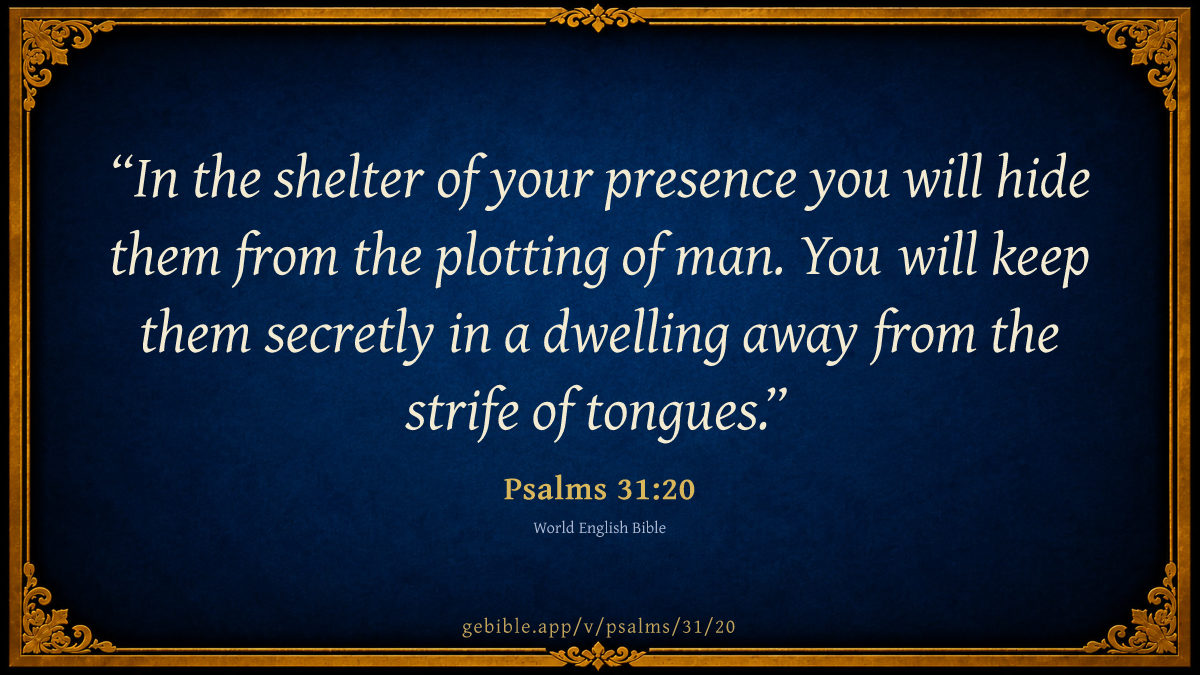
In the shelter of your presence you will hide them from the plotting of man. You will keep them secretly in a dwelling away from the strife of tongues.
Parallel Translations
-
In the shelter of your presence you will hide them from the plotting of man. You will keep them secretly in a dwelling away from the strife of tongues.
-
Thou shalt hide them in the secret of thy presence from the pride of man: thou shalt keep them secretly in a pavilion from the strife of tongues.
-
(31-21) Thou hidest them in the covert of Thy presence from the plottings of man; Thou concealest them in a pavilion from the strife of tongues.
Cross-references (20)
Passages linked to Psalms 31:20 in the Treasury of Scripture Knowledge, ordered by reader-vote popularity; verse text shown in World English Bible.
- Psalms 27:5 For in the day of trouble, he will keep me secretly in his pavilion. In the secret place of his tabernacle, he will hide me. He will lift me up on a rock.
- Psalms 32:7 You are my hiding place. You will preserve me from trouble. You will surround me with songs of deliverance.
- Psalms 91:1-4 He who dwells in the secret place of the Most High will rest in the shadow of the Almighty. I will say of Yahweh, “He is my refuge and my fortress; my God, in whom I trust.” For he will deliver you from the snare of the fowler, and from the deadly pestilence. He will cover you with his feathers. Under his wings you will take refuge. His faithfulness is your shield and rampart.
- Job 5:21 You will be hidden from the scourge of the tongue, neither will you be afraid of destruction when it comes.
- Psalms 64:2-4 Hide me from the conspiracy of the wicked, from the noisy crowd of the ones doing evil; who sharpen their tongue like a sword, and aim their arrows, deadly words, to shoot innocent men from ambushes. They shoot at him suddenly and fearlessly.
- Psalms 140:3 They have sharpened their tongues like a serpent. Viper’s poison is under their lips.
- Psalms 140:5 The proud have hidden a snare for me, they have spread the cords of a net by the path. They have set traps for me.
- Exodus 18:11 Now I know that Yahweh is greater than all gods because of the way that they treated people arrogantly.”
- Psalms 10:2 In arrogance, the wicked hunt down the weak. They are caught in the schemes that they devise.
- Psalms 40:4 Blessed is the man who makes Yahweh his trust, and doesn’t respect the proud, nor such as turn away to lies.
- James 4:6 But he gives more grace. Therefore it says, “God resists the proud, but gives grace to the humble.”
- Psalms 36:11 Don’t let the foot of pride come against me. Don’t let the hand of the wicked drive me away.
- 1 Timothy 6:4 he is conceited, knowing nothing, but obsessed with arguments, disputes, and word battles, from which come envy, strife, insulting, evil suspicions,
- James 3:5-6 So the tongue is also a little member, and boasts great things. See how a small fire can spread to a large forest! And the tongue is a fire. The world of iniquity among our members is the tongue, which defiles the whole body, and sets on fire the course of nature, and is set on fire by Gehenna.
- James 3:14-16 But if you have bitter jealousy and selfish ambition in your heart, don’t boast and don’t lie against the truth. This wisdom is not that which comes down from above, but is earthly, sensual, and demonic. For where jealousy and selfish ambition are, there is confusion and every evil deed.
- Psalms 124:5 then the proud waters would have gone over our soul.
- Romans 13:13 Let’s walk properly, as in the day; not in reveling and drunkenness, not in sexual promiscuity and lustful acts, and not in strife and jealousy.
- 2 Corinthians 12:20 For I am afraid that by any means, when I come, I might find you not the way I want to, and that I might be found by you as you don’t desire, that by any means there would be strife, jealousy, outbursts of anger, factions, slander, whisperings, proud thoughts, or riots,
- Psalms 86:14 God, the proud have risen up against me. A company of violent men have sought after my soul, and they don’t hold regard for you before them.
- Galatians 5:20 idolatry, sorcery, hatred, strife, jealousies, outbursts of anger, rivalries, divisions, heresies,
Cross-references from openbible.info (CC BY 4.0)
Explain this verse (17 sources)
Historical commentary, presented as a primary source — not an endorsement.
Private notes
Saved on this device only — never synced or sent anywhere.
John Calvin 1540 · Public Domain 20. Thou shalt hide them in the secret of…
20. Thou shalt hide them in the secret of thy countenance. In this verse the Psalmist specially commends the grace of God, because it preserves and protects the faithful against all harm. As Satan assiduously and by innumerable means opposes their welfare, and as the greater part of the world is at deadly war with them, they must be exposed to many dangers. Unless God, therefore, protected them by his power, and came from time to time to their aid, their condition would be most miserable. The Psalmist makes an allusion to the hiding which he had just mentioned, and although the metaphor may, at first sight, appear somewhat harsh, it very aptly expresses, that provided the Lord take care of them, the faithful are perfectly safe under his protection alone. By this eulogium, therefore, he sublimely extols the power of divine Providence, because it alone suffices to ward off every species of evil, and while it shines upon the godly, it blinds the eyes of all the wicked, and weakens their hands. “Et que quand elle luit sur les fideles, ses rayons sont pour esblouir les yeux de tous les iniques, et affoiblir leur mains.." — Fr.
This is the reading adopted by Walford. “רכס ,מרכסי, colligavit: hence ‘bands,’ ‘conspiracies.’”
John Calvin's Commentaries (1540-1563) — public domain. Text from the Calvin Translation Society English edition (1840s-50s) via the Christian Classics Ethereal Library (ccel.org). Calvin's coverage is partial (roughly two-thirds of the Bible); uncommented books and verses are honest gaps, never fabricated. The 19th-century editor's footnotes and remarks are omitted so the notes are faithfully Calvin's own voice.
Geneva Bible translators 1599 · Public Domain Hebrew, in the secret of thy face.
Hebrew, in the secret of thy face.
That is, in a place where they shall have thy comfort, and be hid safely from the enemies’ pride.
Geneva Bible (1599) marginal notes — public domain.
John Trapp 1656 · Public Domain Psa 31:20 Thou shalt hide them in the secret…
Psa 31:20 Thou shalt hide them in the secret of thy presence from the pride of man: thou shalt keep them secretly in a pavilion from the strife of tongues.
Ver. 20. Thou shalt hide them in the secret of thy presence] In the golden cabinet of thy gracious providence, where they shall be as safe as if they were in heaven.
Read full note →
Thou shalt keep them secretly in a pavilion] A kind of speech taken from princes’ retiringrooms and withdrawing chambers, which are sacred places (Diodati).
From the strife of tongues] From the calumnies and contumelies of graceless tongue-smiters. The Arabic rendereth it, from the insurrection of tongues. Sedition is first in the tongue, and then in the hand; an unruly tongue setteth on fire, Jas 3:5 But the saints have a promise that as no weapon formed against them shall prosper, so every tongue that riseth against them in judgment shall be condemned, Isa 54:17.
John Trapp, A Commentary or Exposition upon All the Books of the Old and New Testament (1647–1656) — public domain. Text from a community e-Sword module.
Matthew Poole 1685 · Public Domain In the secret of thy presence; or as in…
In the secret of thy presence; or as in the secret of thy presence either,
1. As if they were in thy presence-chamber, where thine own eye and hand guardeth them from all the assaults of their enemies; called his secret, partly because the greatest part of the world are strangers to God and his presence; and partly because it is a safe and secure place, such as secret and unknown places are. Or,
Read full note →
2. As if they were
in the secret of God’s tabernacle, as it is called, Psa 27:5, the place of God’s special presence, where none might enter save the high priest. Or,
3. With thy secret favour and providence, which works mightily, yet secretly, for them, and saves them by hidden and unknown methods. This is opposed to those caves, or other obscure and unsafe places, where David was forced to hide himself.
From the pride of man; from their vain-glorious boasts and threats, and from their bold and insolent attempts.
In a pavilion; or, as in thy pavilion, or tabernacle; and so this clause explains the former, and the pronoun thy is here easily and aptly understood out of the foregoing branch.
From the strife of tongues, i.e. from the mischief of contentious and slanderous tongues.
Matthew Poole's English Annotations on the Holy Bible (1683–1685) — public domain. Text from a community e-Sword/MySword module.
John Gill 1763 · Public Domain Thou shall hide them in the secret of thy…
Thou shall hide them in the secret of thy presence,.... That is, those that fear the Lord and trust in him; and therefore they are called his "hidden ones", Psa 83:3; these the Lord preserves in times of trouble and danger, and when his indignation is out against others; and so the Targum is, "in the time of thine anger"; see Isa 26:20; the presence of God is their protection, he himself is a wall of fire round about them, his favour compasses them as a shield, and they are kept as in a garrison by his power; see Psa 91:1; and that "from the pride of man", which otherwise would at once oppress, bear them down, and destroy them, Psa 124:1;
thou shall keep them secretly in a pavilion from the strife of tongues; which areas a sharp sword, and from whence proceed devouring words, such contradiction of sinners as Christ endured; not that the saints are kept free from the reproaches of men, from the lash of their tongues, but from being harmed by them; and sometimes, through the strivings and contentions of men with one another, they privately escape and are preserved, as the Apostle Paul was, Act 23:9.
John Gill's Exposition of the Whole Bible (1746–1763) — public domain (CC PDM 1.0). Text via the HelloAO Bible API.
John Wesley 1765 · Public Domain The secret - Or, as in the secret of…
The secret - Or, as in the secret of thy presence: either,
1. As if they were in thy presence chamber, where thine own eye and hand girdeth them, from all the assaults of their enemies; called his secret, partly, because the greatest part of the world are strangers to God and his presence: and partly, because it is a safe and secure place, such as secret and unknown places are. Or,
Read full note →
2. As if they were in the secret of God's tabernacle, as it is called, chap. xxvii, 5, the place of God's special presence, where none might enter save the high-priest. With thy secret favour and providence, which saves them by hidden and unknown methods. From - From their vain-glorious boasting and threats, and from their bad and insolent attempts. Pavilion - Or, tabernacle. Strife - From contentious and slandering tongues.
John Wesley, Explanatory Notes Upon the Whole Bible (1754–1765) — public domain. Text via the GEBible commentary corpus.
Adam Clarke 1810 · Public Domain Verse 20. Thou shalt hide them in the secret…
Verse 20. Thou shalt hide them in the secret of thy presence] בסתר פניך besether paneycha, "With the covering of thy countenance." Their life shall be so hidden with Christ in God, that their enemies shall not be able to find them out. To such a hiding-place Satan himself dare not approach. There the pride of man cannot come.
Thou shalt keep them secretly in a pavilion] Thou shalt put them in the innermost part of thy tent. This implies that they shall have much communion and union with God; that they shall be transformed into his likeness, and have his highest approbation.
Adam Clarke's Commentary on the Bible (1810–1826) — public domain. Text from a community e-Sword/MySword module.
Joseph Benson 1811 · Public Domain Psa 31:20. Thou shalt hide them in the secret…
Psa 31:20. Thou shalt hide them in the secret of thy presence — Or, as in the secret of thy presence: either, 1st, As if they were in thy presence- chamber, where thine own eye and hand guard them from all the assaults of their enemies; called his secret, partly because the greatest part of the world are strangers to God and his presence: and partly because it is a safe and secure place, such as secret and unknown places are. Or, 2d, As if they were in the secret of God’s tabernacle, as it is called, Psa 27:5, the place of God’s special presence, where none might enter save the high- priest. Or, 3d, With thy secret favour and providence, which works mightily, yet secretly, for thy people, and saves them by hidden and unknown methods. From the pride of man — From their vain-glorious boasting and threats, and from their bold and insolent attempts. In a pavilion — Or, as in thy pavilion, or tabernacle. From the strife of tongues — From contentious and slandering tongues.
Joseph Benson's Commentary on the Old and New Testaments (1811–1818) — public domain. Text from a community e-Sword module.
Albert Barnes 1834 · Public Domain Thou shalt hide them in the secret of thy…
Thou shalt hide them in the secret of thy presence - See the notes at Psa 27:5. The phrase “secret of thy presence” means thy “secret presence.” The Hebrew is: “the secret of thy face;” and the idea is, that He would hide them, or withdraw them from public view, or from the view of their enemies, into the very place where He Himself dwelt, so that they would be before Him and near Him; so that His eye would be upon them, and that they would be certain of His protection. The language here is the same as in Psa 27:5, except that the word “face” or “presence” is used here instead of the word “tabernacle.” The idea is the same.
From the pride of man - The Hebrew word here rendered “pride” - רכס rôkes - means properly “league” or “conspiracy;” then, “snares” or “plots.” It occurs nowhere else in the Scriptures, though the corresponding verb - רכס râkas - occurs twice, meaning to “bind on” or “to,” Exo 28:28; Exo 39:21. The word here means “league” or “conspiracy,” and the idea is, that when the wicked form a conspiracy, or enter into a league against the righteous, God will take them, as it were, into His own immediate presence, and will protect them.
Read full note →
Thou shalt keep them secretly - Thou wilt “hide” them as with Thyself.
In a pavilion - In Thy tent, or dwelling-place. See the notes at Psa 27:5.
From the strife of tongues - Slander; reproach; calumny. This does not mean the strife of tongues among themselves, or their contentions with each other, but the united clamors of the whole against Himself. God would guard the righteous from their reproaches, or their efforts to ruin them by slander. Compare Psa 37:5-6.
Albert Barnes' Notes on the Bible (1834–1885) — public domain. Text from a community e-Sword/MySword module.
Robert Jamieson, A. R. Fausset & David Brown 1871 · Public Domain the secret of thy presence--or, covering of Thy countenance;…
the secret of thy presence--or, covering of Thy countenance; the protection He thus affords; compare Psa 27:5 for a similar figure; "dwelling" used there for "presence" here. The idea of security further presented by the figure of a tent and a fortified city [Psa 31:21].
Jamieson, Fausset & Brown — Commentary Critical and Explanatory on the Whole Bible (1871) — public domain (CC PDM 1.0). Text via the HelloAO Bible API.
Daniel D. Whedon 1874 · Public Domain 20. From the pride of man—The substantive here rendered…
20. From the pride of man—The substantive here rendered “pride” occurs nowhere else in the Old Testament. The verb means to bind, and hence the idea of a confederacy, which is the sense here, and refers us back to the “counsel” of Psa_31:13.
Pavilion—See on Psa_27:5
Daniel D. Whedon (gen. ed.), Commentary on the Old and New Testaments (1874–1909) — public domain. Text from a community e-Sword module.
The Cambridge Bible for Schools and Colleges 1878 · Public Domain 20. Thou shalt hide them In the hiding-place of…
20. Thou shalt hide them In the hiding-place of thy presence from the plottings of man:
Thou shalt conceal them In a pavilion from the strife of tongues.
Read full note →
With the whole verse cp. Psa_27:5; but the hiding place of thy tent is here spiritualised into the hiding place of thy presence (lit. face as in Psa_31:16). No darkness of evil can penetrate into the light of God’s countenance.
The Cambridge Bible for Schools and Colleges (gen. ed. J. J. S. Perowne; Cambridge University Press, 1878–1918) — public domain. Text from a community e-Sword module.
Ellicott's Commentary for English Readers 1878 · Public Domain (20) The secret of thy presence.—Better, in the hiding-place…
(20) The secret of thy presence.—Better, in the hiding-place of thy countenance, a beautiful thought and common in the Psalms, although expressed by different images. In Psa_27:5, “the hiding-place of his tabernacle;” 61:4, “of his wings;” 91:1, “of his shadow.”
The form the same image takes in the Christian’s hope is beautifully expressed by Tennyson:
Read full note →
“To lie within the light of God as I lie upon your breast,
And the wicked cease from troubling and the weary are at rest.”
Pride.—Better, rough or wrangling talk, as the parallelism shows and the LXX. confirm; and, referring back to Psa_31:18, Gesenius renders the word “conspiracies.”
A Bible Commentary for English Readers, edited by Charles John Ellicott (1878–1897) — public domain. Text from a community e-Sword module.
The Pulpit Commentary 1880 · Public Domain Thou shalt hide (or, thou hidest) them in the…
Thou shalt hide (or, thou hidest) them in the secret of thy presence from the pride (rather, conspiracies) of man. Intense light forms as good a hiding-place as intense darkness. No vision can penetrate it. It is "too dazzling bright for mortal eye." Thus those whom God brings close to himself, and on whom he pours the light of his countenance, need no other protection. Their life is hid in God. Thou shalt keep them (or, thou keepest them) secretly in a pavilion from the strife of tongues. God keeps his own in a "pavilion," or leafy arbour, a place of coolness and refreshment, far away from the "lying lips" (ver. 18) and slanderous tongues (ver. 13) of the ungodly.
The Pulpit Commentary (1880–1919), ed. H.D.M. Spence-Jones & Joseph S. Exell — public domain. Text from a community e-Sword module.
Charles H. Spurgeon 1885 · Public Domain Ver. 20. Thou shalt hide them in the secret…
Ver. 20. Thou shalt hide them in the secret of thy presence from the pride of man. Pride is a barbed weapon: the proud man's contumely is iron which entereth into the soul; but those who trust in God, are safely housed in the Holy of holies, the innermost court, into which no man may dare intrude; here in the secret dwelling place of God the mind of the saint rests in peace, which the foot of pride cannot disturb. Dwellers at the foot of the cross of Christ grow callous to the sneers of the haughty. The wounds of Jesus distil a balsam which heals all the scars which the jagged weapons of contempt can inflict upon us; in fact, when armed with the same mind which was in Christ Jesus, the heart is invulnerable to all the darts of pride. Thou shalt keep them secretly in a pavilion from the strife of tongues. Tongues are more to be dreaded than beasts of preyand when they strive, it is as though a whole pack of wolves were let loose; but the believer is secure even in this peril, for the royal pavilion of the King of kings shall afford him quiet shelter and serene security. The secret tabernacle of sacrifice, and the royal pavilion of sovereignty afford a double security to the Lord's people in their worst distresses. Observe the immediate action of God, "Thou shalt hide, ""Thou shalt keep, "the Lord himself is personally present for the rescue of his afflicted.
Ver. 20. Thou shalt keep them secretly in a pavilion from the strife of tongues. This our beloved God does secretly, so that no human eyes may or can see, and the ungodly do not know that a believer is, in God, and in the presence of God, so well protected, that no reproach or contempt, and no quarrelsome tongue can do him harm. Arndt, quoted by W. Wilson, D.D.
Read full note →
Ver. 20. The believer preserved from the sneers of arrogance by a sense of the divine presence, and kept from the bitterness of slander by the glory of the King whom he serves.
Psalms 31:21*
Charles H. Spurgeon's The Treasury of David (1869–1885) — public domain. Psalms only. Text from a community e-Sword/MySword module.
The Biblical Illustrator 1887 · Public Domain Thou shalt hide them in the secret of Thy…
Psa_31:20
Thou shalt hide them in the secret of Thy presence.
Read full note →
Hid in light
The word rendered presence is literally face, and the force of this very remarkable expression of confidence is considerably marred unless that rendering be retained.
I. the hiding-place. The light of Thy face is secret. What a paradox! Can light conceal? Look at the daily heavens--filled with blazing stars, all invisible till the night falls. The effulgence of the face is such that they that stand in it are lost and hid, like the lark in the blue sky. A glorious privacy of, light is Thine. Light conceals when the light is so bright as to dazzle. They who are surrounded by God are lost in the glory, and safe in that seclusion, the secret of Thy face. The old Greek mythologies tell us that the radiant arrows of Apollo, shot forth from his far-reaching bow, wounded to death the monsters of the slime and unclean creatures that crawled and revelled in darkness. And the myth has a great truth in it. The light of Gods face slays evil, of whatsoever kind it is. Thus the secret of His countenance is the shelter of all that is good. Nor need I remind you how, in another aspect of the phrase, the light of His face is the expression for His favour and loving regard, and how true it is that in that favour and loving regard is the impregnable fortress into which, entering, any man is safe. Only let us remember that for us the face of God is Jesus Christ. He is the arm of the Lord; He is the name of the Lord; He is the face. All that we know of God we know through and in Him; all that we see of God we see by the shining upon us of Him who is the eradiation of His glory and the express image of His person. So the open secret of the face of God is Jesus, the hiding-place of our souls.
II. Gods hidden ones. Thou shalt hide them in the secret of Thy face. Whom? Those that flee for refuge to Thee. The act of simple faith is set forth there, by which a poor man, with all his imperfections, may yet venture to put his foot across the boundary line that separates the outer darkness from the beam of light that comes from Gods face. Remember that Jesus Christ is the hiding-place, and that to flee to Him for refuge is the condition of security, and all those who thus, from the snares of life, from its miseries, disappointments, and burdens; from the agitations of their own hearts, from the ebullition of their own passions; from the stings of their own conscience, or from other of the ills that flesh is heir to, make their hiding-place--by the simple act of faith in Jesus Christ--in the light of Gods face, are thereby safe for evermore. But the initial act of fleeing to the refuge must be continued by abiding in the refuge. But not only by communion, but, also by conduct, must we keep in the light. An eclipse of the sun is not caused by any change in the sun, but by an opaque body, the offspring and satellite of the earth, coming between the earth and sun. And so, when Christian men lose the light of Gods face, it is not because there is any variableness or shadow of turning in Him, but because between Him and them has come the blackness--their own offspring--of their own sin. You are not safe if you are outside the light of the countenance. These are the conditions of security.
III. what the hidden ones find in the light. This burst of confidence in my text comes from the psalmist immediately after plaintively pouring out his soul under the pressure of afflictions. His experience may teach us the interpretation of his glad assurance. God will keep all real evil from us if we keep near Him; but He will not keep the externals that men call evil from us. Though it may leave the external form of evil it takes all the poison out of it and turns it into harmless ministers for our good. Again, we shall find if we live in continual communion with the revealed face of God, that we are elevated high above all the strife of tongues and the noise of earth. (A. Maclaren, D. D.)
The souls refuge in God
These are great words surely. They are an expression of Davids confidence in Gods power and will to hide His people in Himself. He is to be hid from the pride of men, and from the strife of tongues. I suppose that by these phrases we may understand the whole of that cruel and disturbing interference of one mans life with anothers, which may take such an endless variety of forms. The abuse and fault-finding and frivolousness, the foolish quarrellings, strifes of social ambition, of business rivalry, from these we need a refuge as strong as David needed from his enemies. It is good to see how God comes and offers Himself, just here, to the human soul. In the secret of My presence I will hide you.
1. Try first to understand how the soul finds refuge in communion with God. Of all the deep phrases in the Bible, where can we find one deeper than this of David, Thou wilt keep him in the secret of Thy presence? They mean that when a man is spiritually conscious of the presence of God it secludes and separates him from every other presence. Can we understand that? You go into a room full of people, and the tumult of tongues is all about you. You are bewildered and distracted, in the ordinary language of society, which sometimes hits the truth of its own condition rightly, you feel lost. You lose yourself in the presence of so many people. You are merely part of the tumult. But by and by you meet your best friend there; somebody whose life is your life; somebody whom you sincerely love and trust; somebody who thoroughly satisfies you, and, by the contact of his nature, makes your taste and brain and heart and conscience work at their very best. As you draw near to him it seems as if you drew away from all the other people. As he takes hold of you, he seems to claim you, and they let you go. The worry and vexation of the Crowd sink away as he begins to talk with you, and you understand one another. By and by you have forgotten that all those other men are talking around you. You have escaped from the strife of tongues. You are absorbed in him. He has hid you in the secret of his presence. And now it is possible, instead of your best friend, for God Himself to be with you, so that His presence is real, so that lie lets you understand His thoughts and lets you know that He understands yours, so that there is a true sympathy between you and Him, if mere vision and hearing are not necessary go the Divine company, and as close to you--nay, infinitely closer--than the men who crowd you round, and whose voices are in your ears, the unseen God is truly with you, what then? Can any tumult of those men distress you? They parade their foolish vanities before you, and you hardly see them. This gives the very simplest notion of the meaning. Now we suppose that this becomes habitual, the constant temper and condition of a life. We suppose this friendly meeting with one who interests you thoroughly to pass into a friendship, pure, continual, devoted. If not in bodily presence, still in thought and sympathy, our friend is always with us. We always judge ourselves by his standard. We think what he would like or what he would condemn; we appeal even in his absence to his approbation. Is not the protection which we saw given to a man by his friends company for an hour while they talked together extended now over all his life?
2. A true Christian faith starts with the truth of a personal redemption and leads the man up to personal duties. It takes this poor indistinguishable atom and says to him: God knows you. To Him you are not only one of the race; He knows you separately; He made you separately, His Son died for you, and there is in you that which, in some way which belongs to you alone, can glorify Him. What are you doing in this feeble, unconscientious life? Have you never heard of such a thing as responsibility? Get up; repent. Come to God. Get the pattern of your life from Him, and then go about your work and be yourself. If the man is really a Christian he hears that summons, and it is the birth of a true personality, of the real sense of himself in him. It is a revelation.
3. As we look over Christs career, how can we describe its serenity and composure except in these words: God hid Him in the secret of His presence from the pride of man, and kept Him secretly in a pavilion from the strife of tongues. How the strife of tongues raged about Him all His life I From the time when Herod and the scribes debated where He was to be born, that they might murder Him, till the day when the people cried, Crucify Him, and mocked Him as He hung upon the Cross. But, close to His Father always, clear in His own duty always, and always trying to help men so earnestly that He was not capable of being provoked by them, He was completely apart from all the strife. He was hid in the secret of His Fathers presence. (Bp. Phillips Brooks.)
Our refuge in God
All temples in ancient times were asylums. Whosoever could flee to grasp the horns of the altar, or to sit, veiled and suppliant, before the image of the god, was secure from his foes, who could not pass within the limits of the temple grounds, in which strife and murder were not permissible. We too often flee to other gods and other temples for our refuges. Aye! and when we get there we find that the deity whom we have invoked is only a marble image that sits deaf, dumb, motionless whilst we cling to its unconscious skirts. As one of the saddest of our modern cynics once said, looking up at that lovely impersonation of Greek beauty, the Venus de Mile, Ah! she is fair; but she has no arms. So we may say of all false refuges to which men betake themselves. The goddess is powerless to help, however beautiful the presentiment of her may have seemed to our eyes. There is only one shrine where there is a sanctuary, and that is the shrine above which shines the glory of God in the face of Jesus Christ; into the brightness of which poor men may pass and therein may hide themselves. God hides us, and His hiding is effectual, in the secret of the light and splendour of His face. (A. Maclaren, D. D.)
The refuge from talk
The author of this psalm had evidently suffered much from the talk of society. The strife of tongues had raged, and its armies had wounded him. And his experience is that of not a few. A large share of good mens troubles come out of the talk of others. Every man has his own little public, and that public talks, and their talk worries, so that the subject of it cries out for the wings of a dove that he may fly away and be at rest.
I. the strife of tongues. What an expressive phrase that is. How the element of contention asserts itself in the great mass of the worlds talk. I remember being once at a fair in a foreign city, and before each booth stood a crier, sometimes aided by musical instruments; each crier endeavouring to raise his voice above the others in advertising the attractions of his show. It was a good picture of the world at large, where so many people have something to say, something which they are determined the world shall hear, no matter who else goes unheard. Then, how much debate--often useless--there is. And how selfish, carried on not for others, but the mans own advantage. And, then, there is the hiss of slanderous tongues striving against the innocent, and of gossiping tongues striving which can tell most news--bad or good, false or true, it matters not. Now, men get weary of this. We grow blinded and stunned by this excess of talk. We want leisure to think, and to weigh, and to adjust things. If perchance a great seed-thought has floated to us on these winds of oratory and debate, we would fain give it time to strike its roots deep down into our hearts and minds. And we grow ashamed of ourselves, because we are so often drawn into this current of talk about our neighbours. We hear the gossip, and we happen to know a fact or to have heard a piece of news, and almost ere we know it, in it goes into the common stock: and, if we are not very careful, we find ourselves falling into censorious talk, flinging out sharp arrows of sarcasm or pulling a neighbours defects a little farther out into the light; and when we come to sit down and think over what we have said, unless we are very much hardened, we feel ashamed.
II. the refuge.
1. Now, it will not do for us to defy public talk, and to do, wantonly, what shocks social sentiment and multiplies talk. For the talk of society is by no means an unmixed evil. It hurts a good many men, and that unjustly; but it also keeps not a few men steady. It begets a wholesome fear. It is good to have a manly respect for public opinion, and a manly desire for societys esteem. Defiance of society, then, is not our refuge from the strife of tongues.
2. The world does not afford it. To get out of the reach of talk is to quit the world altogether, which is no mans duty but his sin if he attempts it. God provides better for men than by withdrawing them from the world where their work lies.
3. Man is delivered from temptation, not by being taken out of it, but by being helped to conquer it. In putting a man in right relations with Himself, God puts him in right relation to the worlds talk.
III. Let us look at some illustrations of this, growing out of what has been already said.
1. There is the matter of slander and abuse. God does not always exempt good men from these. The man of science delights to show you how he can handle fire, and even go into the fire unhurt. That is a greater achievement than keeping away from the fire. A good man is given to thinking that, if his good name in the world is gone, if the worlds talk casts up nothing hut mire and dirt, it is all over with him. God shows him that he can live, and live quietly and cheerfully, on the simple fact of his conscious integrity before God.
2. Sometimes God saves one from the strife of tongues by putting him where he cannot talk and where others cannot talk to him. He sends a calamity so overwhelming that his friends do not know what to say to him, and the man himself cannot reason about it, cannot argue, cannot explain, is simply reduced to silence. All that he can say is, I am dumb; I open not my mouth because Thou didst it. He must find his only explanation in that simple fact, God did it. God seems to say to him, Be still! There is only one thing you can know about this matter. Be still and know that I am God.
3. Again, God shields good men from the worlds talk by hardening them against it. Exposure is often the best remedy for certain bodily ailments, and that is a kind of cure God often employs for the soul. Archbishop Whately, of Dublin, who died in 1863, was among the sturdiest men of his time, a man of undaunted courage, and withal of that genuine originality which awakens comment and opposition. Much of his official life was passed under a fire of censure, lie once said of himself, My stumbling-block most to be guarded against was the dread of censure. Few would conjecture this from seeing how I have braved it all my life, and how I have perpetually been in hot water, when, in truth, I had a natural aversion to it. So I set myself resolutely to act as though I cared nothing for either the sweet or the bitter, and in time I got hardened. But no earthly object could ever pay me for the labour and the anguish of modelling my nature in these respects. I have succeeded so far that I have even found myself standing firm where some men of constitutional intrepidity have given way. And this will always be the case more or less, through Gods help, if we will but persevere from a right motive.
4. Again, God hides His servant from the strife of tongues by filling his hands with work for others. Tim more one is interested in the welfare of men, the less he will care for their talk; for a good deal of sensitiveness is merely selfishness, after all. That, is a kind of sensitiveness which may be cured; and the best way of curing it is to get the life filled with Christs spirit of ministry. Then what the world is saying of you will go by you like the idle wind. I remember how I went with the Christian commission during the war to help in nursing the sick and wounded. I was peculiarly sensitive to the sight of physical suffering, and my friends laughed at me and said, You will faint at the sight of blood. And I quite feared I should. But it was not so. From the moment that I sat down beside the first man that met my eye, a poor fellow with a muskeg-bullet through his jaw, and tried, while I applied the cooling water, to drop a word or two about Christ and His rest for the weary--all my shrinking vanished. I thought only of those wounded men. I had little or no self-consciousness left. I saw only that colossal misery. That experience was worth a great deal to me, and that is the reason I tell it to you, for it illustrates a universal truth. Get yourself thoroughly interested in other peoples bodies and souls; get the question, What can I do for them? uppermost in your thought, and the worlds gossip about you will attract as little notice as the drifting sea-weed.
5. And I need scarcely add that this is the best way to keep ourselves from being sharers in the worlds gossip. He who dwells in the secret of Gods presence learns to take Gods attitude toward infirmity and error--the attitude of One who remembers that His children are dust, and pities them accordingly. The tongue of such an one will not be a weapon of strife. These are some of the methods in which God hides His people from the strife of tongues; and all these methods are embraced in this one comprehensive fact--that He hides them in the hiding-place of His presence. Then, your life is hid with Christ in God. If we are really Christs, then back into the very bosom of His Father where Christ is hid, there lie will carry us. We, too, shall look out and be as calm and as independent as He is. The needs of men shall touch us just as keenly as they touch Him, but the sneers and strifes of men shall pass us by as they pass by Him and leave no mark on His unruffled life. This, then, is the conclusion of the whole matter. In this world we must be exposed to the strife of tongues. Let God hide thee in the secret of His pavilion and thou needest not fear. (M. R. Vincent, D. D.)
The Biblical Illustrator, edited by Joseph S. Exell (c. 1880s–1900s) — public domain. Text from a community e-Sword module.
Alexander MacLaren 1905 · Public Domain
Psalms
HID IN LIGHT
Read full note →
Psa 31:20.
The word rendered ‘presence’ is literally ‘face,’ and the force of this very remarkable expression of confidence is considerably marred unless that rendering be retained. There are other analogous expressions in Scripture, setting forth, under various metaphors, God’s protection of them that love Him. But I know not that there is any so noble and striking as this. For instance, we read of His hiding His children ‘in the secret of His tabernacle,’ or tent; as an Arab chief might do a fugitive who had eaten of his salt, secreting him in the recesses of his tent whilst the pursuers scoured the desert in vain for their prey. Again, we read of His hiding them ‘beneath the shadow of His wing’; where the divine love is softened into the likeness of the maternal instinct which leads a hen to gather her chickens beneath the shelter of her own warm and outspread feathers. But the metaphor of my text is more vivid and beautiful still. ‘Thou shalt hide them in the secret of Thy face.’ The light that streams from that countenance is the hiding-place for a poor man. These other metaphors may refer, perhaps, the one to the temple, and the other to the outstretched wings of the cherubim that shadowed the Mercy-seat. And, if so, this metaphor carries us still more near to the central blaze of the Shekinah, the glory that hovered above the Mercy-seat, and glowed in the dark sanctuary, unseen but once a year by one trembling high priest, who had to bear with him blood of sacrifice, lest the sight should slay. The Psalmist says, into that fierce light a man may go, and stand in it, bathed, hid, secure. ‘Thou shalt hide them in the secret of Thy face.’
I. Now, then, let us notice, first, this hiding-place.
The ‘face’ of God is so strongly figurative an expression that its metaphorical character cannot but be obvious to the most cursory reader. The very frankness, and, we may say, the grossness of the image, saves it from all misconception, and as with other similar expressions in the Old Testament, at once suggests its meaning. We read, for example, of the ‘arm,’ the ‘hand,’ the ‘finger’ of God, and everybody feels that these mean His power. We read of the ‘eye’ of God, and everybody knows that that means His omniscience. We read of the ‘ear’ of God, and we all understand that that holds forth the blessed thought that He hears and answers the cry of such as be sorrowful. And, in like manner, the ‘face’ of God is the apprehensible part of the divine nature which turns to men, and by which He makes Himself known. It is roughly equivalent to the other Old and New Testament expression, the ‘name of the Lord,’ the manifested and revealed side of the divine nature. And that is the hiding-place into which men may go.
We have the other expression also in Scripture, ‘the light of Thy countenance,’ and that helps us to apprehend the Psalmist’s meaning. ‘The light of Thy face’ is ‘secret.’ What a paradox! Can light conceal? Look at the daily heavens-filled with blazing stars, all invisible till the night falls. The effulgence of the face is such that they that stand in it are lost and hid, like the lark in the blue sky. ‘A glorious privacy of light is Thine.’ There is a wonderful metaphor in the New Testament of a woman ‘clothed with the sun,’ and caught up into it from her enemies to be safe there. And that is just an expansion of the Psalmist’s grand paradox, ‘Thou shalt hide them in the secret of Thy face.’ Light conceals when the light is so bright as to dazzle. They who are surrounded by God are lost in the glory, and safe in that seclusion, ‘the secret of Thy face.’
A thought may be suggested, although it is somewhat of a digression from the main purpose of my text, but it springs naturally out of this paradox, and may just deserve a word. Revelation is real, but revelation has its limits. That which is revealed is ‘the face of God,’ but we read, ‘no man can see My face.’ After all revelation He remains hidden. After all pouring forth of His beams He remains ‘the God that dwelleth in the thick darkness,’ and the light which is inaccessible is also a darkness that can be felt. Apprehension is possible; comprehension is impossible. What we know of God is valid and true, but we never shall know all the depths that lie in that which we do know of Him. His face is ‘the secret’; and though men may malign Him when they say, ‘Verily, Thou art a God that hidest Thyself, O God of Israel!’ and He answers them, ‘I have not spoken in secret’ in a dark ‘place of the earth,’ it still remains true that revelation has its mysteries born of the greatness of its effulgence, and that all which we know of God is ‘dark with excess of light.’
But that is aside from our main purpose. Let me rather remind you of how the thought of the secret of God’s face being the secure hiding-place of them that love Him points to this truth-that that brightness of light has a repellent power which keeps far away from all intermingling with it everything that is evil. The old Greek mythologies tell us that the radiant arrows of Apollo shot forth from his far-reaching bow, wounded to death the monsters of the slime and unclean creatures that crawled and revelled in darkness. And the myth has a great truth in it. The light of God’s face slays evil, of whatsoever kind it is; and just as the unlovely, loathsome creatures that live in the dark and find themselves at ease there writhe and wriggle in torment, and die when their shelter is taken away and they are exposed to the light beating on their soft bodies, so the light of God’s face turned upon evil things smites them into nothingness. Thus ‘the secret of His countenance’ is the shelter of all that is good.
Nor need I remind you how, in another aspect of the phrase, the ‘light of His face,’ is the expression for His favour and loving regard, and how true it is that in that favour and loving regard is the impregnable fortress into which, entering, any man is safe. I said that the expression the ‘face of the Lord’ roughly corresponded to the other one, ‘the name of the Lord,’ inasmuch as both meant the revealed aspect of the divine nature. You may remember how we read, ‘The name of the Lord is a strong tower into which the righteous runneth and is safe.’ The ‘light’ of the face of the Lord is His favour and loving regard falling upon men. And who can be harmed with that lambent light-like sunshine upon water, or upon a glittering shield-playing around Him?
Only let us remember that for us ‘the face of God’ is Jesus Christ. He is the ‘arm’ of the Lord; He is the ‘name’ of the Lord; He is the ‘face.’ All that we know of God we know through and in Him; all that we see of God we see by the shining upon us of Him who is ‘the eradiation of His glory and the express image of His person.’ So the open secret of the ‘face’ of God is Jesus, the hiding-place of our souls.
II. Secondly, notice God’s hidden ones.
My text carries us back, by that word ‘them,’ to the previous verse, where we have a double description of those who are thus hidden in the inaccessible light of His countenance. They are ‘such as fear Thee,’ and ‘such as trust in Thee.’ Now, that latter expression is congruous with the metaphor of my text, in so far as the words on which we are now engaged speak about a ‘hiding-place,’ and the word which is translated ‘trust’ literally means ‘to flee to a refuge.’ So they that flee to God for refuge are those whom God hides in the ‘secret of His face.’ Let us think of that for a moment.
I said, in the beginning of these remarks, that there was here an allusion, possibly, to the Temple. All temples in ancient times were asylums. Whosoever could flee to grasp the horns of the altar, or to sit, veiled and suppliant, before the image of the god, was secure from his foes, who could not pass within the limits of the Temple grounds, in which strife and murder were not permissible. We too often flee to other gods and other temples for our refuges. Ay! and when we get there we find that the deity whom we have invoked is only a marble image that sits deaf, dumb, motionless, whilst we cling to its unconscious skirts. As one of the saddest of our modern cynics once said, looking up at that lovely impersonation of Greek beauty, the Venus de Milo, ‘Ah! she is fair; but she has no arms,’ so we may say of all false refuges to which men betake themselves. The goddess is powerless to help, however beautiful the presentment of her may have seemed to our eyes. The evils from which we have fled to these false deities and shelterless sanctuaries will pursue us across the threshold; and as Elijah did with the priests of Baal upon Carmel, will slay us at the very foot of the altar to which we have clung, and vexed with our vain prayers. There is only one shrine where there is a sanctuary, and that is the shrine above which shines ‘the glory of God in the face of Jesus Christ’; into the brightness of which poor men may pass and therein may hide themselves. God hides us, and His hiding is effectual, in the secret of the light and splendour of His face.
I said, too, that there was an allusion, as there is in all the psalms that deal with men as God’s guests, to the ancient customs of hospitality, by which a man who has once entered the tent of the chief, and partaken of food there, is safe, not only from his pursuers, but from his host himself, even though that host should be the kinsman-avenger. The red-handed murderer, who has eaten the salt of the man whose duty it otherwise would have been to slay him where he stood, is safe from his vengeance. And thus they who cast themselves upon God have nothing to fear. No other hand can pluck them from the sanctuary of His tent. He Himself, having admitted them to share His hospitality, cannot and will not lift a hand against them. We are safe from God only when we are safe in God.
But remember the condition on which this security comes. ‘Thou shalt hide them in the secret of Thy face.’ Whom? Those that flee for refuge to Thee. The act of simple faith is set forth there, by which a poor man, with all his imperfections on his head, may yet venture to put his foot across the boundary line that separates the outer darkness from the beam of light that comes from God’s face. ‘Who among us shall dwell with the devouring fire? Who among us shall dwell with everlasting burnings?’ That question does not mean, as it is often taken to mean-What mortal can endure the punishments of a future life? but, Who can venture to be God’s guests? and it is equivalent to the other interrogation, ‘Who shall ascend to the hill of the Lord, or who shall stand in His holy place?’ The answer is, If you go to Him for refuge, knowing your danger, feeling your impurity, you may walk amidst all that light softened into lambent beauty, as those Hebrew children did in the furnace of fire, being at ease there, and feeling it well with themselves, and having nothing about them consumed except the bonds that bound them.
Remember that Jesus Christ is the Hiding-place, and that to flee to Him for refuge is the condition of security, and all they who thus, from the snares of life, from its miseries, disappointments, and burdens, from the agitation of their own hearts, from the ebullition of their own passions, from the stings of their own conscience, or from other of the ills that flesh is heir to, make their hiding-place-by the simple act of faith in Jesus Christ-in the light of God’s face, are thereby safe for evermore.
But the initial act of fleeing to the refuge must be continued by abiding in the refuge. It is of no use to take shelter in the light unless we abide in the light. It is of no use to go to the Temple for sanctuary unless we continue in it for sacrifice and worship. We must ‘walk in the light as God is in the light.’ That is to say, the condition of being hid in God is, first of all, to take refuge in Jesus Christ, and then to abide in Him by continual communion. ‘Your life is hid with Christ in God.’ Unless we have a hidden life, deep beneath, and high above, and far beyond the life of sense, we have no right to think that the shelter of the Face will be security for us. The very essence of Christianity is the habitual communion of heart, mind, and will with God in Christ. Do you live in the light, or have you only gone there to escape what you are afraid of? Do you live in the light by the continual direction of thought and heart to Him, cultivating the habit of daily and hourly communion with Him amidst the distractions of necessary duty, care, and changing circumstances?
But not only by communion, but also by conduct, must we keep in the light. The fugitive found outside the city of refuge was fair game for the avenger, and if he strayed beyond its bounds there was a sword in his back before he knew where he was. Every Christian, by each sin, whether it be acted or only thought, casts himself out of the light into the darkness that rings it round, and out there he is a victim to the beasts of prey that hunt in darkness. An eclipse of the sun is not caused by any change in the sun, but by an opaque body, the offspring and satellite of the earth, coming between the earth and sun. And so, when Christian men lose the light of God’s face, it is not because there is any ‘variableness or shadow of turning’ in Him, but because between Him and them has come the blackness-their own offspring-of their own sin. You are not safe if you are outside the light of His countenance. These are the conditions of security.
III. Lastly, note what the hidden ones find in the light.
This burst of confidence in my text comes from the Psalmist immediately after plaintively pouring out his soul under the pressure of afflictions. His experience may teach us the interpretation of his glad assurance.
God will keep all real evil from us if we keep near Him; but He will not keep the externals that men call evil from us. I do not know whether there is such a thing as filtering any poisons or malaria by means of light, but I am sure that the light of God filters our atmosphere for us. Though it may leave the external form of evil it takes all the poison out of it and turns it into a harmless minister for our good. The arrows that are launched at us may be tipped with venom when they leave the bow, but if they pass through the radiant envelope of divine protection that surrounds us-and they must have passed through that if they reach us-it cleanses all the venom from the points though it leaves the sharpness there. The evil is not an evil if it has got our length; and its having touched us shows that He who lets it pass into the light where His children safely dwell, knows that it cannot harm them.
But, again, we shall find if we live in continual communion with the revealed Face of God, that we are elevated high above all the strife of tongues and the noise of earth. We shall ‘outsoar the shadow of the night,’ and be lifted to an elevation from which all the clamours of earth will sound faint and poor, like the noises of the city to the dwellers on the mountain peak. Nor do we find only security there, for the word in the second clause of my text, ‘Thou shalt keep them secretly,’ is the same as is employed in the previous verse in reference to the treasures which God lays up for them that fear Him. The poor men that trust in God, and the wealth which He has to lavish upon them, are both hid, and they are hid in the same place. The ‘goodness wrought before the sons of men’ has not emptied the reservoir. After all expenditure the massy ingots of gold in God’s storehouse are undiminished. The mercy still to come is greater than that already received. ‘To-morrow shall be as this day and much more abundant.’ This river broadens as we mount towards its source.
Brethren! the Face of God must be either our dearest joy or our greatest dread. There comes a time when you and I must front it, and look into His eyes. It is for us to settle whether at that day we shall ‘call upon the rocks and the hills to hide us’ from it, or whether we shall say with rapture, ‘Thou hast made us most blessed with Thy countenance’! Which is it to be? It must be one or other. When He says, ‘Seek ye My Face,’ may our hearts answer, ‘Thy Face, Lord, will I seek,’ that when we see it hereafter, shining as the sun in his strength, its light may not be darkness to our impure and horror-struck eyes.
Alexander MacLaren, Expositions of Holy Scripture (1904–1910) — public domain. Text from a community e-Sword module.