
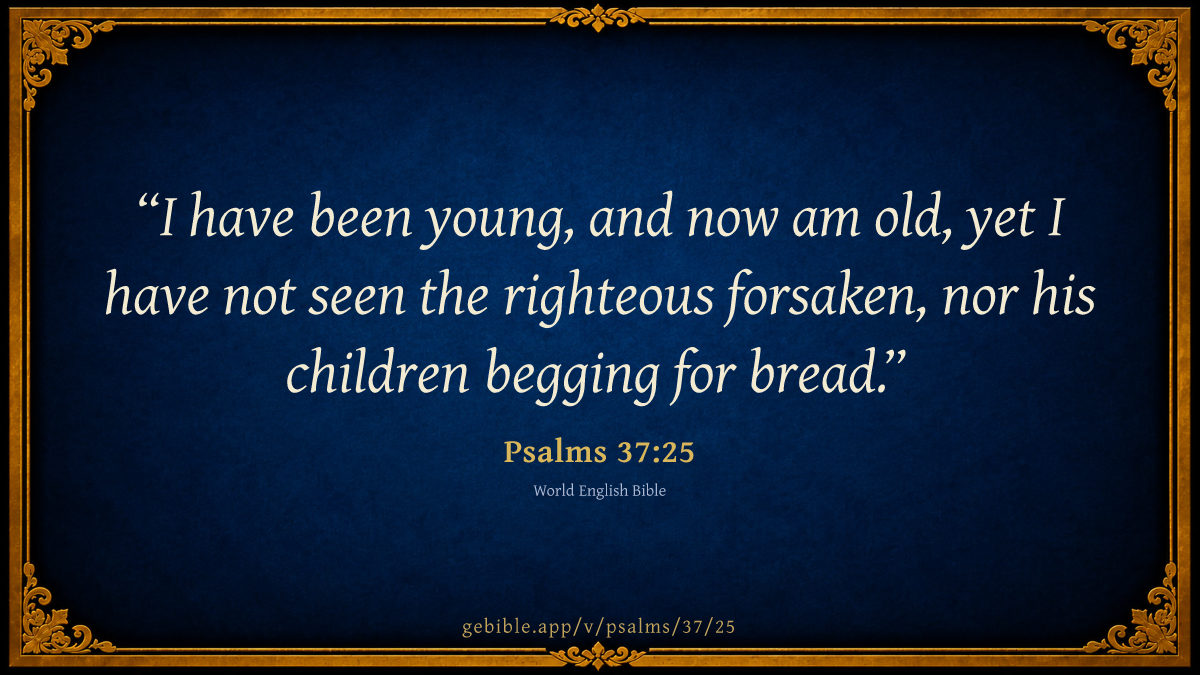
I have been young, and now am old, yet I have not seen the righteous forsaken, nor his children begging for bread.
Parallel Translations
-
I have been young, and now am old, yet I have not seen the righteous forsaken, nor his children begging for bread.
-
I have been young, and now am old; yet have I not seen the righteous forsaken, nor his seed begging bread.
-
I have been young, and now am old; yet have I not seen the righteous forsaken, nor his seed begging bread.
Examined in Scripture Analysis
Contradictions (2)
Questions where the Bible appears to say two different things, with the passages on each side set together.
Cross-references (21)
Passages linked to Psalms 37:25 in the Treasury of Scripture Knowledge, ordered by reader-vote popularity; verse text shown in World English Bible.
- Hebrews 13:5 Be free from the love of money, content with such things as you have, for he has said, “I will in no way leave you, neither will I in any way forsake you.”
- Psalms 37:28 For Yahweh loves justice, and doesn’t forsake his saints. They are preserved forever, but the children of the wicked shall be cut off.
- Psalms 25:13 His soul will dwell at ease. His offspring will inherit the land.
- 1 Samuel 12:22 For Yahweh will not forsake his people for his great name’s sake, because it has pleased Yahweh to make you a people for himself.
- Psalms 112:2 His offspring will be mighty in the land. The generation of the upright will be blessed.
- 2 Corinthians 4:9 pursued, yet not forsaken; struck down, yet not destroyed;
- Psalms 94:14 For Yahweh won’t reject his people, neither will he forsake his inheritance.
- Psalms 71:18 Yes, even when I am old and gray-haired, God, don’t forsake me, until I have declared your strength to the next generation, your might to everyone who is to come.
- Joshua 1:5 No man will be able to stand before you all the days of your life. As I was with Moses, so I will be with you. I will not fail you nor forsake you.
- Genesis 17:7 I will establish my covenant between me and you and your offspring after you throughout their generations for an everlasting covenant, to be a God to you and to your offspring after you.
- Luke 1:53-55 He has filled the hungry with good things. He has sent the rich away empty. He has given help to Israel, his servant, that he might remember mercy, as he spoke to our fathers, to Abraham and his offspring forever.”
- Proverbs 13:22 A good man leaves an inheritance to his children’s children, but the wealth of the sinner is stored for the righteous.
- Psalms 71:9 Don’t reject me in my old age. Don’t forsake me when my strength fails.
- Hebrews 12:5-6 You have forgotten the exhortation which reasons with you as with children, “My son, don’t take lightly the chastening of the Lord, nor faint when you are reproved by him; for whom the Lord loves, he disciplines, and chastises every son whom he receives.”
- Job 32:6-7 Elihu the son of Barachel the Buzite answered, “I am young, and you are very old; Therefore I held back, and didn’t dare show you my opinion. I said, ‘Days should speak, and multitude of years should teach wisdom.’
- Job 15:23 He wanders abroad for bread, saying, ‘Where is it?’ He knows that the day of darkness is ready at his hand.
- Acts 21:16 Some of the disciples from Caesarea also went with us, bringing one Mnason of Cyprus, an early disciple, with whom we would stay.
- Philemon 1:8-9 Therefore though I have all boldness in Christ to command you that which is appropriate, yet for love’s sake I rather beg, being such a one as Paul, the aged, but also a prisoner of Jesus Christ.
- Psalms 59:15 They shall wander up and down for food, and wait all night if they aren’t satisfied.
- Isaiah 13:16 Their infants also will be dashed in pieces before their eyes. Their houses will be ransacked, and their wives raped.
- Psalms 109:10 Let his children be wandering beggars. Let them be sought from their ruins.
Cross-references from openbible.info (CC BY 4.0)
Explain this verse (16 sources)
Historical commentary, presented as a primary source — not an endorsement.
Private notes
Saved on this device only — never synced or sent anywhere.
John Calvin 1540 · Public Domain 25 I have been young, I am also become…
25 I have been young, I am also become old. The meaning of these words is not in the least doubtful, namely, that David, even when he was become an old man, had not seen any of the righteous, or any of their children, begging their bread. But here there arises a question of some difficulty with respect to the fact stated; for it is certain that many righteous men have been reduced to beggary. And what David here declares as the result of his own experience pertains to all ages. Besides, he refers in this verse to the writings of Moses, for in Deuteronomy 15:4, begging is reckoned among the curses of God; and the law, in that place, expressly exempts from it those who fear and serve God. How then does the consistency of this appear, that none of the righteous ever begged his bread, since Christ placed Lazarus among the most abject of them? (Luke 16:20.) I answer, that we must bear in mind what I have before said upon this subject, that with respect to the temporal blessings which God confers upon his people, no certain or uniform rule can be established. There are various reasons why God does not manifest his favor equally to all the godly in this world. He chastises some, while he spares others: he heals the secret maladies of some, and passes by others, because they have no need of a like remedy: he exercises the patience of some, according as he has given them the spirit of fortitude; and, finally, he sets forth others by way of example. But in general, he humbles all of them by the tokens of his anger, that by secret warnings they may be brought to repentance. Besides, he leads them, by a variety of afflictions, to fix their thoughts in meditation upon the heavenly life; and yet it is not a vain or imaginary thing, that, as is set forth in the Law, God vouchsafes earthly blessings to his servants as proofs of his favor toward them. I confess, I say, that it is not in vain, or for nought, that an abundance of earthly blessings, sufficient for the supply of all their wants, is promised to the godly. This, however, is always to be understood with this limitation, that God will bestow these blessings only in so far as he shall consider it expedient: and, accordingly, it may happen that the blessing of God may be manifested in the life of men in general, and yet some of the godly be pinched with poverty, because it is for their good. But if it happen that any of the faithful are brought to beggary, they should lift up their minds on high, to that blessed state in which God will largely recompense them for all that is now wanting in the blessings of this transitory life. We must also bear this in mind, that if God sometimes involve the faithful in the same punishments by which he takes vengeance upon the ungodly — seeing them, for example, affected with the same diseases, — in doing so there is no inconsistency; for although they do not come the length of contemning God, nor are devoted to wickedness, nor even act according to their own inclination, nor yield themselves wholly to the influence of sin like the wicked, yet are they not free of all blame; and, therefore, it need not surprise us though they are sometimes subjected to temporal punishments. We are, however, certain of this, that God makes such provision for his own people, that, being contented with their lot, they are never in want; because, by living sparingly, they always have enough, as Paul says, Philippians 6:12,
“I am instructed both to abound and to suffer need.”
John Calvin's Commentaries (1540-1563) — public domain. Text from the Calvin Translation Society English edition (1840s-50s) via the Christian Classics Ethereal Library (ccel.org). Calvin's coverage is partial (roughly two-thirds of the Bible); uncommented books and verses are honest gaps, never fabricated. The 19th-century editor's footnotes and remarks are omitted so the notes are faithfully Calvin's own voice.
Geneva Bible translators 1599 · Public Domain Though the just man die, yet God’s blessings are…
Though the just man die, yet God’s blessings are extended to his posterity, and though God suffer some just man to lack temporal benefits, yet he recompenseth him with spiritual treasures.
Geneva Bible (1599) marginal notes — public domain.
John Trapp 1656 · Public Domain Psa 37:25 I have been young, and [now] am…
Psa 37:25 I have been young, and [now] am old; yet have I not seen the righteous forsaken, nor his seed begging bread.
Ver. 25. I have been young, &c.] Here he recordeth an experiment of his (such as whereof Psa 119:1-176 is mostly made up), and if other men’s experiences agree not altogether with his, it is no wonder; kings use not to mind beggars. Or he might only mean vagrants; according to that, "Let their children be vagabonds, and beg their bread." Good men may be compelled to crave their bread, as David himself did of Ahimelech, the high priest; as Elijah did of the widow of Sarepta; as those pauperes de Lugduno, and many others have lived upon alms. But seldom or never have good people needed to crave relief of the ungodly.
Read full note →
Yet have I not seen the righteous forsaken] Left he may be for a time, as the lion leaveth his whelps till they are almost famished, and have well-nigh killed themselves with roaring, to make them more hardy and valiant, but never forsaken, no, though he beg his bread; because God hath said, "I will never leave thee, nor forsake thee." The righteous is never forsaken, nor his seed too, said Mr Perkins. God may cast godly parents into want, but their godly children shall surely he blessed. Others understand by righteous here, merciful men, who give alms for the love of God, and therefore come not to poverty, Psa 112:5; Psa 112:9 Pro 11:24-25 Psa 41:1. See Mr Bradford’s sweet letter to Mr John Hall and his wife, prisoners for the gospel (Acts and Mon. 1495).
John Trapp, A Commentary or Exposition upon All the Books of the Old and New Testament (1647–1656) — public domain. Text from a community e-Sword module.
Matthew Poole 1685 · Public Domain This assertion seems to be contradicted by many experiences;…
This assertion seems to be contradicted by many experiences; nor can it be denied, that both good men and their children have sometimes been reduced to great want.
Quest. How then is this true?
Read full note →
Answ.
1. Some render the last clause thus, nor (did I ever see)
his seed, ( to wit, forsaken, as was now said,) though
begging bread. So the sense is, I have seen him brought to beggary, yet even then God did not forsake him. But this sense agrees not with the context nor scope, which is to show the plenty and prosperity where with God blesseth him.
2. This is to be understood of the seed of the righteous treading in their fathers’ steps, from which if they degenerate, they lose all their privileges, as many places of Scripture witness.
3. Some few exceptions do not destroy the truth of a general proposition.
4. These temporal promises were more express and particular to the Jews in the times of the Old Testament, than to Christians in the New, and therefore were more literally fulfilled.
5. He speaks not of any kind of wanting, or desiring, or receiving relief from others, for so David himself did, 1Sa 21:3; 25:8; but of the customary practice and trade of begging, which was threatened as a curse to the disobedient, Deu 28; Psa 109:10.
6. Not begging, to wit, in vain; or so as to be forsaken, as was now expressed, and may very well be here understood; or so as to be sustained or relieved by others.
7. David speaks only of his own experience, which if since that time it be contradicted by other men’s experiences, it is no more than what happens in all the concernments of human life.
Matthew Poole's English Annotations on the Holy Bible (1683–1685) — public domain. Text from a community e-Sword/MySword module.
John Gill 1763 · Public Domain He is ever merciful, and lendeth,.... He sympathizes with…
He is ever merciful, and lendeth,.... He sympathizes with the poor in distress, and shows mercy to miserable objects; not only by words, but deeds: and this is his constant disposition and conduct; of which his lending, as well as giving to persons in necessity, is an instance; and which shows capacity, and is a proof of the observation of the psalmist, that such are never forsaken, nor left to beg their bread: so far from it, that they have to lend and give to others;
and his seed is blessed; either his seed sown, his alms deeds, which are blessed to him and his, and to them to whom he ministers, as Jarchi explains it; see Co2 9:6; or rather his offspring, who are blessed of God with things temporal for his sake; and are blessed by men, who say of them, these are the posterity of such and such liberal persons.
John Gill's Exposition of the Whole Bible (1746–1763) — public domain (CC PDM 1.0). Text via the HelloAO Bible API.
John Wesley 1765 · Public Domain Forsaken - These temporal promises, were more express to…
Forsaken - These temporal promises, were more express to the Jews in the times of the Old Testament, than to Christians.
John Wesley, Explanatory Notes Upon the Whole Bible (1754–1765) — public domain. Text via the GEBible commentary corpus.
Adam Clarke 1810 · Public Domain Verse 25. I have been young, and now am…
Verse 25. I have been young, and now am old] I believe this to be literally true in all cases. I am now grey-headed myself; I have travelled in different countries, and have had many opportunities of seeing and conversing with religious people in all situations in life; and I have not, to my knowledge, seen one instance to the contrary. I have seen no righteous man forsaken, nor any children of the righteous begging their bread. God puts this honour upon all that fear him; and thus careful is he of them, and of their posterity.
Adam Clarke's Commentary on the Bible (1810–1826) — public domain. Text from a community e-Sword/MySword module.
Joseph Benson 1811 · Public Domain Psa 37:25-26. I have been young, and now am…
Psa 37:25-26. I have been young, and now am old, &c. — As if he had said, “I say nothing but what I can confirm by my own long observation: when I was young I began to take notice of it; and I have continued so to do, till now that I am grown old: and I cannot remember that in all my life I ever saw a truly pious; just, and charitable man, left destitute of necessary things, or his children after him,” (treading in his steps,) “reduced to such poverty that they were constrained to beg from door to door.” — Bishop Patrick. He is ever merciful and lendeth — He is so far from begging from others, that he hath ability, as well as inclination, to give, or lend to others, as need requires. And his seed is blessed — Not only with spiritual, but with temporal blessings, wherewith God rewards his benevolence and liberality to the poor and destitute. So far shall he be from wasting his property, and undoing himself and family by his charity and bounty, as covetous and worldly people supposed he would do, that he and his posterity will rather be enriched thereby. It must be observed that these temporal promises were more express and particular to the Jews in the times of the Old Testament, than to Christians in the New, and therefore were more generally fulfilled. Under the Christian dispensation, however, godliness hath so far the promise of the life that now is, that they who seek first and principally the kingdom of God, shall have the necessaries of life provided for them in some way or other, Mat 6:33, and he that watereth others shall be watered himself. To fear and serve God is the readiest way to secure ourselves and families from want; and “so far is charity from empoverishing, that what is given away, like vapours emitted by the earth, returns in showers of blessings, into the bosom of the person who gave it; and his offspring is not the worse, but infinitely the better for it. The bread which endureth, as well as that which perisheth, is his; and the blessings of time are crowned with those of eternity.” — Horne.
Joseph Benson's Commentary on the Old and New Testaments (1811–1818) — public domain. Text from a community e-Sword module.
Albert Barnes 1834 · Public Domain I have been young - The idea in this…
I have been young - The idea in this whole passage is, “I myself have passed through a long life. I have had an opportunity of observation, wide and extended. When I was a young man, I looked upon the world around me with the views and feelings which belong to that period of existence; when in middle life, I contemplated the state of things with the more calm and sober reflections pertaining to that period, and to the opportunities of wider observation; and now, in old age, I contemplate the condition of the world with all the advantages which a still wider observation and a longer experience give me, and with the impartial judgment which one has who is about to leave the world. And the result of all is a conviction that religion is an advantage to man; that God protects His people; that He provides for them; that they are more uniformly and constantly blessed, even in their worldly affairs, than other people, and that they do not often come to poverty and want.” There is a sad kind of feeling which a man has when he is constrained to say, “Ihave been young;” for it suggests the memory of joys, and hopes, and friends, that are now gone forever. But a man may have some claim to respect for his opinions when he is constrained to say it, for he can bring to the coming generation such results of his own experience and observation as may be of great value to those who are “young.”
And now am old - This demonstrates that this psalm was one of the later productions of its author; and the psalm has an additional value from this circumstance, as stating the results of a long observation of the course of affairs on the earth. Yet there is much that is solemn when a man is constrained to say, “I am old.” Life is nearly ended. The joys, the hopes, the vigor of youth, are all gone. The mature strength of manhood is now no more. The confines of life are nearly reached. The next remove is to another world, and that now must be near; and it is a solemn thing to stand on the shores of eternity; to look out on that boundless ocean, to feel that earth, and all that is dear on earth, is soon to be left “forever.”
Read full note →
Yet have I not seen the righteous forsaken - Forsaken by God; so forsaken that he has not a friend; so forsaken that he has nothing with which to supply his wants.
Nor his seed begging bread - Nor his children beggars. This was a remarkable testheony; and though it cannot be affirmed that the psalmist meant to say literally that he had never, in any instance, met with such a case - for the language may have been intended as a general statement, yet it may have been true to the letter. In the course of a long life it may have occurred that he had never met with such a case - and if so, it was a remarkable proof of the correctness of the general remarks which he was making about the advantage of piety. It is not now universally true that the “righteous” are not “forsaken,” in the sense that they do not want, or in the sense that their children are not constrained to beg their bread, but the following things, are true:
(a) that religion tends to make men industrious, economical, and prudent, and hence, tends to promote prosperity, and to secure temporal comforts;
(b) that religion “of itself” impoverishes no one, or makes no one the poorer;
(c) that religion saves from many of the expenses in life which are produced by vicious indulgence; and
(d) that, as a general rule, it saves men and their children from the necessity of public begging, and from the charity-house.
Who are the inmates of the poor-houses in the land? Who are the beggars in our great cities? Here and there, it may be, is one who is the child of pious parents, reduced by sickness or misfortune, or a lack of practical good sense - for religion does not alter the constitution of the mind, and does not impart the “skill” or “talent” upon which so much of the success in life depends; but the great mass of persons in our charity-houses, and of beggars in the streets, are themselves intemperate, or are the wives and children of the intemperate. They consist of those whom religion, as it would have made them virtuous and industrious, would have saved from rags and beggary. It may not now be literally true that anyone who has been young, and who is become old, could say that he had not once seen the righteous forsaken nor his seed begging bread; but the writer of these lines, who has this day - the day on which he pens them (Dec. 1, 1859) - reached the sixty-first year of his life, and who is constrained to say “I have been young,” though he may feel a reluctance to add, “but now am old,” can say, as the result of his own observation in the world, that, as a great law, the children of the pious are not vagrants and beggars. As a great law, they are sober, industrious, and prosperous. The vagrants and the beggars of the world are from other classes; and whatever may be the bearing of religion on the destinies of men in the future world, in this world the effect is to make them virtuous, industrious, prudent, and successful in their worldly affairs, so that their children are not left to beggary and want, but to respectability and to competence.
Albert Barnes' Notes on the Bible (1834–1885) — public domain. Text from a community e-Sword/MySword module.
Daniel D. Whedon 1874 · Public Domain 25. I have been young, etc.—Undoubtedly the psalmist here…
25. I have been young, etc.—Undoubtedly the psalmist here gives the result of personal observation as an old man.
Have I not seen the righteous forsaken—He gives the general law of providence, where the whole life is given to God. Not finally “forsaken,” though for a time he may be in temptation and want.
Daniel D. Whedon (gen. ed.), Commentary on the Old and New Testaments (1874–1909) — public domain. Text from a community e-Sword module.
The Cambridge Bible for Schools and Colleges 1878 · Public Domain 25, 26. Stanza of Nûn. An appeal to the…
25, 26. Stanza of Nûn. An appeal to the experience of a long life in confirmation of the preceding stanzas. He has never seen the righteous permanently deserted by God, or his children reduced to homeless beggary (Psa_109:10). Cp. Psa_37:28; Psa_37:33; Psa_9:10; Gen_28:15. Temporary impoverishment and apparent abandonment for a time need not be supposed to be excluded.
The Cambridge Bible for Schools and Colleges (gen. ed. J. J. S. Perowne; Cambridge University Press, 1878–1918) — public domain. Text from a community e-Sword module.
The Pulpit Commentary 1880 · Public Domain I have been young, and now am old. It…
I have been young, and now am old. It is most natural to understand this literally, and to gather from it that the psalmist, whether David or another, composed this psalm in advanced life. It has certainly all the gravity, calmness, seriousness, and tone of authority which befit a teacher of many years and much experience. Yet have I not seen the righteous forsaken, nor his seed begging bread. The social condition of the Israelites was very unlike that of modem European communities. Though there were rich and poor among them, there could scarcely be any that were very poor. Where there was a general obligation upon all well-disposed persons to lend to such as were in need, and no interest could be asked upon loans, and in the year of jubilee all debts were remitted, and mortgaged lands returned to their original owners or their families, actual begging was scarcely possible, and at any rate could only be brought about by extreme and reckless misconduct. Many philanthropists believe that even at the present time in our own country mendicancy is nearly always the consequence of persistence in evil courses. Still more must this have been the case in Palestine in the time of the monarchy. (see Pro_20:4)
The Pulpit Commentary (1880–1919), ed. H.D.M. Spence-Jones & Joseph S. Exell — public domain. Text from a community e-Sword module.
Charles H. Spurgeon 1885 · Public Domain Ver. 25. This was David's observation, I have been…
Ver. 25. This was David's observation, I have been young, and now am old; yet have I not seen the righteous forsaken, nor his seed begging bread. It is not my observation just as it stands, for I have relieved the children of undoubtedly good men, who have appealed to me as common mendicants. But this does not cast a doubt upon the observation of David. He lived under a dispensation more outward, and more of this world than the present rule of personal faith. Never are the righteous forsaken; that is a rule without exception. Seldom indeed do their seed beg bread; and although it does occasionally occur, through dissipation, idleness, or some other causes on the part of their sons, yet doubtless it is so rare a thing that there are many alive who never saw it. Go into the union house and see how few are the children of godly parents; enter the gaol and see how much rarer still is the case. Poor minster's sons often become rich. I am not old, but I have seen families of the poor godly become rich, and have seen the Lord reward the faithfulness of the father in the success of the son, so that I have often thought that the best way to endow one's seed with wealth is to become poor for Christ's sake. In the Indian mission of the "Baptist Missionary Society, "this is abundantly illustrated.
Ver. 25. I have been young, and now am old, yet have I not seen the righteous forsaken (he doth not say, In my experience I never saw the righteous afflicted, but, I never saw him left or forsaken in his affliction), and I never saw his seed begging their bread: he puts in that, because begging of bread, especially in the commonwealth of Israel, and in the state of the Jews, was a note of utter dereliction! for though God had told them that they should have the poor always with them, yet he had given an express law that there should be no beggar among them; therefore, saith he, I have not seen the righteous so forsaken, that they should be forced to live by begging. If any say, that David himself begged, he asked bread of Abimelech and of Nabal; I answer, it is a good rule, and it resolves the case; transitory cases, and sudden accidents, make no beggars: we must not say, David was a beggar, or begged his bread, because once he was in a strait and asked bread of Abimelech; and in a second strait sent to Nabal: in such sudden cases, the richest man in the world may be put to ask a piece of bread. A good man may fall into such wants, but good men are rarely, if ever or at all, left in them. Joseph Caryl.
Read full note →
Ver. 25. Yet have I not seen the righteous forsaken, nor his seed begging bread. Perhaps it will be objected that their have been many righteous men poor: but the place speaketh of a righteous charitable man, for so the following verse showeth, which saith, "He is ever merciful, and lendeth; and his seed is blessed." And who hath seen such a one or his seed to be brought to such poverty as to beg his bread? When our Saviour Christ had fed four thousand with seven loaves and a few fishes, all being filled, seven baskets full of fragments were gathered up: and it is Saint Austin's note upon it, crescit dum impenditur victus, sic eleemosyna si indigentibus erogetur, the victuals in expending were augmented, and so is the alms which is given to the poor. Michael Jermin.
Ver. 25. Yet have I not seen, etc. I believe this to be literally true in all cases. I am now grey headed myself; I have travelled in different countries, and have had many opportunities of seeing and conversing with religious people in all situations in life; and I have not, to my knowledge, seen one instance to the contrary. I have seen no righteous man forsaken, nor any children of the righteous begging their bread. God puts honour upon all that fear him; and thus careful is he of them, and of their posterity. Adam Clarke.
Ver. 25. Begging bread. This is not meant of an occasional seeking relief in want (for so David himself desired bread of Abimelech, 1Sa 21:3, and he and his soldiers desired some supply of victuals from Nabal, 1Sa 25:8); but of living in a continual way of begging from door to door, which is denounced as a curse against the wicked Ps 109:10, "Let his children be continually vagabonds, and beg." Nor doth it hence follow, that neither the righteous man, not his seed, are ever brought to this sad degree of misery; but only that it doth so rarely happen, that David in all his time had never seen it. Arthur Jackson.
Ver. 25. This observation of the psalmist will be found generally verified. We find indeed exceptions, as in the case of Eli's family. But this was the result of his defect of character as a righteous man. And we know that the promises must fail, if they neglect the means necessary to their accomplishment (see Ge 18:19). But some think that this verse admits of an explanatory supplement; and render the last clause thus, "Nor his seed (forsaken, though) begging bread." David Davidson, in "The Pocket Commentary, 1836."
Ver. 25. These words must be taken as a general observation, not absolutely verified in every case; yet the strict fact is, I apprehend, that the immediate descendants of truly pious persons are very seldom, if ever, reduced to such extremities, unless by their own great imprudence, or their abandoned practices. William Walford.
Ver. 25. Here he records an experiment of his (such as whereof Psalm 119 is mostly made up), and if other men's experiences agree not altogether with his, it is no wonder: kings use not to mind beggars. John Trapp.
Ver. 25-26. Many persons are solicitously perplexed how their children shall do when they are dead; yet they consider not, how God provided for them when they were children. Is the Lord's arm shortened? Did he take thee from thy mothers breasts; and when thy parents forsook thee (as the psalmist saith), became thy Father? And cannot this experienced mercy to thee, persuade thee that he will not forsake thine? Is not "Jesus Christ the same yesterday, and today, and for ever?" "I have been young, "saith David, "and now am old; yet have I not seen the righteous forsaken, "that is granted, nay, "not his seed begging bread."
Many distrustful fathers are so carking for their posterity, that while they live they starve their bodies, and hazard their souls, to leave them rich. To such a father it is said justly, Dives es haeredi, pauper inopsque tibi. Like an over kind hen, he feeds his chickens, and famishes himself. If usury, circumvention, oppression, extortion, can make them rich, they shall not be poor. Their folly is ridiculous; they fear lest their children should be miserable, yet take the only course to make them miserable; for they leave them not so much heirs to their goods as to their evils. They do as certainly inherit their fathers' sins as their lands: "God layeth his iniquity for his children: and his offspring shall want a morsel of bread." Job 21:19.
On the contrary, the good man is merciful, and lendeth; and his seed is blessed. What the worldling thinks shall make his posterity poor, God saith shall make the good man's rich. The precept gives a promise of mercy to obedience, not confined to the obedient man's self, but extended to his seed, and that even to a thousand generations, Ex 20:6. Trust, then, Christ with thy children; when thy friends shall fail, usury bear no date, oppression be condemned to hell, thyself rotten to the dust, the world itself turned and burned into cinders, still "Jesus Christ is the same, yesterday, today, and forever." Thomas Adams.
Ver. 25. Memorandum of an aged observer.
Psalms 37:26*
Ver. 25-26. See Psalms on "Ps 37:25" for further information.
Charles H. Spurgeon's The Treasury of David (1869–1885) — public domain. Psalms only. Text from a community e-Sword/MySword module.
The Biblical Illustrator 1887 · Public Domain I have been young, and now am old; yet…
Psa_37:25
I have been young, and now am old; yet have I not seen the righteous forsaken.
Read full note →
The voice of age to youth
Between youth and age, in one sense, there is a great gulf fixed. It is impossible that there should be an entire intelligence on the one side; it is rare to find an entire sympathy on the other. And yet surely the old ought to have something to say to the young. Curiosity alone would bid them to find out what they can about that undiscovered country from which a voice comes to them, saying, When you reach it, you will find this and this--its feeling, its experience, its memory, its regrets, and its aspirations. If, in addition to this, anything could be said as to the best way of making the journey--anything as to the secret of a good old age, what has to be done, and what has to be avoided in the start; what companions would be congenial, and what insufferable, as the long future unfolds itself and the terminus is at last discernible in the distance--there would be no lack of listeners to such discourse. If in one sense there is a wide and deep chasm between youth and age, in another there is no break and no disruption at all between the two. We are all very ready to suppose that we shall have some notice, that we shall not pass quite unconsciously from young men into old. The very putting of the thought into words shows its futility. It is not so; one age of life shades off into another. Each particular day is of the same piece and colour with its yesterday and its to-morrow. The only notice given comes too late. The continuity is never snapped in twain; the tenor of the life is one and but one. The child is father of the man, and the man of the old man, and the old man of the everlasting being who lifts up the eyes for bliss or woe in Hades. No sin dies a natural death; it cannot be conquered without a battle. It can be a battle in which, in some sense, Satan casts out Satan, that is when pride, or ambition, or fear of the world, or dread of consequences, prevails against some particular evil tendency, and so to say, the body of sin cuts off from itself one member. Such is the history of many reforms and many amendments. Heaven keeps no register of them. They are neither here nor there as to the everlasting life of the man. This is one battle. Many men never fight even this battle. Many go on in their sins weakly, helplessly, till they are found out far on, or till they die in them, late or early, and go hence to be no more seen. But there is another battle with sin quite different in history and character, in course and end from this. This is when a man knowing that there is no gulf fixed by age or the lapse of time between him and sinning, knowing that no man sleeps off, or sleeping loses or outlives his sin, and knowing that he must not risk eternity in the chance of truth, whether taught by experience or taught by revelation, turning out after all a lie, tries upon himself the Gospel remedy, watches and prays, prays and watches, on the faith of God the Father, the Son, and the Holy Ghost, and with many failures and many defeats, yet withstands and is found standing, conquering, one by one, the sins of youth and the sins of age, till he may cast his crown before the Throne, and ascribe his salvation to God and the Lamb. To recommend this course, to press its reasonableness, its necessity, its urgency upon such as have ears to hear, this is why age speaks to youth, and this is what it is saying: Keep innocency, and take heed unto the thing that is right, etc. (Dean Vaughan.)
Testimony from an aged saint
The aged Christian is able, from his own experience, to testify to the protecting care of a Divine Fathers love. The difference between the testimony of an old man and a very young man is the difference between knowledge and supposition, between fact and surmise; it is the difference between the words of a veteran who carries the scars, the sword-cuts, and the bullet-wounds of many battlefields, and the words of the ruddy-faced youth who has not yet won his shoulder-straps.
The Biblical Illustrator, edited by Joseph S. Exell (c. 1880s–1900s) — public domain. Text from a community e-Sword module.
unfoldingWord translationNotes 2017 · CC BY-SA 4.0 the righteous person abandoned
the righteous person abandoned
This can be stated in active form. AT: "Yahweh forsake the righteous person" (See: Active or Passive)
Read full note →
the righteous person
This does not refer to a specific person. It is a general statement. (See: Generic Noun Phrases)
begging for bread
Here "bread" represents food in general. AT: begging for food" (See: Synecdoche)
All the day long he is
This idiom means this action is a habit of his life. AT: "He is always (See: Idiom)
his children become a blessing
"his children grow up to bless others"
Turn away from
To stop doing something is spoken of as if the person turned away from it. AT: "Stop doing" (See: Metaphor)
translationWords
righteous
bread
grace
bless
turn
eternity
unfoldingWord translationNotes — © Distant Shores Media and the Door43 World Missions Community, licensed CC BY-SA 4.0. Source: git.door43.org/Door43/en_tn.
Tyndale Open Study Notes 2022 · CC BY-SA 4.0 37:25-26 The Lord does not abandon his children or…
37:25-26 The Lord does not abandon his children or their descendants.
Tyndale Open Study Notes — © Tyndale Open Resources, licensed CC BY-SA 4.0. Text via the HelloAO Bible API.