
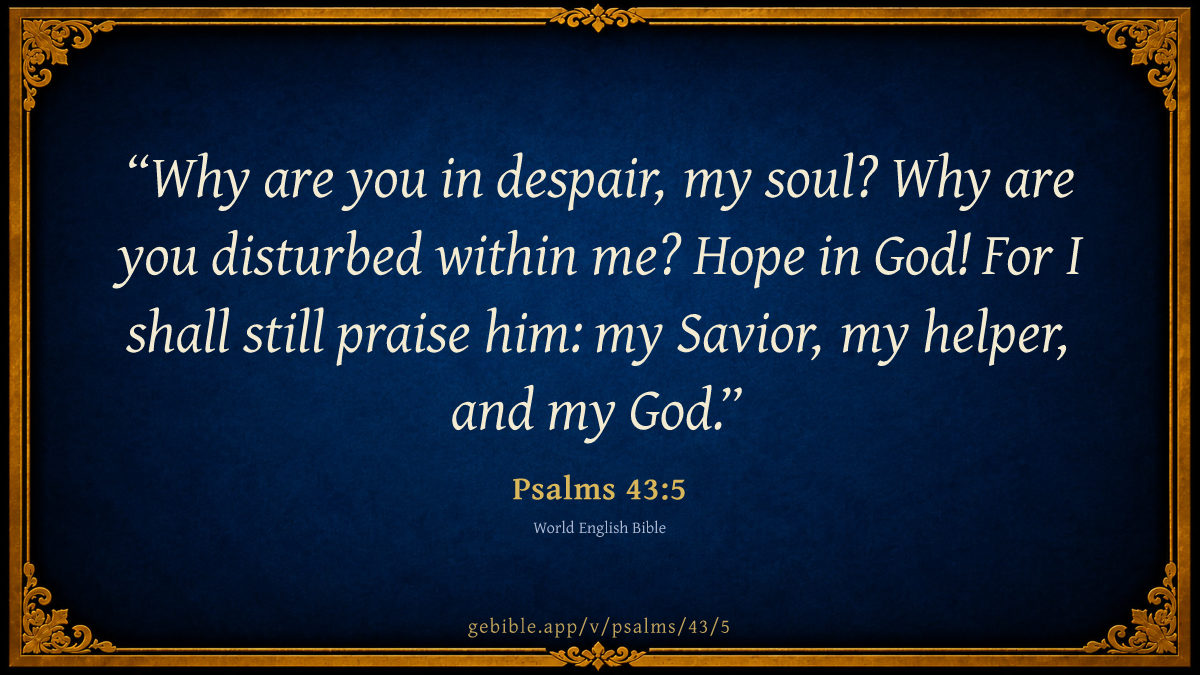
Why are you in despair, my soul? Why are you disturbed within me? Hope in God! For I shall still praise him: my Savior, my helper, and my God.
Parallel Translations
-
Why are you in despair, my soul? Why are you disturbed within me? Hope in God! For I shall still praise him: my Savior, my helper, and my God.
-
Why art thou cast down, O my soul? and why art thou disquieted within me? hope in God: for I shall yet praise him, who is the health of my countenance, and my God.
-
Why art thou cast down, O my soul? and why moanest thou within me? Hope thou in God; for I shall yet praise Him, the salvation of my countenance, and my God.
Cross-references (2)
Passages linked to Psalms 43:5 in the Treasury of Scripture Knowledge, ordered by reader-vote popularity; verse text shown in World English Bible.
- Psalms 42:5 Why are you in despair, my soul? Why are you disturbed within me? Hope in God! For I shall still praise him for the saving help of his presence.
- Psalms 42:11 Why are you in despair, my soul? Why are you disturbed within me? Hope in God! For I shall still praise him, the saving help of my countenance, and my God.
Cross-references from openbible.info (CC BY 4.0)
Explain this verse (12 sources)
Historical commentary, presented as a primary source — not an endorsement.
Private notes
Saved on this device only — never synced or sent anywhere.
Geneva Bible translators 1599 · Public Domain Whereby he admonisheth the faithful not to relent, but…
Whereby he admonisheth the faithful not to relent, but constantly to wait on the Lord, though their troubles be long and great.
Geneva Bible (1599) marginal notes — public domain.
John Trapp 1656 · Public Domain Psa 43:5 Why art thou cast down, O my…
Psa 43:5 Why art thou cast down, O my soul? and why art thou disquieted within me? hope in God: for I shall yet praise him, [who is] the health of my countenance, and my God.
Ver. 5. Why art thou bowed down, &c.] See Psa 42:5; Psa 42:11.
John Trapp, A Commentary or Exposition upon All the Books of the Old and New Testament (1647–1656) — public domain. Text from a community e-Sword module.
John Gill 1763 · Public Domain Why art thou cast down, O my soul?.... See…
Why art thou cast down, O my soul?.... See Gill on Psa 42:5 and See Gill on Psa 42:11.
Next: Psalms Chapter 44
John Gill's Exposition of the Whole Bible (1746–1763) — public domain (CC PDM 1.0). Text via the HelloAO Bible API.
Adam Clarke 1810 · Public Domain Verse 5. Why art thou cast down] Though our…
Verse 5. Why art thou cast down] Though our deliverance be delayed, God has not forgotten to be gracious. The vision, the prophetic declaration relative to our captivity, was for an appointed time. Though it appear to tarry, we must wait for it. In the end it will come, and will not tarry; why then should we be discouraged? Let us still continue to trust in God, for we shall yet praise him for the fullest proofs of his approbation in a great outpouring of his benedictions.
ANALYSIS OF THE FORTY-THIRD PSALM
Read full note →
This Psalm, which is of the same nature with the former, and properly a part or continuation of it, contains two chief things: -
I. A petition, which is double. 1. One in the first verse. 2. The other in the fourth verse.
II. A comfortable apostrophe to his own soul, Ps 43:5.
First, He petitions God, -
1. That, being righteous, he would be his Judge: "Judge me, O Lord."
2. That, being merciful, he would plead his cause: "Plead my cause."
3. That, being almighty, he would deliver him: "Deliver me," Ps 43:1.
For this petition he assigns two reasons: -
1. The unmerciful disposition of his enemies. 1. They were a factious, bloody, inhuman people: "Plead my cause against an ungodly nation," גוי לא כסיד goi lo chasid, "a people without mercy." 2. They were men of deceit and iniquity: "Deliver me from the deceitful and unjust man," Ps 43:1.
2. The other reason he draws from the nature of God, and his relation to him: "For thou art the God of my strength." Thou hast promised to defend me. On this he expostulates: 1. "Why hast thou cast me off?" For so, to the eye of sense, it at present appears. 2. "Why go I mourning, because of the oppression of the enemy?" Ps 43:2.
Secondly, The second part of his petition is, that he may be restored to God's favour, and brought back to his own country, Ps 43:3.
1. "O send forth thy light and thy truth," the light of thy favour and countenance, and make thy promises true to me: "Let them lead me," Ps 43:3.
2. "Let them guide me;" - whither? To dignity and honours? No, I ask not those: I ask to be guided to thy holy hill and tabernacles, where I may enjoy the exercises of piety in thy pure worship, Ps 43:3.
Thirdly, That he might the better move God to hear his petition, he does as good as vow that he would be thankful, and make it known how good God had been to him.
1. "Then will I go unto the altar of God, my exceeding joy." The joy and content he would take in this should not be of an ordinary kind.
2. "Yea, upon the harp will I praise thee, O God." His joy should be expressed outwardly by a Psalm, doubtless composed for the occasion; the singing of which should be accompanied by the harp, or such instruments of music as were then commonly used in the Divine worship.
The petitions being ended, and now confident of audience and favour, he thus addresses his heavy and mournful heart as in the former Psalm: 1. Chiding himself. 2. Encouraging himself.
1. "Why art thou cast down, O my soul? and why art thou disquieted within me?" Chiding.
2. "Hope in God: for I shall yet praise him, who is the health of my countenance, and my God." Encouraging. See notes and analysis of the preceding Psalm.
Adam Clarke's Commentary on the Bible (1810–1826) — public domain. Text from a community e-Sword/MySword module.
Albert Barnes 1834 · Public Domain Why art thou cast down?... - See Psa 42:5,…
Why art thou cast down?... - See Psa 42:5, note; Psa 42:11, note. The sameness of this verse with Psa 42:5, Psa 42:11 proves, as has been already remarked, that this psalm was composed by the same writer, and with reference to the same subject as the former. The doctrine which is taught is the same - that we should not be dejected or cast down in the troubles of life, but should hope in God, and look forward to better times, if not in this world, certainly in the world to come. If we are his children, we shall “yet praise him;” we shall acknowledge him as the “health” or the salvation (Hebrew) of our countenance; as one who by giving “salvation” diffuses joy over our countenance; as one who will manifest himself as our God. He who has an eternity of blessedness before him - he who is to dwell forever in a world of peace and joy - he who is soon to enter an abode where there will be no sin, no sadness, no tears, no death - he who is to commence a career of glory which is never to terminate and never to change - should not be cast down - should not be overwhelmed with sorrow.
Albert Barnes' Notes on the Bible (1834–1885) — public domain. Text from a community e-Sword/MySword module.
The Cambridge Bible for Schools and Colleges 1878 · Public Domain 5. The refrain is once more repeated, and now,…
5. The refrain is once more repeated, and now, we may believe, with a still more unwavering faith and certain hope that his prayer will be answered.
The Cambridge Bible for Schools and Colleges (gen. ed. J. J. S. Perowne; Cambridge University Press, 1878–1918) — public domain. Text from a community e-Sword module.
The Pulpit Commentary 1880 · Public Domain Why art thou cast down, O my soul? and…
Why art thou cast down, O my soul? and why art thou disquieted within me? hope in God: for I shall yet praise him, who is the health of my countenance, and my God. The refrain of Psa_42:11 is here repeated totidem verbis; and the plaint of the exiled monarch is brought to an end. The burden of the refrain is hope and confidence. Notwithstanding the woes of the present, the writer has no doubt in respect of the future; he will yet have occasion to "praise" God, whom he feels to be his God his Health and Salvation.
The Pulpit Commentary (1880–1919), ed. H.D.M. Spence-Jones & Joseph S. Exell — public domain. Text from a community e-Sword module.
Charles H. Spurgeon 1885 · Public Domain Ver. 5. Why art thou cast down, O my…
Ver. 5. Why art thou cast down, O my soul? If God be thine, why this dejection? If he uplifts thee, why art thou so near the ground? The dew of love is falling, O withering heart, revive. And why art thou disquieted within me? What cause is there to break the repose of thy heart? Wherefore indulge unreasonable sorrows, which benefit no one, fret thyself, and dishonour thy God? Why overburden thyself with forebodings? Hope in God, or wait for God. There is need of patience, but there is ground for hope. The Lord cannot but avenge his own elect. The heavenly Father will not stand by and see his children trampled on for ever; as surely as the sun is in the heavens, light must arise for the people of God, though for awhile they may walk in darkness. Why, then, should we not be encouraged, and lift up our head with comfortable hope? For I shall yet praise him. Times of complaint will soon end, and seasons of praise will begin. Come, my heart, look out of the window, borrow the telescopic glass, forecast a little, and sweeten thy chamber with sprigs of the sweet herb of hope. Who is the health of my countenance, and my God. My God will clear the furrows from my brow, and the tear marks from my cheek; therefore will I lift up my head and smile in the face of the storm. The Psalm has a blessed ending, such as we would fain imitate when death puts an end to our mortal existence.
Ver. 5. Why art thou cast down, O my soul. He comes to his former remedy; he had stilled his grief once before with the same meditation and upbraiding of his own soul, and chiding himself; but he comes to it here as a probatum est, as a tried remedy; he takes up his soul very short, Why art thou so cast down, O my soul? and why art thou disquieted within me? You see how David's passions here are interlaced with comforts, and his comforts with passions, till at last he gets the victory of his own heart. Beloved, neither sin nor grief for sin, are stilled and quieted at the first. You have some short spirited Christians, if all be not quiet at the first, all is lost with them; but it is not so with a true Christian soul, with the best soul living. It was not so with David when he was in distemper; he checks himself, the distemper was not yet stilled; he checks himself again, then the distemper breaks out again; he checks himself again, and all little enough to bring his soul to a holy, blessed, quiet, temper, to that blessed tranquillity and rest that the soul should be in before it can enjoy its own happiness, and enjoy sweet communion with God. As you see in physic, perhaps one purge will not carry away the peccant humour, then a second must be added; perhaps that will not do it, then there must be a third; so when the soul hath been once checked, perhaps it will not do, we must fall to it again, go to God again. And then it may be there will be breaking out of the grief and malady again; we must to it again, and never give over, that is the right temper of a Christian. Richard Sibbes.
Read full note →
Ver. 5. Hope in God. The more terrible the storm, the more necessary is the anchor. Heb 6:19. William S. Plumer.
Ver. 5. Hope in God. The complete and perfect state of God's children here is not in re, but in spe: as Christ's kingdom is not of this world, so is not our hope. The worldling's motto is, "a bird in the hand." Give me today, say they, and take tomorrow whoso will. But the word of believers is, spero meliora my hopes are better than my present possessions. Elnathan Parr.
Ver. 5. The varied conflicts of the soul afford occasion for the exercise of the graces, and thus, through the divine wisdom and goodness, are made the means of eventual good. Henry March.
Ver. 1-2,4-5. Five mys:
1. My cause"plead it."
2. My strength"thou art."
3. My joyGod is.
4. My soul"why disquieted."
5. My God.
Ver. 5. Discouragement's recovery. R. Sibbes Sermons.
Ver. 5. I shall yet praise him. I, even I; shall, sooner or later, most assuredly; yet, despite troubles, foes, devils; praise with gratitude, confidence, exultation; him above all other helpers, though now afflicting me.
Ver. 5. Health of my countenance, removing that which mars it sin, shame, fear, care, sorrow, weakness, etc.
Charles H. Spurgeon's The Treasury of David (1869–1885) — public domain. Psalms only. Text from a community e-Sword/MySword module.
The Biblical Illustrator 1887 · Public Domain Why art thou cast down, O my soul?
Psa_43:5
Why art thou cast down, O my soul?
Read full note →
and why art thou disquieted within me? hope in God: for I shall yet praise Him, who is the health of my countenance and my God.
Discouragements recovery
This psalm was penned by David, which shows the passions of his soul; for Gods children know the estate of their own souls for the strengthening of their trust and bettering their obedience. Now, this is the difference between psalms and other places of Scripture. Other scriptures speak mostly from God to us; but in the Psalms this holy man doth speak mostly to God and his own soul; so that this psalm is an expostulation of David with his own soul in a troubled estate; when being banished from the house of God, he expostulates the matter with his soul: Why art thou cast down, O my soul? and why art thou disquieted within me? The words tell of--
I. Davids perplexed estate. Why art thou cast down, etc.
1. How did he come to be thus perplexed? He was in great trouble and affliction. A soul that is lively in grace cannot endure to live under small means of salvation.
2. The second thing that troubled this holy man was the blasphemous words of wicked men. Therefore if we would try our state to be good, see how we take to heart everything that is done against religion. Can a child be patient when he sees his father abused? Gods children are sensible of such things. But observe--
1. A child of God must not be too much discouraged and cast down in afflictions. There must be measure both in sorrow and in joy. Not as Nabal (1Sa_25:36-37). And we may know when this measure is exceeded if our mourning and sorrow do not bring us to God, but drives us from God. Grief, sorrow and humility are good; but discouragement is evil (Exo_6:9; 1Pe_3:7). Christians must not exceed in anything; when they do they are overcome of their passions. And to be cast down and disquieted is sin, because it doth turn to the reproach of religion and God Himself; and because their so sinking under afflictions never yield any good fruit, and it hinders us both from and in holy duties; for either we do not perform them at all, or otherwise they are done but weakly; for as the troubled eye cannot see well, so the troubled soul cannot do good, nor receive good. Observe--
II. His expostulation with himself. Why art thou cast down? etc. The word in the original shows that it is the nature of sorrow to bring the soul downwards. Sorrow and sin agree both in this, for as they come from below, so they bring the soul down to the earth.
1. What is meant by casting down, and why doth he find fault with himself for it? Because it breeds disquieting. Hence it is said in Psa_37:1, Fret not thyself, etc. Here is no true humiliation but abundance of corruption. But note--
III. The remedy to which the psalmist turns: he first reflects upon and expostulates with his soul, and then bids it. trust in God. And so we learn that. Gods children in their greatest troubles recover themselves, that the prerogative of a Christian in these disquietings, and in all estates, is, he hath God and himself to speak unto, whereby he can remove solitariness. Put him into a dungeon, yet he may speak unto God there, and speak unto himself. Let all the tyrants in the world do their worst to a Christian; if God be with him he is cheerful still. (R. Sibbes)
The psalmists dialogue with his soul
These words occur thrice, at short, intervals, in this and the preceding psalm. They appear there twice, and here once. Quite obviously the division into two psalms has been a mistake, for the whole constitutes one composition. The first part of each of the little sections, into which the one original psalm is divided by the repetition of this refrain, is a weary monotone of complaint.
I. The dreary monotony of complaint. We all know the temptation of being overmastered by some calamity or some sad thought. We keep chewing some bitter morsel and rolling it under our tongues so as to suck all the bitterness out of it that we can. You sometimes see upon the stage of a theatre a funeral procession represented, and the supernumeraries pass across the stage and go round at the back and come in again at the other end, and so keep up an appearance of numbers far beyond the reality. That is like what you and I do with our sorrows. A bee has an eye, with I do not know how many facets, which multiply the one thing it looks at into an enormous number; and some of us have eyes made on that fashion, or rather we manufacture for our eyes spectacles on that plan, by which we look at our griefs or our depressing circumstances, and see them multiplied and nothing but them. That way madness lies.
II. Wise self-questioning. There are a great many of our griefs, and moods, and sorrows that will not stand that question. Like ghosts, if you speak to them, they vanish. It is enough, in not a few of the lighter and more gnat-like troubles that beset us, for us to say to ourselves, What are we putting ourselves into such a fuss about? Why art thou cast down? We cannot control our thoughts nor our moods directly, but we can do a great deal to regulate, modify and diminish those of them that need diminishing, and increase those of them that need to be increased, by looking at the reasons for them. And if a man will do that more habitually and conscientiously than most of us are accustomed to do it, in regard both to passing thoughts and overpowering moods that threaten to become unwholesomely permanent, he will regain a firmer control of himself--and that is the best wealth that a man can have. Very many men who makes failures, morally, religiously, or even socially and commercially, do so because they have no command over themselves, and because they have not asked this question of each sly temptation that comes wheedling up to the gate of the soul with whispering breath and secret suggestions--What do you want here? What reason have you for wishing to come in? Why art thou cast down, O my soul?--question yourselves about your moods, and especially about your sad moods, and you will have gone a long way to make yourselves bigger and happier people than you have ever been before.
III. An effort twice foiled and at last successful. In the cathedral of St. Marks, Venice, there is a mosaic that represents Christ in Gethsemane. You remember that, like the psalmist, He prayed three times there, and twice came back, not having received His desire, and the third time He did receive it. The devout artist has presented Him thus: the first time prone on the ground, and the sky all black; the second time raised a little, and a strip of blue in one corner; and the third time kneeling erect, and a beam from heaven, brighter than the radiance of the Paschal moon, striking right down upon Him, and the strengthening angel standing beside Him. That was the experience of the Lord, and it may be the experience of the servant. Do not give up the effort, at self-control and victory over circumstances that tempt to despondency or to sadness. Even if you fail this time, still the failure has left some increased capacity for the next attempt, and God helping, the next time will be successful.
IV. The conquering hope. The psalmists question to his soul is not answered. It needed no answer. To put it was the first struggle to strip off the poisoned sackcloth in which he had wrapped himself. But his next word, his command to his soul to hope in God, completes the process of putting off the robe of mourning and girding himself with gladness. He makes one great leap, as it were, across the black flood that has been ringing him round, and bids his soul: Hope thou in God. The one medicine for a disquieted, cast-down soul is hope in God. People say a great deal about the buoyant energy of hope bearing a man up over his troubles. Yes! so it does in some measure, but there is only one case in which there is a real bearing up over the troubles, and that is where the hope is in God. But the hope that is in God must be a hope that is based upon a present possession of Him. It is only if a man has a present experience of the blessings of strong and all-sufficient help that come to him now, when he can say, My God, the health of my countenance, t, hat he has the right, or that he has the inclination or the power to paint the future with brightness. And we shall not attain either to that experience of God as ours, or to the hope that, springing from it, will triumph over all disquieting circumstances without a dead lift of effort. There is a great lack amongst all Christian people of realizing that it is as much their duty to cultivate the hope of the Christian as it is their duty to cultivate any other characteristic of the Christian life. (A. Maclaren, D. D.)
Despondency: its cause and cure
I. Why the soul is bowed down and disquieted.
1. The soul may be bowed down for lack of the old help and strength got from the means of grace. As our hearts are framed we need help from habit, from outward expression, from worship, from voice and ear, from sympathy and exhortation, from words and sacraments.
2. The soul may he cast down from thoughts and doubts springing at once out of the mans own mind, growing at once out of the evil of his very spiritual nature.
3. The soul may be bowed down by the burden of wilful sin, neglected duty, or worldly indulgence. No amount of religious fervour, or doctrinal knowledge will keep the heart glad in which is the consciousness of wrong.
4. But all this sore trouble is deepened, if it happens to come upon us in times of worldly woe, when we can least afford to miss Gods peace, when we are in greatest need of comfort. Why, was it not just this we had counted on, that when all earthly fountains would be dried up, then the river of God would still flow on?
II. why the soul need not be bowed down.
1. God would have us to learn and know that He Himself is an all-sufficient comforter, apart from any outward helps or earthly sympathy. Thus we enter further into the secret of Gods covenant.
2. All progress in religion seems to be from dark to dark. The plant at first strikes its roots in the dark; and it would appear as if the spirit needed fresh times of sorrow before it will be moved to larger growth.
3. We must learn the insufficiency of present attainments before we will seek more. How vague and dim are the hopes and expectations of many! In worldly prosperity such meagre experience does well enough; but, oh! it is not well for the soul to rest there. Come unto Me, He cries, now loudly, now whisperingly; and it is to move and bend us He has to send darkness and trouble. How natural it is we should be disquieted; and is it not the case that so soon as we see this good wise reason for our dejection, immediately we are delivered? And though it was good for us to be dejected, yet we say, why should we be so? Why art thou cast down, why dost thou still continue to be cast down, O my soul? (R. MacEllar.)
The psalmists remonstrance with his soul
There is a kind of dialogue between the psalmist and his soul. He, as it were, cuts himself into two halves, and reasons and remonstrates with himself, and coerces himself, and encourages himself; and finally settles down in a peace which unites in one the two discordant elements.
I. The psalmists question to his soul, Why art thou cast down? why art thou disquieted? There are two things here, apparently, opposite to each other, and yet both of them present in the fluctuating and stormy emotions of the poet. On the one hand is deep dejection. The word employed describes the attitude of a man lying prone and prostrate, grovelling on the ground. Why art thou cast down? And yet, side by side with that torpid dejection, there is a noisy restlessness. `why dost thou mourn and mutter--as the words might be rendered--within me? And these two moods are, if not co-existent, at least so quickly alternating within his consciousness that he has to reason with himself about both. He has fits of deep depression, followed by, and sometimes even accompanied with, fits of restless complaining and murmuring. And he puts to himself the question, What is it all about? Now, if we translate this question into a general expression it just comes to this--A man is worth very little unless there is a tribunal in him to which he brings up his feelings and makes them justify their existence, and tell him what they mean by their noise and their complaining. He that has no rule over his own spirit is like a city broken down and without walls. The affections, the emotions, the feelings of sorrow or of gladness, of dissatisfaction with my lot, or of enjoyment and complacency in it, are excited by the mere presence of a set of external circumstances; but the fact that they are excited is no warrant for their existence. And the first thing to be done in regard to them is to see to it that the nobler man, the man within, the real self should cross-question that other self, and say, Tell me, have you reason for your being? If not, take yourselves away. Why art thou cast down, O my soul, and why art thou disquieted within me?
II. The psalmists charge to his soul. Hope thou in God. Ah! it is no use to say to a soul, What is all your agitation about? unless you can go on to say, Be quiet in God. Sweep away the things seen and temporal, and put the thing, or rather the Person, Unseen and Eternal, in the front of them. And then comes quiet; and then there comes aspiration. Then energy comes hack to the languid and relaxed limbs, and the man that was lying on his face in the dust starts to his feet, ready for strenuous effort and for noble service. The soul that is to be quickened from its torpor, and to be quieted from its restlessness, must be led to God, and, grasping Him, then it is able to coerce these other feelings, which, apart from Him, have, and ought to have, the field to themselves. Nor must we forget another thought, that this charge of the psalmist to his soul teaches us. The deep-seated and central faith in God which marks a religious man ought to permeate all his nature to the very outskirts and circumference of his being. Even amidst the perturbations of the sensitive nature of the poet-psalmist, his inmost self was resting upon God.
III. The psalmists confident assurance, which is his reason for exhorting his lower self to quiet faith and hope.:For I shall yet praise Him, etc. The I here is the whole united and harmonized self, in which the emotions, affections, passions and lower desires obey the reins and whip of the higher nature. When God governs the spirit, the spirit governs the soul, and the man who has yielded himself to God, first of all in the surrender, possesses himself, and can truly say I. Only when the heart is united to fear Gods name is there true concord within. Oh to live more continually under the influence of that glorious light of the assured future, when our lips shall be loosed to give forth His praise, and when we shall have learned that every sorrow, disappointment, loss, painful effort, all that here seemed kindred with darkness, was really but a modification of light, and was a thing to be thankful for. If only we chose to walk in the light of the future, then the poor present would be small and powerless to harm us. I shall yet praise Him is the language that befits us all. And there is not only the assurance of a future that shall explain all, and make it all material for praise, when all the discords of the great conflicting piece of music are resolved into harmony, but there is here also the deep sense of present blessing. I shall yet praise Him who is the health (or salvation) of my countenance and my God. Who is, not who will be; who is in the moment of difficulty and sorrow; who is, even whilst as the other part of the psalm tells us, the enemy are saying Where is thy God? who is, even whilst the sense and flesh and the lower self have lost sight of Him. And my God. Ah! there we touch the bottom and get our feet upon the rock. He that can say He is my God has a right to be sure that he will yet praise Him. (A. Maclaren, D. D.)
The psalmists remonstrance with his soul
I. Moods and emotions should be examined and governed by a higher self. There are plenty of people who, making profession of being Christians, do not habitually put the break on their moods and tempers, and who seem to think that it is a sufficient vindication of gloom and sadness to say that things are going badly with them in the outer world, and who act as if they supposed that no joy can be too exuberant and no elation too lofty if, on the other hand, things are going rightly. It is a miserable travesty of the Christian faith to suppose that its prime purpose is anything else than to put into our hands the power of ruling ourselves because we let Christ rule us. If the wheelhouse, and the stearing gear, and the rudder of the ship proclaim their purpose of guidance and direction, as eloquently and unmistakably does She make of our inward selves tell us that emotions and moods and tempers are meant to be governed, often to be crushed, always to be moderated by sovereign will and reason. In the psalmists language, my soul has to give account of its tremors and flutterings to Me, the ruling Self, who should be Lord of temperament and control the fluctuations of feeling.
II. There are two ways of looking at causes of dejection and disquiet. There is a court of appeal in each man which tests and tries his reasons for his moods; and these, which look very sufficient to the flesh, turn out to be very insufficient when investigated and tested by the higher spirit or self. We should appeal from Philip drunk to Philip sober. If men would only bring the causes or occasions of the tempers and feelings which they allow to direct them, to the bar of common sense, to say nothing of religious faith, half the furious boilings in their hearts would stop their ebullition. It would be like pouring cold water into a kettle on the fire. It would end its bubbling. Everything has two handles. The aspect of any event depends largely on the beholders point of view. Theres nothing either good or bad, but thinking makes it so.
III. No reasons for being cast down are so strong as those for elation and calm hope. Try to realize what God is to yourselves--My God and the health of my countenance. That will stimulate sluggish feeling; that will calm disturbed emotion. He that can say, My God! and in that possession can repose, will not be easily moved by the trivialities and transitorinesses of this life, to excessive disquiet, whether of the exuberant or of the woeful sort. There is a wonderful calming power in realizing our possession of God as our portion--not stagnating, but quieting.
IV. The effort to lay hold on the truth which calms is to be repeated in spite of failures. No effort at tranquillizing our hearts is wholly lost; and no attempt to lay hold upon God is wholly in vain. Men build a dam to keep out the sea, and the winter storms make a breach in it, but it is not washed sway altogether. And next season they will not need to begin to build from quite so low down, but there will be a bit of the former left to put the new structure upon. And so by degrees it will rise above the tide, and at last will keep it out. Did you ever see a child upon a swing, or a gymnast upon a trapeze? Each oscillation goes a little higher; each starts from the same lowest point, but the elevation on either side increases with each renewed effort, until at last the destined height is reached and the daring athlete leaps on to a solid platform. So we may, if I might so say, by degrees, by reiterated efforts, swing ourselves up to that stedfast floor on which we may stand high above all that breeds agitation and gloom. (A. Maclaren, D. D.)
Hope, the antidote to despondency
I. The state alluded to. Dejection and despair. Many things conduce to it.
1. There are not only the difficulties of the Christian course--its dangers, trials, sorrows, disappointments, etc., but--
2. There are the frailties and the circumstances of material life.
(1) Some are cast down owing to constitutional physical temperament. This tendency might and ought to be checked and overcome by cherishing an opposite state of mind.
(2) Others are cast down by the reflections on human existence, the failure of the right, and triumph of wrong--the utter abandonment of the world, the almost imperceptible progress of the Gospel in the world.
(3) Others, again, are dispirited by failure of health and the crushing hand of affliction, by domestic trials, ill-assorted marriages, and invincible sorrow.
II. The investigation suggested. It is very advisable and useful to act as the psalmist did, and institute the inquiry as to the reason of our despondence. Most of the troubles of life and religion come in an unreasoning manner, inasmuch as they appeal to our feelings, not to our logic--our hearts and not our heads. But when we bring a little logic into our feelings and sentiments, it acts as a whole, some regulation and useful restraint. We should generally find that in the dealings of Providence there is no cause whatever for the soul to be east down. Not one moment of trial but what is necessary for the souls discipline, and shall minister to the souls best condition.
III. The antidote supplied--Hope thou in God. Yes, it is the want of faith that is at the root of all fearful despair, and faith, trust and hope are the remedy, the cure of the souls disease and spirits gloom. Just think what it is to hope in God! There is everything to make us do so! He has all the resources of the universe at His control. But the keynote of hope is love. If we realize that He loves us, we shall know that He will use all these resources for our good. Perfect love casteth out fear. (Homilist.)
The defeat of Despair
Mr. Greatheart, old Honest and the four young men went up to Doubting Castle to look for Giant Despair. When they came at the castle gate, they knocked for entrance with an unusual noise. At that the old giant comes to the gate; and Diffidence his wife follows Then these six men made up to him, and beset him behind and before; also, when Diffidence the giantess came up to help him, old Mr. Honest cut her down at one blow. Then they fought for their lives, and Giant Despair was brought down to the ground, but was very loath to die. He struggled hard, and had, as they say, as many lives as a cat; but Great-heart was his death, for he left him not till he had severed his head from his shoulders. (J. Bunyan.)
Psa_44:1-26
The Biblical Illustrator, edited by Joseph S. Exell (c. 1880s–1900s) — public domain. Text from a community e-Sword module.
Alexander MacLaren 1905 · Public Domain
Psalms
THE PSALMIST’S REMONSTRANCE WITH HIS SOUL
Read full note →
Psa 43:5.
This verse, which closes this psalm, occurs twice in the previous one. It is a kind of refrain. Obviously this little psalm, of which my text is a part, was originally united with the preceding one. That the two made one is clear to anybody that will read them, by reason of structure, and tone, and similarity of the singer’s situation, and the recurrence of many phrases, and especially of these significant words of my text.
The Psalmist is in circumstances of trouble and sorrow. We need not enter upon them particularly, but the thing that I desire to point out is that three times does the Psalmist take himself to task and question himself as to the reasonableness of the emotions that are surging in his soul, and checks these by higher considerations. Thrice he does it; twice in vain, for the trouble and anxiety come rolling back upon him in spite of the moment’s respite, but the third time he triumphs.
I. We note, then, first, that moods and emotions should be examined and governed by a higher self.
In the Psalmist’s case, his gloom and despondency, which could plead good reasons for their existence, had everything their own way at first, and swept over his soul like the first rush of waters which have burst their bounds. But, presently, the ruling part of his nature wakes, and brings the feebler lower soul to its tribunal, and says, in effect, ‘Now! now that I am here, what hast thou to say about these sorrows that thou hast been complaining about? Why art thou cast down, O my soul? Why art thou disquieted? . . . Hope in God!’
I shall have a word or two to say presently about the details of this remonstrance, but the main point that I make, to begin with, is just this, that however strong and reasonably occasioned by circumstances a man’s emotions and feelings, either of the bright or the dark kind, may be, they are not to be indulged, unless they have passed muster and examination by that higher and better self. It is necessary to keep a very tight hand upon all our feelings, whether they be the natural desires of the sensuous part of our nature, or whether they be the sentiments of sadness, or doubt, or anxiety, or perplexity, which are the natural results of outward circumstances of trial; or whether, on the contrary, they be the bright and buoyant ones which come, like angels, along with prosperous hours. But that necessity, commonplace as it is of all morals and all religion, is yet a thing which, day by day, we so forget that we need to be ever and anon reminded of it.
There are hosts of people who, making profession of being Christians, do not habitually put the brake on their moods and tempers, and who seem to think that it is a sufficient vindication of gloom and sadness to say that things are going badly with them in the outer world, and who act as if they supposed that no joy can be too exuberant and no elation too lofty if, on the other hand, things are going rightly. It is a miserable travesty of the Christian faith to suppose that its prime purpose is anything else than to put into our hands the power of ruling ourselves because we let Christ rule us.
And so, dear brethren! though it be the A B C of Christian teaching, suffer this word of exhortation. It is only ‘milk for babes,’ but it is milk that the babes are very unwilling to take. Learn from this verse before us the solemn duty of rigid control, by the higher self, of the tremulous, emotional lower self which responds so completely to every change of temperature or circumstances in the world without. And remember that there should be a central heat which keeps the temperature substantially the same, whatever be the weather outside. As the wheel-house, and the steering gear, and the rudder of the ship proclaim their purpose of guidance and direction, so eloquently and unmistakably does the make of our inward selves tell us that emotions and moods and tempers are meant to be governed, often to be crushed, always to be moderated, by sovereign will and reason. In the Psalmist’s language, ‘My soul’ has to give account of its tremors and flutterings to ‘Me,’ the ruling Self, who should be Lord of temperament, and control the fluctuations of feeling.
II. Note that there are two ways of looking at causes of dejection and disquiet.
The whole preceding parts of both the psalms, before this refrain, are an answer to the question which my text puts. ‘Why art thou cast down, O my soul?’ ‘My soul’ has been talking two whole psalms, to explain why it is cast down. And after all the eloquent torrent of words to vindicate and explain its reasons for sadness-separation from the sanctuary, bitter remembrances of bright days, which the poet tells us are ‘a sorrow’s crown of sorrow,’ taunts of enemies and the like-after all these have been said over and over again, the Psalmist says to himself: ‘Come now, let us hear it all once more. Why art thou cast down? Why art thou disquieted within me? Thou hast been telling the reasons abundantly. Speak them once again, and let us have a look at them.’
There is a court of appeal in each man, which tests and tries his reasons for his moods; and these, which look very sufficient to the flesh, turn out to be very insufficient when investigated and tested by the higher spirit or self. We should ‘appeal from Philip drunk to Philip sober.’ And if a man will be honest with himself, and tell himself why he is in such a pucker of terror, or why he is in such a rapture of joy, nine times out of ten the attempt to tell the reasons will be the condemnation of the mood which they are supposed to justify. If men would only bring the causes or occasions of the tempers and feelings which they allow to direct them, to the bar of common sense, to say nothing of religious faith, half the furious boilings in their hearts would stop their ebullition. It would be like pouring cold water into a kettle on the fire. It would end its bubbling. Everything has two handles. The aspect of any event depends largely on the beholder’s point of view. ‘There’s nothing either good or bad, but thinking makes it so.’ ‘Why art thou cast down, O my soul? and why art thou disquieted within me?’ The answer is often very hard to give; the question is always very salutary to ask.
III. Note that no reasons for being cast down are so strong as those for elation and calm hope.
‘Hope thou in God, for I shall yet praise Him, who is the health of my countenance and my God.’ I need not deal here with the fact that the first of the three occurrences of this refrain is, in our Bible, a little different from the other two. That is probably a mistake in the text. In all three cases the words ought to stand the same.
Try to realise what God is to yourselves-’My God’ and ‘the health of my countenance.’ That will stimulate sluggish feeling; that will calm disturbed emotion. He that can say ‘My God!’ and in that possession can repose, will not be easily moved, by the trivialities and transitorinesses of this life, to excessive disquiet, whether of the exuberant or of the woful sort. There is a wonderful calming power in realising our possession of God as our portion-not stagnating, but quieting. I am quite sure that the troubles of our lives, and the gladnesses of our lives, which often distract, would be far less operative in disturbing, if we felt more that God was ours and that we were God’s.
Brethren! ‘there is no joy but calm.’ To be at rest is better than rapture. And there is no way of getting and keeping a fixed temper of still tranquillity unless we go into that deep and hidden chamber, in the secret place of the Most High, where we cannot ‘hear the loud winds when they call,’ but dwell in security, whatever storms harass the land. ‘Why art thou cast down,’ or lifted ‘up,’ and, in either case, ‘disquieted’? ‘Hope in God,’ and be at rest.
IV. Note that the effort to lay hold on the truth which calms is to be repeated in spite of failures.
The words of our text are thrice repeated in these two psalms. In the two former instances they are followed by a fresh burst of pained feeling. A moment of tranquillity interrupts the agitation of the Psalmist’s soul, but is soon followed by the recurrence of ‘the horrible storm’ that ‘begins afresh.’ A tiny island of blue appears in his sky, and then the pale, ugly, grey rack drives across it once more. But the guiding self keeps the hand firm on the tiller, notwithstanding the wash of the water and the rolling of the ship, and the dominant will conquers at last, and at the third time the yielding soul obeys and is quiet, because the Psalmist’s will resolved that it should be quiet, and it hopes in God because He, by a dead lift of effort, lifts it up to hope.
No effort at tranquillising our hearts is wholly lost; and no attempt to lay hold upon God is wholly in vain. Men build a dam to keep out the sea, and the winter storms make a breach in it, but it is not washed away altogether, and next season they will not need to begin to build from quite so low down; but there will be a bit of the former left, to put the new structure upon, and so by degrees it will rise above the tide, and at last will keep it out.
Did you ever see a child upon a swing, or a gymnast upon a trapeze? Each oscillation goes a little higher; each starts from the same lowest point, but the elevation on either side increases with each renewed effort, until at last the destined height is reached and the daring athlete leaps on to a solid platform. So we may, if I might say so, by degrees, by reiterated efforts, swing ourselves up to that steadfast floor on which we may stand high above all that breeds agitation and gloom. It is possible, in the midst of change and circumstances that excite sad emotions, anxieties, and fears-it is possible to have this calmness of hope in God. The rainbow that spans the cataract rises steadfast above the white, tortured water beneath, and persists whilst all is hurrying change below, and there are flowers on the grim black rocks by the side of the fall, whose verdure is made greener and whose brightness is made brighter, by the freshening of the spray of the waterfall. So we may be ‘as sorrowful, yet always rejoicing,’ and may bid dejected and disquieted souls to hope in God and be still.
Alexander MacLaren, Expositions of Holy Scripture (1904–1910) — public domain. Text from a community e-Sword module.
unfoldingWord translationNotes 2017 · CC BY-SA 4.0 Why are you bowed down, my soul? Why are…
Why are you bowed down, my soul? Why are you upset within me?
The author refers to his inner self as his "soul," which represents himself. He asks these questions to rebuke himself. See how you translated this in Psalms 42:5. AT: "I should not be bowed down. I should not be worried" (See: Rhetorical Question and Synecdoche)
Read full note →
bowed down
The writer speaks of depression or discouragement as if it were his soul being bent over. See how you translated this in Psalms 42:5. AT: "discouraged" (See: Metaphor)
Hope in God
The writer continues to speak to his own soul and commands it to trust God. See how you translated this in Psalms 42:5. (See: Imperatives - Other Uses)
my salvation and my God
The phrase "my salvation" refers to God. If necessary the two phrases can be combined. AT: "my God who saves me" (See: Doublet)
translationWords
soul
hope
praise
unfoldingWord translationNotes — © Distant Shores Media and the Door43 World Missions Community, licensed CC BY-SA 4.0. Source: git.door43.org/Door43/en_tn.
Tyndale Open Study Notes 2022 · CC BY-SA 4.0 43:5 This verse is repeated in 42:5, 11.
43:5 This verse is repeated in 42:5, 11.
Tyndale Open Study Notes — © Tyndale Open Resources, licensed CC BY-SA 4.0. Text via the HelloAO Bible API.