
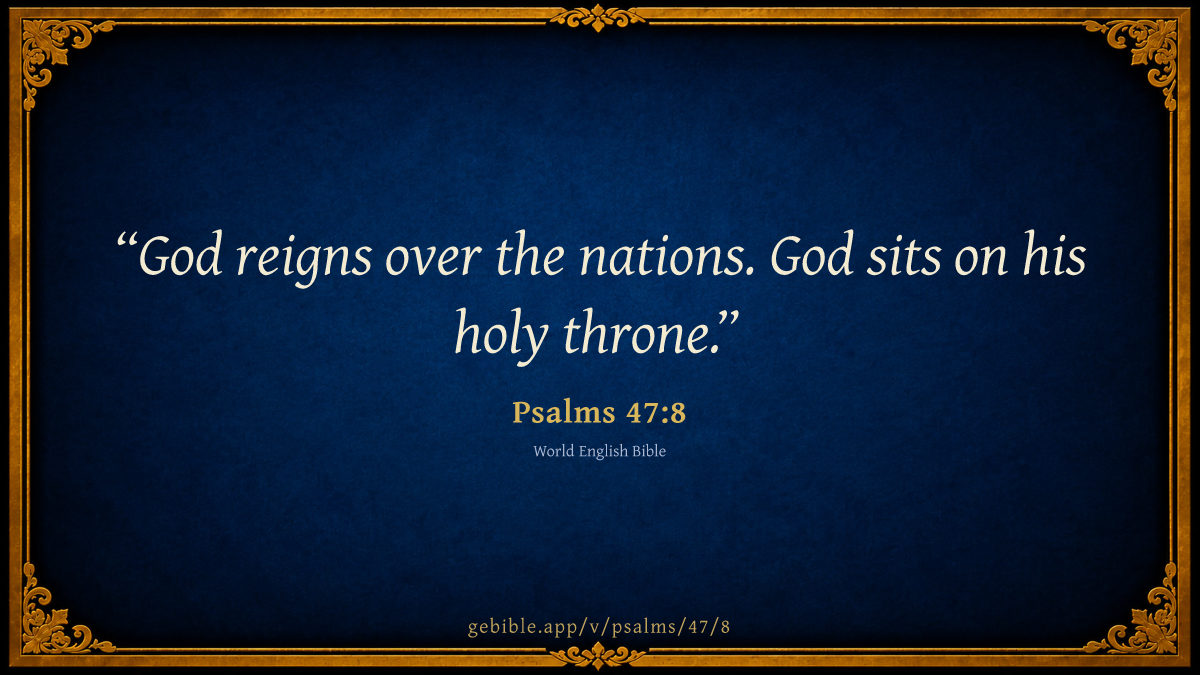
God reigns over the nations. God sits on his holy throne.
Parallel Translations
-
God reigns over the nations. God sits on his holy throne.
-
God reigneth over the heathen: God sitteth upon the throne of his holiness.
-
(47-9) God reigneth over the nations; God sitteth upon His holy throne.
Cross-references (15)
Passages linked to Psalms 47:8 in the Treasury of Scripture Knowledge, ordered by reader-vote popularity; verse text shown in World English Bible.
- 1 Chronicles 16:31 Let the heavens be glad, and let the earth rejoice! Let them say among the nations, “Yahweh reigns!”
- Revelation 19:6 I heard something like the voice of a great multitude, and like the voice of many waters, and like the voice of mighty thunders, saying, “Hallelujah! For the Lord our God, the Almighty, reigns!
- Psalms 45:6-7 Your throne, God, is forever and ever. A scepter of equity is the scepter of your kingdom. You have loved righteousness, and hated wickedness. Therefore God, your God, has anointed you with the oil of gladness above your fellows.
- Psalms 93:1 Yahweh reigns! He is clothed with majesty! Yahweh is armed with strength. The world also is established. It can’t be moved.
- Psalms 9:4 For you have maintained my just cause. You sit on the throne judging righteously.
- Psalms 22:27-29 All the ends of the earth shall remember and turn to Yahweh. All the relatives of the nations shall worship before you. For the kingdom is Yahweh’s. He is the ruler over the nations. All the rich ones of the earth shall eat and worship. All those who go down to the dust shall bow before him, even he who can’t keep his soul alive.
- Psalms 89:14 Righteousness and justice are the foundation of your throne. Loving kindness and truth go before your face.
- Psalms 96:10 Say among the nations, “Yahweh reigns.” The world is also established. It can’t be moved. He will judge the peoples with equity.
- Psalms 99:1 Yahweh reigns! Let the peoples tremble. He sits enthroned among the cherubim. Let the earth be moved.
- Psalms 110:6 He will judge among the nations. He will heap up dead bodies. He will crush the ruler of the whole earth.
- Revelation 20:11 I saw a great white throne, and him who sat on it, from whose face the earth and the heaven fled away. There was found no place for them.
- Psalms 48:1 Great is Yahweh, and greatly to be praised, in the city of our God, in his holy mountain.
- Psalms 94:20 Shall the throne of wickedness have fellowship with you, which brings about mischief by statute?
- Psalms 97:1 Yahweh reigns! Let the earth rejoice! Let the multitude of islands be glad!
- Hebrews 4:16 Let’s therefore draw near with boldness to the throne of grace, that we may receive mercy and may find grace for help in time of need.
Cross-references from openbible.info (CC BY 4.0)
Explain this verse (14 sources)
Historical commentary, presented as a primary source — not an endorsement.
Private notes
Saved on this device only — never synced or sent anywhere.
John Calvin 1540 · Public Domain 8. He hath obtained the kingdom over the heathen…
8. He hath obtained the kingdom over the heathen Literally it is, He hath reigned; but as the verb מלך, malach, is in the past tense, which in Hebrew denotes a continued act, we have translated it, He hath obtained the kingdom The prophet repeatedly informs us that God reigns over the Gentiles; and from this it is easy to gather that he here treats of a new and a previously unheard of manner of reigning. There is an implied contrast between the time of the Law, when God confined his empire, or kingdom, within the boundaries of Judea, and the coming of Christ, when he extended it far and wide, so as to occupy the whole world from one end to the other. The majesty of God sent forth some sparks of its brightness among the heathen nations, when David made them tributary; but the prophet could not, on that account, have properly said that God reigned among them, since they both contemned his worship and the true religion, and also wished to see the Church completely extinguished. To find the fulfillment of this prophecy, we must, therefore, necessarily come to Christ. What is added in the second clause of the verse, God sitteth upon the throne of his holiness, may be taken in a twofold sense. By this form of expression is often to be understood the tabernacle, or the temple; but it also sometimes signifies heaven. If any are inclined to explain it of the temple, the meaning will be, That while God reigned over the whole world, and comprehended all nations under his dominion, he had established his chief seat at Jerusalem; and it was from thence that the doctrine of the gospel, by which he has brought under his dominion all people, flowed. We may, however, very properly take this expression as spoken of heaven; and thus the sense will be, That God, in stretching forth his hand to subdue men, and bring them to submit to his authority, evidently shows that, from his heavenly throne, he reigns over men. Unless he show men his power and working by signs manifest and near at hand, he is not acknowledged as Governor of the world.
John Calvin's Commentaries (1540-1563) — public domain. Text from the Calvin Translation Society English edition (1840s-50s) via the Christian Classics Ethereal Library (ccel.org). Calvin's coverage is partial (roughly two-thirds of the Bible); uncommented books and verses are honest gaps, never fabricated. The 19th-century editor's footnotes and remarks are omitted so the notes are faithfully Calvin's own voice.
John Trapp 1656 · Public Domain Psa 47:8 God reigneth over the heathen: God sitteth…
Psa 47:8 God reigneth over the heathen: God sitteth upon the throne of his holiness.
Ver. 8. God reigneth over the heathen] This is his universal kingdom, whereof before, Psa 47:7, and yet never can too much be said of it.
Read full note →
God sitteth upon the throne of his holiness] He is in a special manner King of his Church, as Ahasuerus was of his Esther, called his throne, Exo 17:16 (because the hand upon the throne of the Lord, that is, Amalek’s hand upon the Church, as some interpret it). His throne of glory, Jer 14:21; and here the throne of his holiness, because Christ (who is called God so many times in this psalm) loved the Church, and gave himself for it, that he might sanctify and cleanse it, and so present it to himself a glorious Church, Eph 5:25-27.
John Trapp, A Commentary or Exposition upon All the Books of the Old and New Testament (1647–1656) — public domain. Text from a community e-Sword module.
Matthew Poole 1685 · Public Domain Over the heathen, i.e. over all heathen nations, as…
Over the heathen, i.e. over all heathen nations, as being the King of all the earth, Psa 47:7; which was not true in David’s time, but; was fulfilled by Christ.
God sitteth upon the throne, to wit, as Judge and King, exercising dominion, or reigning, as he now said; this being only another expression of the same thing. And this holy throne is either,
Read full note →
1. The ark, upon which God was said to sit to govern the Israelites. Or rather,
2. Heaven; which is oft called God’s
throne, Psa 11:4; Isa 66:1, whence God is said to behold and to rule all nations; of which general dominion of God he here speaks. And here Christ sits at his Father’s right hand for that purpose.
Matthew Poole's English Annotations on the Holy Bible (1683–1685) — public domain. Text from a community e-Sword/MySword module.
John Gill 1763 · Public Domain The princes of the people are gathered together,.... Not…
The princes of the people are gathered together,.... Not against Christ, as at his first coming, but to him, and to his church and people; even the great men of the earth, the kings and princes of it, as they will in the latter day; see Isa 49:23; or this may mean the saints in general, who are all of them the princes of people, and are set among princes, yea, are kings priests unto God; some render it, "the willing" or "voluntary ones of his people" (g); the same word is here used as in Psa 110:3; where it is rendered "willing", and designs such who are made willing to be saved by Christ, submit to his righteousness, and be subject to his word and ordinances;
even the people of the God of Abraham; whom the God of Abraham has chosen for his people, taken into covenant, given to his Son, and who are redeemed by his blood, and effectually called by his grace; and who, though Gentiles, belong to the same covenant and the same covenant God as Abraham did, and have the blessing of Abraham upon them; and are indeed his spiritual seed, being Christ's. The Targum is, "the people that believe in the God of Abraham". The words may be rendered in connection with the former clause, "gathered together unto the people of the God of Abraham" (h); and so denote the association of the Gentiles converted with the believing Jews, as was at the first times of the Gospel, and will be at the latter day, Co1 12:13;
Read full note →
for the shields of the earth belong unto God; that is, the rulers of the earth, as the word is rendered in Hos 4:18; who are as a shield and a protection to their subjects; these are set up and put down by the Lord at his pleasure; and their hearts are in his hands, and he can convert them when he pleases, and gather them to his Son, and into his churches; or, as Jarchi interprets it,
"he has power in his hands to protect as with a shield all that trust in him;''
safety is of the Lord; the protection of the world and of the church is from him who is King over all the earth;
he is greatly exalted; that is, Christ, who has all power in heaven and in earth; he is highly exalted at the right hand of God, angels, authorities, and powers, being subject to him.
(g) "voluntarii populorum", Junius & Tremellius, Piscator, Cocceius. (h) So Pagninus, Montanus, Vatablus, Gejerus.
Next: Psalms Chapter 48
John Gill's Exposition of the Whole Bible (1746–1763) — public domain (CC PDM 1.0). Text via the HelloAO Bible API.
John Wesley 1765 · Public Domain The throne - Heaven is often called God's throne,…
The throne - Heaven is often called God's throne, whence God is said to behold and to rule all nations; of which general dominion of God, he here speaks. And Christ sits at his father's right-hand, for that purpose.
John Wesley, Explanatory Notes Upon the Whole Bible (1754–1765) — public domain. Text via the GEBible commentary corpus.
Adam Clarke 1810 · Public Domain Verse 8. God reigneth over the heathen] Though this…
Verse 8. God reigneth over the heathen] Though this is literally true in God's universal dominion, yet more is here meant. God reigns over the heathen when, by the preaching of the Gospel, they are brought into the Church of Christ.
God sitteth upon the throne of his holiness.] He is a holy God; he proclaims holiness. His laws are holy, he requires holiness, and his genuine people are all holy. The throne of his holiness is the heaven of heavens; also the temple at Jerusalem; and, lastly, the hearts of the faithful.
Adam Clarke's Commentary on the Bible (1810–1826) — public domain. Text from a community e-Sword/MySword module.
Joseph Benson 1811 · Public Domain Psa 47:8. God reigneth over the heathen — Over…
Psa 47:8. God reigneth over the heathen — Over all heathen nations. He is not only our King, and therefore we owe our homage to him, but he is King of all the earth, Psa 47:7, and therefore in every place the incense of praise ought to be offered to him. God, as Creator, and the God of nature and providence, reigns even over the heathen, and disposeth of them and all their affairs as he pleaseth, though they know him not, nor have any regard to him. God sitteth upon the throne of his holiness — Namely, as Judge and King, exercising dominion, or reigning, as was now said. Heaven is often called God’s throne, whence God is said to behold and to rule all nations; of which general dominion of God he here speaks. And Christ sits at his Father’s right hand for that purpose.
Joseph Benson's Commentary on the Old and New Testaments (1811–1818) — public domain. Text from a community e-Sword module.
Albert Barnes 1834 · Public Domain God reigneth over the heathen - Over the “nations;”…
God reigneth over the heathen - Over the “nations;” not over the “heathen” in the sense in which that term is understood now. It does not mean that God reigns, or that he has set up his throne over the people that have not the true religion, but that he is exalted over the “nations” of the earth as such; or, that he has universal dominion. See the notes at Psa 46:10.
God sitteth upon the throne of his holiness - Upon his holy throne, The idea is, that his government is established in holiness or justice.
Albert Barnes' Notes on the Bible (1834–1885) — public domain. Text from a community e-Sword/MySword module.
Robert Jamieson, A. R. Fausset & David Brown 1871 · Public Domain The instruction continued.
The instruction continued.
throne of . . . holiness--or, "holy throne" (see on Psa 2:6; Psa 23:4).
Jamieson, Fausset & Brown — Commentary Critical and Explanatory on the Whole Bible (1871) — public domain (CC PDM 1.0). Text via the HelloAO Bible API.
Daniel D. Whedon 1874 · Public Domain 8. God reigneth over… heathen—גוים, (goyim,) Gentiles, heathen nations,…
8. God reigneth over… heathen—גוים, (goyim,) Gentiles, heathen nations, and in Psa_47:2; Psa_47:8, “king over all the earth”—Psa_47:4, “peoples.” This Jehovistic reign was fully vindicated of old by calling or defending his Church in the midst of hostile nations. Thus he displayed his sovereign power over Egypt, the nations of Canaan, Syria, Assyria, Babylon, and Arabia. But the language takes a prophetic form, and is fully realized only in the call and gathering of the nations under Messiah’s reign into one spiritual commonwealth, so often and strongly brought out by the great apostle to the Gentiles. See Eph_1:10; Eph_2:11-19; Eph_3:10.
God sitteth upon the throne—To which he had ascended, (Psa_47:5,) and where he receives the homage and submission of the nations.
Daniel D. Whedon (gen. ed.), Commentary on the Old and New Testaments (1874–1909) — public domain. Text from a community e-Sword module.
The Cambridge Bible for Schools and Colleges 1878 · Public Domain 8. God hath proclaimed himself king over the nations,
8. God hath proclaimed himself king over the nations,
God hath taken his seat upon his holy throne.
Read full note →
The verbs express not merely a fact but an act. God was King, but He has given fresh proof of it. He has caused Himself to be acknowledged King, and taken His seat upon His throne to judge and rule (Psa_103:19). Cp. Rev_11:15.
8, 9. The final realisation of Jehovah’s sovereignty over the world.
The Cambridge Bible for Schools and Colleges (gen. ed. J. J. S. Perowne; Cambridge University Press, 1878–1918) — public domain. Text from a community e-Sword module.
The Pulpit Commentary 1880 · Public Domain God reigneth over the heathen. God had manifested his…
God reigneth over the heathen. God had manifested his kingly power over the heathen by subduing great numbers of them, and making them subject to Israel. He would one day manifest it still more by bringing all nations into his Church. God sitteth upon the throne of his holiness. The throne from which he exercises a just, a righteous, and a holy rule.
The Pulpit Commentary (1880–1919), ed. H.D.M. Spence-Jones & Joseph S. Exell — public domain. Text from a community e-Sword module.
Charles H. Spurgeon 1885 · Public Domain Ver. 8. Now at this moment, over the most…
Ver. 8. Now at this moment, over the most debased idolaters, God holds a secret rule; here is work for faith. How we ought to long for the day when this truth shall be changed in its aspect, and the rule now unrecognised shall be delighted in! The great truth that God reigneth in providence is the guarantee that in a gracious gospel sense his promises shall be fulfilled, and his kingdom shall come. He sitteth upon the throne of his holiness. Unmoved he occupies an undisputed throne, whose decrees, acts, and commands are holiness itself. What other throne is like this? Never was it stained with injustice, or defiled with sin. Neither is he who sits upon it dismayed, or in a dilemma. He sits in serenity, for he knows his own power, and sees that his purposes will not miscarry. Here is reason enough for holy song.
None.
Read full note →
Ver. 8. (last clause). Divine sovereignty always connected with holiness.
Ver. 8.
1. God has a throne of holiness, for which he is to be feared by all men.
2. A throne of grace, for which he is to be loved by his redeemed.
3. A throne of glory, for which he is to be praised by his whole creation.
Psalms 47:9*
Charles H. Spurgeon's The Treasury of David (1869–1885) — public domain. Psalms only. Text from a community e-Sword/MySword module.
unfoldingWord translationNotes 2017 · CC BY-SA 4.0 The princes of the peoples
The princes of the peoples
"The rulers of all the nations"
Read full note →
gathered together to the people
Possible meanings are that the rulers of the nations 1) "gather in front of the people" or 2) "gathered together with the people" so that all may worship God as king.
the shields of the earth belong to God
Possible meanings are that "shields" 1) refers to instruments of war. AT: "God has more power than the weapons of all the kings on the earth" or 2) refers to the rulers of the nations who are spoken of as shields who protect their nations. AT: "the kings of the earth are subject to God" (See: Metaphor)
translationWords
God
reign
nation
holy
throne
prince
people group
Abraham
shield
exalt
unfoldingWord translationNotes — © Distant Shores Media and the Door43 World Missions Community, licensed CC BY-SA 4.0. Source: git.door43.org/Door43/en_tn.