
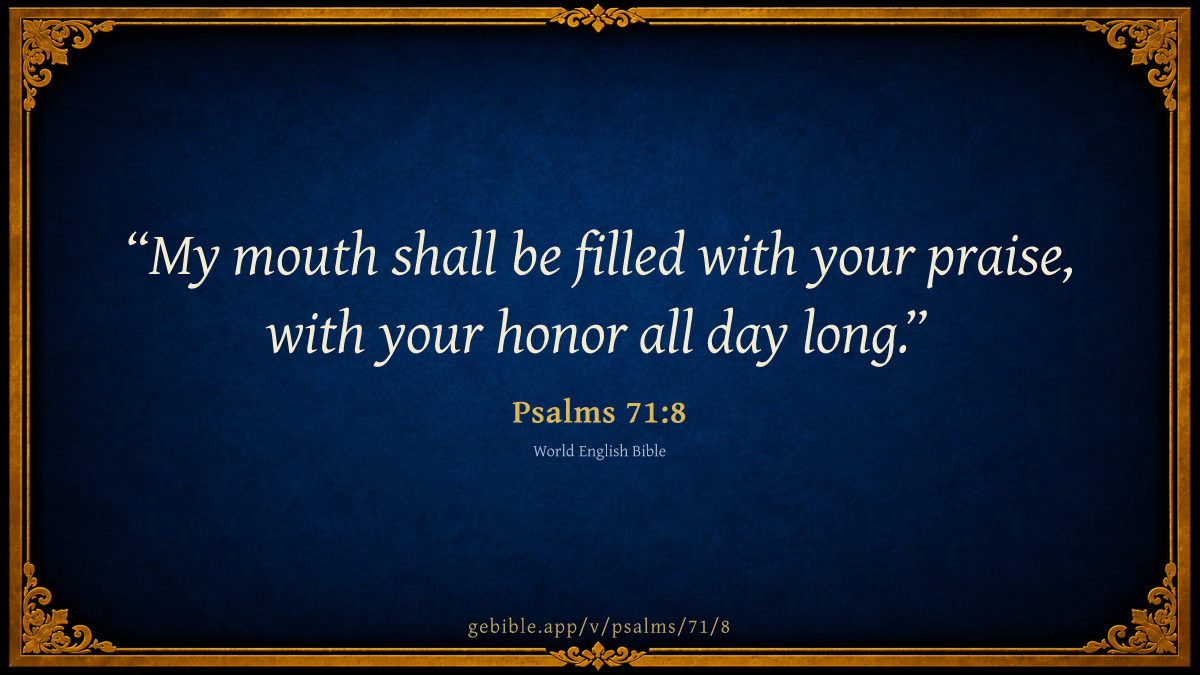
My mouth shall be filled with your praise, with your honor all day long.
Parallel Translations
-
My mouth shall be filled with your praise, with your honor all day long.
-
Let my mouth be filled with thy praise and with thy honour all the day.
-
My mouth shall be filled with Thy praise, and with Thy glory all the day.
Cross-references (9)
Passages linked to Psalms 71:8 in the Treasury of Scripture Knowledge, ordered by reader-vote popularity; verse text shown in World English Bible.
- Psalms 35:28 My tongue shall talk about your righteousness and about your praise all day long.
- Psalms 146:2 While I live, I will praise Yahweh. I will sing praises to my God as long as I exist.
- Psalms 104:1 Bless Yahweh, my soul. Yahweh, my God, you are very great. You are clothed with honor and majesty.
- Psalms 71:15 My mouth will tell about your righteousness, and of your salvation all day, though I don’t know its full measure.
- Psalms 71:24 My tongue will also talk about your righteousness all day long, for they are disappointed, and they are confounded, who want to harm me.
- Psalms 145:1-2 I will exalt you, my God, the King. I will praise your name forever and ever. Every day I will praise you. I will extol your name forever and ever.
- Psalms 51:14-15 Deliver me from the guilt of bloodshed, O God, the God of my salvation. My tongue will sing aloud of your righteousness. Lord, open my lips. My mouth will declare your praise.
- Psalms 63:5 My soul shall be satisfied as with the richest food. My mouth shall praise you with joyful lips,
- Psalms 96:6 Honor and majesty are before him. Strength and beauty are in his sanctuary.
Cross-references from openbible.info (CC BY 4.0)
Explain this verse (11 sources)
Historical commentary, presented as a primary source — not an endorsement.
Private notes
Saved on this device only — never synced or sent anywhere.
John Trapp 1656 · Public Domain Psa 71:8 Let my mouth be filled [with] thy…
Psa 71:8 Let my mouth be filled [with] thy praise [and with] thy honour all the day.
Ver. 8. Let my mouth be filled with thy praise] Minister unto me still fresh matter for my spirit to work upon.
John Trapp, A Commentary or Exposition upon All the Books of the Old and New Testament (1647–1656) — public domain. Text from a community e-Sword module.
Matthew Poole 1685 · Public Domain Give me occasion to multiply my praises to thee,…
Give me occasion to multiply my praises to thee, for delivering me out of my present distress.
Matthew Poole's English Annotations on the Holy Bible (1683–1685) — public domain. Text from a community e-Sword/MySword module.
John Gill 1763 · Public Domain Let my mouth be filled with thy praise,.... Or…
Let my mouth be filled with thy praise,.... Or "thy praise shall fill my mouth" (x); which shows that his heart was affected with the goodness of God to him, and that he had a deep impression and sense of it upon him; for out of the abundance of the heart the mouth speaks; and for the mouth to be filled with the praise of God, is to speak largely, publicly, and with great delight, in the praise of God, his divine perfections and benefits;
and with thy honour all the day; the excellency of his nature, the glory of his majesty, the honour due unto him, on account of his being, attributes, and blessings of providence and grace; a work to be employed in all the day, evening, morning, and at noon; as often as prayer is made to God, praise, honour, and glory, should be given him; since his mercies are new every morning, and they continue all the day long; his goodness endures for ever.
Read full note →
(x)
John Gill's Exposition of the Whole Bible (1746–1763) — public domain (CC PDM 1.0). Text via the HelloAO Bible API.
Joseph Benson 1811 · Public Domain Psa 71:8-11. Let my mouth be filled with thy…
Psa 71:8-11. Let my mouth be filled with thy praise — Give me occasion to multiply praises to thee for delivering me out of my present distress. Cast me not off in my old age — When I am most feeble, and most need thy help, and am one that is grown old in thy service. For mine enemies lay wait for my soul, &c. — Hebrew, שׁמרי נפשׁי, shomree naphshi, the watchers, or observers, of my soul — That watch, that they may find occasion to take away my life, and that I may not escape out of their hands; take counsel together — Combine their powers and policies to destroy me. Saying, God hath forsaken him — For his many acts of wickedness, as is manifest, because the hearts of all Israel are turned from him, and his own heart fails him. Persecute him, and take him — Let us pursue him closely now, and we shall certainly take him; for he has not forces sufficient to withstand us, and deliver him out of our hands.
Joseph Benson's Commentary on the Old and New Testaments (1811–1818) — public domain. Text from a community e-Sword module.
Albert Barnes 1834 · Public Domain Let my mouth be filled - This is an…
Let my mouth be filled - This is an appeal to himself, in view of the goodness of God, to praise him always. See the notes at Psa 35:28.
With thy praise - With the expressions of praise.
Read full note →
And with thy honor all the day - With such expressions as shall promote thy glory, and make thy honor known.
Albert Barnes' Notes on the Bible (1834–1885) — public domain. Text from a community e-Sword/MySword module.
Daniel D. Whedon 1874 · Public Domain 8. Let my mouth be filled with thy praise—My…
8. Let my mouth be filled with thy praise—My mouth shall be filled, etc. The review of his wonderful history (Psa_71:5-7) inspires this purpose.
Daniel D. Whedon (gen. ed.), Commentary on the Old and New Testaments (1874–1909) — public domain. Text from a community e-Sword module.
The Cambridge Bible for Schools and Colleges 1878 · Public Domain 8. My mouth shall be filled with thy praise,
8. My mouth shall be filled with thy praise,
And with thy honour all the day (R.V.).
Read full note →
Cp. 1Ch_29:11 “Thine, O Jehovah, is the greatness, and the might, and the honour, and the victory, and the majesty.” The P.B.V. that I may sing of thy glory and honour all the day long comes from the LXX through the Vulg.
The Cambridge Bible for Schools and Colleges (gen. ed. J. J. S. Perowne; Cambridge University Press, 1878–1918) — public domain. Text from a community e-Sword module.
The Pulpit Commentary 1880 · Public Domain Let my mouth be filled with thy praise and…
Let my mouth be filled with thy praise and with thy honour all the day. Praise alternates with complaint and prayer, even in this first portion of the psalm, preparing the way for the sustained praise of the second portion.
The Pulpit Commentary (1880–1919), ed. H.D.M. Spence-Jones & Joseph S. Exell — public domain. Text from a community e-Sword module.
Charles H. Spurgeon 1885 · Public Domain Ver. 8. Let my mouth be filled with thy…
Ver. 8. Let my mouth be filled with thy praise and with thy honour all the day. What a blessed mouthful! A man never grows nauseated though the flavour of it be all day in his mouth. God's bread is always in our mouths, so should his praise be. He fills us with good; let us be also filled with gratitude. This would leave no room for murmuring or backbiting; therefore, may we well join with holy David in this sacred wish.
Ver. 8. Let my mouth be filled with thy praise. Let my mouth, I say, be so filled with thy praise, that from the bottom of my heart, even to the lips of my mouth, the plenitude of thy grace, O God, infused into my heart, and diffused over my lips, may loyally magnify thee; so shall I not be found like that people, of whom thou dost say: "This people honour me with their lips, but their heart is far from me." Isa 29:13. Gerhohus.
Read full note →
Ver. 8.
I. What? filled with what? --murmurings? doubts? fears?
No! Praise. My own? --of men? No. Thy
praise. Thy honour.
II. When? All the day.
1. The whole day.
2. Every day; a good preparation for heaven.
Psalms 71:9*
Charles H. Spurgeon's The Treasury of David (1869–1885) — public domain. Psalms only. Text from a community e-Sword/MySword module.
The Biblical Illustrator 1887 · Public Domain Be Thou my strong habitation, whereunto I may continually…
Psa_71:8
Be Thou my strong habitation, whereunto I may continually resort.
Read full note →
God, our continual resort
David knew what it was to hide himself away in the great caverns and rocks of his native land. He had done so in the cave of Adullam. And such residences are never forgotten. You may live for an age in such a town as this, and forget it all. What is there to remember in this labyrinth of bricks and mortar? But when you get into the clear bracing atmosphere of the hills, amid these crags and glens, and you spend a night in some mountain cave, you will never forget that. And David never did. And in his loftiest songs he speaks of God in language culled from the cave. And what a gracious heart he must have had to be able to speak like this. He desired not merely to dwell with, but in, God. He would have the Lord to be his house, his home, whereunto he might continually resort. The text suggests--
I. The delightful repose that David found in God. Be Thou my strong habitation: that is, be my house and home.
1. What wonderful condescension he had experienced from God. That he should be allowed to think of the great and glorious God as his home. And he did so, for--
2. He had realized in God peculiar love. In a mans own home he expects to find love. Pity the poor wretch who is disappointed therein. In the world we do not expect it, we reckon on rough treatment; but within our own doors we enter the sanctuary of love. And David had dwelt in God as in the abode of love.
3. And home is the place of special rest. We lay aside our working dress. The advocate takes off his gown, and says, Lie there, Mr. Barrister, and let the father come to the front. The tradesman takes off his apron, the warrior his harness, the bearer his yoke, for he is at home. And so we have rest in God.
4. And of joyful freedom. Religious people sometimes start back from the prayers of a true saint, and say, He is too familiar. Of course a child is too familiar for the imitation of a stranger; but have you ever blamed a child for clambering on his fathers knee? And yet you would not think of copying him. Boy, dost thou know what thou art at? Thou art playing with a learned judge, before whom prisoners tremble, and courts are hushed. Even wise counsellors speak to him as my lord. But that urchin does not say, My lord. Look, he is plucking him by the beard; he is kissing his cheek. What presumption! No! he is the judges child; he who is to judge others is father to him. So the saints of God say, Our Father, which art in heaven, ever reverentially, but yet with sweet familiarity. They are at home with Him.
5. And of intimate knowledge. David knew the Lord even as he knew the eaves in which he had sheltered. David could have served as a guide to the great hollow of Adullam.
6. Of tender care. We may get more skill elsewhere, perhaps, but what can make up for the tenderness of home? One would like to die there when our time comes.
II. David had realized in God powerful security. He felt then, and so does the child of God, perfectly safe.
III. God was to him a place of continual resort. The gate of communion with God is never locked. There is joy in such resort itself, and as an outlook for the unknown future; and it is a joy which answers so many blessed purposes. Let us continually resort unto God as we ever may. Let us come now. (C. H. Spurgeon.)
God the habitation of souls
I. A sense of the souls need. The soul needs a habitation. It is a homeless wanderer.
1. It wants a home for protection. How exposed is a guilty soul?
2. It wants a home for comfort. Home is the scene of comfort. But the guilty soul is comfortless.
3. It wants a home for settledness. It is a restless wanderer.
II. A faith in Gods sufficiency. God is just the habitation which the soul wants, affording security, comfort, and permanent residence.
1. God is an accessible habitation. The doors of infinite love are ever open to welcome all who come. This habitation is ever near to us.
2. God is a secure habitation. Those who are in Him are safe from all dangers and all foes. God is our refuge and strength.
3. God is a blessed habitation. In Him is found infinitely more than all we want to perfect us in everlasting bliss.
4. God is an enduring habitation. The eternal God is our refuge, etc. Return, O prodigal, to thy Fathers house. (Homilist.)
The best home
(to children):--I am going to talk to you about the best home you could ever think of. God is a home; thats what our text says.
I. Home is a place of shelter and security. Every boy and girl feels safe at home. Now, there are a great many dangers and troubles in the world that grasp us, and threaten us, and frighten us; but if we only get into this home of which I am speaking, they cant harm us. God is a sure refuge for His children. Long ago, rich people lived in castles built of strong stone walls, and frequently surrounded by a deep broad ditch, so that robbers and enemies would not be able to enter and despoil them of their property. They used to fight with each other, and when the battle began to turn against them, they would flee into their castles, and there they were safe. New, God is a great castle; He is a strong habitation. If you once get inside of it, no enemy can harm you.
II. Home is a place of supply. I know that there are homes where children do not have many nice things, where they have at times to suffer hunger. But such is not the case with this home of which I am speaking. This home has everything to make those who live in it satisfied and happy.
III. Home is a place of love. Mother, father, wife, children, are but faint, faint images of God. He is the fountain of all their affection. There is no place in the universe so safe and so delightful. (B. D. Thomas.)
The Biblical Illustrator, edited by Joseph S. Exell (c. 1880s–1900s) — public domain. Text from a community e-Sword module.
unfoldingWord translationNotes 2017 · CC BY-SA 4.0 My mouth will be filled with your praise ...…
My mouth will be filled with your praise ... with your honor
The psalmist speaks of his desire to praise and honor Yahweh with the words he speaks as if his mouth were full of words the way it can be full of food. AT: "My mouth will be filled with words that praise you ... that honor you" or "I will always praise you ... will always honor you" (See: Synecdoche)
Read full note →
your praise
Here "praise" refer to the words that he will use to praise Yahweh. AT: "words that tell people how great you are" (See: Metonymy)
your honor
Here "honor" refer to the words that he will use to honor Yahweh. AT: "words that cause people to honor you" (See: Metonymy)
all the day
"all day long" or "at all times"
Do not throw me away ... do not abandon me
These two phrases have basically the same meaning and are used together for emphasis. (See: Parallelism)
Do not throw me away
"Do not force me to go away from you." For God to reject him is spoken of as God forcing him to go away. See how this is translated in Psalms 51:11. AT: "do not reject me" (See: Metaphor)
do not abandon me
"do not leave me forever"
translationWords
honor
unfoldingWord translationNotes — © Distant Shores Media and the Door43 World Missions Community, licensed CC BY-SA 4.0. Source: git.door43.org/Door43/en_tn.