
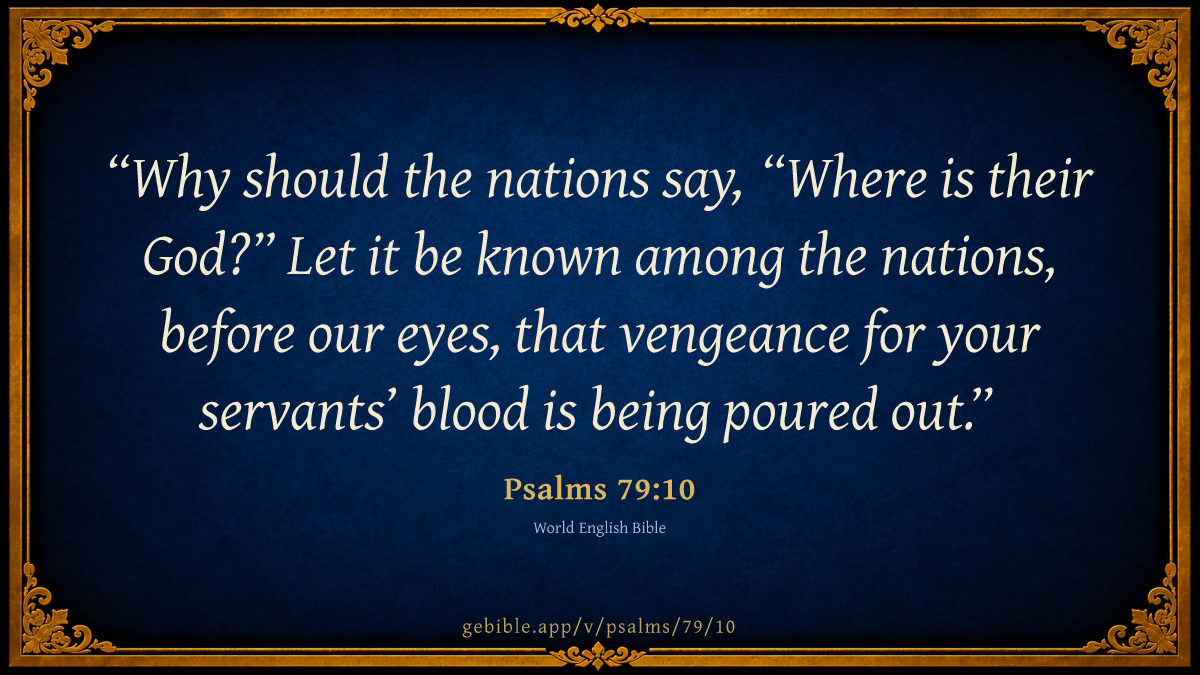
Why should the nations say, “Where is their God?” Let it be known among the nations, before our eyes, that vengeance for your servants’ blood is being poured out.
Parallel Translations
-
Why should the nations say, “Where is their God?” Let it be known among the nations, before our eyes, that vengeance for your servants’ blood is being poured out.
-
Wherefore should the heathen say, Where is their God? let him be known among the heathen in our sight by the revenging of the blood of thy servants which is shed.
-
Wherefore should the nations say: 'Where is their God?' Let the avenging of Thy servants' blood that is shed be made known among the nations in our sight.
Cross-references (16)
Passages linked to Psalms 79:10 in the Treasury of Scripture Knowledge, ordered by reader-vote popularity; verse text shown in World English Bible.
- Psalms 42:10 As with a sword in my bones, my adversaries reproach me, while they continually ask me, “Where is your God?”
- Exodus 6:7 I will take you to myself for a people. I will be your God; and you shall know that I am Yahweh your God, who brings you out from under the burdens of the Egyptians.
- Exodus 7:5 The Egyptians shall know that I am Yahweh when I stretch out my hand on Egypt, and bring the children of Israel out from among them.”
- Psalms 42:3 My tears have been my food day and night, while they continually ask me, “Where is your God?”
- Psalms 94:1 Yahweh, you God to whom vengeance belongs, you God to whom vengeance belongs, shine out.
- Psalms 115:2 Why should the nations say, “Where is their God, now?”
- Ezekiel 39:21-22 “I will set my glory among the nations. Then all the nations will see my judgment that I have executed, and my hand that I have laid on them. So the house of Israel will know that I am Yahweh their God, from that day and forward.
- Micah 7:10 Then my enemy will see it, and shame will cover her who said to me, where is Yahweh your God? Then my enemy will see me and will cover her shame. Now she will be trodden down like the mire of the streets.
- Revelation 18:20 “Rejoice over her, O heaven, you saints, apostles, and prophets; for God has judged your judgment on her.”
- Psalms 9:16 Yahweh has made himself known. He has executed judgment. The wicked is snared by the work of his own hands.
- Psalms 58:11 so that men shall say, “Most certainly there is a reward for the righteous. Most certainly there is a God who judges the earth.”
- Psalms 83:17-18 Let them be disappointed and dismayed forever. Yes, let them be confounded and perish; that they may know that you alone, whose name is Yahweh, are the Most High over all the earth.
- Jeremiah 51:35 May the violence done to me and to my flesh be on Babylon!” the inhabitant of Zion will say; and, “May my blood be on the inhabitants of Chaldea!” will Jerusalem say.
- Ezekiel 36:23 I will sanctify my great name, which has been profaned among the nations, which you have profaned among them. Then the nations will know that I am Yahweh,” says the Lord Yahweh, “when I am proven holy in you before their eyes.
- Joel 2:17 Let the priests, the ministers of Yahweh, weep between the porch and the altar, and let them say, “Spare your people, Yahweh, and don’t give your heritage to reproach, that the nations should rule over them. Why should they say among the peoples, ‘Where is their God?’ ”
- Romans 12:19 Don’t seek revenge yourselves, beloved, but give place to God’s wrath. For it is written, “Vengeance belongs to me; I will repay, says the Lord.”
Cross-references from openbible.info (CC BY 4.0)
Explain this verse (11 sources)
Historical commentary, presented as a primary source — not an endorsement.
Private notes
Saved on this device only — never synced or sent anywhere.
John Calvin 1540 · Public Domain 10. Why should the heathen say, Where is their…
10. Why should the heathen say, Where is their God? Here the people of God, in urging his name as a plea at the throne of grace: do so in a different sense from that in which they had urged it before. He extends his compassion towards us for his own name’s sake; for, as he is merciful, and will have our mouths stopped, that he alone may be accounted righteous, he freely pardons our sins. But here, the faithful beseech him that he would not allow his sacred name to be exposed to the blasphemies and insults of the wicked. From this we are taught that we do not pray in a right manner, unless a concern about our own salvation, and zeal for the glory of God, are inseparably joined together in our exercise. From the second clause of the verse, the same question may be raised which we have just now answered. Although God declares that he will execute vengeance upon our enemies, we are not warranted to thirst for revenge when we are injured. Let us remember that this form of prayer was not dictated for all men indiscriminately, that they might make use of it whenever impelled by their own passions, but that, under the guidance and instruction of the Holy Spirit, they might plead the cause of the whole Church, in common, against the wicked. If we would, therefore, offer up to God a prayer like this in a right manner, in the first place, our minds must be illuminated by the wisdom of the Holy Spirit; and, secondly, our zeal, which is often corrupted by the turbid affections of the flesh, must be pure and well-regulated; and then, with such a pure and well-tempered zeal, we may lawfully beseech God to show us, by evident examples, how precious, in his sight, is the life of his servants whose blood he avenges. The faithful are not to be understood as expressing any desire to be glutted with the sight of the shedding of human blood, as if they longed greedily after it: they only desire that God would grant them some confirmation of their faith, in the exercise of his fatherly love which is manifested when he avenges the wrongs done to his own people. It is farther to be noticed, that the appellation, the servants of God, is given to those who, nevertheless, were justly punished on account of their sins; for although he may chastise us, yet he does not forthwith cast us off, but, on the contrary, testifies thereby that our salvation is the object of his care. Again, we know that when the anger of God is extended over the whole body of the Church, as the good and the bad are mingled together in her, the former are punished in common with the latter, even as Ezekiel, Jeremiah, Daniel, and others, were carried into captivity. They were not, it is true, altogether faultless; but it is certain that so great a calamity was not brought upon the Jews on their account. In their person, there was rather set forth a spectacle to the ungodly, that they might be the more deeply affected.
John Calvin's Commentaries (1540-1563) — public domain. Text from the Calvin Translation Society English edition (1840s-50s) via the Christian Classics Ethereal Library (ccel.org). Calvin's coverage is partial (roughly two-thirds of the Bible); uncommented books and verses are honest gaps, never fabricated. The 19th-century editor's footnotes and remarks are omitted so the notes are faithfully Calvin's own voice.
John Trapp 1656 · Public Domain Psa 79:10 Wherefore should the heathen say, Where [is]…
Psa 79:10 Wherefore should the heathen say, Where [is] their God? let him be known among the heathen in our sight [by] the revenging of the blood of thy servants [which is] shed.
Ver. 10. Where is their God?] See Psa 43:3. So Turks at this day (when they have the better of Christians) cry, Where is the Christian’s God? We are the right Mussulmans, &c.
Read full note →
By the revenging of the blood of thy servants, &c.] For the which make thou inquisition, and do justice.
John Trapp, A Commentary or Exposition upon All the Books of the Old and New Testament (1647–1656) — public domain. Text from a community e-Sword module.
Matthew Poole 1685 · Public Domain Their God; he whom they served, and of whom…
Their God; he whom they served, and of whom they boasted. He is lost and gone, or grown impotent or idle.
Let him be known among the heathen, by the execution of his judgments upon them, according to Psa 9:16.
Read full note →
In our sight; that we may live to see it, and praise thy name for it.
Matthew Poole's English Annotations on the Holy Bible (1683–1685) — public domain. Text from a community e-Sword/MySword module.
John Gill 1763 · Public Domain Wherefore should the Heathen say, where is their God?....…
Wherefore should the Heathen say, where is their God?.... They boast of, and put their confidence in, and expect salvation from? he does not appear for them, he is not with them; he has forsaken them, and will not help them; than which nothing can be more afflicting and distressing to the Lord's people; see Psa 42:3,
let him be known among the Heathen in our sight; in his holiness and justice, as a God of power, and to whom vengeance belongs; let him be known by his judgments executed upon the Heathen, openly and publicly in our sight, and in the view of the whole world; see Psa 9:16, so it follows,
Read full note →
by the revenging of the blood of thy servants, which is shed; as in Psa 79:3, which blood God will revenge according to the request of his people, and give them blood to drink by way of retaliation; by which means his vindictive justice will be known, and it will be seen where the God of his people is, that he is with them, and maintains their cause; see Rev 6:9. The words may be rendered in connection with the preceding clause thus; "let it be known among the Heathen in our sight, even the revenging of the blood of thy servants which is shed"; though Kimchi supplies the words as we do, "by a revenging", &c.
John Gill's Exposition of the Whole Bible (1746–1763) — public domain (CC PDM 1.0). Text via the HelloAO Bible API.
Adam Clarke 1810 · Public Domain Verse 10. Where is their God?] Show where thou…
Verse 10. Where is their God?] Show where thou art by rising up for our redemption, and the infliction of deserved punishment upon our enemies.
Adam Clarke's Commentary on the Bible (1810–1826) — public domain. Text from a community e-Sword/MySword module.
Albert Barnes 1834 · Public Domain Wherefore should the heathen say Where is their God?…
Wherefore should the heathen say Where is their God? - The nations. Why should such a course of forbearance toward them be pursued as to lead them to ask the question whether God is able to punish them, or to come to the conclusion that he is not the God of those who profess to worship him. See Psa 42:3, note; Psa 42:10, note.
Let him be known among the heathen - Let him so manifest himself among them that they cannot but see that he is God; that he is a just God; that he is the Friend and Protector of his people.
Read full note →
In our sight - So that we may see it; or, so that it may be seen that he is our Friend and Protector.
By the revenging of the blood of thy servants which is shed - Margin, vengeance. The true idea is, “Let the avenging of the blood of thy servants - the blood poured out, or shed, be known among the nations in our sight.” The prayer is that God would so interpose that there could be no doubt that it was on account of the blood of his people which had been shed by their enemies. It is a prayer that just punishment might be executed - a prayer which may be offered at anytime.
Albert Barnes' Notes on the Bible (1834–1885) — public domain. Text from a community e-Sword/MySword module.
The Cambridge Bible for Schools and Colleges 1878 · Public Domain 10. Wherefore &c.] The same plea in Psa_115:2 (cp.…
10. Wherefore &c.] The same plea in Psa_115:2 (cp. also Psa_115:1 with Psa_79:9); Joe_2:17. Cp. Exo_32:12; Psa_42:3; Mic_7:10.
let him be known] Better:
Read full note →
Let vengeance for thy servants’ blood that is shed
Be made known among the heathen in our sight.
Defer not vengeance to some future generation: let us see with our own eyes the fitting punishment of the enemies of Israel. This verse and Psa_79:9 are based upon Deu_32:43. Note how the thought of vengeance goes side by side with that of deliverance in Isa_35:4; Isa_47:3; Isa_59:17; Isa_61:2; Isa_63:4; and in Jer_50:15; Jer_50:28; Jer_51:6; Jer_51:11; Jer_51:36, chapters which also probably date from the Exile.
The Cambridge Bible for Schools and Colleges (gen. ed. J. J. S. Perowne; Cambridge University Press, 1878–1918) — public domain. Text from a community e-Sword module.
Ellicott's Commentary for English Readers 1878 · Public Domain (10) Wherefore.—Taken from Joe_2:17.
(10) Wherefore.—Taken from Joe_2:17.
Let him be known.—Better, Let it be known, i.e., where God is. Let the answer to the question be given in vengeance, and let us see it.
A Bible Commentary for English Readers, edited by Charles John Ellicott (1878–1897) — public domain. Text from a community e-Sword module.
The Pulpit Commentary 1880 · Public Domain Wherefore should the heathen say, Where is their God?.…
Wherefore should the heathen say, Where is their God?. (so Joe_2:17) A triumph over a foreign nation was always regarded in the ancient world as a triumph over their gods. Their gods were bound to protect them, and, if they did not, must either have been absent or powerless. (comp. 2Ki_18:33-35 2Ki_19:12) Let him be known among the heathen in our sight by the revenging of the blood of thy servants which is shed; rather, let there be shown forth among the heathen in our sight vengeance for the blood of thy servants that has been shed; or, in other words, "Let an evident judgment, visible to us, fall upon the heathen who have shed the blood of our brethren, thy true servants." An immediate judgment is prayed for; but it did not please God to send the judgment till after the expiration of a long term of years.
The heathen taunt.
Read full note →
I THE HEATHEN DID SAY THIS Where is their God? The Jew had talked so much of his God, how great and glorious he was, what wonderful works he had done, the victories he had given them, that now, in view of their burning city, their desecrated temple, the heaps of slain in their streets, the heathen in pride and scorn flung this taunt in their face Where is your God?
II AND THE HEATHEN SAY IT STILL. Missionaries go to them, and tell them of God, so holy, merciful, righteous, that many of them are won for God; but lo! there come, soon after, fellow countrymen of the missionaries traders, sailors, and others, who bring vile alcoholic drinks, murderous weapons, vices unnamable, and much else with them, and do their bad best to make the heathen"s home a hell: what wonder if they should ask, as they do Where is your God?
III AND MEN GODLESS AS HEATHENS SAY IT HERE IN OUR OWN LAND.
1. So called scientific men. One of them, the other day, contemptuously declared that he had been looking down a microscope for some thirty years, and he hadn"t found God yet; and he was sure he should have found him if there was a God to be found. And many others scoff at the idea of God, and deny his existence, or, at any rate, defy you to prove it.
2. Others, because of the problems of moral and physical evil, refuse to believe in God.
3. Others under the pressure of trial and earthly care: hence they have become bitter and hard, and so east off all Faith.
4. Many others, as they mark the glaring inconsistencies of professed Christians. They condemn them all as false, hypocritical, and insincere.
IV But we ask WHEREFORE SHOULD THEY SAY THIS?
1. Wherefore the man of science? For God is known by the spirit, not the intellect.
2. Or the mind baffled by moral problems? Our children trust us, when they cannot understand: should not God"s children trust him?
3. Or the care-embittered soul? Does the denial of God make care lighter? Would it not be better to humble one"s self before God, and to hide in the shelter of his love?
4. And the declaimer against the inconsistencies of the Church? He exaggerates them, and ignores the mass of true-hearted believers.
CONCLUSION. But let us take care to give no occasion for the heathen to say Where, etc.? S.C.
The Pulpit Commentary (1880–1919), ed. H.D.M. Spence-Jones & Joseph S. Exell — public domain. Text from a community e-Sword module.
The Biblical Illustrator 1887 · Public Domain Wherefore should the heathen say, Where is their God?
Psa_79:10
Wherefore should the heathen say, Where is their God?
Read full note →
A bad spirit and a theological error
I. A bad spirit. Where is their God?
1. There is a tendency in wicked men to deal in it. This spirit always indicates--
(1) A mean nature.
(2) A malignant nature.
(3) A haughty nature.
2. There is a susceptibility even in good men to be pained by it. This is no sign of strength and greatness, but the reverse; the really great and strong man will feel no more the most cutting gibes of scorners than granite the drops of morning dew.
II. A theological error. The question implies that the true God would not allow His people to suffer oppression and death at the hands of others.
1. The creatures whom God has created with an inner sovereignty, He allows to act freely both for good and evil.
2. All the evil that comes into the universe in this way He overrules for good. (Homilist.)
The Biblical Illustrator, edited by Joseph S. Exell (c. 1880s–1900s) — public domain. Text from a community e-Sword module.
unfoldingWord translationNotes 2017 · CC BY-SA 4.0 Why should the nations say, "Where is their God?"
Why should the nations say, "Where is their God?"
This can be translated as a statement. AT: "The nations should not be able to say, 'Where is their God?'" (See: Rhetorical Question)
Read full note →
Where is their God?
This taunt can be translated as a statement. AT: "Their God cannot do anything!" (See: Rhetorical Question)
May the blood of your servants that was shed be avenged on the nations before our eyes
To shed blood is a metonym for killing innocent people. This can be translated in active form. AT: "Avenge your innocent servants whom the nations killed where we can see you do it" (See: Metonymy and Rhetorical Question)
before our eyes
"in our sight" or "while we are present"
May the groans of the prisoners come before you
Asaph speaks of the sound made by prisoners in pain and sorrow as if it were a person who appears before a king. AT: "Listen carefully to the groans of the prisoners and help them" (See: Metaphor and Assumed Knowledge and Implicit Information)
children of death
This is an idiom that refers to people who are condemned to death. AT: "those who are condemned to die" (See: Idiom)
translationWords
blood
servant
avenge
prison
power
die
life
unfoldingWord translationNotes — © Distant Shores Media and the Door43 World Missions Community, licensed CC BY-SA 4.0. Source: git.door43.org/Door43/en_tn.