
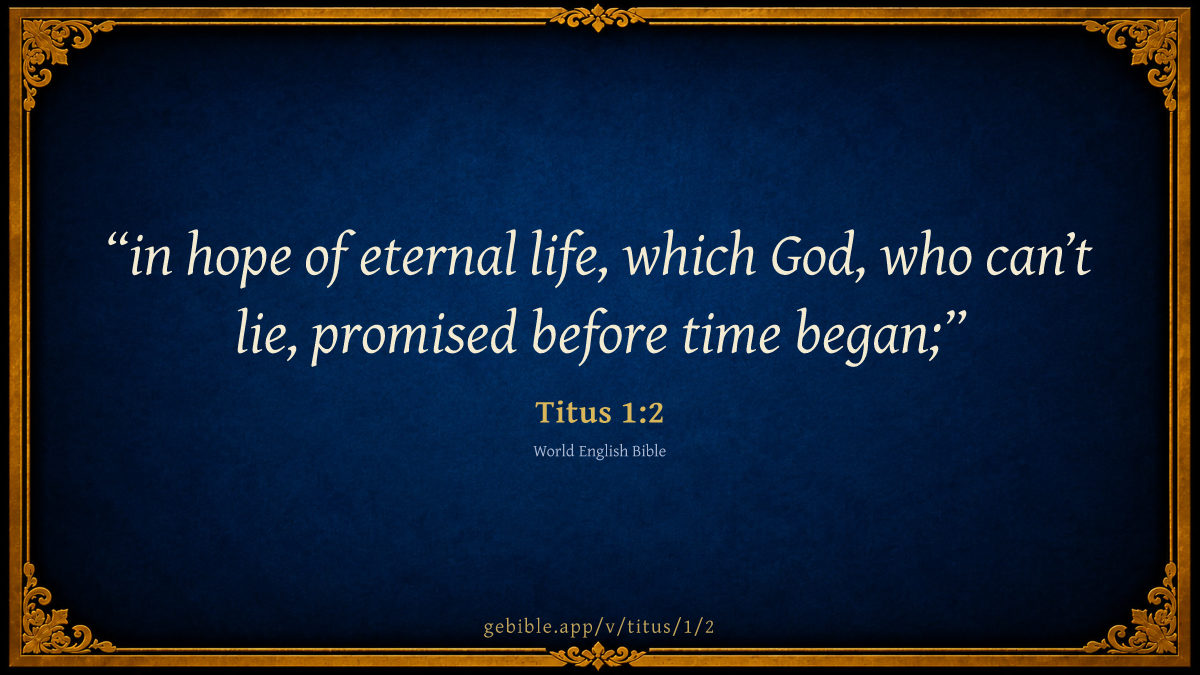
in hope of eternal life, which God, who can’t lie, promised before time began;
Parallel Translations
-
in hope of eternal life, which God, who can’t lie, promised before time began;
-
vpon the hope of eternall lyfe which lyfe God that cannot lye hath promised before the worlde beganne:
-
Vnto the hope of eternall life, which God that cannot lie, hath promised before the world began:
Examined in Scripture Analysis
Contradictions (1)
Questions where the Bible appears to say two different things, with the passages on each side set together.
Cross-references (45)
Passages linked to Titus 1:2 in the Treasury of Scripture Knowledge, ordered by reader-vote popularity; verse text shown in World English Bible.
- Numbers 23:19 God is not a man, that he should lie, nor a son of man, that he should repent. Has he said, and will he not do it? Or has he spoken, and will he not make it good?
- 2 Timothy 1:9 who saved us and called us with a holy calling, not according to our works, but according to his own purpose and grace, which was given to us in Christ Jesus before times eternal,
- 1 John 2:25 This is the promise which he promised us, the eternal life.
- Hebrews 6:17-18 In this way God, being determined to show more abundantly to the heirs of the promise the immutability of his counsel, interposed with an oath, that by two immutable things, in which it is impossible for God to lie, we may have a strong encouragement, who have fled for refuge to take hold of the hope set before us.
- 1 John 5:11-13 The testimony is this, that God gave to us eternal life, and this life is in his Son. He who has the Son has the life. He who doesn’t have God’s Son doesn’t have the life. These things I have written to you who believe in the name of the Son of God, that you may know that you have eternal life, and that you may continue to believe in the name of the Son of God.
- 2 Timothy 1:1 Paul, an apostle of Jesus Christ through the will of God, according to the promise of the life which is in Christ Jesus,
- Titus 2:13 looking for the blessed hope and appearing of the glory of our great God and Savior, Jesus Christ,
- 1 Samuel 15:29 Also the Strength of Israel will not lie nor repent; for he is not a man, that he should repent.”
- 2 Timothy 2:13 If we are faithless, he remains faithful; for he can’t deny himself.”
- 2 Timothy 2:15 Give diligence to present yourself approved by God, a workman who doesn’t need to be ashamed, properly handling the Word of Truth.
- Jude 1:21 Keep yourselves in God’s love, looking for the mercy of our Lord Jesus Christ to eternal life.
- Matthew 25:46 These will go away into eternal punishment, but the righteous into eternal life.”
- Romans 6:23 For the wages of sin is death, but the free gift of God is eternal life in Christ Jesus our Lord.
- Titus 3:7 that being justified by his grace, we might be made heirs according to the hope of eternal life.
- 1 Peter 1:20-23 who was foreknown indeed before the foundation of the world, but was revealed in this last age for your sake, who through him are believers in God, who raised him from the dead, and gave him glory, so that your faith and hope might be in God. Seeing you have purified your souls in your obedience to the truth through the Spirit in sincere brotherly affection, love one another from the heart fervently, having been born again, not of corruptible seed, but of incorruptible, through the word of God, which lives and remains forever.
- 1 John 5:20 We know that the Son of God has come, and has given us an understanding, that we know him who is true, and we are in him who is true, in his Son Jesus Christ. This is the true God and eternal life.
- Matthew 25:34 Then the King will tell those on his right hand, ‘Come, blessed of my Father, inherit the Kingdom prepared for you from the foundation of the world;
- John 3:15-16 that whoever believes in him should not perish, but have eternal life. For God so loved the world, that he gave his one and only Son, that whoever believes in him should not perish, but have eternal life.
- John 5:39 “You search the Scriptures, because you think that in them you have eternal life; and these are they which testify about me.
- John 10:28 I give eternal life to them. They will never perish, and no one will snatch them out of my hand.
- Romans 5:21 that as sin reigned in death, even so grace might reign through righteousness to eternal life through Jesus Christ our Lord.
- 1 Thessalonians 5:8 But since we belong to the day, let’s be sober, putting on the breastplate of faith and love, and for a helmet, the hope of salvation.
- Titus 2:7 In all things be showing yourself an example of good works. In your teaching, be showing integrity, seriousness, incorruptibility,
- 1 Peter 1:3-4 Blessed be the God and Father of our Lord Jesus Christ, who according to his great mercy caused us to be born again to a living hope through the resurrection of Jesus Christ from the dead, to an incorruptible and undefiled inheritance that doesn’t fade away, reserved in Heaven for you,
- Proverbs 8:23-31 I was set up from everlasting, from the beginning, before the earth existed. When there were no depths, I was born, when there were no springs abounding with water. Before the mountains were settled in place, before the hills, I was born; while as yet he had not made the earth, nor the fields, nor the beginning of the dust of the world. When he established the heavens, I was there. When he set a circle on the surface of the deep, when he established the clouds above, when the springs of the deep became strong, when he gave to the sea its boundary, that the waters should not violate his commandment, when he marked out the foundations of the earth, then I was the craftsman by his side. I was a delight day by day, always rejoicing before him, rejoicing in his whole world. My delight was with the sons of men.
- John 6:68 Simon Peter answered him, “Lord, to whom would we go? You have the words of eternal life.
- John 17:2 even as you gave him authority over all flesh, so he will give eternal life to all whom you have given him.
- Romans 1:2 which he promised before through his prophets in the holy Scriptures,
- Romans 2:7 to those who by perseverance in well-doing seek for glory, honor, and incorruptibility, eternal life;
- Romans 5:2 through whom we also have our access by faith into this grace in which we stand. We rejoice in hope of the glory of God.
- Romans 5:4 and perseverance, proven character; and proven character, hope:
- Romans 16:25
- 1 Timothy 6:19 laying up in store for themselves a good foundation against the time to come, that they may lay hold of eternal life.
- 2 Timothy 2:10 Therefore I endure all things for the chosen ones’ sake, that they also may obtain the salvation which is in Christ Jesus with eternal glory.
- 1 John 3:2-3 Beloved, now we are children of God. It is not yet revealed what we will be; but we know that when he is revealed, we will be like him; for we will see him just as he is. Everyone who has this hope set on him purifies himself, even as he is pure.
- Revelation 13:8 All who dwell on the earth will worship him, everyone whose name has not been written from the foundation of the world in the book of life of the Lamb who has been killed.
- Revelation 17:8 The beast that you saw was, and is not; and is about to come up out of the abyss and to go into destruction. Those who dwell on the earth and whose names have not been written in the book of life from the foundation of the world will marvel when they see that the beast was, and is not, and shall be present.
- John 6:54 He who eats my flesh and drinks my blood has eternal life, and I will raise him up at the last day.
- John 17:24 Father, I desire that they also whom you have given me be with me where I am, that they may see my glory, which you have given me, for you loved me before the foundation of the world.
- Acts 15:18 “All of God’s works are known to him from eternity.
- 1 Thessalonians 2:15 who killed both the Lord Jesus and their own prophets, and drove us out, and don’t please God, and are contrary to all men,
- 1 Timothy 6:12 Fight the good fight of faith. Take hold of the eternal life to which you were called, and you confessed the good confession in the sight of many witnesses.
- Mark 10:17 As he was going out into the way, one ran to him, knelt before him, and asked him, “Good Teacher, what shall I do that I may inherit eternal life?”
- Mark 10:30 but he will receive one hundred times more now in this time: houses, brothers, sisters, mothers, children, and land, with persecutions; and in the age to come eternal life.
- Colossians 1:27 to whom God was pleased to make known what are the riches of the glory of this mystery among the Gentiles, which is Christ in you, the hope of glory.
Cross-references from openbible.info (CC BY 4.0)
Explain this verse (18 sources)
Historical commentary, presented as a primary source — not an endorsement.
Private notes
Saved on this device only — never synced or sent anywhere.
John Calvin 1540 · Public Domain 2. In the hope (or, on account of the…
2. In the hope (or, on account of the hope) of eternal life This undoubtedly denotes the cause; for that is the force of the Greek preposition ἐπί; and therefore it may be translated, “On account of the hope,” or “On the hope.” True religion and the practice of godliness — begin with meditation on the heavenly life; and in like manner, when Paul (Colossians 1:5) praises the faith and love of the Colossians, he makes the cause and foundation of them to be “the hope laid up in heaven.” The Sadducees and all who confine our hope to this world, whatever they may pretend, can do nothing else than produce contempt of God, while they reduce men to the condition of cattle. Accordingly, it ought always to be the aim of a good teacher, to turn away the eyes of men from the world, that they may look up to heaven. I readily acknowledge that we ought to value the glory of God more highly than our salvation; but we are not now discussing the question which of these two ought to be first in order. All that I say is — that men never seek God in a right manner till they have confidence to approach to him; and, therefore, that we never apply our mind to godliness till we have been instructed about the hope of the heavenly life.
Which God promised before the times of ages. As Augustine translated the words, Πρὸ χρόνων αἰωνίων to mean — not “the times of ages” but “eternal times,” he gives himself great uneasiness about “the eternity of times,” till at length he explains “eternal times” as denoting those which go beyond all antiquity. As to the meaning, he and Jerome and other commentators agree, that God determined, before the creation of the world, to give that salvation which he hath now manifested by the gospel. Thus Paul would have used the word promise incorrectly instead of decree; for before men existed there was no one to whom he could promise.
Read full note →
For this reason, while I do not reject this exposition, yet when I take a close survey of the whole matter, I am constrained to adopt a different interpretation — that eternal life was promised to men many ages ago, and not only to those who lived at that time, but also for our own age. It was not for the benefit of Abraham alone, but with a view to all who should live after him, that God said,
“In thy seed shall all nations be blessed.” (Genesis 22:18.)
Nor is this inconsistent with what he says, in another sense, (2 Timothy 1:9) that salvation was given to men “before the times of ages.” The meaning of the word is still the same in both passages; for, since the Greek word αἰών, denotes an uninterrupted succession of time from the beginning to the end of the world, Paul declares, in that passage, that salvation was given or decreed for the elect of God before times began to flow. But because in this passage he treats of the promise, he does not include all ages, so as to lead us back beyond the creation of the world, but shews that many ages have elapsed since salvation was promised.
If any person prefer to view “the times of ages” as a concise expression for the ages themselves, he is at liberty to do so. But because salvation was given by the eternal election of God before it was promised, the act of giving salvation is put in that passage (2 Timothy 1:9) before all ages, and therefore we must supply the word all. But here it means nothing more than that the promise is more ancient than a long course of ages, because it began immediately after the creation of the world. In the same sense he shews that the gospel, which was to have been proclaimed when Christ rose from the dead, had been promised in the Scriptures by the prophets; for there is a wide difference between the promise which was formerly given to the fathers and the present exhibition of grace.
Who cannot lie. This expression ἀψευδής is added for glorifying God, and still more for confirming our faith. And, indeed, whenever the subject treated of is our salvation, we ought to recollect that it is founded on the word of Him who can neither deceive nor lie. Moreover, the only proof of the whole of religion is — the unchangeable truth of God.
John Calvin's Commentaries (1540-1563) — public domain. Text from the Calvin Translation Society English edition (1840s-50s) via the Christian Classics Ethereal Library (ccel.org). Calvin's coverage is partial (roughly two-thirds of the Bible); uncommented books and verses are honest gaps, never fabricated. The 19th-century editor's footnotes and remarks are omitted so the notes are faithfully Calvin's own voice.
Geneva Bible translators 1599 · Public Domain Hope is the end of faith.
Hope is the end of faith.
Freely, and of his mere liberality.
Read full note →
See 2 Tim. 1:9.
Geneva Bible (1599) marginal notes — public domain.
John Trapp 1656 · Public Domain 2 In hope of eternal life, which God, that…
2 In hope of eternal life, which God, that cannot lie, promised before the world began;
Ver. 2. God that cannot lie] The word of promise binds God; therefore it seems, saith one, that it is stronger than God; for he can as soon deny himself as his promise.
Read full note →
Promised] That is, purposed, as 2Ti 1:9, or decreed to promise, or promised to Christ, or promised to our first parents from the beginning of ages, ante multa saecula, so some sense it.
John Trapp, A Commentary or Exposition upon All the Books of the Old and New Testament (1647–1656) — public domain. Text from a community e-Sword module.
Matthew Poole 1685 · Public Domain In hope of eternal life; which faith also, producing…
In hope of eternal life; which faith also, producing the acknowledgment, profession, and obedience to the truth, according to godliness, produceth in the soul a hope, or certain expectation, of eternal salvation or happiness.
Which God, that cannot lie, promised; nor doth this hope grow up as a rush without mire, or a flag without water, but is bottomed in God’s declaration of his will to that purpose; and it is impossible that the God of truth should lie, or speak what he never intended to effect. ’ Ephggeilato might as well here have been translated purposed, and must be so interpreted, if we interpret the next words, before the beginning of time, unless we say it was promised to the Head of the elect, Christ, on their behalf.
Read full note →
Before the world began; before the beginning of time, or rather, many ages since, as Rom 16:25. Thus eternal life was promised, though more obscurely, Gen 15:1; 17:7; 22:18.
Matthew Poole's English Annotations on the Holy Bible (1683–1685) — public domain. Text from a community e-Sword/MySword module.
John Gill 1763 · Public Domain In hope of eternal life,.... Or "for the hope…
In hope of eternal life,.... Or "for the hope of eternal life"; in order to bring souls to the hope of it. This is another end of the Gospel ministry, as to bring God's elect to faith in Christ, and to the knowledge and acknowledgement of the truth, as it is in Jesus, so to the hope of eternal glory and happiness: in a state of nature, they are without the grace of hope, or any true ground and foundation of it; and though it is the gift of God's grace, and is implanted on the soul by the Spirit of God in regeneration; yet the Gospel is the means of producing it at first, as well as afterwards encouraging and increasing it; for in it, Christ the foundation of hope is proposed, and set forth before awakened and convinced sinners: the object of this hope is "eternal life"; not anything now seen and enjoyed, for that is not hope; not anything in this present life, but something future; a life of perfect bliss and happiness with Christ to all eternity; which is a hope laid up in heaven, an inheritance reserved there; a life which is secured in the hands of Christ, which he has a power to give, and does give to all his sheep, and is the gift of God through him: and of which it is further said,
which God, that cannot lie, promised before the world began; eternal life is a "promise", and so of free grace, and not by the works of the law, which is inconsistent with a promise: it is the promise of God, who is faithful to his word, and "can not lie"; being the God of truth, that can neither deceive, nor be deceived: this does not contradict his omnipotence, but argues the perfection of his nature, which cannot admit of anything that implies weakness and mutation: and this promise was made before the world was, as early as the choice of God's elect in Christ, and the gift of grace to them in him; as early as the covenant was made with him, and he was set up as the Mediator of it; who was present to receive this promise as their head and representative for them, and to whom it was made as federally considered in him, and in whom it was secured for them; see Ti2 1:1.
John Gill's Exposition of the Whole Bible (1746–1763) — public domain (CC PDM 1.0). Text via the HelloAO Bible API.
John Wesley 1765 · Public Domain In hope of eternal life - The grand motive…
In hope of eternal life - The grand motive and encouragement of every apostle and every servant of God. Which God promised before the world began - To Christ, our Head.
John Wesley, Explanatory Notes Upon the Whole Bible (1754–1765) — public domain. Text via the GEBible commentary corpus.
Adam Clarke 1810 · Public Domain Verse 2. In hope of eternal life] In expectation…
Verse 2. In hope of eternal life] In expectation of a state of being and well being which should last through eternity, when time should be no more. This includes, not only the salvation of the soul and its eternal beatification, but also the resurrection of the body. This was a point but ill understood, and not very clearly revealed, under the Mosaic law; but it was fully revealed under the Gospel, and the doctrine illustrated by the resurrection and ascension of Christ.
Which God, that cannot lie, promised] We have often seen that the phrase, the foundation of the world, means the Jewish economy, and, before the foundation of the world, the times antecedent to the giving of the law. This is evidently the meaning here. See 2Ti 1:9-11.
Read full note →
Supposing the word αιωνιων in this verse to signify eternal, says Dr. Macknight, the literal translation of προ χρονων αιωνιων would be, before eternal times; but that being a contradiction in terms, our translators, contrary to the propriety of the Greek language, have rendered it before the world began, as Mr. Locke observes on Ro 16:25. The true literal translation is before the secular times, referring us to the Jewish jubilees, by which times were computed among the Hebrews, as among the Gentiles they were computed by generations of men. Hence, Col 1:26, The mystery which was kept hid απο των αιωνων και απο των γενεων, from the ages and from the generations, signifies the mystery which was kept hid from the Jews and from the Gentiles.
Adam Clarke's Commentary on the Bible (1810–1826) — public domain. Text from a community e-Sword/MySword module.
Joseph Benson 1811 · Public Domain Tit 1:2-4. In hope — Which doctrine lays a…
Tit 1:2-4. In hope — Which doctrine lays a foundation for, and shows us how we may attain a well-grounded and lively hope; of eternal life — The grand motive and encouragement of every apostle and every servant of God. Which God, that cannot lie — Nor deceive any of his creatures, hath not only, as in the former dispensation, intimated to us, but expressly promised — To all obedient believers; before the world began — Or, before the times of the ages, as Macknight renders προ χρονων αιωνιων, observing, “the promise here referred to is that which God made to Adam and Eve, and their posterity, at the fall, when in passing sentence on the serpent, he said of the seed of the woman, It shall bruise thy head. The same promise was renewed in the covenant with Abraham: In thy seed shall all the nations of the earth be blessed.” That this included a promise of eternal life to all believers has frequently been shown. It is true, “supposing the word αιωνιος, in this clause, to signify eternal, the literal translation of the passage would be, before eternal times. But that being a contradiction in terms, our translators, contrary to the propriety of the Greek language, have rendered it, before the world began. As Locke observes on Rom 16:25, the true, literal translation is, before the secular times, referring us to the Jewish jubilees, by which times were computed among the Hebrews, as among the Gentiles they were computed by generations of men.” But hath in due times — Or, in his own times, as the phrase καιροις ιδιοις properly signifies. God’s own times are fittest for his own work. What creature dares ask, Why no sooner? Manifested his word — His gospel, containing that promise, and the whole truth which is after godliness; through preaching — The public declaration thereof; which is committed unto me — Or, wherewith I am intrusted. According to the commandment — Or sovereign pleasure; of God our Saviour — And who dares exercise this office on any inferior authority? By affirming that Christ intrusted him with the preaching of the gospel according to the commandment of God, or as it is expressed 1Co 1:1; 2Co 1:1, by the will of God, the apostle carried his own authority to the highest pitch. To Titus, mine own son — Begotten of God by my preaching, and a true follower of me, and my assistant in the Lord’s work. See on Php 2:22. After the common faith — Common to me and all my spiritual children. Grace, mercy, and peace, &c. — See on 1Ti 1:2.
Joseph Benson's Commentary on the Old and New Testaments (1811–1818) — public domain. Text from a community e-Sword module.
Albert Barnes 1834 · Public Domain In hope of eternal life - Margin, for. Greek,…
In hope of eternal life - Margin, for. Greek, ἐπ ̓ ἐλπίδι ep' elpidi. This does not mean that Paul cherished the hope of eternal life, but that the “faith of the elect,” which he aimed to secure, was in order that people might have the hope of eternal life. The whole system which he was appointed to preach was designed to secure to man a well-founded hope of salvation; compare the notes, 2Ti 1:10.
Which God, that cannot lie - On the phrase” cannot lie,” see the notes at Heb 6:13. The fact that God cannot lie; that it is his nature always to speak the truth; and that no circumstances can ever occur in which He will depart from it, is the foundation of all our hopes of salvation.
Read full note →
Promised - The only hope of salvation is in the promise of God. It is only as we can have evidence that He has assured us that we may be saved, that we are authorized to cherish any hope of salvation. That promise is not made to us as individuals, or by name, but it becomes ours:
(1) Because He has made a general promise that they who repent and believe shall be saved; and,
(2) Because, we may have evidence that we have repented, and do believe the gospel. If this is so, we fairly come under the promise of salvation, and may apply it to ourselves.
Before the world began - That is, the purpose was then formed, and the promise may be considered as in fact then made; - for a purpose in the mind of God, though it is not as yet made known, is equivalent to a promise; compare the Mat 25:34 note; 2Ti 1:9 note.
Albert Barnes' Notes on the Bible (1834–1885) — public domain. Text from a community e-Sword/MySword module.
Haydock's Catholic Bible Commentary 1859 · Public Domain Who [1] lieth not, or who cannot lie, being…
Who [1] lieth not, or who cannot lie, being truth itself. --- Hath promised; that is, decreed to give life everlasting to his faithful servants. --- Before the times of the world.[2] Literally, before secular times. (Witham)
===============================
Read full note →
[BIBLIOGRAPHY]
Qui non mentitur, Greek: o apseudes.
===============================
[BIBLIOGRAPHY]
Ante tempora sæcularia, Greek: pro chronon aionion.
George Leo Haydock (1774–1849), Haydock's Catholic Family Bible and Commentary, 1859 edition — public domain. Excludes Psalms (Douay-Rheims chapter numbering differs from Protestant) and Deuterocanonical books (Catholic canon only).
Robert Jamieson, A. R. Fausset & David Brown 1871 · Public Domain In hope of eternal life--connected with the whole preceding…
In hope of eternal life--connected with the whole preceding sentence. That whereon rests my aim as an apostle to promote the elect's faith and full knowledge of the truth, is, "the hope of eternal life" (Tit 2:13; Tit 3:7; Act 23:6; Act 24:15; Act 28:20).
that cannot lie-- (Rom 3:4; Rom 11:29; Heb 6:18).
Read full note →
promised before the world began--a contracted expression for "purposed before the world began (literally, 'before the ages of time'), and promised actually in time," the promise springing from the eternal purpose; as in Ti2 1:9, the gift of grace was the result of the eternal purpose "before the world began."
Jamieson, Fausset & Brown — Commentary Critical and Explanatory on the Whole Bible (1871) — public domain (CC PDM 1.0). Text via the HelloAO Bible API.
Daniel D. Whedon 1874 · Public Domain 2. In hope—Literally, upon hope. But what is it…
2. In hope—Literally, upon hope. But what is it that rests upon this hope? Afford, translating it in hope, misses by saying it is the whole clause after apostle, from not seeing that the whole passage to Tit_1:4 expands St. Paul’s apostle. Paul is apostle, according to godliness; and based upon hope, etc., to end of Tit_1:3. The apostolate is based, not, as is the mission of the gainsayers, (Tit_1:9,) upon Jewish fables, (Tit_1:14,) but upon a hope of eternal life, eternally promised by a truthful God. This is his and Titus’s platform over all rival systems in Crete.
Eternal life—AEonic life; that life which belongs to the endless and glorious aeons, ages, or time-worlds, of the future. See notes on Mat_25:46; Gal_1:4-5; Eph_1:10. In this transcendent object of hope St. Paul’s Gospel stood alone.
Read full note →
Cannot lie—Literal Greek, unlying. Hence the assured fulfilment of the apostolic hope.
Before the world began—Προ χρονων αιωνιων, before aeonic times; before the time-worlds began to roll on their events; from the anterior eternity. See notes on Gal_1:4-5; Eph_1:4; Eph_2:2; and 2Ti_1:9. As Alford rightly says, against Huther, the same phrase in 2Ti_1:9 forbids interpreting it here as merely equivalent to απ’ αιωνος, “from of old.” Luk_1:70. The promise, from eternity, is explained in our note to Eph_1:4-5; Eph_1:9. From his very nature God eternally promises eternal life to all who come into accord and unison with himself. The temporal promises of eternal things in the Gospel are the external expressions of the true eternal promise. And so the apostle declares that the aeonic life of the gospel hope is not a thing of to-day, but lies in ideal in the anterior eternal ages. And hereby is, perhaps, made clear the error of Huther, who tells us that if the phrase means from eternity, then promised must mean decreed. Just as if a mental promise, and that a conditional one, too, could not be as truly eternal as a mental decree! And he quotes the questionable authority of Calvin, who says: “As the phrase treats of a promise, it does not embrace eternal ages, so as to bring us to before the world began, but teaches us only that many temporal ages had passed since the promise was made.” But the true meaning is, that there are the “promise and potency” of holy and blessed union with God himself for all who thereto consent in his own appointed way; an eternal election of all who voluntarily come into that election.
Daniel D. Whedon (gen. ed.), Commentary on the Old and New Testaments (1874–1909) — public domain. Text from a community e-Sword module.
The Cambridge Bible for Schools and Colleges 1878 · Public Domain 2. in hope of eternal life] The force of…
2. in hope of eternal life] The force of this phrase ‘in hope’ in N.T. is seen best from 1Co_9:10, ‘to plow in hope—to thresh in hope of partaking,’ or Rom_4:18, ‘who in hope believed against hope.’ It stands strongly by itself with a verb of some other strong feeling or action, equivalent to summa spe. The force of Act_26:5-6 comes out far more clearly if we keep ‘in hope’ there too, and understand St Paul to say ‘All the Jews know me; from a boy I have been a strict Pharisee; and today I am living in hope of the promise to our fathers as I stand here on my trial—the hope to which our twelve tribes look; and about this very hope I am called to account.’ Comparing the structure as well as the subject matter of that verse, we may well connect ‘in hope’ here with ‘Paul the Apostle’ before, and with ‘the message wherewith I was entrusted’ after. St Paul is still magnifying his office, as the emphatic ego shews. ‘My commission is threefold, and ranges from (1) the first spiritual life and gifts of those who have been chosen by God, through (2) the growing life of the true man of God thoroughly furnished, to (3) all the hope of glory; how your people in Crete may be justified, sanctified, glorified, is in the message wherewith I was entrusted; against this no Judaic formalism, no Gnostic spiritualism can hold: I have taught you (1) of the Holy Catholic Church; (2) of the Communion of saints and the Forgiveness of sins; (3) of the Resurrection of the body and the Life everlasting: and you are my true child after this common faith.’
God, that cannot lie] See Tit_1:1; ‘God’s promise, and mine as His messenger, is very different from the Cretan teachers’ word’ (Tit_1:12). The epithet is unique in N.T.
Read full note →
promised before the world began] R.V. literally, ‘before times eternal’; A.V. from Vulg. ‘ante tempora saecularia.’ The parallel passages are 2Ti_1:9 ‘his own purpose and grace which was given us in Christ Jesus before times eternal,’ Rom_16:25 ‘the mystery which hath been kept in silence through times eternal,’ 1Co_2:7 ‘which God foreordained before the worlds,’ Vulg. ‘ante saecula.’ The last passage shews the meaning of the Vulgate, ‘before the times of the world’s history,’ which is definite and accepted by R.V. there, though rejected here and in 2Ti_1:9 in favour of a bare and indeed meaningless phrase. It is better to import no extraneous definiteness into aionios, and also to recognise the proper idiomatic use of the preposition as to times and dates, of which 2Co_12:2 is an instance, ‘fourteen years ago,’ not ‘before fourteen years.’ Render in eternal times gone by. There is no difficulty as to the fact here or in 2Ti_1:9; with God to purpose, to promise, to give, are all one.
The Cambridge Bible for Schools and Colleges (gen. ed. J. J. S. Perowne; Cambridge University Press, 1878–1918) — public domain. Text from a community e-Sword module.
Ellicott's Commentary for English Readers 1878 · Public Domain (2) In hope of eternal life.—Better translated, resting on…
(2) In hope of eternal life.—Better translated, resting on the hope of eternal life. The connection of the preceding clauses with these words has been well summed up: “The Apostle’s calling had for its object the faith of the elect and the knowledge of the truth; and the basis on which all this rested was the hope of eternal life.”
Which God, that cannot lie.—Possibly, this singular and strong expression was chosen with reference to the peculiar vice of the Cretans, over whose Church Titus was then presiding. (See Tit_1:12 : “One of themselves, even a prophet of their own, said, The Cretians are alway liars.”)
Read full note →
Promised before the world began.—More accurately rendered, from eternal ages. (See 2Ti_1:9.) The promise of eternal life was the result of a divine purpose fixed from eternity.
A Bible Commentary for English Readers, edited by Charles John Ellicott (1878–1897) — public domain. Text from a community e-Sword module.
The Pulpit Commentary 1880 · Public Domain Who for that, A.V; times eternal for the world…
Who for that, A.V; times eternal for the world began, A.V In hope of eternal life. This seems to be a further description of the scope or sphere of the apostolate, which, as some take epi , is based upon the hope of eternal life. Who cannot lie (aqeudhv); here only in the New Testament, rarely in the LXX, but common in classical Greek. The epithet is here used to show the certainty of the fulfillment of the promise made before the ages. (comp. Heb_6:18 Num_23:19) Before times eternal. (see 2Ti_1:9, note) The translation, "before times eternal," conveys no sense; cronoi aiwnoi are "the times of ages, (Rom_16:25) placed in opposition to the kairoi idioi , or to the "now" of 2Ti_1:10, in which the manifestation of the promise took place.
The immortal hope.
Read full note →
"In hope of eternal life." How often these words have been inscribed over the resting-place of the dead! How restful they are! How such inscriptions in the dark catacombs tell of the new and blessed era that Christianity introduced! But it would be a mistake to connect them only with heaven. "This is life eternal," we read, "to know thee the only true God, and Jesus Christ, whom thou hast sent.
I HOPE AND LIFE ARE HERE CONNECTED. It was not so in paganism. Men lost hope. They lived in and for the present day, and when tired of life committed suicide. Hope, such as the great Christian hope, brightens all human duties and joys. Life is real and earnest, all through the years. Age does not dim the brightness of the eye of the soul. So we are saved by hope saved from ennui, disheartenment, and misery. We find Paul rejoicing in hope and patient in tribulation because of the life within, that was hid with Christ in God.
II SERVICE IS ASSOCIATED WITH ETERNAL LIFE. Paul is a servant of God, and that service is quickened by faith and sustained by hope. The Christian teacher sees not only man in his fall and misery, but he sees the ideal man in him one who may be re-created in Christ Jesus. The desert blossoms as the rose, as hope cheers the sower who plants the immortal seed of the kingdom in human hearts. The measure of our life is the measure of
(1) the cheerfulness and
(2) the continuance of our service.
And what hope! It includes glory, honor, immortality, and eternal life. W.M.S.
The Divine veracity.
"God, who cannot lie." Man can lie. Man does lie. His word is not always his bond. He indulges in exaggeration. He tells half-truths, which are ever the worst of lies.
I SOME THINGS GOD CANNOT DO. He who gave the moral Law embodies in himself that Law. He cannot do that which is untrue, unrighteous, unjust! "God is not a man, that he should lie; neither the son of man, that he should repent." This is our consolation in trouble. God is faithful, who hath promised faithful in all that is exquisitely minute as well as all that is magnificently great. And in the wide sweep of the Divine promises we may find our rest in all times of tribulation. "All the promises of God in him in Christ are Yea and Amen, to the glory of God the Father." He cannot lie.
II SOME THINGS THAT WE TOO OFTEN DO.
1. Carry our own cares, because we will not trust our Father, and cast all our care on him.
2. Recall our Fast sins, and so torture our hearts with remembrance of them, when God has said that he has blotted them all out, and will remember them against us no more.
3. Lose the bright vision of heaven, and so become cast down in old age, forgetting that there can be no suppressio veri, or suppression of truth, with our Savior. "I go to prepare a place for you; if it were not so, I would have told you. " This should be the rest of our hearts, if we have believed in Christ to the salvation of our souls. "We are in him that is true. W.M.S.
The Divine foresight.
"Before the world began." This is one of the glories of the gospel. It foresees all events in history, and provides for all the necessities of a being who is born to be redeemed.
I THERE ARE NO AFTER-THOUGHTS WITH GOD. Our vision is imperfect. Our plans miscarry, because we have not taken in all aspects of the future. Sometimes our provision for that future is too limited; sometimes it is ill adapted, and we say, had we foreseen, we could have avoided disappointment, disaster, and defeat. All the future lies clearly before the omniscient gaze of God. "The Lamb was slain before the foundation of the world.
II GOD"S PURPOSES ARE REVEALED IN HIS PROMISES.]Not before the earth began, but before the world began the world of busy men and women; the world of toil and strife, of sin and sorrow, and the developments of guilt and grief. Then it was that God declared that "the Seed of the woman should bruise the serpent"s head." This involves all. Sin would have involved death; but the eternal life which St. Paul speaks of here was the gift of God in the incarnate Savior. "This is life eternal, to know thee the only true God, and Jesus Christ, whom thou hast sent. W.M.S.
The Pulpit Commentary (1880–1919), ed. H.D.M. Spence-Jones & Joseph S. Exell — public domain. Text from a community e-Sword module.
The Biblical Illustrator 1887 · Public Domain In hope of eternal life
Tit_1:2
In hope of eternal life
Read full note →
Christianity a hope-inspiring promise
I.
It is an absolutely certain promise. It is Gods premise, and God cannot lie.
II. It is an infinitely rich promise. Eternal life, i.e., eternal well-being.
III. It is a very old promise. Before the world began. (Homilist.)
Hope reaching beyond the revolutions of time
I. It is glorious in its object. Eternal life--a life of eternal goodness.
II. It is divine in its foundation.
1. Inviolable.
2. Eternal.
3. Conditional. (Homilist.)
Lessons
I. A glorious prospect--Eternal life.
II. A truth-speaking god--That cannot lie (Num_23:19; Heb_6:18).
III. An old-standing promise--Before the world began. (F. Wagstaff.)
The covenant--its deathless life and hope
I. The general doctrine.
1. God, he tells us, who cannot lie, made a certain promise before the world began. Not, observe, formed a purpose merely. We know well, indeed, from many a scripture, that He formed a purpose. But the apostle says that He did more,--that He made a promise--and to this belongs the special character under which he presents the adorable God here, God that cannot lie. But to whom was the promise made? It could only be to the Son of God, our Lord Jesus Christ.
2. It was eternal life of which God, before the world began, made promise. The Son of God could not receive such a promise for Himself. He could receive it only as the predestined Mediator--the Head and Surety of a people given to Him by the Father, to be in time redeemed by Him, and eternally saved.
3. And thus does there arise a third momentous truth, namely, that this promise could be made to Christ only on a certain condition--only on supposition, and in respect of His whole future obedience unto death in behalf of His people.
II. A hope unspeakably glorious and stable in its character.
1. Its glory. Hope of eternal life. I cannot tell what this is. It doth not yet appear, etc. This, at least, we know, that the eternal life shall have in it the expansion to the full of all the faculties and affections of the renewed nature; the perfect harmony of those faculties and affections both among themselves and with the will of the adorable God; the end of the last remnants of sin; all tears forever dried up; body and soul reunited in a holy, deathless companionship, and made perfectly blessed in the full enjoying of God to all eternity!
2. Its immovable stability.
(1) First, the apostle says that it is built on the promise of God who cannot lie. Ah, if that is not security enough, then farewell, at least, to all possible security in the universe!
(2) Nor is this a promise of God merely--one among many; it is, in a sort, the promise, the promise pre-eminently, of Jehovah, as the words intimate, eternal life which God, that cannot lie, promised before the world began. So we read, This is the promise that He hath promised us, even eternal life. And again and again we read of eternal life, as of the grand central blessing--I give unto My sheep eternal life. Thou hast given Him power over all flesh, that He should give eternal life to as many as Thou hast given Him. Whoso eateth My flesh, etc., hath eternal life.
(3) Again, the promise which this hope is built on was made by God before the world began. See the immovable stability which lies here. For this world is one of ceaseless fluctuations, vicissitudes. Had the promise arisen amidst the changes and emergencies of time, then, one of them having begotten it, another might peradventure have made a final end of it. But it was anterior to them all--made in full foresight of them all--made an eternity before them all. And thus none of them can in any wise affect its stability.
(4) The promise this hope is built on is, as we have seen, the promise of a covenant--a promise made only on express and determinate conditions. And own that these have been to the uttermost fulfilled, it has become matter of justice no less than truth--of rectitude, as well as faithfulness. Concluding inferences:
1. See the absolute security of the ransomed Church of God, and each living member of it.
2. Remember those words in Romans, Therefore it is of faith, that it might be by grace; to the end the promise might be sure to all the seed. That is to say, there is an open entrance for all of us, sinners, into the whole inviolable security of this covenant of promise, by faith alone, without the deeds of the law--it is of faith, that it might be by grace.
3. I end with the hope (daughter of the faith)--the undying hope--the hope of eternal life, which God, that cannot lie, promised before the world began. What a hope this for storms and tempests--anchor of the soul indeed, sure and steadfast! What a hope for afflictions, to sustain under them; for duties, to carry through them; for death and the grave, to give the victory over them! (C. J. Brown, D. D.)
The grace of hope
I. Every faithful teacher must conceive it to be his duty to draw mens hearts from things below to the contemplation of things of an higher strain, and from seeking the things tending to a temporal, unto such as belong to life eternal.
1. This was the aim of all the men of God, whose faithfulness the Scriptures hath recommended unto our imitation. All that pedagogy during the law was only to train men unto Christ, and to salvation by Him.
2. All other professions further men in their earthly estates, some employed about the health of the body, some about the maintaining of mens outward rights, some about the framing of tender minds in human disciplines and sciences; all which further our fellowship and society among men; only this, of all other professions, furthereth men in their heavenly estate, and fitteth them, yea maketh up for them their fellowship with God (Eph_4:11-12).
3. Hereby men lay a sure groundwork of profiting men in godliness, for this expectation and desire of life eternal once wrought in the heart, it easily bringeth men to the denial of themselves, both in bearing the cross for Christ, as Moses esteemed highly of the rebuke of Christ--for he had respect unto the recompense of reward--as also in stripping themselves of profits, pleasures, advancements, friends, father, wife, children, liberty, yea, of life itself.
II. True faith never goes alone, but, as a queen, is attended with many other graces, as knowledge, love, fear of God; among which hope here mentioned not only adorneth and beautifieth, but strengtheneth and fortifieth the believer, and as a helmet of salvation, causeth the Christian soldier to hold out in repentance and obedience.
1. The original of it. It is a gift of God and obtained by prayer as faith also is, whence the apostle prayeth that the God of our Lord Jesus Christ would give the Ephesians to know what the hope is of his calling.
2. The subjects in whom it is. The saints, for as the practise of believers before Christ to wait for His first coming in humility, as we read of Simeon, Hannah, and many others, so now believers as constantly wait for his second coming and the comforts of it (Rev_22:17).
3. The object of this hope. Things to come, and, namely, after the resurrection, life eternal. In which regard the apostle calleth it a hope laid up in heaven, which is all one with that in the text, hope of life eternal, unto which it lifteth up the heart and affections. Where the excellency of the grace may be conceived from the excellency of the object; it is not conversant about momentary and fleeting matters, nor insisteth in things below, but about durable and eternal things to come; and not only comforteth the soul here below on earth, but crowneth it hereafter in heaven.
4. It is added in the description that this grace of hope doth firmly and not waveringly expect this eminent object, and this it doth, both because it is grounded not upon mans merit, power, or promises, but upon the most firm promise of God, as also in that the Holy Ghost, who first worketh it, doth also nourish it, yea, and so sealeth it up unto the heart as it can never make ashamed; it may, indeed, be tossed and shaken with many kinds of temptations, yet in the patient attending upon the Lord it holdeth out and faileth not. (T. Taylor, D. D.)
Eternal life
I. What is that eternal life which is the object of faith and expectation? Complete deliverance from all evil, and the positive and perfect enjoyment of all good forever.
II. Why do we relieve in it?
1. God has promised it.
2. Christ has actually taken possession of it.
3. The Holy Spirit, given to them that believe, is expressly said to be the earnest and first fruits of eternal life.
4. The real Christian has an undoubted and undeceiving foretaste of this blessedness.
III. The influence which our relief of this great truth should have upon our spirit and conduct.
1. It should influence us to a due consideration of, and a diligent preparation for, the eternity to which we are destined.
2. It should influence us to a decided consecration of ourselves to that blessed Master whose service on earth is connected with so great and so substantial a reward in heaven.
3. It should induce us to a cheerful renunciation of the world as our portion.
4. It should influence us to cheerful and patient suffering under all the ills which can possibly crowd upon us in the present state of existence.
5. It should influence us to indefatigable diligence in seeking the salvation of the human soul.
6. Lastly, what comfort may not this subject inspire in the prospect of our departure hence, our descent into the cold grave, and our introduction into that state, of which we have feebly enunciated the reality. (G. Clayton, M. A.)
The inspiration of hope
Look up! thundered the captain of a vessel, as his boy grew giddy while gazing from the topmast,--look up! The boy looked up, and returned in safety. Young man, look up, and you will succeed. Never look down and despair. Leave dangers uncured for, and push on. If you falter, you lose. Do right, and trust in God.
God, that cannot lie
What God cannot do
Truth once reigned supreme upon our globe, and then earth was Paradise. Man knew no sorrow while he was ignorant of falsehood. Falsehood is everywhere; it is entertained both by the lowest and the highest; it permeates all society. In the so-called religious world, which should be as the Holy of Holies, here too, the lie has insinuated itself. We have everywhere to battle with falsehood, and if we are to bless the world, we must confront it with sturdy face and zealous spirit. Gods purpose is to drive the lie out of the world, and be this your purpose and mine. After wandering over the sandy desert of deceit, how pleasant is it to reach our text, and feel that one spot at least is verdant with eternal truth. Blessed be Thou, O God, for Thou canst not lie.
I. The truth of the text.
1. God is not subject to those infirmities which lead us into falsehood. You and I are such that we can know in the heart, and yet with the tongue deny; but God is one and indivisible; God is light, and in Him is no darkness at all; with Him is no variableness, neither shadow of turning.
2. The scriptural idea of God forbids that He should lie. The very word God comprehendeth everything which is good and great. Admit the lie, and to us at once there would be nothing but the black darkness of atheism forever. I could neither love, worship, nor obey a lying God.
3. God is too wise to lie. Falsehood is the expedient of a fool.
4. And the lie is the method of the little and the mean. You know that a great man does not lie; a good man can never be false. Put goodness and greatness together, and a lie is altogether incongruous to the character. Now God is too great to need the lie, and too good to wish to do such a thing; both His greatness and His goodness repel the thought.
5. What motive could God have for lying? When a man lies it is that he may gain something, but the cattle on a thousand hills are Gods, and all the beasts of the forest, and all the flocks of the meadows. Mines of inexhaustible riches are His, and treasures of infinite power and wisdom. He cannot gain aught by untruth, for the earth is the Lords, and the fulness thereof; wherefore, then, should He lie?
6. Moreover, we may add to all this the experience of men with regard to God. It has been evident enough in all ages that God cannot lie.
II. The breadth of meaning in the text. When we are told in Scripture that God cannot lie, there is usually associated with the idea the thought of immutability. As for instance--He is not a man that He should lie, nor the son of man that He should repent. We understand by it, not only that He cannot say what is untrue, but that having said something which is true He never changes from it, and does not by any possibility alter His purpose or retract His word. This is very consolatory to the Christian, that whatever God has said in the Divine purpose is never changed. The decrees of God were not written upon sand, but upon the eternal brass of His unchangeable nature. There is no shadow of a lie upon anything which God thinks, or speaks, or does. He cannot lie in His prophecies. How solemnly true have they been! Ask the wastes of Nineveh; turn to the mounds of Babylon; let the traveller speak concerning Idumea and Petra. Has Gods curse been an idle word? No, not in one single case. As God is true in His prophecies, so is He faithful to His promises. His threatenings are true also. Ah! sinner, thou mayst go on in thy ways for many a day, but thy sin shall find thee out at the last.
III. How we ought to act towards god if it be true that he is a god that cannot lie.
1. If it be so that God cannot lie, then it must be the natural duty of all His creatures to believe Him if I doubt God, as far as I am able I rob Him of His honour; I am, in fact, living an open traitor and a sworn rebel against God, upon whom I heap the daily insult of daring to doubt Him.
2. If we were absolutely sure that there lived on earth a person who could not lie, bow would you treat him? Well, I think you would cultivate his acquaintance.
3. If we knew a man who could not lie, we should believe him, methinks, without an oath. To say He has promised and will perform; He has said that whosoever believeth in Christ is not condemned; I do believe in Christ, and therefore I am not condemned, this is genuine faith.
4. Again, if we knew a man who could not lie, we should believe him in the teeth of fifty witnesses the other way. Why, we should say, they may say what they will, but they can lie. This shows us that we ought to believe God in the teeth of every contradiction. Even if outward providence should come to you, and say that God has forsaken you, that is only one; and even if fifty trials should all say that God has forsaken you, yet, as God says, I will never leave thee, nor forsake thee, which will you take--the one promise of God who cannot lie, or the fifty outward providences which you cannot interpret?
5. If a man were introduced to us, and we were certain that he could not lie, we should believe everything he said, however incredible it might appear to us at first sight to be. It does seem very incredible at first sight that God should take a sinner, full of sin, and forgive all his iniquities in one moment, simply and only upon the ground of the sinner believing in Christ. But supposing it should seem too good to be true, yet, since you have it upon the testimony of One who cannot lie, I pray you believe it. (C. H. Spurgeon.)
Lessons:
1. If God cannot lie, then whatsoever His ministers promise or threaten from Him, and out of His Word, is above all exception; seeing He hath spoken it, who cannot lie, deceive, or be deceived; which should stir up every man to give glory unto God (as Abraham did) by sealing to His truth--that is, by believing and applying unto his own soul every word that proceedeth out of the mouth of God, for whosoever thus receiveth His testimony hath sealed that God is true, than which no greater glory can be given unto Him. Whereas not to believe Him on His Word is as high a dishonour as any man can cast upon Him, for it is to give God the lie; he that believeth not hath made Him a liar, which in manners and civility we could not offer to our equal, and which even a mean man would scorn to put up at our hands.
2. Seeing God cannot lie let every one of us labour to express this virtue of God--first, and especially the minister in his place, seeing he speaketh from God; nay, God speaketh by him, he must therefore deliver true sayings worthy of all men to be received, that he may say in his own heart that which Paul spake of himself, I speak the truth in Christ, I lie not, and justify that of His doctrine which Paul did of his writings, the things which now I write unto you, behold I witness before God that I lie not. (T. Taylor, D. D.)
God cannot lie
I. An argument for trust. God, in all views of His character, may be safely trusted. He is wise, mighty, good, and faithful.
II. An argument for truth. God, who cannot lie Himself, hates lying in others. Be truthful, for God cannot be deceived. (J. Edmond, D.D.)
Promised before the world began
All the promises, promises to Christ
St. Paul speaks only of the promise of eternal life, but you will admit at once that such a promise must be regarded as including every other. In promising eternal life, God is to be considered as promising whatsoever is required for the attaining eternal life. The promise of eternal life is a sort of summary of all the promises; for every other promise has to do with something which is helpful to us in our course; with those assistances in duty, or those supports under trial, without which eternal life can never be reached. To whom, then, did He make the promise? If He promised before the world began, He must have promised before there were any human beings, with whom to enter into covenant. If the promise were then made, the two contracting parties must have been then in existence or intercourse; whereas there was then certainly no Church, no man, to form a covenant with the Almighty. There can be little debate that it must have been to Christ, the second Person in the ever-blessed Trinity, that God made the promise of eternal life before the world began. Before the world began the apostasy of our race was contemplated and provided for in the councils of heaven. A solemn covenant was entered into between the Persons of the Trinity, each undertaking an amazing part in the plan for our redemption; and though the Mediator had not then assumed human form, He already acted as the Head or Representative of the Church, engaging to offer Himself as a sacrifice for sin, and receiving in return the promise that the sacrifice should be accepted, and should prevail to the full salvation of all such as believe on His name. Eternal life was promised to Christ, on behalf of the Church; it was promised to the Church for the sake of Christ; or, rather, it was promised to Christ, as that result of His obedience and endurance in the flesh, which He might bestow on all those who should have faith in the propitiation. But whilst this seems sufficient to explain the strangeness of our text, you can hardly fail to observe that the explanation involves a great general doctrine or truth; even the same doctrine or truth which is elsewhere announced by St. Paul when, speaking of Christ, he says that all the promises of God are in Him yea and amen; in other words, that God has promised nothing to man, but in Christ or on account of Christ, and that all that He hath thus promised hath on His account been fulfilled. In order to the clearing and understanding of this, you are to observe that Adam, as the father of all men, steed federally in their place. And when the whole race had thus fallen, in the person of their representative, there were no blessings and no mercies for which man could look. Human nature had become so necessarily and entirely exposed to Divine vengeance that there was no room whatsoever for promise. Therefore, if He promised at all, it could only have been in virtue of His having covenanted with another Head; with One who had put the race which He represented into such a moral position, that it would no longer be at variance with the Divine character, to extend to them the offices of friendship. Because it was His own Son who had undertaken to be this Head of humanity, and because it was therefore certain that the required ransom would be paid to the last farthing, God could immediately open to man the fountain of His benevolence, and deal with man as a being who stood within the possibilities of forgiveness and immortality. But if this be the true account why, after his transgression, man could still be the object of the promises of God, it follows distinctly that, according to the doctrine of our text, these promises, however announced to the sinner at or after the time of his sin, were promises originally made to another; and that, too, before the world began. There could have been no promises, it appears, had not the Word which was in the beginning with God, and which was God, previously engaged to become the Surety for the beings who had just woven death and woe and shame into their inheritance. Assuredly it follows from this that whatsoever is now promised to man is not promised to man in himself but to man in his representative. It must have been promised to Christ before it was promised to man; or rather, the promise must have been made unto Christ though the thing promised should be given to man. Fix not, then, as the origin of a promise, the occasion when the promise was clothed in human speech; associate not the making of that promise with the human being to whom it was first uttered. The promise was made before man was created; the promise was given to a higher than man, to a higher than any finite being. And when you have taken, as you justly may, all the promises of God, and gathered them into the one emphatic summary, the promise of eternal life, you are not to say, This clause of the promise was made to Adam, this to Moses, this to David, this to Paul; you are to say, generally, of the whole, with the apostle in our text, that God, which cannot lie, promised it--and to whom could He then promise but to Christ?--promised it before the world began. Now we have been so occupied with the great doctrine of our text, with the fact of all Gods promises being promised to Christ, and to us only for the sake of Christ, and in virtue of His merits, that we have made no reference to what St. Paul here says of Gods truthfulness--God, that cannot lie. He uses a similar expression in his Epistle to the Hebrews: That by two immutable things, in which it was impossible for God to lie, we might have a strong consolation. It is one of Satans most frequent and dangerous devices, to put before you your unworthiness, and to strive to make this hide the rich provisions of grace. It looks so like genuine humility, to think oneself unworthy to have a promise made good, that the Christian will almost fancy it a duty to encourage the suspicion which the devil has injected. But you are to remember that your own unworthiness has nothing whatsoever to do either with the making or the performing the promise. God did not originally make the promise to you; He made it to His own dear Son, even to Christ, before the world began; and the performing the promise, the making good His own Word, is this to be contingent on anything excellent in yourselves? Nay, it is for His own sake, for the glory of His own great name, that He accomplishes His gracious declaration. He is faithful, He cannot lie; heaven and earth may pass away, but not one jot nor one tittle can fail of all which He hath covenanted with Christ, and, through Christ, with the meanest of His followers. (H. Melvill, B. D.)
The Biblical Illustrator, edited by Joseph S. Exell (c. 1880s–1900s) — public domain. Text from a community e-Sword module.
B. W. Johnson 1891 · Public Domain 2. In hope of eternal life. All his work…
2. In hope of eternal life. All his work as an apostle was in hope, etc.
B. W. Johnson's The People's New Testament with Notes (1889–1891) — public domain. Electronic text from the Christian Classics Ethereal Library (CCEL) ThML edition.
Tyndale Open Study Notes 2022 · CC BY-SA 4.0 1:2 The confidence that they have eternal life enables…
1:2 The confidence that they have eternal life enables God’s people to live in the present in light of the future (see 2:11-14; 3:7-8). • God—who does not lie: The true God contrasts with popular Cretan conceptions (see study note on 1:12). This statement also underlines God’s plan of salvation as unchanging (1:1): God can be trusted to fulfill his promises (see Num 23:19; 1 Sam 15:29; Rom 3:3-4).
Tyndale Open Study Notes — © Tyndale Open Resources, licensed CC BY-SA 4.0. Text via the HelloAO Bible API.