
Oh let the wickedness of the wicked come to an end, but establish the righteous; their minds and hearts are searched by the righteous God.
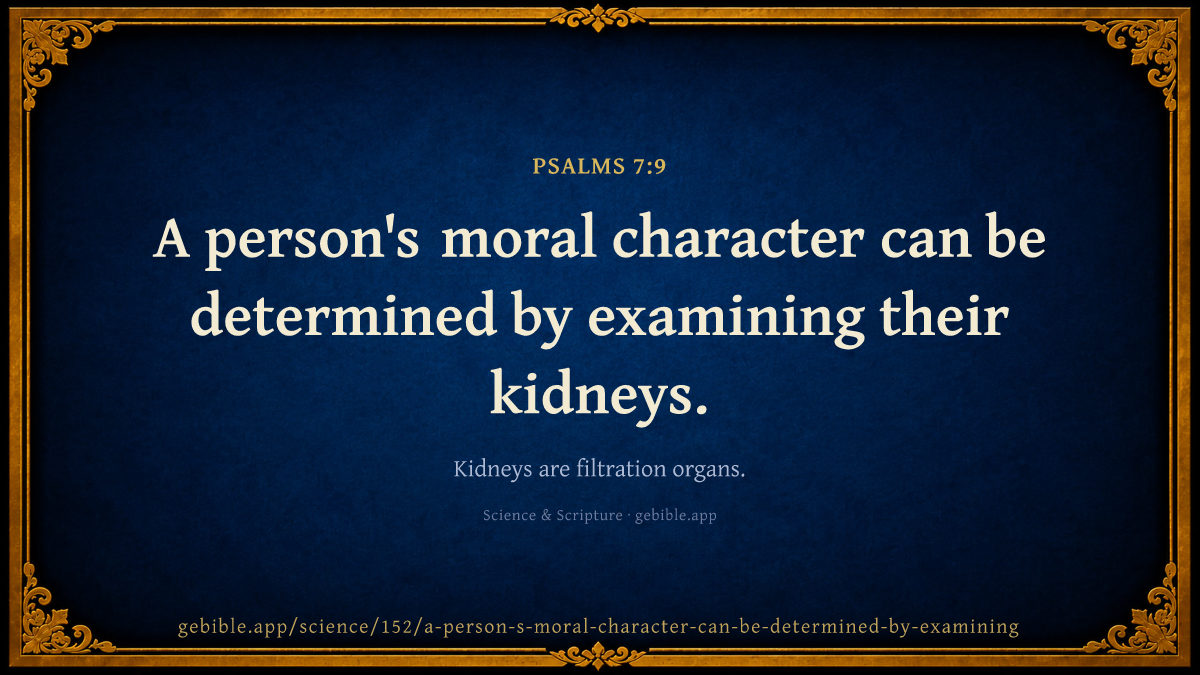
A person's moral character can be determined by examining their kidneys.
Medicine
97
passages in this field
Show this passage in
The cited passage
What current science says
Kidneys are filtration organs. Their job is to remove waste products from your blood, regulate fluid balance, and produce urine. They contain zero neurons and play no role in thought, emotion, morality, or decision-making. Your moral character lives in your brain — specifically in regions like the prefrontal cortex (judgment), the amygdala (emotion), and the anterior cingulate cortex (empathy). Examining someone's kidneys for moral insight would be about as useful as checking their elbows for math skills.
What the text says
This comes from Psalms 7:9. The text says 'the righteous God trieth the hearts and reins' — where 'reins' is the archaic English word for kidneys. Ancient Hebrews believed kidneys were the seat of conscience and moral judgment.
Three honest ways to read this passage
-
As history
The text records how its authors understood the world with the knowledge they had. Read this way, a difference from modern science is a window into the ancient mind, not a failure.
-
As accommodation
The text speaks to its first audience in their own terms, to make a point that isn't mainly about physics or biology. Read this way, the scientific detail is the vehicle, not the cargo.
-
As contradiction
The text makes a claim about the physical world that modern findings dispute. Read this way, the difference is a genuine factual disagreement worth naming.
GEBible doesn't pick one of these for you. Each entry shows the passage, what it says, and what current science says — nothing more.