
I will bless Yahweh, who has given me counsel. Yes, my heart instructs me in the night seasons.
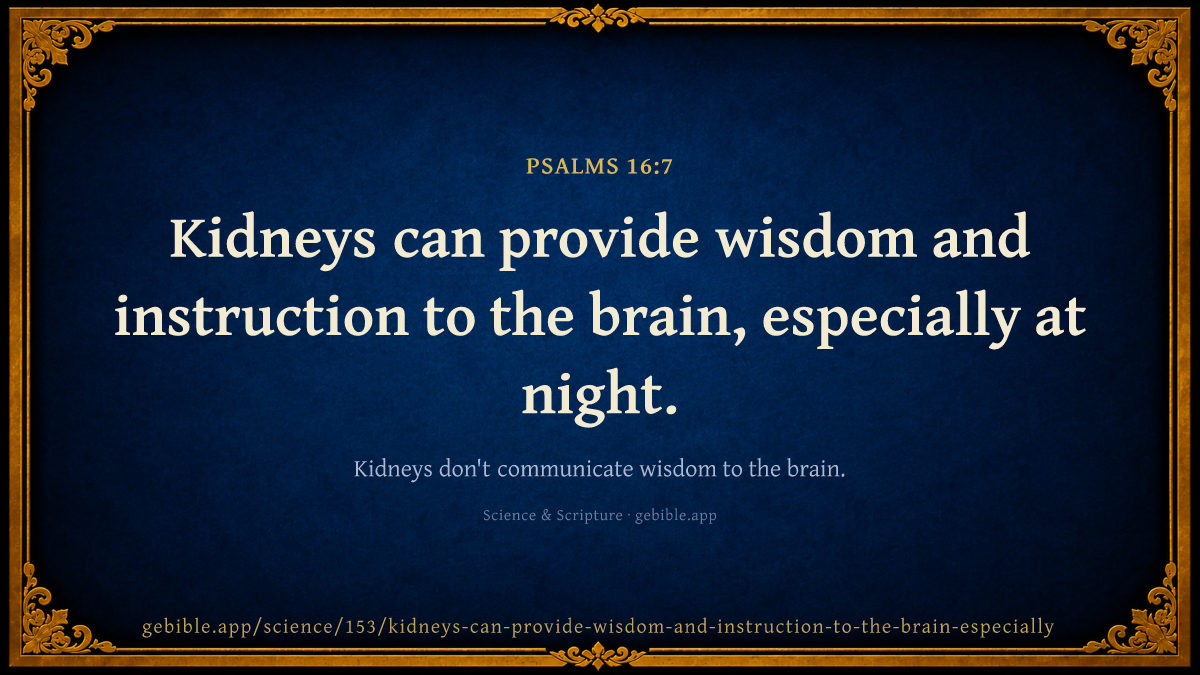
Kidneys can provide wisdom and instruction to the brain, especially at night.
Medicine
97
passages in this field
Show this passage in
The cited passage
What current science says
Kidneys don't communicate wisdom to the brain. They send chemical signals related to blood pressure, hydration, and electrolyte balance — but 'you need more water' is not the same as 'here's some life advice.' The ancient belief that kidneys were the seat of emotion and conscience came from the fact that kidneys are deep inside the body and surrounded by sensitive nerves, so strong emotions can cause physical sensations near them (that 'gut feeling'). But we now know those sensations come from the vagus nerve and your enteric nervous system — not from your kidneys drafting a midnight TED Talk.
What the text says
This comes from Psalms 16:7. 'My reins also instruct me in the night seasons' — the writer credits their kidneys with providing nighttime guidance and moral instruction.
Three honest ways to read this passage
-
As history
The text records how its authors understood the world with the knowledge they had. Read this way, a difference from modern science is a window into the ancient mind, not a failure.
-
As accommodation
The text speaks to its first audience in their own terms, to make a point that isn't mainly about physics or biology. Read this way, the scientific detail is the vehicle, not the cargo.
-
As contradiction
The text makes a claim about the physical world that modern findings dispute. Read this way, the difference is a genuine factual disagreement worth naming.
GEBible doesn't pick one of these for you. Each entry shows the passage, what it says, and what current science says — nothing more.