
Sing to Yahweh with thanksgiving. Sing praises on the harp to our God,
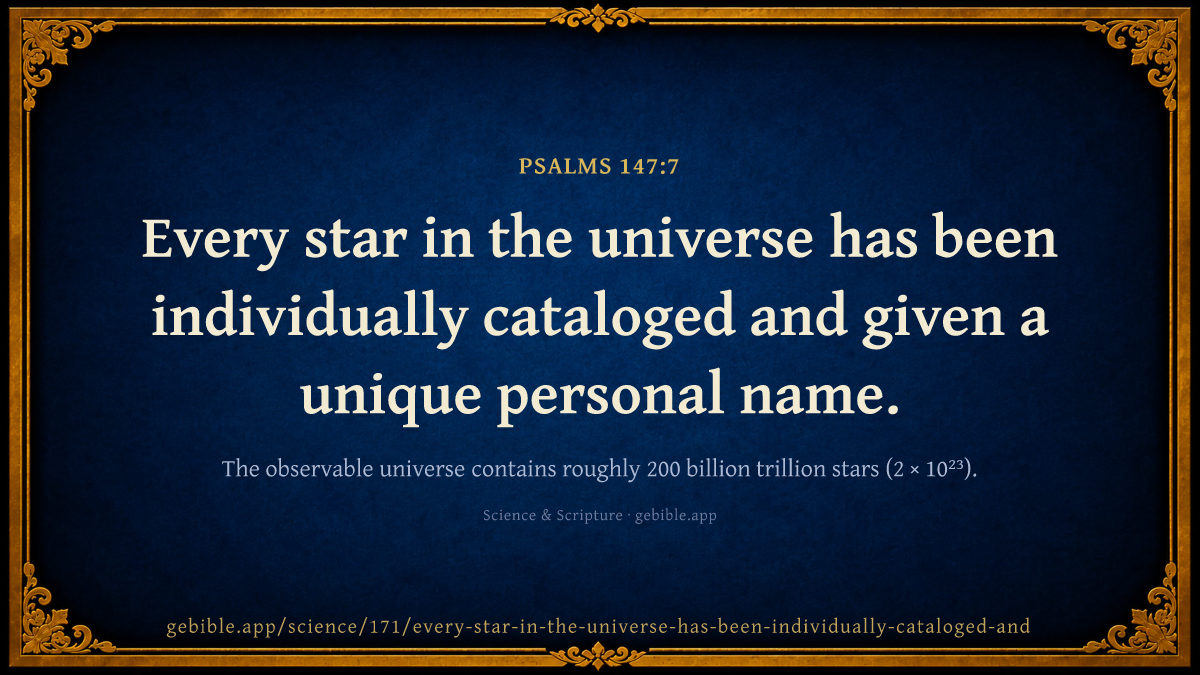
Every star in the universe has been individually cataloged and given a unique personal name.
Astronomy
47
passages in this field
Show this passage in
The cited passage
What current science says
The observable universe contains roughly 200 billion trillion stars (2 × 10²³). That's a 2 followed by 23 zeros. If you named one star per second without sleeping, it would take about 6.3 quadrillion years — roughly 450,000 times the current age of the universe. Even our best telescopes can only resolve a tiny fraction of these individually. The Gaia space observatory — the most ambitious star-mapping mission ever — has cataloged about 1.8 billion stars, which is roughly 0.000000001% of the total. We haven't even started.
What the text says
This comes from Psalms 147:4. 'He telleth the number of the stars; he calleth them all by their names' — claiming every star has been counted and personally named.
Three honest ways to read this passage
-
As history
The text records how its authors understood the world with the knowledge they had. Read this way, a difference from modern science is a window into the ancient mind, not a failure.
-
As accommodation
The text speaks to its first audience in their own terms, to make a point that isn't mainly about physics or biology. Read this way, the scientific detail is the vehicle, not the cargo.
-
As contradiction
The text makes a claim about the physical world that modern findings dispute. Read this way, the difference is a genuine factual disagreement worth naming.
GEBible doesn't pick one of these for you. Each entry shows the passage, what it says, and what current science says — nothing more.