
for as he thinks about the cost, so he is. “Eat and drink!” he says to you, but his heart is not with you.
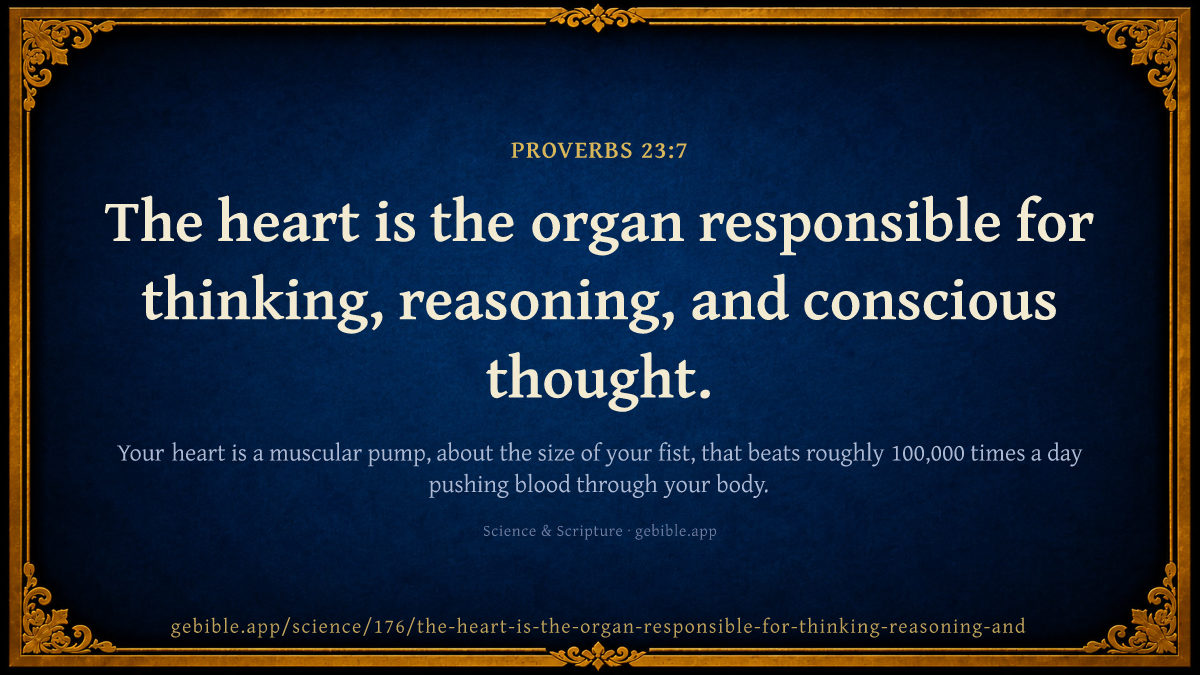
The heart is the organ responsible for thinking, reasoning, and conscious thought.
Medicine
97
passages in this field
Show this passage in
The cited passage
What current science says
Your heart is a muscular pump, about the size of your fist, that beats roughly 100,000 times a day pushing blood through your body. It contains zero neurons capable of conscious thought. Thinking happens in the brain — specifically the cerebral cortex, which has about 16 billion neurons forming trillions of synaptic connections. The ancient Egyptians agreed with this verse so strongly that during mummification they carefully preserved the heart but scooped the brain out through the nose and threw it away. Neuroscience has since confirmed: that was exactly backwards.
What the text says
This comes from Proverbs 23:7. 'As he thinketh in his heart, so is he' — the text locates cognition in the heart, reflecting the ancient belief that the heart, not the brain, was the seat of thought.
Three honest ways to read this passage
-
As history
The text records how its authors understood the world with the knowledge they had. Read this way, a difference from modern science is a window into the ancient mind, not a failure.
-
As accommodation
The text speaks to its first audience in their own terms, to make a point that isn't mainly about physics or biology. Read this way, the scientific detail is the vehicle, not the cargo.
-
As contradiction
The text makes a claim about the physical world that modern findings dispute. Read this way, the difference is a genuine factual disagreement worth naming.
GEBible doesn't pick one of these for you. Each entry shows the passage, what it says, and what current science says — nothing more.