
Yes, my heart will rejoice when your lips speak what is right.
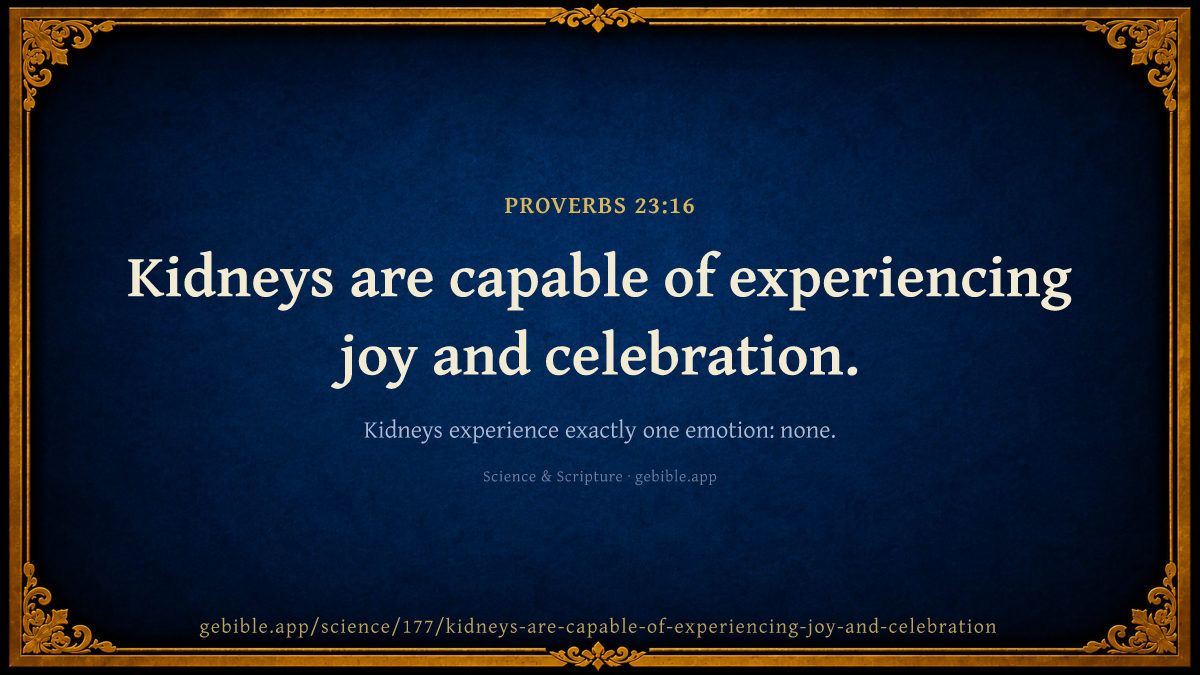
Kidneys are capable of experiencing joy and celebration.
Medicine
97
passages in this field
Show this passage in
The cited passage
What current science says
Kidneys experience exactly one emotion: none. They're filtration units. Each kidney contains about 1 million nephrons — tiny filtering structures that process roughly 180 liters of blood per day, producing about 1.5 liters of urine. The 'joy' in your body comes from neurotransmitters like dopamine and serotonin acting on brain receptors. Your kidneys don't have dopamine receptors for pleasure processing. The happiest your kidneys will ever feel is when you drink enough water — and even then, they don't feel anything about it.
What the text says
This comes from Proverbs 23:16. 'Yea, my reins shall rejoice' — the writer's kidneys are literally celebrating, reflecting the ancient belief that kidneys were organs of emotion.
Three honest ways to read this passage
-
As history
The text records how its authors understood the world with the knowledge they had. Read this way, a difference from modern science is a window into the ancient mind, not a failure.
-
As accommodation
The text speaks to its first audience in their own terms, to make a point that isn't mainly about physics or biology. Read this way, the scientific detail is the vehicle, not the cargo.
-
As contradiction
The text makes a claim about the physical world that modern findings dispute. Read this way, the difference is a genuine factual disagreement worth naming.
GEBible doesn't pick one of these for you. Each entry shows the passage, what it says, and what current science says — nothing more.