
Therefore Yahweh’s anger burns against his people, and he has stretched out his hand against them and has struck them. The mountains tremble, and their dead bodies are as refuse in the middle of the streets. For all this, his anger is not turned away, but his hand is still stretched out.
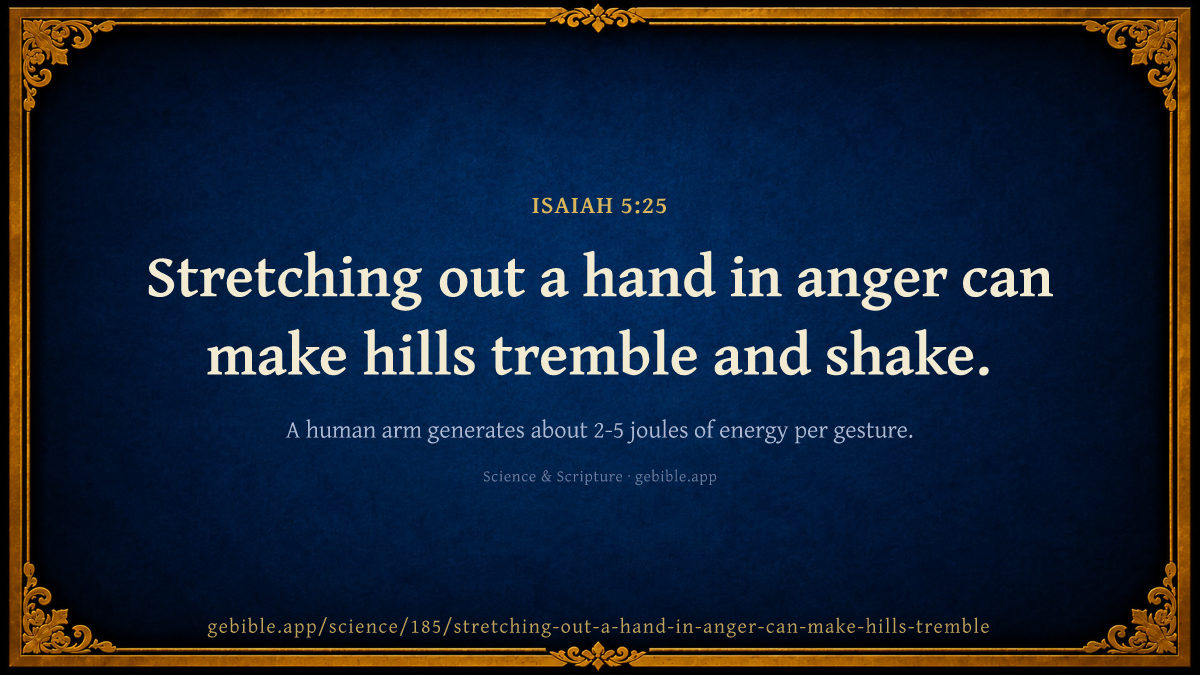
Stretching out a hand in anger can make hills tremble and shake.
Geology
25
passages in this field
Show this passage in
The cited passage
What current science says
A human arm generates about 2-5 joules of energy per gesture. A small earthquake (magnitude 2) releases about 63,000 joules — roughly the energy of rolling a bowling ball. A moderate earthquake (magnitude 5) releases the equivalent of 500 tons of TNT. Hills are geological formations weighing millions to billions of tons, anchored to tectonic plates. The energy gap between a hand gesture and mountain-shaking seismic activity is roughly 15 orders of magnitude. You'd need to multiply a hand wave's energy by one quadrillion to budge a hill.
What the text says
This comes from Isaiah 5:25. 'He hath stretched forth his hand against them, and the hills did tremble' — a gesture of anger causes literal seismic activity in mountains.
Three honest ways to read this passage
-
As history
The text records how its authors understood the world with the knowledge they had. Read this way, a difference from modern science is a window into the ancient mind, not a failure.
-
As accommodation
The text speaks to its first audience in their own terms, to make a point that isn't mainly about physics or biology. Read this way, the scientific detail is the vehicle, not the cargo.
-
As contradiction
The text makes a claim about the physical world that modern findings dispute. Read this way, the difference is a genuine factual disagreement worth naming.
GEBible doesn't pick one of these for you. Each entry shows the passage, what it says, and what current science says — nothing more.