
It is he who sits above the circle of the earth, and its inhabitants are like grasshoppers; who stretches out the heavens like a curtain, and spreads them out like a tent to dwell in,
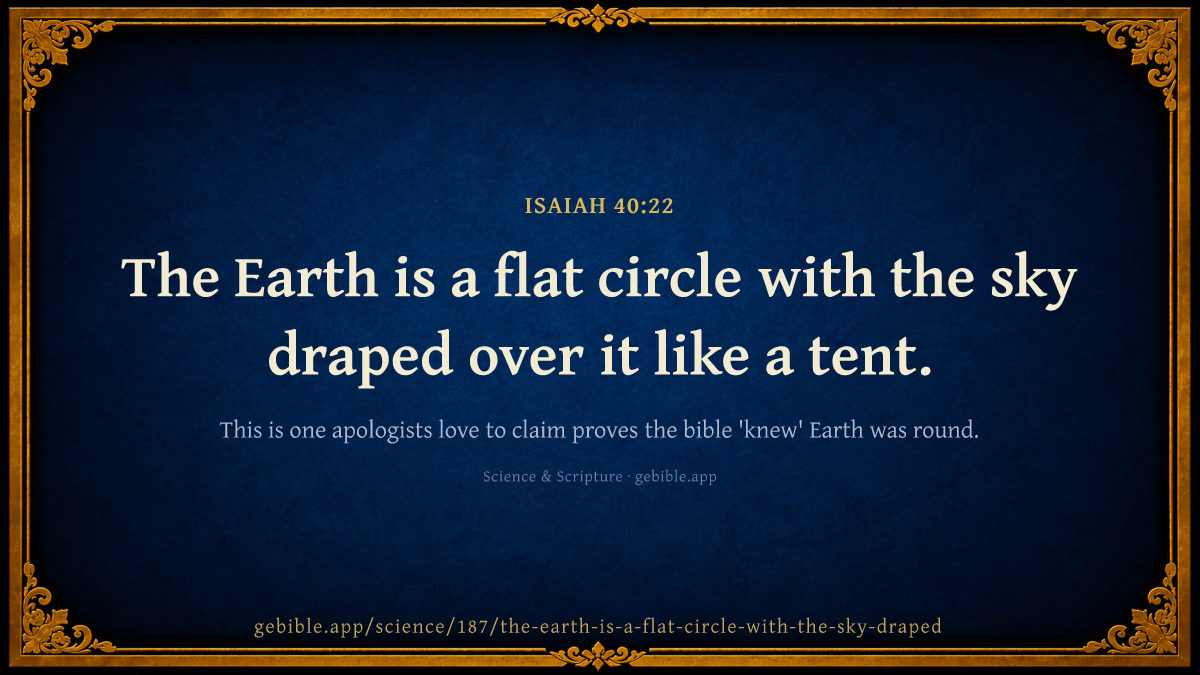
The Earth is a flat circle with the sky draped over it like a tent.
Astronomy
47
passages in this field
Show this passage in
The cited passage
What current science says
This is one apologists love to claim proves the bible 'knew' Earth was round. But a circle is flat — think coin, not basketball. The Hebrew word used is 'chug' (circle/disc), not 'kadur' (ball/sphere), which the same author uses elsewhere (Isaiah 22:18). Earth is a sphere (technically an oblate spheroid), not a flat disc. And the sky is not a tent — it's an atmosphere of gases extending roughly 100 km up before gradually giving way to the vacuum of space. You can't stretch out a gas like a curtain. This verse describes exactly what a flat-earth cosmology would look like.
What the text says
This comes from Isaiah 40:22. 'It is he that sitteth upon the circle of the earth... that stretcheth out the heavens as a curtain, and spreadeth them out as a tent to dwell in' — a flat, circular Earth under a fabric sky.
Three honest ways to read this passage
-
As history
The text records how its authors understood the world with the knowledge they had. Read this way, a difference from modern science is a window into the ancient mind, not a failure.
-
As accommodation
The text speaks to its first audience in their own terms, to make a point that isn't mainly about physics or biology. Read this way, the scientific detail is the vehicle, not the cargo.
-
As contradiction
The text makes a claim about the physical world that modern findings dispute. Read this way, the difference is a genuine factual disagreement worth naming.
GEBible doesn't pick one of these for you. Each entry shows the passage, what it says, and what current science says — nothing more.