
Behold, they brought to him a man who was paralyzed, lying on a bed. Jesus, seeing their faith, said to the paralytic, “Son, cheer up! Your sins are forgiven you.” Behold, some of the scribes said to themselves, “This man blasphemes.” Jesus, knowing their thoughts, said, “Why do you think evil in your hearts? For which is easier, to say, ‘Your sins are forgiven;’ or to say, ‘Get up, and walk?’ But that you may know that the Son of Man has authority on earth to forgive sins-” (then he said to the paralytic), “Get up, and take up your mat, and go to your house.”
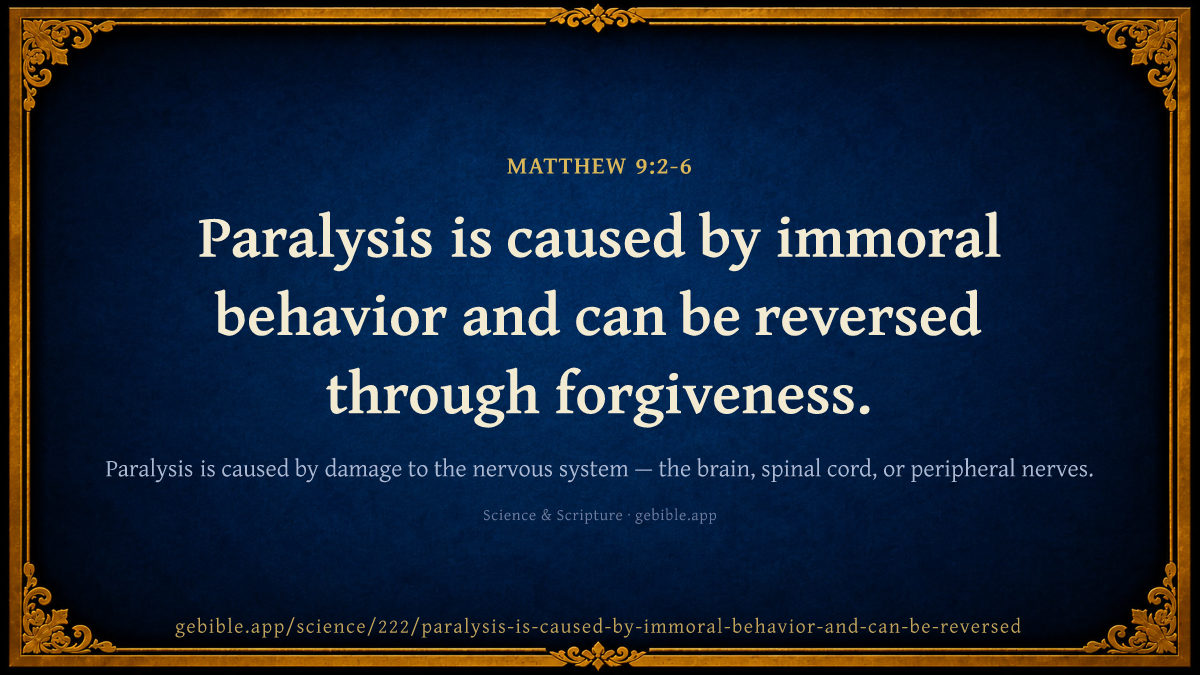
Paralysis is caused by immoral behavior and can be reversed through forgiveness.
Medicine
97
passages in this field
Show this passage in
The cited passage
What current science says
Paralysis is caused by damage to the nervous system — the brain, spinal cord, or peripheral nerves. Common causes include spinal cord injuries, strokes, multiple sclerosis, and ALS. None of these have anything to do with a person's moral choices. Forgiveness might improve your emotional state, but it cannot regenerate severed nerve fibers. If it could, we wouldn't need the billions of dollars spent annually on spinal cord injury research.
What the text says
This comes from Matthew 9:2-6. The text presents a paralyzed man who is healed after his sins are forgiven — directly linking moral failure to physical paralysis.
Three honest ways to read this passage
-
As history
The text records how its authors understood the world with the knowledge they had. Read this way, a difference from modern science is a window into the ancient mind, not a failure.
-
As accommodation
The text speaks to its first audience in their own terms, to make a point that isn't mainly about physics or biology. Read this way, the scientific detail is the vehicle, not the cargo.
-
As contradiction
The text makes a claim about the physical world that modern findings dispute. Read this way, the difference is a genuine factual disagreement worth naming.
GEBible doesn't pick one of these for you. Each entry shows the passage, what it says, and what current science says — nothing more.