
Now when he came near to the gate of the city, behold, one who was dead was carried out, the only son of his mother, and she was a widow. Many people of the city were with her. When the Lord saw her, he had compassion on her, and said to her, “Don’t cry.” He came near and touched the coffin, and the bearers stood still. He said, “Young man, I tell you, arise!” He who was dead sat up, and began to speak. And he gave him to his mother.
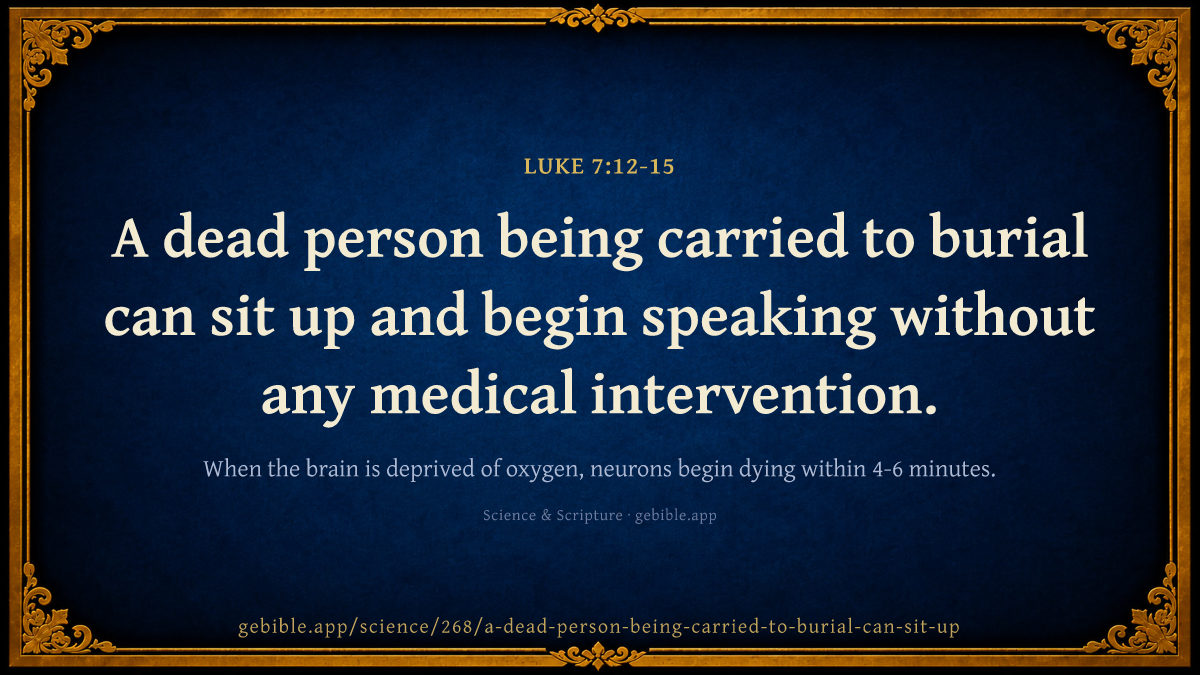
A dead person being carried to burial can sit up and begin speaking without any medical intervention.
Medicine
97
passages in this field
Show this passage in
The cited passage
What current science says
When the brain is deprived of oxygen, neurons begin dying within 4-6 minutes. After about 10 minutes without oxygen, brain damage is typically severe and irreversible. A person dead long enough to be placed in a coffin and carried to a burial site has been oxygen-deprived for hours at minimum. At that point, brain cells have undergone autolysis (self-digestion), making any recovery biologically impossible. Even modern CPR, defibrillators, and ECMO machines can only revive people within a narrow window after cardiac arrest — and survivors often have neurological deficits. You absolutely cannot sit up and chat after your brain has been dead for hours.
What the text says
This comes from Luke 7:12-15. A dead man being carried out for burial 'sat up, and began to speak' after his coffin was touched — full revival from clinical death with immediate cognitive and motor function.
Three honest ways to read this passage
-
As history
The text records how its authors understood the world with the knowledge they had. Read this way, a difference from modern science is a window into the ancient mind, not a failure.
-
As accommodation
The text speaks to its first audience in their own terms, to make a point that isn't mainly about physics or biology. Read this way, the scientific detail is the vehicle, not the cargo.
-
As contradiction
The text makes a claim about the physical world that modern findings dispute. Read this way, the difference is a genuine factual disagreement worth naming.
GEBible doesn't pick one of these for you. Each entry shows the passage, what it says, and what current science says — nothing more.