
He said to her, “Daughter, cheer up. Your faith has made you well. Go in peace.”
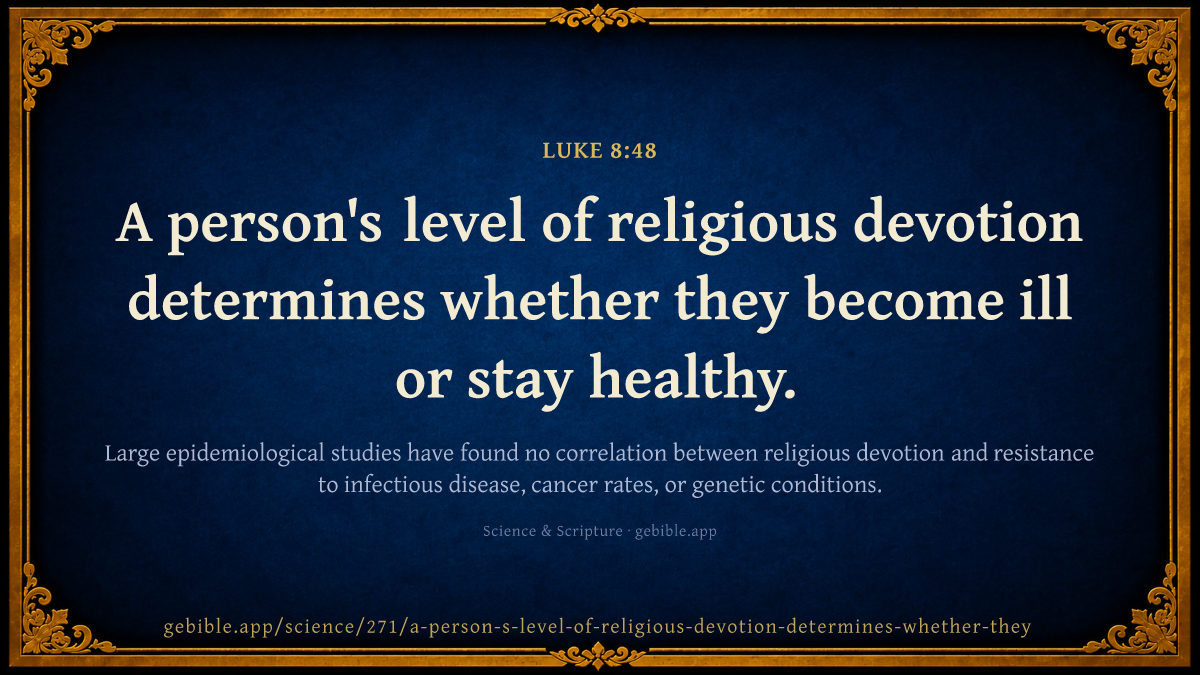
A person's level of religious devotion determines whether they become ill or stay healthy.
Medicine
97
passages in this field
Show this passage in
The cited passage
What current science says
Large epidemiological studies have found no correlation between religious devotion and resistance to infectious disease, cancer rates, or genetic conditions. Deeply devout people get the flu at the same rate as everyone else. Viruses don't check your belief system before infecting you — they check whether your cells have the right receptor proteins. Communities that reject medicine in favor of faith healing consistently have higher mortality rates from preventable diseases. The data is clear: prayer doesn't alter pathogen biology, but vaccines, antibiotics, and sanitation do.
What the text says
This comes from Luke 8:48, which states 'Thy faith hath made thee whole' — establishing a framework where illness is the result of insufficient faith and health is a reward for sufficient belief.
Three honest ways to read this passage
-
As history
The text records how its authors understood the world with the knowledge they had. Read this way, a difference from modern science is a window into the ancient mind, not a failure.
-
As accommodation
The text speaks to its first audience in their own terms, to make a point that isn't mainly about physics or biology. Read this way, the scientific detail is the vehicle, not the cargo.
-
As contradiction
The text makes a claim about the physical world that modern findings dispute. Read this way, the difference is a genuine factual disagreement worth naming.
GEBible doesn't pick one of these for you. Each entry shows the passage, what it says, and what current science says — nothing more.