
for an angel went down at certain times into the pool and stirred up the water. Whoever stepped in first after the stirring of the water was healed of whatever disease he had.
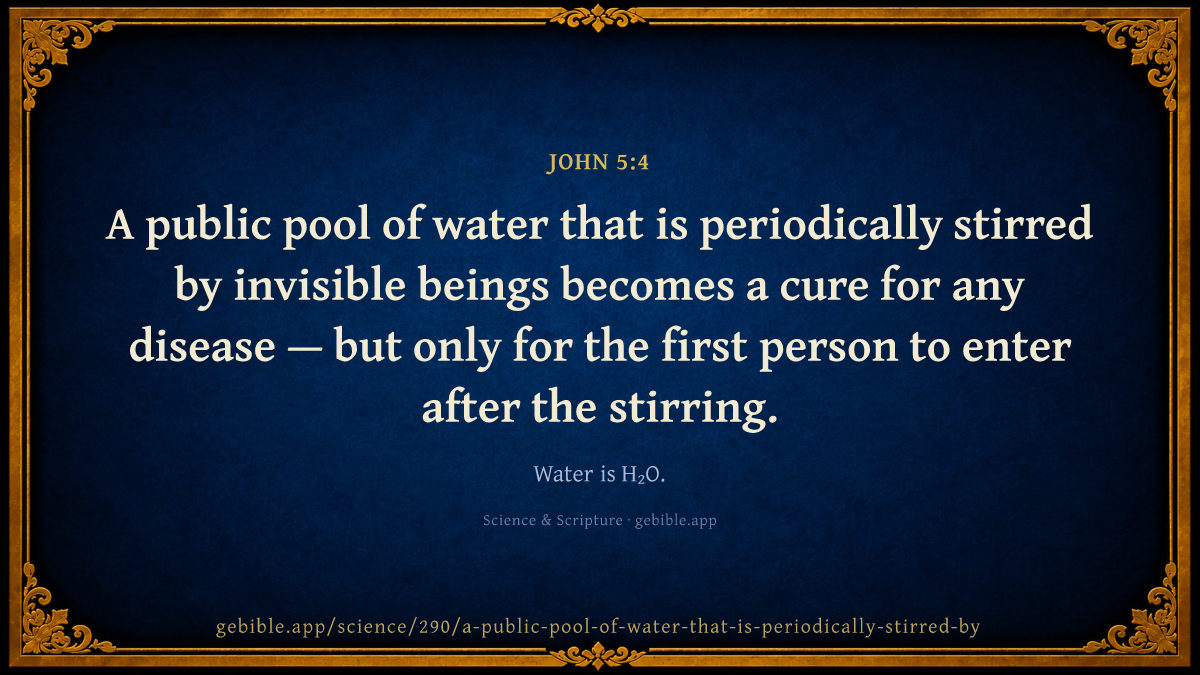
A public pool of water that is periodically stirred by invisible beings becomes a cure for any disease — but only for the first person to enter after the stirring.
Medicine
97
passages in this field
Show this passage in
The cited passage
What current science says
Water is H₂O. Stirring it doesn't change its molecular composition, add antibiotics, or grant it healing properties. A stirred pool is just a pool with moving water — same chemistry, same temperature, same lack of pharmaceutical agents. The 'first person only' rule is especially bizarre from a scientific standpoint: medicine doesn't have a one-use-per-stirring limit. This is essentially describing a cosmic game of musical chairs where disabled people race each other to a puddle. The Pool of Bethesda has been excavated by archaeologists — it's a real place. It was also just a pool of regular water.
What the text says
This comes from John 5:4. The text describes the Pool of Bethesda, where 'an angel went down at a certain season into the pool, and troubled the water: whosoever then first after the troubling of the water stepped in was made whole of whatsoever disease he had.' First-come, first-served miracle medicine.
Three honest ways to read this passage
-
As history
The text records how its authors understood the world with the knowledge they had. Read this way, a difference from modern science is a window into the ancient mind, not a failure.
-
As accommodation
The text speaks to its first audience in their own terms, to make a point that isn't mainly about physics or biology. Read this way, the scientific detail is the vehicle, not the cargo.
-
As contradiction
The text makes a claim about the physical world that modern findings dispute. Read this way, the difference is a genuine factual disagreement worth naming.
GEBible doesn't pick one of these for you. Each entry shows the passage, what it says, and what current science says — nothing more.