
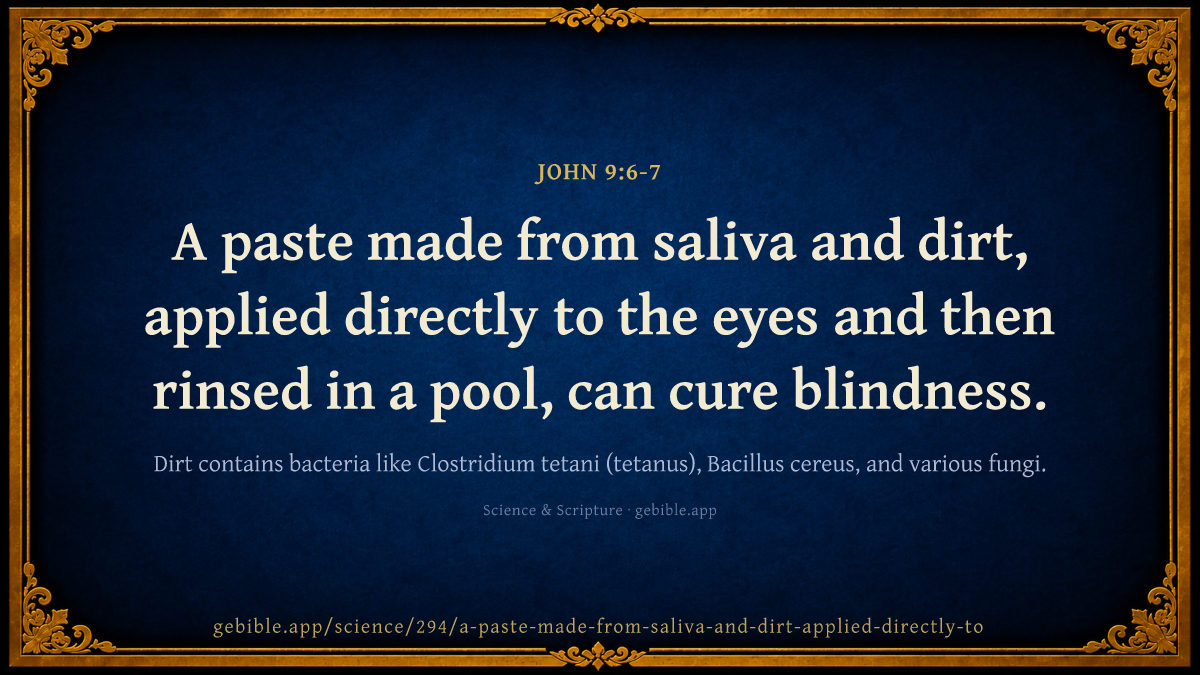
When he had said this, he spat on the ground, made mud with the saliva, anointed the blind man’s eyes with the mud, and said to him, “Go, wash in the pool of Siloam” (which means “Sent”). So he went away, washed, and came back seeing.
A paste made from saliva and dirt, applied directly to the eyes and then rinsed in a pool, can cure blindness.
Medicine
97
passages in this field
Show this passage in
The cited passage
What current science says
Dirt contains bacteria like Clostridium tetani (tetanus), Bacillus cereus, and various fungi. Rubbing soil into someone's eyes is a fast track to keratitis (corneal infection), not restored vision. Human saliva adds Staphylococcus and Streptococcus to the mix. Combined, you've created a bacteria smoothie applied directly to one of the most infection-prone organs in your body. The Pool of Siloam has been excavated by archaeologists — it contained regular water, not ophthalmic solution. This 'treatment' would more likely cause blindness than cure it.
What the text says
This comes from John 9:6-7. The text describes spitting on the ground, making mud with the saliva, rubbing it on a blind man's eyes, and telling him to wash in the Pool of Siloam — after which he could see. The text doesn't clarify whether it was the spit, the mud, or the pool water that did it.
Three honest ways to read this passage
-
As history
The text records how its authors understood the world with the knowledge they had. Read this way, a difference from modern science is a window into the ancient mind, not a failure.
-
As accommodation
The text speaks to its first audience in their own terms, to make a point that isn't mainly about physics or biology. Read this way, the scientific detail is the vehicle, not the cargo.
-
As contradiction
The text makes a claim about the physical world that modern findings dispute. Read this way, the difference is a genuine factual disagreement worth naming.
GEBible doesn't pick one of these for you. Each entry shows the passage, what it says, and what current science says — nothing more.