
But as for the bile, it is good to anoint a man that has white films in his eyes, and he will be healed.” But when they drew near to Rages,
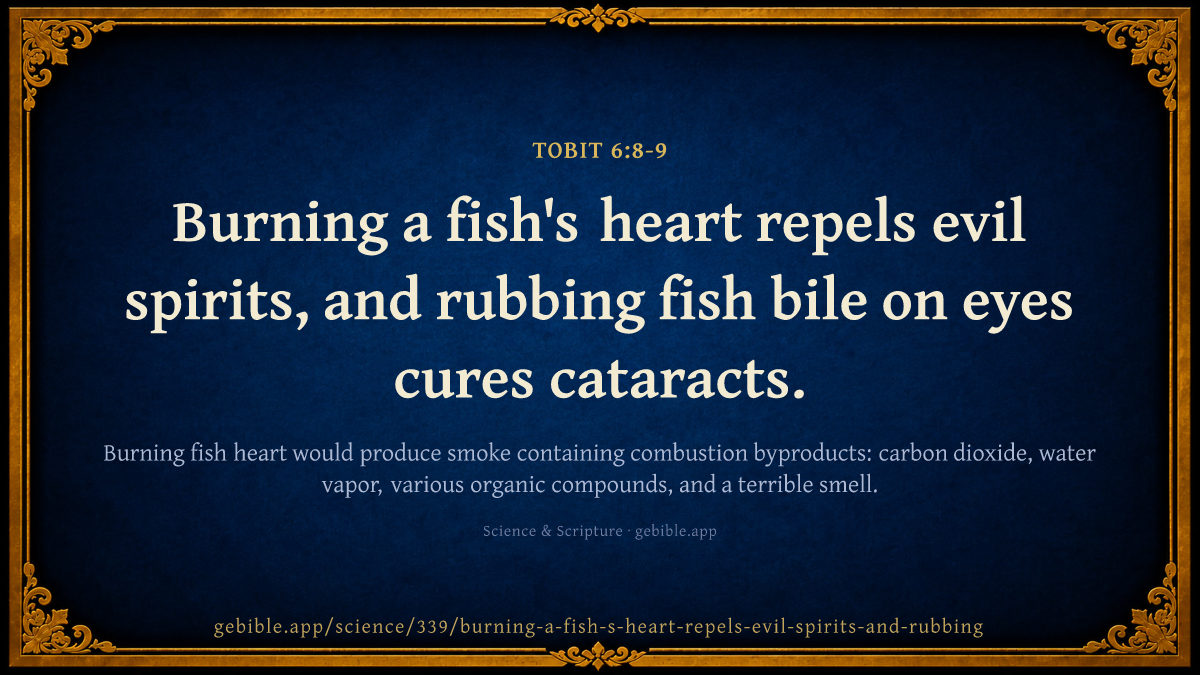
Burning a fish's heart repels evil spirits, and rubbing fish bile on eyes cures cataracts.
Medicine
97
passages in this field
Show this passage in
The cited passage
What current science says
Burning fish heart would produce smoke containing combustion byproducts: carbon dioxide, water vapor, various organic compounds, and a terrible smell. None of these repel anything except perhaps dinner guests. As for fish bile (gall) on the eyes: bile contains bile salts, cholesterol, and bilirubin — all of which are irritants to the delicate corneal surface. Applying bile to eyes would cause chemical irritation, potential corneal damage, and risk of infection from bacteria present in the bile. Modern cataract treatment involves surgically removing the clouded lens and replacing it with an artificial one — a precision procedure, not a fish-gut home remedy.
What the text says
This comes from the Book of Tobit (Tobias) 6:8-9. An angel instructs that burning a fish heart's smoke 'will drive away all kinds of devils' and that 'the gall is good for the eyes' to cure white specks — presenting fish organs as both an exorcism tool and ophthalmic medicine.
Three honest ways to read this passage
-
As history
The text records how its authors understood the world with the knowledge they had. Read this way, a difference from modern science is a window into the ancient mind, not a failure.
-
As accommodation
The text speaks to its first audience in their own terms, to make a point that isn't mainly about physics or biology. Read this way, the scientific detail is the vehicle, not the cargo.
-
As contradiction
The text makes a claim about the physical world that modern findings dispute. Read this way, the difference is a genuine factual disagreement worth naming.
GEBible doesn't pick one of these for you. Each entry shows the passage, what it says, and what current science says — nothing more.