
To whose wickedness a smoking waste still witnesses, and plants bearing fair fruit that doesn’t ripen, a disbelieving soul has a memorial: a standing pillar of salt.
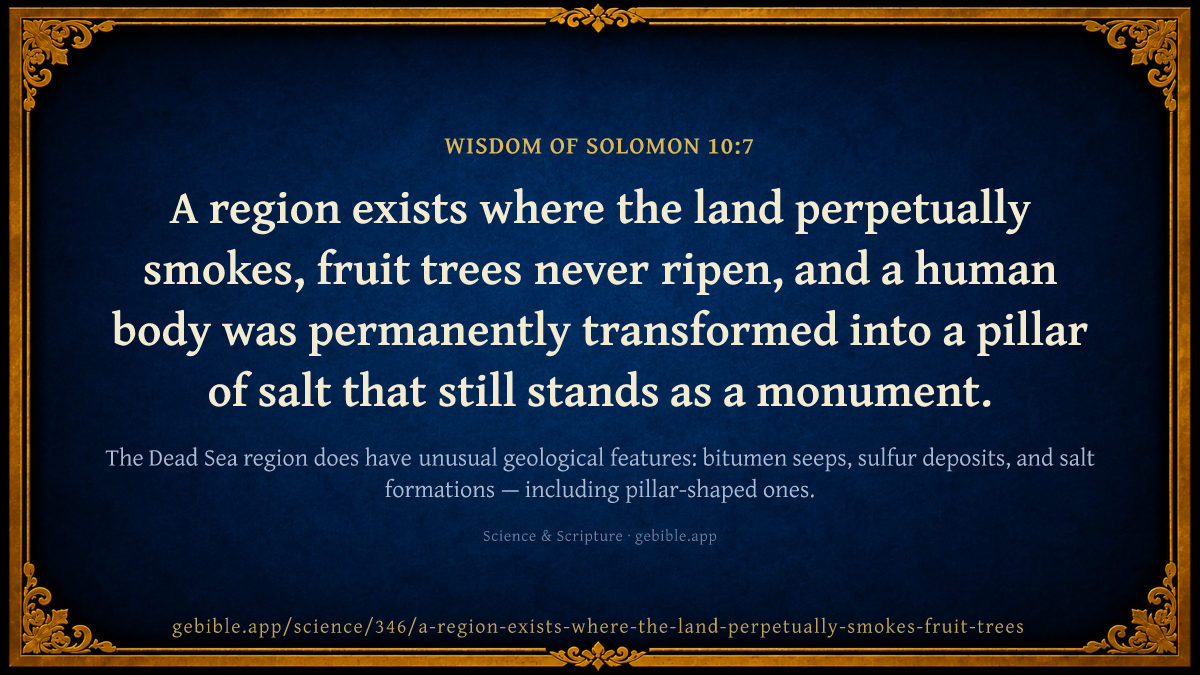
A region exists where the land perpetually smokes, fruit trees never ripen, and a human body was permanently transformed into a pillar of salt that still stands as a monument.
Geology
25
passages in this field
Show this passage in
The cited passage
What current science says
The Dead Sea region does have unusual geological features: bitumen seeps, sulfur deposits, and salt formations — including pillar-shaped ones. None of these features, however, are perpetual. Salt pillars form through evaporite geology — water dissolves underground salt deposits, then evaporation leaves behind salt structures. They erode relatively quickly; no salt pillar has stood for thousands of years in that climate. Fruit trees in the region grow normally when irrigated. The 'smoking land' may reference natural bitumen or sulfur vents, which are geological. Every 'strange' feature of the Dead Sea region has a straightforward geological explanation.
What the text says
This comes from the Wisdom of Solomon (likely 10:7), which describes the destroyed land of Sodom as still smoking, with perpetually unripe fruit trees, and a standing salt pillar that was once a person — presenting these as ongoing observable phenomena.
Three honest ways to read this passage
-
As history
The text records how its authors understood the world with the knowledge they had. Read this way, a difference from modern science is a window into the ancient mind, not a failure.
-
As accommodation
The text speaks to its first audience in their own terms, to make a point that isn't mainly about physics or biology. Read this way, the scientific detail is the vehicle, not the cargo.
-
As contradiction
The text makes a claim about the physical world that modern findings dispute. Read this way, the difference is a genuine factual disagreement worth naming.
GEBible doesn't pick one of these for you. Each entry shows the passage, what it says, and what current science says — nothing more.